Photo:Molly Matalon. “I wanted her to have eyes that were expressive, that looked real,” said Bonnie Erickson, who designed the first Miss Piggy.
Who doesn’t love Miss Piggy?
In January, the New York Times took a look at the origins of the iconic diva as she put her stamp on the latest Muppets special.
Darryn King wrote, “Nearly 50 years ago, a prima donna pig made her first appearance on The Muppet Show and quickly became its breakout star. Within a few years, she was a sought after Hollywood celebrity, a pinup model and the author of a best-selling book.
“Well, Miss Piggy is ready for her close-up once again. Jennifer Lawrence, Emma Stone and Cole Escola (Oh, Mary!) are currently developing a movie for the character. And a new Muppet Show special will premiere on Disney+ and ABC on Wednesday. Piggy is front and center in that special, making snidely aristocratic remarks in a Regency-era sketch, hijacking Kermit’s duet with Sabrina Carpenter and ‘giving the people what they truly want: Moi.’
“For Eric Jacobson, playing a glamorous pig has been the role of a lifetime. In recent decades, he has become the lead voice and puppeteer behind several instantly recognizable Muppets, among them Bert, Grover and Oscar the Grouch on Sesame Street and Fozzie Bear. But when it comes to aura and cultural significance, he said in a recent phone interview, ‘Miss Piggy’s on another magnitude, as she would tell you herself.’
“It wasn’t always the case. An early version of Piggy appeared as a minor player in one of Jim Henson’s failed Muppet television pilots, which aired in March 1975. The puppet was designed and constructed by Bonnie Erickson, who had fond childhood memories of chasing piglets for her pig farmer uncle. …
“Over a few weeks, Erickson carved the pig out of a 1-foot cube of soft foam using nail scissors, then used a belt sander to smooth the contours and curves. Crucially, by the time The Muppet Show premiered in September 1976, she had infused her creation with something extra: Piggy became the only major Muppet to get eyes with irises. The pupils even have highlights. …
“A sow in opera gloves would have been a decent gag in itself, but it soon became clear that the character was destined for greater things. … A script specified that she deliver a mere slap, but the puppeteer Frank Oz instead had Piggy execute a swift karate chop — preceded by a full-torso windup and accompanied by a ‘Hiii-yah!‘ — that sent Kermit flying. Miss Piggy was born. …
“Oz went on to devise an elaborate back story for the character involving the loss of her father in a tragic tractor accident and a fraught mother-daughter relationship. His voice for Piggy alternated between a dainty coo and a withering growl that recalled Bette Davis in All About Eve.
“Piggy was deeply insecure yet utterly convinced of her own star quality, girlish and refined but occasionally compelled to, say, maul Florence Henderson in a jealous rage. … Balancing those sometimes conflicting impulses could be tricky, according to Jerry Juhl, the head writer for The Muppet Show. Juhl, who died in 2005, said that writing for Miss Piggy hadn’t been easy.
“ ‘You’re walking a fine line with that character,’ Juhl said in an archival interview, as quoted in Jim Henson: The Biography (2013), by Brian Jay Jones. ‘If she isn’t a bitch, she isn’t funny. But you’ve got to feel the other side.’ …
“The new Muppet Show special has Kermit, Miss Piggy and the whole furry, felted company return to the variety show format … with an array of cheerfully bonkers acts, that irresistible theme tune and chaos behind the scenes. …
“The writer Albertina Rizzo said that the writing team had been honored to cook up new outrageous things for one of their comedy heroes to say. ‘Strangely, I think reading Barbra Streisand’s autobiography really helped,’ Rizzo said. Streisand ‘has such a strong sense of self,’ she explained. ‘So if you mix that with a boatload of delusion and some beginner French, you’re kind of on the right track.’
“ ‘The thought process was, What would a reasonable, grounded, normal person say?’ she added. ‘Then write the opposite of that.’ ”
Photo: Simon Beck. Simon Beck makes giant, transitory earth art using snow in the mountains or sand on the beach. Especially with beaches, it’s a race against time.
Here’s an artist who knows “you can’t take it with you.” And that’s OK. To him, all art vanishes. His just vanishes sooner.
Maggie Penman writes at the Washington Post, “Simon Beck’s work is, by its nature, temporary. For two decades, Beck has been using his feet to make intricate designs in fresh snow and on beaches. A former mapmaker, Beck designs many of the drawings ahead of time on paper. Then he spends 12 hours alone with a compass, walking in snowshoes to create complex patterns. Some designs resemble snowflakes, stars or flowers. Others include messages or peace signs.
“ ‘In mapmaking, you’ve got something in existence on the ground, and you’ve got to reproduce it in small scale on paper by measuring it,’ Beck said. ‘Making one of these drawings is the same process in reverse.’ Beck mostly works in France, but his art is seen all over the world on social media.
“At 67 years old, Beck has made nearly 700 artworks in sand and snow, and he said he aspires to make at least a thousand. The first time he tried making a pattern in the snow, in 2004, it was just an experiment. He started occasionally posting his snow and sand art. After a few years, he realized how many people were connecting with his work, and he started to dedicate himsel more seriously. He can work in the snow only from late October until early March, so he has a short season to make as many drawings as he can.
“The patterns can be as large as three soccer fields. After they’re done, Beck photographs them, often using a drone or by perching high on a nearby slope. Then, the drawings melt or are swept away by the wind or skiers — or they’re covered by fresh snow. The ephemeral nature of his work is part of the point. … He’s made hundreds of patterns in the same spots, and every time it snows, he has a fresh canvas.
“When Beck works in sand on beaches, the timetable is even shorter.
“ ‘When the tide starts going down, you have to wait until it’s dry before you can start drawing,’ he said. ‘Typically, you’ve got about five hours to get the drawing done before the tide comes in and starts covering it up.’ …
“ ‘The record was 75 people watching me,’ he said. … The skiing wasn’t very good that day, so dozens of people stopped to watch as Beck completed his work, yelling ‘Bravo!’ and applauding and taking photographs, he recalled.
“Often, though, Beck starts working on a snow drawing around 11 a.m. or noon, and doesn’t finish until around midnight, taking pictures of it the next morning. He eats a hearty breakfast before he starts: two big bowls of porridge with banana. He brings snacks with him for when he gets hungry while working, but he doesn’t take breaks. …
“By the time he finishes, he’s pretty hungry. …
“Beck usually works alone, but doesn’t mind the solitude. He listens to classical music while he works. ‘The Earth is beautiful, and the snow is beautiful, and winter is beautiful,’ Beck said.”
Photo: Matt McClain/Washington Post. Albert Villa, center, and his grandmother, Jean Fratzke, right, during a practice for the Forgetful Friends Chorus on Oct. 7 in Springfield, Virginia. The chorus is for people with memory challenges and their caregivers.
I have blogged before about the ways people with dementia respond to music, how they can remember a song even when they can’t remember much else. Today’s story touched me particularly because one of the interviewees was so confident she was dementia-free. Her doctor had given her a list of conditions older people get, including dementia. “But that hasn’t happened,” she says stoutly.
Kendall Staton writes at the Washington Post, “Drema Yates, 86, wobbles into the sanctuary of Manassas Church of the Brethren, clutching tightly onto the arm of her husband, Mike Yates. She relies on Mike, who’s eight years younger, to keep her standing with each unsteady step. …
“A dozen people are talking in hushed voices, waiting for the rehearsal of the Forgetful Friends Chorus to begin. There’s no auditioning, because the only people allowed to participate are singers who have dementia and their caregivers.
“ ‘Singing brings me closer to God,’ Drema says. ‘God is in my world. Without God I wouldn’t know anything.’
“Drema can’t remember what she had for breakfast, but she knows she’s been married to Mike for 51 years. He reminds her that he made eggs, toast and coffee. Drema says matter-of-factly that she has a great memory.
“She was diagnosed with dementia four years ago.
“Says Mike, who is 78, ‘She refuses to accept that she’s got dementia.’ So, he avoids the subject altogether.
“The chorus is rehearsing ‘The Star Spangled Banner’ to open the Walk to End Alzheimer’s, an annual fundraiser hosted by the Alzheimer’s Association. Director Connie Young, who started the choir in 2016, says today is a better turnout than usual.
“The group gets together twice a month to rehearse and travels to local senior living facilities to perform. Before the coronavirus pandemic began in 2020, the choir sang for a crowd once every few months. Now the group performs only occasionally.
“Most recently, they sang at the funeral of Lisa Bosley, a member who died in May. Her husband, Dave Bosley, still sings with Forgetful Friends. He wants to feel connected to Lisa, he says: ‘We were married 56 years, 11 months, and 19 days.’ About a year ago, Bosley invited Drema and Mike to join the chorus. They’ve been coming ever since. …
“Mike makes Drema breakfast, drives her around and tries to make her happy. Their life is all he has, but it’s slipping away.
“ ‘We really had a good life together. To watch all that go away and to know there’s nothing you can do about it,’ Mike says. ‘That’s the hard part.’ …
“Procedural memory, a type of long-term memory, is what makes it possible for dementia patients to summon long-ago lyrics, experts say — even as they forget their loved ones’ names. …
“The morning of the fundraiser is 54 degrees. People pull coats tight around their bodies as the morning air nips at their skin.
“Mike convinced Drema to use a wheelchair, which he pushes to the pavilion on a street in downtown Manassas. She burrows her hands under the blanket on her lap. …
“Drema says she feels sorry for people who have Alzheimer’s: ‘We never know who’s going to have it. The doctor put it on my list of stuff that I might get because I’m old. But that hasn’t happened.’
“She looks at Mike and asks what they’re doing. He pinches her nose; she giggles. He looks at her tenderly. He wheels her back to the car.”
What courage it takes to be a caregiver! I can’t imagine how hard it must be.
Art: Henri Rousseau. “The Rabbit’s Meal” (1908), oil on canvas; The Barnes Foundation, Philadelphia.
In my college days, it was a treat to visit the Barnes Foundation in Marion, Pennsylvania, where Barnes’s will specified it should remain forever. He hated art experts and was as determined as one can be — considering “you can’t take it with you” — to keep his collection away from museums.
After a long conflict among many players, the collection nevertheless ended up with the Philadelphia Museum of Art, where an effort was made to maintain the groupings of works the way the will required.
The art critic who wrote today’s feature describes a recent exhibit. Writing at Hyperallergic in January, Judith Stein says, “If you’ve ever tried to puzzle out what’s happening in Henri Rousseau’s haunting ‘Sleeping Gypsy’ (1897) at the Museum of Modern Art, then you’re already familiar with the artist’s extraordinary ability to tantalize viewers. That painting of a lion and a slumbering woman is on view in Henri Rousseau: A Painter’s Secrets at the Barnes Foundation, now in the company of nearly 60 more works — many equally mesmerizing.
“Self-taught, self-confident, and inscrutable, Henri Rousseau … began painting before retiring as a toll collector for the city of Paris in 1893. It was at this point that he became a professional, though impoverished, artist.
“The title A Painter’s Secrets is not a ploy. Curators Christopher Green and Nancy Ireson freshly contextualized many artworks in the light of his personal story, and conservators conducted revelatory technical studies that, among other findings, exposed areas of long obscured, nuanced color. The grumpy-faced baby in ‘The Family’ (c. 1892–1900) is enlarged in the catalog to underscore Rousseau’s shrewd observational skills. …
“It’s startling to discover the top section of the four-year-old Eiffel Tower in the distant background of‘Sawmill, Outskirts of Paris’ (1893–95), one of the small works that the enterprising painter sold to his neighbors. Other surprises are eerie. Sheltered within a barely visible structure in ‘Carnival Evening’(1886), a disembodied head spies on a pair of costumed revelers.
“A Painter’s Secrets incorporates several of the Barnes Foundation’s 18 Rousseau paintings, temporarily installed alongside loans of thematically related examples. Visitors can compare their‘Scouts Attacked by a Tiger’ (1904) with the savage animals in dramatic struggles depicted in the Fondation Beyeler’s ‘The Hungry Lion Throws Itself Upon the Antelope’ (1898–1905) and the Cleveland Museum of Art’s ‘Fight Between a Tiger and a Buffalo’ (1908). …
“ ‘Rousseau is not so much a storyteller as a story-giver,’ Christopher Green notes in his catalog essay. Will the naked damsel with knee-length blond hair in the Barnes’s ‘Unpleasant Surprise’ (1899–1901) be rescued by the hunter shooting at the ferocious bear about to maul her? Will the beautiful flute player in the Musée d’Orsay’s ‘The Snake Charmer’ (1907) be able to keep the venomous serpents at bay? …
It was Rousseau’s fellow artists who initially recognized his genius.
“An ambitious painter, he courted official patronage in vain. Picasso, who both admired and gently mocked Rousseau, first discovered his work in 1908, when he came across the ‘Portrait of a Woman’ (1895) in a bric-a-brac shop selling canvases for reuse. Framed on one side by voluptuously patterned, cinched drapery, his model stands on a balcony in front of an enfilade of potted flowers, overlooking a distant mountain range and a delicately colored sky. Unsurprisingly, Picasso bought it and kept it until his death. …
“While you’re at the Barnes, you can find other works by Rousseau from the permanent collection in nearby galleries, installed unchanged since 1951 as components of founder Albert Barnes’s provocative art ensembles. Once you’re there, prepare to be sidetracked by the abundance of work by Picasso, Cézanne, Matisse, and Renoir. A Painter’s Secrets is a rare opportunity to situate Rousseau in this lineage and, in the process, to absorb his innovative (and far from ‘naive’) use of pictorial space and color, and his enchanting imagination.”
There’s a great array of Rousseau’s paintings, here, at Hyperallergic. No firewall. Subscriptions encouraged.
Photo: Steve Ettlinger,. Steve Ettlinger, the author of Twinkie, Deconstructed, has displayed this Twinkie in his home for 21 years.
Do you sometimes think about treats you enjoyed as a kid and wonder if they are still around?
Double Bubble bubblegum? (Still around.) Necco wafers? (Yes.) Dixie ice cream cups with pictures of movie stars inside lid? (Nope, but if you can live without the actual ice cream, try eBay.)
Hannah Goeke has a fun story at the Boston Globe about the Hostess cupcakes called Twinkies. “Two things will survive the apocalypse, as the myth goes,” she says, “cockroaches and Twinkies. In Maine, one of those famous snack cakes is turning 50 this year after a high school chemistry teacher decided to put its shelf life to the test in an experiment that continues to this day.
“During a class discussion on food additives in 1976, a student asked teacher Roger Bennatti how long a Twinkie would last. Bennatti sent a student down to the store to pick up a couple.
“ ‘I ate one and put the other one up on top of the chalkboard,’ he recalled in a phone interview.
“According to Hostess, the company that makes Twinkies, the golden sponge cake has a shelf life of about 45 days. But the George Stevens Academy in Blue Hill, Maine, is now celebrating the 50th anniversary of their Twinkie experiment.
“When he retired in 2004, Bennatti recalled, his students only had one question. ‘What will happen to the Twinkie?’ The snack had been sitting untouched in the classroom for nearly 30 years, but seemed no worse for wear.
“Libby Rosemeier, assistant head of the George Stevens Academy and one of his former students, carried on his legacy. The Twinkie is now stored in an airtight glass box in a school office, brought out occasionally for curious visitors.
“The Bangor Daily News wrote about the long-running experiment when Bennatti retired, and the sturdy snack became a sensation.
“But Bennatti says Hostess never got in touch with him.
” ‘Are you kidding me? They want me dead,’ he quipped. ‘No food company wants their claim to fame to be, hey, this lasts 50 years.’ …
“To last so long, Twinkies contain few [health department] recommendations, replacing dairy and a real cream filling with a mix of sugar and shortening, corn syrup, water, salt, and cellulose gum. The snack is mainly made of flour, sugar, eggs, and over 30 other ingredients, according to Steve Ettlinger, the author of Twinkie, Deconstructed.
“While the original Twinkie recipe had fresh ingredients, the cakes spoiled too quickly during delivery to stores, Ettlinger said. The manufacturer started looking for substitutes.
“Ettlinger began studying Twinkies to learn more about additives and asked Hostess headquarters and bakeries to find out what the filling contained. ‘I asked one in particular in Biddeford, Maine; they said if I told you, I’d have to kill you,’ Ettlinger said. …
“Ettlinger preserved a Twinkie in its original packaging in his home for 21 years.
“ ‘I got fascinated with them … I’m about to turn 77. I’m gonna write in my will that that Twinkie is gonna go to either my daughter or my son.’ ” (Gee, I hope they don’t fight over it!)
Photo: Pat Greenhouse/Globe. Jaaco, 19, demonstrated his skills at the DreamCutz barbershop in the Judge John J. Connelly Youth Center in Boston. Adrian Major, who runs the program for the Department of Youth Services, watched.
When we moved to Massachusetts decades ago, I somehow ended up on the mailing list of a charitable individual who had a lot of compassion for youth who’d run afoul of the law. I think he once worked for the Department of Youth Services. He raised money to buy these forgotten kids presents at Christmastime.
Judging from Katie Johnston’s recent article at the Boston Globe, the state has more ways to help troubled youth nowadays.
“The DreamCutz classroom in Roslindale looks and smells like it could be the training ground for any aspiring barber: mannequin heads with bushy afros and beards waiting to be trimmed, the scent of aftershave and clipper cleaner in the air.
“But the classroom is in a facility run by the Department of Youth Services, and the students learning to do fades and line-ups are locked in their rooms upstairs each night.
“Twice a week, young people at the Judge John J. Connelly Youth Center come to this former library, now decked out with spray-painted murals and a digital barber pole, as part of the statewide Skill Up initiative that launched here in 2023.
“Skill Up is the first standardized vocational program across all five regions in the DYS system, which serves 12-to 21-year-olds for offenses ranging from trespassing to manslaughter. Previously, young people could get silk-screening, culinary, and carpentry training in a few DYS facilities, but no formal training available to everyone. Now there is a $5.2 million budget and 23 programs across the state, including music production, bicycle repair, and horticulture. Participants earn $15 an hour for up to nine hours of skills training a week – money that’s released when they are.
“The job skills and money are important, but the less tangible benefits they gain from the instructors, who also serve as mentors, are just as essential, DYS officials and participants said.
” ‘It wasn’t just haircuts,’ said Jamari, 18. ‘It was getting to know me, wanting to know what I wanted to do with myself, even after.’
“ ‘It makes me forget that I’m doing time,’ he added. ‘It makes me feel like I’m just at a barbershop and I’m chopping it up with my friends and my family members.’ …
“Bikes not Bombs, the Boston nonprofit that runs the bicycle repair program, lets participants keep the bikes they fix and gives them the chance to apprentice for the nonprofit when they get out. Those in the silk-screening program designed and produced T-shirts for the Big E fair in Springfield last year.
Until recently, youth rehabilitation was focused mainly on education [Cecely Reardon, the DYS commissioner] said, but it was missing those who weren’t on an academic path. ‘They leave here with something no one can ever take away from them,’ Reardon said. ‘If we can help a young person be successful, that’s in the name of public safety.’ “
Photo: Jose Sarmento Matos/Washington Post. Members of The Archers crew — from left, Vanessa Nuttall, Kim Greengrass, Tim Bentinck and Sunny Ormonde — during rehearsals in a BBC studio in Birmingham, England, on Jan. 13.
Radio will never die. As often as people predict it won’t be able to compete with whatever the new thing is, it reinvents itself. Plus, as today’s story shows, there are old-time triumphs that manage to evolve and stay the same.
Steve Hendrix writes at the Washington Post in January, “Something bad — or harrowing or heartwarming — is always about to happen on The Archers, a preposterously popular daily BBC radio soap opera that marks its 75th anniversary this month. People fall off roofs, roofs fall on people, tractors overturn, young women get pregnant (sometimes by accident) and young men get married (sometimes to other men).
“There are stabbings and affairs and bar fights and barn burnings. But there are also pie contests, cow milkings, pints at the pub, and lots and lots of tea around kitchen tables … in the fictional farm village of Ambridge, somewhere in anywhere Middle England. And for three-quarters of a century, Britain has been hanging on every twist.
“The Archers, recognized by Guinness World Records as the longest-running serial drama on the planet … endures as a real-time chronicle of ever-evolving, never-changing modern Britain.
“ ‘It’s part of the fabric of our national life,’ said Sybil Ruscoe, a former BBC agriculture reporter who grew up listening to The Archers in Shropshire and joined the show four years ago as its farming and countryside adviser. ‘It’s universal human drama that takes place in a rural setting, with the hedgerows, the horses, the wellies, the thermal vests.’
“All the pastoral pathos makes the BBC Radio 4 production a surprisingly enduring star in the broadcaster’s vast lineup, attracting more than 5 million weekly listeners on the air and hovering routinely at or near the top of shows streamed on the BBC Sounds app. (Listeners outside the U.K. can find it on BBC.com.)
“Cliff-hanger episodes still become national happenings, with media coverage and mentions in Parliament, as in 2016 when a verdict was reached in the case of organic cheesemaker Helen Archer, on trial for plunging a knife into her psychologically abusive husband.
“The legions who listened on smart speakers to that nail-biter may be nothing like the 20 million (about 40 percent of the United Kingdom’s population) who were glued to their Philcos in 1955 when newlywed Grace Archer was killed in a stable fire, but it is still a striking level of relevance for a Churchill-era radio drama. …
“[Emma Freud, a British journalist and commentator] ticked off the show’s topical march from rationing in the 1950s to unwed mothers in the 1960s and onward to sperm donors, gay marriage, modern slavery, domestic violence and immigration — societal shifts that never stop churning. …
“The mix has created a diverse and devoted fan base, populating countless Facebook groups, subreddits and message boards. Ian McKellen is known to be a listener, as is Stephen Fry. Judi Dench appeared on the 10,000th episode, and when Queen Camilla hosted a party for the show, she dazzled the cast and crew with her encyclopedic command of Archer-cana.
“ ‘She could be one of our continuity researchers,’ Jeremy Howe, the show’s senior editor, said.
“That a horsey-set royal would follow along may be less surprising than the number of young Britons (along with Americans, Romanians and Russians) checking in on Ambridge at 7 o’clock, six evenings a week. … The Archers is one of the BBC’s most popular downloads by 18-to-35-year-olds.
” ‘It’s stunning the people I meet who listen to this program,’ Ruscoe said. ‘And every single one of them has an opinion to share.’
“Physical Ambridge, such as it is, exists in a cluttered suite of rooms the size of a two-bedroom apartment in the center of Birmingham. Eight days a month, actors, producers and sound effects wizards gather in this dedicated BBC studio piled with all the objects that fill the fictional county of Borsetshire with noise: ironing boards as rusty gates, portable doors and windows that slam, a staircase to nowhere equipped with metal, carpet and wood treads. There’s a full kitchen with running water, a classic AGA stove, and lots of cups and cutlery for clinking on cue.
” ‘A live room,’ the most open space with the least soundproofing, suffices for any capacious setting, such as a church or village hall or the Bull, the Ambridge pub and social hub. An adjacent ‘dead room’ is lined with foam panels playing, ironically, the great outdoors, with birdsong and traffic and the ineffable whoosh of open sky layered on digitally as scenes are recorded.”
What a fun article! Do you have a favorite soap opera?
Photo: Kentaro Takahashi. Kazuo Yamagishi inside his studio in Kanazawa in the Ishikawa Prefecture of Japan. Like many lacquer artisans, he was displaced from his original home in Wajima after the 2024 earthquake.
When my husband was working for a company that did a lot of business with Japan, I was often sent on a search for a nice business gift since his Japanese contacts gave him such beautiful ones. I could never compete with the lacquer trays and picture frames and the way they combined utility and artistry. But those beauties can’t compete with the museum-quality lacquer described in today’s article.
Patricia Leigh Brown writes at the New York Times, “Deep in his heart, Kazuo Yamagishi, a lacquer artist designated a Living National Treasure of Japan, does not reside in a nondescript beige apartment complex in a packed area of Kanazawa, the capital city of Ishikawa Prefecture on the country’s main island.
“His real home, the one before he was displaced, is captured in a lacquer tray with delicately carved red lines inlaid with gold and mother-of-pearl stretching across the horizon of its ebony surface. The work is meant to recall ‘the quality of the sunset in autumn,’ he said — the walks he would take along the shore in Wajima, his once-breathtaking small city, as the early evening light shimmered across the Sea of Japan.
“That was before a massive earthquake on New Year’s Day 2024 washed away his wooden home and studio, as it did those of hundreds of other Wajima artisans in this Holy Land of Lacquerware at the tip of the Noto Peninsula about two hours north of Kanazawa. …
“Wajima holds a singular place in the lacquer firmament, prized for its exceptional durability and honed by craftspeople whose family know-how goes back five generations and more. The strength of Wajima-nuri— designated a ‘Traditional Craft of Japan’ by the government — derives from the sap of the urushi tree, from which lacquer originates, reinforced with fine powdery local clay containing microfossils. …
“Today, many craftspeople remaining in Wajima are working out of 85 emergency prefabricated lacquer studios financed by the Japanese government, at a cost of $8.5 million. More than 3,000 housing units have been built to shelter residents, including artisans. … ‘The temporary studios are quite small, and they can’t go back to doing what they did before the quake,’ Shigeru Sakaguchi, the mayor of Wajima City, said in an interview. ‘But they need to keep producing to survive.’ …
“It is a slow craft in a fast world, learned through years of hands-on apprenticeships. … Each piece, including utilitarian bowls, art objects and more, requires over 100 steps and a retinue of specialists — from shapers of the wooden bases to artisans who apply layers of lacquer to produce a veneer thick enough for artists like Yamagishi to carve or incise.
“He and other surface decorators are masters of challenging techniques like ‘chinkin,’ which involves deftly embedding gold, silver or platinum powder into hand-carved dots and grooves. … Each layer of lacquer, known as urushi, needs high humidity and warm temperatures to harden in a box or room called an urushi miro.
“The sparkle of this natural material is difficult to convey without seeing it in person: Jewel-like motifs appear to float on glossy polished surfaces and then dissolve into the depths of the material. ‘Artists see the depth of surfaces as something only lacquer can achieve, with layers and layers of light,’ [Masami Yamada, the Victoria & Albert Museum’s curator of Japanese art] said. …
“A year and 10 months after the quake, the road to Wajima — which had buckled, complicating rescue efforts — remains a roller-coaster patchwork of construction barricades and earthmovers. But it still boasts panoramic vistas of the Sea of Japan, lush rice terraces and cedar forests. …
“The peninsula’s geographic isolation has protected it from modernization efforts, unlike so many other parts of Japan, said Masanori Aoyagi, director of the Ishikawa Prefectural Museum of Art and the country’s former commissioner for cultural affairs. ‘It has a preserved quality, sustaining its own ecosystem of nature and kogei’ (pronounced ‘ko-gay’), he said, using a term for Japanese traditional crafts. ‘It’s a fragile and vulnerable land and culture that really deserves care.’ …
“As Wajima rebuilds … the nurturing of young talent is a top concern. Kunie Komori, a Living National Treasure who harvests bamboo from nearby hills and hand-weaves it for his lacquer art, directs the Ishikawa Prefectural Wajima Urushi Art Technical Training Center, which closed for nine months from quake damage. It received government support to house its 34 students, only two of whom are from Wajima.”
Photo: Andrew Woolfolk/Louisa County Public Schools. Students from Louisa County High School’s automotive technology program during a car presentation in February 2025.
As those of you who volunteer already know, giving makes you feel good. In Mineral, Virginia, there are teenagers who are learning how great it can feel when something they are learning in school enables them to give hope to people in need.
Sydney Page reports at the Washington Post, “Jessica Rader knew she was getting a car. Still, when the keys to a 2007 gold Prius were handed to her, she wept.
“ ‘It’s not just about the car,’ said Rader, 40. ‘It’s about community.’
“Students at Louisa County High School in Mineral, Virginia, spent several months repairing and refurbishing the car before they presented it to Rader, a single mother of three children.
“ ‘Kids who never met me cared about me enough to put hard work into a vehicle to make sure myself and my kids were safe,’ Rader said about the Prius she received in 2023. ‘I got to meet all of them; it was breathtaking.’
“For the past eight years, students enrolled in the school’s automotive technology program have been reviving timeworn vehicles and giving them to single mothers for free. They work on about five cars per year. …
“The giveaway program is done in partnership with Giving Words, a local nonprofit that supports single mothers, mainly through car repairs and donations.
” ‘A broken-down car means she can lose her job, miss her appointments,’ said Eddie Brown, who founded Giving Words with his wife in 2018. ‘They’re relying on Ubers, buses and family, and some of those can be unreliable.’
“Brown and his wife were both single parents before they met. ‘The idea came from our own experience being single parents and struggling with transportation issues,’ Brown said. Brown taught himself how to do simple car repairs and soon began fixing other people’s cars in his driveway. …
“Brown said he and his wife wanted to focus on helping single mothers because around 80 percent or more of single parents in the U.S. are mothers. They formed partnerships with local repair shops, as well as Louisa County High School and Charlottesville Area Technical Education Center, to be able to do more repairs and help more women. The cars are donated by individuals or automotive businesses.
“Since its inception, Giving Words has given more than 60 cars to single mothers in need of a vehicle. High school students have worked on about half of those cars, and the rest have been refurbished by repair shops. …
“About 20 students work on each car, handling such tasks as brake and tire repairs to heating and cooling systems, oil and fluid changes, and battery testing.
” ‘They get a real shop experience,’ [Shane Robertson, an automotive teacher at the school] said. ‘You’ve got real life intersecting with education.’ …
” ‘The whole class is very rewarding,’ said Holden Pekary, 16, who is in his second year of the automotive program. … Before winter break last month, he and his classmates presented a repaired vehicle to a woman with a baby.
” ‘We raised the garage doors, and we all clapped for her,’ he said. ‘It was nice. I put the license plate on the car for her, and she had a little baby in her arms.’ …
” ‘It gave me a different perspective on adolescents,’ Rader said. ‘It was nothing in return for them.’ …
“Rader had long struggled with drug addiction, she said, and after becoming sober in March 2022, she lived in a transitional home, where she was told about Giving Words.
“ ‘It wasn’t even three months later, and they gave me a car,’ Rader said. ‘Because I had that vehicle, I was able to go from a part-time job to a full-time job; I was able to start school.’ …
“Giving Words also gave her free oil changes, as well as diapers and clothing for her sons. She said having a vehicle changed her life.”
More at the Post, here. See also a charity I like called Second Chance Cars, a “Massachusetts-based nonprofit that provides affordable used cars to working people in need,” here.
Photo: Rory Carroll/The Guardian. Aoibheann Boyle and Andrew Collins inspect oysters at the Green Ocean Foundation’s project in Dún Laoghaire harbor.
I don’t have a traditional Irish story to offer for St Patrick’s Day, but today’s article may get you singing about sweet Molly Malone and her “cockles and mussels, a-live, a-live-o.”
That’s because Ireland is doing some interesting work with shellfish. Rory Carroll of the Guardian reports from Dublin’s Fair City about an oyster graveyard rising from the dead.
He begins, “The dinghy slowed to a stop at a long line of black bobbing baskets and David Lawlor reached out to inspect the first one. Inside lay 60 oysters, all with their shells closed, shielding the life within. ‘They look great,’ beamed Lawlor. So did their neighbors in the next basket and the ones after that, all down the line of 300 baskets, totaling 18,000 oysters.
“They are, however, never to be eaten. Instead they are tasked with reproducing and restoring oyster reefs to Dublin Bay more than two centuries after they were wiped out. …
“Similar restoration projects are unfolding elsewhere in a continent that once had sprawling reefs of the European flat oyster (Ostrea edulis) until overfishing, dredging and pollution wreaked obliteration.
Reefs create rich ecosystems, provide a habitat for almost 200 fish and crustacean species and play a vital role in stabilizing shorelines, nutrient cycling and water filtration.
“ ‘These oysters are amazing climate heroes,’ said Lawlor, co-founder of Green Ocean Foundation, a nonprofit that is driving efforts in Dublin. ‘They are natural filter feeders. Each oyster filters at a rate of 190 liters [~200 quarts] of seawater a day.’
“By feeding on plankton and nitrates, the oysters clear algae and help sunlight to reach the seafloor, boosting sea grass – a carbon sink – which in turns helps other species and improves coastal biodiversity and marine habitat.
“Ireland’s inhabitants cultivated oysters in the middle ages but in the 1800s industrialization and overfishing killed off the Dublin Bay reefs – a phenomenon replicated from Scandinavia to the Mediterranean.
“Inspired in part by New York’s Billion Oyster Project [see my blog post here] Lawlor enlisted volunteers and business sponsors for pilot projects that moved oysters from Tralee Bay in County Kerry to sites in Malahide, Howth, Poolbeg and Dún Laoghaire, which ring Dublin bay, and in Greystones, in County Wicklow.
” ‘You’re building your understanding of why things work well or don’t work well. You want to make sure they survived, to see what the growth was like, and to see if they spawn,’ said Lawlor. The transplanted oysters fared especially well in Dún Laoghaire so it was chosen for the next phase of the project. …
“Scientists from Dublin City University’s Water Institute analyzed the water last year for baseline indicators and will monitor the oysters’ impact with sensors and chemical and biological assessment.
“The baskets are connected along a 100-metre line and are flipped by hand every few weeks to let Arctic terns, gulls and other birds peck away fouling that might otherwise curb the flow of water through the baskets.
“The Luna Oyster Project, a collaboration between Norfolk Seaweed and Oyster Heaven, aims to restore 4 million oysters to the North Sea by using the first mass deployment of clay structures called mother reef bricks.
“The Dublin initiative is far smaller but will hopefully grow, said Lawlor. ‘The temptation is to think massive but you need to take one step at a time. A lot of the challenge is bringing people with you,’ he said, citing government departments, local councils, wildlife groups and harbor authorities.”
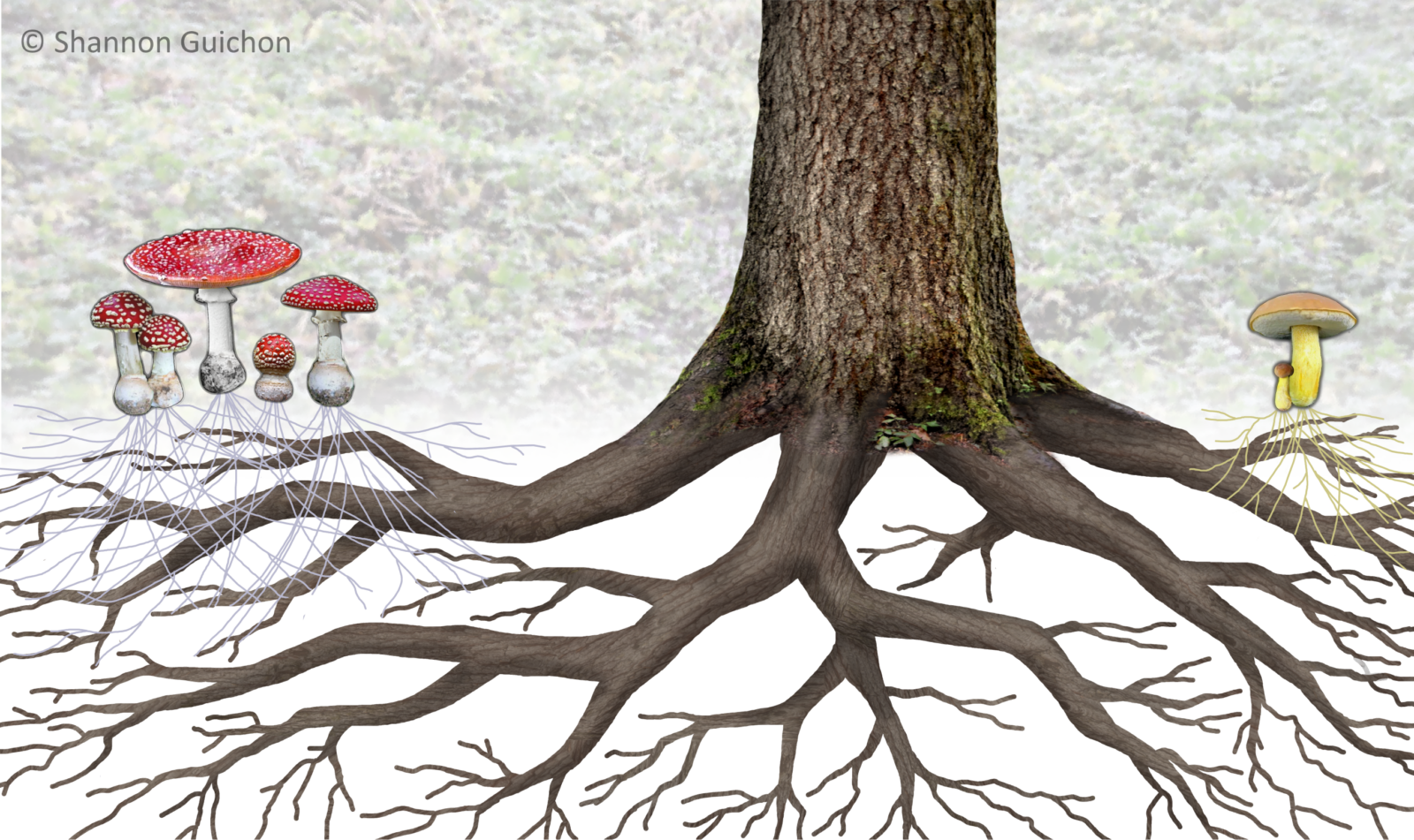
Photo:Dr. Shannon Guichon/National Forest Foundation. Do you know about the “Wood Wide Web” (mycorrhizal network)? Fungus not only produces mushrooms (above) but connects trees and plants through tiny threads called mycelium.
Years ago, during one of our country’s endless wars over boundaries, I thought about earthworms and how they don’t recognize boundaries. I said to myself the world needed a kind of diplomacy that recognized what connects us instead of what separates us, Earthworm Diplomacy. After reading today’s feature, I’m thinking I should have focused on fungi.
In January “the Tyler Prize for Environmental Achievement, sometimes described as the ‘green Nobel Prize,’ was awarded to Toby Kiers, an evolutionary biologist at Vrije University Amsterdam who has spent the past three decades studying the workings and significance of the soil’s circulatory system.
Alan Burdick reported at the New York Times that “last year, Dr. Kiers won a MacArthur ‘genius’ award, as well as the Climate Breakthrough Award, sharing it with Giuliana Furci, a fungi conservationist, and Merlin Sheldrake, a mycologist at the University of Oxford.
“The fungal kingdom, which stands apart from plants and animals, contains anywhere from two million to five million species, including yeasts, mildew, lichens and mushrooms. Dr. Kiers studies mycorrhizal fungi, microbes that form vast, underground networks with carbon drawn from the roots of plants and trees, providing vital nutrients in exchange.
“Dr. Kiers and her colleagues have calculated that these microbial filaments, laid end to end, would span half the galaxy and that they sequester 13 billion tons of atmospheric carbon dioxide — one-third of the world’s fossil-fuel emissions — in the soil each year.
“These brainless, distributed organisms are also astonishingly strategic in their business dealings, her team has shown, imposing tariffs and inflating prices. In 2021, Dr. Kiers founded the Society for the Protection of Underground Networks, or SPUN, a global network of researchers and ‘underground explorers’ that works to identify and protect hot spots of fungal diversity. Last year they unveiled the first ever global underground atlas. And a new initiative called Underground Advocates, developed with the More-Than-Human Life program at the New York University School of Law, helps train scientists in legal and policy skills.
“In a recent video call, Dr. Kiers … said, ‘Fungi are usually the underdogs. The awards feel like an award for the invisible, the parts of the world that are challenging to understand, and a celebration of decentralized ways of thinking and operating that fungi have mastered.’ …
New York Times Why fungi?
Toby Kiers These underground ecosystems play a crucial role in regulating the climate. Soils store about 75 percent of Earth’s terrestrial carbon and contain close to 60 percent of Earth’s biodiversity.
Mycorrhizal fungi form the basis of food chains for those aboveground organisms, which together generate more soil and nutrients. They draw carbon from plants and get it to stick to minerals underground, where it’s hard to release back into the atmosphere.
The vast majority of crops form partnerships with mycorrhizal fungi and rely on them for their nutrients. Some beautiful experiments have shown that when plants interact with mycorrhizal fungi, they make bigger, sweeter flowers, which attract more pollinators.
These fungi also hold soil together; their bodies are woven into the aggregate and produce sticky chemicals that are hard to break down. Take away that scaffolding and soils would erode and disappear.
People think they know what soil and dirt is. With high-resolution imaging, we’re starting to make it visible and show that it’s alive. These are ecosystems, with as much complexity as what’s happening aboveground. I think 2026 is really going to be the year where people start talking about fungal restoration. It’s not enough to just add native plants to restore ecosystems; it has to be native plants together with native fungi. …
Times How did you and fungi meet?
Kiers When I was 19, I became so enchanted by the idea of being a field biologist that I left college, not knowing if I’d come back, and spent a year at the Smithsonian Tropical Research Institute, a research station on an island in the middle of the Panama Canal.
I needed a niche. At the time, mycorrhizal fungi were pretty unknown there. The older scientists were studying everything aboveground — trees, bats, primates. I started wondering what generated all that diversity. So I did an experiment with researchers where we took soil from underneath the trees of one species and used it to inoculate other tree seedlings to see if it would affect their growth.
We stained the roots with a dye, and you could see this intricate weave of fungi inside the cells — they penetrate it — called an arbuscule; it looks like a mini tree. That’s where nutrient exchange happens. And I could see that happening in the roots with my own eyes. …
Studies were starting to show that plants actually get huge benefits from fungi.
Later, I realized that they’re powerful actors in their own right. My Ph.D. thesis explored whether noncognitive organisms can discriminate between good and bad partners. For instance, from experiments, we know that plants will digest one of those arbuscules if they’re not getting enough phosphorus from the fungus; they can abort the interaction.
But the fungi make choices as well. We found that a fungus can avoid trading with plants in the shade, which have less carbon to trade. They trade differently depending on how many other fungal competitors are present. They can hoard resources in their network and artificially inflate the price. …
We’ve been studying fungal trade as an underground market and developing techniques to track, in real time, when and where important exchange deals take place, how fungi navigate space, how they decide when and how much carbon to send down each pathway, how they build their road systems and how they optimize that supply-chain design.
Are fungi capitalists? No. They’ve developed a system that is much more sophisticated than the economic system humans use. But it has allowed us to use economics as a mathematical framework to analyze these trade strategies, to make predictions and to see if the fungi follow them. The frontier is linking what we’re seeing on the micron scale to the global data to understand the role of fungi in the carbon cycle.
Times Meanwhile, in SPUN, you’ve built a worldwide network of investigators to map the global distribution of networked microorganisms.
Kiers We wanted to turn the traditional approach on its head. SPUN has become a rambunctious, decentralized community of people working together to study and protect underground fungi. We’re slightly outside academia while still adhering to rigorous science and publishing in top journals.
In 2022, we set up the Underground Explorers Program. It’s a network of researchers who are dedicated to mapping fungal biodiversity in their local ecosystems. We’ve given away 137 grants across 58 countries, 80 percent of them to researchers in the global south and more than half led by women. It’s a fungi-without-borders approach. For these scientists, climate change is not an option to care or not care about; it’s their survival, their livelihoods, with consequences that their children will inherit.
There’s a researcher in Mongolia who is trying to map and protect fungal communities that are threatened by desertification — fungi that hold the grass down and enable nomadic herders to continue grazing their animals. In Nigeria, a scientist named Bolaji Thanni is studying the effects of textile effluents on soil health to help advocate for stricter waste disposal regulations and the use of eco-friendly dyes. In Mexico, there’s a professional climber who is mapping mycorrhizal fungi along cliffs — which is just so unknown, right?
We’re a really scrappy organization. We’re super lean and mean; we don’t even have an office. We are everywhere and nowhere. That really helps us. In an academic setting, you almost have to know what you’re going to find before you’re funded to find it.
I use the term ‘punk science.’ We’re trying to cross boundaries and disciplines and not accept the state of the world as a given, while celebrating science that is rooted in creativity.
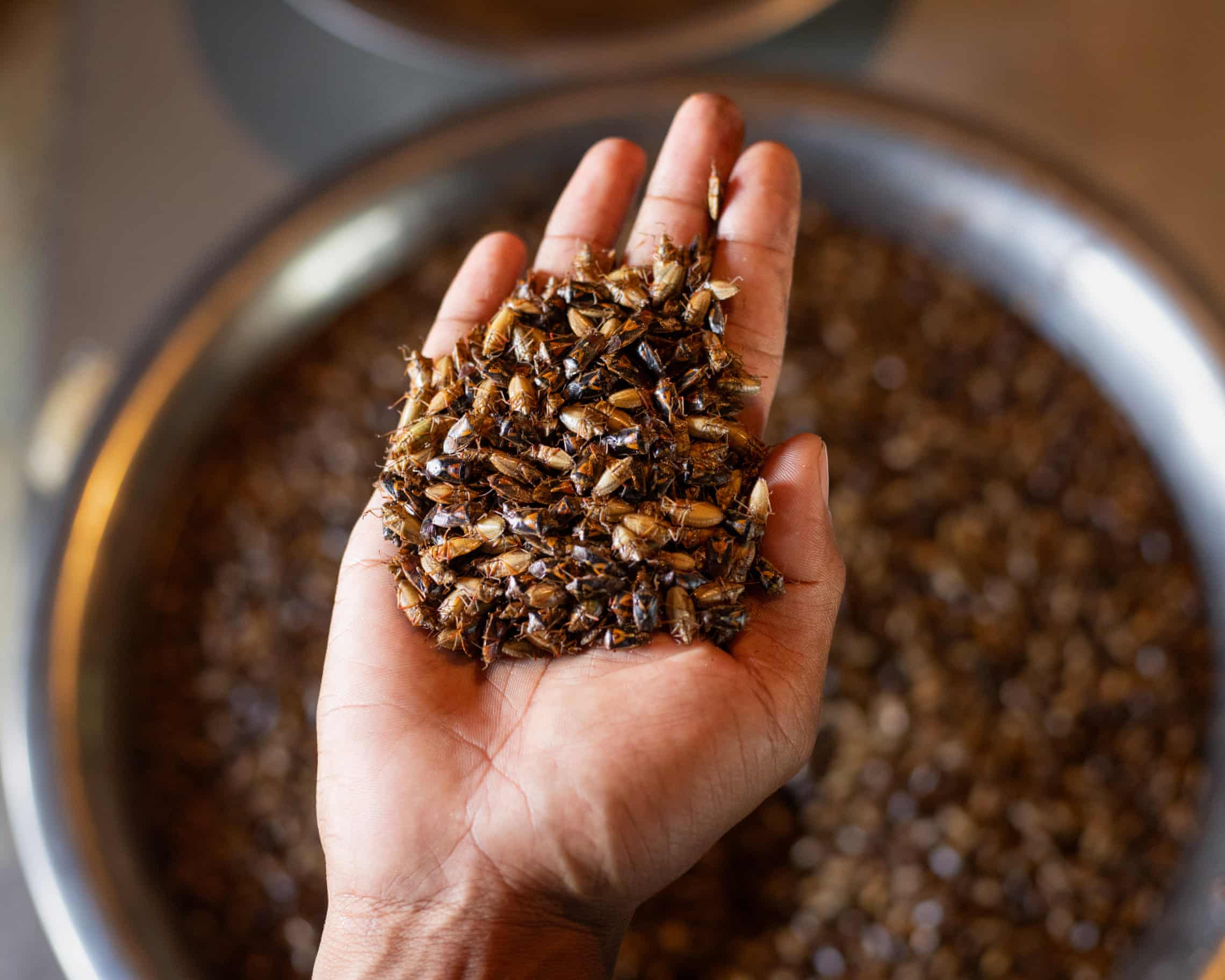
Photo: Thejavikho Chase. Today we learn that stink bugs can be ground into a thick paste and used to make valuable products.
OK, this food may be nutritious, but it sounds pretty gross to me. I suppose that eating unfamiliar foods outside your culture takes extreme hunger — or a sense of adventure.
But as Femi Ezhuthupallickal Benny and Thejavikho Chase report at the Guardian, the people who routinely eat stink bugs are doing it because they like it.
“Every few years when Udonga montana, a bamboo-feeding stink bug, erupts in massive swarms,” they write, “the people of the Mizo community in northern India don’t reach for pesticides. Instead, they look for baskets.
“Locally, this small brown stink bug is called thangnang. Outsiders see them as an infestation but in the bamboo forests of Mizoram state this small brown bug has long been woven into the food culture.
“Drawing on generations of traditional ecological knowledge, the Mizo people have developed an intricate system of harvesting, processing and consuming the insects that not only provides high-protein nutrition but also helps control pest populations without harming the forest with pesticides.
“ ‘We have been eating thangnang for more than 100 years,’ says Salemkulhthangi, an elder from the Serhmun village. …
“The big harvesting opportunity comes during mautam, the rare mass flowering of bamboo (Melocanna baccifera) that triggers stink bug outbreaks. ‘There isn’t a fixed date or month; it’s mostly around September-October,’ says Lalvohbika, a conservationist at Dampa tiger reserve in Mizoram. …
“Instead of spreading a sheet on the ground to collect the falling insects, as entomologists might, the Mizo have designed a fishing net-like implement with a long bamboo handle and a conical plastic pocket held open by a strong circular metal wire. As the flowering approaches, the villagers shake the branches, sending the bugs tumbling into the net. Once full, the bag’s narrow end is untied and the catch is emptied into gunny sacks at the base of the trees.
“Hot water is poured over to kill the insects, which are then cleaned and put in a basin where twigs, leaves and other debris are removed by hand. The cleaned bugs are soaked again in warm water, then ground into a thick paste that is processed into two valuable products: a fragrant cooking oil used as food and medicine, and a protein-rich paste used as animal feed.
The taste, it should be said, is an acquired one.
“The stink in the bugs’ name comes from the pungent odor they emit when they are stressed or threatened. … The oil that appears as a top layer as the paste is boiled is carefully skimmed off, bottled and sold in local markets. Nothing goes to waste: even the pulp that remains after oil extraction becomes hmun hlui, a tangy condiment eaten with rice, and the leftover residue is sun-dried and fed to pigs. …
“As global demand for protein rises and climate change threatens food security, the Mizo way of turning a sporadic pest outbreak into protein is a reminder that perhaps the future of food lies not in modern laboratories but in the ancient wisdom. …
“Yes, insects can ravage crops and frustrate farmers, but some of the creatures that chew through leaves and stems are, remarkably, more nutritious than the plants they destroy. … As the entomologist Victor Meyer-Rochow once asked: ‘Why kill insects when they per se are nutritious?’
“It’s a question that resonates deeply in several villages in north-east India where even crop pests find their way into the cooking pot, not out of desperation but as part of a sustainable, seasonal diet that values what their land provides.”
More at the Guardian, here. Have you ever tried chocolate-covered ants or any similar foods that Westerners like me are too squeamish to enjoy?
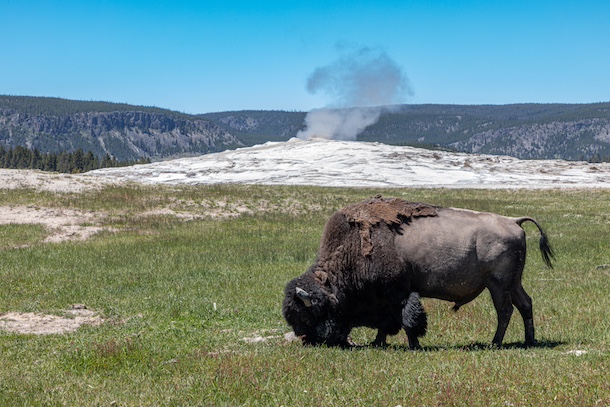
Photo: Dietmar Rabich, Wikimedia Commons, CC BY-SA 4.0. The American bison is a well-loved symbol of the prairie, and for good reason. Bison provide important ecosystem services.
I have blogged several times about Frank and Deborah Popper’s insights on the loss of population in the industrial Midwest and the idea of returning former urban areas to prairie, a kind of Buffalo Commons. (See one post, here.) It’s an optimistic concept: Instead of crumbling under the loss of “the way things were,” we can learn not only to accept the change but feature it.
But what if the prairie itself is disappearing? The environmental radio show Living on Earth investigates the role of agribusiness.
“The American prairie is one of the most biodiverse ecosystems in the world, with numbers of species rivaling even a tropical rainforest. But today, just one percent of eastern tallgrass prairie remains, and western shortgrass prairie is disappearing at a rate of more than a million acres a year. Author Josephine Marcotty joins host Paloma Beltran to discuss her book Sea of Grass: The Conquest, Ruin, and Redemption of Nature on the American Prairie.
Paloma Beltran How did the idea for Sea of Grass first come about?
Josephine Marcotty Growing up, I really had little or no contact with the prairie because it was gone. … I grew up in a suburb of Detroit, and the prairie was something I read about in books like Laura Ingalls Wilder, but not something that I had experienced. So it was only when I started exploring the prairie that was left and understanding what we had lost that inspired me to write, not only about agriculture, but about what we were losing by expanding agriculture in the Midwest.
Beltran Can you describe the American prairie for us? You know, what does it feel like to visit such a place and what makes it special?
Marcotty The tallgrass prairie, which is now almost completely gone, used to be an extraordinary place where grasses would be taller than a standing person, and in order to see over the top of them, you had to stand on top of a horse. It was a place where people could get lost, and often did in those tall grasses, or in the massive wetlands that used to occupy a third or 25% of the mid part of the country. It was an extraordinary place full of animals that we no longer have, wolves and bears and other carnivores, extraordinary birds. So I mean, the thing that I like about a prairie is the immense silence. All you hear is the sound of wind, and that enormous sense of space that you get, which is very similar to [being] out on a great lake or out on an ocean. …
Beltran Let’s talk about one of the main characters in your book, the buffalo. …
Marcotty They are what biologists call a keystone species on the prairie. They have been around for millions of years. … They were huge. And they shared the grasslands with giant sloths and other animals that you know have long gone. But over time, they became a key part of the grassland ecosystem. So they come through and they eat the grass short and that creates an environment that’s conducive to birds that like short grass, or insects that need short grass, and then they move on, and then the grass grows taller, and then that becomes an ecosystem for other animals that like taller grass. One of the things that they do is they wallow.
If you’ve ever been to Yellowstone National Park or any other park where you can see bison, you’ll see them roll over and just create these huge clouds of dust, and then when they leave, there’s a little wallow. Those wallows are really important for collecting water when it rains, and scientists have found that there’s unique species of animals and insects that will live in and around those wallows when they collect water. Bison, they carry seed across thousands, hundreds of miles when they eat the grass, and then they move the seed up to other parts of the of the grassland. …
Prairies create a whole universe of organisms around them, and that’s an excellent way of sequestering and processing carbon, of sequestering and processing nitrogen, both of which are very important for world health in terms of air pollution and in terms of climate change. The world’s grasslands contain more carbon than humans have released since the Industrial Revolution, more than the planet’s forests and atmosphere.
[But] we’re plowing up about a million acres a year, and that’s the equivalent of adding 11.2 million cars to the road every year. … For many, many decades, intensive agriculture stopped at around the 98th parallel because it was too dry in the West to really graze crops properly. And instead, that’s why we have cattle there. That’s because it was good country for cattle and bison. But through genetic technology, we now are creating seeds like for corn that is much more capable of withstanding severe weather, that can thrive in dry conditions. … And the profits from that are much greater than from growing cattle. So you can sell a piece of land that has been plowed for much higher price than you can sell it if it hasn’t been plowed. …
What’s driven the loss of grasslands … is just growing corn for our gas tanks.
Photo: Tristam Kenton. Actor Howard Brenton (seen above in Churchill in Moscow at the Orange Tree Theatre) likes working in small venues where he doesn’t need a mike. He says, “Microphones have no place in the theater.”
Some of the best theater my husband and I have ever seen has been in front of very small audiences. There is something about the intimacy of the setting that can inspire actors to outdo themselves. I recall a thrilling version of Moby Dick years ago when the GeVa theater in Rochester, New York, was just starting out. There were maybe five people in the audience.
At the Times in the UK, Dominic Maxwell wrote recently about London’s tiny Orange Tree Theatre, asking, “What do Patricia Hodge, Jane Asher, Roger Allam, Greta Scacchi, Anna Chancellor, Charles Dance, Geraldine James, Robert Bathurst and Freddie Fox have in common? Actually, that should be where do they all have in common because in the past three years these big names have all acted in plays at the 190-seat Orange Tree Theatre in Richmond, southwest London.
“At the weekend Ian McKellen performed three solo benefit shows for it at the larger Richmond Theatre, which raised more than £100,000 [~$135,000]. That, beams Tom Littler, the Orange Tree’s enterprising artistic director, when I meet him at his theatre on a crisp January weekday, is ’15 or 20 per cent of the fundraising we need to do for the year.’ …
“Littler, 41, took over the Orange Tree in 2022. And while he knows that not every show can be an event on the level of next year’s Shakespearean fiesta, he reckons ‘a couple a year’ don’t half help build excitement about a theatre. The present show is Littler’s larky reinvention of Richard Brinsley Sheridan’s 1775 comedy The Rivals, transplanted to a PG Wodehousey 1920s. …
“Littler is keen to argue that he is operating in the tradition of a venue that has been mixing revivals and new work since 1971, when its first artistic director, Sam Walters, set it up with his wife, Auriol Smith, in a room above the Orange Tree pub opposite. … But the big-name actors, plus the odd big-name director — Trevor Nunn did Uncle Vanya in 2024; Richard Eyre is about to do Strindberg’s The Dance of Death — is very much a Littler thing. …
“Littler knows famous faces are not everything. ‘But they are important for the profile and they help to get a new play seen. But I always say, it’s not a fame barometer thing, it’s the treat of seeing actors that good close up. …
“You have to wonder how Littler gets the talent. … He got the celebrated director Blanche McIntyre to make her Orange Tree debut (on Poor Clare) after writing her a fan letter. [David] Suchet’s involvement came after they had ‘a cup of tea together’ and discovered a shared love of Eliot’s play. [Patricia] Hodge’s involvement came because she shares an agent with Dance, whom Littler had worked with on Strindberg’s Creditors. …
“Read Littler’s program notes for The Rivals and you soon sense what a scholar he is. Sure enough, he has three degrees: one in English from Oxford, an MA in Classics from the Open University and an MPhil in 18th-century English literature he decamped to Cambridge to do, just before he got his previous job, running the even tinier Jermyn Street Theatre off Piccadilly Circus from 2017 to 2022. He talks enthusiastically about writers from Ovid to Ayckbourn, from Coward to Shakespeare. …
“He knows that ‘being a good scholar in theatre won’t get you very far at all on its own.’ He picked this up early: after getting into theatre as a child at Exeter School in Devon, he did lots of directing while at Oxford. Aged 22 he started a stint as an assistant director to Peter Hall while also putting on his own fringe productions, then later assisted other directors, including Nunn.”
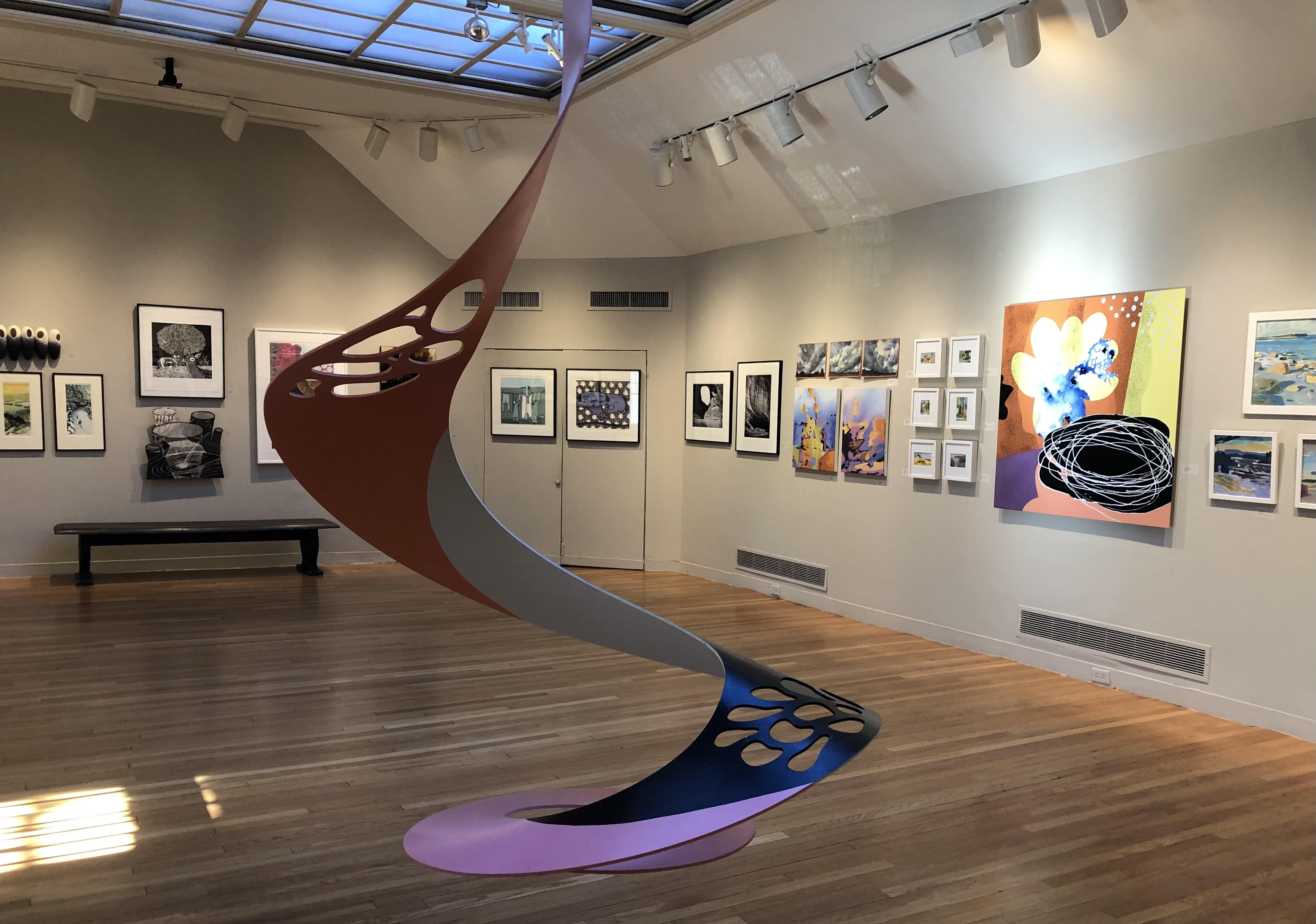
Photo: Suzanne and John’s Mom. Exhibit at Concord Art, November 30, 2021. Researchers have found that visiting galleries and museums to look at original art is good for your nervous system.
The other day, I was talking with a staff member here about her plans for the weekend, and she told me she wanted to go into Boston Sunday and visit an art museum or gallery. I am always impressed when anyone drives to Boston: the one-way streets are confusing and the parking is awful. She surprised me by saying, “Parking’s the easy part. There’s a lot of free street parking on Sundays.”
After reviewing today’s articles, I can hardly wait to tell her that what she was doing for fun is also good for her health.
Rhea Nayyar wrote recently at Hyperallergic about new research suggesting that museums and galleries are “non-clinical spaces for preventive health promotion. … Supporting existing research on the benefits of viewing original artwork versus reproductions, a new study found that seeing authentic art can help drop cortisol levels, among other positive effects on the nervous system. …
“Fifty adults between the ages of 18 and 40 participated in the experimental study — one half was made to view five authentic paintings with their wall labels in a gallery setting for a 20-minute period, while the other half was shown high-quality reproductions of those paintings in a similarly curated setting. All participants had their heart rate and skin temperature monitored, and they provided saliva samples before and after the viewing sessions.
“The recorded data showed that those who viewed original artwork had higher heart rate variability patterns compared to the reproductions group, indicating that authentic viewing experiences contribute to a more receptive and adaptable nervous system. The post-viewing saliva samples also yielded a 22% cortisol decrease among the original art group, as well as a measurable drop in two of four recorded inflammatory proteins. …
“[The researchers likened] the stimulated but calming response elicited to that provoked byexercise or meditation.”
That supports University of Pennsylvania research described by Hyperallergic‘s Elaine Velie in 2022.
“ ‘Art museums have great potential to positively impact people, including reducing their stress, enhancing positive emotional experiences, and helping people to feel less lonely and more connected,’ researcher Katherine Cotter told Hyperallergic.
“The study, titled ‘Art Museums As Institutions for Human Flourishing,’ was published in the Journal of Positive Psychology by Cotter and James O. Pawelski of the University of Pennsylvania. Their work is encompassed in the burgeoning field of positive psychology, which studies ‘the strengths that enable individuals and communities to thrive.’ Drawing on research from different academic disciplines, the study is part of an initiative that examines how the arts and humanities affect ‘human flourishing’ — a comprehensive framework that takes into account both ‘ill-being’ (living with disease, disorders, or in negative states) and ‘well-being’ (practicing positive health habits). …
“Cotter and Pawelski compiled and reviewed over 100 research articles and government and foundation reports. They discovered that visiting a museum reduced stress levels, frequent visits decreased anxiety, and viewing figurative art lowered blood pressure. They also found that museum visits lowered the intensity of chronic pain, increased a person’s life span, and lessened the likelihood of being diagnosed with dementia.”







 Suzanne's Mom's Blog