Feeds:
Posts
Comments

Photo: Swem Library
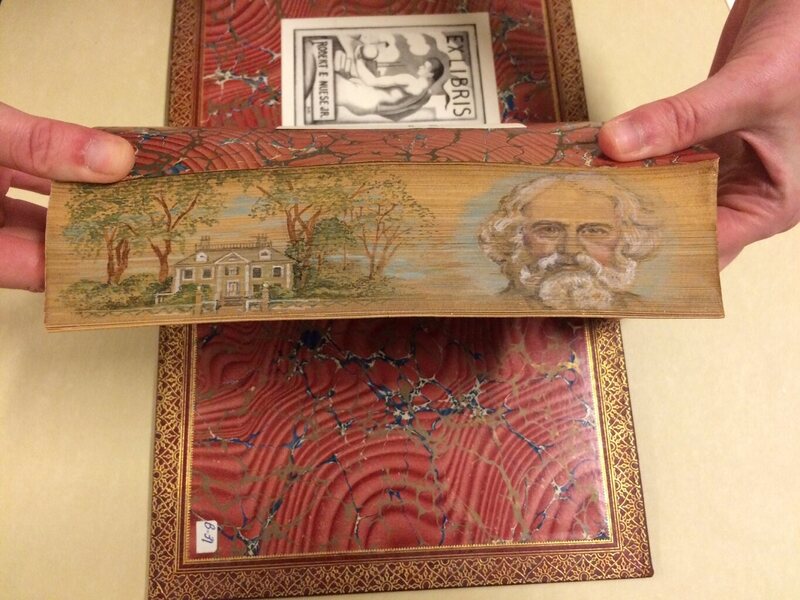
Art on page edges from
The Complete Poetical Works of Henry Wadsworth Longfellow. See 22 other examples at Atlas Obscura.

Have you ever noticed paintings along the page edges of old books? According to a 2016 Atlas Obscura article by Eric Grundhauser, they’re called “fore-page paintings.”

He writes, “While you don’t see them very often these days, fore-edge paintings were once some of the loveliest book illustrations around. … A fore-edge painting refers to an image painted or drawn on the closed leaves of a book. …

“Some ambitious, ‘disappearing’ fore-edge paintings were painted on the inside edges of the pages, so that the hidden scenes could only be seen when the page block was fanned in a certain direction. …

“These secret illustrations could be doubled, with an illustration on either side of the pages, revealing themselves depending on the slant of the page block (known as the ‘two-way double’). Some were painted so that if the book was laid open in the center, naturally splaying the pages to either side, two different illustrations could be seen on either side (known as a ‘split double’). …

“ ‘Sometimes the fore-edge paintings corresponded to the subject of the book, and sometimes not,’ says Jay Gaidmore, Director of Special Collections at the Earl Gregg Swem Library. The library holds the 700-strong Ralph H. Wark Collection, the largest collection of fore-edge painted books in America. …

“ ‘Most of the books are 19th century English fore-edges, but there are a few American scenes.’

“Fore-edge paintings can be found on books dating back to the 11th century, with early examples being decorated with symbolism and heraldry. …

“According to the Boston Public Library’s website for their 250+ collection of fore-edge books, for the most part the paintings were made using watercolors, and went unsigned, often being commissioned by a book-binding firm. …

“The technique has even been printed onto some modern books like Chip Kidd’s 2001 novel, The Cheese Monkeys, which was printed with a two-way double, disappearing fore-edge message. If the pages are shifted in one direction, the phrase ‘GOOD IS DEAD,’ appears, while if they are shifted in the opposite direction, the message, ‘DO YOU SEE?’ can be read.”

Tip of the hat to Fort Point artist Karen McFeaters, who retweeted this lead from @michikokakutani. More here, where you can see 22 additional examples.
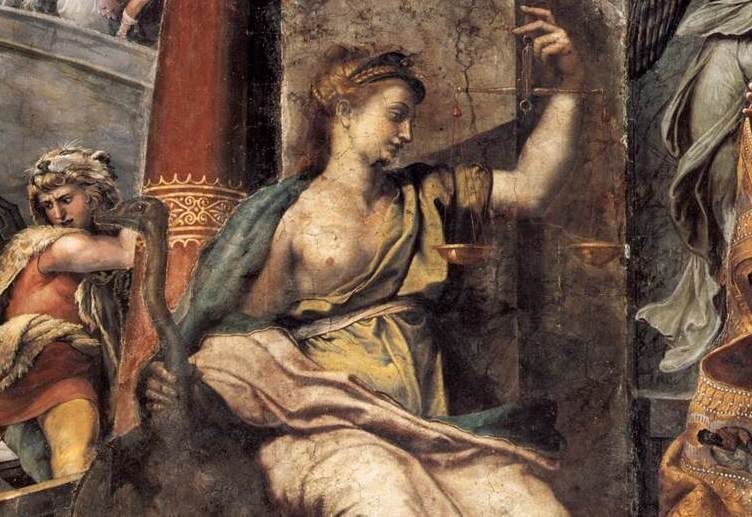
Photo: Wikimedia Commons
Two Allegory of Justice figures in the Vatican, once attributed to Raphael’s followers, were identified in 2017 as being by the master himself.

This Artsy report on 2017 art discoveries was pretty cool. Curiously, I had already written about one of the finds — here. It was the Rodin sculpture discovered in a New Jersey town hall.

Abigail Cain writes, “Art history is, by definition, primarily a thing of the past — but each year, some small portion of it is rewritten by those in the present.

“In 2017, we gained new insight on the early years of Leonardo da Vinci and the final ones of Andy Warhol; amateur archaeologists were rewarded with major finds; and several masterpieces were discovered, simply hiding in plain sight. From newly mapped Venezuelan petroglyphs to a long-lost Magritte, these are 10 of the most notable art-historical discoveries of the year.”

I especially loved that volunteers made the find that occurred in England. “A team of amateur archaeologists,” writes Cain, “dug up one of the most significant Roman mosaics ever discovered in Britain.

“The discovery was made in a field outside of Boxford, in southern England, by a group of local volunteers supervised by professional archaeologists. Although the project began in 2011, it wasn’t until August of this year — during the final two weeks of the scheduled dig — that organizers realized they’d found something extraordinary.

“As it turned out, they’d uncovered a remarkably well-preserved mosaic, built as part of a Roman villa that dates to roughly 380 A.D. Not only is it a rare find for the country — experts have labeled it the most exciting of its kind unearthed in 50 years — the subject and style of the artwork is highly unusual for the area. The work illustrates the story of Bellerophon, a Greek mythological hero tasked with killing the Chimera.”

Check out Artsy, here, to read about: the discovery that two figures in the Vatican were painted by Raphael and not his assistants; two ancient tombs in Egypt; the likely identity of Leonardo’s mother; a portrait by Peter Paul Rubens found hanging in a historic Glasgow house; a miniscule carving recovered from a Bronze Age tomb with “detailed handiwork centuries ahead of its time”; the last piece of a lost René Magritte painting found in Belgium; and drone technology that helped researchers map “massive, 2,000-year-old petroglyphs in Venezuela for the first time.”

Doesn’t it make you want to go out and discover some long-lost treasure?

lewisset_304x400

Photo: British Museum
One of the walrus-ivory pieces among the British Museum’s 12th century Lewis Chessmen is a castle that records the metaphor “bíta í skjaldarrendur” (“biting its shield-end,” or fighting on in the face of great odds), a phrase still common in today’s Iceland.

Iceland is such an interesting country. I have enjoyed reading about how everyone gives books at Christmas and how volunteers embrace danger to rescue reckless tourists. Now the Economist explains that although almost no one else speaks it, Icelanders love their language.

“It is hardly surprising that Icelanders have names for the many different fish that abound in their surrounding waters — the various types of cod, herring and so on which they have been catching for centuries.

“It is rather more surprising that they have not just one word for the coelacanth, but three. …

“But Icelanders are keen namers of things — and would never dream of simply adopting a transliterated version of someone else’s word. So they call the coelacanth skúfur, which means ‘tassel.’ Or skúfuggi: tassel-fin. Or sometimes forniskúfur: ‘ancient tassel.’ [You can hear the spoken pronunciation at the Economist.]

“Icelanders are fiercely proud of their tongue and stay actively involved in its maintenance. On Icelandic Language Day they celebrate those among the population of 340,000 who have done the most for it. They love the links it gives them to their past.

“Ordinary Icelanders revel in their ability to use phrases from the sagas — written around eight centuries ago — in daily life. The commentator who says that a football team is bíta í skjaldarrendur (‘biting its shield-end’) as it fights on in the face of great odds, is behaving quite normally in borrowing an image from ancient tales of Viking derring-do. ….

“The result is something close to unique — a language that is at the same time modern (it can happily express concepts such as podcasting), pure (it borrows very few words from any other tongue) and ancient (it is far closer to the ancestral Norse tongue than its increasingly distant cousins, Danish and Norwegian). Its complex grammar has barely changed in almost a thousand years and has a distinct old-worldliness. But if, like the forniskúfur, Icelandic is a living fossil, it is a lovely and lively one. …

“From early on [Icelanders] were particularly keen on using it to write things down; much of what is known about Viking culture comes from Icelandic texts. In the 13th century Snorri Sturluson produced the Prose Edda, one of the earliest and most important accounts of the antics of Thor, Frigg, Loki and their kith and kin. …

“Some words do look similar to English ones: bók, epli and brauð are ‘book,’ ‘apple’ and ‘bread.’ …

“Some of these similarities, though, can mislead. An English-speaker who knows that dóm is cognate to the English word ‘doom’ may find the Reykjavik building marked dómsmálaráðuneytid rather menacing. But it is just the ministry of justice: ‘doom’ in English was once mere judgment; only later did it take on first the meaning of condemnation, then ruin.

“It is not clear in quite what way J.R.R. Tolkien meant the word when he named the climactic locale in The Lord of the Rings Mount Doom. But as a philologist interested in Norse and other ancient tongues, and keen on the archaic, he certainly knew his Icelandic.

“The name of the wizard Gandalf is taken from the Eddas. The Tolkiens’ Icelandic nanny, Adda, not only took care of the children; part of her role was to help him practice Icelandic. Mrs Tolkien was not pleased by the attention.”

Wow, that’s interesting because, as we learned in this recent post, Tolkien was orphaned at the age of 12. His early years with that nanny must have made a big impression on him.

Find other curious facts about the Icelandic language at the Economist, here, and listen to more of the pronunciations.

Photo: Gavin Ashworth
Klewicke, “Original Design Quilt” (Corning, New York, 1907), pieced silk, faille, taffeta, and satin, digitized by the American Folk Art Museum in New York City.

Nowadays, it’s not enough for museums to exhibit art that you can go see or read about in a book: they want to be able to share their treasures online. That’s why the American Folk Art Museum in New York City is digitizing the New York Quilt Project, which features more than 6,000 quilts and their histories.

Allison Meier writes at Hyperallergic, “From a 19th-century block pattern quilt made from a woman’s wedding dress, to a commemorative quilt celebrating the 1901 Pan-American Exposition in Buffalo, the New York Quilt Project contains an invaluable record of the state’s folk art history. …

“Now AFAM [the American Folk Art Museum] is digitizing these materials to make them more accessible. …

“The vast majority of these quilts are not at the New York City museum, but are heirlooms in private collections, whether an attic in the Catskills or a quilt trunk in Brooklyn. … AFAM has so far put about 1,500 quilts online, and expects to finish the digitization in 2019. AFAM also has related oral history recordings that they’re working to digitize.

“Quilt projects statewide were really popular in the ’80s, and people started collecting their histories,” [Mimi Lester, an AFAM archivist and project manager for the digitization] explained.

“The Kentucky Quilt Project, founded in 1981, was the first of these, inspiring a resurgence of interest in the United States. Frequently these grassroots initiatives revolved around ‘quilt days,’ at which people could have their family quilts documented. …

“People would bring their quilts to YMCAs or churches or museums, and we would have registrars there who would help the individuals fill out the forms and take photographs,” Lester said. …

“Details were recorded like family background, religion, where a quiltmaker learned the craft, why they made the quilt, and where they obtained textiles, and a small tab was sewn into the back of each quilt for identification. These stories often chronicle immigration.”

Click here for photos of some lovely quilts — and lovely quilters.

Hat tip: radio show Studio 360 on twitter, @studio360show.

The Turkey Whisperer

Photo: Andrew Jackson for the Guardian
Elin William says, “From the moment I started strumming, the turkeys crowded ’round.”

A few months ago, I told my younger grandson that I had read a story about a woman who plays music to calm down turkeys. I don’t think he quite believed me.

But it’s true. Elin William wrote at the Guardian about her unusual use of music.

“I got my first guitar when I was 12, and it’s been a slow process of self-tuition since then. I also play piano and violin, but I only play the guitar to the turkeys on the Rhug Estate farm in Corwen, north Wales, where I work.

“It began as an experiment. Rhug is an organic farm, and the main principle is to create as little stress as possible for the animals. But the farm is on the side of a main road, so some get spooked by loud noises: the traffic, machinery or sounds from the car park. We started playing the radio to them overnight. We’d put on Classic FM when we were shutting up at 7 pm and leave it on until we returned in the morning.

“The turkeys in particular responded really well. So we started playing the radio all day, every day. Then my boss, Lord Newborough, thought, ‘What if the music was much more up close and personal?’ He knew I played guitar and suggested I had a go. …

“From the moment I started strumming, the turkeys crowded ’round. I got the impression they enjoyed listening to me play. They started pecking on the guitar and plucking the strings. That’s the result of organic farming: you get inquisitive animals, rather than ones that are scared. …

“I’ve now performed in front of hundreds of turkeys. … I sing Welsh folk songs and ones my dad would have loved to hear, like the Animals’ ‘House of The Rising Sun’ – that’s the one I like playing most. …

“I’ve been described as a turkey whisperer. It’s like a horse whisperer, but not as glamorous. I don’t have a magic touch – anyone who played to them would get the same reaction, to be honest. …

“I’m an animal lover and it’s important to me that the turkeys are happy. But I’m not a vegetarian. Getting so close to the birds doesn’t make me think I have to give up meat. Farming is a mega industry, but here the focus is on quality of life. Having worked with them, it’s impossible to imagine turkeys in cages.” Read more at the Guardian, here.

Photo: Elizabeth Hafalia, The Chronicle
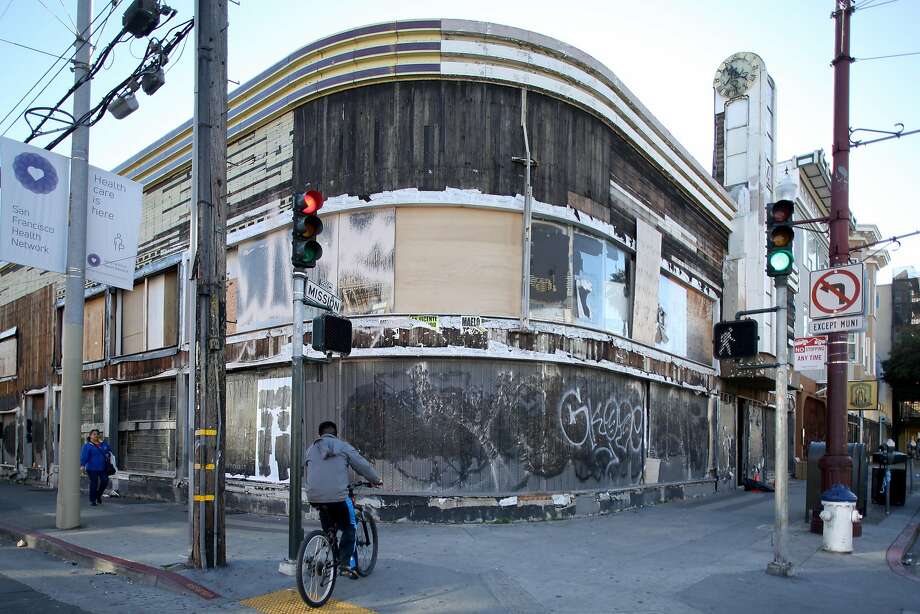
Facing a need for affordable housing and arts space, San Francisco’s Mission Economic Development Agency is joining with Dance Mission Theater and the Mission Neighborhood Centers to repurpose this neglected 1919 building.

Have you ever visited San Francisco’s Mission District? A poor, immigrant neighborhood, it is nevertheless a vibrant experiment in people-oriented housing and support for food entrepreneurs and the arts. The creative energy there is tangible.

Moreover, the neighborhood’s community-development folks never stop turning dreams into reality. J.K. Dineen has an update at the San Francisco Chronicle.

“A historic but long-neglected commercial building at Mission and 18th streets in San Francisco is poised to be rejuvenated with a mix of affordable housing, child care and dance.

“The dilapidated 1919 structure, a former furniture store that was remodeled with an Art Deco flair in the late 1930s, has been on and off the market for more than a decade. …

“Finally the Mission Economic Development Agency, a politically powerful group that often opposes market-rate housing, reached a deal to buy it by collaborating with Dance Mission Theater and the Mission Neighborhood Centers, which will open a child care facility there.

“ ‘We are all going in together to do a new model of cooperative living and dancing and taking care of our children,’ said Krissy Keefer, executive director of Dance Mission Theater. ‘It’s going to be very communal.’ …

“Brokers with the San Francisco office of the realty firm Marcus & Millichap … said market-rate developers were scared off by the Mission’s anti-gentrification political environment and that ‘MEDA was very good to work with.’ …

“The building will be the group’s first home ownership project — the others are rentals — and the first targeting middle-income families rather than low-income folks. Mission Neighborhood Centers is providing some of the project funding, along with two nonprofits: Low Income Investment Fund, a financial intermediary that provides capital for community developments, and the Neighbor to Neighbor fund.”

I’m sure everyone has read about the housing crunch in San Francisco, with tech employees pushing prices up. It’s good to hear of anything designed to ease the shortage. More here.

Artist of the Southwest

stella2

Stella McLennan Roca (1879–1954), a painter known for her landscapes and her influence on the arts community in Arizona.

At Christmas, friends in Minnesota sent a letter that included this update: “Out of the blue in the spring, Mariana was contacted by Lonnie Dunbier, an art historian who was searching for information about Mariana’s grandmother, Stella Roca.

“Lonnie was preparing a series of lectures, to be given in Lincoln, Nebraska, about early Nebraska women artists. Stella [had] grown up in Nebraska City before attending the Chicago Art Institute and moving to Mexico, where she met and married Mariana’s grandfather, subsequently settling in Tucson, where she became a widely acclaimed landscape artist. Over a couple months in the spring, all of Stella’s landscapes that we have were photographed and quite a lot of historical information was exchanged, updated and edited, resulting in a comprehensive biography for use in her lectures.”

What a lovely experience! As a person who saves every letter ever written to her, I thought about what fun it would be if someone contacted me for information like that.

And I’m always interested in women artists, so I went to Wikipedia to learn more. I got a little sidetracked fixing typos in the entry, but I figured out that an offer Roca received through the Art Institute of Chicago to teach in Mexico was what led to her meeting her future husband.

I also read that her “work was known for light colored desert landscapes and glowing mountains” and that she served as president of the Tucson Fine Arts Association in 1932 and “was featured in the ‘Who’s Who in American Art.’ ” I search the internet for some of her work and was impressed. Delightful.

As for being sidetracked, do you know that anyone can edit Wikipedia? People will check up on you, of course, but it is ridiculously easy, and as a former editor, I simply had to fix a couple misspellings and a run-on sentence. If I was wrong to do that, Wikipedia experts will let me know.

Art: Stella McLennan Roca


Photo: National Institutes of Health via AP
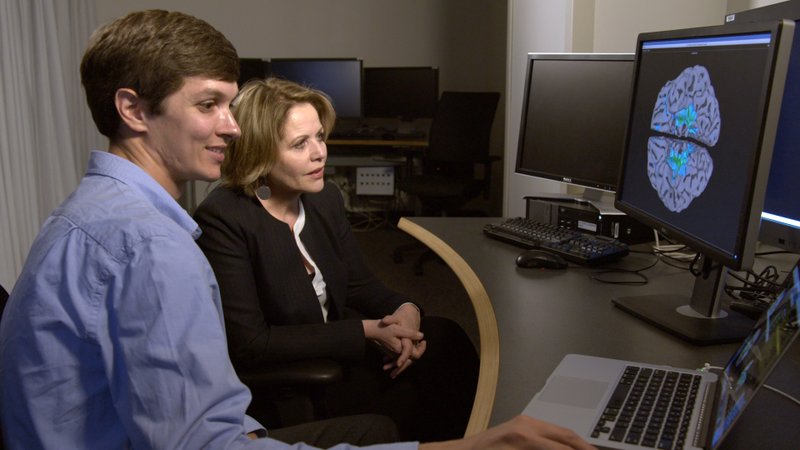
Soprano Renee Fleming looks at a brain scan with NIH neuroscientist David Jangraw after singing in the MRI machine.

To help scientists understand how music helps patients heal, notable musicians like opera’s Renee Fleming are getting brain scans.

Lauran Neergaard writes at the Associated Press, “Music increasingly is becoming a part of patient care — although it’s still pretty unusual to see roving performers captivating entire wards, like at MedStar Georgetown University Hospital one fall morning.

“ ‘It takes them away for just a few minutes to some other place where they don’t have to think about what’s going on,’ said cellist Martha Vance after playing for a patient isolated to avoid spreading infection.

“The challenge: Harnessing music to do more than comfort the sick. Now, moving beyond programs like Georgetown’s, the National Institutes of Health is bringing together musicians, music therapists and neuroscientists to tap into the brain’s circuitry and figure out how.

“ ‘The brain is able to compensate for other deficits sometimes by using music to communicate,’ said NIH Director Dr. Francis Collins, a geneticist who also plays a mean guitar.

“To turn that ability into a successful therapy, ‘it would be a really good thing to know which parts of the brain are still intact to be called into action. To know the circuits well enough to know the backup plan,’ Collins added. …

“ ‘The water is wide, I cannot cross over,’ well-known soprano Renee Fleming belted out, not from a concert stage but from inside an MRI machine at the NIH campus.

“The opera star — who partnered with Collins to start the Sound Health initiative — spent two hours in the scanner to help researchers tease out what brain activity is key for singing. How? First Fleming spoke the lyrics. Then she sang them. Finally, she imagined singing them.

“ ‘We’re trying to understand the brain not just so we can address mental disorders or diseases or injuries, but also so we can understand what happens when a brain’s working right and what happens when it’s performing at a really high level,’ said NIH researcher David Jangraw, who shared the MRI data with The Associated Press.

“To Jangraw’s surprise, several brain regions were more active when Fleming imagined singing than when she actually sang, including the brain’s emotion center and areas involved with motion and vision. One theory: it took more mental effort to keep track of where she was in the song, and to maintain its emotion, without auditory feedback.”

Read how the new insights are being used to study Alzzheimer’s patients and others here.

Self-Portrait as Saint Catherine by Artemisia Gentileschi, a painter whose reputation is second only to Caravaggio among 17th-century Italian artists.

Lately, I’ve been following a really cool twitter feed called Women’s Art, @womensart1. It’s astonishing how many women, known and unknown, have been creating beautiful works over the centuries. Paintings, embroidery, sculpture, photos, quilts — you name it. The pictures have been an absolute treat.

Speaking of women’s art, I just learned about Artemisia Gentileschi, a painter whose reputation is apparently second only to Caravaggio among 17th-century Italian artists.

Paul Jeromack reported at Art Newspaper that she recently scored a big price at auction. Too bad she doesn’t get to benefit.

“A previously unknown Self-Portrait as Saint Catherine,” writes Jeromack, “sold at Drouot in Paris on 19 December for an artist record of €2,360,600 [about $2.9 million]. …

“The work, which dates from the same period (1614-16) as another Saint Catherine picture by the artist held by the Uffizi, was discovered by auctioneer Christophe Joron-Derem and presented in his sale of European paintings. …

“Lionised as an icon of feminist empowerment and artistic accomplishment since the 1970s … Gentileschi was canny enough to exploit her singular fame as a female painter in the form of self-portraits in the guise of religious or allegorical figures (her most notable depiction by another artist is by her friend Simon Vouet, who portrayed her with her brushes and palette and a wonderfully commanding swagger).  …

“Despite the artist’s popularity, she is not represented in many important museums: neither of the National Galleries in London or Washington, DC, nor the Getty, nor the Louvre, which curiously did not pre-empt the sale under French patrimony laws. While the picture’s relatively modest size of 71 sq. cm would endear it to private collectors, one hopes a major museum would be astute enough to acquire it.” More here.

Don’t you love it when someone “discovers” a lost masterpiece? That’s what I dream of — finding a masterpiece at a garage sale. Or like the blogger Things I Find in the Garbage, finding something amazing dumped on the curb.


Art: JRR Tolkien
An Oxford exhibit will feature decades of illustrated letters from “Father Christmas” to the children of Middle Earth wizard JRR Tolkien.

This is more of a Christmas post, but as the exhibit won’t go up until next summer, you have time to plan a trip to Oxford, England, to see JRR Tolkien’s illustrated Father Christmas letters. They will be on display from June 1 to October 28, 2018. If you can’t go, there is a heavenly array at the Guardian.

Maev Kennedy writes at the Guardian, “In December 1920 Father Christmas wrote a letter to a modest house in the Oxford suburbs, enclosing a watercolour sketch of his own rather more exotic domed snow house, approached by a flight of steps lit by ice lanterns. ‘I heard you ask Daddy what I was like and where I lived,’ he wrote to three-year-old John Tolkien, and as the family grew to four children, he continued to write every Christmas for 23 years. …

“The illustrated letters continued to arrive every Christmas Eve, sometimes delivered by a postman who had been persuaded to include them with the more boring letters and cards, sometimes materialising on the hearth rug with a handmade stamp. Some years Father Christmas was evidently very busy, and could only pass on the briefest snippets of news, and other years, when he had time on his hands, he could include elaborate multi-layered paintings. One showed his reindeer and sleigh arriving over the Oxford skyline – ‘your house is just about where the three little black points stick up out of shadow on the right.’

“Many recount the adventures of his friend and helper the Polar Bear – in 1926 he accidentally switched on all the Northern Lights – or the goblins who attempted to steal the stored presents in 1932. In one letter Polar Bear ‘found a hole in the side of a hill & went inside because it was snowing.’ He slid down a rocky slope, more rock fell on him, and he could not climb back: ‘But almost at once he smelled goblin & became interested & started to explore. Not very wise for of course goblins can’t hurt HIM but their caves are very dangerous.’

“The snow, the entrance to treacherous caves and the smell of goblin will be instantly familiar to readers of the book Tolkien was working on at the time, The Hobbit, the first of the adventures of Middle-earth. …

“Catherine McIlwaine, Tolkien archivist at the Bodleian, [says,] “There couldn’t be a clearer demonstration of how important his family was to him. He was orphaned from the age of 12, when his mother died, and then he spent years boarded out in lodging houses in Birmingham.’ ”

More at the Guardian, here.

Photo: Rahmat Gul/AP
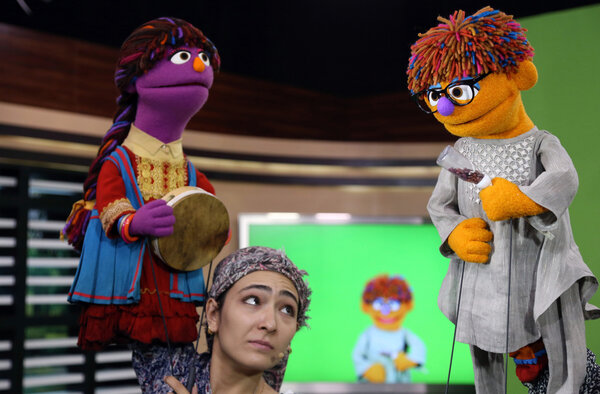
Characters from the Afghan Sesame Street. A MacArthur Foundation grant will enable the Sesame Workshop and the International Rescue Committee to roll out a version for Syrian refugee children.

Even if they make it to relative safety, children often suffer the most from wars and dislocation. In addition to the trauma, there is the problem of education, which is unavailable or spotty in refugee camps.

That is why people of goodwill are reaching out with programs that can both comfort and teach. Jason Beaubien reports on one example at National Public Radio.

“The MacArthur Foundation will give $100 million to Elmo, Big Bird and their buddies to massively scale up early childhood development programs for Syrian refugees.

“Sesame Workshop and the International Rescue Committee won a global competition by the MacArthur Foundation seeking solutions to what the judges called ‘a critical problem of our time.’

” ‘The most important thing to remember is that the humanitarian system is designed to reach people’s immediate needs — to keep people alive, feed them, make sure that they have shelter,’ says Sarah Smith, senior director of education at the IRC. The global humanitarian system, she says, isn’t very good at supporting displaced children. ‘And the fact is these children are likely to stay as refugees for their entire childhood.’ …

“The IRC and Sesame Workshop plan to launch what they’re describing as the ‘largest early childhood intervention program ever created in a humanitarian setting.’ …

“It will be distributed over traditional television channels, the internet and mobile phones. It will also serve as an educational curriculum for childcare centers, health clinics and outreach workers visiting the shelters where refugees live. The workers will deliver books to kids and caregivers.

“Sherrie Westin of Sesame Workshop says … ‘These Muppets will be created to reflect the children’s reality so that children can relate with them. … One of the Muppets may have had to leave home. She may live in a tent. She may become best friends with her new neighbors.’ …

” ‘We know that in their first years of life the trauma that children are experiencing has the greatest impact on them,’ Westin at Sesame Workshop says. ‘And yet they receive the least support.’ ”

More at NPR, here.

Photo: Edwin Ongom, CURE International
Aisha holds her daughter at CURE Children’s Hospital of Uganda. Uganda surgeons are teaching Western doctors a technique to cure hydrocephalus in infants.

Western medical professionals are learning that offering medical insight in the Third World can be a two-way street. In this story, Westerners are benefiting from the teaching of some Ugandan surgeons.

Michaeleen Doucleff writes at National Public Radio, “It’s not every day that surgeons develop a new brain surgery that could save tens of thousands of babies, even a hundred thousand, each year. And it’s definitely not every day that the surgery is developed in one of the world’s poorest countries.

“But that’s exactly what neurosurgeons from Boston and Mbale, Uganda, report [last December] in the New England Journal of Medicine.

“The treatment is for a scary condition in which a baby’s head swells up, almost like balloon. It’s called hydrocephalus, or ‘water on the brain.’ But a more accurate description is ‘spinal fluid inside the brain.’

“Inside our brains, there are four chambers that continually fill up and release spinal fluid. So their volume stays constant.

“In babies with hydrocephalus, the chambers don’t drain properly. They swell up, putting pressure on the brain. If left untreated about half the children will die, and the others will be badly disabled.

“Traditionally doctors treat hydrocelphalus in the U.S. with what’s called a shunt: They place a long tube in the baby’s brain, which allows the liquid to drain into the child’s stomach.

“But a third of the time, these shunts fail within two years, says Dr. Jay Riva-Cambrin, a neurosurgeon at the University of Calgary. …

“For many kids in rural Uganda — and other poor countries — emergency neurosurgery isn’t an option. ‘They’re going to die from a shunt malfunction,’  says [Dr. Benjamin Warf, a neurosurgeon at Harvard Medical School, who led the development of the new method at a clinic in Uganda]. …

“So Warf and his colleagues decided to innovate. … In the new method, doctors basically poke a hole in the brain’s chambers so they can drain. They also prevented the chambers from filling back up by partially damaging the region of the brain that produces spinal fluid. …

“After 15 years of testing and optimizing, he and his team can finally say that their approach — at least in the short term — appears to be just as effective as the procedure commonly used here in the U.S.

“In the study, Warf and his colleagues tested the two methods on about 100 children in Uganda. After 12 months, the doctors couldn’t detect a difference in the children’s brain volume or cognitive skills. …

“The new technique has been so successful in developing countries that American doctors are now traveling to Uganda to learn how to do the technique from Ugandan doctors.

” ‘The doctors at the clinic in Uganda are wizards at the [new] method,’ says Riva-Cambrin. ‘They’re the ones that taught me the procedure.’ ”

More at NPR, here.

Photo: Catherine Smart for The Boston Globe
Steelhead trout from the University of New Hampshire aquaculture program.

As the tension between traditional fishing and the sustainability of the marine environment increases, so do hopes that some fishermen will get interested in the new approaches to aquaculture.

One new approach is being tested at the University of New Hampshire in collaboration with a New England chef.

Catherine Smart writes at the Boston Globe, “About a year ago, Jeremy Sewall — chef and partner of Row 34 and Island Creek Oyster Bar restaurants, and the recently opened Les Sablons — was scrolling through his Instagram feed when he spotted a glistening, speckled Steelhead trout from Greenpoint Fish & Lobster Co. in Brooklyn. The caption read that it was raised through the aquaculture program at the University of New Hampshire.

“As Sewall tells it, ‘I screenshot that picture and send it to my purchaser Phil and say, “Find me this fish, I own a restaurant in New Hampshire and I need to find this fish.” ‘

“The rainbow trout in question was raised by Michael Chambers, a research scientist at UNH’s School of Marine Science and Ocean Engineering.

It was grown in an offshore pen that bears little resemblance to the stagnant, antibiotic-filled fish ponds people might associate with aquaculture.

“Many phone calls to the marine biology department later, purchaser Phil found Chambers and set up a meeting with Sewall. The scientist and the chef sat down to lunch. ‘Come to find out, that was kind of the end of the project. They had raised the fish [he saw on social media] and they weren’t sure what they were going to do next year, and I was like, “We have to do this, it’s incredible,” ‘ says Sewall.”

So they partnered.

Smart describes meeting Chambers and Sewall at the Judd Gregg Marine Science Complex and heading out with them to feed the fish.

Chambers said, “ ‘As a biologist, you want to see your chicken, your cows, every day — so you can see if they are healthy. If something is up, you can catch it right away.’  …

” ‘What’s unique about this is that we have a floating system that’s designed to hold fish at the center. And we have these,” he says, pulling up tubes of nylon netting, filled with mussels and seaweed growing on rope. ‘These act as biological filters, or a biological curtain, which are now taking nutrients that the fish give off and are absorbing them, taking that nitrogen out of the system.’  This Integrated Multi-Trophic Aquaculture system, known as IMTA, is a big part of what sets Chambers’s project apart. …

“As a restaurateur, Sewall sees a major business opportunity, likening Chambers’s method of fish farming to the small organic farms that chefs patronize to get the best meat and produce. He is willing to wait for the fish to grow and is eager to create new dishes to showcase the end product.”

More at the Globe, here.

Photo: Paula Keller
Actor Luverne Seifert demonstrates techniques of Ten Thousand Things, which brings free, low-budget, high-quality theater to people who are not rich.

A new theater company trains actors to do high-quality, free performances for new, nontraditional audiences. Somehow I knew it would be based in Minneapolis, a hotbed of theatrical innovation in the late 1990s when I lived there.

Theresa J. Beckhusen reported the story at American Theatre.

” ‘If I was going to spend my life making theatre, I didn’t want to make art for rich people.’ This is how Michelle Hensley, artistic director of Ten Thousand Things (TTT), a theatre company in Minneapolis, kicked off a recent conference. …

“The gathering drew around 100 theatre makers from across the country to compare notes about working with the grass-roots theatrical model championed by Hensley’s company. Its motto could be fairly summed up as … art for not-rich people.

“For 30 years Ten Thousand Things has been touring productions to prisons, transitional housing, rehab centers, immigrant centers, shelters for survivors of domestic violence, and more — and all for free. …

“TTT productions are performed in the round, in whatever space their tour sites have available. … Actors mingle with audience members, interacting before, during, and after performances.

“The productions are spare: no lavish costumes, no fancy sets, no lights. Hensley puts a premium on story and language. …

“Many conference attendees shared stories … One incarcerated woman in particular was moved by a wedding scene in The Tempest because she’d missed all the weddings in her family. [Another told] how audience members drove from Tijuana to San Diego just to see a bilingual Twelfth Night. …

“Playwright Kira Obolensky led a session on choosing material that would work in the intimate settings pioneered by TTT. She began by posing a question … : What story would you tell if everyone was in the audience? … ‘I don’t think a lot of American playwrights and directors ask themselves this question.’ …

“Brad Delzer reported that he recently began employing TTT’s model with True North Theatre, his new theatre company in Carlisle, Pa. Sensing an opportunity to bring theatre to places that don’t typically see it, and to connect with the strong military community in the Carlisle area, Dezler toured Lisa Peterson and Denis O’Hare’s An Iliad to a soup kitchen, a men’s shelter, and the town’s Army Heritage Center, before holding two public performances. …

“He had been generally apprehensive about the whole thing, but had particularly fretted about how a six-minute list of wars from the last few centuries would go over. ‘It played really well, he said, noting the power that came from the moment. ‘It surprised us.’ ”

There’s more at American Theatre, here, where you can see how different TTT groups manage to fund free performances.

Suzanne’s Lockets

LunaAndStellaLockets

Suzanne’s lockets were featured in the Boston Globe last week, and I wanted to tell you about that — and the lockets — in time for Valentine’s Day.

Longtime readers know this blog has a connection to Luna & Stella, Suzanne’s jewelry company. It’s easy to forget that, as she was willing from Day One to let me write about whatever interested me, and I’m interested in an awful lot of things in addition to jewelry.

The antique and vintage lockets are a fairly new addition to Suzanne’s offerings, and they have been a pretty big hit. Although Suzanne acquires them from all over, many, if not most, originated in the greater Providence area, once known as the jewelry capital of the world. Some of the lockets have the original photos in them, but Suzanne will size your photos to fit if you like.

Among the more fascinating aspects of the lockets, in my opinion, are the handmade hinges, which are practically invisible. Hinges made today tend to be clunky and stick out. Suzanne went through a long search to see if anyone could make hinges the old way and even looked into buying some antique machinery, but in the end, attending flea markets and working with vintage dealers meant she could sell the lockets for a more reasonable price.

You can see lockets here, some in Valentine shapes. And the website also has chains and birthstone charms to pair with a locket — Luna & Stella‘s trademark stars, moons, suns, hearts, and more.