Feeds:
Posts
Comments

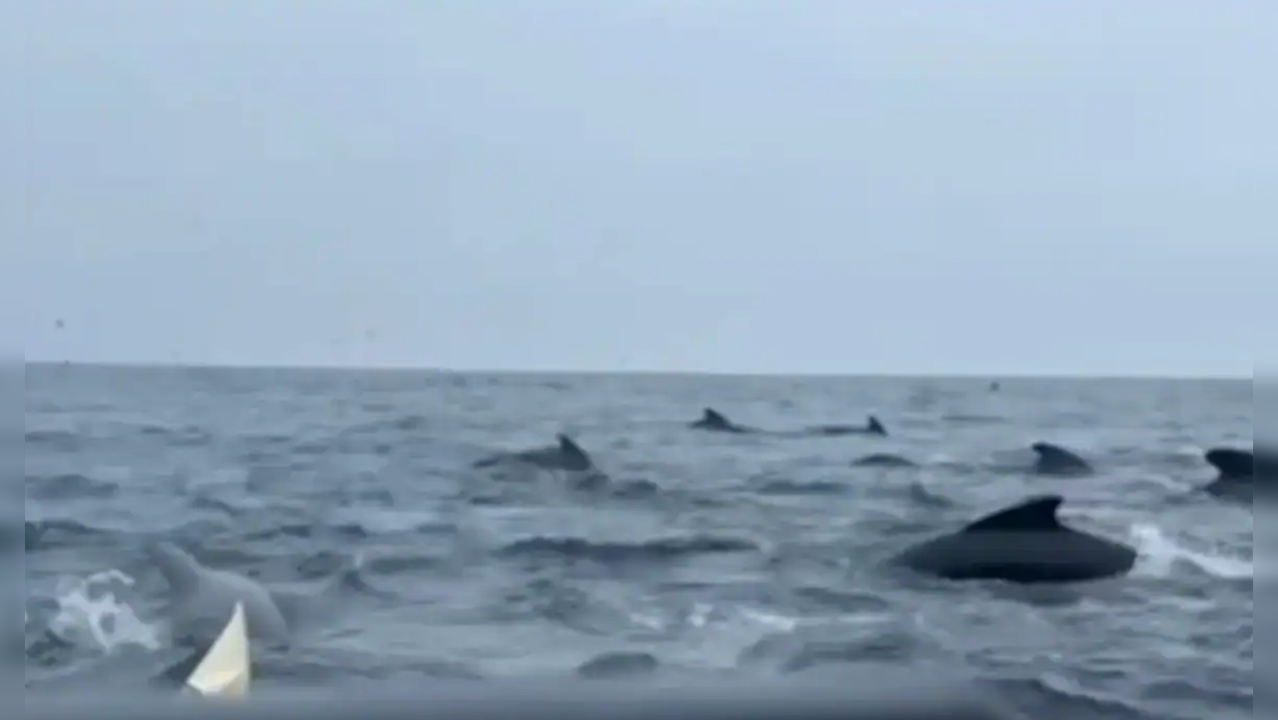
Photo: Tom Waddington via Times Now.
Tom Waddington was surrounded by pilot whales as he rowed solo from Newfoundland to England.

I’ve been on a couple whale watches with family members, and I think there are few things more exciting than seeing whales in their natural environment. In today’s story, a man who sought excitement by rowing from Newfoundland to England may have gotten a little too much from some curious pilot whales.

Bill Chappell reports at NPR, “Tom Waddington is on a quest to row across the Atlantic Ocean all by himself — but [in July], he found plenty of company at sea, when a pod of pilot whales thronged around him. They followed him for hours, growing from a few playful animals to hundreds of large creatures. …

“The whales popped their heads above the surface and seemed to play together — a gam of whales, gadding about — as Waddington, who is rowing some 2,000 nautical miles from the Newfoundland coast to Penzance, in the United Kingdom, watched in amazement.

“ ‘This is so cool,’ Waddington said as he took a video of the whales’ antics. With a laugh, he added, ‘I love it, but I’m scared they’re gonna hit my rudder.’

“Waddington emerged unscathed — but a little shaken by the risks mammals weighing thousands of pounds can pose to his boat and equipment on an unsupported solo trip.

“ ‘They were just playing and going under the boat and I was taking videos,’ he said on Facebook and Instagram, describing hundreds of whales around him. Then one of the whales slammed into the side of his light boat.

“ ‘And I was like, Oh my God. And suddenly it turned from David Attenborough into Moby Dick. And I was really scared.’

“Waddington’s team on land believes the playful mammals are long-finned pilot whales, which the National Oceanic and Atmospheric Administration says are known to live in the North Atlantic and ‘are very social, living in large schools of hundreds of animals separated into close-knit pods of 10 to 20 individuals.’ …

“When it came time to take leave of his visitors, Waddington says he wasn’t sure how to do that. He tried shouting a bit, and splashed his oars. He veered north — but the whales followed, and for more than two hours, it seemed more whales kept showing up.

“Waddington, who works as a ski instructor, is rowing across the ocean for a fundraiser benefiting Mind, the British mental health charity led by the actor Stephen Fry. Waddington estimates that more than 1,000 whales swam with him. For advice, he called his coach, Charlie Pitcher (who has himself rowed across the Atlantic).

“ ‘He was like, the best thing to do is, be quiet and still — which is exactly the opposite of what I did’ earlier, he said.”

Check out the map of Waddington’s transatlantic journey at NPR, here.

Photo: Popi Sibiya.
Blogger Popi Sibiya didn’t see herself in any travel writing about Africa and decided to write from a female traveler’s point of view. Here she is in Matadi, Congo.

We all know that a lot of things in our world have historically been male-oriented. Medical research, for example. As women step up to correct imbalances, that sort of bias is being corrected. Today we learn about online travel influencers who are providing a fuller picture of where and how to travel. Safety is one thing that might be more of an issue for women.

Ayen Deng Bior reports from Senegal for the Christian Science Monitor, “Last year, South African travel blogger Popi Sibiya found herself cruising the canals of Ganvié, a village on stilts in the middle of a lake in Benin. As she sat in the back of a wooden canoe, she pulled out her smartphone and began broadcasting the experience to her 40,000 Instagram followers. …

“Ms. Sibiya is a former kindergarten teacher who has spent much of the last two years crisscrossing the African continent on public transportation – and now has over 100,000 followers. She is part of an emerging group of young African women travel bloggers who are using their social media platforms to redefine what adventure travel looks like in Africa – and who gets to experience it. They are pushing back on the stereotype that travel on the continent is the exclusive domain of khaki-clad Europeans on safari or sunburned Americans sipping cocktails on Zanzibari beaches – and inviting their mostly African audiences to do the same. 

“African travelers ‘are starting to prioritize fun and adventure’ on their own continent, says Ms. Sibiya, whose followers are mostly well-off South Africans used to traveling to Europe, the Middle East, and Asia for their vacations. On her account, ‘they see that we also have beautiful beaches; we don’t have to go to Thailand,’ she says.

“Each year, African countries clock more than 80 million visitors, and the industry generates about 25 million jobs, according to the World Travel & Tourism Council, an industry advocacy group. 

“Still, African countries are rarely featured on global ‘where to visit’ lists – at least outside stock-standard international favorites like Morocco, Mauritius, South Africa, and Egypt. 

“Ordinary travelers with large social media followings are filling that void, says American travel journalist Rosalind Cummings-Yeates, who has traveled extensively in the region and often uses travel influencers to help plan her trip. 

“ ‘We don’t have to rely on traditional media [anymore],’ she says. Instead, would-be travelers can scroll the feeds of influencers like Ebaide Joy, Instagram alias @go_ebaide, a Nigerian adventure traveler currently riding her motorcycle from Nigeria to Kenya. Or like Ess Opiyo (@ess_opiyo), a Kenyan travel guide with a passion for offbeat destinations. …

“Margot Mendes has seen firsthand the power of social media to transform how people travel in the region. She lives in Dakar, Senegal, where she works in marketing. She puts the same skills to use on her Instagram account, @thedakardream, where she shares her life and travels with her 33,000 followers. 

“Her grid features scenes from bustling open-air markets, peach-colored sunsets overlooking cerulean hotel pools, and glimpses of local cuisine including baguette sandwiches and spiced rice dishes. 

“Ms. Mendes started the account five years ago, when she moved back to Dakar from Paris, where her Senegalese and Bissau-Guinean family had migrated when she was a child. Originally, the page was just to show her worried friends and family in Europe how much Dakar had transformed in the decades since they emigrated. 

“ ‘It was just me being curious about my culture and going to places to discover my own culture,’ she says. 

“But soon her page began to gain an audience beyond people she knew. She says her new followers – most of them African – told her they loved seeing their own continent branded as a glamorous travel destination for the first time. 

“Ms. Mendes’ account has the feel of a glossy travel magazine, but for many young African women documenting their travels, it is important not to shy away from the continent’s struggles – or the challenges that make travel there tricky to navigate. 

“Recently, for instance, Nigerian British travel blogger Pelumi Nubi completed a 10-week road trip from London to Lagos. … Ms. Nubi documented the journey for more than a quarter million people on her Instagram account, @pelumi.nubi. Her posts bounced between travel highs – like when Lumi the Peugeot’s wheels touched African soil for the first time in Morocco – and lows – a video of Lumi’s crumpled hood after she slammed into a parked car on a dark road in Ivory Coast. 

“ ‘You have the people who are trying to paint [Africa] as a war-torn place, a dangerous place, and then you have the people who are trying too hard to sell it as this paradise,’ says Ms. Sibiya, whose page cheerfully records her travels in rickety buses she describes as ‘hearses’ and doesn’t shy away from her brushes with poverty, bad roads, and chaotic border crossings. …

“Ms. Sibiya says her audience is mainly other South Africans, many of whom tell her they are experiencing the continent’s beaches, safaris, fancy hotels, and restaurants for the first time through her account. For many, the issue is partly cost. Counterintuitively, flights between African countries are often more expensive than flights from the continent to international travel hubs like Dubai in the United Arab Emirates or New York. And instead of high speed trains or rental cars, overland travelers often have to choose between taking rundown public transport or paying up for a private car and driver. 

“Ms. Sibiya funds her travels through paid subscriptions to her Instagram account, which cost 140 rand (about $7) a month and give access to more detailed and frequent travel updates than her public page. Currently, she has around 1,200 subscribers.”

More at the Monitor, here. No firewall. Subscriptions are reasonable.

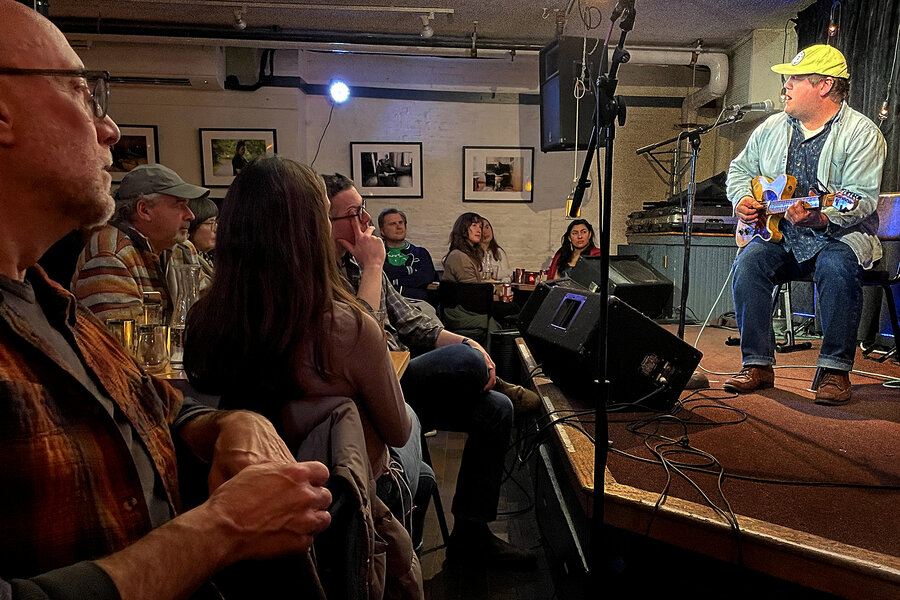
Photo: Melanie Stetson Freeman/CSM Staff.
Folk musician Jake Xerxes Fussell performs at Club Passim, one of his favorite venues, in Cambridge, Massachusetts.

My son has a goofy impression of who I was in the 1960s. He describes some kind of hippy personality, which I never had. I was more of a folkie — in the sense that I loved folk music and followed that crowd, went to those concerts.

I don’t think folk music has been cool with young people for many years, but I was interested to read at the Christian Science Monitor about one young musician who is keeping it alive and moving it forward. Simon Montlake has the story.

“In the summer of 1993, Fred Fussell, a folklorist and museum curator in Columbus, Georgia, packed his family van for a monthlong road trip to document the crafts and traditions of Native American tribes. He brought along his son, Jake, who had just finished fourth grade and was riding shotgun, where he kept a daily tally of roadkill.

“That summer, the Fussells visited artisans from Native communities in Oklahoma, Texas, and Louisiana, those whose forebears had been expelled from the Southeast in the 1800s but kept alive their spiritual ties to the land. Jake took charge of a Sony tape recorder. He taped his father’s interviews, learning to ‘sit back and shut up’ while people talked, which ‘is the key to good documentation,’ says the elder Mr. Fussell.

“His young son also recorded performances, which included music. … Jake liked vernacular arts and crafts, and he showed an early talent for drawing. But what lit his fire were the songs he heard at folk festivals his father put on in Georgia, songs that had been passed down from generation to generation and performed like the oral traditions of Homeric verse. …

“ ‘I always knew I would play music because music was the thing that was a constant source of joy,’ the younger Mr. Fussell says today.

“His family’s circle of friends included musicians, from blues singers to bluegrass pickers, and veteran collectors of traditional songs who never stopped looking for more. … From this unusual upbringing, Jake Xerxes Fussell has emerged as one of the most singular interpreters of folk music and all its tributaries. …

“ ‘He’s a real-deal folk singer. And there’re not very many of those,’ says Eli Smith, organizer of the Brooklyn Folk Festival. …

“From spirituals and jigs to fiddle tunes and sea chanteys, folk music is part of America’s cultural bedrock. It has long braided commercial music – from the folk revivalists of the 1950s and 1960s, who include Pete Seeger and Bob Dylan. …

“Some traditional songs arrived with the European migrants who brought their fiddles and hymnbooks to Appalachia and other regions. Others sprang from the Black experience of enslavement and freedom. …

“Mr. Fussell draws on that inheritance to create music that sounds both contemporary and timeless. His creative process carries him down rabbit holes of archival research and experimentation with musical motifs, even while tinkering on his guitar at home or on tour.

“He adds melodies when none exist and transposes verses, acting as both a caretaker and a remodeler of songs. …

“He started as a toddler on pots and pans, banging out rhythms at home. Then he got a drum kit and was ‘immediately good,’ says Coulter Fussell, his older sister. … From drums, Mr. Fussell moved to the upright bass, which he learned at school from a teacher who played in a bluegrass band. When he was 13 years old, his teacher asked him to take over as the bassist at a weekly gig at a barbecue restaurant.

“ ‘Everybody went there on a Friday night,’ says Ms. Fussell, who is now a quilter in Water Valley, Mississippi. ‘The band would play, and it was these scruffy grown men and then little Jake up there.’ …

“He was also listening to rock and hip-hop on the radio and going to shows, including of Georgia’s R.E.M., whose lead singer, Michael Stipe, had studied drawing with Mr. Rosenbaum at the University of Georgia. But rock bands lacked the raw passion and poetry of the traditional songs he heard growing up. ‘None of that stuff really spoke to me in any real deep way,’ he says. 

“Mr. Fussell also fell hard for the music of Mr. Dylan, whom Mr. Rosenbaum had known in Greenwich Village in the early 1960s. But it was another local musician and family friend, Precious Bryant, who would influence Mr. Fussell’s rhythmic guitar picking and give him a taste of life on the road.

“Since Ms. Bryant, a country-blues artist, didn’t drive, it was Mr. Fussell’s mother, Cathy, who would drive her to shows. Her eager son began to take that role once he got a driver’s license. He would also visit Ms. Bryant at her rural trailer home, bringing along his guitar. ‘She would play, and I would play along,’ Mr. Fussell says. 

“ ‘Jake always liked older people. He liked listening to older people. He liked hanging around with older people,’ says his mother, a retired English teacher and quilter.”

Lots more at the Monitor, here. No paywall. Tiny Dest Concert at YouTube here.

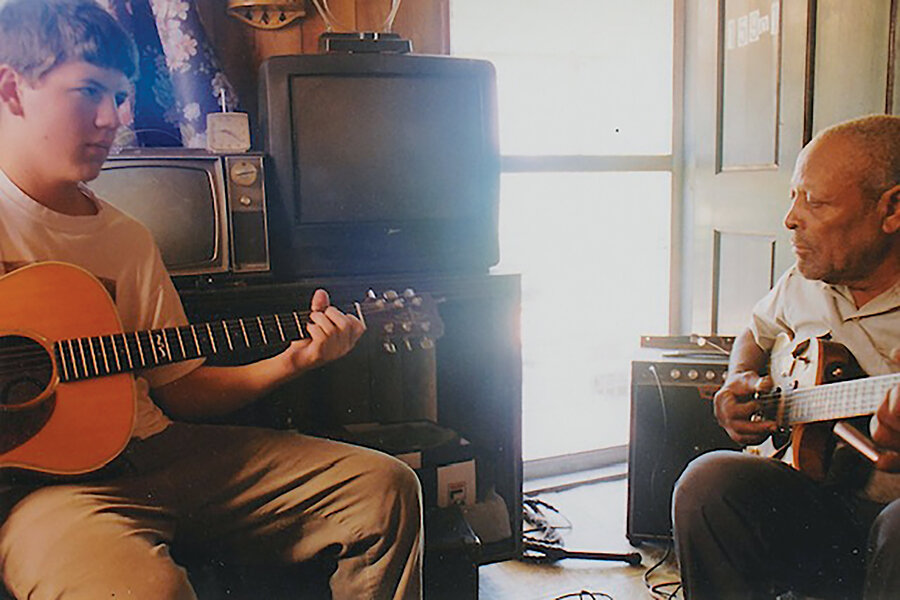
Photo: Jake Xerxes Fussell
As a youngster, Jake Xerxes Fussell soaked up the wisdom of older generations. Here he is jamming with George Daniel, a blues musician, in Macon County, Alabama, around 1996.

First Starring Role at 94

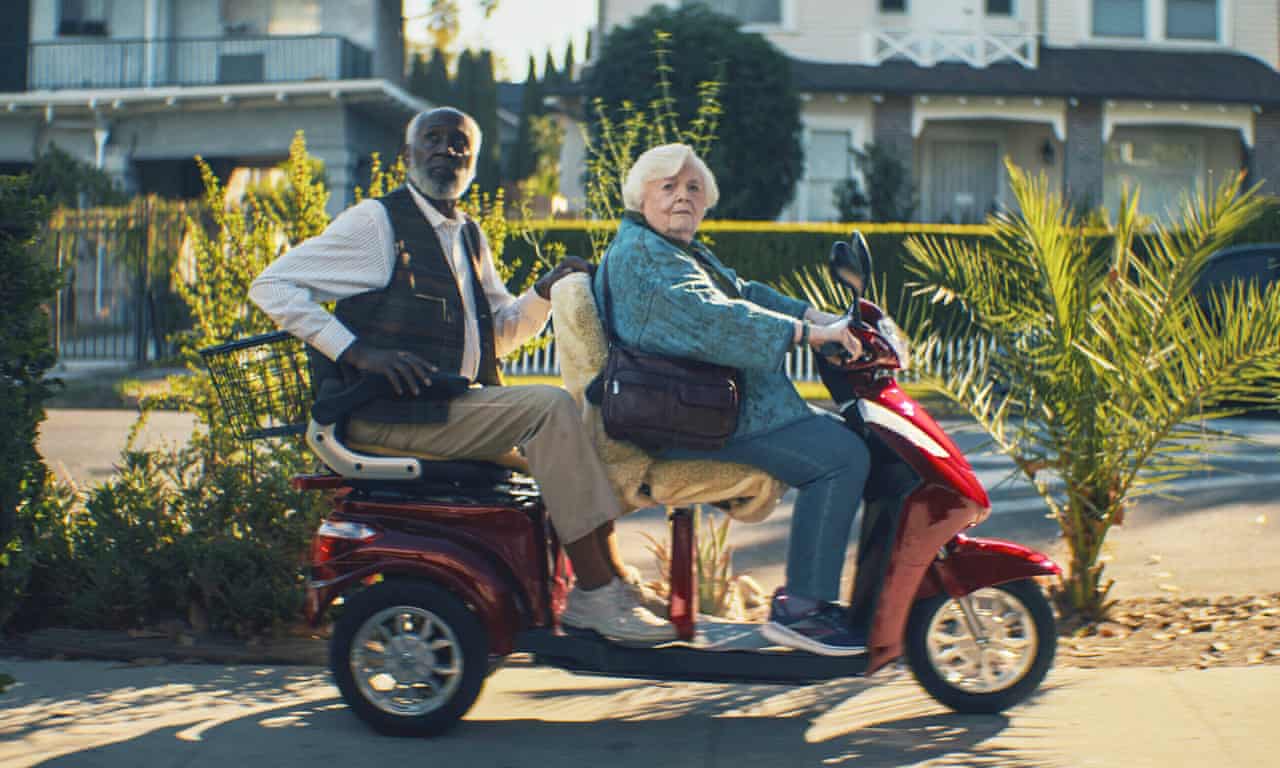
Photo: Magnolia Pictures/AP.
Actor June Squibb with Richard Roundtree in the movie Thelma. 

I’ve been wanting to see this movie since I first read about it, but I have trouble accessing movies these days. Some get shown on the tv network in our retirement community, but we may not get this one for a while as it’s not available yet.

What’s cool about Thelma is that the lead actor is 94 and also that she has glowing reviews.

Fiona Sturges writes at the Guardian, “There’s a new action hero in town. In Josh Margolin’s wildly entertaining Thelma, an elderly widow is duped out of $10,000 by a scammer masquerading as her grandson. Realizing her error, she resolves to track him down, retrieve her cash and dispense some rough justice.

If summer blockbusters are about the action, then Thelma has it all: guns, explosions and mobility scooter-based stunts.

“When the 94-year-old actor June Squibb read the script, with its mischievous nods to Mission: Impossible, she knew she had to do it. She also knew she would do lots of the stunts herself. ‘I have more security in my physicality than a lot of people do, and I thought riding around on that scooter was going to be great fun,’ she beams. …

“She says she is in excellent health, even though, ‘I should be doing pilates more than I am, because I’ve had such a crazy schedule. I was doing it for one hour a week with a trainer, and it makes a huge difference. I’m in good shape.’

“Extraordinarily, Thelma is Squibb’s first ever starring role. Until now, she has been viewed as a character actor, someone you’re more likely to know by face (or by voice: she is Nostalgia in Inside Out 2) than by name. She has spent decades quietly propping up lead actors playing their wives, mothers and grandmothers in films such as Scent of a WomanAbout Schmidt and Palm Springs. 

“While Thelma is primarily a comedy, it is underpinned by a more serious theme: the way society treats its elderly. We see Thelma’s well-meaning family talking about her when she’s still in the room and pondering whether to move her into a home. … But she is happy to report that, in her 10th decade, she has had nothing but love and respect from her family and has retained her independence. She lives in an apartment complex in the San Fernando Valley. … ‘And I have a wonderful assistant without whom I couldn’t keep working,’ Squibb says. ‘I have two cats and I make sure that, first thing in the morning, they’re taken care of. And then I have most of the day to myself if I’m not filming. I have no trouble getting around, though I do get tired. Tiredness is real when you get to my age.’

“Yet Squibb has rarely been in such demand. She credits her increased workload to a ‘greater interest in the aging process. There’s more work for people my age than ever before. … When I was a young, good-looking actor in New York, I was constantly aware that people looked at me as an object.’ She and her contemporaries had their coping mechanisms, ‘but I got mad too. When #MeToo happened, all of us in our 80s were amazed. We were, like, “Oh my God, we’ve lived this our whole lives.” ‘ …

“Squibb learned her craft in the 1950s at the Cleveland Play House, where she met Jack Lee, who went on to become a leading musical director on Broadway. ‘He decided I had to sing. So, I began singing and I did all the comedienne roles in all the musicals. … My first 20 years in New York were all musicals.’ Then came a gear-change after she met her second husband, Charles Kataksakis, an acting coach. Kataksakis thought she had it in her to play more serious roles (he and Squibb were together for 40 years until his death in 1999). …

“Squibb was 61 when she made the move from stage to screen. … ‘I went to my agent and said, “I think I should be doing this too.” The next week I was auditioning for Woody Allen.’ That film was Alice, a romcom starring Mia Farrow in which Squibb played a maid. The casting director, Ellen Lewis, took an instant shine to Squibb and set her up for a meeting with Martin Brest, who cast her in his new Al Pacino vehicle, Scent of a Woman. …

“After that came roles in TV shows . … [Alexander] Payne brought her on board for 2013’s Nebraska, in which she played the abrasive and unfiltered Kate, wife of Bruce Dern’s delusional Woody. The role earned her an Oscar nomination for best supporting actress. …

“Squibb just wrapped another film, playing the lead in Eleanor the Great, about a 90-year-old who moves back to New York after decades in Florida. It is the directorial debut of Scarlett Johansson, who Squibb describes as ‘so bright, so smart.’ Being No 1 on the call sheet, she says, means ‘going into it with a feeling of responsibility that you don’t have with a supporting role. I always felt what I did was important. But as the lead you’re kind of responsible for the whole film.’ ”

More at the Guardian, here. Have you seen this movie yet? (Looking at Laurie, who seems to see everything.)

When Olive Oyl Danced

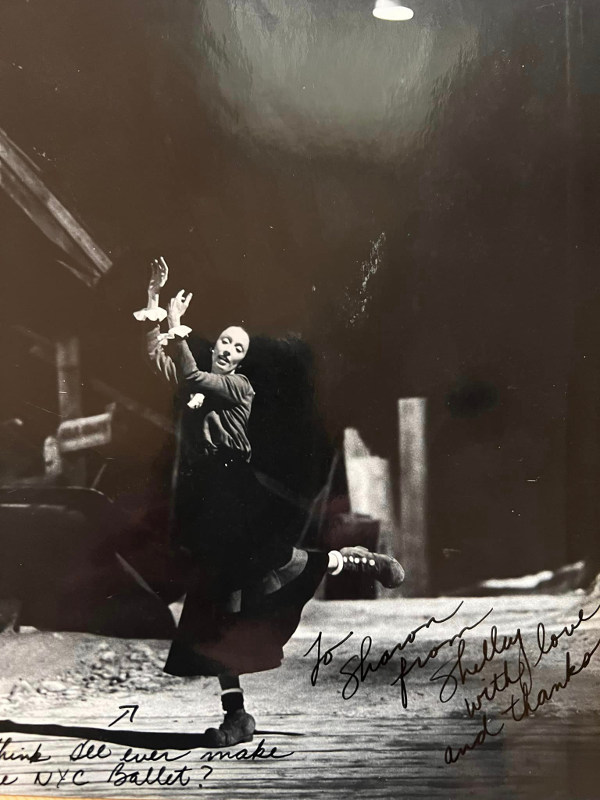
Photo: Sharon Kinney via ArtsMeme.
The recently deceased actress Shelley Duvall dancing as Olive Oyl in director Robert Altman’s Popeye (1980). 

One of the films that the late, versatile actor Shelley Duvall was best known for was her wistful interpretation of a cartoon character — Popeye’s girlfriend Olive Oyl.

Website ArtsMeme says, “Duvall (1949-2024), who recently passed away, led a long and memorable career primarily as a character actress, but in this case she played a full leading role countering Robin Williams as Popeye. …

Sharon Kinney … the creator/choreographer/coach of Shelley’s special dance, tells us that Duvall did her own singing in the number. She was not dubbed, which would be common in this circumstance.

“The dance world reveres Sharon for having been one of choreographer Paul Taylor‘s original dancers in his iconic dance company. But since retiring from performance, she has led a fruitful career as an instructor at Cal State Long Beach, as a filmmaker and indeed as a dance-film choreographer/coach living in Los Angeles. Sharon shared with Facebook friends her memories of working with the lanky Ms. Duvall in staging a solo song ‘He Needs Me,’ in the Altman film.

“Sharon reminisced, ‘She was so professional, so invested and really wanted to personify Olive Oyl and her love for Popeye! She did great things before with Altman and had just finished The Shining with Stanley Kubrick! She then went on to do some other great work with Faierie Tale theater!’

“Shelley Duvall’s inscription to Sharon Kinney on the glossy photo [above] is good natured. ‘Think I’ll ever make New York City Ballet?’ she mused. Dance ‘people’ will recognize the innate beauty of her pose that is rooted in the cartoon version of OO as gangly. Even in her clodhopper shoes, this Olive Oyl is luscious.” Check out YouTube videos of Duvall singing “He Needs Me” and “He’s Large,” in which she’s defending an early attachment to the character Bluto.

In a comprehensive reminiscence after her death, Owen Gleiberman at Variety notes, “In Robert Altman’s Popeye, an early visionary/cracked comic-book musical. With goldfish eyes, pursed lips, and a Victorian knot of hair set off by her dainty clenched-fist pose of adoration, Duvall gave a performance as Olive Oyl that was so perfect it was almost a joke.

“As an actor, Duvall could seem naturally stylized, which made Olive a role she was born to play. Yet within all that, she found a reservoir of heart. The highlight of Popeye might be Duvall’s performance of ‘He’s Large,’ in which Olive explains her devotion to the oversize Bluto with a girlish defiance that’s indelible.

“And indelible, make no mistake, was the word for Shelley Duvall. She imprinted her presence upon you; once you’d seen her, you couldn’t forget her. It was Altman who first had that reaction. In 1970, a few months after MASH came out and made Altman the hottest director in Hollywood (a status that wouldn’t last long — he was far too independent an artist), he was shooting his next feature in Houston, a fantasy comedy called Brewster McCloud, when he met Duvall at a party and, encouraged by a handful of crew members, decided to cast her in the movie.

“She’d had no experience as an actor. What they were all reacting to was what you can only call Duvall’s being — the eyes that were like something out of anime, her rabbity two front teeth, and a quality that could make you laugh or break your heart: the softness of her gaze, the tender passive radiance with which she looked out at the world.”

More at ArtsMeme, here, amd at Variety, here.

Alcohol-Free Comedy Club

Photo: SoBar Comedy.
SoBar Comedy worked in collaboration with Dray Drinks, Boston’s first non-alcoholic bottle shop to assemble its lineup of non-alcoholic beers, wines and mocktails.

We’ve featured articles about watering holes that ban cellphones (here, for instance) so people can socialize without distractions. Turns out, there are also people who hate all the alcohol that flows at comedy clubs, people who would really like to enjoy the comedy. Enter, Boston’s SoBar.

WBUR Radio’s Elijah Nicholson-Messmer reports, “When John Tobin started working as a door person at a local comedy club in the early ‘90s, his boss asked him how he liked the work.

“ ‘I love being in the comedy business,’ Tobin said.

“But his boss Dick Doherty, a legend in the city’s comedy scene who drank and drugged his way through the ‘60s, ‘70s, and early ‘80s, was quick to correct him.

” ‘You’re not in the comedy business,’ Tobin recalled Doherty saying. ‘You’re in the alcohol business.’

“Over three decades later, that business has started to change. Younger adults are drinking less than they did 10 or 20 years ago and show producers like Tobin and his business partner Norm Laviolette are taking notice.

[In June] they launched SoBar Comedy, the country’s first sober-curious comedy club [to host] bi-weekly improv and stand-up shows, located in Faneuil Hall.

“Tobin and Laviolette own and operate some of the biggest comedy clubs across New England, including Laugh Boston and Improv Asylum. Laviolette said they started noticing the trend at their other comedy clubs, where food and beverage sales form a cornerstone of the business model. The pattern soon became clear — younger audience members were increasingly forgoing beers and cocktails when going out.

“ ‘As we started to watch we’re like, “Well, geez, maybe there’s an opportunity . . . to do something that speaks directly to that mindful drinking, sober-curious [mindset],” ‘ Laviolette said. …

“On opening night at SoBar, some folks were excited to sample the non-alcoholic beers and mocktails on offer, crafted in collaboration with Dray Drinks, Boston’s first non-alcoholic bottle shop. …

“Performing comedy for an all-sober audience is a daunting task for some comedians, but for Corey Manning, who headlined and hosted SoBar’s inaugural show, having an alcohol-free night of comedy comes with plenty of upside.

“ ‘One of the things that’s different about a sober show than the regular comedy show is that I didn’t have to deal with a drunk audience member, which is always a good thing not to have to do,’ Manning said.

“This December, Manning will celebrate 30 years of sobriety from drugs and alcohol. Now, he helps others as a substance misuse counselor. But in the early years of his sobriety, performing in comedy clubs across the country made that journey challenging. …

“Crowds and performers expect alcohol at comedy clubs like they expect popcorn at a movie theater, Manning said. But for audiences and comedians who want a fun night out without the drinking, that relationship can be far from ideal. Over the years, Manning’s sobriety has helped other comedians as well.

“ ‘Because I have been consistently the person that didn’t drink at comedy shows, it actually has inspired other comedians who are having difficulties with drinking and stuff like that to not drink,’ Manning said. ‘And one of the things that I also started trying to do is work that material into my set, because sometimes I hit home with someone in the audience.’

“Other comedians like Mary Spadaro, who performed at SoBar’s opening night, make an asset of their sobriety, flipping what could easily be a heavy subject into fresh comedy material.

“Decades after Tobin got his start as a comedy club door person, his old boss’s words still ring true for much of the industry today. Many comedy clubs across the country are still very much in the alcohol business. But for Tobin and Laviolette, it’s all about putting the comedy first.”

Uh-oh. I found that the club is on hold until “early 2025.” I hope it succeeds long term. With two successful clubs under their belts, I think the owners know what they’re doing. Maybe summer was just not the best time to launch in Boston. Do you think a sober comedy club could thrive where you live?

More at WBUR, here.

The Play in the Prison

Photo: A24.
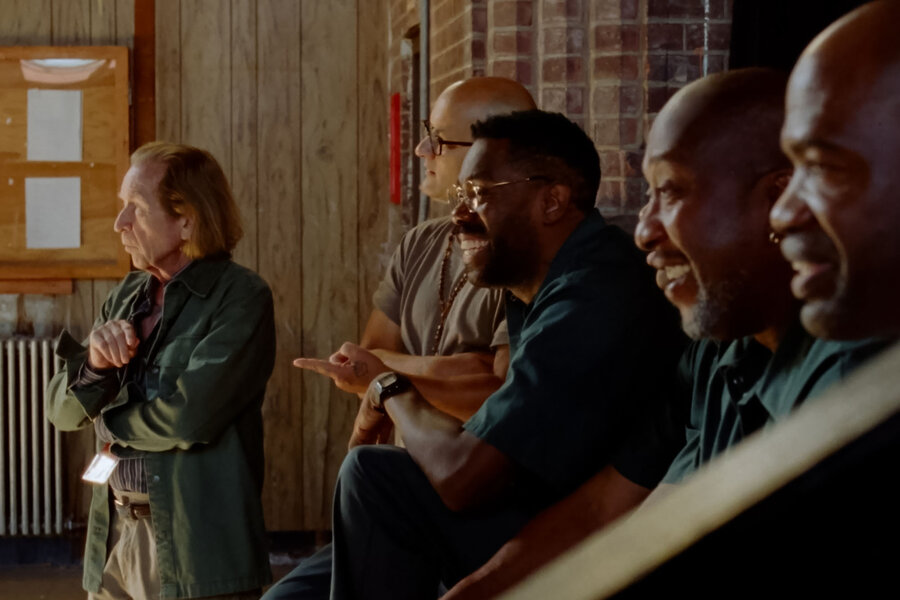
From left, Paul Raci, Sean San José, Colman Domingo, Sean “Dino” Johnson, and Mosi Eagle star in Sing Sing.

There are certain kinds of stories that always get my attention, and I’m grateful when other people find the same things interesting. Things like climate change, entrepreneurs, immigration, the kindness of strangers, housing, and life after prison. Just to name a few.

So you may be sure I liked today’s story about a theatrical production at a prison and the movie made about it.

Stephen Humphries writes at the Christian Science Monitor, “The world’s most unpredictable play only had one performance. It was staged inside a prison. The comedy, Breakin’ the Mummy’s Code, is about a man from ancient Egypt who embarks on a time travel adventure. Along the way, he encounters Robin Hood, Roman gladiators, cowboys, Hamlet, pirates, and – because why not? – Freddy Krueger from The Nightmare on Elm Street. It included a Shakespeare soliloquy – plus dance numbers. 

Breakin’ the Mummy’s Code was created by incarcerated men inside Sing Sing Correctional Facility in New York. It received a standing ovation in Cellblock B.

Now, a new movie explores the play’s legacy: the healing effect it had on its participants.

Sing Sing, directed by Greg Kwedar, reenacts the making of Breakin’ the Mummy’s Code. It even stars one of the play’s original actors. Already generating Oscar buzz, the movie … chronicles a budding friendship between two incarcerated men. Thematically, it’s about identity. The characters live in a hypermasculine environment that venerates bravado, toughness, and aggression. But the amateur actors come to discover that empathy, vulnerability, and tenderness are strengths, not weaknesses. The movie makes a case for the rehabilitative impact of arts programs inside prisons.

“ ‘I was a witness to it,’ says Mr. Kwedar, who taught an acting class in a prison with his creative partner, Clint Bentley, as part of their research. ‘I think the greatest teacher is what it’s like to step into another character and move in their shoes and step outside of yourself. That is a process of empathy’. … It gives you a prism to look at all the relationships in your life and to see perspective.’ …

“[Mr. Kwedar] spent seven years developing Sing Sing with Rehabilitation Through the Arts (RTA), the nonprofit that runs the theater program.

“There are dozens of similar theater projects across the United States. Perhaps the most well-known is Shakespeare Behind Bars. That program, which operates in three prisons in Kentucky and in one in Michigan, boasts a 6% recidivism rate for those who have participated in its productions. The Monitor was the first publication to write about that program. Then it became the subject of an award-winning 2005 documentary, Shakespeare Behind Bars

“ ‘Prisons function on shame and guilt,’ says Shakespeare Behind Bars founder Curt Tofteland, who has longtime collegial connections with the RTA. ‘But shame and guilt doesn’t change behavior. Why? Because shame and guilt doesn’t change thinking.’ …

“When change does happen, it’s a result of the actors exploring questions that the scripts raise, including ‘Who am I?’ 

“The two men at the heart of the story – John ‘Divine G’ Whitfield (played by Colman Domingo) and Clarence ‘Divine Eye’ Maclin (who portrays himself) – had to grapple with those existential questions. As the film unfolds, the audience learns that Mr. Maclin was one of the most feared men in the prison. Acting freed him to shed the gangster identity he’d clung to. The program helped him learn to express emotions. He even cried onstage. Now, he’s a natural performer on screen. …

“ ‘This is a movie about the landscape of the human face,’ says Mr. Kwedar. ‘It’s about drawing close to someone and looking them in the eyes and hearing their stories, and to know their names. And when you do that, it’s impossible to see that person as anything less than human.’

Sing Sing was filmed inside a recently decommissioned prison in New York. Its cast of established and first-time actors includes 13 RTA alumni. The production employed community-based filmmaking. For starters, it had a nonhierarchical pay structure. Everyone on set … was paid the same rate. …

“Last month, the director screened the movie inside the Sing Sing facility itself. He calls it the most profound theatrical experience of his life.”

More at the Monitor, here. No paywall. Subscriptions encouraged.

Art: Charlotte Holden.
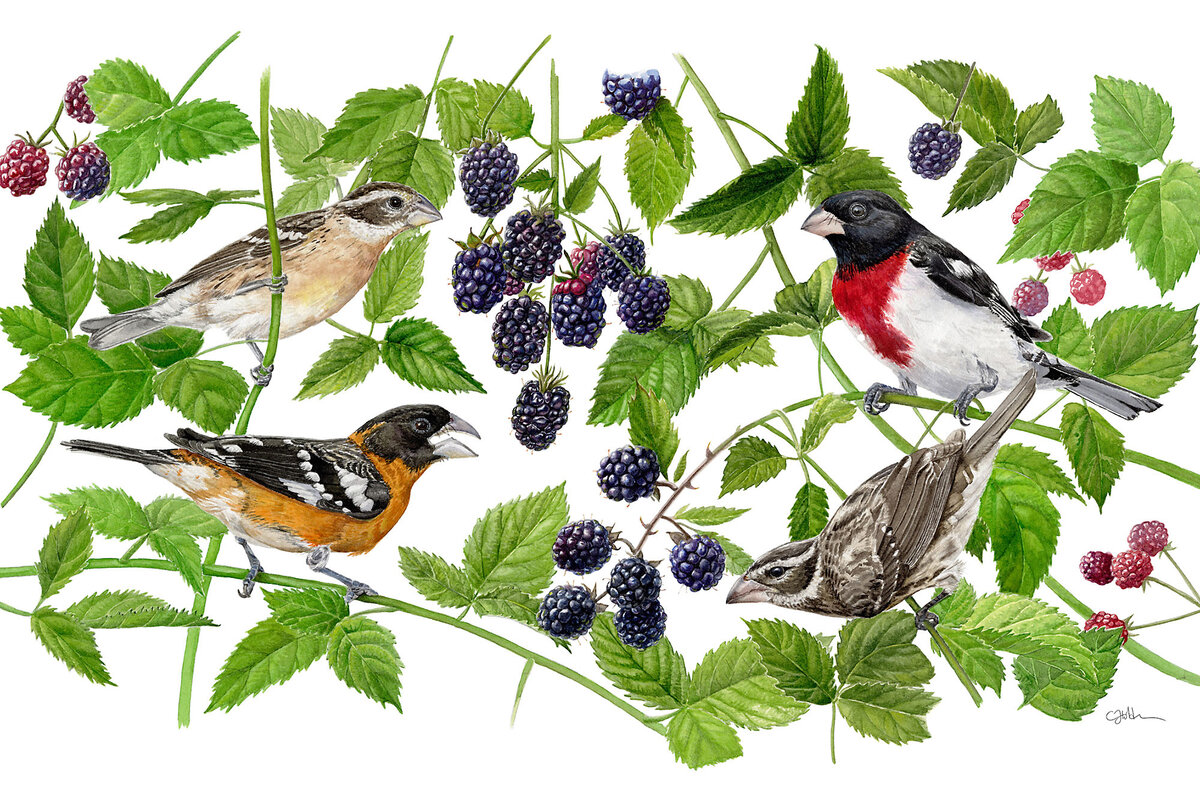
A watercolor by Charlotte Holden, one of the artists in the Bartels Science Illustration Program at the Cornell Lab of Ornithology in Ithaca, New York, was used on the 2023 mug sent to members of the Ornithology Lab.

Our family has a lot of bird mugs. You may have some, too, especially if you have supported any environmental organization. As important as it is to protect creepy crawly insects, say, or an ugly fungus, those things don’t make great tea cups. Everyone, however, loves birds.

Today’s story is about the contemporary artists behind the bird art on your holiday cards, calendars, and coffee mugs.

Stephanie Hanes wrote at the Christian Science Monitor, “When international researchers recently discovered that a population of hummingbirds in South America was actually two distinct species – a finding made after much trekking and tracking and genome sequencing – they called on Jillian Ditner to help explain their work.

“Ms. Ditner is a bird illustrator at Cornell University’s Lab of Ornithology. And in her rendering, she could highlight the distinctions between Patagona gigas, the southern giant hummingbird, and Patagona sp. nov., the new northern giant hummingbird. …

“The birds look nearly the same. But look closely, and the plumage on the right has a bit more reddish-brown saturation. There is more distinct coloration around the northern’s neck; a beak that extends just a bit longer. 

This is one of the skills of the bird illustrator. More so than a photographer, Ms. Ditner explains, these artists can accentuate and highlight differences in species.

“They can exaggerate just a bit the ideal features that help reveal an animal’s distinct parts; play with that boundary between reality and understanding. 

“ ‘Photographs are always going to be limited,’ she says. ‘With scientific illustrations – you can take endless angles of a photograph and put them in one picture … there’s the ability to condense a lot of detail into one visual.’

“Ms. Ditner runs Cornell’s unique Bartels Science Illustration Program, a year-long fellowship for bird artists that has seen skyrocketing popularity since its founding two decades ago. (This year, Ms. Ditner received 215 applications for the solo spot; that’s up from a few dozen, she says, when she started in her position six years ago.) The Bartels program is part of Cornell’s Lab of Ornithology, which many birders in the area just call ‘the Lab.’ …

“At a time when a global library of digital images lives in one’s pocket, when attention is fought over and commoditized, there is something precious about the act of deep observation and the hand-drawn beauty that science illustration requires.  

“The bird artists at the Lab are specialists in that larger field of science illustration, a profession that includes everything from botanical sketches and renderings of the solar system to medical drawings and wildlife art. 

“Despite advances in both photography and artificial intelligence, the scientific illustration field is growing, say those who work in the field. According to The Franklin Institute, Philadelphia’s renowned natural history museum, new technology has only increased the need for science illustrators, who can help bring either nanoparticles or galaxies to a comprehensible scale; a handful of colleges have science illustration programs.

“Charlotte Holden, an artist and longtime bird lover, was one of the Bartels Illustrators in 2002. During her time in the program, Ms. Holden worked with researchers, studied bird anatomy, and honed her realism style by combining bird images with illustrations of their native flora. Like many who go through the program, her work appeared in Cornell’s Living Bird magazine, on posters, and on other materials. …

“Although Ms. Holden has been watching birds ever since she was a child outside of New York City, it was only by drawing, she says, that she began to recognize details like a bird’s different feather groups, or unique colors. 

“It’s like life, she says. It’s hard to see the details when everything is in motion. Ornithological art slows us down. It has a long history that blurs science and art and wonder; a moment to pause and appreciate the world around us. …

” ‘Art in itself is just very inspiring,’ says Maria Klos, a 2023 Bartells Illustrator who now lives in California. ‘It seems to always draw people in.’  

“One of Ms. Klos’ projects during her time in the program was to draw a pair of life-size American condor wings, which are now attached to one of the Lab’s exterior walls. Visitors can put their arms up against the image to see how their own ‘wingspans’ measure up; one more moment of art, bird, and human together.  

“Both Ms. Klos and Ms. Holden have continued their jobs as professional illustrators; both recently put on shows of their art and both say they are inspired to continue drawing nature professionally. The Bartels program has opened doors to new professional contracts, they say, but also a new way of seeing the world.

“ ‘It fosters a deeper connection to nature … when you just sit with it and observe it,’ Ms. Klos says. ‘You see things that you might have been overlooking for a long time, or might never have noticed if you didn’t sit down with it and draw it.’ ”

More at the Monitor, here. No paywall.

Photo: Jean Ogden via Wikimedia.
Navajo Churro sheep.

There’s a story at National Public Radio about the special relationship between a kind of sheep and the Navajo people, or Diné. Ayesha Rascoe hosts the NPR program, which you can listen here, if you prefer.

Ayesha Rascoe: For centuries, the lives of Navajo people have been intertwined with livestock — specifically, one particular breed of sheep they’ve relied on for meat and wool. The tribe is well known for weaving the wool of Churro sheep into colorful clothing and tapestries. Those weavings can fetch thousands of dollars from collectors, but they have far more than monetary value. Raising Churro sheep and weaving their wool is an important way Navajo people pass cultural knowledge from generation to generation. KSJD’s Chris Clements visited a Navajo Churro sheep celebration.

Chris Clements: Inside a crowded farmhouse on the edge of the Navajo Nation, weavers are demonstrating how to spin, dye and treat wool from Churro sheep, which they consider sacred.

Roy Kady: Hello. My name is Roy Kady. I am from Goat Springs, Ariz.

Clements: Kady, who’s in his 60s, is standing outside, wearing an ornate turquoise necklace, earrings, bracelets, and a white hat. He’s considered a master weaver, part of centuries of Navajo citizens who’ve carried on traditional beliefs that date back to the 1500s when Churro sheep arrived with early Spanish colonists.

Kady: I’m filling these big shoes that my mother wore as an agropastoralist.

Clements: Tyrrell Tapaha is Kady’s student and his grandson, who’s here at the event. …

“Tyrrell Tapaha: There’s always been weaving in my life, whether it be his work, my grandma’s work, or my great-grandma’s work. ..

“Kady: Tyrrell [says] I want to weave a human form. Do you have any ideas how I could do that? And so I just share with him. …

“Clements: Tapaha has been learning the tricks of the trade since he was very young. When he was only 8, Kady had him teach a class on the art of finger weaving at a nearby chapterhouse. … Tapaha knows that Kady’s teachings will live on with him.

“Tapaha: At least it’ll last my lifetime, you know? And I kind of hear that in how Roy talks about his contribution to the space is like him being an older person now and kind of seeing that handed off.

“Clements: After the morning’s presentations, it’s time for lunch. The weavers roast mutton, a Churro sheep they slaughtered earlier in the day. Participants of the sheep celebration gather around the grill, watching the fire hiss and sputter as the mutton cooks. It’s common for every part of the animal to be used. Nothing, not even its hooves goes to waste.

“In 1863, the U.S. military forced Navajo people to leave their ancestral homelands and relocate to an internment camp. It’s known as the Long Walk. … It almost led to the extinction of the Churro sheep.

“Navajo people were allowed to return home four years later. Some tribal members who’d managed to escape the Long Walk, kept some Churro alive. And today, thousands of Churro sheep live on or near the Navajo Nation.”

Read more about the sheep and the passing along of Diné culture at NPR, here.

Image: CNN.
When you see phrases like “intricate interplay,” a concept I illustrate with this CNN image, suspect AI. There are lots of other common usages to be alert to.

Hello, Word People. That is, People Who Are Fascinated by Words. When you do online searches in the future, will you know what words and phrases may indicate AI behind the scenes? Kyle Orlando has some answers at Ars Technica.

“Thus far, even AI companies have had trouble coming up with tools that can reliably detect when a piece of writing was generated using a large language model [LLM]. Now, a group of researchers has established a novel method for estimating LLM usage across a large set of scientific writing by measuring which ‘excess words’ started showing up much more frequently during the LLM era (i.e., 2023 and 2024). The results ‘suggest that at least 10 percent of 2024 abstracts were processed with LLMs,’ according to the researchers.

“In a preprint paper posted earlier this month, four researchers from Germany’s University of Tübingen and Northwestern University said they were inspired by studies that measured the impact of the Covid-19 pandemic by looking at excess deaths compared to the recent past. By taking a similar look at ‘excess word usage’ after LLM writing tools became widely available in late 2022, the researchers found that ‘the appearance of LLMs led to an abrupt increase in the frequency of certain style words’ that was ‘unprecedented in both quality and quantity.’

“To measure these vocabulary changes, the researchers analyzed 14 million paper abstracts published on PubMed between 2010 and 2024, tracking the relative frequency of each word as it appeared across each year. They then compared the expected frequency of those words (based on the pre-2023 trend line) to the actual frequency of those words in abstracts from 2023 and 2024, when LLMs were in widespread use.

“The results found a number of words that were extremely uncommon in these scientific abstracts before 2023 that suddenly surged in popularity after LLMs were introduced. The word ‘delves,’ for instance, shows up in 25 times as many 2024 papers as the pre-LLM trend would expect; words like ‘showcasing’ and ‘underscores’ increased in usage by nine times as well. Other previously common words became notably more common in post-LLM abstracts: The frequency of ‘potential’ increased by 4.1 percentage points, ‘findings’ by 2.7 percentage points, and ‘crucial’ by 2.6 percentage points, for instance.

These kinds of changes in word use could happen independently of LLM usage, of course — the natural evolution of language means words sometimes go in and out of style.

“However, the researchers found that, in the pre-LLM era, such massive and sudden year-over-year increases were only seen for words related to major world health events. …

“In the post-LLM period, though, the researchers found hundreds of words with sudden, pronounced increases in scientific usage that had no common link to world events. … The words with a post-LLM frequency bump were overwhelmingly ‘style words’ like verbs, adjectives, and adverbs (a small sampling: ‘across, additionally, comprehensive, crucial, enhancing, exhibited, insights, notably, particularly, within’). …

“The pre-2023 set of abstracts acts as its own effective control group to show how vocabulary choice has changed overall in the post-LLM era.

“By highlighting hundreds of so-called ‘marker words’ that became significantly more common in the post-LLM era, the telltale signs of LLM use can sometimes be easy to pick out. Take this example abstract line called out by the researchers, with the marker words highlighted: ‘A comprehensive grasp of the intricate interplay between […] and […] is pivotal for effective therapeutic strategies.’

“After doing some statistical measures of marker word appearance across individual papers, the researchers estimate that at least 10 percent of the post-2022 papers in the PubMed corpus were written with at least some LLM assistance. The number could be even higher, the researchers say, because their set could be missing LLM-assisted abstracts that don’t include any of the marker words they identified. …

“Papers authored in countries like China, South Korea, and Taiwan showed LLM marker words 15 percent of the time, suggesting ‘LLMs might … help non-natives with editing English texts, which could justify their extensive use.’ On the other hand, the researchers offer that native English speakers ‘may [just] be better at noticing and actively removing unnatural style words from LLM outputs,’ thus hiding their LLM usage from this kind of analysis.”

More at Ars Technica via Wired, here.

Photo: Etsy.
Antique button hook for shoes.

Recently, Suzanne’s friend Jackie Delamatre has been researching and writing about unfamiliar utensils like grapefruit spoons. There sure are an array of antique gizmos for her to choose from, and lots of new ones.

Don’t you love the word “gizmo”? It was so handy when Suzanne was a toddler and was asking too many times in 10 minutes “what’s this called, what’s that called?”

Today’s story explains why and how we use words like gizmo, whatchamacallit, thingamajig …

Ursula Kania, a senior lecturer in English Language and Linguistics, at the UK’s University of Liverpool, writes at the Conversation.

Years ago, humans started speaking and we’ve not shut up since. Sometimes, though, we struggle to remember the name of an object, a place, or a person we want to talk about. The technical term for this phenomenon is ‘lethologica.’ … Drawing the occasional, temporary blank is very common. Unsurprisingly, stress doesn’t help, and it gets worse as we age.

“But what can we do if we’re coming up empty yet still want to keep the conversation going? …

“We can hesitate, using so-called fillers like ‘ehm’ and ‘uh’ to buy us some time, in the hope that the right word will make a delayed but triumphant appearance. We can describe what we mean, hoping to still get the message across. … We may even be able to recall certain formal characteristics of the word, like the first letter or sound, or how many syllables it has and generously offer these clues to the puzzled listener: ‘You know – this guy we met last week, I think his name starts with a G.’

“This is why we also call this the tip-of-the-tongue phenomenon. We’ve almost got it, and our brain is doing its best to use all stored bits of information (for example, on the word’s pronunciation and meaning) to come up with something useful to say, even if it isn’t the correct word itself.

“Sometimes, this results in us making up words on the spot (referred to within linguistics as ‘spontaneous’ or ‘ad-hoc coinages’). You may not find them in the dictionary, but they usually still make sense in context.

“Even young children already come up with them in an attempt to put into useful practice what they’ve already learned about language. …

“My favorite example in this category, though, is a Tweet about a German customer in a Welsh pub who couldn’t recall the word ‘cutlery’ and politely asked for ‘food weapons.’

“Last but certainly not least, we may use ready-made placeholders like ‘thingamajig,’ ‘whatchamacallit’ (for an object) or ‘what’s-his-name’ (for a person).

“Apparently, the struggle to find the right word is real and has been for some time, because the Oxford English Dictionary has its own category for these terms, labelled ‘thing or person whose name is forgotten or unknown.’ It includes 64 entries and some records go back as far as the early middle English period (1100–1300).

“Not all of them are still used today. The last attested use for the strangely evocative whiblin’ was in 1652, for example, and ‘jiggumbob’ is marked as obsolete.

Others, like ‘gizmo’ or ‘doodah’ are still going strong, though, and you can even buy ‘Whatchamacallits’ and ‘Whozeewhatzits’ – they are chocolate bars made by Hershey’s.

“There are threads on Reddit dedicated to collecting placeholder words in English and from around the world. They are worth exploring, with gems like ‘doomaflitchie,’ the Dutch ‘huppeldepup’ and the German ‘dingsdabumsda.’ “

If you know any others, especially whatchamallits in non-English languages, do let us know. We old folks need lots of these substitutes. More at the Conversation, here. No paywall.

Photo: Lil Rhody Clam Cake Crawl.
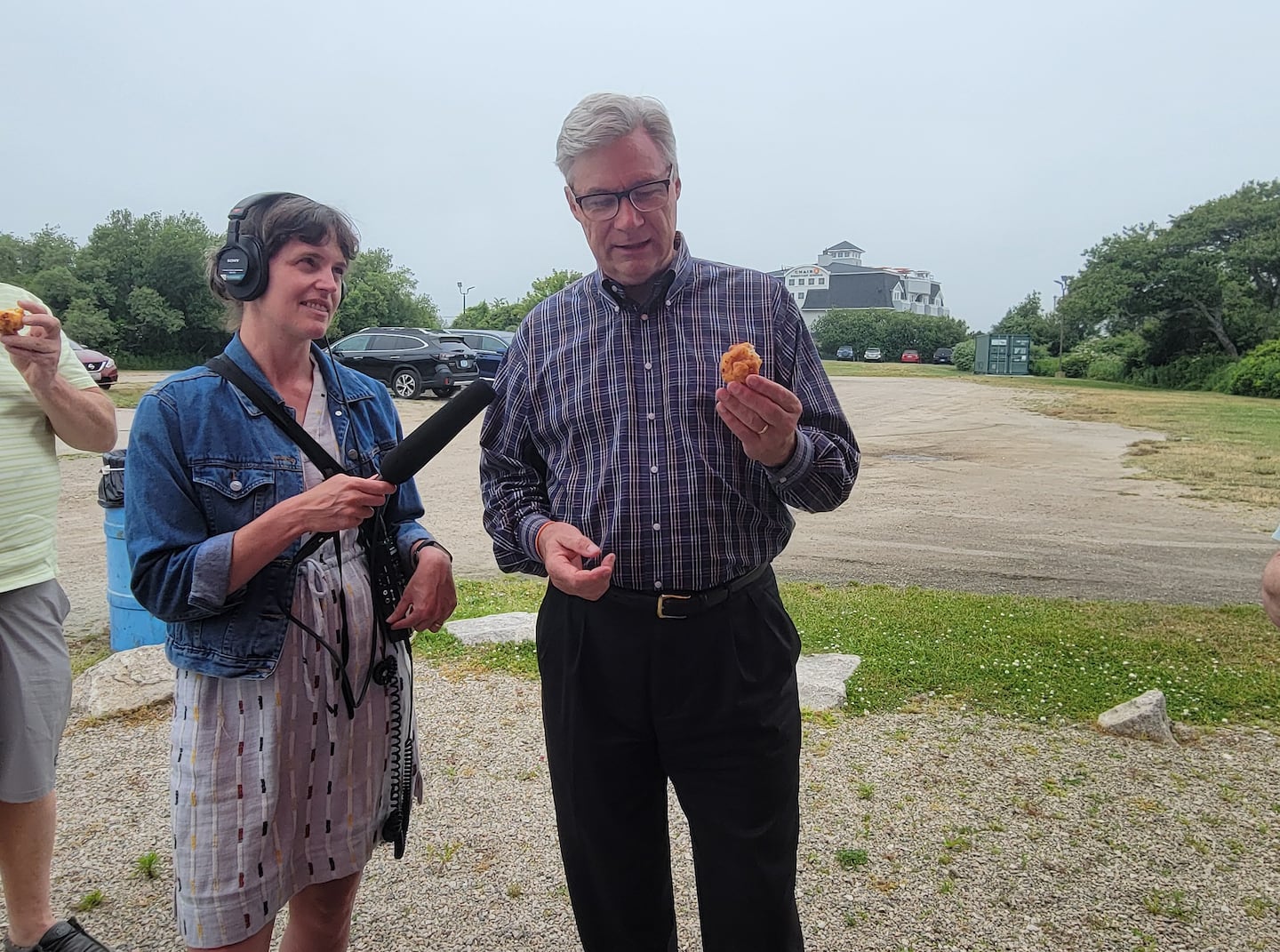
Megan Hall, left, producer of the Rhode Island Report podcast, listens as US Senator Sheldon Whitehouse analyzes a clam cake as part of the 10th Lil Rhody Clam Cake Crawl.

Rhode Island is justly proud of its clam cakes, which is why local enthusiasts launched an annual hunt for the very best.

At the Boston Globe, Ed Fitzpatrick wrote about one distinguished guest who lent his opinions to fellow Rhode Island “Clamarati” during the 10th Lil Rhody Clam Cake Crawl.

“As they stood outside Aunt Carrie’s Restaurant,” Fitzpatrick wrote, “Renee Bessette asked US Senator Sheldon Whitehouse why he had agreed to join the 10th Lil Rhody Clam Clake Crawl.

“ ‘A momentary lapse in judgment,’ Whitehouse replied with a laugh.

“But the Senate Judiciary Committee member grew serious when it came time to judge Rhode Island clam cakes using a rigorous seven-point rubric that includes ‘clam-to-cake ratio’ (does it have a lot of clams?), ‘clambiance’ (as an overall experience, would you go here again?), and ‘nubbins’ (Does it have protrusions, often clams, that can also be used as a handle as you eat?).

“ ‘Less on crispy. Smaller. More on tenderosity,’ Whitehouse said as he contrasted an Iggy’s clam cake with an Aunt Carrie’s clam cake.” Read all of the Senator’s insights at the Globe, here

Blogger Hunter Gather Cook also has a Rhode Island clam cake post, which includes a recipe that recommends using freshly ground clams if at all possible.

“Think clam beignet, or donut hole,” writes Hunter Gather Cook. “Only savory. Crispy, golden brown on the outside, pillowy and light on the inside. Steam rises from the first bite. The slightest aroma of brine surrounds you. Tiny chunks of clam nestle themselves in the folds of the pillow, offering surprising bites of chewy meatiness as you down one of these little glories after another. And another.

“With the possible exception of the Pacific Northwest, no region can boast mastery of the humble clam like New England. And within New England, it is Rhode Island that does it best. I have never seen these clam cakes any other place. They are a masterpiece of street food. …

“They are to me the gateway food of Block Island, which is the place I learned to forage and the place whose natural beauty I still hold closest to my heart. My fondest wish is to die an old man in a little cottage on that island. But not just yet.

“I am 3,100 miles from Block Island right now, a long way from Galilee and Rhody clam cakes. A few days ago, as I drove home from Bodega Bay, laden with clams, I realized that this was my first real chance to make clam cakes with fresh clams I had caught since I’d moved West years ago.

“I looked at my bucket of horseneck clams, dug an hour before. While they are certainly not the glorious quahog of my youth, they would do just fine in a clam cake — after all, you grind the clams anyway. …

“My recipe has no corn. More clams than the typical fritter, cake flour instead of all-purpose, and a touch of maple syrup. Maple syrup? Trust me. You need it.

“Now normally Rhode Island clam cakes are served with Tabasco and tartar sauce. … I am more of a Tabasco man. But I could not keep thinking about how much these were like New Orleans beignets. So I decided to break from Rhode Island tradition and add a little bit of the Big Easy to this recipe: Remoulade.

“If I thought I loved clam cakes before this, I may now be a clam cake junkie. … The recipe I made was way too much for Holly and I to eat at one sitting, but I decided to make them all anyway. We gorged ourselves on clam cakes until we were about to burst. I put the leftover cakes in the fridge.

“And you know something? They fried up almost as good the next day. Popped back in the deep fryer for 2-3 minutes, they came out fine.”

Any clam cake recipe including remoulade will horrify RI clamarati, but here goes. It starts with “canola or other vegetable oil for frying, 3 beaten eggs, 1/2 cup buttermilk, 1/2 cup clam broth, 1/2 cup cold beer, 2 teaspoons maple syrup, 1 1/2 cups chopped or ground clams, 1 teaspoon salt, 2 1/2 teaspoons baking powder, and 3 1/2 cups cake flour, or all-purpose flour.”

More at Hunter Gather, here.

Photo: Avener Prado.
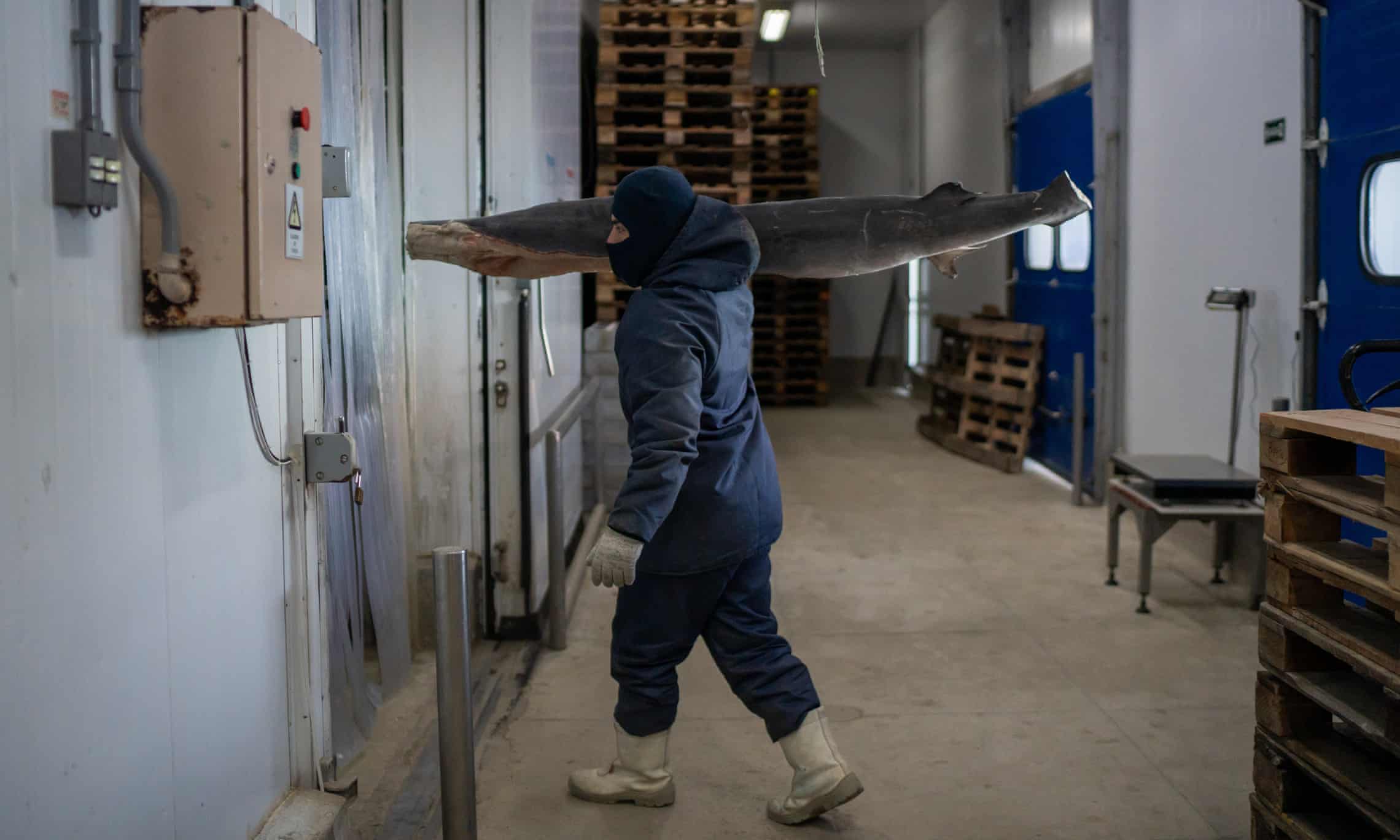
A trade that goes under the radar. Here, a blue shark is taken into cold storage in Cananéia, a fishing port in São Paulo state. Sharks reproduce slowly, but at least 80 million are killed annually
.

This is a sorry tale. Even if you don’t like the idea of swimming with sharks or keeping them as pets, I know you will be concerned that we are decimating their numbers. Today’s story explains that sometimes we are eating sharks without realizing it.

Constance Malleret reports at the Guardian that “worried conservationists say most people do not realize they are eating shark.

“The bright blue skies and calm waters of the estuary belie rough conditions at sea, and there is no sign of activity among the colourful fishing boats moored around the harbor of Cananéia, a sleepy fishing town 160 miles south of São Paulo.

“On the wharf, however, a delivery of frozen fish from Uruguay has just arrived and a few men in white gumboots are busy unloading pallets of beheaded specimens labelled Galeorhinus galeus – school shark. These thin grey fish will be kept in a cold store on shelves already stacked ceiling-high with carcasses of blue sharks, all awaiting processing and distribution to cities inland.

“ ‘Why do we work with shark?’ says Helgo Muller, 53, the company manager. ‘Because people like it; it’s good and cheap protein. It doesn’t give you crazy profits, but it’s decent enough.’

“Shark is just a small fraction of the firm’s business but they process about 10 tons a month, he says, mostly blue shark imported from countries including Costa Rica, Uruguay, China and Spain.

“Communities up and down Brazil’s 4,600-mile coastline have always eaten sharks. ‘It is part of our tradition,’ says Lucas Gabriel Jesus Silva, a 27-year-old whose grandfather moved to the area in the 1960s to fish sharks for their fins.

“However, the widespread appetite for shark meat that Muller’s company helps feed is now troubling scientists and environmentalists, who worry about unsustainable pressure on various species. …

” ‘Sharks are very vulnerable to overexploitation as they don’t reproduce as often or with as many offspring as bony fishes do,’ explains Prof Aaron MacNeil, of Canada’s Dalhousie University.

“Research published in April found that 83% of the shark and ray species sold in Brazil were threatened, according to the International Union for the Conservation of Nature (IUCN) classification.

“For years, conservation efforts focused on the fin trade with Asia and the barbaric practice of ‘finning’ – removing a shark’s fins and returning the wounded and helpless animal, often still alive, to the sea. But research from earlier this year suggests restrictions on finning have not reduced shark mortality, with at least 80 million sharks still being killed annually.

“ ‘Meat was kind of left by the wayside,’ says MacNeil, who is researching the global shark meat trade. ‘It’s only now we’re realizing how big the trade is. Its value has certainly exceeded that of fins.’ The pressure on sharks for food has risen in parallel with a decline in catches of other fish, he says.

“Traditionally, Brazilians ate shark in moqueca, a seafood stew from the states of Bahia and Espírito Santo. And many of Cananéia’s residents recall how their older relatives would use shark’s head broth and cartilage as homemade remedies. But now, sold in fillets or steaks, shark has been absorbed into Brazilians’ diet as it is cheaper than other white fish, boneless and easy to cook. It now appears in school and hospital canteens.

“The fact that few Brazilians realize they are eating shark has probably helped make it ubiquitous. While coastal people with a shark-eating tradition recognize the subtle differences in texture and flavor between shark species, to most Brazilians it is just cação – a generic term under which both shark and ray meat are sold. …

“Campaigners say the generic labelling prevents informed decisions by consumers, and this could even affect their health due to high concentrations of dangerous pollutants in these top predators. ‘If they knew, they might not eat it,’ says Ana Barbosa Martins, a researcher at Dalhousie University. …

“ ‘Fishers don’t cast their nets to catch shark specifically, but sometimes a [protected] hammerhead comes up. What can you do?’ says Lucia Rissato, who runs a fish stall in Peruíbe. … ‘We have to sell it in secret, like drugs.’ “

I guess, for vegans, getting tricked into eating shark meat is not an issue.

More at the Guardian, here. No paywall.

Photo: Minden Pictures/Alamy.
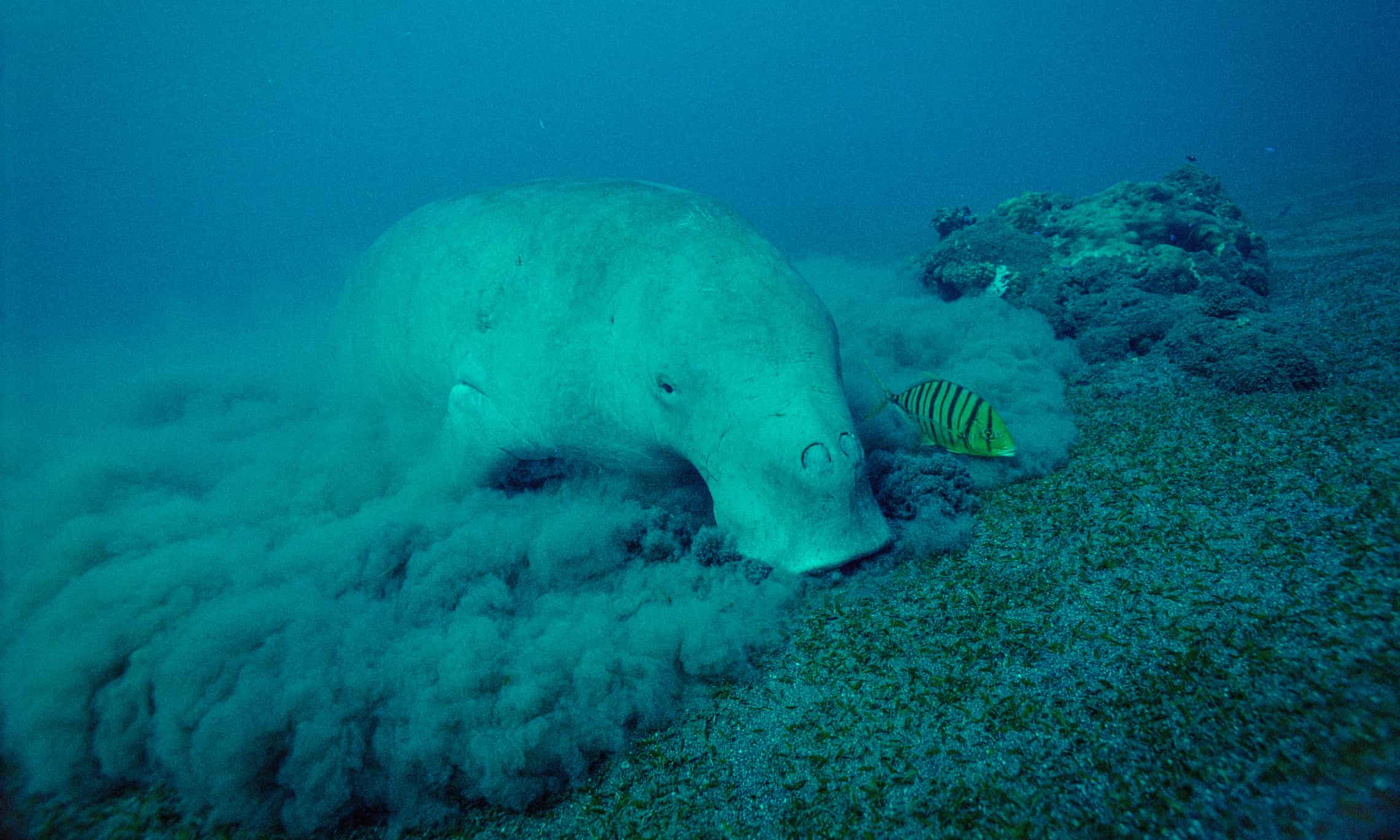
The rare sight of a dugong feeding on a seagrass meadow in Vanuatu. The gentle giants were once a common sight around the Melanesian archipelago.

Here’s an interesting story about a saltwater cousin of the shy freshwater manatee. It eats seagrass, and like most other living things in the ocean, it’s negatively affected by warming trends.

Rebecca Root writes at the Guardian, “In a bright spring day, the sun dances over the water of Havannah Bay on the island of Efate in Vanuatu. Below the surface, pockets of seagrass that can just about be seen from the shoreline, sway in the current. It’s here, if they are lucky, that onlookers may spot a dugong bobbing in the shallow water, orbiting the seagrass meadows they feed on.

“ ‘It’s wonderful seeing them swimming by and grazing off the seagrass in front of the resort,’ says Greg Pechan, the owner of a local hotel, the Havannah, which sits at the tip of the bay. Pointing out beyond the jetty that stretches into the Pacific Ocean, he says Vanuatu’s sea life is a big attraction for visitors to the Melanesian country.

“Light grey in color, dugongs, sometimes known as ‘sea cows’ and whose closest relatives are freshwater manatees, can grow up to four metres long and weigh up to 400kg (900lb). They are a ‘friendly species’ and respected by islanders, says Heidi Joy, a marine science student from Efate.

“A few years ago, it would not be unusual for Joy, who lives close to Havannah Bay, to spot a dugong in the morning and then again at sunset. That has since changed, she says. ‘We rarely see them now.’

“Dugongs are considered vulnerable to extinction by the International Union for Conservation of Nature. The exact number roaming Vanuatu’s waters is, however, unknown and this uncertainty is hindering conservation efforts, experts say.

“ ‘A lot of studies have been done where you’ve got large populations of dugongs in large seagrass meadows [such as] Australia or Abu Dhabi, but we’ve got a different dugong population. We’ve got small groups or individuals,’ says Christina Shaw, the CEO of the Vanuatu Environmental Science Society. She says that a national assessment of dugongs and seagrass in Vanuatu is urgently needed. …

“In 2023, the status of neighboring New Caledonia’s population was downgraded to ‘endangered‘ while east African dugongs have become ‘critically endangered.’ …

“In Vanuatu, however, only one aerial survey – in 1987 – has been carried out to assess the national distribution, abundance, cultural importance and threats, according to Helene Marsh, an emeritus professor in environmental science at James Cook University.

“Dugongs globally are threatened by gill-net fishing, boat traffic, coastal development and hunting. In Vanuatu, dugong meat used to be considered a source of protein, their oil used for cooking and other parts whittled into handicrafts.

“But since the 1980s, certain islands have introduced local prohibitions known as tabu, which mandates their protection. In 2010 the government also signed the Convention on Migratory Species’ dugong memorandum of understanding, committing it to protecting the sea cows and the seagrass they eat. This means hunting is now rare, says Shaw.

“Instead, another predator threatens the dugong: the climate crisis. On a spring evening in Efate, rain hammers relentlessly until nightfall, rendering the ocean a murky green. It’s downpours such as this, becoming more common, alongside storms and cyclones, that damage the seagrass so vital to the dugongs.

“Vanuatu sits in the Pacific ‘Ring of Fire,’ a tectonic belt of volcanoes and earthquakes, and a tropical cyclone region, making it prone to disasters. When these batter the bays and beaches of Vanuatu, the seagrass is swept up by the heavy winds, while the rain and debris creates sediment on the water surface, smothering the seagrass from the sunlight it needs to thrive. …

“Richard Leck, head of oceans at WWF Australia, says: ‘When that happens dugongs have no choice but to get on the move and sometimes they have to go into deeper water, expend much more effort to graze seagrass and when that happens they often get emaciated and lose condition really quickly.’ …

“As with dugongs, there is limited data on the prevalence and condition of seagrass in Vanuatu. This makes it hard, says Shaw, to advocate for investment in conservation. ‘Funders don’t like paying for studies,’ she says. ‘But how do we do [conservation] if we don’t know what’s there?’ ”

More at the Guardian, here.

Photo: Okinawa Institute of Science and Technology.
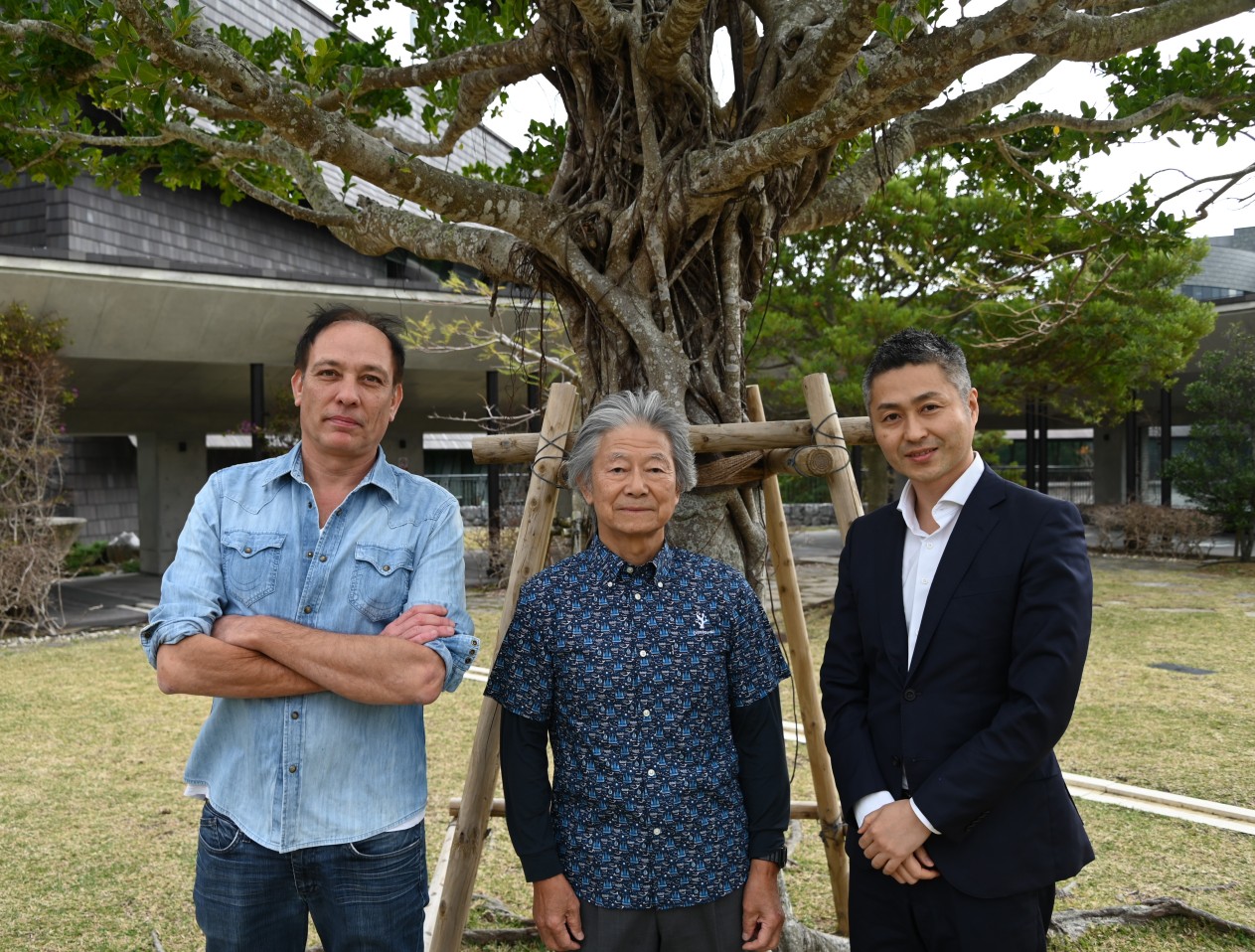
Prof. Timothy Ravasi, Prof. Noriyuki Satoh, and Shimon Sato (L-R) lead the Coral Project at OIST, a nonprofit initiative helping conserve coral biodiversity in Okinawa. 

It is now generally known that corals are important for ocean biodiversity but are in danger from climate change. If you search on “coral” at this blog, you will find a variety of stories about what people are trying to do to help.

Today we look at an organization in Japan that merges the work of local people to that of scientists.

The website of the Okinawa Institute of Science and Technology (OIST) says, “Unlike many global reef locations requiring a boat ride, Okinawa’s reefs are accessible directly from the beach — a simple walk to a nearby beach, a quick dip into the crystal-clear waters, and within moments, you are immersed in a lively ocean community. 

“Yet elders in Okinawa remember a time when coral-filled waters were more abundant, a contrast to the significant coral decline observed in recent years, especially near shorelines. Worldwide, human activities have resulted in an alarming decrease in coral populations in the last decade. Consequently, efforts to plant corals are gaining momentum. 

“The OIST Coral Project, an initiative focused on studying and preserving coral biodiversity in Okinawa, was launched in July 2023 at the Okinawa Institute of Science and Technology (OIST). To date, the project has successfully enlisted the support of 20 companies in Okinawa and mainland Japan. …

“In January 2023, Prof. Noriyuki Satoh, head of OIST’s Marine Genomics Unit, sat down with Shimon Sato, an experienced fundraiser and Advancement Officer at OIST. They came up with an ambitious idea: to use knowledge of genomics and eDNA in a new project to plant and conserve coral in Okinawa. This was the start of an innovative effort to protect local marine life by connecting with locals and companies in Okinawa and Tokyo to establish potential collaborations. 

“Prof. Satoh and his team at the Marine Genomics Unit achieved groundbreaking milestones by decoding the genomes of corals in 2011, zooxanthellae (symbiotic organisms that coexist with corals) in 2013, and the crown-of-thorns starfish (known for devouring corals) in 2017. …

“Using this knowledge, Prof. Satoh identified the best types of coral that can be planted at specific sites in Okinawa. … Permission was granted by Okinawa Prefecture and planting is done by professional vendors, following Japan’s strict coral planting regulations.

Each planting site is overseen by a different fishermen’s organization, each with its own unique team and structure.

“Before planting, Prof. Satoh engages in negotiations with the fishermen’s organizations, explaining the project’s objectives and benefits. These fishermen, who have a deep understanding and respect for the sea, are important allies. …

“Yet this project is not just about planting corals — scientists also conduct eDNA monitoring of corals and study the fish that arrive after the planting, observing which species are on the rise or decline. …

“Cause-related marketing is one of the unique aspects of this project. This is an approach where businesses associate themselves with societal issues or values by working with non-profit organizations to promote a specific cause. …

“ ‘We began with 8 companies, including Japan’s largest mobile company NTT Docomo in Tokyo and several others in Okinawa.’ … Supporting companies can use the project’s [logo]. Ryukyu Cement Co., Ltd., the largest cement company in Okinawa, displays the logo on their cement bags and donates a portion of their cement sales to the project. Another notable supporter is Majun, the leading Kariyushi wear company in Japan. Majun has created an original 100% cotton Kariyushi t-shirt embroidered with the Coral Project logo. …

“In 2018 Onna Village, where OIST is located, was declared a ‘coral village’ or ‘sango no mura’ in Japanese, and in 2019 the Government of Japan declared the village a ‘Sustainable Development Goals Future City.’ Impressively, the practice of coral planting in Onna Village began two decades ago. In 2004, a local organization, Team Churasango, was established by community members with participation from both local and mainland companies. On average, they plant 1,000 corals annually, in response to the observed decline in coral numbers. …

“The project team has recently welcomed a third person – Prof. Timothy Ravasi, leader of the Marine Climate Change Unit at OIST. Prof. Ravasi’s unit uses the latest methods in genomics to study how marine organisms adjust to warmer and more acidic oceans. …

“Shimon attributes the success of the project to two main factors. First, Prof. Satoh’s expert knowledge of corals and excellent people skills. Second, the project has secured the support of numerous stakeholders. … ‘Okinawan people value coral, and they want to return the coral reefs to their previous beautiful and healthy state. We want to support those hopes using the power of science,’ he said.”

More at the Okinawa Institute of Science and Technology, here. And you can click here to read about how OIST got the Isawa Award for this work.