June 4, 2012 by suzannesmom
You remember the advice at the end of Voltaire’s Candide? “Il faut cultiver ton jardin”? Increasing numbers of people are finding the advice to cultivate a garden a good idea for our times. But the implication of minding one’s own business is not part of it as people become more neighborly and create better communities through gardening.
“In 2002,” writes Katherine Gustafson at YES! Magazine, “two neighbors armed with spades and seeds changed everything for crime-addled Quesada Avenue in San Francisco’s Bayview-Hunters Point area.
“The street had been ground zero for the area’s drug trade and its attendant violence. But when Annette Smith and Karl Paige began planting flowers on a small section of the trash-filled median strip, Quesada Gardens Initiative was born. Over the course of the next decade, the community-enrichment project profoundly altered the face of this once-blighted neighborhood.
“Jeffrey Betcher is the initiative’s unlikely spokesperson. A gay white man driven to the majority-black area by the high cost of housing elsewhere, he moved into a house on Quesada Avenue in 1998 to find drug dealers selling from his front stoop and addicts sleeping beneath his stairs. He told me about the day that he returned home from work to discover that his neighbor Annette had planted a little corner of his yard.
“ ‘Even though there was a throng of people – drug dealers who were carrying guns, pretty scary folks – she had planted flowers on this little strip of dirt by my driveway,’ he told me. ‘I was so moved by that … I thought, that’s what life is about. That’s what community development is about. That’s what’s going to change this block faster than any public investment or outside strategy. And in fact it did.’ ” More here.
If you like this sort of thing, please read a little book called Seedfolks. You will love it.
Photograph: Katherine Gustafson

Posted in Uncategorized | Tagged annette smith, Bayview-Hunters Point, community development, community garden, garden, gardening, jeffrey betcher, karl paige, Katherine Gustafson, nature, neighborhood, paul fleischman, Quesada Gardens Initiative, san francisco, seedfolks | Leave a Comment »
June 3, 2012 by suzannesmom
Looking at streams swollen by yesterday’s rain, I began thinking about Scuffy the Tugboat.
“The water moved in a hurry, as all things move in a hurry when it is Spring. Scuffy was in a hurry, too. ‘Come back little tugboat, come back,’ cried the little boy.”
Remember?
A farmers market in Providence was undaunted by the rain. The farmer at the farmstand here joked that the puddle was just a matter of hydroponic gardening. In other photos, I show peonies and a sign buffeted by the storm — and a rabbit too busy foraging to worry about cameras.



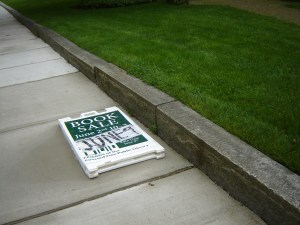


Posted in Uncategorized | Tagged author, children's books, concord, farmer, farmers market, farmstand, Gertrude Crampton, hydroponic, illustrator, library sale, new england, peonies, polka-dot tie, rain, scuffy the tugboat, Tibor Gergely | 5 Comments »
June 2, 2012 by suzannesmom
Did you catch the story today about the young boy whose composition was performed by the New York Philharmonic?
At the National Public Radio site, Jeff Lunden writes: “What would it be like if you were 10 years old and composed a piece of music that was played by the New York Philharmonic? For a few New York City school kids, including one fifth-grader, it’s a dream come true, thanks to the orchestra’s Very Young Composers program.
“Composer Jon Deak, who played bass with the New York Philharmonic for more than 40 years, says the idea for Very Young Composers came when he and conductor Marin Alsop visited an elementary school in Brooklyn several years ago.”
Now every year, “72 lucky kids in six New York area schools participate in this free after-school program. …
” ‘The kids are not chosen for being musical geniuses,’ [the Philharmonic’s director of education, Theodore] Wiprud says. ‘The guidelines we give the schools, in trying to identify some fourth- and fifth-graders for the program, is that they be kids for whom this could make a difference. Whether or not they study an instrument is not necessarily a good predictor of whether they’re going to do something creative in music.’ …
” ‘Some of these kids have trouble locating middle C on a piano,’ Deak says. ‘Does that mean they can’t compose music of depth? No. What do they have to do? They have to hum it for us, sing, whistle, tap the rhythms — even if they can’t notate them — and we get their piece.’
“As [teaching artist and composer Daniel] Felsenfeld puts it, ‘The most important thing about this class is that you never, ever, ever write their music for them — not even a little.’ ”
I’m hearing a refrain from yesterday’s post: all children have music in them and you should just let it flower.
Read more and listen to the performance of young Milo Poniewozik’s composition at NPR.
Photograph of student Milo Poniewozik and the New York Philharmonic: Michael DiVito

Posted in Uncategorized | Tagged children, composer, Daniel Felsenfeld, education, Jeff Lunden, jon deak, Michael DiVito, milo Poniewozik, music, New York Philharmonic, Teaching artist | Leave a Comment »
June 1, 2012 by suzannesmom
I’ve been meaning to blog about the wildly successful music-education program out of Venezuela, El Sistema.
Here music critic Mark Swed follows the L.A. Philharmonic to Caracas and writes about El Sistema for the Los Angeles Times.
“Musically, Venezuela is like no other place on Earth. Along with baseball and beauty pageants, classical music is one of the country’s greatest passions.
“In the capital, Caracas, superstar Venezuelan conductor Gustavo Dudamel is mobbed wherever he goes. Classical music teeny-boppers run up to him for autographs when he walks off the podium at concerts. The state-run music education program, which is known as El Sistema and from which Dudamel emerged, is the most extensive, admired and increasingly imitated in the world. One of its nearly 300 music schools for children, or núcleos, is deep in the Venezuelan Amazon, reachable only by boat. …
“The basic tenet of José Antonio Abreu, the revered founder of El Sistema, is the universal aspect of music. He likes to say that music is a human right. That’s an effective, politically expedient slogan. But what he has demonstrated on a greater scale than ever before is that music is not so much a right as a given. El Sistema is not about talent, ingeniously effective system though it may be for discovering and fostering musical talent. The truly revolutionary aspect of El Sistema is its proof that everyone has a capacity for music.”
Read about how El Sistema has spread worldwide in the Los Angeles Times.
Children at La Rinconada in Caracas, Venezuela, Feb. 14, 2012. Gustavo Dudamel, right, among students at a showcase of El Sistema in Caracas, Venezuela, Feb. 15. Photograph: Mark Swed / Los Angeles Times

Posted in Uncategorized | Tagged children, conductor, education, el sistema, Gustavo Dudamel, José Antonio Abreu, L.A. Philharmonic, mark swed, music, poor, poverty, venezuela | Leave a Comment »
May 31, 2012 by suzannesmom
I was in a meeting on the 31st floor a month or so ago, when I saw a bird swoop past the window. That could never be a pigeon up this high, I thought. Could it be a … ?
This week a colleague sent me photos. It turns out that a pair of peregrine falcons had nested several years ago on the 32nd floor outside our president’s office and, after a sojourn at the Custom House, decided to come back this year. The babies have just been tagged, and the tagger took pictures.
I have been reading a novel about Bedouins translated from Arabic. It has numerous passages on Bedouins’ fondness for falcons as hunting birds, so this feels like a coincidence. But the main thing is, they are really cool birds.




Posted in Uncategorized | Tagged bedouin, bird, boston, falcon, nature, peregrine | 2 Comments »
May 30, 2012 by suzannesmom
A concept called Rapid Bus Transit is getting increased attention, I hear, even though so far in the United States, having a designated lane doesn’t seem to make much difference. When I take Boston’s Silver Line to go to the SoWa art galleries, it acts like an ordinary bus — stuck in traffic and arriving in clumps. (In NY City, in the old days, we used to say, Why are buses like bananas? Answer: Because they are green and yellow and come in bunches.)
I do like taking the Silver Line to the airport, though.
Will Doig at Salon.com writes: “When it comes to improving mass transit, there’s a lot of low-hanging fruit on the humble city bus. The vital connective tissue of multi-modal transit systems, the bus could be an efficient — nay, elegant — solution to cities’ mobility woes if only we made it so. …
“Making people like the bus when not liking the bus is practically an American pastime essentially means making the bus act and feel more like a train. Trains show up roughly when they’re supposed to. Buses take forever, then arrive two at a time. Trains boast better design, speed, shelters, schedules and easier-to-follow routes. When people say they don’t like the bus but they do like the train, what they really mean is they like those perks the train offers. But there’s no reason bus systems can’t simply incorporate most of them. That’s the goal of bus rapid transit.” Doig has more at Salon.
Photograph: Duncan Allen at world.nycsubway.org

Posted in Uncategorized | Tagged art galleries, brt, duncan allen, mass transit, rapid transit, salon, silver line, sowa, sustainability, train, transportation, will doig | 2 Comments »
May 29, 2012 by suzannesmom
I’m fascinated by the many ways the Internet has enabled broader support for worthy causes. I’ve blogged about Kickstarter, for example, “a funding platform for creative projects.” Through Kickstarter, friends and other well-wishers can help fund a documentary, an art installation, or a book publication within a designated time frame. Magic can happen, often with only small donations that add up.
Today OFH_John tweeted about something similar for schools, Donors Choose. Donors Choose calls itself “an online charity connecting you to classrooms in need.” You can search for projects in your local area, projects that have special meaning to you, and projects that might let your company offer special expertise.
John’s company has optical expertise and jumped on a need at a District of Columbia school, where an applied science project on light called for optical gear. Read about that here.
If you are seeking to help impoverished schools in particular, you may look for the “high poverty” rating at Donors Choose. School needs of all sorts are listed here.
Photograph: DonorsChoose.org

Posted in Uncategorized | Tagged donors choose, education, fund raising, funding, kickstarter, light unit, OFH_John, optical, optics, Optics for Hire, schools, science | 2 Comments »
May 28, 2012 by suzannesmom
I caught Public Radio International’s Living on Earth program Saturday morning and felt reassured to hear about a new generation of environmentalists.
The story that caught my attention was on the National Environmental Education Foundation (NEEF), which recently “announced the three winning high schools for the Sustainable Energy Award, sponsored by Samsung: Northwest Pennsylvania Collegiate Academy, Erie, Pa.; Boston Latin School, Boston, Mass.; and Secondary Academy for Success, Bothell, Wash.”
The judges found that the three schools “demonstrated a school-wide effort to achieve energy savings through the creative and innovative use of technology. Each school will receive $10,000 to further their initiatives.”
For example, in 2008, an environmental group at Boston Latin “conducted an energy audit of the school with help from the local utility NSTAR. Improving on the score of 59 out of 100 meant a strong energy efficiency initiative. The school turned off the lights in vending machines after school, lowered the hot water temperature, and replaced hundreds of light bulbs in the auditorium ceiling with more energy-efficient bulbs. …
“The school has had two fundraisers that generated more than $12,000 to support their initiative. With help from the Facilities Department of the Boston Public Schools, the school implemented a $75,000 lighting retrofit that saves 200,000 kWh and $33,000 a year. The school also installed a 28-panel PV array on its roof through a partnership with the City of Boston’s energy department and the Massachusetts Technology Collaborative. The system displays real-time data on electricity generated, and the school is putting this data online for study by other students.”
One thing that stands out is the effort to involve a lot of students, not just a small green group. Making the effort broader should help it expand. More here.
Photograph: National Environmental Education Foundation

Posted in Uncategorized | Tagged boston latin, Bothell, energy conservation, environment, Erie, living on earth, loe, National Environmental Education Foundation, neef, Northwest Pennsylvania Collegiate Academy, nstar, Samsung, Secondary Academy for Success | Leave a Comment »
May 27, 2012 by suzannesmom
Although the Christian Science Monitor daily is strictly online, there is a hard-copy Christian Science Monitor Weekly that is worth buying. The cover story of the latest issue is about a group of Iraq and Afghanistan veterans. Each was floundering a bit in civilian life, looking for the same sense of purpose that they had felt in the military.
The story of how they came together in the blighted Oliver neighborhood of Baltimore is inspiring. The setting for the TV show The Wire, the area had been run by drug dealers for decades. Despite the best efforts of the local police, the residents could never get the help they needed to feel safe, to get vacant lots cleaned up, or to weatherize homes.
Today the veterans, applying the leadership and community-rebuilding skills they learned in places like Anbar Province, are making a difference — and feeling motivated once more.
See a great array of pictures at the Monitor website.
Photograph : Christian Science Monitor
Three veterans – (l. to r.) Patrick Young, Earl Johnson, and Dave Landymore – survey buildings and chat with neighbors on a warm Friday night. The men are volunteers with the 6th Branch, a nonprofit organization of volunteer veterans who use their community rebuilding skills to address urban blight in a project called Operation Oliver.

Posted in Uncategorized | Tagged 6th branch, Christian Science Monitor, civilian, Dave Landymore, Earl Johnson, military, operation oliver, Patrick Young, urban | 2 Comments »
May 26, 2012 by suzannesmom
Tom Jacobs at Pacific Standard reports on new research into the benefits of music for children.
“Music education produces myriad benefits,” he writes, “strengthening kids’ abilities in reading, math, and verbal intelligence. New British research suggests it may also teach something less tangible, but arguably just as important: The ability to empathize.
“In a year-long program focused on group music-making, 8- to 11-year old children became markedly more compassionate, according to a just-published study from the University of Cambridge. The finding suggests kids who make music together aren’t just having fun: they’re absorbing a key component of emotional intelligence.”
The research team was led by Tal-Chen Rabinowitch of the university’s Centre for Music and Science. Read more.
Photograph: Pete Pahham/Shutterstock

Posted in Uncategorized | Tagged cambridge university, children, empathy, music, pacific standard, pete pahham, Tal-Chen Rabinowitch, tom jacobs | Leave a Comment »
May 25, 2012 by suzannesmom
Your blogger is one grandma all excited about having some baby time this weekend.
But in Azerbaijan, six grandmas from Russia are competing in a pop-music contest.
“Eurovision 2012 is under way, and about half a billion viewers are expected to tune in for the finale on Saturday. …
“The song contest started in the 1950s, and each country competing is represented by a single singing group or soloist. Because Azerbaijan won last year, Eurovision is being staged in its capital, Baku. …
“Representing Russia this year is a group of six grandmothers. Their song, ‘Party for Everybody,’ tells the story of the babushkas welcoming their grandchildren home. ‘This song itself is kind of appalling, but Eurovision isn’t about the best song,’ [says William Lee Adams, editor-in-chief of Wiwibloggs]. ‘It’s about the best act. And this one comes with attitude and spunk and spirit, and the belief that you can keep on moving no matter how old you are.’ ” Amen to that.
Read more at NPR, and watch the videos. If you catch what language the babushkas speak, please let me know. It is not actually Russian but a minority language.

Posted in Uncategorized | Tagged Azerbaijan, babushkas, baku, eurovision, grandmas, party for everybody, russia, six grandmothers, william lee adams, wiwibloggs | 2 Comments »
May 24, 2012 by suzannesmom
So far this spring I have walked to the office by way of North Station only a few times. But when I did, I got curious seeing people in hard hats working like they had a deadline on a part of the Greenway blocked off by a fence. I peeked in and thought, “What is that? It looks like a labyrinth.”
As someone who tends to think of Theseus, Ariadne, and the Minotaur on
Crete when labyrinths are mentioned, it has taken me a while to realize how many people today use them for meditation. And work being what it is, there will probably come a day soon when I want to test out the possibilities.
The new labyrinth was dedicated on a rainy day this week as part of a lovely Armenian Heritage Park.
Alejandra Matos writes for the Boston Globe, “US Representative Edward Markey and other officials welcomed the rain, calling it tears of joy from generations of Armenians.
“The park, located between the North End and Faneuil Hall, includes a sculpture surrounded by a reflecting pool, and is meant to honor Armenian immigrants to the state. Middlesex Sheriff Peter J. Koutoujian, who is Armenian, said he has been fighting for the park since 1999.
“ ‘This is a gift to the city, not just for the Armenian immigrants. This is a park dedicated to all immigrants who have experienced coming to this great city,’ Koutoujian said.”
The third-largest Armenian population in the United States is in nearby Watertown. Read more at the Globe.
4/8/13 Update: The sculpture gets reconfigured to reflect how immigrants adapt. Check it out here.
Photograph: Aram Boghosian for the Boston Globe

Posted in Uncategorized | Tagged Alejandra Matos, Aram Boghosian, armenian, Armenian Heritage Park, boston, greenway, immigrant, labyrinth, Peter Koutoujian, postaday, rose kennedy, sheriff, watertown | 7 Comments »
May 23, 2012 by suzannesmom
Do you believe that kids are overprogrammed with structured activities — not enough time for daydreaming, not enough time for experimenting?
Well, here’s a site that might encourage parent-and-child experimenting on do-it-yourself projects. Sounds like it could be rewarding in a variety of ways (collaborating with parents, nurturing creativity, building confidence and independence).
The NY Times writes that a couple who do home improvement got an idea for projects that might interest children.
They “developed Built by Kids (builtbykids.com), a Web site devoted to do-it-yourself projects that parents and children can collaborate on, like herb gardens planted in a wheelbarrow, refurbished tatami tables and handmade wagons. The tasks were tested and refined during a series of daylong workshops with friends at the couple’s Los Angeles bungalow.
“Their intention is to revive some of the backyard know-how that children had before the distractions of television, video games and other off-the-shelf entertainment, [founder Timothy] Dahl said. The do-it-yourself movement is enjoying a long, fashionable run as an alternative to consumer culture, he added, but when children are involved, the results are ‘too often dismissed as disposable “crafts.” ‘ “ Read more. Try a project.
Photograph: BuiltByKids.com
Posted in Uncategorized | Tagged craft, diy, parent, project, skill | 4 Comments »
May 22, 2012 by suzannesmom
A secret cache of pre-1917 Russian literature has been found stashed behind the walls at the Russian State Polytechnical Museum Library in Moscow.
Alexandra Guzeva writes at Russia Beyond the Headlines, “A treasure trove of pre-revolutionary books and magazines has been discovered in the archives of the Russian State Polytechnical Museum Library in Moscow. The museum librarians were preparing the collection for a move to a temporary depository when a small hiding place stacked with books was uncovered …
“As the books were packed into boxes, the empty racks were dismantled. Behind one of these racks, the librarians found a plywood wall that sounded hollow when tapped.
“ ‘We moved the cover aside and found books behind it. When we removed the wall completely, we saw piles of books stacked up to the ceiling.’ said [Svetlana Kukhtevich, deputy director of the Polytechnic Library]. …
“According to preliminary estimates, the 6.5-foot-long hiding place contained about 30,000 books printed before the 1917 Russian Revolution. The books are almost exclusively in foreign languages, including French, German, Latin and Greek.”
The reason that the books were hidden is not known. Read more.
Photograph: Ilya Varlamov

Posted in Uncategorized | Tagged Alexandra Guzeva, Ilya Varlamov, pre-revolution, russia beyond the headlines, russian literature, Russian State Polytechnical Museum Library, Svetlana Kukhtevich | Leave a Comment »
May 21, 2012 by suzannesmom
Don’t throw it out. Fix it. That’s the philosophy in the”Repair” Café movement, which I learned about through the Christian Science Monitor, which highlights articles on people who “make a difference.”
It points to Kelly McCartney at Shareable.net, who writes: “In the Netherlands, mom and former journalist Martine Postma stumbled onto an idea that tacks the word ‘repair’ onto the familiar green mantra, ‘reduce, re-use, recycle.’ The result is community-based Repair Cafés where folks come together to fix their broken items. What started as a few neighbors in Amsterdam helping each other out has, two years later, become a much bigger deal, with 30 groups springing up around the country. …
“As Ms. Postma surmised, ‘Sustainability discussions are often about ideals, about what could be. After a certain number of workshops on how to grow your own mushrooms, people get tired. This is very hands on, very concrete. It’s about doing something together, in the here and now. …
“Similar endeavors have begun to crop up in the United States, as well. Sidling up alongside tool-lending libraries in a nice way, groups like the West Seattle Fixers Collective and the Missoula Urban Demonstration Project host do-it-yourself fix-it events and classes to help community members make needed repairs on broken items.” Read more here.
This reminds me of resilience circles, another people-helping-people movement that seems to be taking hold in the United States. Check out the word on resilience circles here.
Photograph: Jerry Lampen/Reuters/File

Posted in Uncategorized | Tagged fixers collective, Heerenvee, kelly mccartney, Martine Postma, missoula, Netherlands, repair cafe, resilience circles, seattle, shareable.net | 2 Comments »
« Newer Posts - Older Posts »










 Suzanne's Mom's Blog
