Feeds:
Posts
Comments

Photo: Walaa Buaidani.
Mona Araghili showcases aghabani embroidery at the Threads of Hope exhibition in Damascus, Syria. Post-Assad, she sees an opportunity for serious investment in traditional crafts.

“Threads of Hope” is a phrase that seems to cover a lot of what is going on in the world. Hopes may be hanging by threads, but every day they can strengthen. In today’s article from the Christian Science Monitor, the words are applied to the reemergence of traditional Syrian embroidery after the fall of the Assad regime.

Dominique Soguel writes, “By the time Ameera al-Hammouri was 10, her hands were dancing across the taut fabric beneath her grandmother’s aghabani embroidery machine. She was too short to sit, so she stood, working the foot pedal to coax floral patterns from metallic thread and her own memory.

“Decades later, in a rundown apartment building on the outskirts of Damascus, her machine now runs on an erratic supply of electricity. The building’s elevator no longer works and many of its windows are broken, but inside the sanctity of Ms. Hammouri’s spotless home, the artistry lives on. ‘Working on the embroidery machine for me is like drawing on paper,’ she says. … ‘Whatever I imagine, I bring to life with my hands.’

“Aghabani embroidery originated in Damascus more than 150 years ago, blending Ottoman, Arabic, and Persian design influences. Traditionally, patterns were hand-printed in Damascus onto fabrics that were then sent to Douma, about 8 miles from the capital, where women embroidered them at home. Their work, displayed on tablecloths and other household items, became a hallmark of Syrian hospitality.

“Today, the survival – indeed, the revival – of this craft tradition rests in the hands of women from Douma, a city synonymous with both resistance and ruin. The women behind these works are not only artisans. They are mothers, widows, and survivors of siege, displacement, and economic collapse.

“Ms. Hammouri herself endured all of it. Her husband and eldest son were arrested in 2012 and never returned. Douma was subjected to a five-year siege, when government forces surrounded the city, cutting it off from food, medicine, and fuel. Ms. Hammouri’s house was destroyed. As the bombs fell, she moved her children from house to house, basement to basement.

“The siege ended in 2018. With no income and no husband, Ms. Hammouri turned to the one thing that had always grounded her: her original aghabani machine, bought in 1988 with money she scraped together by selling her wedding gold and other treasures. It still stands in a corner of her bedroom, alongside a newer model.

“ ‘I talk to this machine,’ confides Ms. Hammouri, who is known in the community as Umm Meriee. ‘It holds my secrets. I’ve cried over it.’

“At first, she worked quietly from home, taking orders from traders who remembered her family’s reputation and bought pieces for export. Over time, she began training other women.

“If Syria’s current political opening brings more trade and tourism, she says, crafts like aghabani could once again become a source of stable income rather than just a means of survival.

“Now, twice a week, her apartment fills with the chatter and laughter of industrious women. … This gathering of women is not a formal enterprise. There is no signboard or registration, no website to market their work. But family reputations endure in a country where word of mouth is the norm.

“ ‘They know my name in the market,’ says Umm Meriee, recalling how she revived ties with shopkeepers in the Al-Hariqa market, in Damascus’ old city, because her aunts and grandmother had put the family name on the map. …

“For Mona al-Masri, a Tuesday regular, embroidery is her identity. … While her colorful pieces earn heartfelt ‘wows’ from her daughters, it is next to impossible to eke a living from this craft. In a good week, working three hours a day in between bouts of housework, Ms. Masri earns just over $6. … Despite the skill and time aghabani requires – a single detailed motif can take hours, and a full tablecloth might take a week or more to complete – handmade aghabani cannot compete with cheaper, machine-made imitations that dominate the local market, such as those imported from China.

“ ‘Right now, aghabani has no future,’ says Ms. Masri. But with government support, she feels that future could ‘be a very bright one.’

“Mona Araghili shares that optimism. … More than a decade ago, Ms. Araghili set up Threads of Hope – Aghabani with little more than a social media page and materials she borrowed from friends. With her college friend Basheera Baghdadi, who had grown up in Douma, she smuggled fabric and thread into the besieged city, using tunnels and roundabout routes through the countryside. …

“Ms. Araghili never shut down her group’s Facebook page, she says. ‘I always hoped that we could restart someday.’ ”

More at the Monitor, here.

Photo: Melanie Stetson Freeman/CSM.
One Man Swamp Band street musician Brian Belknap performing in the French Quarter of New Orleans in April.

Here’s a story of resilience, 20 years after the devastation of Hurricane Katrina in New Orleans, Louisiana.

Patrik Jonsson writes at the Christian Science Monitor, “When Hurricane Katrina careened into Mississippi and Louisiana 20 years ago this week … the overtopping of New Orleans’ levees caught local, state, and federal officials flat-footed in the days after the storm’s Aug. 29, 2005, landfall just east of New Orleans, near the Pearl River. …

“As I head back to New Orleans ahead of the 20th anniversary of that historic storm, looking to chronicle the growth that has taken place since that disaster threatened to wash away the soul of this vibrant city, I’m following some of the paths I took when covering the aftermath of Hurricane Katrina, remembering that time, those scenes.

“Twenty years after that catastrophe, New Orleans’ larger recovery has been a complicated story of progress, ongoing challenges, and missed opportunities.

“It was still a lawless city when I arrived in 2005. As dark descended and I settled into my van for the night, so did fear. Rumors abounded – most outrageous, but some not far from the truth about the human toll. About 1,800 people are believed to have perished during Katrina and its aftermath, most from the storm surge in Mississippi and catastrophic flooding in New Orleans. The most expensive natural disaster in United States history, it caused over $200 billion in damage. …

“Communities reemerge, but they reemerge differently. People search for what once was – a piece of flatware, a boat transom, a bent-up old .22 rifle. Or an old guitar. They drag the past from the wreckage and use it to imagine the future.

This year, I’ve brought my Guild A-20 dreadnought guitar, my road companion. I’m realizing that this reporting trip is also to build a connection across the decades – maybe one as rickety and rusty as that old Huey Long – and to see the effects on communities and people, including myself, and how they recover. …

“This time I am staying in a rental, a shotgun-style short-term place near the Tremé, the city’s iconic music district.

“I go to a nearby coffeehouse the next morning, where schoolkids in uniforms are already plinking away standards on a well-tuned upright piano. Wrens are cajoling amid the Magnolia grandiflora. I sip chicory-infused coffee and chat with the shop owner about a day that’s dawning with surprising coolness.

“Afterward, I find a great, steep stoop from where I can less watch but rather consider the city. I grab my Guild and sit down, strum some cowboy chords in B major, and noodle some lines from my reporter’s notebook: ‘She’s an angel, even when she’s falling down / She’s an angel, in the wrong part of town.’ …

“Brian Belknap traded a guitar for a life in New Orleans.

“The Chicago native arrived a decade ago, well after the ravages of Katrina. Like so many before him, he fell for the languid city’s slow charms. With little money, he lived on the streets for a while, busking for change. But then he traded his 1942 Martin D-18 for a battered shotgun shack in St. Roch. …

“Every day, Mr. Belknap walks into the French Quarter in the early, cooler parts of the day, setting up the instruments that now make up his One Man Swamp Band on Royal Street.

“ ‘There’s still desperation here,’ Mr. Belknap says. ‘But out here it’s an intimate experience. The people are close. The music is everywhere. Even in hard times, the sense of joy is unmistakable.’

“To punctuate that point, he grabs an accordion, gives a kick on a high hat pedal, and rolls into an original song about folks stomping the varnish off a dance floor.

“Though he’s not a native, in some ways Mr. Belknap’s presence here is a small part of New Orleans’ recovery. The city lost a third of its population after the hurricane. But it has been bouncing back – though not to what it was before Katrina.

“There’s a new $15 billion system of levees, floodgates, and drainage canals built to better withstand storms like Katrina. The public school system, among the worst in the country before 2005, has been revamped. Today, graduation rates have risen significantly, and more New Orleans high schoolers are going straight to college than before.

“But the city continues to grapple with the lasting impacts of the initial federally funded rebuilding plan, called Road Home. Over $9 billion in federal funds was allocated for residents to rebuild – but within a tangle of Byzantine application procedures. Disbursements, too, were based on property values before Katrina struck. This left mostly Black, low-income residents with far less to rebuild, and long-standing racial disparities continue today.

“ ‘Katrina in many ways reshaped the way we think about vulnerability in disasters,’ says Jeannette Sutton, a sociologist who studies emergency preparedness at the State University of New York at Albany. Road Home and other programs, she says, have proved that ‘If you were poor before a disaster, the [disaster response] is not going to improve your well-being’. If you were barely getting by before, you’re not going to be better off with the funding in the aftermath. But those who could ‘afford’ a disaster are probably going to recover pretty well.’ …

“Gentrification has also changed the flavor of New Orleans in many ways. The city continues to debate limiting short-term and highly profitable tourist rentals – like the one I’m staying in – which create a demand for housing and cause other rents to rise. The checkerboard of empty lots in the hard-hit Lower Ninth Ward, too, still defines many of the failures of the federal rebuilding plan. …

“Liz LeFrere was 8 years old, living in New Orleans East, when Katrina struck. She thought she’d miss a day or two of school. Four months later, the family returned to live in the broken city, since her father was a police officer.

“Ten years ago, when she was a student at Tulane, the campus flooded on Aug. 29 – the Katrina anniversary. Ms. LeFrere broke down in uncontrollable tears. ‘It came out of nowhere,’ she says. ‘It’s definitely part of a communal trauma.’

“Yet the storm’s indelible impact also created a new life for her. Today, Ms. LeFrere is part of an artist collective dedicated to understanding Katrina and its aftermath through art – including massive portrait murals that now dot and define the city.

“Artists like Ms. LeFrere are committed to telling a tangibly redemptive story. ‘The art is where expression can be a catalyst for change,’ she says. The murals ‘help create a sense of people seeing themselves reflected in the face of the city. The narrative of New Orleans expanded.’ ”

There’s a lot more at the Monitor, here. Impressive photos. No paywall, but subscriptions keep responsible news coming. Reasonable prices.

Photo: Suerob/Getty Images/iStockphoto.
The European goldfinch, above, was one of the species most affected by the growing amount of light-polluted areas. 

I am not a scientific kind of birdwatcher, but I love trying to identifying the birds around here, sometimes by their song. I’ve learned that one “song” of the red-bellied woodpecker, for instance, sounds a lot like a metal windup toy.

Citizen scientists the world over are contributing to what scientists know about birds. Consider how a recent study was able to use a bird lovers’ website to take our knowledge of avian behavior a step farther.

Hannah Devlin, science correspondent at the Guardian, reports that “urban birds stay up significantly later than their rural counterparts, according to research that highlights the impact of light pollution on wildlife.

“The study, based on recordings submitted by bird enthusiasts to a popular species identification and mapping website, showed that light pollution caused birds to sing for an average of 50 minutes longer each day, with some species waking up an hour earlier and settling down for the evening an hour later.

“ ‘We were shocked by our findings,’ said Dr Brent Pease, an assistant professor of biodiversity conservation at Southern Illinois University Carbondale. ‘Under the brightest night skies, a bird’s day is extended by nearly an hour.’

“Light pollution now affects 23% of Earth’s surface and is rapidly growing in extent and intensity, data suggests. There is already evidence for detrimental effects on human health and concerns that many species are affected, with negative consequences including die-offs of insects and the disruption of migration patterns in bats and sea turtles.

“The latest study used bird recordings submitted to BirdWeather, a citizen science project that allows users to submit recordings from birds in their local area to produce a global live library of birdsong and which uses AI to allow users to identify birds in their gardens. In total the scientists analyzed 2.6m observations of onset (morning) bird vocalization and 1.8m observations of cessation (evening) bird calls, for hundreds of species. This data was combined with global satellite imagery measurements of light pollution. …

“The analysis found that for birds in light-polluted areas, the waking day was extended by 50 minutes on average.

Species with large eyes, relative to their body size, had the strongest response to artificial light.

“ ‘The American robin, Northern mockingbird and European goldfinch all extended their day by more than average,’ said Pease. …

“The impact of a longer day for birds was not yet clear, the researchers said. ‘We know that sleep loss is not great for humans, but birds are different,’ said Pease. ‘They have developed interesting strategies to cope with loss of sleep during migratory periods.’

“A disturbance of natural behavior patterns was of concern, Pease added, although there is evidence, in some species, that artificial lighting may increase foraging and mating time and improve the survival rate of fledglings.

“The findings are published in the journal Science.”

Sounds like this is a case of “more research is needed.” More at the Guardian, here.
Photo: Christian Jungeblodt/The Guardian.
Eisenhüttenstadt, Germany, was built in Soviet-controlled east Germany shortly after the second world war. It has not been considered a desirable place to live in recent years, but it is not giving up.  

This idea to bring more residents to a city that has lost population was new to me. There are probably lots of other places that could try the same approach.

Deborah Cole writes at the Guardian, “An innovative contest by a city in formerly communist east Germany to curb depopulation by offering a fortnight of free housing has stunned local officials with its success.

The competition drew more than 1,700 applications from around the world to try living in Eisenhüttenstadt, a Soviet-style planned city on the Polish border, near Berlin, which was built around a steel plant in the aftermath of the second world war.

“ ‘We ourselves were very surprised by the reach our Probewohnen (trial living) project has had,’ Julia Basan, the municipal economic development officer spearheading the campaign, told reporters on Thursday.

“She said those who had thrown their hat into the ring since May had ‘the most wide-ranging motives’ including one foreign man who simply said he ‘wanted to marry a German woman.’ But the majority were ‘very realistic applications,’ Basan said.

“The two winners, both German professionals, will move into spacious furnished flats in the city centre in September and be treated to a red-carpet orientation program.

“Melanie Henniger, a 49-year-old IT consultant and self-described ’empty nester’ living in the north-western city of Bremen, said she had grown up in nearby Frankfurt an der Oder and was interested in returning to her eastern roots.

” ‘This is a great chance to get to know the region again, because otherwise I wouldn’t have any opportunities at all as I don’t know anyone there any more,’ she said. ‘In the best case scenario, I can put down new roots there again.’

“The other successful applicant, 39-year-old Jonas Brander, is a Berlin-based film-maker working on a documentary about Eisenhüttenstadt.

“ ‘I’m very interested in the city and its people and I want to get very close to life in my work,’ Brander said, adding that he was drawn to its ‘living history.’

“Eisenhüttenstadt, which is celebrating its 75th anniversary, was the first city to be founded – in east or west Germany – after the Nazi period. It was built according to a socialist model designed to blend work and family life for the good of all.

“But the years since national reunification in 1990 have been hard on the town, which has fewer than half the 53,000 residents it counted before the fall of the Berlin Wall.

“The shrinking and aging population has compounded a skilled labor shortage for local industry, in what economists say can easily turn into a death spiral. …

“Basan said the program had allowed Eisenhüttenstadt to put its best foot forward, touting its renovated and affordable neoclassical housing, verdant surroundings perfect for swimming and cycling, and plentiful childcare and work opportunities.

“ ‘We even had one family, from another European country, who heard about us via the Probewohnen program and are moving here on their own steam. They’ve already signed a work contract with a local company,’ she said.

“ ‘They did it all themselves and we’re just thrilled.’ ”

More at the Guardian, here.
Photo: Haley Friesen.
The Somali Museum Dance Troupe practiced at the Tapestry Folk Dance Center in Minneapolis a few years ago.

It has not been an easy adjustment for Somali refugees who were settled in Minnesota years ago. It’s been especially hard for new generations to find their way. So I’m happy to read about the positive things.

Amina Isir Musa reports at Sahan Journal that “the Somali Museum Dance Troupe’s TikTok presence has helped popularize traditional dances among U.S.-born Somalis.”

She says, “In the basement of the Midtown Global Market in Minneapolis you might find yourself transported to a different land. As you walk toward the Somali Museum of Minnesota, you might hear the joyful sounds of the jaandheer, a traditional dance from the Sanaag region of the Somali peninsula. To many listeners, particularly those from the Northern Somali region, the music says, Welcome home.

“On a recent day, a group of young Somali Minnesotans practiced the dance as their instructor replayed the past 30 seconds of music over and over until they got it right. The instructor, Abdurahman Muhumed, a young man with braided hair, had recently performed with the Somali Museum Dance Troupe  at the ‘Star of Unity’ concert at the Ordway Theatre in St. Paul. As a more experienced dancer, he was training the others as part of the troupe’s leadership training component. 

“A few days later, several members of the 20-member Somali Museum Dance Troupe –- Bashir Ismail, Ayan Furreh, Harun Mohammed and their coach, Mohamoud Osman Mohamed, who is also artistic director of the Somali Museum, talked about their work and their passion for celebrating Somali culture through dance. 

“Mohamoud helped found the Somali Museum Dance Troupe nearly 10 years ago to share his love of that culture and to elevate its artistic expression. His father, Osman Ali, had told him about the importance Somali performing arts held before that country’s long-raging civil war, and the two of them combined efforts to create the Somali Museum Dance Troupe. 

“In its early years, the troupe consisted of young recent immigrants who knew a lot of dances from back home and wanted to share those same dance styles,” and it has since grown to include many enthusiastic young people who have never known Somalia. For more about the dance troupe, click here.

The Sahan Journal has also covered what’s going on with a community leader my husband and I got to know when we lived in Minneapolis, Mohamed Wardere. Having once worked in community outreach for a US Senator, he is now “executive director of Hiddo Soor, a Somali nonprofit that hosts cultural events.” He said that “Somali business owners around the state, who sponsor the festivals, requested events in their towns so that their neighbors could understand their culture. 

“Wardere said when he began hosting cultural festivals, most attendees were members of the Somali community, but in recent years the wider community has participated in the festivities. Last year, about 4,000 people attended the festival in Plymouth, he said. 

“Wardere said he is excited that more people are learning about Somali history and gaining respect for his culture.” Mohamed was always good at sharing understanding of Somali culture.

Read the article by Yvette Higgins on the celebration of Somali independence, its “street festival in Minneapolis, a multiday soccer tournament, a concert at the Ordway, and festivals in Plymouth, Rochester, Owatonna and St. Cloud.” That story is here.

Photo: FoxyDonuts.
Seattle is making a game of loving rats.

Gotta love the kooky things people come up with. Today’s story is about people in the state of Washington who’ve decided there is a patron saint of rats. They call him St. Rat.

Nathalie Graham writes at the Stranger, “Heat waves shimmer along Pine Street. A rancid, somehow warm fishy smell wafts from Momiji’s dumpster, which is baking in the hot sun on 12th Avenue. The crumb rubber in Bobby Morris Playfield’s astroturf emits its own corona of heat, absorbing the sun’s rays. …

“Nearby, genderqueer youths balance on the concrete lip of the Cal Anderson Gatehouse scrubbing Hot Rat Summer, a pseudo-famous, pseudo-religious guerrilla mosaic of a rat with a halo. …

“Hot Rat Summer features St. Rat, a kind of patron saint for those at the bottom of the societal heap. … They leave offerings of doodles, flowers, and snacks at St. Rat’s feet. They protect the art and the saint within it.

“Last month, City Hall decided to protect Hot Rat Summer from bureaucracy, but that has not kept it safe from taggers, who’ve consistently spraypainted it. Ten days ago, it was a wash of black. …

“The taggers may not see the value of St. Rat, but the art and theology professors at Seattle University who spoke to the Stranger certainly did. They gave a few hot takes on this venerable rat.  

“Ken Allen, an associate professor of Art History at Seattle University, strolled over to Hot Rat Summer to analyze it in person. For the scholar of West Coast art in the mid-20th century, the rat’s saintly halo evoked the Beatnik era and artist Joan Brown, part of a loose, bohemian artist collective in the mid-50s called the Rat Bastard Protective Association

“These bastards ‘often used urban detritus in their assemblage and collage work,’ Allan wrote in an email. Brown, herself, often featured animals, including rats, ‘in a similarly dignified if not quite saintly way as in the Rat Summer piece.’ Take her various portraits of weird cats or The Bride, a painting of a beautiful cat in a wedding dress with a leashed pet rat (the groom?). Or the less sanctified Fur Rat, a rat sculpture made with chicken-wire and a raccoon fur coat.  

“ ‘They would have admired the underground spirit of the anonymous artist of Rat Summer, no doubt,’ he continued. 

“As would Beatnik writers like Jack Kerouac, who ‘idealized the poor and oppressed.’ …

“Dr. Kristin Doll, adjunct professor in Seattle University’s Department of Theology and Religious Studies, meditated quite a bit on the ‘Saint Rat’ figure central to Hot Rat Summer. 

“Doll wrote in an email that she couldn’t attribute any intentional religious metaphors to the artist(s) because she did not know them, but says the work is full of symbols with a clear religious history that make for a ‘clever twist on tradition.’ She loved it. 

“ ‘The creators of Hot Rat Summer are certainly creative, humorous, and they have injected a serious topic (protection of trans people and their rights) with tongue-in-cheek versions of traditional religious themes,’ she wrote. …

“Mosaics are common in religious art, Doll wrote, especially in the Eastern Orthodox tradition and in the Byzantine empire, which popularized the style. …

“St. Rat is not a saint. Cannonization is a lengthy, posthumous process analyzing a saint’s life for piety and holiness, plus a series of documented miracles. We don’t know if St. Rat is based on a real rat, if that real rat is dead or living. … This makes analyzing holiness hard. 

“And, Doll points out, the Vatican formalized the process in the 12th century to prevent situations exactly like Saint Rat, or, as she explained, ‘the rise of a popular cult based on a figure that may not meet the Church’s standards of holiness.’ Worshippers of Saint Guinefort, a greyhound who became a folk saint in 13th century France, know what she’s talking about.  

“Anyone who has been to Cal Anderson has seen the dog worshippers. Rats are not so well loved. We’re quicker to associate rats with garbage, plague, and excellent French cooking than we are to associate them with holiness. ‘A rat is a subversive image that challenges traditional notions of sanctity,’ Doll wrote.”

More at the Stranger, here, and on Instagram. Fun pictures at both sites.

Photo: Steven Wright/Unsplash.

Anyone can post on Wikipedia. I even tried it once myself. But volunteer editors are always checking that you obey the rules. My post on the neglected artist Lucille Corcos was removed because at that time, citations from online links were not allowed.

Today’s story shows what can happen if your Wikipedia entries are mainly another no-no: self-promotion. There’s a lot of self-promotion on Wikipedia, but this guy was especially sneaky.

Nate Anderson writes at Ars Technica, “Quick — what are the top entries in the category ‘Wikipedia articles written in the greatest number of languages‘?

“The answer is countries. Turkey tops the list with Wikipedia entries in 332 different languages, while the US is second with 327 and Japan is third with 324. Other common words make their appearance as one looks down the list. ‘Dog’ (275 languages) tops ‘cat’ (273). Jesus (274) beats ‘Adolf Hitler’ (242). …

“A couple months back, something would have been different. Turkey, the US, and Japan were still in the same order near the top of the leaderboard, but the number one slot was occupied by an unlikely contender: David Woodard, who had Wikipedia entries in 335 different languages. …

“Woodard is a composer who infamously wrote a ‘prequiem’ — that is, a ‘pre requiem’ — in 2001 for Oklahoma City bomber Timothy McVeigh, who had murdered 168 people with a truck bomb. The piece was to be performed at a church near McVeigh’s execution site in Terre Haute, Indiana, then recorded and played on the radio so that McVeigh would have a chance to hear it.

“According to the LA Times, which spoke to the composer, ‘Woodard’s hope in performing the 12-minute piece, he said, is to “cause the soul of Timothy McVeigh to go to heaven.” ‘ …

“Woodard also had a scheme to help save Nueva Germania, an 1880s colony in Paraguay that was designed to let German culture flourish away from the influence of European Jews. … ‘As an artist who is fed up with much of the pretentious nonsense that has come to define Western culture,’ Woodard told SF Gate, ‘I am drawn to the idea of an Aryan vacuum in the middle of the jungle.’

“So what was a guy like this doing with articles in 335 different languages? Inquiring minds want to know, which is why people have posted questions to sites like Reddit over the last year asking about the Woodard situation. …

“A Wikipedia editor who goes by ‘Grnrchst’ recently decided to find out, diving deep into the articles about Woodard and into any edits that placed his name in other articles. The results of this lengthy and tedious investigation were written up in the August 9 edition of the Signpost, a volunteer-run online newspaper about Wikipedia.

“Grnrchst’s conclusion was direct: ‘I discovered what I think might have been the single largest self-promotion operation in Wikipedia’s history, spanning over a decade and covering as many as 200 accounts and even more proxy IP addresses.’

“A network of accounts with an unusual interest in Woodard was identified, and its activities over the last decade were mapped. Starting in 2015, these accounts inserted Woodard’s name ‘into no fewer than 93 articles (including “Pliers,” “Brown pelican,” and “Bundesautobahn”), often referencing self-published sources by Woodard himself.’ And that was just in the English version of Wikipedia.

“From 2017 to 2019, the accounts ‘created articles about David Woodard in at least 92 different languages, creating a new article every six days on average .… They started off with Latin-script European languages, but quickly branched out into other families and scripts from all corners of the globe, even writing articles in constructed languages; they also went from writing full-length article translations, to low-effort stub articles, which would go on to make up the vast majority of all translations (easily 90 percent or more).’ …

“After a reduction in activity, things ramped up again in 2021, as IP addresses from around the world started creating Woodard references and articles once more. For instance, ‘addresses from Canada, Germany, Indonesia, the UK and other places added some trivia about Woodard to all 15 Wikipedia articles about the calea ternifolia.’

“Then things got ‘more sophisticated.’ From December 2021 through June 2025, 183 articles were created about Woodard, each in a different language’s Wikipedia and each by a unique account. These accounts followed a pattern of behavior: They were ‘created, often with a fairly generic name, and made a user page with a single image on it. They then made dozens of minor edits to unrelated articles, before creating an article about David Woodard, then making a dozen or so more minor edits before disappearing off the platform.’

“Grnrchst believes that all the activity was meant to ‘create as many articles about Woodard as possible, and to spread photos of and information on Woodard to as many articles as possible, while hiding that activity as much as possible. … I came to believe that David Woodard himself, or someone close to him, had been operating this network of accounts and IP addresses for the purposes of cynical self-promotion.’

“After the Grnrchst report, Wikipedia’s global stewards removed 235 articles on Woodard from Wikipedia instances with few users or administrators. Larger Wikipedias were free to make their own community decisions, and they removed another 80 articles and banned numerous accounts. …

“In the end, just 20 articles about Woodard remain, such as this one in English, which does not mention the controversy.”

More here.

Photo: Erin Brethauer.
Marquee hosted more than 300 artists and small business owners in Asheville, North Carolina, before Hurricane Helene, a devastating storm in 2024.

When Hurricane Helene washed through Asheville, North Carolina, last year, my childhood friend Ursula was one of the many who lost out. Her basement washed out, not only forcing her to stay at a neighbor’s but damaging many of her father’s artworks and the materials for her own weaving. At the same time, Asheville lost its whole arts district.

Now Ursula is rebuilding, and so is Asheville.

Jonathan Abrams writes at the new York Times, “Jeffrey Burroughs strolled among crooked trees and clumsily leaning chain-link fences on a recent Thursday afternoon in Asheville’s lower River Arts District. Nearby, heaps of flood-damaged antiques dotted the ground outside gaptoothed buildings that had previously housed hundreds of working artists.

“ ‘It’s nice that at least it’s green,’ Burroughs, president of the River Arts District Artists, said of the bent trees. ‘It was really depressing through the winter and the fall.’

“Burroughs, who uses they/them pronouns, is not joking when they say they have taken just two days off in the more than 10 months since Hurricane Helene, the deadliest hurricane to strike the mainland United States since Katrina in 2005, ravaged wide swaths of the Southeast, leaving at least 250 people dead.

“The storm overwhelmed Asheville’s French Broad River, submerging much of the once robust River Arts District in as much of 24 feet of water, caking it in layers of mud and destroying the life’s work and financial pipeline of hundreds of artists. …

“ ‘People were prepared because this area has flooded’ in the past, Burroughs said. ‘They moved everything up. Nobody anticipated second floors would flood. That’s not something you even conceive.

‘All of a sudden, it was like a lake opened in the middle of our town.’ …

“Over the past few decades, the River Arts District blossomed into that sprawling artistic epicenter as antiquated buildings transformed into bustling studios, classrooms, galleries and showrooms. The district’s recovery is seen as a crucial step in regaining a steadiness of income and the sense of normalcy for the many who lost so much in the storm.

“ ‘The business owners in the River Arts District have been working their tails off to rebuild since Hurricane Helene struck and I am making sure the state works with that same urgency to support their recovery,’ said Gov. Josh [Stein] who recently toured the district on a bike.

“The River Arts District housed nearly 750 artists before the hurricane. ‘You’re just immersed in art,’ said Davis Perrott, a woodworker who recalled waking up from the storm to a sound like someone forcefully slamming themselves against his window. ‘I’m sure there are other areas like it, but I haven’t seen it.’

“The upper portion of the district, which houses Burroughs’s jewelry store, returned fully in January. A few spaces have reopened in the lower portion of the district, which is closer to the river and suffered the most flooding.

“About 350 of the displaced artists are working again in the district. Some are actively involved in the continuing recovery process, waiting to return to the home that welcomed them.

“Others have decided not to return. For them, the risk of another storm outweighed anything else.

“Riverview Station was a major hub in the district, once hosting hundreds of artists, including the 14,000-square-foot ceramics space, the Village Potters Clay Center. That was before ’26 feet of water went through and wiped us out,’ said Sarah Wells Rolland, its founder. …

“The center was home to studios, showrooms, a gallery and classrooms where workshops were held. Wells Rolland said that $500,000 worth of equipment was lost in the flooding.

“ ‘I never even entertained going back,’ she said. … ‘I believe it’ll all wash away again.’

“Instead, Wells Rolland opened a new center near the arts district. While her business has returned, she is still searching for her creative spark.

“ ‘I’ve lost a lot of people. … Just numb is what I felt. I didn’t have any ideas. Still, almost a year out, I’m a highly creative person, but I still don’t feel like I have that creative energy yet.’

“As the district returns in fits and bursts, it could provide a blueprint for how other communities ravaged by increasingly destructive natural disasters can recuperate their livelihoods. Those affected have been depending much more on smaller networks of supporters and volunteers than on any government channels. …

“Marquee, an art gallery that hosted more than 300 artists, [anticipated] a September reopening, with other businesses in the lower district.

“ ‘We’re able to tweak the things that we wished we’d have done the first time before we opened and now we’re getting to get it all right,’ said Robert Nicholas, the building’s owner.

“Despite the devastation it caused, the storm reinforced what had drawn many to the district in the first place, heightening their sense of community.” More at the Times, here.

Photo: Colleen Cronin/ecoRI News.
Lego artist Andrew Grover stands with his creation and the schoolhouse its modeled after in Burrillville, Rhode Island.

Today’s story about preserving an old schoolhouse reminds me of a teacher I used to work with. She received her training in what was called a normal school. It was a long time ago. Like the schoolhouse in the article, her first school was heated by a wood stove. She had to arrive very early to start the fire and get the little school heated up enough for students.

In Burrillville, Rhode Island, there’s a little schoolhouse like that on a lovely piece of land, and local preservation advocates are using a conservation easement to protect it in perpetuity. To promote the idea of conservation easements in general, they have enlisted the help of a locally renowned Lego builder.

“Bright red doors, low-pitched roofs, masterful craftsmanship all describe two local houses,” Cronin reports. “Neither have bathrooms or full-time occupants, but they share a simple elegance and a story.

“One is the work of Pascoag masons nearly 200 years ago, and the other is the creation of Rhode Island Lego artist Andrew Grover this spring.

“Grover built a model of the former, what was once known as the Eagle Peak Schoolhouse, for the Burrillville Land Trust. The artwork is a part of an effort to bring awareness to a land conservation mechanism known as a conservation easement — a deed restriction that was placed on the old schoolhouse property by its owners to keep the building and the 25 or so acres surrounding it preserved in perpetuity.

“The conservation easement ‘is something that will ride with the land forever,’ Burrillville Land Trust president Paul Roselli told ecoRI News.

“Unlike selling or donating the land to a trust, municipality or the state, the owners still own the property when they place it in a conservation easement. They can sell it, pass it on to relatives or donate it, but based on the condition of the easement, they and any future owners must maintain the historic structure on the property and cannot further develop the land.

“The role of the Lego model, which was funded by the Rhode Island State Council on the Arts, is to get a conversation going about the property and how it is being saved for future generations. …

“Grover, known for his Lego models of some of Rhode Island’s most grandiose architecture, said the schoolhouse is the smallest structure he has recreated. The small size actually made his job a little harder than usual, because he had to make sure it’s simple beauty translated in the Lego medium and avoided making the model look like a box.

“He added texture to the mock stone façade to create depth and built a partial stone wall around the building. Grover said the construction was done over the course of several weeks, and consists of more than 1,000 pieces. …

“Grover got involved with the project and the land trust through his love of hiking. To the lifelong Rhode Islander, Burrillville is one of those rare parts of the state that still has rural charm, and hiking through it frequently, he started to realize how much of the town isn’t protected against development.

“ ‘There’s so much development pressure in the state that when you find an area like that it has to be treated like a gem,’ Grover said. …

“Carol Murphy and Roberta Lacey, the married couple who bought and rehabbed the schoolhouse, agree that the natural world needs protection, which was why they purchased the property in the first place. …

“Although they have made a few updates, including replacing the knob and tube electrical work that is a fire hazard and insurance nuisance, the couple has tried their best to return the building that once hosted the children of 19th-century quarry workers and farmers to its old glory.

“A wood stove sits at the center of the room, in front of one of the desks from the 1800s that belonged to the space when it was a classroom. The original blackboard sits in the little kitchen, which doesn’t have any appliances besides a sink.

“It was built in 1824 and its original use isn’t clear, according to Lacey, who is a member of the land trust. In the 1850s, it was donated for use as a school and operated as one until the Bridgeton School opened in the 1890s. …

“ ‘It’s a land that’s so precious to us,’ said Murphy, noting that every time she visits the old schoolhouse it takes her breath away.

“There are only a few outlets in the house and an outhouse in the back, so Lacey and Murphy don’t live there but enjoy it for recreational purposes. The Conservation Commission and Burrillville Land Trust have also held a few meetings there.

“Lacey said, ‘It’s like the honor of my life actually to be able to do this and try to preserve this property.’ ”

In New Shoreham, Rhode Island, an old house called Smilin’ Through (in remembrance of a song written there) has similar protection, but people can live in it. In my opinion, it’s a little dark inside for comfortable living, but the land around it is breathtaking.

More at ecoRI News, here.

Any one change has a cascading effect, and for tribes’ radio stations, the recent change to Corporation for Public Broadcasting has posed an existential threat. More than music is involved here. It’s about keeping a culture alive.

Neel Dhanesha reports at Neiman Lab, “In the most remote parts of Alaska, staying in touch can involve a bit more effort than sending a text. Cell service is spotty, highways are nonexistent, and the postal service remains a vital lifeline, delivering supplies and mail by plane. But for anyone who wants to broadcast a different kind of message — a reminder to pick up milk, for example, or birthday wishes — there’s always the Muktuk Telegram.

“Named for a traditional food of whale skin and blubber, the Muktuk Telegram (also called the Mukluk Telegraph, after a phrase referring to how gossip spreads in Alaska) is sort of like an amplified shout: Someone calls into a radio station with a message, and it gets broadcast on their airwaves so that anyone in range with a radio tuned to the right frequency will hear it. Usually, the radio station broadcasting the Telegram is one of the fifteen tribal radio stations in Alaska. But now, after Congress took away $9.4 billion in previously allocated public media funding and the Corporation for Public Broadcasting (CPB) subsequently announced it will shut down, the future of those stations, the Telegram, and tribal public media across the country is up in the air.

“ ‘Stations are trying to figure it out,’ said Jaclyn Sallee, president and CEO of KNBA, a tribal radio station in Anchorage, and Koahnic Broadcast Corporation, which produces shows that are distributed to tribal radio stations across the country. …

“Indigenous radio and television stations are unique in the landscape of American media. While many are part of the NPR and PBS networks, they are mostly staffed by Indigenous reporters and producers and primarily serve audiences in tribal nations around the U.S., many of which lack broadband or cell service. According to Native Public Media, an NPR-like network for tribal stations, there are 57 tribal radio and 3 tribal television stations in 20 states in its network across the country, and most if not all of them received CPB funding before the rescissions package passed.

“ ‘When a Tribal station goes dark, the silence is more than technical,’ said Loris Taylor, president and CEO of Native Public Media, in an emailed statement to Nieman Lab. ‘These stations are not just media outlets, they are cultural infrastructure. … Without these stations, many Tribal citizens, especially elders, low-income families, and those without broadband, would lose essential access to news and public discourse.’

Among the essential services at risk are emergency alerts, which are particularly crucial in areas with gaps in cellular coverage.

“At particular risk is the Missing Endangered Persons Alert, a new type of alert similar to an AMBER alert that the Federal Communications Commission (FCC) adopted in August 2024 and that is set for national launch in September. According to the FCC’s website, ‘The MEP code could be particularly beneficial to Tribal communities, where American Indians and Alaska Natives are at a disproportionate risk of violence, murder, or vanishing.’ …

“Kathryn Squyres reported in Current, a spokesperson from Sen. Mike Rounds (R-S.D.) office explained that the Department of the Interior’s Bureau of Indian Affairs (BIA) will distribute $9.4 million of previously appropriated funding to 35 tribal radio stations in 11 states, which matches the amount those stations received from the CPB in fiscal year 2025. But it’s unclear what will happen after this year’s grants are dispersed, or to the 22 radio stations and nine states left out of that deal. …

“In an emailed statement, a spokesperson from the Department of the Interior wrote that ‘a transfer of previously appropriated federal funds allows Interior to support tribal communications infrastructure through targeted grants. Indian Affairs will administer these funds under established authorities. At this time, Indian Affairs anticipates awarding the first set of contracts by the end of Fiscal Year 2025 or early Fiscal Year 2026.’ It’s not clear where that funding is coming from, or whether other programs at the Bureau of Indian Affairs will be affected by the funding being reappropriated.

“It wouldn’t be the first time stations have been funded through the Bureau of Indian Affairs. Before the CPB was created in 1967, says Mark Trahant, who spearheaded the revival of ICT (formerly Indian Country Today), tribal stations received funding through the BIA for almost 40 years. Trahant, a member of the Shoshone-Bannock tribe of Idaho, said the funding Rounds claims to have secured is probably ‘a handshake. And I don’t think it’ll be anywhere near what’s being funded [through CPB] now.’ …

“If the DOI funding gets delayed for any reason [stations] may have to shut down. For now, said Sue Matters, station manager at KWSO, a tribal station on the Warm Springs Indian Reservation in Oregon, ‘everyone’s scrambling.’

“If stations disappear, Trahant said, he’s worried about what might fill the gap. …

“Trahant said. ‘To me, this is a question of who owns the airwaves. The great thing about CPB was that it set as a national standard that the public owns the airwaves, and they have an investment in that. I think that’s what’s really been missing from this debate.’ ”

More at Nieman Lab, here.

Photo: Adrian Sherratt/The Guardian.
The UK pollinator pathways project in Knowle, Bristol.

I do like stories about how humans sometimes learn what they’ve been doing wrong and then go all out to rectify the damage. I’m speaking of what humanity has done in ignorance to bees and other pollinators that uphold life on Earth.

Emma Snaith has a turnaround example at the Guardian. “Take a closer look at the colorful plants dotted along an initially unassuming Bristol alleyway and you’ll see them teeming with insects. Bumblebees, hoverflies and ladybirds throng around a mixture of catmint, yarrow, geraniums and anemones. ‘It’s buzzing with pollinators now,’ Flora Beverley says.

“Just over a year ago, the alley we are walking down was a dreary, litter-strewn dumping ground. Now, thanks to the pollinator pathways project, it is filled with nectar-rich plants and bee hotels. Colorful murals line the walls. A neighbor and her son passing by stop to tell Beverley they watered the plants yesterday. The local people who helped to transform the pathways continue to maintain them too.

“A trail runner and fitness influencer, Beverley started the project after a chronic illness left her unable to spend as much time running in the countryside. She wanted to bring more nature into her local community and, at the same time, help to connect important nearby habitats in Bristol including parks and the Northern Slopes nature reserve with insect-friendly corridors.

“The project took off unexpectedly well and in the space of a year local groups have revamped seven alleyways around the south of the city. Most transformations take place over a weekend. Volunteers and mural artists pile in, and it is funded by small grants that Beverley – who does not get paid – applies for in her own time, street collections and donations from local businesses.

“ ‘The things that are good for nature tend to be very good for people too,’ she says. ‘We’re lucky to have so many green spaces in Bristol, but there is a lack of connection between them.’ Habitat fragmentation is a big issue.’ …

Scientists are reporting catastrophic declines in insect numbers around the world. International reviews estimate annual losses globally of between 1% and 2.5% of total insect biomass every year. The drivers of the plummeting numbers vary, but include habitat loss, exposure to pesticides and the climate crisis.

In the UK, ​a citizen science survey run by the conservation charity Buglife monitors bug splats on cars. It found a 63% decline in flying insects between 2021 and 2024.

“There are many ways to help protect insects, some simple, others harder to achieve. Prof Dave Goulson from the University of Sussex says that creating more pollinator-friendly habitat in our cities is ‘a fairly easy win.’

“ ‘We already know that urban areas can be surprisingly good for pollinators compared to modern, intensive farmland,’ he says. …

“A huge network of community pollinator pathways has [sprung] up across 300 towns in 24 states in the US and in Ontario, Canada. It began in 2017 when the conservationist Donna Merrill offered people near her home town of Wilton free native trees to form a passage of pollinator habitat that spanned the Connecticut-New York state line. Merrill was particularly inspired by Oslo’s ‘bee highway‘ created a few years before – a network of green rooftops, beehives and patches of insect-friendly plants that stretches across the city.

“In the UK, Buglife is tackling the loss of pollinator habitat on a national scale through its B-Lines network, which is mapping a series of 3km-wide [~2 miles] insect superhighways that crisscross the country, connecting the best remaining wildflower-rich areas. The charity has been working with farmers, landowners, wildlife organizations, businesses, local authorities and the public for more than 10 years to help fill at least 10% of each line with insect-friendly plants. …

“The charity’s B-Lines officer, Rachel Richards, says the lines running north-south are particularly important for migrating species and those moving northwards as a result of the climate crisis.

“ ‘Reconnecting fragmented landscapes builds resilience,’ she says. ‘As we see more fires and floods, it’s quite easy for an amazing site to be destroyed or partly destroyed. But if we have the stepping stones of wildflower-rich habitat, it can be colonized by insects from neighboring sites.’ ” More at the Guardian, here.
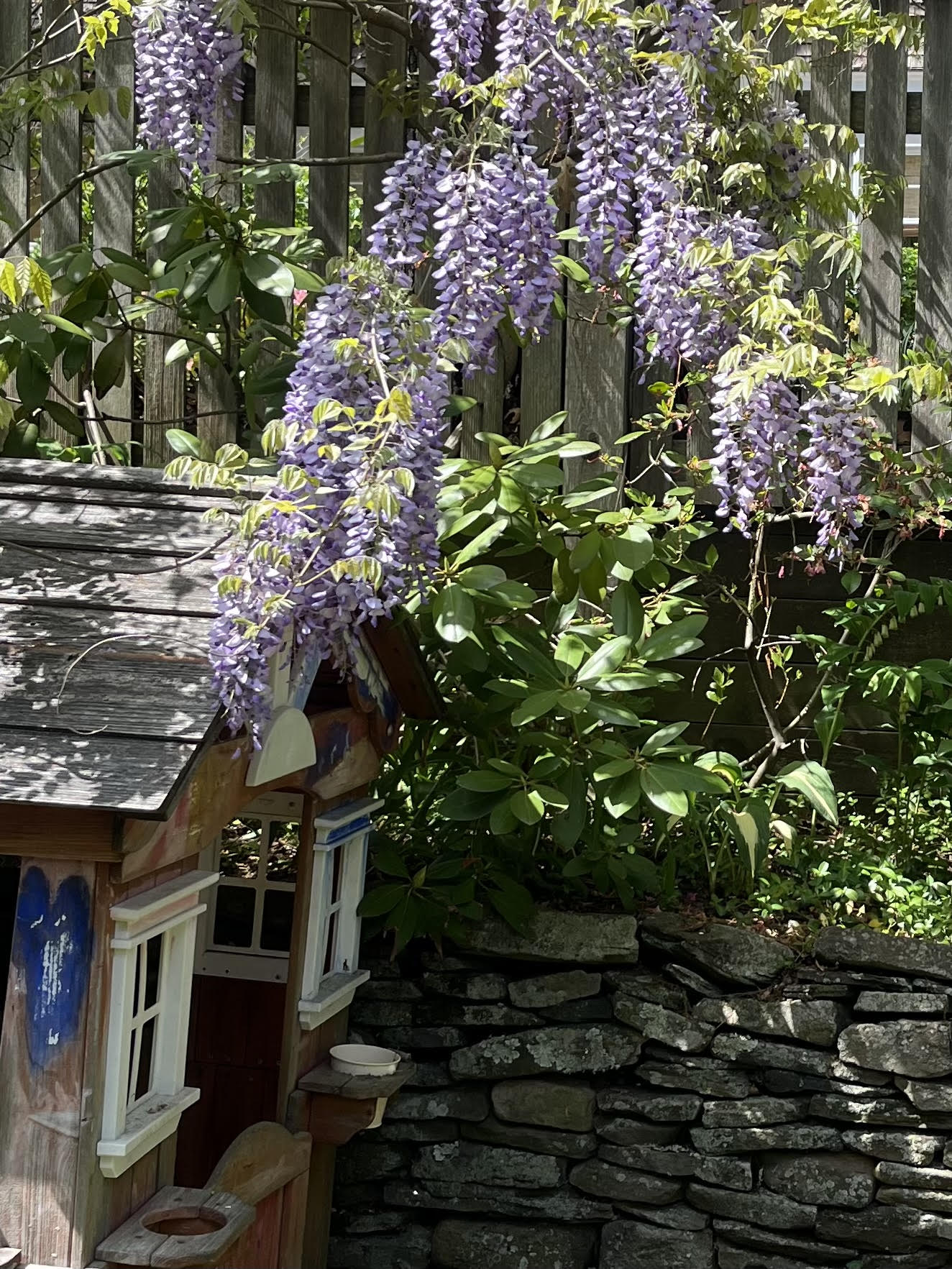
In the Greater Boston area, my friend Jean and Biodiversity Builders have been leading the way for years. I wrote about them several times — for example, here. Do you have pollinator pathways near you?

Photo: Robert Ritchie, Unsplash via Living on Earth.
The streaks of light in this 30-minute timelapse image show fireflies in a Wisconsin field.

Where are the fireflies of our childhood? Although the population perked up around here this past summer, possibly because of all the rain, firefly lovers have reason to be worried about the long term. Today’s story explains what’s going on — and how we can all help.

Eric Berger writes at the Guardian, “Max Vogel, a 29-year-old public defense attorney, was picnicking with friends in early August at Prospect Park in Brooklyn, New York, when he noticed flashes of light appear in the air around him.

“They were fireflies, bioluminescent insects that the Washington DC native had not seen while living in Oregon, where there are few, if any. For many Americans who live where fireflies do, their flashing lights at dusk are a tangible rite of summer – though one that may now be under threat. …

“Vogel said, ‘It’s like a shooting star that just is surprising and gives you the childlike wonder of how you felt when you first saw fireflies in your yard.’

“Even in areas of the US where there are typically fireflies, people are especially excited to see them this year because there appear to be more this summer after a steady decline in recent years, according to scientists.

“Despite that welcome news, researchers caution that it does not necessarily signal a reversal of the downward trend. They remain concerned about the long-term viability of the firefly family, which includes more than 2,000 species, some of which are at risk of extinction due to factors such as light pollution and climate change.

“ ‘It’s been really uplifting to hear all of the reports of huge increases in fireflies,’ said Candace Fallon, senior endangered species conservation biologist for the Xerces Society for Invertebrate Conservation. ‘But they are also insects, and insects are notorious for having populations that bounce up and down each year, and so it’s hard to say that their populations are increasing from a single year of data.’

“Fireflies, also known as lightning bugs, are beetles that come out at night during summer and produce a bioluminescent gleam, primarily to attract a mate.

“Cultures around the world treasure the bugs, including in Japan, where they are symbols of love and fallen soldiers.

“ ‘Catching fireflies is a relatively harmless thing that you can do that really connects you to your natural world,’ said Matt Schlesinger, chief zoologist with the New York Natural Heritage Program, which is participating in a project to identify which firefly species occur in state parks.

“Scientists in the US and Canada do not have baseline data on firefly species, which makes it difficult to quantify how much the population has decreased, and they must instead rely on anecdotal reports and documented habitat loss, which point to a downward trajectory, Fallon said.

“She and other researchers conducted a study published in the journal PLOS One which found that 18 species in North America are threatened with extinction. But the scientists also did not have enough data on more than half of the assessed species to determine their extinction risks. …

“The primary factor behind fireflies’ decline is habitat loss and degradation, according to the Xerces Society. That includes land being disrupted by development, light pollution and pesticide use. Artificial lighting at night makes it hard for the bugs to communicate and mate, Fallon said.

“Climate change, including an increase in droughts and rising sea levels, also affect firefly populations, she said.

“Still, there are some firefly species that appear to be doing ‘just fine,’ Schlesinger said [adding that] the kinds that specialize in particular habitats are the ones struggling. …

“ ‘If they can still have a big year, at least those species are probably doing fine and have the potential to recover,’ Schlesinger said. That said, ‘any single year doesn’t tell you about the long-term trajectory of firefly populations. …

“Kids should continue the tradition of venturing out with jars in the summer but should then release the bugs rather than collecting them, Schlesinger said.

“Other ways to help fireflies survive include: not using pesticides, reducing artificial lighting at night, and allowing the grass to grow long and the leaves to pile up in your yard.

“ ‘A lot of fireflies pupate in leaves, and so when we rake those and put them in bags, we’re destroying their habitat at a very small scale,’ Schlesinger said.

“Despite the concerns about extinction, Fallon is encouraged by master gardeners in Arkansas who created a firefly sanctuary, and by lawmakers in Maryland who approved legislation earlier this year which introduces new regulations on what type of lighting can be bought with state funds. …

“ ‘I think we have enough time to make a difference.”

More at the Guardian, here. See also the radio show Living on Earth, here.
Photo: Dave Koz.
Dave Koz and the Summer Horns perform on their summer 2025 tour. A video of their impromptu, in-flight performance went viral.

When I was in high school, Cousin Bob dated Ellen, a girl I knew who was good friends with Liza Minnelli. This was back when Minnelli was best known as the daughter of Judy Garland and not in her own right.

Well, Liza was already a good singer, and Ellen sang exactly like Ethel Merman. She was a little tiny thing, and it was amazing to hear that booming voice come out of her.

One day, the two of these girls were traveling together, and their plane was badly delayed. So Liza and Ellen started singing to entertain the other passengers, and it got in the paper that Judy Garland’s daughter had done this.

I think that’s the only story I know that’s similar to the one in this post, but probably you know of others.

Kelly McCarthy reported at ABC in August, “No one likes being stuck on an airplane longer than absolutely necessary, so when a famous jazz group aboard an Alaska Airlines flight was asked to help lift the spirits of their fellow severely delayed passengers with a live musical interlude, they happily busted out horns and played the unlikely venue.

“In a now-viral video, Dave Koz and the Summer Horns performed their rendition of Stevie Wonder’s ‘You Haven’t Done Nothing’ in an impromptu concert amidst a slew of delays, diversions and timed-out staff en route from St. Louis to their next tour stop in Seattle.

“The moment took place in the wee hours early [in the] morning on the tarmac after their flight was diverted to Boise, Idaho, the namesake saxophonist told Good Morning America. That’s when Koz said most people were ‘at their breaking point’ and ‘this wonderful flight attendant’ stepped in to see if their group would want to provide some in-flight entertainment.

” ‘Charlene was like, “Can you guys play?” ‘ fellow saxophonist Marcus Anderson added. ‘We end up getting our instruments out and everyone’s excited and all these phones are coming out — we’re just thinking about giving people a great concert on an airplane.’

“They selected a song from their show set list and played it with as many of the 16 band members who had carried on equipment. …

” ‘People were clapping. It was great vibes. It was great energy,’ Anderson said, adding that little kids recorded the video and were already watching it back in their seats after they concluded.

” ‘We got the video content from people, and I said, “Hey, Dave, I’m going to post it and share it.” By the time we get off the plane — it was trailing close to maybe 200,000 views,’ Anderson explained of the initial explosion in social media interest. …

” ‘We were just taking a moment trying to make lemonade with lemons, and it tasted very good,’ Anderson, whom Koz called ‘the future of the saxophone,’ said. ‘We brought the concert to all those incredible passengers, not just on stage, but on the plane as well.’

“Koz said he’s ‘never played on a plane’ before that, whereas Anderson once performed a solo version of ‘America the Beautiful’ on Fourth of July. …

” ‘This really taps into everybody’s sort of frustration right now of traveling in the United States, where you feel so out of control, and this feeling of like you just don’t know what to do,’ Koz explained. ‘We were able to sort of channel that energy and turn the vibe completely.’

“In 40 years of the music industry, this moment reminded Koz that he’s still ‘humbled by the power of music to change a mood.’ “

More at ABC, here.

A Show of Rejected Art

Photo: Burl Community Art Gallery.
Artist Julie Peters Krohn painted the rejected Minnesota State Fair entry “The Corn King” as an homage to Ron Kelsey, former superintendent of farm crops at the state fair.  It is on view for the “State Fair Rejects” exhibition at the Douglas Flanders & Associates gallery in Minneapolis.

Do you remember the Museum of Bad Art in Massachusetts? I wrote about it a few times (for example here). The art in today’s story about entries that were rejected by the Minnesota State Fair are not necessarily bad art; they just didn’t fit the taste of this year’s judges. It’s a nice challenge for the rest of us anyway. Would we reject these for an exhibition that doesn’t claim to offer high art in the first place?

A gallery in Minneapolis decided that some of these pieces really deserved to be judged by ordinary folk.

As Alex V. Cipolle reported at Minnesota Public Radio (MPR), “The Fine Arts Competition at the State Fair is one of the most competitive juried exhibitions in Minnesota. This year, artists submitted a total of 2,835 pieces; only 336 were accepted.

“Minneapolis artist Mike Welton says: Don’t take it personally. Welton submitted his painting, “QUEER,” part of a series of LGBTQ-themed signage that Welton has photographed around the country. It didn’t make the cut. In his career, Welton estimates he’s shown in about a dozen Fine Art Competitions, and been rejected from about seven or eight. …

“Welton has unique insight, too. Each year Jim Clark, the fine arts superintendent, chooses artists to curate the show. In 2017, Welton was one of those artists.

“ ‘The year I curated, I couldn’t even pick pieces I wanted to because not all of them could go in,’ Welton says.

“Welton — and many other artists — are taking their rejected entries elsewhere. “Queer” will be on view for ‘State Fair Rejects,’ an exhibition … at the Douglas Flanders & Associates gallery in Minneapolis. …

“ ‘There was a lot of professional artists complaining about being rejected all the time, and I thought, well, maybe we should do a reject show,’ Douglas Flanders says. Last year was the gallery’s first reject show with 50 artist submissions. This year, Flanders says there are almost 80 artworks, from sculpture and paintings to textiles and photography. …

“ ‘People loved coming and supporting it and having another opportunity, obviously, to show their work, too, at a gallery that maybe they would otherwise never have the chance to,’ [Gallery manager Syril McNally] says. “So this year, that’s even more popular, just [by] word of mouth.”

“Beth Stoneberg of the Burl gallery [in St. Paul] says it’s the fifth time they’ve hosted ‘Rejected!’

“ ‘It’s probably one of our most anticipated exhibits of the year. It draws a remarkable crowd. It sparks a lot of conversation,’ Stoneberg says. ‘People are really rooting for the underdog.’ …

“One of her favorite submissions this year is ‘The Corn King’ by artist Julie Peters Krohn. The painting depicts Ron Kelsey, Minnesota ‘corn historian’ and the former superintendent of farm crops at the fair’s Agriculture Horticulture building. Krohn has painted Kelsey with seed sacks (Kelsey may have the largest collection of seed sacks in the world at 1,400).

“ ‘I was inspired while attending the Minnesota State fair last year after I met Ron Kelsey and his scarecrow in the agriculture building,’ Peters Krohn said in her artist statement. 

“I learned about the fair honoring him with a lifetime membership for his many years of involvement, which has included, but is not limited to, corn producer, corn judge, seed art competition creator, scarecrow competition creator and the display of his collection of vintage seed bags. I saw humor in creating a painting of a sculpture of a man so involved but so little known.’ ” More at MPR, here.

You can find a piece that actually won a 2025 State Fair prize by clicking here. It’s called “There Might Be Dragons.”

Photo: Phillip Jones/Vent Haven Museum..
In Fort Mitchell, Kentucky, there’s a haven for ventriloquist dummies.

Whenever I saw ventriloquist dummies in childhood, I was fascinated that they could seem to talk. You don’t see them nowadays that much, and it seems that fewer people are learning the skills that let them appear to “throw their voices” into those dummies.

Mina Tavakoli , a neophyte ventriloquist, writes at N+1 that there’s a place in Kentucky where the art is alive and well.

“A half-nude, three-foot figure called me to a table just beside the vending machines. … ‘I’m Dicky!’ he squeaked.

“I wagged my pen in front of his tight little face. ‘Dicky,’ I repeated. [It was then] right as Dicky’s jaw flung open, that his ventriloquist  —  his father, his frère, his semblable; the standard abbreviation going forward is vent  —  sneezed. At that second, Dicky did too. The vent trumpeted into his tissue and held it in front of his wooden child, who did the same, loudly and juicily. …

“We were all in Kentucky. Side by side by side, we stood near the entrance of the Vent Haven Ventriloquist ConVENTion. … Dummies were rising from zippered suitcases, lifted from velvet-lined trunks, coffined on banquettes with protective canvas bags on their heads, like prisoners expecting execution. Dummies congested every visible cranny of the Erlanger Holiday Inn in a huge interspecies fiesta of dwarves, worms, baboons, children, et cetera.

“The human delegation was only slightly less mixed. Many attendees were entertainers  —  clowns, cruise-ship performers, Santa impersonators, balloon artists (known in the trade as ‘twisters’), theme-park proprietors, theme-park employees, and (hugely overindexed) magicians  —  clapping one another on the back and nodding like Marines celebrating dockage on home soil. …his was the ConVENTion’s welcome reception, where the cream of ventdom was swarming the warm and ferny lobby to relive the lives and re-die the deaths of the vaudeville. …

“The man with the chef’s hat and meatball puppet … calmed hospital patients and veterans through a nest of spaghetti. Just past the gurgle of the lobby fountain was Barbie Q. Chicken, a 4-year-old bird who was both Broadway prima donna and antibullying activist. Beside the wall of potted plants was Danny, an underweight and barefoot hillbilly from the mountains of West Virginia, and further beyond him was Herman the Worm (pronounced ‘Hoiman Da Woim’), a cross-eyed caterpillar made out of a dryer vent hose. Beep, a monkey, was kitty-corner, behind me were Doodle the toad and the handsomely breasted showgirl Miss Trixie, and now approaching with tensed biceps was Rocco, the muscular pit bull from Staten Island. … Some had that sort of vaporizing charisma; some, one could tell, had the limper, more sheepish personalities of those whose lives are defined by long stretches of extreme silence. As the lobby mushroomed with figures of felt, wood, and PVC tubing, they formed a great chorus of flopsy [creatures] that would not shut up.

“First-timers formed lines against the marble  —  our official title was ‘red dotters,’ after the distinguishing round stickers on our name tags. … Men, eager to know what brought me to ventriloquism, showed me photos of daughters, wives, dogs, farms. Men, who were not full-timing entertainers, were retired dental hygienists, hairdressers, firefighters, ranchers. Retired anythings. …

“Northern Kentucky was never exactly a likely mecca for the ventriloquial arts. In the 1920s, barrooms across the nation boomed with the surrealist showbiz acts of American vaudeville. From Midwestern saloons and small-town beer halls to New York’s glitzy Palace Theater, most cities welcomed troupes where magicians charmed, plate spinners spun, contortionists contorted, and ventriloquists  … threw their voices across club circuits that sold the business of analog enchantment. When the theaters darkened in the Depressive ’30s, televised variety shows shuttled ventriloquism safely to the entertainment capitals of Los Angeles and New York, though the rise of more sophisticated special effects began to render dummies anachronistic as early as the mid-’60s. By the early ’70s, when vent-prominent programs like The Ed Sullivan Show had sunsetted to make way for sitcoms, the ventriloquist-and-dummy act was already approaching something like near-obsolescence.

“A tile salesman, one William Shakespeare Berger, homed his collection of dummies in his garage in Fort Mitchell, Kentucky. Before his passing, in 1972, he donated his entire estate to establish Vent Haven, the world’s only museum devoted to ventriloquiana. The Vent Haven ConVENTion, now in its forty-ninth year, is presently six miles away from the original site of Berger’s family home, and functions as ventriloquism’s true earthly haven:. …

“The general act of learning ventriloquism is tedious, because the puppet is an instrument, and only one half of the theater routine. It is an ancient art, a maze of gestures and shadow gestures. … Nimble fingers tweak at little pinches and squeeze-boxes stuck inside the cavities of the ventriloquial dolls … while the tongue operates flawlessly under confinement. …

“There is no real ‘throwing’ of the voice, alas; the ear’s deficits are made up for by the eye, which focuses on the puppet’s moving jaw, forming the suggestion that whatever’s being said by you is said by your companion. The most problematic letters of the alphabet  —  there are five of them  —  inspire too much frottage between lips, which explains why puppets often have jeery, whiny, heavily accented, broken, or otherwise goofy voices: these are coping mechanisms, rerouted into hallmarks of the form.

“Take the letter p, an annoying plosive. Under the standard ventriloquial straitjacketry of (1) a relaxed jaw, (2) slightly open but stiffened lips, and (3) a closed set of teeth, a phrase like ‘I like to hike’ is shockingly easy to pronounce, whereas ‘I prefer puppetry’ is humbling. To dodge the automatic, upper-to-lower-lip kiss involved in expressing the letter p, ventriloquists hump the back of the tongue against the soft palate and vault air right through the back. In practice, this sounds much like the letter t. The ventriloquist thinks p, says their muffled t, and does this ad nauseam until the letter is strong and clear. (‘I trefer tuttetry.‘)”

Lots more at n+1, here. Did you ever try to do this?