Feeds:
Posts
Comments

Posts Tagged ‘architecture’

Photo: Jim Stephenson.
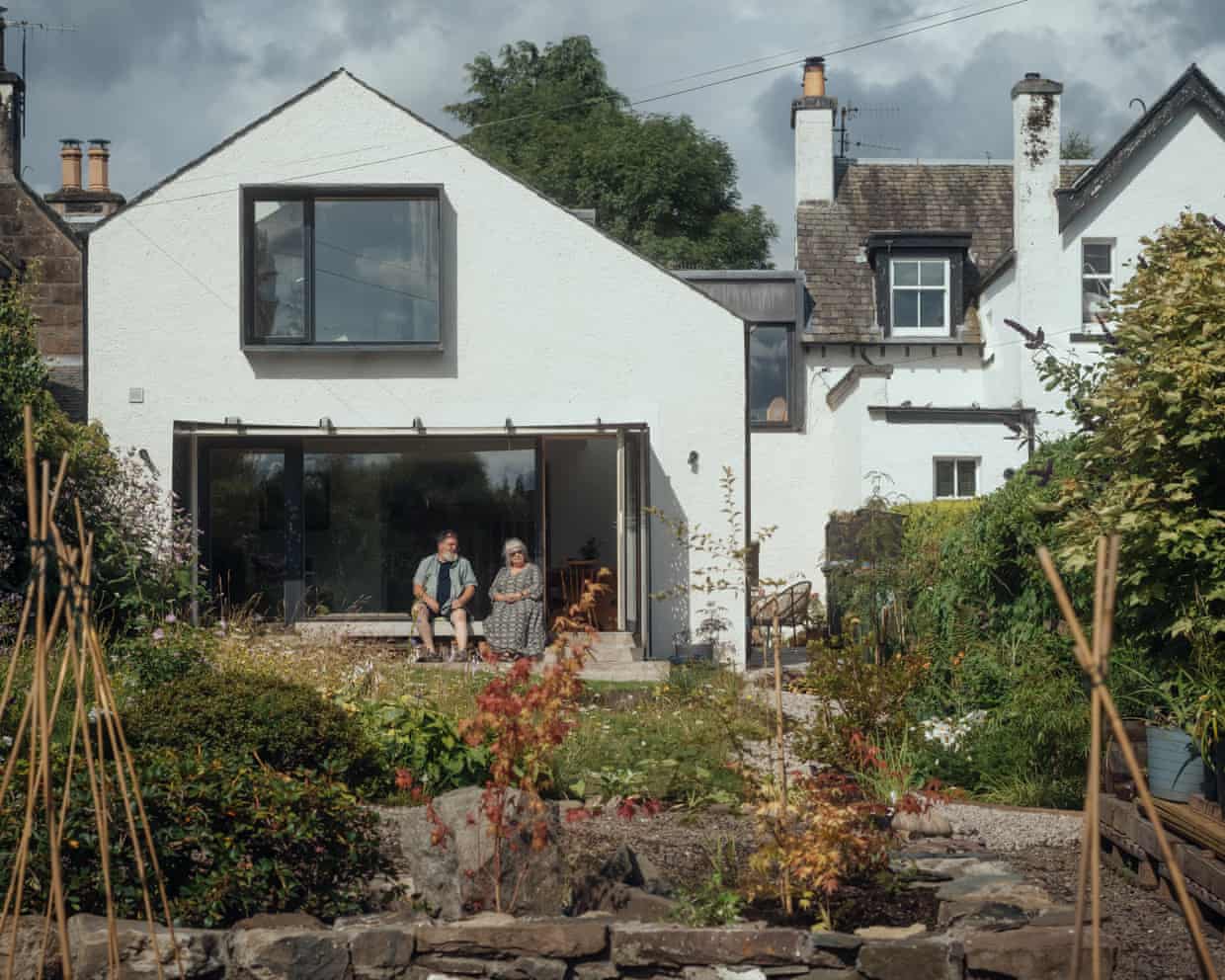
The yard of a cottage in Comrie, Scotland. More and more architects are designing for people with dementia — and their families.

People who want to stay in their homes to the end are braver than I am, and they are in the majority. I think the most impressive are those who are determined to care for a disabled loved one until they can’t manage anymore. I have known a few caregivers adapting to life with a dementia victim.

To help them do that, some architects are designing “dementia-friendly” houses. Charlotte Luxford writes at the Guardian about a home like that near Glasgow.

“Glaswegian retirees Jim McConnachie and Frances McChlery had always dreamed of building their own home with a waterside view, and had even toyed with buying a plot on Scotland’s west coast. However, when McChlery’s sister was diagnosed with young-onset dementia, they had to rethink their plans.

“ ‘The prospect and implications of supporting my sister-in-law became a key consideration,’ says McConnachie, ‘and we decided to build a home closer to the facilities of the city so she could live with us and be closer to extended family.’

“McConnachie embarked on a tour of Scotland’s lochs, but after making a pitstop at Comrie in Perthshire on a sunny day he passed a ‘for sale’ sign on the way out of the village that piqued his interest.

“ ‘Looking at the cottage from the street it was tiny and worn, but to the rear was a lovely south-facing garden that backs on to the River Earn,’ says McConnachie. Excited, he brought McChlery and her sister for a viewing. They both saw potential in the property and were charmed by the bustling village with its valley views and thriving community.

“Last used as a dental surgery, the 18th-century cottage didn’t have any insulation and suffered from water damage and structural decay. McConnachie, who trained as an architect, embraced the challenge of transforming it into a warm and adaptable home that could also accommodate extended family. ‘We wanted the house to remain flexible and welcoming as a family hub, while also ensuring Frances’s sister felt safe, independent and engaged,’ he says.

“McConnachie sought guidance from architecture firm Loader Monteith on maximizing the layout, navigating conservation area restrictions and incorporating dementia-friendly design principles. For example, accessible kitchen shelving to allow her sister to navigate the space with some independence and open views through living spaces, so she feels connected but not surveilled.

“[Director] Matt Loader … wanted to respect the ‘honesty’ of the original cottage, so the front two rooms were maintained as cosy living spaces, each with its own fireplace and lime-plastered walls.

“The kitchen is at the heart of the home, with a small courtyard … providing a sheltered spot for morning coffee. ‘The relationship between Frances and her sister is rooted in cooking, baking and gardening, so the kitchen and its connection to the outside spaces was key,’ adds Loader.

“A defining feature is the marble-topped island, crafted from a piece of stone passed down through the family. As both sisters are short, ‘the island was set low to allow Frances’s sister to help with baking and food preparation, which is an important occupational therapy,’ says McConnachie. …

“Seating [nooks] are a recurring theme; upstairs is a thoughtfully positioned window seat surrounded by shelves displaying ‘memory anchors’ Loader says: ‘Housing artefacts that hold historical significance can help those with Alzheimer’s recognize that this is their home, and it’s important to retain that sense of familiarity.’

“McChlrey’s sister’s living quarters have been sensitively designed to cater for her needs without making it feel at odds with the rest of the house. The upstairs landing also includes a small servery, complete with sink and washing machine, that is designed to facilitate social interaction while also aiding practical care. …

“On the ground floor, the front of the cottage is currently a home office on one side and a sitting room on the other, each with full-width sliding doors and sofa beds so they can be transformed into sleeping spaces when family visit or permanently if need be later.

“One of the biggest benefits of the layout, McChlery has discovered, is its ‘intervisibility,’ allowing her to keep an eye on her sister without making her feel she is under supervision.

” ‘The deterioration of people with Alzheimer’s isn’t predictable,’ says McConnachie. ‘The best-laid plans to leave clear space and simple-to-use facilities to allow for independence can be quickly taken over by the continuing onset of the condition, so it’s worth allowing space for supervised sharing tasks.’

“McConnachie ensured they left room for the introduction of fittings such as stair lifts and bathroom aids, as well as planning a simple and level route through the house – you can get from the front door to the garden without a step [up or down].

“ ‘Caring for another adult with dementia is very difficult emotionally and physically – the grief and injustice are always in the back of your mind,’ adds McChlery. ‘Everything about this house helps – it provides a beautiful and safe space that enables us all to be at home for as long as possible.’ “

More at the Guardian, here.

Read Full Post »

Photo: Christopher Thomond/The Guardian.
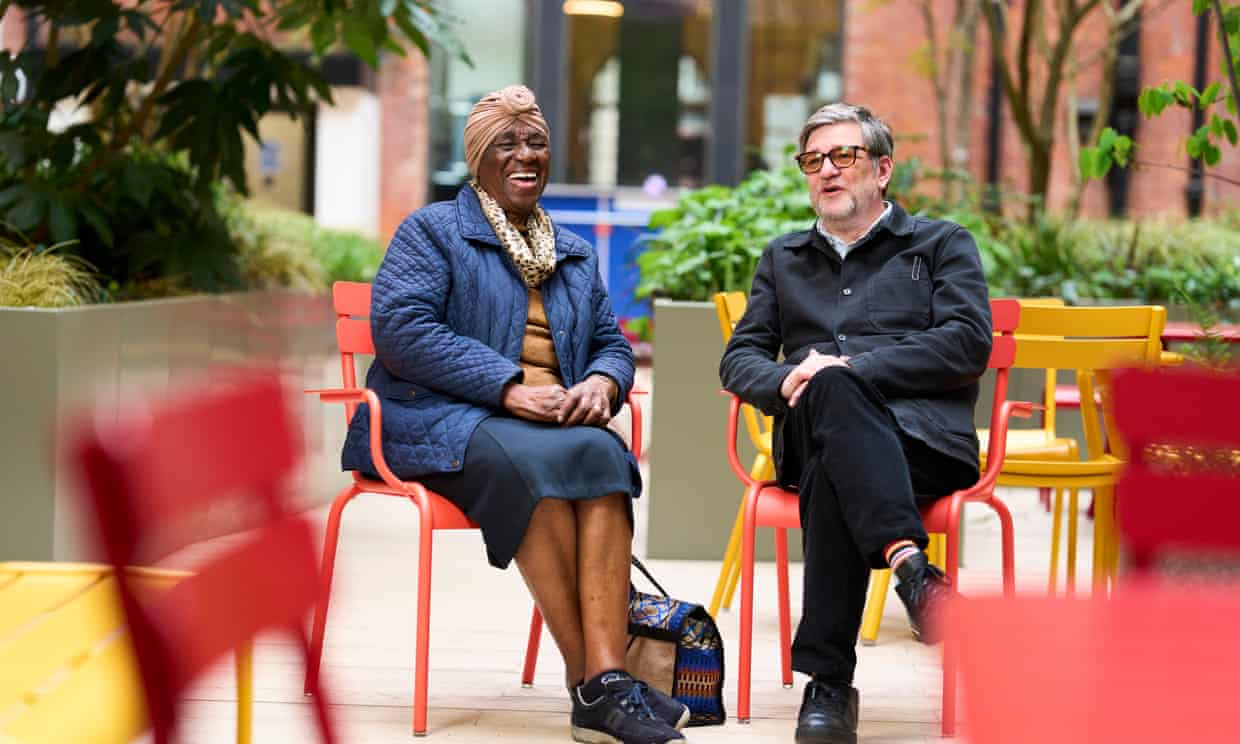
Elaine Unegbu, the chair of the Age Friendly Manchester [UK] older people’s board, and Paul McGarry, the head of the Greater Manchester aging hub. 

Where I live now, in a retirement community with various levels of care, the management favors pilot projects from academia and startup companies to test technology that can keep people independent longer. I haven’t volunteered for any of them, but I think it’s a good idea, especially as Erik still holds patents for something along those lines.

I recently read about some simple but ingenious innovations in Manchester, England, that I thought might interest readers like Making Home Home. I mean — how obvious but how overlooked is putting numbers on outdoor benches to aid in emergencies?

Chris Osuh  reports at the Guardian, “Futuristic planning for spaces where people can age well and live in an area designed for them to grow old in is accelerating in the UK with a radical project backed by £1.5bn [$1.7bn].

“The plan to transform a hospital into the first neighborhood in the country designed for people to thrive as they age will be a national testbed for holistic health and social care approaches. It will include hi-tech homes that adapt to occupants’ life stage and care needs, transport, a village green and a social calendar to combat isolation.

“The master plan for the North Manchester general hospital (NMGH) redevelopment in the Crumpsall district is the result of collaboration by public health officials, local politicians, experts and architects.

“Michelle Humphreys, the director of strategic projects for Manchester University NHS foundation trust (MFT), described it as a neighborhood that ‘adapts around people as they go through life,’ powered by advances in medical wearables and remote monitoring. …

“NMGH’s ‘healthy neighborhood‘ scheme is multigenerational. It will include family housing and will be built in line with age-friendly concepts, spearheaded by the World Health Organization (WHO) in response to two major trends – the aging population and urbanization.

“By 2050 60% of the global population will live in urban environments and 27% of people will be over the age of 65, the OECD predicts, yet experts say cities are often defined by spatial agism where environments are not set up for older people.

“The age-friendly movement aims to ensure older people can still play a part in civic life. The Elders Council of Newcastle, Northern Ireland’s older people’s commissioner and Wales’ commitment to becoming an age-friendly nation reflect how UK regions and devolved governments have been preparing for demographic change.

“The humble bench – improved with armrests, numbered to aid in a medical emergency, or placed strategically for wellbeing and intergenerational conversation – can be transformative, with dozens installed in Manchester, taking inspiration from New York’s CityBench initiative. However, the UK has further to go.

Akita, in northern Japan’s Tohoku region, where 30% of the population is over 65, has more than 60 heated roads to prevent slips on ice.

“In Singapore, where one in four are predicted to be over 65 by 2030, the Admiralty ‘vertical village’ has a central medical tier, so older residents, who live in slip-proof homes with alarms alerting neighbors in an emergency, can have surgery without leaving. In Germany in 2007, BMW made 70 changes to its Dingolfing factory to adapt to an older workforce. …

“Prof Stefan White, from Manchester Metropolitan University and Manchester School of Architecture, said the NMGH project would exemplify how to free up hospital space and allow people to ‘age in place’ with the type of support ordinarily provided in a care home made available to the whole neighborhood on a flexible basis.

“Elaine Unegbu, the chair of the Age Friendly Manchester older people’s board, has successfully lobbied the Greater Manchester mayor’s team for transport adaptations, benches and afternoon matinees. She said the healthy neighborhood would give residents peace of mind at a time when gentrification ‘whitewashed’ older urbanites, with many forced from their homes by health crises to the detriment of communities.

“Manchester, where previous age friendly projects include the Derek Jarman Pocket Park inspired by LGBTQ+ over-50s, has been pioneering the movement in the UK since 2008. Last month the city hosted international experts at the Age-Friendly Futures Summit.

“Paul McGarry, the head of the Greater Manchester aging hub, said: ‘The task is to get a national conversation on aging.’ “

More at the Guardian, here.

Read Full Post »

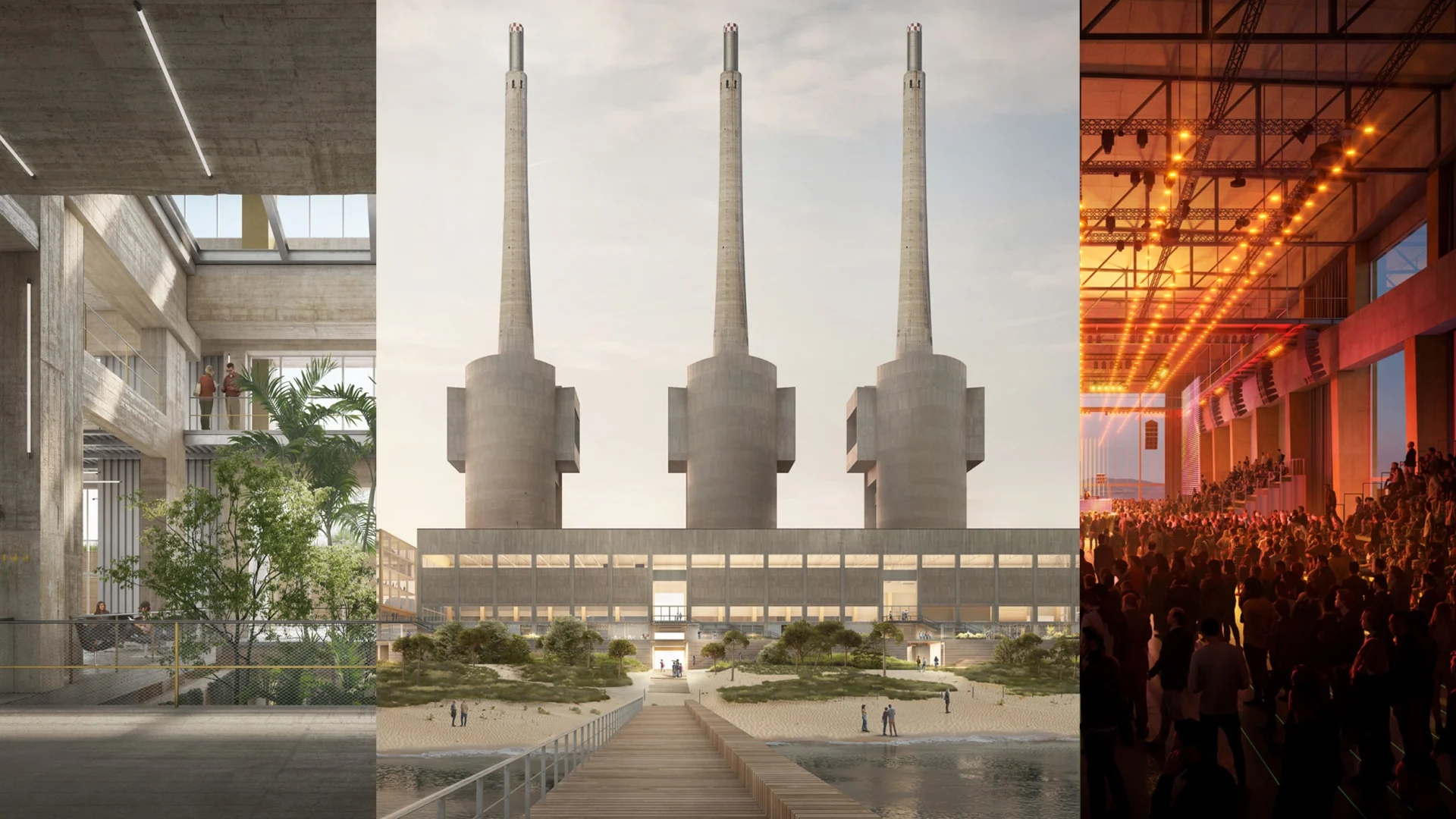
Photo: Garcés de Seta Bonet Arquitectes/Marvel.
Barcelona is transforming its skyline’s biggest eyestore into a beautiful tech hub.

I have a dear friend who is so keen on the possibilities of artificial Intelligence that she doesn’t seem to care how much energy it takes from other purposes — or whether the energy is clean. She says China uses coal; China is ahead.

I, on the other hand, rejoice to see coal going by the wayside and creative uses for the coal plants that once stained the landscape.

Jesus Diaz has a story about that at Fast Company.

“Tres Xemeneies (Three Chimneys) is a former coal-fired power plant in Sant Adrià de Besòs. … Barcelona’s plant is set to undergo a radical transformation into the new Catalunya Media City — a cutting-edge hub for digital arts, technology, and education. 

“The winning design is called E la nave va, a nod to Federico Fellini’s film of the same name, which translates to And the Ship Sails On, a reference to how this long-dead structure that resembles a three-mast ship will keep cruising history in a new era. According to its creators — Barcelona-based Garcés de Seta Bonet Arquitectes and New York-Barcelona firm Marvel — the project promises to honor the site’s industrial legacy while propelling it into a sustainable, community-centric future. The project is slated to break ground in late 2025 and be completed by 2028.

“Three Chimneys looks exactly how it sounds: a gigantic structure dominated by three 650-foot-tall chimneys. The brutalist plant was built in the 1970s and faced controversy even before its opening. Many of the residents of Badalona and Barcelona hated it both for the aesthetics and the environmental implications. Its problems continued in 1973, when workers building the station went on strike. … The company that ran the station was also sued because of the pollution it caused, and the plant eventually shuttered.

“The structure is imposing. Its giant concrete vaults, labyrinthine floors, and towering chimneys presented a unique challenge to preserving its industrial DNA while adapting it for the 21st century. … Rather than force modern elements onto the existing framework, the team used the building’s features to organize its function.

“For instance, the lower floors — with their enclosed, cavernous spaces — will host incubators and exhibition halls, while the airy upper levels with their panoramic coastal views will house vocational training classrooms and research labs.

“ ‘We kept the existing structure largely unaltered,’ [Guido Hartray, founding partner of Marvel] says, ‘retaining its experiential qualities and limiting modifications.’ This approach ensures that the power plant’s raw, industrial essence remains palpable, even as it accommodates immersive media studios and a modern, 5,600-square-meter exhibition hall likened to London’s Tate Modern Turbine Hall. …

“The architects leveraged the building’s robust concrete skeleton — a relic of its industrial past — as a sustainability asset. Barcelona’s mild climate allows the thermal mass of the concrete to passively regulate temperatures, reducing reliance on mechanical systems. Spaces requiring precise climate control, such as recording studios and laboratories, are nested in a ‘building within a building,’ insulated from external fluctuations, according to the studios.

“The rooftop will double as a public terrace and energy hub, with 4,500 square meters [~48,438 square feet] of solar panels generating renewable power. This dual function not only offsets the energy demands of lighting and HVAC systems but also creates a communal vantage point connecting Barcelona, Sant Adrià de Besòs, and Badalona. ‘The rooftop’s role as both infrastructure and gathering space embodies our vision of sustainability as a social and environmental practice,’ Hartray says.

“The project’s most striking intervention — the ‘transversal cuts’ that slice through the turbine hall — emerged from a meticulous study of the building’s anatomy. Marvel and Garcés de Seta Bonet identified natural breaks in the long, warehouse-like structure, using these to carve openings that link the interior to the outdoors. These cuts create fluid transitions between the industrial hall and the surrounding landscape. …

“The north facade’s new balcony, overlooking the Badalona coastline, epitomizes this connectivity. Jordi Garcés, cofounder of Garcés de Seta Bonet Arquitectes, tells me via email that they have designed a proposal that plays with connections and knots — temporal, landscape, and territorial. … ‘The architectural elements at different heights will offer new landscape perspectives, as if it were a land art piece.’ In this ‘shared communal space,’ he says, residents and visitors alike can engage with the Mediterranean horizon.

“The building is the core of Catalunya Media City, which is a project that the regional government says will democratize access to technology and creativity. It claims that it will house educational programs for more than 2,500 students annually, including vocational training; research incubators partnering with universities and corporations; immersive installations and performances in a monumental hall with 56-foot-tall ceilings; and production studios, including an auditorium, soundstages, and UX labs.”

More at Fast Company, here.

Read Full Post »

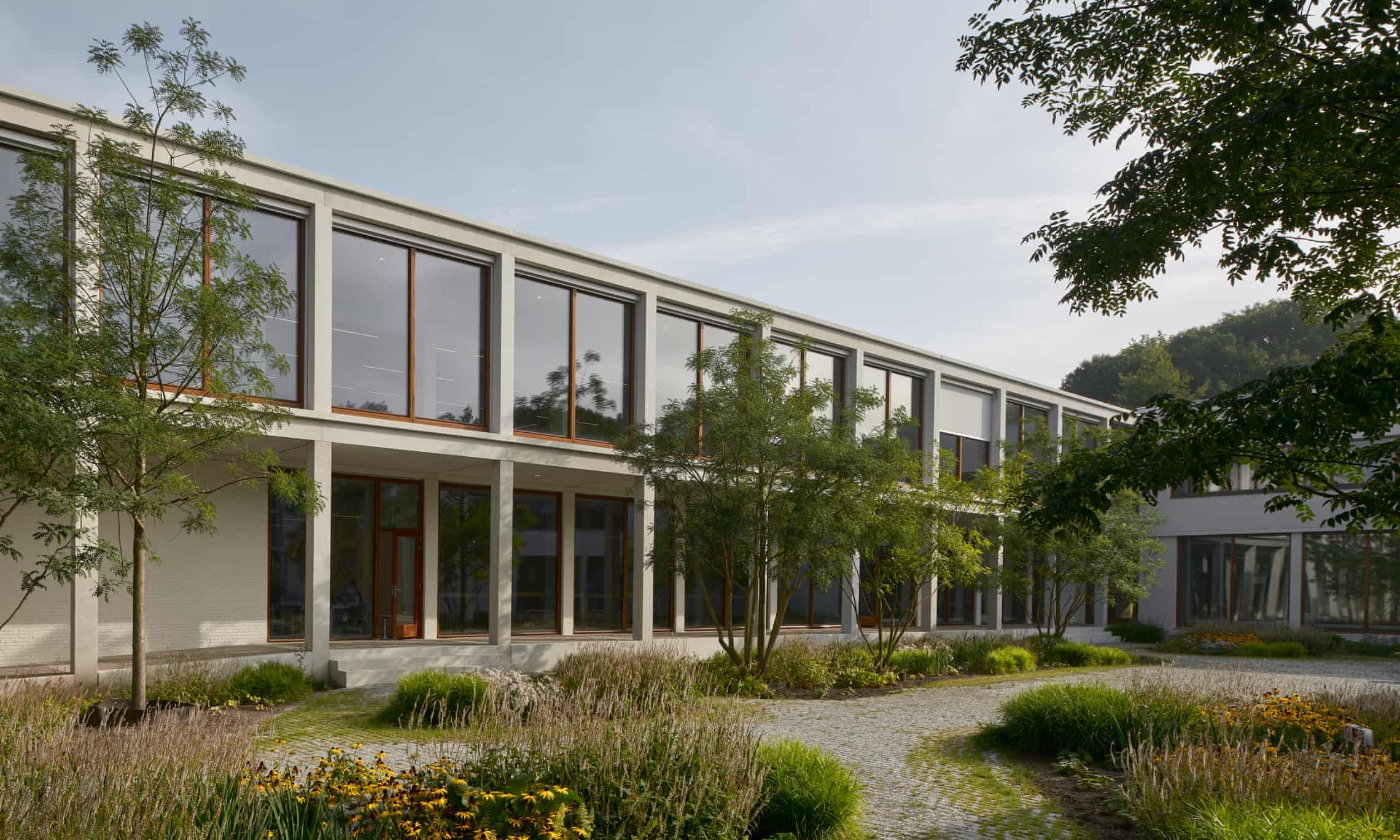
Photo: MWA Hart Nibbrig.
The makeover by Maarten van Kesteren Architects of  a 1960s Utrecht college at less than half the cost of a new building and a third the carbon footprint is a lesson in sustainability.

In today’s story, a design company worked with what was available to make an old building sustainable. Apparently there’s some controversy about the approach, refitting the old instead of building everything new. See what’s happening in the Netherlands.

Rowan Moore writes at the Guardian, ” ‘The greenest building,’ to quote a slogan now popular among architects, ‘is one that is already built.’ It sums up the belated realization that the carbon impact and energy consumption of demolition and new building can be more significant than those of heating, cooling and running a building when it’s in use. It’s still a principle that is only patchily put into practice, in the UK and elsewhere. But the Dutch not-for-profit organization Mevrouw Meijer (meaning Mrs Meijer), which works to give new life to old school buildings, is quietly showing how it can be done.

“Her organization’s approach, says its founder, Wilma Kempinga, makes environmental, financial and practical sense, but it’s also about the experiences and memories of childhood. ‘It’s very important that students experience beauty,’ she says. ‘This is a place you will remember for the rest of your life.’ For Kempinga, beauty is best achieved by making the most of existing buildings – even those thought unremarkable – and getting the best young architects to design the transformation.

“We’re sitting in Nimeto, a trade school in Utrecht where students aged 16 to 21 learn shop window dressing, theatre set design, painting and decoration, specialist restoration and other skills. It’s a decent work of 1960s Dutch welfare state modernism – one of thousands from the country’s postwar educational construction boom: well lit and well proportioned, built in white-painted brick, within whose plain walls are the sights, sounds and smells of young people making things. Some of them are painting at encrusted easels beneath north-facing skylights, or planing and cutting timber; others trying out their decorating techniques on a house-like structure built to offer them as many awkward junctions and other challenges as possible. The school is populated with trompe l’oeil fragments of architecture – parts of stage sets – and experimental displays of objects you might find in a shop window.

“Now it’s better than ever. Where once the school was divided into two main blocks, they are now linked by first floor bridge and gallery with a colonnade underneath. A central courtyard that was a car park is now a garden that marks the cycle of the school year with yellow-and-white flowers in September, and blue-and-white flowers in spring. Double-height spaces bring light into a large basement, which can now be used for learning rather just storage. They also break open a regimented former arrangement of internal corridors double-loaded with classrooms. You can now look up, down, sideways and across, as well as straight ahead.

“The canteen is in one of the two blocks, the library in another, meaning that the two facilities shared by all students are distributed across the school. Previously, says Nimeto’s principal, Henk Vermeulen, students working in one part would refer to those in another as being ‘on the other side,’ but now all parts of the building are equally theirs. …

“The new design, by Maarten van Kesteren, a young architect based in The Hague, is about opening up and connections and making a shared container for the multifarious creativity of the students. The ‘whole school has a feeling that you are part of a lively workshop,’ as Van Kesteren puts it. The detail is simple, with what Kempinga calls ‘very beautiful pure materials that are unusual in school buildings,’ such as an oak floor whose woody smell mixes with that of the workshops. The project is achieved by the minimum of means, the only new structure being the long gallery/bridge, and gains additional education space. … It is also less than half the cost of an equivalent new building, with 30% of the carbon footprint.

“Mevrouw Meijer’s role, here and elsewhere, is to make the case for renovating rather than replacing, generating the evidence that it will be cheap, practical and climate-friendly. They also help select the architect. … Young practices without previous school experience, such as Van Kesteren’s, are preferred. ‘We don’t want an old guy or an old girl,’ says Vermeulen, but someone who will bring fresh thinking. As his school is always making the case that its inexperienced students should be trusted with opportunities, he says, it should do the same when appointing architects. …

“The original Nimeto building is typical of many in the Netherlands, whose design is quietly humane without being spectacular or special enough for it to be designated as significant heritage. Yet, says Kempinga, they are part of the country’s shared memory. …

“Schools also tend to be located in the centre of the communities they serve, whereas new replacements are often more remote. Yet, as Vermeulen puts it, ‘our neighborhood should profit from a new school, and our students are supposed to be working for this society,’ so it’s better if they stay put. The external landscape at Nimeto has been designed so as to connect the school’s garden with its surroundings and form part of the ‘ecological structure,’ as Van Kesteren says, of Utrecht.

“Mevrouw Meijer now have a number of school projects under way and recently completed. … Mevrouw Meijer is named after a well-loved children’s book character who worries a lot about nothing until she adopts and raises a baby blackbird, which teaches her to concentrate on essentials. If this sounds whimsical, the organization’s projects seem to be based on impeccable logic and well-founded aspirations; the only mystery is why their ideas are not applied more widely. There’s a mistaken belief that the best way to be sustainable to is to build something with all the latest environmental materials and devices. …

“Kempinga says it’s a question of attitude. ‘A lot of people like new buildings,’ she says, ‘and don’t have the imagination to see what’s possible with old ones.’ “

More at the Guardian, here.

Read Full Post »

Photo: Sky2105, CC BY-SA 3.0/Wikimedia Commons.
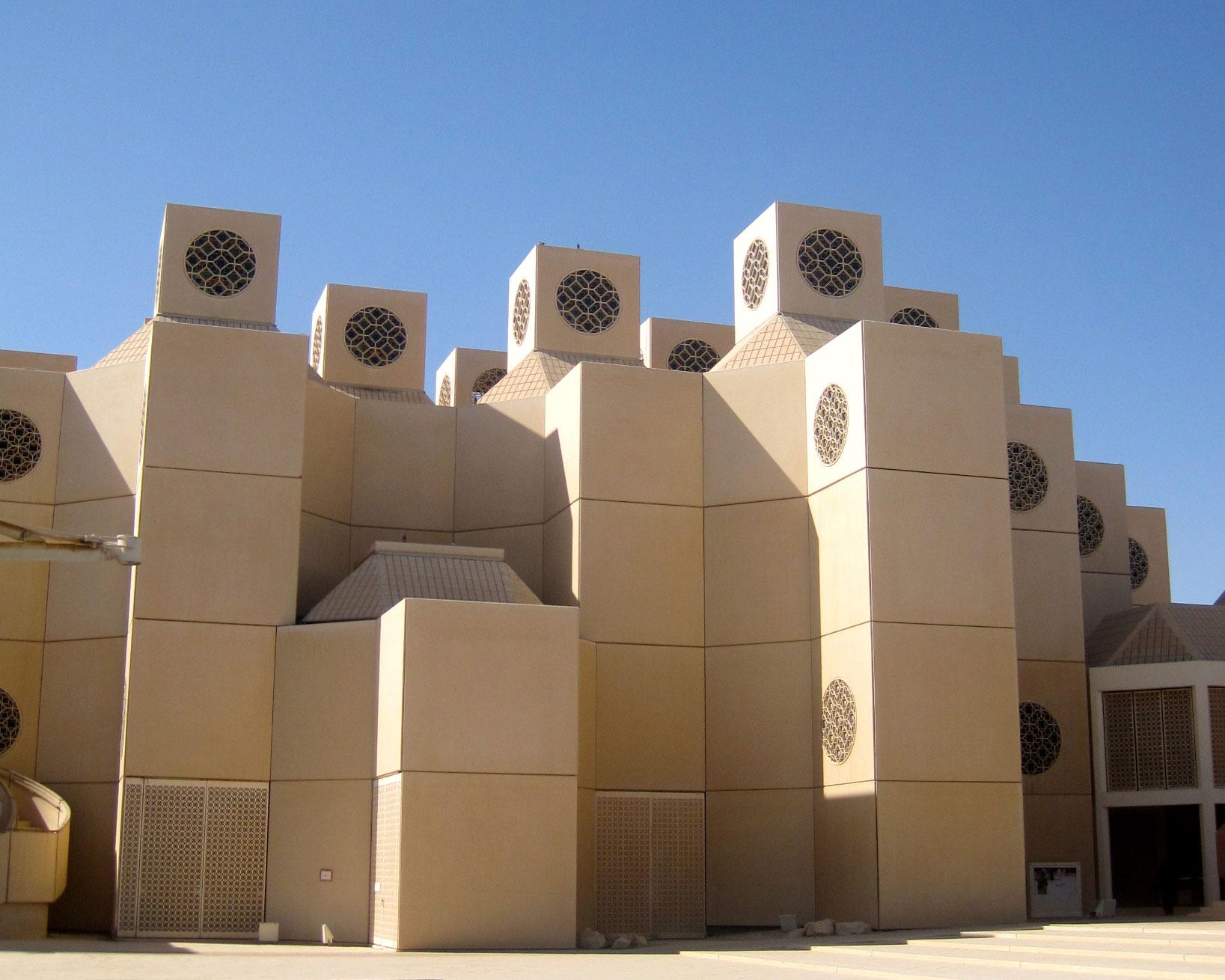
Qatar University campus features a new wind catcher design built into the architecture. The science behind it is borrowed from 12th C Iran.

Here’s a “cool” air-conditioning concept that was new to me but apparently known in Iran for centuries.

Durrie Bouscaren reports at radio show The World, “As a kid, radio producer Sima Ghadirzadeh spent her summers in one of the hottest places on earth — the desert city of Yazd, Iran. … Here, intricate wind-catching towers rise above the alleyways — they’re boxy, geometric structures that take in cooler, less dusty air from high above the city and push it down into homes below. 

“This 12th-century invention — known as badgir in Persian —  remained a reliable form of air-conditioning for Yazd residents for centuries. And as temperatures continue to rise around the world, this ancient way of staying cool has gained renewed attention for its emissions-free and cost-effective design. 

“Wind catchers don’t require electricity or mechanical help to push cold air into a home, just the physical structure of the tower — and the laws of nature. Cold air sinks. Hot air rises. 

“Ghadirzadeh said she can remember as a child standing underneath one in her uncle’s living room in Yazd. 

“ ‘Having been outside in the heat, and then suddenly, going inside and being right under the wind catcher and feeling the cool breeze on you, was so mysterious,’ Ghadirzadeh said. 

“Temperatures in Yazd can regularly reach 115 degrees Fahrenheit. But somehow, it was bearable, Ghadirzadeh said. … Historians say wind catchers are at least 700 years old. Written records in travelers’ diaries and poems reference the unique cooling structures. 

“ ‘From the 13th century, we have references to the wind catcher — by some estimates, they were in use in the 10th and 11th centuries,’ said Naser Rabbat, director of the Aga Khan program for Islamic architecture at MIT. 

“Most wind catchers only cooled the air by a few degrees, but the psychological impact was significant, Rabbat said. They soon appeared all over the medieval Muslim world, from the Persian Gulf to the seat of the Mamluk empire in Cairo, where they are called malqaf. 

“In Iran, the wind catcher is a raised tower that usually opens on four sides because there’s not a dominant wind direction, Rabat said. The ones in Cairo are ‘extremely simple in form,’ usually with a slanted roof and a screen facing the direction of favorable wind, he added.

“Over time, wind catchers became symbols of wealth and success, growing increasingly elaborate. Homeowners would install intricate screens to keep out the birds. Water features and courtyard pools could bring the temperature down even more.  

“ ‘They would even put water jars made out of clay underneath — that would cool the air further,’ Rabbat said. ‘Or, you can put a wet cloth and allow the breeze to filter through, and carry humidity.’ 

“Many of the older techniques that kept life comfortable in the Persian Gulf fell out of favor after World War II, said New York and Beirut-based architect Ziad Jamaleddine. …

“Those shaded walkways, created by overhanging buildings and angled streets so beloved in historic cities like Yazd, were no longer considered desirable. 

“ ‘What they did is they substituted it with the gridded urban fabric city we are very familiar with today. Which perhaps, made sense in the cold climate of western Europe,’ Jamaleddine said.  But in a place like Kuwait or Abu Dhabi, mass quantities of cool air are necessary to make this type of urban planning comfortable. 

“Attempts to re-create wind catchers occurred during the oil crisis of the 1970s and 1980s in cities like Doha, where the Qatar University campus incorporates several equally distributed wind towers. But these projects became less common when oil prices returned to normal. Wind catchers are not easy to replicate without a deep understanding of the landscape and environment, Jamaleddine said. …

“Today, air conditioners and fans make up more than 10% of global electricity use, according to the International Energy Agency. The air conditioners are leaking refrigerant into the atmosphere, which acts as a greenhouse gas. And they no longer function when the power goes out — as seen this summer during extreme heat waves across the world. 

“Architect Sue Roaf thinks it’s ‘almost criminal’ to build structures that continue to rely on air-conditioning, knowing its impact on the climate. Roaf focuses on climate-adaptive building and chose to build her home using the same principles of ventilation and insulation that she learned while studying the wind catchers of Yazd.”

More at The World, here. No paywall.

Read Full Post »

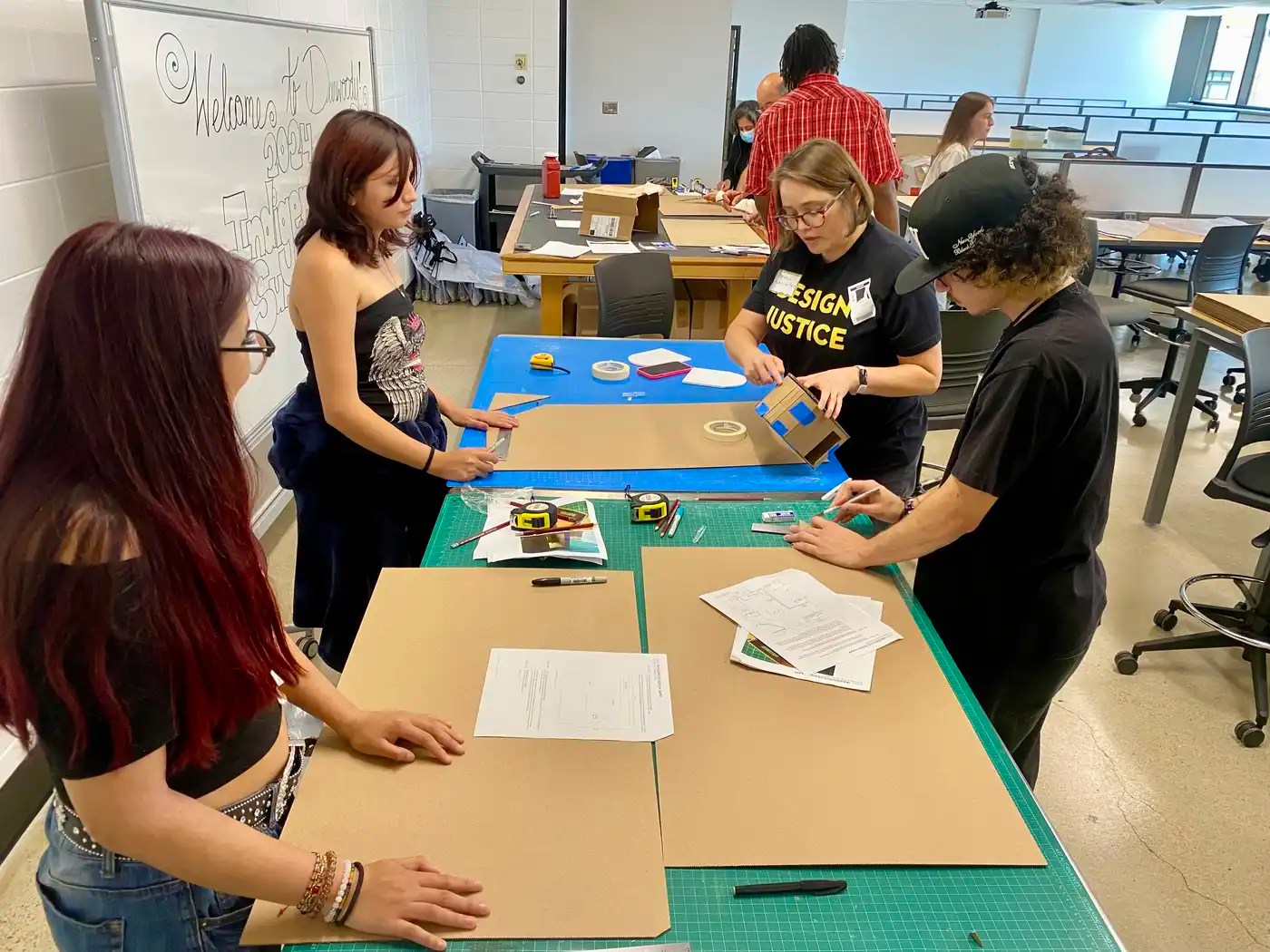
Photo: Alex V. Cipolle.
University of Minnesota architecture professor Jessica Garcia Fritz teaches Indigenous Design Camp campers cardboard scoring techniques on day one.

It seems like every year, the first question on the first day of school is, “What did you do over the summer?” This past summer, if you were an indigenous teen in the Twin Cities of Minnesota, you might have had some new experiences to report.

In July, Alex V. Cipolle at Minnesota Public Radio wrote about an unusual class at the Dunwoody College of Technology.

“A group of teens cuts cardboard with X-ACTO Knives. They will soon shape this cardboard into architectural models of their bedrooms. …

“ ‘It’s my first time doing something in architectural-related study,’ says Dominic Stewart of Burnsville.

“ ‘I’m excited to get that hands-on experience,’ says Carsyn Johnson of Elk River.

“They are here for the weeklong Indigenous Design Camp, the first camp of its kind in the U.S. The goal is to teach Indigenous teens about career options in architecture and design, a field where Native Americans are underrepresented.

“Two of the founders of the new camp — architects and friends Mike Laverdure and Sam Olbekson — estimate that there are only about 30 Indigenous architects total in the U.S.

“Laverdure is an enrolled member of the Turtle Mountain Band of Chippewa and a partner at DSGW Architects as well as the president of First American Design Studio. Olbekson is a citizen of the White Earth Nation and founded the firm Full Circle Indigenous Planning and Design. They are the only two practicing Native architects in Minnesota. 

“ ‘The need for creating a space for kids to become designers, Indigenous designers, is great,’ says Laverdure, who has wanted to start this camp for years. ‘Representation matters for these kids to see us as architects and designers. A lot of us who grew up in reservations or urban Indigenous communities only see a few career types.’ …

“The campers are Indigenous teens ages 14-18 from the metro area. They will be constructing architectural models all week. Campers will also tour the University of Minnesota School of Architecture and local architecture firms.

“They will also visit the American Indian Cultural Corridor on Franklin Avenue, where both Laverdure and Olbekson have designed buildings, as well as another Olbekson project, the recently completed expansion of the Red Lake Nation College downtown.

“Olbekson says, ‘to actually go and see [the buildings] and see the impact that they’re having on the community, not only as individual buildings, but how they’re forming an identity for the American Indian Cultural Corridor and how these projects are supporting education, economic development, community building, cultural development, and youth and elder spaces, I think is going to be a great way for them to understand the impact of what design, urban design, interiors, landscape, can have on creating a healthy, Indigenous urban community.’

“The camp began [with] a welcome from Laverdure, Olbekson and University of Minnesota assistant architecture professor Jessica Garcia Fritz, a citizen of the Cheyenne River Sioux Tribe. Fritz also helped start the camp.

“ ‘If you think about your home reservations, or your urban communities, you think about all the buildings that are there,’ Laverdure told the class, ‘Ninety-nine percent of all the buildings built that Indigenous people sit in are not designed by indigenous designers. … When you have Indigenous designers be a part of that process, what happens is that those buildings have a special kind of connection to the communities and that makes those buildings extra special.’

“Next came a presentation on Indigenous architecture, past and present, by Tammy Eagle Bull, who did a video call from her home in Arizona. Eagle Bull is a member of the Oglala Lakota Nation of Pine Ridge, South Dakota. In 1994, she became the first Native woman in the U.S. to become a licensed architect. …

“For the remainder of the first day of camp, Jessica Garcia Fritz guided campers in a design exercise to create their sleep space or bedroom.

“First, they taped 10 by 10-foot squares on the classroom floor to help them visualize the scale. Then they sketched blueprints of their bedrooms. Finally, they cut and scored cardboard to build shoebox-size models. …

“ ‘One of the things Tammy Eagle Bull had said this morning was, “I wish that a camp like this had existed when I was young.” I think that’s the sentiment among many of us,’ Garcia Fritz says. …

“Garcia Fritz, Laverdure and Olbekson hope this camp is the first of many. One of the goals is to expand the camp to greater Minnesota.

“ ‘Right now, it’s in the Twin Cities, but there are so many Indigenous communities regionally, up north and even in other states that could really benefit from this,’ Olbekson says. 

“ ‘Long term, we want to create a space where five to 10 years from now, we’ve got 10, 15, 20, Native designers that are out there and being a force for change,’ Laverdure says.”

More at MPR News, here.

Read Full Post »

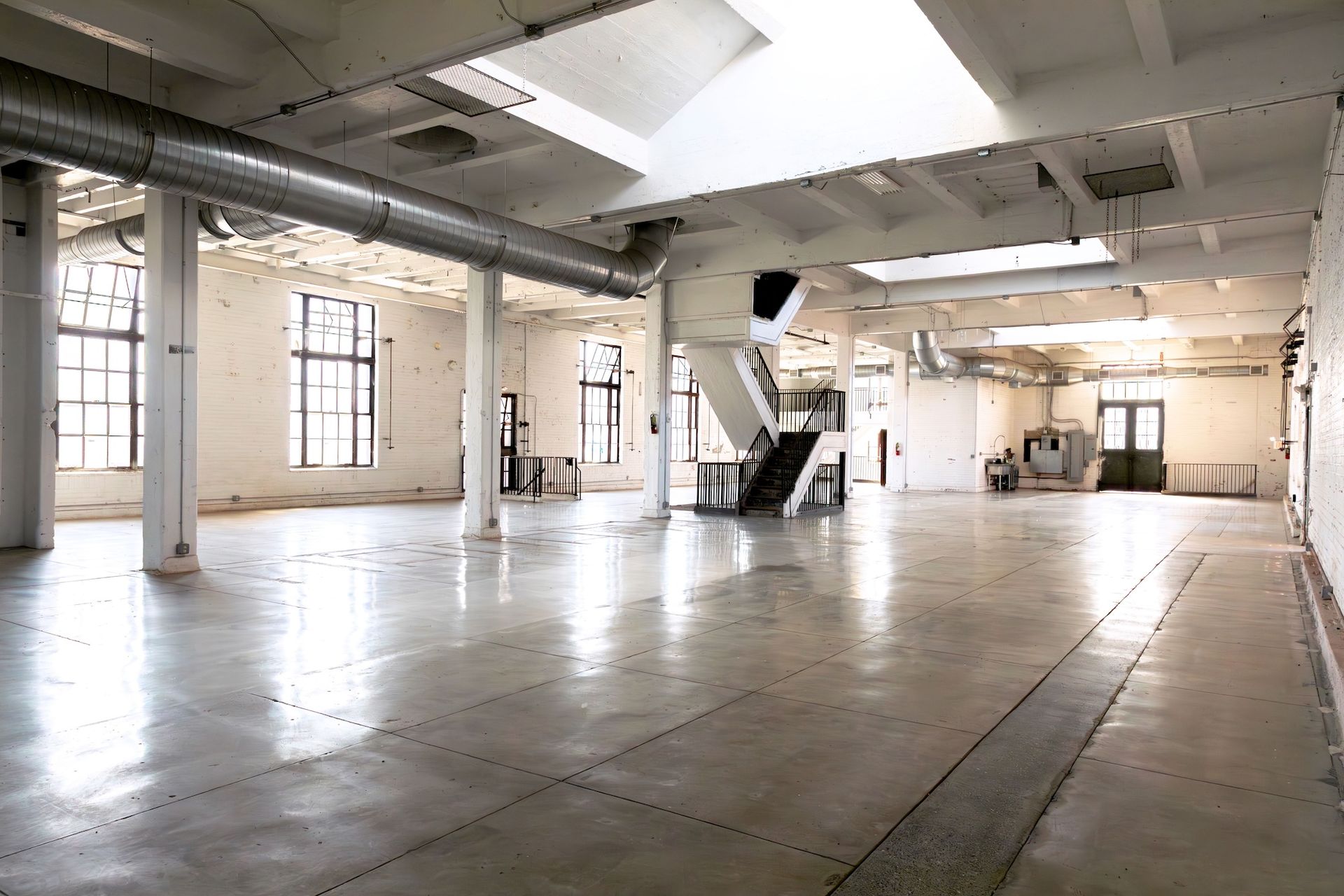
Photo: Isabel Kokko, Forman Arts Initiative, Philadelphia, via the Art Newspaper.
Inside the former electrical substation as it appears today. The Forman Arts Initiative plans to renovate four buildings in Kensington to hold a gallery, performing arts venue, garden area, and FAI offices.

One of the cool places I get leads from is ArtsJournal. The variety of topics is great because they check out way more sources than any one person could monitor (or pay the fees for). Today’s story is from the Philadelphia Inquirer and covers an art initiative not far from where I used to live in Pennsylvania.

Rosa Cartagena writes, “A new 100,000-square-foot arts campus coming to West Kensington will open in stages over the next two years. The Forman Arts Initiative, an arts organization that awards grants to local creatives and arts nonprofits, plans to renovate four buildings on American Street. The multipurpose space will hold a gallery, performing arts venue, and garden area, in addition to FAI’s offices.

“Michael Forman and Jennifer Rice, the art-collecting couple behind FAI, envision the campus as a cross between an arts center, coffee shop, art-making studio, and gallery space where they can publicly display their collection of more than 800 artworks. The collection — largely works from artists of color and women — includes such names as Philadelphia ceramist Robert Lugo, legendary photographer Gordon Parks, and abstract painter Alma Thomas.

“ ‘We live with our art, and we think of our collecting more as stewardship than ownership,’ said Rice. … ‘We’re really looking at using art as a tool for education, community engagement, performance, and inspiration.’

“In late 2022 and early 2023, the couple purchased a vacant lot and four adjoining buildings on the 2200 block of American Street. … FAI will work with Philadelphia architecture firms DIGSAU and Ian Smith Design Group to transform the 100,000-square-foot site. Forman said it’s too early to know how much the restoration and renovation will cost, but FAI plans to finance it internally and will seek government funding and potential support from local foundations.

“FAI has also attracted one of the most influential people in the art world to serve as lead designer: urban planner and sculptor Theaster Gates. Forman and Rice first connected with him as collectors of his art and when they began developing plans for the campus, they approached Gates for his unique style that combines ‘social practice and art practice,’ said Forman.

“In Chicago, where Gates lives and works, he is renowned for repurposing abandoned industrial buildings into arts spaces, archives for Black culture, affordable housing, and artist residences that have revitalized a South Side neighborhood.

“Philadelphia has been a site for his artwork, as well. In 2020, Gates created the public work Monument in Waiting, in a response to the movement to tear down Confederate monuments. The sculpture, which critically questions national heroes, has been on display at Drexel University since 2022. …

“FAI is undertaking an extensive listening tour to determine what exactly the West Kensington neighborhood needs and wants from a space such as this. Gates will work with newly appointed FAI executive director Adjoa Jones de Almeida, who was previously at the Brooklyn Museum, and associate executive director Sunanda Ghosh, a local nonprofit strategist who has worked with BlackStar and Asian Arts Initiative, among others.

“ ‘We are very intentionally saying to people, “We actually don’t know,” because, truly, we are emphasizing the design of a communities engagement strategy,’ said Jones de Almeida, who moved to East Kensington earlier this year. The plan is to incorporate input from the neighborhood’s residents and organizations into the design of the space.

“She’s interested in ‘radical collaboration’ with neighborhood organizations such as the Norris Square Neighborhood Project and Taller Puertorriqueño, both recipients of last year’s FAI grants. …

“Forman and Rice believe that West Kensington is the best location because, despite being systemically overlooked and under-resourced, the community has a strong arts community, including Crane Arts and the Clay Studio.

“ ‘We were interested in the notion that we’re not displacing anybody — the buildings that we bought were all commercial,’ said Rice. ‘It’s just repurposing.’ …

“ ‘You have to enter with big ears and an open and pliant heart,’ said Gates. ‘The work of creating a creative space and making a significant investment in a place that’s been highly underinvested is hard work when you’re trying to really listen, because there’s a lot of bruised feelings.’ ”

More at the Inquirer, here. And the Art Newspaper version has no paywall, here.

Read Full Post »

Photo: Siméon Duchoud/Kere Architecture.
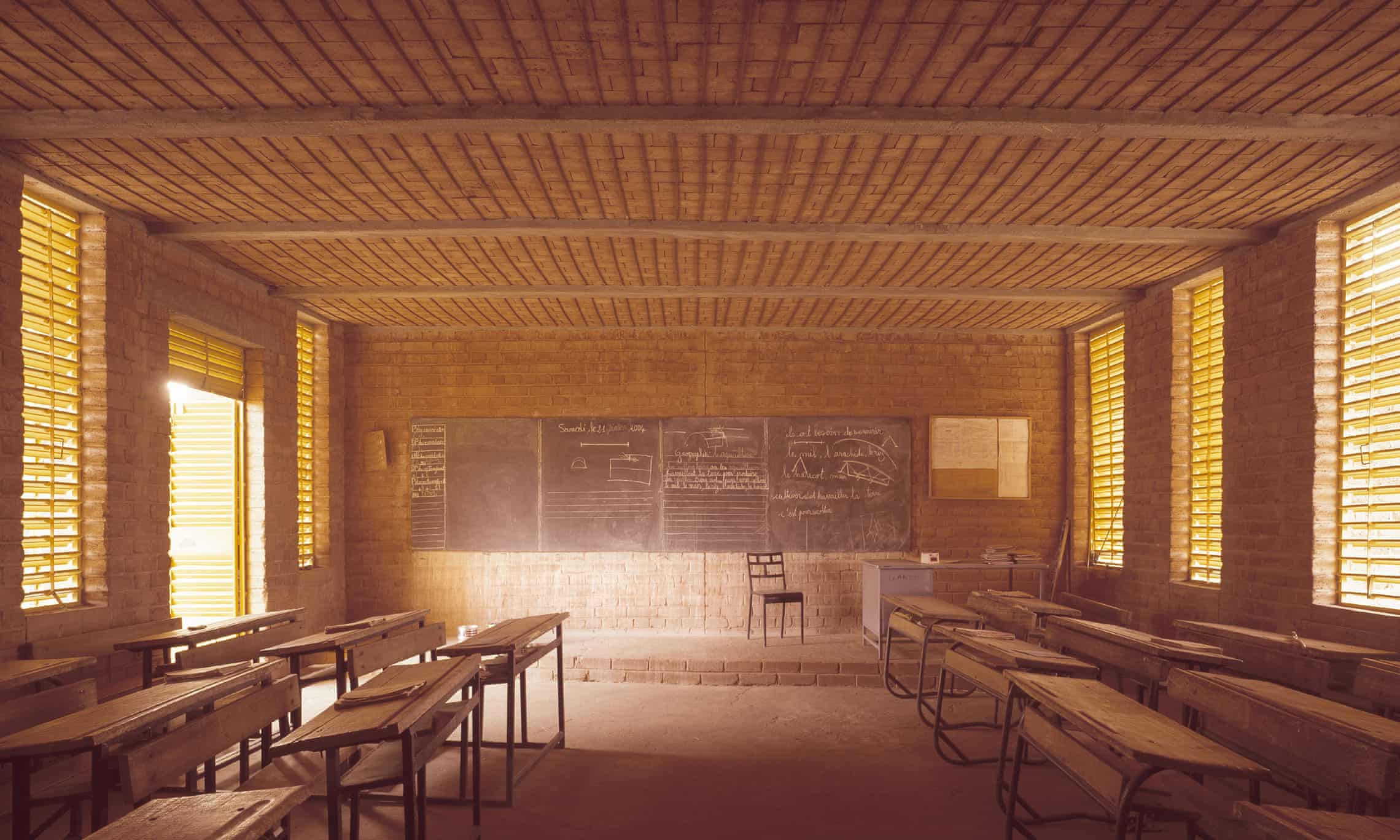
Gando primary school in Burkina Faso, Diébédo Francis Kéré’s first construction project after finishing his studies in Germany.

In some cases, ingenuity will help people live with climate change. And the best ideas will come from those who have lived the life. Consider an architect who grew up in a very hot part of Africa.

Èlia Borràs  writes at the Guardian, “If architects are people who like to think their way around challenges, building schools in Burkina Faso must be the dream job. The challenges, after all, are legion: scorching temperatures in the high seasons, limited funds, materials, electricity and water, and clients who are vulnerable and young. How do you keep a building cool under a baking sun when there is no air conditioning?

Finding ingenious ways to use cheap materials to make sure that the schools and orphanages that they have built around Burkina Faso are cool, welcoming places.

“Architect Diébédo Francis Kéré grew up in the small village of Gando and knows the challenges well. He and other architects such as Albert Faus are finding ingenious ways to use cheap materials to make sure that the schools and orphanages that they have built around Burkina Faso are cool, welcoming places.

Kéré, who won the Pritzker prize in 2022, has spoken movingly about the support he was given as a child by the whole community, with everyone giving money towards his education as he left the village and eventually gained a scholarship and studied in Germany. ‘The reason I do what I do is my community,’ he said.

“Gando primary school, built in 2001, was Kéré’s first construction after completing his studies. ‘At first, my community didn’t understand why I wanted to build with clay when there were glass buildings in Germany, so I had to convince them to use the local materials,’ Kéré has said. Men and women came together to build the school, merging traditional techniques such as clay floors, beaten by hand until they were ‘smooth as a baby’s bottom’ with more modern technology to seek better comfort.

“The Noomdo orphanage was another of his projects. ‘The Kéré building provides us with good thermal comfort because when it’s hot, we’re cool, and when it’s cold, we’re warm inside,’ says Pierre Sanou, a social educator at the orphanage near the city of Koudougou in the Centre-Ouest (centre-west) region of Burkina Faso. ‘We don’t need air conditioning, which is an incredible energy saving,’ says Sanou. Temperatures in this region of the world remain at about 40C (104F) during the hottest season.

“ ‘Kéré builds with local materials from our territory like laterite stone and uses very little concrete,’ says Sanou. Kéré’s buildings in Burkina Faso are earthy. They start from the ground and take into account that concrete is a material that needs to be transported to the site, is much more expensive and generates waste. ‘They are permeable buildings that seek the movement of natural air and protection from the sun. For example, they are built with very strong walls and very light roofs so that the cool air that enters from below pushes the hot air out from above,’ says Eduardo González, a member of the Architecture School of Madrid.

“One particularly ingenious innovation is his use of the ancient idea of raised and extended metal roofs. The rooms of Noomdo are covered by a shallow barrel vault resting on a concrete beam but with openings. Above, a metal plate protects the roof from direct sunlight and rain. Additionally, it lets out the hot air. …

“Nearby, the Bangre Veenem school complex designed by Faus in the village of Youlou uses similarly ingenious ways to cool the building. Ousmane Soura works as an education adviser at the school. ‘Before building the school, [Faus] came to speak with the traditional authorities to obtain permission to build and to find out if there were sacred places that are sometimes not obvious or visible to people who don’t know them,’ says Soura.

“The school complex accommodates everything from nursery to high school, including a professional school. ‘The students don’t say: “It’s really hot” and want to go home because they’re comfortable and can concentrate with the class,’ adds Soura.

“It is built with bricks made from laterite stone native to the area. Laterite is shaped with a mould, dried in the sun, and becomes a brick of very intense red colour. ‘They are more resistant to bullets than concrete blocks, which have two holes in the centre,’ says Soura.

“Faus also managed to minimize material transportation and use the territory’s own materials. Even the quarry workers were from the area. ‘It’s a very beautiful material. When families see the buildings, they want their children to go to school,’ says Soura. There are even teenagers who meet inside the classrooms to talk after class or during vacation periods. The complex is an open space.”

More at the Guardian, here. No paywall. Donations encouraged.

Read Full Post »

Photo: MCNY via Hyperallergic.
The Museum of the City of New York had a gingerbread display for the first time last year. This is John Keuhn’s gingerbread interpretation of Madison Square Park in Manhattan.

I had a nice little foray into holiday gingerbread early last week, between getting over Covid at the new place and the Paxlovid rebound.

My older granddaughter had a kit that was easy enough for even me to work on. Don’t you love the way the world is going with gingerbread? In Boston, an architectural society located near my old job is on its ninth year of amazing displays. (See BSA, here.)

Today’s story, from Hyperallergic, is about a gingerbread exhibit in New York. Elaine Velie reported in 2022, “The Museum of the City of New York (MCNY) is trying out a different type of exhibition this year, and it looks delicious. Gingerbread NYC: The Great Borough Bake-Off, up through January 16, features seven bakers’ edible replicas of New York City’s five boroughs (the Bronx, Brooklyn, Manhattan, Queens, and Staten Island).

“ ‘I can speak from personal experience about how difficult it is, said Jonah Nigh, one of the competition’s judges and a semifinalist on the reality show Baking It, where he was asked to create a gingerbread house. ‘You can measure everything as much as you want, but when you put it in the oven, you have no control over how much it shrinks and expands.’ …

“Nigh told Hyperallergic he especially enjoyed Sans Bakery’s miniature of Long Island City, Queens. ‘I love really small details,’ Nigh gushed, adding that it was so transformed it no longer looked gingerbread. That project belonged to Erica Fair, who has run the gluten-free bakery since 2010. She wanted to represent the iconic parts of her neighborhood and decided to recreate the seven line subway car, the iconic Silvercup film studio, and the graffiti visible below as people cross the East River from Manhattan.

“The baker explained that weather plays an outsized role in the success of the fickle medium: She initially planned to make her work twice as big, but her original house broke in half during the city’s early November heat wave. For her final product, Fair used Pez candies as bricks and mixed luster with vodka (it evaporates quicker than water) as paint. She also built a few Christmas trees with gummy bears.

“John Kuehn represented Manhattan and won the contest’s ‘grandest’ prize [above]. He had never made a gingerbread house before, but had worked as an architect, and his expertise is evident in the final product, a replica of Midtown’s Madison Square Park. Kuehn’s final version includes carefully constructed miniatures of the Flatiron Building and the Metropolitan Life Insurance Tower. He started working in early October and said that he spent around eight hours a day on the project until it was due before the judges in early November. …

“The bake-off and exhibition are a new initiative for the East Harlem museum, but one that will likely become a tradition, according to MCNY Chief Operating Officer Jerry Gallagher. The museum put out a call for both professional bakers and amateurs across the city and assembled an impressive team of judges. In addition to Nigh, the deciding panel comprised Bobbie Lloyd, who runs Magnolia Bakery; Nadine Orenstein, a drawings and prints curator at the Metropolitan Museum of Art who also serves as a judge for the annual National Gingerbread House Competition; painter-turned-baker Colette Peters, who designs elaborate cakes and teaches decorating with her namesake Colette’s Cakes in New Jersey; Melba Wilson, who owns the popular Melba’s Restaurant in Harlem; and Amy Scherber, at the helm of Manhattan’s beloved Amy’s Bread for 30 years.

“All seven displays won distinctions ranging from ‘most resilient to ‘best overall,’ the first of which was awarded to L’Appartement 4F Bakery’s recreation of a Brooklyn brownstone, which partially collapsed soon before it was set to be judged.”

Great photos at the paywall-free Hyperallergic, here. This year, the same museum invited 23 bakers from across the five boroughs to create gingerbread displays on the theme of “Iconic New York.” Read about that here.

Video: MCNY
This year’s gingerbread display at the museum.

Read Full Post »

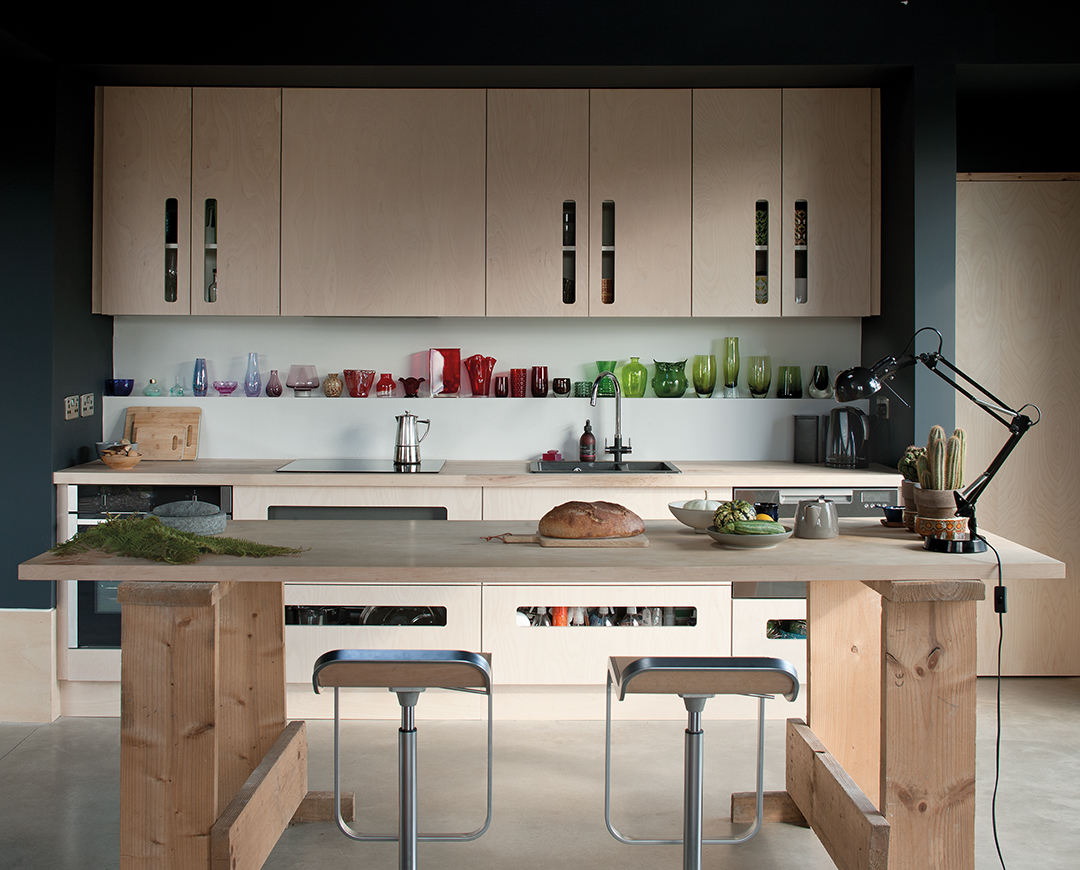
Photo: Ann Nisbet Studio designed the house above to make it dementia- and age-friendly. In the kitchen, “there are large letterbox-type slots in the drawers and cupboards to allow someone with dementia to see that there are cups, plates, cutlery and food inside,” Homes and Interiors Scotland reports.

When I was at the Fed, I attended a couple Harvard conferences on housing for the aging. I learned about something called “universal design” and thought how sensible it would be if architects would always ensure that housing features worked for people at any stage of life. Why go to the expense and disruption of putting in wider doorways, higher toilet seats, shower grab bars, ramps, and the like down the road?

In today’s article, architects considered these issues, even taking into account the possibility of someone developing dementia.

Caroline Ednie  writes at Homes and Interiors Scotland, “ ‘We lost all our belongings in the fire and were left homeless,’ recalls Kathy Li, an architect who teaches at Glasgow School of Art. ‘It was pretty traumatic. But after the initial shock wore off, we realized that what was important to us wasn’t necessarily the house itself but its location. It’s close to a beautiful reservoir where you can swim or fish, and forests that are perfect for mountain biking or road cycling.’ …

“So Kathy and her partner Richie Elliot decided to stay on the site, initially in a tiny caravan and then in a larger one-bedroom static caravan. ‘It took five years to resolve with the insurance company and we lived in the caravan the entire time,’ recalls Kathy. …

“Eventually, with the situation settled in their favor, she and Richie could begin to think about replacing their home on the site. …

“ ‘We knew we didn’t want lots of little rooms. There are fantastic views right down the valley, and we wanted to take advantage of these and of the woodland at the front. There is a southerly aspect too, which then got us thinking about a low-energy building. It was time to start again. We had this chance to create a house for life.’

“She approached architect Ann Nisbet. …The brief was essentially for an energy-efficient one-bedroom house, flexible enough to suit both living and working, to be constructed using ‘harmless’ materials.

“An unusual but crucial part of the brief was that the house should be dementia- and age-friendly. Kathy’s mother and stepfather both had dementia, and she was keen to explore and incorporate design features that would make it easier for sufferers to live in the house.

In response, Ann Nisbet attended a dementia design course at Stirling University – one of the world’s leading centers for research into the syndrome.

“ ‘We were keen to take this information, which mostly looked at care homes and hospitals, and apply it to a domestic house in a design-led, non-institutional manner,’ the architect explains.

“ ‘Research shows that you read your surroundings differently if you have dementia – for example, two materials of similar monotonal color when read together will be viewed as the same object. We used this knowledge to try to create a navigation system throughout the building, while still keeping the material palette modern and minimal.’

“As a result, the door and window frames, floors, skirtings and walls are all tonally different. As for circulation, all the key areas of the building are visible from the connection lobby, which helps you navigate the floor plan and prevents confusion.

“Thought was given to the kitchen units too: there are large letterbox-type slots in the drawers and cupboards to allow someone with dementia to see that there are cups, plates, cutlery and food inside.

“ ‘Many people have experienced a close friend or family member being diagnosed with dementia, and as we live longer, the number of sufferers is increasing,’ says Fay Goodwin, project architect at Ann Nisbet Studio.

“ ‘This house demonstrates that buildings can and should be designed to enable people with the condition to live longer in their own home and to help them overcome the day-to-day challenges they face.’ “

More at Homes and Interiors Scotland, here. Check out the close-up of the ktichen cabinets with the see-through slots. No paywall.

Read Full Post »

Photo: José Hevia.
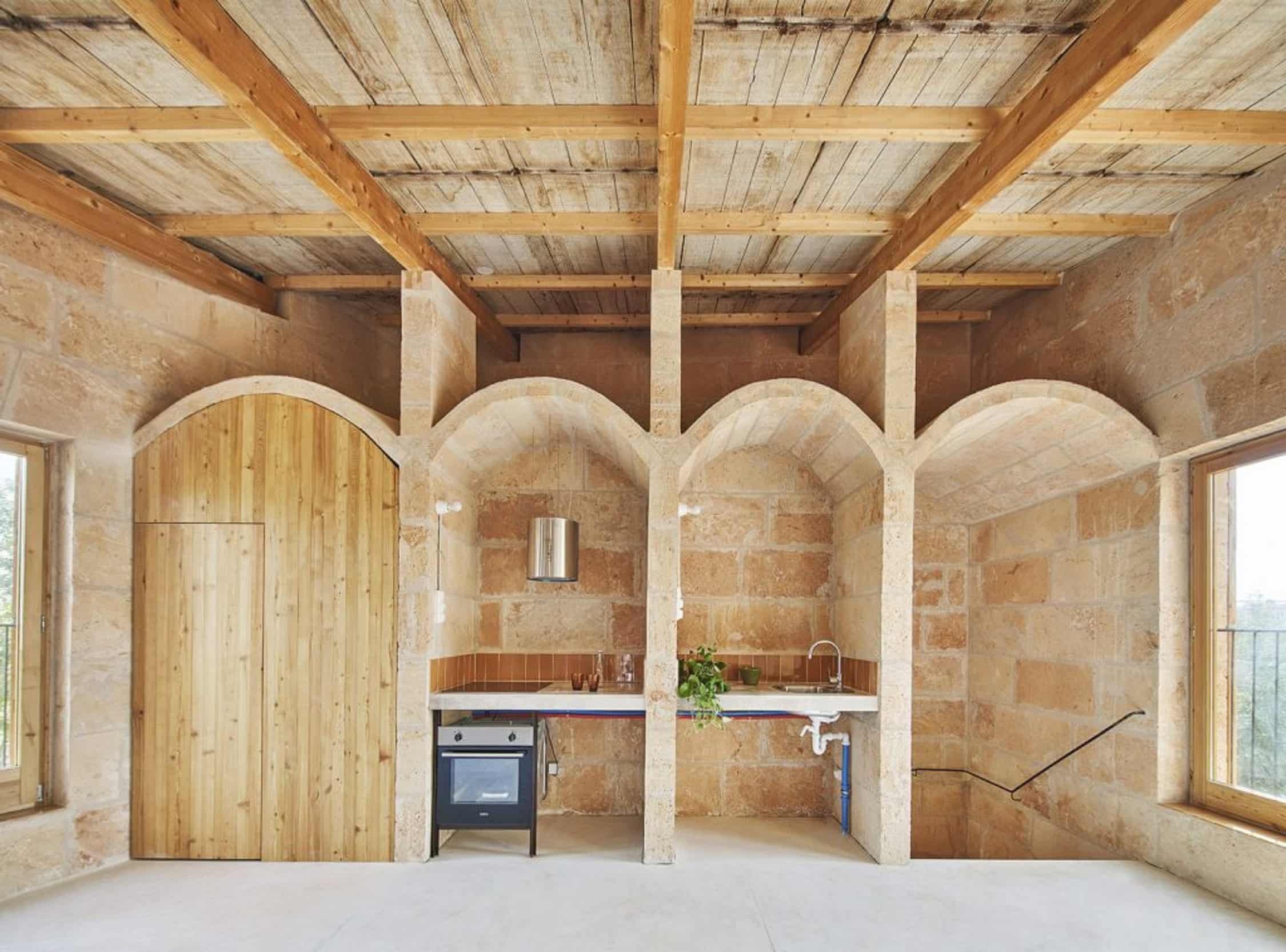
The Guardian reports on “affordable housing near Palma, Mallorca, built by Balearic social housing institute Ibavi, constructed from load‑bearing stone quarried locally.” 

The materials we use these days for constructing new buildings are generally harmful to the environment, at least in their creation. Now some architects are advocating for the old ways, the more sustainable and beautiful old ways.

Rowan Moore writes at the the Guardian, “Imagine a building material that is beautiful, strong, plentiful, durable and fireproof, whose use requires low levels of energy and low emissions of greenhouse gases. It is one of the most ancient known to humanity, the stuff of dolmens and temples and cathedrals and Cotswolds cottages, but also one whose sustainability makes it well-suited to the future. Such a material, according to a growing body of opinion in the world of construction, is among us. It’s called stone.

“Last week I sat in the roof garden of a hefty pile of masonry in central London, talking to three advocates of this magnificent substance: engineer Steve Webb, Pierre Bidaud of the Rutland-based Stonemasonry Company and architect Amin Taha. … The building on top of which we met is their joint creation: the six-storey, five-year-old Clerkenwell block where Taha has his office and his home.

“Their point is that stone has been supplanted in the industrial era by steel, concrete and mass-produced bricks, and is used (if at all) mostly as a thin cosmetic facing, while the hard work of holding up a building is done by the upstart alternatives. They argue that solid stone can once again form the walls and structure of building, with benefits for the environment and for the beauty of architecture. Any form of the material – limestone, sandstone, basalt, granite – can, depending on its properties, be used.

“Webb explains how the strength of stone compares well with steel and concrete, yet its environmental impact is far lower. The latter require several different energy-consuming activities, including extraction, smelting, transport, processing and installation. Stone only needs to be cut out from a quarry, taken to a site and put in place. Where the many ingredients of steel and concrete require multiple holes to be dug in the ground, not to mention such things as blast furnaces and rolling mills, the stonework for a given project only needs one.

“The planet, as Taha points out, is made mostly of stone. … We are in no danger of running out. For the same reason, stone should almost always be locally available, which keeps the environmental costs of transport down. The material is long-lasting and recyclable. ‘Any stone building is a quarry,’ says Bidaud. ‘It can be dismantled.’

“At the same time, 21st-century engineering allows stone to be used more effectively than ever before. The material is naturally strong in compression – that is, when loads are pushed down on it – which means it is good for walls, columns and arches, but less so if it is stretched or bent, as in beams or floor slabs.

It is now possible to combine stone with a (sparing) use of steel such that it can perform like reinforced concrete. …

“Next year, a 10-storey residential tower is due for completion on Finchley Road in north London (by Taha’s practice Groupwork and Webb’s firm Webb Yates Engineers), whose load-bearing stone structure will make it one of the most remarkable buildings in modern Britain. The three are collaborating on a grand new private house whose masonry vaults look almost medieval in their craftsmanship.

“They also cite works by others, such as an eight-storey, all-stone social housing building in Geneva by local architects Atelier Archiplein, and the Salvador Espriu project on the edge of Palma, Mallorca, whose graceful stone ceilings belie the fact that these are affordable homes built by a government housing institute called Ibavi. …

“Webb, Bidaud and Taha argue that stone doesn’t have to be costly. Taha, for example, has demonstrated that you can cut stone into bricks at the same cost or cheaper than the more usual fired-clay kind, with less than one fortieth of the carbon emissions, which has led to 10 quarries offering them as a commercial product. The problem is rather ‘forces of habit in the building industry.’ …

“Meanwhile, [2 billion] bricks of the traditional, energy-hungry, carbon-intensive kind are bought in this country every year. Steel and concrete remain the standard options for a wide range of building tasks. Webb is scathing about professional inertia on the subject, about architects ‘who protest about climate emergency, cycle to work and eat locally grown tomatoes’ but don’t examine their own decisions about construction techniques.

“You can get a glimpse of the highly appealing alternatives in a display at the Design Museum in London, How to Build a Low-Carbon Home, where the work of Taha, Webb and Bidaud is on show (until March 2024) alongside structures in wood and straw. …

“Who could look at the solid stone structure of, for example, the Mallorcan social housing, where the forces of nature and the work of humans is evident in the fabric, and prefer the processed surfaces and plasticized finishes of their British equivalents? And the great thing about stone is that, having been used for millennia, it’s well tested.” More at the Guardian, here.
Construction in the UK is often shoddy. Consider the tragic Grenfell Tower fire, here, and the completely avoidable death toll. “The fire was started by an electrical fault in a refrigerator on the fourth floor. This spread rapidly up the building’s exterior, bringing flames and smoke to all residential floors, accelerated by dangerously combustible aluminum composite cladding and external insulation, with an air gap between them enabling the stack effect.”

My husband has been following that story and says more has been spent on lawyers than on fixing the materials in buildings or adding sprinklers.

Read Full Post »

Photo: Julius Jansson via Unsplash.
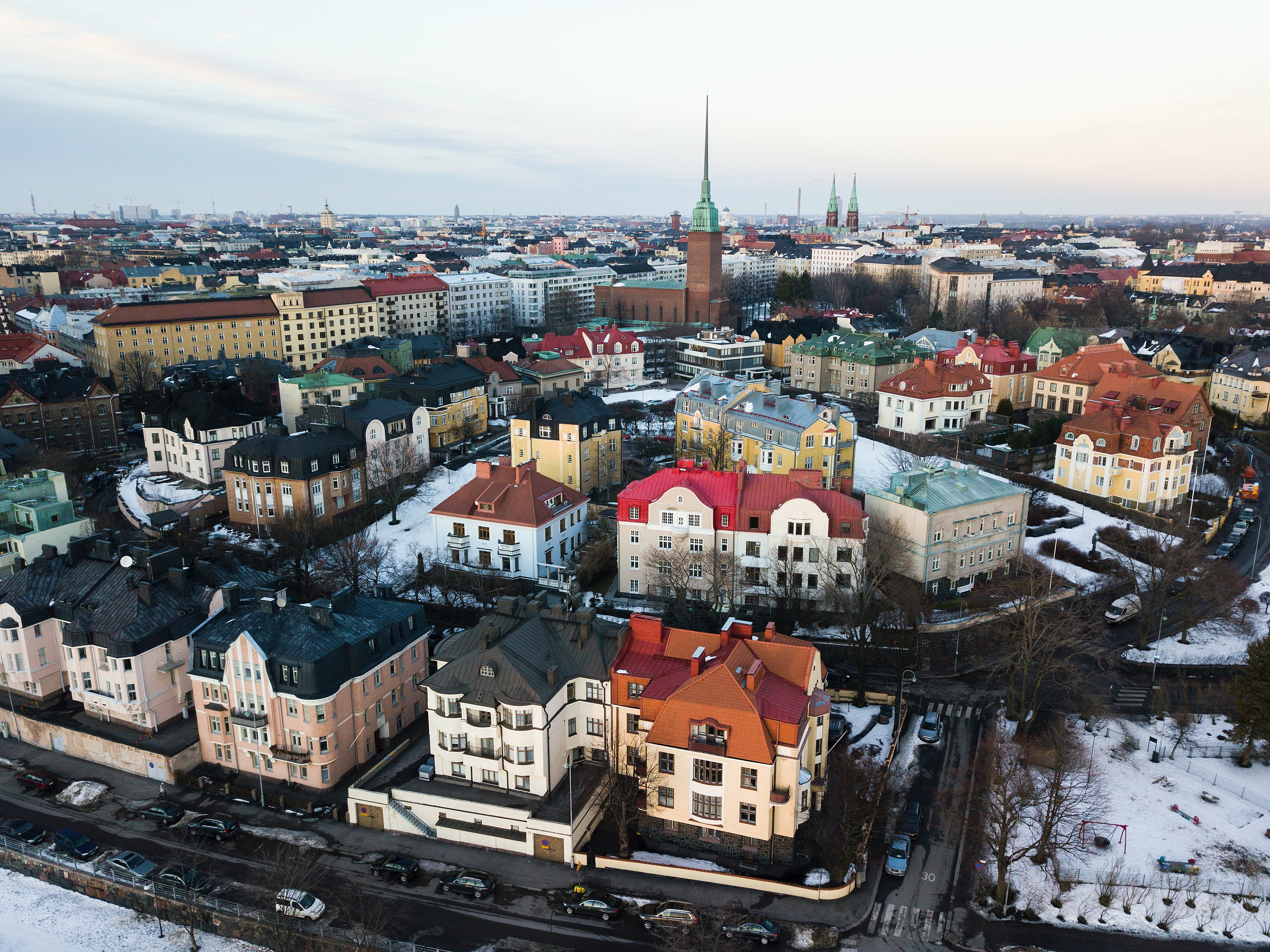
Aerial view of the centre of Helsinki, which is still a low-rise city.

I like learning how different countries make their cities more livable. Finland is known for being a trendsetter in many areas, including funny contests, housing, education, eldercare, basic income — and urban living.

Gillian Darley at Apollo magazine wrote recently about design in Finland.

“The Helsinki skyline is startlingly low for a capital city, its further horizons determined by water and scattered wooded islands. In the centre, urban civility and a clear-headed planning regime have established a height limit of around eight stories, punctuated by occasional eminences. The standout is the heroic central station, designed in the early 1900s by Eliel Saarinen. …

“Otherwise, only a few spires and the lofty white Lutheran cathedral, the jazz-style tower of the Hotel Torni and pencil-thin chimneys from redundant power stations cut into the ordained pattern. One of the power stations, Hanasaari, which closed down this March, is currently preoccupying the city authorities. They have turned to Buro Happold for advice, in the hope that the firm’s experience with Battersea Power Station may help rescue the 1970s brick shell.

“A little further east, overlooking the harbor, a gaggle of multi-story blocks has recently loomed – as if testing the water. Otherwise, only a few spires and the lofty white Lutheran cathedral, the jazz-style tower of the Hotel Torni and pencil-thin chimneys from redundant power stations cut into the ordained pattern. …

“Another factor is starting to determine the physiognomy of the city centre: some of it is, and more will be, sited below ground. There is no single clear reason for this, though factors include the exigent climate, respect for that polite skyline, and the key part that open space plays as amenity, in the city as in the overwhelmingly forested country.

“The use of subterranean space and the creation of a new realm overhead are becoming a speciality of Helsinki-based architectural practice JKMM. The Amos Rex art museum (named for the Finnish publisher and patron Amos Anderson) sits beneath a swooping pedestrian square – formerly a bus terminal, now an unorthodox playground of sculptural skylights and domes at the foot of a cheerful art-deco clock tower.

“The galleries below are reached via the handsome glazed entrance of the Lasipalatsi (‘Glass Palace’), part of a restored modernist complex together with the Bio Rex cinema (1936) next door. Elegant stairs sweep into a lobby and the sequence of soaring new galleries. …

“[Another] subterranean structure is due to open in 2027: this is an ambitious underground annex for the National Museum of Finland in central Helsinki. The spectacular new space is flagged by a circular cantilevered entrance, a concrete vortex from which visitors will descend on a series of stairs to the galleries and facilities below. Above, a public garden will be open all year round.

“For decades, visitors to Finland had been drawn by Alvar Aalto’s questing version of modernism, seen as closely aligned with Nordic social democratic aspirations and sustained by a tight group of followers, at home and abroad. Inevitably, his work has been challenged by the passing of time and changing usage. In Helsinki, the shrouded hunk of the white Carrara marble-clad Finlandia Hall, dating from 1971, is in the middle of a recladding expected to take five years; the crisp Academic Book Store of the 1960s – a smart street-front clad in beautifully detailed copper, with dramatic angular roof lights bursting into life within – is compromised by chipped and stained marble facings on the entry columns.

“West of central Helsinki is another post-war landmark: the ‘garden city’ of Tapiola, which has been highly influential in European town planning. It shares its roots with British first-generation New Towns and, patched and amended though it is, it still offers compelling evidence of an urbane landscape, the antithesis of the formless out-of-town development. …

“When considering a future for the best works by Aalto and his circle, there is often a clash between function and feasible preservation, but in Tapiola there is also a town of 9,000 people to consider. The building materials of the early 1950s, especially in schools and sports buildings, have not stood the test of time; the hazards of asbestos are ubiquitous. The swimming hall, already restored once, is wrapped in sheeting and plywood, its fate uncertain.

“Yet the best of the flats and housing are highly sought after: the terraced houses, with perky monopitch roofs and skinny clerestory windows on to the roadside, benefit from back gardens and immediate access to a natural landscape of rock and pinewoods.  The little cinema has been restored and is highly valued, the lake remains centre stage and expanses of open parkland stretch out on every side.

“The societal hopes that brought Tapiola into being in 1953, according to the ideas of a visionary lawyer, Heikki von Hertzen, may have faded. Established according to principles of social enterprise, Tapiola has been outstripped by Espoo, the municipality of which it is a part, and which is a product of modern broad-brush urban development. But Tapiola is more than just a name in the history of town planning – it richly deserves a second look and, even, another close look at those founding principles.

More at Apollo, here. No paywall.

Read Full Post »

Photo: Douglas Magno/AFP.
An aerial view shows Kdu dos Anjos’s house in Aglomerado da Serra, a favela complex on the outskirts of Belo Horizonte, Minas Gerais State, Brazil. The home, in an area of deep poverty, has won an architecture award.

I have mixed reactions to today’s story about upgrading a home in a Brazilian favela, or slum. On the one hand, the results are joyful. On the other hand, couldn’t our world also try to eliminate slums and poverty? (Read about a poverty-abolition movement in Matthew Desmond’s Poverty, by America.)

Al Jazeera reports on the award-winning favela home, “At first glance, it is a house like dozens of others in the crowded favelas of Brazil. But this seemingly modest dwelling of 66 square metres (710 square feet), with its exposed brick walls, has just been recognized as the ‘house of the year’ in an international architecture competition.

“The house honored by specialized website ArchDaily belongs to Kdu dos Anjos, a 32-year-old artist living in the bustling Aglomerado da Serra favela at the bottom of a hill on the edge of the southeastern city of Belo Horizonte.

“The two-story structure defeated some more imposing contest entries from India, Mexico, Vietnam and Germany.

‘I’m very proud that my house won this prize, because most of the news about the favelas talks of violence and homes destroyed by landslides,’ said dos Anjos. ‘Today, my home is on top of the world!’

“The house, built on a small lot dos Anjos purchased in 2017, is well ventilated and enjoys abundant natural light; it features horizontal casement windows and a large terrace.

“ ‘The design of the house represents a constructive model that uses common materials in the slums, with an adequate implementation and attention to lighting and ventilation, resulting in a space with great environmental quality,’ ArchDaily wrote on its website.

“For dos Anjos, who founded a cultural centre in his community, the prize carries special significance. ‘I know my house isn’t the most chic in the world, but it’s a well-built shack,’ he says with a grin. … ‘What the architects did is pure magic,’ he added. ‘We barely have [710 square feet], but I’ve had parties here with close to 200 people.’

“The design was the work of the Levante architecture collective, which does pro bono or low-cost work in the favelas. From the outside, the house resembles its neighbors, but it incorporates several features that make it both sturdier and more respectful of the environment, particularly in its ‘attention to lighting and ventilation,’ said architect Fernando Maculan, the project leader.

“One apparent difference with nearby houses is in the arrangement of the bricks, laid horizontally — not vertically — and in staggered rows, which adds solidity and improves insulation. …

“ ‘The masons were angry because they thought laying bricks this way was very time-consuming,’ Maculan said. ‘And we had a lot of trouble getting the materials up the stairs — it’s the last house on the alley, and I had to pay the workers who carried it a lot,’ he said. …

“The entire job cost 150,000 Brazilian reais ($29,000), and the investment paid off in more ways than one: Not only did the architecture prize bring international recognition, the house has helped dos Anjos realize a childhood dream.

“ ‘When I was a boy, I lived in a very modest, poorly insulated room. I even got stung by a scorpion — my sister did too,’ he said. ‘Winning this prize after having suffered from architecture-related problems represents a great victory for me.’ ”

More at Al Jazeera, here. There’s a wonderful array of pictures and no firewall.

Read Full Post »

Photo: Ann Hermes/CSM Staff
Collections at the Field Museum include more than 100,000 birds killed in collisions with buildings in Chicago,” the Christian Science Monitor reports. “Each bird is stuffed and tagged.”

I learned decades ago that if small birds start flying into my windows, I need to hang up images of hawks or cats to warn them away. Sometimes I bought images of predators from Audubon or Duncraft. Other times I cut shapes out of black cardboard.

For skyscrapers, it’s not so easy, even though suburban homes kill more birds. At the Christian Science Monitor, Richard Mertens writes about the skyscraper challenge.

“The bird lies on its side, a clump of feathers no bigger than a crumpled leaf. It’s just a dark speck on the concrete, with massive glass and steel skyscrapers rising above it in the pre-dawn light.

“Annette Prince sees it at once. She hurries over and lifts it gently in her right hand. It has a slender bill, a tuft of yellow on its rump, and dark eyes that show no glimmer of life. A yellow-rumped warbler, bound for the warmth of the Caribbean or the American South, has met its end in Chicago’s Loop. …

“In the contest between birds and cities, the cities are winning. Scientists estimate that, on average, at least a million birds die in collisions with buildings each day in the United States – and as many as a billion a year. Most perish during the spring and fall migrations in which vast numbers journey up and down the continent, flying mainly at night. City lights attract and disorient them, and many end up crashing into windows, not just the sides of gleaming office towers but suburban patio doors as well. The problem, then, is twofold: lights and glass.

The light from ever-expanding cities is disrupting the movement of creatures that evolved to migrate in the dark, using the stars and the Earth’s magnetism as their guides.

“And the modern architectural penchant for glass has proved deadly for them. Most glass is invisible to birds, appearing either as clear air to fly through or as a reflection of the trees and sky behind them.

“There are growing efforts to make cities safer for birds. The National Audubon Society’s Lights Out programs, in which owners and managers agree to switch off exterior lights during migration, have spread to 45 U.S. cities. Architects and developers are learning how to make buildings bird-friendly by using specially treated glass that birds can see. Grassroots activists like Ms. Prince are monitoring collisions, pressuring businesses and local officials to take bird safety seriously, and in some places asking homeowners to consider their own windows. Scientists say more birds die by hitting houses – urban and rural – than by striking downtown skyscrapers.

“For many conservationists, the issue is far more than birds. … ‘It’s a proxy for a much bigger problem of our stewardship of the planet,’ says Andrew Farnsworth, an ornithologist with the Cornell Lab of Ornithology and an expert on bird collisions. …

“A 2019 study by the Cornell Lab concluded that the North American bird population had declined by 29%, more than 3 billion birds, over the previous half-century. The biggest reason, scientists say, is probably habitat loss. Feral cats also kill birds – by some estimates more than windows – as do collisions with vehicles and power lines. But the combination of buildings and city lights is deadly.

“By this measure, Chicago may be the deadliest city of all. According to a 2019 study, Chicago endangers more migrating birds than any American city, followed by Dallas and Houston. It’s a matter of lighting, but also geography. Chicago sits on the Lake Michigan shore and within the Mississippi Flyway, a broad path that funnels migrating birds from as far as the Arctic to the Gulf of Mexico, Central America, and beyond.

“Yet if Chicago is one of the worst cities for birds, it’s also one of the best. It has produced a strong response in defense of avian migrants, including a well-established Lights Out program and architects who use bird-friendly designs. It also has some of the most determined advocates for bird safety in the country. Ms. Prince’s group started with just a handful of volunteers two decades ago and has grown to more than 150. These monitors take turns patrolling a square mile or more of downtown Chicago, searching at daybreak for dead or wounded birds. It’s difficult, labor-intensive work, and few cities can match the scale of the effort.

“If a bird is alive, monitors take it to a rehabilitation center in the suburbs. They take the dead ones to Chicago’s Field Museum, where volunteers prepare them for storage in the museum’s collections.  Over the years, the museum has acquired more than 100,000 birds this way. Songbirds, especially warblers and sparrows, are the most common, but bird kills encompass as many as 170 species.

“The monitors also work with building managers to reduce collisions. Turning off exterior lighting is a start. The lights of entryways, lobbies, and glassed-in atria also attract birds. Moreover, birds drawn to a city typically spend a day or two there, pausing to rest and feed before continuing their journey. Most collisions happen on the lower floors, during the day. Monitors encourage building managers to dim interior lights, move plants away from windows, and apply speckled film to clear glass so birds can see it.

“Geoffrey Credi was one of the first to embrace this effort. Two decades ago, Mr. Credi, director of operations at Blue Cross Blue Shield Tower in downtown Chicago, attended a symposium about birds and buildings. He was surprised to discover that his building, which overlooks Grant Park, was considered one of the worst in town. He already knew there was a problem. Collision monitors and custodial staff had found birds outside. Mr. Credi threw himself into efforts to make the building safer. He and his staff began to track where birds were hitting. They had speckled film applied to clear-glass entryways. An olive tree in an atrium attracted birds, so Mr. Credi had it moved. …

“The effect of city lights on birds is well established. One of the most dramatic examples involves the 9/11 memorial in New York. The National 9/11 Memorial & Museum’s ‘Tribute in Light’ consists of two columns of light shining into the night, a symbol of the fallen towers. It’s switched on once a year to mark the anniversary.

“Members of NYC Audubon and others were alarmed when it was first turned on in 2002. Videos show hundreds of birds circling and crossing through the light, like insects in a car beam. Radar and ground observation revealed that the number of birds in lower Manhattan increased from around 500 to as many as 15,700. Conservationists reached a compromise with the museum. Monitors would consult radar and watch the sky. When the number of birds in the beams exceeds 1,000 in 20 minutes, the organizers would turn off the lights for 20 minutes.

“ ‘There was an immediate reduction,’ says Dr. Farnsworth. Some years, he says, the lights go off eight times on the tribute night. Other years, when migration is low, they stay on all night.

“Meanwhile, architects are beginning to design buildings that reduce bird collisions. Jeanne Gang, a prominent Chicago architect, is well known for her efforts. Her designs do not eschew glass, but modify it in critical places to discourage collisions. On lower floors, the glass is fritted – printed in the factory with a ceramic pattern that is both durable and visible to birds.

“A simple pattern consists of lots of small dots. But other patterns work, too. Glass on a dormitory complex that Ms. Gang designed for the University of Chicago is imprinted with pale white chevrons, making an aesthetic element out of a safety feature. Elsewhere in the building, decorative steel panels screen the glass. Retractable shades reduce transparency. At glass corners, vertical shields eliminate the see-through effect that is perilous for birds. …

“The world of bird-friendly architecture is evolving rapidly. Glass companies are coming out with more products, including glass imprinted with patterns only visible to humans under ultraviolet light. Birds can see the patterns; people can’t. Architects also are finding new ways to reconcile the competing demands of function, aesthetics, and economics. At the Jacob K. Javits Convention Center in New York, architects used fritted glass to reduce sunlight into the building and save on energy bills. The pattern also reduces bird collisions.”

Lots more at the Monitor, here. No firewall, but subscriptions are solicited.

Read Full Post »

Photo: African American Design Nexus.
The innovative architect and designer Felecia Davis can make buildings out of wool and fungus.

More on human ingenuity today. At the Washington Post, Elizabeth Evitts Dickinson writes about a woman who is pioneering all-fiber construction materials and “clothes that monitor your health.” And that’s just the beginning.

“Imagine you’re standing in an outdoor pavilion,” Dickinson suggests, “one that’s similar in design to a covered picnic area at a local park or an amphitheater, only instead of support columns made from concrete, wood or stone, this structure is propped up by what appear to be posts of crocheted wool. Above you, a vast expanse of undulating roof is made of the same knitted material. Fungus coats this wool frame, forming the walls and the ceiling, not unlike the way plaster might cover the wood framing of a wall.

“This is the premise of an experimental material known as MycoKnit. ‘We’re trying to make an all-fiber building,’ says designer Felecia Davis, an associate professor of architecture and a lead researcher in the Stuckeman Center for Design Computing at Pennsylvania State University. She is part of an interdisciplinary team testing how knitted materials, such as wool yarn, might function as the framing for a building while a mixture of straw and mycelium fungus embeds itself onto this knitted fabric to create the rest. Mycelium is composed of individual fibers known as hyphae, which, in nature, create vast and intricate networks through soil, producing things like mushrooms. The amazing thing, Davis tells me, is that something as basic as fiber can become both the structure (the wool yarn) and the infill (the fungus).

“Davis and her partners are harnessing mycelium’s fast-growing power by regulating environmental conditions in the lab to encourage the fungus’s expansion on their knitted edifice. With the assistance of a computer algorithm made by one of Davis’s PhD students, the team can virtually assemble and examine the structure stitch-by-stitch in order to predict its shape, before building it and letting the fungus propagate overtop. …

“Davis is now working with her students to create a 12-by-12-by-12-foot MycoKnit prototype that can be fabricated and grown in one place, and then taken on-site to build, like an Ikea kit. She imagines a future where biofabricated materials replace less-sustainable building supplies, many of which wind up in landfills.

“Davis is a triple threat designer: trained as both an architect and an engineer, and with a penchant for technology. In her Penn State lab and through her firm, Felecia Davis Studio, she mixes time-honored craft techniques and humble materials with the high-tech — so that clothing might, for instance, alert the wearer to excess carbon monoxide in the air or signal when an infant stops breathing in their crib. Davis works with textiles, she says, because ‘you can address it at the nano- and micro-scale with tiny particles that you can spin to make a thread or yarn, or you can look at it from the massive scale. A building. A city.’ …

“Davis has always loved experimenting with objects and material. The oldest of three siblings, her earliest collaborator was her sister Audrey (now a neonatologist). As kids in the ’60s and ’70s, they explored the foothills of Altadena, Calif., near their home, gathering fresh bay laurel leaves and other natural materials for projects. With their friends, they fashioned dolls out of flour-based papier-mâché, carving apples for the heads. …

“Davis’s mother volunteered at the Pasadena Art Museum and introduced her children to abstract art and modernism; she was also a docent at the Gamble House in Pasadena, one of the country’s most well-preserved examples of Arts and Crafts design. Davis credits that house, in part, for her early desire to pursue architecture. ‘We would do our homework in the attic while she gave her tours,’ Davis says. ‘That house was mind-blowing.’

“On a recent October day, the SoftLab at Penn State is ‘messy,’ Davis says. … Fabric samples have been stretched and pinned to a corkboard, sharing space next to thin electrical conduits and sketches of networking design. There are clear boxes filled with copper-coated yarn and fabrics twisted with stainless steel that are capable of conducting electricity. Davis is refreshingly agnostic about her sourcing, using a combination of existing craft techniques and materials — from wool to human hair — in combination with the latest in software and hardware, such as the LilyPad Arduino, a microcontroller designed to work with e-textiles.

“A pair of black leggings stretch across the bottom half of a dress form. From a distance, they resemble something a rock star might wear, bedazzled and tricked out with lines of metallic thread, but on closer inspection these accents are electrical threads and processors. The leggings are the result of a partnership with Penn State engineer Conrad Tucker, who wanted to create a way of alerting people with Parkinson’s disease to subtle changes in their walking gait, which can foreshadow the onset of more debilitating symptoms. …

“The leggings were originally an information-gathering experiment, but ‘we’ve circled back on this project now that we have a yarn that is washable,’ she says. ‘We think we can make a simpler version of our leggings.’ Davis sees the potential for other ‘smart’ clothing like

a hospital shirt that frees patients from the tether of wires affixed to machines, allowing them to move freely or, ideally, go home sooner because their clothes, connected to the internet, would be able to communicate critical data to doctors.

“While Davis was earning her master’s in architecture at Princeton University, she ‘noticed how little people talk about the emotional experience of people in [a] space. … You’re in basic response with your environment all the time … You’re meshing with it, which is why it’s so important to think about human emotion in design.’ In this view, the aesthetics of what we design is more than an accessory, but a fundamental need in support of human emotional health. …

“As humans we tend to imbue the materials in our lives with emotional resonance — a child’s security blanket or a favorite sweater — and Davis has wondered whether we could also imbue the materials themselves with emotional feedback capacities. In 2012, she partnered with two other designers to create and install a project called the Textile Mirror at Microsoft Research Lab in Redmond, Calif. In the back of a fabric panel, Nitinol wires, made of a shape-changing nickel-titanium alloy, were activated after a person entered information about their state of mind into a mobile phone. The panel would adjust, shrinking and crumpling to reflect pain or sadness, for instance, and then release. As the textile ‘relaxed,’ it helped those in an agitated state to relax as well. Textiles capable of reflecting emotion have the potential to alert architects, building owners and inhabitants to the effect that specific design and material choices have. We can begin to create emotionally reactive dwellings and objects, as Davis calls them. …

“As someone who believes in the scientific method of showing data and results, Davis recognizes that working with emotions is tricky. It’s nearly impossible to scientifically pin down, precisely, what people are feeling at any given time. ‘This is kind of at the edge of what computation can actually tell you,’ she says. ‘We can’t read people’s minds, and yet we function as a species because we can intuitively read emotions.’ “

More at the Post, here.

Read Full Post »

Older Posts »