Feeds:
Posts
Comments

Posts Tagged ‘art’

It took a little poking around on the web as neither the Rhode Island State Arts Council nor the Block Island Airport seem to have published any information on the airport’s new exhibit, but I can finally share some tidings of artist Neal Personeus.

From Cape Scapes: “Neal began his interest in driftwood sculptures as a young boy on the beaches of North Truro in Cape Cod, Massachusetts. His original works were typically pirate ships in the sand made from the various flotsam and jetsam that Cape Cod Bay and the Atlantic Ocean would return to the land. By the time he was in his early teens, his works began to change towards wharf scenes and typical seaside shops perched upon interesting driftwood base pieces.

“When Neal was in his early twenties, he became an architectural and engineering draftsman. He rented a beachside cottage with some friends during the summer of 1984, and spent the entire vacation working beachside on his sculptures while watching the Olympics. It was during this time that he honed in on the type of works he would ultimately settle upon. Utilizing his interest in architecture, he would scour the beaches and dunes for beautifully bleached and unusually shaped base pieces, and then picture the style of house that would blend into and compliment the environment of the base piece.” More here.

You can find lots of Neal’s work on Pinterest if you search on Neal Personeus. And check out this Warwick Museum of Art poster featuring the piece called “Yeah … but the view” here.

Art: Neal Personeus
This humorous piece, currently in an exhibit of Personeus sculptures at the Block Island Airport, is called “Yeah … but the view.”

Read Full Post »

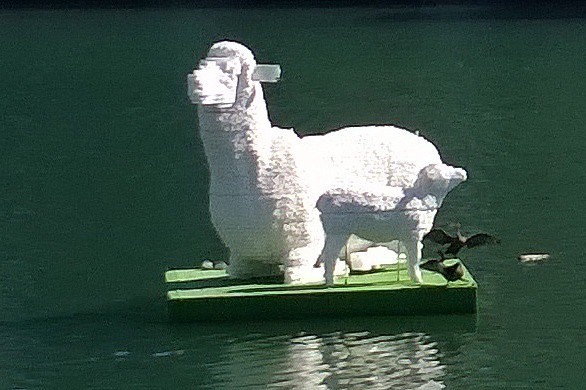
Today I sat on a shady bench next to Fort Point Channel and ate my Vietnamese noodles from the food truck. In front of me, floating on a green platform visited by cormorants, were two sheep — a big one and a small one. As the breeze and the tide nudged the platform, it turned slowly, showing the sculptures with different shadings and from different angles.

Steve Annear at the Boston Globe says, “The installation, called ‘Who Wears Wool,’ was created by artist Hilary Zelson, and pays homage to the Fort Point area’s former wool trade. … Earlier this year, FPAC [Fort Point Arts Community] put out a request for proposals seeking an artist who could weave together a prominent display connecting the neighborhood’s arts community with residents and visitors.  …

“For the project, Zelson said she layered EPS foam — or expanded polystyrene — to create the bodies of the sheep. The layers are held together with a spray adhesive, and the sheep are bolted to the dock with an armature of steel rods. Once built, the sheep were covered in packing peanuts to create the look of wool, before the entire thing was covered with a white acrylic latex coating …

“Zelson started working on the project in August. The first six weeks alone were dedicated to planning, she said.

“ ‘Once I was able to get the foam to my studio, I was working seven days a week,’ she said. ‘It was probably a 300-hour project.’ … The project — from the 3D renderings to the welding to the stacking of foam — was documented on Zelson’s Instagram account”

More here.

What I see in my photo are a ewe and a lamb — and cormorants.
100715-sheep-sculpture-ft-pt-channe;l

Read Full Post »

In 2007, conceptual artist Yoko Ono established the John Lennon Peace Tower in Iceland, a beam of multiple, heaven-directed lights that is intended to appear every year from John Lennon’s birthday, Oct. 9, to Dec. 8. It was most recently relit in 2014.

Wikipedia says, “The Imagine Peace Tower (Icelandic: Friðarsúlan, meaning ‘the peace column’) is a memorial to John Lennon from his widow, Yoko Ono, located on Viðey Island in Kollafjörður Bay near Reykjavík, Iceland.

“It consists of a tall tower of light, projected from a white stone monument that has the words ‘Imagine Peace’ carved into it in 24 languages. These words, and the name of the tower, are a reference to Lennon’s peace anthem ‘Imagine.’

“The Tower consists of 15 searchlights with prisms that act as mirrors, reflecting the column of light vertically into the sky from a 10-metre wide wishing well. … The power for the lights is provided by Iceland’s unique geothermal energy grid. It uses approximately 75 killowatts of power.

“Buried underneath the light tower are over 1 million written wishes that Ono gathered over the years in another project, called Wish Trees. … Iceland was selected for the project because of its beauty and its ecofriendly use of geothermal energy.” More at Wikipedia.

Says the Peace Tower website: “One of the mesmerising features of the Imagine Peace  Tower is that the strength, intensity and brilliance of its light continually changes with the prevailing weather and atmospheric conditions unique to Iceland – creating a clear pillar of light on a cloudless night, beams irridescing with rainbow refractions in rain or snowfall, and brilliantly reflecting off and through any moving layers of cloud.” More.

Photo: McKay Savage
“Imagine Peace” Tower

Read Full Post »

Back when Netscape was the browser of choice, I clicked every day on What’s Cool, and I think that is how I learned about the Museum Of Bad Art (MOBA), “a community-based, private institution dedicated to the collection, preservation, exhibition and celebration of bad art in all its forms and in all its glory.” I read that many pieces were pulled out of dumpsters and attics — or found abandoned by the side of the road.

Twenty years later, I got to wondering if MOBA was still around. I found lots of information on their expanded website.

“MOBA was founded in the fall of 1993 and presented its first show in March 1994. The response was overwhelming. Since then, MOBA’s collection and ambitions have grown exponentially.

“Initially, MOBA was housed in the basement of a private home in Boston. This meager exhibition space limited the museum to being a regional cultural resource for the New England area.

“As the only museum dedicated to bringing the worst of art to the widest of audiences we felt morally compelled to explore new, more creative ways of bringing this priceless collection of quality bad art to a global audience. Another Boston-area cultural institution, Dedham Community Theatre, generously allowed MOBA the use of their basement. Our first permanent gallery is now conveniently located just outside the men’s room in a 1927 movie theatre.

“The ambiance created such a convivial atmosphere, that when we went looking for a second location, the only place that was up to our quality standards was another theatre basement. The Somerville Theater in Davis Square, Somerville MA is now our second gallery.”

MOBA now exhibits online, publishes an email newsletter called MOBA News, and offers the book Museum of Bad Art : Masterworks. More here.

It was hard to pick one piece of art to show you from the many great examples online. But what’s not to love about the landscape below?

Says MOBA, “The wild westerly wind that devastated this peaceful bucolic landscape was strong enough to denude mature trees, grossly distort fair weather clouds, rend the fur from a cow, bend a wrought iron weather vane, and induce panic in a basset hound whose ears and tongue point due east. …

“In the note accompanying his donation, Mr. Roots wrote, ‘I was happy with the way the barn turned out. It was when I started animals and people that [I realized] I was having problems with proportions.’

“He enjoys other creative pursuits in addition to painting. ‘I have won the World’s Worst Poetry Contest in Pismo Beach, CA, placing 1st, 2nd, and 4th in separate years., [and] I have made many bottles of home brew and wine.’ ”

Art: Bob “Grandpa” Roots
“On a Windy Day,” Donated to the Museum of Bad Art

Read Full Post »

I liked this story about a 91-year-old artist having his first solo show. John sent it to me. I hope the Arlington Advocate leaves it up for a while. (I know that all the profiles I wrote for the newspaper chain of which the Advocate is a part — and all my theater reviews — are long gone.)

A solo exhibition called ‘Umberto Centofante: A Life’s Work” was featured at the Arlington Center for the Arts (ACA) until last week and highlighted 40 years of still lifes, portraits and landscapes.

Heather Beasley Doyle writes, “When Umberto Centofante tells a story about his life or talks about his art, a distinct, almost palpable energy underscores his words. His eyes light up, his body springs lightly and a hearty laugh punctuates his paragraphs. …

“Centofante’s life began in Pontecorvo, Italy, where he grew up on his family’s farm. When he was eight years old, he says, his teacher gave him a sketchbook to take home with him.

“ ‘All of a sudden some ideas came into my head,’ Centofante recalled, and he filled the book with drawings of farm life. …

“The drawings earned him a prize and the opportunity to receive professional art instruction — a chance he had to pass up so he could help work the farm. Eventually, Centofante became a police officer and worked in Rome. After World War Two ended, he emigrated from Italy, bound for the Boston area and a job as a truck mechanic at Garwood Industries in Brighton he secured with help from an uncle who lived in Milton. Centofante had never been a mechanic, but he learned with the same intuition that had enabled him to fill the sketchbook.

“Centofante is ‘self-taught in everything,’ including painting, according to the oldest of his four children, Elaine Gleason. …

“In the Gibbs Gallery, Centofante’s paintings of boats ferrying passengers through white-capped brilliant blue seas share space with glowing, color-soaked portraits of children and exacting, nearly monochromatic nature scenes such as ‘High Moon.’ …

“Centofante says he never sketches out a project ahead of time — that he spends more time thinking and planning a painting than setting paint to canvas.

“ ‘I don’t design; I just start. I find the resolution very quickly,’ he explained. …

“Asked why he paints, he replied simply: ‘It makes me feel good.’ ”

Read more of the story at the Arlington Advocate.

Photo: Arlington.Wicked.Local.com

Read Full Post »

Treehugger recently featured some rather magical lamps in the shape of mushrooms.

Kimberley Mok writes, “Whether they glow in the dark or are uncommonly rare, mushrooms are the incredible, unsung heroes of the natural world. They can bio-remediate oil spills, potentially cure diseases, and when used in your garden, can lessen its need for watering. Now, thanks to Japanese artist Yukio Takano, you can even have a LED version of them on your desk, transforming any mundane workspace into one of glowing, fungal wonder.

“Made with glass, salvaged driftwood and outfitted with energy-efficient LEDs and unique little light switches, Takano — who creates under the name The Great Mushrooming — seems to get the little details right enough to make these lamps look like the real thing (they come with hidden battery packs, to up the authentic-look factor, apparently). …

“Takano’s mushroom lights are one-of-a-kind, and while he sells at design fairs like Tokyo’s Design Festa, according to blogger tokyobling he doesn’t ship them abroad, due to the fragility of these glassworks. You can always feast your eyes over at Yukio Takano’s site The Great Mushrooming and visit the portfolio.”

More styles at Treehugger, here.

 Photo: Yukio Takano

Read Full Post »

Someone posted a chair by Jeffro Uitto on Facebook, and I had to know more.

Uitto’s About page says, “On the Washington coast there’s a place where nature’s leftovers get a second chance at stardom. The place is Knock on Wood, and Jeffro Uitto is the artist making the magic happen.

“Since high school Jeffro has been creating with wood, his favorite medium. This stuff isn’t from a lumber mill either. Each piece is found and rescued from the shores of Tokeland, the banks of Smith Creek, or the valleys between the Willapa Hills. In due time the varied sticks, slabs, and roots are cured and then found a fitting home. …

“Not everything is built right in the shop though. Clients have brought Jeffro on site to build one-off creations in places like Alaska and Hawaii.

“Jeffro’s shop is located near the historic Tokeland Hotel, a stone’s throw from Willapa Bay. … Visitors are surprised to see that many of Jeffro’s tools are hand made by the artist himself. After you get to know him, this isn’t surprising at all.”

Be sure to check out the amazing sculptures at Jeffro Uitto’s website, here.

Photos: Jeffro Uitto

Read Full Post »

Four years ago, I blogged about some beautiful manhole covers is Japan. Now I learn that Minneapolis also has discovered the artistic possibilities of heavy, round metal that lots of people see as they cross the street.

Eric Grundhauser writes at Slate‘s Atlas Obscura blog, “Minneapolis has made its underfoot sewer covers a point of artistic pride, with designs that celebrate the area’s art, history, and wildlife.

“In the early 1980s, Minneapolis began asking artists to design iconic manhole covers for the city. … From David Atkinson’s whimsical summer grill design to Stuart D. Kippler’s introspective geography marker, each of the covers turned what was once a mundane city feature into a unique piece of art. …

“[Kate] Burke created sculpted images of regional icons like the Minnesota state fish (the walleye), the state fruit (Halverson apple), and the state bird (loon). The detailed pieces of steel each feature tableaux of their subject that make most municipal equipment look lazy by comparison.

“Some of the covers even feature small hidden details such as a worm in the state apple, or a pheasant erupting from the bronzed image of the state grain (wild rice).” More here.

I love that the Minnesotan sense of humor is part of the artistic effort. Reminds me of Massachusetts sculptor Mags Harries, who is still associated with the bronze banana peels, orange skins, and broken crates she embedded among the produce vendors in the Haymarket in 1976.

Photo: J Wynia/Creative Commons
Manhole cover in Minneapolis.

Read Full Post »

In India, a man who saw sculptural possibilities in castaways has left behind hundreds of pieces of art in a public rock garden.

Nek Chand, an Indian artist who rose to prominence by quietly building a sprawling kingdom of folk sculptures in northern India that became one of the country’s most popular tourist destinations, died on [June 12] in Chandigarh. He was 90. …

“Mr. Chand’s life’s work, known as the Rock Garden of Chandigarh, covers several acres and is populated by rock sculptures and figures of dancing women and animals, many of them fashioned from found objects like the mudguards of motorcycles and broken bangles.

“It stands in contrast to the striking if neglected government buildings conceived by Le Corbusier, who planned Chandigarh — the capital of the states of Punjab and Haryana — in the 1950s.

“For some, the Rock Garden, which has thousands of visitors a day, is an antidote to what, with its stark Modernist buildings, is seen as something of a bureaucrat’s city. …

“Mr. Chand was born Nek Chand Saini on Dec. 15, 1924, in the village of Barian Kalan, which became part of Pakistan after partition. He was newly arrived in the city of Chandigarh just after India’s independence in 1947. He worked for the government as a road inspector, according to the Department of Chandigarh Tourism website. But, [Rupan Deol Bajaj, a retired government functionary] said, he became fascinated by found objects, including weather-beaten rocks.

“ ‘I started building this garden as a hobby’ in the 1950s, he said in an interview with Agence France-Presse in December. ‘I had many ideas, I was thinking all the time. I saw beauty and art in what people said was junk.’

“By night he slipped onto a patch of land and artfully arranged rocks and construction waste behind a barricade of empty tar drums.”

The garden was a secret for a long time. When the authorities learned about it, a debate on its future ensued. But, says the Times reporter, “a groundswell of support led to its official opening to the public in 1976.” More here.

Photo: Reuters
Nek Chand, at 76, next to one of his sculptures. He died in June at age 90.

Read Full Post »

I think this children’s book, reviewed at Brain Pickings, is one I need to buy.

Maria Popova writes, “This Moose Belongs to Me (public library) — a disarming story about a boy who believes he owns his pet moose Marcel, only to discover that so do other people, who call him by different names, while the moose himself doesn’t quite get the concept of being owned and is thus oblivious to the boy’s list of rules for being a good pet. …

“For the backgrounds of his illustrated vignettes, Jeffers reapporpriates classical landscape paintings by a mid-century Slovakian painter named Alexander Dzigurski, rendering the project a sort of posthumous collaboration and a creative mashup.”

Read the intriguingly philosophical Brain Pickings review here.

And here is a children’s book reviewed by Asakiyume that embraces insights about both the environment and other cultures.

She writes, “Discarded plastic bags are more than just an ugly nuisance in the West African nation of the Gambia. There, plastic shopping bags kill livestock that eat them and provide a breeding ground for malaria-carrying mosquitoes.

“A woman named Isatou Ceesay found an ingenious solution. She learned how to make plarn [yarn made from plastic bags], and, with her friends, started crocheting small change purses from the discarded plastic bags, which she and her friends sold. The trash problem — and attendant health risks — disappeared, and Isatou and her friends had a new source of income. The project was so successful that Isatou started teaching women in other villages, and in 2012 she won the International Alliance for Women’s World of Difference award.

Miranda Paul, a writer who has lived and taught in the Gambia, wrote about Isatou in One Plastic Bag: Isatou Ceesay and the Recycling Women of the Gambia (illustrated by the fabulous Elizabeth Zunon).” Lots of reasons for buying that book here, at Asakiyume’s blog.

Art: Oliver Jeffers

Read Full Post »

I have enjoyed Maria Popova’s reviews of children’s books at Brain Pickings and have been moved to buy quite a few.

This is the first picture book for grown-ups I’ve seen at her site, a kind of meditation on living life, with watercolors of an Everyman thinking about things.

Popova writes, “French-born, Baltimore-based artist Jean-Pierre Weill explores in The Well of Being (public library) — an extraordinary ‘children’s book for adults,’ three years in the making, that peers into the depths of the human experience and the meaning of our existence, tracing how the stories we tell ourselves to construct our personae obscure the truth of our personhood, and how we can untell them in order to just be. …

“Weill dances across the Big Bang, the teachings of the 18th-century Italian philosopher and mystic Ramchal, evolution, 9/11, and life’s most poetic and philosophical dimensions. He tells the lyrical story of a man — an androgynous being who ‘represents Everyman and also Everywoman,’ as Weill explains in the endnotes — moving from the origin of the universe to the perplexities of growing up to the mystery of being alive.”

Here’s a passage:

Is the world not whole? Is it not beautiful?

For now, let’s consider well-being a choice, something you can try on and wear. When we put on the hat and coat of well-being we incline towards joy without special occasion.

More at Brain Pickings, here.

Art: Jean-Pierre Weill 

Read Full Post »

On Sunday, I got to the Peabody Essex Museum early and decided to walk around Salem before going in to see the Thomas Hart Bentons. I thought I might take a look at the hotel where I stayed when DeAnna and Mairtin got married.

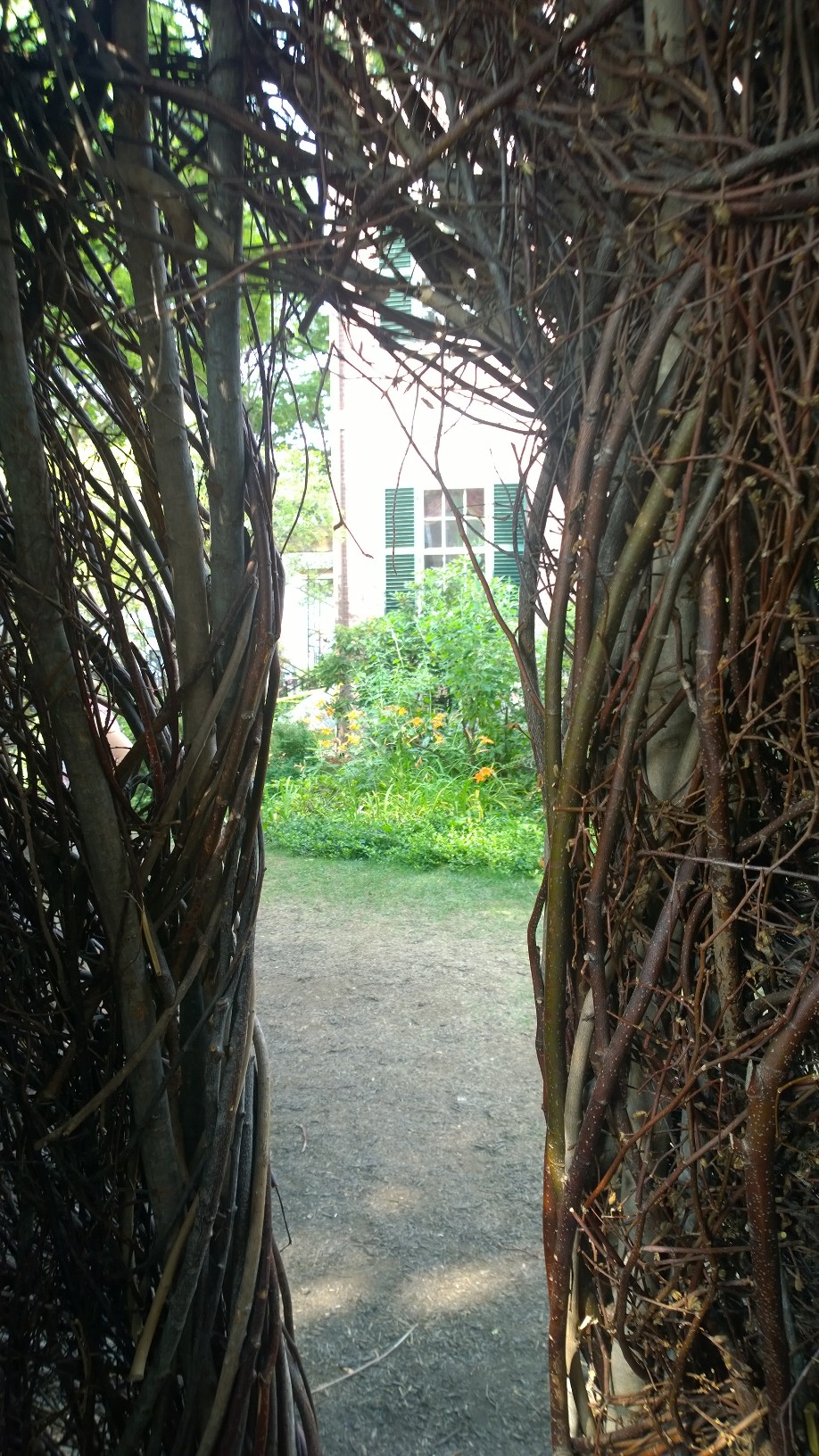
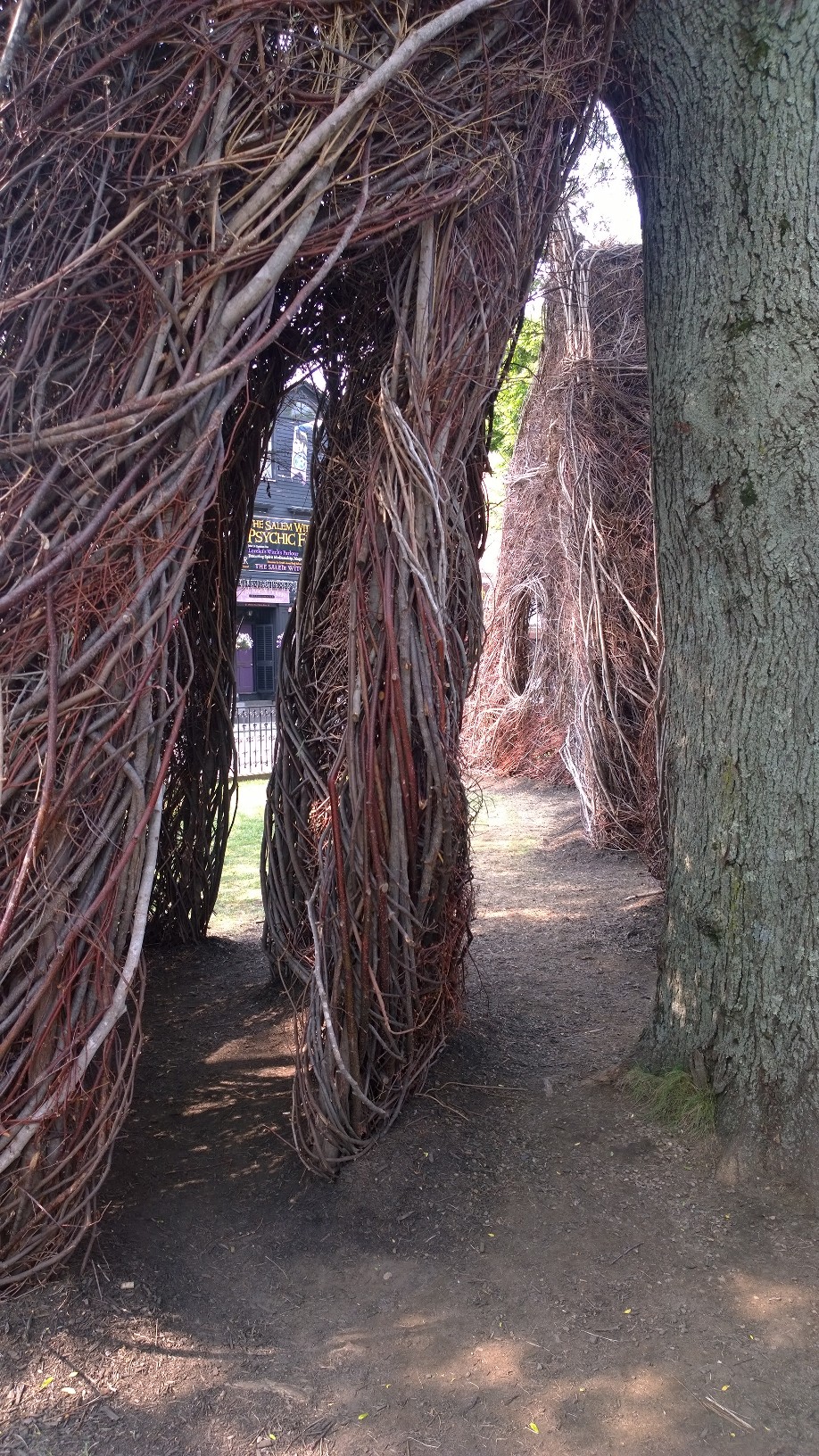
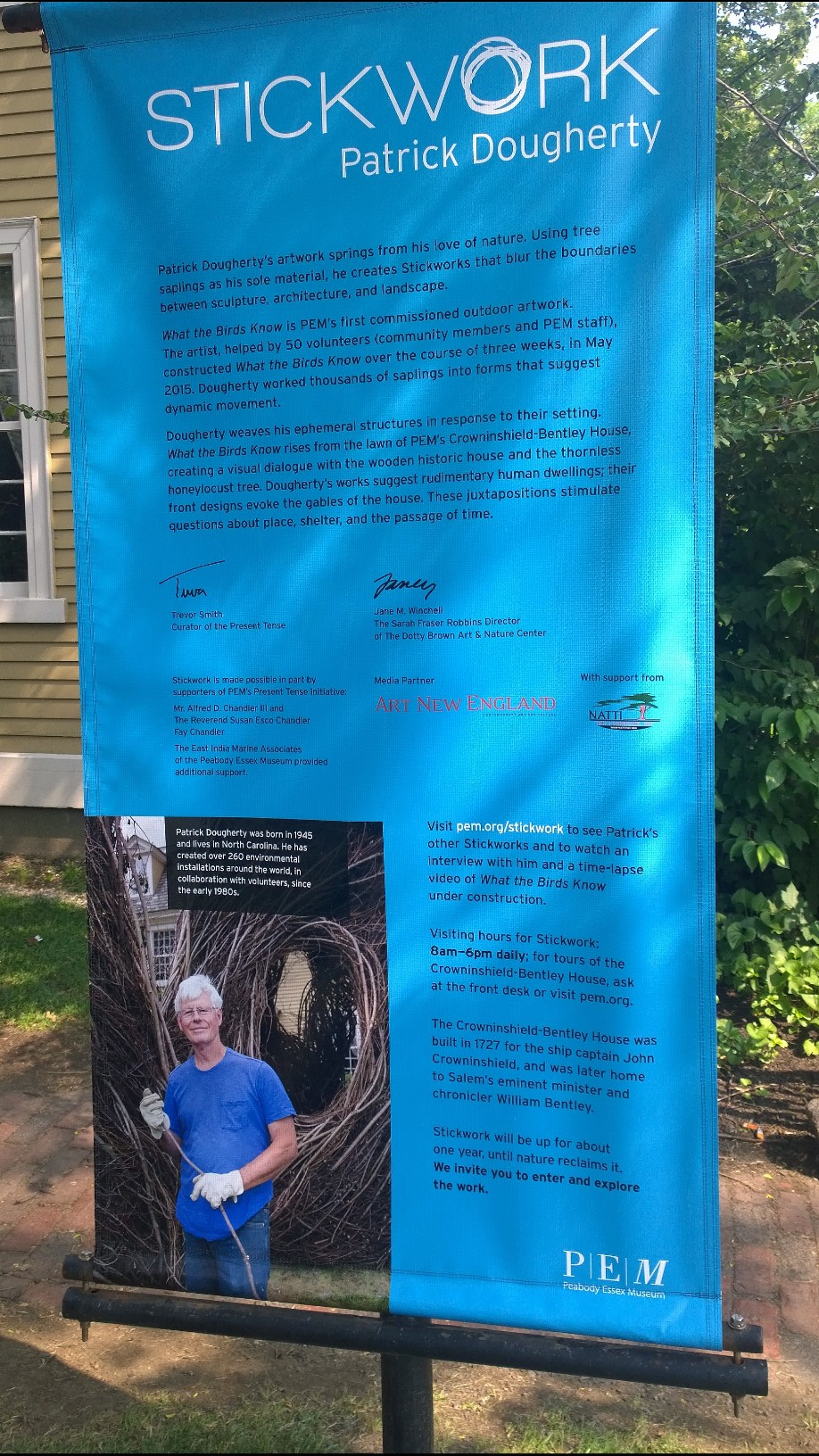
I hadn’t gone very far when what should I spy but some very strange constructions made of sticks. Turns out the sculptures, by Patrick Dougherty, were also a PEM exhibition: “Stickwork.”

From Dougherty’s website: “Born in Oklahoma in 1945, Dougherty was raised in North Carolina. He earned a B.A. in English from the University of North Carolina in 1967 and an M.A. in Hospital and Health Administration from the University of Iowa in 1969. Later, he returned to the University of North Carolina to study art history and sculpture.

“Combining his carpentry skills with his love of nature, Patrick began to learn more about primitive techniques of building and to experiment with tree saplings as construction material. In 1982 his first work, Maple Body Wrap, was included in the North Carolina Biennial Artists’ Exhibition, sponsored by the North Carolina Museum of Art. In the following year, he had his first one-person show entitled, ‘Waitin’ It Out,’ in Maple at the Southeastern Center for Contemporary Art in Winston-Salem, North Carolina.

“His work quickly evolved from single pieces on conventional pedestals to monumental scale environmental works, which required saplings by the truckloads. Over the last thirty years, he has built over 250 of these works, and become internationally acclaimed. His sculpture has been seen worldwide—from Scotland to Japan to Brussels, and all over the United States.” More at http://www.stickwork.net.

Aren’t artists something? They just follow where it leads. Nobody gets them into windowless rooms to discuss strategy, goals, subgoals, benchmarks, measures, or evaluation.

Although, I suppose, if Dougherty started out in hospital management, he was subjected to lots of that sort of thing.

071215-Dougherty-Sticks-Salem

071215-lilies-and-sticks

071215-more-Stickwork

071215-thru-the-sticks-darkly


071215-Pat-Dougherty-Stickwork-Salem

Read Full Post »

Art: Thomas Hart Benton
One of my favorites: Spring on the Missouri, 1945, oil and tempera on Masonite panel. On loan to the PEM from the North Carolina Museum of Art.


When I was moonlighting as a theater reviewer, I always liked to “sleep on it” before writing anything, just in case my unconscious had anything useful to add.

Well, I slept on the big Thomas Hart Benton exhibition I saw yesterday, and sleep confirmed that certain lesser-known aspects of his work are troubling. I still adore the wavy energy of his landscapes, people, horses, trains, clouds, smoke, even fence posts. I still love the way Benton honors ordinary people and ordinary jobs and the way his paintings comment on social injustice.

But I really did not like the gruesome murals of invading armies that Benton created to jolt overly complacent Americans after Pearl Harbor. There was something cheap about them.

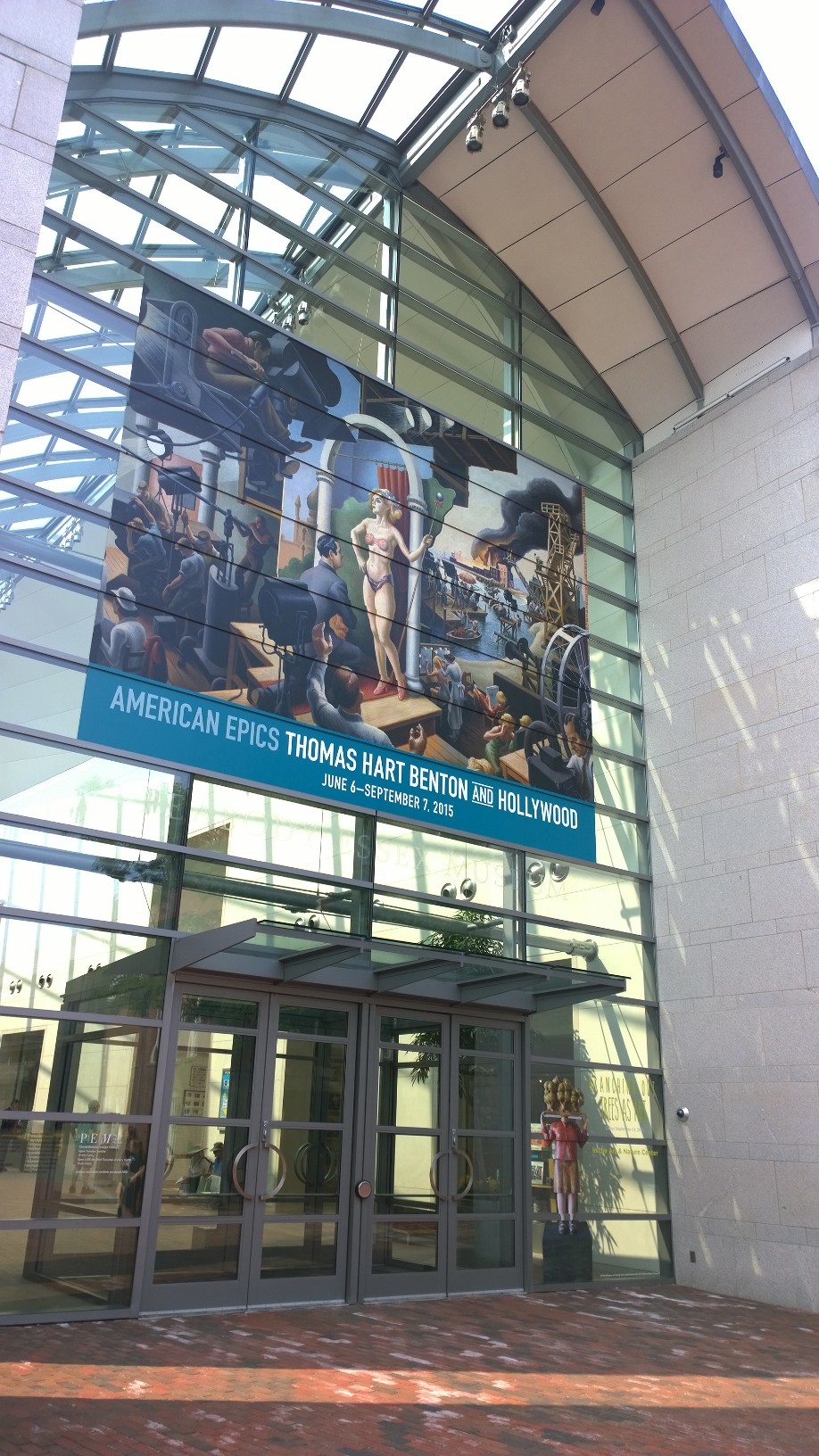
Of course, there was a lot more than that to the exhibition “American Epics: Thomas Hart Benton and Hollywood,” a sweeping retrospective of most of the artist’s work: murals showing Indians or slaves being mistreated, paintings of the the vibrant life of the West and Midwest, detailed depictions of the inner workings of Hollywood sets, designs for the Henry Fonda version of The Grapes of Wrath, illustrations for an edition of Huckleberry Finn, posters touting the contributions of African Americans to the war effort.

The day before, I had been hearing about Irving Berlin’s dedication to the war effort, and I think these two different artists conveyed, more viscerally than I had previously experienced, the underlying fear prevalent at that time. Since I grew up after it was all over, I probably unconsciously assumed that everyone always knew the Allies would win.

Do go to the show at the Peabody Essex Museum in Salem. You have until September 7. An enormous array of Benton’s work has been gathered from near and far — and there are some intriguing movie clips. (I was moved by a character’s tears to put The Grapes of Wrath on my Netflix list.)

Details of the exhibition here, at the PEM website.

071215-Thos-Hart-Benton-show

071215-Thos-Hart-Benton-at-PEM

Read Full Post »

Melita posted this link on Facebook. She was so excited about the idea of a graffiti class for older folks that she contacted the organization to see if they were planning anything for Boston. I told her I would join her if they held a class. But, alas, Boston is not on their calendar. We have to get the experience vicariously from AxaNews.net.

The Axa article is a series of photos with captions like this: “Women spray their designs on a wall during a graffiti class offered by … LATA 65 [an] initiative for the elderly in the area of urban art. Since it began in 2012, they have introduced the world of graffiti to over 100 senior citizens, giving workshops in different neighborhoods of Lisbon.”

Dovas adds more at Bored Panda, “Graffiti and street art have both often served to deepen the rift of misunderstanding between young and old, but there’s one art organization in Lisbon, Portugal that’s working to change that. LATA 65 works to destroy age stereotypes and turn senior citizens into street artists by providing them with spray paint cans, masks and gloves and finding them free spots in the city to tag up and paint!

“It all begins with workshops, where the students learn about the history of street art and get to create their own stencils. They then find run-down parts of the city to jazz up with colorful tags and stencil art.

“According to the organization’s Facebook, their goal is to connect older and younger generations through art, to help the elderly engage in new forms of contemporary art and, most importantly, to let them have fun.”

This is a whole different level from the knitting groups Di organized with old folks and young girls at church back in the day. Suzanne and Joanna were regulars when they were about 7.

See the seniors’ graffiti artwork here.

Photo: Rafael Marchante/Reuters
Women spray their designs on a wall during a graffiti class offered by the LATA 65 organization in Lisbon, Portugal, May 14, 2015.

Read Full Post »

At the website This Is Colossal, Christopher Jobson writes about time-lapse videos of Joe Mangrum’s spontaneous sand paintings.

“Artist Joe Mangrum (previously) was just in Zuidlaren, Netherlands, where he was commissioned by the Doe Museum to create 8 temporary sand paintings over a period of 11 days. All of Mangrum’s paintings are spontaneous and evolve as he works, a grueling physical process that involves dozens of revolutions around the artwork as he adds new details and flourishes by pouring brightly colored sand. All eight artworks were photographed as he worked and turned into time-lapse videos, three of which are included here. The sand paintings will remain on view through October 30, 2015. You can follow more of Mangrum’s work on Facebook.”

Jobson wrote in a previous post about the work, “Since 2006 artist Joe Mangrum has taken to the streets of New York, Chicago, San Francisco and elsewhere armed with sacks of colored sand that he sprinkles by the handful to create sprawling temporary paintings. Each work is spontaneous in its design and evolves as Mangrum works, spending upwards of 6-8 hours hunched over the ground to complete each piece. The artist estimates he’s completed nearly 550 paintings over the last few years. A graduate of the Art Institute of Chicago, his paintings have appeared at The Corcoran Gallery, the Museum of Arts and Design in NYC, as well as The Asia Society. He also made a recent appearance on Sesame Street. ”

See the videos here. The sand paintings are like berserk mandalas; in the videos, they are alive.

Art: Joe Mangrum

Read Full Post »

« Newer Posts - Older Posts »