Feeds:
Posts
Comments

Posts Tagged ‘art’

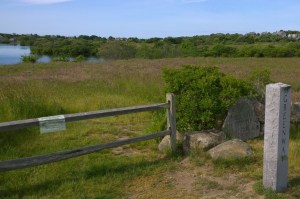
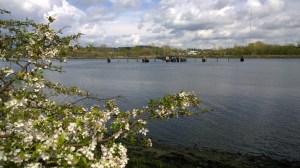
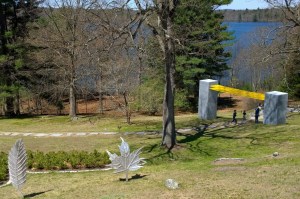
A beautiful day is always a good excuse to walk the grounds of the deCordova Museum in Lincoln, Mass., enjoying the sculptures and lake view.

A little history from the museum website: “DeCordova Sculpture Park and Museum is located on the former estate of Julian de Cordova (1851-1945). The self-educated son of a Jamaican merchant, Julian de Cordova became a successful tea broker, wholesale merchant, investor, and president of the Union Glass Company in Somerville, Massachusetts. Although he married into the locally prominent Dana family of Boston, Julian achieved prosperity without the advantages of inheritance or social position. …

“Inspired by his trips to Spain and his own Spanish heritage, Julian remodeled his summer home in Lincoln, Massachusetts in 1910 to resemble a European castle. …

“For Julian, the visual arts served as a medium for self-improvement and enlightenment. In his later years, he opened the doors of his estate to share the wonders he had collected during seven decades of world travel. Julian envisioned a place where art would continue to educate and excite beyond his lifetime. To meet that end, he gave his property to the town of Lincoln in 1930 with the stipulation that his estate would become a public museum of art following his death.

“Julian’s will established a committee of incorporation, whose duties included formulating the policy, objectives, and supervision of the new museum with the guidance of professionals in the field, such as the Director of the Museum of Fine Arts (MFA) in Boston. Independent appraisers determined that Julian’s collections were not of substantial interest or value, so the collection was sold and the proceeds were used to create a museum of regional contemporary art.”

It’s nice to have an institution that focuses on New England artists, especially one that also offers a beautiful park for families to enjoy.

The yellow cables that seem to vibrate between the concrete blocks are a startling aspect of Stephanie Cardon’s sculpture Beacon. The collection of giant leaves, by Alan Sonfist, is called The Endangered Species of New England. The purple carpet is by Mother Nature and is called Violets.

042416-DeCprdova-lake

042416-DeCordova-giant-leaves


042416-violet-carpet-Lincoln-Mass

Read Full Post »

There can be unexpected ramifications to keeping cats, as art forgers described in Science magazine discovered to their regret.

In an article on how experts check the authenticity of a putative Velázquez or a painting found along with mummies, Lizzie Wade writes, Investigations into the artist responsible for more modern works often have a specific goal: To figure out if the work in question is a forgery.

“Bonnie Magness-Gardine manages the Art Theft Program at the Federal Bureau of Investigation in Washington, D.C. For many years, she and other investigators had seen innumerable forgeries of the work of Clementine Hunter, a self-taught and incredibly prolific African-American painter from Louisiana.

“Many people tried to copy her distinctive folk-art style, but only two regularly succeeded: William Toye and his wife Beryl Ann Toye, a couple from New Orleans. They were so good at imitating Hunter’s style that ‘they got away with this for years,’ Magness-Gardine says.

“In 2009, the Federal Bureau of Investigation finally gathered enough evidence to confiscate the Toyes’ supposed Hunter collection, and during the raid they noticed that ‘they lived in a very modest house with approximately 30 cats,’ Magness-Gardine says.

“When forensic investigators analyzed the seized works, they found cat hair embedded in the paint — a characteristic not shared by Hunter’s authentic work. ‘That’s essentially what brought them down,’ Magness-Gardine says. William Toye pled guilty to art fraud in 2011.”

More here.

Art: Clementine Hunter/ Bridgeman Images
Picking Cotton, 1950s (oil on board), Minneapolis Institute of Art, The Ethel Morrison Van Derlip Fund. Hunter is a favorite of would-be forgers.

Read Full Post »

Tom Murphy wrote recently at the Providence Journal about a shop in North Kingstown that will teach you how to build your own guitar.

“Owner Dan Collins and his partner, Ariel Bodman, design and build guitars with the skill and dedication of artists,” writes Murphy. “They talk about the sound produced by different kinds of wood with terms like the ‘color’ and the ‘ring.’ …

“Dan and Ariel have brilliantly carved out a niche in the industry by sharing their deep knowledge and experience with student builders who pay a fee to craft their own custom instruments. With his background in art and hers in music, they give students a much deeper appreciation for their new instruments than they might get walking out of the average music store. …

“Many students become hooked on the experience and come back for a second, third, even a fourth build. ..

“The custom builds, the repairs and the teaching are the business side of Dan Collins’ unique shop, but from 7 to 10 p.m. on the last Saturday of each month, something really extraordinary happens.

“The floors are swept, tools are put away, equipment is pushed aside and the long work bench in the middle of the room is transformed into a banquet table as Shady Lea Guitars holds its ‘open mic night.’

“In a cleared portion of the workshop, there is a well-lit stage and an odd assortment of comfortable old chairs. It’s potluck, so students, customers, friends and enthusiasts alike can share their favorite recipes along with their music. The friendly audience always puts participants at ease, and they respond with heartfelt performances.” More here.

Read Full Post »

When I was growing up in Rockland County, New York, my parents liked to buy art from artist friends and, when possible, offer other kinds of support. They hired the Hungarian-American artist André Dugo, for example, to paint a portrait of my brother Bo and me sitting in an armchair and reading one of the artist’s children’s books. We often read his book Pete the Crow or the books featuring a cardinal and a blue jay, or the one about the calf that ate the wrong kind of grass and puffed up like a balloon.

One day, Mr. Dugo came to our house to watch television with us. (We had one of the first TVs because my father was writing a story on Dumont for Fortune magazine.) We kept asking Mr. Dugo what he would like to see, and he kept saying he just wanted to see whatever we ordinarily watched.

As we worked our way through several programs, Mr. Dugo noted our reactions, sometimes asking questions.

Not many months after, a children’s book came out. It was called Tom’s Magic TV, and its premise was that a boy traveled through the TV screen and into adventures with sharks, circus clowns, puppets, cowboys and spacemen. Bo and I were not mentioned. The mother didn’t look like my mother. This was an early exposure to children’s-literature research — or poetic license.

I’m pretty sure that Gene Autry was the model for the cowboy adventure.

030916-Toms-Magic-TV-Dugo

Read Full Post »

As an official member of his town’s tree committee, John has been working hard to promote the many benefits of an urban tree canopy both for quality of life and for the business environment.

Now here comes a really unusual idea for fans of urban greenery. You just need a large body of water.

At the website “Pop Up City,” describes Rotterdam’s floating forest, thought up by (who else?) an artist.

“Rotterdam will get its first ‘bobbing forest’ in 2016: a collection of twenty trees that are floating in the Rijnhaven, a downtown harbor basin.

“Inspired by Jorge Bakker’s artwork ‘In Search of Habitus‘, an aquarium filled with bobbers that grow small trees, Dutch designers and entrepreneurs from Mothership decided to carry out this idea in ‘real life’. After experimenting with a sample tree last year, an entire floating forest of twenty trees is scheduled to be ‘planted’ on March 16, 2016.” Check out some intriguing photos here.

My only question as a person who grew up in a hurricane corridor: What happens if there’s a storm?

Photo: Popupcity.net

Read Full Post »

I checked Gwarlingo not long ago to catch up on Michelle Aldredge’s thorough, sensitive meditations on art and literature.

What caught my attention was her review of a movie about restoring an old house in Japan.

“It is rare to find a film that is pitch-perfect in its cinematography, story, pacing, and length,” Aldredge writes, “but Davina Pardo’s short film Minka is such a gem. (I owe writer Craig Mod a thank you for turning me onto this quiet masterpiece.)

“Based on journalist John Roderick’s book Minka: My Farmhouse in Japan, the film is a moving meditation on place, memory, friendship, family, and the meaning of home. Most remarkable, this haunting story plays out in a mere 15 minutes.

Minka is the Japanese name for the dwellings of 18th-century farmers, merchants, and artisans (i.e., the three non samurai-castes), but as Wikipedia explains, this caste-connotation no longer exists in the modern Japanese language, and any traditional Japanese style residence of an appropriate age could be referred to as minka. The word minka literally means ‘a house of the people.’

“The story of how AP foreign correspondent John Roderick and his adopted Japanese son Yoshihiro Takishita met, and then rescued a massive, timber minka by moving it from the Japanese Alps to the Tokyo suburb of Kamakura is full of small surprises and revelations (the biggest one comes at the end of the film).

Minka is a film that celebrates stillness. Pardo’s camera lovingly lingers on sun, shadows, and dust. But the peaceful home is not just a restored space full of beautiful, personal objects, it is also an expression of the deep connection between Roderick and Takishita and of familial love.”

Read about that at Gwarlingo, where the filmmaker will let you watch the entire 15-minute movie.

Photo: Davina Pardo & Birdlings LLC
A still from the film
Minka

Read Full Post »

012116-fish-for-supper

Art: Maggie Stern
“Fish for Supper”

Concord Art has mounted a juried show of member works. I have been twice this week. It’s accessible and stimulating.

When you first enter, you hear a strange clattering and turn to see a beat-up old medicine cabinet with vintage pill bottles inside that are rattling around like ghosts. Very amusing.

My former boss, Meredith Fife Day, had two lovely country scenes in acrylic from her travels in Ireland, and she was the one who reminded me to see the show.

I took a photo of Maggie Stern’s playful “Fish for Supper,” above. Stern says, “What I love most about art is that you get to make up the rules.” I Googled her and found that she has connections with the Fuller Craft Museum in Brockton, Mass., and has excelled in a variety of artistic realms, including illustrating children’s books and making kits for crafty folks to reproduce her original stitchery.

I was also drawn to Lorraine Sullivan’s use of vintage linens. There must be something in the air about vintage. I’ve been doing a little prospecting (along with Erik’s mother) to add to Suzanne’s new vintage locket collection at Luna & Stella, and have learned that the idea of mixing vintage with contemporary birthstone jewelry is quite popular.

In fact, all sorts of vintage items are being cherished now, to the point that it was not only wonderful but a bit painful to see how Sullivan used her seamstress grandmother’s handiwork in the piece below. Creative destruction. Happy-sad.

012216-vintage-linen-art-1

012116-vintage-linens-now-art


Read Full Post »

The first pictures feature berries, shadows, rain, and snow. I took them in Massachusetts.

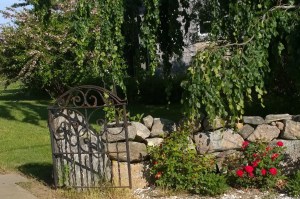
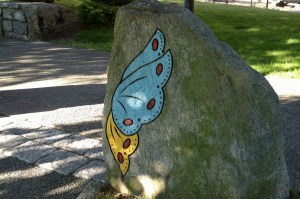
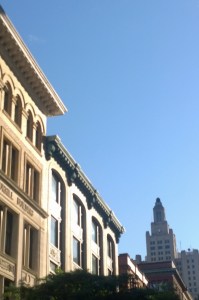
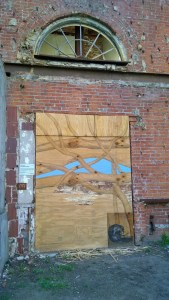
The others are from Providence, which has long exuded an artistic vibe. I liked the sunrise on rooftops in one photo and a beautiful ornate building, sadly neglected. More-contemporary art pops up in unexpected places: the robot-like sculpture at a busy intersection and the robot in the ladies room at Small Point Café.

011716-shadow-berries

011616-raindrops-on-holly


011816-snow-on-hollu

011916-Providence-sculpture


011216-early-sunlight-Providence-_Pro

012016-beautiful-neglected-building


012016-WC-Robot

Read Full Post »

Candice Frederick, of the New York Public Library’s Schomburg Center for Research in Black Culture, recently posted research by Katherine Ellington on an African American artist who was new to me.

From Ellington notes: “Augusta Savage was among [a] group of artists who came to Harlem from the Jim Crown South in search of opportunity and where her creative expression could thrive.

“My quest for Augusta Savage (1892 –1962) sculpture led me to a first-time visit to the Art and Artifacts Division of the Schomburg Center for Research in Black Culture. … As a young girl in the early twentieth century, Savage began shaping ducks out of red clay found in the backyard of her home in Green Cove Springs, Florida. Savage’s work gained local attention when she entered and won a prize at a local county fair, which led to community support for further study.

“In 1921, she moved to Harlem after studying at State Normal College for Colored Students (now Florida A & M University). Savage later completed a four-year program in sculpture in three years at Cooper Union. …

“In 1931, Savage … opened the Savage Studio of Arts and Crafts — a fine arts training ground for over 1,500 students including many well-known Harlem Renaissance artists such as Charles Alston, Ernest Crichlow, Norman Lewis, Morgan Smith and Marvin Smith, Jacob Lawrence and Gwendolyn Knight Lawrence. …

“In 1934, Savage became the director of the newly established Harlem Community Art Center, after she was commissioned by the 1939 World’s Fair. Around that time she created “The Harp” as a series, but it was destroyed during the cleanup after the fair. …

“Savage’s art was often in response to the fight against racism. She used a variety of methods, shaping clay and plaster, casting bronze, and later years, carving marble and wood. In the Augusta Savage collection, there are works that illustrate themes such as nineteenth-century romanticism and African and Greek culture. As a trained portraitist, her busts include Marcus Garvey, W.E.B. Du Bois, James Weldon Johnson and Gwendolyn Bennett.”

More here.

Photo: The New York Public Library. Image ID: 1654255
“Harp,” by Augusta Savage

Read Full Post »

091615-Penguins-by-Keilan

Penguins by Keilan

My friend Kristina Joyce gives art lessons to a talented middle schooler who has brittle bone disease.

Henry Schwan wrote about young Keilan Hughes in the Concord Journal last April, reporting that he was “one of several students whose art [was] on display in the children’s room at the Concord Library. Joyce had them focus on nature in the Middle East, and Keilan drew a bird titled, ‘Yellow Wagtail from the Holy Land.’

“ ‘It’s relaxing, it takes my mind off things,’ Keilan said of his art.

“Keilan’s talents could take him in a number of directions. He dreams of being a doctor one day, but also has a backup plan of becoming a residential architect. …

“He was diagnosed with brittle bone disease the day he was born. ‘I don’t mind,’ Keilan said. ‘Most of the time, I forget that I even have [it].’ …

“Currently, there is no cure for brittle bone disease, but Keilan and his mom hope for a breakthrough. …

“ ‘It’s important to look at the bright side and look to the future,’ says his mother.”

Kristina tells me Keilan’s mother, who is from Trinidad, the family as a whole, and the school district have all been extremely supportive. One well-wisher made a website for Keilan to show his art. Others have given him specific requests for drawings. “Everybody loves Keilan,” she said.

More at the Concord Journal, here.

Photo: Ann Ringwood/Wicked Local Staff
Keilan Hughes is submitting yearbook cover art that his teacher said was so good she didn’t suggest a single correction.

Read Full Post »

Our 5-year-old grandson’s friend had been planning to attend an American Repertory Theater musical with her grandmother today at 10 a.m. We decided to go, too.

The show was The Pirate Princess and was loosely (very loosely) based on Shakespeare’s Twelfth Night. It was a hoot for me, and the young man in the photo seemed riveted. But whether he could make head or tail of the  convoluted plot, I have my doubts. It will be interesting to see down the road what he remembers — and whether he wants to see more plays.

The plot involves a brother and sister who get separated in a shipwreck (in this case, it’s thanks to a monster called the Kraken) and have separate adventures with characters who later mistake the sister dressed as a boy for the boy and vice versa. (I kept whispering in my grandson’s ear, “The pirate thinks he’s the girl that he thinks is a boy”; “The Queen thinks he’s his sister but doesn’t know his sister is a girl.” My grandson didn’t respond.)

There were songs, musical instruments, fancy costumes, pirates storming up lighted platforms in the middle of the audience, sword fights, and imaginative special effects. I especially like the jellyfish created by glowing umbrellas with streamers, carried along the aisles in the dark. The Kraken with his many legs was pretty great, too.

After the show, we had hot chocolate and cookies at the Darwin on Mt. Auburn Street. I’m not sure what our grandson will be able to tell his parents about the madcap entertainment he witnessed, but bits and pieces will likely emerge over time. I myself saw Peter Pan and Alice in Wonderland when I was four, but I didn’t become a theater nut until I was 10.

010216-hot-chocolater-after-theater

Read Full Post »

The poet Marianne Moore once helped to save a special tree by writing a poem about it, proving that art is more powerful than apathy.

Maria Popova writes at Brain Pickings, “In 1867, Brooklyn’s Prospect Park, once an American Revolution battlefield, opened its gates to a community hungry for a peaceful respite of wilderness amid the urban bustle. So intense was public enthusiasm that local residents began donating a variety of wildlife to fill the 585-acre green expanse, from ducks to deer. But the most unusual and enduring gift turned out to be a tree, donated by a man named A.G. Burgess and planted in 1872.

“This was no ordinary tree. Ulmus glabra ‘Camperdownii,’ better-known as Camperdown Elm, is a species unlike regular trees in that it cannot reproduce from a seed. The rare elm carries its irregularity on the outside — its majestic, knobby branches grow almost parallel to the ground, ‘weeping’ down. To ameliorate its reproductive helplessness, the Camperdown Elm requires outside help — a sort of assisted grafting, be it by accident of nature or intentional human hand. …

“As excitement over the novelty of Prospect Park began dying down, the Camperdown Elm came to suffer years of neglect. …

“But then, in the 1960s, it was saved by a force even more miraculous than that by which its Scottish great-great-grandfather had been born — not by a botanist or a park commissioner or a policymaker, but by a poet fifteen years the tree’s junior.

“The poet was Marianne Moore (November 15, 1887–February 5, 1972), who had been elected president of New York’s Greensward Foundation — an advocacy group for public parks — in 1965. This brilliant and eccentric woman … created a citizen group called Friends of Prospect Park, aimed at protecting the Camperdown Elm and other endangered trees in the park.

“In 1967, eighty at the time and with a Pulitzer Prize under her belt, Moore penned ‘The Camperdown Elm’ — a beautiful ode to this unusual, dignified, yet surprisingly fragile life-form of which humans are the only bastions. …

“Moore’s poem mobilized the Friends of Prospect Park to envelop the Camperdown Elm in attentive and nurturing care, which ultimately saved it.”

Read the poem and the rest of the story here.

Come to think of it, the Camperdown Elm’s reliance on humans to do the right thing make it very little different from the rest of the natural world.

Read Full Post »

121115-ICA


Until January 24, you can see at the ICA in Boston an exhibition on the artistic legacy of one of the most interesting colleges ever. It couldn’t last, but while it did, it burned with a bright flame.

Let me drop a few names of people who worked and studied there: Robert Rauschenberg, Josef Albers, Robert Motherwell, Cy Twombly, Jacob Lawrence, Willem de Koonig (painters); Buckminster Fuller (architect); Merce Cunningham (choreographer); John Cage (music); and Robert Creeley (poetry). I am leaving out too many, including the women, whose names are not as well known.

I went on my lunch hour and so swept through the exhibition too fast. I confess I am not crazy about much of the art from this period. My favorites here are Motherwell, Lawrence, Cunningham, and Creeley. But how amazing that they all gathered North Carolina’s Blue Ridge Mountains, energizing one another across disciplines and making the school their life for a while, even pitching in with the chores.

Surprisingly, the things I took away with me were two ideas I’d like to apply to art with grandchildren.

I’ve done photographic paper before (you put objects like leaves or shells on the paper, leave it in the sun a few minutes, then run in the house and rinse it in water), but someone in the show did a full body. I might try a hand or a face. I also loved the textures of one piece of art I saw. Not quite a collage, it used string and bumpy surfaces in imaginative ways that reminded me of a project I watched Earl Gordon do when I was a child. He sliced the seed pod of a flower and used it as a stamp. Got to try more of that.

You can read about the school and the exhibit here.

Photo: Craig F. Walker/Globe
I liked “Female Figure” on sun-exposed photographic paper, by Susan Weil and Robert Rauschenberg, left.

Read Full Post »

Maria Popova at Brain Pickings finds the most wonderful books to blog about. In a recent post she extolled the wonders of fairy tale illustrations by Kay Rasmus Nielsen.

I was surprised to learn that’s a man’s name in Denmark. Wikipedia says, “Kay Nielsen was born in Copenhagen into an artistic family; both of his parents were actors – Nielsen’s father, Martinus Nielsen, was the director of Dagmarteater and his mother, Oda Nielsen, was one of the most celebrated actresses of her time, both at the Royal Danish Theater and at the Dagmarteater.

“Kay … received his first English commission from Hodder and Stoughton to illustrate a collection of fairy tales, providing 24 colour plates and more than 15 monotone illustrations for In Powder and Crinoline, Fairy Tales Retold by Sir Arthur Quiller-Couch in 1913. In the same year, Nielsen was also commissioned by The Illustrated London News to produce a set of four illustrations to accompany the tales of Charles Perrault; Nielsen’s illustrations for ‘Sleeping Beauty’, ‘Puss in Boots’, ‘Cinderella’ and ‘Bluebeard’ were published in the 1913 Christmas Edition.”

This is from Maria Popova: “As a lover of illustrated fairy tales and having just returned from Sweden, I was delighted to discover, thanks to the relentlessly wonderful 50 Watts, East of the Sun and West of the Moon: Old Tales from the North … illustrated by Danish artist Kay Rasmus Nielsen (1886-1957), whose work you might recall from [my list of] the all-time greatest illustrations of Brothers Grimm and the fantastic visual history of Arabian Nights. Originally published in 1914, this magnificent tome of 15 stories was recently reissued by Calla Editions, the same Dover imprint that revived Harry Clarke’s magnificent illustrations for Edgar Allan Poe, and features 25 color illustrations, along with a slew of black-and-white ones, in Nielsen’s singular style of haunting whimsy.”

There are more than 20 amazing Nielson illustrations here, at Brain Pickings.

Art: Kay Rasmus Nielsen
The North Wind went over the sea.

Read Full Post »

island-scene-on-Painted-Rock


Feeling the cold setting in?  Well here’s a summery scene on New Shoreham’s famed Painted Rock, one of my favorite pictures of the island’s constantly changing bulletin board. Wish I knew who the artist was.

John is behind the new tumblr blog featuring the Painted Rock in as many iterations as folks can dig out of the albums and send along.

Here’s what John had to say about it on the island e-board:

“Thanks for the kind comments and great pics submitted to paintedrockbi.tumblr.com The ‘mini cooper rock’ and the ‘hamburger rock’ are especially cool.

“There was also a question about me and the reason for the blog, so here goes.

“About 20 years ago my mother painted the rock early one morning to celebrate my sister turning 16 and my turning 21. Our summer home is a only short walk down Mohegan Trail from the rock, but if you took careful note of our ages, you might guess that my sister and I were not really morning people.

“So by the time we had rolled out of bed and made it down the street to look, it was already painted over. No photos were taken, but I know it’s there buried under all the layers. Now I am a parent, and it kind of reminds me of the many things we do for our children that no one ever really sees, but we keep doing anyhow.

“For many years I’ve been thinking about how best to document the many cool rock paintings. And last week I finally got around to doing something about it; hopefully the page will continue to get submissions and we can save the many small memories behind each coat of paint.”

Check it out: http://paintedrockbi.tumblr.com/

Read Full Post »

« Newer Posts - Older Posts »