Feeds:
Posts
Comments

Posts Tagged ‘art’

An artist discovered at 64 has a gallery show in New York.

Jim Dwyer writes at the NY Times, “For more than three decades, [Rafael Leonardo] Black, 64, has made a portal to the world in dense, miniature renderings of ancient myth and modern figures: Frank Wills, the security guard who discovered the Watergate break-in; Shirley Temple as a sphinx; the head of the surrealist André Breton as the head of John the Baptist; Marianne Faithfull in multiple incarnations.

“Until recently, few people ever saw his work because he had almost no visitors. He held paying jobs as a typist in a law firm, a salesman at Gimbels and then Macy’s, and as a secretary in a school. Most recently, he has worked mornings as a part-time receptionist in a hospital. …

“ ‘I just never made the effort to sell it,’ Mr. Black said. ‘I never expected to be able to make a living at it, but I’ve always done it since — well, I guess, since I’ve known my self.’

“Then [in May], a Manhattan gallery owner, Francis M. Naumann, mounted ‘Insider Art,’ an exhibition of 16 works by Mr. Black. Ten of them sold within days, at prices ranging from $16,000 to $28,000.

“ ‘People liked them, people who know art,’ Mr. Black said. ‘It makes me very happy.’ …

“Late last year, [his friend John] Taylor passed along Mr. Black’s number to [another] friend, Tej Hazarika, who publishes in the art world. Mr. Hazarika urged Tom Shannon, an artist and inventor, to look at the work. In turn, he brought it to Mr. Naumann’s attention. …

“ ‘If you are going to make a picture, you have to make something that’s in concert with the way the world operates,’ Black said. ‘There’s a line from the Lovin’ Spoonful: “You came upon a quiet day, and simply seemed to take your place.” ‘ ” More.

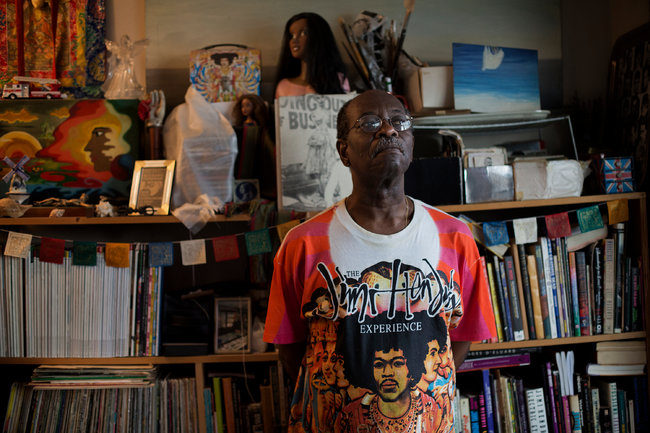
Photo: Victor J. Blue for the NY Times
“There’s a saying: ‘Everybody writes poems at 15; real poets write them at 50,’ ” said Rafael Leonardo Black, who draws miniature figures.
Read Full Post »

No one needs to be told that art is healing. I find it can cheer me up when I’m just having a bad day. I even tell coworkers who are stressed out, “Go over to Fort Point and look at some art.”

But for those who care more about data than folk wisdom, there is research.

Genevra Pittman writes at Pacific Standard, “Music, art, and dance therapy may relieve anxiety and similar symptoms among people with cancer, according to a new analysis of past studies.

“Researchers who analyzed results from trials conducted between 1989 and 2011 said the benefits tied to creative arts therapies were small, but similar to those of other complementary techniques such as yoga and acupuncture. …

“The analysis included 27 studies of close to 1,600 people who were randomly assigned to receive some form of creative arts therapy or not, during or after cancer treatment. Patients with breast cancer or blood cancers—such as leukemia and lymphoma—made up the majority of study participants. Music, art, and dance therapy programs varied in how often sessions were conducted and over what time span. …

“On the whole, people with cancer who were assigned to creative arts treatments reported less depression, anxiety, and pain and a better quality of life during the programs than those who were put on a wait list or continued receiving usual care.” More.

I didn’t get into art therapy when I had cancer, but I’m sure I would have liked it. I did have a booklet created by past patients that contained daily readings, and more often than not the choices hit the spot. The patients named the booklet “No Other Way but Through.”

Photo: Memorial Sloan-Kettering Cancer Center
Art therapy program

Read Full Post »

There’s an in-demand artist who goes to Wal-mart to find subjects. His name is Brendan O’Connell. Maria Godoy writes about him at National Public Radio.

“Most people would be hard-pressed to call Wal-Mart a source of artistic inspiration. … Yet that’s exactly what artist Brendan O’Connell sees in the sprawling big-box stores. For the past decade, O’Connell has been snapping photographs inside dozens of Wal-Marts. The images have served as inspiration for an ongoing series of paintings of everyday life — much of which involves shopping, which O’Connell calls ‘that great contemporary pastime.’ …

“Wal-Mart stores, he notes, are ‘probably one of the most trafficked interior spaces in the world.’ In the tall, open, cathedral-like ceilings of Wal-Mart’s big-box stores, he sees parallels to church interiors of old. …

“As artistic matter, [Wal-mart is] a part of everyday life that seems to have resonated with lots of people. Since [a February New Yorker profile began a] media blitz …  sales of O’Connell’s work have jumped dramatically, he told me [in April]. ‘I sold more in a week than I did in some years,’ he says. …

“The people doing the buying, he says, come from all over the country.

” ‘What I’m struck by is this relationship to brands,’ he says, noting that buyers have called to inquire about specific paintings: ‘ “Do you still have the Corn Flakes? … I want the Maxwell House.” Whatever brand it is that they have a personal relationship with. And that, to me, is fascinating.’ ”


“O’Connell’s work is probably out of the price range of the average Wal-Mart shopper,” adds Godoy. “But he’s passionate about a project to bring art to the masses. The idea behind everyartist.me is to create a collaborative art project involving 1 million elementary school kids across the country. And all the recent attention on his Wal-Mart series has helped jump-start funding for the project … he says.”

(Thank you, Andrew Sullivan, for the lead.)

Image: http://www.brendanoconnell.com
Blond with yams

Read Full Post »

Another good lead from the voracious reader of magazines in my household.

This Smithsonian story shows how a relatively simple invention made it possible for the Impressionists to do much more painting outdoors, en plein air.

Perry Hurt writes, “The French Impressionists disdained laborious academic sketches and tastefully muted paintings in favor of stunning colors and textures that conveyed the immediacy of life pulsating around them. Yet the breakthroughs of Monet, Pissarro, Renoir and others would not have been possible if it hadn’t been for an ingenious but little-known American portrait painter, John G. Rand.

“Like many artists, Rand, a Charleston native living in London in 1841, struggled to keep his oil paints from drying out before he could use them. At the time, the best paint storage was a pig’s bladder sealed with string; an artist would prick the bladder with a tack to get at the paint. But there was no way to completely plug the hole afterward. And bladders didn’t travel well, frequently bursting open.

“Rand’s brush with greatness came in the form of a revolutionary invention: the paint tube. Made from tin and sealed with a screw cap, Rand’s collapsible tube gave paint a long shelf life, didn’t leak and could be repeatedly opened and closed.

“The eminently portable paint tube was slow to be accepted by many French artists (it added considerably to the price of paint), but when it caught on it was exactly what the Impressionists needed to abet their escape from the confines of the studio, to take their inspiration directly from the world around them and commit it to canvas, particularly the effect of natural light.

“For the first time in history, it was practical to produce a finished oil painting on-site, whether in a garden, a café or in the countryside.” More.

Dear artist friends, I can picture what it would have been like for you traveling by train after an outing to some scenic spot before this invention. “Oh, Madame, I am so terribly sorry. I’m afraid my cobalt pig’s bladder burst!”

Photo: Chrysler Museum of Art
The tin tube, below, was more resilient than its predecessor (the pig bladder), enabling painters to leave their studios.

Read Full Post »

You may get a kick out of this BBC story on the intersection of art and engineering.

“Artist Daan Roosegaarde has teamed up with Hans Goris, a manager at a Dutch civil engineering firm with hopes of reinventing highways all over the world.

“They are working on designs that will change with the weather — telling drivers if it’s icy or wet by using high-tech paint that lights up in different temperatures.

“Another of their ideas is to create a road that charges up electric cars as they drive along it.

“Daan Roosegarde said: ‘I was completely amazed that we somehow spend billions on the design of cars but somehow the roads … are still stuck in the Middle Ages.’

“In the past he has designed a dance floor with built-in disco lights powered by dancers’ foot movements.

“They plan to trial their specially designed glow-in-the-dark paint on a strip of road at Brabant, which is near the Dutch border with Belgium, later this year.”

Read more.

Photo of a glow-in-the-dark road: Roosegarde

Read Full Post »

The 13th Fort Point Artwalk was 4 to 7 today. (Saturday and Sunday, the Artwalk will be 12 to 5.)

We got started a little late because we had dinner first at Trade, but we definitely enjoyed what we had time to see.

The Boston Design Museum at the corner of Melcher and A streets had art made of moss in frames that caught my eye. We also liked seeing the models for the Street Seats contest that I blogged about a while back.

Across the way, Ari Hauben’s show was energetic and amusing. Hauben teaches art to kids with special needs in Boston, and he has strong feelings about the country’s current emphasis on standardized tests — especially for the student population he knows best.

He and an optical-engineer friend from Rochester, NY, acquired 50 Melcher Street, and for the current show, Hauben papered the floor with standardized tests. He put up large, green chalk boards with pedagogical insights and opportunities for guest commentary.

And he was eager to explain just how he creates the current works from Instagrams sent him by friends. The website says,  “His style could be defined as blending pop and street art techniques into mixed media works. The process predominantly involves newspaper, epoxy, spray paint, and layering techniques that are integrated into a variety of visual platforms.”

The prices are indicated by grades: A, B, C, D, F. I especially liked a picture of weathered yellow sheds and the work called Peach Farm, below. Lots more variety, here.

WCVB’s Chronicle interviewed Hauben here.

Art: Peach Farm by Ari Hauben

Read Full Post »

Author-illustrator Jarrett Krosoczka knows the power of a kind word. He found his calling largely because of two words from a children’s book author who visited his elementary school class.

And he got through a difficult childhood nourished on the kindness of strangers, including lunch ladies, an unjustly maligned species he has honored in a superhero series. (“Serving justice! And serving lunch!)

Linda Matchan has a lovely story at the Boston Globe about Krosoczka.  (I want to call your attention to how nicely she describes him, here: “with impossibly spiky hair that looks as though he penciled it in himself.”)

“Until recently,” writes Matchan, “Krosoczka was very guarded about his childhood. That changed last October when he got a call from the organizer of a TEDx program at Hampshire College, modeled after the TED Talks series. …

“Scrambling for a topic, his wife urged him to talk candidly about his childhood. With no time to come up with other options, he delivered a moving talk about his early years and the people who inspired and encouraged him. The talk caught the attention of the TED editorial team, which featured it in January on TED.com.

“He spoke in his talk about his mother — ‘the most talented artist I knew’ — who was addicted to heroin and often incarcerated. ‘When your parent is a drug addict it’s kind of like Charlie Brown trying to kick the football … Every time you open your heart, you end up on your back.’ …

“Third grade was the year something ‘monumental’ happened. Children’s book author Jack Gantos came to his school to talk about what he did for a living. He wandered into the classroom where Krosoczka was drawing, stopped at Krosoczka’s desk and studied his picture.

“ ‘Nice cat,’ Gantos said.

“ ‘Two words,’ said Krosoczka, ‘that made a colossal difference in my life.’ ”

More.

Photo: Bill Greene
Jarrett Krosoczka declared May 3 (his favorite lunch lady’s birthday) “School Lunch Superhero Day.”

Author-illustrator Jarrett Krosoczka knows the power of a kind word. He found his calling largely because of two words from a children’s book author who visited his elementary school class.
And he got through a difficult childhood nourished on the kindness of strangers, including lunch ladies, an unjustly maligned species he has honored in a superhero series. (“Serving justice! And serving lunch!)
Linda Matchan has a lovely story at the Boston Globe about Krosoczka.  (I want to call your attention to how nicely she describes him, here: “with impossibly spiky hair that looks as though he penciled it in himself.”)
“Until recently,” writes Matchan, “Krosoczka was very guarded about his childhood. That changed last October when he got a call from the organizer of a TEDx program at Hampshire College, modeled after the TED Talks series. …
“Scrambling for a topic, his wife urged him to talk candidly about his childhood. With no time to come up with other options, he delivered a moving talk about his early years and the people who inspired and encouraged him. The talk caught the attention of the TED editorial team, which featured it in January on TED.com.
“He spoke in his talk about his mother — ‘the most talented artist I knew’ — who was addicted to heroin and often incarcerated. ‘When your parent is a drug addict it’s kind of like Charlie Brown trying to kick the football … Every time you open your heart, you end up on your back.’ …
“Third grade was the year something ‘monumental’ happened. Children’s book author Jack Gantos came to his school to talk about what he did for a living. He wandered into the classroom where Krosoczka was drawing, stopped at Krosoczka’s desk and studied his picture.
“ ‘Nice cat,’ Gantos said.
“ ‘Two words,’ said Krosoczka, ‘that made a colossal difference in my life.’ ”

Read Full Post »

Photo: Getty Images

I have been as keen as anyone to talk about the arts in terms of their economic contributions to communities. (You have to defend the arts in the language people understand.) But in the end, a focus on economic return is limiting. There are other values on the spectrum from “art for art’s sake” to “art for the economy’s sake.”

How about art for wonder’s sake, joy’s sake, self-expression’s sake, mystery’s sake — for the sake of just seeing what comes out and where it leads?

Over in Scotland, Tiffany Jenkins of The Scotsman is having a fit about Maria Miller, the Scottish Secretary of State for Culture, Media and Sport (Sport?!), who expressed her own take on the arts in a recent speech.

Says Jenkins, “The speech began with the right noises – ‘culture educates, entertains and it enriches’ – but quickly took a wrong turn, concentrating on what culture can ‘deliver,’ specifically for the economy, using sentences such as: ‘It allows us to build international relationships, forging a foundation for the trade deals of tomorrow.’ ”

Uh-oh.

“It matters,” writes Jenkins, “because of what happened with the funding body Creative Scotland, where there was a major negative reaction … in part due to an agenda that instructed the arts to be about the economy …

“To her credit Fiona Hyslop, Cabinet secretary for culture and external affairs for Scotland, was reported on Twitter responding to Miller’s speech stating: ‘The Scottish Government does not see arts and culture as a commodity.’ …

“That the arts are central to the economy is not an isolated idea, or a new one. … [But] it is a philistine approach that misses the value and point of culture. It is true that the Edinburgh festivals, for example, bring a strong financial return. … But even in this case, the financial return is not the best thing about the festivals – or why people come back every year to perform or to watch. They do it because they love it, enjoy it and are driven to participate in something meaningful. …

“Let us not forget the economic climate in which the Arts Council was established. This was a period in the 1940s, after a devastating war, when Britain was in a dire financial situation. The funding body was set up not to use the arts to get the country out of the economic crisis, in the blunt instrumental terms they are discussed today, but to stimulate ‘the best’ work.

“Economist John Maynard Keynes, the council’s first chairman, wanted to bring forth a ‘creative renaissance’ that was artist led, and acted at ‘arm’s length’ from the government, a vision that I would have no trouble with if it were realized today.” But it isn’t, complains Jenkins. Many of her concerns are pretty universal.  More.

It’s an argument we will never hear the end of, having been debated in every generation. I am coming down firmly on the side of “yes, and…”

In other words, the arts can be great for the economy, but that is just the tiniest part of why they are great.

Read Full Post »

Photo: Cassandra Giraldo / Wall Street Journal
Slow Art Day host Phil Terry, center, points to El Anatsui’s installation ‘Gli (Wall).’

Thank you, Anna, for pointing out reporter Rebecca Bratburd’s cool story in the Wall Street Journal.

“If art-museum crowds appeared to be moving at snail speed on Saturday,” writes Bratburd, “it’s because they were celebrating Slow Art Day, during which participants in 274 museums around the world got a new, slower perspective on enjoying art.

“Inspired by the experience of gazing at Hans Hofmann’s ‘Fantasia’ and Jackson Pollock’s ‘Convergence’ for hours, Phil Terry launched the art appreciation day in 2010. …

“Mr. Terry, CEO of the New York City-based consulting firm Creative Good, noticed that no one had planned to host an event at Brooklyn Museum this year, so he did the honors. On Saturday, he handed instruction sheets to each of the 35 or so participants. They included straightforward tips, including but not limited to: “Look closely. Back up. There is no wrong way.’ …

“The group then set off at a turtle’s pace to meditate on five of the museum’s roughly 1.5 million works: El Anatsui’s ‘Gli (Wall),’ ‘Waste Paper Bags’ and ‘Peak’; Valerie Hegarty’s ‘Fallen Bierstadt’; and an untitled work by Richard Pousette-Dart. …

“Part of the point is to counteract the rapid pace of modern life, as much as the often overwhelming museum routine, said another participant, Sam Davol, a musician in the band the Magnetic Fields. ‘I felt like I was in slow motion and everyone was whizzing by,’ he said. ‘I began to become self-conscious about it, like a guard would think it was weird that I was standing there for so long.’ …

“Elizabeth Ferguson … said her smartphone complicated matters. ‘I wanted to focus on the piece of art in front of me, but in the midst of it I was getting texts, I wanted to Instagram it, check in on Foursquare and tag #SlowArtDay,’ she said.”

Read more — and try moving slower in your next museum, too.

Read Full Post »

I’m so glad Kai put this on Facebook. He linked to photos of beautiful places. But at Bored Panda you can also find a bird that looks like Salvador Dali, a dad who illustrates his kids’ lunch bags every day with cute cartoons. and a do-it-yourself Porsche made of plastic pipes and aluminum foil. Or you can watch a video of an astronaut crying in weightless space.

I thought, “What the heck?”

Here’s a bit of explanation from the About page.

Boredpanda.com is a highly visual art and design magazine dedicated to showcasing the world’s most creative artworks, offbeat products and everything that’s really weird or wonderful. …

“We got popular among pandas in a very short time, and now we have an average readership of 1 million unique visitors per month generating ~2 million of page impressions. Most of them come from USA, UK and CANADA .

“So, if you have a story, a product or some weird artworks that are cool enough for pandas – it is a perfect opportunity for you to get noticed. Click here and share it with everyone else!” More.

I myself am going to read up on Thomas Lamadieu. “Every time he looks up, Thomas sees a potential canvas where the building rooftops frame the sky. He photographs it and uses the odd sky shapes to create whimsical line drawings.”

Here are two of those beautiful places I mentioned.

Photo: Allard Schager
Tulip fields, the Netherlands

Photo: Oleg Gordienko
Tunnel of Love, Ukraine

Read Full Post »

I liked this story by Penny Schwartz from the Sunday Globe. It’s about the painstaking work of restoring a magnificent synagogue built in the 17th and 18th centuries and destroyed by the Nazis in WW II.

“For the last 10 years, Laura and Rick Brown have been immersed in the art and architecture of Poland’s historic Gwozdziec synagogue. …

“Now, after a decade of research and building small-scale models, the Browns and their international team of 300 carpenters, artists, and students have created a nearly full-scale replica of the the triple-tiered roof and intricately painted ceiling and cupola of the Gwozdziec synagogue, considered one of the most magnificent, well-documented of the wooden synagogues of the era. …

“ ‘They really have done something miraculous,’ said Barbara Kirshenblatt-Gimblett, professor of performance studies at New York University’s Tisch School of the Arts, who was tapped to lead the museum’s exhibit development team. …

“The Browns’ approach to building, using traditional tools and techniques dating back to the time the synagogue was built, offered something beyond having a copy of the synagogue roof built as a prop, Kirshenblatt-Gimblett said. …

“Both sculptors, the Browns came to the Gwozdziec project as founders and directors of Handshouse Studio, an educational nonprofit in Norwell [Massachusetts] that replicates historic objects using authentic methods. …

“Looking back on the journey, Laura and Rick say they are humbled by the hundreds of people, including many MassArt students and graduates, who have given so much time to this project.

“They are grateful to MassArt for allowing them the flexibility to create courses designed for the project including a series of Lost Historic Paintings’ classes analyzing and replicating quarter-scale, then half-scale models of the Gwozdziec synagogue ceiling panels.

“The 85 percent scale replica represents more than the grandeur of a long ago synagogue, Laura said. ‘This object speaks to a very painful history that is still very alive,’ she said.” More.

Photo: Jonathan Wiggs/Globe Staff
Artist Rick and Laura Brown at their studio in Hanover, Massachusetts.

Read Full Post »

Check out Big, Red & Shiny, “a non-profit arts organization and online art journal [set up to] commission and publish articles, essays and reviews that explore the theory, history and reception of art in its current conditions.”

A tweet sent me to BR&S, where I learned about a special art installation that was hung in the MassArt courtyard on Tuesday.

Stephanie Cardon of BR&S writes, “This is the story of how one student’s year long effort has brought solace and joy to a community when it is most needed. In spite of the crystalline air and brilliant sunshine, Tuesday morning was dark for Bostonians near and far. … Yet, serendipitously, it was on this day that Leah Medin poured a sheet of gold, soft as a caress and reaffirming as a cheer, onto many wounded hearts.

“Her gesture was simple, but took months of planning and painstaking work. While carefully conceived, her sculpture unintentionally came to represent the soaring expression of spirit many of us so desperately needed to find that very day.

“I met with Medin to talk about the timely unfurling of her piece, The Gold Divide, in MassArt‘s central courtyard. For those who witnessed it, the hushed voices spoke of awe and wonder and hope. I was curious to hear how the sculpture had come about, and how its transformation into a symbol affected her.

” ‘What happened Tuesday was everything I wasn’t expecting,’ she said about the overwhelming public response. After all, Medin had been planning this piece for over a year. It all started during her junior year abroad in Amsterdam, where she would ride her bike all around the city. As she biked, she took in the sun and the air.

“The fabric — 440 yards of gold crystal nylon organza stitched in 57 foot long panels — was inspired by these outings, by the sense of freedom and exhilaration they contained, by the light.  …

“On the day of the Boston Marathon, Leah Medin was still hard at work in an empty school, putting the finishing touches on the cloth, reinforcing its seams. When she heard what had happened off campus, while she was quietly and solitarily working to meet her deadline, she had a moment of doubt. ‘I called my mom. I wasn’t sure I should stick with it. She told me that now more than ever it was important to bring something beautiful to people.’

” ‘I’ve been waiting for this for a long time. Then, all of a sudden, there were all these eyes on it. On my baby! It was touching the surface and reaching inside the buildings, caressing the people, running along the ground.’ …

” ‘A lot of people have come up to me and said thank you. I don’t even know many of them. We give each other hugs.’ ” More.

See more of Leah’s work at leahmedin.com

Read Full Post »

I like street art and have blogged about it a lot (for example,  Slinkachu, Banksy, Egypt, Os Gemeos). It’s an expression of freedom, so even when it has a serious side, it is cheering.

I’m glad to learn about Street Art Utopia, an amazing site for browsing.

It’s not clear to me how you post something there. Although I see it has the supposed Banksy painting I photographed in Boston a while back, it’s not my picture. If you figure out how to participate at Street Art Utopia, let me know.

Thanks for the tip, Andrew Sullivan.

Photo: Flickr user ajhaysom
Street art by Adnate in Fitzroy, Melbourne, Australia


Read Full Post »

In addition to poetry, art often brings comfort. (Artists don’t usually want to make anyone “comfortable,” which has a different connotation.)

One reason art brings comfort is that creativity generates surprises, and surprises may bring delight.

So although I’m still preoccupied with Boston, I’ll leave Boston for today and write about Cleveland.

Thank you, Mary Ann, for pointing to the Gwarlingo blog, which recently said of the art scene in Cleveland,”prepare to be surprised.”

Blogger Michelle Aldredge writes in part, “It is possible to experience the best of Cleveland culture entirely on foot. …

“According to Ann Craddock Albano, the director of The Sculpture Center in Cleveland, the 550-acre area that encompasses the Cleveland Museum of Art, the Cleveland Botanical Garden, the Museum of Contemporary Art, the Cleveland Symphony, the Cleveland Institute of Art, the Cleveland Cinematheque, Cleveland Institute of Music, and numerous university and medical facilities is the most concentrated neighborhood of world-class cultural institutions in the country. …

“The latest jewel in the Circle’s crown is Farshid Moussavi’s new building for the Museum of Contemporary Art. MOCA is Moussavi’s first museum design, and also the first American project by the Iranian architect, whose firm, Farshid Moussavi Architecture, is based in London.

“A few blocks away from MOCA, at Case Western Reserve University’s Weatherhead School of Management building, silver planes slice through red brick like paper in a windstorm. While Frank Gehry opted for flamboyance, Moussavi wisely chose a simpler, less ostentatious design for MOCA—one that is unique and engages the surrounding neighborhood.” More.

BTW, I wouldn’t mind hearing what other folks do for comfort.

Photo: Michelle Aldredge
The zigzagging stairwell is the most eye-catching feature inside the new MOCA Cleveland

Read Full Post »

Anna%20Ancher.%20%22Breakfast%20before%20the%20hunt%2C%22%201903.%20On%20view%20at%20the%20%22A%20World%20Apart%3A%20Anna%20Ancher%20and%20the%20Skagen%20Art%20Colony%22%20exhibit%20at%20the%20National%20Museum%20of%20Women%20in%20the%20Arts.%20%28Courtesy%20Skagens%20Museum/%29

Anna Ancher painting from the Skagens Museum: “Breakfast before the hunt,” 1903.

Kristina often gives me her Women in the Arts magazine after she’s done with it. This time I was particularly taken with a story on a show in Washington called “A World Apart: Anna Ancher and the Skagen Art Colony.”

DeNeen L. Brown writes that among the 64 paintings and oil sketches, the depiction of light is breathtaking.

She says, “At its height in the 1880s and ’90s, Denmark’s Skagen Art Colony attracted dozens of artists who were drawn to the isolated fishing village by the light and the unspoiled land- and seascapes.

“While the exhibition focuses on Ancher, the most prominent woman, it also includes works by her husband, Michael Ancher, as well as Laurits Tuxen, Viggo Johansen, Christian Krohg, Oscar Bjorck, Holger Drachmann, Carl Locher and P.S. Kroyer, whose large-scale oil paintings capture the ‘heroic’ life of fishermen in Skagen. …

“Ancher, who was the only native of Skagen among the artists in the colony, became an icon in Denmark not only for her art but for breaking social boundaries. She was a wife and mother who painted at a time when most women abandoned work after they married and had children. She also painted during an era when women were prohibited from studying at the Royal Danish Academy of Fine Arts. …

“The Skagen colony artists became known as part of the modern breakthrough movement, shrugging off the academic tradition of neoclassical painting styles preferred at the Academy of Fine Arts in Copenhagen and building on realist, naturalist and impressionist movements to depict everyday life and everyday people in an unidealized way.” More.

In case you should be in Washington in the next few weeks, the show runs through May 12 at the National Museum of Women in the Arts.

Read Full Post »

« Newer Posts - Older Posts »