Feeds:
Posts
Comments

Posts Tagged ‘art’

Candy creates interactive street art. Her “Before I Die” wall garnered a lot of attention — and contributors. Folks wanted more.

So she decided to create a website explaining in detail how others could replicate the wall.

Here she tells how it all started: “It’s easy to get caught up in the day-to-day and forget what really matters to you. After I lost someone I loved very much, I thought about death a lot. This helped clarify my life, the people I want to be with, and the things I want to do, but I struggled to maintain perspective. I wondered if other people felt the same way. So with help from old and new friends, I painted the side of an abandoned house in my neighborhood in New Orleans with chalkboard paint and stenciled it with a grid of the sentence “Before I die I want to _______.” Anyone walking by could pick up a piece of chalk, reflect on their lives, and share their personal aspirations in public space.

“It was an experiment and I didn’t know what to expect. By the next day, the wall was bursting with handwritten responses and it kept growing: Before I die I want to… sing for millions, hold her one more time, eat a salad with an alien, see my daughter graduate, abandon all insecurities, plant a tree, straddle the International Date Line, be completely myself…  People’s responses made me laugh out loud and they made me tear up. They consoled me during my toughest times. I understood my neighbors in new and enlightening ways.”

Candy’s how-to page reads, in part, “Once you’ve created a wall, you can share your wall here by creating a mini-site! A mini-site is a page where you can post photos and responses and document the story of your wall. It’s super easy to use, absolutely free, and no technical skills are required. Visit the Budapest mini-site to see an example.”

Everything you need if you’re going to create a “Before I Die” wall is here.

Photo: Before I Die

Read Full Post »

You may recall a past post about the Greenway mural by Os Gemeos, Brazilian twins who had a show at the Institute of Contemporary Art and painted street art around Boston when they were here. I posted pictures of their work-in-progress for the Greenway, here.

Geoff Hargadon photographed the finished work for the Boston Globe, below.

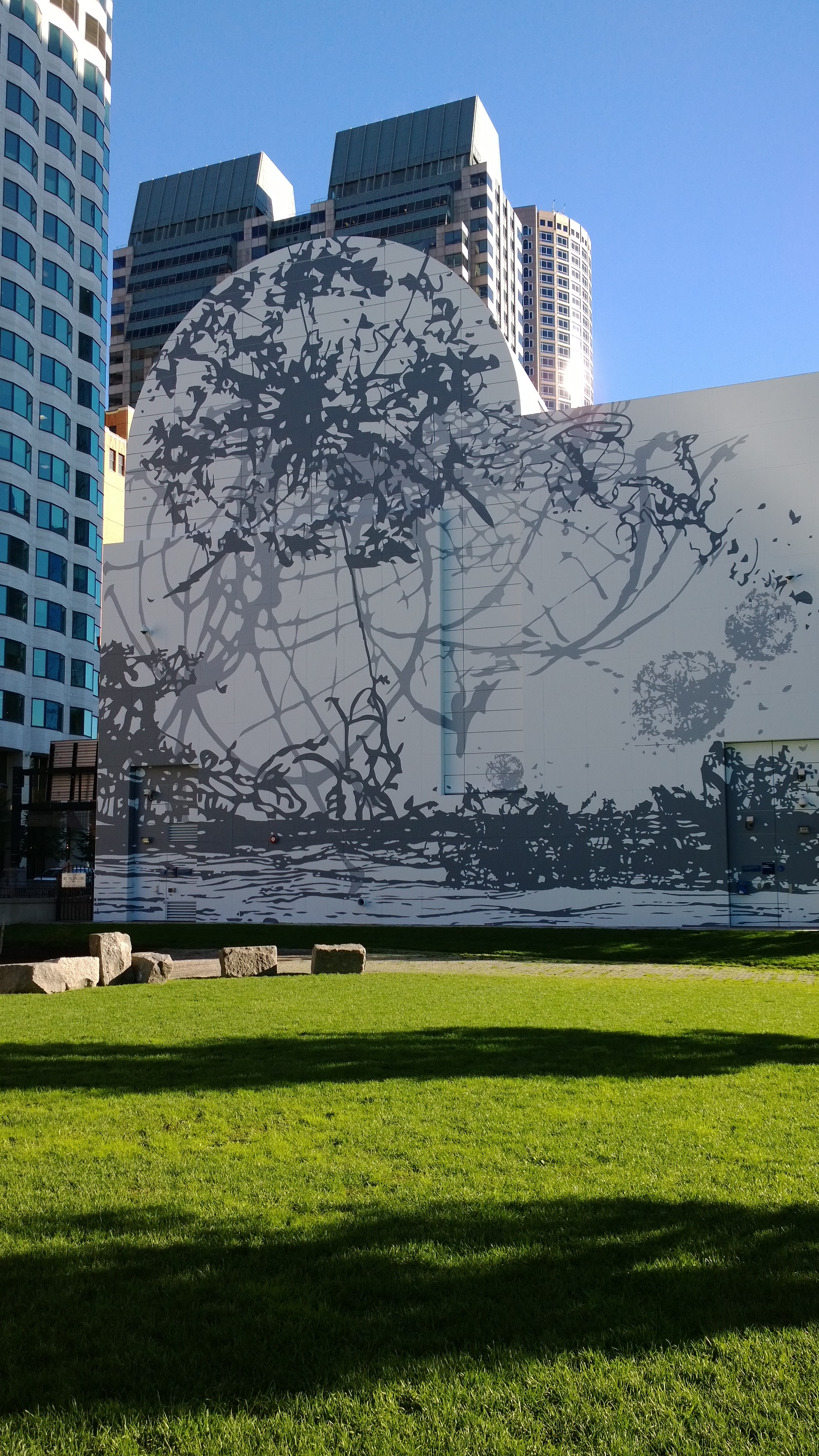
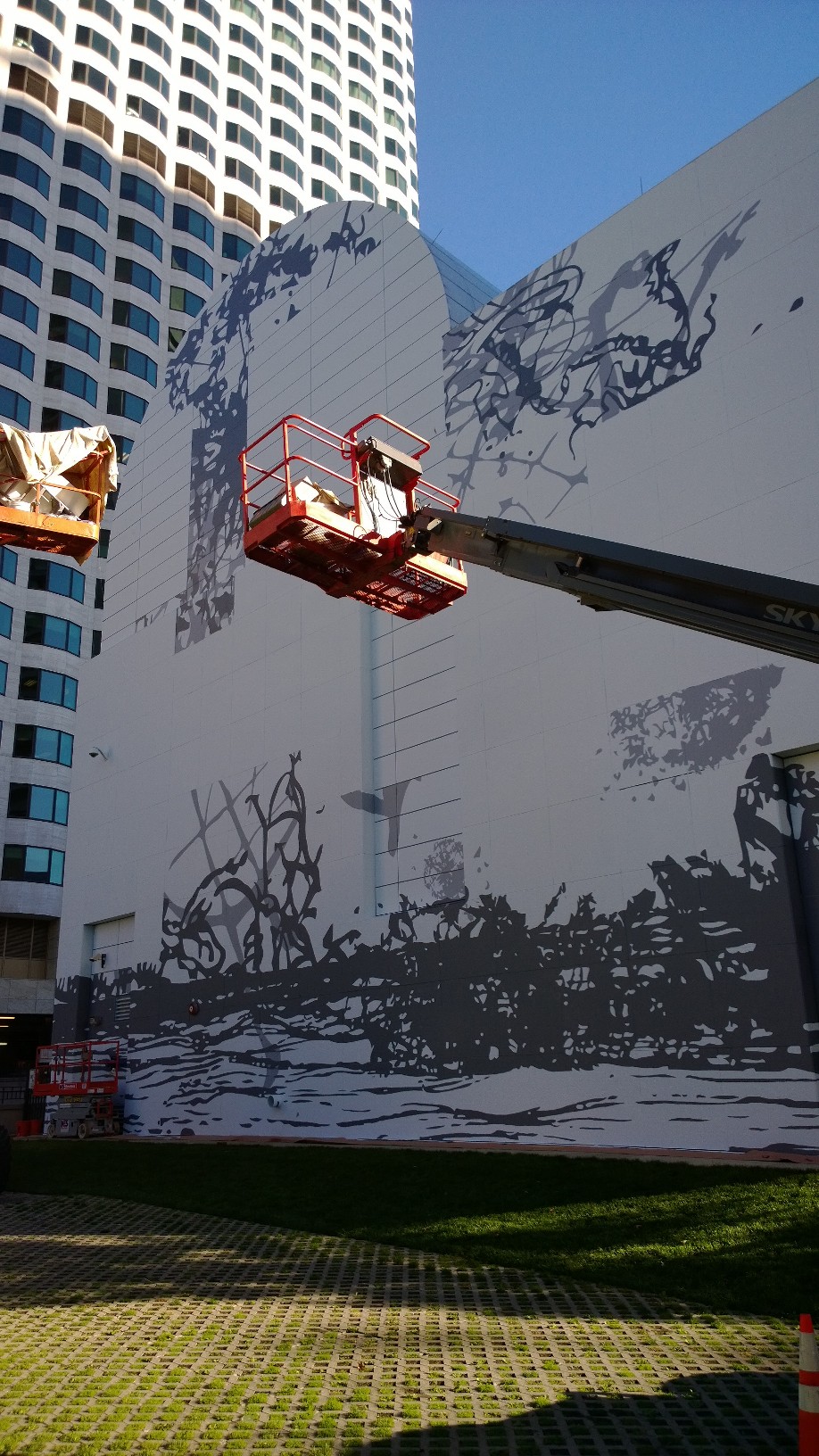
That giant mural is gone now, and Matthew Ritchie is working on the next one. I took a picture of it today and plan to take more for the blog as Ritchie wraps up.

Geoff Edgers at the Globe gives some background on this new piece. “The Institute of Contemporary Art has commissioned British-born Matthew Ritchie, known for using scientific principles to inspire his work, to take over the enormous outdoor canvas.

“Ritchie’s 5,000-square-foot seascape will be installed the week of Sept. 16 and remain up for as long as 18 months.

“The collaboration … is part of a residency for Ritchie that will include a multimedia performance with members of the rock bands The Breeders and The National, concerts at the museum and elsewhere, and a video project to be produced with the ICA’s teen program. But the biggest splash for the public will come on the exterior of the Big Dig ventilation building in Dewey Square.”

Read more at the Globe, here, and at the Greenway site, here.

Photo: Suzanne’s Mom

Matthew-Ritchie-Greenway-art

Read Full Post »

If you saw a sign in a museum saying that the suggested entry fee for students was $8, would you ask if you could pay $2? Would you even ask what the sign meant?

Museums may be taking too much for granted about what people know.

All summer, after classes, Chanel Baldwin hung out in the lobby of the Brooklyn Museum for the air-conditioning. She didn’t understand that the $8 “suggested” student admission was merely suggested. So she got to know intimately the only painting that was in the lobby, and she thought about what was meant by the details surrounding the black man on the horse in “Napoleon Leading the Army Over the Alps,” by Kehinde Wiley.

One day when her cousin was cooling in the lobby with Chanel, NY Times reporter Anand Giridharadas showed up, explaining that they could go through the entrance gate without paying. “No donation today, thank you,” Giridharadas said to the cousins’ astonishment.

“The gates parted,” writes the reporter. “We received green tags to prove our bona fides. … The first room set [Chanel] alight and held her rapt until she had to leave. There was no label too tedious to read, no piece undeserving of her scrutiny. …

“ ‘Look at the detail on it,’ she said of a Fred Wilson mirror, gasping.

“A piece called ‘Avarice,’ by Fernando Mastrangelo, gripped Ms. Baldwin. It appeared from afar like a classic Aztec sun stone. But she got up close. Traced her fingers over it. Went to one side, looked at it; went to the other side, considered it that way. She noticed that the piece was made of corn, and then detected a toothpaste tube, soda bottles and cowboy hats lurking on the surface, all crackling with meaning.

“Watching her,” says Giridharadas, “I realized how the inadvertent exclusion from these rooms must have trained her eyes. … New York is run on the kinds of understandings that kept the cousins in the lobby, with so many places formally open to anyone but protected in their exclusivity by invisible psychic gates.

“Ms. Baldwin suggested a more honest approach, since people tend to think you have to pay: ‘They should just put a sign out telling us that it’s somewhat free.’ ” More here.

Suzanne’s Mom admits that she might not have known the secret code either. But then, she always had the $8.

Photo: Karsten Moran for The New York Times
Chanel Baldwin exploring the Brooklyn Museum after learning that “suggested” when admission fees are “suggested,” that could mean free.

Read Full Post »

Cultural institutions are getting smaller. And more local.

We wrote about a library in a phone booth here and the Little Free Library here. You can see fully realized short films on YouTube and street art just around the corner.

Now folks in Somerville have launched a museum in a doorway. It’s The Mµseum.

From the website: “Judith Klausner (Co-Founder, Curator) is a Somerville MA artist with a love for small, intricate, and overlooked things. She first dreamed up the Mµseum in 2010, as a way to combine her love of  serious miniature art with her passion for making art accessible, and her conviction that New England arts institutions should show the work of New England artists. Three years (and a lot of planning) later, she is delighted to see it become a reality. … Contact Judith at judith@themicromuseum.com.

“Steve Pomeroy (Co-Founder, Engineer) is a programmer and a builder, both by profession and by nature. He’s largely responsible for the engineering behind the Mµseum, from the solar-powered miniature track lighting to the 3D-printed doric columns and laser-cut façade typography. He formally studied computer science at the Rochester Institute of Technology where he discovered a love of communication protocols and formal computer languages. Contact Steve at steve@themicromuseum.com.”

WBUR had a story on the micro museum here.

There is something childlike and innocent about miniature enterprises. Didn’t you always think as a child you could take a few toys and tea cups and bags of flour and new sponges from around the house and set up a table on the street as an authentic store? You thought, Why not? Just do it.

I get a kick out of people just doing it.

Photo: Mara Brod, http://marabrod.com/fineart.html

Read Full Post »

Did you like last week’s entry on stained glass windows that produce solar energy? Well, there’s more.

Kristine Lofgren writes at Inhabitat about an amazing solar chandelier.

“British artist Luke Jerram is known for his stunning art installations, which are often inspired by science. His latest project, unveiled [last year] at the Bristol and Bath Science Park, is the world’s largest solar chandelier! The 16.5-foot-tall chandelier is made of 665 glass bulbs that spin when exposed to light …

“The chandelier was created using glass radiometers rather than traditional light bulbs. As the sun hits each radiometer, it begins to turn, speeding up and slowing down as the light changes. The overall effect is a shimmering, gently moving piece of artwork. At night, it is lit up using electric light.” More.

By the way, Inhabitat also features a piece on a sculptural sound chamber that sings when the wind blows, here.

Read Full Post »

And speaking of payment systems, community-supported agriculture has been around for years and, more recently, community-supported art. I blogged about the approach here in 2011, when the Cambridge Center for the Arts embraced the concept.

The NY Times has written about it, too. Randy Kennedy lays out the principles: “For years, Barbara Johnstone, a professor of linguistics at Carnegie Mellon University [in Pittsburgh], bought shares in a C.S.A. — a community-supported agriculture program — and picked up her occasional bags of tubers or tomatoes or whatever the member farms were harvesting.

“Her farm shares eventually lapsed. (‘Too much kale,’ she said.) But on a recent summer evening, she showed up at a C.S.A. pickup location downtown and walked out carrying a brown paper bag filled with a completely different kind of produce. …

“ ‘It’s kind of like Christmas in the middle of July,’ said Ms. Johnstone, who had just gone through her bag to see what her $350 share had bought. The answer was a Surrealistic aluminum sculpture (of a pig’s jawbone, by William Kofmehl III), a print (a deadpan image appropriated from a lawn-care book, by Kim Beck) and a ceramic piece (partly about slavery, by Alexi Morrissey).

“Without even having to change the abbreviation, the C.S.A. idea has fully made the leap from agriculture to art. After the first program started four years ago in Minnesota … community-supported art programs are popping up all over the country …

“The art programs are designed to be self-supporting: Money from shares is used to pay the artists, who are usually chosen by a jury, to produce a small work in an edition of 50 or however many shares have been sold.”

Read all about it, here. Could be risky if you really don’t want a sculpture of a pig’s jawbone. But if you look at it as supporting the arts, you are likely to be satisfied with that side of things — and there’s always a chance you will love what you get or find its value increase.

Photo: Zoe Prinds-Flash
Drew Peterson’s prints and Liz Miller’s collages were among the art for members of this C.S.A., community-supported art, in Minnesota.

Read Full Post »

Oh, boy, what a cool site! Modern Hieroglyphics started following me after my last Banksy post, so I clicked and took a look at his site. It’s all about street art. I especially loved this post on “reverse graffiti.”

Says Modern Hieroglyphics, “Paul Curtis (Moose) uses a powerwasher to remove dirt and grime off of walls, resulting in the creation of stunning images and patterns. The new art form is known as ‘reverse graffiti’ or ‘clean tagging,’ and is growing in popularity all over the world. This is the story of Moose. …

” ‘I became an artist by accident really, I was promoting music that my label was releasing by using reverse graffiti. I created it for that purpose, then I would do large pieces for fun or like a strange hobby, then people started to ask me to work for them… and the Internet happened and I became notorious. …

” ‘I discovered reverse graffiti one day when I was a teenager working as a dishwasher in a restaurant. I aimlessly wandered out of the kitchen one day to just be in the restaurant section. I’d cleaned everything I could in the kitchen, and felt like I owned the place. So when I saw a small mark on the wall, I reached for the my cloth and wiped it off, only to find that in the process of wiping the mark off the wall, I made a much bigger mark by cleaning the original mark with the cloth.

” ‘In those days people smoked freely in establishments and the wall was brown with nicotine. I had always thought that the wall was painted that color, and now this almost-white cleaning stripe was shining out of the wall like I had a tin of white spray paint and started to write. It was quite a shock for me, and I spent a long time trying to rectify what looked like damage but was only cleaning.

” ‘Years later, while gazing out of the window on a bus, I saw that in the road tunnels in Leeds, these clean marks appeared everywhere, drunks sliding home along the tiled walls left long streaks that looked like chrome in the car lights. Later on, I finally did something with that observation.’ ”

More samples of Moose’s art are at Modern Hieroglyphics.

Art by Paul Curtis (Moose), creator of reverse graffiti

Read Full Post »

Artist Sarah Hall is killing two birds with one stone. Or solving two challenges with one creation. According to Canadian Public Broadcasting, Hall has made stained glass windows that can convert the sun’s rays into energy for the building the stained glass embellishes.

Emily Chung writes, “Lux Gloria by Sarah Hall, at the Cathedral of the Holy Family in Saskatoon, is currently being connected to Saskatoon Light & Power’s electrical distribution network, confirmed Jim Nakoneshny, facilities manager at the cathedral.

“The artwork, which consists of solar panels embedded in brightly coloured, hand-painted art glass, had just been reinstalled and upgraded after breaking and falling into the church last year.

“Once it is connected, the cathedral will be able to use the solar power produced by the art installation to offset its own power consumption from the regular grid, Nakoneshny added.

“According to Kevin Hudson, manager of metering and sustainable electricity for Saskatoon Light & Power, the solar panels are expected to produce about 2,500 kilowatt hours annually or about a third to a quarter of the 8,000 to 10,000 kilowatt hours consumed by a typical home in Saskatoon each year.”

Read all about it at the CBC, here.

Photo: Sarah Hall on Popsci.com website
Lux Gloria: The solar-stained glass installment features dichroic glass and will be connected to the electrical grid in Saskatoon, Saskatechewan.

Read Full Post »

Cate McQuaid, my favorite Boston Globe art critic, who usually covers more esoteric subjects, explains some large artsy globes seen around Boston in recent days.

“Huge, colorful orbs line up in a row down the Tremont Street side of Boston Common. It looks like a giant might be marshaling his marbles. Get up close, and you’ll see that the spheres, each 5 feet in diameter, are globes, fancifully decorated and proffering solutions to climate change.

“ ‘Cool Globes: Hot Ideas for a Cooler Planet’ has landed in Boston. The public art project, for which artists designed globes with green strategies to contend with environmental issues, originated in Chicago in 2007 and has traveled the world.”

Environmental activist Wendy Abrams, says McQuaid, is the initiative’s founder.

“Abrams cites two inspirations for the project, the wrecked cars that Mothers Against Drunk Driving pointedly deploy in their Crash Car Program, and the painted cow sculptures that showed up in the streets of Chicago in 1999 — a public art project that prompted Boston to follow suit with painted cod.”

Read about individual artists’ Cool Globe themes, the outreach to students, and more, here.

The first two photos below are near the Park Street subway station. The third is in front of the aquarium, and I am not sure if it is part of the traveling series.

cool-globes-boston

globes-for-a-coller-planet

globe-at-aquarium

Read Full Post »

Photo: Getty Popperfoto
L.S. Lowry, (pictured in 1957), the artist from Manchester, is the subject of a major new show at the Tate Britain gallery.

Some years ago when my husband was in England on business, he acquired a print of workers coming and going outside a factory. The original was by L.S. Lowry, whose paintings of industrial Britain turn out to be very popular in the UK.

Popularity, however, is not a ticket to being shown at the Tate Britain. Belatedly, Lowry will receive a retrospective in 2014.

Oliver Wainwright at the Daily Mail writes, “Clouds of smoke belch from forests of chimneys, while armies of spidery figures scuttle to and fro between narrow terrace houses and imposing factory gates.

“Crowds of fans shiver on the edge of a football field, a fist-fight breaks out, and barefoot children tease a stray cat on the street corner.

“These are the scenes depicted in the haunting paintings of L.S. Lowry who, more than any other artist, managed to capture the strange, bleak beauty of daily life in northern industrial towns.

“His dream-like images captured the popular imagination, adorning chocolate boxes and biscuit tins, tea towels and jigsaws.

“Yet they are scarcely to be found on the walls of our major national galleries. The Tate owns 23 of his works, but has only ever exhibited one on its walls in the past 20 years — and then only briefly. …

“Why has it taken so long?

” ‘He’s a victim of his own fan base,’ said Chris Stephens, Tate Britain’s Head of Displays. ‘What makes Lowry so popular is the same thing which stops him being the subject of serious critical attention. What attracts so many is a sort of sentimentality about him.’

“This is a strangely inverted piece of art world logic,” Wainwright comments, “where the popularity of an artist is seen as an obstacle to showing their work.”

If you’re an artist, be careful to stay off “chocolate boxes and biscuit tins, tea towels and jigsaws” — or wait to be discovered by art experts of a future generation.

More here and here.

 © The estate of L.S. Lowry
L.S. Lowry, Coming out of School, 1927

Read Full Post »

Suzanne is in Denmark at the moment and sent me a website for something unusual she saw there: a modern Stonehenge.

“The idea of creating The DODECALITH arose in 2006 when the composer Gunner M. Pedersen saw sculptor Thomas Kadziola’s land art project Anemarken (Ancestors’ field) … on the island of Lolland.

“The composer suggested that he and the sculptor create a Stonehenge on Lolland, consisting of a circle of twelve huge menhirs with heads in the open countryside.”

The creators write, “On a hill overlooking the sea, we are creating a singing monument … that will give everyone from near and far an experience of greatness, closeness and beauty, of time’s migrations and settlements. It will express pride and humbleness, times gone by, the present, and, importantly, time coming. …

“The stone figures will stand on invisible foundations and they will sing!
Under a circle of natural sitting stones, a 12 channel sound system will be installed. This system will allow spatial electro acoustic song and music specially created for The DODECALITH to sound inside the circle at intervals every day, all year round. …

“The ancestors [came] from afar, from the land to the south where the waters rose 7,500 years ago and sent the Lolers on their long journey. … Along the coast from Ravnsholt to Ravnsby alone, over 70 burial mounds have survived, several of which are passage graves. … There are now only four mounds … It is here we are re-erecting the Ring of the Lolers, The DODECALITH, to let the new Lolers ancestors sing.” More.

Read Full Post »

Along the Greenway, there is a changing array of public art. This photographic display was borrowed from New York City. The themes are Home, Streets, Creatures, Play, and People. The artists are all topnotch, but the location — set way back from the sidewalk and alongside a superhighway — makes me think that not many people are going to take a good look at it.

Ilona Szwarc entered this one in People/Rodeo Girls.

The artist says, “Rodeo Girls is an ongoing portrait project about young girls from Texas who compete in rodeos. These individuals have a fundamentally different idea about their femininity and a contrasting attitude towards gender roles. … They grow up according to a male archetype and I am examining how their lives and identities are shaped by their surroundings. The photographs celebrate the beauty of the terrain and the idiosyncrasies of this old fashioned American tradition, which is recently vanishing.”

The Fence is “a summer-long, outdoor photographic exhibition that explores the essence of community across cultural boundaries and geographical lines. The Fence is a site-specific exhibition stretching over 1000ft in length, culled from a call for submissions; we asked our community of photographers across the globe to respond to the question – ‘what makes up a community?’ ” More at the project’s website, here.

Read Full Post »

There is always so much to share from Andrew Sullivan’s site.  In a recent entry he pointed to a book called The Art Instinct, by Denis Dutton.

“Micah Mattix reviews

“The first feature of our inclination toward art is that we seem to have a universal love of landscape paintings — and not just any landscape, but landscapes similar to those our ancestors would have encountered on the African savanna. A central pillar of evidence for his argument is a 1993 study commissioned by Russian painters Vitaly Komar and Alexander Melamid that surveyed people from ten diverse countries and found a surprising number of consistent aesthetic preferences. …

“Dutton suggests that this seemingly universal preference for paintings depicting open spaces, trees, water, and animals is related to our ancestors’ search for food and safety. Such landscapes would have presented opportunities for cultivation; and the presence of water and climbable clusters of trees — which could have served as lodgings for game and provided safety from predators — would have been preferred by hunter-gatherers to either a dark forest or desolate plains.” More.

Evolutionary psychology often seems like a stretch, but it’s fun to think about. I do like landscapes.  I also like abstraction. In any case, I’m sure my ancient Picts and Celts ancestors, if such they were, would have liked the 19th century painting Andrew picked to go with his entry.

Who can resist a Turner?

Image: Petworth Park: Tillington Church in the Distance, J. M. W. Turner, c. 1830, via Wikimedia Commons


Read Full Post »

Most street artists don’t think in terms of permanent museum collections. They don’t expect their work to be admired forever. Still, it must be a little sad to see it torn down.

Meghan alerted me, by way of twitter, to the demise of Boston’s only graffiti park, Bartlett Yard, about to be demolished.  Dig has the story.

“Rosa Parks, Mr. Miyagi, and the Incredible Hulk gaze down from the wall, their faces nearly big enough to drive a bus through. A giraffe in a space helmet floats carelessly through the light purple cosmos,” writes Dan Schneider at Dig.

“This barely begins to cover the intricate murals found at the Bartlett Yard, an 8.6-acre parcel of land just blocks away from Dudley Square in Roxbury, formerly used as a bus garage by the MBTA. Since the beginning of the year, the property’s owners have allowed an event planning group called Bartlett Events to turn half of the property into a community art space.

“In May, Bartlett Events held Mural Fest, an open call for graffiti muralists, which drew an estimated 1,000 artists and community members together in a frenzy of aerosol, transforming the Yard from a 125-year-old dilapidated bus garage into the massive public art installation.

“If you want to take in the art at Bartlett Yard, however, you’d better do it soon.

“Come this November it’ll all be torn down to begin construction of Bartlett Place, a mixed-use development of housing with—in all likelihood—no graffiti. …

“The Bartlett Bus Yard has been out of commission since the late nineties, following a community-led effort to shut it down due to concerns about bus exhaust contributing to high rates of childhood asthma in the area. Since then the Yard has been abandoned …

“With a few weekends’ worth of hard work, however, several dozen volunteers were able to clean out most of the Yard’s two main buildings and surrounding blacktop prior to opening day.”

Residents express mixed feelings about the redevelopment, which some fear could lead to the dreaded gentrification and push out lower-income people. Others think it will be good to have more variety.

In any case, it sounds like the artists want to stay around even if the art is  ephemeral.

For Jason Turgeon,  an environmental scientist and one of the founders of Bartlett Events, “the notion of trying to create a permanent graffiti museum would simply miss the point.

“ ‘I come from the Burning Man world, so I know that art doesn’t have to be here forever. Some people say, “You have to save this!” And I say “No, it’s okay. There will be more art after this.” ‘ ”

Read more at Dig.

Photo: DigBoston.com

Read Full Post »

I continue to be a fan of street art and the way it allows informal artists to express themselves while also letting passersby enjoy both homespun and professional achievements as they go about their errands.

In Rhode Island, there’s a painted rock. Everyone paints it, and no painting lasts for long. In the summer, paintings wishing someone happy birthday may last only a few hours, as mine did one Birthday Week when Suzanne turned 16 and John turned 21. (They didn’t wake up in time to see it.)

There has also been some amazing work by experts on that rock, too, but it gets respect for only a couple days. It’s essential to capture it with a camera.

Yesterday I passed along an idea to a gallery owner that she liked. How about painting the painted rock to look like a rock!? Crazy, huh? She may do it, too. She has a painting of rocks in the current show that she could replicate. She knows she’d have to take a photograph, though, or the rock might be painted over before anyone sees it.

Meanwhile, here’s a nice story about street art in the Bushwick section of Brooklyn.

Amy O’Leary writes at the NY Times, “Growing up, Joseph Ficalora would sit on the roof of his family’s steel fabrication business. In Bushwick, Brooklyn, in the 1980s, it was one of the few safe places outdoors. The view was grim. The streets were dirty. Graffiti was endless. …

“Most people want to hold onto their past as it was, but Mr. Ficalora has found greater comfort in obliterating it, bathing the neighborhood in paint.

“Today the rooftop of [his] family business, GCM Steel, offers an eye-popping panorama of street art. More than 50 multicolored murals have transformed a swath of nearby buildings into a vast outdoor gallery called the Bushwick Collective, anchored at the intersection of Troutman Street and St. Nicholas Avenue.” More.

Photo: Victor J. Blue for The New York Times
Gaia, well-known among street artists, paints — legally — on a building in Bushwick, Brooklyn.

Read Full Post »

« Newer Posts - Older Posts »