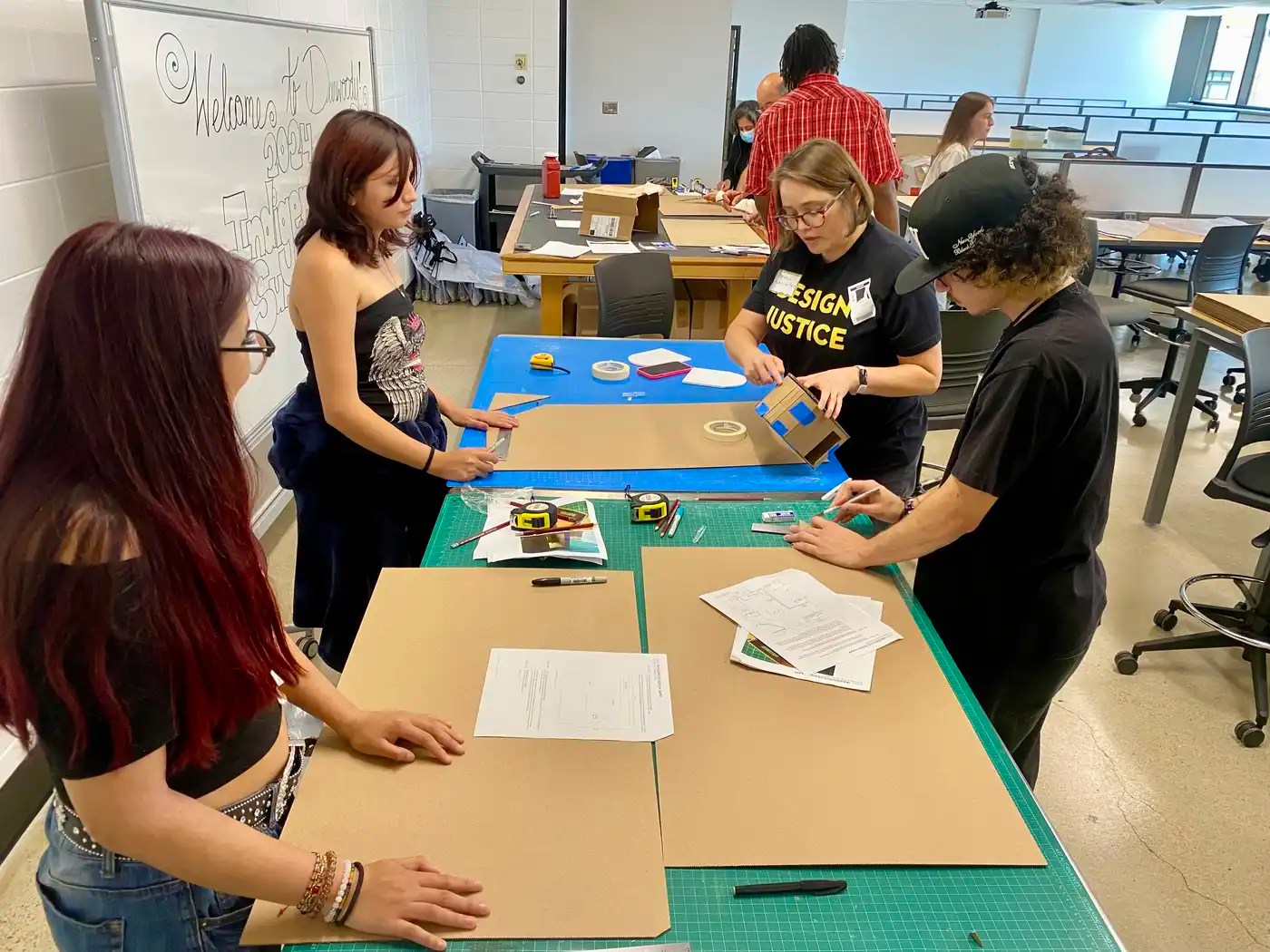
Photo: Alex V. Cipolle.
University of Minnesota architecture professor Jessica Garcia Fritz teaches Indigenous Design Camp campers cardboard scoring techniques on day one.
It seems like every year, the first question on the first day of school is, “What did you do over the summer?” This past summer, if you were an indigenous teen in the Twin Cities of Minnesota, you might have had some new experiences to report.
In July, Alex V. Cipolle at Minnesota Public Radio wrote about an unusual class at the Dunwoody College of Technology.
“A group of teens cuts cardboard with X-ACTO Knives. They will soon shape this cardboard into architectural models of their bedrooms. …
“ ‘It’s my first time doing something in architectural-related study,’ says Dominic Stewart of Burnsville.
“ ‘I’m excited to get that hands-on experience,’ says Carsyn Johnson of Elk River.
“They are here for the weeklong Indigenous Design Camp, the first camp of its kind in the U.S. The goal is to teach Indigenous teens about career options in architecture and design, a field where Native Americans are underrepresented.
“Two of the founders of the new camp — architects and friends Mike Laverdure and Sam Olbekson — estimate that there are only about 30 Indigenous architects total in the U.S.
“Laverdure is an enrolled member of the Turtle Mountain Band of Chippewa and a partner at DSGW Architects as well as the president of First American Design Studio. Olbekson is a citizen of the White Earth Nation and founded the firm Full Circle Indigenous Planning and Design. They are the only two practicing Native architects in Minnesota.
“ ‘The need for creating a space for kids to become designers, Indigenous designers, is great,’ says Laverdure, who has wanted to start this camp for years. ‘Representation matters for these kids to see us as architects and designers. A lot of us who grew up in reservations or urban Indigenous communities only see a few career types.’ …
“The campers are Indigenous teens ages 14-18 from the metro area. They will be constructing architectural models all week. Campers will also tour the University of Minnesota School of Architecture and local architecture firms.
“They will also visit the American Indian Cultural Corridor on Franklin Avenue, where both Laverdure and Olbekson have designed buildings, as well as another Olbekson project, the recently completed expansion of the Red Lake Nation College downtown.
“Olbekson says, ‘to actually go and see [the buildings] and see the impact that they’re having on the community, not only as individual buildings, but how they’re forming an identity for the American Indian Cultural Corridor and how these projects are supporting education, economic development, community building, cultural development, and youth and elder spaces, I think is going to be a great way for them to understand the impact of what design, urban design, interiors, landscape, can have on creating a healthy, Indigenous urban community.’
“The camp began [with] a welcome from Laverdure, Olbekson and University of Minnesota assistant architecture professor Jessica Garcia Fritz, a citizen of the Cheyenne River Sioux Tribe. Fritz also helped start the camp.
“ ‘If you think about your home reservations, or your urban communities, you think about all the buildings that are there,’ Laverdure told the class, ‘Ninety-nine percent of all the buildings built that Indigenous people sit in are not designed by indigenous designers. … When you have Indigenous designers be a part of that process, what happens is that those buildings have a special kind of connection to the communities and that makes those buildings extra special.’
“Next came a presentation on Indigenous architecture, past and present, by Tammy Eagle Bull, who did a video call from her home in Arizona. Eagle Bull is a member of the Oglala Lakota Nation of Pine Ridge, South Dakota. In 1994, she became the first Native woman in the U.S. to become a licensed architect. …
“For the remainder of the first day of camp, Jessica Garcia Fritz guided campers in a design exercise to create their sleep space or bedroom.
“First, they taped 10 by 10-foot squares on the classroom floor to help them visualize the scale. Then they sketched blueprints of their bedrooms. Finally, they cut and scored cardboard to build shoebox-size models. …
“ ‘One of the things Tammy Eagle Bull had said this morning was, “I wish that a camp like this had existed when I was young.” I think that’s the sentiment among many of us,’ Garcia Fritz says. …
“Garcia Fritz, Laverdure and Olbekson hope this camp is the first of many. One of the goals is to expand the camp to greater Minnesota.
“ ‘Right now, it’s in the Twin Cities, but there are so many Indigenous communities regionally, up north and even in other states that could really benefit from this,’ Olbekson says.
“ ‘Long term, we want to create a space where five to 10 years from now, we’ve got 10, 15, 20, Native designers that are out there and being a force for change,’ Laverdure says.”
More at MPR News, here.



 Suzanne's Mom's Blog