Feeds:
Posts
Comments

Posts Tagged ‘climate change’

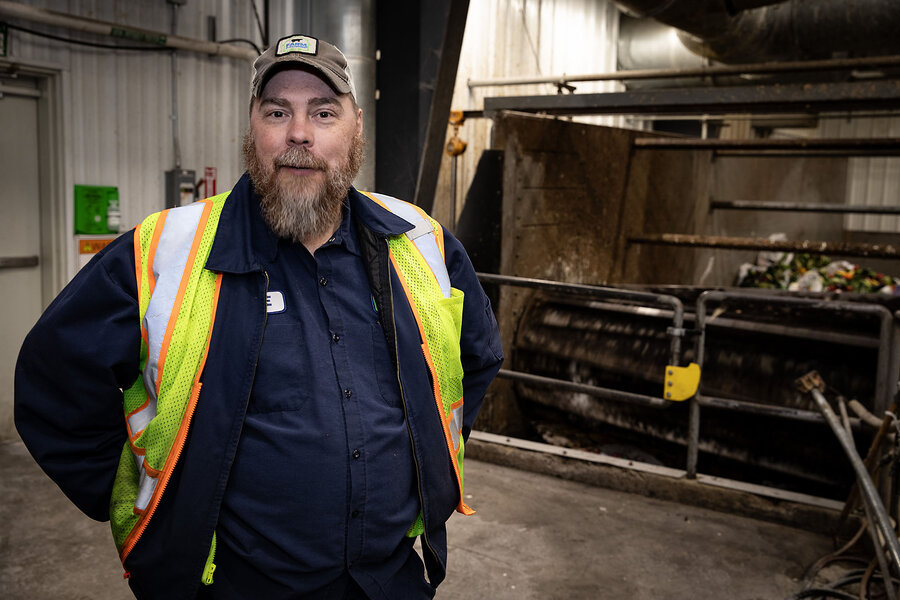
Photo: Melanie Stetson Freeman/CSM.
Abe Marciniec is the site manager of Vanguard Renewables, an organics recycling facility in Agawam, Massachusetts. It processes food waste from supermarkets, distribution centers, universities, and residential drop-offs, turning it to fuel.

Today’s story about Massachusetts being the only state to reduce food waste would seem to be a triumph, and in terms of intentions, it is. But I am ambivalent about the value of turning food waste into gas. Methane, after all, is one of the worst. See what you think.

Troy Aidan Sambajon reports at the Christian Science Monitor, “On a recent Thursday, Abe Marciniec unloads two dozen pallets of ice cream – enough to fill 31 refrigerators – into a machine that transforms it into fuel.

“Today’s flavor is room-temperature rocky road, but this facility handles all kinds of food waste from supermarkets, distribution centers, universities, and even residential drop-offs.

“ ‘We get everything you can find in Aisles 1 through 12,’ says Mr. Marciniec, site manager of the Agawam Organics Recycling Facility, owned and operated by Vanguard Renewables. Mr. Marciniec’s recycling facility is one of six in the commonwealth and only one of 25 nationwide.

“As the expired ice cream funnels into a turbo separator, Mr. Marciniec watches the machine strip food from its packaging. The organic waste is then trucked to a dairy farm, where it’s mixed with cow manure and processed into renewable natural gas.

“ ‘It’s really a great circle,’ says Mr. Marciniec. ‘Food starts at the farm, and our farms turn it back into energy. Farm to table, then back to farm.’ …

“Facilities like this one, which can process up to 250 tons of food waste daily, replace manual work typically done by hand or not done at all. That’s a crucial step in diverting waste away from landfills. Americans throw out about 40% of food annually – a waste of both money and natural resources. Reducing food waste can increase food security, promote resource and energy conservation, and address climate change.

“The Bay Sate has become a leader in reducing food waste. In fact, it’s the only state to significantly do so – to the tune of 13.2% – according to a 2024 study. Massachusetts was among the first five states to enact a food waste ban in 2014. (The others were California, Connecticut, Rhode Island, and Vermont.)

“ ‘The law has worked really well in Massachusetts,’ says Robert Sanders, an assistant professor of marketing and analytics at the University of California San Diego and co-author of the study. ‘That’s due to three things: affordability, simplicity, and enforcement.’

“[Food waste is] the largest category of waste – at 25% – sent to landfills in the United States. In 2019, 66 million tons of food waste came from retail, food service, and households. Around 60% of this waste was sent to landfills, according to the Environmental Protection Agency.

“Vanguard Renewables specializes in turning organic waste into renewable energy. The Massachusetts-based company partners with dairy farms to convert food scraps and manure into biogas through anaerobic digestion.

Microorganisms in cow manure digest organic matter, releasing biogas – a mix of methane and carbon dioxide. 

“The gas is captured in large steel vats on the farm and refined into renewable natural gas, which can be used to heat homes and power buildings. … Since 2014, Vanguard has processed more than 887,000 tons of food waste in New England, producing enough natural gas to heat 20,000 homes for a year. By 2028, the company plans to have more than 50 systems across the country.

“In western Massachusetts, Amherst College has become a model for limiting food waste at the source. Last year, it was recognized as the winner in the zero waste category in the Campus Race to Zero Waste Case Study Competition.

“ ‘The goal has been to push us aggressively to make sure everything is compostable,’ says Weston Dripps, director of sustainability. To achieve that, the school has phased out single-use plastics, to-go boxes, and even canned water, replacing them with refill stations and compostable materials.

“In 2023, Amherst College generated 238 tons of food waste – roughly 4 to 5 tons per week. But instead of ending up in landfills, Vanguard collected 100% of that waste and processed it at its Agawam facility.

“That total includes both pre-consumer waste – such as kitchen scraps from food prep – and postconsumer waste, like leftovers scraped off plates in the dining hall and campus cafés. ‘To really have a clean waste stream, we have to focus on the front end,’ says Mr. Dripps.

“Amherst’s approach goes beyond composting. Each month, the school donates 2,000 to 3,000 pounds of frozen surplus food to the the Food Bank of Western Massachusetts, ensuring edible food reaches those in need.

“Commercial businesses, too, are finding ways to cut down on waste. Maura Duggan, founder and CEO of Fancypants Baking Co., knows firsthand how much food can go to waste in the food industry. Her company produces hundreds of thousands of cookies each week.

“At its Walpole facility, Fancypants has large totes from Vanguard, which collect burnt cookies, food scraps, and anything that can’t be donated or sold. Last year alone, Fancypants diverted about 22 tons of waste. …

“Back in Agawam, Mr. Marciniec passes by 275-gallon totes full of leafy vegetables. Every day, he faces the reality that Americans waste 92 billion pounds of food a year – enough to make 145 million meals.

“ ‘It really makes you think about the things we take for granted,’ he reflects.

“ ‘Millions of people are starving everywhere, and the amount of food waste in this country is substantial,’ says Mr. Marciniec. ‘I’m sure we can do a better job.’ ”

Although I hate to quibble with this effort to at least do something, I know that enforcement has not reached my residential facility yet. Moreover, I’m pretty sure what we really need is not to have so much waste in the first place. What do you think? Is this a good first step?

Note Earle’s comment on my earlier post about this process, here.

More at the Monitor, here.

Read Full Post »

Photo: Vishal Subramanyan/California Academy of Sciences.
“High up in the Sierra Nevada,” writes the Smithsonian, “the tiny Mount Lyell shrew has been shying away from cameras since it was first identified almost 100 years ago. Then three undergraduates hit the jackpot.

I’m not sure if I regard today’s update as more about a threatened mammal or about achieving something important when you’re still an undergraduate.

Here are two takes on the story of a rarely studied shrew that is threatened by climate change. First, an interview at National Public Radio (NPR).

“Juana Summers, Host
“For more than 100 years, scientists have known about a shrew living in the mountains around Yosemite National Park. California designated it a ‘species of special concern,’ but nobody had seen it.

“Vishal Subramanyan
“There’s never actually been even a confirmed sighting of the shrew alive, just because they’re almost always found dead.

“Sacha Pfeiffer, Host
“Vishal Subramanyan is a wildlife photographer and a recent graduate of the University of California, Berkeley. Back in the fall, he and two other undergraduate student researchers, Harper Forbes and Prakrit Jain, decided to find a Mount Lyell shrew. … So they set off into the Sierra Nevada mountains with a lot of plastic cups to set traps in the ground to try to catch this elusive creature.

“Prakrit Jain
“Shrews are quite fast and not very personable, at least at first. They’re always running away. If you try to pick them up, sometimes they might try to bite.

“Summers
“Prakrit Jain is still a student at Berkeley, and he says, before you can even think about the taming of the shrew, you’ve first got to catch one alive. …

“Pfeiffer
“Once you catch one, you have to act quickly because this shrew has a very fast metabolism. That means if they don’t eat every few hours, they can die in the traps.

“Subramanyan
“It was pretty much just go, go, go, and we never really slept for more than two hours at a time. And throughout the course of the three nights and four days, we probably never slept for more than eight hours ’cause we were just constantly trapping, photographing, then trapping again.

“Summers
“Their traps caught a lot of shrews — several different species, actually — but the researchers suspected that at least five of them were the ones they were actually looking for.

“Pfeiffer
“This month, genetic testing confirmed that these undergraduate students had indeed taken the first known photographs of the Mount Lyell shrew.

“Summers
“It may seem like a lot of work to snap a photo, but Subramanyan says it’s actually really important for the world to see these furry little animals. He points to studies that show how other small mammals in the region are at risk with their habitat rapidly warming. And this shrew and its long snout help put a face to the impacts of climate change on biodiversity.

“Subramanyan
“A majority of species that are disappearing aren’t these, you know, traditionally charismatic species you hear about like lions and wolves. But it’s often these smaller, often overlooked animals that are disappearing completely under the radar with no public awareness or attention.

“Pfeiffer
“These researchers say that they dream of exploring far off and distant places. But they realize that the breakthrough they made in what was already a well-studied part of the world shows there’s still a lot to learn closer to home.”

At the Smithsonian there’s a roundup of other interviews.

“Subramanyan, who graduated from the University of California, Berkeley, last year, is a wildlife photographer. Jain and Forbes, undergraduate students at UC Berkeley and the University of Arizona, respectively, made headlines in 2022 for discovering two new scorpion species. After receiving permits from California’s Department of Fish and Wildlife, the trio headed to the Eastern Sierra. They set up 150 pitfall traps near stream and wetland habitats and checked in on them every two hours. …

“They got set up, then they waited.

“ ‘I would love to say we spent three days waiting, and the shrew finally appeared at the last second,’ says Subramanyan to Astrid Kane at the San Francisco Standard. ‘But we got the Mount Lyell within the first two hours.’

“ ‘It just shows that it’s generally an underappreciated species in an underappreciated ecosystem, that people haven’t spent the time and been able to actually bring dedicated focus to the shrews,’ he adds to Issy Ronald at CNN.

“To photograph the shrews, the team had to work quickly. They continued to trap more of the animals, following their planned sleep schedule during the nights, when temperatures dropped to 15 degrees Fahrenheit. The researchers set up a white background and a terrarium for the imaging. ‘You trap some shrews, you photograph them, you release them, and by that time there are more shrews. So it was pretty nonstop,’ Subramanyan says to SFGATE’s Timothy Karoff.

“The animals run around a lot — and bite — making it especially hard to get good photos of them. ‘For every photo that we got in focus, we must have 10 or 20 photos where the shrew is running out of the frame,’ says Jain to Sabrina Imbler at Defector.

‘The students hope their work will increase public recognition for shrews and other less charismatic animals. ‘Many, many species of shrew are known from only a single specimen, or only known from a single locality, or have not been seen in decades,’ says Jain to Katharine Gammon at the Guardian. ‘So if we struggle to find a shrew in a place like California — one of the best studied places in the world — you can only imagine how the shrew diversity of places like southeast Asia and central Africa, for instance, can just be so under-appreciated.’

“Mount Lyell shrews are also extremely threatened by climate change — 89 percent of the animal’s habitat is projected to be lost by the 2080s, according to a statement from the University of California, Berkeley. …

“ ‘If we look at the extinction crisis and the types of animals it’s impacting, a lot of animals are disappearing without any documentation,’ Subramanyan says to the Guardian. ‘An animal like the Mount Lyell shrew, if it was not photographed or researched, could have just quietly disappeared due to climate change, and we’d have no idea about it at all.’ ”

More at NPR, here., and at the Smithsonian, here.

Read Full Post »

Photo: Inside Climate News.
Children play with a water fountain at a park in flood-prone Hoboken, New Jersey. The playground doubles as storage for stormwater runoff.

Yay for humans who come up with ingenious ways to mitigate the effects of climate change! Here’a a clever idea from Hoboken, New Jersey.

Victoria St Martin reports at Inside Climate News (via the Guardian), “For a city that is almost small enough to fit inside Manhattan’s Central Park just a few miles away, a lot of history has played out within the narrow borders of Hoboken, New Jersey.

“It was the site of the first organized baseball game in 1846, home of one of the US’s first breweries in the 17th century and the place where Oreo cookies were first sold in 1912. And, as any Hobokenite will tell you, the Mile Square City, as it is called, is also known for something else.

“ ‘Everything floods up here,’ Maren Schmitt, 38, said with a nervous chuckle on a Tuesday afternoon as she watched her two boys climb at a city playground.

“Nearly four-fifths of the land area in Hoboken – which sits on the western banks of the Hudson River – rests on a flood plain. And its intense susceptibility to flooding has probably never been more apparent than it was during Hurricane Sandy in 2012, when 500m gallons of storm surge flooded the city.

“But now … Hoboken officials have put in place a series of measures designed to mitigate the destructive effects of storms that are driven by climate change, including one innovation that the city hopes may become known as another Hoboken first.

“Located at the corner of 12th and Madison streets, one of Hoboken’s newest playgrounds, known as ResilienCity Park, [is] doubling as a storage area for roughly 2m gallons of stormwater runoff. …

“The park, which sits on five acres barely a mile and a half from the Lincoln Tunnel into Manhattan, features swing sets, slides, a basketball court and an athletic field – and, underneath it all, a below-ground tank capable of holding hundreds of thousands of gallons of stormwater that city officials say would have otherwise spilled on to the streets or streamed into the basements of Hoboken homes and businesses.

“Building climate-resilient – or climate-smart – playgrounds is part of a growing movement among municipalities and environmental advocacy groups in the US. … The Trust for Public Land, a nonprofit conservation group, estimates it has helped fund the construction of more than 300 such play spaces in communities around the country, including Philadelphia, New York and Los Angeles. …

“Some spaces, like those in Hoboken, utilize an underground tank, porous artificial turf and scuppers or openings on a basketball court to store excess stormwater. Others increase resilience with newly planted trees that can absorb carbon dioxide and airborne pollutants; once they mature, those trees also provide shade cover that can reduce the heat island effect of urban areas, a problem intensified by the traditional black asphalt playgrounds commonplace generations ago. …

“ ‘Every geography is going to have slightly different stressors,’ [Daniella Hirschfeld, an assistant professor at Utah State University who studies environmental planning] said. ‘Hoboken is a place that used to be an island. And the amount of water that it needs to store is very different than where I am here in Utah. But ultimately, you know, places can perform both as a safe haven for stormwater and, hypothetically, can even be a safe haven for fire, which is another threat that we’re facing.’

“Caleb Stratton, Hoboken’s chief resilience officer, recalls how city officials asked him to lead the rebuilding and recovery efforts after Hurricane Sandy. The park, one of four planned resiliency sites in the city, was primarily paid for with infrastructure replacement grants, including roughly $10m from the Federal Emergency Management Agency. Stratton said a key element of the park’s design was its multipronged approach to flood mitigation.

“ ‘It’s a park, stormwater pumping station, the whole thing,’ Stratton said during an interview at the park while a cluster of summer campers squealed on a playset nearby. ‘This is all the strategies mixed up into one.’ …

“In addition to the underground stormwater detention tank, which holds 1m gallons of water, Stratton said above-ground infrastructure including rain gardens could hold a million more. An above-ground pump can also send water back into the Hudson.

“ ‘What we’re doing is creating places for the water to go so that we can manage it and keep it off the streets, keep it out of people’s buildings, and get prepared for the uncertain future, which we’re kind of experiencing in real time.’ …

” ‘They need more like this, for sure, so the kids can get outside,’ said Tyrik Davis, 26, a resident of nearby Fairview, New Jersey, who was visiting the park with his children, Naylani, six, and Tyrik Jr, three. ‘Especially this generation. There’s no more kids at the parks. They’re all inside with their phones.’ ”

More at the Guardian, here. No paywall.

Read Full Post »

Photo: Jenna Garrett/The Guardian.
Eric Haas in his backyard in Oakland, California. The California professor had a rainwater and greywater capture system installed at his highly efficient urban home to conserve water. 

I like reading about people who are handy at fixing or making things. Probably because I’m not. Other than sewing on a button or baking cookies, I don’t do much in the do-it-yourself line, but I know some of you do, and I’d love to hear about it.

Today’s article is part of a Guardian series on people who figure out ways to limit their impact on the environment. Sometimes that means working with companies specializing in sustainable building practices. Eric Haas told his story to Victoria Namkung.

“I joined the Peace Corps after college in 1985,” Haas explains, “and was a math and science teacher in Buchanan, Liberia. There, I started to realize that large parts of the world don’t live with all the energy consumption and materialism that we do in the US.

“I started seeing people’s innovative ways of keeping their houses warm or cool and how they would get their water. I had to carry my own water at times and be very conscious where it came from. These experiences started cementing this idea that life could take into account the environment you lived in.

Relatively simple ideas could make a huge difference in the comfort and quality of your house. You adapt and your lifestyle can adapt. …

“When our family settled in Oakland, California, in 2007, part of the decision in buying a house was whether it was somewhere I could finally focus on water conservation and other low-carbon-footprint projects like installing solar panels, insulation and high-efficiency appliances.

“I hired Dig Cooperative Inc, a local contractor known for pioneering water-conservation systems across the greater Bay Area, to install a rainwater and greywater collection system at our home. I have about 4,000 gallons of water I can collect, which translates to about 7inches of rain coming off the roof. Filtered rainwater is used to fill the toilets and washing machine and water most of our plants. It can also be saved on site for emergency use in case of a fire or an earthquake.

“The greywater system takes our ‘used’ shower, bathroom sink and washing machine water and diverts it to the backyard to water our vegetable gardens and six fruit trees. …

“During 2024, the typical household in our area used an average of 124 gallons of water a day. We used an average of 39 gallons of water a day, less than a third.

“It wasn’t hard and the whole project took about a week. Rain barrels needed to be purchased and set up and the ground had to be leveled. I have a relatively small and simple house and connecting the rainwater and greywater system into the existing plumbing just took a day or two.

“The whole project cost about $15,000. We still have a water bill because the shower, sink and dishwasher water use regular city water, but it’s a fraction of what it used to be. … Compared to the average water user, I save about $220 a year on my water bill. So, my rainwater and greywater systems do more for my local environment than they do for my wallet.

“Since moving to Oakland, I’ve noticed a lot of climate-related changes. Before, nobody had air-conditioning, and I never even thought about it. Now it’s almost a necessity on select days. When I first put in the system, there was enough rain periodically in California’s dry season to fill up the tanks enough that I never had to go back to city water for the first several years. Now it only lasts for about 10 months. The dry season is so dry and when we’ve got extra rain in the rainy season my tanks overflow and drain into the sewer because they’re full.

“We have to approach our water use differently in California. … Our overuse of water now impacts our quality of life. We have water-restriction days where they ask you not to use as much water, including not flushing our toilets every time, and we’re encouraged not to have a lawn. … You can still have a really nice garden. We have a hot tub, we have a regular shower, but because those things are connected into this larger system, we have a much smaller impact.

“I feel like I’m doing something real and concrete, and every time I hear the greywater pump go on or when I hear the pump from our rainwater system go on to fill up the washing machine or  toilet, that’s water that I’m not taking from the system and that matters.

“Every time it rains, I love to go out and look at the gutters and see how much it’s pouring into the system. It brings me joy to interact with the natural environment in this small way in my urban house.”

More at the Guardian, here. My DIY climate hack is a Guardian series about everyday people across the US using their own ingenuity to tackle the climate crisis in their neighborhoods, homes and backyards.

Read Full Post »

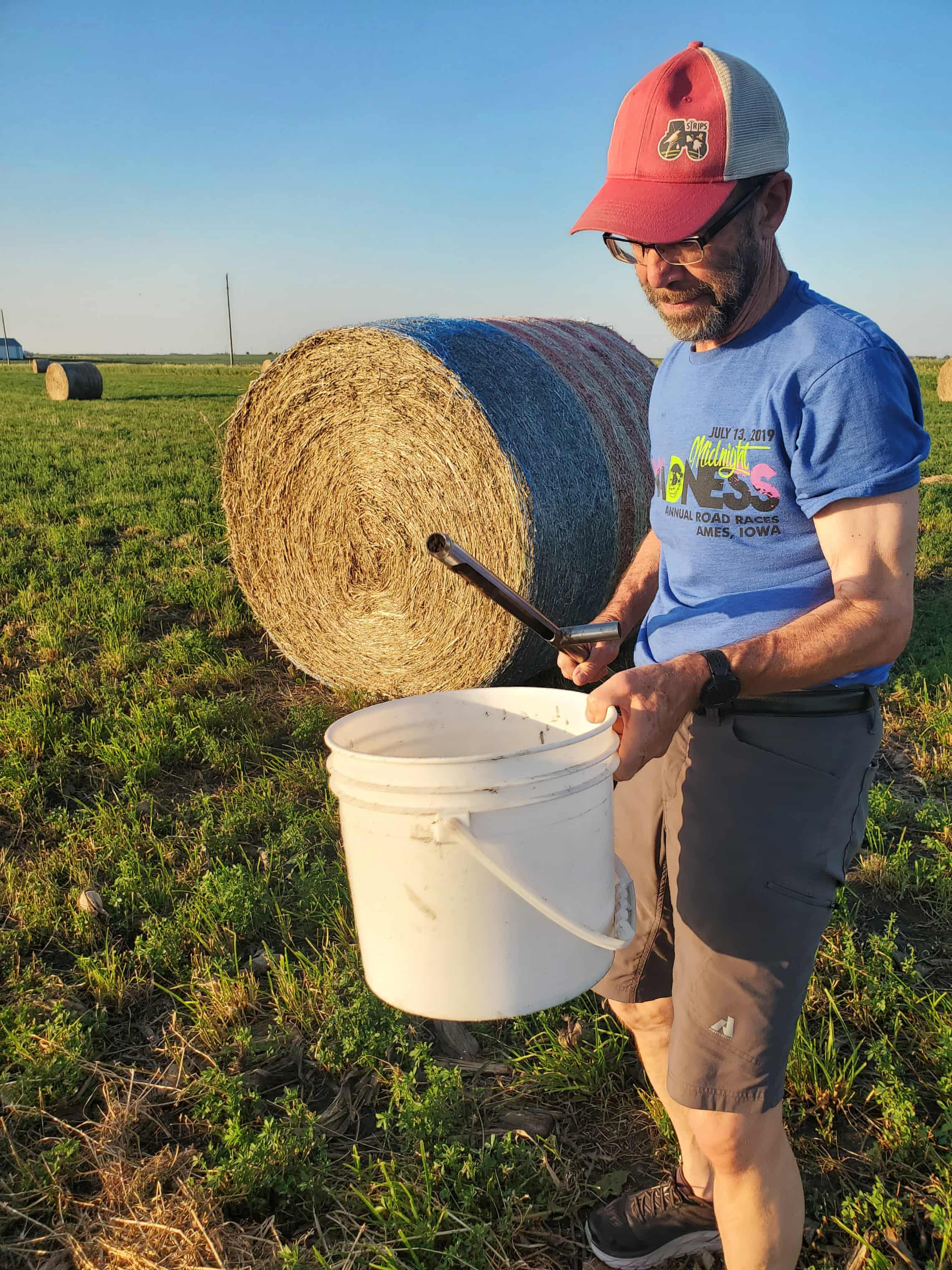
Photo: Lee Tesdell.
Behind farmer Lee Tesdell in the photo are rolled-up strips of prairie sod containing native plants that help improve his land’s resistance to climate change. 

There are so many things we have taken for granted in our natural world. Consider weeds. We might have noticed that various flying things liked their blossoms, but we didn’t like them.

That is, until we started noticing that we wouldn’t have much food if those flying things didn’t pollinate plants.

Now some farmers who used to kill weeds are bringing them back. As Rachel Cramer reports at the Guardian, strips of native plants (weeds) on as little as 10% of farmland can reduce soil erosion by up to 95%.

“Between two corn fields in central Iowa,” she writes, “Lee Tesdell walks through a corridor of native prairie grasses and wildflowers. Crickets trill as dickcissels, small brown birds with yellow chests, pop out of the dewy ground cover. …

“This is a prairie strip. Ranging from 10-40 metres (30-120ft) in width, these bands of native perennials are placed strategically in a row-crop field, often in areas with low yields and high runoff. Tesdell has three on his farm.

“He points out several native plants – big bluestem, wild quinine, milkweed, common evening primrose – that came from a 70-species seed mix he planted here six years ago. These prairie plants help improve the soil while also protecting his more fertile fields from bursts of heavy rain and severe storms, which are becoming more frequent.

“ ‘To a conventional farmer, this looks like a weed patch with a few pretty flowers in it, and I admit it looks odd in the corn and soy landscape in central Iowa,’ … he said. ‘I’m trying to be more climate-change resilient on my farm.’ …

“Prairie strips also help reduce nutrient pollution, store excess carbon underground and provide critical habitat for pollinators and grassland birds. Thanks to federal funding through the USDA’s conservation reserve program, they’ve taken off in recent years.

“But the idea started two decades ago with Iowa State University researchers and Neal Smith National Wildlife Refuge managers. Lisa Schulte Moore, a landscape ecologist and co-director of the Bioeconomy Institute at Iowa State University, who was integral to the research, knows that large patches of restored and reconstructed prairie are vital, especially for wildlife, but she argues that integrating small amounts of native habitat back into the two dominant ecosystems – corn and soya beans – can make a big difference. …

“In north-central Missouri, farmer Doug Doughty has been adding and expanding conservation practices, like no-till, for decades. He also has a few hundred acres of prairie enrolled in the USDA’s conservation reserve program. This past winter, he added prairie strips, as part of a plan to tackle nutrient pollution. High levels of nitrates and phosphorus can wreak havoc on aquatic habitats and the economies that depend on them. There are also health risks for people. Nitrates in drinking water have been associated with methaemoglobinaemia or ‘blue baby syndrome,’ and cancer. …

“During an outreach event in the Iowa Great Lakes region, Matt Helmers uses a rainfall simulator to demonstrate runoff and erosion with different conservation practices. He’s one of the prairie strips researchers and director of the Iowa Nutrient Research Center at Iowa State University. …

“During a big rain storm, each prairie strip in a field acts like a ‘mini speed-bump,’ said Helmers. A thick wall of stems and leaves slows down surface water, which reduces soil erosion and gives the ground more time to soak up water. Below ground, long roots anchor layers of soil while absorbing excess water, along with nitrates and phosphorus.

“Farmer Eric Hoien says he first heard about the conservation practice a decade ago, right around the time he was becoming more concerned about water issues in Iowa. But the final push to add 24 acres of prairie strips came from something Hoien saw in an plane above the Gulf of Mexico.

“ ‘I looked down and for what was probably 20 minutes, it was just like the biggest brown mud puddle I’d ever seen. And so I knew that, that stuff they say about the dead zone, from 30,000 ft, was real,’ Hoien said. …

“Hoien says prairie strips offer other benefits close to home. Neighbors often tell him they appreciate the wildflowers and hearing the ‘cackle’ of pheasants. He also enjoys hunting in the prairie strips and spotting insects he’s never seen before.

“The strips are hugely beneficial for pollinator populations, which have been dropping around the world. Researchers point to a combination of habitat loss, pesticide exposure, parasites and diseases, along with warmer temperatures and more severe weather events due to climate change.

“ ‘If we can help them have a place to live and something to eat, they can be better equipped to cope with those kinds of stress that they’re inevitably going to encounter in their environments,’ says Amy Toth, who is also part of the prairie strips research team and an entomology professor at Iowa State University. Research shows both the diversity of pollinator species and overall numbers are higher in prairie strips compared to field edges without native plants.

“And strips of native plants aren’t just good for pollinators. Researchers, including Schulte Moore, found a nearly threefold higher density of grassland birds on fields with prairie strips. She says that grassland birds have declined more than any other avian group in North America since 1970. …

“Schulte Moore says a group of forward-thinking, innovative farmers and partnerships with non-profits, foundations, universities and agencies in the midwest have helped prairie strips gain traction, but then a ‘monumental shift’ happened with the 2018 Farm Act, when prairie strips became an official practice in the federal conservation reserve program.” More here.

Pray that these federal conservation programs are not already slashed.

And for more on the prairie’s vast potential, read about Buffalo Commons, a movement launched by my husband’s classmate and his wife in the 1980s, here.

Read Full Post »

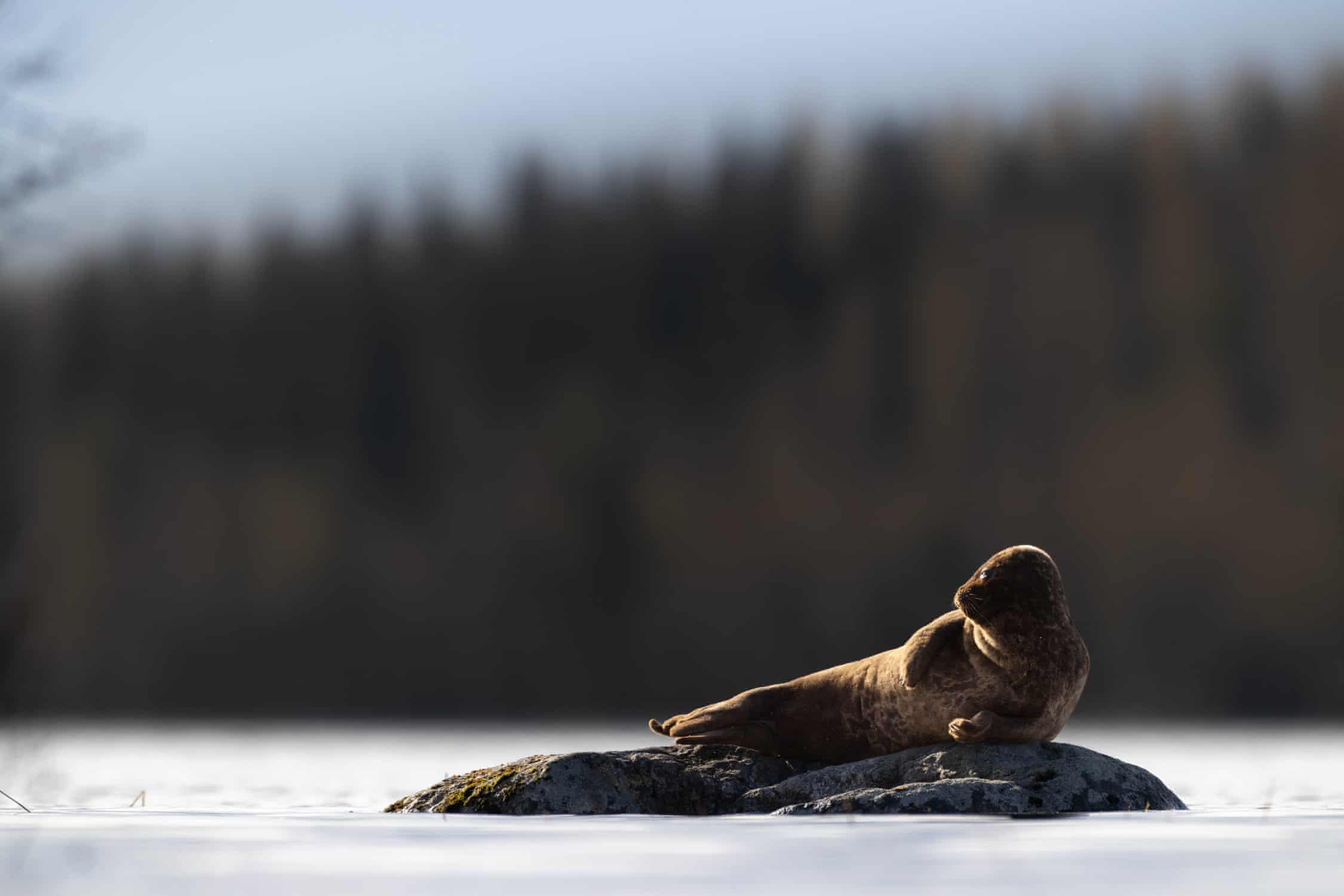
Photo: Samuel Bloch.
Saimaa ringed seals are very sensitive to disturbance, and it is forbidden to deliberately approach them without a permit.

I once wrote here about one of John’s a Ukrainian employees who told me that in Soviet days it was dangerous to read certain books. People read The Master and Margarita, for example, under the library table with a flashlight if no one was around.

I don’t think we are there yet, but I do have a sense that a whole segment of our society will be living an alternate life and trying not to draw attention. That might include people who care about wildlife and global warming, like the Finns in today’s story.

Phoebe Weston writes at the Guardian, “Eight hours shoveling snow in -20C [-4 F] might not sound like the ideal day out, but a committed team of volunteers in Finland are working dawn to dusk building enormous snow drifts for one of the world’s most endangered seals.

“The Saimaa ringed seal was once common around Lake Saimaa in the south-east of the country, but only 495 of them remain.

“The seals make ‘snow caves’ inside snow drifts where they raise their young and protect them from the elements and predators such as red foxes – but as the climate warms, the snow is disappearing. To save these rare seals, 300 volunteers spend days shoveling snow into piles [23 feet long] around the edge of the frozen lake. Last winter they made 200, and the seal population is growing as a result. …

Volunteers meet at first light and work until dusk. [Vincent Biard, a PhD student and volunteer from the University of Eastern Finland] describes the day as ‘kind of fun,’ and adds, ‘you actually have an impact, which is nice. If we don’t do it, then they would just go extinct quite quickly.’ …

“Saimaa seals are less than 1.5 metres long and each one has a unique fur pattern – individual to each animal, like human fingerprints. In the late 1980s their population dwindled to its lowest point, with fewer than 200 left, driven by hunting and deaths caused by fish traps. Accidental deaths in fishing nets remain a challenge.

“Now, the seals are fully protected but the threat of the climate emergency looms large. Between 1925 and 2002, the maximum thickness of the ice decreased by 1.5cm [~i/2 inch] a decade. In mild winters the ice caves can collapse, leaving the pups exposed, with up to 30% of them dying.

“Human-made snow drifts are larger and ‘more durable than natural snow drifts,’ says [Jari Ilmonen, coordinator of Our Saimaa Seal Life, which is an EU-funded program]. …

In the future, ice cover is expected to disappear before the pupping season has ended.

“There have already been some winters where there has not been enough snow to create an artificial drift. In some cases the seals have been known to breed elsewhere, but with no snow ‘just a few would hang on,’ says Ilmonen.

“However, scientists from the University of Eastern Finland are working on plan B. They are creating artificial dens, or nest boxes, that mimic the real thing, with preliminary research showing the seals use them for resting, giving birth and nursing their young. The nest boxes could be used in ice-free winters, researchers say. …

“There are about 40 dens on the lake, where three pups have already been born, but Ilmonen wants to get more out there. ‘If you think that there are maybe 500 seals and maybe 100 pups born each year, you’d need a lot of the boxes,’ he says.

Find more of the Guardian’s age of extinction coverage here, and follow the biodiversity reporters Phoebe Weston and Patrick Greenfield in the Guardian app for more nature coverage.

More at the Guardian, here. No firewall, but voluntary subscriptions support responsible news.

Read Full Post »

Photo: Charles Krupa/AP.
Workers harvest cranberries at the Rocky Meadow bog in Middleborough, Massachusetts, ahead of Thanksgiving. 

Recently, I read about a federal program paying “farmers to convert the land of bogs that is not efficient for growing” into wetlands that can alleviate climate change consequences. Whether or not the federal program will continue, Massachusetts is on the case, helping its own farmers with restoration.

Gloria Oladipo wrote at the Guardian last November, “As millions of cranberries were being harvested for Thursday’s US Thanksgiving holiday, Massachusetts farmers were working to convert defunct cranberry bogs back to wild wetlands, amid climate crisis woes. Several restoration projects were awarded $6m in grants to carry out such initiatives, state officials announced this week.

“The grants, provided by the New England state’s department of fish and game division of ecological restoration (DER), will ‘increase resilience to climate change for people and nature, restore crucial wildlife habitat, and improve water quality’ in 12 communities, said the Massachusetts governor, Maura Healey, in a statement. …

“ ‘These initiatives will enhance our ability to store and sequester carbon with nature and help us meet our net zero goals,’ said Rebecca Tepper, secretary of the state’s office of energy and environmental affairs. …

“The grants are being awarded through two state programs: the DER’s wetland restoration program and the DER’s cranberry bog restoration program, which converts defunct cranberry bogs into wetlands and streams.

“To date, scientists and government officials have converted 400 acres of retired cranberry bogs into wetlands, the Washington Post reported. State officials have said they hope to restore an additional 1,000 acres of bogs within the next decade. …

“As sea levels rise in Massachusetts because of the climate crisis caused by humans burning fossil fuels, scientists are looking to develop bogs into wetlands to improve coastal resilience and slow down erosion.

“Wetlands can hold more water and filter out pollutants amid increased storms that bring potential flooding. They also have other environmental benefits, acting as wildlife habitats and storing carbon dioxide from the atmosphere in their soil.

“More farmers have been drawn to the prospect of transitioning their former cranberry bogs into wetlands. The climate crisis and economic factors, including the high cost of modernizing bogs, can make cranberry farming more difficult. …

“ ‘We are in an upward trend in terms of interest in retiring cranberry bogs,’ said Brian Wick, executive director of the Cape Cod Cranberry Growers Association, to the Post. … But getting land for restoration remains a competitive process, as other businesses – such as housing developers – vie for undeveloped coastal land.

“ ‘This opportunity won’t be here in 25 years,’ said Christopher Neill, a senior scientist at the Woodwell Climate Research Center and an expert in restored bogs, to the Post. ‘These growers are not going to hang on, they’re going to make decisions and the land won’t be available forever.’

“While conservation projects have steadily increased in southeastern Massachusetts, restoration initiatives are still relatively new. The majority of finished projects are only a few years old, with 14 restoration initiatives still being designed and implemented, the Post reported.”

In addition to benefits like carbon storage and habitat for wildlife, converted cranberry bogs can be lovely for walkers.

More at the Guardian, here. Nice photos. No firewall.

Read Full Post »

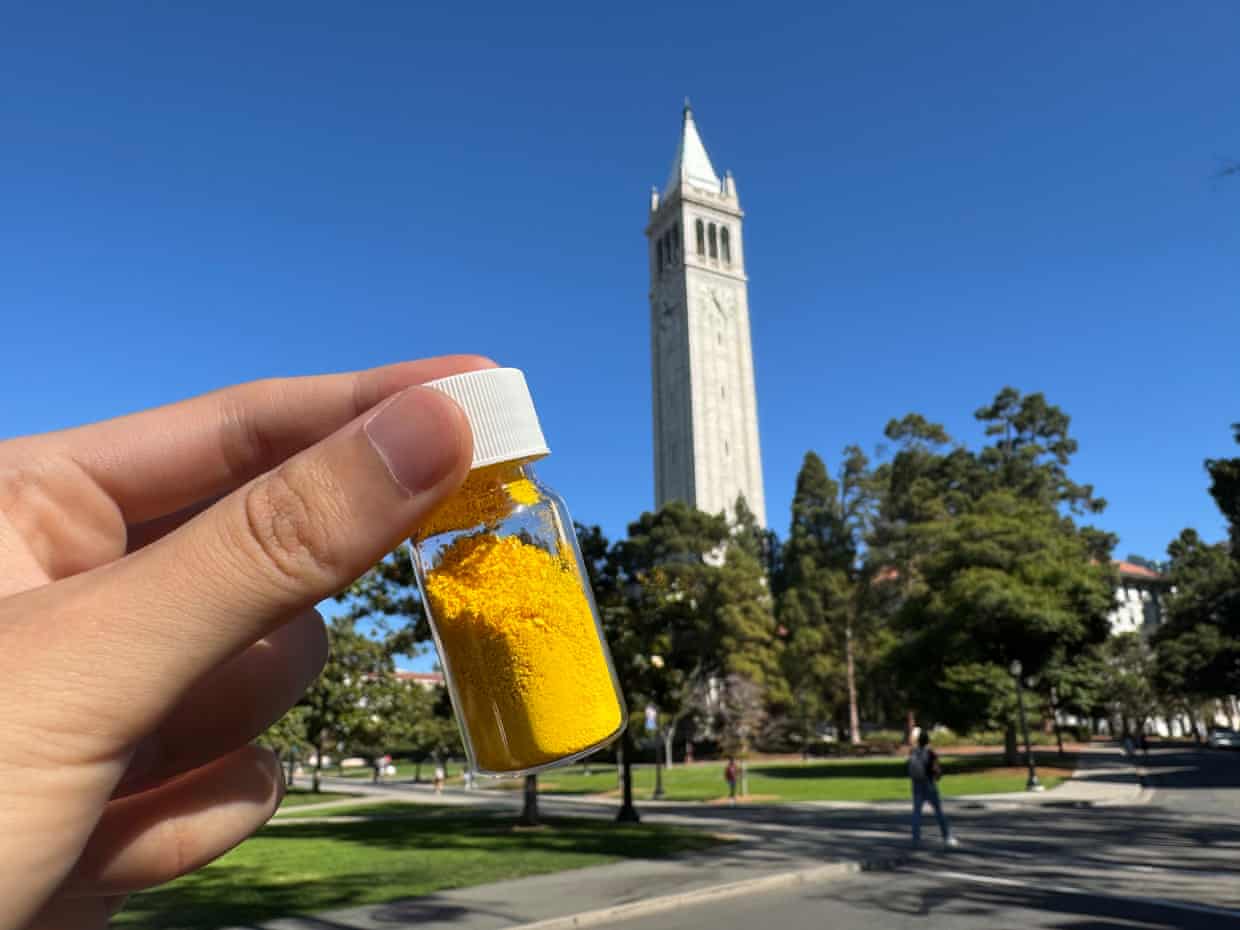
Photo: Zihui Zhou/University of California, Berkeley.
A carbon-capturing powder, pictured on Berkeley’s campus. 

Somehow or other scientific research about global warming will continue. Today’s example comes from Berkeley in California.

At the Guardian, Katharine Gammon reports, “An innocuous yellow powder, created in a lab, could be a new way to combat the climate crisis by absorbing carbon from the air.

“Just half a pound of the stuff may remove as much carbon dioxide as a tree can, according to early tests. Once the carbon is absorbed by the powder, it can be released into safe storage or be used in industrial processes, like carbonizing drinks.

“ ‘This really addresses a major problem in the tech field, and it gives an opportunity now for us to scale it up and start using it,’ says Omar Yaghi, a chemist at the University of California, Berkeley. It’s not the first material to absorb carbon, but ‘it’s a quantum leap ahead [of other compounds] in terms of the durability of the material.’

“The powder is known as a covalent organic framework, with strong chemical bonds that pull gases out of the air. The material is both durable and porous, and can be used hundreds of times, making it superior to other materials used for carbon capture.

“Yaghi has been working on similar materials for decades. It’s part of a broader push to collect tiny amounts of carbon from the air – either from power plants or from air around cities. Yaghi’s research with Zihui Zhou, a graduate student in his lab, and others was published in the journal Nature. …

“Yaghi’s team tested the new powder and found that it could successfully absorb and release carbon more than 100 times. It fills up with carbon in about two hours, and then must be heated to release the gas before starting the process over again. It only requires a temperature of about 120F to release the carbon; that makes it an improvement over other methods, which require a much higher temperature.

“That feature means places that already produce extra heat – such as factories or power plants – could use it to release the gas and start the cycle again. The material could be incorporated into existing carbon capture systems or future technology.

“Yaghi … plans to scale the use of this type of carbon capture with his Irvine, California-based company, Atoco, and believes the powder can be manufactured in multi-ton quantities in less than a year.

“Shengqian Ma, a chemist at the University of North Texas who was not involved in the new work, says this technology could be gamechanging. ‘One longstanding challenge for direct air capture lies in the high regeneration temperatures,’ he says, adding that the new material can substantially reduce the energy needed to use direct air capture. …

“Says Farzan Kazemifar, a associate professor in the department of mechanical engineering at San Jose State University who was not involved in the new study, ‘In the short term, replacing large emitters of carbon dioxide – like coal power plants – with renewable electricity offers the fastest reduction in emissions. However, in the long term, in case the emissions don’t go down at the desired pace, or if global warming effects intensify, we may need to rely on technologies that can remove carbon dioxide from the atmosphere, and direct air capture is one of those technologies.’

“Still, removing carbon from the air remains difficult, and as with all early-stage lab-scale studies, the challenge is scaling up the system for pilot studies. … Any technology to capture the gas from the air requires moving huge volumes of air – and that requires large electricity consumption for running fans, says Kazemifar. …

“Some scientists worry that the expectations of direct air capture systems has been overly rosy. A group of scientists from MIT recently wrote a paper analyzing the assumptions of many climate stabilization plans, and pointing to ways that direct air capture may be overly optimistic.

“Ma also points out that a major challenge to using this approach to combat climate change lies in the high cost of materials for creating substances that capture carbon.

“Still, Yaghi says this material can change the way we address carbon removal. ‘This is something we’ve been working on for 15 years, that basically addresses some of the lingering problems,’ he says.”

More at the Guardian, here.

Read Full Post »

Photo: ItalianNotes.
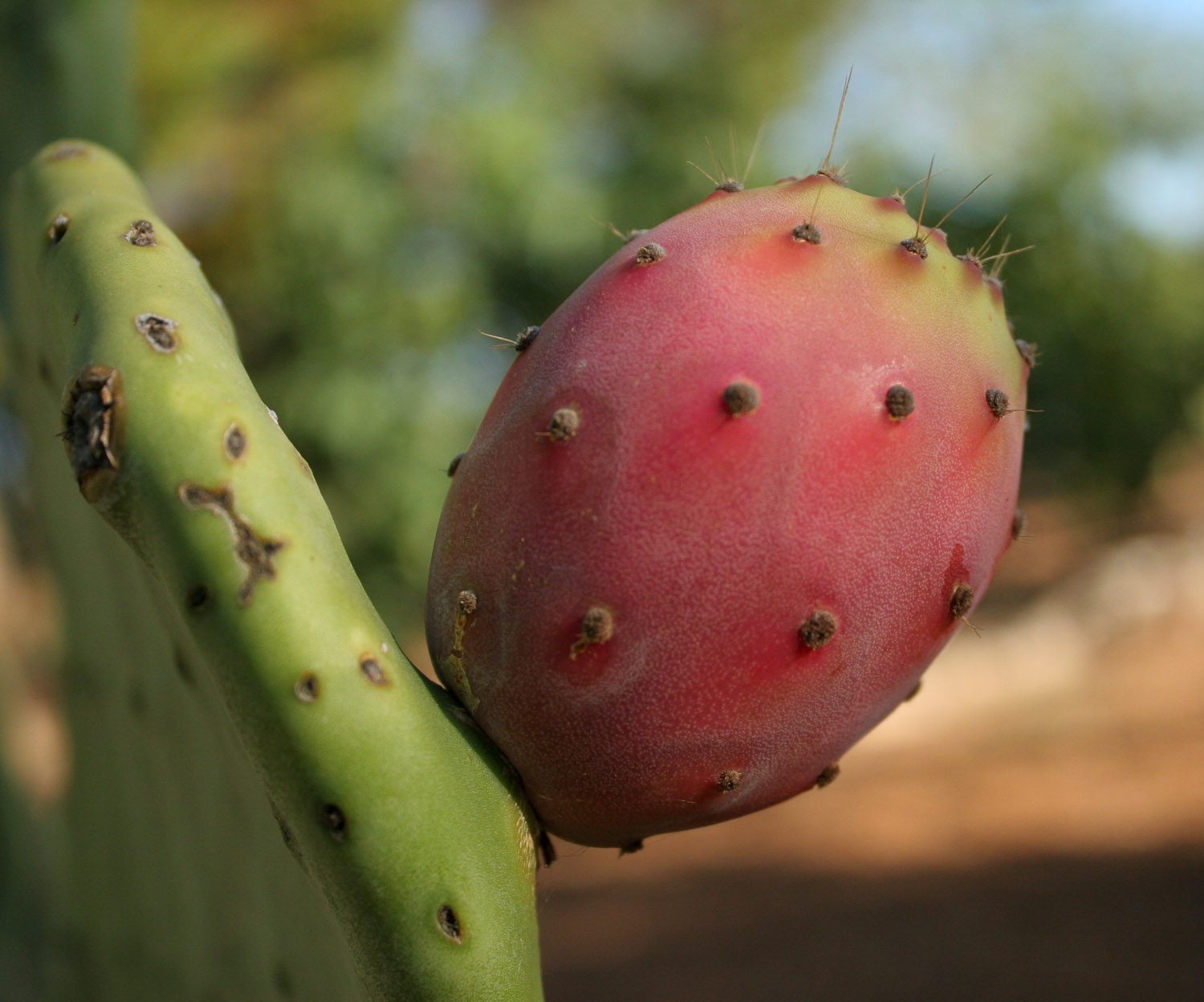
Prickly pear, or cactus pear. When Italy suffers from drought, some people turn to an edible cactus.

A while ago I posted photos I’d taken in New England and was surprised to see a cactus this far north. Hannah called it “prickly pear” and told me it was known for its versatility. It’s apparently the same cactus that Italy is looking to as a reliable food source.

Stefano Bernabei and Gavin Jones write at Reuters, “Global warming, drought and plant disease pose a growing threat to agriculture in Italy’s arid south, but a startup founded by a former telecoms manager believes it has found a solution: Opuntia Ficus, better known as the cactus pear.

“Andrea Ortenzi saw the plant’s potential 20 years ago when working for Telecom Italia in Brazil, where it is widely used as animal feed. On returning to Italy he began looking at ways to turn his intuition into a business opportunity.

“He and four friends founded their company, called Wakonda, in 2021, and began buying land to plant the crop in the southern Puglia region where the traditionally dominant olive trees had been ravaged by an insect-borne disease called Xylella.

“The damage from the plant disease has been compounded by recurring droughts and extreme weather in the last few years all over Italy’s southern mainland and islands, hitting crops from grapes to citrus fruits.

“Ortenzi is convinced the hardy and versatile cactus pear, otherwise called the prickly pear or, in Italy, the Indian fig, can be a highly profitable solution yielding a raft of products such as soft drinks, flour, animal feed and biofuel. …

” ‘As an industry, cactus pear production is growing rather quickly, especially for fodder use and as a source of biofuel,’ said Makiko Taguchi, agricultural officer at the United Nations’ Food and Agriculture Organization headquartered in Rome.

“The cactus produces a tasty fruit eaten in much of Latin America and the Mediterranean, while in Mexico the flat green pads that form the arms of the cactus, are used in cooking. In Tunisia, where it covers around 12% of cultivated land, second only to olive trees, the cactus pear is a major source of income for thousands, particularly women who harvest and sell the fruit.

“In Brazil, which has the world’s largest production, it is mainly cultivated in the north-east for fodder, while Peru and Chile use it to extract a red dye known as Cochineal, used in food and cosmetic production.

Sportswear group Adidas and carmaker Toyota have recently shown interest in using the cactus to produce plant-based leather sourced mainly from Mexico.

“The cactus pear is not yet included in the FAO’s agricultural output statistics, but Taguchi cited the rapid expansion of CactusNet, a contact network of cactus researchers and businesses worldwide which she coordinates. …

“The plant, native to desert areas of south and north America, thrives in the increasingly arid conditions of Italy’s south, and needs ten times less water than maize, a comparable crop whose byproducts also include animal feed and methane. …

“Of the roughly 100,000 hectares of olive trees destroyed by Xylella in southern Puglia, only 30,000 will be replanted in the same way, [Ortenzi] told Reuters in an interview. ‘Potentially 70,000 could be planted with prickly pears,’ he said. …

“Wakonda’s business model discards the fruit and focuses instead on the prickly pads, which are pressed to yield a juice used for a highly nutritious, low-calorie energy drink. The dried out pads are then processed to produce a light flour for the food industry or a high-protein animal feed.

“Wakonda’s circular, ecological production system also includes ‘biodigester’ tanks in which the waste from the output cycle is transformed into methane gas used as a bio-fuel either on site or sold. …

“Under Ortenzi’s business plan, rather than buying up land to plant the cactus, Wakonda aims to persuade farmers of its potential and then license out to them, in return for royalties, all the equipment and know-how required to exploit it.

” ‘The land remains yours, you convert it to prickly pears and I guarantee to buy all your output for at least 15 years,’ Ortenzi said.”

Hmmm. I have two issues. Throwing out the fruit seems super wasteful. And methane may be a biofuel, but it’s no better for the environment than fossil fuel. What do you think?

More at Reuters, here. No firewall.

Read Full Post »

Photo: Associated Press.
This image from the National Oceanic and Atmospheric Administration [NOAA], shows a North Atlantic right whale in the waters off New England, May 25, 2024.

Recently a long Inside Climate News essay about NOAA’s efforts to get lobster fishermen to switch to ropeless gear — and save a few whales — appeared in the Boston Globe. The approach is sound but costly for lobster fishermen struggling to make a living.

Kiley Price wrote, “It was a blessedly calm day as Scott Landry’s team set out in their inflatable boat to scan the glistening waters of Great South Channel between Rhode Island and Massachusetts for an endangered whale affectionately known as Wart. They were on a mission to save her life.

“The group, from the nonprofit Center for Coastal Studies located in nearby Provincetown, had spent the better part of three years monitoring Wart after an aerial team spotted the North Atlantic right whale with a large piece of rope lodged in her mouth.

“Instead of coming loose on its own, the fishing rope slowly tangled itself deeper into Wart’s baleens, hindering her ability to eat and reproduce. Finally, Landry’s team decided to take a more hands-on approach — a dangerous but necessary last resort. …

“His team had to rig up a tool that could slice the rope at a distance — essentially a crossbow with an arrow like a throwing star. Eventually, Wart came up for air close enough to Landry’s dinghy for him to get a single clean shot. He took a breath and fired. The whale immediately dove underwater again, leaving the team in suspense. A few minutes later, she popped back up, revealing the knife had cut right through the chunky rope. …

“Wart’s case is a rare bright spot in the pervasive problem of rope entanglements, one of the leading causes of death for whales. …

“The situation is particularly dire for North Atlantic right whales like Wart, with only around 350 left in the wild. Found along the East Coast of North America, the whales’ migratory paths overlap with highly productive lobster fishing areas in Maine and Massachusetts, where scientists say the whales struggle to dodge copious amounts of gear and traps. …

“Scientists and conservationists are scrambling to find a strategy to reduce entanglement risk without threatening the lobster industry, which is facing its own struggles with climate change. In recent years, a seemingly simple approach has taken center stage: getting rid of the rope.

“The traditional lobster traps that sit on the seafloor are connected to the surface by a line of rope attached to a floating buoy. But the National Oceanic and Atmospheric Administration (NOAA) is working with manufacturers and partners to help develop different high-tech traps that they can sink to the seafloor without the rope tethered to the surface — in hopes of giving whales an unobstructed path through fishery waters. Then lobstermen can use a device to call these wireless traps back up to the surface with their catch.

“Officials say this ‘ropeless’ on-demand gear could help people continue to work during seasonal fishing closures. Enacted by the federal government in New England over the past decade, these restrictions limit lobster harvesting at different times of the year during the whales’ migration season. As whale populations struggle to bounce back, more potential closures loom. …

“The problem? Many lobstermen don’t want it.

“Rob Martin’s lobster boat carved through the gray waters off Cape Cod’s Sandwich Marina this May, temporarily transformed into a gear testing laboratory. NOAA scientists and tech experts had squeezed in alongside Martin, a Massachusetts lobsterman, and his crewmate, former lobsterman Marc Palombo.

“Martin brought the boat to a halt once they were far enough out in the bay, and the team dropped on-demand traps into the water, which quickly sank to the seafloor. Several minutes later, Martin activated the gear using a device onboard. … A few yards away, a bright yellow buoy that had been underwater a moment before now bobbed in the water. Martin and Palombo fished the float out of the water, revealing a cage with a string of lobster traps attached to it. …

“This year, fishers from 19 vessels participated in restricted area trials using on-demand equipment borrowed from a NOAA-run ‘gear library’ located in Woods Hole, Massachusetts. Under a special permit, the participants are allowed to keep and sell their catches throughout the winter and spring months. …

“The end goal for these ropeless gear efforts is to give lobstermen an option to get back out on the water during seasonal fishing closures or restrictions. That includes one in place since 2015 across a stretch of Cape Cod Bay every February to April. The federal government is likely to establish new large closures in just a few years to prevent right whales from going extinct. …

“In 2022, the Massachusetts Division of Marine Fisheries published a report to assess the feasibility of ropeless gear throughout the state, produced by the ocean policy consulting company Homarus Strategies. To assess potential economic impacts, Homarus combined the estimated costs of switching to ropeless gear with the potential loss of revenue from the additional time it takes to operate the gear compared to traditional traps — and the findings were stark. If the government mandates a fisheries-wide shift to ropeless gear, the state could lose around $24 million in revenue per year, according to the report.

“There’s a big caveat to that conclusion: The government has no plans to require this type of shift, said Colleen Coogan, branch chief for the Marine Mammal and Sea Turtle Team at NOAA Fisheries Greater Atlantic Region’s Protected Resources Division.

“ ‘We’ll never require fishermen to use ropeless gear, but that means that if they don’t use it, there will be areas that will be closed for fishing,’ she told Inside Climate News. ‘It’s more that the closure is what helps the whales; the ropeless [gear] is what helps the fishermen.’ …

“ ‘Personally, I don’t think there’s anything that they’re going to be able to do to make it viable … to deal with the financial burden,’ said Cape Cod lobsterman Jeff Souza, whose house is the collateral for a loan he took out a few years ago to build a new boat. … ‘I just want to keep being able to fish and not go broke.’ …

“In the fight to pull right whales back from the brink of extinction, there is a bright spot. Last year, NOAA released the annual population estimate for the species using the most up-to-date data, and found that the rate of their decline is slowing down, likely due to the regulations protecting them. Research suggests that ropeless gear could further help. …

“Landry thinks whales can deal with ‘some level of challenge that we throw at them, but, you know, it’s pile upon pile. There’s the changing of the prey, there’s the rope, there’s the boats. You’re asking a lot of a population of 350 animals.’ ”

More at Inside Climate News via the Globe, here.

Read Full Post »

Photo: Roberto Nutlouis.
Danielle Kaye builds a berm spillway on the farm of Roberto Nutlouis. The berm holds back water, flooding the cornfield behind it. Navajos are using ancient ways to restore parched earth.

In their eagerness to invent, humans seem to be programmed to forget why ancient ways worked. Then they have to reinvent the wheel. Fortunately, indigenous people often are repositories of that wisdom and can produce it as needed.

Lela Nari writes at YaleEnvironment360, “Here in Burnt Corn Valley, smack in the middle of the Navajo reservation’s vast Black Mesa region, the hilly land both craves water and is brutalized by it. The sandy Arizona soil cracks under a punishing August sun as red-striped blister beetles search for moisture across its baked surface. Cottonwood trees and sagebrush rise from deep gullies carved by floodwaters that, during the intensifying summer monsoon, sluice off surrounding mesas and wash away fragile topsoil — reminders that with climate change, even quenching rains harbor powers of destruction.

“This portrait of climatic havoc belies a softer reality, though. Farming once thrived in this parched region and could once again — if the right practices are adopted. Exhibit A: The crops on Roberto Nutlouis’s 12-acre Sliding Rock Farm, in his reservation hometown of Piñon, a five-hour drive north of Phoenix.

“ ‘The corn is actually pretty big and thriving,’ Nutlouis says. He believes — and both Western science and the lived experience of his Native elders affirm — that the traditional rock and stick structures he’s built on his property, which help store water and prevent erosion, have a lot to do with it.

“These structures, similar to those used by Native peoples long before Europeans arrived on the continent, are not only delivering water to crops. … They are also restoring Nutlouis’s watershed and those of his neighbors, helping to sequester carbon, and reviving this high-desert ecosystem. It’s all part of a bigger effort among a range of local and regional grassroots organizations to build back the reservation’s fragile, depleted ecosystems and bring greater sovereignty over food, water, and health to its communities.

“Diné (the Navajo name for themselves) are well aware that climate change is making the weather on their semi-arid plateau weirder, wilder, and more destructive. … The ecological health of the reservation has also been weakened by deforestation from timbering operations and from overgrazing over the years.

“Still, this season, Nutlouis, 44, has been able to skip his usual two-hour roundtrip drive to a reliable well to haul water home for his corn. His crop is healthy and hydrated because his land still holds last winter’s snowmelt. Clearly, his heavy labor over the past 20 years — during which he has built woven brush dams, gabions (wirework cages filled with rocks), earthen berms, concrete spillways and trenches, limestone aprons and walls, and stone-lined ‘Zuni bowls,’ which stabilize eroding streambeds — is paying off.

“Diné and others living in arid zones around the world have long used structures made of naturally occurring materials to capture and control water to grow crops and to mitigate the devastation of floods in ephemeral stream systems. …

“Time and again over the last 15 years, Laura Norman, a research scientist with the U.S. Geological Survey, has seen evidence that when these structures — which Norman calls Natural Infrastructure in Dryland Streams, or NIDS — are placed in gullies, they slow water to mitigate erosion, collect nutrient-rich sediment and plant debris that nourish both crops and wild plants, help store carbon, improve groundwater recharge, and increase downstream water availability by as much as 28 percent. ‘It’s a snowball effect that counters degradation, and you get all of these ecosystem services,’ she says.

“The structures on Nutlouis’s farm are integral cogs in a larger system. … Nutlouis’s property lies in an alluvial fan, where mineral-rich sediments and plant waste atop mesas and other uplands wash down onto flatter ground with rainwater, snowmelt, and spring water. Across the valley, similar farms rely on this kind of system, many of which feature stone and stick constructions that Nutlouis helped build. The organic materials trapped behind the structures, says Jonathan Sandor, an emeritus agronomy professor at Iowa State University, ‘are a major input into keeping the fertility of the soils up.’ …

“Whether rock walls or ramps, hand-dug depressions in the soil, earthen walls, or branches plaited into dams, NIDS splash water over a wider area and slow its flow so it can better soak into the soil. Many trap sediments behind them, fertilizing whatever grows nearby. The stone structures create a hyperlocal cooling effect, especially when they’re combined with shade-making vegetation.

“Here, too, smallness is a boon. ‘Even tiny little one-rock dams can make big changes on the landscape,’ Norman says. …

“Lately, climate change has thrown extra challenges at the reservation. … But the ecosystem services provided by Nutlouis’s structures on his farm and elsewhere do seem to be meeting those climatic challenges. He’s noticed small juniper trees popping up on hillsides around his property despite the dryness; A cottonwood tree towering over one cornfield is also lush and full. ‘The idea that Earth will restore itself with natural seed dispersal’ after NIDS begin to do their job ‘has been my observation,’ says Norman.

“Or as Nutlouis puts it, ‘We’re allowing nature to do its own thing and restore itself.’ ”

More at Yale e360, here. Fascinating pictures. No firewall.

Read Full Post »

Photo: Ning Zeng.
An ancient log excavated and likely buried naturally, cleaned and dried, with the lower end sawed off for lab analysis.

And while we’re on the subject of reducing carbon in the atmosphere, consider an ancient process that works without our help. You may find it a little weird, however, especially as intentionally pursuing this natural approach merely postpones carbon escape for a few thousand years!

Dino Grandoni writes at the Washington Post, “On the outside, its rust-red bark had peeled. Its sweet, distinct cedar smell had disappeared. But at its core, it’s still as hard as a tabletop — and may just contain a way of slowing down rapidly rising temperatures.

“A 3,775-year-old log unintentionally discovered under a farm in Canada may point to a deceptively simple method of locking climate-warming carbon out of the atmosphere for thousands of years, according to a study published [in September].

“ ‘This accidental discovery really gave a critical data point,’ said Ning Zeng, a University of Maryland climate scientist whose team unearthed the ancient chunk of wood. ‘It’s a single data point,’ he added, but it ‘provides the data point we need to really say under what conditions we can preserve wood for a thousand years or longer.’

“Figuring out ways of sequestering carbon may be crucial to meeting the world’s goal of halting warming beyond 2 degrees Celsius above pre-industrial levels. … Doing something as simple as burying wood underground in the right spot, these researchers say, may be a cheap and scalable way of doing just that.

“Forests are Earth’s lungs, sucking up six times the amount of carbon dioxide (CO2) that people pump into the atmosphere every year by burning coal and other fossil fuels. But much of that carbon quickly makes its way back into the air once insects, fungi and bacteria chew through leaves and other plant material. …

“What if that decay could be delayed? Under the right conditions, tons of wood could be buried underground in wood vaults, locking in a portion of human-generated CO2 for potentially thousands of years. While other carbon-capture technologies rely on expensive and energy-intensive machines to extract CO2, the tools for putting wood underground are simple: a tractor and a backhoe.

“Finding the right conditions to impede decomposition over millennia is the tough part. To test the idea, Zeng worked with colleagues in Quebec to entomb wood under clay soil on a crop field about 30 miles east of Montreal.

“ ‘We were trying to do a small pilot project at first,’ said Ghislain Poisson, an agronomist with Quebec’s Agricultural Ministry who worked with Zeng. … But when the scientists went digging in 2013, they uncovered something unexpected: A piece of wood already buried about 6½ feet underground. The craggy, waterlogged piece of eastern red cedar appeared remarkably well preserved. …

“Radiocarbon dating revealed the log to be 3,775 years old, give or take a few decades. Comparing the old chunk of wood to a freshly cut piece of cedar showed the ancient log lost less than 5 percent of its carbon over the millennia.

“The log was surrounded by stagnant, oxygen-deprived groundwater and covered by an impermeable layer of clay, preventing fungi and insects from consuming the wood. Lignin, a tough material that gives trees their strength, protected the wood’s carbohydrates from subterranean bacteria. The team wrote up their results in a paper in the journal Science. …

“Said Daniel L. Sanchez, an assistant professor at the University of California at Berkeley who was not involved in the study, ‘Scientists and entrepreneurs have long contemplated burying wood as a climate solution.’

“The next step is to find prehistoric logs in other locations, to see how well other types of soil preserve wood. … The researchers estimate buried wood can sequester up 10 billion tons of CO2 per year, which is more than a quarter of annual global emissions from energy, according to the International Energy Agency.

“One of the biggest challenges isn’t so much the supply of wood but rather the cost of transporting it to the right spots, Poisson said. ‘There’s probably a lot of unmerchantable wood right now that doesn’t have any market or doesn’t have any purpose.’ “

Hmmm. What do you think? Transporting wood to a burial site wouldn’t just be costly, it would cause more emissions. Not sure the scientists have thought this through. More at the Post, here.

Read Full Post »

Livestock produces a lot of methane, which is unlikely ever to be balanced out by carbon captured in the soil. The Soil Association Exchange wants you to know about a few positive effects, however. 

It’s an ongoing process to keep up on the latest, especially when it comes to protecting the planet. I myself once thought that massive tree planting had the biggest bang for the charitable buck. Then I learned that, although trees are important, they can’t help much without due consideration given to where and how they are planted, and what varieties of trees they are.

Today I’m trying to bone up on the situation with cows, which we all know (including a young grandson who has cut beef out of his diet) produce too much climate-warming methane gas.

James Tapper reports at the Guardian, “New data shows [cows] may play an important role in renewing farm soil. Research by the Soil Association Exchange shows that farms with a mixture of arable crops and livestock have about a third more carbon stored within their soil than those with only arable crops, thanks to the animals’ manure.

“This also has an effect on biodiversity: mixed arable and livestock farms support about 28 grassland plant species in every field, compared with 25 for arable-only and 22 for dairy-only.

“Joseph Gridley, chief executive of SAE, which was set up by the Soil Association in 2021 to support and measure sustainable farming, said it was unlikely that carbon captured in soil would balance out the enormous amounts of methane created by cattle. Farm livestock around the world creates about 14% of human-induced climate emissions.

“ ‘It’s pretty unequivocal in the data that having livestock on your farm does mean you have more emissions – five or six times more emissions,’ he said. ‘But if you integrate livestock into the system, on every metric on soil health, there’s an improvement, and on a lot of the biodiversity measures as well.’

“Soils are degrading, but by how much exactly is unclear. In 2015, the UN Food and Agriculture Organization claimed that the world had only 60 harvests left, but researchers at Oxford University and Our World In Data said in 2021 that there was a complex picture. …

“Lee Reeves, UK head of agriculture at Lloyds bank, which helps fund SAE … suggested ministers should create a decarbonization strategy, and a standardized carbon calculator, so that farmers and other businesses could use a single tool to calculate their carbon impacts.

“ ‘Moving from traditional to regenerative farming can see a dip in profitability for the first five years, so the government needs to support farmers and banks in that,’ he said.

“[In the UK] the Department for the Environment, Food and Rural Affairs has been investigating so-called methane blockers as a way to reduce emissions. Adding substances such as essential oils, probiotics and even seaweed to cattle feed can reduce the amount of burps and wind they generate.

“Last month the Green Alliance charity said that feeding Bovaer, a methane blocker, to a third of the UK’s dairy cows would cut the country’s emissions by about 1%. Yet this is not happening, the campaign group warned, because farmers were unwilling to pay extra for something they did not benefit from. It said methane blockers should be subsidized, as other green farming schemes were.”

More at the Guardian, here. The Natural Resources Defense Council explains more about regenerative farming here.

Read Full Post »

Photo: Soren Ryesgaard.
A boat looks tiny cruising by the rockslide gully of a destroyed glacier in Greenland recently. Rockslide plus global warming equals a surprise.

I don’t remember reading about this mysterious rumble at the time, but I’m always interested when scientists are stumped. I like how they approach figuring out a new phenomenon. Here’s hoping that science will continue to guide us the future. For one thing, unlike business or politics, it is usually collaborative, as seen in this story.

Kasha Patel wrote at the Washington Post, “The strange rumble was detected mid-September last year. An odd seismic signal appeared at scientific stations around the globe, but it didn’t look like the busy squiggles of an earthquake. A day passed, and the slow tremor still reverberated. When it continued for a third day, scientists worldwide began assembling to discuss what was causing the grumble in the ground.

“Some initially thought the seismic instruments recording the signal were broken, but that was quickly nixed. Maybe it was a new volcano emerging before their eyes, others said. …

“ ‘No one had ever seen this. We have nothing to compare it with,’ said Kristian Svennevig, a geologist at the Geological Survey of Denmark and Greenland.

“Nine days later, the vibrations greatly dissipated. But the mystery of the USO [Unidentified Seismic Object] lasted much longer. A year later, the puzzle has been solved, according to a study published in the journal Science [in September 2024]. It took about 70 people from 15 different countries and more than 8,000 exchanged messages (long enough for a 900-page detective novel) to crack the case.

“The short answer: A mega-tsunami created waves that sloshed back and forth in a fjord in Greenland, creating vibrations that traveled around the world.

“The long answer begins in the atmosphere. As greenhouse gas concentrations increase due to climate change, those heat-trapping gases accelerate ice melt particularly around Earth’s poles. On Sept. 16 last year, that extra heat thinned a glacier in eastern Greenland over time so much that it could no longer support the mountain rock above it.

“A 500-foot-thick piece of metamorphic rock, about a third of a mile wide and long, fell and triggered a massive landslide. Rock and ice, enough to fill 10,000 Olympic-size swimming pools, let loose as fast as 47 meters per second and ran for more than a mile. The avalanche plunged into the Dickson Fjord, triggering a 650-foot-high tsunami — one of the highest seen in recent history.

“Farther away from the fjord, tsunami waves reaching 13 feet high damaged an unoccupied research station and destroyed cultural and archaeological heritage sites, including an old trapper hut that had never been affected by tsunamis during its century-old history. …

“Meanwhile, in the fjord, the mega-tsunami wave traveled back and forth in the inlet and created a standing wave called a seiche. We often see small-scale seiches — this rhythmic oscillation in water — in a swimming pool or bathtub. This tsunami source was so energetic that the seiche radiated seismic waves globally, shaking the planet for nine days before it petered out.

“Members of the Danish military sailed into the fjord only days after the event to collect drone imagery of the collapsed mountain face and glacier front and scars left by the tsunami.

“Of course, Svennevig and many of his close colleagues didn’t fully know of the connection between the tsunamigenic landslide and the seiche as the events unfolded, which is detailed in the study.

“At the time, they were scratching their heads about the data at the seismograph stations. The seiche appeared as a single slow vibration, like a monotonous-sounding hum, as opposed to the frantic lines of a typical earthquake reading. The wave peaked every 92 seconds, which is slow compared with an earthquake. …

“ ‘When we started doing this research, nobody had any ideas about what was the root cause,’ said Carl Ebeling, a co-author of the study and a seismologist at the Scripps Institution of Oceanography at the University of California at San Diego. ‘Even for a large landslide under normal circumstances, it would be hard to see that on a global scale, so something special is going on here.’

“As some scientists investigated the peculiar seismic data, another group of authorities and researchers had heard of a large tsunami in a remote fjord in eastern Greenland. The two teams, among others, joined forces, quickly growing into a 24/7 international collaboration via a messaging system. The group brought a variety of local field data and remote, global-scale observations.

“ ‘We knew there was a landslide and a tsunami. You could pull the seismic signal of those,’ Svennevig said. ‘But then there was this other seismic signal that continued for nine days, and they were taken from roughly the same area, so they must be associated somehow.’ …

“The breakthrough came when they received new bathymetry data of the fjord, similar to a topographic map, from the Danish military, which allowed them to better map the seabed in the computer models. Once incorporated, the team used an unprecedentedly high resolution model to show how the landslide direction, along with the uniquely narrow and bendy fjord channel, led to the nine-day seiche.”

More at the Post, here.

Read Full Post »

Photo: Elke Scholiers/Getty Images.
Workers sorting electronic waste at a factory in India. A team at University of Edinburgh is using microbes to recycle lithium, cobalt, and other expensive minerals — a greener way to go.

As we know, the downside of going all-electric to reduce the global-warming effects of fossil fuels is the mining of rare minerals for electricity, for batteries. But that mining can be destructive to communities wherever it’s done. Not to mention there’s a finite supply of such minerals on the planet.

Fortunately, human ingenuity even in the darkest times keeps functioning and looking for better ways to do things.

Robin McKie at the Guardian reports on what is potentially a greener way to acquire the rare minerals needed in the batteries we have today.

“Scientists have formed an unusual new alliance in their fight against climate change,” writes McKie. “They are using bacteria to help them extract rare metals vital in the development of green technology. …

“The work is being spearheaded by scientists at the University of Edinburgh and aims to use bacteria that can extract lithium, cobalt, manganese and other minerals from old batteries and discarded electronic equipment. These scarce and expensive metals are vital for making electric cars and other devices upon which green technology devices depend, a point stressed by Professor Louise Horsfall, chair of sustainable biotechnology at Edinburgh. …

“Said Horsfall, ‘All those photovoltaics, drones, 3D printing machines, hydrogen fuel cells, wind turbines and motors for electric cars require metals – many of them rare – that are key to their operations.’

“Politics is also an issue, scientists warn. China controls not only the main supplies of rare earth elements, but dominates the processing of them as well. ‘To get around these problems we need to develop a circular economy where we reuse these minerals wherever possible, otherwise we will run out of materials very quickly,’ said Horsfall. ‘There is only a finite amount of these metals on Earth and we can no longer afford to throw them away as waste as we do now.’ …

“And the key to this recycling was the microbe, said Horsfall. ‘Bacteria are wonderful, little crazy things that can carry out some weird and wonderful processes. Some bacteria can synthesize nanoparticles of metals, for example. We believe they do this as a detoxification process. Basically they latch on metal atoms and then they spit them out as nanoparticles so that they are not poisoned by them.’

“Using such strains of bacteria, Horsfall and her team have now taken waste from electronic batteries and cars, dissolved it and then used bacteria to latch on to specific metals in the waste and deposit these as solid chemicals. ‘First we did it with manganese. Later we did it with nickel and lithium. And then we used a different strain of bacteria and we were able to extract cobalt and nickel.’

“Crucially the strains of bacteria used to extract these metals were naturally occurring ones. In future, Horsfall and her team plan to use gene-edited versions to boost their output of metals. ‘For example, we need to be able to extract cobalt and nickel separately, which we cannot do at present.’

“The next part of the process will be to demonstrate that these metals, once removed from old electronic waste, can then be used as the constituents of new batteries or devices. ‘Then we will know if we are helping to develop a circular economy for dealing with green technologies.’ “

More at the Guardian, here. Remember the detestable partygoer in the Graduate who insisted “there’s a great future in plastics”? We now know what that kind of thinking led to. Sounds to me like the future might actually be in chemistry.

Read Full Post »

« Newer Posts - Older Posts »