Feeds:
Posts
Comments

Posts Tagged ‘connecticut’

I like win-win stories like this one from National Public Radio. It’s about a new crop with a lot of monetary potential — and distinct advantages for the environment.

“It doesn’t require any land or fertilizer. Farming it improves the environment, and it can be used in a number of ways. So what is this miracle cash crop of the future? It’s seaweed.

“Charlie Yarish, professor of ecology and evolutionary biology at the University of Connecticut, loves seaweed. In nature, he says, when seaweed turns a rich chocolate color, that means the plant is picking up nitrogen, a process called nutrient bioextraction. …

“Many plants and animals cannot survive when there is too much nitrogen in the water, but seaweed is able to ‘capture’ the nitrogen, as well as contaminants in the water.

“A United Nations report says that nearly 16 million tons of seaweed were farmed in 2008 — most of it in Asia. Yarish helped a company called Ocean Approved start the United States’ first open-water kelp farm in the Gulf of Maine in 2006 … Now, he’s helping to create a seaweed farm off the coast of Connecticut.

“Bren Smith owns and runs the Thimble Island Oyster Company, off the coast of Branford, Conn. After his business was hit hard by Tropical Storm Irene last year, ruining about 80 percent of the shellfish crop, Smith started looking around for something more resilient to farm. That’s when he found Yarish, who agreed to help set him up in the seaweed farming business. …

” ‘There’s no barns, there’s no tractors. This is what’s so special about ocean farming. It’s that it’s got a small footprint and it’s under the water. I mean, we’re so lucky; I feel like I stumbled on this just great secret that we then can model and spread out to other places,’ ” Smith says. …

” ‘The plan is to actually split it into a couple different experimental markets — one for food, one for fertilizer, one for fish food. I’m [also] working with a skin care company in Connecticut, and then one for biofuel,’ Smith says. He’s even hoping he can someday fuel his own boat with biofuel from the seaweed.”

Craig LeMoult has the whole story here at NPR, where you also can listen to the audio.

Photograph by Ron Gautreau
Oyster fisherman Bren Smith on his boat.

Read Full Post »

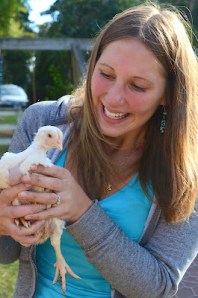
My friend’s great niece doesn’t come from professional farmers, but the gardening gene goes back at least to her Italian great grandfather. Now, having graduated from a liberal arts college and worked for various park services, she is — like a surprising number of young people today — going into farming.

At a farm blog, she describes raising organic chickens in Connecticut.

“Hi! Nichki and Laz from The Wooly Pig here, taking over the Barberry Hill Farm blog for an entry!

“We are young aspiring CT farmers who were lucky enough to meet Kelly and Kingsley last March and over the past several months they have become our good friends and farming mentors. This fall, the Goddards have been so kind as to lend us their pasture and their expertise so that we can raise our very first batch of chickens for our community.

“Our birds are pasture raised, which means they are brought up outdoors with plenty of access to fresh vegetation, open air, and sunlight.

“They are fed a strictly organic diet — an added cost for us that we feel is a worthwhile investment in our customers’ health. …

“We can’t thank our customers enough for supporting local, sustainable agriculture. Your good decisions help build strong, healthy communities right here in Connecticut. …

“For more information on our chickens, please contact us by email at TheWoolyPig@gmail.com.”

Read the engaging Barberry Hill Farm blog here. And if you live near Madison, Connecticut, get your chickens from The Wooly Pig

Photograph from http://www.barberryhillfarm.com.

Read Full Post »

Did anyone watch the television show Rin Tin Tin as a kid?

I thought of it today when I read this awesome AP story:

“The birth of a white bison, among the rarest of animals, is bringing Native Americans who consider it a sacred event to celebrate at one of the least likely of places, a farm in New England.

“Hundreds of people, including tribal elders from South Dakota, are expected to attend naming ceremonies later this month at the northwestern Connecticut farm of Peter Fay, a fourth-generation Goshen farmer.

“Native Americans in the area have come with gifts of tobacco and colored flags for Fay and the bull calf since it was born there a month ago, and Fay is planning to offer his hay field as a campsite for the expected crowds.

” ‘They say it’s going to bring good things to all people in the world. How can you beat that? That’s the way I look at it,’ Fay said.” More. (There’s a photo there, too.)

I knew I had to blog about it because I loved the Rin Tin Tin episode when young Rusty is in dire straights and is saved by the White Buffalo. I know the song from that episode by heart. It was one of my brother’s records when he was little, although I don’t think it made it into the website with his blues records.

“There’s an old Indian legend that I heard long ago.
“It’s about a special valley and the White Buffalo.

“The legend says you’ll find it if your heart is brave and true
“And you treat all men as brothers no matter what they do.

“I have searched for that valley since I started to grow.
“I won’t stop until I find it — and the White Buffalo.”

Read Full Post »

Connecticut seems to be doing quite a lot for entrepreneurs — even rather young ones. So thanks to an annual competition for young inventors in the state, Mallory Kievman is getting her hiccup-suppressing lollipop patented and marketed by experts.

Writing for the NY Times, Jessica Bruder quotes one of Mallory’s benefactors.

“ ‘It’s very rare, when you’re evaluating businesses, that you can envision a company or product being around 100 years from now,’ said Danny Briere, a serial entrepreneur and the founder of Startup Connecticut, which nurtures new companies, including Hiccupops, and is a regional affiliate of the Startup America Partnership. ‘Hiccupops is one of those things. It solves a very simple, basic need.’

“Mallory met Mr. Briere last spring at the Connecticut Invention Convention, an annual competition for kids. ‘I went there, and I knew it would either be a hit or a miss project,’ she said. ‘People would either like it, or they would think I was crazy.’ ” Read more.

I love reading about simple but valuable solutions to everyday challenges. Think paper clip. Think Post-it note. It takes a special kind of imagination. Nowadays, given the valuation of apps, you would think solving everyday challenges was too uncool for the inventive mind. But Hiccupops will likely bring Mallory checks in the mail long after Instagram is forgotten.

Photograph: Andrew Sullivan for the NY Times

Read Full Post »

My sister is a poet, among other things, and she sent me this story about a famous poet and his association with the not-always-poetic city of Hartford, where he worked for insurance industry. (Which just goes to show that poetry blossoms where it will.)

Jeff Gordinier writes in the NY Times about taking a Wallace Stevens walking tour that was, “like Hartford itself, quite modest. …  Along the walk there are pale slabs of Connecticut granite engraved with verses from one of Wallace Stevens’s most indelible poems, ‘Thirteen Ways of Looking at a Blackbird.’ That’s about it.

“Nevertheless, I found the walk to be deeply moving,” writes Gordinier, “After all, how often do we get to explore the cranial machinery of a literary titan by slipping into the groove of his daily commute?

“Stevens never learned to drive. Even though many of his neighbors had no idea what he was up to, he would amble along Asylum Avenue methodically measuring the pace of his steps and murmuring phrases to himself …

“ ‘It seems as though Stevens composed poems in his head, and then wrote them down, often after he arrived at the office,’ Prof. Helen Vendler, Harvard’s grande dame of poetry and the author of Wallace Stevens: Words Chosen Out of Desire, explained to me in an e-mail. ‘As for his commute, he enjoyed it profoundly. It was his only time out of doors, alone, thinking, receptive to the influx of nature into all the senses.’ …

“Evidence suggests that he rather liked his peaceful routine in Hartford — his backyard garden, his wine cellar, even his job at the insurance company.

“ ‘Stevens enjoyed his work very much,’ said James Longenbach, a poet, a professor at the University of Rochester, and the author of Wallace Stevens: The Plain Sense of Things. ‘It was crucial to his achievement. He turned down an offer to be the Norton Professor of Poetry at Harvard because he didn’t want to leave his work. He continued to go to the office even when he was beyond the mandatory age of retirement. He never showed that he felt any conflict or tension between what might appear to be the different aspects of his life.’ …

“What moved me about the walk, in the end, was that he had chosen to walk at all. In a car-mad country that prides itself in being perpetually in motion, the poet made a clear and conscious decision to stop, to slow down, to burrow into his imagination. And walking had opened his eyes and ears to a place that was full of surprises. As Stevens himself put it in a poem:

“ ‘It is like a region full of intonings./It is Hartford seen in a purple light.’ ” Read more.

Read Full Post »

I’ve blogged about Mary Driscoll and OWLL, the nonprofit she set up to help ex-offenders break vicious cycles. Soon she will launch her play Generational Legacy, about what happens to children when mothers are imprisoned. People who had experienced prison helped her write it.

Because I am very interested in this and other ways that people use the arts to help prisoners turn their lives around, an article about using Dante and Shakespeare in a women’s prison caught my eye.

Joel Brown writes in the February 24 Boston Globe,

“Lynda Gardner, Saundra Duncan, and Deborah Ranger will give a reading of a new play at a Harvard University conference next week. A different kind of alma mater qualifies them for this appearance: York Correctional Institution in Niantic, Conn., a high-security state facility for female offenders.

“While behind bars at York, all three joined theater workshops with Wesleyan University professor Ron Jenkins and students from his Activism and Outreach Through Theater course. They got to know Shakespeare and Dante, and it changed their lives.

“ ‘I spent my first six months [in York] trying to figure out ways to kill myself, and the next four and a half years trying to see how much more I can live,’ says Gardner. …

“Saundra Duncan said, ‘When I looked at Dante and saw how he was in exile . . . I saw a lot of that situation in [myself].’ ”

I especially liked this comment on the Inferno: “I’ve been in a lot of the circles of hell … It really isn’t about hell; it is about hope. Climbing out of those circles.’’

Read more.

Read Full Post »

Miller-McCune.com tweeted today that the National Endowment for the Arts has new data on where artists are finding work.

Four of the six New England states are among the states with the most arts jobs: Vermont, Rhode Island, Massachusetts, and Connecticut.

“The report on artists in the workforce supplements and expands upon a 2008 paper, which found about two million Americans list a job in the arts as their primary source of employment. That comes out to 1.4 percent of American workers.

“New York heads the newly released state-by-state list, with artists making up 2.3 percent of its labor force. California, home to the film and television industry, places second with 2.0 percent.

“Not far behind are Oregon and Vermont, each of which has a workforce in which 1.7 percent of workers are artists. That means they exceed the national average by a substantial 20 percent.

“ ‘Writers and authors are especially prominent [in Oregon and Vermont],’ the NEA report notes.

“Also exceeding the national average: Colorado and Connecticut (where artists make up 1.6 of the labor force), and Hawaii, Rhode Island, Massachusetts, Maryland, Washington, Nevada, and Minnesota (at 1.5 percent).”

Although there likely to be different perceptions of what kind of work constitutes arts employment, I find the report interesting. And since I know anecdotally that there are arts jobs in Maine and New Hampshire (the two New England states not among the top few), I can’t help hoping that some organization will do an in-depth study of the region. Unfortunately, ornery New Englanders don’t often think regionally.

And more generally, what are the reasons some states have more arts jobs? Public policies? Landscape? Accident?

Read more here.

Read Full Post »

I think that my cousin Sally has been an artist ever since she first picked up a crayon.

Today she works in monotype and other advanced media. Her work has appeared in solo and group shows. Read about the current one in Lakeville, Connecticut, here.

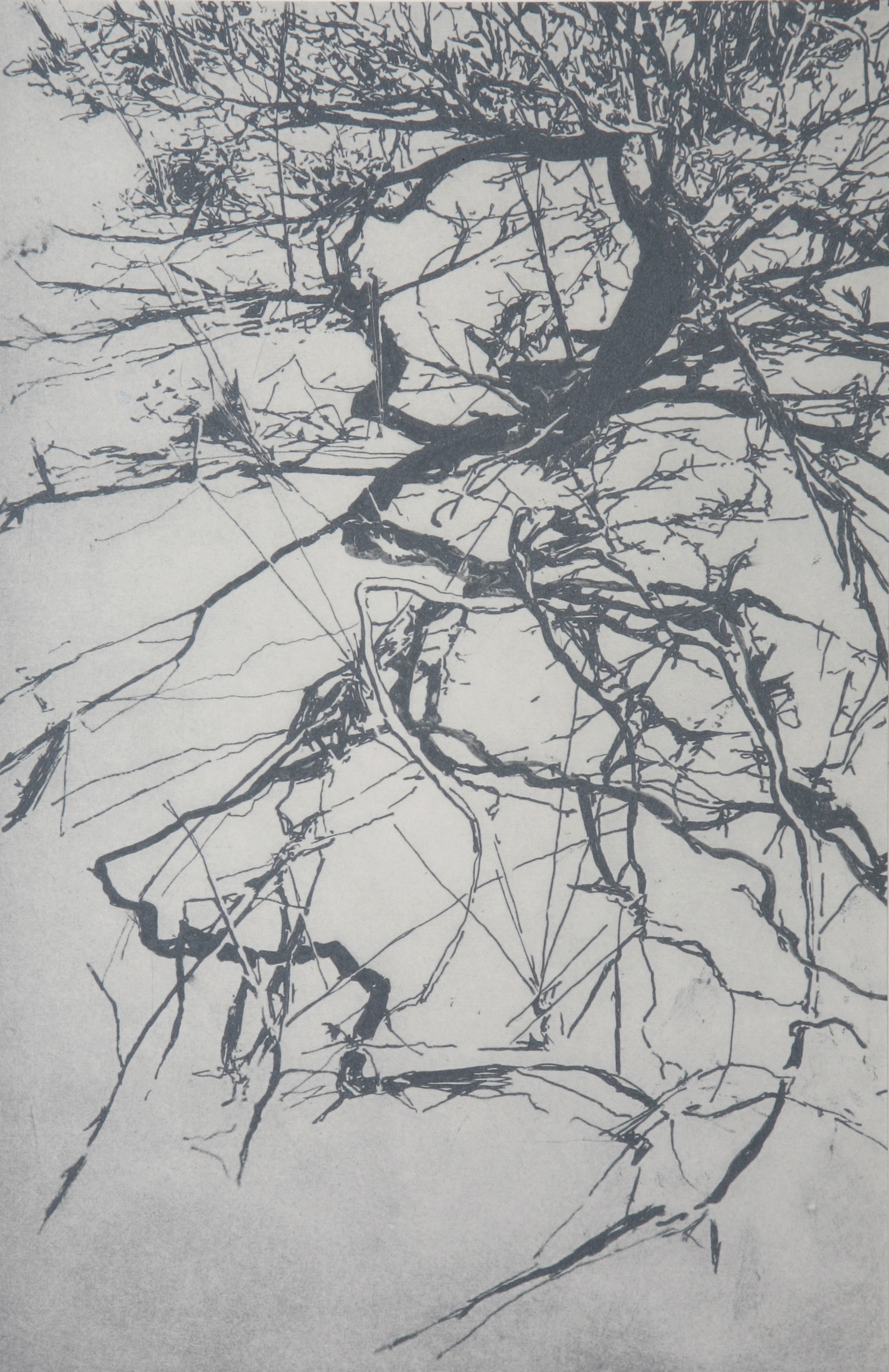
Sally has become a bit of an expert in beautiful, bare trees and branches. Whether or not this focus has anything to do with my Uncle Jim having been a supreme gardener and nature aficionado, I am not prepared to say, but if you read about Sally Frank here and look at some of her art, you will likely find that the trees speak to you in their subtle tree language.

Here Sally captures the intricate expressions of a beach plum bush.

Also, a lovely crabapple with a serene Asian vibe.

Read Full Post »

« Newer Posts