Feeds:
Posts
Comments

Posts Tagged ‘conservation’

Photo: Tulsi Rauniyar.
Climate-ravaged monasteries in Lo Manthang, Tibet, have been meticulously restored by the local community with guidance from experts.

Tulsi Rauniyar wrote recently at the BBC about ordinary Tibetans learning to restore Tibetan monasteries, rescuing them from the consequences of climate change.

“Extreme weather is threatening these intricate 15th Century Tibetan monasteries,” Rauniyar reports, “but local people are rising to the challenge to preserve them.

“Tashi Kunga stands before the Kag Choede monastery, built into the Dhaulagiri mountain range on the Tibet-Nepal border. The monk’s carmine robes glint in the rain, as he recounts the ancient legend of Guru Rinpoche’s battle with a demon.

“The legend goes that centuries ago, a demon wreaked havoc on a monastery in Tibet. Guru Rinpoche chased it south to Upper Mustang in Nepal and defeated the demon following a ferocious battle, burying the demon’s remains across the mountain range. The people of Mustang hono The people of Mustang honoured the sacred grounds by building monasteries atop the demon’s body parts.

” ‘And right on the demon’s heart, the capital of Lo Manthang [was built] in 1380,’ says Kunga, pointing towards the narrow alleys, ancient monasteries, and flat roofs adorned with prayer flags of one of the last medieval walled cities in the world.

“For centuries, Lobas, the indigenous people residing here, have thrived in this remote region situated on top of the Tibetan Plateau. One thing that has remained constant is the monasteries, locally known as ‘Gonpas,’ the most treasured heritage of the region. But almost two decades ago, many of these monasteries, which date back to the 15th Century, started crumbling.

Experts sounded the alarm, attributing the collapse to the severe impacts of climate change. Data indicates a significant increase in the intensity of storms and rainfall across the region. Increased rainfall saturates the rammed-earth buildings, as moisture in the soil is drawn upward into the walls, leading to issues such as leaking roofs and rising damp.

” ‘For us, Buddhists, the paintings and the artifacts in the monasteries are embodiments of the gods themselves, and we can’t worship a half-damaged idol,’ says Kanga.

‘There was no one to repair it. Our heritage was slowly decaying away. We thought the deities were angry.’

“Buddhist monasteries have long been revered as the foundation of Tibetan culture, serving as a vital hub for the creation and safeguarding of both tangible artifacts and profound intellectual traditions. But as unprecedented weather patterns pose a threat to their cultural heritage, local community members have stepped up to restore them. Local people have gained diverse skills, from reinforcing walls to crafting metal statues and restoring paintings.

“Over the past 20 years, a team of local Lobas trained by Western art conservationists have replaced the old, leaky roofs of the temples with round timbers, river stones, and local clay for waterproofing, and have restored the wall paintings, statues, sculpted pillars and the ceiling decorations, giving these centuries-old monuments a new life.

“Luigi Fieni, the lead art conservator at Lo Manthang, has spearheaded the restoration project. Transforming a community of farmers into conservators has been challenging, he says. Most of the Lobas had never held a pen or a paint brush before, and undertook extensive training before they began restoring the 15th Century paintings.

” ‘But it all worked out,’ says Fieni. ‘Tourists visiting Mustang were keenly interested in religion. So we felt these sacred artifacts needed preservation not only for their historical significance but also for sustaining livelihoods here.’

“The team, initially made up of 10 members, has grown to 45 conservators, mostly women, although there was initial reluctance to accept any women in the group. According to local tradition, women are prohibited from touching sacred objects. However, women did eventually take part in the Lo Manthang restoration project.

” ‘It took years of discussion and negotiation with the local clergy and community, but we succeeded in including local women in the wall-painting conservation team,’ says Fieni. …

“Tashi Wangmo, 40, used to spend her time herding yak, collecting and selling herbs, and doing various odd jobs, but it never provided much income. When she received the opportunity to pursue new training and earn a daily wage in the restoration project, she jumped at it.

” ‘It enabled many of us [women] to break free from the limits of our homes, expand our skillsets, and find new opportunities,’ she says.”

More at the BBC, here. No paywall.

If you want to learn about Tibet through some wonderful fiction, check out the Tibet mysteries by Eliot Pattison, starting with The Skull Mantra.

Read Full Post »

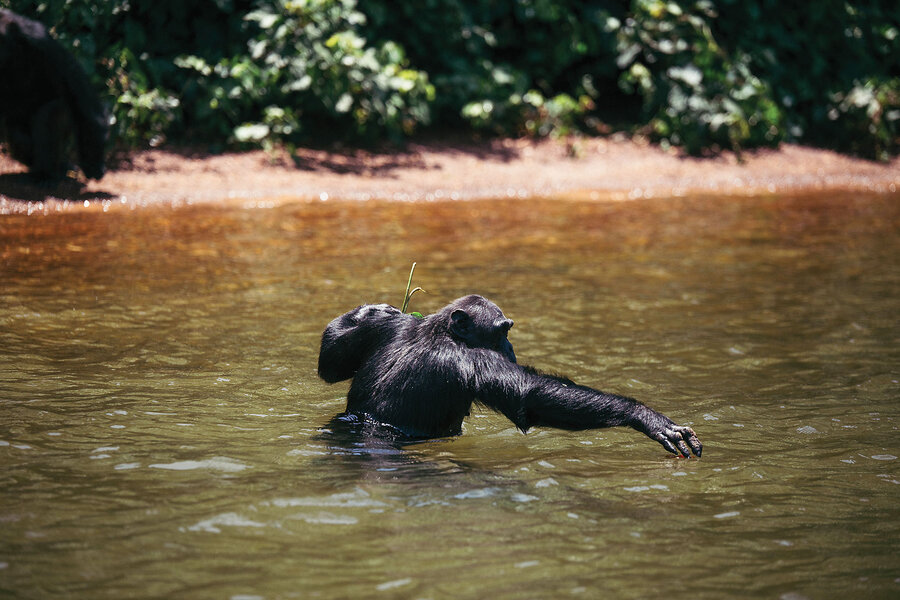
Photo: Kang-Chun Cheng.
A chimpanzee swimming near the Ngamba Island sanctuary in Uganda.

Exercise instructors like to tell you how everything in your body connects to everything else. For example, moving your eyes as if trying to look behind you can help your neck turn a little farther in a neck exercise.

Interconnectedness is also true of nature. Consider Uganda, where work is being done to simultaneously protect chimpanzees, tropical forests, small-farm agriculture, and families.

Kang-Chun Cheng writes at the Christian Science Monitor, “From the shade of a banana tree, Samuel Isingoma explains why he is sacrificing his precious jackfruit to chimpanzees.

“ ‘Since I support and give fruit to the chimps, they don’t disturb anything else,’ says Mr. Isingoma, who has planted 20 jackfruit trees on his 17-acre plot in the western Ugandan village of Kasongoire. The trees’ bounty is solely for the primates. …

“Uganda is East Africa’s largest sugar cane producer and has one of the fastest-growing populations on the continent. The need to make space for homes and farms is reducing the forest cover that helps sustain chimpanzees.

“James Byamukama, an executive director at the Jane Goodall Institute, says it’s critical to have discussions within communities rather than try to impose solutions. Community monitors from the institute’s Uganda chapter have recommended that farmers plant crops that aren’t so palatable to wildlife. So about eight years ago, Mr. Isingoma started planting coffee beans, leaving behind the maize he used to cultivate.

“Now he is taking the institute’s advice one step further by giving his fruit over to hungry chimps.

“As a result, Mr. Isingoma says, ‘I feel there isn’t much of a human-wildlife conflict.’ “

The nonprofit We Stand for Wildlife expands on the connections between farming and forests.

“When over 1000 Ugandan small holder farmers adopted WCS conservation farming practices they increased crop-based income 15 fold and halted clearing on 2700 hectares [6671.845 acres] of riverside forest.

“Following the end of the civil war in 1986 refugee families began to return to their lands in the Murchison-Semliki region of Uganda that contain the last remaining natural forest in the country outside of protected areas. These riverside forests form corridors connecting the national parks and are vital habitat for chimpanzees.

“To feed their growing families farmers began to clear the forest to plant crops. Traditional agricultural practices quickly exhaust the soil and farmers are forced to deforest new areas. Between 2006 and 2010 WCS sound science showed that farmers were clearing nearly 8,000 ha of forest each year. Unless this changed the forest and its resident chimpanzee would soon disappear.

“In an attempt to avert this deforestation trend WCS joined forces with the Jane Goodall Institute and the Chimpanzee Trust. Initially we hoped that we could help farmers to capture the value of their trees by selling their stored carbon in the voluntary REDD+ market place. But the high cost of certifying the carbon for sale and the low price of forest carbon made this idea untenable.

“At WCS we adapted our plans and began offering farmers training in zero tillage farming that conserves nutrients and soil moisture, which is critical as rains become less predictable with climate change.

Farmers who adopted the less capital intensive conservation farming methods saw their maize yields increase 2-fold and their net revenue by 15-fold.

“Today over 1000 farmers are using conservation farming technique that preserve soil fertility and crop productivity dramatically reducing the need to clear more forest. Analysis of forest cover change using the Global Forest Watch interactive mapper shows that deforestation has visibly declined in areas under conservation farming. In lila was forest before the start of the REDD+ project; in green the forest still today and although it is difficult to quantify a 1 to 1 cause and effect relationship it show that deforestation was a lot less where our Private Forest Owners/conservation farmers live.”

More at the Monitor, here, at WCS, and at the Jane Goodall Institute. No firewalls.

Read Full Post »

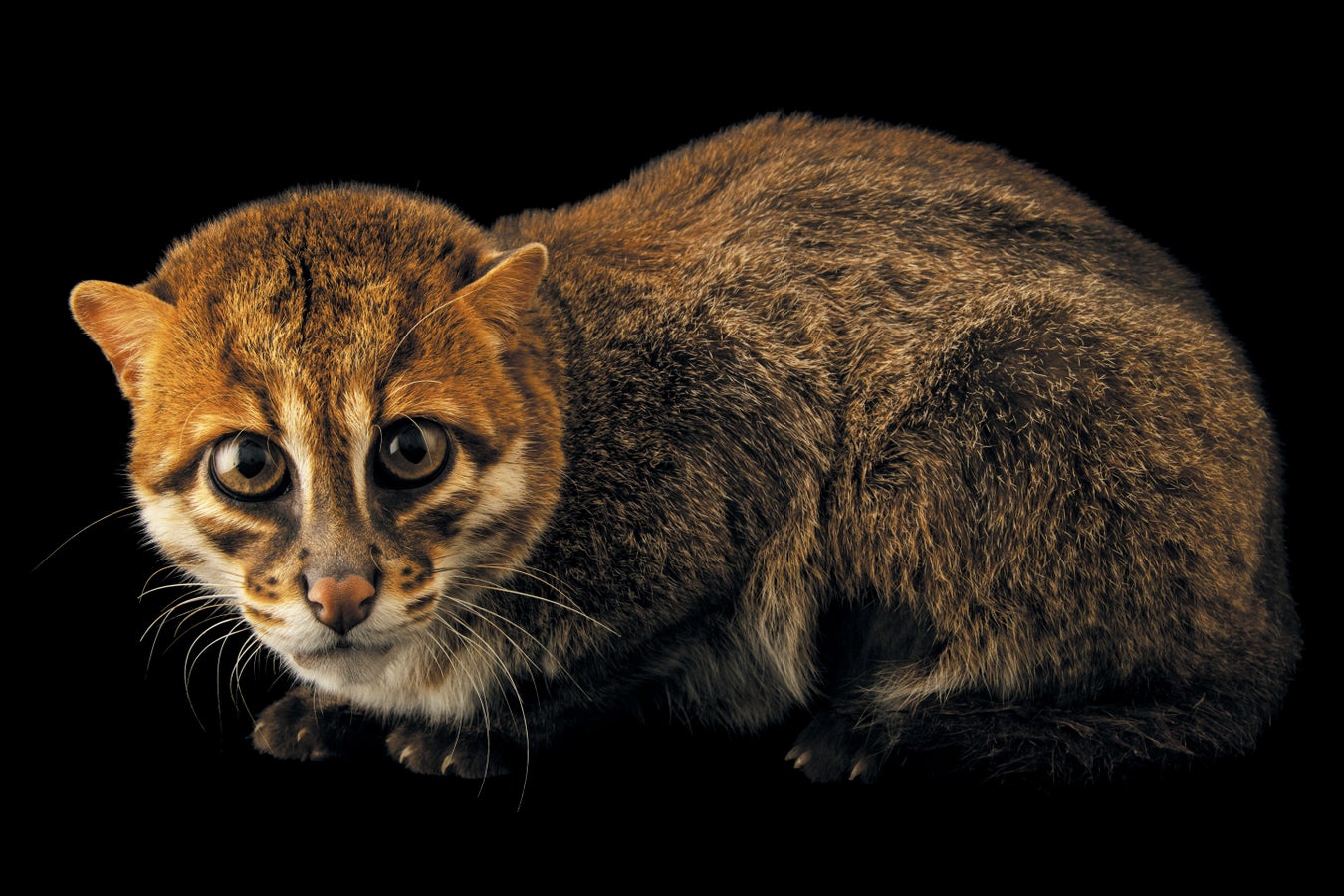
Photo: Joel Sartore/Photo Ark.
Rare flat-headed cats were declared “lost” before the species was rediscovered in 1995.

Lady Macbeth says, “What’s done cannot be undone.” Similarly, when a species is truly extinct, it’s done, never mind random talk of bringing back a wooly mammoth from its DNA. What is more feasible is bringing back to its former range a species that is merely extinct in that region.

Remember our post on the tiger quoll, thought to be extinct in southern Australia? And how about that gray whale, thought to be extinct in the Atlantic Ocean? It just showed up, although that was probably a sign of melting ice that could have opened a passage from the Pacific.

You might like Daniel Shailer’s related story at Scienific American on species that scientists think may yet be found. He explains how researchers will go about prioritizing their searches.

“Gison Morib was home lying in bed, sick from exhaustion after a month-long jungle expedition, when his phone buzzed and a black-and-white photograph appeared. Morib ran outside, jumped on his motorbike and sped through the city of Sentani on Indonesian New Guinea to his colleagues’ expedition and research base — where he broke down in tears.

“ ‘I cannot believe we found it,’ was all he could say, over and over. The photograph showed the first recorded sighting in more than 60 years of an Attenborough’s long-beaked echidna, an egg-laying mammal. After the researchers had spent three years of research and four weeks of trekking through the island’s remote Cyclops Mountains … the team’s camera trap had finally captured an image of the echidna. ‘Even now I can’t describe the feeling,’ … says Morib, a biology undergraduate student at nearby Cenderawasih University. …

“It can be painful for scientists to conclude that an entire species is gone forever. So after at least a decade without recorded sightings, local researchers sometimes simply declare a species temporarily ‘lost’ — hoping it may eventually be found again — instead of giving up entirely. In 2023 that hope led to rediscoveries of animals that included Attenborough’s echidna, De Winton’s golden mole in South Africa and the Victorian grassland earless dragon, a type of Australian lizard that went unseen for half a century. Such hope also fuels ongoing, decades-long searches for species such as the American Ivory-billed Woodpecker, which was last seen in 1944.

“Now an international study published [in] Global Change Biology aims to ‘bring a bit of science back to the search’ for all mammals, amphibians, reptiles and birds playing hide-and-seek, according to senior study author Thomas Evans, a conservation scientist at the Free University of Berlin. In a span of two years, Evans and a team of researchers across the globe — from the U.S. to China, Ecuador and South Africa — compiled what they call the most exhaustive catalog ever of four-limbed creatures that were considered lost to science and those among these animals that were later rediscovered. …

“Although there has been plenty of research into lost species, the study authors say that rediscoveries haven’t been thoroughly assessed since 2011. Analysis tallying losses and rediscoveries across animal groups is even rarer, Evans says.

“His team’s catalog suggests that 856 species are currently missing and that the number of lost species is growing around the world faster than expedition parties can keep up. And this is occurring even though researchers are finding animals through the use of increasingly sophisticated technology, including systems that detect environmental DNA (eDNA) traces of burrowing birds near the South Pole, software that disentangles the noises of different nocturnal species, and even techniques used to spot microscopic traces of rare frogs in ship rats’ stomachs.

“Adding up losses and rediscoveries also suggests that roughly a quarter of lost species are likely already extinct. … Analysis shows that many rediscovered species fit a certain profile: they are big, charismatic mammals or birds that tend to live across a range of habitats, often near humans and in more-developed countries. So, Evans says, if an animal fits the bill for the kind of species that is usually found more easily but continues to evade researchers after long searches, it is probably gone forever. The thylacine, or Tasmanian tiger, is a good example: since the last captive thylacine died in a zoo in 1936, the wolflike species has taken on huge cultural significance across Australia and inspired decades of searching, but it remains lost. The paper argues that precisely because the thylacine is a perfect candidate for rediscovery, the fact it remains lost strongly suggests that it is actually extinct. The same goes for more than 200 other lost species that have been thoroughly searched for as well, Evans says.

“On the other hand, creatures that don’t fit the profile for easy rediscovery, especially reptiles, could still be out there. Because they’re often hard to find and inspire less search effort, small, uncharismatic species are more likely to genuinely be lost but still alive, Evans says. His optimism is backed up by the numbers: new species of small reptiles continue to be discovered at a steady rate, and rediscoveries have boomed, with more than twice as many lost reptiles found between 2011 and 2020 than in the decade before.

“The thylacine has acquired a Bigfoot-like status, complete with amateur hunters and highly questionable sightings. Meanwhile reptiles such as the Fito leaf chameleon of Madagascar are probably sitting pretty and waiting to be found. …

“A probability analysis of some factors also rang ‘alarm bells’ in different ways for different classifications of lost species, Evans says. Mammals classified as lost on islands, such as the Bramble Cay melomys, a rat lost in 2009 and declared extinct in 2016, are disproportionately likely to be gone for good, compared with mammals in other environments. There’s also a sweet spot for finding birds after they’ve been lost: 66 years, on average. This time span is long enough to raise interest in search expeditions but not so long that the animals are considered extremely likely to be extinct. So the odds are not good for the more than a dozen bird species that were lost more than a century ago.

“Evans hopes such details about what may be simply unseen versus what is more likely extinct will help conservationists.”

More at Scientific American, here.

Read Full Post »

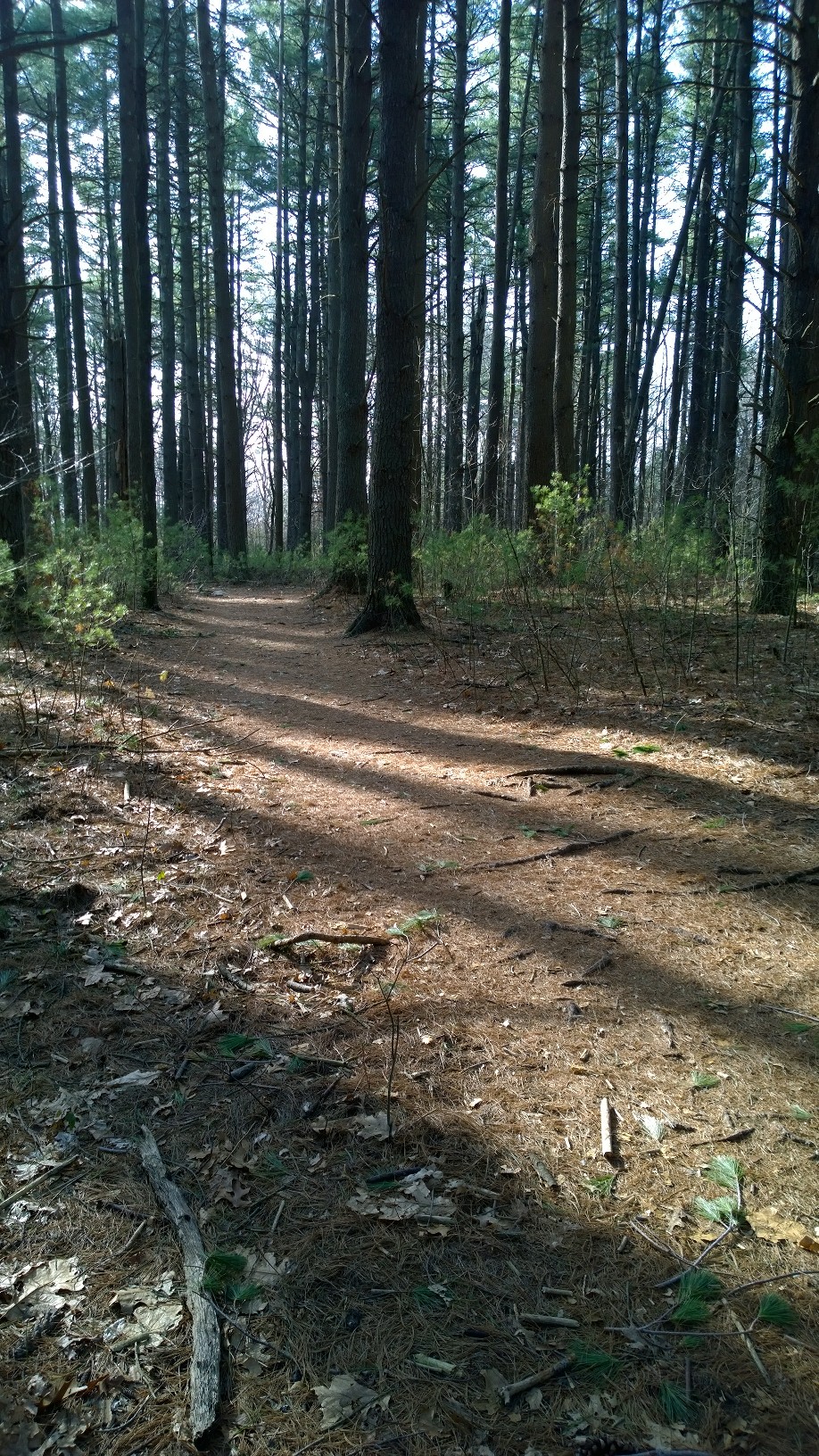
041217-shadows-stripe-forest-floor

Photo: Suzanne and John’s Mom.
Some living things benefit the planet more the older they get.

Those of us who were enthusiastic about planting zillions of trees to store carbon have been learning that the trees need to be part of a healthy ecosystem to do the most good. A collaboration among hundreds of forest ecologists offers keys to what works.

Patrick Greenfield writes at the Guardian, “Forest conservation and restoration could make a major contribution to tackling the climate crisis as long as greenhouse gas emissions are slashed, according to a study.

“By allowing existing trees to grow old in healthy ecosystems and restoring degraded areas, scientists say 226 gigatonnes of carbon could be sequestered, equivalent to nearly 50 years of US emissions for 2022.

But they caution that mass monoculture tree-planting and offsetting will not help forests realize their potential. …

“The research, published [in November] in the journal Nature as part of a collaboration between hundreds of leading forest ecologists, estimates that outside of urban agricultural areas in regions with low human footprints where forests naturally exist, they could draw down large amounts of carbon.

“About 61% of the potential could be realized by protecting standing forests, allowing them to mature into old growth ecosystems like Białowieża forest in Poland [check out the new Polish administration’s environmentalism] and Belarus or California’s sequoia groves, which survived for thousands of years. The remaining 39% could be achieved by restoring fragmented forests and areas that have already been cleared.

“Amid greenwashing concerns around nature’s role in climate crisis mitigation, the researchers underlined the importance of biodiversity helping forests reach their carbon drawdown potential, warning that planting huge numbers of single species would not help and urgent cuts to fossil fuel emissions were needed.

“Rising numbers of forest fires and higher temperatures due to the climate crisis would be likely to reduce the potential, they said. ‘Most of the world’s forests are highly degraded. In fact, many people have never been in one of the few old growth forests that remain on Earth,’ said Lidong Mo, a lead author of the study. ‘To restore global biodiversity, ending deforestation must be a top priority.’

“At Cop26 in 2021, world leaders pledged to halt and reverse deforestation by the end of this decade, although data shows that countries are currently off track. Brazil, Colombia and Indonesia are among nations making progress, however. The researchers said meeting this target, along with making good on UN climate and biodiversity agreements, was crucial to forests reaching their full potential.

“ ‘Conserving forests, ending deforestation and empowering people who live in association with those forests has the power to capture 61% of our potential. That’s huge. It’s potentially reframing forest conservation. It’s no longer avoided emissions, it’s massive carbon drawdown, too,’ said Tom Crowther, the head of the Crowther Lab at ETH Zurich. …

“ ‘It can be achieved by millions of local communities, Indigenous communities, farmers and foresters who promote biodiversity. It could be agroforestry for cacao, coffee or banana, natural regeneration, rewilding or creating habitat corridors. They’re successful when nature becomes the economic choice.’ …

“The research follows a controversial 2019 paper on the potential of forests to mitigate the climate crisis, which was also co-authored by Crowther, that provoked intense scientific debate among forest ecologists. … Several scientists felt that potential for nature to help meet climate goals had been overstated and the paper advocated for the creation of mass tree-planting, driving greenwashing concerns.

“Simon Lewis, a professor of Global Change Science at University College London who was a leading critic of the 2019 paper, said the new estimate was much more reasonable and conservative.

“There is a lot of spin and bluster about what trees can do for the environment. To cut through this always ask: what is the amount of carbon taken up by a hectare of land, and over what time period, he said. … ‘There is still only a finite amount of land to dedicate to forests, and ability of trees to sequester carbon is limited. The reality is that we need to slash fossil fuel emissions, end deforestation, and restore ecosystems to stabilize the climate in line with the Paris agreement.’

“Crowther acknowledged that he had been overzealous in the messaging around the 2019 paper. … ‘The fact that it was so much carbon I think gave people the idea that [the study] was suggesting that tree planting could be an alternative to cutting emissions, which categorically cannot be.’ ”

More at the Guardian, here.

Read Full Post »

Map: Wikipedia.
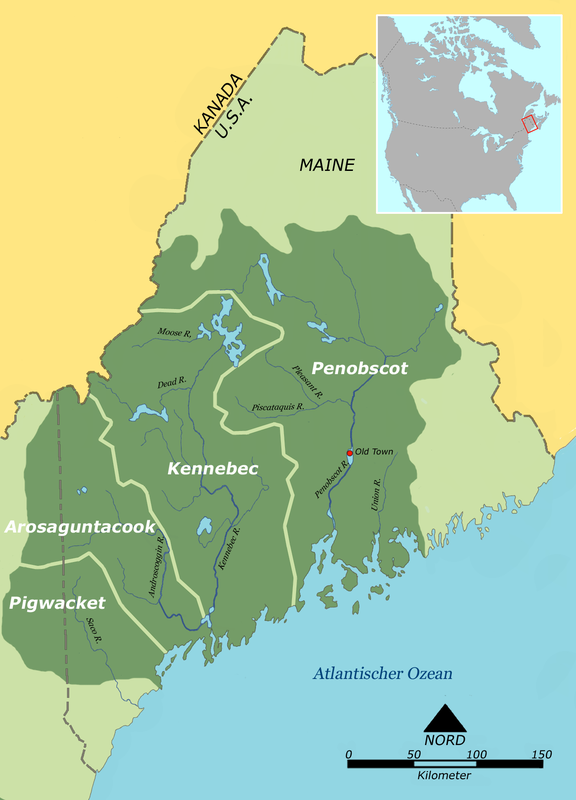
Eastern Abenaki tribes (Penobscot, Kennebec, Arosaguntacook, Pigwacket/Pequawket). Indigenous people often exhibit the best stewardship of natural resources.

What can we learn from people who have been taught from infancy how to live in harmony with the natural world? In an op-ed at the Washington Post, Bina Venkataraman suggests that “in Maine, a return of tribal land shows how conservation can succeed. …

“On a recent morning at the Penobscot Nation headquarters, moose mating rituals dominated the office banter: the wacky way a lovesick moose had stumbled around someone’s pickup truck [when] he heard a hunter’s [mating call]. …

“The Penobscot Nation’s record of caring for nature while still using it — hunting moose and duck while keeping their populations steady, selectively harvesting timber to preserve forests and restoring rivers to support fisheries — inspired an effort to return a 31,000-acre tract of forested land to tribal ownership.

“Late last year, the Trust for Public Land, a conservation group, bought the parcel from an industrial timber company, and today it announced it will give the land to the tribe once it pays off $32 million in loans. …

“The land is close to Mount Katahdin, sacred in Penobscot tradition, and to an 87,000-acre national monument created in 2016 in the North Woods of Maine. It contains 53 miles of streams in the watershed of the Penobscot River, which has been for the tribe a central highway and a source of food and water.

“The transfer is part of a movement to return lands to Indigenous stewardship and work with tribal communities to protect biodiversity. The hope is both to restore justice for tribes that were long ago stripped of their ancestral homelands and to learn from long-standing Indigenous practices new ways to save a beleaguered planet. The pending land return in Maine, or ‘rematriation’ as some Indigenous people call itstands out because of its scale — many previous land returns in the eastern United States have been on the order of hundreds of acres — and because the Penobscot will decide how the land will be managed.

“This is a significant change. For most of the past two centuries, Western conservationists have largely ignored Indigenous people’s knowledge of landscapes and wildlife, along with tribes’ historic claims to the land. But that is no longer tenable. Worldwide, Indigenous-managed lands host 80 percent of the world’s biodiversity, by some estimates, and encompass much of the world’s remaining intact forests, savannas and marshes. If environmentalists and political leaders hope to conserve more natural landscapes … collaboration with tribal nation leaders is critical.

Modern environmentalism has been deprived of Indigenous knowledge, in part, because it has seen nature as something apart from humans.

“Early thinkers hold some responsibility for this. John Muir, long lauded as the father of the national parks, believed that natural landscapes needed to be stripped of the Native Americans who lived on them to create his ideal of pristine wilderness. In the Muir tradition, the U.S. government drove tribal people out of areas that today are considered America’s most beloved landscapes — Yellowstone, Yosemite, the Everglades — a history documented by David Treuer, an Ojibwe writer.

“The federal government created the National Bison Range in 1908 by evicting tribal members from more than 18,000 acres of the Flathead Indian Reservation — ignoring century-old practices for keeping up the bison herd. Only recently has the government returned the land to the Confederated Salish and Kootenai Tribes, whose successful traditional methods for maintaining the herd are featured in a forthcoming ABC documentary.

“When Henry David Thoreau … traveled to the Maine woods in the 19th century, he distinguished between ‘scientific men’ and Indian guides, even as he acknowledged the latter’s navigational expertise. It’s laughable now to think that communities that had inhabited a place for centuries, gaining intimate knowledge of the natural features, flora and fauna and passing down that knowledge across generations, could have less to offer scientifically than settlers encountering those lands for the first time. Yet it was only last year that the U.S. government formally recognized how much tribes can contribute to ecological knowledge of their ancestors’ landscapes. …

“For decades, tribal members in Maine advocated bringing down Penobscot River dams that once powered saw and paper mills to restore an Atlantic salmon fishery. The Penobscot method of timber harvesting, which leaves 75- to 100-foot buffers of trees around rivers and streams, creates ideal conditions for salmon. Salmon like to spawn upriver in shady pools, created by allowing the forest at a river’s edge to thicken and birch trees to fall into it. …

“Some evidence suggests that, globally, the track record for Indigenous management of wildlife is at least as good as that of formal conservation. Researchers have shown, for instance, that Indigenous-managed lands in Canada, Australia and Brazil contain biodiversity equivalent to that of areas designated for conservation.

“But perfect alignment between tribes and environmental groups doesn’t always happen. The economic challenges that many tribes face — and their efforts to acquire land to reclaim sovereignty — often force tough decisions about development, gambling and heavy industry. Some tribal nations have greenlighted oil and gas drilling. The Penobscot have allied with conservationists to oppose a proposed zinc mine in northern Maine because of its likely harm to fisheries. But several tribal members expressed to me their misgivings about wind farms, which most environmentalists see as essential to combat climate change.

“Penobscot leaders have varying visions about how they might one day develop the land that is now being returned to them. Some imagine using it to adapt to sea-level rise — by building housing or growing food; others envision ecotourism lodges or a cultural center that could be accessed by the general public. In the near term, tribal leaders aim to make it accessible to hikers and hunters with permits and to offer public access to the national monument via an old logging road.

“In other parts of North America, co-management of conservation areas is becoming more common. … Groups such as the Trust for Public Land and the Nature Conservancy are brokering more land returns and collaborating with tribes to manage ecologically important landscapes. But more private landowners, philanthropists, nonprofit groups and governments should mimic the efforts in Maine. …

“Environmental movements might have better protected nature if they had long sought to conserve cultures and communities along with land. Earning the trust now of people who have inherited wisdom for living in balance with nature will give conservation a fighting chance on a warming planet.”

More at the Post, here.

Read Full Post »

Photo: Brett Stanley.
The Ocean State’s Jesse Jewels as a mermaid.

Some readers may remember reading in a 2021 post (here) that the US has not one but two mermaid museums! Through that article, I myself learned that spending your free time as a mermaid or merman is a real thing. And quite an industry for waterproof-costume makers.

Today we hear from Emily Olson at ecoRI News, that there’s a mermaid in Rhode Island who’s a serious activist for the ocean.

“When she was young, Jessie Jewels imagined herself a mermaid, moving effortlessly beneath the waves, hair billowing in the current as she played with her ocean friends. But too soon she outgrew her imaginary mermaid tail and contented herself — at least for a while — with exploring the sea on two legs. …

“Jewels is a free diver certified by the National Association of Underwater Instructors, a SCUBA diver, a kayaker, and a Save The Bay beach captain, a role that tasks her with organizing beach cleanups. And in 2021, she revisited the ocean of her childhood imagination when the siren song of mermaiding reached her ears.

“ ‘I found out there’s a culture of mermaids and mermen and mertheys who approach mermaiding as a hobby and athletic sport, and it called to me,’ said Jewel, who willingly succumbed to temptation and donned — or grew, as she’d say — a tail of her own.

“She slowly became more immersed in the culture and decided to test her skills by entering the Miss Mermaid USA pageant, which is similar to Miss USA, but with a twist. ‘You wear the dresses and do all the glam and answer all the questions, but we also do underwater modeling and swimming to show our grace, poise, and distance abilities,’ she said.

“Breath holding is also part of the competition and Jewel can hold hers for 2 minutes, which may sound like a lot to a landlubber, but is a mere fraction of what some professional aquarium mermaids can do.

“Jewels won the Miss Mermaid USA state competition in 2021, 2022, and 2023. She uses her platform to advocate for the importance of clean waterways and draw attention to her work with Save The Bay.

“ ‘I am constantly on Narragansett Bay, and I have seen how things have changed,’ she said. ‘There is a lot of debris floating on the surface, and underwater, there’s a big problem with algae and bacteria, exacerbated by overfishing. I’m in that water, so I see the problems. We’re losing our wild places.’

“She also believes in keeping Rhode Island waters accessible, a value she shares with Save The Bay. …

“When Mermaid Jessie Jewels appears at children’s birthday parties, she encourages them to be stewards of the sea and protect aquatic life. She’s also a mixed-media artist, and a portion of every piece of mermaid-related art she sells goes to Save The Bay. …

“For those who want to join the merfolk community, Jewels hosts mermaid makeovers and photo shoots at her art studio, but she recommends that anyone who wants to learn to swim like a mermaid take a swimming class with a focus on safety. And she stresses the importance of always having a swim buddy.

“And Jewels is really strong, partly due to her months of training last year that led her to the merlympics — an athletic competition for mermaids. The competition requires athletes to don their tails and swim lengths in a pool and navigate an underwater obstacle course. … ‘It was a very, very challenging competition, but super fun,’ she said.

“To learn about Jessie Jewels’ classes and entertainment, visit jessiejewelsart.com. To join her at a Save The Bay beach cleanup, visit savethebay.org.”

More at ecoRI News, here. No paywall.

Read Full Post »

Photo: Rewilding Europe.
By 1627, the massive auroch had been hunted to extinction across its entire range. But strands of its DNA remain alive, and in 2013, Rewilding Europe, together with the Dutch Taurus Foundation, embarked on a program to bring the auroch back to life.

Are you up for another “extinct but still around” story? This one is about the mighty auroch, whose bull form Zeus assumed in one Greek myth. The rewilding folks in Europe are using the auroch’s remaining DNA to bring it back.

Gerry Hadden at PRI’s The World reported recently on the herd being “back-bred” in Spain.

“The auroch — giant, wild cows — date back nearly 10,000 years and once roamed freely across Europe. Until they were hunted to extinction by humans. The last ones died in Poland in 1627, according to Ricardo Almazán, a safari guide in the mountains of Albarracín, Spain, where a herd of modern-day aurochs can be found. 

“Today, the wild bovine — called tauros in Spanish — are here once again thanks to the nongovernmental organization Rewilding Spain.

“They are working to ‘rewild’ the auroch — or bring back the animal hunted out of the area to restore the wilds as they were before. …

“Aurochs played a key role in the ecosystem — namely, grazing the largest brush and small trees to keep forests from growing too dense and prone to burning. …

“Reintroducing the auroch to the wild involves crossbreeding cows with the ancient genes of the aurochs, according to Lidia Valverde from Rewilding Spain.

“So, taking the ‘genetic features from different breeds of cows that we know that are descendants of that wild ancient cow’ to create a new breed, she explained. But they’re not introducing an entirely new species — scientists have managed to recover more than 90% of the aurochs’ DNA, she said.

“Rewilding Europe, together with the Dutch Taurus Foundation, began the program to bring back the auroch in 2013. Now, the breeding of aurochs is happening in a selective way in Spain, Portugal, Croatia, Czech Republic, Romania and the Netherlands. And, more than 600 of the animals have been bred since the end of 2017, according to Rewilding Spain.

They are reminiscent of fighting bulls, but up to three times bigger.

“Almazán said these new aurochs look and behave just like their forebears. They are reminiscent of fighting bulls, but up to three times bigger. An auroch may weigh over 2,000 pounds, with horns hovering 7 feet above the ground. They are Europe’s largest herbivore.

“Almazán said their presence in the forest is evident in the fact that a lot of trees have been knocked down — the aurochs walk along and smash them flat and then eat the wood and everything. The cows’ behavior has a larger, ecological benefit, he said. The new clearing has allowed the sun to reach the forest floor for the first time in years, giving other plants the chance to grow and attracting insects, birds and other grazers, like deer.

“Local farmer, Paco Rollola, who works with Almazán to help keep the aurochs from straying too far, said that lightning struck a tree nearby recently, but it didn’t start a fire because there was no undergrowth around the tree. The aurochs had eaten it all, he said. Without them, he said, everything would have burned down.

“Valverde of Rewilding Spain said that the beasts are not only making this forest healthier, but they’re also helping the local economy [by] attracting tourists to an area seldom visited.”

More at the World, here. I am fascinated by rewilding projects, but as for these giant animals, I just hope they don’t bulldoze (to coin a phrase) the wrong trees. Can’t you just imagine a science fiction film in which the program runs amok?

All innovations need supervision, I guess.

Read Full Post »

Photo: Annas Radin Syarif / AMAN at Medium.
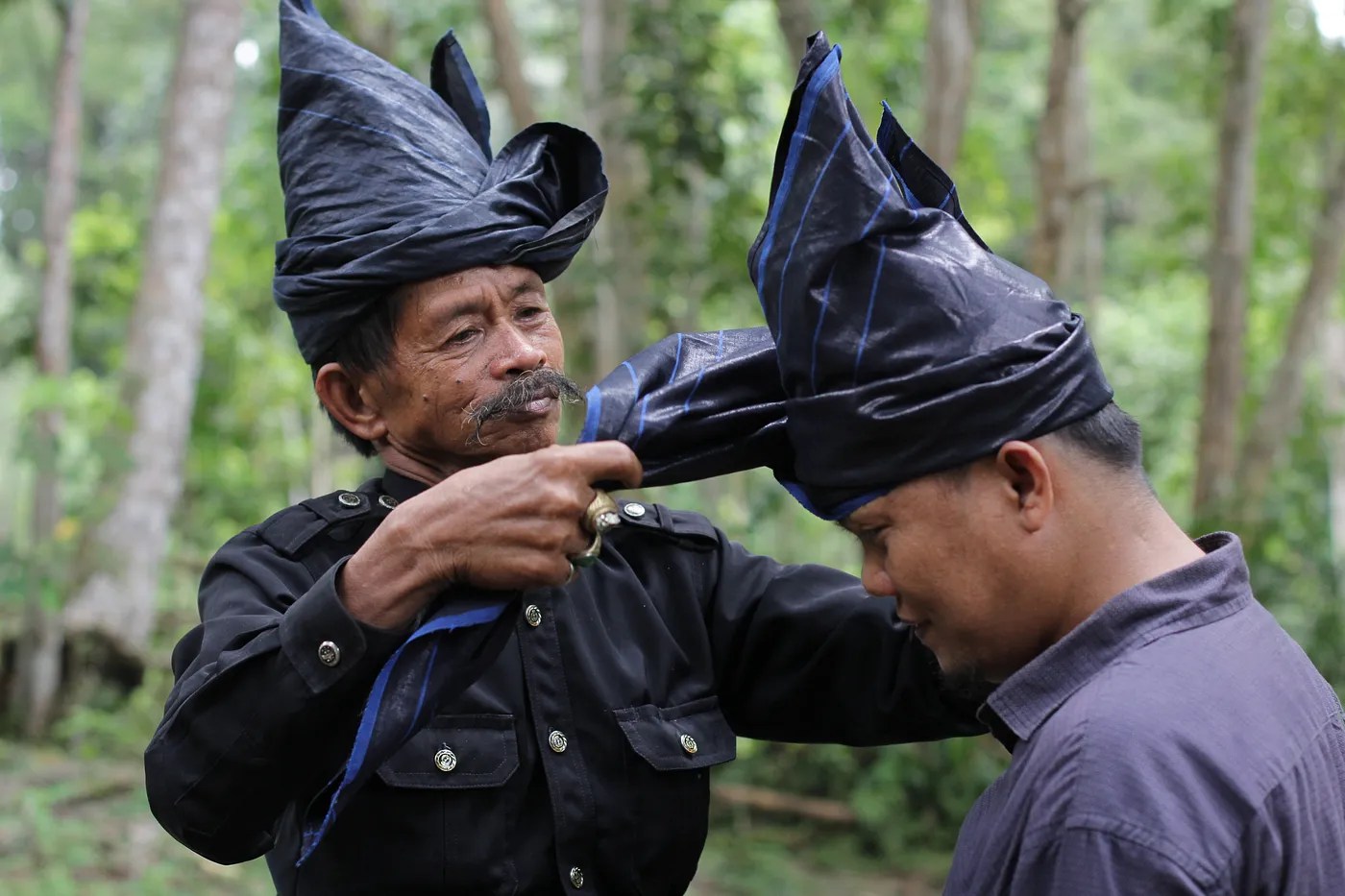
A Kajang elder in Indonesia demonstrates the wearing of a passapu headwrap and the passing of knowledge to the next generation.

While most of the world was going full-steam on nature-destroying “progress,” many indigenous groups were quietly protecting whatever was left.

Peter Yeung at the Washington Post writes about the Kajang people in Indonesia.

“By midmorning, beams of tropical sun cut through the rainforest canopy, illuminating a bamboo hut in a rare clearing of trees. Inside, a wrinkled old man, sitting cross-legged with his eyes shut, whispers blessings to the Earth.

“After the spiritual leader, the Ammatoa, goes silent, groups of men wearing dark indigo sarongs jump to their feet and head into the forest carrying an offering of rattan baskets full of rice, bananas and lighted candles.

‘The Earth is angry with us,’ said Budi, a barefoot boy crouching on the hut’s edge. ‘That is why the weather is getting worse. There are more rains and floods. It is getting hotter. It is because we have sinned.’

“This ritual is known as the Andingingi, held once a year by the Kajang, a tribe from the Indonesian island of Sulawesi. Like many parts of the world, their land has been hit by more extreme weather because of climate change. But as satellite imagery shows, the Kajang’s dense primary forest is free from roads and development, soaking up violent rains that devastate other parts of the island.

“As global deforestation continues at alarming rates, the empowerment of Indigenous peoples such as the Kajang is emerging as a key way to protect the world’s rainforests. A spate of recent research suggests that when armed with land rights, these communities, whose members manage half the world’s land and 80 percent of its biodiversity, are remarkably effective custodians. …

“The Kajang [community] lives according to the Pasang Ri Kajang, an ancestral law passed down orally through legends and tales. It tells of how the first human fell from the sky into their forest, making it the most sacred place on Earth.

“In practice, that means the forest is at the center of life. The Kajang rely on subsistence agriculture, with no industry or commerce to speak of. Cutting trees, hunting animals and even pulling up grass is prohibited on most of the land. Modern technology, such as cars and mobile phones, is not allowed within the traditional territory.

“ ‘The tree is just like a human body,’ said Mail, a 28-year-old Kajang. … ‘If the forest is destroyed, there will be nothing for the bees, nothing for the flowers and nothing for life.’

“So far, Indigenous tribes have received little legal, financial or institutional backing, advocates say. A 2021 report by the nonprofit Rainforest Foundation Norway found that over the past decade, Indigenous peoples received less than 1 percent of donor funding for fighting deforestation.

“Yet policy is now beginning to shift in recognition of the role they can play in protecting the land. …

“At the U.N. Climate Change Conference in 2021, also known as COP26, world leaders pledged $1.7 billion of funding for these communities, calling them ‘guardians of forests.’ …

“In December 2016, the Indonesian government officially recognized more than 50 square miles of rainforest as belonging to nine of the country’s tribes — including the Kajang — following a landmark ruling by the nation’s highest court. … In a case brought by the Alliance of Indigenous Peoples of the Archipelago (AMAN), an Indonesian nonprofit, the Constitutional Court ruled in 2013 that the state should transfer ownership of what are called customary forests to the Indigenous peoples who had historically governed them according to custom. …

“The rate of primary forest loss in Indonesia has declined every year since 2016, according to the most recent data available, and is now at its lowest level since at least 2002.

“The recognition of customary forests, along with government efforts to protect peatlands and mangroves and to tighten regulations on logging, oil palm and mining permits, has helped drive that reduction. …

“The Kajang are a showcase of Indonesia’s experiment. For years, local forest rangers have helped protect a wealth of native wildlife, including deer, monkeys, wild boars and tropical birds, as well as four rivers, whose watersheds supply several villages outside Kajang land. ..

“The philosophy of Kamase Mase, living simply and taking no more than needed to subsist, underpins their lifestyle here. …

“ ‘We must keep the tradition,’ said Jaja Tika, a weaver. … ‘As long as we live, the forest will exist.’ ”

More at the Post, here.

Read Full Post »

Photo: Alfredo Sosa/CSM Staff.
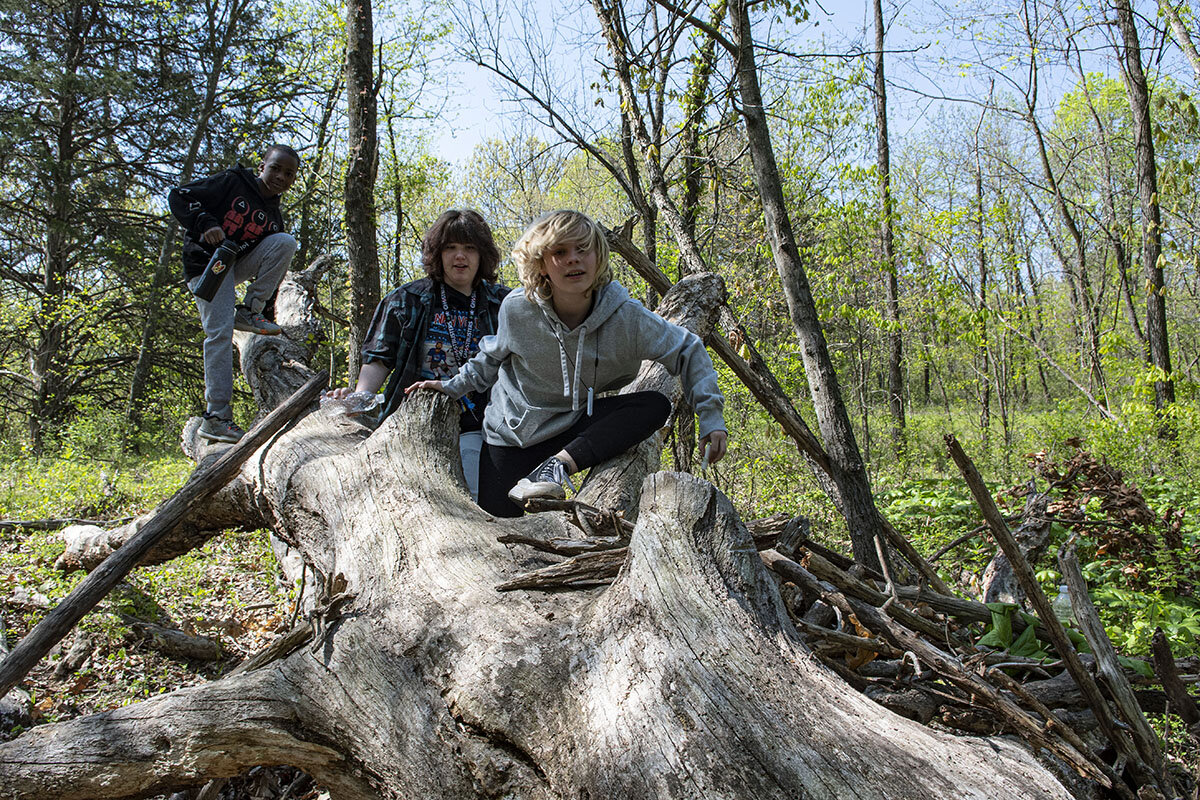
Students from Thorpe Gordon Elementary in Jefferson City, Missouri, at the Runge Conservation Nature Center in April.

It’s not a new idea, but it’s gaining traction: Getting kids outside into nature benefits their learning.

Jackie Valley writes at the Christian Science Monitor, “Down a hiking path and through the woods, giggles and chatter echo from a clearing where elementary students have just finished constructing makeshift shelters.

The challenge blended environment with engineering, hence this visit to the Runge Nature Center from third, fourth, and fifth graders. They’re part of a STEM (science, technology, engineering, and math) club at nearby Thorpe Gordon Elementary in Jefferson City, Missouri. …

“A boy announces he saw a turkey, while another student proclaims ‘teamwork’ her favorite part. The scene portrays what conservation leaders and educators in Missouri are hoping to instill in the state’s youngest residents: an appreciation for the outdoors, a new experience, and some learning along the way.

“ ‘I think it’s so important,” says Melanie Thompson, a librarian from the elementary school who’s leading the STEM group on this day. ‘Kids don’t spend enough time playing outside.’

“In Missouri, efforts to connect children with nature date back to 1939. That’s when the Nature Knights program launched, giving children recognition for conservation practices. Three years earlier, the state’s residents approved an amendment that created an apolitical conservation agency.

“Today, terms such as nature education, outdoor learning, and environmental education refer to instruction that, in many ways, takes students out of traditional classroom settings. Subtle nuances exist, though, depending on the location and programming. The Environmental Protection Agency defines environmental education as a type of learning that allows people to ‘explore environmental issues, engage in problem solving, and take action to improve the environment’ – while also not advocating a particular viewpoint.

“The Missouri Department of Conservation, meanwhile, sees nature education as a way to ‘inspire and educate individuals about nature so they appreciate and ultimately protect our resources and wild places,’ says Brian Flowers, a regional supervisor for the agency’s education branch. …

“ ‘You introduce them to it,’ says Mr. Flowers, referring to conservation, natural resources, and wildlife. ‘You show them why it’s important, and, eventually, that leads to that they care about it. They protect it.’

“A study called The Nature of Americans, conducted in 2015 and 2016, found that more than 80% of children surveyed said time in nature made them feel creative, happy, healthy, and smarter. …

“ ‘Once they’re there, there’s so much that happens – curiosity and creativity and just enjoyment of being outside,’ [Megan Willig, a program coordinator for the National Environmental Education Foundation] says. It can also introduce students to career pathways in the natural resource, conservation, and STEM fields.

“In a grassy field not far from an elderberry patch, a sustainably designed building with large windows and a gently sloping roofline is under construction. It’s the future Boone County Nature School, which occupies land in the Three Creeks Conservation Area and will welcome a rotating cast of 12,000 to 13,000 students each year, says Mr. Flowers.

“The project represents a partnership among the Missouri Department of Conservation, Columbia Public Schools, community organizations, and other school districts in Boone County.

“Columbia Public Schools has hired a teacher to lead instructional efforts at the Boone County Nature School, which fits into the district’s overall mission to pour more resources into place-based learning, says Michelle Baumstark, the chief communications officer. About half of the district’s students qualify for free or reduced-price lunch.

“ ‘These may not be experiences that they would have any other way and when you can create an access to an enriching opportunity, that can change the trajectory of a kid,’ she says.

“The land surrounding the nature school will feature a food forest, pollinator plots, a prairie restoration area, trails, a pavilion, and a council house with three tiers of stadium seating. The karst topography of the conservation area – caves, springs, and hills – is typically only found in southern Missouri near the Ozarks, making it an ideal exploration area for local children, Mr. Flowers says. …

“The Missouri Department of Conservation also operates programs that teach students archery and how to fish, among other things. And, in St. Louis, pavement will be removed and replaced with a green schoolyard at Froebel Literacy Academy. Picture a park-like setting with trees and wildflowers, where students can play and learn through STEM activities.

“The schoolyard project represents a step toward outdoor equity for children who grow up in urban areas that have more concrete and asphalt than lush, green recreation space, says Aaron Jeffries, deputy director of the Missouri Department of Conservation. …

“There’s no national standard for outdoor learning or environmental education, says Ms. Willig of NEEF, which was congressionally chartered in 1990 to complement the work of the EPA. So efforts differ by state and local jurisdiction, though she has seen more interest in making it a formal part of the curriculum.

“If barriers such as time or transportation exist, Ms. Willig recommends that school systems seek community partnerships. For instance, a local nonprofit that supports watershed health, she says, may be keen on helping with programming.

“ ‘The school doesn’t need to reinvent the wheel or start from scratch,’ she says.”

More at the Monitor, here. No firewall, nice pictures.

You can read another of my posts on kids benefiting from nature at school, here.

Read Full Post »

Photo: Charukesi Ramadurai.
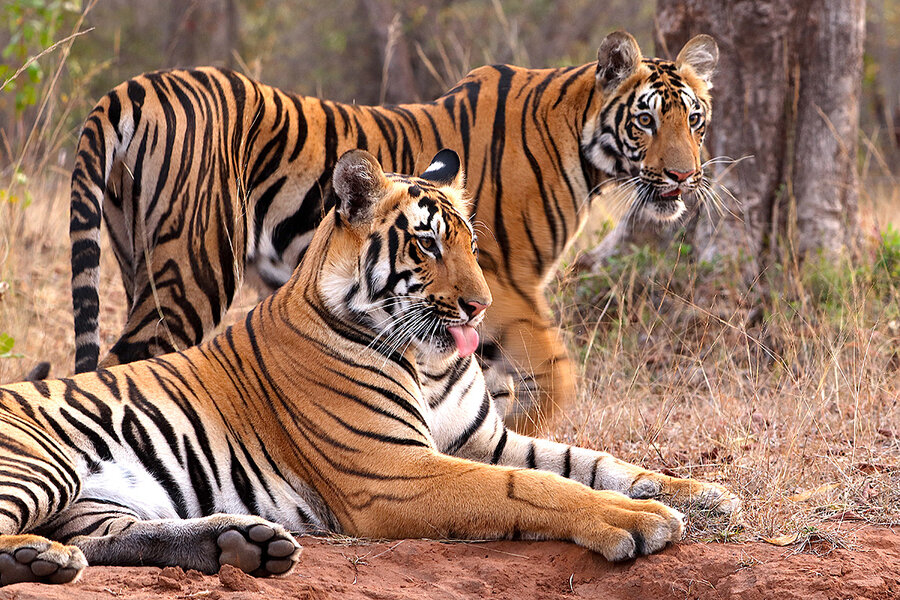
Tigers at Kanha National Park in central India.

With its huge population, extremes of wealth and poverty, and religious suppression, India has more than its share of challenges. But one thing it seems to be getting right is its approach to protecting the national animal, the tiger.

Charukesi Ramadurai reports for the Christian Science Monitor, “On a misty winter morning in a central Indian forest, a soft caw-caw punctuates the silence. Dozens of grazing deer perk up their ears, then join in the staccato warning screeches of the langur monkeys and birds high up in the trees. As the chorus of animal alarms reach a crescendo, a frisson of excitement runs through the humans seated on the safari jeeps, bulky cameras and pricey binoculars at the ready. The urgency of these calls can only mean that a predator has been spotted. 

“The tourists let out a collective gasp when the tiger finally emerges from the thickets, the orange and black fur gleaming in the muted morning sunlight. …

“All eyes are on the king of Indian jungles as the country marks the 50th anniversary of Project Tiger, a program founded in April 1973 to save the species from extinction. Five decades later, India houses the world’s only stable and growing tiger population … with numbers expected to pass 3,000. India also now boasts 53 tiger reserves across 18 states, encompassing about 2.4% of the country’s total land. It’s a success story marked by unwavering hope. 

“ ‘Back when it started, nobody could have imagined that we would have more than 50 protected tiger reserves in this country,’ says conservationist and wildlife tourism expert Amit Sankhala, who is also the grandson of Kailash Sankhala, the first director of Project Tiger. ‘These habitats exist just for the tiger to exist.’ …

“India’s tiger population dwindled from over 40,000 in the 1930s to a mere 1,827 by the end of the 1960s, due to organized hunting and habitat destruction. Spurred on by the World Wildlife Fund (WWF), the Indian government announced the landmark Wildlife Protection Act in 1972, paving the way for Prime Minister Indira Gandhi to launch Project Tiger the following year. Authorities established nine tiger reserves and implemented a blanket ban on hunting, and the tiger was declared India’s national animal.

“Despite the program’s early success, progress has been inconsistent. In fact, tiger numbers dipped to an all-time low of 1,411 in 2008 because of continued habitat loss outside protected areas, as well as unchecked poaching, which wiped out tiger populations in major reserves such as Panna in the central state of Madhya Pradesh and Sariska in the west Indian state of Rajasthan.

“That sparked an urgent push to increase public awareness through celebrity campaigns, and the conservation reins were handed over to a special task force known as the National Tiger Conservation Authority. With stricter wildlife policies and improved monitoring, numbers have been rising slowly but steadily since then. Every consecutive four-year census has shown an increase of a few hundred tigers; according to the 2018 census, India has a tiger count of 2,967, a figure which accounts for nearly 75% of all tigers in the wild.

“Reputed naturalist and wildlife guru Hashim Tyabji calls India’s success in preventing tigers’ extinction ‘a miracle in conservation.’ The project, he says, is a testament to India’s expertise in capturing and relocating tigers from their home areas to forests where numbers are lower and more space is available for these solitary, territorial animals to roam freely. … ‘We have modern tools like camera traps to track tigers. And not to forget, there are many many people who are hugely committed to conservation, and practice responsible tourism.’ …

“The uptick in tiger populations is especially impressive considering India’s rapid rate of development, says Aly Rashid, director at Jehan Numa Wilderness, which operates sustainable wildlife lodges in Madhya Pradesh. 

“ ‘We have 1.4 billion people living here, and the [human] population has doubled since 1973. Given all this pressure on land and resources, I would say this is a huge achievement,’ he explains.

“Although the WWF reports that wild tiger populations are growing globally, the solitary predator isn’t out of the woods yet. It’s still classified as endangered, and in India, degradation of critical tiger corridors and human-tiger conflict pose serious challenges. But Mr. Rashid is hopeful that with community buy-in, India can overcome these challenges. …

“That hope extends beyond tigers, which Mr. Sankhala, the conservationist, calls ‘poster boys for wildlife.’ The apex predator has also helped draw attention to India’s other endangered species, he says, including red pandas and Asiatic lions. Recent amendments in the original 1972 wildlife act have made it possible to protect and nurture various animals, from the barasingha (swamp deer) and gaur (Indian bison) in the heart of the country, to the one-horned rhinoceros in the eastern reaches. …

“ ‘Once you save the tiger, you save everything around it,’ Mr. Sankhala says.”

More at the Monitor, here. No firewall.

Read Full Post »

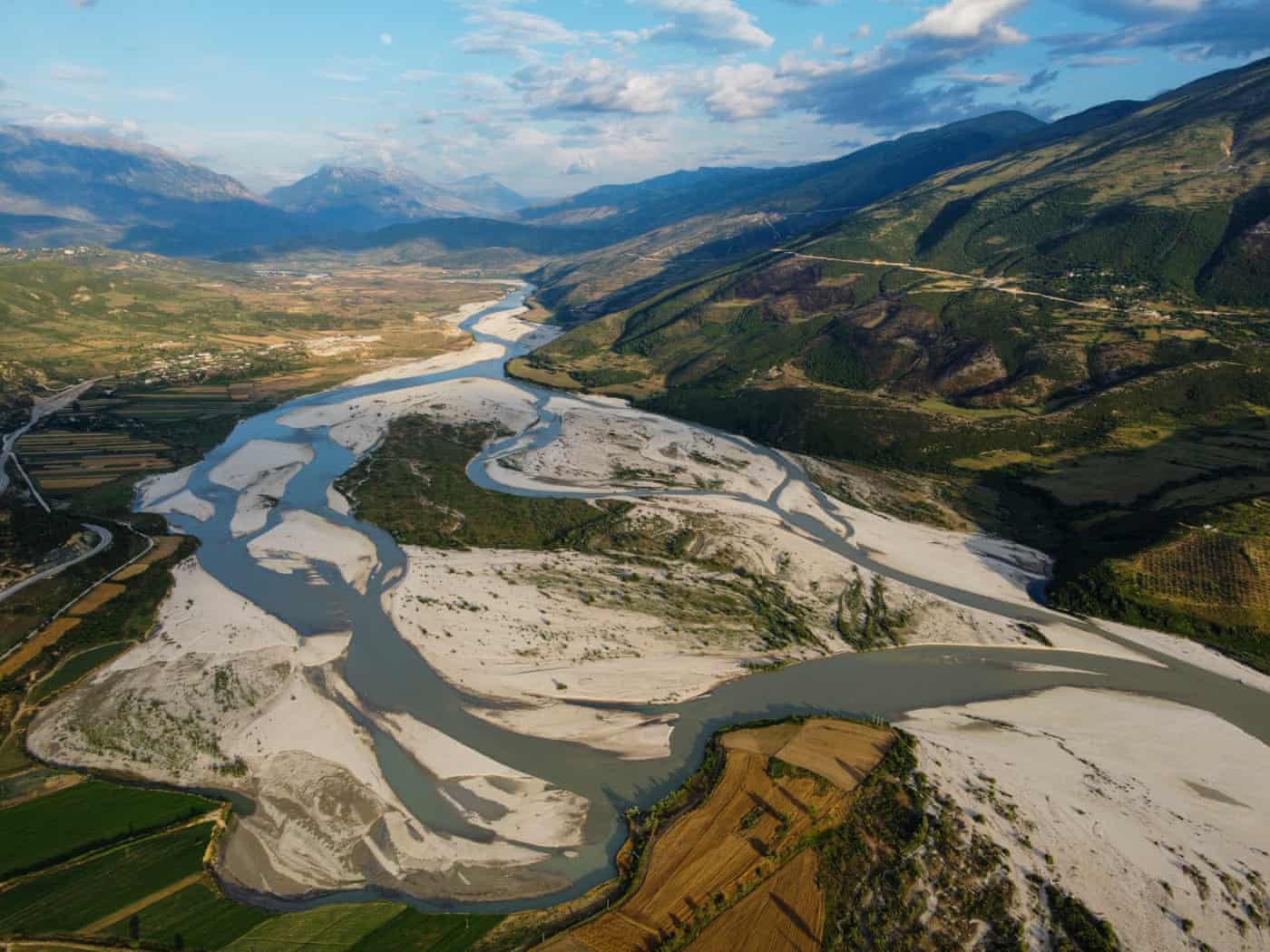
Photo: Nick St Oegger/The Guardian.
The Vjosa River near Qesarat, southern Albania. The river and its three main tributaries in the country have been declared a national park. 

In the 1980s, when I was active in the Esperanto movement, I managed the New England group’s post office box. One day I took out a letter on flimsy paper with a Tirana postmark. Tirana is the capital of Albania. The Berlin Wall had yet to fall, and Albania was still firmly behind the Iron Curtain. I felt like I had received a message from the other side of the moon.

Nowadays Albania is not so different from the rest of Europe, and today’s story is about its participation in European efforts to save wild rivers.

Karen McVeigh  writes at the Guardian, “One of the last wild rivers in Europe, home to more than 1,000 animal and plant species, has been declared a national park by the Albanian government, making the Vjosa the first of its kind on the continent.

“The Vjosa River flows 168 miles (270kms) from the Pindus mountains in Greece through narrow canyons, plains and forests in Albania to the Adriatic coast. Free from dams or other artificial barriers, it is rich in aquatic species and supports myriad wildlife, including otters, the endangered Egyptian vulture and the critically endangered Balkan lynx, of which only 15 are estimated to remain in Albania.

“For years, the Vjosa’s fragile ecosystem has been under threat: at one point as many as 45 hydropower plants were planned across the region.

“But [in March], after an almost decade-long campaign by environmental NGOs, Vjosa was declared the first wild river national park in Europe. Environmentalists described it as a historic decision that has placed the tiny Balkan nation at the forefront of river protection.

“Albania’s prime minister, Edi Rama … described the creation of the national park as a ‘truly historic moment’ for nature as well as social and economic development. ‘Today we protect once and for all the only wild river in Europe,’ he said. ‘This is about to change a mindset. Protecting an area does not mean that you enshrine it in isolation from the economy.’ …

Mirela Kumbaro Furxhi, Albania’s tourism and environment minister, said the creation of the park was part of the country’s evolution and continuing emancipation three decades on from communist rule. …

“She said, ‘Maybe Albania does not have the power to change the world, but it can create successful models of protecting biodiversity and natural assets, and we are proud to announce the creation of this first national park on one of the last wild rivers in Europe.’ …

“A collaboration between the Albanian government, international experts, NGOs from the Save the Blue Heart of Europe campaign to protect Balkan rivers, the International Union for Conservation of Nature (IUCN) and Patagonia, the outdoor clothing company and environmental organization, the 12,727 hectare (31,500 acre) park aims to ensure the Vjosa and its unique ecosystems are safeguarded. It has been given IUCN category II park status, a high level of protection similar to that of a wilderness. The categorisation covers ‘large-scale ecological processes,’ species and ecosystems, crucial to ensuring dams and gravel extraction are banned. It is expected to be operational in 2024.

“Boris Erg, director of the European office at IUCN, paid tribute to the government of Albania for its leadership and ambition. ‘Today marks a milestone for the people and biodiversity of Albania,’ he said. ‘We invite other governments in the region and beyond to show similar ambition and help reach the vital goal of protecting 30% of the planet by 2030.‘ …

“The Albanian government is starting a joint process with the Greek authorities to create the Aoos-Vjosa transboundary park, aiming to protect the entire river across both countries, who agreed in January to sign a memorandum of understanding specifying the next actions.

Europe has the most obstructed river landscape in the world, with barriers such as dams, weirs and fords, estimated to number more than a million, according to a 2020 EU study in 28 countries. Such fragmenting of rivers affects their ability to support life.

“Ulrich Eichelmann, a conservationist and founder of Riverwatch and part of the Save the Blue Heart of Europe campaign, said: ‘Most people in central Europe have never ever seen a wild, living river, free from the impacts of human interference, that isn’t diverted or dammed or built up with embankments and where biodiversity is low as a result. But here, you have a wild river, full of complexity and without interference.’ …

“Ryan Gellert, Patagonia’s CEO, said the collaboration proved the power of collective action. ‘We hope it will inspire others to come together to protect the wild places we have left, in a meaningful way,’ he said, adding that the park was proof that the ‘destruction of nature did not have to be the price of progress.’ “

Man, I love Patagonia. Did you know the company takes no Chinese cotton from Uighur slave labor? I bought the most luxurious cotton towels at Patagonia, guilt free.

More at the Guardian, here. No firewall.

Read Full Post »

Photo: Lauryn Ishak/Bloomberg.
Bukit Timah Truss Bridge on the Rail Corridor in Singapore.

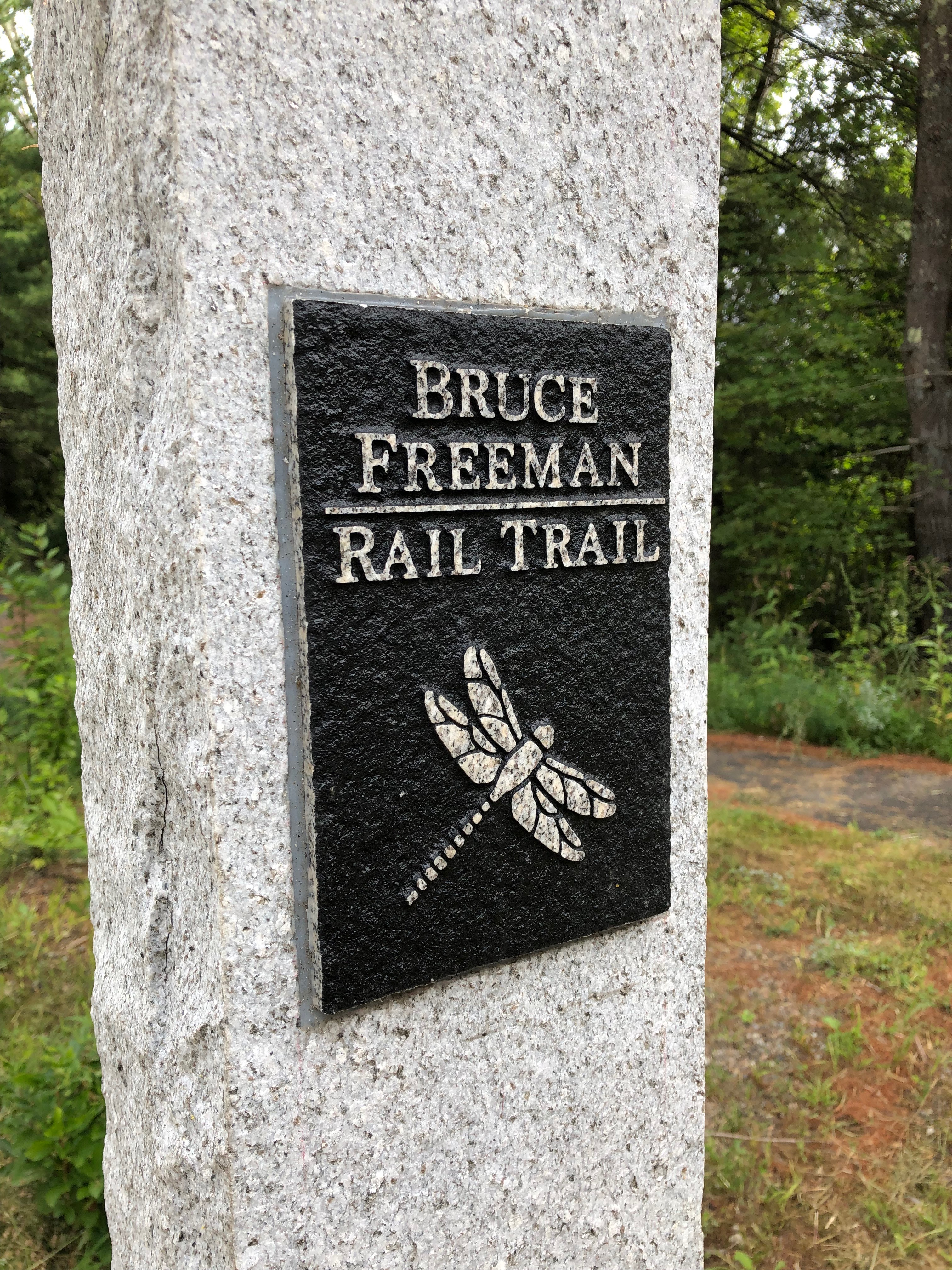
Where I live, certain abandoned rail corridors have taken decades to be ready for biking and hiking. You know Americans: lawsuits. But perseverance pays off, and now you can go for miles on the Bruce Freeman Trail.

Meanwhile in Singapore, government moves faster.

Selina Xu reports at Bloomberg, “A former railway line running through the heart of Singapore has turned into one of its biggest conservation success stories, marking a departure from the more manicured approach to nature that the city-state is known for. 

“The 24-kilometer (15 miles) contiguous stretch of land was part of a rail track built by the British colonial government in Malaya and was returned to Singapore from Malaysia in 2011, more than four decades after the two countries parted ways. Singapore was now faced with a question: What should it do with the land?

“The Nature Society, Singapore’s oldest conservation group, submitted an audacious proposal to authorities: convert the railway into a green corridor that would connect existing green spaces from the Sungei Buloh Wetland Reserve in the north, through some of the city’s most exclusive neighborhoods, all the way to the central business district in the south.

“Since 2012, parts of the rail corridor have been accessible to the public. The government has refrained from parceling out land for real estate development, keeping it as a green spine that’s 10 times longer than the High Line in New York, from which it drew inspiration. Authorities are now committed to preserving it in the long term, and continue to enhance more parts of the corridor, reopening them in phases.

‘When I gave that proposal to them, I wasn’t optimistic that they’d embrace the entire length,’ said Nature Society conservation committee chair Leong Kwok Peng, who spearheaded the campaign. ‘Never in my wildest dreams could I’ve actually imagined that would happen.’

“This month, an 8-kilometer northern stretch that had previously been under renovation was unveiled, with 12 new access paths connecting the corridor to surrounding residential estates and parks and an observation deck with views of the Bukit Timah Nature Reserve. More augmentations are still on the way, according to the National Parks Board (NParks) and the Urban Redevelopment Authority. 

“The focus on preserving the railway underscores a shift in Singapore’s relationship with nature. While half a century ago the city took a tamer and less ambitious approach to greenery, as encapsulated in the government’s ‘Garden City‘ vision which emphasized beauty and tidiness, the thinking now is to bring back the wilderness.

“The preservation of the rail corridor comes after Singapore’s development into a wealthy metropolis meant the sacrifice of acres of forests and wetlands. From 2000 to 2020, it experienced a net loss of 379 hectares (3.6 square kilometers) of tree cover, according to Global Forest Watch, roughly equivalent to 936 football fields. The railway, however, had been left largely untouched for decades due to land disputes between Singapore and Malaysia.

“ ‘The Rail Corridor passes through every terrestrial habitat you can find in Singapore,’ said Ngo Kang Min, a forest ecologist, pointing out on a map the patches of mangroves, marshland, forests and grassland alongside the railway tracks. By allowing the movement of species previously cut off from each other, Ngo envisions the corridor becoming a connector that can increase the genetic diversity of local flora and fauna.

“In October 2018, NParks and the URA began rewilding a 4-kilometer stretch in the central part of the Rail Corridor. Several endangered native primary forest species were reintroduced to return the landscape to its original rainforest state. To date, NParks has planted more than 52,000 native trees and shrubs along the corridor. The restored belt of native forest has since become a key passage, habitat and source of food for various animals, including the Sunda Pangolin, the world’s most trafficked mammal, and the Straw-headed Bulbul. …

“More rewilding will soon be happening in the north of the Rail Corridor, driven by the Nature Society — the largest-scale project of its sort under a nongovernmental organization to date. It plans to plant several thousand trees in order to bring back rare species and improve the canopy cover in a section of the corridor that’s mainly grassland. …

“The Nature Society is now lobbying the government to extend a trail along the Old Jurong Line, a disused railway track that runs through the western industrial tip of Singapore, where fragmented green spaces are scattered among factories, oil refineries and roads. The society is also focusing on preserving already-wild spaces along and adjacent to the corridor, parts of which will be disrupted by proposed housing development. …

“ ‘The attitude towards conservation in the past by the government has always been build, build, build first — economy comes first,’ said Ngo. ‘But now after Covid the conversation has shifted significantly. People want to see more green spaces. There can be room for more radical thinking and design in the way that we build those spaces.’ ”

More at Bloomberg, here.

We love the Bruce Freeman Rail Trail in Massachusetts.

Read Full Post »

Photo: Serious Shea.
Community members stand by a tree planted in Senegal during the launch of the Great Green Wall Corporate Alliance, an initiative that is part of larger efforts to prevent desertification in Africa’s Sahel region. “Serious Shea,” says the Christian Science Monitor, “is transforming a previously firewood-dependent shea industry in Burkina Faso.”

When it comes to human rights and climate justice, corporations can get into the act. It can even boost their brand. Blogger Rebecca told me about a clothing company, Fair Indigo, where she buys clothes because the cotton is organic and she knows the workers are paid a fair wage. I myself have bought cotton towels at Patagonia, which has protected the environment for decades and now promises not to use cotton from Chinese forced labor.

At the Christian Science Monitor, Taylor Luck, Whitney Eulich, Ahmed Ellali, and Sandra Cuffe write about how various countries are working on water conservation — and how certain companies are helping.

“In Guatemala, farmers are setting up ‘living fences’ around fields, creating a buffer of roots to protect their soil during increasingly strong rainy seasons. In Jordan, local Bedouin communities and authorities are pioneering resilient desert agriculture in a region that has been hit by longer and more intense heat waves.

“And in Burkina Faso, William Kwende has been working to revolutionize shea butter production – by substituting renewable energy for traditional wood-burning methods that result in deforestation. He has introduced an approach with 100% renewable energy, self-sustaining biomass burners, and a closed water system, which is curbing emissions while also reducing crop losses. 

“At a time of global strain on food production, including an emerging famine in parts of East Africa, his story symbolizes the potential for using innovation to adapt to a changing climate.

The business Mr. Kwende co-founded, called Serious Shea, is designed to promote reforestation and to secure fairer wages and independence for the local women at the heart of the process. 

“A key part of the innovation: Serious Shea’s eco-processing centers transform shea tree biomass into natural biofertilizer and biochar, enriching soils that are at risk of desertification and reducing reliance on expensive imported chemical fertilizers. 

“ ‘People talk about water and food imports, but when you talk about food crises and adaptation, fertilizer is at the heart of it,’ Mr. Kwende tells the Monitor on the sidelines of COP 27 [Conference of Parties 27], this year’s global climate summit, at Sharm el-Sheikh. …

“Across the globe, innovative ideas like that are greatly needed. Extreme weather events are affecting the vital sector of food production – with the shifts especially hard for Indigenous communities and small-scale farmers. In Peru, rising temperatures have upended the livelihoods of alpaca farmers. In Pakistan, massive floods have sidelined several million acres from crop production. In Somalia and Kenya alone, drought threatens to push millions into food-poverty and starvation. …

“With its own farmers suffering losses amid intense heat waves and drop in Nile waters, atop the food-security crisis in the Horn of Africa, Egypt has placed agriculture front and center to an unprecedented degree at the current [COP]. …

“Agriculture experts say some of the solutions will involve mass-produced technologies such as battery-operated farm equipment. But it will also involve the rise and transfer of hundreds of local, homegrown solutions emerging across the world, many of which advocates say can cut carbon, improve resilience, and be replicated elsewhere. 

“In Mexico, where last summer eight of 32 states experienced moderate to extreme drought and where half of all municipalities in the country face water shortages, some farmers turn 2-liter soda bottles upside down over saplings to capture morning dew or dig holes and line them with organic materials like leaves, to retain rainfall around young trees.

“To the south in Peru, Alina Surquislla’s family has never seen anything like the current effects of rising temperatures in their three generations of alpaca herding. 

“There’s no water; the grass is turning yellow and disappearing for lack of rain,” says Ms. Surquislla. Alpacas are dying out at worrying rates. Speaking over a Wi-Fi satellite connection while walking at nearly 16,000 feet above sea level in the Apurimac region … for now, she says the answer for herders is to go to higher and higher elevations in search of water and grazing.

“Water is also scarce in Jordan. There, local Bedouin communities and authorities are scaling up pioneering desert agriculture in Al Mudawara, a border region near Saudi Arabia that has been hit by longer and more intense heat waves in the past few years. 

“Since 2019, under a directive by Jordan’s King Abdullah, each family in the area has been tending to 6-acre plots of yellow corn and green onions, watered from an underground aquifer. The crops have proved resilient to more frequent 120 degree F temperatures, sprouting up into green waves amid reddish desert sands that have not been utilized for agriculture in modern history. 

“Now over 4,000 acres of corn stalks stand 3 feet high and onions sprout in Al Mudawara. These provide alternative sources of income and living for Bedouin families, many of whom have been forced to abandon traditional camel shepherding due to the mounting costs of imported animal feed. …

“Says Abu Fahed al Huweiti, former director of the Al Mudawara Agricultural Cooperative that has steered the project. ‘It has given a new hope for people here.’

“In Tunisia, amid the lush fig and olive groves of Djebba, clinging to the tops of the Gorraa mountain, farmers continue a centuries-old terraced farming that has helped them cope with massive heat waves and drought that has hit much of Tunisia. 

“A series of cement-lined canals crisscross down the hill through the terraced farms, carrying water from natural springs fed by winter’s snow to groves of figs, pomegranates, quince, and olives on a rotating basis of collective water-sharing. 

“This ingenious method of traditional Berber farming provides timed irrigation of entire land plots, allowing local farmers to grow not only trees but also herbs and diverse flora and fauna, feeding livestock and chickens – all from the same measured water delivery. …

“ ‘We in Djebba keep using the same old techniques because it has shown success. It is an inherited model of coexistence and represents the ideal use of available water resources,’ says Fawzi Djebbi, Djebba farmer, activist, and head of the annual Djebba Fig Festival.  ‘Here we use the water as a collective resource from the mountains. This water belongs to all of us.’  

“Knowledge- and expertise-sharing has also been critical to speeding up farmers’ adaptation to the pummeling effects of severe weather events. 

“The CCDA, an Indigenous and small farmers movement for land rights and rural development in Guatemala, is working with many of their 1,300 affiliated communities around new techniques to help farmers adapt. This year’s rainy season has been one of the longest and heaviest this century, for example.

“One technique is planting trees and plants with deep roots around crop plots. The plants are a buffer against erosion, provide shade during the hot and dry season, and sometimes include edible plants as well. …

“Global organizations are seeking to spread helpful practices and information. The United Nations Food and Agriculture Organization (FAO) has been teaming up with Vodafone to get early warning systems and messages to rural farmers across Africa to better prepare for projected climate trends and to provide advice on mitigation measures.” 

More at the Monitor, here.

Read Full Post »

Photo: Philip Brown/Unsplash.
Led by tribes, conservationists are helping bison make a comeback.

Having recently watched an appalling old Annie Get Your Gun film with Betty Hutton (appalling on the subjects of poverty, women, and especially indigenous people), I was relieved to learned from today’s article that attitudes may have evolved into something more promising.

Back in the day, settlers fought natives in underhanded ways. One way was killing bison, a sacred food source. Today European descendants and tribes are actually collaborating to bring the animals back from the edge of extinction.

Jess McHugh reports at the Washington Post, “Miles of prairie stretched out across the Wichita Mountains Wildlife Refuge in southern Oklahoma, acre after acre of brush, grasses and hearty vegetation creeping toward the low-range granite mountains rising in the distance. Like in much of Oklahoma, the road is flat here, but the speed limit remains 30 mph. That’s because of the bison.

“They appeared seemingly out of nowhere: dozens of massive animals lumbering up the shoulder of the road to cross to the fresh vegetation on the other side. The herd moved slowly, their soft, bovine eyes barely registering the stopped cars awaiting their passage. They quickly set to work mowing down the fresh springtime grass.

“The bison’s quiet munching does more than nourish their bodies — it’s one of many things they do to nurture their entire ecosystem, one that is increasingly under threat from climate change. Grazing bison shaving down acres of vegetation leave more than dung behind:

Their aggressive chewing spurs growth of nutritious new plant shoots, and their natural behaviors — the microhabitats they create by rolling in the ground, the many birds that forged symbiotic relationships with them — trickle down the food chain.

“Once bordering on extinction, bison now serve as a great provider for their ecosystems, standing as an example of the ways in which animal conservation and ecological protection can work in tandem.

“ ‘Buffalo is the original climate regulator,’ said Troy Heinert, a member of the Sicangu Lakota (Rosebud Sioux) tribe and executive director of the InterTribal Buffalo Council, a coalition working to restore the animal on tribal lands. ‘Just by how they use the grass, how they graze, how their hoofs are designed, the way they move.’ …

“Tribes are leading the effort to bring back the bison, Heinert says, which in turn allows for the return of other native grasses, animals and insects — all of which will ‘help fight this changing climate.’

“Bison, called buffalo by some Indigenous peoples, are mammoth creatures. Weighing up to 2,000 pounds, they are the largest land mammal in North America. … Two centuries ago, bison dominated much of the continent from Canada to Mexico, when tens of millions roamed North America. They were so numerous that the pounding of their hoofs beating across the land sounded like rolling thunder. For the many tribes of the plains region — the Lakota, the Shoshone, the Arapaho, to name a few — buffalo was a sacred animal that nourished their people and played an important ceremonial role.

“For European colonizers, the bison were both a commodity and a weapon. Americans massacred them by the thousands, selling their pelts and organizing vast sport hunts. As the United States pushed West in the 1800s, bison became a pawn in their quest to wrest Indigenous tribes off their ancestral homes. …

“By the turn-of-the-20th century, millions of bison had been killed. In 1900, fewer than 1,000 — of an estimated 30 to 60 million — remained, many in zoos.

“President Theodore Roosevelt ordered federal bison herds to be put into place (some, such as Custer State Park, were ironically sourced from tribal herds). The bison observed in the Wichita Mountains are descended from 15 animals commandeered from the Bronx Zoo in 1907 and brought to Oklahoma via train car. In the intervening century, federal, tribal and private herds have brought the species back from the brink of extinction. The estimated number of bison nationwide — while far from the millions — now hovers in the low hundreds of thousands.

“Indigenous peoples have been integral to this effort from the start, both by managing herds and by introducing legislation to protect and expand bison territory. In the past few decades, tribal herd numbers have soared: The InterTribal Buffalo Council, which began as a modest coalition of fewer than 10 tribes in the early 1990s, will soon count 76 tribes across 20 states from New York to Hawaii among its members, managing a total of more than 20,000 animals across 32 million acres.

“The return of the bison is a victory not only for the sake of biodiversity but for the entire ecosystem in which they live. As a keystone species, the bison sustain their environment from the top down.

“ ‘They move through, graze everything down. It’s a type of disturbance — like fire would be,’ said Dan McDonald, lead wildlife biologist at the Wichita Mountains Wildlife Refuge. ‘The fresh green [draws] other animals that would feed on it: elk and deer and whatever other type of grazers that would consume some of that new forage.’

“The herd in Oklahoma is approximately 625 animals, but when large herds move synchronously across the land, they create what scientists have dubbed a ‘green wave.’ The bison’s vigorous grazing stimulates plant growth, creating a flood of new vegetation that follows in the bison’s wake to be ‘surfed’ by animals large and small. Green waves can be so dramatic that some — such as the one created by Yellowstone’s bison herd — can be seen from space.”

Read about the extraordinary side benefits of herd restoration at the Post, here.

Read Full Post »

Photo: Waldemar Brandt/Unsplash.
Though still endangered, tigers are doing better this year than last year.

We hear so much about species on the verge of extinction that we have to blink twice get it through our heads that anything is coming back. That’s why I like today’s story.

Dino Grandoni reports at the Washington Post that “tigers are having a good year. Nepalese officials announced [in July] that the top predator’s numbers within the country’s borders have more than doubled in a bit more than a decade. Across Asia, there are as many as 5,500 tigers prowling jungles and swamps, a leading wildlife group said last week, a 40 percent jump from its 2015 assessment.

“The slow but steady rise in the big cat’s estimated population comes as biologists get better at tracking the animal and marks a high point amid a deepening extinction crisis that may see as many as a million plants and animal species disappear worldwide because of habitat loss and climate change.

“Tiger researchers, while optimistic, warn that the fierce hunter remains under threat from both poaching and encroachment into its remaining habitat. …

“ ‘It’s a fragile success,’ said Dale Miquelle, tiger program coordinator for the Wildlife Conservation Society. ‘There are still many pressures on tiger populations, and they are disappearing from some areas.’

“There are between 3,726 and 5,578 tigers in the wild today, according to the International Union for Conservation of Nature (IUCN), which tracks the status of plants and animals facing extinction. Tens of thousands of tigers once roamed Asia.

“One big reason behind the recent jump in tiger estimates: Scientists have simply gotten better at counting the cats, placing motion-sensing cameras in more spots to identify their territory. …

“But a combination of expanding protected areas and targeting poachers who sell tiger parts for use in traditional medicine has allowed tigers to stabilize or recover in China, India and Thailand.

“ ‘In all of those countries, tiger conservation has been a priority at the highest levels of government,’ said Ginette Hemley, senior vice president of wildlife conservation at World Wildlife Fund.

“Asia’s most iconic predator is perhaps doing best of all in Nepal, where the estimated population has soared from 121 to 355 since 2009, its government said Friday, after the small Himalayan country committed to restoring habitat and dispatched military units to patrol for poachers.

“The grassy lowlands between Nepal and India near the Himalayan foothills — known as the Terai — teem with grazing animals, making it among the most productive potential habitats for the carnivore. …

“Tigers once roamed from Turkey in the west to the eastern coast of Russia and from frigid forests of Siberia in the north to tropical islands of Indonesia in the south. But a century of hunting both tigers and their prey has restricted their range and decimated their numbers.

“By the 1940s, wild tigers vanished from Singapore and Bali. By the 1960s, they were gone for good in Hong Kong and Java. In recent decades, they disappeared from Cambodia, Laos and Vietnam. And today, they continue to die out in Malaysia. …

“Both revered and feared across the globe, the tiger is a classic ‘charismatic megafauna’ — a big, regal animal that receives outsize attention and money in the conservation movement. But by protecting tigers, Miquelle said, conservationists end up protecting entire ecosystems on which other animals and people depend.

“ ‘When we talk about protecting tigers, you’re really talking about protecting the environment that people also need to survive and live a better life,’ he said.

“Yet, as tigers rebound, conflicts arise. In India, home to two-thirds of the world’s wild tigers, the big cats killed 383 people between 2010 and 2019, testing the tolerance of locals for living among them. A protest erupted in a Nepalese village this June after tiger and leopard attacks.

“In a bid to bolster incomes and provide economic incentive for tiger conservation, groups such as the WWF are encouraging residents to open their homes to ecotourists hoping to see the animals.

“Further complicating conservation efforts is Russia’s war in Ukraine, which has made it more difficult for researchers to collaborate with Russian counterparts and to attend a major tiger forum in the port city of Vladivostok scheduled for September.

“And rising seas fueled by global warming threaten to inundate tiger-filled mangroves in Bangladesh, though climate change may end up expanding the cat’s range in Russia.

“Despite the gains, tigers are still officially classified as endangered in the IUCN’s Red List of Threatened Species. And countries still are failing to double their numbers.

“ ‘We haven’t succeeded in that process,’ Miquelle said. ‘But we do feel that there are more tigers today than there were 12 years ago — that progress is being made.’ ”

More at the Post, here.

Read Full Post »

« Newer Posts - Older Posts »