Feeds:
Posts
Comments

Posts Tagged ‘construction’

Photo: Ajit Niranjan/The Guardian.
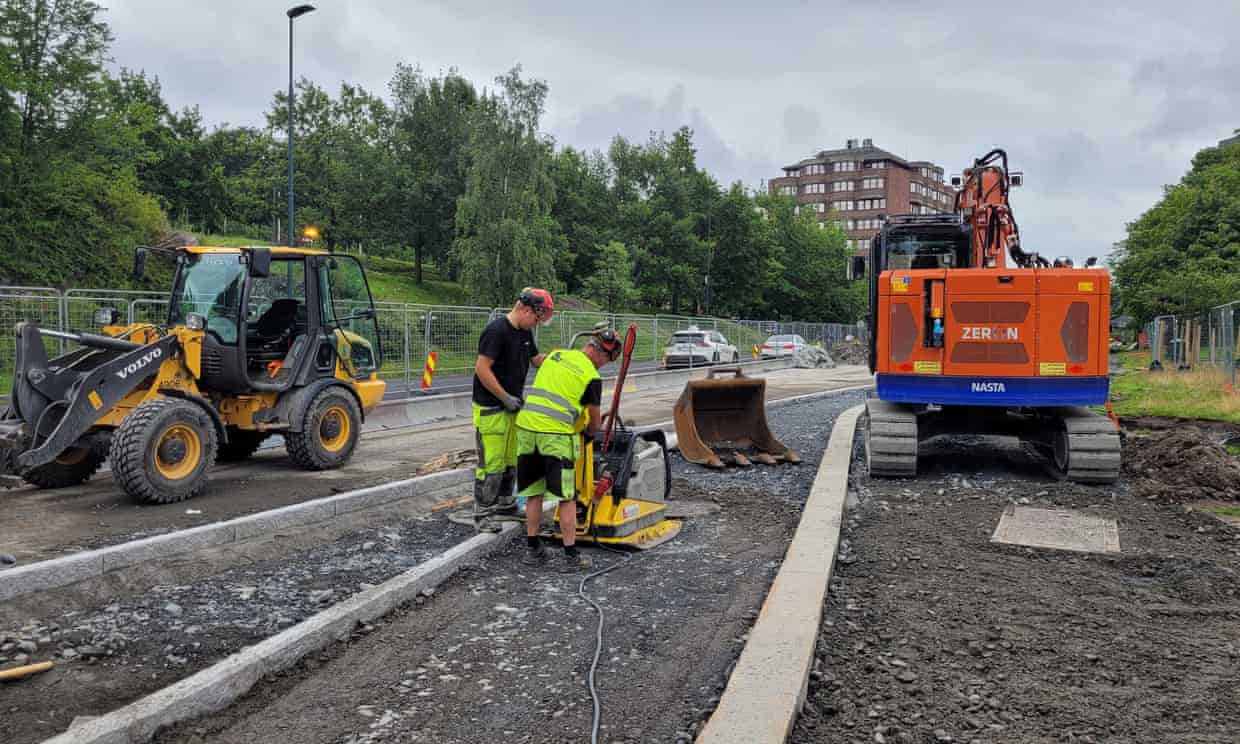
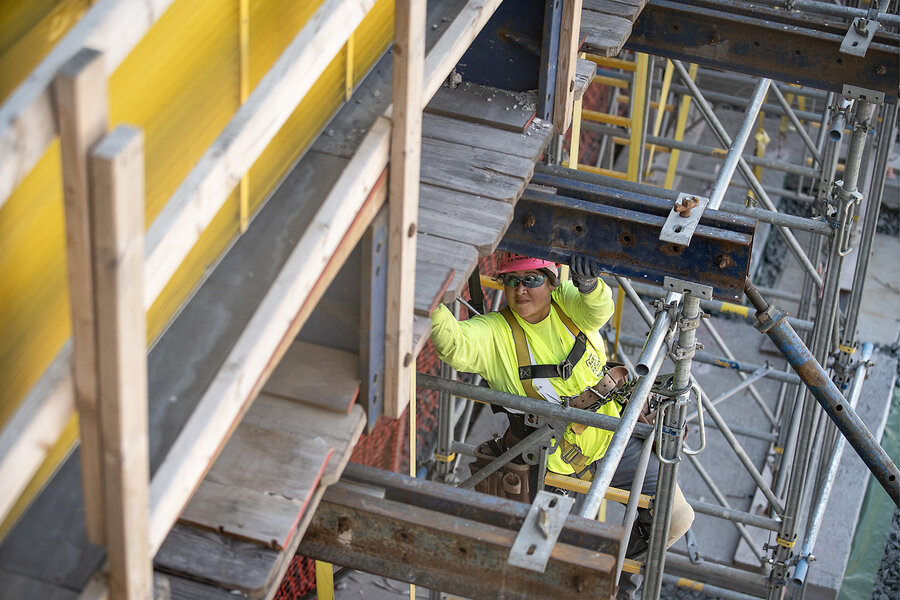
The electric machinery at an emissions-free building site in Oslo, Norway, makes for quieter construction.

Whether we realize it or not, our noisy world is making us a little more jittery than we need to be. It’s not just the clangor and clash of big cities but near airports, hospitals with medivac helicopters, and construction sites.

Despite Norway’s reputation as one of the biggest oil producers, it is leading the way with electric vehicles, even at construction sites.

Ajit Niranjan has the story at the Guardian.

“Tafseer Ali felt no need to raise his voice as the pair of diggers lumbered past him, their treads weighing heavy on the rock and asphalt. Quiet electric machines like these make it easy to work in the city center, the construction manager said – and keep the neighbors happy. …

“The peaceful streets of Oslo are growing even calmer as the city drives noisy machines off municipal building sites. For locals and builders, the drop in decibels is a welcome side-effect of a goal to keep city-managed construction projects free from toxic emissions. The mandate, which is the first of its kind in the world, came into effect on 1 January.

“ ‘I don’t think we’re going to get to 100%, because not all [electric] machines are available on the market,’ said Ingrid Kiær Salmi, an engineer from Oslo’s urban environment agency, speaking to the Guardian at a building site in the city center last year. ‘But I think we’re going to get pretty close.’

“Construction is one of the biggest sources of urban air pollution, but even forward-thinking cities such as Oslo have struggled to clean it up. The Norwegian capital has led the way in replacing the petrol and diesel that powers its construction equipment with biofuels, which do little to heat the planet but still foul the local air. It is now moving to battery-powered machines.

“The latest data shows Oslo’s municipal building sites were 98% free from fossil fuels in 2023; three-quarters were powered by biofuels and less than one-quarter by electricity. For projects run by the urban environment agency, which has more recent data through to October 2024, two-thirds of machine hours were powered by electricity and one-third by biodiesel.

“The proportion of its projects powered by electricity has more than doubled in the past two years as new machines have come on to the market. …

“Electric vehicles are nothing new to Norwegians, who are more likely to drive a car with a big battery than one with a combustion engine, but the market for clean diggers [excavators] and wheel loaders still has a way to go. The building industry has pushed back on Oslo’s pioneering plans for moving too fast. …

“The requirement that all machinery on building sites must be emission-free is ‘at this point, neither effective nor cost-efficient,’ said Stine Marie Haugen, from the Norwegian construction and civil engineering contractors’ association.

“ ‘Currently, very few countries in Europe have a strong focus on emission-free machinery, which means that access to such equipment is somewhat limited,’ she said. ‘Only a few countries bear the development costs of bringing these machines to market.’

“But by taking on these costs, Norway and a handful of other countries are making clean machines cheaper and more attractive for cities around the world. Manufacturers say the early demand from procurement policies like Oslo’s has encouraged them to develop new electric machinery and make existing ones better.

“As the volume of vehicles increases, costs will come down – but ‘like with all new technology, there is a green premium,’ said Tora Leifland, the head of public affairs at Volvo Construction Equipment. A battery-powered machine can cost twice as much as a diesel one, she said, though it will save money on fuel and do little to inflate the overall costs of a construction project.

“There are also benefits that are harder to capture, such as quieter working conditions on-site and reduced disruptions to local communities and businesses.”

More details at the Guardian, here. No firewall. Contributions to support the Guardian‘s reliable journalism are solicited.
Read Full Post »

Photo: Riley Robinson/CSM.
Above, Lucy Lujana, a carpenter with United Brotherhood of Carpenters and Joiners Local 54 in Chicago. As of 2023, only 3.1% of carpenters were women. Sometimes they call themselves the “Sisters of the Brotherhood.”

In the US, some women have moved into jobs traditionally held by men, but progress seems slow to me. In countries including India, Australia, Finland, England, and Israel, women have served at the very top, same as being president in the US. America’s oddly progressive and backward character is something to ponder.

Today we consider women in unions.

Richard Mertens writes at the Christian Science Monitor, “Last year, Lisa Lujano, a longtime member of the United Brotherhood of Carpenters and Joiners Local 54, found herself in very unfamiliar company. She had been tasked to build stairs in one section of the Obama Presidential Center on Chicago’s South Side. When she showed up for work, she discovered she would be part of a crew of five, all women.

“ ‘I don’t know how it came about,’ Ms. Lujano says. … Most of the time, when she shows up for work, she’s the only woman on the crew. And she and her fellow tradeswomen know as well as anyone an inescapable truth: The American construction site is still a man’s world. Until that moment, at least, when suddenly it wasn’t.

“ ‘It was a good experience,’ Ms. Lujano says, looking back on the 11 months working alongside other women carpenters. ‘We were able to relate, be more comfortable with each other. Then she adds, almost exultingly, ‘We’re sisters in the brotherhood!’ …

“Ms. Lujano has been a member of her union for almost 25 years. The journeyman carpenter loves her work, the daily routine. But she still puts up with unpleasant conversations. At lunch she’ll sometimes sit by herself, or take a nap in her car. …

“On a recent Friday, she was … on a team of about 60 workers rebuilding a train station at the edge of the University of Illinois Chicago campus. She’s one of only five women at the site today, the only one on her crew of 10. …

“Over the past decade, the number of women in the construction sector of the U.S. economy has risen steadily, from about 800,000 in 2012 to about 1.3 million in 2023, according to the U.S. Bureau of Labor Statistics.

“Only 11% of jobs in construction industries are held by women, and the majority of these jobs are in office work, sales, or other support services. A growing number are even becoming managers. But on construction sites themselves, the vast majority of construction workers remain men. …

“ ‘The whole process of diversifying the construction trades has been an incredible slog,’ says Jayne Vellinga, executive director of Chicago Women in Trades, an organization that has worked for decades to help women find jobs in the skilled trades.

“[Yet] there’s been a surge in demand for construction workers. … About 94% of construction firms report being unable to hire the skilled workers they need, according to the Associated General Contractors, a trade group in Arlington, Virginia. Experts estimate this shortage numbers more than a half-million workers.

“Given these shortages, the contractors trade group also found last year that 77% of construction companies report that ‘diversifying the current workforce at our firm is critical to strengthening our future business.’

“This doesn’t mean companies will be hiring more women. There remains a significant cultural obstacle to bringing more women into and training them for the skilled trades: Construction is still widely believed to be the domain of men. …

“Like many women, Ms. Lujano followed an unconventional path into the trades. She had no family connections, no uncle or father to bring her into the business, as young men often had. She had dropped out of high school to care for a son who was just a year old. ‘I couldn’t support him,’ she says. …

“In 1998, she saw a flyer from Job Corps, a federal program that offers young people preapprenticeship training and a chance to finish high school. The flyer listed different jobs: plumber, electrician, carpenter, secretary, and more.

“She enrolled in a program in Golconda, a small Illinois town on the banks of the Ohio River. There, over 13 months, she earned a GED certificate and received hands-on training in how to build things. She and other students built ladders, bunk beds, and even frame houses. ‘It was just so cool,’ she says. ‘I ended up loving it.’

“But it wasn’t easy. In her first job she spent four months demolishing and rebuilding porches for a nonunion contractor. Then she got her first union job, working on a bridge in Skokie, just north of Chicago. She was the only woman in a crew of young men in their early 20s. The men would make vulgar comments to her, or about her, even in her presence. …

“Ms. Lujano is no longer a rookie apprentice, but a journeyman carpenter making the full journeyman’s wage: $55 an hour, plus health benefits and a pension. She’s also a union steward, responsible for making sure the workers are properly credentialed and helping them deal with complaints or problems on the job. …

“Looking out over the worksite at the train station in Chicago’s Near North Side, Ms. Lujano sees both good and bad, both progress and the limitations of that progress. Including her with the carpenters, there is one woman among the electricians, one among the ironworkers, one among the bricklayers, and one among the painters. Tradeswomen often feel they are only tokens of diversity on the job site. But to Ms. Lujano, one woman is better than none. …

“Now in her third decade as a union carpenter, she feels keenly the need to help younger women as they face the challenge of working in a world that has, for so long, been dominated by men.”

More at the Monitor, here. No firewall. Subscriptions solicited.

Read Full Post »

Photo: EcoForge.
Startup EcoForge’s lead scientist, Jiale Han, working on making sustainable building products.

Sometimes the Boston Globe features interviews with founders of startup companies. This company is in Rhode Island, and it makes alternative building products for a greener future.

Alexa Gagosz has the story.

“Brown University graduates Rongyu Na and Myung Bender are the founders of EcoForge, a startup that is developing local and sustainable building materials from agricultural residues and plants.

Alexa Gagosz: How does EcoForge work?
“Rongyu Na: We start by providing our solutions, such as material binding agents and fire-resistant agents, to materials like hemp — a bio-based material that’s carbon-negative — to interested companies and manufacturers.

“Unlike traditional materials that harm both people and the planet, our materials significantly improve sustainability and ensure material health. EcoForge’s bio-based building products help construction projects secure permits, reduce carbon emissions by up to 40 percent, and save on future energy costs, estimated at more than 15 percent on heating and cooling.

“AG: How does EcoForge fit into both of your experiences?
“RN: With my extensive experience in industrial design at NASA and at Subaru, Nissan, and Amazon, I’ve worked on future clean mobility concepts and innovative products like the Kindle, and led global initiatives focused on sustainable materials. My passion for sustainability is complemented by a strong background in innovation and design excellence.

“My cofounder, Myung Bender, is a seasoned entrepreneur. Her startup was acquired by Apple, and as the former head of product at Bumble, she brings strong business acumen and operational expertise. We’ve both developed numerous products, and we are now focusing on products that significantly impact our health and the planet.

“AG: What kinds of ‘agricultural residues’ are you using? And what kinds of building materials can they be transformed into?
“RN: Our technology is highly compatible with various plants, allowing us to form building products by leveraging their natural material structures.

Agricultural residues like hemp/cannabis waste, sunflower husks, sugarcane waste, corncobs, and invasive plants like Arundo donax [giant reed] are of particular interest to us.

“We’re currently focusing on creating solutions such as zero-VOC [no volatile organic compounds], 95 percent bio-based binders, and highly compatible sustainable fire-resistant technology that work with hemp and cannabis waste. We’re looking to collaborate with interested companies and manufacturers to transform these faster-growing plants and agricultural residues into various building products.

“AG: Who are your customers?
“RN: Our primary customers are large manufacturers seeking innovation and reduced carbon footprints through selling or licensing our ecologically safe material solutions. Secondary customers include corporate owners and real estate firms who renovate frequently to meet ESG [Environmental, Social, and Governance] goals.

“AG: Who or what is your greatest competition? How do you plan on breaking into the market?
“RN: Our greatest competition comes from traditional material solution suppliers using petroleum-based materials that employ green-washing strategies and lack transparency. These companies are also energy-intensive and cause harm to both the planet and human health. They still have a strong influence in the market, with established market presence, customer bases, and industry equipment tuned for their specifications, making it challenging for new entrants.

“To break into the market, we plan to leverage our unique value propositions. … Our hemp recipes tackle cost, supply, fire safety, performance, recyclability, or degradability issues. Our adaptable products are compatible with existing manufacturing lines and can be used for various building products like ceiling tiles, drywall, insulation panels, and flooring. …

“AG: What challenges are you facing currently, and how do you plan to overcome them?
“RN: One of the biggest challenges has been overcoming the industry’s struggle with greenwashing and false claims. Many companies claim to be sustainable but fall short in practice. This makes it difficult for genuinely sustainable products to stand out and gain trust. … We’re committed to maintaining maximum transparency and conducting rigorous testing to ensure our materials are genuinely sustainable and healthy.”

Read about the cost of their products and their funding sources at the Globe, here.

Read Full Post »

Photo: matusgajdos17/500px.
Australian researchers say concrete could be 30 percent stronger with charred coffee grounds.

Longtime coffee drinkers know that coffee is good for all sorts of things besides waking you up. Coffee grounds are great in compost, for example, and provide useful nutrients for your garden — nitrogen, potassium, and phosphorous.

But coffee grounds for construction projects? At ScienceAlert, Tessa Koumoundouros describes new research showing the possibilities.

“We could be producing concrete that’s 30 percent stronger by processing and adding charred coffee grounds to the mix, researchers in Australia discovered. Their clever recipe could solve multiple problems at the same time.

“Every year the world produces a staggering 10 billion kilograms (22 billion pounds) of coffee waste globally. Most ends up in landfills. ‘The disposal of organic waste poses an environmental challenge as it emits large amounts of greenhouse gases including methane and carbon dioxide, which contribute to climate change,’ explained RMIT University engineer Rajeev Roychand.

“With a booming construction market globally, there’s also an ever increasing demand for resource intensive concrete causing another set of environmental challenges too.

” ‘The ongoing extraction of natural sand around the world – typically taken from river beds and banks – to meet the rapidly growing demands of the construction industry has a big impact on the environment,’ said RMIT engineer Jie Li. … ‘With a circular-economy approach, we could keep organic waste out of landfill and also better preserve our natural resources like sand.’

“Organic products like coffee grounds can’t be added directly to concrete because they leak chemicals that weaken the building material’s strength. So using low energy levels, the team heated coffee waste to over 350 °C (around 660 °F) while depriving it of oxygen.

“This process is called pyrolyzing. It breaks down the organic molecules, resulting in a porous, carbon-rich charcoal called biochar, that can form bonds with and thereby incorporate itself into the cement matrix. …

“The researchers [are now] testing how the hybrid coffee-cement performs under freeze/thaw cycles, water absorption, abrasions and many more stressors. The team is also working on creating biochars from other organic waste sources, including wood, food waste and agricultural waste. …

“Said RMIT engineer Shannon Kilmartin-Lynch, ‘Inspiration for my research, from an Indigenous perspective, involves Caring for Country, ensuring there’s a sustainable life cycle for all materials.’ “

The research was published in the Journal of Cleaner Production.

More at Science Alert, here.

Read Full Post »

Photo: Cristina Baussan for NPR.
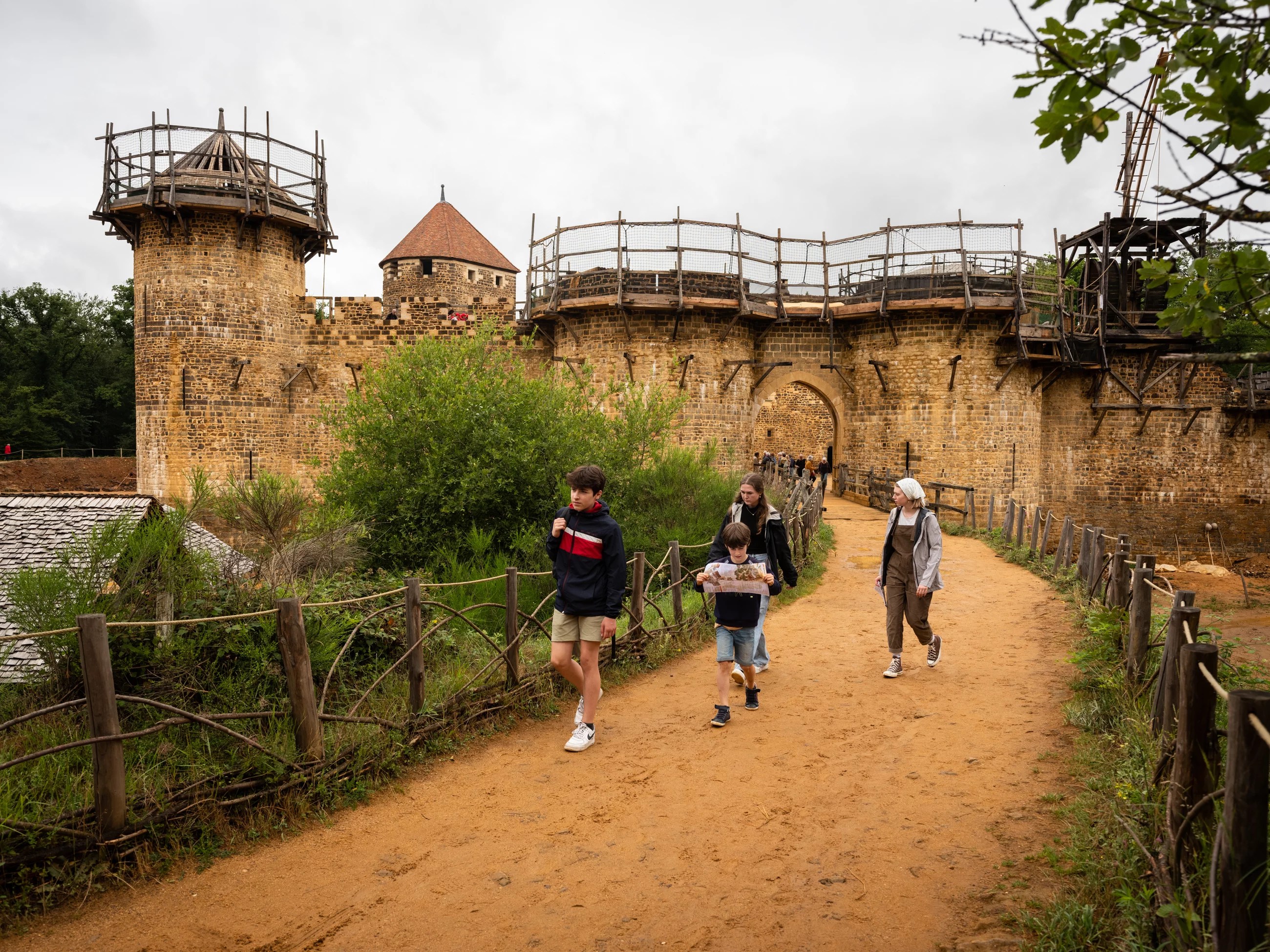
Visitors walk near the construction of Guédelon Castle, dreamed up as an exercise in “experimental archaeology” 25 years ago.

The Plimoth Patuxet Museums in Massachusetts used to be called Plimouth Plantation, and at Thanksgiving lucky visitors got to share in whatever version of the First Thanksgiving was in vogue at the time. Today the history involves the indigenous people in a much more balanced way. But a visit to the site is still a step into another century, a century without cellphones.

Not unlike a visit to a certain castle in France.

Eleanor Beardsley reports at National Public Radio, “Deep in a forest of France’s Burgundy region, a group of enthusiasts is building a medieval castle the old-fashioned way — that is, with tools and methods from the late 13th century.

“Some of those working here are heritage trade craftspeople, others are ardent history buffs, but all say they share a deep respect for nature and the planet, and a desire to return to simpler times.

” ‘This is a place you experience with all your senses,’ says Sarah Preston, communications director and guide of these grounds known as Guédelon Castle. ‘As soon as we walk onto the site you smell the woodsmoke. There’s something so evocative about these sights and sounds.’ …

“Once beyond the entrance barn doors, visitors plunge into a bygone age. There are no mechanical sounds, no motor engines — and cellphones must be turned off. The idea to build Guédelon was born in 1995 among three friends, residents of the area, who are also history buffs and nature lovers. One of the three owned a nearby 17th century château and was involved in work to restore different castles in the area.

” ‘But we thought, how amazing would it be to actually build a castle from scratch?’ Maryline Martin, CEO and a co-founder of Guédelon, told public radio station France Culture last year.

“After finding and purchasing the original 27 acres of land in a forest near a centuries-old abandoned quarry and water (necessary ingredients for any medieval construction site), the co-founders got a construction permit and, in 1997, laid the first stones. …

“Martin said Guédelon is an example of experimental archaeology — which is a way to research how people did things in the past by trying to imitate them. … The builders use the examples of other medieval castles in the area, as well as descriptions in old manuscripts and books.

“The workers are all dressed in medieval clothing, except for sturdy contemporary footwear and sometimes helmets mandated for a modern construction site. The smell of fire and a clanking sound are coming from a nearby blacksmith’s shop. That’s where 20-year-old Matisse Lacroix is forging the tools needed to build the castle. Sparks fly as he pulls a cord that operates a large bellows.

“Lacroix says the furnace temperature is around 2,000 degrees Fahrenheit, ‘so the iron is soft and malleable and I can make these nails.’ He bends and shapes pieces of iron into nails. …

“During NPR’s visit, a group of fourth-graders are at the site. They watch Lacroix pound the glowing red rods. The craftsmen stop their work to explain what they’re doing to visitors as well as train young craftsmen in heritage skills. …

“That learning aspect of Guédelon is one reason its construction is taking so long. The owners say the project is meant to discover and pass along skills and knowledge from a 13th century work site. Workers stop their tasks several times a day to answer questions from visitors — as part of the job. There are six turrets completed as well as a protective wall and inner living castle with a chapel. …

“Preston said they initially financed their work through donations and some European Union funding. Now the château is financed through more than 300,000 visitors a year (paying between 12 and 15 euros each). …

“There are all kinds of projects to recreate the kind of village that would have existed beside a castle like this 800 years ago. A garden grows plants indigenous to the area in the Middle Ages.

” ‘We grow only medieval plants,’ says Antoine Quellen, who works in the garden two days a week. ‘So that means we don’t have tomatoes, we don’t have potatoes, because those came from South America much later.’ He says people ate a lot of grains back then. The indigenous plants are hardier and help preserve the land and soil, as they have a kind of genetic memory of place in their germ cells, he says. …

“Half a dozen stone masons work near the quarry. Tendra Schrauwen, a 29-year-old from Belgium, says Guédelon is one of the few places in the world you can practice this craft using traditional methods and old tools.

” ‘Our job is to cut stones in perfect geometrical shapes,’ he says. ‘For window, doors, chimneys, staircases, stone by stone.’ He says it’s all about teamwork. ‘The stones are very heavy. It’s very dangerous, you can damage your body. So the most important thing is to work in a team.’ …

“To lift the tons of wood and stone needed to finish the castle’s outer walls, two men walk inside a contraption that looks much like a giant hamster wheel. It’s a kind of medieval crane with a central axle and ropes. Known as a treadmill crane, it can pivot and raise or lower materials, depending on which way the workers walk inside it. The only modern addition at Guédelon is a safety brake.”

More at NPR, here. No paywall. Great photos.

Read Full Post »

Photo: Jay Thakkar.
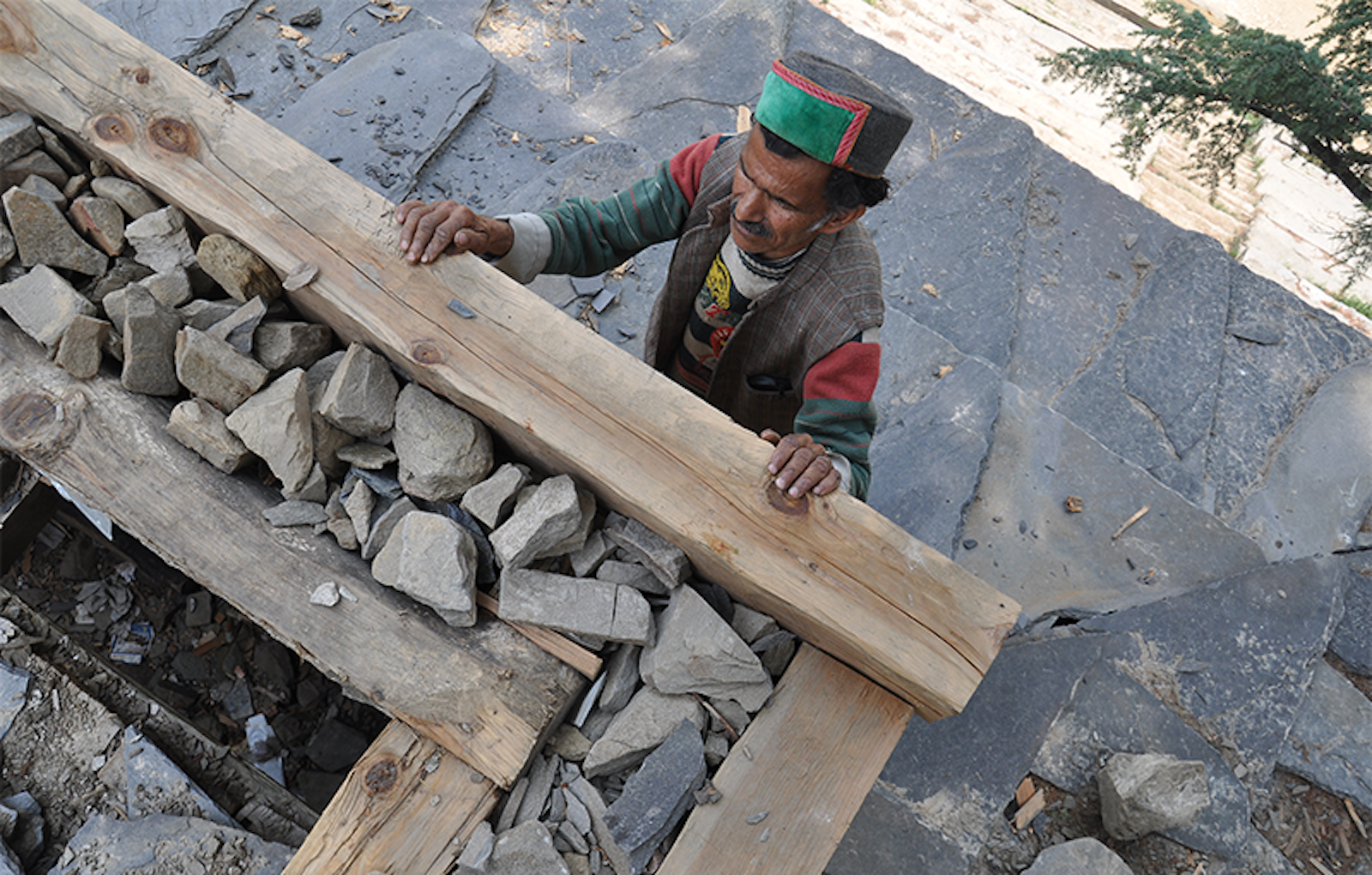
A worker examines a wooden beam in a traditional Indian kath kuni building. These earthquake-resistant structures lack metal and mortar, allowing them to flex as needed during a tremor.

I keep learning about ancient construction techniques that beat modern ones. Remember the post about self-healing concrete, here? That was in Rome. Today’s story explains why some buildings in Turkey and Syria withstood the earthquakes in February and points to ancient buildings in northern India.

Shoma Abhyankar writes at Nautilus, “The powerful 7.8 magnitude earthquake that struck Turkey and Syria on February 6 killed almost 50,000 people, most of whom died under rubble.

“The tragedy falls in a decades-long history of outsized death and destruction from recent earthquakes: The 1999 İzmit earthquake near Istanbul killed at least 17,000 people. … The immediate cause of the human tragedies was not the shaking ground itself, but the buildings people were in, most of which were constructed of reinforced cement concrete, a relatively quick and cheap building method.

“Earthquakes don’t have to be so deadly, say scholars who study this issue. Many traditional buildings have stood the test of time in regions that have endured high seismic activity for centuries.

“In Japan, people had long built earthquake-resistant structures mostly from wood. But a different tradition shows that even stone buildings can withstand vigorous shaking — if they are built with clever physics and architectural adaptations, honed over the centuries.

“In the mountainous region of Himachal Pradesh in India, near where the Indian Plate is colliding with the Eurasian Plate, many structures built in the kath kuni style have survived at least a century of earthquakes. In this traditional building method, the name, which translates to ‘wood corner,’ in part explains the method: Wood is laced with layers of stone, resulting in improbably sturdy multi-story buildings.

“It is one of several ancient techniques that trace fault lines across Asia. The foundations for the timber lacing system of architecture may have originally been laid in Istanbul around the fifth century. … Despite their ancient origins, this model of construction has mostly fared better over centuries than much of the contemporary building across the continent’s many active seismic zones.

“Built along the natural contours of the hills, kath kuni buildings typically get their signature corners from giant deodar cedars, which grow upward of 150 feet tall and 9 feet across in the Himalayas. These wooden beams layer between dry stones, which create walls. A single wooden ‘nail’ joins the beams where they come together.

“As the ponderous-looking structures rise vertically, usually up to two to three stories, the heavy stone masonry reduces, giving way to more wood. The overhanging roof typically has slate shingles resting on wooden beams. ‘The structure is like a body with heavy base, the projecting wooden balconies are limbs, and the heavy slate roof is like a head adding stability to the structure,’ says Jay Thakkar, a faculty member at the Centre for Environmental Planning and Technology University in Ahmedabad, India, who co-authored the book Prathaa: Kath-kuni Architecture of Himachal Pradesh

“The buildings stand free of any mortar or metal, which makes them more capable of shifting and flexing along with torques in the ground. This brilliance of mobility even continues underground. They are built over a trench at least a few feet deep filled with loose stone pieces that works as a flexible plinth. While a building constructed out of what seems almost like rubble to begin with might seem a strange defense against earthquake damage, it works. The gravitational force of the structure itself holds the stones in place.

“ ‘Unlike the cement brick wall, which becomes a single solid mass, the dry stone masonry is flexible,’ Thakkar says. ‘Staggered joints allow the external forces like tremors of earthquakes to be dispersed through the masonry thus preventing cracks in walls.’ He adds, ‘The wooden pin at the corner joint of two beams also allows movement. So when an earthquake hits, the structure sways and shakes but doesn’t collapse.’ ”

More at Nautilus, here. No firewall.

Read Full Post »

Photo: Whitney Eulich.
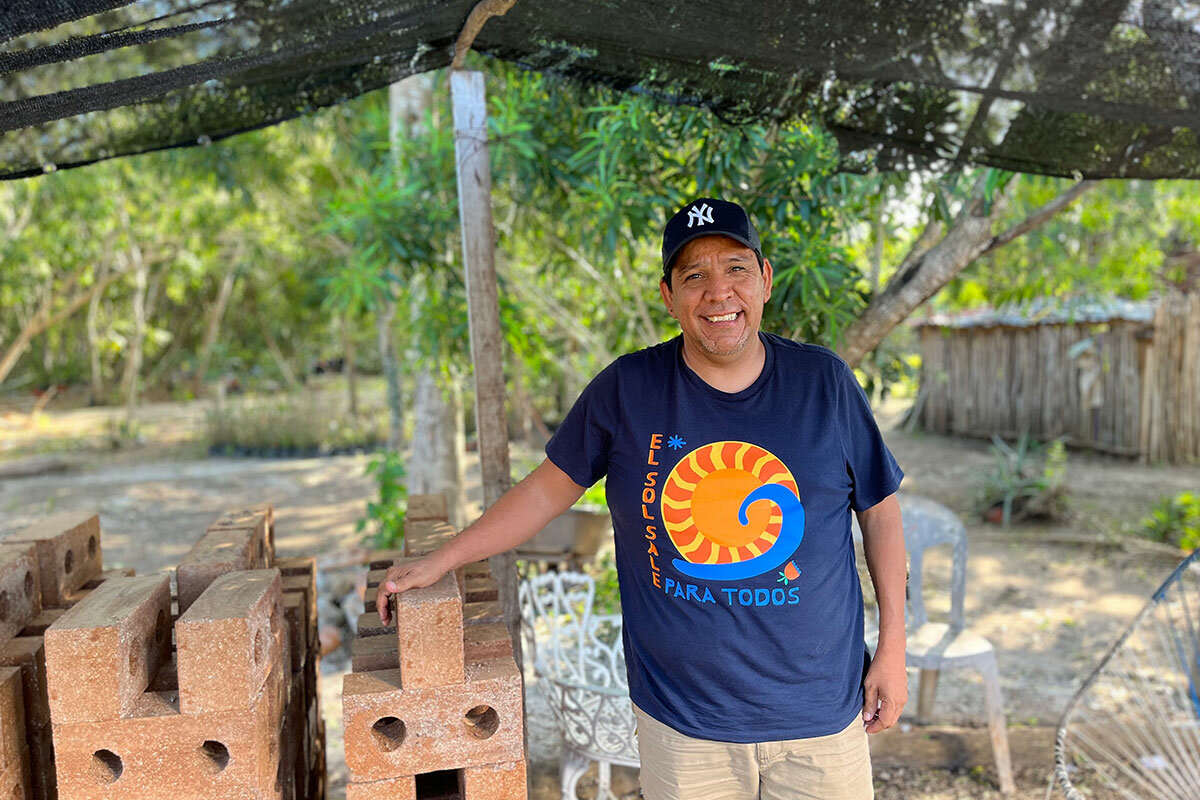
Omar de Jesús Vazquez Sánchez shows his Sargablock solution to the smelly seaweed invasion across the Caribbean shore of Mexico. He makes construction blocks out of it.

Today’s story is an example of someone with too many “lemons” who finds a way to make “lemonade.” It all started with smelly seaweed.

Christian Science Monitor writer Whitney Eulich reports from Puerto Morelos, Mexico, “Sargassum, the invasive, sewage-scented seaweed piling up on beaches across the Caribbean, isn’t something most people look upon kindly.

“But for Omar de Jesús Vazquez Sánchez, his first encounter was ‘love at first sight.’

” ‘Everyone said, “It smells horrible!” and I remember thinking, “There’s something more here,” ‘ says Mr. Vazquez, the founder of Sargablock, a small company in Mexico’s Yucatán Peninsula that transforms the algae into construction blocks.

“A record amount of sargassum is turning crystal blue Caribbean coast waters brown and smelling of rotten eggs as it decomposes in tourist spots from Mexico to Caribbean islands and now along the beaches of Florida’s east coast.

“Researchers blame pollution, overdevelopment, and global warming for the seemingly never-ending seaweed invasion that’s also present in the Atlantic.

“In 2015, as part of his gardening business, Mr. Vazquez launched a beach cleanup service to remove the leafy seaweed. But, as its arrival intensified, he started considering how to turn it into something useful, and in 2018 conceived a way to use sargassum in building blocks. Today he not only sells those blocks to construction projects, but also builds affordable housing in his community.

“ ‘When I look at Sargablock, it’s like looking in a mirror,’ he says, comparing his company to conquering his personal struggles, including addiction, and briefly, homelessness.

‘When you have problems with drugs or alcohol, you’re viewed as a problem for society. No one wants anything to do with you. They look away.’

“ ‘When sargassum started arriving, it created a similar reaction. Everyone was complaining,’ he says. … ‘I wanted to mold something good out of something everyone saw as bad.’ …

“The state government of Quintana Roo collected 19,000 tons of sargassum from beaches in 2020; 44,000 tons in 2021; and 54,000 tons last year. Researchers say the amount could nearly double this year, and it arrived months ahead of what is typically the start of sargassum ‘season’ in May. …

“Mr. Vazquez mixes 40% sargassum with other organic materials, like clay, that he then puts it into a cement-block-forming machine. The blocks bake in the sun for several days before they’re ready to use. He says he used 3,000 tons of sargassum in  2021, 2,000 tons last year. By early April 2023, he’d already used 700 tons.

“The UNDP [United Nations Development Program] selected Mr. Vazquez’s work transforming sargassum for their Accelerator Lab, which identifies and broadcasts creative solutions to environmental and sustainability challenges globally. The idea is that some of the most timely and creative responses come from locals living the repercussions of environmental dilemmas firsthand. …

“A joint study by universities in England and Ghana found that blocks made with organic material like sargassum can last for 120 years. The ecology and environment offices of Quintana Roo concluded the blocks are safe for use in construction. 

“Mr. Vazquez grew up surrounded by nature – and the hardships of poverty. It shaped him into someone who takes action, he says. He remembers singing for spare change on the street as a child, before his single mother moved the family to the U.S. as unauthorized immigrants. They picked grapes in California, and Mr. Vazquez dropped out of high school to double down on what he considers his profession: gardening.

“ ‘There’s this idea of the American dream. But, for me, personally,’ he says, ‘I was always asking God to let me come back to Mexico.’

“It took almost 30 years to do so. ‘Coming back, it took a lot of time to adapt – the salaries are different. Sometimes people are skeptical’ of Mexicans returning from the U.S. he says. He worked odd jobs, like selling timeshares to tourists passing through the Cancún airport. Eventually he invested his savings – $55 at the time – in a nursery.

“As his nursery grew, he was making a name for himself creating a small but promising solution to the sargassum challenge. He gained attention through appearances on Shark Tank Mexico and a locally organized Ted Talk. Although he was living the ‘Mexican dream,’ something was missing. He reflected on when he was happiest in his life and it came down to two things: Memories of spending time in his grandparent’s simple adobe-block home in Jalisco, and being with his mother, who had sacrificed so much for him before passing away in 2004.

“ ‘We never had a house of our own, we didn’t have much food or clothes. I didn’t have a father,’ he says. When he built what he expected to be his nursery’s new office with Sargablock, he designed it as a replica of his grandparents’ home and named it after his mother, Angelita.

“ ‘The first thing that came to my mind and heart was to donate houses to women like my mother, who are doing everything in their power to make it work,’ he says.

“Enter Casas Angelitas. Using Sargablock, Mr. Vazquez has built and donated 14 homes to families in need, many single moms, but also elderly couples and parents supporting kids with disabilities.”

More at the Monitor, here. No firewall. Subscriptions for the online publication are reasonably priced.

Read Full Post »

Photo: Evan Qu/Unsplash.
Self-healing concrete at the Pantheon in Rome.

I grew up in a family that placed high value on the humanities — the arts, literature — and the people who practiced them. With the exception of our beloved Uncle Jim, who was a chemist, and Margaret Lawrence, who was a physician, we didn’t know how to admire people who didn’t fit our limited definition of “creative.”

But today, I’m bowled over by the imaginative pragmatism of people who invent solutions to real-world problems like those who reengineer gasoline engines to use electricity, for example, or who invent building materials that reduce the dangerous carbon dioxide we pump into the atmosphere.

I think even my parents would have loved that today’s scientists are finding inspiration in the ancients. After all, it was fine to admire archaeologists.

Adele Peters reports at Fast Company on research that suggests new possibilities for ancient wisdom.

“A road or bridge made from modern concrete might only last 50 years. But the massive Pantheon building in Rome, made from unreinforced concrete, has been standing for nearly two millennia. And nearby, some ancient concrete aqueducts still deliver water to the city. What made ancient Roman concrete so much more durable?

“A new study from researchers at MIT and Harvard University, along with labs in Italy and Switzerland, suggests that an ancient manufacturing technique can create self-healing concrete that naturally fills in cracks. Using a similar process now could help shrink concrete’s massive carbon footprint. ‘We’re looking to the ancient world as a source of inspiration,’ says chemist Admir Masic, an engineering professor at MIT who focuses on sustainable construction materials.

“Cement, the glue that binds concrete together, is responsible for up to 8% of global emissions when it’s made, both because of the energy it uses and the process of heating up limestone, a key ingredient in the material, which releases CO2 directly. Multiple startups are now working on alternatives: including companies that replace limestone with different rocks or add captured CO2 to the final product.

“The Roman-inspired approach is different. By making concrete last much longer, far less of it would need to be made in the first place. … The older production method also happens at a lower temperature, so it uses less energy.

“The researchers studied samples from a 2,000-year-old city wall in an Italian city. They focused on tiny white fragments of lime that aren’t found in modern concrete, but are ubiquitous in old ruins throughout the former Roman Empire. …

“In the past, some researchers thought that the fragments, called lime clasts, were the result of sloppy mixing. But it’s more likely that they were formed deliberately, and the study suggests that they are the reason the concrete lasts so long.

When tiny cracks form in the concrete, water travels to the lime clasts, which dissolve and then fill the cracks with calcium carbonate.

“The researchers attempted to duplicate the manufacturing process that created the lime clasts, and then tested the material against samples made with modern techniques. After cracking the samples and adding rainwater, they watched what happened: The old-school concrete healed itself within two weeks, while in the modern version, the cracks remained.

“Other approaches to ‘self-healing’ concrete also exist now. For example, it’s possible to embed bacteria in concrete that can fill cracks; but it’s costly to make. ‘Current self-healing concretes are very expensive because they are based on very complex chemistry, while our material is super cheap,’ Masic says. … The ancient process involves adding quicklime, a calcium oxide-based material (also known as lime), directly to other ingredients before adding water.

“A new startup is now spinning out from the research to bring the concrete to market. It may later add other features that the lab is studying, including making concrete that can absorb CO2 as it sits outside.” That would be amazing!

More at Fast Company, here.

Speaking of “creative,” check out the varied interests of that MIT chemistry professor: “Professor Masic’s research focuses on the science-enabled engineering of sustainable construction materials for large-scale infrastructure innovation. A chemist by training, with expertise in biomineralization, he specializes in the development of multifunctional cement-based materials, ranging from self-healing concrete materials to carbon absorbing concretes and electron conducting cement-based materials.

“He is a principal investigator in the Concrete Sustainability Hub at MIT, a faculty fellow in Archaeological Materials at MIT’s Center for Materials Research in Archaeology and Ethnology (CMRAE), and the faculty director of the Refugee ACTion Hub (ReACT) at MIT. MIT ReACT aims at providing new professional content development for displaced learners around the world.”

Read Full Post »

Photo: Jessica Rinaldi/Globe.
Apprentices learning how to plaster inside Forge, a trade school that helps students move right into a job.

The kinds of people I follow on social media are always saying that there is no shortage of labor right now, just a shortage of decent pay. So my next thought is, How do people qualify themselves for decent pay, especially young people who don’t go to college?

Investigating one approach, Scott Kirsner writes at the Boston Globe about a trade school that is hiring its graduates.

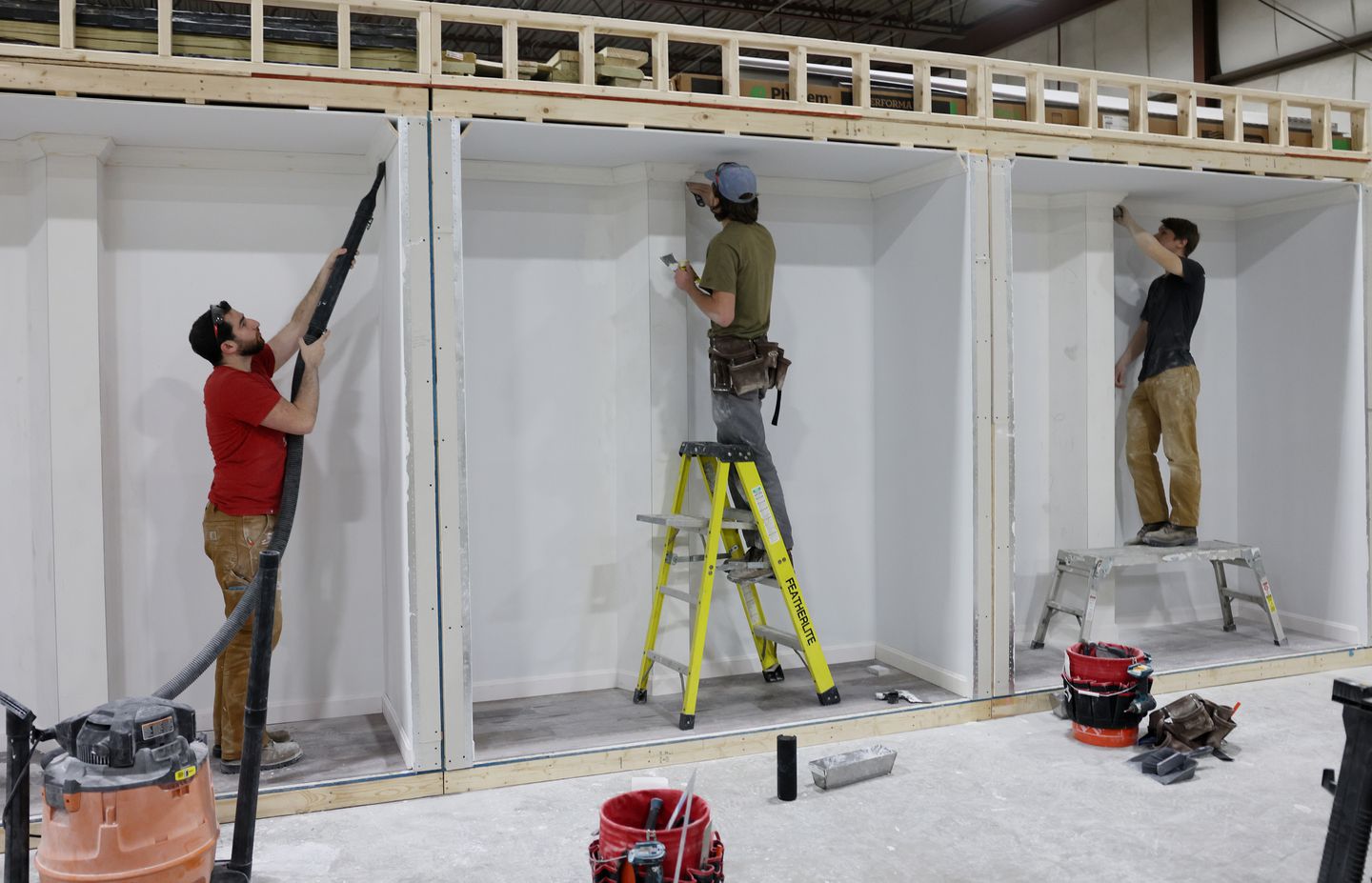
“In a building next to the Mass. Pike in Newton, two construction crews are at work. Enter the front door, labeled with a sheet of paper that says ‘Forge,’ and a crew is renovating a 1960s-era office space that will eventually house software developers, customer service staffers, and a finance department.

“But go through another door, and you’re in a high-ceilinged industrial space. Here, 10 apprentices are toting lumber, measuring walls, and hanging sheetrock. But this crew is part of a 12-week program that teaches the basics of construction and pays them $15 per hour as they learn.

“Founded in late 2020, Forge is a startup that runs a new kind of trade school but also seeks to employ the graduates. And the company has raised nearly $28 million, some of it from the Miami-based homebuilder Lennar Corp., to train more workers and expand to a second city, likely Tampa. Founder Mark Kasdorf says his goal is to employ 100,000 people in 10 years.

“Kasdorf thinks that can happen by creating a new kind of ‘on-ramp’ to the construction trades for so-called Generation Z workers just now entering their twenties.

“ ‘The types of employers in the trades today are incompatible with Gen Z, from big builders like Suffolk to the union to a 65-year-old operator of a plumbing general contracting company. They don’t like Gen Z, and Gen Z doesn’t like them.’ Kasdorf says nearly one-third of Forge’s graduates so far have been women. ‘They’ll tell you that there’s no on-ramps for them,’ he says. …

“Kasdorf sold a previous company, Intrepid Labs, to the consulting giant Accenture in 2017. … When Kasdorf left Accenture to start Forge, he raised money from Boston Seed Capital and was focusing on creating technology for ‘augmented reality’ glasses. … [But] he realized that ‘we’re running out of skilled tradespeople in the US,’ especially as an older generation begins to retire.

“The company changed its focus in February 2021, to ‘building a private trade school where we’re training the next generation of trades worker for America,’ he says, and surrounding them with technology like those augmented reality glasses. …

“One early student, Nick Claude, was managing a bar in Hingham when he heard about the opportunity from a customer who worked for Forge. Claude says he ‘had wanted to get into the trades. … He reached out to 30 or 40 tradespeople, but found ‘many weren’t willing to take on strangers they don’t know.’

“The 12-week program has students build their own workbench, and then they move on to working on simulated houses, learning how to frame a house, install roofing, and add flashing. They install tile and faux-wood flooring and learn to hang sheetrock, plaster walls, and add molding. Kasdorf says about 70 percent of the apprentices finish the program and move into paid positions with Forge, earning $21 an hour and health insurance. (Forge guarantees them 32 hours a week of work.)

“The company sends its alumni out on window replacement jobs, or one-day bathroom refits, typically subcontracting for a larger brand. … Forge also buys houses in the Boston area, dispatches crews to renovate them, and then flips them. The company seeks to buy $300,000 to $400,000 starter homes that it can resell for $600,000. He says that the worse shape a house is in, the better it is for Forge: ‘We want houses that need a lot of labor — it’s more training opportunities for our people.’ …

“Using technology is still part of the picture, Kasdorf says. Twice a day, at noon and 4 p.m., someone on each crew dons an augmented reality headset for a quality check. That allows a supervisor at the office in Newton to ‘see’ the work that has been done remotely, ask questions, and address any problems that have cropped up. …

“Forge has a long way to go to show that it can profitably train and employ thousands of tradespeople. (At present, the company has 90 employees.) But it is working on a major problem — there were more than 400,000 open jobs nationally in construction in September, according to the Bureau of Labor Statistics, and a recent article from McKinsey & Co. highlighted ‘a persistent labor shortfall’ in the sector that could become even worse in the wake of the Bipartisan Infrastructure Law, which will funnel billions into new transportation projects. …

“ ‘The demand is strong’ for people with skills in carpentry and other trades,” says Tom Fischer of the North Atlantic State’s Carpenters Training Fund, adding that he would never knock a training program just because it is small — every bit helps.

More at the Globe, here.

Read Full Post »

Photo: Suzanne’s & John’s Mom.
Have you ever wondered how this tradition got started?

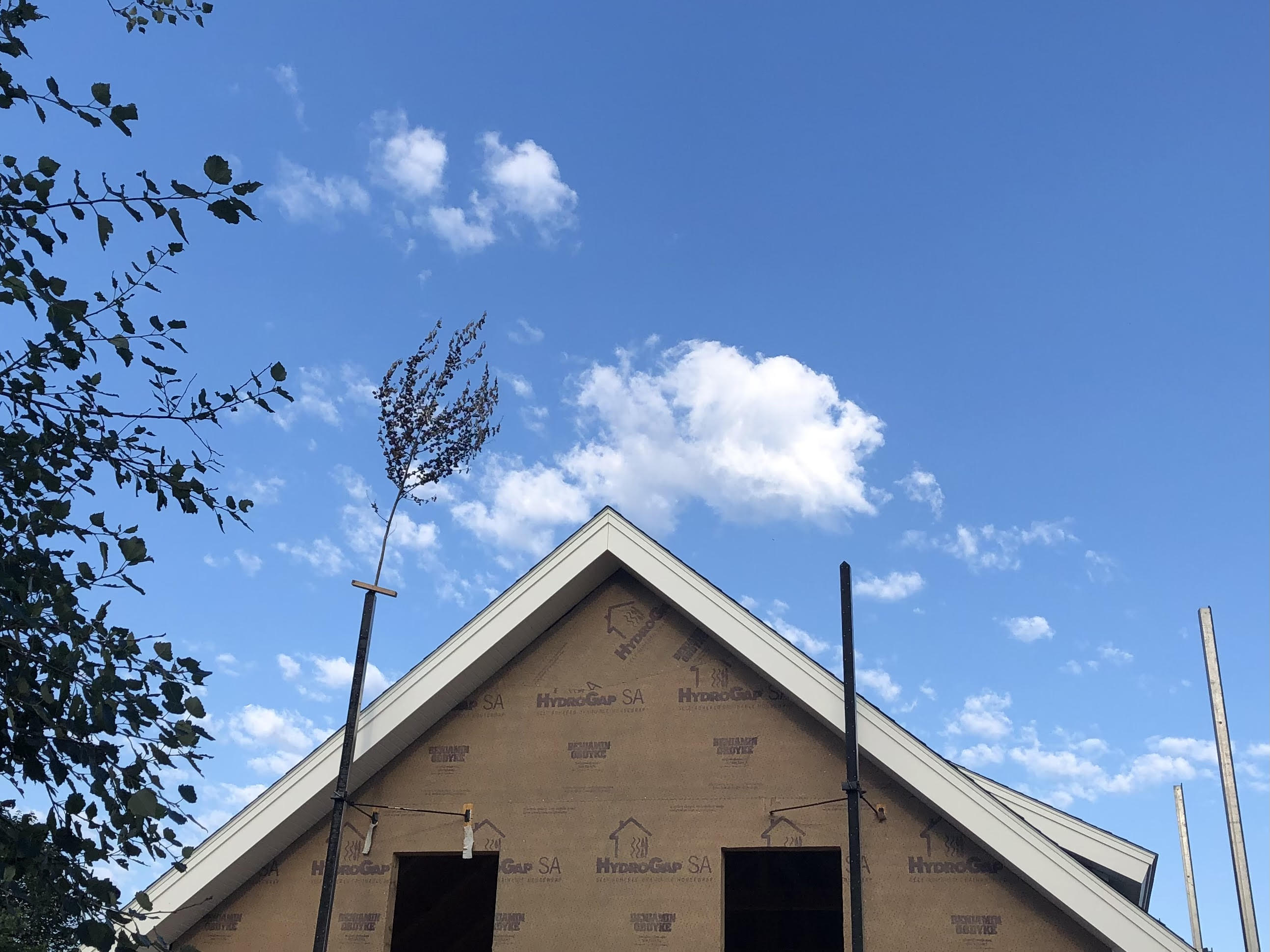
Here is what I was able to find out about the custom of putting a tree on the roof of a building under construction.

Mark Vanhoenacker posted one explanation at Slate in 2013. “The tree is an ancient construction tradition. There are many such rites associated with a new edifice including the laying of foundation stones, the signing of beams, and ribbon-cuttings. But what’s particularly charming about the construction tree is that it isn’t associated with the beginning or the end of construction. Rather, the tree is associated with the raising of a building’s highest beam or structural element.

[The] name of the rite: the topping-out ceremony. It’s a sign that a construction project has reached its literal apogee, its most auspicious point. …

“When a new building reaches its final height, it’s not surprising we’d mark the occasion with a ceremony. But why celebrate with a tree?

“In fact, the first topping-out ceremonies didn’t use trees. In 8th-century Scandinavia sheathes of grain were the plant material of choice. But as topping-out ceremonies spread throughout northern Europe, trees were a natural evolution. …

“The ancient topping-out ceremony has survived mostly intact in this era of high-tech, high-altitude edifices. In the U.S., particularly on large projects, the final beam is often signed, and an American flag may accompany the tree skyward. The purpose of the ceremony — at least for shining skyscrapers — is usually couched in comfortably post-pagan terms: a celebration of a so-far safe construction site, an expression of hope for the secure completion of the structure, and a kind of secular blessing for the building and its future inhabitants.

“But superstition remains a part of the ceremony, especially on smaller projects. Elizabeth Morgan, an architect at Kuhn Riddle in Amherst, Mass., (and a childhood friend) told me that the general understanding among her colleagues is that the greenery may ‘symbolize the hope that the building will be everlasting.’ She also reports a vague sense among construction teams that ‘if you don’t do it, bad things will happen.’

“Her colleague Brad Hutchison noted that ceremonies often involve a pine bough, not a whole tree. He remembers a wintry Friday afternoon ceremony when a pine bough was mounted on the ridge beam of a recently framed roof. … ‘This is New England, so a lot of carpenters are/were sort of New Agey and took the tradition somewhat seriously,’ he said. ‘New-Agey superstition and carpentry/building go well together, I think.’ …

“What about outside of America? The tree tradition reputedly remains strong in much of northern Europe. … In Victoria, Australia, Kate Ulman, a farmer and blogger, recently attended a topping-out ceremony at her parents’ house. Their construction team had never been to a topping out but were familiar with the custom. This being Australia, in addition to a fir branch, they added—what else?—some eucalyptus. And there was cake.

“What about in Hong Kong, where skyscrapers are a revered form of public art, and the resulting skyline dwarfs even that of New York? I contacted Julia Lau, a Hong Kong architect. … Lau told me that despite Hong Kong’s British heritage, Western topping-out ceremonies are rare. The main celebration is Chinese-influenced and takes place at the start of construction, with a roast suckling pig. On the (auspiciously numbered) date of the ceremony, a stakeholder in the building will bow three times while holding three pieces of burning incense — a pleading for a ‘safe and smooth-sailing project,’ says Lau.”

Sandra and I walked by the building in the photo this morning around 6 (hot day). We’d been wondering about the custom. The topping-out here uses a branch from a nearby tree and is not actually attached to the roof but hoisted nearby to look like it. I hope it still brings luck.

More at Slate, here.

Read Full Post »

Photo: EdiliziAcrobatica.
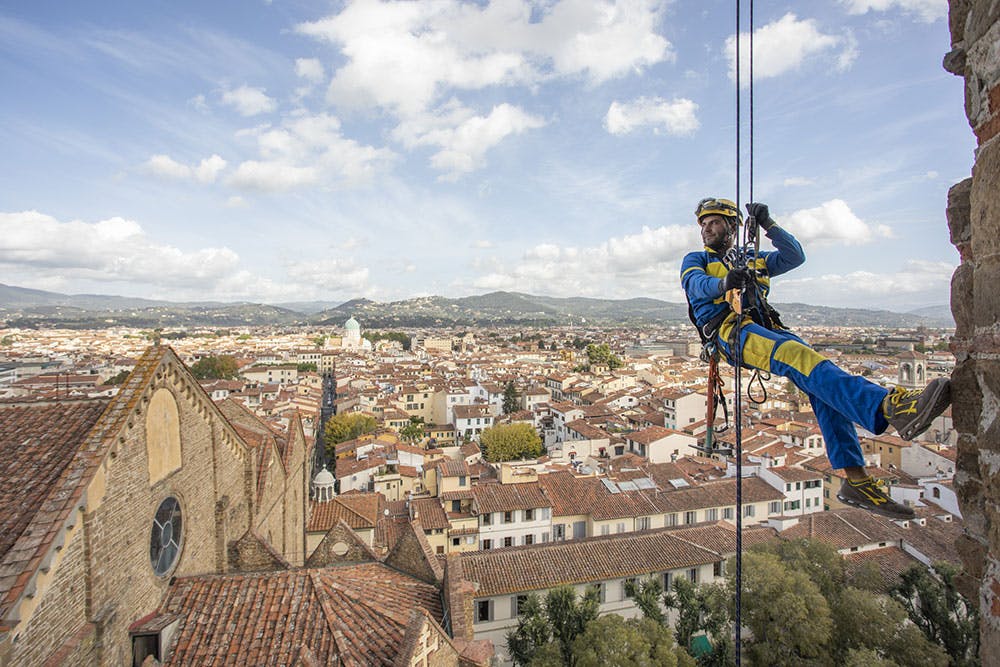
A construction worker has a great view from Santa Croce in Florence.

So many different kinds of jobs in the world! Today’s story is about construction workers with specialized talents that might just as easily have gotten them hired by the circus.

Rebecca Ann Hughes has the story at Apollo. “Beneath the celestial vistas of Parma Cathedral’s frescoed dome, two men swing like trapeze artists from ropes crisscrossing under the roof as though in a circus tent. They seem to be attempting to join the swirling vortex of angelic limbs in Correggio’s scene of the Virgin’s Assumption above them. But they are actually members of EdiliziAcrobatica, an Italian construction company specializing in rope access building interventions. On this occasion, the company has been drafted in to repair a bell in the cathedral.

“EdiliziAcrobatica’s team has rock-climbed up and abseiled down some of Italy’s most significant historic monuments. The company has worked on the Ponte Vecchio in Florence, Siena Cathedral, and the Roman Forum, to name a few. It has also intervened in banks, apartment blocks and various other public and private buildings. Suspended from ropes, the acrobatic technicians can perform a whole range of tasks, from the waterproofing of roofing to welding – all the necessary tools in bags and buckets attached to their harnesses. To watch the team at work is a breathtaking and nail-biting experience. From street level, they are minute figures poised on the roof of Parma’s dome to replace copper panels damaged by rain or casually dangling above the waters of the Arno to repair a leaking fountain on the Ponte Vecchio. …

“The building company didn’t choose to specialize in these acrobatic techniques just for the spectacle. Rope access, a construction work-at-height technique that started to become popular in the 1980s, comes with a multitude of advantages over traditional scaffolding, as Riccardo Iovino – who founded EdiliziAcrobatica in 1994 – explains via email.

“At the forefront is safety. Workers are attached by two ropes, one for safety, and ropes can also relay equipment. Although founder Iovino was, as a skipper, at home shimmying up and down rigging – and was thus inspired to adopt the technique professionally – EdiliziAcrobatica’s workers are not expected to have a mountaineering or caving background. The company assists the construction workers – who are overseen by specialist surveyors – with training and obtaining the required permit for rope access work. Thus, suspended from the side of a building, EdiliziAcrobatica’s technicians can carry out restoration work, paint walls, clean windows, replace gutters and repair unsafe elements of a building in total safety.

“That’s not to say that these strict safety procedures dampen the thrill of the work. Enzo Spitale, who began as an acrobatic builder and now acts as coordinator overseeing the team in Italy, returned from his interview 10 years ago thinking it was all completely mad. But he now says his employment at EdiliziAcrobatica was a life-changing opportunity. Dangling from a Renaissance dome or a medieval bridge, ‘you feel one step away from the sky,’ Spitale says. ‘It is unique and unimaginable for those with their feet on the ground.’

“This aspect of the job comes with its own risks. ‘It is always important, as I remind the new company recruits, never to lose concentration at work,’ says Spitale. ‘We are suspended from ropes several metres off the ground, we have to pay attention to what we are doing and not get distracted by the clouds!’ “

More at Apollo, here.

Read Full Post »

welling-court1

Photo: Welling Court Mural Project
New York City recently sought proposals from qualified nonprofit organizations to install artwork on an ugly sidewalk shed or fence.

There’s a lot of construction and renovation going on in New York City these days, and many otherwise interesting buildings are obscured by scaffolding and green plywood fences. Fortunately, the city is always looking for ways to bring culture to unlikely places and to engage artists.

Michelle Cohen writes at the website 6sqft, “On September 12, the New York City Department of Cultural Affairs announced a search for applicants for a new pilot program called City Canvas, Archpaper reports. The program was designed to beautify New York City’s visual landscape by installing large-scale–and temporary artwork on its endless construction fences and 270 miles of sidewalk sheds. The protective construction structures are an everyday eyesore for New Yorkers, but current building codes prohibit altering them. The City Canvas program circumvents that ban by allowing select artists and cultural institutions to add visual art to the visual affronts.

“There are two main objectives for the new initiative. First, to improve the experience of strolling through the city’s streets for residents and tourists alike by turning the ubiquitous fences into beautiful works of art, and second, to increase opportunities for artists and cultural institutions to get recognized for their work and to create art that represents the surrounding community. …

“During the pilot period, which will run for the next 24 months, the city is seeking proposals from at least one qualified nonprofit organization to install artwork on at least one ugly sidewalk shed/fence.” More.

The winning applications were announced November 28 at the New York City Department of Cultural Affairs (DCLA) website: “DCLA, in partnership with the NYC Department of Buildings and the NYC Mayor’s Office, is excited to announce two cultural organizations selected for the City Canvas pilot. ArtBridge and Studio Museum in Harlem will each work with local communities to transform protective construction structures into spaces for temporary art installations. First installations are anticipated in Spring 2019.”

Well, it’s a drop in the bucket, but I can’t wait to see what emerges.

Read Full Post »

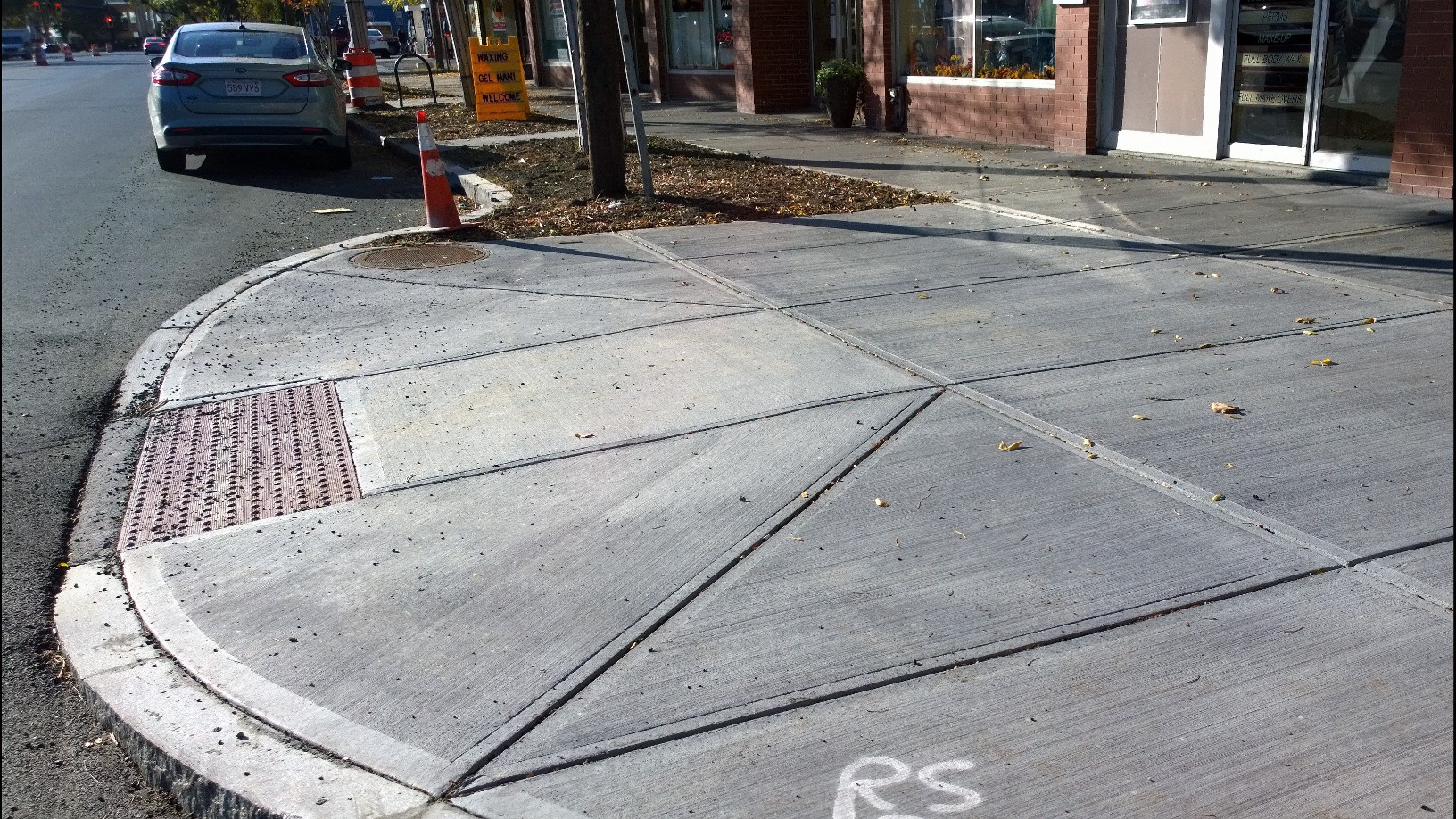
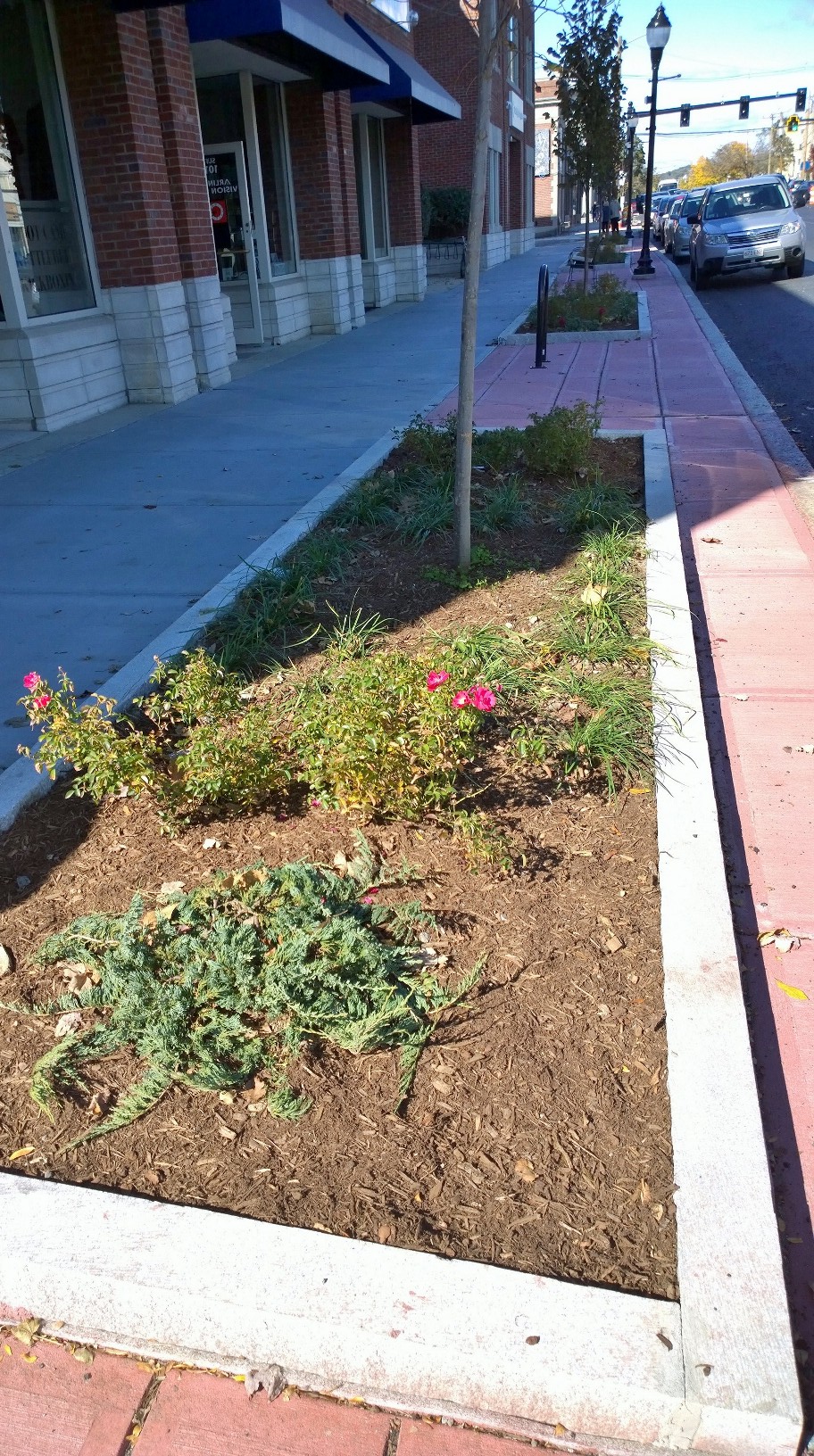
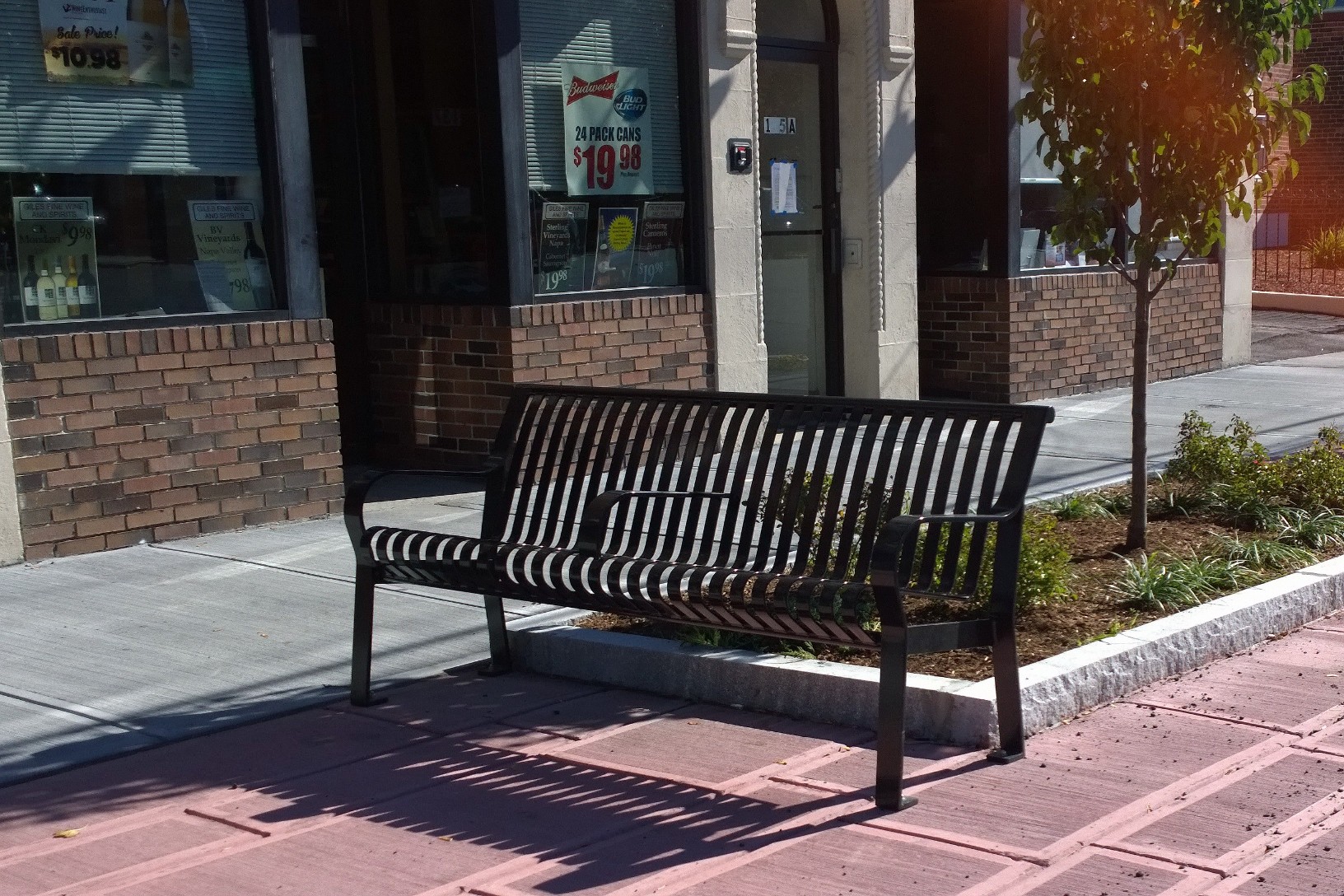
Massachusetts Avenue in East Arlington is shrinking. After contentious debate, the town decided to widen the sidewalks, add barrier islands in the street, and new plantings and benches.

The job is not done, but in spite of construction and less room for vehicles, the traffic doesn’t seem to have increased — one of those counterintuitive results that designers tout. The goal is to make the street more pedestrian and bike friendly and allow more community activities on sidewalks. Through the tree committee, John has been involved with the beautification side of things.

One of the issues that gets raised when a major disruption like this is afoot is the effect on small businesses. Neighbors are making a point of shopping local, hoping that Arlington merchants won’t suffer.

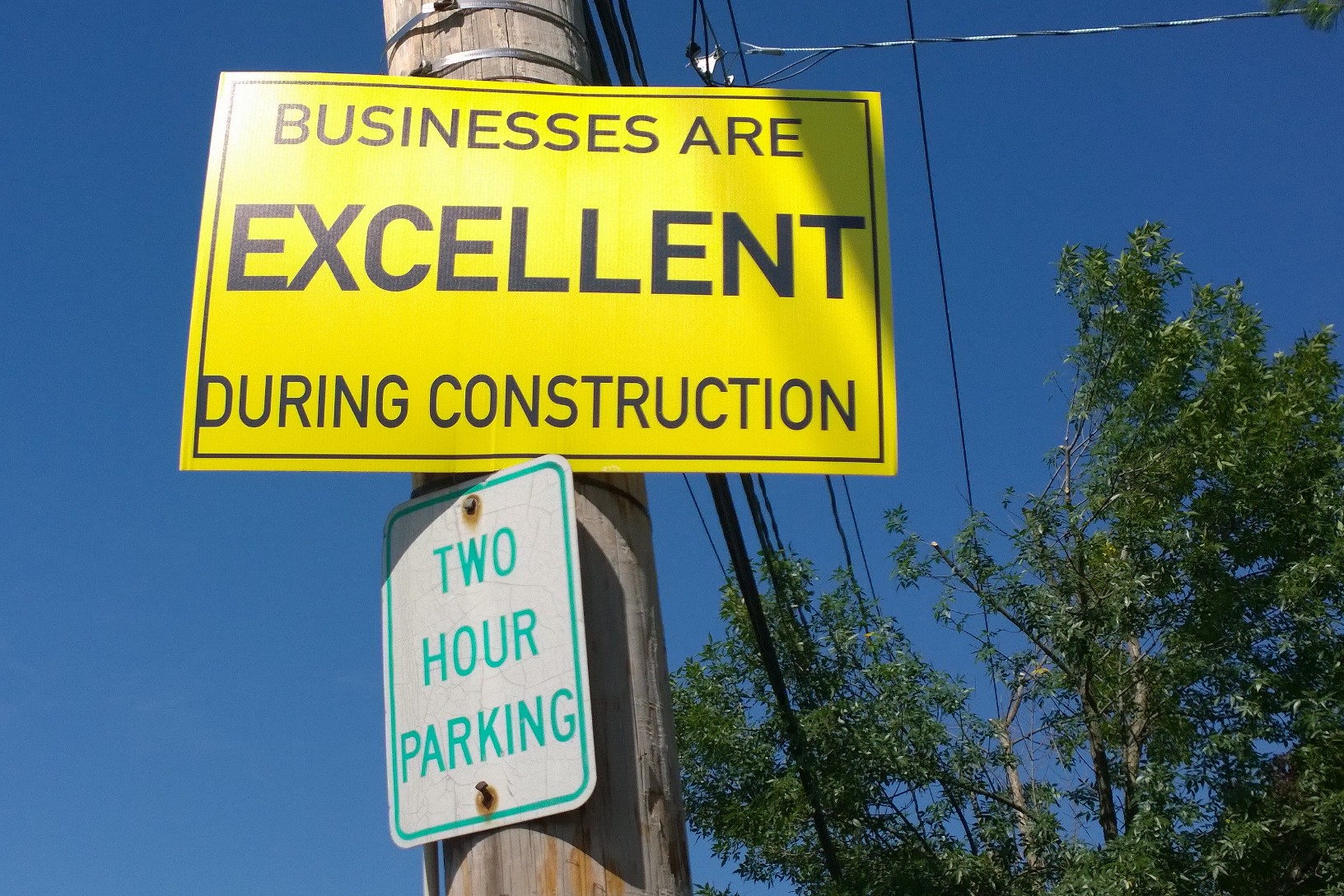
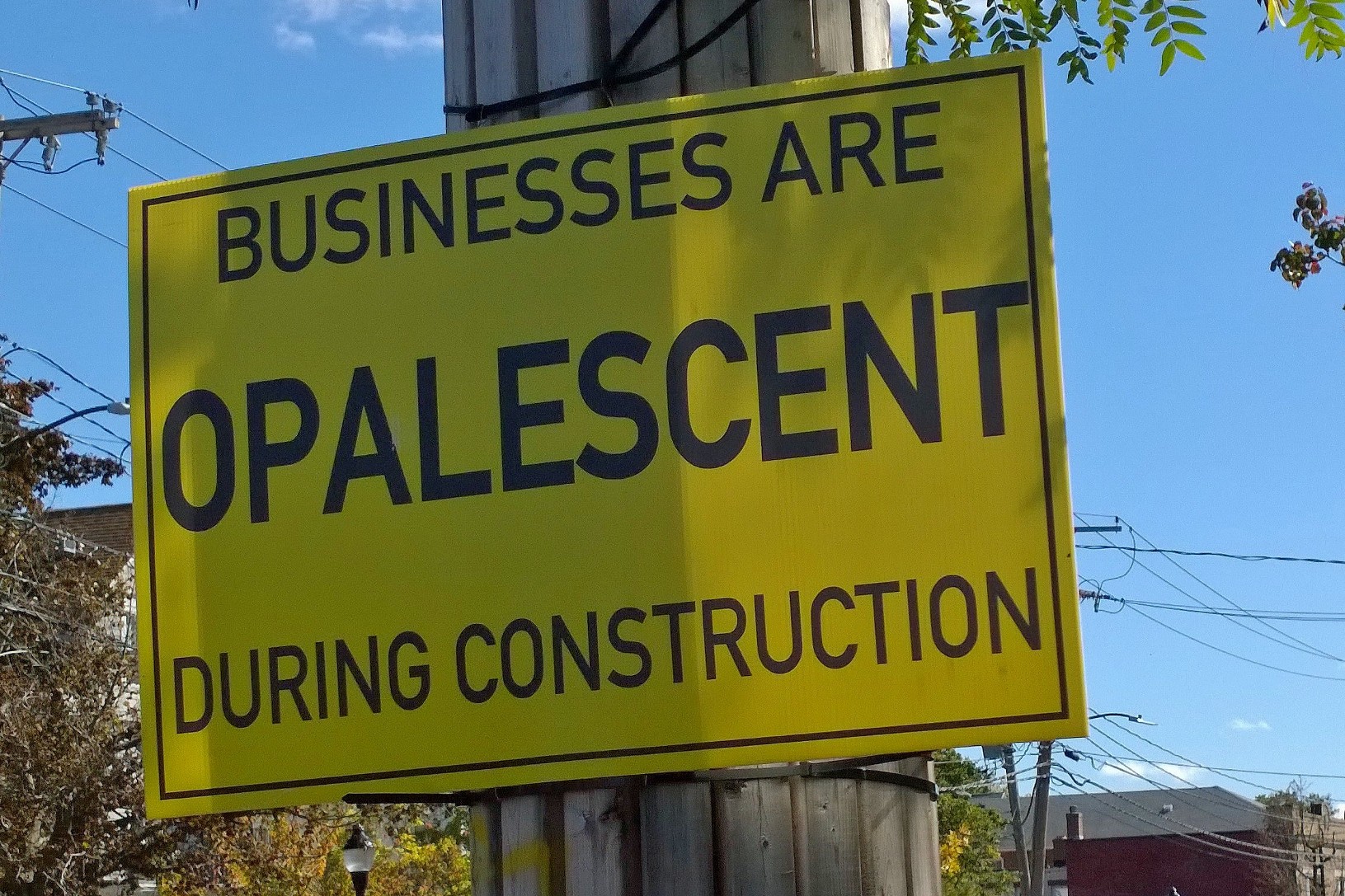
And to make sure residents don’t forget how important that is, there is an amusing signage campaign — signs saying that “Businesses are [fill in the blank] during Construction.”

For example, “Businesses are Opalescent during Construction.” Other Mad-Libs-type adjectives used are Quirky, Colorific, Radiant, Prismatic, Harmonic, Niblicious, and Excellent.

Below, I include a couple of the signs. And I tried to show how the project is coming along — the wide sidewalk, the plantings, the bench. I look forward to seeing how the residents begin to make use of their new public spaces.

091915-shop-local-despite-construction

101715-support-small-biusiness

101715-bump-out-sidewalk

101715-widening-the-walk

101715-wider-walk-allows-benches

Read Full Post »

Not sure how I learned about this story in the St. Louis Post-Dispatch, but I knew right away it would be good for the blog. It seems that enterprising neighbors of some vacant urban land started a garden on it 35 years ago, always wondering what would happen if the owners ever turned up.

Reporter Paul Hampel writes, “Joe Spears was ready to give up the farm. He had no legal claim to the plot of land in Kinloch, after all. Spears was just one of several dozen people who, without any official clearance, had been planting and harvesting greens, okra, melons, beans, tomatoes and peppers for the past 35 years on about nine vacant acres abutting North Hanley Road.

“When an executive from one of the largest construction firms in the Midwest approached the amateur farmers in the fields last fall, it looked like a good thing was coming to an end.

“ ‘We were never trying to pull the wool over anyone’s eyes,’ Spears, 70, of Rock Hill, said … ‘It wasn’t our property. And it wouldn’t be right for us to make a scene when the rightful owners told us to move on.’

“The rightful owner, Clayco Inc., explained that the minifarms lay in the path of the planned expansion of NorthPark Business Park, the company’s massive development … Then came a proposal that caught the farmers, including Armstead Ford, by surprise.

“ ‘Clayco offered to give us another place to farm,’ Ford, 75, of Northwoods, said. ‘I was hopeful but skeptical.’ …

“Clayco president Bob Clark allayed those concerns when he announced that the company was relocating the farmers to 8 acres in Berkeley that they had asked him for, just across North Hanley Road from the old farm.

“And the farmers won’t have to capture rain in barrels or haul in water to the new site: Clark, 56, was throwing in an irrigation system, along with a building on the property that has running water, electricity and restrooms.”

Read the rest of the story here, and check out the other photos.

Read Full Post »

110714-a-pigeon-that-I-pass-alas


When Suzanne was two, she and John used to watch a TV show with a theme song that went like this: “Stop the pigeon, stop the pigeon, stop the pigeon — now!”

One day we took the train to New York City, and in spite of the fact that Suzanne never saw pigeons where we lived, she took one look at the city’s official bird and started singing, “Stop the pigeon!”

So unlike many people, I have some good feelings associated with pigeons, and I am getting a big kick from the pigeons I photographed near city hall yesterday.

Someone with a sense of humor has decorated the barrier around the construction site for the  new Government Center T stop with pigeon portraiture.

110714-peeking-thru-pigeons

110714-stop-the-pigeon-now


Read Full Post »

Older Posts »