
Feeds:
Posts
Comments

Posts Tagged ‘crime’

Image: The Dial.

I read a lot of murder mysteries. They are not the only type of book I like, but I like the puzzles and sometimes even the writing. So I was drawn to today’s article on the emergence of an unlikely crew that has gotten involved in solving tough cases.

Julia Webster Ayuso wrote recently at the Dial about forensic linguists.

“On the evening of October 16, 1984, the body of four-year-old Grégory Villemin was pulled out of the Vologne river in Eastern France. The little boy had disappeared from the front garden of his home in Lépanges-sur-Vologne earlier that afternoon. His mother had searched desperately all over the small village, but nobody had seen him.

“It quickly became clear that his death wasn’t a tragic accident. The boy’s hands and feet had been tied with string, and the family had received several threatening letters and voicemails before he disappeared. The following day, another letter was sent to the boy’s father, Jean-Marie Villemin. ‘I hope you will die of grief, boss,’ it read in messy, joined-up handwriting. ‘Your money will not bring your son back. This is my revenge, you bastard.’

“It was the beginning of what would become France’s best-known unsolved murder case. The case has been reopened several times, and multiple suspects have been arrested. Grégory’s mother, Christine, was charged with the crime and briefly jailed but later acquitted. Jean-Marie also served prison time after he shot dead his cousin Bernard Laroche, who had emerged as a prime suspect. …

“More than three decades after Grégory’s murder, police brought in a team of Swiss linguists from a company called OrphAnalytics to examine the letters and their use of vocabulary, spelling and sentence structure. Their report, submitted in 2020, and part of which was leaked to the press, pointed to Grégory’s great-aunt, Jacqueline Jacob. The results echoed earlier handwriting and linguistic analysis that had led to Jacob and her husband’s arrest in 2017. (The couple was freed later that year over procedural issues.)

“While the new evidence has not yet been presented in court, some believe it could help to solve the case that has haunted an entire generation. It has also shone a spotlight on the little-known field of forensic linguistics. In France, the use of stylometry — the study of variations in literary styles — has largely been confined to academic circles. The Grégory case is the first time it has been applied in a major criminal investigation.

“The use of forensic linguistics in the case was initially treated with skepticism. … The general prosecutor at the Court of Appeal of Dijon, Philippe Astruc … cautioned: ‘To imagine that it will suddenly be settled with a single report is an illusion.’

“ ‘The press didn’t understand it, and the lawyers are saying it can’t work,’ Claude-Alain Roten, CEO of Orphanalytics, told me over the phone from his office in Vevey, a Swiss town on Lac Léman. But he assured me his results are reliable. ‘We came to similar conclusions to the conclusions they had already reached by other means,’ he said, adding that OrphAnalytics last year completed another report commissioned by the general prosecutor of Dijon, who oversees the Villemin investigation, analyzing an additional anonymous letter. ‘It gives us a very precise idea of who the person who wrote the letter is.’

“According to forensic linguists, we all use language in a uniquely identifiable way that can be as incriminating as a fingerprint. … The term ‘forensic linguistics’ was likely coined in the 1960s by Jan Svartvik, a Swedish linguist who re-examined the controversial case of Timothy John Evans, a Welshman who was wrongfully accused of murdering his wife and daughter and was convicted and hanged in 1950. Svartvik found that it was unlikely that Evans, who was illiterate, had written the most damning parts of his confession, which had been transcribed by police and likely tampered with. The real murderer was the Evans’ downstairs neighbor, who turned out to be a serial killer.

“Today, the field is perhaps still best known for its role in solving the ‘Unabomber’ case in the United States. Between 1978 and 1995, a mysterious figure sent letter bombs to academics, businessmen and random civilians, killing three people and injuring at least 24. The lone bomber was careful not to leave any fingerprints or DNA traces, evading the authorities for 17 years and triggering one of the longest and most expensive criminal investigations in U.S. history. But in 1995, he made a crucial mistake. He told the police he would pause his attacks on the condition that a newspaper publish his 35,000-word anti-technology manifesto.

“When the document appeared in the Washington Post, the New York Times and Penthouse magazine, several people — including the perpetrator’s brother— reached out to say they recognized the writing style. Meanwhile, FBI linguist James Fitzgerald and sociolinguist Roger Shuy, who had been studying the bomber’s letters, had identified patterns in his language that helped narrow the list of suspects: Spellings such as ‘wilfully for ‘willfully’ and ‘clew’ for ‘clue’ pointed to someone from the Chicago area, for example. Eventually, the linguistic evidence was strong enough to issue a search warrant for the home of a reclusive mathematician named Theodore Kaczynski, raised in Chicago but living in rural Montana, where investigators found copies of the manifesto and homemade bombs. …

“At OrphAnalytics, Roten, who has a PhD in microbiology, explains that algorithms identify patterns in syntax much like in a DNA sequence. The difference, he tells me, is ‘there are very few errors in genome sequences, which is not the case when we compare texts,’ he said. Unlike with DNA, which a perpetrator can’t control, the author of a poison-pen letter is likely to try to obscure his writing style, for example by trying to sound less educated or to seem foreign.

“Still, linguists argue that style is almost impossible to hide because many of the choices we make are unconscious. Someone may decide to spell a word wrong, but forget to modify less noticeable details, such as their use of punctuation. ‘People say a lot about themselves when they’re trying to hide their writing,’ said Roten.”

More at the Dial, here. No firewall.
Read Full Post »

Photo: Neal’s Yard Dairy/Instagram.
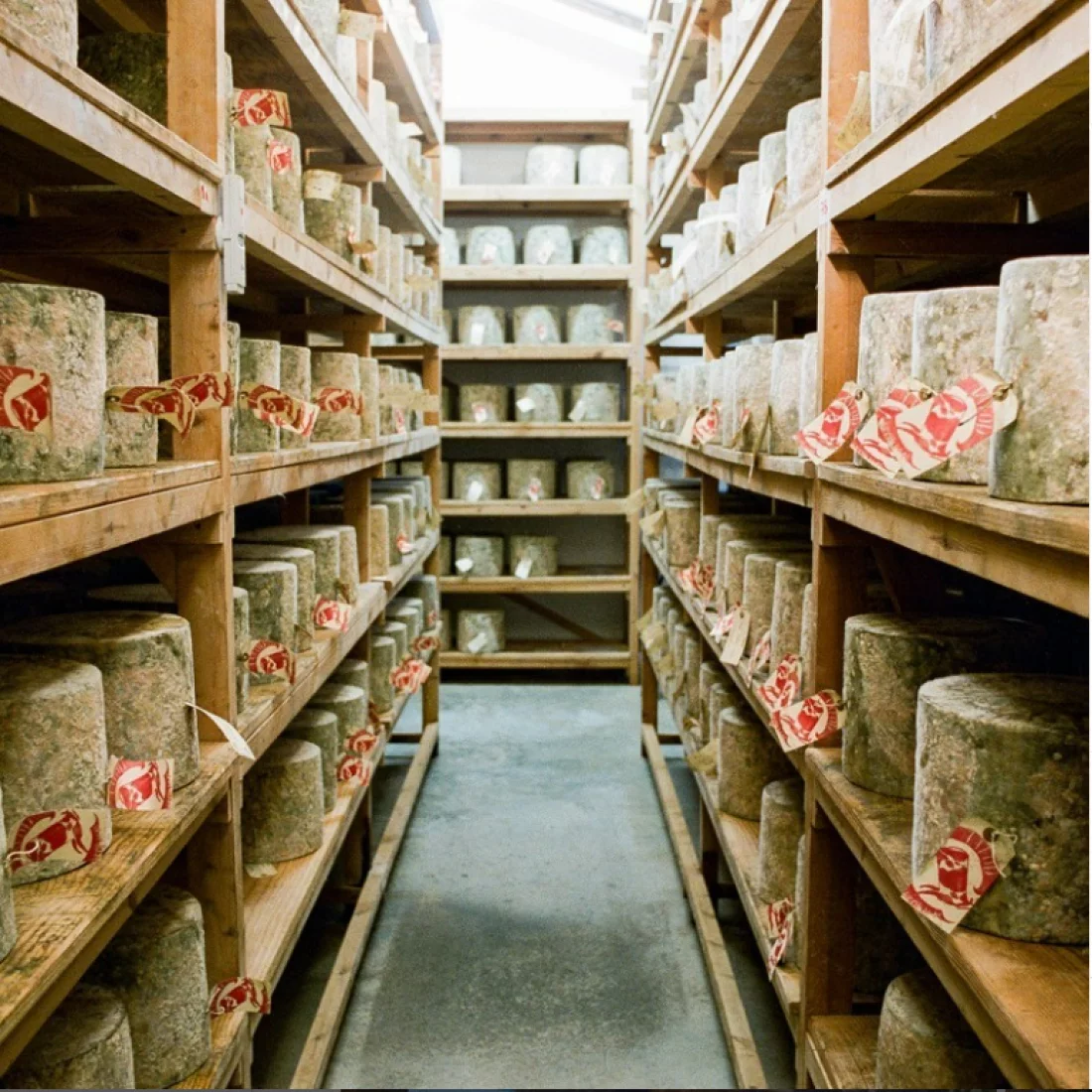
London-based distributor Neal’s Yard Dairy announced recently on Instagram that it was “the victim of a sophisticated fraud” involving high-value cheddar cheese.

You really don’t want to get mixed up with people who are intense about cheese. Years ago, when I was a member of Cheese Lovers International, I crossed knives with the highly emotional founder, whose name I no longer recall. To compensate for something I once complained about, he told me he would give me a discount on every order for my life. Unfortunately, his staff had no way of knowing about my discount. Explaining got to be too much work.

Rachel Treisman and Juliana Kim have a great cheese story at National Public Radio.

“Authorities in London have arrested a 63-year-old man in connection with the cheese heist of 2024, in which tens of thousands of pounds of high-value cheddar were stolen from a major distributor. ..

“ ‘The man was taken to a south London police station where he was questioned. He has since been bailed pending further enquiries,’ a police spokesperson said.

“Over the past week, the British artisanal cheese community has been reeling after Neal’s Yard Dairy announced it had been the ‘victim of a sophisticated fraud resulting in the loss of over £300,000 worth of clothbound Cheddar’ — the equivalent of more than $389,000.

“ ‘The theft involved a fraudulent buyer posing as a legitimate wholesale distributor for a major French retailer, with the cheese delivered before the discovery of the fraudulent identity,’ the company said.

“The thief made off with 950 wheels — over 22 metric tons, or roughly 48,500 pounds — of Hafod, Westcombe and Pitchfork cheddar. … The wheels came from three different artisan suppliers across England and Wales.

“ ‘Between them, these cheeses have won numerous awards and are amongst the most sought-after artisan cheeses in the U.K.,’ Neal’s Yard Dairy said. … The crime cuts deep: Cheddar, which originated in a village by the same name in Somerset, England, is the best-selling cheese in the U.K. and a big source of national pride.

“Last week, British celebrity chef Jamie Oliver explained in an Instagram video that there is ‘only a small handful of real cheddar cheese makers in the world,’ and that’s where the stolen cheese came from. …

“Neal’s Yard Dairy is shouldering the cost of the crime, having already paid the artisan cheesemakers in full. The company says it is now taking steps to ensure its own financial stability. …

“Tom Calver with the cheesemaker Westcombe says they were led to believe they were sending their products to France via Neal’s Yard Dairy.

“ ‘These guys … basically impersonated a wholesaler-slash-customer, quite a large retailer over in France,’ he said in an Instagram video, showing a row of empty shelves and noting he had posted excitedly about the 10-ton order just weeks earlier. ‘It was a hoax, it was theft, it was fraud. I mean, it’s nuts.’

“Patrick Holden, whose Hafod Welsh cheddar was taken, told the BBC … he believes they may be trying to sell it in the Middle East or Russia, ‘because people won’t ask questions there.’

“ ‘I think if they tried to sell it closer to home they’d find it difficult,’ he said, naming North America and Australia as examples. ‘Because the international artisan community is very connected.’ …

“Neal’s Yard Dairy is asking its ‘esteemed community of cheesemongers around the world’ to keep an eye out for the cheese and contact them if they are offered or receive any suspicious deals — especially clothbound cheddars of certain weights (10 kg and 24 kg) with the tags detached. …

“ ‘Because we can potentially trace it back — hopefully, maybe, I don’t know.’ “

I have one more question: Where was Ratatouille at the time of the crime?

More at NPR, here.

Read Full Post »


Photo: Melissa Lyttle for The New York Times
Noreen McClendon, executive director of Concerned Citizens of South Central Los Angeles, works to create affordable housing and job opportunities. A byproduct: crime reduction.

When people focus on getting “tough on crime,” crime can get worse. Emily Badger writes at the New York Times about research suggesting that people in communities where crime has gone way down since the 1990s “were working hard, with little credit, to address the problem themselves.

“Local nonprofit groups that responded to the violence by cleaning streets, building playgrounds, mentoring children and employing young men had a real effect on the crime rate. That’s what Patrick Sharkey, a sociologist at New York University, argues in a new study and a forthcoming book. Mr. Sharkey doesn’t contend that community groups alone drove the national decline in crime, but rather that their impact is a major missing piece. …

“Between the early 1990s and 2015, the homicide rate in America fell by half. Rates of robbery, assault and theft tumbled in tandem. In New York, Washington and San Diego, murders dropped by more than 75 percent. Although violence has increased over the last two years in some cities, including Chicago and Baltimore, even those places remain safer than they were 25 years ago. …

“This long-term trend has fundamentally altered city life. It has transformed fear-inducing parks and subways into vibrant public spaces. It has lured wealthier whites back into cities. It has raised the life expectancies of black men. …

“The same communities were participating in another big shift that started in the 1990s: The number of nonprofits began to rise sharply across the country, particularly those addressing neighborhood and youth development. …

“Nonprofits were more likely to form in the communities with the gravest problems. But they also sprang up for reasons that had little to do with local crime trends, such as an expansion in philanthropic funding. …

“Comparing the growth of other kinds of nonprofits, the researchers believe they were able to identify the causal effect of these community groups. …

“The research also affirms some of the tenets of community policing: that neighborhoods are vital to policing themselves, and that they can address the complex roots of violence in ways that fall beyond traditional police work. …

“Many similar groups did not explicitly think of what they were doing as violence prevention. But in creating playgrounds, they enabled parents to better monitor their children. In connecting neighbors, they improved the capacity of residents to control their streets. In forming after-school programs, they offered alternatives to crime.

“In the East Lake neighborhood of Atlanta, the crime rate in the mid 1990s was 18 times the national average. …

“ ‘We knew we wanted to see violence and crime go down in the community,’ said Carol Naughton, who led the foundation for years and today is the president of a national group, Purpose Built Communities, that is trying to teach East Lake’s model in other cities. ‘But we’ve never had a crime-prevention program.’

“Today violent crime in East Lake is down 90 percent from 1995.”

One and one and 50 make a million. As solutions to the world’s problems fail to come top-down, ordinary folks are leading the way. More here.

Read Full Post »

The Institute for the Study and Practice of Nonviolence is an outstanding Providence nonprofit that takes a holistic approach to ending violence in poor communities.

On Thursday, I went to an open house and barbecue organized by the students in the Institute’s work program, and was mightily impressed. I shook hands with Mayor Jorge Elorza and chatted at some length with Chief of Police Hugh Clements and the Institute’s executive director, Teny Gross. Not to mention the retired priest who was a founding member, the youth themselves, and the dedicated staff. I heard some pretty inspiring stories!

The young organizers provided a tour of their headquarters, a lovely converted convent on Oxford St.

It was a great event. But here is something sad. In the five years since I visited the Institute’s old quarters, the vagaries of funding sources have forced cutbacks. They no longer have 17 streetworkers turning youth from violence toward work and better lives. They can afford only four. It seems a shame when the need is still significant.

The Institute is advertising for a development director, and they sure need a way to get more support. A big endowment to protect the work from shifts in the winds would be ideal. Read more here.

By the way, Teny Gross has been called to teach nonviolence techniques around the nation and world. He has received many acknowledgments for his success. An unusual honor this month gave him one of his proudest moments. It relates to a George Washington letter about religious tolerance.

“225 years ago, George Washington wrote a letter ‘To the Hebrew Congregation in Newport,’ which is now known as the Touro Synagogue in Newport, Rhode Island. To mark the historic importance of the letter, the congregation and the Touro Synagogue Foundation conduct an annual ‘Letter Reading,’ around the time that the letter was sent. The setting is the beautifully restored Touro Synagogue, built in 1763.

“The letter was only four paragraphs long, but they were four powerful and significant paragraphs and they are regarded as critical in the history of the Jewish people in the Colonial United States.  The letter reading evolved into today’s two hour event filled with greetings from dignitaries, announcements of scholarships and an award to Teny Gross, leader in the Institute for the Study of the Practice of Nonviolence.”

Goes to show that teaching nonviolence can spread out in many unexpected ripples.

Read the details here.

Photo: Institute for the Study and Practice of Nonviolence

Read Full Post »

Even if, like me, you never got into the TV show “The Wire,” you may know that it was about a troubled section of Baltimore. You also may be interested in a new school there, intended to serve as a real community gathering place.

New York Times design critic Michael Kimmelman has the story.

“In many ways, public schools are gated communities, dead zones,” writes Kimmelman. “They’re shuttered after dark and during the summer, open to parents and students while in session but not to the larger community.

“A new public school in one of the poorest neighborhoods in East Baltimore wants to challenge the blueprint. Designed by Rob Rogers, of Rogers Partners in New York, Henderson-Hopkins, as it’s called, aspires to be a campus for the whole area — with a community center, library, auditorium and gym — as well as a hub for economic renewal.

“This is the neighborhood where parts of ‘The Wire’ were filmed. In 2000, when the city’s mayor convened local business leaders, the vacancy rate was 70 percent. Poverty was twice the city average. Crime, infant mortality and unemployment were all through the roof.

“The idea that emerged — of making the school the centerpiece of a major redevelopment project — is a grand urban experiment. Operated by Johns Hopkins University in collaboration with Morgan State University, the school, which opened in January, belongs to a $1.8 billion plan that also includes new science and technology buildings, a park, retail development and mixed-income housing. While gentrification might threaten to displace the poor, the school is to be the glue that helps bind the district together.” Read more here.

Photo: Matt Roth for The New York Times
Henderson-Hopkins, which shares its library, gym, auditorium, and other features with the surrounding area, is designed to catalyze change in a blighted section of Baltimore.
 

Read Full Post »