Feeds:
Posts
Comments

Posts Tagged ‘ecology’

Pius Sawa at AlertNet (and the Christian Science Monitor) writes, “Residents of Rusinga Island in Kenya [are experimenting] with renewable energy innovations, environmentally friendly farming, tree planting, and other efforts aimed at improving the island’s environment, creating jobs, and overcoming shortages of food and water.

“For the past 16 years, Ester Evelyn Odhiambo has dedicated herself to improving life on one small island. It’s no small task.

“Rusinga Island, in the northeast corner of Lake Victoria in Kenya, is about 16 km (10 miles) long and 5 km (3 miles) wide. About 30,000 people call it home. But the island over the years has become an increasingly inhospitable environment for them.

“ ‘If you plant something, it just dries out,’ says Ms. Odhiabmo, who runs an organization to help people widowed or orphaned by AIDS [Kisibom, or “come and learn”]. ‘You try to irrigate, and the water is too little because the sun comes and dries everything.’

“The changes have come because of poor management of resources – including forests and fishing grounds – and because of increasing climate impacts.

“But now residents are experimenting with renewable energy innovations, environmentally friendly farming, tree planting, and other efforts aimed at improving the island’s environment, building resilience, creating livelihoods, and overcoming shortages of food and water.”

More.

Photograph: Pius Sawa/AlertNet
Ester Evelyn Odhiambo opens a charcoal refrigerator on Rusinga Island, Kenya. It is lined with charcoal, into which water seeps through a hosepipe fed by a bucket. The wet charcoal absorbs heat and keeps the items inside the fridge cool without needing electricity.

 

Read Full Post »

If you had to guess one church in San Francisco that would be all over the idea of rooftop gardening to feed whoever needs feeding, which one would it be?

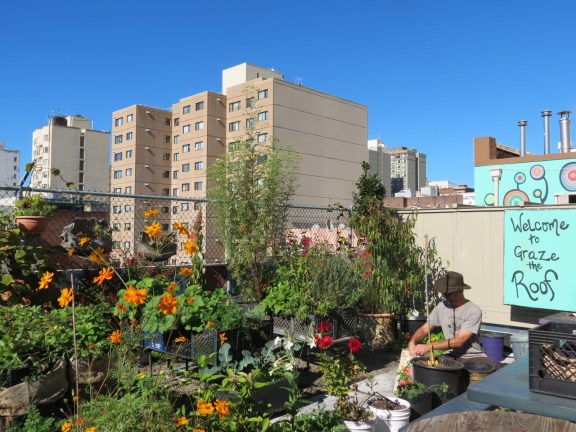
Right. Glide. I like its garden’s name: Graze the Rooftop.

“Graze the Roof is an edible, community-produced vegetable garden on the rooftop of Glide Memorial Church, a progressive church and nonprofit located in the Tenderloin district of San Francisco.

“Graze the Roof features lightweight (upcycled) raised garden beds made from milk crates; a worm composting system and an educational mural which ties the whole project together. Glide youth and volunteers from throughout the Bay Area maintain the garden and host monthly tours and workshops.”

Do you live in the San Francisco area? Looks like there are a lot of fun workshops available, such as Designing Sustainable Habitats, Introduction to Permaculture, and Urban Fruit Tree Stewardship. Read more here.

Photo: Graze the Roof

Read Full Post »

On Saturday we watched the documentary Urbanized, about urban planning.

Although there were many discouraging notes (Mumbai slums, Beijing smog, destructive construction in Stuttgart), there were enough positive ones to give hope.

I liked the grassroots gardening efforts in Detroit, pedestrian/bike paths in Bogota (while cars were relegated to mud), miraculous transformations of aging infrastructure (the High Line in Manhattan), lighted paths in Cape Town, and bicycle commuting in Copenhagen.

The point was made that walkability (one of my favorite topics, as readers know) and similar quality-of-life improvements in cities can be hugely beneficial to the planet just because cities are so big and changes there affect so many people.

Doug Foy, who helped get Boston Harbor cleaned up and now consults with New York City’s Mayor Bloomberg, has spoken at my workplace a few times. He likes to talk about how New York avoided buying a whole new water supply simply by partnering with plumbers unions to get standard toilets gradually replaced with low-flush toilets.

Read Full Post »

Planetizen’s Brent Toderian wrote a while back that he attended a book party in Vancouver where Simon Fraser University City Program Director Gordon Price asked “each member of the crowd to state an urban design decision that ‘they loved.’ …

“When it came to my turn, my answer took a big picture and perhaps surprising approach, depending on your definition of urban design. In Vancouver, a city often referred to as ‘a city by design,’ the most important urban design decision we ever made, the decision I loved most, is actually usually referred to as a transportation decision.

“In 1997, the city approved its first influential Transportation Plan.

“It was a game-changer for our city-making model in many ways, most notably in its decision to prioritize the ways we get around, rather than balance them. The active, healthy and green ways of getting around were ranked highest – first walking, our top priority, then biking, and then transit, in that order. The prioritization then went on to goods movement for the purposes of business support and economic development, and lastly, the private vehicle. …

“If you’re a driver who is worried about a ‘war on the car,’ remember this — our model of city building understands the ‘Law of Congestion’ and proves that when you build a multimodal city, it makes getting around better and easier for every mode of transportation, including the car. It makes our city work better in every way.”

Read Toderian’s whole Planetizen post, here.

Photo: Vancouver.ca

Read Full Post »

Brian sent me information about Higher Ground Farm, which is putting down roots on the roof of the Design Center in South Boston.

“A roof farm is a type of green roof. A green roof is a system of layers that is laid over an existing roof. A green roof is beneficial to a building owner and the community because it protects the existing roof, doubling to tripling its life, thereby saving money and keeping materials out of the landfill.

“Green roofs also reduce a building’s energy costs by insulating in the winter and cooling the rooftop in the summer. Finally, green roofs temper the effects of two common urban environmental problems – combined sewer overflow and the urban heat island effect.

“A series of roof farms throughout the city will capitalize on the environmental benefits of green roofs while also increasing access to fresh, healthy food. Higher Ground Farm will operate several roof farms throughout the greater Boston area, utilizing previously unused space while providing additional rental revenue to a building owner.

“Roof agriculture has the potential to be a job-producing boost to the economy, and a completely environmentally sustainable business sector that can set Boston apart from other cities. Higher Ground Farm will utilize the resources of our top-notch universities to study roof agriculture, which will position Boston as a leader in the field. Finally, Higher Ground Farm will be a space where our community can reconnect to productive green space and learn about sustainable city planning.” More.

I also found a video interview about it that you will like, here.

Read Full Post »

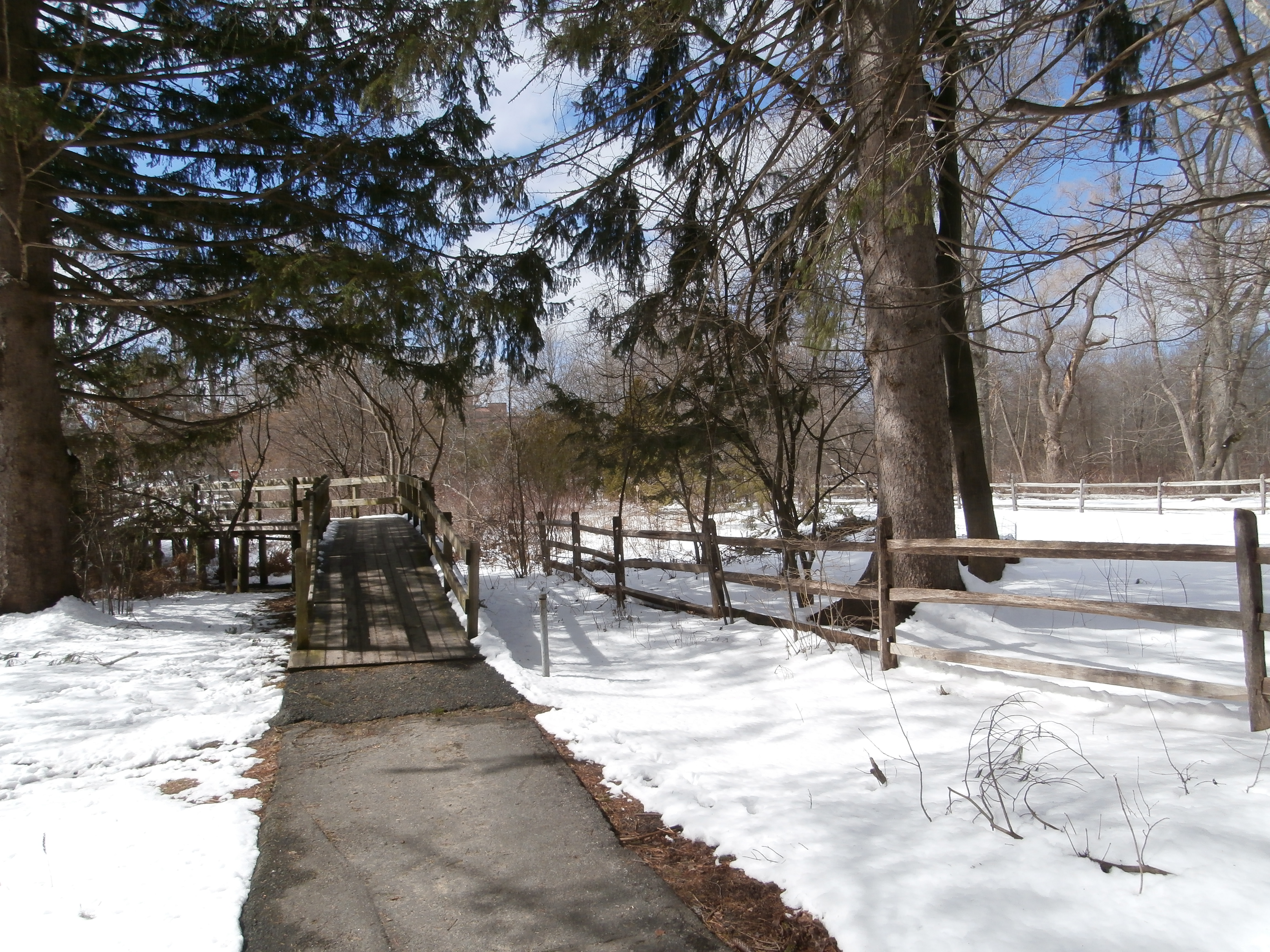
When you take pretty much the same walk every day, camera in hand, you may have trouble finding new things to photograph. You may look in vain for something different, puzzling, or mysterious.

But there is something to be said for combing the same territory over and over, as scientists are finding from studying the detailed record keeping of Henry David Thoreau.

“ ‘As far as I know, there is more information about the effect of climate change in Concord than any other place in the United States,’ said Richard Primack, a Boston University biologist who calls Concord a living lab for his research. …

Primack, writes Kathleen Burge at the Boston Globe, “has researched how climate change has affected the flowering times of plants, comparing modern data with the information Thoreau collected between 1852 and 1860. Primack and his lab found that for every 1 degree Celsius increase in mean spring temperature, plants bloom about three days earlier. …

“Primack came to his work about a decade ago, when he decided to change the direction of his research. He had been studying the effects of climate change on plants and animals in southeast Asia and decided, instead, to focus on his home state.

“But when he began searching for older records of plant flowering times in the United States, he came up short. Finally, after six months, someone told him about Thoreau’s journals.

“This was kind of a gold mine of data,” Primack said. “As soon as we saw it, we knew it was amazing.” More from the Globe.

Keep an eye open for the upcoming Thoreau exhibit at the Concord Museum April 12 to September 15, described here.

cross over the bridge

Read Full Post »

Happy President’s Day! Why are you working?

​According to Mother Jones, economist David Rosnick has “found that dialing back the amount of time the average person works by 0.5 percent per year would mean a significant reduction in greenhouse gas emissions. If you work 40 hours a week, that would mean shaving about 12 minutes off the average work week per year. Working one minute less per month seems pretty doable. Basically, we’re using a whole lot more of everything when we’re working – electricity, gasoline, heating, air conditioning, etc. Leisure requires less greenhouse-gas-producing activity.”

I forget were I found this story first, but you can read more at Mother Jones, here.

Photograph: http://yasmincolemanportraits.wordpress.com/
“Lazy Bones, sleeping in the shade. How you ‘spect to get your corn meal made?”
(Hoagy Carmichael)

Read Full Post »

I hope colleagues who saw almost the same post on the blog I contribute to at work don’t mind a repeat. I’m winging it a bit as I hold a two-day-old little girl in my left arm and type on her mom’s Mac with my right.

This post can be taken as reassurance that there are pockets of people here and there working to make the world greener for my grandkids and yours. It originates with Jim Robbins, Yale Environment 360, part of the Guardian Environment Network.

He begins in Seattle.

” ‘The biggest threat to Puget Sound is non-point sources [of pollution],’ says Nancy Ahern, Seattle Public Utilities deputy director.

“Blowhole samples taken from killer whales have revealed fungi, viruses and bacteria living in their respiratory tracts, some of them antibiotic-resistant and once found only on land. Health officials often have to shut down oyster beds because of fecal contamination. Salmon in streams are killed by torrents of dirty storm water.

“To lessen this deluge of diffuse pollution — a problem faced by many regions worldwide — Seattle is looking not at new and expensive sewage treatment infrastructure. Instead it is embracing an innovative solution to storm water runoff called green infrastructure … A growing number of places, from New York City to Sweden, are investing in everything from rooftop gardens to pollution-filtering assemblages of trees to reduce tainted runoff.

“Gray infrastructure is the system of pipes and ditches that channel storm water. Green infrastructure is the harnessing of the natural processes of trees and other vegetation — so-called ecosystem services — to carry out the functions of the built systems. Green infrastructure often intercepts the water before it can run into streets and become polluted and stores the water for gradual release through percolation or evapotranspiration. Trees also clean dirty water through natural filtering functions. …

A 2012 study by American Rivers, ECONorthwest, and other groups examined 479 projects around the country. About a quarter of the projects were more expensive, they concluded, and 31 percent cost the same; more than 44 percent brought the costs down, in some cases substantially. New York City, for example, expects to save $1.5 billion over the next 20 years by using green infrastructure.” I call that having your cake and eating it, too.

More.

Photograph: Mike Di Paola/Getty Images
Plants grow on a rooftop farm in Greenpoint, New York.

Read Full Post »

An editorial in the NY Times earlier this month praised the efforts of a Long Island organization committed to rescuing a lovely, endangered body of water.

The editorial said that in Shinnecock Bay, “pollution from fertilizer and septic runoff feeds frequent algae blooms that block oxygen and sunlight. …  Once-lush beds of eelgrass, shelter for the little fish that feed bigger ones, have largely disappeared from the western part of the bay.”

But there is hope. “What Shinnecock Bay has going for it are scientists working to restore its waters and tidal flats to health. The Shinnecock Bay Restoration Program, run by Stony Brook University’s School of Marine and Atmospheric Sciences and its Institute for Ocean Conservation Science, means to fix the problem, not just study it.

“The institute’s executive director, Dr. Ellen Pikitch, said a big part of the job was as simple as replanting eelgrass and seeding the bay with clams and oysters, which filter the water clean and make the bay better able to fend for itself. …  Local officials were doing their part by agreeing to close sections of the bay to shellfishing.”

More on what is being done now and ideas for even bigger efforts here. The program could serve as a model for sustainability elsewhere in the world. And we can all do our bit by using less fertilizer and thinking first before putting pollutants down our drains.

Read Full Post »

Every day, no matter what else is going on around the world, artists are thinking of new ways to express beauty.

Henry Grabar writes an Atlantic Cities “postcard” about two Belgian designers’ insight that plates lit from the inside could make something wonderful out of discards — while saving a tree from being cut down for Christmas.

The resulting “tree” of broken cups and plates glows ethereally and was selected for display in the town square of Hasselt, Belgium.

” ‘We decorated the tree with objects which would otherwise have remained invisible,’ MOOZ designers Inge Vanluyd and Stefan Vanbergen wrote in their DesignBoom submission.” Not just invisible, I would add, but thought to be useless.

More.

Photograph: MOOZ, via DesignBoom (an independent publication dedicated to architecture and design)

Read Full Post »

I just got a great lead from Erik. It seems that Sweden has run out of garbage for running its waste-to-energy program. Fortunately, Norway has garbage it can spare. (I wonder if Erik’s buddy Svein knows that.)

Check out Matt Hickman at Mother Nature Network:

“Sweden, birthplace of the Smörgåsbord, Eric Northman, and the world’s preferred solar-powered purveyor of flat-pack home furnishings, is in a bit of a pickle: the squeaky clean Scandinavian nation of more than 9.5 million has run out of garbage. The landfills have been tapped dry; the rubbish reserves depleted. And although this may seem like a positive — even enviable — predicament for a country to be facing, Sweden has been forced to import trash from neighboring countries, namely Norway. Yep, Sweden is so trash-strapped that officials are shipping it in — 80,000 tons of refuse annually, to be exact — from elsewhere.

“You see, Swedes are big on recycling. So big in fact that only 4 percent of all waste generated in the country is landfilled.

“Good for them! However, the population’s remarkably pertinacious recycling habits are also a bit of a problem given that the country relies on waste to heat and to provide electricity to hundreds of thousands of homes through a longstanding waste-to-energy incineration program. So with citizens simply not generating enough burnable waste to power the incinerators, the country has been forced to look elsewhere for fuel. Says Catarina Ostlund, a senior advisor for the Swedish Environmental Protection Agency: ‘We have more capacity than the production of waste in Sweden and that is usable for incineration.

“Public Radio International has the whole story (hat tip to Ariel Schwartz at Co.Exist), a story that may seem implausible in a country like garbage-bloated America where overflowing landfills are anything but scarce.” Read more.

Photograph: Smath/Flickr

Read Full Post »

Nourishing the Planet, a Worldwatch Institute project, “assesses the state of agricultural innovations with an emphasis on sustainability, diversity, and ecosystem health, as well as productivity.”

At the Nourishing the Planet blog, Jenna Baning writes about five groups of farmers in Africa who are sharing their problems and finding that the group has more solutions than the individuals.

1. Africa Rice Center “has been developing learning tools that focus on reaching as many farmers as possible … One powerful method has been farmer-to-farmer videos, which feature local experts sharing their knowledge about seed drying and preservation, rice quality, and soil management.”

2. Self-employed Women’s Association (SEWA), “a member-based Indian trade union that brings together approximately 1.3 million poor, self-employed women workers. … These women meet monthly in groups across the country to discuss challenges they are facing and identify possible solutions. SEWA’s Village Resource Centers connect the farmers with agricultural supplies, including improved seeds and organic fertilizers, as well as trainings.”

3. Songtaab-Yalgré, a rural women’s association that began “by teaching each other how to read and write in their local language. After gaining this basic, but critical skill, the organization then found ways to boost members’ incomes by producing shea butter products.”

4. Ecova – Mali was founded by two former Peace Corps Volunteers in 2007 because they saw that local people were better at training other local people than foreigners were. It “runs a training center and testing ground 35 kilometers (22 miles) outside of Bamako, Mali’s capital, as well as provides small grants to local farmers.”

5. The First Annual Conference of Indigenous Terra Madre, “a network launched by Slow Food International in 2004, focuses on protecting and promoting improved education, biodiversity, and connections between food producers and consumers. In June 2011, 200 representatives from 50 indigenous communities around the world met in Jokkmokk, Sweden, for the first-ever Indigenous Terra Madre Conference.

“The meeting, hosted by the native Arctic people known as the Sámi, and organized in partnership with Slow Food Sápmi and Slow Food International, discussed food sovereignty issues, the importance of preserving traditional knowledge for future generations, and ways to involve indigenous people and local communities in policy decision making and implementation.

“Small-scale farmers and indigenous people around the world shared their experiences and the solutions they had developed in response to the challenges they faced in common. As TahNibaa Naataanii, a participant in the meeting from the US-based Navajo Sheep Presidium, described, ‘We hear stories of the same thing that is happening in our own countries and own lands, and it gives us hope.’ ”

More here.

Photograph: Noor Khamis/Reuters/File
A farmer sets rice seedlings into paddy fields in Kirinyaga district, about 62 miles southeast of Kenya’s capital, Nairobi. The Africa Rice Center helps farmers share solutions to problems with each other.

Read Full Post »

Cathryn J. Prince has a story in the Christian Science Monitor about a research ecologist who thinks we can have our cake and eat it too: that is, have a strong economy and a sustainable future.

Prince writes, “As head of the conservation biology department at Antioch University New England in Keene, NH, [Tom] Wessels isn’t against chopping down trees or clearing land to farm. He just wants to see more people embrace sustainable forest and land management practices.

“Wessels, trained as a research ecologist, says economics plays as much a role in protecting the environment as does saving energy. Think how the adoption of fair trade principles for growing and selling coffee have changed the economics of that industry. Forests can benefit in the same way.

“ ‘Adam Smith, the father of modern economic theory, wrote about this in Wealth of Nations,’ Wessels says. ‘People will act out of self-interest, but they can support each other doing it. …

“Market forces can help to conserve forests and farmlands, says Wessels, who also serves as chair of the Vermont-based Center for Whole Communities. …

“ ‘We are incredibly frivolous about our energy use,’ Wessels says. ‘Any organism or population that is energy wasteful gets selected out of the system.” Charles Darwin explained this when he wrote about survival of the fittest, he says. Survival of the fittest also means survival of the most adaptable, and the most energy efficient, he says. …

“Partnering with more than 400 organizations in 47 states, Whole Communities aims to help create communities where people rely on each other for their food and other needs.

“For example, Wessels would like to see Detroit become a different kind of urban jungle. The city has lost about 50 percent of its population since the late 1980s. Empty lots abound. But now community gardens have begun to fill these open tracts with food crops. The Detroit Food Policy Council and the city government want to make Detroit food secure by 2020 – meaning that everyone will have access to sufficient, safe, and nutritious food.

“ ‘A lot of our focus is around food security,’ Wessels says. ‘Detroit will become a model for other urban areas.’ ” More here.

Photograph: Cathryn J. Prince

Read Full Post »

I like win-win stories like this one from National Public Radio. It’s about a new crop with a lot of monetary potential — and distinct advantages for the environment.

“It doesn’t require any land or fertilizer. Farming it improves the environment, and it can be used in a number of ways. So what is this miracle cash crop of the future? It’s seaweed.

“Charlie Yarish, professor of ecology and evolutionary biology at the University of Connecticut, loves seaweed. In nature, he says, when seaweed turns a rich chocolate color, that means the plant is picking up nitrogen, a process called nutrient bioextraction. …

“Many plants and animals cannot survive when there is too much nitrogen in the water, but seaweed is able to ‘capture’ the nitrogen, as well as contaminants in the water.

“A United Nations report says that nearly 16 million tons of seaweed were farmed in 2008 — most of it in Asia. Yarish helped a company called Ocean Approved start the United States’ first open-water kelp farm in the Gulf of Maine in 2006 … Now, he’s helping to create a seaweed farm off the coast of Connecticut.

“Bren Smith owns and runs the Thimble Island Oyster Company, off the coast of Branford, Conn. After his business was hit hard by Tropical Storm Irene last year, ruining about 80 percent of the shellfish crop, Smith started looking around for something more resilient to farm. That’s when he found Yarish, who agreed to help set him up in the seaweed farming business. …

” ‘There’s no barns, there’s no tractors. This is what’s so special about ocean farming. It’s that it’s got a small footprint and it’s under the water. I mean, we’re so lucky; I feel like I stumbled on this just great secret that we then can model and spread out to other places,’ ” Smith says. …

” ‘The plan is to actually split it into a couple different experimental markets — one for food, one for fertilizer, one for fish food. I’m [also] working with a skin care company in Connecticut, and then one for biofuel,’ Smith says. He’s even hoping he can someday fuel his own boat with biofuel from the seaweed.”

Craig LeMoult has the whole story here at NPR, where you also can listen to the audio.

Photograph by Ron Gautreau
Oyster fisherman Bren Smith on his boat.

Read Full Post »

In a recent article in the NY Times, Kathryn Shattuck described a festival that took place on “600 acres of pasture and test plots at the Land Institute on the outskirts of Salina, Kansas. …

“Each autumn for 34 years, during its annual Prairie Festival, this nonprofit research organization has become a Mecca of sorts for those whose passions run to sustainability, farming and feeding the world.

“For two days, Friday evening through Sunday afternoon, lectures and walking tours, interspersed with art installations and musical performances, focused on climate change, agricultural practices and what the institute’s president, Wes Jackson, called ‘getting over the hump’ in the use of carbon-based energy sources. …

“Jackson, a plant geneticist who co-founded the institute in 1976, calls the festival ‘an intellectual hootenanny,’ where ideas collide with music, art, food like bison chili, and bread and beer made from Kernza, the institute’s trademarked perennial wheatgrass.

“But the democratic casualness of the environment — listeners sprawled on hay bales, children frolicking on the hillside — belied the seriousness of purpose as college hipsters and wizened hippies shared space with revered scientists and conservationists like David Orr, an environmental studies professor at Oberlin; Fred Kirschenmann, a distinguished fellow at the Leopold Center for Sustainable Agriculture at Iowa State University who is also the president of the Stone Barns Center for Food and Agriculture in Pocantico Hills, N.Y.; and Douglas Tompkins, who has preserved more than two million acres of wilderness in Chile and Argentina.”

Read all about it here.

Photograph: Steve Hebert for the New York Times
Sleeping under the stars at the Prairie Festival 

600 acres of pasture and test plots at the Land Institute on the outskirts of Salina, Kansas

Read Full Post »

« Newer Posts - Older Posts »