Feeds:
Posts
Comments

Posts Tagged ‘egypt’

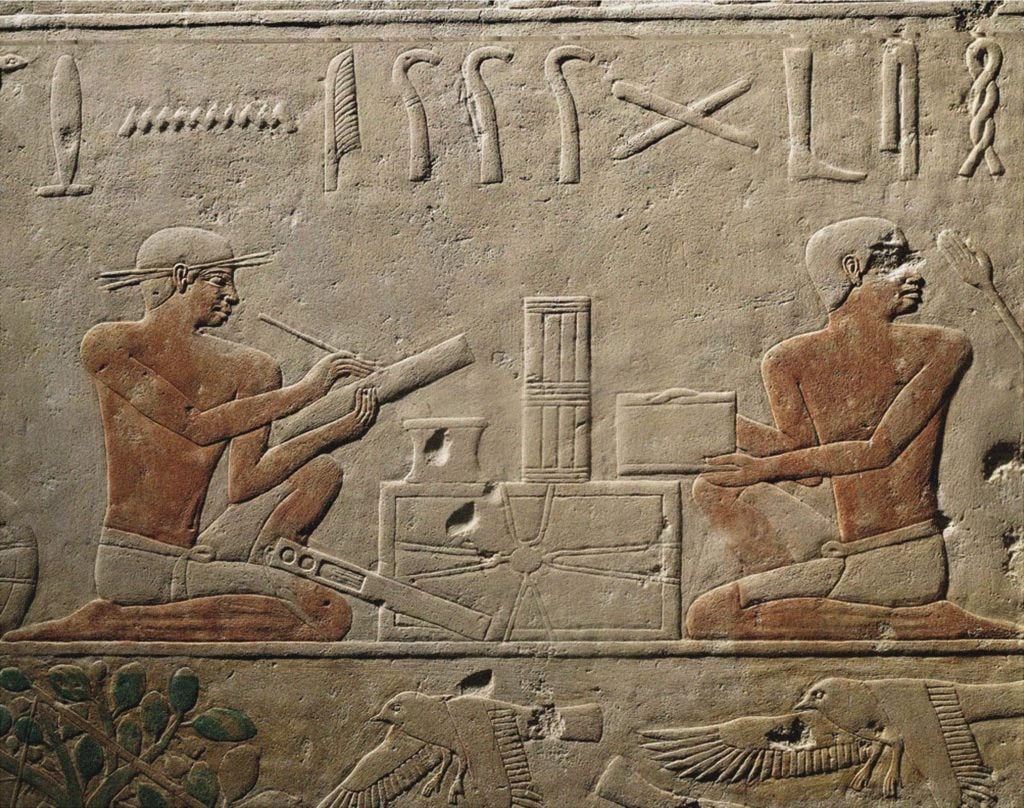
Photo: Fine Art Images/Heritage Images/Getty Images.
Relief depicting two scribes from Saqqara, Old Kingdom, 5th Dynasty, in the collection of the Egyptian Museum, Cairo.

I went for a massage the other day, and the masseuse noted that the muscles in my shoulders and neck were really tight. “Have you been working at the computer a lot?” she asked.

Writing on computers is the usual culprit these days, but back in Ancient Egypt, research suggests, writing on papyrus did even more damage.

Adnan Qiblawi wrote at ArtNet, “According to a new study published in Scientific Reports, scribes were suffering with similar issues back in the days of the pyramids.

“A team of archaeologists examined dozens of adult males’ skeletons from the necropolis at Abusir, Egypt, which was used between 2700 and 2180 B.C.E. Written evidence indicates that 30 of the studied males lived as scribes. These high ranking dignitaries enjoyed privileged lives with an elevated social status thanks to their literacy, at a time when only one percent of ancient Egypt could read and write.

“Records indicate that influential families sent their sons to the royal court for education and training. Eventually, they became scribes who served a similar societal role to contemporary government workers. 

“ ‘These people belonged to the elite of the time and formed the backbone of the state administration,’ explained Veronika Dulíková, an Egyptologist and member of the archaeology team. ‘Literate people worked in important government offices such as the treasury (today’s Ministry of Finance), the granary (today’s Ministry of Agriculture). They also played an important role in the collection of taxes.’ …

“While Egyptian scribes’ lives have been studied in detail, their archaeological remains have never before been examined for anomalies. The study’s lead author, Petra Brukner Havelková, is an anthropologist at the National Museum in Prague who has specialized in identifying activity-induced bone markers for nearly two decades.

“When comparing the remains of scribes to non-scribes, the former were found to suffer from osteoarthritis, a breakdown of the joint tissue. The condition was found in joints connecting the lower jaw to the skull, the right collarbone, the upper right arm bone connected to the shoulder, the bottom of the thigh, right thumb bones, and throughout the spine. 

“Just as modern-day government workers suffer neck and spinal injuries from sitting at desks and arching forward to stare at screens, ancient Egyptian scribes endured comparable physical stresses from hunching over papyrus for prolonged sessions.

It is theorized that scribes often squatted on their right legs, which may explain why significant damage was found on the skeleton’s right sides, with particular degeneration in their right knees.

“Historical sculptures, such as The Seated Scribe, corroborate that scribes frequently knelt or sat cross-legged while writing. They recorded their notes on sheets of papyrus, pottery notepads called ostraca, or wooden boards. Scribes generally wrote in hieratic cursive, a simpler script more practical for everyday note-taking, rather than using the elaborate hieroglyphs carved on monuments by specialists.

“Researchers were most surprised to discover damage in the scribes’ jaws, which is explained as a consequence of chewing on rush stems to make brush-like heads. They used these rush pens, and later reed pens, to write their notes, pinching the utensils between the index and thumb fingers of their right hands.

“Looking to the future, the study’s scientists are seeking to collaborate with other research groups to analyze scribes’ remains across other ancient Egyptian cemeteries.”

More at Artnet, here. No word yet on whether scribes had access to a massage.
Read Full Post »

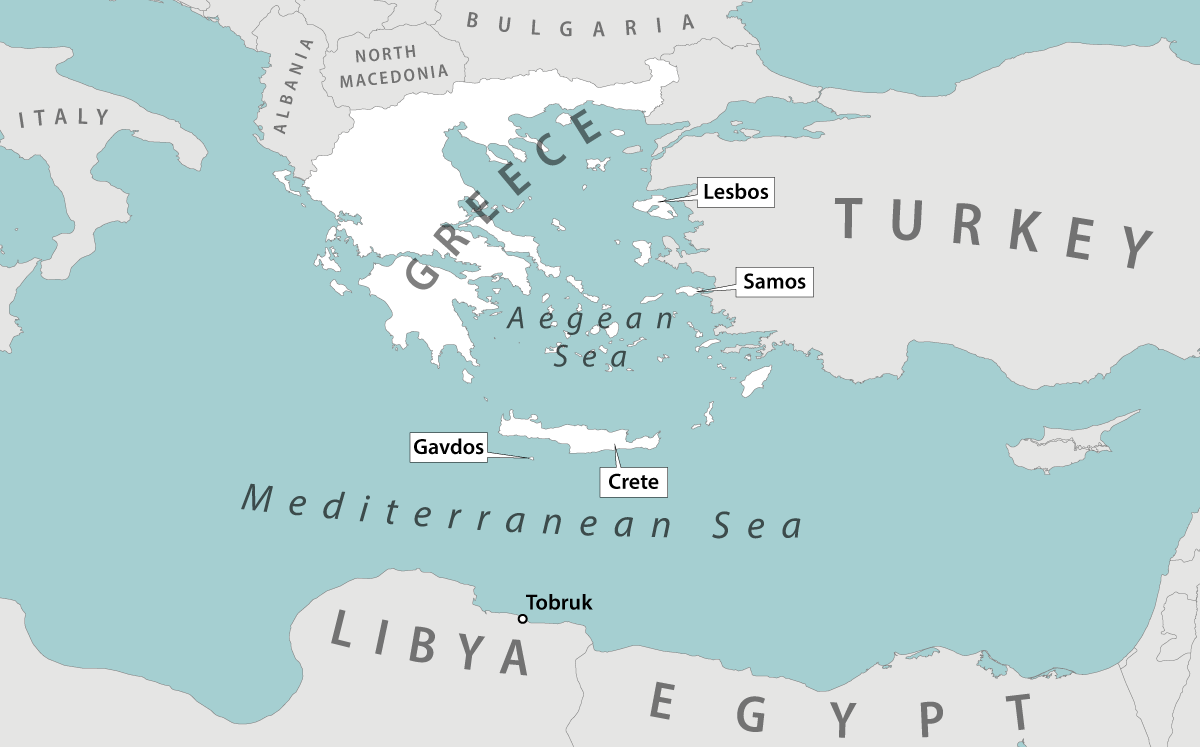
Map: Jacob Turcotte/CSM Staff.
Little islands with big responsibilities.

Because world leaders are not dealing effectively with the causes of mass migration, sometimes tiny communities and a handful of sympathetic residents are left holding the bag.

Christian Science Monitor contributor Nick Squires has a report from the little island of Gavdos in Greece.

“A tawny smudge on the blue horizon of the Mediterranean, it is the southernmost point of Europe, a sun-baked outpost of deserted beaches, gnarled juniper trees, and flocks of shaggy goats. The tiny Greek island of Gavdos, which lies to the south of Crete, [is thought to be] the place where Odysseus was shipwrecked and held captive by the nymph Calypso. …

“The island finds itself thrust to the forefront of Europe’s migration crisis, which erupted in 2015 when more than 1 million asylum-seekers reached the Continent.

Islanders may be sympathetic, but they want the migrant arrivals to stop as soon as possible, especially as the summer tourist season approaches.

“Since the beginning of the year, around 1,200 migrants have arrived on Gavdos by boat, with most of them setting out from Tobruk on the coast of Libya. In the same period last year, there were no arrivals at all. …

“The impact on such a small island is huge. The population of Gavdos is just 70 – on one occasion recently, islanders were outnumbered by the 91 migrants who arrived on a single boat from the Libyan coast.

“Most of the arrivals are economic migrants from Egypt. They are fleeing poverty and political tensions. There is a smattering of other nationalities, including Pakistanis, Bangladeshis, Syrians, and Sudanese.

“It is an influx that Gavdos is totally unprepared for. There are no facilities for the migrants – no reception center, no soup kitchen, no nongovernmental organizations. Unlike Greek islands in the Aegean such as Lesbos and Samos, which have been dealing with migrant arrivals from nearby Turkey for years, there are no personnel from charities such as the Red Cross or Doctors Without Borders.

“The task of dealing with the migrants is left to just three men – the deputy mayor, his twin brother, and the island’s sole police officer. …

“Says Lefteris Lougiakis, the deputy mayor, ‘We have the responsibility of providing them with shelter and food. During the winter, we cut wood to keep them warm. It’s a very difficult situation.’

“Islanders do what they can to care for the migrants and many feel empathy for them. ‘They travel for 20 hours in very small boats with no life jackets. It’s just by luck that we are not in their position. I feel sorry for them,’ says Stella Stefanaki, who runs a small bakery on the island. She provides sandwiches for the new arrivals, for which she is reimbursed by the council.

“Islanders may be sympathetic, but they want the migrant arrivals to stop as soon as possible, especially as the summer tourist season approaches. …

“The migrants have to cross 170 nautical miles of open sea to reach the island from North Africa. It is highly dangerous, but that has not stopped smugglers from promoting it as an effective way of getting into Europe by the back door. Each migrant pays up to $5,000 for the crossing. …

“The ‘capital’ of the island is the village of Kastri, a cluster of about a dozen houses on a ridge. The other main settlement, Sarakiniko, consists of a few cottages and tavernas hidden among sand dunes and facing a huge sweep of beach.

“There are just four children living on the island. Three of them belong to Efi Georgaka, who sells honey; keeps sheep, pigs, and goats; and, during the summer, works in the ferry ticket office in the island’s minuscule harbor.

“ ‘If things keep going like this then the island will change,’ she says, sitting on the harbor wall. ‘There will be a need for police and coast guard officers and the navy, like on other Greek islands. We don’t want [the authorities] here. We treasure the freedom and tranquillity that we have,’ says Ms. Georgaka. …

“Gavdos has emerged as a new migrant destination because of pressures elsewhere: a crackdown onmigrant boats by Greek authorities and the EU border agency Frontex in the Aegean, twinned with the hard-line policies pursued in Italy by Prime Minister Giorgia Meloni, who has staked much political capital on stopping the boats coming from North Africa.

“Earlier this month, Greece’s government promised to provide money and personnel to help Gavdos and its much larger neighbor, Crete, deal with the dramatic rise in migrant arrivals.

“ ‘Crete will not be left alone, and even more so Gavdos,’ said Dimitris Kairidis, the migration minister, after paying a visit to both islands.” More at the Monitor, here.

To me, this is a failure of leadership at a national and international level. People don’t leave home and throw themselves into danger because home is safe. It’s not fair for the little guys to have to fix what they have no power to fix.

Read Full Post »

Photo: The Japanese Food Lab.
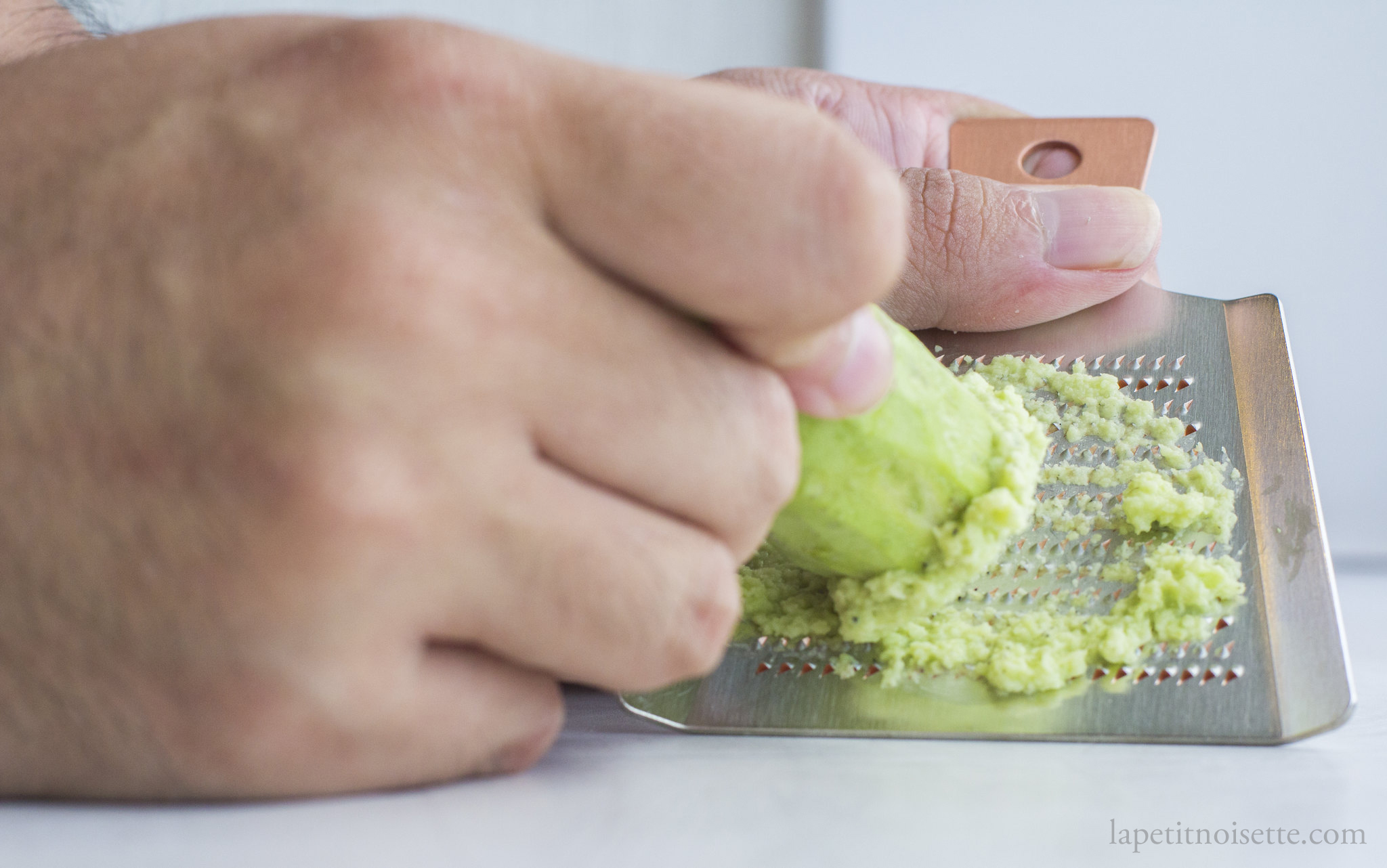
Grating a wasabi root. The fumes from this horseradish relative have been found to kill fungus on papyrus.

I love stories of great discoveries made by accident, but was the discovery in today’s post made by accident? I haven’t succeeded in finding out. Perhaps it was just a matter of understanding how chemicals work, as in the case of the Bryn Mawr professor who wrote that a pinch of salt improves a cup of tea. (Read about that tempest in a teapot here.)

Verity Babbs writes at Artnet, “A new study reveals that Japanese horseradish isn’t just good as a sinus-clearing part of a plate of sushi, but is also effective in art conservation.

“Wasabi vapors have been found to effectively treat fungal infections on both painted and unpainted samples of mock ancient Egyptian papyrus, and to do so without impacting the papyrus’ delicate chemicals or painted pigments.

“A study led by Hanadi Saada of the Conservation Center of the Grand Egyptian Museum and published in March’s volume of the Journal of Archaeological Science shares the results of treating fungally infected replicas of ancient papyri with wasabi.

“To create accurate replicas for the study, the team heated modern papyri (painted with accurately replicated ancient pigments) to 212°F for 120 days, mimicking a 1,000-year aging process. They then exposed the replicas to fungal species and treated them with vapors from wasabi left on nearby aluminum foil after three days.

“Exposure to the wasabi vapors was found to completely eradicate microbial growth and increase the sample papyri’s strength by 26 percent. The treatment only negligibly impacted the chemical makeup of the pigments used, and no noticeable change was observed in the color of both painted and unpainted samples of papyri.

“Papyrus — made from the stems of the plant Cyperus papyrus — was used in the ancient world for baskets, sails, and boat-making in addition to being a popular writing material. …

“Famous papyri include the Ebers Papyrus, which documents ancient Egyptian medical practices and is considered the world’s best-preserved and most extensive example. Dating to around 1550 B.C.E., it is kept at the Leipzig University Library in Germany. …

“Native to Japan as well as Korea and the far east of Russia, wasabi is a popular condiment, made from the plant Wasabia japonica, which is similar to the horseradish.

“This new conservation solution is a much greener and safer treatment than disinfectants previously used, which were known to harm the artifacts, possibly as badly as the fungus itself. Further research will be carried out to test the efficacy of wasabi for treating fungal infections on other organic, textile, and paper artifacts. The Grand Egyptian Museum in Giza plans to use the wasabi treatment for future preservation.  The study concluded that ‘Wasabi can be considered a safety biocide for controlling biodegradation of archaeological painted papyri.’ ”

More at Artnet, here.

Read Full Post »

Photo: Diane Walker via Exeter Cathedral and Hyperallergic.
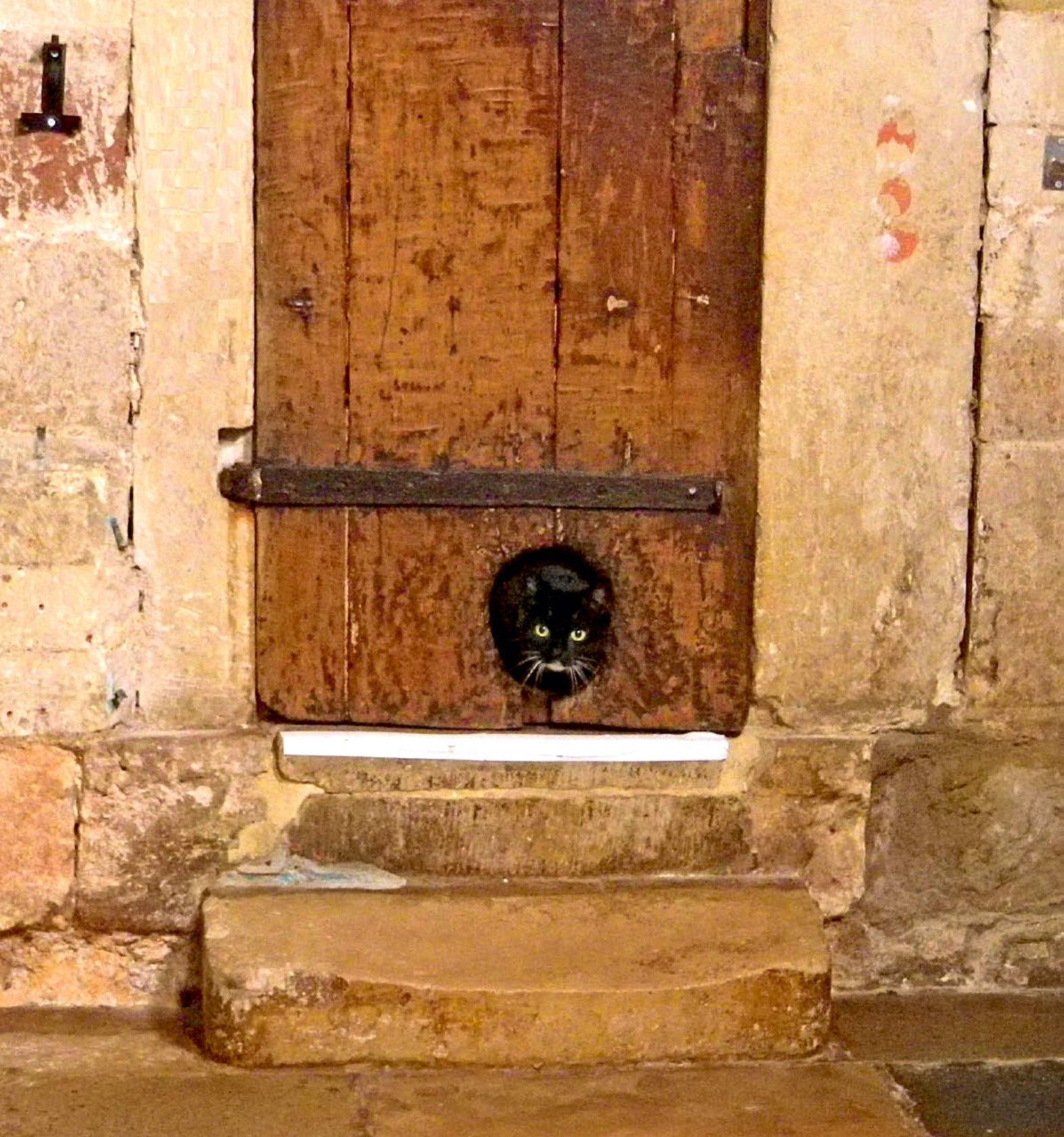
The 400-year-old door hole in the Exeter Cathedral in Devon County, UK.

Are you ready for a silly post? It’s silly, but it has a serious side. Especially for cat owners. Rhea Nayaar introduces the topic at Hyperallergic.

“There are a few rumors floating around about the invention of the handy cat door through which our beloved friends pass in and out as they please, but how far back does it go, really? Apparently for centuries, as the Exeter Cathedral in Devon county, England, is gaining attention for a 16th-century circular door hole for the resident pest control cat.

A circular hole was cut into the bottom right side of the painted panel for pest control cats to keep mice from the sacristy, and thus, the painting was dubbed ‘Madonna della Gattaiola‘ (c. 1458), or ‘The Virgin of the Cat Flap.’

“Historian and author Diane Walker told Hyperallergic that cathedral records indicated that the door in question was installed in 1376, when the space behind it was renovated and outfitted for a large astronomical clock. The clock’s mechanics were lubricated with animal fat which attracted mice down the line, and by 1598, per the records, then-Bishop of Exeter William Cotton had paid carpenters to make a hole in the door so his mouser cat could take care of the problem.

“ ‘The idea that the hole was cut to enable the bishop’s cat to catch mice in the space where the clock mechanism was located does lead to a re-think of the “Hickory, Dickory, Dock, the mouse ran up the clock” nursery rhyme,’ Walker told Hyperallergic

“ ‘The story is normally illustrated with a picture of a mouse running up the outside of a long-case clock,’ Walker continued. ‘But it makes much more sense that the idea of a mouse running up a clock would be associated with an ancient clock mechanism, such as that at Exeter Cathedral, where the original mechanisms included weightlines making an easy climb for a mouse attracted to the lubricating tallow.’

“The best part of it all is that the cathedral actually had cats on the payroll throughout the 14th and 15th centuries — 13 pence a quarter, according to written records. It’s unclear how the cats received their wages. …

“Cuteness aside, even Walker admits that while this is a very old cat door, it’s unlikely to have been the first. The 14th-century church of San Giorgio in Montemerano, Italy, has its own cat hole cut into a painted door that’s now preserved and on display. A 15th-century painting on panel of the Virgin Mary by an anonymous local painter who went by the nickname ‘Master of Montemerano’ was reportedly adapted into a door at the church. A circular hole was cut into the bottom right side of the painted panel for pest control cats to keep mice from the sacristy, and thus, the painting was dubbed ‘Madonna della Gattaiola‘ (c. 1458), or ‘The Virgin of the Cat Flap.’

“But humans have relied on cats for pest control long before the 15th century. Ancient Egyptians were known for pedestalizing cats and honoring deities with cat-like features. One would think that cat doors would have been folded into Ancient Egyptian architecture and design considering the cultural reverence for felines, but two Egyptologists confirmed with Hyperallergic that they haven’t come across any such invention in their research.

“Cairo-based professor, archaeologist, and archaeozoology expert Salima Ikram said that while cats were ‘definitely used for pest control,’ the geography and climate of Northeast Africa meant that homes and buildings were more open-air so doors weren’t used often. And University of California, Los Angeles professor and architectural Egyptologist Willeke Wendrich told Hyperallergic that field researchers ‘hardly have any actual doors that have survived from antiquity.’ “

More at Hyperallergic, here.

Are you a cat person and do you have a cat door? I like cats myself and am all for indoor pest control. But I worry a lot about cats killing birds outdoors.

Did you know this? “Predation by domestic cats is the number-one direct, human-caused threat to birds in the United States and Canada. In the United States alone, outdoor cats kill approximately 2.4 billion birds every year. Although this number may seem unbelievable, it represents the combined impact of tens of millions of outdoor cats. Each outdoor cat plays a part.”

So says American Bird Conservancy, here. So if you have a cat door like the one at the Exeter Cathedral, think twice about using it.

Read Full Post »

Photo: Hamada Elrasam.
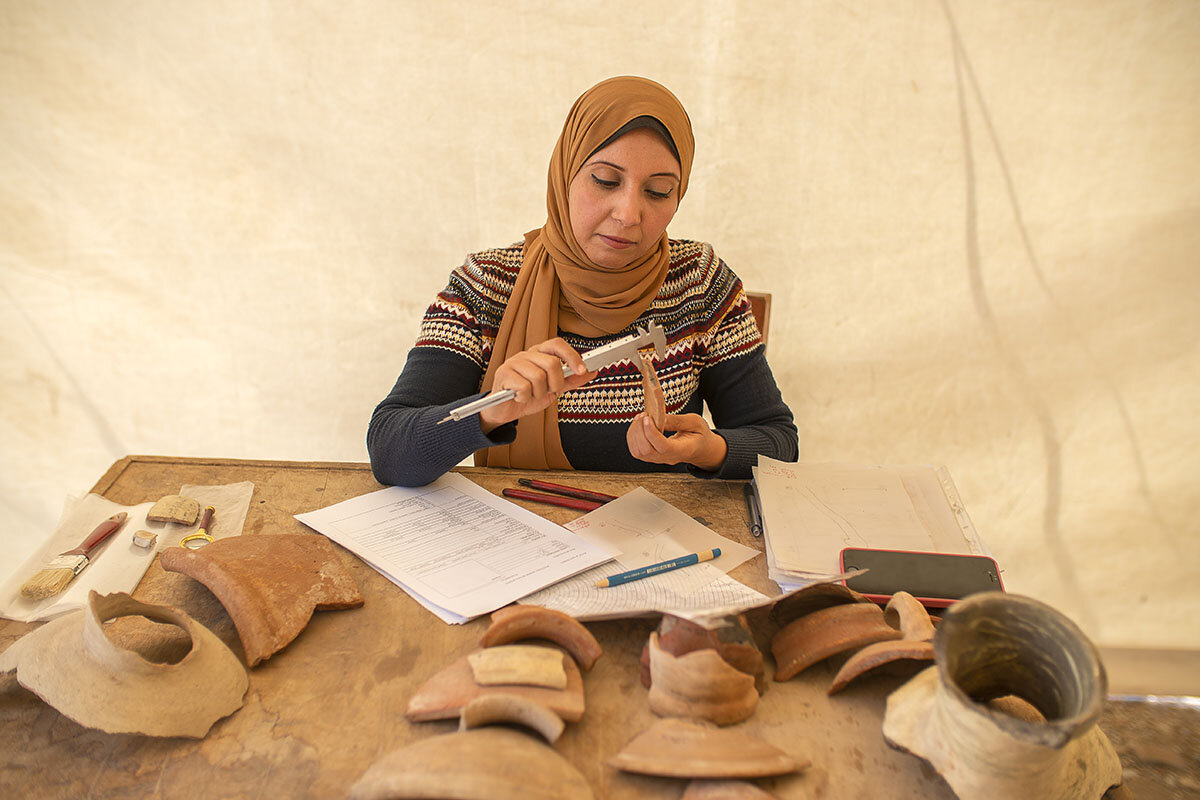
Dr. Asmaa Ebrahim measures a pottery shard at the archaeological excavation at Aten, a rediscovered city of ancient Thebes in Luxor, Egypt, Nov. 17, 2022.

You have probably read about the “curse” that targets anyone disturbing the tomb of a pharaoh. It’s a legend people love but, as one expert says, it’s “unadulterated claptrap.” Still, one could almost imagine that the pharaohs would want to punish non-Egyptians like Howard Carter, who excavated the tomb of King Tut. Perhaps their ghosts would be more tolerant of Egyptian archaeologists.

Taylor Luck wrote about a few at the Christian Science Monitor.

“On a mild, late November morning, almost completely hidden behind the 5-foot-high walls of a sprawling, yellow-gray mud-brick city rising from the ground, a dozen members of an archaeological team survey and brush away soil.

“In a nearby tent, carefully holding jagged pottery shards in one gloved hand under a lens, Asmaa Ebrahim painstakingly scribbles down notes on the 3,000th piece of pottery.

“Traditionally, in this valley, rich with ancient Egyptian history and the iconic archaeological sites to match, the role of ceramicist was filled by a foreign archaeologist with credentials from Cambridge or Princeton, not an Assiut University graduate from upper Egypt. …

“ ‘For once, Egyptians are the leading Egyptologists,’ Dr. Ebrahim smiles.

“As workers brush away dust and sand, a leather sandal pokes out from the ground, strap facing up, slightly sun-dried but looking as if it had fallen off the foot of its careless owner days – rather than 3,400 years – ago. …

“Today, in Aten, the recently discovered city at the foot of the Valley of the Kings, a new generation of Egyptian archaeologists and specialists is uncovering new details of daily life in ancient Egypt. …

“Aten, the so-called Golden City, was the residential, administrative, and industrial center of ancient Thebes, dating back to the 18th dynasty and the reign of Pharaoh Amenhotep III – the golden age of ancient Egypt. 

“Discovered by chance while this rare all-Egyptian team was searching for the mortuary temple of the boy king Tutankhamen in 2021, it is now providing an ever-widening window into the daily life of ancient Egyptians.

“Aten was abruptly abandoned by Amenhotep III’s son Akhenaten, when he transformed ancient Egypt’s religion and moved the capital 240 miles north of Thebes. That means much of the city was left intact as if life was suddenly frozen three millennia ago – Egypt’s own Pompeii.  

“Bread remains in clay ovens, precious stones are scattered in the jewelry workshop, and sun-dried bricks are neatly stacked in a tiny pyramid waiting to be carted off to build a temple or a palace.

“A wavy, zigzag serpentine wall that experts believed was designed to limit Nile floodwaters cuts through the north of the city; at its end in a tent, Dr. Ebrahim holds up a four-handle jug. …

“ ‘This [complete residential life depicted in Aten] is unique. You won’t find it at any site currently in Egypt.’

“Already the team has uncovered seven districts containing homes, a bakery, kitchens, a tailor, a weaver’s loom, a leather tannery, a metalsmith, a sandal cobbler, and a butchery complete with dried meats in jars inscribed with the butcher’s name, ‘Luwy.’ The team is also uncovering technical clues as to how ancient Egyptians built and furnished some of the wonders of the ancient world.

“Its discoveries have included preserved amulet molds, a jewelry workshop, a brick factory, and granite, basalt, and pottery workshops, all of which it believes were used to build and decorate Luxor’s lavish temples and palaces – and craft the ornate treasures that were buried in King Tut’s tomb.

“The discoveries are thanks to a new generation of Egyptian archaeologists trained and encouraged by Zahi Hawass, who is leading the dig at Aten. The colorful and bombastic former director of Egypt’s department of antiquities used his public persona as ‘godfather’ of Egyptian antiquities to help bring along 500 young specialists to staff all-Egyptian excavation teams.

“Dr. Ebrahim is one of dozens who studied archaeology and Egyptology in Egypt and then, at Dr. Hawass’ urging, went abroad in the 2010s to work and train to gain technical expertise that Egypt lacked – in restoration, conservation, pottery analysis, carbon dating, and surveying. …

“ ‘Our role as Egyptians cannot only be serving foreigners and bringing them coffee and tea while they write books and make films and we do nothing,’ Dr. Hawass says as he walks along Aten’s serpentine wall. …

“ ‘As a young man entering a bookstore, I never found a single book on Egyptology written by an Egyptian. All our work depended on foreigners, and they took all the credit,’ he says. ‘But now we are a complete scientific team.’

“Although recent years have seen more joint international-Egyptian teams, this excavation is one where every role – from extracting and sorting soil to analysis to conservation – is done by an Egyptian, with eight experts overseeing two dozen workers.

“One core team member is Siham El Bershawy, a Luxor native who grew up a few miles away from the Valley of the Kings and now preserves and restores everything from papyrus to mummies at Aten.

“ ‘That feeling when you take items out from the ground in your own site, in your own country, in your own community with your own two hands – you feel a sense of pride as an Egyptian,’ Ms. El Bershawy says. …

“The team has also uncovered a clue he believes may lead it to the lost tomb of Queen Nefertiti – a name.

“ ‘Smenkhkare,’ the name of a mysterious pharaoh who ruled briefly between Aten and King Tut, was found on multiple inscriptions in Aten. Egyptologists are divided on the figure; some believe Smenkhkare may have been a brother to Tutankhamen or a hitherto unknown co-regent with Akhenaten. Dr. Hawass is of the camp that believes Smenkhare was a name assumed by Nefertiti after her husband Akhenaten’s death as she ruled briefly as pharaoh.”

More at the Monitor, here.

Read Full Post »

Photo: Mariam Ehab.
View of Mandara Beach in Alexandria, Egypt, where floating ropes help the visually impaired enter and exit the Mediterranean Sea, Aug. 23, 2022.

You may have noticed that I love stories about Sweden and Egypt. That’s because two of my grandchildren are half Swedish and two are half Egyptian. How lucky is that!?

Today’s story comes from Alexandria in Egypt. Miriam Ehab covered it for the Christian Science Monitor.

“In a sunny spot along the bustling shores of Alexandria, Egypt’s second-largest city, a group of beachgoers splash and frolic in the sea. But this is no ordinary beach.

“Holding onto floating barriers and ropes, safe in the knowledge that attentive lifeguards are nearby, almost everyone here is blind or visually impaired. Mandara Beach is the first of its kind in the Arab world’s most populous country, specially fitted so it’s accessible to swimmers with physical disabilities. For many, it’s more than just a day of fun and relaxation – it’s a rare window of empowerment.

“Inaugurated in 2021 for people using wheelchairs, Mandara underwent another renovation last year. When the revamped beach opened again in June, at the height of Egypt’s summer season, thousands of citizens with visual impairments could also safely swim in the calm cerulean Mediterranean waters. …

“ ‘This is the first time I’ve been to the sea,’ Sarah, one beachgoer, says with a beaming smile. ‘I was very happy and did not feel afraid at all when I was swimming.’ … 

“Some 12 million Egyptians live with a disability, roughly 3.5 million of whom face visual challenges. In 2018, President Abdel Fattah al-Sisi declared the ‘year of persons with disabilities.’ … Parliament responded with a slew of laws, including the provision of state-subsidized health care to people with disabilities.

“Other benefits included tax exemptions on the purchase of cars, educational and medical materials, and imported assistive devices. Legal fees, whether for plaintiff or defendant, also were lifted for people with disabilities. And in 2021, Parliament approved tougher penalties for the bullying of people with disabilities.

“ ‘The laws from 2018 are excellent,’ says Hassan Abdel Qader, head of Alexandria’s Blind Association. ‘But the problem is in their implementation.’

“The fact is, say campaigners, that many public spaces and means of transport still lack accessibility, assistive technologies are hard to come by, services for people with disabilities are patchy, and discrimination is not uncommon. Still, change is coming, slowly. 

“Some months ago, Jihad Mohammed Naguib, an employee at the Department of Tourism and Resorts in Alexandria, was inspired by something she heard from the governor of Alexandria, Maj. Gen. Mohamed el-Sherif. He noted that there were never any blind people on the beaches, which are the pride of the coastal city. …

“ ‘The idea ​of ​allocating a part of the beach for the visually impaired … was put forward after we inaugurated the free Mandara Beach for people with motor disabilities and the success that it met,’ Major General Sherif says in an interview. And so, with funding from the Rotary Club of Alexandria Pharos, the work began. 

“Floating ropes with plastic balls were installed on a flat portion of the beach, so that swimmers with visual impairments could enter and leave the water holding these ropes. People in wheelchairs could use a modified ramp, the end of which was fitted with a metal box submerged in the water, ensuring their safety while in the sea. Lifeguards and a first-aid unit were also available – which isn’t always the case on Egypt’s public beaches.

“Those directly affected – and most likely to benefit – were consulted from the beginning. ‘We proposed some things that they have already implemented, and others that they promised would be implemented in the future,’ Mr. Qader says.

“Those suggestions included a whistle for children who feel endangered, and a rope that extends from the entrance of the beach to the water, so that even if a visually impaired person visits on their own they can reach the sea without assistance. …

“The beach is the latest in a recent string of hard-won successes for Egypt’s visually impaired people. The Egyptian Blind Sports Federation already runs several sports teams, including soccer, weightlifting, judo, and showdown – a type of air hockey for blind people.

“But gaps remain.  ‘Most services, and recreational and sports activities for the visually impaired, are concentrated in the Egyptian capital, Cairo, while other Egyptian cities have little capabilities,’ says Moamen Mostafa, the former head of public relations for the Blind Association of Egypt. …

“That makes Mandara Beach all the more poignant for a group who have difficulty accessing recreational and sports activities.  For 52-year-old Mohamed Attia and his 40-year-old wife, Sahar, both wheelchair users, this was the first time they could enjoy the beach together. 

“ ‘I am happy to go into the sea for the first time in my life, after I could only watch it from afar,’ says Ms. Attia. 

“The couple were delighted to find a group of people who helped them move their wheelchairs into the water. … 

“Mr. Attia says … ‘Those who had this idea have a compassionate heart. We really wish this project to continue and spread on all the beaches of Egypt,’ he adds. 

“That wish may come true. Buoyed by the success and widespread acceptance of Mandara Beach, Major General Sherif says there are plans to open a similar facility in Alexandria’s Anfushi Beach. From there, he hopes, the idea will spread through the country.”

More at the Monitor, here.

Read Full Post »

Art: John James Audubon.
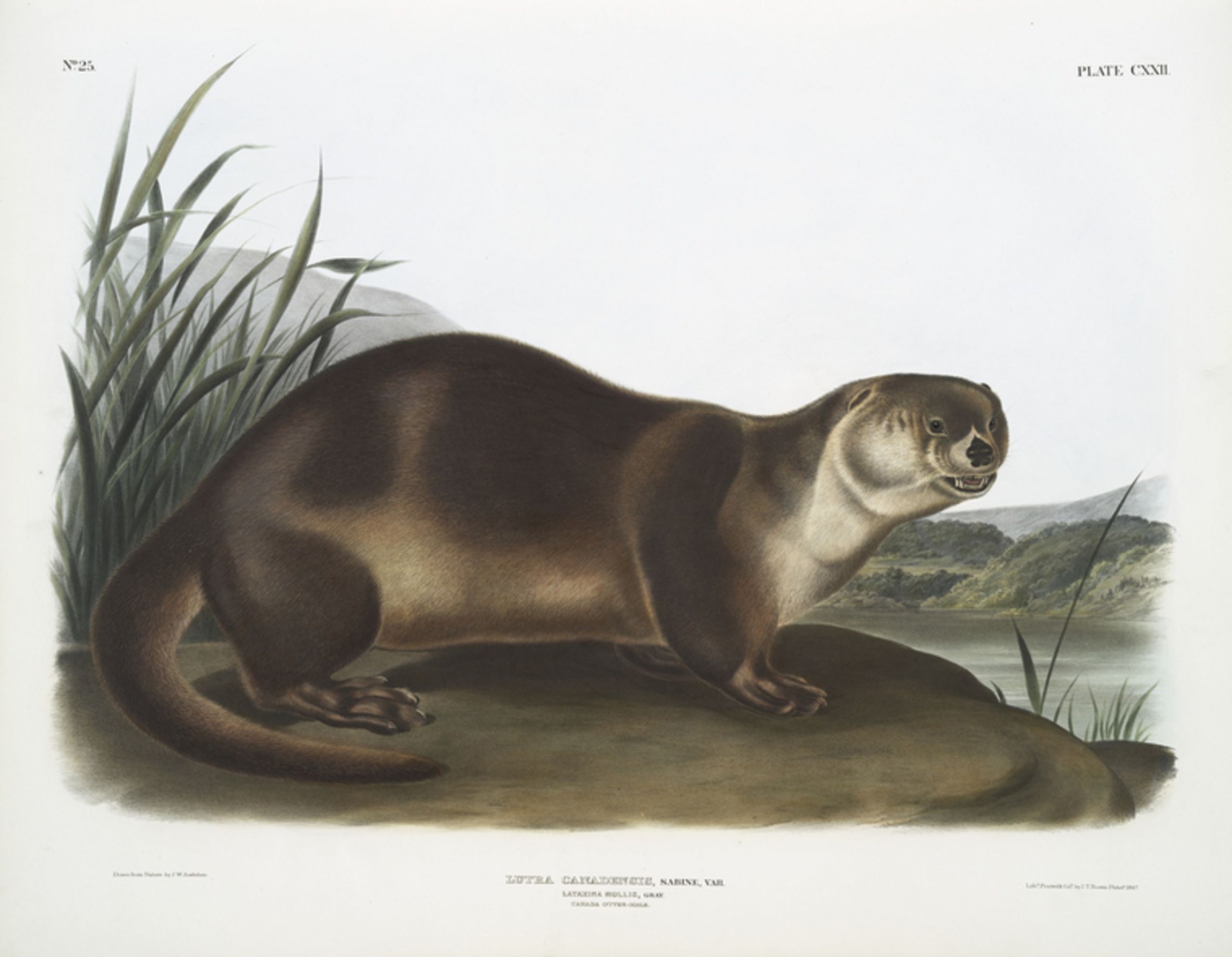
“Lutra Canadensis, Canada Otter” (New York Public Library).

Hyperallergic is an online art magazine with a wide variety of stories that you just want to share. You can read it without paying, but of course, they need contributors as well as readers.

Today’s inspiration from Hyperallergic is about otters.

Sarah Rose Sharp writes, “Though seals are probably the gateway to aquatic mammal fandom, connoisseurs of the genre all agree that otters are best in class. These furry powerhouses are not only capable of tender intimacy and novel tool usage, they often just seem to be having the best time ever. So it’s no wonder that they have been a recurring motif throughout art history. …

“Though better known for his bird illustrations, John James Audubon’s last major work was The Viviparous Quadrupeds of North America, produced in collaboration with his friend, the Reverend John Bachman, who wrote the text that accompanies his illustrations. On his final drawing expedition in 1843, Audubon traveled with his son up the Missouri River to document and depict the four-legged mammals of North America — including, of course, otters.

“But the love of these little water scamps goes back much further than a couple of centuries. On view at the Metropolitan Museum of Art is just one example of otters as a common motif during the Late Period and Ptolemaic times.

“ ‘The pose of raised paws signifies the otter’s adoration of the sun god when he rises in the morning,’ reads the label on this Ancient Egyptian bronze statuette, dating to between 664 and 30 BCE.

‘In myth otters were attached to the goddess Wadjet of Lower Egypt, whose cult was centered in Buto, in the northern Delta.’ …

“For high otter drama, you can hardly do better than the standoff in Pieter Boel’s painting ‘Otter Harassed by Dogs‘ (c. 1600) currently in the collection of El Museo del Prado in Madrid, Spain. … Otters could mess you up at any time, so try to stay on their good side.

“Obviously, otters are a common motif in ancient and contemporary animal fetish carvings, such as [one] example of an ‘otter toy‘ from Cape Prince Of Wales, Alaska, part of the Smithsonian’s Museum of Natural History collection. According to the Toh-Atin Gallery, otters as a fetish animal represent ‘balanced femininity.’ …

“For the painfully literal seeking out otters in museum collections, nothing can hold a candle to the American Museum of Natural History (AMNH) in New York, whose permanent River Otter installation and background mural in the Hall of North American Mammals was captured by AMNH photographer Denis Finnin. ‘As morning mist veils a lake in Algonquin Provincial Park, a young female river otter comes ashore and inspects a spider web,’ reads the AMNH image description. …

“Speaking of meditative otters, a beautiful painting on silk from the Meiji period, the work of Japanese artist Seki Shūkō, is sure to meet all your needs for minimalist marine mammals. You can practically hear the noise of the rushing river. …

“But otters need not only be social animals, they can also be voices for animal welfare, as a woodcut by South Korean artist Shumu demonstrates.

“ ‘Animals are different from humans in language and appearance,’ the artist said in a message to Hyperallergic. ‘But animals feel the same or similar pain as humans, and they have emotions. Species discrimination against animals must stop. I hope that by continuing to work and share the life of veganism, it can become a small but resonant message.’ “

Nice examples of otter art through the ages at Hyperallergic, here. No firewall. Do you have favorite otter stories or images? Please share them.

Read Full Post »

Photo: Amr Nabil/AP.
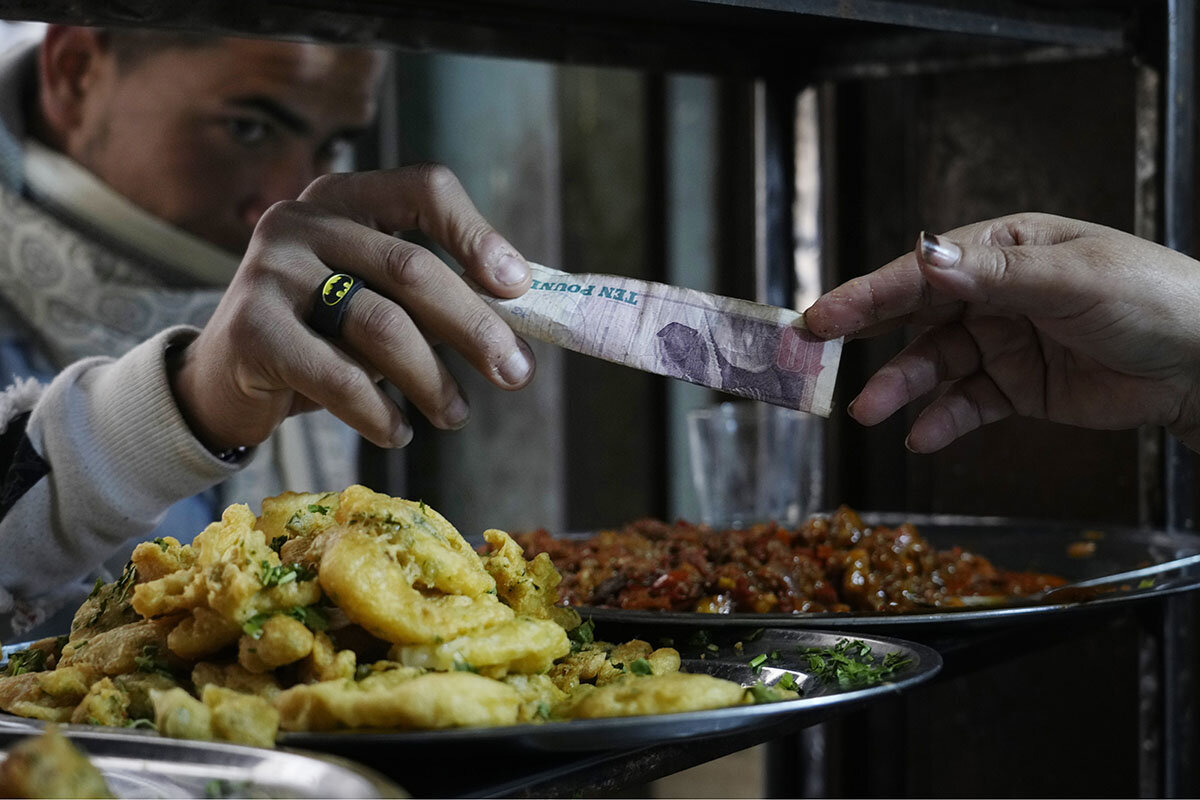
A man buys food at a popular restaurant in Cairo, March 22, 2022. The app Tekeya is working to counter food waste.

In restaurants around the world, especially in the fanciest ones, a lot of perfectly good food goes to waste because of some perceived defect. Can we find a better solution than throwing it out?

Eman Mounir reports at the Christian Science Monitor about a new app in Egypt to deal with food waste.

“Early one morning, servers at the Al-Aseel Al-Dimishqi restaurant began their usual preparations for the day. They laid out rows of baklava, kunafa, and other syrup-drenched, nut-stuffed delectables. But the offerings weren’t for customers who flock to the upscale New Cairo suburb. 

“Instead, within an hour, staff from an organization called Tekeya had arrived to whisk away 135 portions of perfectly edible dishes.

“The reason? The desserts – made a day earlier – weren’t considered fresh enough to dish up. 

“Throughout Egypt, which boasts a rich culinary history, such views aren’t uncommon. … Now, though, amid a global reckoning over the food chain and its role in the climate crisis, attitudes in Egypt are slowly changing. 

“The Al-Aseel restaurant is one of around a dozen across the Egyptian capital that Tekeya staff visits each day in a quest to stop fit-for-consumption food from being dumped. Restaurants pay a small annual fee that allows them to alert Tekeya whenever they have unsold food. Personal users of the app can then buy that food at half-price, or either the restaurant or the user can request Tekeya  deliver the food to a food bank or charity of their choosing. In total, up to 40 plates are saved from going to the trash each day. …

“Tekeya, which was inspired in part by the rituals around Ramadan, is the first such app in Egypt, where poor nutrition and undernourishment account for up to 55% of annual child deaths.  

“ ‘I’ve seen several platforms helping fight food waste across Europe. It’s uplifting to find one that does the same here in Egypt,’ says Al-Aseel’s manager, Ramez Abo Abed, who has been using the app for three years.

“In 2019, Menna Shahin had an idea particularly inspired by Ramadan, the Muslim holiday when the devout give to poor people and fast throughout the day. That prompts both celebration and waste. Since fasts are eventually broken with lavish meals at dusk, demand for food commodities soars by up to a third, and waste, in turn, also multiplies. 

“ ‘I would put so much thought into how to dispose of [food] responsibly without harming the environment, and how to minimize my excess usage,’ Ms. Shahin says. ‘I thought to myself, why not assist everyone to dispose of their excess food wisely?’

“Ms. Shahin ended up co-founding Tekeya along with her husband, Max Hartzen. By Tekeya’s second Ramadan, some 10,000 discounted meals were ordered during the holy month, with users choosing to donate roughly a quarter of those to charities.

“Now a 15-member team, Tekeya continues to face the stigma associated with ‘leftover food,’ says Aya Magdy, the startup’s account manager. ‘People presume that it’s food that has gone bad, making it difficult to convince them to buy or donate it.’

“Traditional Egyptian fare includes delicately spiced falafel served piping hot, while koshary, a staple street food, provides a hearty kick through mixing rice and pasta with fresh onions, tomatoes, garlic, chili, lentils, chickpeas, and a dazzling array of spices – these and other classic dishes almost all require freshly chopped ingredients. 

“But there’s a growing awareness of the impact of food waste on the environment. When food is thrown out, it rots and creates methane, a greenhouse gas that is almost 30 times as potent as carbon dioxide. To date, Tekeya counts at least 45,000 meals it has saved from ending up in landfills – preventing the equivalent of 133,000 kilograms (about 293,000 pounds) of carbon dioxide from being released into the environment, Ms. Shahin says.

“The team also works hard to guarantee the quality of the food it passes on, carrying out regular checkups amid stringent requirements. And because trust is such a big factor, if clients complain that the food from a restaurant is too stale or otherwise unsatisfactory, collaboration is immediately terminated.   

“The number of users has climbed steadily. The app now has more than 50,000 subscribers and 120 food suppliers in Cairo. And users tend to be conscientious themselves. Sara Harfoush, a teaching assistant in Cairo University’s Faculty of Economics and Political Science, was initially skeptical, so she conducted her own trials to gauge quality. After ordering off the app several times – and finding it satisfactory each time – she began buying food cheaply to donate to those in need. …

“The idea is catching on with well-known brands. Alban Khalifa, a dairy shop with multiple branches across Cairo, has been reducing food waste and financial losses through Tekeya for nearly two years. Regulars know they can snap up half-price puddings through the app at the close of day.

“That food would otherwise join the tens of thousands of tons of ingredients overflowing from trash cans on many streets of Cairo. In rural areas, heaps of discarded vegetables and harvests rot in the sun, attracting stray animals.

“There are other draws beyond environmental and sanitation concerns. Soaring inflation and another round of currency devaluation in March have further squeezed citizens in a country where a third of the population is classified as low-income earners. 

“Mohamed Refaat, a pharmacist in Cairo, says he quickly became a regular user after learning about Tekeya. The combination of contributing to saving the environment and getting good food at a discount is, he says, ‘very attractive to any user given the soaring prices and rising inflation rates.’ ”

More at the Monitor, here.

Read Full Post »

Photo: Omar Adel via Unsplash.
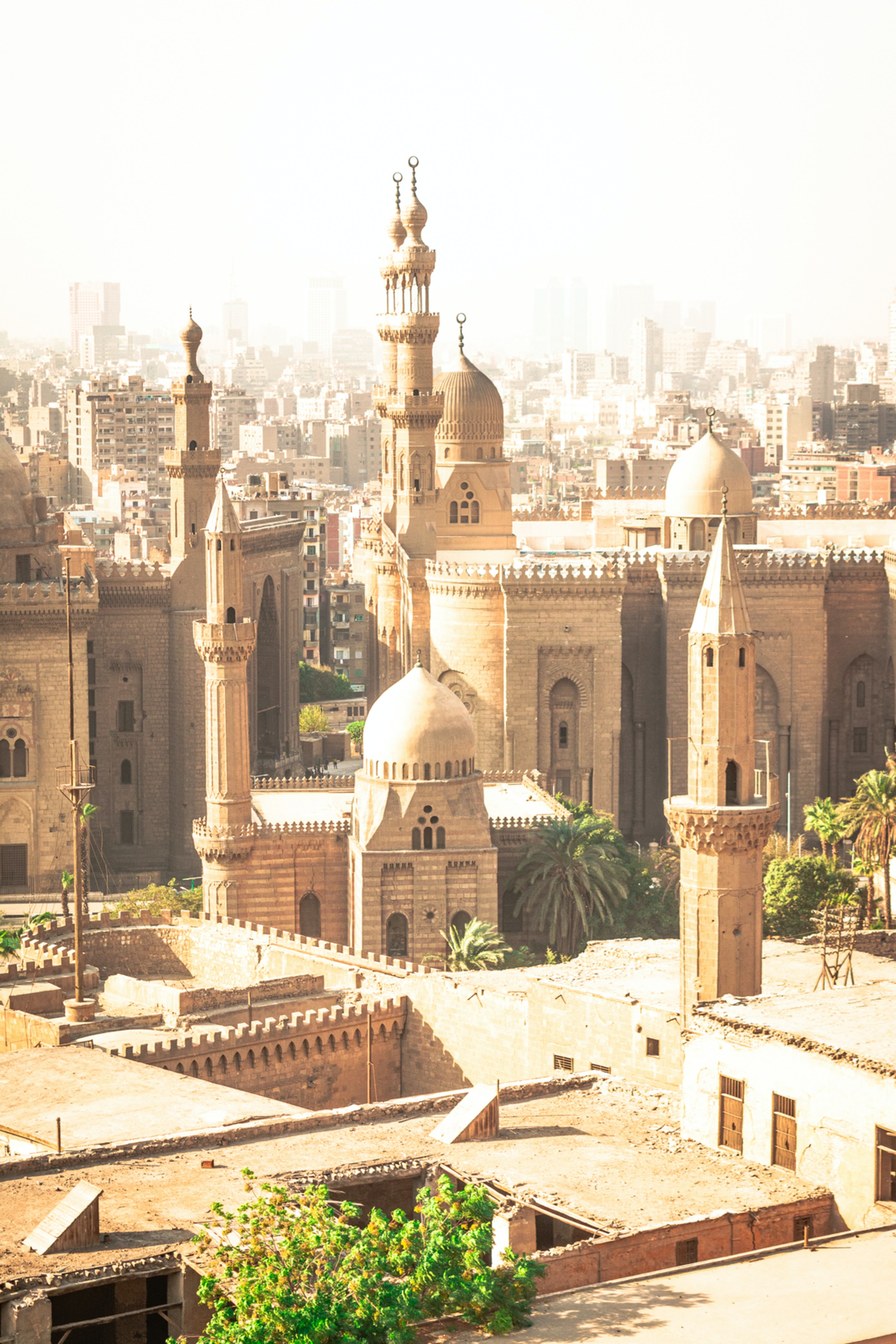
The Al-Rifa’i Mosque in Cairo. The city’s redevelopment highlights every kind of culture, from mosques to belly-dancers.

Members of my extended family were in Egypt recently, and judging from the videos and photos, they had a fantastic time. It made me think of an article I saw back in January about Cairo.

Donna Abu-Nasr at Bloomberg CityLab had a report on how the city’s “revival blends ancient Egypt with modern tastes.”

She wrote, “When Egyptian ballerina Amie Sultan decided to go into belly dancing, she raised eyebrows among her friends and fellow professionals. Why switch from an art form that’s highly respected to one that’s often scorned in her home country and the rest of the Arab world?

“Six years later, Sultan wants to elevate a dance focused on shaking hips and torsos in low-end cabarets to the theater. It’s just one of the ways Egyptians are trying to establish a contemporary cultural identity in Cairo that taps into their heritage.

“The renaissance of traditions spans everything from new museum exhibits to artisans integrating old crafts into modern furniture and designers selling handmade jewelry, bags and shoes online. There’s also the redevelopment of buildings to champion Egyptian identity. For her bit, Sultan says her goal is to preserve, document and revive the performing arts. Egypt is the spiritual home of belly-dancing, which traces its roots back to ancient times. …

“Perhaps the most striking example of the cultural resurrection was when 22 mummies were transported through central Cairo [in April 2021] to their latest resting place at the new National Museum of Egyptian Civilisation. The multi-million dollar spectacle was broadcast live on state television. …

“Some parts of the sprawling metropolis are being refurbished in an attempt to recapture more of the tourism market. … One of those areas is central Cairo, also known as Khedival Cairo in reference to Khedive Ismail, the ruler under whom downtown Cairo was built in the late 19th century. The country’s sovereign wealth fund plans to redevelop the mid-20th century Mogamma building, a hulking government office complex. …

“Private entrepreneurs, like Karim Shafei, 48, have also for years been actively working on restoring that part of town. … The vision that he and his partner, Aladdin Saba, an investment banker, have for downtown is to make it a real city center that reflects Egyptian identity: a meeting point for Cairenes from all walks of life and a platform for innovation and creativity.

“ ‘There’s nowhere in Cairo where tourists can go and experience the contemporary Egyptian lifestyle, unlike many other cities such as Beirut, Istanbul, Paris and New York,’ said Shafei. ‘Today, there’s a big portion of tourism that’s intended to experience a country in its modern form. You want to experience the way cuisine is, the way people live, how they dress.’ 

“One thing that Shafei has noticed is a change in the government’s attitude toward restoration. In the past, authorities would just focus on painting a wall or fixing a sidewalk. In the past year, the discussions have become deeper.

“Sultan, the dancer, has likewise found a sympathetic ear for her project, which she is doing through her company Tarab Collective. When she has approached government officials with her idea, ‘there’s some shock, but then as they listen they actually see that this is a serious project.’ . …

“Belly-dancing has been associated with smoky cabarets where alcohol is served. … It’s also informally performed by people at home, at picnics or celebrations. …

“Last year, Tarab Collective produced a tribute to the golden age of Egyptian cinema and the dance’s divas from 1940 to 1960. It featured 12 performers and premiered at the closing of the Gouna Film Festival in October.

“[Sultan’s] company is also working on setting up an institute to teach the dance, register it with UNESCO as intangible heritage and change its name from one that comes from the French danse du ventre to ‘Egyptian dance.’

“ ‘At the end of the day, this dance represents Egypt,’ she said. ‘It’s how we show ourselves to the world, just like we identify Spain with flamenco.’ “

More at Bloomberg CityLab, here. I know I’ve told you that there was a wonderful belly-dancer at our son’s wedding — with flaming candles in her hair, no less. If I can get into my old computer, I’ll post a picture.

Read Full Post »

Photo: James O Davies/The Historic England Archive, Historic England.
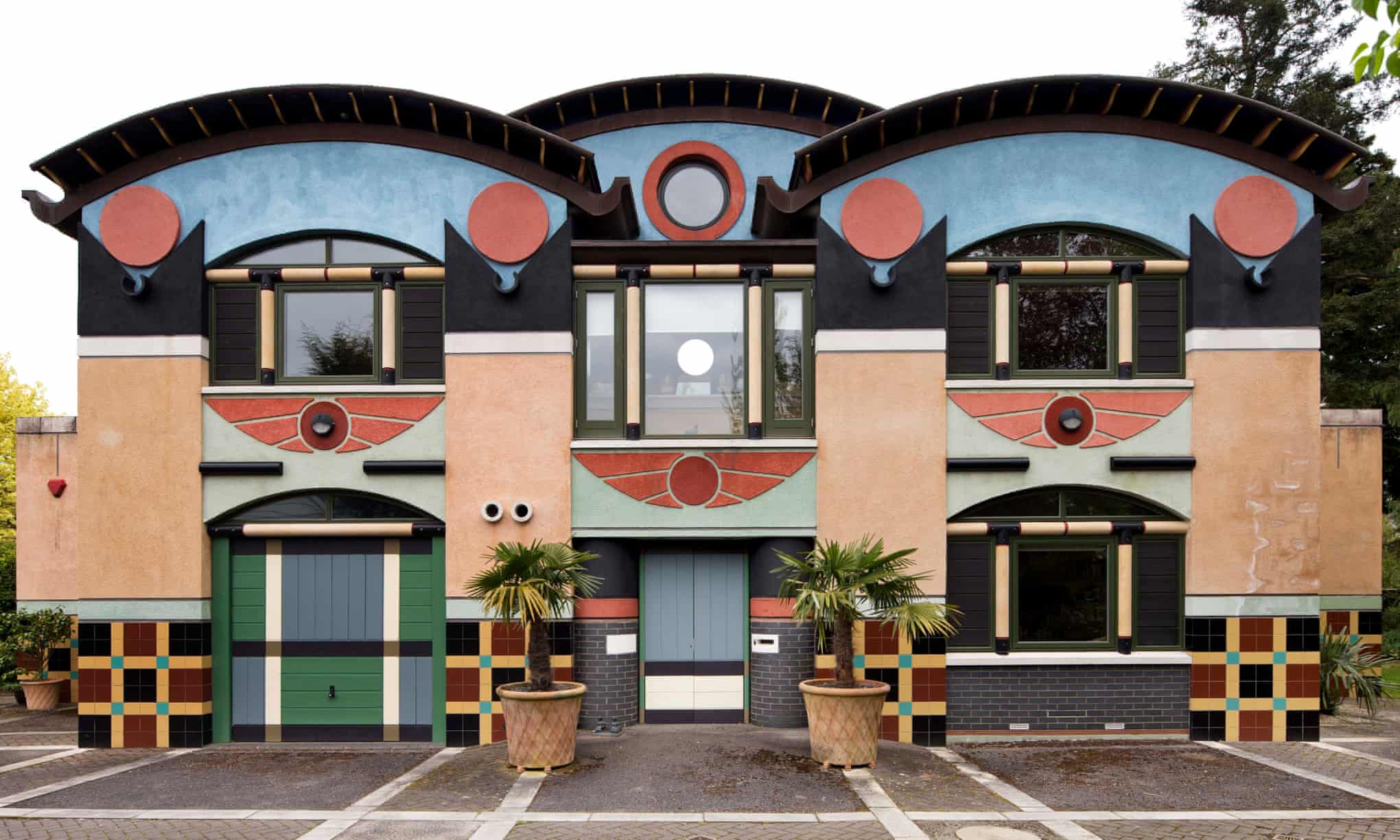
Sphinx House, Moulsford, Oxfordshire, is an example of Egyptian influences on the work of newly rehabilitated British architect John Outram.

Sometimes a person whose work hits a wall of resistance from contemporaries is merely ahead of the times. That may be the case with UK architect John Outram.

Guardian reporter Oliver Wainwright talks to the architect about his philosophy and rehabilitation. ” ‘Our beginning was a worm,’ says John Outram. ‘It had light-sensitive cells at one end that later turned into eyes.’ He is standing in the bathroom at the top of his house in London’s Connaught Square, explaining the symbolism of the patterns that line the walls of his shower.

“Three white worms wiggle their way across a background of blue mosaic tiles at the base of the cubicle, while a black I-shape floats against a band of red tiles above, denoting ‘the emergence of the ego.’ A third yellow band at the top marks the realm of light, where the figure of ‘thought’ appears between two triangles, signifying the parted halves of the ‘heap of history.’

“It’s a lot to digest before breakfast – and we haven’t even got on to the symbolic ceiling (the ‘raft of reason’) or the hexagonal serpent-skin floor tiles.

“ ‘I stand here every morning to do my exercises,’ says Outram, breaking into an infectious giggle. ‘A good dose of metaphysics sets one up for the day.’

“The eccentric architect has reason to be cheerful. At the age of 87, he is enjoying an unexpected wave of popularity. Having been stamped with the label of postmodernism – out of favor since the 1990s, when his work was described as ‘architectural terrorism’ – he has been rediscovered by a new generation, thirsty for color, pattern, ornament and fun.

“The last few years have seen several of his buildings listed, from the Isle of Dogs pumping station, that cartoonish temple to summer storms, to an opulent country house in Sussex built for the Tetra Pak billionaires Hans and Märit Rausing. Illustrations of Outram’s buildings can now be found emblazoned on T-shirts and mugs, while he has a growing following on Instagram, which he joined during lockdown, where he expounds his esoteric theories to a rapt audience. And now, for the first time, the full breadth of his maverick output has been brought together in a monograph. So how does it feel to be recognized so late in life, after years in the wilderness?

” ‘I call it being dug up,’ he says with a chortle. ‘Disinterred, as it were. It’s quite entertaining.’

“As Geraint Franklin, the book’s author, observes, the English have never quite known what to do with Outram. His buildings are hi-tech, neoclassical and postmodern all at once, yet they fit neatly into none of these categories. His chubby columns house sophisticated mechanical systems for ventilation, wiring and drainage, while simultaneously alluding to ancient mythologies in their richly layered ornament.

“A huge jet engine fan in the pediment of the pumping station helps to cool the machinery inside, while also standing as the symbolic source of the ‘river of somatic time.’ A pyramidal glass fireplace in the Egyptian-themed Sphinx Hill house in Oxfordshire summons momentous Pharaonic allusions, while cleverly sucking smoke beneath the floor to a hidden flue.

“In Outram’s world, embracing technology and modernity did not preclude the presence of poetry and history. … Outram piled it all on, mining inspiration from Sumerian, Egyptian, Chinese and Mayan cultures with magpie glee. …

“Born in Malaysia, where his army officer father was stationed, Outram’s outsider status owes something to his upbringing. His childhood saw spells in Burma and India, before he arrived at prep school in England at the age of 11, feeling like ‘a refugee from the British empire.’ His early exposure to the vivid sights and sounds of South Asian cities informed his impression of the classical world, as being ‘much more like India than like the British Museum. Very noisy, very smelly, very colorful.’ …

“Unlike his hi-tech peers, his projects rarely exceeded the capabilities of the average builder. ‘The problem with hi-tech is that it’s very expensive, and the tech isn’t very high,’ he says. ‘I’d been a pilot, so I knew what real hi-tech was – and it wasn’t suitable for architecture.’ …

“As Franklin writes, base materials are subject to an almost alchemical transformation in Outram’s hands. Humdrum concrete – which he once described as a ‘funereal porridge of muddy ashes’ – could be transformed into ‘blitzcrete with fragments of colored brick, ground and polished to an edible nougat finish. It debuted at his New House for the Rausings in Wadhurst, Sussex, in 1986, where five types of crushed brick swirl across the facade like confetti in the wind.”

More at the Guardian, here. Great Pictures. No firewall.

Read Full Post »

Photo: National Museum of Ireland.
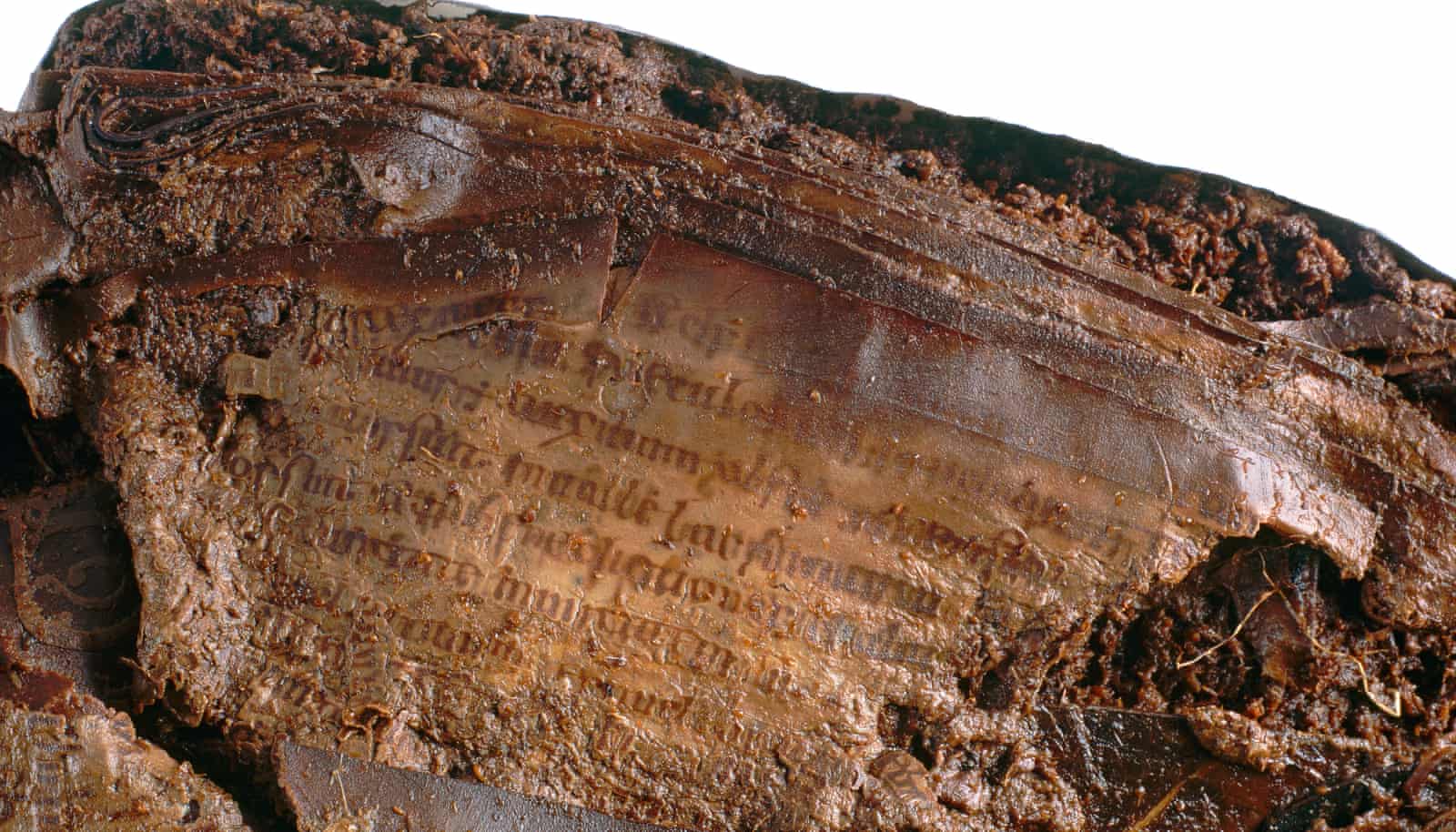
Found in an Irish bog. The psalter is shown here pre-conservation – lines of psalms clearly visible.

In the miracles-all-around-us department, imagine finding in a peat bog a medieval book of psalms that looked like the monastic compilers might have had links with Egypt! Lisa O’Carroll writes for the Guardian about a book on the psalter’s discovery and painstaking restoration.

“One summer’s day in Tipperary as peat was being dug from a bog, a button peered out from the freshly cut earth. The find set off a five-year journey of conservation to retrieve and preserve what lay beyond: a 1,200-year-old psalm book in its original cover.

“Bogs across Europe have thrown up all sorts of relics of the ancient past, from naturally preserved bodies to vessels containing butter more than a millennium old, but the 2006 discovery of an entire early medieval manuscript, entombed in a wet time capsule for so long, was unprecedented, said the National Museum of Ireland.

“The book fell open upon discovery to reveal the Latin words in ualle lacrimarum (in the valley of tears), which identified it as a book of psalms. One particularly unexpected feature was the vegetable-tanned leather cover with a papyrus reed lining, suggesting the monks could have had trade links with Egypt.

“ ‘It still blows me away,’ said John Gillis, the chief manuscript conservator at Trinity College Dublin, home of the Book of Kells, the Book of Armagh and 450 other medieval Latin manuscripts. ‘It was by far and away the most challenging, most interesting project I have ever undertaken – and to put that in context, I am surrounded by these iconic manuscripts.’

“Ten years after going on display at the National Museum in Dublin, the Faddan More Psalter is one of Ireland’s top 10 treasures and now the subject of a 340-page book from the institution documenting every stage of the ‘terrifying’ preservation process for future scholars. …

“The process of stabilising the book outside the bog, drying it and then unpicking and unfolding pages where possible was painstaking. Archaeologists placed the ‘conglomeration’ of squashed pages, leather and turf in a walk-in cold store in the museum at 4C. But there was no manual in the world to guide Gillis on how to go about the task. …

“Initial examination was limited in order to mitigate further trauma. CT scans and X-rays to find 3D structures were excluded owing to concerns that they could accelerate the degradation.

“After trying sophisticated versions of freeze-drying, vacuum-sealing, and drying with blotting paper, Gillis settled on a dewatering method using a vacuum chamber installed in the museum lab for four years to minimise shrinkage and decay.

“It would take two years before all the folio fragments were in a dry and stable state before the daunting task of dismantling could begin, a process chronicled in the book out later this month, The Faddan More Psalter, The Discovery and Conservation of a Medieval Treasure.

“ ‘It was absolutely terrifying,’ Gillis said of the responsibility he felt.

‘I heard from someone in the British Museum that there was a picture of the [book fragments] on the walls in a staff area there with the words “If you think you have a bad day ahead …”

” ‘You had this nerve-racking scenario of disturbing this material, which meant losing evidence, when the whole point was trying to gain as much information as possible.’

“Many of the spaces between the iron gall letters had dissolved into the bog, leaving an alphabet soup of several thousand standalone letters. It would take months after the drying process to piece them all together, in sequence on the right pages.

“ ‘The rewards when you slowly lifted up a fragment, and suddenly beneath this little bit of decoration would appear, particularly the yellow pigment they used. It would kind of shine back at you,’ Gillis said. ‘And you’d go: “Wow, I am the first person to see this in 1,200 years.” So that kind of privilege made all the sleepless nights and racking of the brain worthwhile.

“ ‘It was the purest conservation I’ve ever carried out. There is no repair, I’ve attached nothing new. All I’ve done is captured and stabilised.’ ”

More at the Guardian, here.

Read Full Post »

Photo: Reuters.
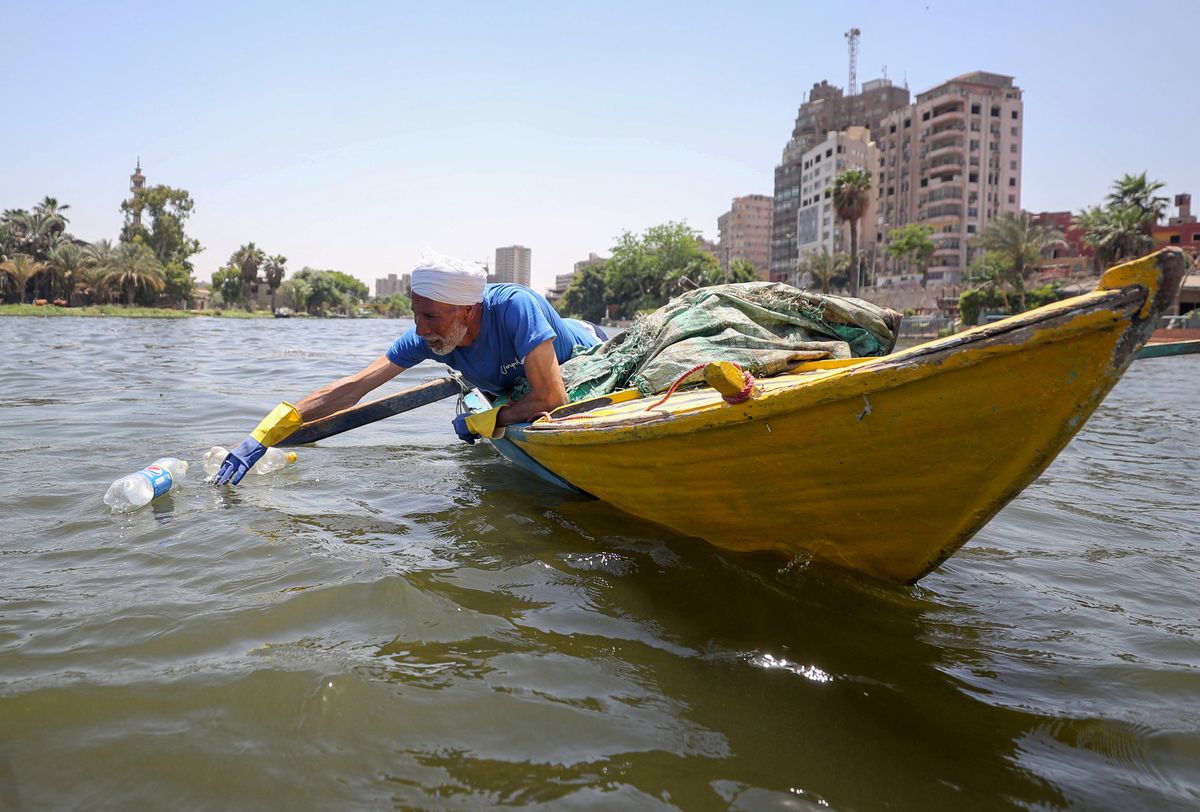
An Egyptian nonprofit has enlisted fishermen from Al-Qursaya, an island near central Cairo, to collect plastics that have been reducing the catch.

At the Center for Biological Diversity, I recently learned about the enormity of the plastics problem in waters where people fish. The website states: “Plastic accumulating in our oceans and on our beaches has become a global crisis. Billions of pounds of plastic can be found in swirling convergences that make up about 40 percent of the world’s ocean surfaces. At current rates, plastic is expected to outweigh all the fish in the sea by 2050.” Yikes!

New efforts large and small are needed to reverse what’s happening. On Twitter, the World Economic Forum is promoting one of the small efforts, which is how I learned about it.

Reuters reports, “For 17 years, Mohamed Nasar has supported his family of five by fishing in the Nile River near the banks of the tiny island of Al-Qursaya close to central Cairo.

“But the 58-year-old says fishermen like himself catch fewer fish every year as the Nile has become clogged with plastic bottles, bags and other waste.

‘The fish get caught in the bottles, and they die,’ said Nasar.

“A local environmental group named ‘VeryNile‘ has asked the island’s fishermen to use their boats to collect plastic bottles from the river. VeryNile says it buys the bottles at a higher price than the general market price on offer from traders or recycling plants.

“The initiative provides a sustainable solution for helping to clean up the Nile, while providing an additional source of income for fisherman like Nasar.

” ‘This job helped us a bit. We come and collect about 10 to 15 kilos (of plastic bottles), we get about 12 Egyptian pounds ($0.7682) for each,’ Nasar said as he sat in his boat collecting bottles. …

“Another fisherman, Saeed Hassanein, said cleaner Nile water would mean more fish.

” ‘On the one hand, the Nile is cleaner, and on the other hand the fisherman now has more than one source of income,’ he said.

“With the help of more than 40 fishermen, VeryNile has over the past year collected around 18 tons of plastic bottles, most of which were sold to recyclers.” More at Reuters, here.

The World Economic Forum, which defines itself as the “international organization for public-private cooperation,” is increasingly focused on addressing the consequences of global warming, and I hope it is serious about that. It’s easy to feel cynical about the forum’s annual conference for the world’s rich and powerful — called Davos because it takes place in Davos, Switzerland — but I have to believe it’s helping to make both the problems and the possible solutions more widely accepted. Besides, I know there are many altruistic people on the staff, like my friend Kai, who was one of them several years ago.

In a recent podcast, Radio Davos discusses initiatives tackling climate change, calling the current decade “the decade of ocean science, and one in which we must get on track for net-zero by 2050.”

So there’s that. Meanwhile, in Egypt, impoverished fishermen are pulling out plastic that corporations, cruise ships, and too many individuals keep dumping.

Read Full Post »

Photo: Reuters.
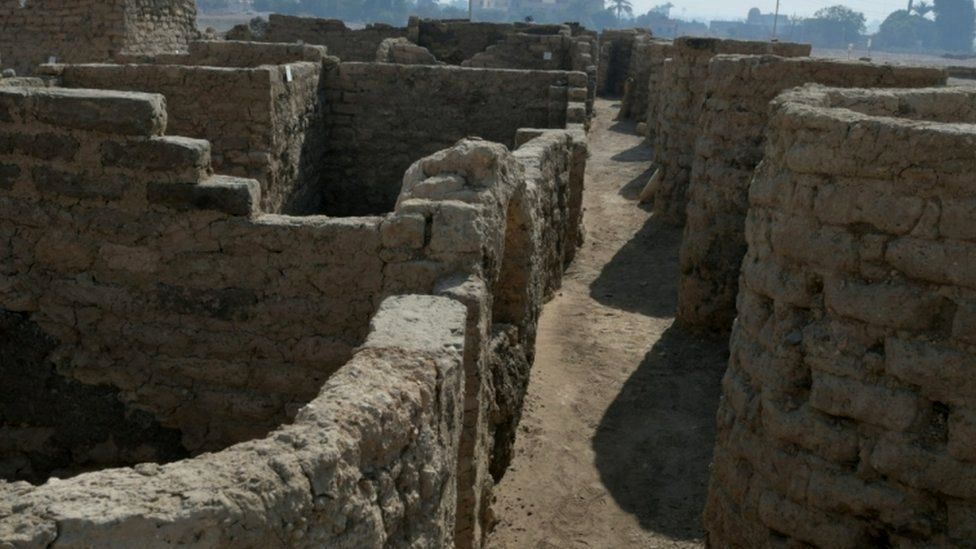
‘Lost golden city’ found in Egypt reveals lives of ancient pharaohs.

Archaeologists in Egypt have had a run of successes lately. The most recent find of a whole city is expected to generate clues to the daily lives of the pharaohs.

The BBC reports that “the discovery of a 3,000-year-old city that was lost to the sands of Egypt has been hailed as one of the most important archaeological finds since Tutankhamun’s tomb.

“Famed Egyptologist Zahi Hawass announced the discovery of the ‘lost golden city’ near Luxor. [He] said the find was the largest ancient city, known as Aten, ever uncovered in Egypt. It was unearthed within weeks of the excavation starting in September 2020.

“The city dates to the reign of Amenhotep III, one of Egypt’s most powerful pharaohs, who ruled from 1391 to 1353 BC. …

“Betsy Brian, professor of Egyptology at Johns Hopkins University in Baltimore, US, said … the city would ‘give us a rare glimpse into the life of the ancient Egyptians’ at the time when the empire was at its wealthiest.

“The dig revealed a large number of valuable archaeological finds, such as jewelry, colored pottery, scarab beetle amulets and mud bricks bearing seals of Amenhotep III. …

” ‘Within weeks, to the team’s great surprise, formations of mud bricks began to appear in all directions,’ Dr Hawass said in his statement. ‘What they unearthed was the site of a large city in a good condition of preservation, with almost complete walls, and with rooms filled with tools of daily life.’

“Now, seven months after the dig started, several areas or neighborhoods have been uncovered, including a bakery, an administrative district and a residential area.”

More at the BBC, here. Check out the photos.

Read Full Post »

Photo: Ahmed Hasan / AFP via Getty Images.
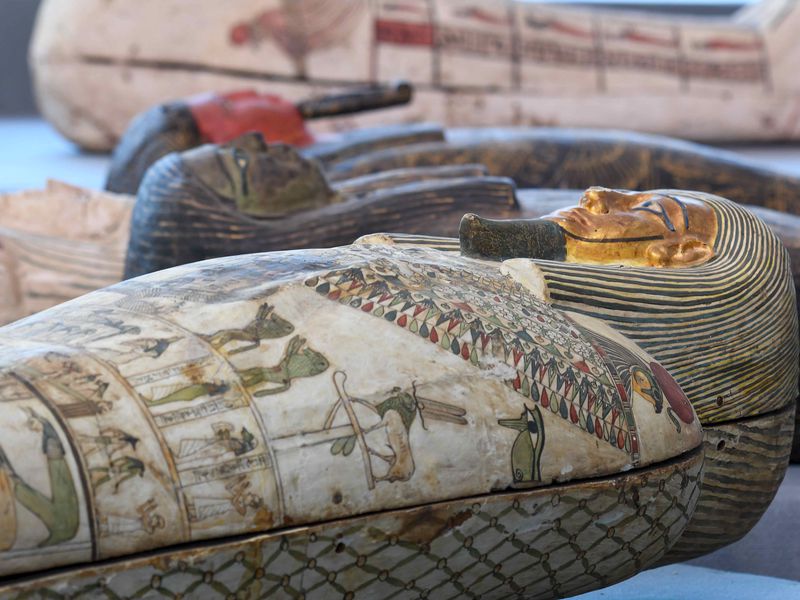
The sealed wooden coffins at Saqqara in Egypt date from between the sixth and first centuries B.C.

On the weekend, when I was indoors with grandchildren for the first time in more than a year, one of the kids read to me from a book of “spooky stories.” One yarn was about mummies, which reminded me of the prepandemic time that grandson and I had visited the Egyptian section of the RISD Museum. Maybe Suzanne will show him the picture from today’s post about a recent discovery in Egypt.

Jo Marchant wrote about this at Smithsonian last November. “A giant trove of ancient coffins and mummies has been discovered at the vast Egyptian burial site of Saqqara. After hinting at a big announcement for days, the Egyptian antiquities ministry revealed the details this morning: more than 100 intact wooden coffins with brightly painted scenes and hieroglyphs, and well-preserved mummies inside.

“The announcement comes after a string of recent discoveries at Saqqara, including 59 intact coffins revealed in September and October. The newly announced coffins were found nearby, at the bottom of three 12-meter shafts revealed when archaeologists led by Mostafa Waziry, head of Egypt’s Supreme Council of Antiquities, were removing debris from the site. Other finds include funerary masks and more then 40 statues of the funerary deity Ptah-Sokar, all untouched for at least 2,000 years.

“Speaking at a press conference at Saqqara with dozens of the coffins displayed on stage behind him, Egypt’s antiquities minister, Khaled el-Enany, praised the Egyptian archaeologists who excavated the finds, which mostly date from between the sixth and first centuries B.C. ‘They have been working day and night and I’m very proud of the result,’ he said. Their story will be told in a Smithsonian Channel docuseries called Tomb Hunters, scheduled to air in 2021.

“As the coronavirus pandemic devastates the tourism industry on which Egypt depends, the recent finds have been publicized in a series of increasingly dramatic events. At a previous press conference in October, Egyptian officials opened a coffin live on stage. This time they went one step further, not just opening a coffin but X-raying the mummy inside, revealing the individual to have been an adult male, perhaps in his 40s. ….

“Egyptologists have welcomed the announcement. To find an unplundered necropolis from this period is ‘extremely significant,’ says Salima Ikram, an archaeologist based at the American University in Cairo, who works at Saqqara. They note that although the latest find is larger, it doesn’t differ significantly from the previously announced finds. ‘This is very impressive, but it’s lots more of what we already have,’ says Campbell Price, curator of Egypt and Sudan at the Manchester Museum in the United Kingdom. Nonetheless, researchers are excited about the possibilities for learning more about this ancient sacred landscape, and the people who were buried there.

“Saqqara, located around 20 miles south of Cairo, is one of Egypt’s richest archaeological sites. Home to the 4,700-year-old Step Pyramid, Egypt’s oldest surviving pyramid that’s about 200 years older than the more-famous Pyramids at Giza, the site was used as a burial ground for more than 3,000 years. Like the previous 59 coffins, the newly announced finds mostly date from fairly late in ancient Egypt’s history, from the Late Period (664-332 B.C.) and the Ptolemaic period when Greeks ruled as Pharaohs (305-30 B.C.)

“During this period, Saqqara was far more than a cemetery, says Price. It was a pilgrimage site, he says, like an ancient Mecca or Lourdes, that attracted people not just from Egypt but from all over the eastern Mediterranean. Buildings such as the Step Pyramid were already thousands of years old at this time; people believed they were burial places for gods, and wanted to be buried close by.

‘Saqqara would have been the place to be seen dead in,’ says Price. ‘It had this numinous, divine energy that would help you to get into the afterlife.’

“Geophysical surveys have revealed the remains of numerous temples buried under the sand. Archaeologists have also discovered millions of animal mummies, including dogs, cats and birds, believed to have been left as offerings. Recent finds of mummified cobras, crocodiles and dozens of cats, including two lion cubs, were reported in November 2019 and feature in a Netflix documentary, ‘Secrets of the Saqqara Tomb,’ released this month. Meanwhile the discovery of an underground embalmers’ workshop, announced in April, suggests a thriving business in dealing with the dead, with coffins and masks to suit a range of budgets.

“But the undertakers weren’t digging from scratch, says Aidan Dodson, an Egyptologist at the University of Bristol in the United Kingdom. They were reusing older, looted tombs, he says, ‘scouring Saqqara for locations’ suitable for placing new coffins, even beneath the Step Pyramid itself. That makes the site a densely packed mix of finds that range thousands of years. ‘One would be hard pressed to dig and not find something,’ says Ikram. The latest coffins come from an area north of the Step Pyramid, next to the bubasteon, a temple complex dedicated to the cat goddess Bastet, where older tombs were reused to hold hundreds of mummified cats.” As Laurie would say, “Holy Cats!”

More at the Smithsonian, here.

Read Full Post »

Photo: Cairo Scene.
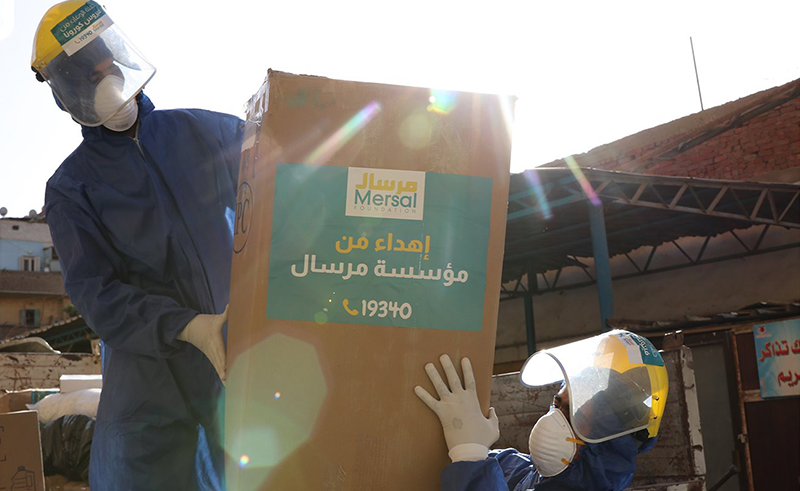
Last fall, the Mersal Foundation, a health-care nonprofit in Egypt, received one large award from AstraZeneca for its work with lung cancer patients and another to aid those afflicted with the Coronavirus.

When I read a story like today’s, which is about a nonprofit that’s filling the gaps in a health-care system, I think of my favorite Allen Ginsberg poem:

“When Music was needed, Music sounded
“When a ceremony was needed, a teacher appeared
“When students were needed, telephones rang
“When cars were needed, wheels rolled in …”

It reminds that good people can make things happen.

Sudarsan Raghavan reported recently at the Washington Post, “The pleas for help were flooding in. By 2 p.m., Raba Mokhtar was picking up the 131st call of the day to the Mersal Foundation’s 24-hour hotline. Like the vast majority, it was related to the coronavirus pandemic.

“On the other end of the line, a woman was frantically describing the condition of a relative, a 67-year-old man who had tested positive for the virus. He had a 100-degree fever and could hardly breathe. They had first tried the Health Ministry’s hotline to look for a bed in a government hospital, with no luck. …

“In a country where government health resources can be either stretched or inadequate and where most people cannot afford hospitalization, a once little-known charity has become a lifeline for thousands of Egyptians. For the past year, and especially during the latest coronavirus wave, the Mersal Foundation has contracted and paid for beds in private hospitals or provided oxygen tanks to people in need.

“Mersal and its founder, Heba Rashed, have become so trusted that more than a quarter-million people now follow her social media accounts to learn the true impact of the pandemic in Egypt. …

“Egypt has reported about 165,000 infections and 9,100 deaths since the start of the outbreak. Medical experts and even government ministers have publicly said the real numbers are far higher.

“Doubts among the public deepened in January when a video went viral online claiming that coronavirus patients at a government hospital had died because of a lack of oxygen. The government denied the report, but a week later Sissi ordered a doubling of oxygen production to meet increased demand.

“Against this backdrop, the Mersal Foundation has emerged as a trusted oasis of care. And Rashed, 40, has become a coronavirus prognosticator for her legions of followers.  

‘It makes me feel very responsible for every word I utter,’ she said. ‘People get affected by everything I say.’

“Growing up in Jordan and the Egyptian desert town of Fayoum, Rashed never intended to start a charity. In college, she studied Spanish and Arabic and later earned a master’s degree in linguistics and several diplomas in other fields. She later worked as a linguist and as a project manager. In her spare time, she volunteered at a local charity.

“Soon, Rashed said, she realized she had ‘no passion’ for her job and found her charitable work more fulfilling. She also noticed there were few nonprofit groups in Egypt specializing in health issues. So with two friends, she launched Mersal five years ago. ‘It was truly hard at the start,’ Rashed recalled. ‘We had no connections.’

“Eventually, they found a sympathetic donor. He gave roughly $1,300, and they set up the charity in Rashed’s apartment. Slowly they grew, soliciting donations mostly on social media. They began to get noticed by some larger donors.

“Today, the foundation has four offices in Cairo and one in the northern city of Alexandria, with roughly 200 employees, according to Rashed. …

“ ‘The second wave is much more vicious than the first one, in terms of the intensity of the infection,’ Rashed said. ‘The number of infections is bigger than the last wave. The symptoms are much more.’

“She was infected. So were more than half of her 100 employees in the office, forcing mass isolations. ‘It made it very hard to do our work,’ Rashed said matter-of-factly. …

“The case of the 67-year-old man who had been struggling to breathe was typical. His oxygen levels were extremely low, though he was using a tank. … Mokhtar, the employee who took the call, asked the man’s relative to send a complete medical report, X-rays of his lungs and any bloodwork. Mokhtar gave her the WhatsApp number.

“ ‘We will show them to the medical department, and we will get you a bed when one becomes available,’ Mokhtar said. ‘Peace be with you.’

“Finding a bed usually takes a few hours but can stretch into a day or two, employees said. … The foundation has contracted with more than 30 private hospitals. In some cases, patients who need help getting care can pay some or all costs. Mostly, though, the charity pays as much as $1,300 per day for hospital beds in intensive care units, money obtained in large part through online appeals for donations.”

More at the Washington Post, here. Grateful stories may be found at the Mersal Foundation Facebook page, here,

Read Full Post »

Older Posts »