Feeds:
Posts
Comments

Posts Tagged ‘endangered’

720

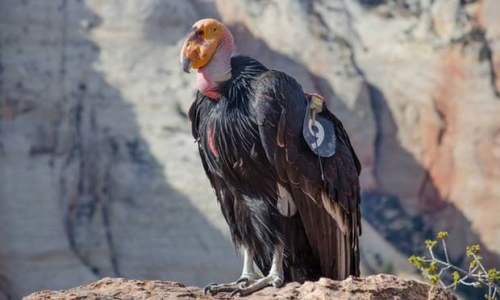
Photo: Zion National Park
California condor chicks No 1,000 and 1,001 hatched in May this year, signalling a success for the species.

They are ugly and mostly unloved. But today, when so many creatures are going extinct, one can only rejoice to see that these guys are coming back. They are California Condors.

Maanvi Singh writes at the Guardian, “Nestled among the red-rock cliffs of Zion national park and the Grand Canyon, California condor chicks No 1,000 and 1,001 blinked into this world. Their birth signalled success for a decades-long program to bring North America’s largest bird back from the brink of extinction.

“As a result of hunting, diminishing food and dwindling territory, the number of birds in the wild numbered just 22 in the early 1980s. Lead poisoning was also a major killer, caused by inadvertently ingesting bullets that hunters left inside dead animals that the enormous birds, which have a wingspan of 9.5ft and weigh up to 25lb, scavenged for food.

“Facing imminent extinction, the few remaining wild birds were placed into a captive breeding program in 1987 and slowly released back into the wild starting in the early 1990s. Biologists estimate that the 1,000th and 1,001st chicks hatched in May this year, but they were only able to confirm their existence over the past several days, because the raptors build their nests inside caves carved into steep, sometimes inaccessible cliffs. ‘You know, condors can be secretive,’ said Janice Stroud-Settles, a wildlife biologist at Zion National Park in Utah. …

“The 1,000th hatchling’s parents were both born in captivity, and the mother has already lost two chicks. Her firstborn probably died – as many baby condors do – in an initial, unsuccessful attempt to fledge (AKA fly) the nest. …

“ ‘We’re hoping this chick will successfully fledge once it’s old enough to fly – sometime in the fall,’ Stroud-Settles said, noting that the nesting site she chose has a large ‘porch’ area where the growing chick can practice flapping before taking its perilous first flight. …

“But the species is still classified as critically endangered by the IUCN [International Union for the Conservation of Nature] and faces multiple threats, including the ongoing menace of lead poisoning.

“A law that went into effect this month has made it illegal to use lead ammunition to hunt any game in California. In Utah and Arizona, however, conservationists have taken a different approach. Because a straight ban could alienate hunters, conservationists are encouraging locals to reduce their use of lead bullets through a voluntary program. …

“The total living population of California condors now numbers more than 500, with more than half in the wild. The oldest bird being tracked in the condor restoration program is 24, but researchers estimate that California condors can live up to 70 years. They are very gregarious animals who get together in large groups and ‘like humans, tend to mate for life,’ noted Stroud-Settles.”

If this bird can be brought back from the brink of extinction, maybe all sorts of things threatened by human ignorance can be brought back, too. Elephants, butterflies, insects, trees. Maybe even — dare one hope? — our wobbling democracy.

More at the Guardian, here.
Read Full Post »

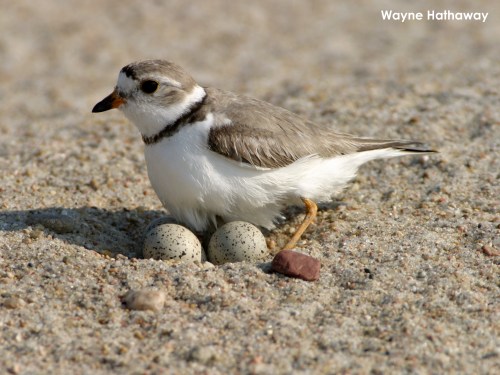
pipl_nest_007

Photo: Wayne Hathaway
The endangered Piping Plover is a species that actually benefited from Hurricane Sandy in 2012 — at least on Fire Island.

It’s a ill wind that blows nobody good, as they say, and the ill wind of Hurricane Sandy seems to be a case in point. As devastating as it was along the East Coast, there are reasons why an endangered shore bird benefited on Fire Island, a place I spent many youthful summers. Annie Roth has the story at the New York Times.

“The wrath of Hurricane Sandy’s powerful winds and violent storm surge left considerable damage across New York and New Jersey in October 2012. But for one tiny bird, the cataclysmic storm has been a big help. …

“The piping plover is a small, migratory shorebird that nests along North America’s Great Lakes and Atlantic Coast. The species, which is listed as endangered in New York State and threatened federally, has been the focus of intensive conservation efforts for decades. But on one island that was heavily damaged by the big storm, the piping plover population has increased by 93 percent, [as Katie Walker, a graduate student in wildlife conservation at Virginia Tech] and colleagues reported in the journal Ecosphere. …

“Fire Island, a 32-mile-long barrier island off the southern coast of Long Island that is popular with vacationers, was hit particularly hard by Hurricane Sandy. The storm washed sand and seawater across the island, flooding homes, flattening dunes and breaching the island in three places.

“Sand deposited from Fire Island’s oceanside onto its bayside created a number of new sand flats. Some areas were also breached by seawater but most were filled by the Army Corps of Engineers shortly after the storm as part of the recovery effort. …

“Piping plovers like to nest on dry, flat sand close to the shoreline, where the insects and crustaceans they feed on are easily accessible. But over the past century, coastal development and recreational use of shorelines have vastly reduced the amount of waterfront property available. …

“For the past three years, the majority of new and returning plovers chose to nest in habitats generated by the storm. And now, for the first time in nearly a decade, Fire Island’s population of piping plovers is growing. …

“Barrier islands like Fire Island are known as early successional habitats, which means they require regular disturbance events to keep their ecosystems in check. Under normal circumstances, Fire Island would experience disturbance events on an annual basis. However, engineers have gone to great lengths to stabilize the island, and now only powerful storms like Sandy are able to have a significant impact on the island’s ecosystem.

“ ‘Barrier islands are very dynamic systems, they don’t stay the same from one year to the next. The species that inhabit them there are adapted to these changes, so if we try to keep these systems static, we are going to lose these species,’ said [Jonathan Cohen, assistant professor at SUNY College of Environmental Science and Forestry, who was not involved with the study].

“Last year, 486 pairs of piping plovers nested along the shores of New York and New Jersey, approximately 10 percent of which did so on Fire Island. If current trends continue, the two states may soon reach their recovery goal of 575 breeding pairs set out by the U.S. Fish and Wildlife Service.”

More at the New York Times, here.

Read Full Post »

5109

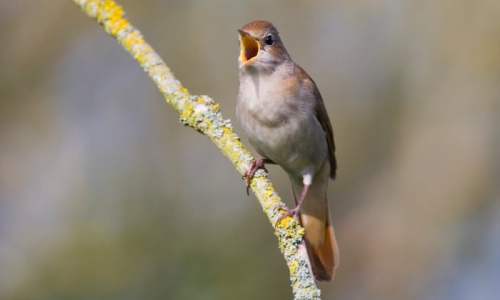
Photo: David Tipling/Getty Images
The nightingale’s song has been inspiring writers for more than a thousand years, but today most people have only recordings.

I’m reading one of the Narnia books to my younger grandson (The Horse and His Boy), and naturally some of the cultural references are to author CS Lewis’s England. We turned to our North American bird book when a nightingale was mentioned, and no nightingale was there. I’ll be showing him this story.

Patrick Barkham reports at the Guardian, “The nightingale has virtually disappeared from Britain over the past 50 years, its population plummeting by 93% to fewer than 5,500 pairs. But now a chorus of nightingale events are being arranged by artists, musicians and filmmakers to raise awareness of the plight of one of the country’s most celebrated but endangered birds.

“Birdsong was played on phones [in April] as the street artist ATM spent the day painting a nightingale in a gallery on the square, and more than 750 people attended a concert [of musicians performing] with amplified nightingale song.

Let Nature Sing, a track of pure birdsong including the nightingale, has been released by the RSPB to highlight the loss of more than 40 million birds from the UK in 50 years. …

“Its song was played in Berkeley Square as ATM painted a nightingale on the tailplane of a Wellington bomber at an event organised by the makers of a new documentary, The Last Song of the Nightingale.

“In 1924, the BBC’s first live-to-radio broadcast featured the cellist Beatrice Harrison playing a duet with a nightingale recorded in her garden in Surrey. The BBC continued this annual tradition until 1942, when the broadcast was famously abandoned when microphones picked up the sound of Wellington and Lancaster bombers en route to attack Germany, and the radio engineers realised the sounds could forewarn Hitler. …

“[Folksinger Sam] Lee said the nightingale was the most inspiring of musicians.

“ ‘For me it’s pure song,’ he said. ‘It’s an animal that is so utterly at one with music and the environment and using all the tropes and articulation and emotional capacity of a human musician, in the shape of a tiny brown feathered being.’ …

“Lee will rework the classic song ‘A Nightingale Sang in Berkeley Square’ at a free Extinction Rebellion event in the square, after which the audience will be encouraged to disperse through the streets of London with the nightingales’ song playing on their phones.

“Lee said … ‘At this rate we’re going to lose our nightingales, and so many species are in massive decline. We have to start celebrating these species and the arts are a very important way of brokering awareness and creating an agency for change.’ …

“ATM said he was convinced that nightingales did once sing in Berkeley Square. ‘It’s all about whether there was dense scrub in the square and I wouldn’t be surprised if there was one singing here 150 years ago.

“ ‘I lived in Berlin and the nightingale’s song was a common sound. Unfortunately the modern ethos of park-keeping is lawns and open spaces. People are frightened of the impenetrable places the nightingale needs.’ ”

More.

Read Full Post »

190402-erika-hernandez-micop-community-leader-radio-indigena-dj-se-206p_6f4e8705eeab07bbf03092d2680ed931.fit-1240w

Photo: Arcenio Lopez
Erika Hernandez, of the Mixteco Indígena Community Organizing Project in California, is a Radio Indigena DJ.

As languages spoken by small communities disappear, overwhelmed by other languages, it’s encouraging to read that the digital media that’s part of the problem is also part of the solution. As is radio.

Ludwig Hurtado has the story at NBC News. “Josefino Alvarado, a California farm worker, describes his typical morning picking blueberries at a Ventura County farm.

“As the sun beats down on him and his fellow workers, a crackle of static hums at their feet. ‘Hola mi gente,’ (Hello, my people) a voice calls out from the radio’s speakers in Spanish. Then, ‘tanìndíí,’ which means ‘good morning’ in Mixteco.

“On this farm and most of the farms nearby, workers have their radios tuned into the same station: 94.1, Radio Indígena. … The community-run station boasts 40 hours of original programming every week, broadcasting music and talk shows in a handful of indigenous languages, as well as Spanish programming too.

“The station is a welcome cultural lifeline for thousands of farm workers who speak Mixteco or other indigenous Central American languages.

“ ‘Listening to it is a point of pride,’ Alvarado, who is a frequent listener, said. While he only understands Spanish and Mixteco, he often will listen to some of Radio Indígena’s shows in Zapoteco, Triqui, and Nahuatl. Even if he doesn’t understand them, he said he’s proud to hear the languages being kept alive on the airwaves.

“Alvarado, who moved to the U.S. in 1997, was born and raised in the city of Oaxaca in central Mexico, where he and his family learned Mixteco as their first language. Although Mixteco has come into the national spotlight thanks to the Academy Award-winning film, Roma, the language is still virtually unknown to the general population. …

“Due to economic and cultural pressure in Mexico, many Mixtec communities are shifting to Spanish. UNESCO considers almost half of Mixteco’s 50 dialects to be either severely endangered or at risk of endangerment.

“According to the 2010 census, over 685,000 Latinos in the U.S. identified themselves as American Indian, up from around 400,000 in 2000. But experts agree that the actual number of indigenous Latinos in the U.S. is much higher than estimated because many don’t report to the census due to stigma and immigration status. …

“ ‘There’s a lot of radio stations in Oxnard, but they just play music,’ said Roberto Jesús, who listens to the show every morning as he drives to work, getting informed about the news and about his legal rights as an immigrant. … In the U.S., Mixtecs face barriers because of their limited English and sometimes limited Spanish. This leaves many of them vulnerable to exploitation and discrimination.

“Radio Indígena is hosted and run by the Mixteco Indígena Community Organizing Project (MICOP), a nonprofit organization formed to provide health outreach, humanitarian support and language interpretation to this underserved and often unnoticed community. …

“Radio Indígena started when organizers saw a void in the city of Oxnard, but [Arcenio Lopez, executive director of MICOP and Radio Indígena] said that the station has listeners from all over the country and world, since the episodes are available to stream online. …

“Delfina Santiago and Carmen Vasquez co-host a show on Radio Indígena every Sunday from 10 a.m. to 1 p.m. Even though they don’t get paid for their work, the two spend lots of time during the week preparing for their program, ‘Al Ritmo De Chilena,’ which is an educational program that delves into the history of different indigenous cultures for each episode.

Santiago and Vazquez say that the digital age has played a role in keeping their language alive and keeping folks connected to one another, in a world where they might otherwise feel alone. Indigenous Mexican music can be found on YouTube and SoundCloud. …

“ ‘We’ve already lost three languages in Oaxaca,’ Santiago lamented. ‘They’re gone.’ ”

More here.

Read Full Post »

Photos: Niijang Xyaalas Productions
Actor Tyler York performing in
SGaawaay K’uuna. Actors had to learn a vanishing language in order to understand their lines in this film about one of Canada’s First Nations.

We’ve had a number of posts about vanishing languages, languages spoken by few people because younger generations are choosing to (or be forced to) speak a language used more widely. Nowadays it’s usually English that leads to not only the loss of a native language but the way of life it represents. As Brian Friel said in his play Translations, about the Irish language and culture, “it can happen that a civilization can be imprisoned in a linguistic contour which no longer matches the landscape of fact.”

Dalya Alberge wrote in March at the Guardian about a new film shot in a disappearing language.

“Plenty of films are somewhat incomprehensible, but a forthcoming movie is in a language that only about 20 people in the world can speak fluently. With subtitles, audiences will be able to understand a feature film titled SGaawaay K’uuna, translated as Edge of the Knife. …

“It is in two dialects of the highly endangered Haida language, the ancestral tongue of the Haida people of British Columbia. It is unrelated to any other language, and actors had to learn it to understand their lines.

“The film is playing an important role in preserving the language, its director Gwaai Edenshaw said. He told the Guardian:

‘I know that, if our language is this far gone, statistically it’s supposed to be over. But that’s not something that we’re willing to accept.’

“The Haida are an Indigenous First Nations community whose traditional territory is Haida Gwaii (formerly Queen Charlotte Islands), an archipelago of forested islands off the west coast of Canada.

“Edenshaw said most of the fluent Haida speakers were in his Haida Gwaii homeland. … He added that the community generally lives off the sea and makes dugout canoes and houses from local red cedars. Noting that their numbers were ravaged by smallpox and other diseases in the 19th century, he said a former population of tens of thousands has dwindled to a few thousand today. …

“More than 70 local people worked on the production, with Haida speakers taking incidental roles, weavers creating the costumes and other craftspeople making props. … It is part of a wider push to preserve the Haida language, including a new dictionary and recordings of local voices. …

“2019 is Unesco’s Year of Indigenous Languages, ‘to preserve, support and promote’ them worldwide. Mark Turin, associate professor of anthropology at the University of British Columbia and a specialist in endangered languages, told the Guardian that about half of up to 7,100 languages worldwide were ‘severely endangered’ and would likely cease to be used as everyday vernaculars by the end of this century unless action is taken. …

“He pointed to recent research that shows a correlation between indigenous language sustainability and decreased youth suicide within indigenous communities: ‘Speaking your indigenous language [has] public health implications.

” ‘This film – which I’ve watched and loved – has done something that I don’t think I’ve ever seen before, using a feature movie as a process of language revitalisation.’

More here.

Actors in a film based on a legend of the Haida people of British Columbia had to learn the Haida language to understand their lines. The movie has subtitles.

Read Full Post »

americanchaffseed2

Photo: Masswildlife
American chaffseed has been found in Massachusetts after 50 years, and nature-lovers are cheering.

Maybe finding a plant that was thought to be extinct in Massachusetts doesn’t rate high with you amid all the distressing things happening in our world, but I will take good cheer where I can find it. And botanists are certainly excited.

Steve Annear reports at the Boston Globe, “State wildlife officials and local botanists are sprouting smiles after the ‘Holy Grail’ of plants was discovered this summer, a ‘jaw-dropping’ find that puts to rest a decades-long search in Massachusetts.

“According to the Massachusetts Division of Fisheries and Wildlife, in July, Rhode Island botanist Doug McGrady located an abundance of the plant ‘American chaffseed’ growing on a relatively small patch of land on Cape Cod.

“The discovery is particularly exciting because American chaffseed has been listed as a federally endangered species since 1992 — and it hasn’t been seen in Massachusetts in more than five decades, officials said. …

“ ‘There are historic records of American chaffseed along coastal plains from Massachusetts to Louisiana,’ they said. ‘But populations declined over time due to habitat loss and fire suppression.’

“After McGrady found the plant, MassWildlife staff visited the site to further confirm that it was, indeed, American chaffseed. While there, they counted over 2,600 stems, officials said. …

“The plant is currently listed as growing in New Jersey, North Carolina, South Carolina, Georgia, Florida, Alabama, and Louisiana, according to the US Fish and Wildlife Service. …

“In a video posted on MassWildlife’s Facebook page … State Botanist Bob Wernerehl can be seen crouching down in front of a patch of American chaffseed, as he explains the significance of the plant.

“ ‘In Massachusetts this rare plant is so rare it has never been seen since 1965, despite numerous attempts to search for it,’ Wernerehl says. ‘So this is a brand new find of this very rare and special plant.’ …

“He said when botanists went out to the site where the plant was found — an area he can’t divulge because it’s endangered — the population was ‘really good.’

“ ‘It wasn’t just a meek little population hiding out. It was pretty big,’ he said. ‘They look healthy, and they should theoretically reproduce and continue good solid population numbers over time.’ ”

More at the Boston Globe, here. Next up for lost species: How about the Ivory-billed Woodpecker? Stranger things have happened.

Read Full Post »

02jphawaii1-jumbo

Photo: Honolulu Museum of Art
“Black Lava Bridge, Hana Coast No. 1,” 1939, by Georgia O’Keeffe.
 

Who knew that the great Southwest artist Georgia O’Keeffe also painted Hawaii? I myself was surprised to read the report at the New York Times of a new exhibit showcasing the artist’s Hawaii art.

William L. Hamilton writes, “Finding out Georgia O’Keeffe had a Hawaiian period is kind of like finding out Brian Wilson had a desert period.

“But here it is: ‘Georgia O’Keeffe: Visions of Hawaiʻi,‘ 17 eye-popping paradisal paintings, produced in a nine-week visit in 1939, and now on display at the New York Botanical Garden in the Bronx, through Oct. 28.

“It is the first time the largely unknown group has been shown together since its original exhibition in 1940 at Alfred Stieglitz’s gallery, An American Place, in New York. In addition, there are two oil sketches never before exhibited. And not a bleached skull in sight.

“As with previous shows on artists — including Frida Kahlo and Claude Monet — the Garden has also mounted a living display of the subjects depicted in the artworks, and more. In the Enid A. Haupt Conservatory are over 300 tropical plant types, representing the three major groups of flora in Hawaii. …

“[The] air is palpable in the humidly colored, freshly amplified palette of her paintings of hibiscus, wild ginger, pink ornamental banana, and the sea and landscapes in the library gallery, with its muted gray background, as meditatively sensual as a Hawaiian open-air church.

“That air also hangs, warmly spiced, in the Conservatory, with a profuse display of the natural exoticism of the islands that goes well beyond the painter’s depiction. …

“ ‘Every single portrait she painted — the heliconia, calliandra — they’re all imported,’ Todd Forrest, the Garden’s vice president for horticulture and living collections, said of O’Keeffe’s output. ‘That’s the sort of flora people have in their mind’s eye when they think of the islands.’ …

“Missing from her vision, as eager to absorb the overwhelming newness of the place as she was, were Hawaii’s true nobility: the hundreds upon hundreds of native species that exist nowhere else. To its credit, the Conservatory has represented them too, a group rarer to see than even the paintings. …

“O’Keeffe, of course, is an art world star, one of the first of the 20th century’s artists singled out for celebrity. Her larger-than-life flowers are famous too. Since 1924, she had studied and depicted them — gone to the startling heart of them — with her original style. …

“She was already a celebrity in 1939 when at 51, self-created and self-confident, she was asked by N.W. Ayer & Son, a Philadelphia advertising agency, to travel to the islands to produce two print-ad images for the Hawaiian Pineapple Company, later Dole. Not known for commercial work, O’Keeffe had completed a commission in 1936 — what would be the largest of her flower paintings — for the Elizabeth Arden Sport Salon in New York. …

“ ‘What she wanted was an adventure,’ [Honolulu Museum of Art deputy director Theresa Papanikolas] said. …

“ ‘Many of the native plants are endangered and therefore they can’t be shipped,’ explained Francisca Coelho, who designed the edenic installation. The Garden worked with the National Tropical Botanical Garden in Hawaii, which provided cuttings and seedlings of natives legally transportable. …

“And there are tiny groves of pineapples. O’Keeffe cavalierly neglected to paint any while she was in Hawaii on Dole’s dime. Her sponsors had to send her a pineapple when she got back to New York. Ignoring that, she painted a pineapple plant from her memory of being in the fields — a budding fruit guarded like a queen by its threatening wreath of swordlike leaves and fire-colored dirt.

“ ‘I laughed so hard,’ said Christine Gentes, who was visiting the Garden from Chicago with her daughter and sister. ‘She did it for an ad, and turned it into a painting. I mean, she really resisted. Artists never like to do that kind of work.’ ”

Lots of great pictures here and here.

Read Full Post »

Photo: Drew Fellman
Ben Kilham, of the Kilham Bear Center in New Hampshire, seen with a giant panda at Panda Valley in Dujiangyan, China, in the  IMAX film Pandas. Oh, to be that guy at that moment!

I loved the picture above and thought I’d like to have that kind of connection to a Giant Panda. But as Cristela Guerra reports at the Boston Globe, if you work with pandas, you learn that they have a strong bite for chomping bamboo and you should expect to get bitten.

Guerra starts with the backstory of a promising new research effort. “In New Hampshire, Ben Kilham’s work with black bears has earned him a couple of nicknames, including ‘the bear whisperer’ or simply ‘Papa Bear.’

“In Chengdu, China, Hou Rong’s research into giant pandas has earned her a nickname as well: ‘Panda Mom.’

“Their cross-cultural collaboration is the focus of a new documentary called ‘Pandas,’ [which opened] at the New England Aquarium on April 6. …

” ‘Pandas’ presents breathtaking, panoramic views of China around the mountains of Sichuan where the nonprofit Chengdu Research Base for Giant Panda Breeding is located. There, a group of scientists raise endangered giant pandas in captivity with the hope that one day they’ll be able to introduce them into the wild.”

Kilham’s techniques, honed with black bears in New Hampshire, “involve taking captive-born bear cubs for walks through the woods, where they follow Kilham like a mother bear. …

” ‘That’s what the mother bear does; she is their protecting force,’ Kilham said of the training method. ‘For pandas, it works the same way.’ …

” ‘I had trouble learning in school,’ Kilham says in the documentary. ‘But I could read nature the way other people read books. I don’t teach bears how to be bears. The knowledge is already inside them.’ …

“Inspired by Kilham’s techniques, the scientists at the Panda Base begin to test the abilities of captive-born panda cubs to see if one has what it takes for a journey into the wild. This means a whole lot of footage of adorable, roly poly baby pandas being bottle-fed, pushed down a wooden slide, and wrestling with researchers. …

“ ‘For bringing a captive-born animal whose mom is also captive-born, whose grandparents are also captive-born into the wild, my biggest consideration is [the panda’s] vigilance.” said [wildlife conservation biologist Jake] Owens. ‘How alert they are, how aware they are about potential dangers.’ …

“ ‘All young animals need to have is some sort of mother figure,’ Kilham said. ‘What you’re giving the cubs is an opportunity to learn. If you just put them out there by themselves, they’re unable to go anywhere.’ ”

More here. And check out the movie trailer here.

Read Full Post »

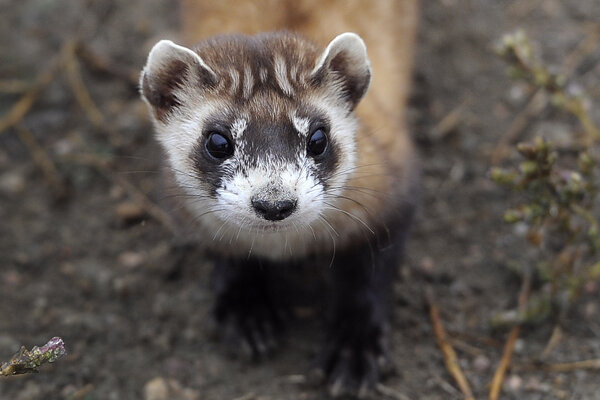
Photo: Kathryn Scott Osler/Denver Post via Getty Images
Black-footed ferrets are the most endangered mammal in North America. Scientists in Montana are trying to save the ferrets by saving their main food source, prairie dogs.

Never doubt the power of a research report written in elementary school. Maybe I would have become interested in conservation anyway (my mother headed up a local conservation group for years), but a report I wrote in 6th grade about the devastation to birds caused by fancy hats pre-WWI made me pay particular attention to birds. John, an environmentalist today, really got into the cause of endangered black-footed ferrets when he wrote a report on them in elementary school.

Although once-threatened birds like the snowy egret and the great egret have been saved, the black-footed ferret, alas, is still endangered. At National Public Radio, Nate Hegyi reports on how scientists are addressing the problem today.

“In central Montana, drones are dropping peanut butter pellets on prairie dog colonies. It’s part of an effort by biologists to save North America’s most endangered mammal — the black-footed ferret (or as the U.S. Fish and Wildlife Service calls it, the BFF).

“Prairie dogs make up the vast majority of a BFF’s diet. Save the food and you save the ferret, biologists wager. …

“Kristy Bly, a senior biologist with the World Wildlife Fund, [said] there are only about 300 black-footed ferrets left in the wild, and they depend almost entirely on prairie dogs to survive. And protecting the prairie dog population is beneficial to species beyond the ferrets.

” ‘Prairie dogs are Chicken McNuggets of the prairie, where so many species eat them,’ Bly said.

“But in recent years, prairie dog towns across the American West have been exposed to a deadly disease called sylvatic plague. While it’s treatable in humans, sylvatic plague can wipe out entire prairie dog towns in less than a month. And that means no more food for endangered black-footed ferrets.

“So Bly, [Fish and Wildlife biologist Randy Matchett] and a team of scientists and engineers have spent this year vaccinating prairie dogs in central Montana against the plague using drones.

“Drone pilots fly the machines across the prairie, dropping blueberry-sized pellets about every 30 feet. They are flavored to taste like peanut butter, and prairie dogs love peanut butter. The kicker is that they’re laced with a live vaccine that protects them from the plague. …

“By the end of [one] day, they hope to expose more than 4,000 prairie dogs to the vaccine. Past field trials have shown that prairie dogs living in vaccinated areas survive waves of the plague.

” ‘Without [the ferret], do we really have a complete ecosystem?’ Bly asked. ‘You start taking those pieces apart, it’s like a domino effect. When we have ferrets on the landscape the piece of the puzzle that is the American prairie all fits.’ ” More here.

I like the idea of using drones this way. Makes me wonder if the technique could be adapted to handle the overabundance of deer in areas suffering from tick-borne disease. Couldn’t a deer contraceptive in salt pellets be scattered by drones? Just asking.

Read Full Post »

Photo: eGuide Travel
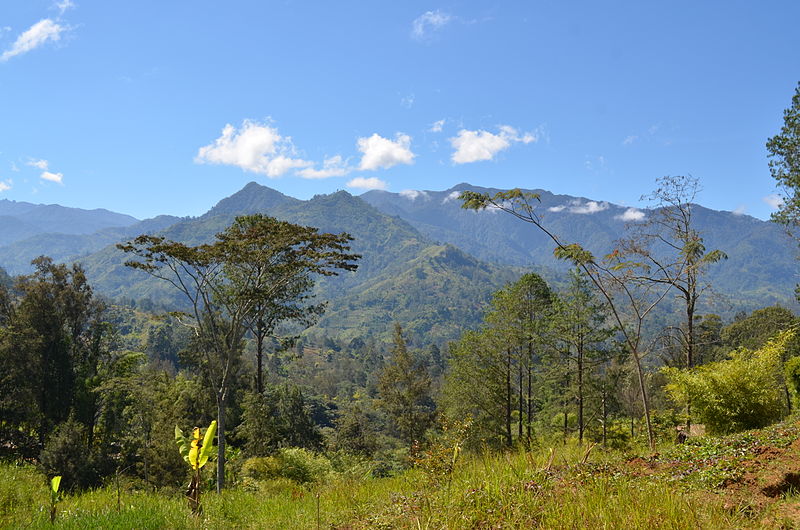
The highlands of Papua, New Guinea, are among the isolated places that linguists search for speakers of dying languages.

I’ve blogged before about linguists and others who are trying to preserve languages spoken by only a few people. The belief is that there is intrinsic value in such endangered languages and that they are key to understanding cultures. Recently I saw that one group is focusing on a particular manifestation of rare languages — their poems.

Fiona Macdonald writes at the BBC about the Endangered Poetry Project.

” ‘They fly to Port Moresby in Papua New Guinea and there they take a bus for three days and then they hike over a mountain and then they take a canoe and then they get to this little bay with 300 people,’ ” she reports, quoting Mandana Seyfeddinipur, head of the Endangered Languages Archive at London’s SOAS [School of Oriental and African Studies]. …

” They are ‘PhD students of 25 with a digital camera, a digital audio recorder and solar panels.’ …

“ ‘They live with the communities for months at a time, and develop social relationships, and talk to them and record them, and then they come back and they give me this SD card. … ‘The only record that we have of this language is in this tiny SD card.’ …

“The newly launched Endangered Poetry Project aims to tackle [language] loss at another level. ‘Languages are dying out at an astonishing rate: a language is being lost every two weeks,’ says the National Poetry Librarian Chris McCabe. ‘And each of those languages has a poetic tradition of some sort.’ …

“The project has issued a call-out to members of the public, asking for poems written in an endangered or vulnerable language. ‘In the first week, we’ve had over a dozen submissions in about 10 languages,’ says McCabe. ‘That includes poems in Breton, and poems in a dialect of Breton called Vannes. We’ve had a poem in Alsatian, and the Sardinian dialect Logudorese. We’re interested in these variations in language in different places as well, which can often be markedly different from the established language. …

” ‘You get a focus on place – in poems we’ve received from Sardinia, for example, there’s a focus on the mountain range there,’ says McCabe. ‘It shows you where people felt drawn to for inspiration in the landscape. Also, the style of a lot of Gaelic poems is very lyrical, and often uses repetition, a lot like a song. In that poetic tradition, you see how the division between poetry and music is quite slight – they often cross over between one and the other. The poetry tells us a lot about what kind of artistic experience people like, as well as what’s important in their geography.’ ”

Lots more here. Very interesting stuff.

Read Full Post »

Here’s a new one. Certain rats, with their renowned sense of smell, are being used in the fight against traffickers of endangered species.

The unusual rats had previously been tapped for tasks such as identifying who has tuberculosis and needs treatment. And as I noted a year ago, they have also been successful at sniffing out land mines.

Now, according to Oliver Milman the Guardian, “An elite group of African giant pouched rats will be used at ports, initially in Tanzania, to detect illegal shipments of pangolins – the world’s most trafficked animal, which has been pushed towards extinction due to the trade in its scales and skins …

“The US Fish & Wildlife Service is spending $100,000 on a pilot project that will train rats to detect the illegal items and learn to communicate this to their human handlers. The rats, which can grow up to 3ft long, have poor eyesight but an excellent sense of smell. …

“The Fish & Wildlife Service said it hoped that the foray into the investigation of wildlife smuggling would be the first stage of a ‘much larger project to mainstream rats as an innovative tool in combating illegal wildlife trade.’ …

“The money for rat training is part of a larger $1.2m package that will provide funding for law enforcement in Cambodia, forest patrols to reduce tiger poaching in Indonesia and sniffer dogs to unearth illegal shipments of saiga antelope horn.”

More here.

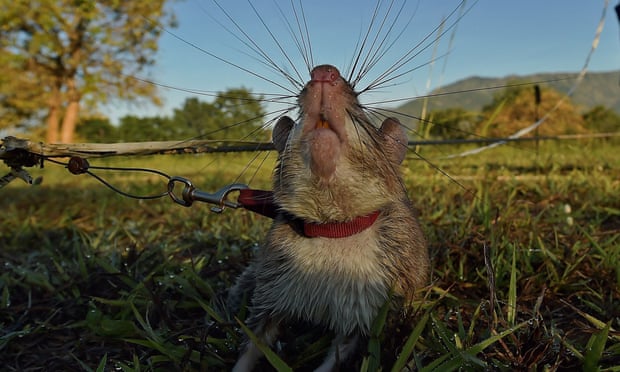
Photo: Carl de Souza/AFP/Getty Images
African giant pouched rats like the one seen here are being trained to investigate illegal wildlife trafficking.

Read Full Post »


Photo: We Believers

Here’s some good news from Elyse Wanshel at the Huffington Post. It seems that there is an alternative to the plastic six-pack rings that endanger sea turtles and other marine life when trash gets into the ocean.

Saltwater Brewery in Delray Beach, Florida, has created edible six-pack rings that feed, rather than kill, marine life if the rings end up in the ocean and an animal happens to eat it. The rings are created from beer by-products during the brewing process such as barley and wheat and are completely safe for humans and fish to eat. The rings are also 100 percent biodegradable and compostable, which just ups the product’s sustainability game. …

“The only drawback is that edible six-pack rings are more expensive to produce. But the company hopes that customers will be willing to pay a little more in order to help the environment and animal life. …

“The Ocean Conservancy’s 2015 Ocean Trash Index — which enlisted 561,895 volunteers to pick up 16,186,759 pounds of garbage — also offers a few staggering facts. It cites plastic as among the most common trash item ingested by sea turtles in 2015. Volunteers found 57 marine mammals, 440 fish and 22 sharks, skates and sting rays entangled in plastic. The index also explains that littering isn’t the sole culprit for plastic in the ocean. Plastic can also be blown by the wind from a trashcan or dump, end up in a storm drain and then travel through pipes into the ocean. Facts like these makes a concept like edible six-pack rings seem vital.

“ ‘We hope to influence the big guys,’ Chris Goves, Saltwater Brewery’s president, said. ‘And hopefully inspire them to get on board.’ ” More here.

If more breweries join up, the cost to create the rings would go down. Sounds like a worthy idea for a little consumer pressure.

Read Full Post »

Here’s a guy who didn’t just ring his hands when he learned that a magnificent butterfly species was endangered in his part of California; he decided to do something about it.

Zachary Crockett reports at Vox, “It begins its life as a tiny red egg, hatches into an enormous orange-speckled caterpillar, and then — after a gestation period of up to two years — emerges as an iridescent blue beauty. Brimming with oceanic tones, the creature’s wings are considered by collectors to be some of the most magnificent in North America.

“For centuries, the California pipevine swallowtail — or, Battus philenor hirsuta — called San Francisco home. As development increased in the early 20th century, the butterfly slowly began to disappear. Today it is a rare sight.

“But one man’s DIY efforts are starting to bring the butterfly back.”

Tim Wong, a 28-year-old aquatic biologist at the California Academy of Sciences, tells Crockett, ” ‘I first was inspired to raise butterflies when I was in elementary school … We raised painted lady butterflies in the classroom, and I was amazed at the complete metamorphosis from caterpillar to adult.’ …

“Years later, he learned about the pipevine swallowtail — which had become increasingly rare in San Francisco — and he made it his personal mission to bring the butterfly back.

“He researched the butterfly and learned that when in caterpillar form, it only feeds on one plant: the California pipevine (Aristolochia californica), an equivalently rare flora in the city.

” ‘Finally, I was able to find this plant in the San Francisco Botanical Garden [in Golden Gate Park],’ Wong says. ‘And they allowed me to take a few clippings of the plant.’

“Then in his own backyard, using self-taught techniques, he created a butterfly paradise.”

Read more here. It sure takes persistence.

Here’s hoping an elementary school project in 2016 will lead to the rescue of another endangered species down the road.

Photo: Tim Wong (@timtast1c)

Read Full Post »

Racing against the clock, the last fluent speaker of a Native American language records folktales and creates a dictionary.

Jia Tolentino writes at the website Jezebel, “Marie Wilcox, an octogenarian Native American woman from the San Joaquin Valley in California, was born on Thanksgiving in 1933; she grew up in a one-room house with the grandmother who delivered her and spoke her native Wukchumni …

“In this 10-minute mini-doc from the Global Oneness Project, via NYTLive, Marie talks about speaking primarily English to her children, who worked alongside her in the fields for a good part of the year. She started learning Wukchumni when her sister started speaking it again in an attempt to pass the endangered language on to each their kids.

“ ‘I was surprised she could remember all that,’ her daughter says. ‘She just started writing down her words on envelopes. … She’d sit up night after night typing on the computer, and she was never a computer person.’

“ ‘I’m just a pecker,’ says Marie. ‘I was slow.’

“She decided to make a dictionary. ‘Not for anyone else to learn — I just wanted to get it together.’ …

“According to a New York Times piece on this documentary from 2014:

Before European contact, as many as 50,000 Yokuts lived in the region, but those numbers have steadily diminished. Today, it is estimated that fewer than 200 Wukchumni remain.”

Watch the short film Marie’s Dictionary, by Emmanuel Vaughan-Lee, here. I found it moving.

Photo: Emmanuel Vaughan-Lee

Read Full Post »

Is the New England cottontail no longer in trouble? I guess, as David Abel suggests at the Boston Globe, it depends on who you talk to.

“The threatened New England cottontail — the region’s only native rabbit, made immortal in The Adventures of Peter Cottontail [by Thorton Burgess] — appears to be making a comeback.

“Federal wildlife officials [are] removing the cottontail from the list of candidates to be named an endangered species. It’s the first time any species in New England has been removed from the list as a result of conservation efforts. …

“Wildlife officials said the bark-colored rabbits, which have lost nearly 90 percent of their dwelling areas to development, are benefiting from an increasing effort to protect their habitat. …

“The rabbit, which has perky ears and a tail that looks like a puff of cotton, has been the victim of development that has wiped out most of the region’s young forests. … Unlike its abundant cousin, the Eastern cottontail, the New England species relies on the low-lying shrubs of young forests for food and protection from predators, such as raptors, owls, and foxes. …

“Some environmental advocates worry that the federal government may be acting prematurely in removing [New England cottontails] from the list of candidates for endangered status …

“It has never been easy to galvanize concern for the cottontails, given how much they look like the nonnative Eastern cottontails. Those rabbits, brought to the region by trappers in the 19th century, have flourished because they have better peripheral vision than the native bunnies …

“ ‘People think they’re everywhere,’ Scott Ruhren, director of conservation for the Audubon Society of Rhode Island, said of the local cottontails. ‘But like every species, they are important and deserve a place on the New England landscape.’ ” More here.

Update January 10, 2019: More good news at EcoRI, here. If zoos can do more this sort of wildlife restoration, they will go a long way toward justifying their existence to opponents.

Photo: Mark Lorenz for The Boston Globe
A New England cottontail bred in a refuge in Newington, N.H., was penned Thursday in advance of its release.

Read Full Post »

« Newer Posts - Older Posts »