Feeds:
Posts
Comments

Posts Tagged ‘film’

Photo: Ayen Deng Bior.
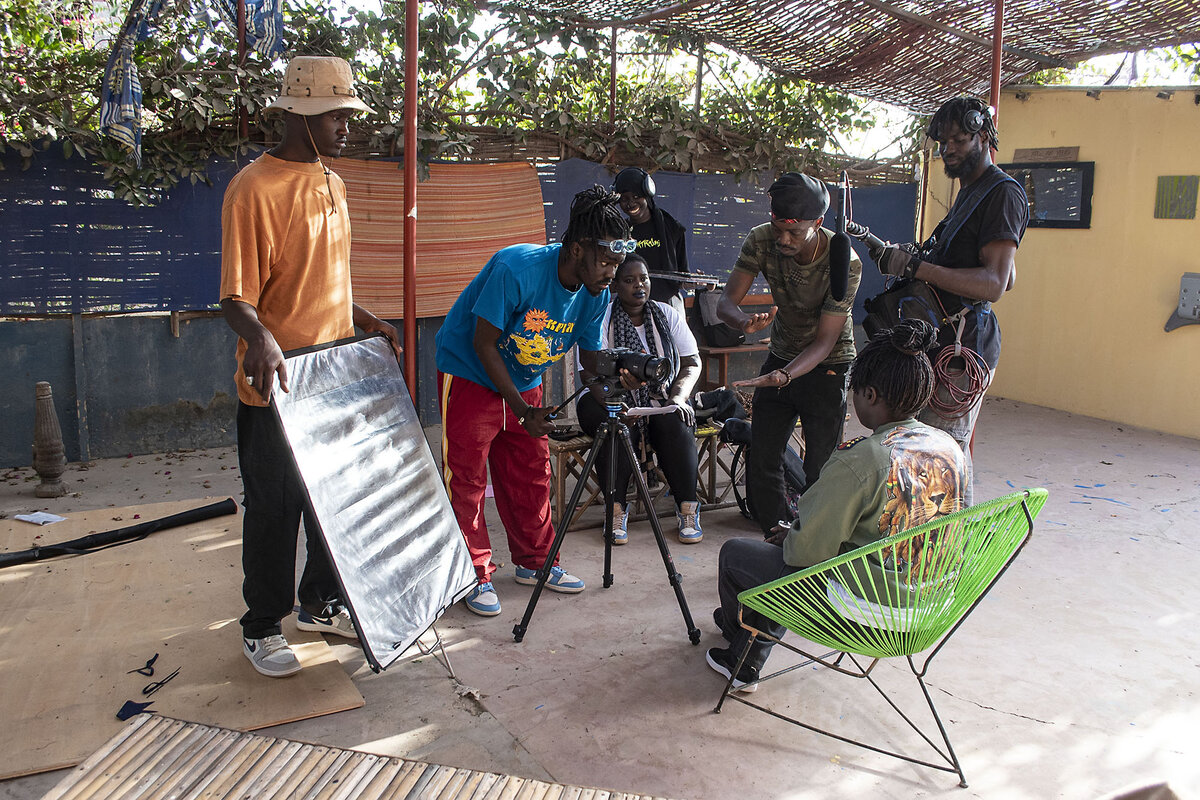
“Assistant director Pape Samba Tine (second from right) yells, ‘Action!’ on the set of a new Senegalese documentary about women’s lives,” the Christian Science Monitor reports.

For generations, films about Africa were written by non-Africans — in effect by the descendants of the colonizers. But over time, Africans have begun to tell their own stories in their own way.

Ayen Deng Bior, reporting from Senegal for the Christian Science Monitor, writes, “On a dusty Monday afternoon, the hallways of the Kourtrajmé film school buzz with nervous chatter and excitement. It is pitch day, and soon everyone files into a classroom to listen to the students present their screenplay ideas.

“The topics cover a wide sweep of Senegalese life, from the story of a 19th-century slave insurrection to a supernatural drama about a woman who can read people’s thoughts.

“When Leida Ndiaye’s turn comes, she is sweating. … But soon, she finds her rhythm, describing her idea for a rom-com about a woman in her early 30s who uses her job in human resources to ‘interview’ prospective dates to her birthday party. Ms. Ndiaye explains that she wants to provoke new conversations about dating and marriage.

“ ‘A lot of financially independent women are living the same situation here in Senegal,’ she says. ‘The tension between her professional life and her chaotic emotional life leads her to a deep introspection on her true desires and the nature of love.’

“Ms. Ndiaye and her classmates at Kourtrajmé are part of a new generation of Senegalese filmmakers who are setting out to tell their own stories on their own terms. With a film about Senegalese migrants, Io Capitano, up for best foreign film at the Oscars [2024], they know the world is eager to hear about their lives. 

“But Io Capitano’s success also highlights the challenges they face. The movie was made by Italian filmmakers, igniting conversation about what types of stories get told about Africa and by whom. 

“ ‘The Italian film is amazing, but it’s another story about migration,’ says Emma Sangaré, an American producer and screenwriter, and Kourtrajmé’s co-founder. For her students, she adds, there is so much more to say.

“Kourtrajmé’s popularity is a testament to hunger of young Africans to showcase a different kind of story. The school, which opened in 2022, gets hundreds of applications from all over the continent for about two dozen spots in its screenwriting and directing courses. Both six-month programs are fully funded.  

“The Dakar school is the third branch of Kourtrajmé, which French director Ladj Ly started in 2018 in a disadvantaged suburb of Paris in order to bring new and different voices into the film industry. Senegal’s Kourtrajmé was founded by Mr. Ly, Ms. Sangaré, and her husband, French Malian director Toumani Sangaré. …

“Last year, Banel & Adama, a magical realist romantic drama by French Senegalese director Ramata-Toulaye Sy, premiered to positive reviews at the Cannes film festival. But for many Senegalese filmmakers, a lack of resources and connections still makes the global film circuit hard to break into.

Io Capitano, for instance, had budget of more than $8 million. … But getting funding like that often means turning to American or European producers. In these situations, Ms. Sangaré says the power dynamic makes it hard for young Senegalese filmmakers to assert their authority about the kinds of stories they want to tell. …

“Mariama Niang is in director mode, supervising her team as it prepares to shoot an interview for her documentary, Elle, on a recent afternoon. …

“For Ms. Niang, an alumnus of Kourtrajmé who has wanted to be a filmmaker since she was a child, this moment has been a long time coming.

“ ‘Cinema is the world,’ she says. ‘In cinema, you can see everything. You can see one movie, and you see all your life in that movie.’

Elle, whose title means ‘she,’ follows five Senegalese women who have made names for themselves in their respective industries – from photography to financial consulting – while challenging the common narrative here that women are ‘just’ homemakers and childbearers. It’s a contentious topic that Ms. Niang has wanted to tackle for years, but she couldn’t figure out how to pay for it.

“Kourtrajmé changed that. The film school funded half the production, and Ms. Niang used the pitch skills she honed there to convince a private investor to pay for the rest.

“Back at Kourtrajmé, Ms. Ndiaye [says] ‘It’s better to tell our own story because if you don’t do it, people won’t know what exactly African people are living. … Westerners are doing it; they share their history; they share their culture. Why not us?’ ”

More at the Monitor, here. No paywall.

Read Full Post »

Photo: Adrian Susec/Unsplash.

Film buffs, it turns out, are not only creative about making movies, they’re creative about ways to screen movies. That’s because a different locale can lend a whole new feeling to the movie-going experience.

Bryn Stole writes at the New York Times, “Some of international cinema’s biggest names gathered on [a Tuesday in February] at the Berlin International Film Festival as the event honored Martin Scorsese with a lifetime achievement award. Before accepting his trophy, Scorsese listened as the German director Wim Wenders gave a laudatory speech to an audience including celebrities and local dignitaries.

“Just around the corner, parked in the middle of a busy thoroughfare, a group of Berlin’s taxi drivers crammed into the back of a worn-out taxi van to watch a double-feature capped by Scorsese’s 1976 movie Taxi Driver.

“Klaus Meier, who has been driving a cab in Berlin since 1985, handed out bottles of soda and beer, popping the caps with the blade of a pocketknife. Irene Jaxtheimer, who runs a taxi company, passed around homemade popcorn. A generator outside the cab powered a modest television, a DVD player and a small electric heater.

“The unconventional screening, just outside a centerpiece event for one of Europe’s most prestigious film festivals, was part of the makeshift TaxiFilmFest. Running through Sunday, it is partly a protest over the miserable state of the taxi industry these days and partly a counterfestival to celebrate the taxi cab’s iconic place in the urban cultural landscape.

“It’s also in objection to an exclusive partnership deal between the festival, known locally as the Berlinale, and the ride-hailing giant Uber to ferry filmmakers between the city’s movie theaters during the event. … Beeping horns from the busy street outside — some of them coming from sleek black Uber vehicles emblazoned with the Berlinale logo — blended with the street scenes from Taxi Driver playing on the tinny television speakers. ‘Ah, I really miss those mechanical fare boxes!’ Meier said as the fares ticked away in the onscreen cab of the movie’s unhinged antihero, Travis Bickle, who drives around mid-’70s New York with growing hatred and menace.

“The back-seat festival is showing only taxi-themed flicks, and the potential repertoire is deep. Meier polled friends and fellow taxi drivers about which films to show, and said he had received dozens of suggestions about movies in which a cab plays a starring role.

“The early feature on Tuesday was Barry Greenwald’s 1982 quirky slice-of-life documentary Taxi! about some odd characters driving cabs in Toronto. The previous evening, a small rotating crowd beat the rain to catch portions of the 1998 French action-comedy Taxi, a lighthearted flick from the director Gérard Pirès about sinister, Mercedes-driving German gangsters, hapless Marseilles cops and a lead-footed rookie cabdriver who turns out to be the only person fast enough to catch the criminals.

“An early hit at the TaxiFilmFestival, which kicked off last Thursday, was Under the Bombs, a Lebanese drama set during the 2006 conflict between Hezbollah and Israel. In the movie, a Beirut taxi driver is hired to drive a woman into the war-torn south of Lebanon in hopes of finding her sister and son. Meier described it as ‘Shakespearean’ and ‘a masterpiece,’ and Berndt said it was clearly the ‘most moving taxi film’ he’d ever seen.

“But the clear favorite among attendees was Jim Jarmusch’s Night on Earth, a quirky, episodic 1991 film about taxi drivers and passengers in five cities around the world. The selection for TaxiFilmFest’s Sunday night finale had yet to be chosen, and Meier said he remained open to suggestions. …

“The festival attendees, squeezed into the back of the van on Tuesday, also reminisced about better days for taxi driving, such as ferrying around American and British soldiers from the occupying Allies stationed in West Berlin. (The French troops, the small crowd agreed, had less cash and rarely hailed cabs.) …

“The days before the fall of the Berlin Wall were ‘blissful times, hard to even imagine anymore,’ said Stephan Berndt.” More at the Times, here.

See also my 2014 post about a theatrical production in a taxi in Iran, here.

By the way, I hated the movie Taxi Driver when I saw it around 1976 — and walked out. Still don’t get what’s to like. You?

Read Full Post »

Photo: ReelShort App/Crazy Maple Studio.
Want a short soap opera for Valentine’s Day?

Has there ever been a soap opera that wasn’t about romance? Even hospital dramas are mostly about jealousy and staff affairs. But given that typical plots take years to come to a resolution, entrepreneurial geniuses have popped up to meet a need.

Learn about the 60-second soap-opera episodes that are gaining a contemporary audience.

Claire Moses reports at the New York Times, “When Albee Zhang received an offer to produce cheesy short-form features made for phones last spring, she was skeptical, and so, she declined. But the offers kept coming. Finally, Ms. Zhang, who has been a producer for 12 years, realized it could be a profitable new way of storytelling and said yes.

“Since last summer, she has produced two short-form features and is working on four more for several apps that are creating cookie-cutter content aimed at women. Think: Lifetime movie cut up into TikTok videos. Think: soap opera, but for the short attention span of the internet age.

“The biggest player in this new genre is ReelShort, an app that offers melodramatic content in minute-long, vertically shot episodes and is hoping to bring a successful formula established abroad to the United States by hooking millions of people on its short-form content.

“ReelShort is owned by Crazy Maple Studio, a company in Northern California that is backed by the Beijing-based digital publisher COL Group.

“ReelShort’s titles include ‘The Double Life of My Billionaire Husband,’ ‘I Got Married Without You’ and ‘Bound by Vendetta: Sleeping With the Enemy.’ The shows are formulaic: The plotlines include romance and revenge, the characters are archetypical and the dialogues are simple.

“The extremely short genre became popular in the Asia-Pacific region during the pandemic, and Joey Jia, the chief executive of Crazy Maple Studio, took notice.

“ReelShort aims to get people hooked as quickly as possible, with much of the action happening in the first few super short episodes. ‘This is a pay-as-you-go model,’ Mr. Jia said. ‘If people are confused by the story, they leave.’

“The cost of making these features is relatively low, $300,000 or less, according to Crazy Maple Studios. The crews are small and partly made up of recent film graduates in Los Angeles, according to actors who worked on the productions.

“Viewers can watch dozens of minute-long episodes on ReelShort for free via multiple platforms, including YouTube and TikTok. But at some point, they must either pay or watch ads to unlock subsequent episodes. Sometimes people pay as much as $10 or $20 to keep watching, Ms. Zhang, the producer, said. …

“In the United States, ReelShort is trying to succeed where the short-form content company Quibi failed. … While Quibi focused on more highbrow content with A-list stars, ReelShort is doing the opposite: It’s giving people juicy plot points, from werewolves to evil step mothers to secret billionaire husbands to more werewolves.

“ ‘We learned a lot from Quibi,’ said Mr. Jia. … ‘To build a successful mobile app, you need to find out your core audience,’ he said. And that audience is women who love soap operas. …

“In total, more than seven million people downloaded ReelShort in the United States in 2023, on Apple and Android phones combined, according to data.ai. …

“Kasey Esser, a Los Angeles-based actor who has worked on short-form shows for ReelShort and other apps, described the format as this generation’s soap opera. He drew a comparison to channels with made-for-TV content, such as Hallmark.

“ ‘People know exactly the story they’re going to be getting, but they will still watch it,’ Mr. Esser, 34, said. ‘They will still love it.’

“For the actress Samantha Drews, ReelShort was a chance to play different types of characters. ‘I can say now that I’ve been cast in 15 to 16 features in the last few years,’ Ms. Drews, 25, said. ‘That’s not something every actor can say.’ “

More at the Times, here.

Read Full Post »

Photo: Aardman/Netflix.
A still from Chicken Run: Dawn of the Nugget. The Wallace and Gromit studio reassures fans over rumors of a clay “shortage.”

Here’s a kind of antidote to all the serious things one worries about these days. I myself am an Olympic worrier. For example, when Suzanne went to live in New York after college, I made a little notebook for her, starting with “Things to Worry About in New York City.” (I don’t think it infected her much.)

These days, I worry about the health of people I care about, the war in the Middle East, climate change, the increase in authoritarian governments, Covid, the meanness of our political divide, plastic in the ocean, homelessness, Bangladesh, Burma, Sudan, Ukraine, hungry children, income inequality. And when I don’t know what is going on or why something is happening in my own life, I revert to a childhood way of coping by making up scenarios that are usually off base. Like my scratchy eye means I’m going blind.

So I was delighted to see that there are silly things to worry about. Couldn’t they become a kind of self-inoculation? I guess they would still have to be regarding something you actually cared about. A nice example today is the worry that Wallace and Gromit claymation fans indulged in when they thought there might be a shortage of clay.

Andrew Pulver has the story at the Guardian, the “Wallace and Gromit studio, Aardman Animations, has reassured its fans, and the film industry at large, that production of its popular films will not be grinding to a halt any time soon, saying ‘there is absolutely no need to worry.’

“After reports that the manufacturers of Aardman’s favored modeling clay had gone out of business, meaning the animators had enough supplies for only one more film, Aardman issued a statement on social media saying: ‘We are touched about recent concern over the future of our beloved clay creations, but wanted to reassure fans that there is absolutely no need to worry.’ …

” ‘We have been tinkering away behind the scenes for quite some time with plans in place to ensure a smooth transition to new stocks to continue to make our iconic productions.’

“Aardman is shortly to release Chicken Run: Dawn of the Nugget, a sequel to its hit poultry comedy from 2000, while it is still in production on a new Wallace and Gromit feature, due for release in 2024.” More at the Guardian, here. No paywall.

That’s one worry that can be put to bed. … But wait! The Guardian goes on to say, “In 2005 Aardman lost much of its archive material in a warehouse fire in Bristol.” What? Oh, no!

Read Full Post »

Image: Cineteca di Bologna as part of Progetto Chaplin.  

We had one of the first televisions because my father was writing a story for Fortune on Dumont. It was a little black & white screen in a huge wooden box.

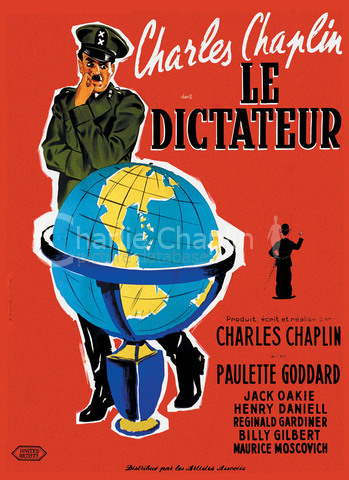
There really wasn’t much on in the beginning. We watched endless silent movies like Charlie Chaplin, and some with sound like The Tons of Fun, featuring big, heavyset guys, or Laurel & Hardy. The Lone Ranger was considered a huge advancement and even in black & white Disney was pure magic. Artist AndreÌ Dugo came over to watch what we were watching because he was writing Tom’s Magic TV.

But that was later.

Today I am remembering those hours of watching silent movies because the radio show the World tells me that silent movies are still being shown.

Theo Merz writes at the World, “On a recent Saturday evening, an audience ranging from teenagers to the retired, gathered at the film institute in Brussels, Belgium, to watch Isn’t Life Wonderful, a 1924 movie by the American director D.W. Griffith.

“It’s one of Griffith’s lesser-known works telling the story of a couple of Polish refugees who fall in love despite the hardships they face in Germany following World War I.

“ ‘We have an amazing collection of silent films in the Cinematek,’ said Christophe Piette, who chooses which films to screen. …

“The Cinematek — the only remaining cinema in the world with a regular schedule of silent films (along with live piano accompaniment) — is thriving.

“ ‘It is a museum, like, you could say; Paris has the Louvre Museum.’ …

“Piette said that around 80% of silent movies have been lost forever — at the time they were being made, the industry just wasn’t very interested in preserving its output. But Piette’s predecessors tasked themselves with collecting every single silent film that remained. Now, the cinematheque has about 10,000 such movies.

“ ‘[The Cinematek] really wanted to share it with the audience and with younger people who are used to younger films — to recent films — and to show them where cinema was coming from. It is our mission.’ …

“The silent film program has been going since the 1980s, and Piette said it’s as popular as ever. But he complained about a lack of funding from the Belgian government, especially given the program’s unique status and the broad audience it attracts.

“Lucas Vienne is 17 years old. He comes to the Cinematek most days and was in the audience for Isn’t Life Wonderful.

“ ‘I started to come here to see very popular movies, the Shining and stuff like that,’ he said. ‘But then, I started to check out films I’d never heard of.’

“Now, Vienne said that he doesn’t see much difference between silent films and more recent movies — for him, it’s all cinema. ‘I’m also interested in the history of cinema — so, coming back to silent film, it’s interesting to see how film evolved.’

“For the price of a ticket, audiences not only get to see a movie  — they also get a live concert.

“Hughes Marachel is one of a roster of pianists who accompany every single film. He’s 59 and has been working at the Cinematek part-time for more than three decades.

“Marachel is a professional performer and composer. But when he’s playing there, his main aim is to blend into the background.

“ ‘You are not to be the star,’ he said. ‘The star is the movie. The best compliment you can make to a silent movie pianist is: “Wow, I forgot you were there.” ‘

“Often, pianists are seeing the film for the first time, and everything they play is entirely improvised. ‘You just let the picture on the screen, the movie, impress you, and the impression comes in your body and in your fingers. And you play.’

‘Marachel said that interest in the screenings dipped when film on demand became widely available at home. Now, the movies are picking up again as audiences seek out something different. …

“ ‘For young people, it’s very interesting.’

“Many of the films he accompanies are a hundred years old — if not more. But the Cinematek hopes it’ll still be attracting an audience a hundred years into the future.

More at the World, here.

I looked for a bit more on Hughes Maréchal.

The website Screen Composers says, “Hughes Marachel composed more than 80 film original soundtracks, with inspiration reflecting his interest and passion for a large spectrum of music. His long experience as a silent movie pianist allows him to quickly adapt to and grasp a film’s rhythm and emotional intensity.

“He can also rely on his extended experience with multiple instruments and time as a studio musician.

“With a vivid interest in acoustic music, he enjoys the hypnotic power of atmospheric music, the lyricism and poetry that music can convey. Since the beginning of his career, Hughes has always viewed the job as a dialogue between the musician and the director (as well as the movie editor and sound engineer and designer) working together to serve the film. Music only has meaning if it brings an additional dimension to the visual one.”

Read Full Post »

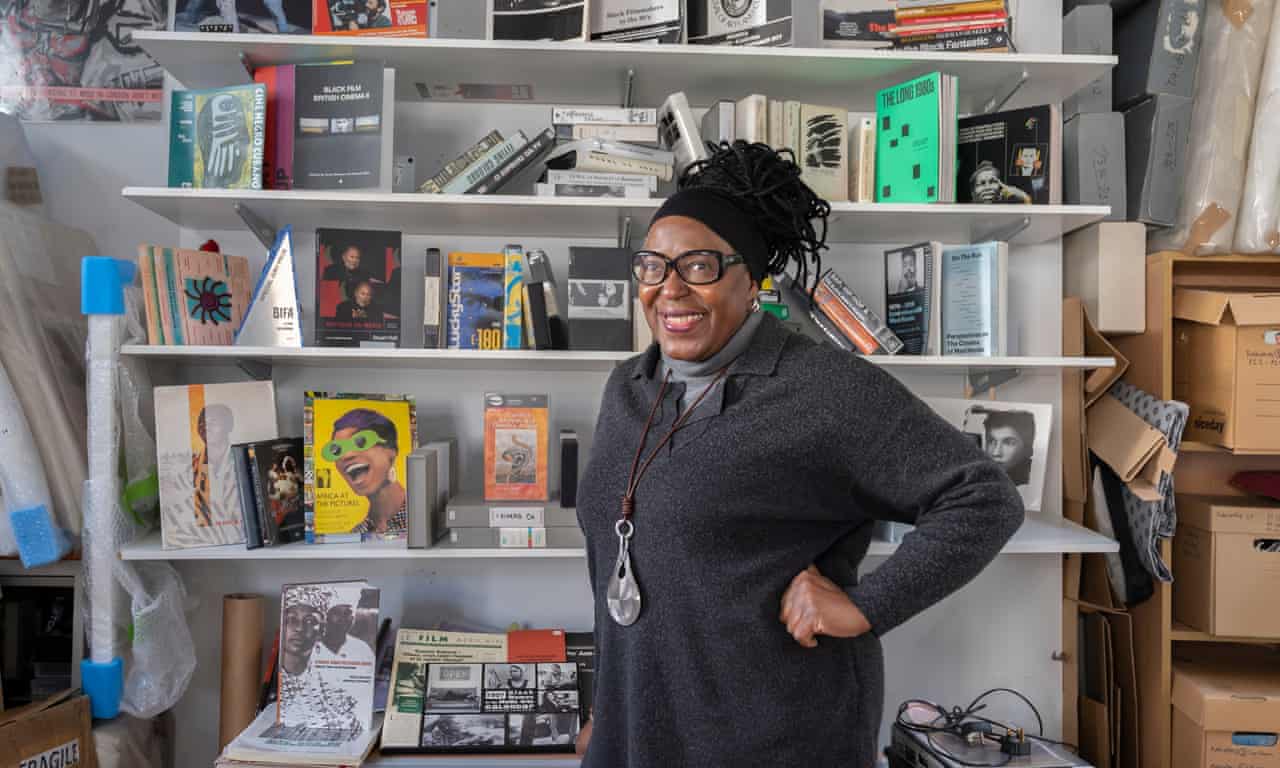
Photo: Amaal Said/JGPACA [June Givanni Pan African Cinema Archive].
From a Mogadishu film week
poster to VHS videos of pioneering art movies, June Givanni has collected a range of Black film artifacts and is now ready to share.

Sometimes people whose childhood struggles involve race-based discrimination grow up to embrace and trumpet the beauty of their heritage. I enjoy stories like that.

At the Guardian, Leila Latif interviews one such person, the founder of June Givanni Pan African Cinema Archive.

Discussing her recent exhibition, “PerAnkh: The June Givanni Pan African Cinema Archive,” Givanni played down the show’s title. Says Latif, “The Black British film curator, activist and archivist who created it is hesitant about positioning herself front and center.

“ ‘I don’t want it to sound like it’s all me, me, me,’ she worries. ‘My name is part of it because I worked as a curator for many years and collected work throughout the non-digital era, which developed into this archive.’

“Though she wants the films, documents, artworks and objects she has preserved to be the focus of people’s attention – from an installation of the earliest audiovisual works by the Black Audio Film Collective to new works by the Chimurenga collective from South Africa – Givanni is more than worthy of the spotlight. When she received the British independent film awards’ grand jury prize in 2021, the organizers said that she had ‘made an extraordinary, selfless and lifelong contribution to documenting a pivotal period of film history.’

Born in British Guiana 72 years ago, Givanni moved to the UK aged seven and was immediately underestimated.

“ ‘They put me with the five-year-olds because I was Black and I’d come from the Caribbean,’ she remembers. ‘My mum went to the school twice before they moved me up to my age range.’

“As an adult, Givanni collaborated with some of the most significant figures and institutions in pan-African cinema and across ‘different territories, different continents.’ She kept adding elements to her collection, she says, ‘because I needed to use them for subsequent programs and as part of building a body of knowledge and a whole series of resources that can be shared with others.’

“Lack of preservation has meant many of pan-African cinema’s masterworks have disappeared. In America alone, it is estimated more than 80% of Black films from the silent era are lost, and technological advances endanger film further. While physical film has a potential shelf life of hundreds of years, digital preservation requires constant migration to keep up with changing technology. …

“Givanni has faced changes in technology, politics and culture since she began in the early 80s. The first film festival she worked on was called Third Eye, inspired by the Latin American Third Cinema movement which set out to challenge Europe and North America’s dominance in film. For Givanni, the festival provided ‘an area to develop our own ideas about representation and taking charge. Pan-African cinema has always been a cinema of resistance. I can’t tell you how inspiring it was that there were all these people out there doing things that really chimed with what I thought should be happening.’ …

“She programmed festivals on five continents; worked for Greater London Council’s ethnic minorities unit and the Independent Television Commission; ran the BFI’s African Caribbean film unit and co-edited Black Film Bulletin, which relaunched in 2021 as a quarterly collaboration with Sight and Sound magazine, and has celebrated the under-sung work of film-makers. …

“The spirit of pan-Africanism was a guiding light, connecting all cultures that originated on the continent without treating them as a monolith. Givanni explains, ‘When I say pan-African, it’s not just the African continent; it’s the entire diaspora. All those significant histories are interconnected and cinema is very much part of that.’

“Choosing how to represent that history at Raven Row, with selections from an archive that now surpasses 10,000 items, was a gargantuan task. But Givanni immediately knew she wanted to include ‘a poster of the Mogadishu film week, given to me at my first attendance at the Fespaco film festival in 1985 by a Somali film-maker. Now people mention Somalia and they don’t picture these vibrant and strategic cultural events taking place there. …

“ ‘At the Havana film festival I bought a collection of silkscreen posters that will be exhibited. Lots of art can be seen digitally, but to see a silkscreen poster, the texture and the color of it – there’s an experience of culture and artifacts that goes beyond digital representation.’

“Beyond allowing the public to admire key objects from Givanni’s collection, the exhibition is structured around a program of films from the likes of Sarah Maldoror and Ousmane Sembène (the mother and father of African cinema). There is also an archive studio and reading room in the spirit of the exhibition’s title, PerAnkh – an Egyptian term for ‘a place of learning and memory.’ “

More at the Guardian, here. No firewall.

Read Full Post »

Photo: Dale Robinette/ Lionsgate Publicity.
Emma Stone and Ryan Gosling are not primarily dancers, but thanks to coaching, they did a good job dancing in the film La La Land.

Fred Astaire and Ginger Rogers were film stars who were best known for dancing. But what if your stars need to dance but know no more steps than the average partygoer? For stunts, you get stunt experts, but do you also get experienced dancers to stand in? Can’t imagine how that would work.

Haley Hilton has the answer at Dance Magazine, “From Patrick Swayze lifting Jennifer Grey above his head in Dirty Dancing, to John Travolta and Uma Thurman doing ‘The Twist’ in Pulp Fiction, to Emma Stone and Ryan Gosling tapping their way through ‘A Lovely Night’ in La La Land, dancing Hollywood A-listers have made simple steps iconic on the silver screen. Behind the movie magic and clever choreography is a hard-working choreographer, navigating the challenges unique to actors with varying levels of skills in dance. Leading industry choreographers Chloé Arnold, Marguerite Derricks and Mandy Moore [say] creating choreography for celebrities takes a different set of skills — and amount of time — than working with elite professional dancers.

“ ‘With dancers, you know they can do anything you come up with,’ says choreographer and tap dancer Chloé Arnold, who created the moves for Ryan Reynolds, Will Ferrell and Octavia Spencer for the 2022 holiday film Spirited. ‘Whereas with celebrities, you have to first build trust, then take the time to discover how their body naturally moves.’ Uncovering strengths is the first step: For example, certain actors­ might have an innate musicality. Once a choreographer is aware of that, they can highlight that strength while avoiding steps that magnify their weaknesses.

“Marguerite Derricks, who choreographed for the Amazon Prime series ‘The Marvelous Mrs. Maisel’ from 2016 to 2022, believes that adaptability is essential when choreographing for A-listers. ‘Once I have the script, I go into a studio with an assistant and put together movement ideas,’ she says. ‘Then I take those ideas to the actors, but I’m very ready to change up the moves. Right when I walk in, I tell them I have hundreds of ideas in my pocket, so if we try something that looks great and feels good we continue. If not, I will remove it and start playing with new ideas.’

“Derricks, whose movement has been featured in more than 50 films and 40 television shows, cultivates an open dialogue with performers and a low-stress environment in the studio. ‘It’s not about pushing a style or an idea on actors, but going in as their confidant and cheerleader, and making them feel comfortable,’ she says. ‘When they see my patience, they are more patient with themselves.’

“When La La Land choreographer Mandy Moore works with celebrities, she makes sure that she will have ample time to teach them to dance. ‘On set, things can change and shift, and if the actor understands the basics of movement and weight changes, as well as the choreography, they will be able to make changes without melting down.’ She, too, enters the rehearsal space with an open mind. ‘I am someone who preps everything to a T, knowing it could all change the first second I get into rehearsal,’ she says. …

“Having an A-lister on a project will bring attention to the work, but for these three choreographers, the benefits extend far beyond that. ‘What actors bring to the choreography is so rich — they totally embody the character,’ Derricks says. ‘I get so excited because I know that in some ways, they will take my movement deeper than even dancers can.’ That’s why Derricks encourages dancers to take acting classes. ‘You can kick and spin and pas de bourrée, but the magic is how you put it all together in a story. Acting brings greater depth to your dancing.’

“The Spirited celebrities shared their genuine enthusiasm for tap with their massive fan base—as well as their appreciation for the dancers on set. … ‘Everyone was so kind, and there were no big egos,’ [Arnold] says. ‘If one of the actors grasped something and the other didn’t, they would respond with comedy. If the steps didn’t work out and needed to be changed, they were trusting. They could have challenged me or pushed back, but there were no excuses.’ …

“ ‘So much of choreography is reading the room,’ Derricks says. ‘When working with actors for the first time, I want them to know that I am here for them. I’m not here to win an award. I will do whatever I can to help make them comfortable and confident for the scene.’

“Building that confidence is no easy task. Moore says she’s found many actors have been told they’re not good dancers, leading to insecurities. ‘It’s time-consuming, but you need to help them believe in themselves,’ she says. ‘It’s almost like therapy — you don’t want to feed into their complex. You want them to leave you loving dance.’ One of the ways Moore fosters confidence in the rehearsal studio is by not having mirrors on the walls. ‘I don’t want them to get critical of how they look,’ she says. She also holds off on filming portions of rehearsal until the dancers are ready.

“Navigating difficult personalities is another potential challenge. When casting dancers, choreographers can choose who to work with, but when they are part of a larger work with celebrities, they don’t have that luxury. Arnold does all she can to change the energy in the room. ‘If you are seeing negative things, introduce alternatives,’ she says. ‘Dress for the betterment of the space. Sometimes I will come in wearing a message T-shirt that says something uplifting. Be kind, lead by example and make sure the rest of the cast feel supported by you.’ ”

More at Dance, here. No firewall. Nice pictures from movies.

Read Full Post »

Photo: Sarah Rose Sharp/Hyperallergic.
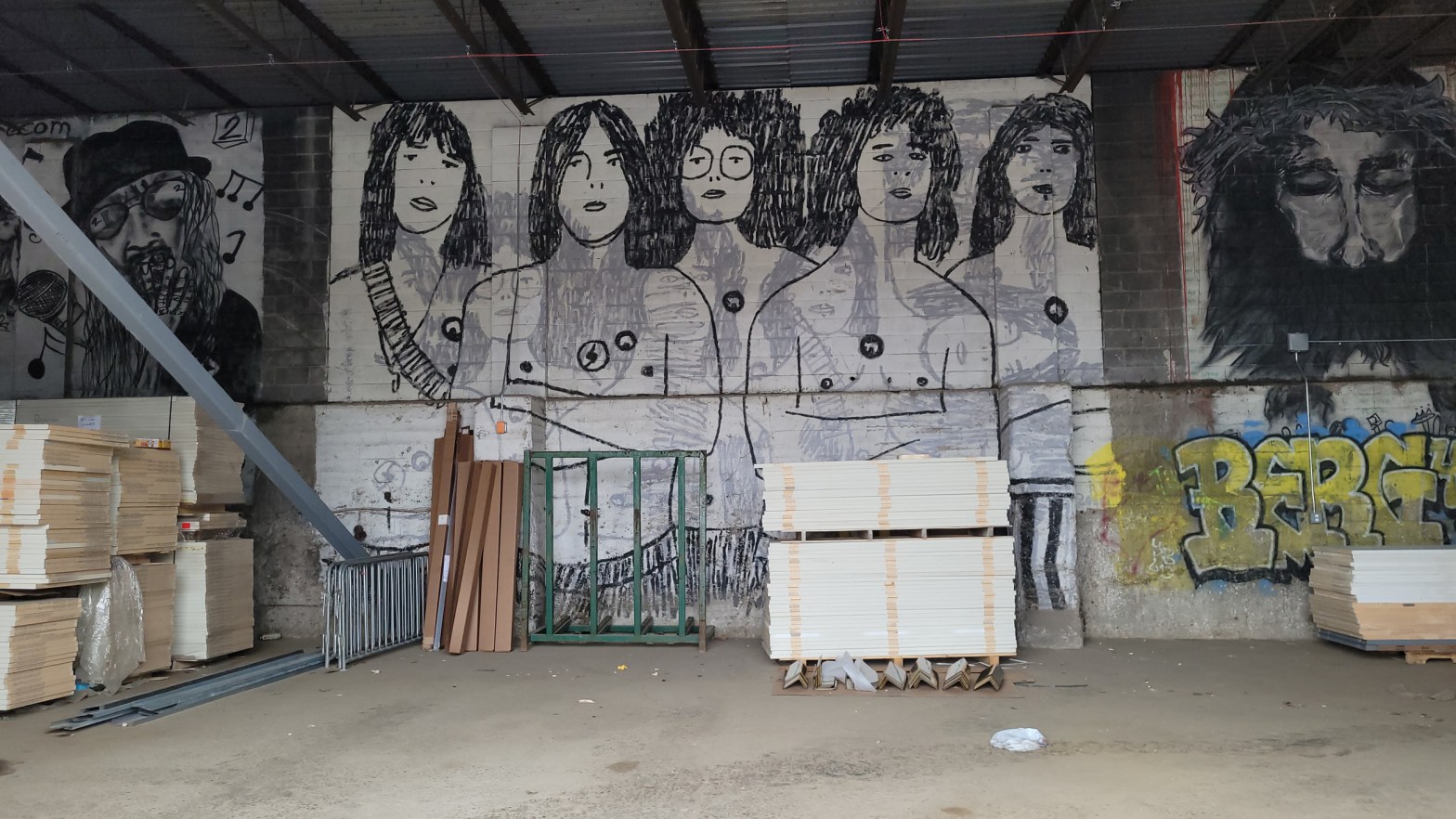
The only public mural commemorating iconic Detroit band MC5 remains intact, as housing for artists is built around it.

When you base housing development on what people can pay to live there, good things may happen. If only the development of the artist community in Fort Point, Boston, had been based on that principle! City planners of the past and their favored developers have pretty much ruined Fort Point — and all of Seaport — and set the area up for drowning in a future hurricane.

Sarah Rose Sharp opines at Hyperallergic, “Artists are fundamentally problem solvers. They are generally understood to be solving problems of a personal-expressive nature, or perhaps ones related to community, and occasionally political or environmental problems. They are not often considered the front line for solving, say, problems of city infrastructure. But maybe they should be.

“[Ten years ago] if you’d asked Oren Goldenberg what he does, he might have said ‘filmmaker’ or ‘producer,’ or he might have narrowed his eyes and asked: ‘Who wants to know?’ These days, however, the answer is a little more complicated. At some point in the last decade, Goldenberg stopped making films as a document, and stepped through the frame to build the world-as-document. … Our School (2005-2009) is a feature-length documentary that seeks to reveal the experience of going to high school for one day, from dawn to nightfall, in his home city of Detroit.

“ ‘When I was doing Our School, I’m like, should I just go be a teacher? What’s going to really help with the education crisis? It’s gonna be a teacher, right?’ said Goldenberg during a walking interview with Hyperallergic across the site of his latest undertaking. Ten years ago, the grounds we are walking on would have been identified by in-the-know Detroiters as Recycle Here!, a community-grown waste management center piloted by Matthew Naimi in a city that had famously suspended trash pick-up for decades, to say nothing of recycling. A lot has changed in ten years, and for the last seven, Goldenberg has been right at the heart of it.

“Nowadays, Recycle Here! is a recognized part of city infrastructure, but the facilities that surround it have undergone a startling transformation. In place of the crumbling outbuilding that once belonged to the former Lincoln automotive factory (still indicated by the adjoining Lincoln Street and its eponymous art park, also developed by Naimi and his associates), a new complex is emerging. Once a free space and favorite haunt of street artists, that has tragically claimed at least one life, the complex is on the home stretch of work that has stabilized the structure and secured facilities. The project is expected to launch this year with communal gathering spaces, a fresh venue for longtime neighbor Marble Bar, and 81 live-work units calibrated to hold the community that occupied the former structure.

“ ‘In doing this project, I’ve learned that our presumptions around development and construction are just wrong,’ said Goldenberg. ‘When you think of high-end developments, they create a projection of who can we attract, as opposed to who is here, because they need something that could pay the cost to renovate a historic building. …

“ ‘You have to create different models of verification,’ Goldenberg continued.

‘When we first started getting money here, people asked: Why is your commercial rent so low? I replied: “Well, it’s for Recycle Here! They’re already here, this is all they can pay.” ‘

“This isn’t the first time Goldenberg has taken an interest in housing. Brewster Douglass, You’re My Brother (shot 2010-11, released 2012) is a documentary about the first public housing for low-income Americans, erected in Detroit. …

“In another past project, Goldenberg once more explored community-building in a historic space. Though he created the video Make it History: the Downtown Synagogue, Goldenberg’s more notable legacy with the organization is arguably the series of after-dark House music dance parties, which sought to bring in new energy and a wave of younger constituents to the Isaac Agree Downtown Synagogue, built in 1921 and currently the last remaining free-standing synagogue in Detroit. …

“ ‘I think a lot of directors consider films holy, and worth more than the humans who make them,’ said Goldenberg. ‘I push very hard against that. I just don’t think it’s true. No one should die making your movie, no one should be exhausted. [This new movie] is different. People are going to live here.’

“In Detroit, the shattering of infrastructure, regulation, and ownership opened a window, one that is now rapidly closing as entrepreneurial forces have seized upon the city as a development opportunity. But for a minute, and maybe even a minute longer, there are so many problems that artists have been able to get their hands on and start to solve in the way that artists do: A way that places a completely different valuation on what community means, what a recycling center means, what a building means. Filmmakers and producers already know how to imagine a world into being, through the sheer power of belief. Goldenberg is showing what happens when that belief becomes a home that others can occupy.”

More at Hyperallergic, here. No firewall. Subscriptions encouraged.

Read Full Post »

Photo: Everett Collection.
A scene from the French film Jeanne Dielman, voted best of all time at Sight & Sound magazine recently. It’s the first time the best-film honor has come to a female director, Chantal Ackerman.

Do you follow “best of” lists? I find them interesting, and I especially like seeing how judgments change over the years. Today’s story is about voting for the best film of all time. I’ve seen hardly anything on the list, but what caught my attention is that the film that has moved to the top was made by a woman. A first for the poll.

Alex Ritman writes at the Hollywood Reporter, “Almost 50 years after its release, Jeanne Dielman, 23 quai du Commerce, 1080 Bruxelles — Chantal Akerman’s groundbreaking 1975 drama following the meticulous daily routine of a middle-aged widow over the course of three days — has become the first film by a female director to top Sight & Sound magazine’s once-a-decade ‘Best Films of All Time’ poll in 70 years.

“More than 1,600 film critics, academics, distributors, writers, curators, archivists and programmers voted in the poll, which the BFI-backed [British Film Institute] publication has been running since 1952, with the results, announced Thursday, seeing Akerman’s feature — which was heralded by Le Monde in January 1976 as ‘the first masterpiece of the feminine in the history of the cinema’ — leapfrog from 36th position in 2022 to No. 1.

“The 2012 winner, Alfred Hitchcock’s Vertigo, now sits in second place, with Orson Welles’s Citizen Kane (which held the No. 1 spot for 50 years) placed third and Yasujirō Ozu’s Tokyo Story fourth. Three more films are new to the top 10, including Wong Kar Wai’s In The Mood for Love in fifth place (up from 24th in 2012), Claire Denis’ Beau travail at number seven (up from 78th) and David Lynch’s Mulholland Dr. in eighth place (up from 28th). Only four new films released since 2012 managed to break into the top 100 of the poll. …

“ ‘Jeanne Dielman challenged the status quo when it was released in 1975 and continues to do so today. It’s a landmark feminist film, and its position at the top of list is emblematic of better representation in the top 100 for women filmmakers,’ said Mike Williams, Sight and Sound editor. ‘While it’s great to see previous winners Vertigo and Citizen Kane complete the top three, Jeanne Dielman’s success reminds us that there is a world of under-seen and under-appreciated gems out there to be discovered, and that the importance of repertory cinemas and home entertainment distributors cannot be overestimated in their continued spotlighting of films that demand to be seen. What currently undervalued masterpieces might emerge in 10 years thanks to this tireless work?’

“Added BFI executive director of public programs and audiences Jason Wood: ‘As well as being a compelling list, one of the most important elements is that it shakes a fist at the established order. Canons should be challenged and interrogated and as part of the BFI’s remit to not only revisit film history but to also reframe it, it’s so satisfying to see a list that feels quite radical in its sense of diversity and inclusion.’

“See the top 20 greatest films of all time, according to Sight & Sound‘s 2022 poll, below

1       Jeanne Dielman, 23, quai du Commerce, 1080 Bruxelles (Chantal Akerman, 1975)

2       Vertigo (Alfred Hitchcock, 1959)

3       Citizen Kane (Orson Welles, 1941)

4       Tokyo Story (Ozu Yasujiro, 1953)

5       In the Mood for Love (Wong Kar Wai, 2001)

6       2001: A Space Odyssey (Stanley Kubrick, 1968)

7       Beau travail (Claire Denis, 1998)

8       Mulholland Dr. (David Lynch, 2001)

9       Man with a Movie Camera (Dziga Vertov,1929)

10     Singin’ in the Rain (Stanley Donen & Gene Kelly, 1951)

11     Sunrise: A Song of Two Humans (F.W. Murnau, 1927)

12     The Godfather (Francis Ford Coppola, 1972)

13     La Règle du jeu (Jean Renoir, 1939)

14     Cléo from 5 to 7 (Agnès Varda, 1962)

15     The Searchers (John Ford, 1956) 

16     Meshes of the Afternoon (Maya Deren & Alexander Hammid, 1943)

17     Close-Up (Abbas Kiarostami, 1989)

18     Persona (Ingmar Bergman, 1966)

19     Apocalypse Now (Francis Ford Coppola, 1979)

20     Seven Samurai (Akira Kurosawa, 1954) 

More at the Hollywood Reporter, here, and at the Boston Globe, here. I imagine that the reason several movies jumped higher up the list is that voters who had never heard of them found them and watched.

I am going to research a few and order them through our retro Netflix DVD service. Jeanne Dielman might be a bit dark for me. At least from what I’ve read about it. The selections I’ve already seen are the kinds I like: Vertigo, Citizen Kane, 2001. (How funny to think the the year 2001 is futuristic. Kubrick, you have no idea!)

Do you have any recommendations?

Read Full Post »

Photo: Kerry Jones.
Artist Kerry Jones turned her old trailer into one of the smallest cinemas in the UK.

Today we have another idea on taking what you have and turning it into something that can delight others.

“Until fairly recently,” writes the BBC, “Kerry Jones’s caravan lay rotting and forgotten about in her garden in Galashiels in the Scottish Borders — a home for discarded bric-a-brac.

“But during the Covid-19 lockdown, the artist and filmmaker saw new potential in the 1980s Swift Pirouette, and resolved to turn it into a tiny, traveling cinema. With a maximum of eight seats, it could be one of the smallest cinemas in the UK.

” ‘It isn’t the first cinema caravan to exist,’ said Kerry. ‘There was one over in Dumfries and Galloway that a friend of mine made at the beginning of the 2000s, that was really inspiring. I’m really interested in projects that involve people out in your community.’ …

“Over the pandemic, Kerry secured a bursary [grant] from the Alchemy Film and Arts charity based in nearby Hawick as part of a local arts program running between July 2021 and December 2023. She used it to renovate the caravan inside and out, swapping the retro mint paneling for a bright red that could be seen for miles. … Inside, she plans to install between six and eight seats, again in a plush, cinematic red fabric.

“Speaking to Mornings with Stephen Jardine, she said: ‘[I’ve] had it for 12 years — it’s been out and about, it’s been used for people to stay, it’s been a spare room. But over the last few years, but it’s just been one of those spaces that you put things in and forget about.’

“Kerry’s caravan cinema project — named Moving Images — [made] its debut at Hawick’s Alchemy Film Festival on 28 April, screening nine short films all made by people in the south of Scotland.

“It comes at a time when Scotland has lost one of its smallest cinemas — the Schoolhouse Cinema in Shetland. This 20-seat cinema, run by local magician Chris Harris, was put up for auction in 2020 after he decided to leave the islands.

“Around the same time another tiny theater opened in the Highland village of Cromarty — a 35-seat facility that took two years to come to fruition.

“Kerry aims to cater for an even more intimate experience, and will be using a small portable projector to save on power without sacrificing picture quality.

“The caravan itself is solar powered, but Kerry said she will borrow a high-quality battery as back-up until she can crowdfund her own.

“Any spare cash will then be put towards taking the caravan on the road — possibly for a tour of free screenings and running filmmaking workshops at local primary schools.

“Kerry added: ‘It’s going to be really adaptable. Selkirk’s market square have said they’d be quite interested in having the caravan there. I’d love to take it out to some of the more rural areas like Duns and Gordon.

” ‘We’re also going to work with a group called Connecting Threads and they’re doing lots of projects along the Tweed [river] — I’d love to see it there, that would be quite magical.’ “

There’s more to read at the artist’s website. “As part of The Teviot, the Flag and the Rich, Rich Soil, our programme exploring the pasts, presents and futures of Hawick and the Scottish Borders and investigating the town and wider region’s cultural identities in relation to land, water, industry, territory, place and environment, Alchemy is offering a number of bursaries to Borders-based artists. These bursaries will support a range of community-oriented projects between July 2021 and December 2023.”

More at the BBC, here, and Jones’s website, Alchemy Film and Arts, here.

Read Full Post »

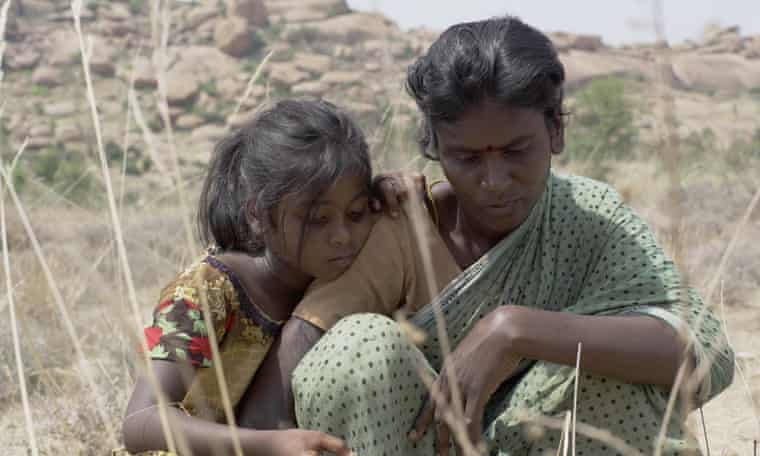
Photo: Pebbles.
India’s entry for the Oscars,
Pebbles, focuses on the inequalities that life inflicts on women in Tamil Nadu.

This year’s Oscars are scheduled March 27, and although I haven’t stayed up to watch the whole awards ceremony for years, I like reading about the winners later. I especially like getting ideas for foreign films my husband and I might eventually be able to order from our retro Netflix DVD service.

Hannah Ellis-Petersen, South Asia correspondent for the Guardian, describes one film that looks promising. The story of grinding poverty might be too painful for some potential viewers if they didn’t know that the director himself had lived that life and risen to be a filmmaker.

“As a child laborer working in the flower markets of Madurai, there was nothing more exciting for PS Vinothraj than when the film crews would descend. He would put down his sacks of petals and look up in awe at the camera operators who sat atop cranes to get dramatic sweeping shots. It was, to his nine-year-old mind, intoxicating. ‘I knew that’s what I wanted to do with my life,’ he said. …

“The odds were stacked heavily against him. Vinothraj was born into a poverty-stricken family of daily wage laborers in Tamil Nadu. He left school, aged nine, to support his family after his father died and by 14 was working in the sweatshops of Tiruppur.

“This month, his debut film Pebbles [Koozhangal] a Tamil-language movie made on a shoestring budget and set in the arid landscape where he grew up, was unanimously selected as India’s entry to the Oscars. In February this year, it had won the Tiger award for best film at the 50th International Film Festival Rotterdam. In a New Yorker review, Vinothraj was described as an ‘extraordinary observational filmmaker’ whose film presents ‘a gendered vision of rage.’

Pebbles is, as Vinothraj describes it, a ‘snapshot of a life.’ It depicts the journey of an abusive, alcoholic father and his son as they walk back home through the barren, overwhelmingly hot landscape of rural Tamil Nadu, after the father has dragged the boy out of school and taken him to a village where he wants to force his estranged wife to return home.

“It was inspired by true events; as Vinothraj says, ‘the story chose me.’ When his sister married a man from a neighboring village, the family were unable to provide a dowry. In a humiliating march, his sister was sent back to the family home by her new husband through the parched landscape. It was this walk of shame, that so many women are still forced to endure, that Vinothraj wanted to capture.

“ ‘But I wanted to make it so it was the husband who had to make the walk, not the woman,’ he said. ‘It was my small way of taking revenge for this humiliation of my sister.’

He also chose to portray the journey through the eye of a child, the son, to inject ‘hope and humanity’ into their journey.

“The film focuses on the small but devastating tragedies and inequalities that life in rural Tamil Nadu inflicts on women. … Women forced to get off buses in blazing heat when their babies, awoken by men aggressively coming to blows, need to be breast fed. Women forced to patiently scoop water from the ground and into jars as the merciless sun beats down.

“Tamil Nadu’s oppressive environment is omnipresent in Pebbles. ‘The landscape is the third main character in the film,’ Vinothraj said. ‘I wanted to explore it in detail, the role it plays in the plight of the people.’ For authenticity, he filmed during the hottest days of the year in May. Temperatures got so high during the 27-day shoot that cameras began to malfunction.

“Vinothraj’s determination to make films never wavered. While working in garment factories at 14, he enrolled into college between 6am and 10am before back-to-back shifts, realizing he would need education to go into cinema.

“Small things would bring glimmers of joy. In Pebbles a girl, whose family are depicted in such abject poverty that they hunt for rats to eat, is pictured momentarily euphoric as she collects helicopter seeds in her dress and then scatters them into the air. ‘This was how I used to feel when I was a child,’ said Vinothraj. ‘The conditions of my life were bad, but I could still find moments to be happy. I did not feel like I was suffering because I did not know anything else.’

“At 19, after his bosses tried to marry him off – a tactic used to keep child laborers working in factories once they grow up – he decided it was time to leave. He had heard that Chennai, the bustling main metropolis of Tamil Nadu, was where films were made and movie people mingled.

“ ‘I had no idea how I would survive; my only thought was that I had to pursue my passion for cinema,’ he said. On arriving in Chennai he slept in the streets until he convinced a DVD shop to hire him.

“ ‘In the DVD shop, I used to watch three films a day,’ he said. “English films, Korean films, Japanese films, Latin American films.’ … The DVD shop also gave Vinothraj access to film directors, who would borrow or buy films, often on his recommendation. After almost three years, he was hired as an assistant on a short film and began to work his way up. …

“The success of the film has left Vinothraj in a state of disbelief. He thought its only audience would be the villagers whose lives inspired the story.” More at the Guardian, here.

Click here to see 10 other foreign films submitted for this year. Several look like my cup of tea, maybe yours, too.

Read Full Post »

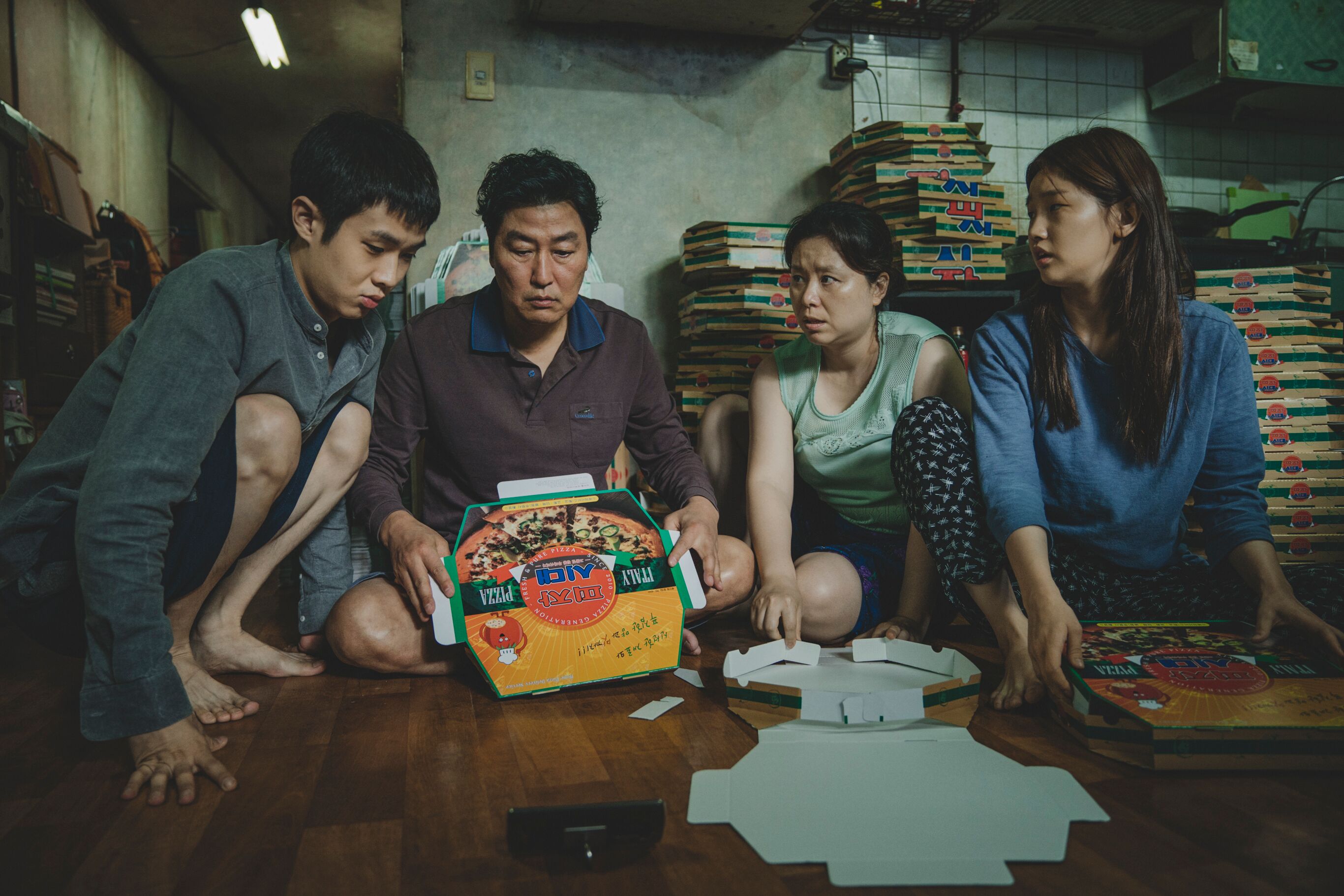
Photo: Cinetic.
From the award-winning Korean film Parasite.

Movies can raise consciousness and lead to change, often positive change. Although the wonderful flic we watched last night, The Loins of Punjab, was mostly for laughs, I think some people would take away a heightened awareness of prejudice, and what it can be like to live in a society where too many people see a terrorist behind every brown skin.

Today’s post is about a hopeful side effect of the award-winning Korean movie Parasite, which led the government to look into the plethora of barely habitable basement apartments dividing the country’s haves and have-nots — and begin to make a plan.

As Monica Castillo wrote at Hyperallergic in February 2020, “Weeks after Bong Joon-ho’s historic win at the Oscars, his film Parasite is still making headlines. … Parasite may now pave the way for housing reform in South Korea.

“The country’s government announced it would launch an initiative to help families like the movie’s working-class Kims to improve housing conditions. The Korea Herald reports that the South Korean government, Korea Energy Foundation, and the Seoul Metropolitan Government will offer ‘3.2 million won per household to enhance heating systems, replace floors, and install air conditioners, dehumidifiers, ventilators, windows, and fire alarms’ to 1,500 families in semi-basement apartments who make less than 60 percent of the median income. …

“In Parasite, the Kims live in a cramped, dingy semi-basement apartment that becomes easily flooded when heavy rains fall. They envy the wealthier Park family that lives in an elevated area with a spacious modern mansion, and hatch a plan to get each member of the Kim family in the employment of the Parks. …

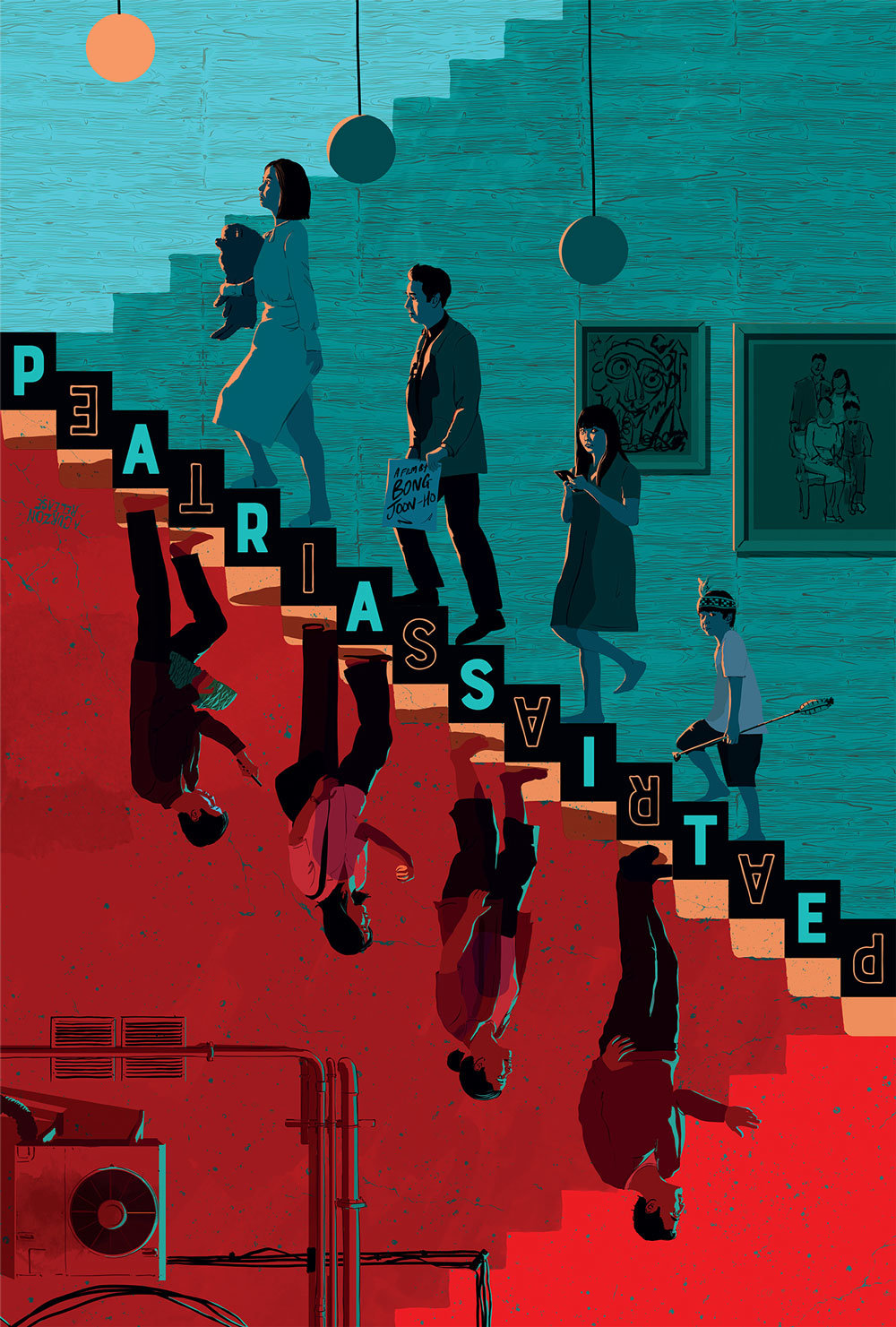
“The film’s clear class distinction between the haves and the have nots also inspired many designers. In a look at the fan art and advertising inspired by the movie, Mubi found several instances where artists visually interpreted the movie’s theme on class through metaphors. Parasite’s attention to architecture featured in a number of the pieces, as several artists incorporated both Park and Kim family homes into their designs. The works ranged from digital illustrations both intricate and deceptively simple to photographic composites reimagining the movie’s many twists and turns. 

“Even in the official movie poster, there are hints of a difference between the two families, as the post points out that the Kims have black censor bars over their eyes and the richer Parks have white censor bars. For the French release not long after its Cannes premiere, the Parasite poster featured the Kim family barefoot and the Parks in shoes, a nod to their well-heeled background.”

More at Hyperallergic, here.

At Mubu, you can check out posters the movie inspired and the emphasis on inequality. What an array! Adrian Curry wrote, “All great works of art inspire more great art and Parasite has been a gloriously fecund host for poster designers to feed off, inspiring ingenious commercial campaigns and fan art alike. The original Korean poster — the first glimpse any of us got of this soon-to-be sensation back [in April 2019] — was designed by Kim Sang-man, a film director (Midnight FM), art director (Joint Security Area), and composer. …

“Its placid yet ominous domestic scene, rendered undeniably creepy by the censor bars across the protagonists’ eyes … featured half the major players (not least that boxy, modernist home, the ultimate star of the film) and a number of significant objects (the teepee, that ornamental rock, those legs…) without giving much of the game away. One thing I didn’t register until quite recently is how the bars across the eyes are color-coded by family: black for the Kims, white for the Parks.”

I didn’t see Parasite. Did you? Did you think it made a case for affordable housing? A case against inequality?

Read Full Post »

Photo: Kino Lorber.
The film The Village Detective: A Song Cycle, directed by Bill Morrison, is a project that got started after an Icelandic fisherman pulled up an old Soviet movie from the depths.

Remember this post on repurposing 1980s photos of New Orleans street life damaged by Hurricane Katrina in 2005? Today’s story on waterlogged 35mm film found by a fisherman reminds me that creative people keep discovering ways of working with damaged art to convey deeper messages. It’s as if the lost island of Atlantis wants to break through to our modern world.

Dan Schindel reports at Hyperallergic, “In 2016, a fisherman dredged up a case off the coast of Iceland that contained four reels of decades-old 35mm film. It looked like the beginning of an inspirational story about a precious movie rediscovery. But, anti-climactically, he’d merely found pieces of the 1968 Soviet mystery-comedy Derevenskiy Detektiv (‘Village Detective’) — which was, as filmmaker and historian Bill Morrison puts it, ‘not lost, rare, or even, to my mind … particularly good.’

“But such an unusual event still deserved scrutiny. What circumstances led this particular film to this completely unexpected place? Morrison’s investigation resulted in his new film The Village Detective: A Song Cycle.

“Morrison constructs his films — such as Decasia (2002) and The Great Flood (2013) — from raw, unrestored fragments of celluloid. In 2016’s Dawson City: Frozen Time, he told the story of a much more exciting rediscovery, how hundreds of lost films were dug up from under a skating rink in the Yukon. He showcases the images of these movies with every scratch, fade, and blur included.

“Each film print records two stories: the one a crew conjured together however long ago, and the record of everything that’s happened to the strip since its creation. The vagaries of the projection, transportation, and preservation of physical film leave it vulnerable to damage. Many archival projects focus on the first story, but Morrison is interested in both. …

“Finding some reels of Village Detective may not in itself be remarkable, but this specific reel has its own unique story, and Morrison finds value in that. His interrogation of the water-warped images becomes a rumination on mortality.

Village Detective starred Mikhail Zharov. To several 20th-century generations of Russians, he was a vital figure, an acclaimed and popular actor who worked with many of the titans at the forefront of Soviet cinema development, including Sergei Eisenstein. … Morrison was told about the fisherman’s discovery by his friend Jóhann Jóhannsson. …

“Through images of Village Detective and Zharov’s other films, as well as pieces from contemporary Soviet cinema and modern-day interviews with historians and preservationists, Morrison reconstructs the actor’s life and times, tracing the path of his career.

“The discovery of his work entombed at the bottom of the sea precipitates the audience’s own rediscovery of him — through the use of his films, that rediscovery becomes something like a resurrection. He’s dead, he’s gone, and yet there he is again. He may be hard to discern through the haze of distorted colors or the flurry of scratches, but you can appreciate the way he acts. …

“The past is supposed to just be what we remember, and yet in the act of watching a film, we are in communion with it. From what could have merely been a curiosity, Morrison constructs a haunted, haunting meditation.”

Whenever I see an offbeat movie like this (the most recent being Agnes Varda’s The Gleaners and I), I think of my friend Penny, now gone. She used to make offbeat, artsy but messy Super-8 films back in the ’60s, and I helped. Even though we both worked in the mornings, Penny was a great one for dragging me out of my apathy to go to downtown Philadelphia for a Kenneth Anger flic or an Andy Warhol. Sure do miss her.

More at Hyperallergic, here.

Read Full Post »

harss_plainspoken_img_0

Photo: Timothy Norris
Choreographer Mark Morris is currently learning to make films remotely with his dancers. Above, he leads audience members in a sing-along at California’s Ojai Music Festival in June 2013. The image is from an article in the
Nation.

As we all try to learn new technologies to continue valued activities under social distancing, I’m noticing that some technologies turn out to be pretty hopeless while others will be a good addition to our repertoire. Figuring out why my sound system’s feedback was disrupting an ESL teacher’s online class wasn’t worth repeated failures. I contribute to the teaching other ways. But basic features of Google Classroom, WhatsApp, Skype, and FaceTime have been great. Those are keepers.

In an example from the dance world, choreographer Mark Morris is teaching himself to make films with his quarantined dancers.

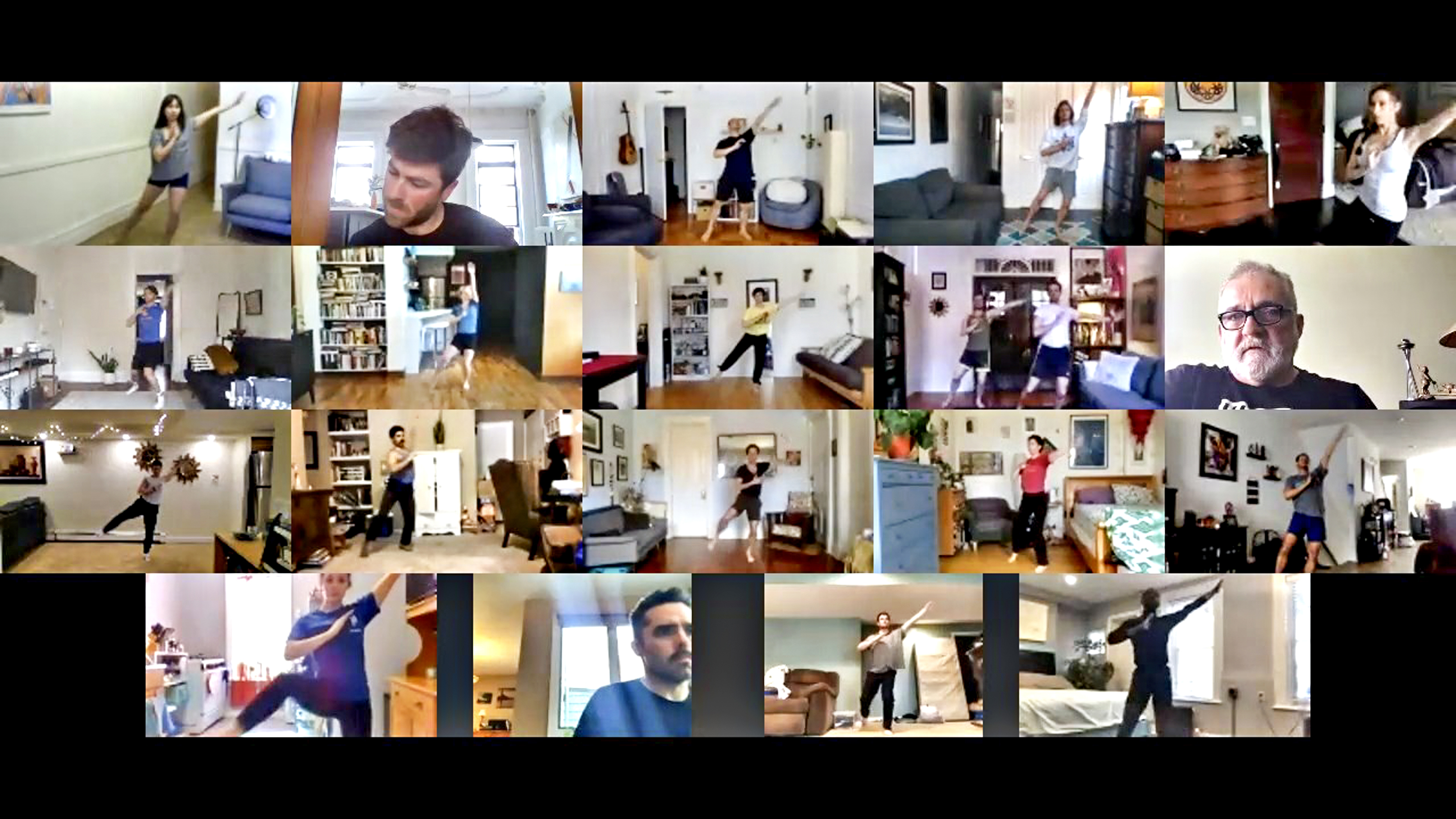
Sarah L. Kaufman writes at the Washington Post, “Choreographer Mark Morris says to his dancers. ‘Go as far away as you can in your room.’

“Morris, in a black T-shirt and a string of beads, peers through his reading glasses at his computer screen. Arranged around his own image in rows of little boxes he can see who’s on this recent videoconference call: his rehearsal director, music director and three Mark Morris Dance Group performers.

“Stuck at home like everyone else in New York, the dancers jog backward, past couches, beds and bookshelves, to the rear walls of their apartments. … It’s all he and his performers have to work with.

“Choreography in the age of covid-19 is hardly a graceful undertaking. Morris, the esteemed modern-dance artist whose company has performed to acclaim for more than 40 years, suddenly finds himself out of place in a world of seclusion. His profession depends on working closely with people, getting them to move exactly as he wants. But he’s determined to keep creating. No matter that the city’s quarantine makes gathering in a rehearsal studio impossible.

‘Now, let’s dance a little bit,’ he says. ‘Foot articulation is not important ’cause I don’t see that. What’s more interesting is swooshing’ — he swirls his hand in a serpentine movement — ‘and depth changing.’ …

“The three dancers in their separate squares whirl and glide into view with a smooth, floating quality, winding side to side as if drifting on wind currents. In his chair, Morris echoes their moves with his upper body, lifting his arms as they do. He gasps, he gapes. He sucks in a breath and runs a hand over his hair. Suddenly he waves frantically at the screen.

“ ‘Stop, stop!’ He grabs his head in his hands and pitches backward in his chair. Something has bowled him over — but what? Anguish, despair? Has he been horrified into silence by what he’s seen?

“The dancers wait, breathing hard. Finally the choreographer snaps himself upright.

” ‘That was great!’ he shouts, beaming.

“He adjusts his glasses and adopts a lilting Italian accent: ‘I feel like-a Federico Fellini.’

“That captures this weird, tilted reality perfectly. There is a certain hallucinatory, Fellini-esque quality to this scene, where a giant of the dance world struggles to master the same awkward video technology that remote office workers are using to teleconference. And where top dancers are limited to a few feet of floor space and bad lighting, using bathroom doors as stage wings. …

“Morris has retooled himself as a filmmaker. He began working on this dance last fall, devising the movements in his company’s spacious Brooklyn headquarters with a pianist and 15 dancers. He was nearly finished before shuttering the building last month. …

” ‘My job is irrelevant, if not obsolete,’ Morris says in a phone interview. … ‘The truth is,’ he continues, ‘I’m not making up a dance. I’m making a film. But I’m not an auteur, I don’t understand this technology.’ …

“The dancers have been taking company class every day on Zoom, and having weekly Zoom singing sessions and happy hours. But rehearsing with Morris — even with his tendency to tease them about their unmade beds — fulfills a deep-seated need. Gazing into his virtual studio, Morris appears to be comfortably in his element, scanning each face, each body, picking up every move and gesture, editing freely. No one escapes his focus.

” ‘Can you exit stage left or stage right?’ Morris asks the group. Christina Sahaida and Laurel Lynch slip out of view through nearby doorways, then simultaneously strut back in like Ziegfeld showgirls.

“ ‘Oh, my God,’ he exclaims, delighted. He leans in, like a scientist studying specimens under glass. …

“ ‘There will be more dance products coming from me,’ Morris says later. … ‘When I’m done with this I’ll start something else. Even though it’s not my medium.’ ”

More here. (There’s a firewall at the Post, but you can get a free subscription for a short period of time.)

Photo: Mark Morris Dance Group

DANCE-MORRIS

Read Full Post »

janes_closeup

Art: Bradshaw Crandell
Jane Hall, a screenwriter at Hollywood’s most glamorous studio, would be lost to us but for her daughter’s painstakingly researched biography. Here she is on the cover of the October 1939 edition of
Cosmopolitan magazine.

I’ve been thinking about the unacknowledged accomplishments of women.

Having just finished a great biography on Frances Perkins, a trailblazer in FDR’s administration, I find myself not at all surprised that she is almost unknown today. Perkins is just one more example of accomplished women throughout history who have failed to get their just due. It’s complicated.

Being dismissed by men is not the only reason, Dear. Sometimes you were dismissed by women, too. Sometimes you didn’t sign your poem or your art and so became known as “Anonymous.” Sometimes, like Perkins, you were determined to do the most possible good for the most people in need by the most effective means.

Thinking about this led me to a New Yorker article on women in the early days of Hollywood.

Margaret Talbot writes, “One of the stranger things about the history of moviemaking is that women have been there all along, periodically exercising real power behind the camera, yet their names and contributions keep disappearing, as though security had been called, again and again, to escort them from the set.

“In the early years of the twentieth century, women worked in virtually every aspect of silent-film-making, as directors, writers, producers, editors, and even camera operators. The industry — new, ad hoc, making up its own rules as it went along — had not yet locked in a strict division of labor by gender. Women came to Los Angeles from all over the country, impelled not so much by dreams of stardom as by the prospect of interesting work in a freewheeling enterprise that valued them. …

“Some scholars estimate that half of all film scenarios in the silent era were written by women, and contemporaries made the case, sometimes with old stereotypes, sometimes with fresh and canny arguments, that women were especially suited to motion-picture storytelling.

“In a 1925 essay, a screenwriter named Marion Fairfax argued that since women predominated in movie audiences — one reason that domestic melodramas, adventure serials featuring acts of female derring-do, and sexy sheikh movies all did well — female screenwriters enjoyed an advantage over their male counterparts. They were more imaginatively attuned to the vagaries of romantic and family life, yet they could write for and about men, too.

“After all, men ‘habitually confide in women when in need either of encouragement or comfort,’ Fairfax wrote. ‘For countless ages woman’s very existence — certainly her safety and comfort — hinged upon her ability to please or influence men. Naturally, she has almost unconsciously made an intensive study of them.’

“Alice Blaché, the French-born director behind some six hundred short films, including ‘The Cabbage Fairy’ (1896), one of the first movies to tell a fictional story, … wrote in 1914, ‘There is nothing connected with the staging of a motion picture that a woman cannot do as easily as a man, and there is no reason why she cannot completely master every technicality of the art.’

In a way, the early women filmmakers became victims of the economic success that they had done so much to create.

“As the film industry became an increasingly modern, capitalist enterprise, consolidated around a small number of leading studios, each with specialized departments, it grew harder for women, especially newcomers, to slip into nascent cinematic ventures, find something that needed doing, and do it.

“ ‘By the 1930s,’  Antonia Lant, who has co-edited a book of women’s writing in early cinema, observes, ‘we find a powerful case of forgetting, forgetting that so many women had even held the posts of director and producer.’ …

“Trying to figure out who actually worked on films is not as easy as you might think. Credits were assigned haphazardly in the early days of filmmaking. …

“In the tendentious but mostly persuasive book ‘Nobody’s Girl Friday: The Women Who Ran Hollywood’ (Oxford), J. E. Smyth … tots up an impressive array of women film editors, costume designers, talent agents, screenwriters, producers, Hollywood union heads, and behind-the-scenes machers. … It’s little wonder that studios of the era catered to female audiences, with scripts built around the commanding presence of such actresses as Bette Davis and Joan Crawford, and with stories thought to reflect women’s prevailing concerns.

“Smyth quotes Davis, who pulled enough weight in Hollywood to have been dubbed the Fourth Warner: ‘Women owned Hollywood for twenty years,’ she said in a 1977 interview, so ‘we must not be bitter.’…

“Smyth burrows enthusiastically into humble sources that, she suggests, other scholars have looked down on: studio phone directories, in-house newsletters. Researchers on similar quests have come upon evidence in still more unlikely forms and places. Reels of film forgotten or lost sometimes turn up randomly — interred in an archive in New Zealand, or sealed into a swimming pool in a remote town in the Yukon.” The search goes on.

It’s a long article. Read it here. And while we’re on the subject, be sure to read Robin Cutler‘s wonderful book, Such Mad Fun, about her mother’s role as a writer in Hollywood.


Read Full Post »

« Newer Posts - Older Posts »