Feeds:
Posts
Comments

Posts Tagged ‘film’

skatekitchen_custom-7cb11468e3eaad2e6acb94579b8e6315ed0687dc-s700-c85

Photo: Magnolia Pictures 
In the film Skate Kitchen, the introverted Camille (played by Rachelle Vinberg, left) finds her tribe of skaters in New York City. The filmmaker found her subjects almost the same way — instinctively.

What I especially loved about this article on making a female-skateboarder movie was the director’s sixth sense. She hears girls on the subway talking in a wildly creative way and experiences vibes that direct her to pursue a new path of possibility.

Lakshmi Singh reports at National Public Radio, “Director Crystal Moselle made waves three years ago when her documentary The Wolfpack won the grand jury prize at the Sundance Film Festival. The film told the true story of six brothers growing up in confinement in Manhattan’s Lower East Side — and it all began from a chance encounter Moselle had with the brothers on the street.

“Her new film comes from a similar place. Skate Kitchen follows a group of teenage girl skateboarders and activists rolling their way through the streets of New York. This time, she met them on the subway.

From the NPR interview:

“I learned to understand my instinct. There’s this thing that happens to me. …  I’m like: Oh, this is something. This is interesting. I just — I have to explore it. …

“I was on the train in New York City. I was on the G train. And I heard this voice that just — you know, sometimes there’s a voice that’s so charismatic, you just have to figure out who’s talking and what’s happening. I mean, that’s how I am. And I look over, and there’s these three teenage girls, and they have skateboards. And Nina [Moran] — she’s telling a story. I can’t remember what the story was about. I think maybe it was about a party she went to or something that happened in the park that day. And she has that kind of voice that almost silences a room where you want to — just everybody stops what they’re doing and they want to see who’s talking.

“And so I — just out of curiosity and out of this instinct that I’ve kind of gained from my past project, I just — I feel like there’s this moment where I sort of know that there’s something there and I have to figure it out. And I went up to them and asked them — I just said, hey, you know, introduced myself. I said, my name’s Crystal. I’m a filmmaker, and I’d love to talk to you guys. Maybe you guys would be interested in doing some sort of video project at some point. [And] — I don’t remember saying this — I said, is there more of you? …

“They’ve found all these really interesting pockets [of the city], and they go to these skate parks, and they have these, like, spots that they skateboard and they just use the architecture of buildings. And you know, people chase them away. And it’s just, like, this kind of really riveting scene. And I would just start hanging out with them and experiencing it myself. They’d even, like, make me jump on the skateboard. They’re like, if you’re going to hang out with us, you have to skateboard. Here’s the board. Skate down the block. …

“The girls actually met through YouTube. They would be commenting on each other’s videos and, you know, that’s how they would create these communities because it’s difficult. Like, if you’re a girl living on Long Island and there’s no other girls around that skateboard, you can go to, you know, a social media platform to find other women that also do the same thing that you do that’s, like, something specific. …

“I think that it’s actually a really positive thing to be able to find people that are, I guess, your tribe. …

“When I was with Rachelle one day — Rachelle Vinberg, who plays Camille. She was skating with all these boys. And they all rolled by, and the little girl [watching the film crew] didn’t notice them at all. And then Rachelle rode by with her hair just like in the wind. It was just an epic moment — she’s, like, carving down this hill. And this little girl, like, stopped in her tracks and just watched her and, like, saw the future.”

More here. I love how this director is drawn by curiosity to pursue things that are unfamiliar and interesting. Having something interesting to think about is apparently as essential to her as food.

Read Full Post »

One of the many reasons I’m grateful to WordPress is that, as the largest self-hosted blogging tool in the world, it gives me some visibility among other bloggers.

One day recently I garnered a “like” from the Girl Scouts of South Carolina Mountains to Midlands. I decided to check out their blog, and I found a good story to share.

Michelle Taylor writes, “Zainab Bhagat has always reached out to the hurting, even when she didn’t realize she was practicing philanthropy. As a child in elementary school, she noticed one of her friends often went without. Her friend never seemed to have school supplies or a complete lunch. Without a second thought, Zainab shared everything she had to offer. …

“When Zainab had the opportunity to earn the Gold Award in high school, she never questioned if she should pursue it or not. She felt it a moral obligation to share her time, talent, and treasure with the world. …

“She knew the project would take her full devotion. She would have to spend at least 80 hours researching, planning, and working her project. She would have to present her concept before a committee, and her project would have to address a real issue in her community. But anything worth doing is rarely easy.

“Zainab created a documentary about homelessness in her hometown of Irmo, South Carolina. She interviewed and became fast friends with a local teen who had endured incredible hardship. Watch her hard-hitting and inspirational documentary [here].”

More at the Girl Scouts of South Carolina blog, here. How reassuring it is to see young people like this readying to enter the world of adulthood. They will make that world better.

Read Full Post »

Although Ginia Desmond had been writing scripts for 12 years, she had never made a movie. Now at 74, she has risen to the challenge.

Johanna Willett writes at the Arizona Daily Star, “Ginia Desmond had a decision to make. Buy a house. Make a movie. Buy a house. Make a movie. She made a movie.

“The 74-year-old has been writing scripts for a dozen years, but ‘Lucky U Ranch’ is her first feature-length film to make it to the big screen.

“That’s because she funded it.

” ‘I consider myself the writer,’ she says of the low-budget film, which so far isn’t readily available for viewing. ‘I wrote the script, and I wrote the checks.’

“Writing screenplays is not Desmond’s first career — or even her second. This act follows others that starred Desmond as a mother and wife, professional artist and businesswoman. …

“For almost 30 years, she imported goods such as furniture and baskets to sell in her Tucson store Sangin Trading Co. on Sixth Avenue. She sold the business in 2003. …

“ ‘Ginia is an interesting combination of very creative and very practical,’ says Victoria Lucas, a Tucson screenplay consultant with a 20-year career in Los Angeles.

” ‘She has that sense of the big picture and how a business is run, and with her writing skills and talent, she has the ability to understand characters. … Very few writers write visually so that when you read the script, it’s like you have seen the movie. … Ginia writes like that. She has a real gift for getting under the skin of characters and making the reader or audience understand them. … She is a treasure for Tucson.” Read more here.

Thank you, Cousin Claire for posting the story on Facebook. Like Desmond, Cousin Claire lives in Tucson, and she has at least one script stored away somewhere about an adventurous female ancestor. I read it. And I know for a fact she is under 74, so …

Photo: Kelly Presnell/Arizona Daily Star
Ginia Desmond, 74, is reflected in her movie poster’s glass.

Read Full Post »

I added Ello to my social media a while ago but am only now beginning to explore it. A kind of Facebook without ads, it seems to be preferred by people in the arts. Lately, Ello has been publishing interviews with particularly interesting users.

Here are excerpts from Ello Chief Marketing Officer Mark Gelband’s interview with Ben Staley.

“Ben Staley is an Emmy award-winning filmmaker, storyteller, photographer, and professional adventure-haver. His striking portraits and nature photography are a constant source of inspiration to the Ello team. …

“Mark: I started paying really close attention to your work when you were documenting the film you’re making about ships and welders. Could you tell us more about that project?

“Ben: The project is called ‘Starbound’ and it’s about a boat of the same name. The boat is a catch processor that fishes on the Bering Sea. It’s a top performer but the factory was outdated and inefficient and they were losing money. The construction project would lengthen the boat, making it as environmentally friendly as possible and saving the jobs of the 100+ crew members. The owners are doing it for the best reasons. They could have taken the easy way out and and saved a lot of money up front and had no risk, but they undertook this incredible challenge because they care about the environment and their employees and their families. …

“For me as a storyteller it’s a once-in-a-lifetime opportunity to capture this process and tell their story. The family that owns the boat are incredibly committed and hardworking people and they will willingly spend more money and take on this risk to do things the right way. …

“Picking a 240 foot-long boat up out of the water, cutting it in half and sticking 60 foot section in the middle, welding it back together and putting it back in the water. All in the space of a couple months. The hard work, skill and craftsmanship are incredible. …  I’ll be making the first trip to sea with the boat later this summer and hope to have the doc done by end of year. …

(more…)

Read Full Post »

I  noticed the Eric Carle picture book Mister Seahorse at Suzanne and Erik’s house today, and it got me thinking about seahorses as fathers.

Did you know seahorse fathers carry the babies from conception to birth, not the mothers?

According to Wikipedia, “The male seahorse is equipped with a pouch on the ventral, or front-facing, side of the tail. When mating, the female seahorse deposits up to 1,500 eggs in the male’s pouch. The male carries the eggs for 9 to 45 days until the seahorses emerge fully developed, but very small. Once the young are released into the water, the male’s role is done and he offers no further care.”

It’s kind of the reverse of today’s devoted fathers. With no direct role in giving birth to babies, they sure do get involved in the daily care and feeding. Grandfathers, too. My husband babysits regularly, and can handle most anything, including diapers.

For more on seahorses, and how to protect them, check out the Sea Horse Trust, here. And if you’re up for a refresher on how increased carbon dioxide in the atmosphere is endangering sea creatures with spines, including the pygmy seahorse, reread my review of the climate-change movie Revolution, here.

Art: Eric Carle

Read Full Post »

Here is my latest photo roundup, but the picture I’d hope to start with will not appear.

I thought I was in the 1960s film Blowup. I spent ages (well, at least 30 minutes) zooming in on a photo I took of what I’m pretty sure was a bluebird. When I finally found the bird in the background of woodland twigs and leaves, he was so blurry I couldn’t use the picture to confirm the identification. So no photo of a bluebird for this post.

I have two other photos from walking in the town forest, one of Fairyland Pond and one of trail markers, including the Emerson-Thoreau Amble.

Next is my youngest granddaughter chasing a squirrel up a tree on Easter (love the shot my husband got). My oldest granddaughter is captured mid-Easter-egg hunt. The robin stayed stock-still for his portrait that afternoon.

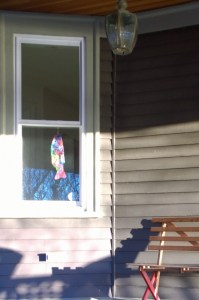
The window fish was painted by my younger grandson at his Montessori nursery school. As usual, I couldn’t resist shooting shadows.

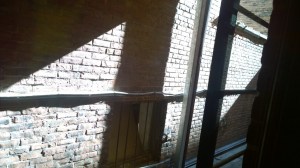
Now, about the shadows on brick. For nearly three months, until the moment when the sun shone through the alley (like the sun that shone on the keyhole to Smaug’s back door in The Hobbit), I thought the window in the renovated building was smack up against a wall and there was nothing to see there. What a lovely surprise!

I’m wrapping up today’s collection with a license plate from the Pawnee Nation. Since the Pawnee Nation is in Oklahoma and the car was in Providence, I’m intrigued and hope to learn more. Here’s the tribe’s website.

033116-pond-in-town-forest

033116-trail-in-woods


032716-squirrel-went-up-tree

032716-Easter-basket


032716-robin-Blackstone-Blvd

032916-grandson-fish-decoration


032216-sudden-light-narrow-alley

033016-Pawnee-Nation-car-license


Read Full Post »

I checked Gwarlingo not long ago to catch up on Michelle Aldredge’s thorough, sensitive meditations on art and literature.

What caught my attention was her review of a movie about restoring an old house in Japan.

“It is rare to find a film that is pitch-perfect in its cinematography, story, pacing, and length,” Aldredge writes, “but Davina Pardo’s short film Minka is such a gem. (I owe writer Craig Mod a thank you for turning me onto this quiet masterpiece.)

“Based on journalist John Roderick’s book Minka: My Farmhouse in Japan, the film is a moving meditation on place, memory, friendship, family, and the meaning of home. Most remarkable, this haunting story plays out in a mere 15 minutes.

Minka is the Japanese name for the dwellings of 18th-century farmers, merchants, and artisans (i.e., the three non samurai-castes), but as Wikipedia explains, this caste-connotation no longer exists in the modern Japanese language, and any traditional Japanese style residence of an appropriate age could be referred to as minka. The word minka literally means ‘a house of the people.’

“The story of how AP foreign correspondent John Roderick and his adopted Japanese son Yoshihiro Takishita met, and then rescued a massive, timber minka by moving it from the Japanese Alps to the Tokyo suburb of Kamakura is full of small surprises and revelations (the biggest one comes at the end of the film).

Minka is a film that celebrates stillness. Pardo’s camera lovingly lingers on sun, shadows, and dust. But the peaceful home is not just a restored space full of beautiful, personal objects, it is also an expression of the deep connection between Roderick and Takishita and of familial love.”

Read about that at Gwarlingo, where the filmmaker will let you watch the entire 15-minute movie.

Photo: Davina Pardo & Birdlings LLC
A still from the film
Minka

Read Full Post »

Today would have been Shakespeare’s 451st birthday, and I am seeing testimonials all over Facebook and twitter. So it seems like a good day to write about the Sonnet Project in New York City.

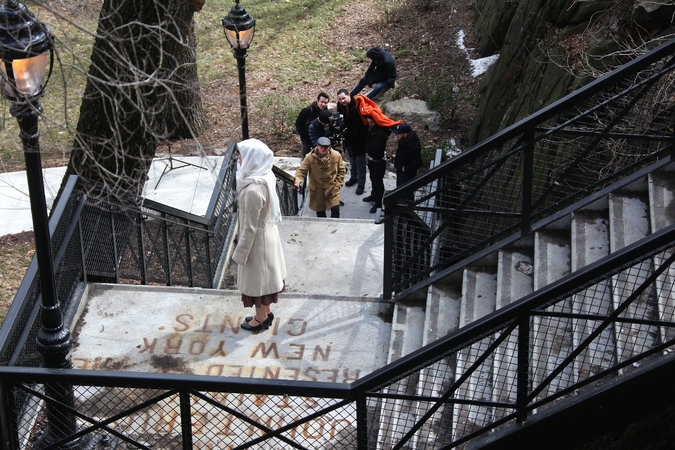
Stuart Miller wrote at the New York Times about “an ambitious project to create a short film for each of Shakespeare’s 154 sonnets, with each movie shot at a different New York City location.

“ ‘It brings Shakespeare to people who might not be in touch with it, and we can use social media like Twitter and Instagram to spread the word,’ [actor Billy] Magnussen said. The endeavor, called the Sonnet Project, grew from the work of the New York Shakespeare Exchange, a local theater group.

“The group, which started the project in 2013, just completed its 100th film: Sonnet 27, starring Carrie Preston, an Emmy award-winning actress, and filmed on the Verrazano-Narrows Bridge [and premiering] April 8 on the Sonnet Project website and app. …

“Some directors found inspiration at the location where the films were shot. At Leidy’s Shore Inn, a 110-year-old bar on Staten Island, Daniel Finley, who was making Sonnet 19, filmed Laurie Birmingham, an actress who works mostly in regional theater, as a world-weary regular musing over her drink.

“ ‘We walked in at 10 a.m. and the regulars were there watching OTB and scratching their lotto tickets,’ he said. ‘We learned some of their stories and Laurie based her character on those impressions.’ ” More at the New York Times, here.

Photo: Chang W. Lee/The New York Times
A crew filming Sonnet 108 at the John T. Brush stairway. 

Read Full Post »

It always seems so limiting to put anything in a category. Some WordPress bloggers are good at categorizing their posts, and I’m sure that helps many readers, but my posts are never about one thing only.

Netflix makes movie recommendations based on categories that pigeonhole movies we’ve rated highly. But the approach seems clunky. Just because we have liked a lot of foreign films (Wadjda, Son of Rambow, Princess Mononoke), that doesn’t mean we like all foreign films. Maybe we like the ones we’ve seen for some other reason than being foreign. Maybe they are less glitzy, more honest, or more entertaining.

He are some funny categories Netflix recommended for my husband and me: “emotional, independent films based on books,” “critically acclaimed foreign movies,” “mind bending movies,” “anime,” “musicals,” “social & cultural documentaries,” “critically acclaimed emotional movies,” and “horror movies.” Horror!? Where did they get that?

At the late, lamented Kate’s Mystery Books in Cambridge, you could get pretty sound advice on books from Kate herself. She would ask you to name some mysteries you liked, and you might say you had read all of Tony Hillerman and Arthur Upfield. Then she would say, “Different cultures.”

Well, ye-es. But what kept me coming back to those authors were detectives who were likable and endings that were positive in some way. no matter how small. Kate did give me some authors I loved, like Eliot Pattison (mysteries about Tibet and, more recently, several about 18th century American Indians), but other books about different cultures might be too noir for me or too fluffhead, like mysteries with animal detectives.

I suppose categories help a bit. I just think they are clunky. Where would I file this post, now? Movies? Books? Retail? Misconceptions? Colin Cotterill, Dr. Siri, Laos?

Colin Cotterill writes a series that is both funny and deadly serious about a 70+ coroner in Laos, Dr. Siri, a likable antihero with an offbeat bunch of equally likable cronies.

Read Full Post »

Photo: Greenfusefilms.com

Vanessa Gould, the sister of one of Suzanne’s elementary school buddies, is a documentarian. A while back, she made a Peabody-winning film about makers of advanced origami called Between The Folds. More recently, she was given unheard-of access to the New York Times obituary desk.

Her parents just sent an e-mail about the resulting movie and what Vanessa has been up to in general.

“Vanessa recently worked on Showtime’s Years of Living Dangerously, a nine-part series tackling the challenges of climate change. … Vanessa was a producer on several of the stories and did additional cinematography on others. You can see most of her work in episodes three (“Super Storm Sandy”) and nine (“Chilean Andes”). Episode three, “The Rising Tide” with Chris Hayes, airs tonight, Sunday, April 27, at 10 pm on Showtime. … Here are links: http://www.yearsoflivingdangerously.com and https://www.facebook.com/YearsOfLiving. …

“Soon after making Between The Folds, one of the artists in the film passed away. Vanessa alerted the Times of his death, aware that it was unlikely they would run an obituary. And yet – somewhat amazingly – they did, and she assisted them in the unusual process of putting together an editorial obituary. Only three or four such obituaries are written by the NYT staff each day. The whole story of how these obituaries are selected and written, as well as the social history they tell, became her fascination. Hence OBIT will be her next film. Check out these links: http://www.obitdoc.com, http://www.greenfusefilms.com, and www.vanessagould.com.”

I wonder if OBIT will show to what extent the obituaries of famous people are written before they shuffle off this mortal coil. Come to think of it, do any newspapers let people submit their own obit in advance? I recently read a hilarious one that a small paper accepted from the deceased at the insistence of his grandson. It revealed a guy with a terrific sense of humor — not a bad tribute.

Read Full Post »

An old, falling-apart film of a heath hen has been unearthed.

Why is that thrilling? The heath hen is extinct.

Writes Carolyn Y. Johnson in the Boston Globe, “The bird stamps its feet on the ground, taking mincing dance steps through the corn stubble. Neck feathers flare like a headdress, and the male puffs out his neck, making a hollow, hooting call that has been lost to history.

“These courtship antics are captured on a silent, black-and-white film that is believed to be the only footage of something not seen for nearly a century: the extinct heath hen.

“The film, circa 1918, is the birding equivalent of an Elvis sighting, said Wayne Petersen of Mass Audubon — mind-blowing and transfixing to people who care. It will premier Saturday [March 8] at a birding conference in Waltham.

“Massachusetts officials commissioned the film nearly a century ago as part of an effort to preserve and study the game bird, once abundant from Southern New Hampshire to Northern Virginia. Then, like the heath hen, the film was largely forgotten.

“Martha’s Vineyard is where the last known heath hens lived, protected in a state preserve. But the last one vanished by 1932. …

“Jim Cardoza, a retired wildlife biologist who worked for the Division of Fisheries and Wildlife, said that for him, the film holds lessons about how conservation efforts have evolved.

“ ‘The thing that is striking to me is the habitat of the animal — it looks like they’re out in corn fields and open areas and things like that,’ Cardoza said. ‘That isn’t what the birds really inhabited — they were a scrub-land species.’ Conservationists at the time, he said, ‘didn’t know what the habitat requirements of the species even was.’  ”

Read the rest of the article and watch the film here.

I love the idea of a long-rumored, valuable film finally being found. It’s a great story. It’s also an argument for better filing systems.

State of Massachusetts woodcut, 1912. The fancier heath hens are males.

Read Full Post »

Do you ever check the website This Is Colossal? They have the best stuff.

Here is a cute bit about giant, playful robots in Argentina.

In a “clip from Fernando Livschitz of Black Sheep Films,” says the website, “we watch as tin windup toys overtake the streets of Buenos Aires, living amongst its inhabitants as if it was an everyday occurrence. Livschitz is known for his short films that blend live action footage with aspects of absurdity, most notably his New York and Buenos Aires theme parks. Music by the very fine Canned Heat circa 1972.” More.

We hear so much these days about robots in advanced manufacturing and medicine, but I like the idea of robots as toys. You could really warm up to some of these guys, as Frank Langella did with his robot in the futuristic movie Robot & Frank.

Photo: Fernando Livschitz at This Is Colossal

Read Full Post »

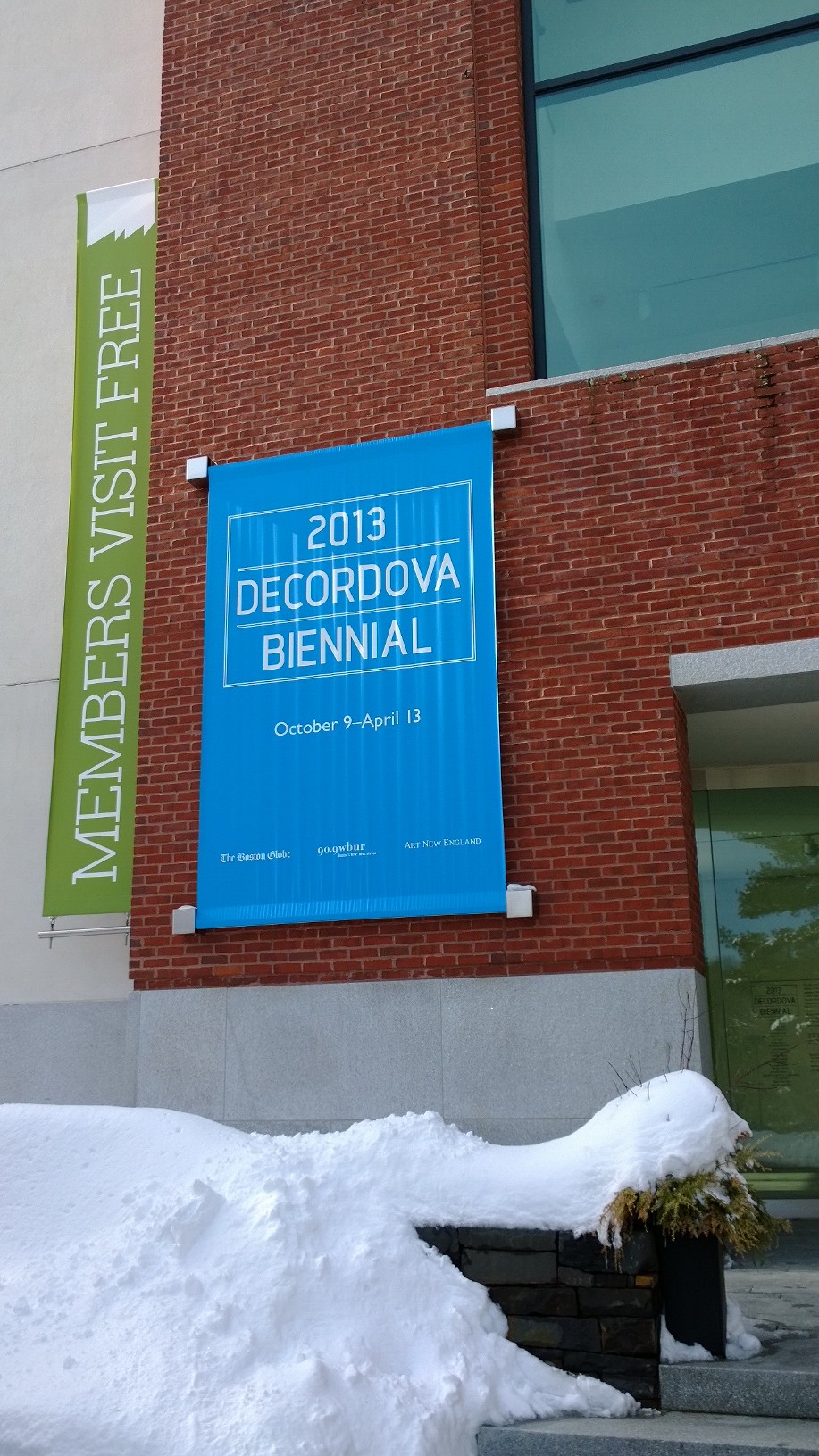
2014-DeCordova-in-winter

On Sunday, my husband and I decided to see what’s new at the DeCordova Museum in Lincoln.

A favorite in the biennial show of New England artists was Laura Braciale of Manchester, NH. It took me a minute, but when I realized she had displayed everyday objects along with what they looked like once she had turned them into art, I thought, Yes, art really is in everything if you look.

The blurb about her says, “close observation reveals subtle differences between the three-dimensional structures and their two-dimensional renderings. …  Her works engage a question concerning representation—which image is more ‘real’? As both her items and her illustrations occupy the same physical reality, however, Braciale’s work suggests that neither is more real than the other.” (Sigh. I’m not really fond of the way museums write.)

In a different DeCordova exhibit we saw three tintype photo portraits by the late David Prifti, Suzanne’s high school photography teacher. (A solo show in Winchester, Mass., goes through March 2, here.)

The biggest surprise was a documentary about Laos, a country we are interested in largely because of the the mystery books of Colin Cotterill. (Read one of my posts about him, here.)

The film, Route 3, shows a small mountain town that, having been leased to China for 75 years, was utterly destroyed to make way for casinos, hotels, entertainments, and jobs for Chinese people alone. Hard to imagine selling a part of your country like that, but Laos is desperately poor.

The documentary was by Patty Chang and David Kelley, who live and work in Boston and Brooklyn.

The DeCordova says on its website, “Blending the genres of documentary and road trip films with surrealist cinematic passages, Patty Chang and David Kelley present a compelling trip through the physical and psychological landscape of a community in transition. … Enlisting the help of tour guides and local entrepreneurs in this tightly controlled area, the artists immersed themselves in this community to create a unique portrait of a changing society.” More information on the artists here and here.

Read Full Post »

We watched a lovely thing on PBS recently, an opera about the Christmas armistice in World War I. You have probably heard of it. The combatants decided to take Christmas off. A movie was made about it, taking a few liberties with the story. Then the Minnesota Opera Company commissioned  composer Kevin Puts to write an opera based on the movie.

From the composer’s website: “Silent Night is an opera in two acts by composer Kevin Puts and librettist Mark Campbell, based on the 2005 film Joyeux Noël, directed by Christian Carion and produced by Nord-Ouest Production. Commissioned by Minnesota Opera with co-producer Opera Company of Philadelphia, it opened on November 12, 2011 at the Ordway Theater, St. Paul Minnesota … The opera is sung in English, German, French, Italian and Latin.

The interplay of the five languages was charming, especially when the German officer translated English into French and French into English so the three main officers could understand one another.

Read Allan Kozinn’s comments about this Pulitzer Prize winner at the NY Times ArtsBeat blog, here.

I will say that, delightful as it is to see the soldiers put down their arms and show each other pictures of loved ones back home, it makes the misery and futility of war doubly painful as the men are ordered back to battle and the camera pans over the lifeless bodies and the very young faces.

Peace is something to think about at Christmas. Ordinary people just want to live in peace.

Read Full Post »

Got to share this movie: Le Havre (in French with subtitles).

Lately, nearly all the movies we see are on Netflix. Our taste seems to run to animation, documentaries, and foreign films. Not exclusively, but in general.

Last night we watched an odd, wistful comedy about an old guy in Le Havre,
France, who makes up his mind to help a boy whose family is arrested after being discovered in a packing crate near the harbor, on route from Africa to London.

Every shot in the film was like a painting, every gesture true. The characters were good-hearted, down-and-out types in the roughneck port, where many undocumented immigrants come looking for work. There they find squatter camps, deportation, kindness, hostility, drugs, poverty, crime, and sometimes a living.

The dialogue in the bar scenes reminded me of Mike Leigh films, the ones where he has his actors ad-lib their lines. It was just so funny and believable. And the “trendy” charity fundraiser the old guy arranges with the graying rock band has to be seen to be believed.

The “2011 comedy-drama film written and directed by Aki Kaurismäki, starring André Wilms, Kati Outinen, Jean-Pierre Darroussin and Blondin Miguel. It tells the story of a shoeshiner who tries to save an immigrant child in the French port city Le Havre. The film was produced by Kaurismäki’s Finnish company Sputnik …

“The film premiered in competition at the 2011 Cannes Film Festival, where it received the FIPRESCI Prize. Kaurismäki envisions it as the first installment in a trilogy about life in port cities. His ambition is to make follow-ups set in Spain and Germany, shot in the local languages.”

More at Wikipedia, here.

Read Full Post »

« Newer Posts - Older Posts »