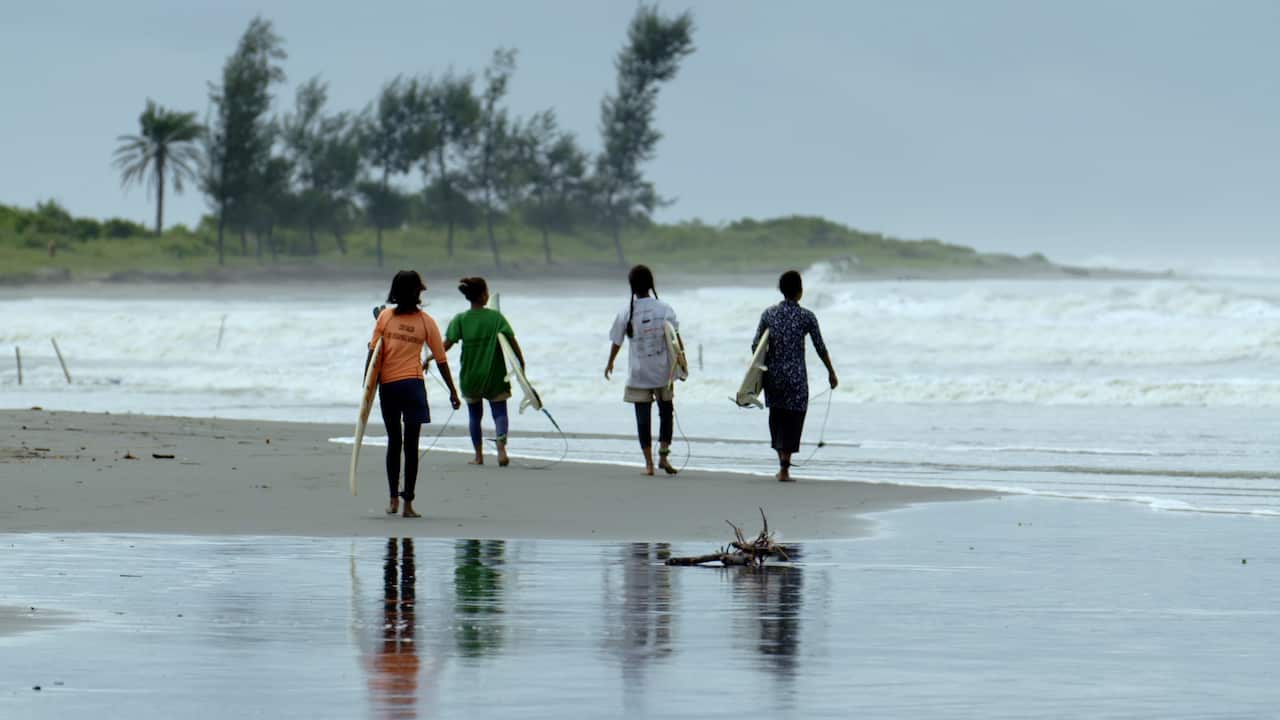
Photo: SBS News. The surf club in Cox’s Bazar teaches girls in Bangladesh how to surf.
From the little I know about Bangladesh, it’s a hard life there. It’s hard even for a man, even for a famous one like Nobel Peace Prize winner Muhammad Yunus, who has drawn the resentment of the country’s prime minister. But for most females, it’s almost out of the question to have any kind of independent life.
Today’s story suggests that some young women in Bangladesh are bucking tradition. Rhiona-Jade Armont writes at SBS News, “Along one of the longest uninterrupted beaches in the world, two young surfer girls paddle out past the break.
“The conditions out here are rough and unruly, but these fearless teens cling to their boards, waiting for the perfect wave to ride back to shore.
“Here, in the coastal town of Cox’s Bazar in Bangladesh, Shobe and Ayesha are not your average 13-year-olds.
“ ‘Everybody says I live like a boy,’ Shobe says. ‘I go everywhere wearing a t-shirt. I’ve been surfing since childhood, so people are used to seeing me like this.’
“Girls in Cox’s Bazar are often expected to follow a set path, including working from a young age, marrying early and bearing children. Bangladesh has one of the highest rates of child marriage in the world.
“Parents who struggle to earn a steady income often marry off their teenage daughters, despite it being illegal until age 18. … Shobe’s older sister was married at 13. …
“These girls often come from poorer households and are more likely to miss out on a full education. But a small surf club has given girls like Shobe a chance to change their fate and do something they love. …
“Blazing a new trail has meant breaking tradition, and girls like Ayesha have fought hard battles at home. Her father has been the toughest to win over.
“ ‘If I tell [people] my girls do surfing they ridicule us,’ he says. ‘I want a good future for them. I don’t want to live from their earnings. Now that they are 14 and 15 years old, I have to think about their marriages.’
“For Ayesha, the pressures at home only drive her further away. ‘I don’t feel good at home. That’s why I spend as much time as I can at friends’ home or school.’
“Ultimately, she always ends up where she feels the most free. ‘My best friend is the sea.’
“For Shobe and Ayesha, surfing provides a future filled with possibility. They’ve excelled in local competitions, but the next stage is seeking out opportunities to compete on the international circuit.
“Shobe in particular dreams of one day being a famous surfer and representing Bangladesh. But fame is not only a shiny way to a new life. It’s a means of finding family who she’s lost contact with and receiving recognition.”
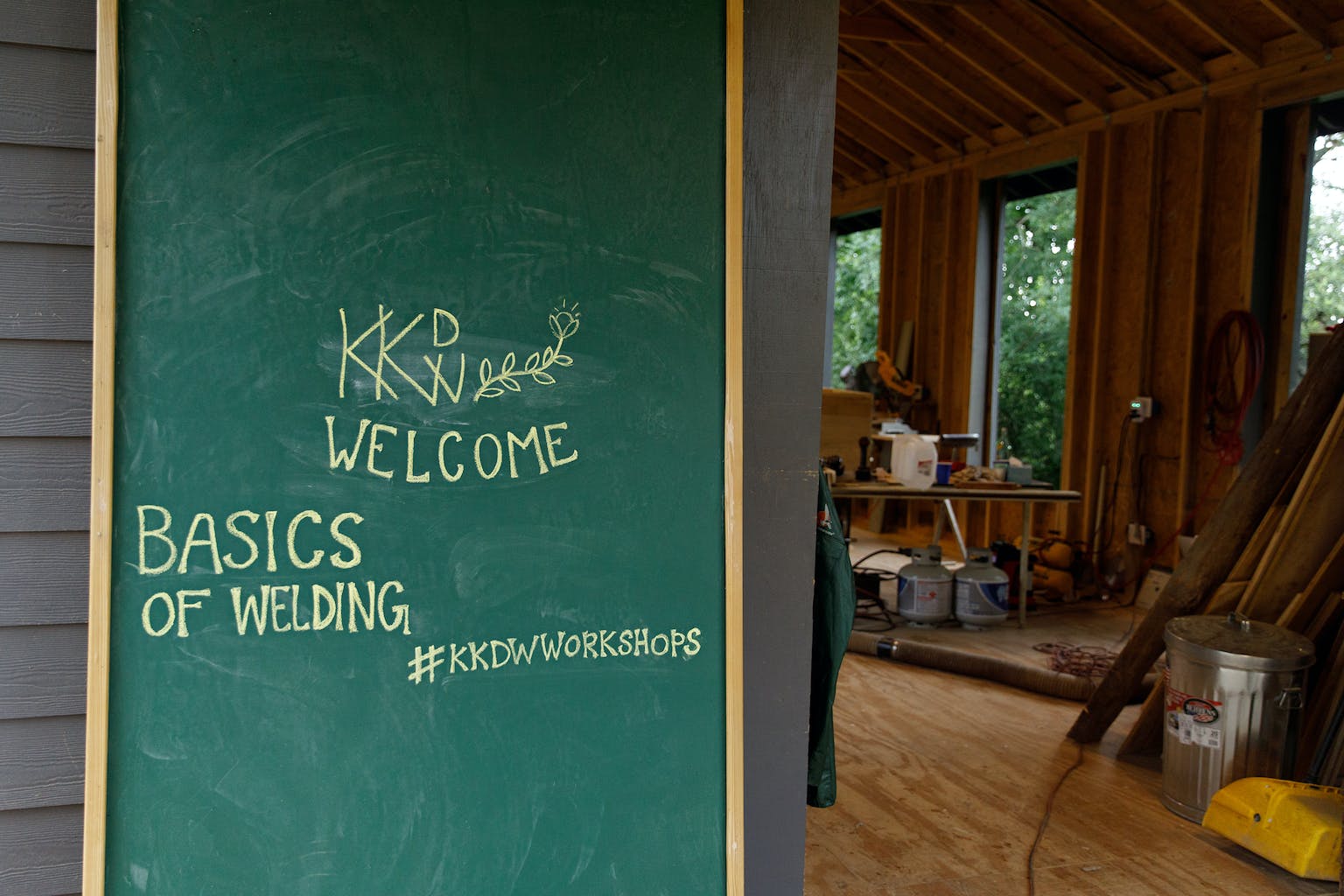
Photo: Nicole Mlakar/Texas Monthly. Kelly DeWitt Norman and Travis Norman’s workshop is one example of the opportunities in Texas for nonwelders to learn welding.
There are no gender specific skills anymore, unless maybe giving birth.
“Ainsley Muller, 11, went to art camp and theater camp in summers past. This summer, she was presented an opportunity she couldn’t refuse: learning how to use a power drill, weld metal and unclog a sink.
“ ‘When my mom told me about construction camp, I knew I had to go,’ she said. ‘Some people don’t think girls can do things like that, and they’re wrong. I had a blast.’
“ ‘I thought she’d be a good fit for it because she’s creative and hands on, and she loves science,’ said Ainsley’s mom, Amy Muller, 50.
“ ‘I also wanted to show her that as women, we don’t have to depend on the men in our lives to handle the physically hard tasks that present themselves,’ Muller added. ‘I wanted her to know that she was capable of doing these things herself.’
“That’s the same message Taryn Ritchie had in mind in 2019 when she helped put on Austin’s first girls construction camp sponsored by the National Association of Women in Construction.
“Ritchie is a chief estimator for Balfour Beatty, a general contractor in the Austin area. She said she’d noticed over the years that few women were working at the job sites she visited. …
“ ‘I wanted to shift the narrative and show girls that jobs as carpenters, plumbers and electricians are viable options,’ she said.
“Ritchie learned that other chapters of National Association of Women in Construction also held construction camps for girls. Girls from San Diego to Chicago have put on helmets and safety goggles and learned how to mix concrete, solder pipes together and rewire lamps. Camps have also been held in Baltimore and Silver Spring, Md., where earlier this month 16 girls learned about heavy equipment, heating and air conditioning systems and power installation.
” ‘The only way we can overcome [shortages] is by welcoming women with open arms,’ she said. …
“Ritchie said she felt a similar obligation. ‘I thought, “We need to do a camp like this in Austin,” ‘ she said. ‘I wanted to let girls know that office jobs in construction were not their only options. Why not teach them about all of the possibilities, from building houses to plumbing them?’
“That first year, she said, 15 girls signed up for a camp held with support from the Austin Independent School District. …
“One of this year’s instructors, Jennifer Barborka, enthusiastically got onboard to teach campers a little of what she’s learned as a fourth-year plumbing and welding apprentice. …
“ ‘I was proud that every single girl completed the project, but I was even more thrilled to see how many of them were interested in my trade,’ she said. ‘Not everyone can afford college, and not everyone is geared toward that kind of learning.’ …
“ ‘I told the girls that if they were to join a union, they could get paid while they get on-the-job training, and not end up with a ton of debt,’ she said, adding that last year as a third-year apprentice she made more than $60,000.
“That sounded appealing to Taryn Smith, 14. … She became intrigued at the idea of making a decent living without taking on student loan debt.
“ ‘Going to Camp NAWIC opened my eyes,’ Taryn said. ‘A lot of the things I do in my daily life — like being on the drum line in band — are very male-dominated. Sometimes, you feel like you’re not heard or seen. Seeing firsthand that women are plumbers and electricians made me think that I could do the same,’ she said.”
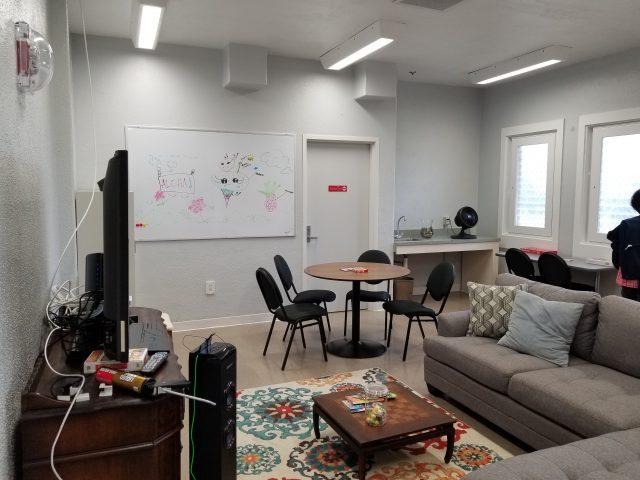
Photo: Honolulu Civil Beat. The inside of the Hale Lanipolua Assessment Center, which is run by Hale Kipa and serves as an alternative to the Hawaii Youth Correctional Facility.
Hawaii has a different approach to helping kids who get in trouble. There’s an understanding that girls in particular often get started in crime after serious childhood abuse — and that locking them up doesn’t solve anything. (See my 2012 post about a Boston theatrical production by former inmates that spelled out just how females can get trapped in an endless cycle of crime and punishment.)
Claire Healy writes at the Washington Post, “When Mark Patterson took over as administrator of the Hawaii Youth Correctional Facility in 2014, he inherited 500 acres of farm ranch — and the care of 26 boys and seven girls between 13 and 19 years old.
“By 2016, his facility, in Kailua, Oahu, was only holding between five and six girls at a time. And in June, the last girl left the facility. For the first time, there are no girls incarcerated in the state of Hawaii.
“Patterson said this moment is ’20 years in the making,’ and the result of a systemwide effort to divert girls from the judicial system and into trauma-based care programs. The number of incarcerated boys has also lowered significantly in the past decade, he added.
“Patterson said HYCF is a last resort — the kids there ‘have run away from programs 10 to 11 times’ and are the most vulnerable of the high-risk youth. But various state officials have agreed that ‘we no longer want to keep sending our kids to prison,’ Patterson said.
‘What I’m trying to do is end the punitive model that we have so long used for our kids, and we replace it with a therapeutic model.’
“He added, ‘Do we really have to put a child in prison because she ran away? What kind of other environment is more conducive for her to heal and be successful in the community?’
“Hawaii isn’t the only state to reach zero girls in long-term placement facilities. According to Lindsay Rosenthal, director of the Vera Institute’s Initiative to End Girls’ Incarceration, Vermont has zero long-term placement facilities for girls, and for nine months in 2020, Maine had zero incarcerated girls statewide. Since February 2021, New York City hasn’t had more than two girls in the state’s juvenile placement facility at any given time.
“This is part of a larger trend in juvenile justice reform: Since 2000, more than 1,000 juvenile facilities have closed, including two-thirds of the largest facilities. And between 2000 and 2018, youth incarceration rates dropped by more than half, according to the Square One Project, a justice reform initiative.
“But just as women are the fastest-growing prison population, the proportion of girls in juvenile detention has increased even as overall numbers have gone down. … As advocates point out, the majority of incarcerated girls are in prison for low-level offenses, often influenced by a history of abuse — as noted in various research — or systemic challenges, such as poverty.
“Rosenthal [emphasized] that a state reaching zero doesn’t necessarily reflect progress — Vermont has sent some girls to facilities in New Hampshire, and placed at least one girl into an adult prison, for example — without the presence of community-based alternative programming. HYCF is an example of a facility that has seen such an investment pay off, she said.
“Gender-focused programming is essential, Rosethal added, because of ‘the criminalization of sexual abuse.’ This legacy, she said, reaches back to colonization and slavery in the United States and has resulted in the disproportionately high incarceration rates of Black and Indigenous women and girls. …
“Patterson said the movement to replace punitive systems with trauma-informed care in Hawaii’s juvenile justice system reaches back to 2004, when Judge Karen Radius, a now-retired First Circuit Family Court judge, founded Girls Court. One of the first in the nation, the program aimed to address the specific crimes and trauma history of girls. …
“Many influential programs in the state followed the formation of Girls Court. In 2009, Project Kealahou launched as a six-year, federally funded program aimed at improving services for Hawaii’s at-risk female youth. And in 2013, Hawaii created the Juvenile Justice Reform Task Force to analyze the juvenile justice system in Hawaii and provide policy recommendations aimed at reducing the HYCF population.
“Then, in 2018, Patterson partnered with the Initiative to End Girls’ Incarceration and drafted a ’10-year strategy to get to zero.’ The overarching goal was to focus on the underlying trauma the youth were suffering from, instead of the crimes they were charged with, Patterson said.
“Before working with youths, Patterson was the warden of Hawaii’s only women’s prison, the Women’s Community Correctional Center (WCCC), across the street. He said his time there showed him how many of the women there could trace their trauma back to their home life as a child.
“That same year, he set out transitioning HYCF into the Kawailoa Youth and Family Wellness Center, remodeling the program around trauma-informed care — a framework for care providers to understand and consider the impact an individual’s trauma history has on their life and health. Today’s campus has a homeless shelter, an assessment center, a vocational program serving youths ages 15 to 24, a farm managed by a nonprofit and a high school for high-risk youths.
“Guiding this transformation was Patterson’s goal of creating a pu’uhonua — a place created within a traditional Hawaiian village for conflict resolution and forgiveness — for Hawaii’s most vulnerable youths.
“As Patterson described it, a pu’uhonua acknowledges and identifies a wrong that has been committed in the village. But unlike a punitive system, ‘we’re going to teach you how to live with the village and manage the wrong,’ he said. ‘So that you’re no longer an outcast, but you’re still welcome back.’ ”
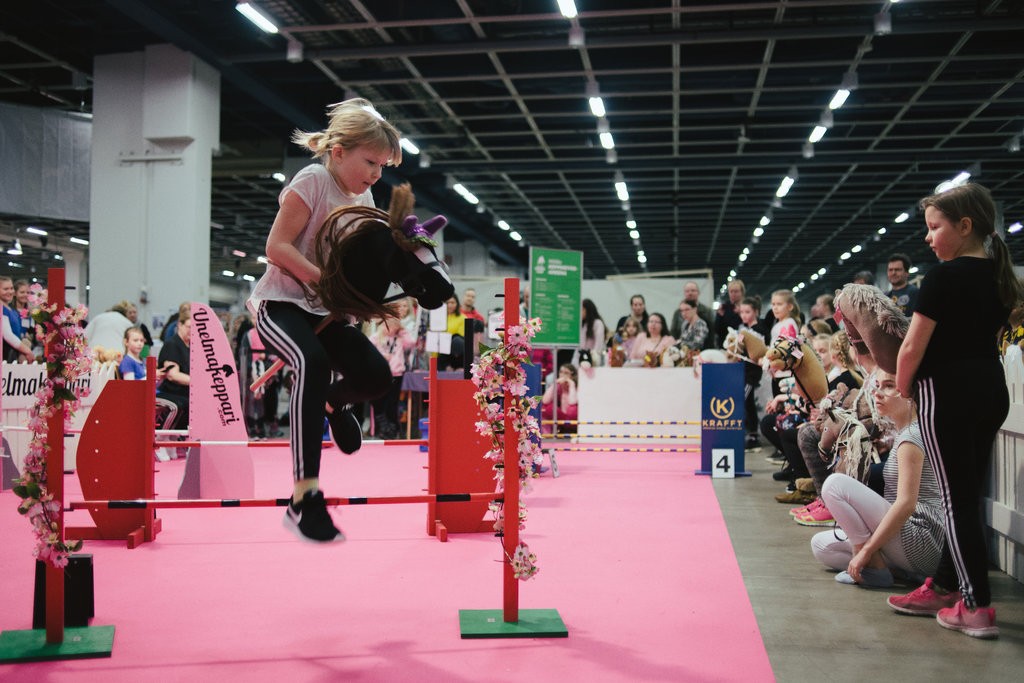
Photo: Dmitry Kostyukov for the New York Times A girl performing during a hobbyhorse competition in Helsinki in March 2019.
Now here’s an unusual pastime: hobbyhorse competitions. Who knows how these things get started with kids? They make up their own fun. It starts out as private play, under the radar, and before you know it, it’s on TV.
Ellen Barry reported from Finland for the New York Times. “A dozen girls waited in line in a Helsinki arena for the dressage competition, ready to show off their riding skills, their faces masks of concentration.
“The judge put them through their paces — walk, trot, canter — and then asked them for a three-step rein-back, that classic test of a dressage horse’s training and obedience. The judge looked on gravely, occasionally taking notes.
“If anyone thought it strange that the girls were riding sticks, no one let on. The make-believe world of the hobbyhorse girls extended as far as the eye could see.
“A veterinarian lectured girls on hobbyhorse vaccination schedules, saying ‘check that the eyes are clear and there is no nasal discharge.’ The girls discussed hobbyhorse bloodlines and hobbyhorse temperaments, hobbyhorse training routines and hobbyhorse diets. There were rhinestone-studded bridles for sale. …
“ ‘The normal things, that normal girls like, they don’t feel like my things,’ [Fanny Oikarinen, 11,] said. But she is at home in the world of hobbyhorses, where boys and grown-ups have no place.
“Fanny and her friend, Maisa Wallius, are training for summertime competitions. They have choreographed a two-part dressage routine to a song by Nelly, the rapper. Asked which types of girls are drawn to hobbyhorses, Maisa thinks for a while before answering.
“ ‘Some are sports girls,’ she said. ‘Some are really lonely girls. And some can be the coolest girl at school.’
“It is impossible to say exactly when the Finnish hobbyhorse craze began, because it spread for years under the radar before adults became aware of it.
“In 2012, a filmmaker, Selma Vilhunen, stumbled across internet discussion boards used by hobbyhorse enthusiasts and was enraptured.
“Teenage girls had invented a form of hobbyhorse dressage, in which the rider’s lower body pranced and galloped like a horse, while her upper body remained erect and motionless like a rider. This evolved into an elaborate network of coaches and students and competitions, but it was discussed only online, for the most part.
“ ‘It was like a secret society,’ Ms. Vilhunen said.
“One of the girls she sought out as a guide to the hobbyhorse scene was Alisa Aarniomaki, a teenager from a city on Finland’s west coast.
“Leather-jacketed and fuchsia-haired, Ms. Aarniomaki was a celebrity in the online world for her hand-sewn hobbyhorses and riding videos, but she was apprehensive about letting her classmates know about it. When she was 12, some friends happened to spot her practicing in the woods near her school, and teased her for playing a child’s game. …
“When Ms. Vilhunen’s documentary film, ‘Hobbyhorse Revolution,’ was released in 2017, it captured its subjects in long spells of raucous joy. This was important to the filmmaker, who has made adolescent girls the focus of much of her work.
“ ‘Little girls are allowed to be strong and wild,’ she said. ‘I think the society starts to shape them into a certain kind of quietness when they reach puberty.’ …
“Within the rapidly expanding community of enthusiasts, the problem of ridicule really doesn’t come up. ‘I haven’t run into that sort of situation in a long time,’ [Ms. Aarniomaki] said. ‘I live in a bubble that is filled with hobbyhorses.’ ”
Photo: Mashable
Teen girls invent portable, solar-powered tent for people experiencing homelessness.
I worked at MIT in the early 2000s in the same building as a foundation that gave grants to inventors, both established inventors and young people. How the family made the money that funded the foundation is a complicated story, but this support for inventors is a big deal, so hats off for that!
Brittany Levine Beckman writes at Mashable about an invention by an inspiring group of teen girls.
“As Daniela Orozco picks off excess plastic bordering a 3D-printed box, she recalls how many homeless people she saw on her way to school when she was a high school freshman. Just one.
“Four years later, the number has multiplied. … In the San Fernando Valley, homelessness increased 36% to 7,094 people last year, according to the Los Angeles Homeless Services Agency’s annual count. Daniela and her friends wanted to help, but giving money wasn’t an option.
” ‘Because we come from low-income families ourselves, we can’t give them money,’ the high school senior says. …
“That was the starting point for their invention: a solar-powered tent that folds up into a rollaway backpack. The girls and 10 others from their high school had never done any hands-on engineering work before, but with the help of YouTube, Google, and trial-and-error, they got it done. They hope that one day, their tent will improve the lives of people experiencing homelessness in their community.
“The teen girls from San Fernando High School … none of whom had coded, soldered, sewn, or 3D-printed before they joined forces, won a $10,000 grant from the Lemelson-MIT Program to develop the invention.
“They were recruited by DIY Girls, a nonprofit that teaches girls from low-income communities about engineering, math, and science, to go after the grant.
” ‘I knew I wanted to apply for it, but I needed a team,’ says Evelyn Gomez, 29, the executive director of DIY Girls. ‘I went back to my calculus teacher at my high school and did a hands-on recruitment activity.’ …
“Hands-on STEM education at schools, especially for girls in low-income communities, is severely lacking, Evelyn says. Women make up just 29% of the science and engineering workforce, according to the National Science Board, a federal agency. Around 6% of female working scientists and engineers are Hispanic or Latina.
” ‘I studied aerospace engineering. When I was getting my master’s degree, I was often the only girl in the class and definitely the only Latina in the class. … You’re going to represent the Latina community in a bad light if you ask a stupid question or you’re going to represent women in a bad light if you ask a stupid question, and of course that’s not true. But I felt that.’ …
“In the beginning, the team depended on Evelyn for guidance, but they quickly started doing everything on their own. If they had an issue with a solar panel not functioning properly, they watched YouTube videos. If they couldn’t figure out a stitch pattern, they Googled it. The girls even developed their own inspirational hashtag: #wegetitdone.
” ‘You’re learning new things you’ve never even heard of or even thought of,’ says Chelly Chavez, who learned the programming language C++ to get the technical aspects of the tent to behave. The tent has button-powered lights, two USB ports, a micro-USB port, and the girls have even tested a sanitizing UVC light on a countdown timer. …
“They made two prototypes of the tent, but the first one is now in shreds. They put it through the ringer during quality control tests, tearing it with a knife, dousing it with water, and stomping on it. … They destroyed their finished product, just to start again. It was yet another tough engineering lesson the girls would learn. …
“The $10,000 grant from the Lemelson-MIT Program could only be used on the invention itself, not traveling to Cambridge, Massachusetts, to present the award. So DIY Girls fundraised an additional $15,000 to send the team to MIT.” More here.
Photo: Smithsonian This quilt, “Solar System,” was created by E.H. Baker in 1876 and is now in the collection of the Smithsonian Institution. Astronomy was a field of science that was more open to women historically than other fields were.
Women have always been interested in science, but they have not always been welcomed as equals. Consider Beatrix Potter, who was more knowledgeable about botany (mushrooms especially) than most men of her time.
But a determined woman could still learn and contribute. It seems that many were interested in astronomy, sometimes translating that interest into the art form they knew best.
At the Smithsonian’s website American History, you can read about Ellen Harding Baker of Cedar County, Iowa, and the quilt of the solar system she completed in 1876 after years of research to make it as accurate as possible.
“The wool top of this applique quilt is embellished with wool-fabric applique, wool braid, and wool and silk embroidery. … The lining is a red cotton-and-wool fabric and the filling is of cotton fiber. The maker, Sarah Ellen Harding, was born in Cincinnati, Ohio, June 8, 1847, and married Marion Baker of Cedar County, Iowa, on October 10, 1867. They lived in Cedar County until 1878, and then moved to Johnson County. …
“The design of Ellen’s striking and unusual quilt resembles illustrations in astronomy books of the period. Ellen used the quilt as a visual aid for lectures she gave on astronomy in the towns of West Branch, Moscow, and Lone Tree, Iowa. New York Times (September 22, 1883) mentioned this item from an Iowa paper: ‘Mrs. M. Baker, of Lone Tree, has just finished a silk quilt which she has been seven years in making. It has the solar system worked in completely and accurately. The lady went to Chicago to view the comet and sun spots through the telescope that she might be very accurate. Then she devised a lecture in astronomy from it.’ ” More.
Good news, bad news. Maria Mitchell of Nantucket garnered international recognition for discovering a comet, but her female students were generally shut out of work in the field.
Smithsonian reports, “Mitchell was born on Nantucket in 1818. Her family was Quaker, which meant that they believed both girls and boys should go to school. Her father, a teacher and an astronomer, taught her about the skies when she was very young. In terms of equipment, at-home astronomers weren’t at a disadvantage; Harvard’s telescope was roughly the same size and power as the Mitchells’. When she was 12, she and her father observed a solar eclipse.
“From there, Mitchell’s ascent as an astronomer was swift. In 1847, the prince of Denmark awarded the 29-year-old Mitchell a medal for reporting a comet that was too far away to be seen without a telescope (the comet became known as ‘Miss Mitchell’s Comet’). The next year, she became the first woman elected into the American Academy of Arts and Sciences. …
“[Mitchell] used the rhetoric of the time to argue for more women in the sciences. ‘The training of a girl fits her for delicate work,’ Mitchell wrote in 1878. ‘The touch of her fingers upon the delicate screws of an astronomical instrument might become wonderfully accurate in results; a woman’s eyes are trained to nicety of color. The eye that directs a needle in the delicate meshes of embroidery will equally well bisect a star with the spider web of the micrometer.’ ” More.
Quilters! Be sure to check out other solar-system quilts at Barbara Brackman’s blog on blogspot, here.
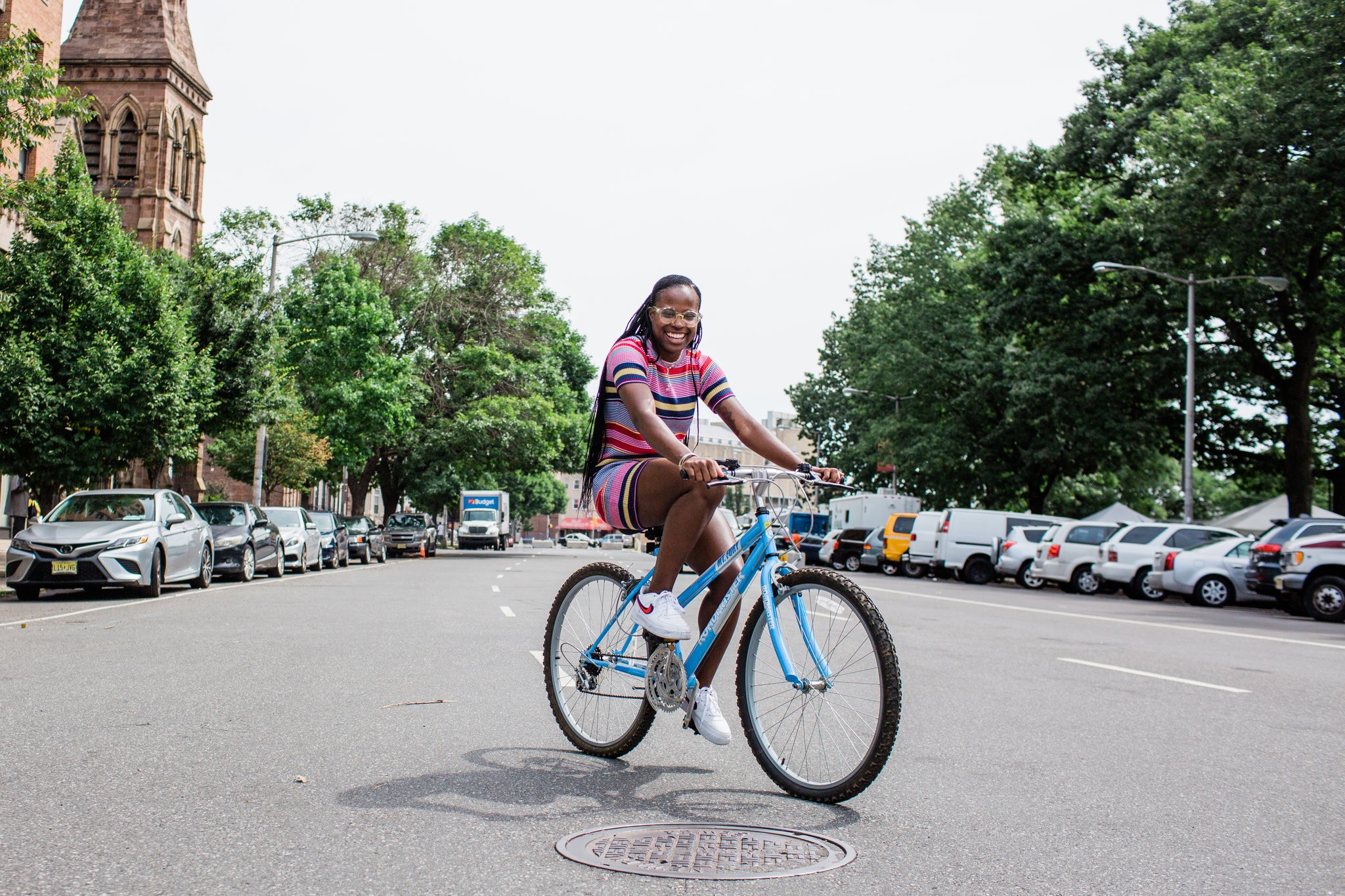
Photo: Gabriela Bhaskar for the New York Times
A graduate of Rutgers University in Newark is teaching girls to ride bicycles as part of a program run by the organization she founded, Girls on Bikes.
I love reading how a small gesture or comment can lead to something big in a person’s life. It’s all about the Power of One. In this story, a bystander said something upbeat to Kala La Fortune Reed when she was biking to class, and it led to a movement.
Liz Leyden writes at the New York Times, “The training wheels were off. The young woman with a bright smile and golden sunglasses told Kaneisha Marable she didn’t need them. The little girl believed her.
“Kaneisha pedaled a wobbly path up the block beside Lincoln Park. House music thumped from the stage to her left, a festival underway, but the 8-year-old girl paid it no mind. Her eyes darted between the pavement ahead and Kala La Fortune Reed, the woman jogging by her side.
“The bike tipped. Kaneisha teetered. Finally, the wheels began to spin. Ms. La Fortune Reed let go, watching girl and bike move farther away.
“ ‘Yes, she’s got it,’ she exhaled. ‘You got it!’
“The victory came on a [Sunday in August] at a learn-to-ride clinic run by Girls on Bikes, a community group aiming to achieve pedal equality for a new generation of girls and women in Newark.
“The effort began in 2016 when Ms. La Fortune Reed rediscovered her old bicycle and started riding everywhere: to classes at Rutgers University in Newark, thrift shops and parks throughout the city.
“One day, a man called out to her. Keep it up, he said. There aren’t enough girls on bikes.
“Ms. La Fortune Reed scanned the streets and realized he was right. … She recruited Maseera Subhani and Jenn Made, friends from Rutgers who shared her love of cycling and for Newark itself; the idea of using bicycles to spread empowerment resonated with each of them.
“The trio juggled full-time classes and part-time jobs to get the group going. Ms. La Fortune Reed interned with a local bike mechanic and learned how to repair bikes and build them from scratch. Ms. Made created a curriculum for school workshops. Ms. Subhani found graphic designers to make fliers and T-shirts, and reached out to other community groups to collaborate. …
” ‘We wanted to create a sisterhood,’ Ms. La Fortune Reed said. ‘We go really slow. We have fun. We’re doing this to build relationships, to build a movement.’ …
“Ms. La Fortune Reed said Girls on Bikes tries especially hard to reach girls in middle school.
“ ‘We try to catch them at that age, to build up bicycling and the idea of empowerment and leadership, before peer pressure hits,’ she said.
“In June, the group taught a four-week workshop for sixth- through eighth-grade girls at Marion P. Thomas Charter School. …
“ ‘Before, there was a negative connotation for a lot of them — this idea that if you rode a bike it meant you couldn’t afford a car, that you weren’t cool,’ [the teacher] said. ‘But having that reimagined by these strong, stylish young women, the students really bought into it.’ …
“More than 80 children, including 45 girls, participated throughout [the August bike] weekend. Some didn’t need any help, just a nudge to put on helmets. Simply watching them enjoy the bicycles made Ms. La Fortune Reed happy.
“But the moments when she saw girls growing in their confidence — testing out no-hands, standing on their pedals, letting go of training wheels — meant something more. ‘We’re leaving a memory in their lives that they can accomplish anything,’ she said.
“When Kaneisha Marable realized that she was riding on her own, she looked back at Ms. La Fortune Reed, astonished. She rode and rode and then ran off, returning a few minutes later with her mother. She climbed back on the bicycle.
“ ‘Look, Mommy, look! Look what I learned to do!’ ”
Photo: Only a Game
Golf was the entree to a freer world for this Afghan girl.
We hear a lot of stories about disadvantaged kids who rise above their circumstances by becoming stars — at sports, say, or ballet.
But sometimes the reason those pursuits mark a turning point is simply that they open up a different world. They show the kid that there are different worlds. The kids don’t have to become stars to benefit.
Here is a story about an Afghan girl whose path to breaking free involved golf. Martin Kessler tells the story at the radio show Only a Game.
“Before it was her turn to take the shot that could change her life, Shagufa Habibi remembers being uncomfortably warm.
“Shagufa and 11 of her teammates were standing on a soccer pitch in Herat, Afghanistan. Herat doesn’t have a golf course, so this soccer pitch was the best her team could do. It was a summer afternoon — the hottest part of the day in a city where temperatures can exceed 100 degrees. It was the only time locals would let the women have the field.
“Shagufa wore a long black dress and a head scarf. She carried a wooden club.
“Each of the women had one chance to hit a ball at a target at the other end of the field. Whoever got closest would get to attend a golf tournament in Bangladesh.”
Shagufa amazed herself. Her shot was the best.
“Shagufa Habibi was born in 1995, the youngest child in a large family. Her parents are illiterate. Her dad made his living selling dried fruit — until his hand was mangled in a terrorist attack at a local mosque. …
“When Shagufa was a young girl, the Taliban controlled Afghanistan. Girls couldn’t go to school, so Shagufa and her seven sisters stayed home. Shagufa was allowed outside just once a day, to help her mom buy food. …
“In 2001, the Taliban lost control of the government, and schools opened for girls. Shagufa’s friends started attending. But Shagufa’s father wouldn’t have it – he believed women belonged at home.
“So Shagufa and her sisters devised a plan. After their father left the house in the morning, they would sneak off to school.”
Over the next few years, there were conflicts with Shagufa’s conservative father, an unwanted marriage to an older man, separation, depression, and a decision to embrace sports at school. Sports were so freeing.
” ‘I was forgetting everything,’ Shagufa says. ‘I’m just free. And this ball was giving me more motivation for my future to be so optimistic.’
When Shagufa went to that golf tournament, she was “amazed by what she saw in Bangladesh. Girls weren’t wearing long dresses or scarves. She says women looked so free.
“On the final day of the trip, the Afghan embassy hosted their players for a lunch. The conversation turned to education. Shagufa had a question – but she wasn’t sure she should speak up.
” ‘Should I ask them or not, should I ask them or not?’ Shagufa remembers thinking. ‘Then I said, “Would you tell me, please: how is the education in Bangladesh? And is it possible for me, somehow, I come and do my education?” ‘ ”
Read what happened next at WBUR’s Only a Game, here.
The first booth I encountered at the Art and Artisan fair Saturday was promoting a charity called Vision of Hope Zambia.
Co-founder Meg O’Brien had been a student at Berklee College of Music when a missionary friend in Zambia asked her to lend her musical talent to uplifting girls who lived on the streets.
When she visited Africa, Meg must have been shocked by what she saw: young girls, often orphaned, often HIV positive, who had no place to get a meal or even take a shower. She flew into action, co-founding Vision of Hope Zambia with Chitalu Chishimba.
Meg’s mother and aunt also flew into action, creating a craft initiative that donates 100 percent of proceeds to the cause.
The two artisans not only sew with skill — baby bibs, changing blankets, aprons and the like — they also are good at selling, promoting Meg’s charity while highlighting various features of their products.
Meg’s aunt saw me talking to my grandchildren and immediately pointed out the colorful array of child-size aprons. In the end, though, I bought an adult-sized apron for myself.
From humble beginnings in 2009 (“weekly meetings in the backyard of the Girl Scouts building underneath a tree”), the organization is now able to provide housing and education for many girls as it continues to grow.
Photo: Vision of Hope Zambia Girls at Vision of Hope proudly show off their hard work in rug making.
Photo: Thomson Reuters Foundation Schoolgirls make their way to their school on an early morning in New Delhi.
Not long ago I read a story about boys in India who volunteer to help girls pursue education.
The article by Astrid Zweynert and Ros Russell begins, “Boys campaigning for girls’ education is not common in most parts of the world, but in India’s Rajasthan state, they are at the heart of a drive to get more girls into schools.
“Educate Girls trains young people to go into villages to find girls who are not in the classroom in a country where more than 3 million girls are out of school.
“Some 60 percent of Educate Girls’ 4,500 volunteers are boys, founder and executive director Safeena Husain told the Thomson Reuters Foundation.
” ‘Having these boys as champions for the girls is absolutely at the core of what we’re trying to achieve,’ Husain said in an interview as she was awarded the $1.25 million Skoll Award for Social Entrepreneurship, the largest prize of its kind. …
“In Rajasthan, 40 percent of girls leave school before reaching fifth grade, often because their parents do not see education as necessary for their daughter because she is going to get married or stay at home to do housework, Husain said. …
“Educate Girls’ approach to is to define hotspots where many girls are out of school, often in remote rural or tribal areas, and then deploy its volunteers to bring them back into the classroom, said Husain.”
There’s plenty of research showing that when girls are educated, the standard of living in a country goes up. Educated girls “are less likely to get married at an early age or to die in childbirth, they are likely to have healthier children and more likely to find work and earn more money.”
I hardly need to remind readers of this blog that people are people. We are all just living our lives, with more or less the same daily concerns. And the differences are what make things interesting.
Sam Radwany at the radio show Only a Game recently described some youthful experiences in Minneapolis that sound both the same and different. The story is about a group of American Muslim girls who choose to cover themselves in keeping with their kind of Islam but who are also enthusiastic basketball players.
“The Twin Cities are home to one of the largest Somali populations in the world. The community is concentrated in the Cedar-Riverside neighborhood of Minneapolis, where these pre-teen players go to school. … Balancing their cultural and religious standards of modesty with sports can be tricky.
“ ‘Sometimes our hijab, our scarves, got off, and we would have to time out, pause, to fix it,’ Samira said. ‘Our skirts were a problem — they were all the way down to our feet.’ …
“Last season, some of the girls opted to wear long pants instead of dresses. But that still put them at a disadvantage when playing other Minnesota teams. …
“And because the girls’ team didn’t have their own jerseys, they had to share with the boys. Ten-year-old Amal says the experience was unpleasant.
“ ‘Horrible! Very horrible,’ she said. ‘And the boys, their jerseys were all sweaty and yucky and nasty.’ …
“That’s where a local nonprofit dedicated to expanding sports and recreation opportunities for local Muslim girls stepped in. … [They] brought in researchers and designers from the university to help the young athletes find a new solution to the stinky jersey problem.
“Jennifer Weber, the girls’ coach, said the players did most of the work themselves, with guidance from the experts. …
“Chelsey Thul from the university’s Tucker Center for Research on Girls and Women in Sport described some features of the new uniforms: ‘And so this sport uniform has black leggings. It’s longer, probably about to the knees …
“ ‘The biggest change to the hijab is that it’s not a pullover, so that instead, it fastens with Velcro at the neck,’ Weber said. ‘So it’s got some give to it, and it’s forgiving, and it moves as they move.’
“And of course, with the young girls’ input, there’s a bit of color. Samira and Amal said the team had a lot of ideas.” Read about their design ideas and their delight in the uniforms here.
Photo: Jim Mone/AP
Somali American girls in the Cedar-Riverside neighborhood of Minneapolis designed their own uniforms for greater freedom of movement.
I was on the brink of unsubscribing to the American Academy of Poets poem-a-day e-mail because I let so many pile up and then have to slog through all sorts of contemporary brain twisters.
But as I was working my way through the poems today, I came across the one below. I thought, “Oh, I know exactly what this is about” and was carried back to my college days and hanging out at the home of my great aunt’s friend Gertrude Ely.
Gertrude Ely was quite elderly at that time but really interesting to be around. She knew all sorts of movers and shakers and was an awesome storyteller. I happened to be staying at her house one weekend when she received an unusual letter.
An elderly Philadelphia gentleman wrote that he had read in the Bulletin that she had received some civic award, and he just had to write and tell her a memory he had from his service in WW I in Europe. The Army was sending over carloads of friendly, proper young volunteers to chat with and cheer soldiers and bring a breath of home. The man wrote he would never forget a load of girls pulling up in an open car and Gertrude Ely calling out, “Any of you boys from Philadelphia?” He said, “At that moment, I believe every soldier there was wishing he was from Philadelphia.”
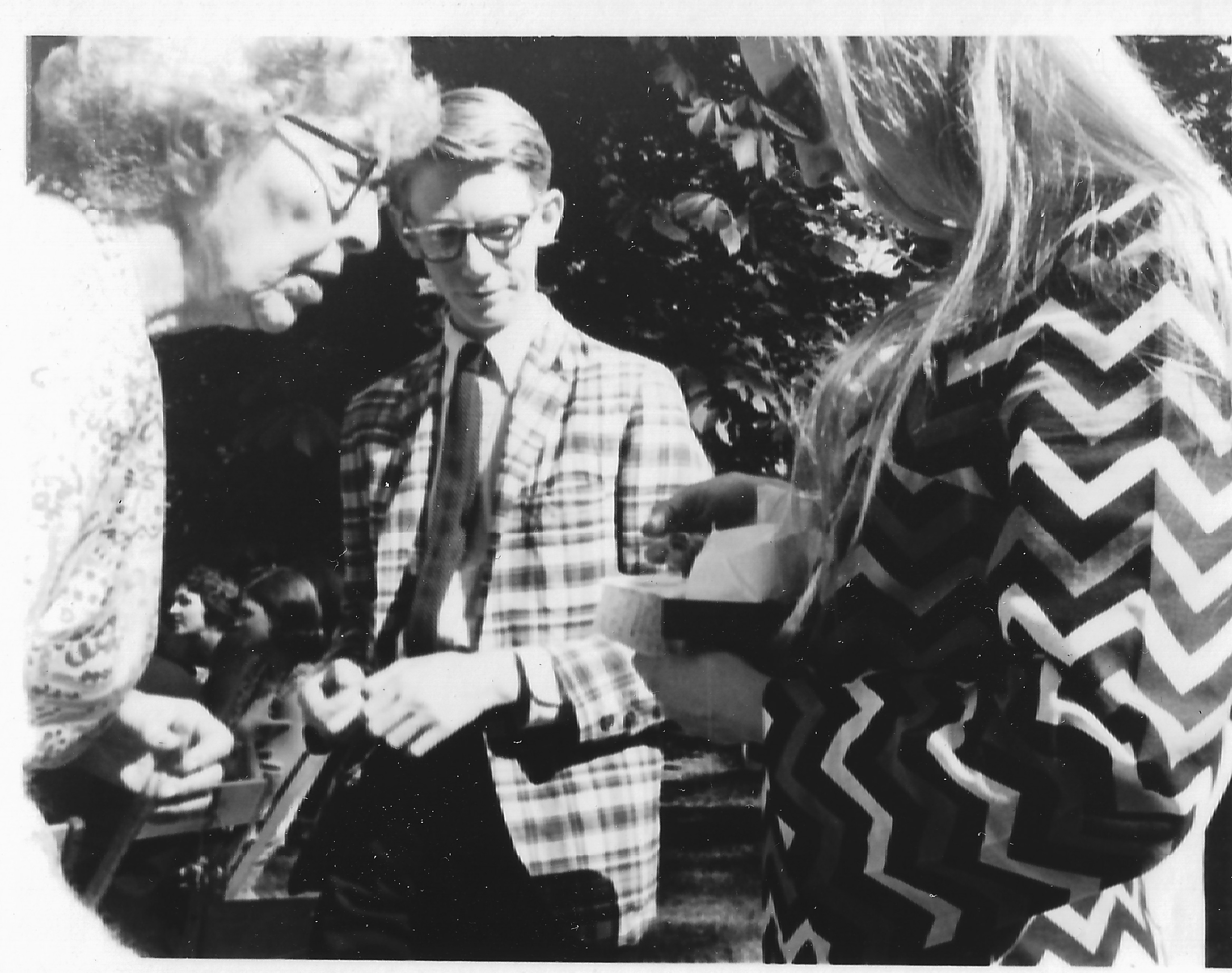
Gertrude Ely at my college graduation.
***
American Boys, Hello! by Ella Wheeler Wilcox
Oh! we love all the French, and we speak in French
As along through France we go.
But the moments to us that are keen and sweet
Are the ones when our khaki boys we meet,
Stalwart and handsome and trim and neat;
And we call to them—“Boys, hello!”
“Hello, American boys,
Luck to you, and life’s best joys!
American boys, hello!”
We couldn’t do that if we were at home—
It never would do, you know!
For there you must wait till you’re told who’s who,
And to meet in the way that nice folks do.
Though you knew his name, and your name he knew—
You never would say “Hello, hello, American boy!”
But here it’s just a joy,
As we pass along in the stranger throng,
To call out, “Boys, hello!”
For each is a brother away from home;
And this we are sure is so,
There’s a lonesome spot in his heart somewhere,
And we want him to feel there are friends
right there
In this foreign land, and so we dare
To call out “Boys, hello!”
“Hello, American boys,
Luck to you, and life’s best joys!
American boys, hello!”
[Ella Wheeler Wilcox wrote “American Boys, Hello!” while visiting France during the latter stages of World War I as entertainment for the American soldiers stationed there.]
Photo of Ella Wheeler Wilcox: American Academy of Poets, here.
She’s a mild-mannered school teacher in Pakistan — unless education for girls is threatened, and then, watch out! She’s the Burka Avenger!
Salman Masood and Declan Walsh have the story at the NY Times: “Cartoon fans in Pakistan have been excited by the arrival of the country’s first caped crusader, in the form of a female superhero who flies through the air, battling villains using pens and books.
“The heroine, Burka Avenger, is certainly an unusual role model for female empowerment in Pakistan: a woman who uses martial arts to battle colorful villains …
“But the cartoon, in which a demure schoolteacher, Jiya, transforms into the action heroine by donning a burqa, or traditional cloak, has also triggered an awkward debate about her costume.
“ ‘Is it right to take the burqa and make it look “cool” for children, to brainwash girls into thinking that a burqa gives you power instead of taking it away from you?” asked the novelist and commentator Bina Shah in a blog post.
“The criticism has not overshadowed the broader welcome that Burka Avenger, which aired [in Islamabad] for the first time on Sunday evening, has received. With slick computer animation, fast-paced action and flashes of humor that even adults can appreciate, the character could offer Pakistanis a new cultural icon akin to Wonder Woman in the United States.”
And she is generating some thoughtful discussions about the role of girls and women and the importance of education for girls. The show’s maker, pop star Aaron Haroon Rashid, points out that the burka is merely the heroine’s disguise.
(An excellent disguise indeed, used effectively by the playwright Tony Kushner in Homebody/Kabul, about a Western woman who leaves home and disappears in Afghanistan.)





 Suzanne's Mom's Blog