Feeds:
Posts
Comments

Posts Tagged ‘healing’

Photo: Linda Xiao for the New York Times.
The hearty and healing Korean soup called gukbap.

Did you love Michelle Zauner’s Crying in H-Mart, her wistful, mouth-watering memoir? The Korean American emo singer wrote beautifully about her difficult relationship with her Korean mother, a relationship that couldn’t be understood without delving into the love they shared for Korean food.

If you also like Korean food, consider this hearty, aromatic soup, good for whatever ails you.

Eric Kim writes at the New York Times, “I come from water people. My mother, Jean, grew up in Jeonju, the capital of North Jeolla, a province on South Korea’s west coast known for its salt-preserved seafood, assertively seasoned cooking and clear spring water. It’s said that the same water makes the region’s bean sprouts especially sweet, germinating them, then eventually extracting their gentle flavor, as in one of the city’s signature dishes, bean-sprout soup with rice.

“In Korean cuisine, a scoop of steamed white rice nestled inside a bowl of brothy soup, or gukbap, forms a wide category of healing meals. Many things can become gukbap, like those bean sprouts and rice (kongnamul gukbap), our house brew when I was growing up; pork bones and rice (dwaeji gukbap); and beef, radish and rice (sogogi gukbap). There’s always rice, or bap, which also means meal in Korean. To some ears, then, gukbap could be translated to ‘soup meal,’ breakfast, lunch or dinner, not least because that one bowl contains protein, carbohydrates, vegetables, fat, everything.

Build a meal around soup — or build a life around it, as my family has, a pot ever-simmering on the stove — and you might slowly find yourself healed.

“Soup rice eases as it goes down. My friend Matt Rodbard, who was a writer of the cookbooks Koreaworld and Koreatown, calls gukbap a ‘utility player,’ because it can be served in the morning, ‘for fortifying a hangover or just getting you a solid foundation for the day,’ or in the evening with soju, to catch (or extend) the night’s excesses. …

“It took me until my 30s to realize how much I had taken my mother’s cumulative hours of boiling homemade stocks for granted. In the United States, standard boxed broths like chicken, beef and vegetable are much too assertive for the kinds of gentle Korean soups that nuzzle you from the inside because they’re so rich in flavor yet light on the tongue.

“There are no shortcuts to that kind of umami, but there are tricks: Sohui Kim, who wrote Korean Home Cooking, taught me to sear beef before boiling it for a stronger-tasting broth. Or if you want the kind of quiet savoriness that only vegetables can lend, turn to her ideal soup meal these days: doenjang guk, with hearty greens like spinach and radish tops. For Joanne Lee Molinaro, the author of The Korean Vegan Cookbook, her vegetarian yukgaejang fits the bill whenever she’s craving gukbap, which is often meat-based. The spicy soup’s quintessential ingredient, gosari, the new stems of the bracken fern, shreds beautifully, like meat. Caroline Choe, who wrote the cookbook Banchan, adds a little ground black pepper and scallions to gomtang, a beef-bone soup, her go-to for gukbap. Each of these cherished home soups is eaten with a scoop of rice, because on the Korean table, when there’s guk, there’s bap.

“This Kim-family gukbap, a Korean American iteration of my mother’s hometown classic, leads with beef and radish, bolstered by a hearty handful of soybean sprouts, which lend both protein and aroma. The brightest, reddest gochugaru you can find, bloomed in the beef fat, results in a tongue-tingling chile oil, pure flavor floating atop the soup.

“Ordinarily you would use a big, juicy Korean radish for this type of broth, for the edge of sweet bitterness it lends, but I prefer small red radishes, the latent Pink Power Ranger in me emerging as their carmine skins soften to a translucent fuchsia, a sign of tenderness. Where salt seasons this soup, fish sauce dials up its umami. …

“Resourcefulness is never bad when you’re cooking from scratch, especially when you remember that water, too, is a resource. In the Korean kitchen, a cook might save the starchy runoff water from rinsed rice to thicken a soup later or to germinate a bean seedling.”

More at the Times, here.
Read Full Post »

Photo: Atdhe Mulla.
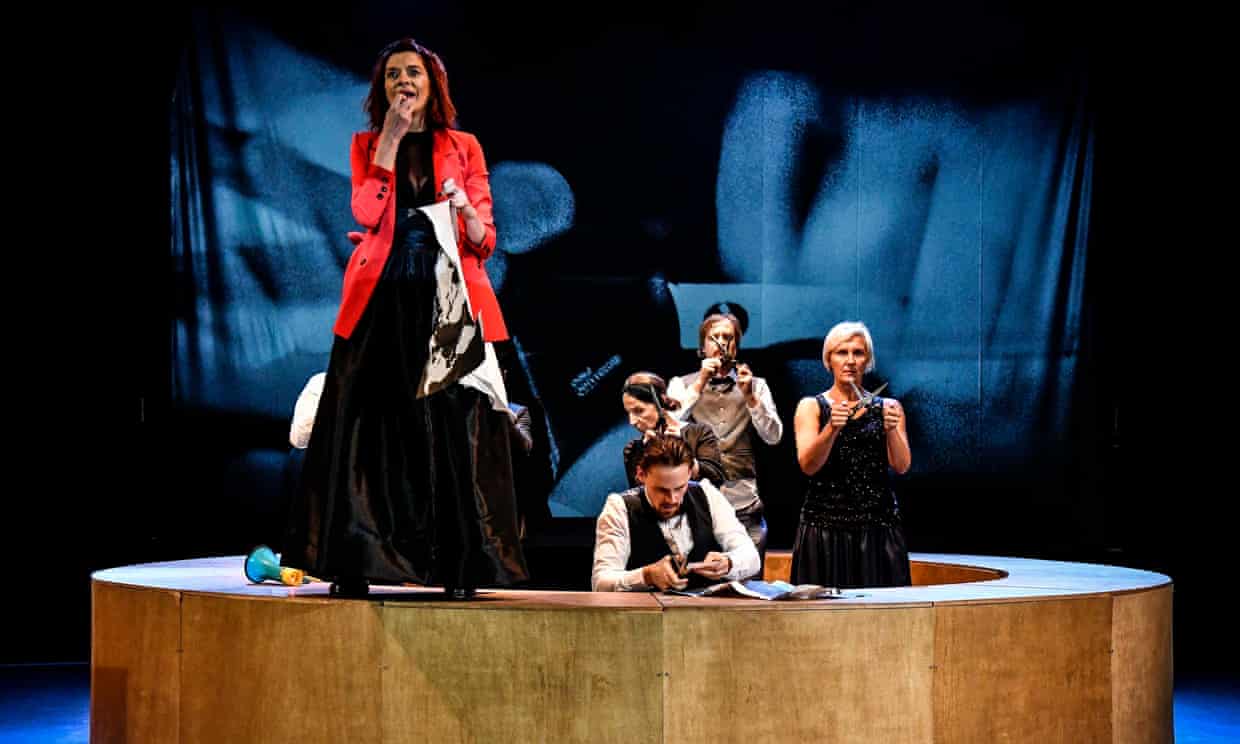
The play Negotiating Peace had its premiere at Pristina’s Oda theatre in October, before going on tour. 

Wars eventually end, but the peace that follows is often uneasy. Art can bring some laughs into people’s lives and add to the accumulation of small things that make a more lasting difference.

Philip Oltermann writes at the Guardian, “When political leaders present war as the only solution, it is up to artists to remind people that finding peace is still possible. That is the starting point for a Kosovo-based theatre company, Qendra Multimedia. …

“The lesson it draws, and the genre it chooses to present its findings, is unexpected: the Kosovan playwright Jeton Neziraj’s Negotiating Peace shows the diplomacy of peace as a farce, albeit a necessary one.

“Dramatizing roundtable talks between the fictional warring countries of Banovia and Unmikistan, the play is a frenzied comedy in which vain generals can only be lured to the negotiating table by promises of Hollywood films celebrating their actions. Opposing parties get drunk while negotiating demilitarized zones, mix up drafts of ceasefire agreements and sign on the wrong dotted line. Maps of disputed territories are partitioned with paper scissors until holy lands turn into showers of confetti. …

“ ‘When you talk about serious things, you must not talk about it in a serious way,’ said Orest Pastukh, a Ukrainian actor who is one of five members of Qendra’s multinational cast with first-hand experience of their country going to war. ‘If we would speak seriously about war and peace, everybody would go mad.’

“The play … is loosely based on the Dayton accords that in 1995 brought a halt to the three-and-a-half-year Bosnian war, the deadliest chapter in the breakup of Yugoslavia. At its premiere at Pristina’s Oda theatre last week, it also mixed in elements of the peace settlement that four years later ended the war in Kosovo. …

“To end that conflict between Serbs and Kosovo-Albanians in the breakaway province, Nato acted more swiftly and aggressively than it had done in the Bosnian war. In downtown Pristina, gratitude for the US’s assertive leadership in the peace talks is still palpable. There is a statue of a waving Bill Clinton, a bust of Madeleine Albright and a street named after Richard Holbrooke. …

“It may seem surprising, therefore, that in Negotiating Peace, moral certitudes come wrapped in sarcasm and not in pathos. The Holbrooke-type character, Joe Robertson, played by Harald Thompson Rosenstrøm, a Norwegian, is not just a ‘beast of peace’ but also ‘a schizophrenic, a brutal Mazarin.’ …

“ ‘When I read Holbrooke’s memoir To End a War, I realized that the negotiating table was also a kind of stage,’ Neziraj said on the eve of his play’s premiere. ‘And a dramatic stage on which actors were acting quite bizarrely,’ involving negotiators staging walkouts and new political borders ‘being drawn on napkins.’

“He said studying the Dayton agreement, as well as the Oslo accords signed between Israel and Palestine in 1993, had robbed him of the illusion that peace talks were structured conversations led by experts in their fields. ‘They are the fruit of the wills of individuals at a certain moment,’ Neziraj said. …

” ‘War doesn’t end when you lay down your arms,’ Neziraj said. ‘We in Kosovo live in an interim state, which is not war but neither a fully fledged peace.’ …

“Neziraj is aware of his own cynicism, and Negotiating Peace eventually manages to snap out of it. Towards the end of the play, the summit looks like a failure: faith in the UN is shot to shreds, there are calls for a second conference organized by the EU.

The chief negotiator appeals to the audience for advice to break the deadlock.

“As the play tours around the Balkans, the company intends to invite different real-life witnesses on to the stage. In Pristina the job fell to Aida Cerkez, a veteran Associated Press correspondent who covered the siege of Sarajevo from the Bosnian capital. Her 10-minute monologue changes the mood of the play.

“ ‘The only precondition for peace is to get everybody around the same table,’ she said after the curtain call. ‘And to get everybody around the same table, you have to militarily weaken the dominant side. As long as one side can think it can win, there’s no reason to sit down at the negotiating table. In Bosnia, that condition was met by Nato bombing. …

” ‘Peace is not the absence of armed conflict,’ she said. ‘In Bosnia we are living the absence of armed conflict, not peace. But that’s not nothing. It’s a lot.’ “

More at the Guardian, here. No paywall.

Read Full Post »

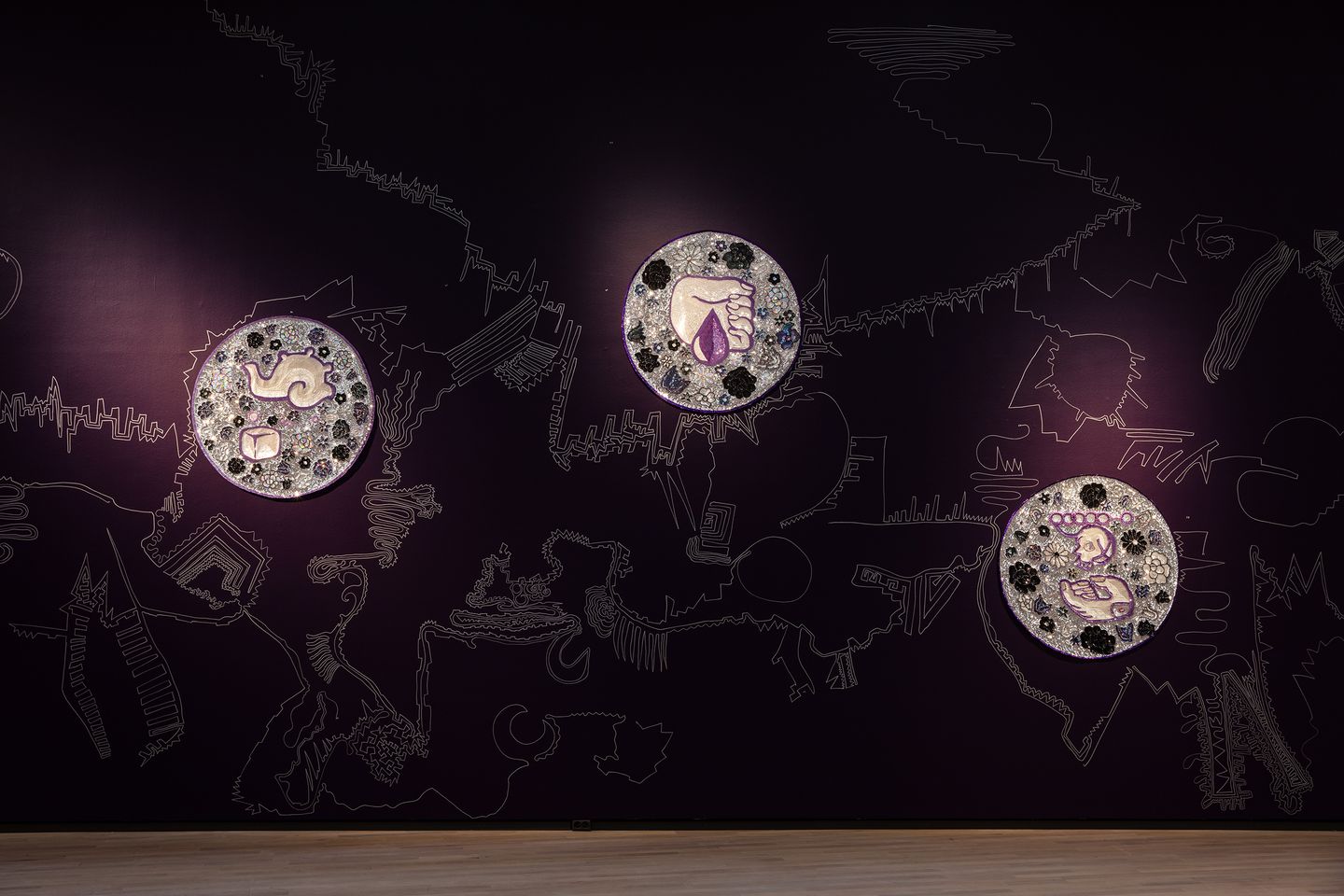
Photo: Christian Tunge via Henie Onstad Kunstsenter Museum in Norway.
Art by Guadalupe Maravilla: “Embroideries” (2019).

Today’s post is about the artist Guadalupe Maravilla, who has found his own way of using art-making as a healing practice. He is interviewed by Jareh Das at Ocula magazine.

“At the age of eight in 1984, Maravilla fled civil war in El Salvador and arrived in the U.S. undocumented. As an adult, he overcame colon cancer, which led him to learn about global healing practices from cultures as far-reaching as Mayan and Tibetan, alongside standard medical treatments like radiation and chemotherapy.

“Accordingly, his practice brings together often separate knowledge systems, from Western Cartesianism, which sees the mind and the body as separate entities, to non-Western and non-hierarchical approaches that look to nature and natural remedies for healing and tend to view humans as part of a wider cosmological system of equal parts.

“For Maravilla’s first exhibition in Europe, and most comprehensive to date, Sound Botánica at Henie Onstad Kunstsenter (18 March–7 August 2022), over 30 works comprising monumental sculptures, drawings, a large-scale mural, and instances of activated sound baths fill the institute, including four major bodies of work: ‘Tripa Chuca’ (2016–2020), ‘Embroideries’ (2019), ‘Disease Throwers’ (2019–ongoing), and ‘Retablos’ (2021), which are devotional [votive] paintings.

“Speaking to the ethics of artistic creation, both the retablos and embroideries were made with collaborators specialized in such forms, co-authored, and fairly compensated — all of which are important to Maravilla and his wider way of working.

Sound Botánica unfolds over two main gallery spaces with the most captivating and monumental works on view being Disease Thrower #4, #6, #7, #8, #9 (all 2019)—totem-like sculptures that each incorporate a sound gong, assembled from plaster of Paris made by microwaving tissues and plastic that hold together objects collected during the artist’s travels.

“The most recent Disease Thrower #13 (2021) is an astounding work measuring over two meters high made from cast aluminum, moulding vegetation and nature into a constellation of organic forms, some related to the healing and nutrition during Maravilla’s cancer treatment, with notable vegetable forms like squash placed besides real squash at the base of the sculpture.

“In the conversation that follows, Maravilla speaks about forced migration, how trauma manifests in the body and the collective, and disrupting boundaries between art and life, with a practice led by a personal commitment to create a more equal and equitable world.

Jareh Das: Some of your artworks, such as the series of monumental sculptures ‘Disease Throwers’, are activated through performative gestures. I notice they are made of materials like luffa sponges, anatomical models, gongs, glass bottles, and the invented plaster you create by melting tissues and plastic in a microwave.

“These are hybrid, totem-like sculptures that draw from your experience as a child who migrated undocumented to the U.S. They also bridge Indigenous cultures with ritual, and speak to your cancer treatments, which have included modern medical techniques alongside healing practices.

“How did you bring together these intersecting knowledge systems and develop an art practice centered on collective healing experiences, as the exhibition Sound Botánica at Henie Onstad Kunstsenter demonstrates?

Guadalupe Maravilla: I am interested in collective healing and the intersections between the Indigenous and the medical, and dismantling systems. My daily experiences are the core of my work. People often wonder how I can be so open about having cancer, being undocumented, and being a child of war.

“I escaped the civil war in the south of El Salvador in 1984 and migrated to the United States, which separated me from my family; this is very common with migration. Somehow, I made it to the United States — I feel very blessed to be in this position, as an artist now exhibiting all over the world.

“I have a teaching position as a professor and all these great things, so I think of how lucky I am, but I also think back to the kids who did not make it, particularly those who crossed with me. On the other hand, because I’m a cancer survivor too, I can make a direct connection between the trauma of the civil war and seeing violence as a kid and the illness that came to inhabit my body.”

More at Ocula, here. No paywall. You can also listen to an interview at PRI’s the World, here.

Read Full Post »

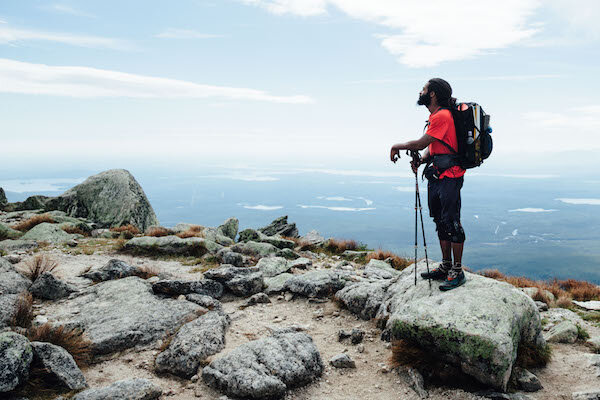
Photo: AkunaHikes.
“I learned that I was capable of living, I was capable of leading,” said the 41-year-old Army veteran who had struggled with post-traumatic stress disorder after Iraq.

I know that the Sound of Music is a little corny, but there is wisdom in the line “I go to the hills when my heart is lonely,” which Maria (soon to be Maria von Trapp) sings. Nature can be healing.

Andrea Sachs writes at the Washington Post about an Iraq war veteran and how the mountains healed him.

“Will Robinson was about 100 miles into his hike on the Pacific Crest Trail when the dark clouds started to lift. Not the ones high in the California sky, but the ones clustered in his head.

“ ‘I learned that I was capable of living, I was capable of leading. I was capable of inspiring and motivating people. That was something I had completely lost for a decade-plus,’ said the 41-year-old Army veteran who struggled with depression, anxiety and post-traumatic stress disorder after his medical discharge in 2003. …

“Since that first long-distance hike in 2016, his mileage has multiplied to more than 11,000 miles and counting. In 2019, he became the first Black American man to earn the Triple Crown of thru-hiking by completing the trifecta of legacy trails: the 2,650-mile PCT from California to Washington state, the 2,194-mile Appalachian Trail from Georgia to Maine and the 3,100-mile Continental Divide Trail from New Mexico to Montana. Two years later, ESPN declared Robinson ‘the trailblazing superstar of thru-hiking.’ He also received the 2022 George Mallory Award, which honors exceptional outdoor explorers. …

“Before the PCT, Robinson had never seriously hiked, though the military had prepared him for similarly tough challenges. ‘The closest thing I did to hiking was drill marching,’ said Robinson, who grew up on bases with his Army father. ‘It’s a lot different with a 100-pound pack and an M16, but it gave me a basis for hiking.’ In the armed forces, he powered through his pain, a practice he had to unlearn as a trekker. …

“After six months in Iraq and a stop in Germany for medical treatment, he returned to Louisiana, where he often felt too broken to leave the house, much less pursue outdoor activities. He underwent multiple surgeries and tried various therapy treatments and medications, to no avail. ‘After Iraq, I was disabled at 23,’ he said. A chance ‘encounter’ with celebrity long-haul hiker and Wild author Cheryl Strayed provided the jolt he needed to recharge his life.

“On that fateful day in March 2016, Robinson was in his room, ‘like always,’ when he glanced at the TV and saw Wild on the small screen. In the film version of Strayed’s best-selling memoir, he watched Reese Witherspoon lug her pack by a PCT trail marker, a scene that stirred up a memory from Iraq. During his downtime, Robinson would often pore over a PCT guidebook that someone had sent to the soldiers in a care package. ‘One day I’d love to do this,’ he said, reminiscing about that period in his life when he envisioned a future filled with adventure.

Without waiting for the closing credits, he jumped onto his computer and acquired a free long-distance permit, one of 5,657 issued that year.

“On April 2, he arrived in Southern California and embarked on a journey of personal discovery and recovery that resembled Strayed’s transformative quest two decades earlier. …

“In addition to the physical benefits of hiking in nature, medical experts extol its psychological virtuesStanford University-led research from 2015 determined that walking at least 90 minutes in a non-urbanized setting can help alleviate depression, lower stress and anxiety, and reduce rumination, the infinite loop of negative thoughts. A 2019 study called ‘Nature and mental health: An ecosystem service perspective’ also explored the wide-ranging rewards, such as a happier state of mind, more positive social interactions, a clearer sense of purpose and a sturdier grip on life’s demands. …

“Robinson did not initially set out to complete the entire PCT, which runs from the Mexican border to the Canadian border. His primary goal, he said, ‘was to try to see if I could find me again, regardless of how many miles it would take.’ With only a few weeks to prepare, he trained around Slidell, about 30 miles northeast of New Orleans. …

“Early in the hike, he found his trail family and earned his trail name, ‘Akuna,’ a riff on a Swahili phrase (and The Lion King refrain) that translates to ‘no worries.’ The nicknames are bestowed by other long-distance hikers or are given to oneself. They are often fanciful, silly or philosophical.

“About five miles in, he was resting on a rock, feeling sluggish, when a woman named ‘Cookie’ appeared at his side. She determined that he needed food and proceeded to stuff her namesake snack into his mouth. The pair forged a bond, along with ‘2Pie,’ a teacher from Ohio, and ‘Nothing Yet,’ a veteran who had tackled the AT [Arizona Trail] the previous year to quell his PTSD. The group hiked together for long stretches, a major breakthrough for Robinson, who for years had avoided social situations because of his fraught mental state.

“ ‘Being around people triggered panic and anxiety attacks, and I didn’t want any part of it. I just shut down,’ he said. ‘But on the trail, I ran into so many great individuals who were there for me. All they wanted was to be part of my adventure and help me accomplish my goal.’ …

“He said, ‘For me, every hike is like a therapy session in progress. I’m going through things in my head, working out problems. When I find a solution, I can zone out and be in peace.’ “

More at the Post, here, and at AkunaHikes, here.

Read Full Post »

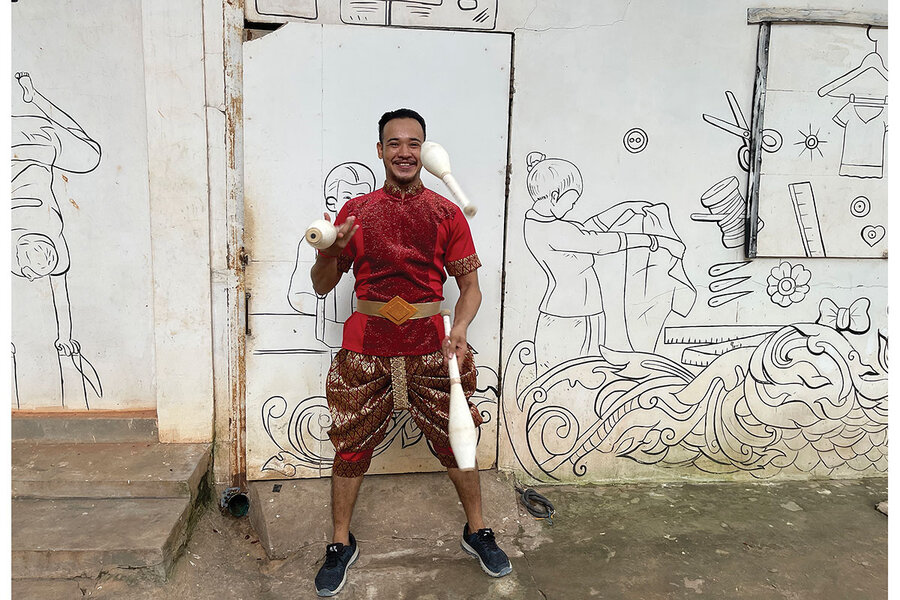
Photo: Charukesi Ramadurai.
A juggler welcomes visitors as they start arriving for the evening show at Phare Circus. Like other performers, he is a student of the Phare Ponleu Selpak school in Battambang, Cambodia.

I don’t belong to the religion, but I’ve always liked Christian Science Monitor articles, and now I know why. The other day, one of the editors wrote that finding positive angles on painful realities is intentional.

The story today acknowledges the horror of the Khmer Rouge genocide and its impoverished aftermath but focuses on one of the ways people are healing.

Charukesi Ramadurai writes, “A short drive away from the famed Angkor Wat temple ruins in Siem Reap, Cambodia, another spectacle has been quietly attracting visitors for years. Every evening, under the big top at the Phare Circus, audiences watch mesmerized as acrobats and artists jump and somersault, dance and paint, execute midair flips and twist into pretzels. …

“Watching them smile under the spotlight, it is difficult to imagine that these confident young men and women come from impoverished or troubled families. Celebrating its 10th anniversary on Feb. 8, Phare Circus simultaneously provides young Cambodians with a livelihood and showcases the talents of students at Phare Ponleu Selpak, a not-for-profit arts school located in Battambang, Cambodia.

“Phare Ponleu Selpak – meaning ‘The Brightness of the Arts’ – was set up in 1994 by French art teacher Véronique Decrop, who practiced art therapy at refugee camps, and a small group of refugees who returned home from Thailand after the brutal Khmer Rouge regime ended in 1979. Apart from giving children a safe space away from crowded homes and dangerous streets, the school aims to revive arts that were decimated during the Cambodian genocide. …

“ ‘The Khmer Rouge left us with zero – 1,000 years of history of the Cambodian empire reduced to ash. More than 90% of the masters were killed or just disappeared,’ says musician and genocide survivor Arn Chorn-Pond, who founded Cambodian Living Arts, an organization that provides arts education scholarships.

“Preserving the arts ‘gives young Cambodians something to hold on to from their past,’ he says. ‘It also gives them an identity; it gives them confidence; it gives them the voice to tell their own stories to the world.’

“Tor Vutha, one of the co-founders, says the school was their way of paying it forward, or as he puts it, ‘transfer the knowledge from our heart to the community.’ He says that the organization started small and evolved along with the needs of locals. 

“ ‘Many children were suffering from war trauma and needed help,’ he recalls. ‘We had received art in the refugee camp and embodied its benefits, so we wanted to share the same with the children and youth to help them overcome their traumas and help the community rebuild.’ …

“Today, the school offers training in graphic design, animation, music, and other arts, and students are free to explore their interests. It takes in more than 1,000 children annually, many of whom have gone on to perform at Phare Circus.  …

“[Craig Dodge, director of sales and marketing at Phare Circus], who has been with Phare Circus from the beginning, remembers it starting back in 2013 with an ‘outdoor stage, plastic chairs, rain.’ It has since come a long way.

“In addition to the main circus tent, the Phare campus in Siem Reap hosts local musicians, food stalls, and a small crafts shop. Families are welcomed at the main gate by jugglers and acrobats, who give them a taste of what awaits inside. Phare Circus has produced 23 different shows over the past decade, with more than 5,000 performances in front of over a million spectators, including foreign tours in countries such as the United States, Australia, Japan, France, Italy, and Singapore.

“All shows are strongly rooted in Cambodian culture, from dances depicting rural life, to a juggling act that pokes fun at tourists, to acrobatic routines inspired by Cambodian mythology and folklore. …

“Wendell Johnson, an American retiree in Siem Reap, has been a regular visitor to Phare Circus since its first year of production. He says what keeps him coming back are ‘the smiles, the incredible athletic abilities, and the storylines’ that vividly connect Cambodia’s past to the present. He also praises the artists’ grit and determination, noting that he’s seen performers immediately redo failed stunts and succeed. 

“The Phare Circus performers train for several years at the school, building both their skills and self-esteem, before they’re eligible to work at the circus. Almost all come from large families with limited resources, and being at school keeps them away from hunger, drugs, abuse, and trafficking. The circus is also an opportunity to travel the world, and pays well. 

“The steady work has been particularly transformative for the handful of female performers, whom young girls back in Battambang look up to as inspirations. 

“Srey Chanrachana started training at Phare Ponleu Selpak in 2007 at the age of 11. Back then, her family of five depended on the irregular income of her taxi driver father.

“ ‘We used to live in a very small house where we would all sleep together, and our roof would always leak whenever there was rain,’ she recalls. Now they live in a larger, more comfortable home. 

“With her earnings, she has also enrolled in English and computer classes to further her education, and she says working at the circus has made her more confident.”

More at the Monitor, here. No firewall.

Read Full Post »

Photo: Boaz Rottem/Alamy.
“For hundreds of years, Rwandans with enough milk would share their supply with those in need,” says the BBC.

You learn something every day. From an article in the New York Times and another at the BBC, I just learned that drinking milk is so popular in Rwanda that milk is the main thing served at the country’s favorite bars.

Abdi Latif Dahir reports at the Times, “As the sun scorched the hilly Rwandan capital on a recent afternoon, a motorcycle taxi driver, two women in matching head scarves and a teenager wearing headphones all separately sauntered into a small roadside kiosk to drink the only thing on tap: milk.

“ ‘I love milk,’ said Jean Bosco Nshimyemukiza, the motorcycle taxi driver, as he sipped from a large glass of fresh milk that left a residual white line on his upper lip. ‘Milk makes you calm,’ he said, smiling. ‘It reduces stress. It heals you.’ …

“Men and women, young and old, sit on benches and plastic chairs throughout the day, glass mugs before them, gulping liters upon liters of fresh milk or fermented, yogurt-like milk, locally known as ‘ikivuguto.’

“Some patrons drink it hot, others like it cold. Some — respecting an old custom of finishing your cup at once — chug it down quickly, while others sip it slowly while eating snacks like cakes, chapatis and bananas. …

“ ‘I come here when I want to relax, but also when I want to think about my future,’ said Mr. Nshimyemukiza, who added that he drinks at least three liters of milk daily.

‘When you drink milk, you always have your head straight and your ideas right.’

“While milk bars have popped up everywhere over the last decade, the drink they sell has long been intrinsic to the country’s culture and history, as well as its modern identity and economy.

“Over the centuries, cows were a source of wealth and status — the most valuable gift to confer on a friend or a new family. Even royalty craved easy access to milk. During the Kingdom of Rwanda, which lasted for hundreds of years until the last king was deposed in 1961, cows’ milk was kept in wooden bottles with conical woven lids right behind the king’s thatched palace.

“Cows were considered so valuable they ended up in children’s names — Munganyinka (valuable as a cow) or Inyamibwa (beautiful cow) — as well as in traditional dances, where women raised their hands to emulate the giant-horned Ankole cows.

“In 1994, Rwanda was the scene of a genocide. … As the country recovered from the genocide, Rwanda’s government looked to cows again as a way to grow the economy and fight malnutrition.

“In 2006, President Paul Kagame introduced the ‘Girinka’ program, which aims to give every poor family one cow. The program has so far distributed over 380,000 cows nationwide, according to the Ministry of Agriculture and Animal Resources — with contributions coming from private companies, aid agencies and foreign leaders including Prime Minister Narendra Modi of India. …

“As milk production increased in this landlocked nation, so did the number of people who moved to urban areas for education and employment. And so were born the milk bars, which allowed farmers to sell their surplus milk and let customers drink copious amounts of it to be reminded of home. Most milk bars are in Kigali, the country’s most-populous city, with 1.2 million people.

“Steven Muvunyi grew up with nine siblings in the Rubavu district in the country’s west. After moving to Kigali to attend university, he said he missed being in the countryside, milking cows and drinking milk without limits.

“I come to the milk bars and I am overcome with nostalgia from my childhood,” he said one evening in late September, as he drank from a big mug of hot, fresh milk in downtown Kigali.

“As he sat at the bar, Mr. Muvunyi, 29, who works in Rwanda’s budding technology sector, showed photos of his 2-year-old son looking at him while he drank a glass of milk at his parents’ farm. He worried, he said, that children growing up in cities would not be as connected to the country’s dairy culture, given the easy access now to pasteurized milk at supermarkets. ‘I want to teach my children early the value of milk and cows,’ he said. …

“No matter the circumstances, Rwandans say the milk bar is here to stay. During the pandemic last year, Ngabo Alexis Karegeya started sharing images and videos on Twitter about the Rwandan attachment to cows and milk — drawing national attention. Mr. Karegeya graduated from university this year with a degree in business administration, but still fondly remembers his days tending cows as a boy. He tweeted a photo of himself in his graduation gown with the caption ‘certified cow-boy y’all.’

“ ‘Rwandans love cows and they love milk,’ said Mr. Karegeya, who owns five cows in the lush hills of his family’s home in western Rwanda and drinks three liters a day.

“ ‘The milk bar brings us together,’ he said. ‘And we will keep coming to the milk bar to drink more milk.’ ”

More at the Times, here, and at the BBC, here.

Read Full Post »

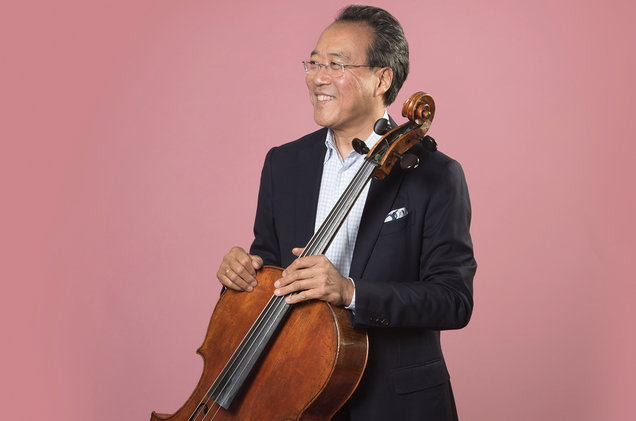
ma-bb21-2018-beat-billboard-1548

Photo: Judith Jockel/laif/Redux
Cellist Yo-Yo Ma is a musician who knows the power of music to be a force for good. Concerned about our fractured society, he asked himself, “What can I do?”

Recently, my husband and I watched the lovely documentary Won’t You Be My Neighbor? — about children’s television visionary Fred Rogers.

Mister Rogers had a gift for speaking directly to the individual child through a mass medium, unlikely as that sounds, looking into the child’s eyes and letting the child know that she was seen.

Cellist Yo-Yo Ma, who ultimately became a friend of Mister Rogers, is seen in the documentary making his first appearance on the show. He tells the documentarian, who happens to be his son Nicholas, that he was scared to death when Mister Rogers put his face very close and looked into his eyes, until he realized that’s what children do.

It made me a bit sad and more conscious of the lack of eye contact today’s children get as we imagine we’re interacting if we talk to them while looking at our phones. No wonder they get stressed. Generally speaking, it’s through the eyes that children learn they are really seen. Mister Rogers understood their needs. He was a great healer.

Yo-Yo Ma is also a healer, but although he has appeared often on television like Mister Rogers, it is music that is his medium. Rebecca Milzof reports at Billboard about Ma’s current project to use his musical gift to help heal the fractured world.

“On Sept. 2, cellist Yo-Yo Ma played all six of Bach’s cello suites at the Nikolaikirche in Leipzig, Germany. It wasn’t out of the ordinary for the world’s most famous classical musician, who was playing at the church where the composer premiered many of his works. But the setting had a deeper meaning: In 1989, it’s where peaceful rebellions against communist rule — which led to the fall of the Berlin Wall — began.

“ ‘This is the very [place] where these [political] changes happen,’ says Ma, 62, over the phone from Leipzig. Today, he notes, Syrian refugees are coming to the city and facing demonstrations of a different sort — from right-wing nationalists. ‘It’s the right moment to explore the idea of home. What is home? It’s where you go to be sustained in difficult times. For me, Bach is home.’

“Over the next two years, Ma will visit 36 sites worldwide as part of his Bach Project, playing the cello suites in places like the Nikolaikirche — settings with sociopolitical meaning. It coincides with the recent release of his third and final recording of the suites, Six Evolutions.

“ ‘We live in more and more of a fractured society,’ the 18-time Grammy winner says. ‘As a cellist, I was thinking, “What can I do to help?” I’ve been toying with the idea of “citizen musicians” for a while.’ …

“So far, that has meant engaging with the Mexican-American community around Denver after playing Red Rocks in August and meeting community organizers spurring industrial revitalization outside Cleveland.

“ ‘One of the things culture does best is to make the “other” into “us,” ‘ he says. He’ll test that idea on six continents.” More at Billboard, here.

By the way, Nell Minnow has a really nice interview with the younger Ma about Won’t You Be My Neighbor? on Medium, here. He talks about performing with his dad as a child on Mister Rogers’ Neighborhood, and he still sounds amazed that Fred Rogers could get him to do that.

Read Full Post »

6Photo: Fondazione Manifesto
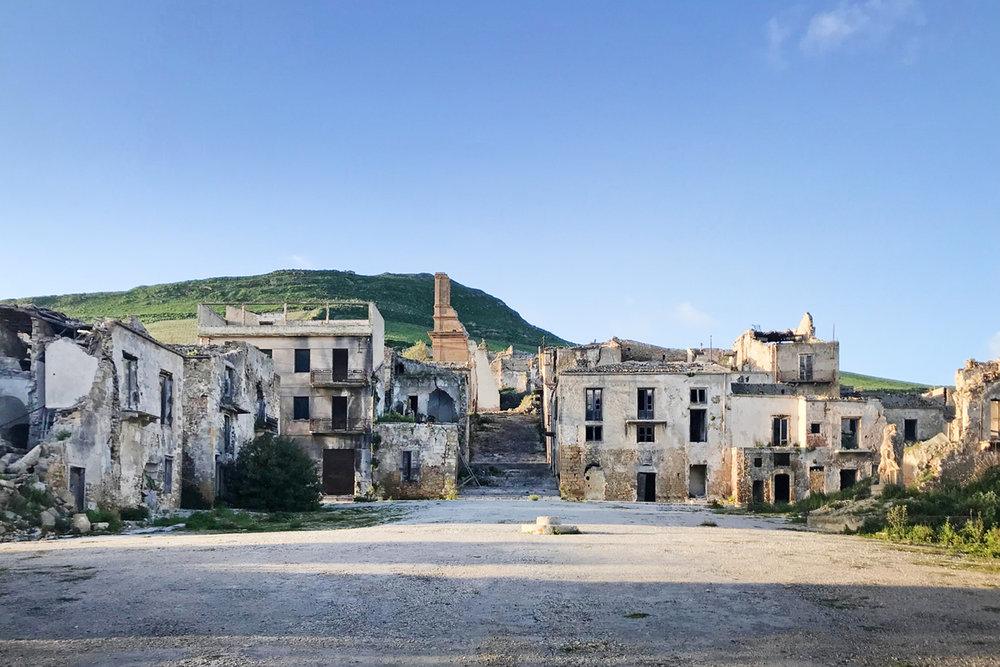
Poggioreale, Sicily, one of the towns destroyed by a 1968 earthquake. A public art project has helped to heal the region’s survivors, many of whom were still suffering from depression decades later.

I’ve blogged a lot about the healing power of various arts in various contexts, but I think this is the first post about what art can do for a traumatized region after a natural disaster. The story takes place in Sicily, where a 1968 earthquake flattened an already impoverished region.

Patricia Zohn writes at artnet news, “On a recent day this summer, I [descended] into the rural, arid Belice Valley. I was accompanied by Zeno Franchini of the Fondazione Manifesto, an advocacy group that leads tours of the region, which was devastated by the 1968 earthquake in Sicily. …

“More than the number of people who died (approximately 400), or the number rendered homeless (approximately 100,000), the earthquake exposed grave fissures in the socioeconomic and political fabric of one of Italy’s poorest regions — disparities that linger to this day.

“While thousands of earthquake victims lived outside Gibellina, an isolated agricultural community, in two shanty towns with barebones infrastructure, in 1970, the National Institute of Social Housing in Rome, determined, after numerous plans for reconstruction were abandoned, to build an entirely new city, a Gibellina ‘Nuova’ for the victims at a site 11 miles from the ruins. …

“By 1979, scant progress had been made due to government corruption, the Mafia influence, and red tape, and victims were still living in dire conditions. That’s when Gibellina’s flamboyant, powerful gay Mayor, Ludovico Corrao, invited a number of leading Italian and German artists and architects to participate in a rescue mission. …

“Though there was no budget for art or culture, Corrao had already begged and borrowed to found the Orestiadi performance festival, just outside the ruins of Gibellina, with the help of performers like John Cage and Philip Glass. Emilio Isgrò, an artist and dramatist, described a wind-chilled night of 1983

‘where artisans, sheep farmers, housewives, anti-Mafia judges and theater directors and personalities from all over Europe sat together to watch’ his performance in the festival. …

“The concrete Utopian city of Gibellina Nuova [became] an open-air laboratory for assessing the healing capabilities of public art. Today, 50 years since the earthquake struck, many look back on Corrao’s radical experiment in civic engagement, rehabilitation, and unification as a cautionary tale. But new efforts are now underway to realize a more pragmatic version of [his] utopian dream.

“ ‘The city needs to really become an Art Town,’ says Alessandro La Grassa, president of the Center for Social and Economic Research of Southern Italy, the organizational heir to the early activist efforts. He envisions it as a place ‘where artists live or stay and where empty buildings and spaces start to find a new function.’ …

“Today the region is a symbol of hope. A newly revitalized combination of social activists, municipal agencies, educational institutions, and private support is finally bringing the unique art interventions of more than five decades in the Belice Valley — and especially the city of Gibellina — to the attention of a wider public. …

“Tours of Poggioreale, Burri’s Cretto, and Gibellina Nuova are available until November 14 through fondazionemanifesto.org.” More here.

I wonder how public art might by employed to rebuild after a hurricane like Michael. Something for art leaders in Florida to think about.

Read Full Post »

Photo: Hartford Courant
Former US Marine Roman Baca
develops ballets that help veterans heal and help audiences gain empathy. For his Fulbright Fellowship, he’s creating a new version of Igor Stravinsky’s
Rite of Spring tied to WW I.

Not long ago, Suzanne’s friend Liz found a piece of antique weaponry and asked instagram friends how it might be used in an art project or something else positive.

I said to “beat it into plowshares.”

In their own way of beating weapons into plowshares, war veterans may continue to serve the country after their time in the military. They may run for Congress like Seth Moulton of Massachusetts or establish a nonprofit like Soldier On, which treats veterans suffering from addictions.

And then there’s the Marine who became a choreographer to tell stories that enlighten and heal.

Candice Thompson writes at Dance Magazine, “When Roman Baca returned home from active duty in Iraq in 2007, he found himself having a tough time transitioning to civilian life.

” ‘I remember a couple of instances where I was mean and angry and depressed,’ says Baca. [His wife] suggested Baca return to his roots in dance. ‘She asked me, “If you could do anything in the world, what would you do?” ‘…

“Baca had to broker his transition back into dance. Earlier, he had trained at The Nutmeg Ballet Conservatory in Connecticut and spent a few years as a freelance dancer before feeling compelled, like his grandfather had, to serve his country. ‘I walked into the recruiter’s office and said, “I want to help people who can’t help themselves.” ‘ Baca reveled in the rigor of the Marine Corps, which seemed like a perfect analog to classical ballet. …

“Baca served as a machine gunner and fire team leader [in Fallujah]. And while his job was one of looking for insurgents and intelligence, Baca also ended up doing humanitarian work, bringing water and school supplies to those in need. The transition from violence to aid helped him meet his original desire to defend the vulnerable.

“In 2008 … he reached out to his mentor Sharon Dante from The Nutmeg Ballet Conservatory. He had dabbled in choreography before joining the Marines and had begun to write while overseas. Dante suggested [that he] focus his writing and choreography on his experiences in Iraq. The exploration led Baca to form Exit12 Dance Company, a small troupe with a goal of inspiring conversations about the lasting effects of violence and conflict. …

“When a theater in the UK reached out to him in 2016 about creating a new Rite of Spring — one that would explore the connections between the creation of this famous ballet and the outbreak of World War I, in commemoration of the war’s centennial, as well as touch on today’s veterans and current events — he knew immediately it was a project for [him].

” ‘One percent of our population serves in the military, and an even smaller number serves in war,’ explains Baca of one of the central questions motivating this new commission. ‘How do we take all of this remote and little understood experience and inspire the audience to positive action?’ ”

More at Dance Magazine, here.

Read Full Post »


Photo: National Institutes of Health via AP
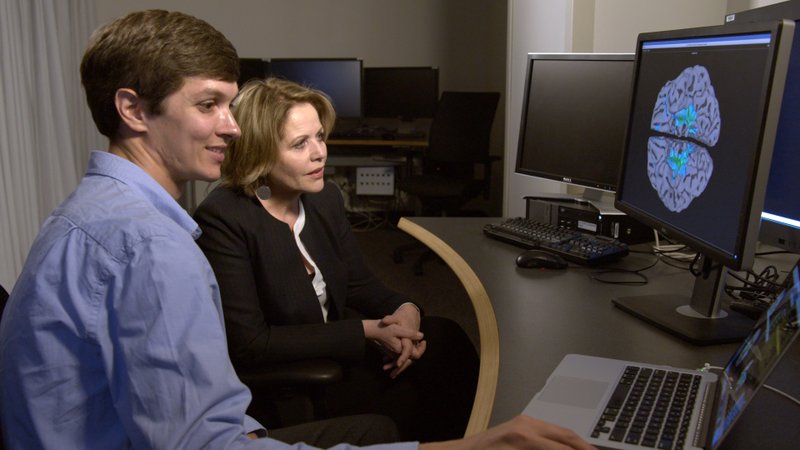
Soprano Renee Fleming looks at a brain scan with NIH neuroscientist David Jangraw after singing in the MRI machine.

To help scientists understand how music helps patients heal, notable musicians like opera’s Renee Fleming are getting brain scans.

Lauran Neergaard writes at the Associated Press, “Music increasingly is becoming a part of patient care — although it’s still pretty unusual to see roving performers captivating entire wards, like at MedStar Georgetown University Hospital one fall morning.

“ ‘It takes them away for just a few minutes to some other place where they don’t have to think about what’s going on,’ said cellist Martha Vance after playing for a patient isolated to avoid spreading infection.

“The challenge: Harnessing music to do more than comfort the sick. Now, moving beyond programs like Georgetown’s, the National Institutes of Health is bringing together musicians, music therapists and neuroscientists to tap into the brain’s circuitry and figure out how.

“ ‘The brain is able to compensate for other deficits sometimes by using music to communicate,’ said NIH Director Dr. Francis Collins, a geneticist who also plays a mean guitar.

“To turn that ability into a successful therapy, ‘it would be a really good thing to know which parts of the brain are still intact to be called into action. To know the circuits well enough to know the backup plan,’ Collins added. …

“ ‘The water is wide, I cannot cross over,’ well-known soprano Renee Fleming belted out, not from a concert stage but from inside an MRI machine at the NIH campus.

“The opera star — who partnered with Collins to start the Sound Health initiative — spent two hours in the scanner to help researchers tease out what brain activity is key for singing. How? First Fleming spoke the lyrics. Then she sang them. Finally, she imagined singing them.

“ ‘We’re trying to understand the brain not just so we can address mental disorders or diseases or injuries, but also so we can understand what happens when a brain’s working right and what happens when it’s performing at a really high level,’ said NIH researcher David Jangraw, who shared the MRI data with The Associated Press.

“To Jangraw’s surprise, several brain regions were more active when Fleming imagined singing than when she actually sang, including the brain’s emotion center and areas involved with motion and vision. One theory: it took more mental effort to keep track of where she was in the song, and to maintain its emotion, without auditory feedback.”

Read how the new insights are being used to study Alzzheimer’s patients and others here.

Read Full Post »


Photo: Homeboy Industries
The Rev. Gregory J. Boyle, S.J., is the founder of Homeboy Industries in Los Angeles, the largest gang intervention, rehabilitation and re-entry program in the world.

I recently heard Terry Gross interview this amazing priest, founder of the world’s largest gang intervention, rehabilitation and re-entry program, on her radio show Fresh Air. This is a man who lives his religion, ministering to the outcasts of society.

“GROSS: My guest, Father Greg Boyle, has worked with former gang members in LA for over 30 years. He’s the founder of Homeboy Industries, which was created to help former gang members and people transitioning out of prison create stable lives and stay out of gangs. Instead of Father Greg trying to convince business owners to hire young people who are at risk, he created jobs for them through Homeboy Industries.

“Homeboy is a series of businesses including a restaurant, a bakery, cafe, farmers markets created with the purpose of hiring these young people so they can have on-the-job training. The employers come from rival gangs so they have to put aside their distrust and hatred of each other. Homeboy also provides other job training and social service programs. …

“Back in the ’80s and ’90s, Father Greg spent a lot of time on the streets. He’s witnessed shootings, he’s buried over 200 young people and he’s kept on with the work in spite of being diagnosed with a chronic form of leukemia about 15 years ago. He started working with gangs in 1986 when he became the pastor of the Dolores Mission Church in East LA, which was then the city’s poorest Catholic parish. He’s just written his second book, called, Barking To The Choir: The Power Of Radical Kinship.

“Father Greg Boyle … you say that employment isn’t necessarily going to totally change someone’s life. They might end up back in prison. But if somebody’s healed, that will change their life possibly forever. What’s the distinction you make between [the employment] opportunity that you’re giving them and healing?

“BOYLE: Thirty years ago when we started Homeboy Industries, you know, the motto was nothing stops a bullet like a job, and that was a response to gang members saying if only we had work. And that was essential, but then when we discovered that, you know, we would dispatch gang members to jobs. But the minute any kind of monkey wrench was tossed into the mix, they would unravel, you know, that there was no resilience.

“There was no healing. And they would go right back to gang life or go back to prison. So it was then that we kind of, probably 15 years ago, we said, you know, healing is probably more necessary along with the fact that people need to have a reason to get up in the morning and a place to go and a reason not to gang bang. …

“So we altered our [stance] from just finding a job for every gang member or employing them with us but also trying to have them come to terms with whatever suffering they’ve been through and trauma. …

“GROSS: You talk about people whose parent would put their head in the toilet and flush the toilet and nearly drown them. … So when people have been brought up like this, and they’re also poor and they have no real future prospects, how do you heal them? …

“BOYLE: Well, part of what we have at Homeboy is this irresistible culture of tenderness, you know, where people kind of hold each other. …

“We don’t get tripped up so much by behavior. Even gang violence itself is a language. … What language is it speaking? You know, it’s not about the flying of bullets. It’s about a lethal absence of hope. So let’s address the despair. And the same thing is with behavior.

“I mean, we bring it up, and at some point we say, we think you’re telling us that you’re not ready to be here. We love you. We think you’re great. Come back when you’re ready. So that’s the thing we do often enough. And we drug test because we don’t want anyone to numb their pain as they do the work. …

“They’re not going to be able to transform their pain if they’re inebriated or if they’re constantly smoking marijuana. … They’re used to self-medicating. They’re used to escape. They want to find that place where they can’t see their pain from. And the antidote, really, is to hold them in a place where they feel cherished, and that’s really compelling.”

There’s so much food for thought in this long interview. Read it at NPR, here.

Read Full Post »

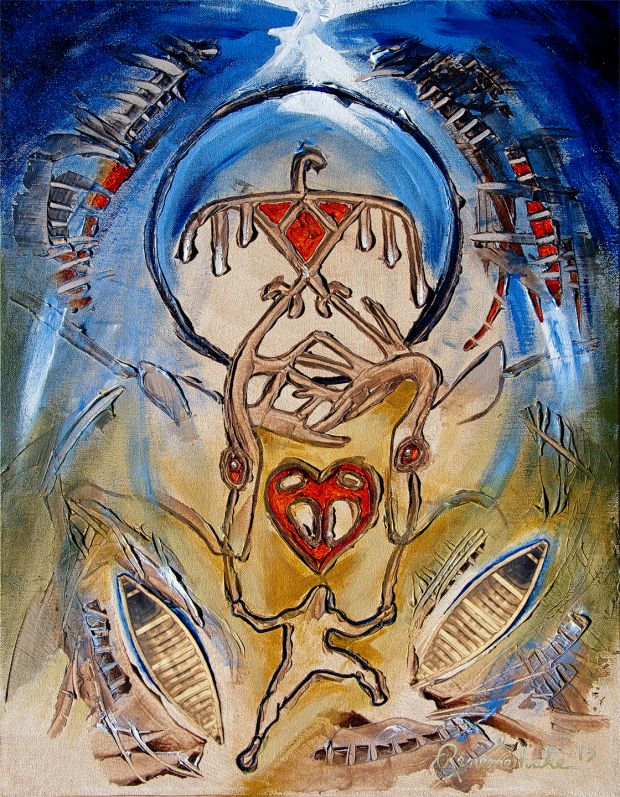
Art: Rene Meshake
Ojibwe artist Rene Meshake was part of a group of indigenous storytellers from Canada who attended the Untold Stories conference in Ireland in May.

As many people know, there was a dark period in US history when authorities thought is would be a good idea for indigenous children to be separated from their language, families, and culture. The same thing happened in Canada. Today, those children and their children are reclaiming their voices and telling their own stories.

Here is Catherine Conroy at the Irish Times: “On a Friday morning in a house in Dublin, I sit down to speak with three indigenous storytellers from Canada. They are here for a conference called The Untold Stories of the Past 150 Years/Canada 150 at [University College Dublin]. …

“Maria Campbell, Rene Meshake, and Sylvia Maracle, from Canada’s ‘Indian Country,’ accompanied by indigenous historian Kim Anderson, tell me a story of pain, resilience and the rebuilding of a shattered community through stories.

“Sylvia Maracle is an activist and storyteller from the Tyendinaga Mohawks. She believes their stories will resonate with Irish people, ‘with colonisers having come and disrupted what was probably the natural order.’ …

“She tells me of a conversation she had with an Irish taxi driver when she arrived. ‘He asked, “Are people recovering their memories?” I said, “They were always there, we just didn’t have the conversation.” He said, “That’s what happened here.” ‘ …

“Maracle believes in the power of storytelling as a force for rebuilding their communities. She feels privileged to have been ‘old woman raised’ by her traditional grandmother. …

“Maracle tells me that people now visit Maria Campbell ‘because they want this good medicine, this traditional stuff.’

“Campbell agrees that storytelling is medicine. ‘I grew up with a great grandmother and she never spoke English, she was a total “savage” according to the priest because she never converted.’

“But while Campbell grew up with stories, she always felt split between her traditional home life and her life outside. It was only after she stopped using drugs and attended her first ceremony in her late 20s that she realised the healing power of the stories, which came from ‘the old ladies, always women laughing.’ It was a revelation to realise ‘that you’d got this medicine, everything you need to help put yourself back together.’

“Campbell tells a story about the effects of colonisation that she learned from her teacher, the Old Man. …

“He had been trying to explain to her the effect of colonisation on their community’s wahkotowin, which in English means kinship, ‘but if you look at the word bundle, it’s all of our laws, it’s the way that we talk to each other, the way that we laugh.’

“He threw [a] jigsaw in the air. ‘He said, ‘”That’s what happened to us, everything was shattered and wahkotowin flew. Maybe you have three pieces, maybe she’s got half of one, if we come back together and we start to rebuild that, you bring your three pieces, you bring yours, and soon we’ll make the picture.” ‘…

“She recalls one story she wanted from her father that he would not give. ‘Then he got diagnosed with a terminal illness and I had to do the translating for him [in hospital]. I kind of went to pieces when we were driving home. He pulled to the side of the road, rolled me a cigarette, and he said, “That story you want, I’ll give it to you now.” He retold it and she understood now that it was a story about death, not the funny story she’d always thought it was.

“She translated and published the story. ‘In my family’s way, they were telling me that they trusted that I would treat it with integrity.’ ”

More at the Irish Times, here.

Read Full Post »

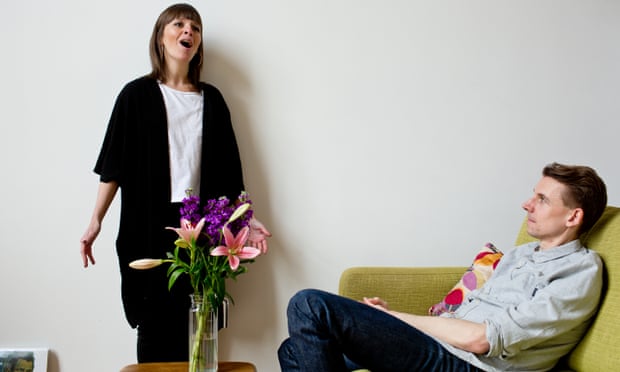
Tim Jonze wrote a funny story at the Guardian about hiring a therapeutic opera singer to deal with his anxiety about becoming a father.

“The soprano reaches a dramatic climax, demonstrating impressive lung power as she sustains the dizzying peak note, before bringing Quando me’n’ vo’ to its close. It is a powerful, emotionally draining performance, and one that seems to resonate around the room for some time after she has finished. Which is why I get up off the sofa and ask her if she would like a cup of tea.

“This, as you might have guessed, is not your typical night at the opera – and not only because it’s only just gone 11 am. It is called Opera Helps, and is a project dreamed up by the artist Joshua Sofaer. The gist is this: contact the Opera Helps phoneline with a personal problem, and they will endeavour to send a singer to your house. Said singer will briefly discuss the issue with you, select a suitable aria that addresses it, then perform it for you while you relax in familiar surroundings: on a comfortable chair, for instance, or even in bed.

“It’s not therapy as such – in fact, they are very keen to stress that their singers are not trained therapists – but the project does aim to help you look at your problem from a new perspective and, hopefully, experience the healing power of music.

“ ‘It’s about giving someone the space for reflection, the same way having a chat with a friend might give you fortitude to carry on,’ says Sofaer, who found success running the project in Sweden before bringing it to the UK. …

“ ‘In my experience, you either respond to the music or you don’t – I don’t think it is based on your musical education or what class you’re from or how much money you’ve got, which is the common perception. The idea that opera needs an expert audience is a complete misnomer.’ ”

More at the Guardian, here.

Photo: David Bebber for the Guardian  
Opera singer Caroline Kennedy sings to Tim Jonze to relieve his stress.

Read Full Post »

The blogger at A Musical Life on Planet Earth — who has been healing from an injury suffered when he nearly tripped on an eager toddler in a music class — doesn’t need to be told that music is healing.

But for the rest of us, a new study from Greece on music and heart health might be enlightening. Tom Jacobs writes at Pacific Standard, “There are many ways of reducing your risk of a heart attack. A healthy diet. Regular exercise. And don’t forget your daily dose of Dylan or Debussy.

“A newly published, small-scale study from Greece finds listening to either classical or rock music positively impacts two important predictors of cardiovascular risk. The effects are particularly pronounced for classical music fans, who, in the study, had a more robust physiological response to music of either genre.

“ ‘These findings may have important implications, extending the spectrum of lifestyle modifications that can ameliorate arterial function,’ a research team led by cardiologist Charalambos Vlachopoulos of Athens Medical School writes in the journal Atherosclerosis. ‘Listening to music should be encouraged in everyday activities.’

“The pulse waves of one’s circulatory system and the rigidity of one’s arteries are related but independent predictors of morbidity and mortality. Essentially, the stiffer one’s blood vessel walls become, the greater the pulse pressure, and the harder the heart has to work to pump blood into the arteries. This can lead to higher blood pressure and an increased strain on the heart. …

“The participants, described as ’20 healthy individuals,’ visited the lab three times. On each occasion, baseline measurements of aortic stiffness and pulse wave reflections were taken following a half-hour rest period.

“They then either listened to a half-hour of classical music (primarily excerpts from J.S. Bach’s Orchestral Suites); a half-hour of rock (including tracks by Led Zeppelin, Black Sabbath, and Green Day); or a similar period of silence. …

“The key result: both indicators were lower after participants listened to either genre of music. … More at Pacific Standard here.

And you can listen to to Will McMillan’s healing singing at A Musical Life on Planet Earth, here.

Will McMillan

Read Full Post »

Longtime concert pianist Byron Janis recently wrote an essay for the Wall Street Journal about programs using music to help veterans with PTSD and other traumas to heal.

“Can music heal?” he asks. “There’s been a great deal of study by neuroscientists on the different ways music acts upon the brain, affecting our behavior, memory and the like. …

“I recently witnessed the healing effects of music first hand. As part of their ‘National Initiative for Arts and Health in the Military,’ I was invited by Americans for the Arts to visit the Walter Reed National Military Medical Center and participate in ‘Stages of Healing.’ This program, created by Dr. Micah Sickel, helps patients learn how to play a musical instrument and facilitates live performances whose aim, according to the hospital, is to ‘enhance the healing process’ …

I knew what I wanted to play for them—two Chopin waltzes and ‘A Hero’s Passing By’ … I then played two songs from a musical I had written about the Hunchback of Notre Dame. One was a love song and the other is titled ‘Like Any Man,’ which I felt very much suited the occasion. The Hunchback sings that although he is so disabled, he is just like any man.” Read more.

Photo of Byron Janis in 1962: Wikimedia Commons

Read Full Post »

Older Posts »