Feeds:
Posts
Comments

Posts Tagged ‘indian’

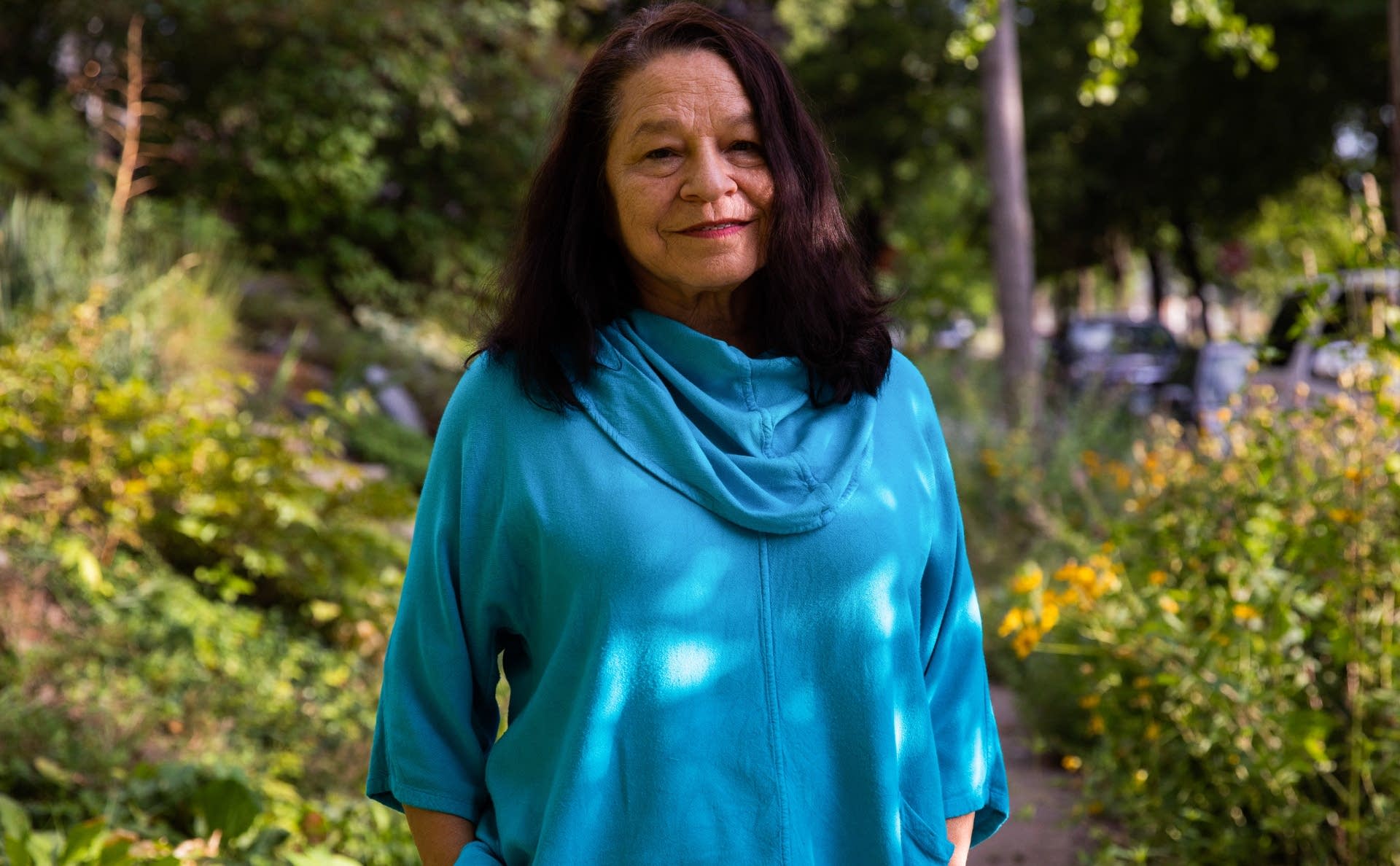
Photo: Jaida Grey Eagle via MPR News.
Among her many accomplishments, Twin Cities-based author Marcie Rendon writes a mystery series about indigenous investigator Cash Blackbear. 

I read a lot of mysteries, and I gravitate toward those about different cultures, often outside North America. But indigenous cultures here are equally foreign to me, which is why I have enjoyed Marcie Rendon’s Cash Blackbear series, about a tough young Ojibwe woman who investigates crimes against members of Upper Midwest tribes, often women.

I have several articles here for you to click on if interested, but I’m going to focus on what the Minnesota-based McKnight Foundation said about Rendon when they gave her an award.

“The McKnight Foundation is pleased to announce the selection of Marcie Rendon for its 2020 Distinguished Artist Award—a $50,000 award created to honor a Minnesota artist who has made significant contributions to the state’s cultural life. Rendon, an enrolled member of the White Earth Nation, is a writer whose poems, plays, children’s books, and novels explore the resilience and brilliance of Native peoples.

“ ‘Marcie brings a strong and necessary voice to so many genres,’ said Pamela Wheelock, McKnight’s interim president. ‘She has created a tremendous body of work, including poetry, plays, lyrics, and award-winning crime novels, all while raising up other Native voices in our community. Her commitment to making art in community embodies what a distinguished artist means to Minnesota and to McKnight.’ …

“A gifted storyteller and prolific writer, Rendon is the author of the award-winning Cash Blackbear mystery series, set in Minnesota’s Red River Valley. The first novel in the series, Murder on the Red River, earned the 2018 Pinckley Prize for Debut Novel, and the second, Girl Gone Missing, was nominated for the Mystery Writers of America – G. P. Putnam’s Son’s Sue Grafton Memorial Award. Rendon … is also the author of four nonfiction children’s books, including Powwow Summer (Minnesota Historical Society Press, 2013).

“Rendon’s plays include Sweet Revenge, chosen for the Oklahoma Indigenous Theatre Company’s 2020 New Native American Play Festival. She has also curated and produced a variety of Native-focused performances at the History Theatre, the Minnesota Fringe Festival, and Patrick’s Cabaret. She is the founder of Raving Native Theater, a platform that brings voice and visibility to other Native American artists and performers.

“ ‘We are more resilient than we are traumatized,’ said Rendon. ‘Art keeps us thriving, not just surviving. I try to make room for other Native artists. Every time someone steps forward, it makes room for others to step forward.’ …

“Rendon’s poem ‘Resilience’ is also included in US Poet Laureate Joy Harjo’s digital project ‘Living Nations, Living Words: A Map of First Peoples Poetry,’ which will join the permanent collection of the American Folklife Center at the Library of Congress.

“Rendon’s awards include a 2020 Ensemble/Playwright Collaboration Grant from the Network of Ensemble Theaters and the Playwrights’ Center, and a 2020 Covid-19 artist grant from the Tiwahe Foundation for demonstrating resilience during the pandemic. Rendon was named a 2018 50 Over 50 honoree by AARP Minnesota and Pollen Midwest and received Loft’s 2017 Spoken Word Immersion Fellowship with poet Diego Vazquez. …

“Said Sandy Agustin, a member of the Distinguished Artist Award selection committee, ‘Whether she is writing about boarding schools, incarceration, or the epidemic of missing and murdered Indigenous women, she is nurturing Native voices and amplifying communities that are too often unheard, especially Native women.’

“Born in northern Minnesota in 1952, Rendon was a voracious reader, creative writer, and poet from an early age. While studying criminal justice at Moorhead State College in the early 1970s, she was part of a group of Native student activists who successfully demanded the launch of the university’s first American Indian studies department.

“After moving to the Phillips neighborhood of Minneapolis in the late 1970s, she worked as a counselor and therapist, while raising her three daughters. In 1991 she saw a performance by Margo Kane, a Cree-Saulteaux artist, that inspired Rendon to share her own poetry and writing with a wider audience. …

“She is currently collaborating with artist Heather Friedli on an upcoming installation at the Weisman Art Museum about the high rates of incarceration among Native women.”

I have read most of the Cash Blackbear books (there’s a new one just out), and I find the urgent educational energy of the series both its strength and its weakness. Rendon feels empowered by a need to educate unenlightened readers like me, and I appreciate what she’s doing. After all, injustices continue and indigenous women in particular still disappear at an intolerable rate. I’ll just say that sometimes the mission overwhelms a good yarn.

More at the McKnight Foundation, here. See also Minnesota Public Radio, here, and Visual Collaborative, here.
Read Full Post »

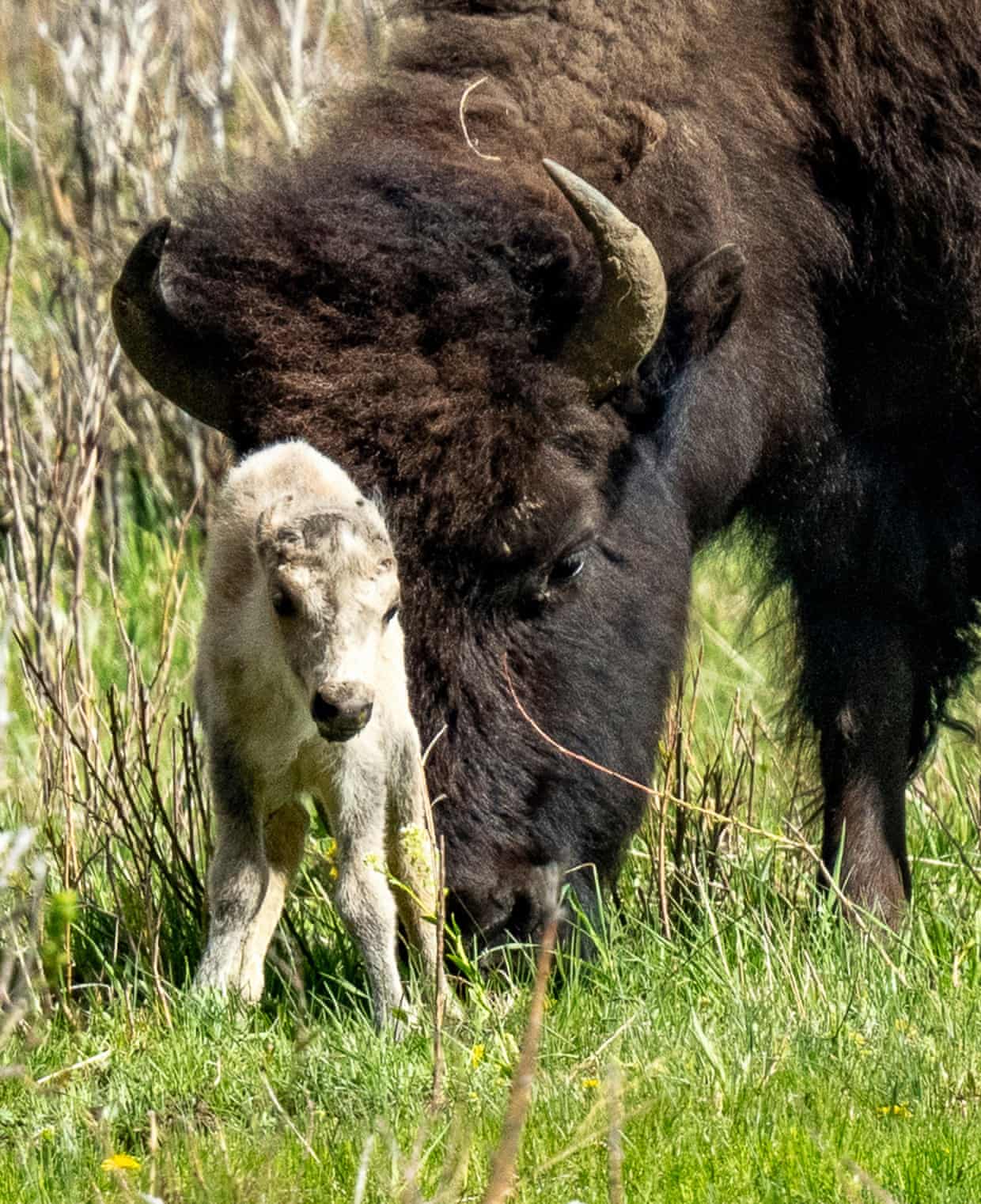
Photo: Erin Braaten/Dancing Aspens Photography via AP.
A rare white buffalo calf in Yellowstone National Park in Wyoming on 4 June 2024. 

In the early days of TV, a show we watched regularly was Rin Tin Tin. It featured a dog and a boy and the US Army patrolling out west. I’m sure there were many elements that would be considered offensive today, but you know, children pick up nice things from anywhere. I can still sing the song about the White Buffalo.

After a white buffalo was born in June, Oliver Milman wrote about the event at the Guardian.

“A rare white buffalo has been born in Yellowstone national park, with the arrival prompting local Lakota Sioux leaders to plan a special celebration, with the calf representing a sign of hope and the need to look after the planet.

“The white calf was reportedly spotted shortly after its birth … by park visitor Erin Braaten, a photographer. She took several shots of the wobbly baby after spotting it amongst a herd of buffalo in the north-eastern corner of the large park, located in Wyoming and a small slice of Montana.

“ ‘I couldn’t believe what I was seeing,’ Braaten told ABC News. ‘It was so surreal. I just knew it was something special and one of the coolest things I’ve ever photographed.’

“Braaten and her family watched the calf and its mother for another half an hour before coming back on each of the following two days to look for the white calf, but with no further sighting. …

“Members of the Lakota Sioux tribe will hold a ceremony to celebrate the arrival at the headquarters of the Buffalo Field Campaign, which advocates for the animals, in West Yellowstone on 26 June.

“The birth of a white buffalo holds a special significance to the tribe, according to the Buffalo Field Campaign. ‘The birth of this calf is both a blessing and warning. We must do more,’ said Chief Arvol Looking Horse, the spiritual leader of the Lakota, Dakota and the Nakota Oyate in South Dakota, according to AP, referring to looking after nature and the environment.

“Tens of millions of buffalo once roamed the plains of the western US, only to be slaughtered on an enormous scale for their hides by settlers, hunters and traders in the 19th century, leaving just a few hundred of the animals unscathed.

“The mass killing of buffalo caused severe harm to native American communities that relied upon the animals as a sustainable food source, as well as being a key cultural touchstone.” More at the Guardian, here.

At a National Park Service (NPS) site, you can read a lot more about the legends surrounding the White Buffalo. For example: “To American Indians, a White Buffalo Calf is the most sacred living thing on earth. The calf is a sign to begin life’s sacred loop. Some American Indians say the birth of a white calf is an omen because the birth takes place in the most unexpected places and often happens among the poorest of people. The birth is sacred within the American Indian communities, because it brings a sense of hope and is a sign that good times are about to happen.” More at NPS, here.

If you go to the YouTube clip below, you will see many happy comments from people who loved the Rin Tin Tin episode about the White Buffalo when they were kids.

Read Full Post »

061820bunny_chow20indian

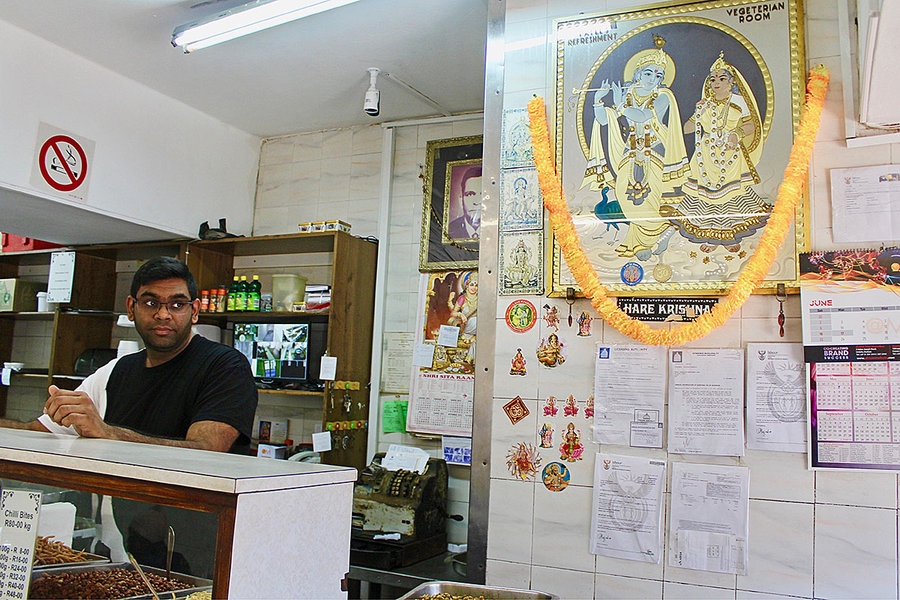
Photo: Ryan Lenora Brown/Christian Science Monitor
Ritesh Patel is the third generation of his family to run Patel’s Vegetarian Refreshment Room, one of the first establishments to sell the iconic food of Durban, South Africa — “bunny chow.”

Certain foods carry with them the unique history of a time and place. Such is the case with “bunny chow,” beloved in Durban, South Africa. No actual bunnies died for this vegetarian dish, the name of which is a linguistic misunderstanding. It all started with a lunchbox made of bread.

Ryan Lenora Brown writes at the Christian Science Monitor, “There are a few must-dos for any first-time visitor to Durban, a city of rolling hills in eastern South Africa. Among them: You must be sure to have a bunny.

“Wait, a what?

“Actually, bunny is short for bunny chow – but don’t be fooled. It’s not a rabbit, or a rabbit’s food. The Durban bunny chow is actually a hollowed-out loaf of bread filled with spicy curry, and it’s this city’s star culinary attraction.

” ‘A bunny chow is to Durban what a pizza is to New York,’ says Ritesh Patel, part of the third generation at Patel’s Vegetarian Refreshment Room, a takeout joint that is one of Durban’s earliest bunny chow peddlers. …

“There are many legends of the bunny chow’s illustrious beginnings, but they all share a few common features. For one thing, it’s undoubtedly the creation of Durban’s Indian community, most of which arrived here as 19th century indentured laborers, shipped in by the British to work the sugar-cane plantations and railroads.

“It also probably owes its name to the banias, the city’s early Indian shopkeepers. By the early 20th century, several were running lunch counters. And then one day, the legend goes, one of them had a novel idea: hollow out a loaf of bread and fill it with beans curry. Voilà: a kind of low-budget, edible lunch pail for workers at the nearby factories and shops. ..

“Some versions of the lore, however, offer a darker reason. In early 20th-century South Africa, people of different skin colors often couldn’t share the same shops, the same neighborhoods, and certainly not the same restaurants. Enter the bania chow, a takeout meal that black customers could eat on the road.

“Whatever its precise origins, bania chow morphed into bunny chow. Joints selling the curry bread bowls proliferated along the length of the Grey Street Casbah, a multiracial stretch of shops, mosques, and apartment blocks through the center of Durban’s downtown. …

“Like many pockets of multiculturalism in South Africa, the Grey Street Casbah was known for its music (jazz), its gangsters (feared), and its politics (anti-establishment). In the earliest years of Patel’s Vegetarian Refreshment Room, the restaurant shared a road with the offices of a fiery young Indian lawyer who’d gotten into politics after being kicked off the white section of a local train. His name? Mohandas Karamchand Gandhi. …

“Today, Grey Street is Dr. Yusuf Dadoo Street, renamed for an Indian titan of the anti-apartheid movement. Zulu gospel music jostles for space with calls to prayer from the gold-domed Juma Mosque down the road. Hawkers sell fat green avocados, roasted corn on the cob, and 25 kinds of knockoff brand name shoes, while prospective customers stream by chatting in Zulu, Shona, and Lingala.” Food can surmount cultural differences.

Read more about the history of this signature dish — and its future — at the Christian Science Monitor, here.

Read Full Post »

broken20treaty20quilt20performance

Photo: Portland (Maine) Museum of Art
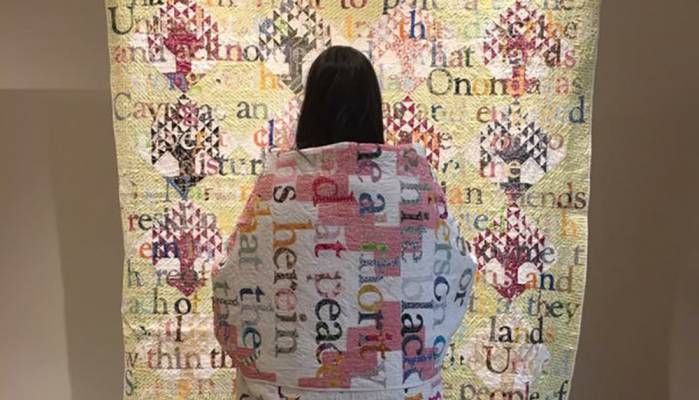
The quilts of artist Gina Adams tell the tale of broken treaties.

Lately, I’ve been reading books that have given me a deeper, more disturbing understanding of American history. Of course I knew about slavery and broken Indian treaties and adventurism abroad, but I tended to slink away from knowing too many details. You can hide only so long. Two books I would recommend are the novel Underground Railroad and the history Ramp Hollow.

Artist Gina Adams found her metier in quilts about broken treaties. There are no shortage of those, she says. This article by Indian County Today recounts the evolution of her work “Broken Treaties Quilts.”

“Gina Adams’ journey to becoming a political artist began as she probed deeper into her Native roots. Trained as a painter and printmaker, Gina Adams made apolitical art for many years. …

“While studying the effects of post-Colonial trauma and assimilation at the University of Kansas, Adams identified feelings of remorse and grief in her own life, stemming from her Ojibwe-Lakota grandfather’s forced boarding at the Carlisle Indian Industrial School in Pennsylvania. Her art began to change.

“ ‘I realized how powerful it was to be able to speak about all of those feelings,’ said Adams, who lives in Longmont, Colorado. …

“ ‘Broken Treaties Quilts,’ involves sewing text from Indian treaties onto antique quilts. … Sewing the words of injustice, letter by letter, onto objects of comfort and beauty represents the turmoil that Indians have suffered. …

“Adams, 52, recently finished quilts about both the 1851 and 1868 Fort Laramie treaties, which she made in response to the Dakota Access Pipeline standoff at Standing Rock. She has made 18 quilts so far, and shown them from Maine to the Midwest. Wherever she shows her work, she makes a new quilt that’s relevant to the treaty history of that geographic area.

Her goal is to create a quilt for every U.S. state.

“There’s no shortage of broken treaties, she said, and all were populated with twisting, confusing language that purposefully misled people and subjected the treaties to misunderstanding and different interpretations.

“Adams has spent most of the past three years reading the treaties, word for word.

” ‘In cutting up these letters and reading and re-reading these treaties, you begin to realize how the language was meant to be confusing when they were written. They are still confusing today. They’re very duplicitous in their meaning,’ she said. ‘You can understand why the misunderstandings happened. …

“In Native cultures, the quilt transcends modern timekeeping. It’s been around forever, serving as a source of warmth and comfort, as well as a feeling of home and family. Quilting is also thoroughly American, she notes, and both the quilt and quilting bees symbolize community and the idea of working together. …

“Adams begins with antique quilts that she finds at flea markets and elsewhere. Many people also give them to her. She prefers quilts that are a century old or older, so they reflect the general vintage of the treaties she represents. …

“The process of making the quilts is time-consuming and labor intensive, and enjoyable, Adams said.

“ ‘It’s very contemplative. It’s very mindful,’ she said. ‘I so look forward to every single aspect of it, even when I am doing the detailed stitching on the quilt. It’s a really focused time. I am lost in my thoughts and just focusing on the work itself. I find it to be so rewarding.’

“Adams … descended from indigenous and colonial Americans. Her grandfather was Ojibwe and Lakota, and Adams has always identified with her Native roots. ‘I remember being 3 and 4 years old and going on hikes with my grandfather. He would talk to me and introduce me to plants and animals and things in nature in the Ojibwe language,’ she said. ‘He would tell me everything in Ojibwe and then translate it. It was a wonderful connecting point that stuck in my heart and soul and has been there my whole entire life.’

“Adams, who is not an enrolled tribal member, plans to take Ojibwe language classes this fall, to deepen her cultural immersion.”

Read about Adams’s quilting process here.

Hat tip: @WomensArt1 on twitter.


Read Full Post »

Photo: Travel Blog
Crow Hop dance, one of several being adapted for exercise classes on the reservation.

A fitness program for members of a tribe in Idaho is showing results with its combination of exercise and spirituality.

Emily Schwing reports at National Public Radio, “In Indian Country, a gym membership is not a cultural norm and the incidence of heart disease and obesity are high. Native Americans are 60 percent more likely to be obese than non-Hispanic whites. The Coeur D’Alene tribe, whose headquarters is in northern Idaho, is trying to combat the problem by incorporating culture into fitness programs.

“The tribe has created an exercise routine — called ‘Powwow Sweat’ — based on traditional dancing. The program features a series of workout videos that break down six traditional dances into step-by-step exercise routines.

” ‘Drop the pringles and let’s jingle,’ commands Shedaezha Hodge, as she demonstrates the steps that make up the women’s ‘Jingle Dress’ dance.

“High steps, box steps, cross steps and kicks combine into a routine that would give any Zumba class a run for its money. …

“All the dances in the exercise program are typical at powwows, including the ‘Men’s Fancy Dance’ — which features four basic steps and a hip move. The hip move involves lifting your knee up, then circling it out to the side, all the while bouncing to the drum beat.

” ‘I lost 13 1/2 pounds,’ says Ryan Ortivez, who attends the weekly ‘Powwow Sweat’ classes at the Coeur D’Alene Wellness Center, in Plummer, Idaho. …

“The CDC [Centers for Disease Control and Prevention] has given the Coeur D’Alene tribe $2 million to develop ‘Powwow Sweat.’ It also supports a community garden on the reservation and a project that stocks the gas station market with healthy food options. …

“Mainstream fitness and nutrition programs don’t meet the needs of tribal members, [LoVina Louie, director of the tribe’s wellness center] says.

” ‘What they lack is spirituality,’ says Louie. ‘Most programming is only physical, or it’s only nutrition. It’s in these compartments — whereas we’re more holistic,’ Louie says. …

“It’s this combination of tradition and exercise that keeps tribal member Ryan Ortivez and his neighbors coming to class each week, to watch the videos and dance alongside each other.

” ‘It’s a lot more attractive than doing jogging or the bicycle for me, because it also relates to my culture,’ says Ortivez.

I’m in love with my community, first and foremost,’ he says. ‘My people. I love to see my community get involved and get active and be healthy.’ “

More here. Be sure to see the great little videos.

Read Full Post »

With no wish to detract from the joy that Italians take from their countryman’s spirit of adventure or the pride that Americans feel for positive developments that followed the First Encounter, it’s hard to deny that it wasn’t the best thing for the people already living here. So without beating a drum that isn’t mine to beat, I’ll just share a gentle poem by a major Native American poet, a member of the Muscogee (Creek) Nation. It’s a poem that is good for all people.

Eagle Poem by Joy Harjo

To pray you open your whole self
To sky, to earth, to sun, to moon
To one whole voice that is you.
And know there is more
That you can’t see, can’t hear;
Can’t know except in moments
Steadily growing, and in languages
That aren’t always sound but other
Circles of motion.
Like eagle that Sunday morning
Over Salt River. Circled in blue sky
In wind, swept our hearts clean
With sacred wings.
We see you, see ourselves and know
That we must take the utmost care
And kindness in all things.
Breathe in, knowing we are made of
All this, and breathe, knowing
We are truly blessed because we
Were born, and die soon within a
True circle of motion,
Like eagle rounding out the morning
Inside us.
We pray that it will be done
In beauty.
In beauty.

More at the Poetry Foundation.

Update June 21, 2019: Joy Harjo became the first Native American US Poet Laureate in 2019. Click here.

Photo: Wikipedia
Joy Harjo in 2012.

Read Full Post »

Photo: Star Tribune
Ojibwe poet Jim Northrup

I have been trying to learn something about tribal cultures in the United States. I liked Spokane/Coeur d’Alene tribal member Sherman Alexie’s Thunder Boy (a charming picture book for young children) and The Lone Ranger and Tonto Fistfight in Heaven (an early, painful collection of short stories). Now I am reading some Native American poetry.

One poet, Jim Northrup, recently died. Here is a beautiful obit by Jana Hollingsworth in the Duluth News Tribune.

“Jim Northrup was a ‘tough man’ who taught his eldest sons to survive in the elements by living in a tepee on the Fond du Lac Reservation for several years, when money and jobs were scarce.

“But it was more than physical survival, said his son, Matthew, on Tuesday, the day after his father died from cancer-related complications. He taught them how to be strong in a world that didn’t treat everyone the same, he said, using humor — and education — as tools.

” ‘ “When you have really nothing else,” he said to me a lot, “you have your humor,” Matthew said. ” ‘When you grow up poor on the rez and when you grow up a lower class in society, you realize that.’

“Northrup, an award-winning writer of books, columns, plays and poetry — and a prominent member of the Fond du Lac Band of Lake Superior Chippewa — died [in July]. He was 73.

“Northrup was a storyteller, known for his stark and honest writing about his experience as a U.S. Marine in Vietnam and his early years at a federal boarding school. He was funny and pointed in his writings about everyday life on the reservation, politics and change in Indian Country. He wrote as a way to heal himself from some of the trauma he experienced during the war, he said earlier this year.

” ‘I knew my poetry was being used in vets’ groups to help people open up (and) maybe even write their own poetry as part of their healing,’ he told the News Tribune in March. ‘It worked for me, so I hoped it helped (others).’ ”

More here, where you can hear Northrup read a poem in Ojibwe about passing along the culture. Read the whole obit. It’s really lovely. I hated to cut it.

Read Full Post »

It’s been sweltering in Southern New England lately, but one doesn’t want to stay indoors all summer.

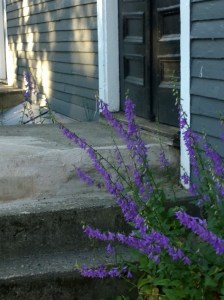
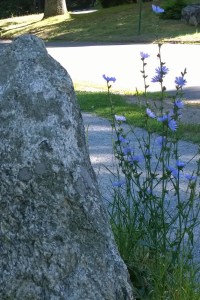
Taking pictures can be a distraction from the heat. Some of the pictures I’m posting may actually look like they were taken on a cool day, but take my word for it, they weren’t. Even the indoor photo of my grandson and his construction project reminds me it was too hot to play outside last Thursday.

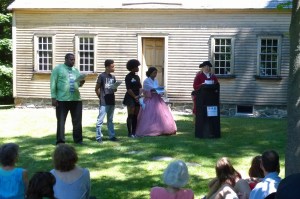
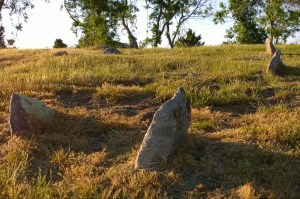
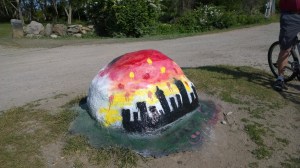
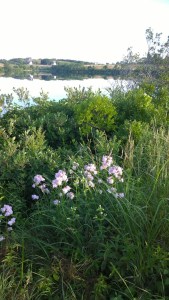
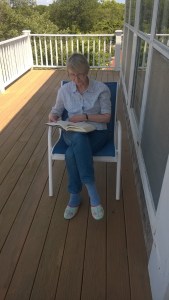
So, here’s what I have: A weed by the dry cleaner’s, Ragged Sailor (chicory) beside a lichen-covered rock, a Fourth of July reading outside the home of a former slave who fought in the American Revolution, my grandson, boats moored in New Shoreham’s Old Harbor, the Indian burying ground at Isaac’s Corner, a city scene on the Painted Rock, Crescent Beach swimmers, Bouncing Bet flowers at Fresh Pond, and yours truly reading Evicted and trying to stay cool.

To expand on a couple of these: I’m told that the Manissean Indians in the cemetery were buried standing up so they could walk into the next life.

And the Fourth of July reading at the home of ex-slave Caesar Robbins was amazing. First the Declaration of Independence was read, which was an eye opener for me because I remembered only the first lines.

Next, anyone who wanted to could read aloud a section of Frederick Douglass’s powerful 1852 Fourth of July speech on the lack of independence for so many people on that Independence Day. Hearing this speech, I could readily imagine how Douglass’s soaring rhetoric helped pave the way for the Civil War and Emancipation.

063016-weeds-by-dry-cleaner

063016-chicory-Ragged-Sailor


070416-Robbins-House-Concord

071416-a-serious-builder


062616-Old-Harbor-boats

062516-Indian-burying-ground-New-Shoreham


062616-painted-rock-cityscape

071516-surf.-restaurant-view


071617-bouncing-bett-fresh-pond

071616-finding-a-breeze-in-heat


Read Full Post »


I’ve been telling Suzanne and John about a free children’s hour on Thursdays at the Tomaquag Museum in Exeter, Rhode Island. I thought it sounded like fun for the kids.

According to the website, the program teaches “the history and culture of the Narragansett Tribal Nation through music, dance and storytelling. … Children’s Hour targets pre-school and homeschoolers during the school year and the families during school vacation. …

“Each week will have a different theme or focus. It will include music, dance, storytelling, engagement with exhibits and art or science activities. Each activity will be scaled to fit the ages and abilities of the youth. We will encourage peer mentoring between older and younger participants.

A typical Children’s Hour consists of: Traditional Greeting & Narragansett Welcome Dance (weather permitting); Narragansett Lesson/cultural concept (in our museum); Scavenger Hunt connected to theme where kids can explore exhibits; Social Dance to our Pavilion building; Storytelling/book share; craft or game depending on the content; Closing circle

The museum just won a national award for museum and library services. Executive Director Lorén Spears and Narragansett tribal leaders went to Washington last week, where Michelle Obama presented the award.

More here.

Photo: Tomaquag Museum Executive Director Lorén Spears


Read Full Post »

In September, Emily Fox did a feature at Michigan Radio on efforts to preserve a dying Native American language. The initiative is focused on preschoolers.

“Anishinaabemowin is the language that was spoken by tribes in Michigan for millennia,” Fox says, “and it’s near extinction in the state.  Many Michigan tribes don’t have any fluent speakers left, while those that do are only reporting between one to three fluent speaking elders.

“Michigan tribes are doing what they can to bring the language back. Some are doing language immersion weekends. Some are creating programs to learn Anishinaabemowin online.

“A lot of tribes are teaching community language classes, or bringing it to the public schools and day care centers.

“The Saginaw Chippewa Indian Tribe in Mt. Pleasant only has one fluent Anishinaabemowin speaker, but they have been able to pool enough resources together to have a four-day-a-week early childhood language immersion school since 2009.

“Isabelle Osawamick, with the Language Department for the Saginaw Chippewa tribe, says the teachers at the Sasiwaans Immersion School only speak in Anishinaabemowin. The language is used in class lessons and in every daily activity. …

“She says with immersion, the kids start to understand Annishinabemowin quickly.

“ ‘I’ve seen them listen and in a matter of two months they comprehend 100%,’ Osawamick says.”

Click here to read the details and to listen to the recorded broadcast.

Photo: Emily Fox / Michigan Radio
Two-year-olds at the Sasiwaans language immersion school in Mt. Pleasant get a lesson in the Native American tradition of smudging.

Read Full Post »

Ken Shulman reports at WBUR’s Only a Game that skateboarding often means a lot to kids on reservations.

The story starts with an Apache artist, Doug Miles.

“Miles paints mainly on found objects: fuel cans, car hoods, panels from a trailer home. But there’s one outlier among the surfaces, a curious artifact that migrated from California to America’s inner cities to the suburbs and, finally, to the reservation: the skateboard. …

“Miles said. ‘My son needed a skateboard. I didn’t have enough money. So I painted him one. And then he rode it all around the rez. And I knew what was going to happen. I knew. So when he got home I said, “What did everybody say?” And he said, “Dad, Dad, everybody wants one.” ‘

“Today Miles’ skateboards hang in private collections and museums. Some of them sell for hundreds of dollars. But the former social worker is most proud of APACHE Skateboards — a skateboard team, shop and artist collaborative he founded on the San Carlos Reservation, about 90 miles east of Phoenix.

“Miles said that making skateboards helps his kids connect with their Apache heritage.

“We’ve been making things for centuries as native people,” he explained. …

“The San Carlos team has a thriving skate park — with colorful murals painted by Miles and his crew. The team also travels to compete against other tribes and against big city skaters. Miles said the travel is mind opening.

“ ‘The kids in the South Bronx and the other reservations and East LA, they’re just like our kids,’ he said. ‘These are all communities that are struggling. So when they meet our kids they’re really meeting themselves. And so I think it empowers kids to know that we’re struggling here, too, but we’re also making art and skateboarding and having a lot of fun in the process.’ ”

More here.

Photo: Ken Shulman/Only A Game
For some Native Americans living on Indian reservations in the American Southwest, skateboarding is more than just a recreational activity.

Read Full Post »

Casey Kelly has a story at WBUR’s Only a Game on a sport enabled by the removal of dams on the Penobscot River in Maine.

The recent removal of two dams (and upgrades to others) in Maine’s Penobscot River made available over 1,000 miles of habitat for Atlantic salmon and other fish — and also made the river available to whitewater enthusiasts.

“The dam removal was the culmination of years of restoration efforts by several groups. The Penobscot Nation, for whom the river has been vital for centuries, helped lead that effort.

“ ‘The creator put us here, in the Penobscot River Valley,’ said James Eric Francis, Sr., the director of cultural and historic preservation for the Penobscot Nation. ‘We are surrounded by the sacred river.’

“Last month, paddlers from all over the country gathered for a race celebrating the removal of the dams.” More here, including a video.

Here’s how freeing the river came about. It was a major collaboration by disparate groups committed to identifying and acting on the values they held in common.

Photo: Craig Dilger for The New York Times  
The dismantling of the Veazie Dam is also giving 11 species of fish better access to 1,000 miles of spawning habitat.

Read Full Post »

Photo: Nathaniel Brooks/NY Times
Lyle, Miles, and Ty Thompson have ignited a scramble for Native American recruits at lacrosse programs.

Maybe everyone who follows lacrosse knows that Native American players of the game that Indians invented tend to go to Syracuse University for college sports, but I didn’t.

I read the sports section only if there is a human-interest story, and today a NY Times front page article about a family of exceptional lacrosse players drew me in.

Zach Schonbrun writes, “The Albany lacrosse coaches stared at a small projector screen, searching for the black streak of a three-foot-long ponytail swooping toward the goal.

“They were watching Lyle Thompson, an Onondaga Indian from upstate New York, who has become a Wayne Gretzky-like figure in collegiate lacrosse. …

“He is a strong contender for this year’s Tewaaraton Award, lacrosse’s Heisman Trophy, which has never gone to a Native American. If he does not win, it could easily go to his older brother, Miles, who scored 43 goals in 12 games for Albany last season. And if Miles does not win, their cousin and teammate, Ty, has a chance.

“The Thompsons, who grew up on a reservation in upstate New York, are more than exceptional athletes thriving in the sport of their ancestors, a sport that is still endowed with deeply spiritual significance to Native Americans. They are trailblazers who have upended the athletic world and reservation life, and their success has ignited a scramble for Native American recruits at lacrosse programs across the country.” There’s lots more to the story here.

I especially liked this part, “One recent afternoon, Lyle Thompson, 21, took out a rattle made from the shell of a snapping turtle he had caught while golfing with his oldest brother, Jeremy. He uses the rattle to make music, part of the way he stays connected with Indian culture. Learning the Onondaga language is another.

 Art: Smithsonian Archives
What began as stickball, a Native American Indian contest played by tribal warriors for training, recreation and religious reasons, has developed over the years into the interscholastic, professional and international sport of lacrosse. See Federation of International Lacrosse.

Read Full Post »

Did anyone watch the television show Rin Tin Tin as a kid?

I thought of it today when I read this awesome AP story:

“The birth of a white bison, among the rarest of animals, is bringing Native Americans who consider it a sacred event to celebrate at one of the least likely of places, a farm in New England.

“Hundreds of people, including tribal elders from South Dakota, are expected to attend naming ceremonies later this month at the northwestern Connecticut farm of Peter Fay, a fourth-generation Goshen farmer.

“Native Americans in the area have come with gifts of tobacco and colored flags for Fay and the bull calf since it was born there a month ago, and Fay is planning to offer his hay field as a campsite for the expected crowds.

” ‘They say it’s going to bring good things to all people in the world. How can you beat that? That’s the way I look at it,’ Fay said.” More. (There’s a photo there, too.)

I knew I had to blog about it because I loved the Rin Tin Tin episode when young Rusty is in dire straights and is saved by the White Buffalo. I know the song from that episode by heart. It was one of my brother’s records when he was little, although I don’t think it made it into the website with his blues records.

“There’s an old Indian legend that I heard long ago.
“It’s about a special valley and the White Buffalo.

“The legend says you’ll find it if your heart is brave and true
“And you treat all men as brothers no matter what they do.

“I have searched for that valley since I started to grow.
“I won’t stop until I find it — and the White Buffalo.”

Read Full Post »

This morning at Porter Square, none of the escalators were working. As I walked down the long staircase into the subway, I heard music. That is not unusual. We commuters often get to hear a busker or a group of musicians at Porter Square, some of them truly outstanding. Today as I descended I thought I heard opera.

It was indeed opera. Baritone Wesley Ray Thomas had set up his boom box and was performing “It Was You” from Verdi’s “Masked Ball.” When I say “performing,” I mean that not only was he singing beautifully but acting. Very emotional. I waited for a train to go by so I could hear the whole piece.

I asked for Thomas’s card, which gives his MySpace site, but when I poked around on YouTube, I found much more.

It turns out that not only is Thomas an opera singer, but being partly American Indian, he participates in the singing at PowWows and other traditional events.

I highly recommend this six-minute video. (The subway location shown is Porter Square.)

8/1/14 Update: Read new Globe story on what the opera guy has had to overcome in life, here.

Read Full Post »

Older Posts »