Feeds:
Posts
Comments

Posts Tagged ‘innovation’

On mornings when I don’t walk in my neighborhood or in the Greenway near work, I’m more likely to walk around the emerging waterfront district than the Public Garden, the approach to which involves too much waiting at street lights.

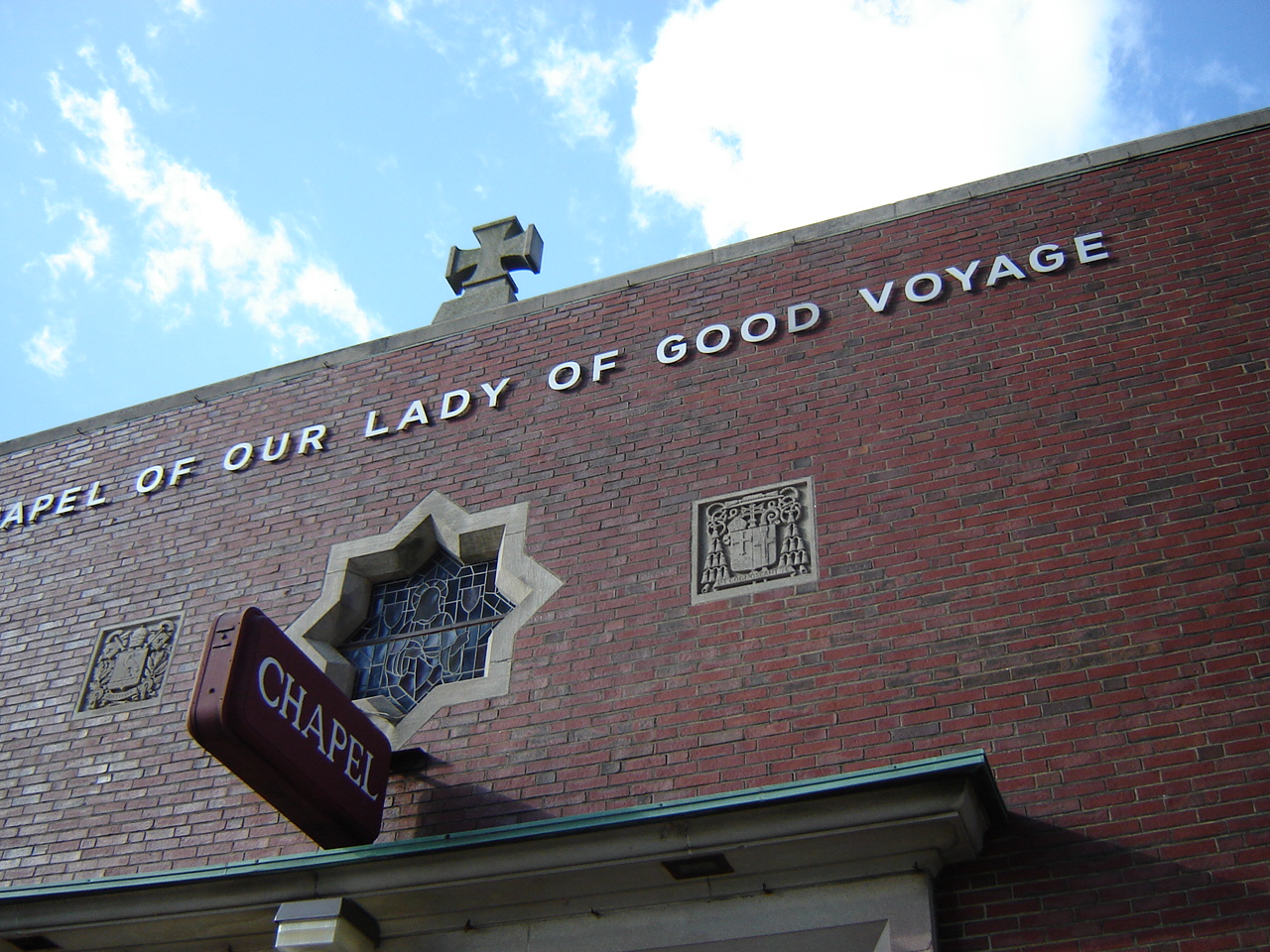
The area near Seaport Boulevard and the harbor, though booming with construction today, still wears the remnants of its formerly neglected status: vistas of pitted parking lots, streets that end ­­­­­­in chain-link fences, highway underpasses filled with brown grass and fast-food wrappers. Then there is the Chapel of Our Lady of Good Voyage.

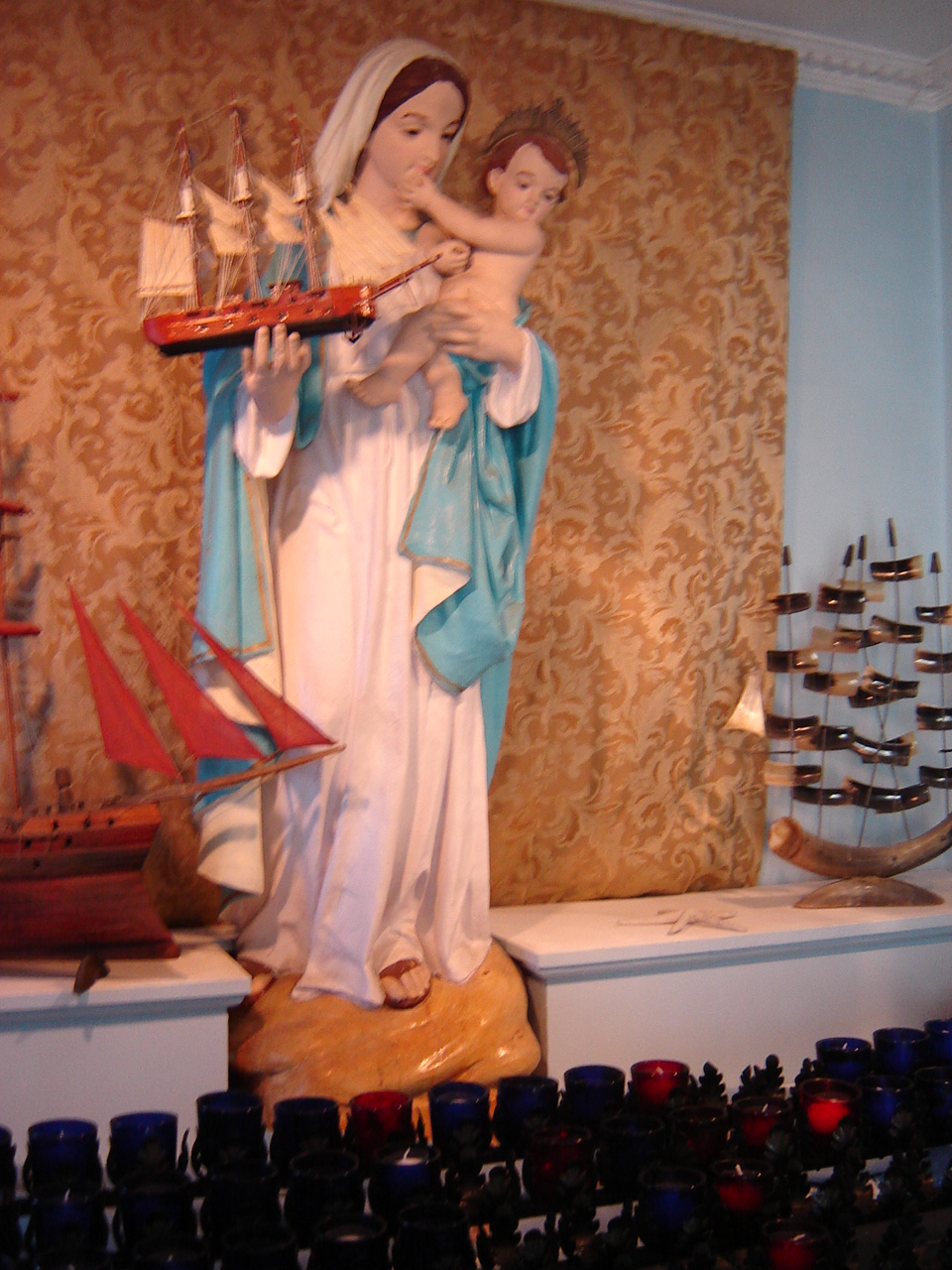
Unlocked, empty, and trusting, the tiny chapel has a basket for donations to the food pantry. Under a statue of Mary holding her infant in one hand and a ship in the other are votary candles. Someone in charge must think – or know – that no traveler seeking blessings will steal alms for the poor in front of Mary unless desperate. In which case, perhaps he will be welcome to it.

I picture Ishmael coming to a place like this (different denomination and in New Bedford) to hear the sermon on Jonah and the Whale before his ill-fated voyage with the obsessed Captain Ahab.

I wonder if sailors really go to the chapel nowadays and what will happen to it as the area develops at its rapid pace. Along the water, the mayor’s prized Innovation District is gathering steam. In the other direction, the Fort Point Channel area is bursting with restaurants, arts, and artists.

Less than 20 years ago, I visited one artist, the son of friends, who was squatting with other artists in the abandoned Fort Point warehouses where doors had no locks, broken boards and pipes littered the floors, and loose wires hung from the ceilings.

The chapel is part of that earlier world, when lighting a votary candle might have seemed like one’s best chance for making it until tomorrow.
Read Full Post »

A guy at the office reads a different blog I write, a blog for work, and knows the types of stories I like. Recently he e-mailed me about a new documentary in which the solutions to our economic problems are tackled by “just folks.” Add this to the growing list of proofs that “one and one and 50 make a million.”

“In Fixing the Future, host David Brancaccio, of public radio’s Marketplace and NOW on PBS, visits people and organizations across America that are attempting a revolution: the reinvention of the American economy. By featuring communities using sustainable and innovative approaches to create jobs and build prosperity, Fixing the Future inspires hope and renewal in a people overwhelmed by economic collapse.

“The film highlights effective, local practices such as: local business alliances, community banking, time banking/hour exchange, worker cooperatives and local currencies.” That’s what the film’s website says anyway. Read more. And if you see the movie, please let me know.

 Photographs: http://fixingthefuture.org

Read Full Post »

Connecticut seems to be doing quite a lot for entrepreneurs — even rather young ones. So thanks to an annual competition for young inventors in the state, Mallory Kievman is getting her hiccup-suppressing lollipop patented and marketed by experts.

Writing for the NY Times, Jessica Bruder quotes one of Mallory’s benefactors.

“ ‘It’s very rare, when you’re evaluating businesses, that you can envision a company or product being around 100 years from now,’ said Danny Briere, a serial entrepreneur and the founder of Startup Connecticut, which nurtures new companies, including Hiccupops, and is a regional affiliate of the Startup America Partnership. ‘Hiccupops is one of those things. It solves a very simple, basic need.’

“Mallory met Mr. Briere last spring at the Connecticut Invention Convention, an annual competition for kids. ‘I went there, and I knew it would either be a hit or a miss project,’ she said. ‘People would either like it, or they would think I was crazy.’ ” Read more.

I love reading about simple but valuable solutions to everyday challenges. Think paper clip. Think Post-it note. It takes a special kind of imagination. Nowadays, given the valuation of apps, you would think solving everyday challenges was too uncool for the inventive mind. But Hiccupops will likely bring Mallory checks in the mail long after Instagram is forgotten.

Photograph: Andrew Sullivan for the NY Times

Read Full Post »

I took a tour of Mass Challenge today, an accelerator incubator program. And what is an accelerator incubator program? you ask. An incubator helps small businesses get launched and grow. An accelerator helps them get launched and grow really fast.

The program I visited may be the biggest anywhere. It has a whole floor of a gorgeous new building overlooking Boston Harbor, which the landlord has provided rent-free at least until 2014. It has zillions of sponsors and supporters, including the mayor and the governor, who don’t always see eye to eye on other matters.

Enter by tomorrow to be in the running for this year’s program and the top prize. Every entrant, whether chosen for the program or not, gets three to five professional reviews. You can enter from anywhere in the world. Caveats: there is an entry fee of $200, and your startup has to have made less than $1 million so far. Click here to enter.

From the website: “MassChallenge is the largest-ever startup accelerator and competition, and the first to support high-impact, early-stage entrepreneurs with no strings attached. Benefits for startups include:

* 3 month accelerator program. World-class mentorship and training, free office space, access to funding, media and more.
* $1M in Cash Awards. $4M+ in-kind support.
* Open to all. Any startup can enter, from anywhere, in any industry.
* No equity taken. No restrictions applied.”

And while we’re on the subject of small business, I also saw a great presentation about a new City of Boston website that walks people through all the things they need to do to get a business started in Boston. A wonderful, user-friendly site.

Read Full Post »

Around this time last year, a young cub scout rang the bell. He was selling popcorn as a fundraiser for his den. His mother waited by the gate. While I was filling out an order form, he studied the black net over my yard and the way our leaves seemed to float.

“What do you think that’s for?” I asked.

The cub scout pondered only a moment. “When all the leaves fall down,” he said, “you roll them up in the net and dump them in a leaf pile.”

Bingo. He had put his finger on my husband’s innovation to alter and illuminate the fall leaf-raking ritual.

I looked up at the cub scout’s mother and said, “This young man is going places!”

The popcorn was good, too.

Read Full Post »

Some years ago, the John Adams family biographer Paul Nagel introduced me to physician/poet Norbert Hirschhorn. Paul told me that Bert was on the team that helped save thousands of lives in Third World countries simply by distributing water to which sugar and electrolytes had been added. (A National Institutes of Health paper references Bert’s 1973 research on “oral glucose electrolyte solution for all children with acute gastroenteritis” here.)

A special NY Times science supplement on Sept. 27, 2011, “Small Fixes,” reminded me of Bert and the notion that small innovations can have a huge impact.

Among the great stories in the supplement. is this one about Thailand’s success fighting cervical cancer with vinegar.

It turns out that precancerous spots on the cervix turn white when brushed with vinegar. “They can then be immediately frozen off with a metal probe cooled by a tank of carbon dioxide, available from any Coca-Cola bottling plant.” The complete procedure, which can be handled by a nurse in one visit, has been used widely in Thailand, where there are a lot of nurses in rural areas.

In Brighton, Massachusetts, Harvard’s George Whitesides founded Diagnositcs for All to commercialize his inventions, including a tiny piece of paper that substitutes for a traditional blood test for liver damage. Costing less than a penny, “it requires a single drop of blood, takes 15 minutes and can be read by an untrained eye: If a round spot the size of a sesame seed on the paper changes to pink from purple, the patient is probably in danger.” Read the Times article.

Amy Smith at MIT is another one who thinks big by thinking small. Read about her Charcoal Project, which saves trees in poor countries by using vegetable waste to make briquettes for fuel.

Read Full Post »

« Newer Posts