Feeds:
Posts
Comments

Posts Tagged ‘isolation’

Photo: Jeenah Moon/Bloomberg.
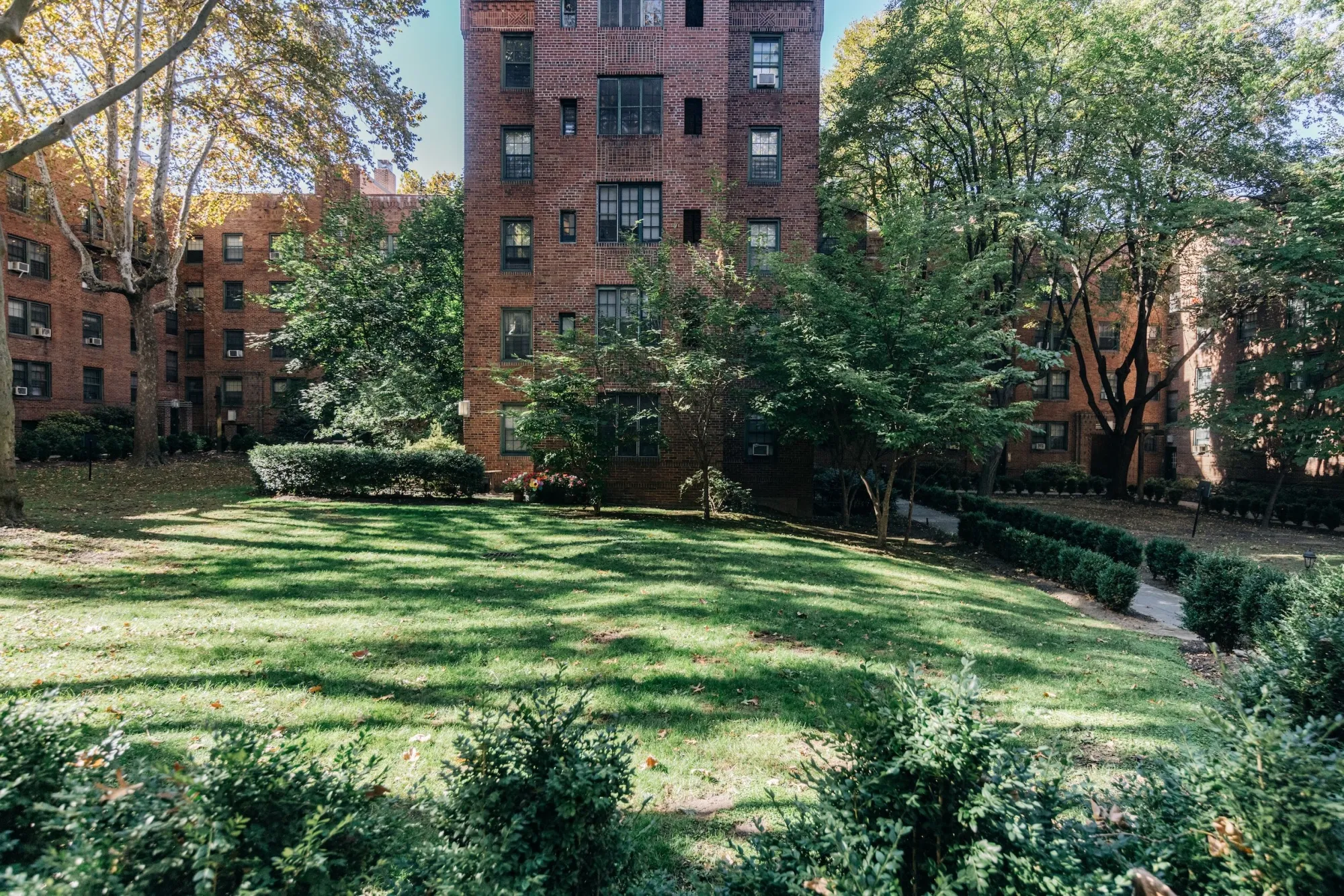
An interior courtyard at the Sunnyside Garden Apartments in Queens, New York. Completed in 1928, it remains a beacon of quality of life.

Growing up on the Copeland Estate in a suburb of New York, I would have been quite isolated from humanity if not for a scattering of nearby homes that had children. Having playmates meant so much to me. But for years, US community designers forgot about the importance of human interaction for both children and adults. One way to build it in, especially in cities, is the classic courtyard.

Alexandra Lange notes at Bloomberg CityLab that the shrinking population of children under five across the US “is bad news for the diversity and stability of cities, which are improved by the amenities that families seek — parks, public libraries, safe streets. It’s also discouraging for families who prefer to live in the city or don’t have the option or desire to move to the car-dominated suburbs. Any effort to retain families has to start with housing, their primary expense.

“That one weird trick for making cities more family-friendly? We’ve known it for decades: It’s the courtyard. …

“While Europe can claim centuries-old courts, America dabbled in them for decades, before the suburbs became the dominant housing type of both government subsidy and political propaganda.

“Courtyards don’t have to belong to the past. While textbook examples in brick and stone are lovely — and still home to thriving communities — contemporary architects are making courts in all sorts of materials, and for all types of housing, from apartments to townhomes.

“One of the first influential figures to advance the idea of the courtyard as the ideal urban type for families was Henry Darbishire, the mid-19th century English architect. His first patron, Angela Burdett-Coutts, was inspired by Charles Dickens and his novels of the urban poor to apply her wealth to reformist housing. ‘Nurturing the family and protecting children from the street was a huge part of the logic — turning the city inward,’ says Matthew G. Lasner, housing historian and the author of High Life: Condo Living in the Suburban Century.

“Architects and philanthropists quickly embraced an easily replicable courtyard model, with a single entrance on the street and interior vertical access off a planted court. The concept came to America in the 1870s via developers like Alfred Treadway White, responsible for the Cobble Hill Towers in Brooklyn. In the 1920s, more reformist developers — including everyone from the Rockefellers to communist unions — constructed many more of these courtyard projects.

“As architecture critic John Taylor Boyd wrote in 1920 of the Linden Court complex in Jackson Heights, the courtyard’s ‘benefits are apparent when it is remembered that the streets are the only playground of New York children, including the children of the rich.’ …

“When you’re talking courtyards in America, it’s hard to avoid Sunnyside Gardens. Not only does the Queens community remain one of New York City’s best neighborhoods, but it was home to one of America’s best critics, who made his affection clear.

“Lewis Mumford was one of the first residents of Sunnyside Gardens, completed in 1928, and constantly returned to its balance of private and public space, building and garden, in his analysis of other lesser New York City housing options. In “The Plight of the Prosperous,” published in the New Yorker in 1950, Mumford takes aim at the new white-brick residential buildings ‘that have sprung up since the war in the wealthy and fashionable parts of the city.’ While new low- and middle-income housing projects like his own ‘provide light and air and walks and sometimes even patches of grass and forsythia,’ these other private buildings, clustered in uptown rich neighborhoods, lack multiple exposures, outdoor space, cross-ventilation and quiet. …

Clarence Stein and Henry Wright were the primary architects and planners behind Sunnyside Gardens, with Marjorie Sewell Cautley the landscape architect; all three would subsequently collaborate on Radburn, New Jersey, the ‘town for the motor age’ that in fact applied these communal principles for a result that we would now call transit-oriented development.

“The planners’ primary insight, in both the city and the suburbs, was to prioritize protected, communal open space over private yards or interior amenities. The courts, or courtyards, could be much larger if not subdivided by owner, and even in areas with public parks, having play space (and play companions) directly outside your door was a huge amenity. …

“On the West Coast, the courtyard evolved a little differently: surrounded by lower density, semi-detached houses with, eventually, a swimming pool in the center instead of a lawn. Irving Gill, considered the father of California modernism, designed prototype bungalow court in Santa Monica in the teens, with parking out of sight in the back and doorstep gardens. On tighter sites, U-shaped buildings with Spanish- and Italian-influenced architecture featured tiled fountains at center court. …

“ ‘When people have families with children, the home is important, but equally important are the people who are there with you,’ says Livable Cities president Meredith Wenskoski. “Your neighborhood is crucial. …

Bay State Cohousing, a 30-unit development outside Boston, has common amenities as part of its charter, including a shared kitchen and activity rooms. But the pastel, clapboard complex, intended to blend in with single-family neighbors, also forms a U around a southwest-facing courtyard, with outdoor circulation providing plenty of opportunities for casual run-ins with the neighbors.

“ ‘The courtyard is a nested boundary that allows interaction with other children, and more importantly, with other adults who become a kind of network,’ says Jenny French, whose firm French 2D designed Bay State. ‘In an urban setting, the barrier that the contemporary parent has to letting their child out the door, thinking about the car-dominated city where they are unable to play in the street – the courtyard is a natural alternative.’

“French, who has also been coordinating the housing studio at the Harvard Graduate School of Design for seven years, can’t help but extend these design observations into the cultural and political spheres. Everyone talks about loneliness in America for people of all ages. For teens and seniors alike, French sees a solution. It’s one we’ve had all along: ‘Could a courtyard house actually be the friendship apparatus we need?’ ”

Lots more at Bloomberg, here.

Read Full Post »

Photo: Liam James Doyle/MPR News.
David Huckfelt performs on the Turf Club stage. “We’re building these little fires in small places,” Huckfelt says.

Because I still believe that “one and two and fifty make a million,” as Pete Seeger used to sing, I get a kick out of all the stories I’ve been seeing lately that confirm the power of small.

Alex V. Cipolle reports at Minnesota Public Radio (MPR) about one small but mighty effort, a new arts collective that “goes on tour to build community in rural Minnesota and beyond. …

“On a September evening at the Turf Club in St. Paul, models weave through bar tables in upcycled designs.

Annie Humphrey, an artist and musician based on the Leech Lake Reservation, performs on the stage, followed by Minneapolis musician David Huckfelt. On a back table Shanai Matteson, an artist from Palisade leads printmaking demos with a stencil of a black aandeg (the Anishinaabe word for crow) and an orange-red sun.

“ ‘There’s a story about the crow. Long ago, the crow had bright, beautiful, vibrant colored feathers,’ Humphrey recalls. ‘But crow also saw that the people were suffering because they had no fire.’ To bring fire to the people, crow flew close to the sun and scorched his feathers black.

“ ‘He was able to grab the fire and bring it back down to the earth and bring fire to the people so that they could be warm,’ Humphrey continues. ‘If you take a crow feather and hold it in the sun, it’s iridescent, and all these colors are still in that feather.’

“The stencil is the logo for the new arts and community-building collective Fire in the Village, started by Humphrey, Matteson and Huckfelt this year. (Fire in the Village is also the title of a book of Ojibwe stories by Humphrey’s mother, Anne Dunn.) …

“The trio all share a background in activism, specifically fighting the Line 3 oil pipeline. … But with Fire in the Village, the collective wants to do something untethered from any one cause. 

“ ‘If we were going to start something, I knew that it should center on art and the human spirit, the human condition,’ Humphrey says, ‘and have no politics involved at all.’

“Through art, fashion, music and collaborative events with schools and local organizations, the collective is hoping to heal divides and put a dent in the loneliness epidemic in rural communities and on reservations.

“ ‘I think a lot of people are feeling isolated,’ Matteson says. ‘There’s a lot of divisiveness going on. Personally, I’m not interested in continuing that. I don’t want to be part of a cause where it feels like it’s putting another barrier between me and the people who live around me.’ …

“ ‘We like the feeling of the collective and not pushing one person as a front for something,’ Huckfelt adds. ‘So, we’re really working together with our skillset because we believe in music, we believe in art, we believe in community, and so that’s what’s being put forward here.’ …

“ ‘Fire in the Village is a way to connect with individuals and to smaller communities that you’re a part of,’ says Meira Smit, one of the Macalester students who came to the Turf Club. ‘A way to build messages and movements around the things that we deeply care about.’

“Haley Cherry, a producer for Minnesota’s Native Roots Radio on AM950, also came out to walk in the fashion show after meeting Humphrey and Huckfelt this past year.

“ ‘It’s important to hear from both perspectives: issues of Indigenous identity, but also [from] David, as a white ally, I think it’s important to draw those bridges of community concerns,’ says Cherry, who is a descendant of the Ho-Chunk Nation of Wisconsin. …

“In June, Humphrey also led a community mural with youth groups on the Leech Lake Reservation, the Boys & Girls Club in Deer River and the Long Lake Conservation Center. Soon, the mural will be installed at the powwow grounds in Ball Club, a village on the reservation. There are more murals to come, Humphrey says.

“The tour is also about revival, Huckfelt says, stopping at historic community buildings in small towns, such as the 210 Gallery and Art Center in Sandstone Oct. 19 and the Historic Chief Theater in Bemidji on Nov. 2. ‘A lot of these spaces are really beautiful old music and theater art spaces,’ Huckfelt says. …

“Huckfelt says, ‘We’ve been doing this work in our own ways for a long time, individually and together. It’s a natural step to call it “Fire in the Village” —  little fires that we can sustain and we can huddle around for good ideas and for community.’ …

“ ‘It’s a very gentle way to say really hard stuff,’ Humphrey says. ‘I have played in front of people who don’t agree with what I speak, but when I sing it?’ “

More at MPR, here. No firewall. Great pictures.

Read Full Post »

Photo: Oscar Espinosa.
Residents of a Japanese apartment building designed to combat loneliness in seniors are seen weeding with a boy from the child development center on the first floor.

Social media, working at home, and lack of face-to-face interaction are among the reasons for the increased isolation of all ages in our world. Isolation is not good for individuals or for society.

At the Christian Science Monitor, Oscar Espinosa describes an apartment building in Japan specially designed to bring people together more.

“A message on a small whiteboard near the elevator,” he writes, “is a reminder that dinner in this apartment building is tonight at 7 p.m., as it is once every month. Many of the residents are likely to attend, since being together is the point.

“Nagaya Tower, in the peaceful city of Kagoshima on the Japanese island of Kyushu, houses 43 people, ages 8 to 92, including a family with five children. With shared community spaces, the tower was built so that different generations could meet and interact. The staff is dedicated to supporting residents and connecting them with each other to generate that community life so important to combating the loneliness of older people, which has become a significant problem in Japan’s increasingly aging society.

“ ‘This community is inspired by the ancient nagayas of the Japanese Edo period,’ says Nomura Yasunori, who moved here five years ago with his wife. ‘From children to the elderly, families, singles, from different occupations, all lived together in the same long compartmentalized house.’

The building was designed in a V shape so that everyone could see each other when they enter or leave their homes.

“[In 2021], the Japanese Cabinet Office appointed a minister for loneliness and social isolation. … According to a survey conducted in 2017 by Japan’s National Institute of Population and Social Security Research, 15% of older men who live alone talk with one person or no one every two weeks, while 30% feel they have no reliable people they can turn to for help in their day-to-day lives.

“Dozono Haruhiko, founder of one of Japan’s first palliative care clinics, saw how his patients could suffer from social isolation. He believed that what these patients needed was human interaction, and so, in 2011, he applied for a government grant with his idea for Nagaya Tower, which was completed in 2013.

“By 6 p.m. on this evening, residents are starting to arrive with food for the communal dinner. Some of them rearrange tables to form a single one that takes up almost the entire room; others go to the kitchen to lend a hand.

“ ‘After coming to Nagaya Tower I feel rejuvenated,’ smiles Kukita, who arrived three years ago with his wife. … ‘Here you stay young because you are surrounded by children and young people.’ Kukita says he walks every day in the park, swims in the pool, participates in the art workshop once a month, and, above all, takes every opportunity to talk and spend time with the children.

“ ‘I can learn a lot from the elderly people through the exchange,’ says Takai, who is in his 30s and is one of the younger residents. ‘We help each other from time to time if we have a problem.’

“The building was designed in a V shape so that everyone could see each other when they enter or leave their homes, allowing them to greet each other, which is not common practice in other places, according to Moemu Nagano, age 27, who has lived here for two years. …

“After dinner, Kawasaki Masatoshi sings Bob Dylan’s ‘Blowin’ in the Wind’ to a standing ovation, making it clear that Nagaya Tower’s motto, ‘Life is happy when you have someone to smile with,’ is more than just a phrase on a piece of paper. He loves community life and boasts of being resident zero, when he moved in 10 years ago.

“ ‘I signed up before the construction of the building was finished, and I will stay here for the rest of my life,’ Mr. Kawasaki says.

More at the Monitor, here. No firewall. Charming photos. And for more insights on communal or supported living, read the blog Making Home Home, here.

Read Full Post »

Photo: juniperphoton via Unsplash.
In a world of increasing isolation and loneliness, a community can encourage people to say “hi.”

In retirement communities, I’m learning, there’s a big push to connect people with other people and combat isolation. When new residents go to the dining room, the hosts invariably ask, “Would you like to sit with some other folks?” That effort, I find, can either be helpful or strange. I had one elderly couple write down all the things I said about my history and our decision to move and then not recognize me the next day!

But I understand why the organization does it. Isolation is historically a problem for older people.

Nowadays it’s a problem for younger people, too, who often communicate through electronic media only and don’t gather in person.

Orla Barry writes at the radio show The World, “Loneliness can be as bad for your health as smoking 15 cigarettes a day, according to an international commission launched by the World Health Organization this month.

“Saying hello to a stranger may not seem like that big of a deal. But Åsa Koski, a social strategist with the Luleå municipality in northern Sweden, believes its impact could be greater than one might think. She started the Säg hej! (‘Say hi!’) campaign in Luleå to try and get people to interact more with each other to combat widespread loneliness.

“Luleå is a coastal city located around 93 miles south of the Arctic Circle. Winters there are long and cold and the average temperature can drop to 5 degrees Fahrenheit.

“But Koski, doesn’t think the weather alone is to blame for the isolation that many Swedes reportedly feel. Recent research by Sweden’s public health agency found that a third of 16-29-year-olds say they experience problems caused by loneliness.

“Koski thinks the continual urbanization of the town and an ever-growing dependence on digital technology are far bigger factors than the long dark winters. …

“California-born Lauren Ell is familiar with the Swedish reticence to engage in friendly banter with a stranger but she thinks it’s a generational thing. Ell first moved to Sweden as a foreign exchange student in 2006. Making friends with Swedish students was almost impossible, she said. 

“Like Koski, Ell thinks digital technology is part of the problem.

“ ‘Even back in 2006 gaming was really big and I remember a lot of my classmates would just go home and play video games all evening.’ Today, everyone is stuck on their phones, she said. Ell, who now lives in Skaulo, a small Swedish town north of Luleå, said she knows things aren’t that different in the US. But she said Swedes appear to have a natural tendency to keep to themselves or just mingle within their own social circles, and that makes it even harder for foreigners to integrate into the community.

“Swedish Italian filmmaker Erik Gandini believes other factors may be driving the problem of loneliness in Sweden.

“ ‘A long time ago, this country really embraced the idea of personal autonomy and independence,’ he said. Gandini was born and raised in Italy to a Swedish mother and Italian father. When he moved to Stockholm at the age of 20 he was struck by the number of people in their late teens already living alone.

“In 2021, Sweden recorded the lowest average age of young people leaving the parental home across the European Union — at 19 years. In Italy, the average age is closer to 30. …

“Gunnar Andersson, professor of demography at Stockholm University said Sweden’s ‘culture of individualism’ dates back centuries, with teenagers in rural communities typically leaving home to go and work on another farm. The strong welfare state allows young adults to live independently without the support of their parents. …

“It’s very different from the traditional Italian family structure that Gandini grew up in and in 2015 he made a documentary about the Swedish system called The Swedish Theory of Love. The film got a mixed response in Sweden. Gandini said it touched a nerve. 

“ ‘The idea is so strong in Sweden of making sure that you never need anybody else, it’s become something sacred here. Swedish people don’t like to see that criticized or questioned,’ he said.

“Gandini believes it’s a double-edged sword. The government changes in the 1970s led to greater female emancipation and pushed Sweden toward becoming a more modern society, he said, but that has left people more prone to isolation and loneliness.

“US native Lauren Ell said she often feels lonely living in Sweden. She never intended to live in the Nordic country long term, but 10 years ago, Ell fell in love with a Swedish man and moved to his hometown of Skaulo.

“In the last couple of years Ell, who now has two small children, set about trying to get to know her community better. She began organizing events to bring local residents together. … But Ell finds that just getting people to show up is not easy. It’s demoralizing, she said. …

“Ell, who’s 35, said she finds it harder to connect with Swedes who are her own age and younger. Many of her best conversations are with older neighbors in their 60s and 70s, she said. …

“Teachers in Luleå have reported that the campaign is already having an effect. Koski said students are now challenging each other to see how many ‘hi’s’ they can get in a day. A teacher told Koski that one student, who usually spends most of his time alone, admitted he was buoyed up when other students began to say ‘hi’ to him.”

More at PRI’s The World, here. No firewall.

Read Full Post »

Photo: Suzanne and John’s Mom.
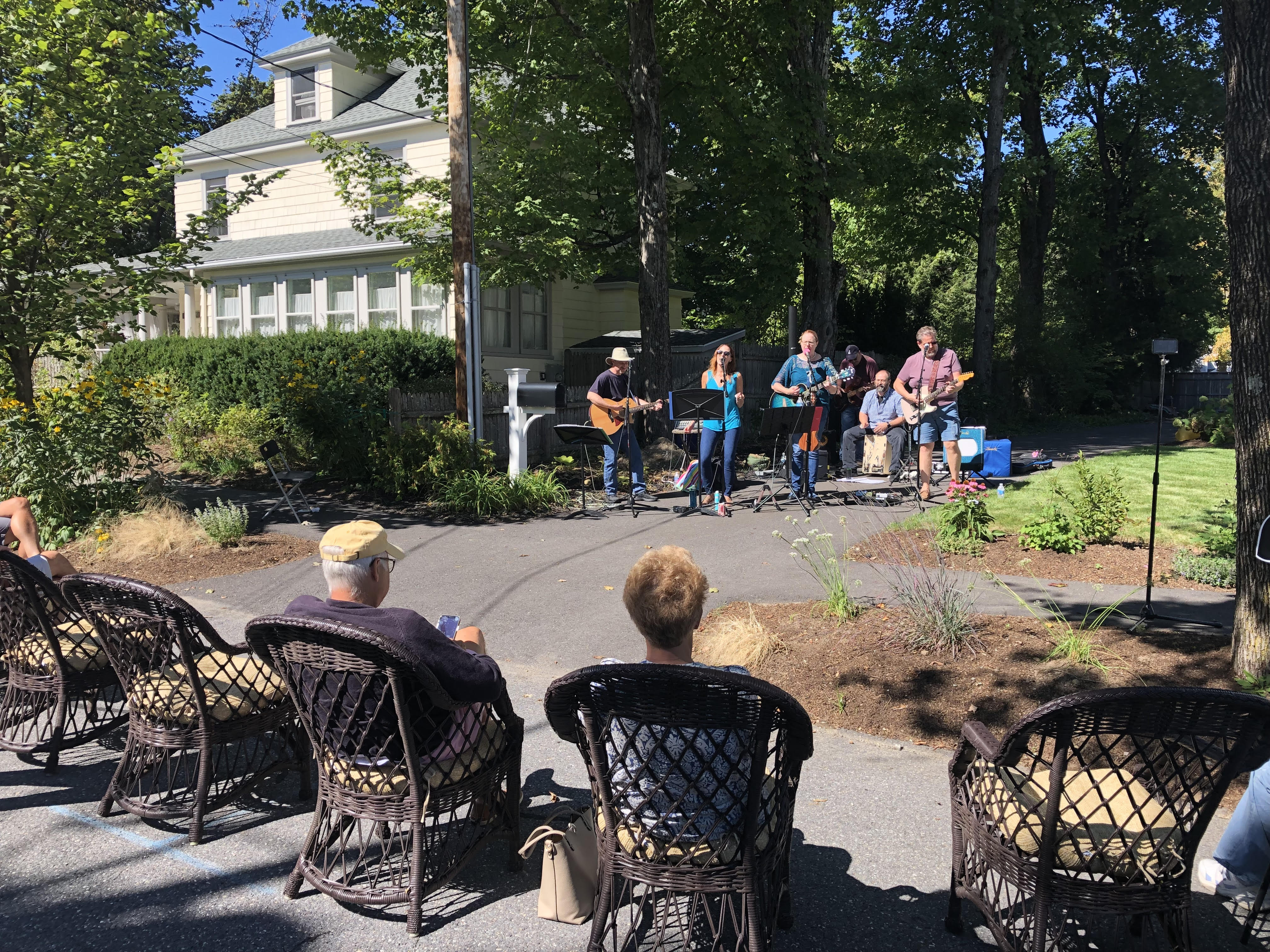
Porchfest events in Massachusetts towns promote neighborliness.

When Sara and I traveled together at age 16, one of the many things I learned from her was that it was perfectly fine to be friendly to strangers under some circumstances. You know, for example, how women who don’t know each other may strike up a conversation in a restaurant ladies room? That’s the kind of thing that was a revelation to me.

Nowadays, some folks have gotten more wary. Too wary. It is one factor in an epidemic of loneliness.

Sophie Hills  writes at the Christian Science Monitor, “Lida and Mark Simpson sit on the steps of their porch with friends while the blues rock band Red Medicine plays in a yard across the street. People crowd all four corners of the intersection, dancing and chatting. It’s PorchFest in Petworth, a neighborhood of Washington, D.C. Some 100 performers will play on porches and yards throughout the day. A new group of people walks up, searching for space with a view of the band. ‘Sit, sit,’ says Ms. Simpson with a big smile, gesturing toward the wall at the edge of the yard.

“The Simpsons, who have a 4-year-old and a 6-year-old, chose Petworth because it’s walkable, close to restaurants and playgrounds and public transit, and still has a neighborhood feeling. When they first moved in eight years ago, Ms. Simpson says she hoped for an active front porch culture. But it didn’t quite coalesce until people began socializing from their yards in 2020. Happily, says Ms. Simpson, ‘porch and stoop culture restarted during the pandemic, and it’s stayed around.’

“[This spring], the U.S. surgeon general declared an epidemic of loneliness and isolation, saying that 1 in 2 adults reported experiencing loneliness even before the pandemic. At a time when neighborliness is decreasing and Americans are growing further apart, some, like the Simpsons, are intentionally building relationships within their communities. And events like porch fests are growing in popularity. Central to a culture of neighborliness, many say, are front porches. …

“ ‘As it has built for decades, the epidemic of loneliness and isolation has fueled other problems that are killing us and threaten to rip our country apart,’ wrote Surgeon General Vivek Murthy in the New York Times on April 30, announcing a framework to rebuild community. …

“A front porch is a liminal space, says Michael Dolan, a writer and editor in Washington. ‘It’s the outside of the inside and the inside of the outside. … When people who have [porches and stoops] don’t use them, they’re missing out on the opportunity to interact with the environment. [And] the environment includes humans and includes passersby, includes somebody coming up to ask directions, includes somebody coming by to say hello.’

“The type of neighborliness embodied by Mister Rogers is no longer the norm. Over half of Americans say they only know some of their neighbors. … Over half of Americans who say they know some of their neighbors say they never get together socially, according to a Pew study from 2019.

“It takes curious and open people to build the kind of community that has block parties, borrows ingredients, and watches each other’s kids, but social spaces like front yards and porches are important too, says [Campbell McCool, founder of a Mississippi development that centers community life]. ‘A front porch is central to the whole personality of a neighborhood,’ he says. …

“Historically, Mr. McCool says, three things sped the decline of the front porch in suburbia in the 1950s: air conditioning, television, and the car. Air conditioning and TV coaxed people indoors. Cars meant more people lived further apart from each other.

“When sociologists began studying differences between residents in neighborhoods with and without porches, they found that in the latter there was little to no interaction. People drove straight into their garages, and private backyard decks grew in popularity. …

“Today, polls show that older Americans are more likely to have neighborly connections. Just 4% of Americans over 65 say they don’t know any of their neighbors, compared with 23% of adults under 30. …

“Karen Goddard, who prefers porches to private decks, calls herself a ‘professional porch sitter’ in her attempt to make neighborliness popular again. …

“The point, Ms. Goddard says, is to meet on front porches without agendas, minutes, or formality – ‘just meeting and conversation.’

“It resonated with Ms. Goddard as something she was already doing. ‘My friends in my neighborhood in New Hampshire knew that they could come to my house any Friday night and hang out on the porch,’ she says. …

“ ‘I like to smile and make eye contact and say “hello” if possible, because I just think that’s important for human connection and for neighbors.’

“The porch has always been a place of social interaction, says Mr. Dolan. That’s been his experience for the four decades he’s lived in the Palisades neighborhood of Washington, where he says neighborliness shines. …

” ‘I like to answer my door and say hello to the people who come to my house,’ he says. ‘[One gains] the feeling of trust in the neighborly compact, the ability to rely on one’s neighbors and call one’s neighbors. … Or even if your neighbors bother you, … you tolerate them because they’re neighbors. So it’s a sense of place that reinforces your feeling of being part of something.’ ”

More at the Monitor, here. No firewall. Subscriptions welcome.

Read Full Post »

Photo: Jon Swihart.
Belly dancer performance and artist lecture at a potluck in Santa Monica. (The potluck founders are moving to a state where they will have to remember to call a potluck “hot dish.”)

A sense of community is important to us all. Today’s story is about artists in California using the act of breaking bread together as a way to build bonds and reduce isolation.

“When artists Jon Swihart and Kimberly Merrill move from Santa Monica to Minneapolis … they will be leaving behind both a cherished home and a remarkable artistic and social legacy. Inspired by their friends Mark Ryden and Marion Peck’s recent move out of state, the couple decided it was time for a change. …

“Paying the home’s mortgage for decades solely by working as an artist is something Jon considers one of his greatest accomplishments. Another is the role he played — along with Kim — in hosting 162 potlucks in their verdant backyard, each one featuring artists or other creative producers who spoke about their life and work.

“ ‘Painting can be so isolating,’ Jon notes. ‘So sometime in the late 1980s I started inviting artists over to the house to talk about their work. Word spread quickly and people started asking if they could join us. The potlucks officially launched in 2003 after we became a couple. At Kim’s suggestion we started using the backyard — and supplying plates and plastic cutlery — and things really took off.’ By the time COVID-19 forced Jon and Kim to discontinue them in 2020, the artist potlucks had taken on a life of their own, drawing as many as 200 people at a time from an email list of over 2,500 names. …

“The backyard potlucks followed a consistent formula that worked because so many people stepped up to contribute and help out. Around 6pm on a Saturday night, a long table filled up with potluck delicacies — both store bought and homemade — while a drink table was stocked with wine and beer. Jon and his tech crew would set up for the artist slideshow as Kim greeted visitors in her studio at the back of the house.

“The house itself, although only 1,300 square feet, was one of the attractions. Built in 1927, its tile floors, beamed ceilings, and arched doorways offered a sense of warmth and comfort. On top of that, Jon’s trove of antiques and art objects — which include a painting attributed to Jean-Léon Gérôme that was later authenticated on the show popular British TV show Fake or Fortune — provided sophisticated eye candy.

“Over time an extraordinary variety of artists stood under the lanterns in Jon and Kim’s backyard, discussing not just their work, but also the events and challenges of their lives.

‘I would tell the speakers to avoid art theory,’ Jon recalls, ‘and instead talk about how a passion for art sustained you through disasters and triumphs.’ …

“Every now and then a potluck broke the mold. At one unforgettable event, a group of fire-spitters recruited from the Venice Beach boardwalk performed on the sidewalk in front of the house, stopping traffic and astonishing the neighbors. Another off-the-charts event was art historian Gerald Ackerman’s talk, which was also a celebration of his 80th birthday. 

“As artist F. Scott Hess recalls: ‘Jerry, the world’s foremost authority on Jon’s favorite artist, Jean-Léon Gérôme, was a longtime friend of all of us. That night in Jon’s backyard there were theatrical recreations of Gérôme paintings, with costumes as close to the originals as was possible. And there was a belly dancer as well. Jerry was thrilled with the acting out of Gérôme’s ‘The Duel After the Masquerade,’ with Brian Apthorp as the wounded harlequin taking a good 10 minutes to die.

“To cap off the evening, Jerry was given a Gerald Ackerman Action Figure, in its original box, a creation of Peter Zokosky, with all the extras a topnotch art historian would need.

“The popularity of the potlucks brought innovations. Trekell Art Supplies began sending merchandise for one-dollar-ticket raffles that raised money to support the events. Artists also began to donate prints or small works of art to be included in the raffles. Artist Eric Davis soon began creating buttons that included a logo and event date along with the featured artist’s name and work. … Davis made between 40 and 100 buttons, which were given away for free: a total of over 7,500 in a span of 14 years.

“ ‘They were open events and anyone could come,’ Swihart comments. Art dealers, critics, students, and collectors began to attend, especially after Greg Escalante — a dealer and the founder of Juxtapoz Magazine — talked them up. Thousands of complete strangers streamed through the house. Amazingly, nothing was ever stolen, which gave Jon and Kim a new faith in humanity. …

“During many of the artist talks — held under strands of paper lamps and a glowing moon — there was absolute silence among the audience. The energy was positive, even magical, and artists who might have seemed unapproachable before laid themselves bare. Again and again the talks humanized artists by revealing them as people who had struggled and who, at some point, had been afraid to experiment with their art. 

“One notable speaker — Robert Williams, the legendary underground comic and ‘lowbrow’ artist — told the crowd how the dominance of Abstract Expressionism had inhibited the development of representational art when he was a student. Because Jon and Kim’s potlucks were not sponsored by an organization or institution, contrarian points of view, like those offered by Williams, were respected and even welcomed. … From Swihart’s point of view, having Robert Williams speak at a potluck was ‘like having Eric Clapton stop by to play in my garage band.’ …

“ It was a cauldron for friendships, conversation, networking, alchemy, and artistry,’ recalls Eric Davis. … Artist Peter Zokosky comments: ‘Even at the time, you knew something rare and miraculous was happening. Jon gave a forum to 100-plus artists over the years, and never once did he give a slideshow of his own work.’

“ ‘The potluck was one of the most satisfying experiences of my life,’ Jon states. ‘We had so many artists on our wishlist when COVID shut them down, but it was time to bring it to an end.’ ” 

More at Hyperallergic, here. No firewall.

Read Full Post »

The other day, someone on twitter asked how other people were keeping themselves from being being overwhelmed by anxiety in these challenging times. My answer to that was “take action.” It makes a person feel less powerless and therefore more hopeful.

If you’re overwhelmed by politics, take political action of some kind. There are opportunities for every taste. If you’re overwhelmed by lost paychecks, use a food bank and volunteer there, too. If you’re overwhelmed with sadness for seniors quarantined in nursing homes, volunteer to talk to a few online.

Allyson Chiu writes at the Washington Post, “When the coronavirus pandemic left elderly residents in long-term care facilities largely cut off from their families and the outside world in early March, Hita Gupta got to work. Channeling the resources and volunteers of a nonprofit she founded in 2018, Gupta, 15, of Pennsylvania, started sending letters, cards and care packages to senior homes nationwide, even reaching some facilities in the United Kingdom and Canada.

“Her efforts garnered her widespread media attention and positive feedback poured in from recipients. But Gupta didn’t think the efforts went far enough. While letters and cards are a kind gesture that research has suggested can have a positive impact on mental health, they are ‘one-sided communication,’ the high school junior said.

” ‘That cannot be matched by a real-time conversation with a senior, a real conversation where both sides are learning and they’re building a bond,’ said Gupta, who until March had been volunteering on the weekends at a senior living facility near her home in Paoli, a Philadelphia suburb. ‘Being able to speak with someone who’s having a hard time … who’s experiencing isolation and loneliness, being able to ease some of that tension, I think that’s so important.’

Drawing inspiration from the regular Skype sessions she has with her grandparents, who live in India, Gupta started offering another service to the eldercare centers: video calls with volunteers from her nonprofit, Brighten A Day.

“The organization has also been collecting and donating camera-enabled devices such as smartphones, tablets and laptops to facilities in need, allowing residents more opportunities to virtually connect with their loved ones in addition to volunteers.

“During the pandemic, the virtual interactions have emerged as a complement to more traditional efforts to reach out to seniors, which have mostly focused on written communication. …

“[Says] Robert Roca, chair of the American Psychiatric Association’s council on geriatric psychiatry, ‘Somebody expressing interest, somebody prepared to listen, the experience of having somebody reach out to you, even if it’s not a person you know well, there’s something very powerful about that in restoring the morale of somebody who’s demoralized by loneliness.’ …

“Though there isn’t a ‘one-size-fits-all solution’ to combating loneliness, Roca emphasized the benefits of feeling connected. And for many older adults who have been isolated amid the pandemic, video calls have emerged as a ‘lifeline,’ he said. …

“About 100 volunteers have signed up to participate in calls, Gupta said. Interested facilities receive a spreadsheet listing information about the volunteers, such as their hobbies and what languages they speak, to help match them with residents. Volunteers also go through an orientation that provides guidelines for how to act during a call and tips for facilitating an engaging conversation. …

“ ‘Every time our residents talk to one of the volunteers, they’re like overjoyed afterward and that’s all they can talk about,’ said [Brandi Barksdale, director of life enrichment at memory-care facility] Artis Senior Living of Huntingdon Valley. …

“Jackie Kaminski, 21, has been video-chatting with the same resident at Berkeley Springs Center in West Virginia since the beginning of July. The pair talk over Zoom every week, Kaminski said, adding that she was recently able to celebrate her resident’s birthday with him.

“ ‘It did take time … to have him open up,’ said Kaminski, a senior at Indiana University. But now, they talk about his family and childhood, and he gives her advice on things happening in her life. ‘We have a great rapport,’ she added. ‘We have this relationship.’

“These conversations can help elderly people in long-term care facilities feel like they are valuable, said Eleanor Feldman Barbera, an expert on aging and mental health based in New York. One of the stages of life, Barbera said, is to ‘feel like you’re giving to the next generation.’

“ ‘Being able to talk to other people, younger people and talk about your life and feel like you’re passing on your wisdom can be a great way of feeling like you’re still accomplishing things and that your years are a benefit to somebody else,’ she said.”

More at the Washington Post, here.

Read Full Post »

200424_drive_by_performances_008_0

Photo: Devin Muñoz
” ‘Cooped-Up’ is a contemporary dance performance viewed entirely from behind car windows,” reports Margo Vansynghel at
Crosscut.

I’m fascinated by all the different ways the arts are reaching out during our lockdown. Some efforts come off better than others, and a given organization may be kind of lame on one evening and on another delightful. We’re all learning as we go.

In this story, Seattle dancers offer performances for an audience in cars.

Margo Vansynghel writes at Crosscut, “Gedney Barclay sat in her idling car in a North Seattle Safeway parking lot, awaiting instructions. She could feel herself getting anxious. … She looked around — unsure of what would happen next — and glanced at the phone in her hand. The call from an unknown number would come anytime now. And then there would be no turning back.

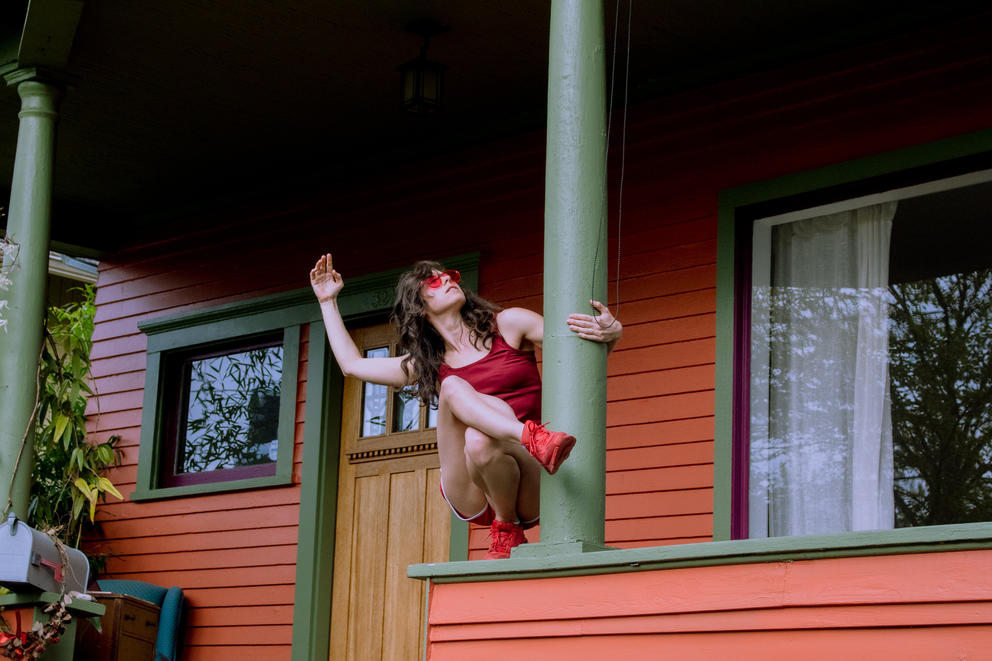
“Barclay wasn’t involved in some kind of nefarious plot. She was about to participate in ‘Cooped-Up: Drive-in Dances for Cooped Up People,’ a contemporary dance performance by local company LanDforms, in which audience members view the proceedings through their own car windows. …

“Guided by pins on a digital map and a downloaded soundtrack — featuring songs,  poetry, a couple of old voicemail messages and mysterious clues — ticketed audience members drive through the city and visit performers at their homes. The dancers perform from porches, sun rooms, front yards, alleys and balconies while the audience, cocooned in 20 cars (one per household), drives up to watch at 10-minute intervals.

“ ‘It’s a wild journey all over Seattle,’ says LanDforms’ Leah Crosby. She and co-director Danielle Doell describe the show as a whimsical mashup of a drive-in movie, scavenger hunt, escape room and ‘durational performance’ tailored to and inspired by COVID-19 restrictions. Basically, they say, it’s like curbside pickup of food-to-go, but for dance. The first, mid-April performance of Cooped-Up sold out almost instantly. …

“Crosby and Doell are among the many local artists finding front yard and window workarounds to the stay-at-home order and ban on gatherings.

“Earlier in March, artist Rachel Kessler and On the Boards director Betsey Brock staged a citywide performance titled ‘Going the Social Distance,’ for which they collected song requests (and home addresses) from participants, donned cheerful costumes and biked to people’s houses blasting the songs through Bluetooth speakers. Isolated fine art photographers are venturing out to photograph people from a safe distance either outdoors or behind windows. In late April, KEXP radio DJ John Richards started broadcasting live concerts from his front yard. …

“Cooped-Up deals explicitly with our new corona-colored reality. In seven different dances created collaboratively over Zoom, the participating dancers bring their personal quarantine experiences (and corresponding cocktail of emotions) to the makeshift stage. However whimsical, the show doesn’t shy away from expressing the loneliness and the boredom specific to this cultural moment. …

“On a Zoom call with production manager (and frequent collaborator) Ari Kaufman in late March, the duo wondered: ‘How can we make a live performance right now?’ Doell says. …

“When Doell, who is also a youth educator, noticed that cooped-up kids in her neighborhood had been hunting for the stuffed animals neighbors placed in windows as a way to pass the time, she wondered, ‘Maybe we can make kind of a dance teddy bear hunt?’ …

“These are not improvised performances. Everything is timed to the minute, if not to the second: when the first audience member’s car leaves; when they should arrive at the next location; where every car should theoretically be at each point in the performance; when the next song is supposed to start; and when each dancer resumes their short loop. ….

‘At any given time during the show, there are basically seven miniperformances happening simultaneously, Crosby says. That’s a lot to keep track of.

“During the five-hour run of the show, she sits in her room in West Seattle, headphones on, surveying multiple screens and spreadsheets like an air traffic controller. Meanwhile, pacing in his kitchen about a dozen miles away, production manager Kaufman has his phone at the ready, in case a car gets lost or runs into any trouble. …

“The dancers, including Doell, say [they] miss the collective warmups and preshow rituals, the murmur as the audience trickles into the theater. When they’re done, there’s no applause. It’s a new shade of loneliness. But also one that has Doell reconnecting with her neighborhood, she says.

“ ‘A lot of neighbors were poking their heads out and being like: “Wow, what is happening?” ‘ Doell recalls. …

” ‘Normally, the audience member’s job is to pay money and then sit face-forward in a dark room where their identity is masked,’ she says. [In this performance, they] have to figure out where to go. Follow the clues. Find the dancer. Park by the gray garbage bin, not the green one — and don’t knock it over while backing up. …

“[Audience member Barclay] hadn’t ventured outside her neighborhood for a long time. Driving through the city was a poignant reminder of something she already knew: So many people, in house after apartment after studio, were going through the same isolation, the same loneliness. But for a few hours, from the relative safety of her car, Barclay felt like she’d made a connection — rekindled the kind of mutual appreciation between dancer and audience that electrifies live performance.

” ‘It made me feel way less alone,’ she says.”

More here.

Read Full Post »


Photo: Alamy
Exercise and social activities could help to reduce the risk of developing dementia in later life, according to a new report.

Although there is no cure yet for dementia, lifestyle changes have the potential to reduce new cases by as much as one-third.

Nicola Davis writes at the Guardian about a recent report from the Lancet Commission on dementia prevention, intervention and care. The study suggests that many “dementia cases might be avoided by tackling aspects of lifestyle including education, exercise, blood pressure and hearing. …

“ ‘There are a lot of things that individuals can do, and there are a lot of things that public health and policy can do, to reduce the numbers of people developing dementia,’ said Gill Livingston, professor of psychiatry of older people at University College London and a co-author of the report. …

“ ‘We expect it to be a long-term change that will be needed for exercise; joining a gym for two weeks is probably not going to do it,’ she said.

“Clive Ballard, professor of age-related diseases at the University of Exeter medical school and also a co-author of the report, added that the evidence suggests individuals should also try to follow a Mediterranean diet, maintain a healthy weight and keep an eye on their blood pressure. …

“The results reveal that as many as 35% of dementia cases could, at least in theory, be prevented, with 9% linked to midlife hearing loss, 8% to leaving education before secondary school, 5% to smoking in later life and 4% to later life depression. Social isolation, later life diabetes, midlife high blood pressure, midlife obesity and lack of exercise in later life also contributed to potentially avoidable cases of dementia, the report notes. …

“They admit that the estimate that more than a third of dementia cases could be prevented is a best case scenario, with the figures based on a number of assumptions, including that each factor could be completely tackled. …

“Fiona Matthews, professor of epidemiology at Newcastle University who was not involved in the report, said that interventions for depression and social isolation could still prove valuable. ‘If we could actually resolve some of that issue, even if it is not 100% causal, it is likely we might be able to slow [dementia] progression – even if [an individual] is on a pathway to developing dementia already,’ she said.

“She added that the proposed areas for action could offer myriad health benefits beyond lowering dementia risk. …

“The authors pointed out that an intervention that delayed dementia onset and progression by even a year could decrease the number of people with dementia worldwide in 2050 by nine million.”

More at the Guardian, here.

Read Full Post »

Raising a family is challenging under any circumstances, but Simon Romero of the NY Times can tell you about families that have added on a somewhat more extreme challenge: settling in Antarctica.

He writes from Villa Las Estrellas, “Children at the schoolhouse here study under a portrait of Bernardo O’Higgins, Chile’s independence leader. The bank manager welcomes deposits in Chilean pesos. The cellphone service from the Chilean phone company Entel is so robust that downloading iPhone apps works like a charm. …

“Fewer than 200 people live in this outpost founded in 1984 during the dictatorship of Gen. Augusto Pinochet, when Chile was seeking to bolster its territorial claims in Antarctica. Since then, the tiny hamlet has been at the center of one of Antarctica’s most remarkable experiments: exposing entire families to isolation and extreme conditions in an attempt to arrive at a semblance of normal life at the bottom of the planet.

“It gets a little intense here in winter,” said José Luis Carillán, 40, who moved to Villa Las Estrellas three years ago with his wife and their two children to take a job as a teacher in the public school.

“He described challenges like trekking through punishing wind storms to arrive at a schoolhouse concealed by snow drifts, and withstanding long stretches with only a few hours of sunlight each day. …

“Most of the students at the village’s small school, who generally number less than a dozen, are the children of air force officials who operate the base; some of the parents say the isolating experience strengthens family bonds.

“That Villa Las Estrellas is so remote — its name can be translated as Hamlet of the Stars, since the lack of artificial light pollution here enhances gazing into the heavens — sits just fine with many who live here.

“ ‘People in the rest of Chile are so afraid of thieves that they build walls around their homes,’ said Paul Robledo, 40, an electrician from Iquique (pronounced E-key-kay). ‘Not here in Antarctica. This is one of the safest places in the world.’ More here.

And here you thought our cold snap was a little intense!

Photo: Daniel Berehulak for The New York Times  
Children being picked up from school in Villa Las Estrellas. Most of the students at the village’s small school, who generally number less than a dozen, are the children of air force officials who operate a nearby base. 

Read Full Post »

We went downtown to have lunch at the Whitney Museum with friends and to take in the Real/Surreal exhibit.

Favorite artists like Charles Sheeler, Mardsen Hartley, and Grant Wood were featured. I liked the eerie emptiness of Edward Hopper’s “Seventh Avenue” and the anxious denizens of George Tooker’s subway world.

Sounds unnerving, but in surfacing the alienation, I think the artists make one feel the possibility of getting a grip on it.

Afterward, we walked up Madison, stopping at a gallery in the Carlyle Hotel that was showing Magritte works, some for sale.

I have always liked Magritte, with his bowler-hatted men blocked by giant green apples and his nighttime streets overarched by daytime skies. And I especially like him because once in a workshop, I directed a Tom Stoppard one-act play inspired by him, After Magritte. It was the best fun!

Read Full Post »