Feeds:
Posts
Comments

Posts Tagged ‘japan’

Here’s an interesting start-up by a couple of entrepreneurs who love to eat. The two women decided to build a business around helping travelers find truly authentic cooking.

According to Aashi Vel and Steph Lawrence’s website, “Traveling Spoon believes in creating meaningful travel. We are passionate about food, and believe that by connecting people with authentic food experiences in people’s homes around the world we can help facilitate meaningful travel experiences for travelers and hosts worldwide.

“To help you experience local cuisine while traveling, Traveling Spoon offers in-home meals with our hosts. In addition, we also offer in-home cooking classes as well as market tours as an extra add-on to many of the meal experiences. All of our hosts have been vetted to ensure a safe and delightful culinary experience.

“Traveling Spoon currently offers home dining experiences in over 35 cities throughout Bangladesh, Cambodia, China, Hong Kong, India, Indonesia, Japan, Singapore, South Korea, Sri Lanka, Taiwan, Thailand, Turkey and Vietnam, and more countries are coming soon!” More here.

I have no doubt that Traveling Spoon is also boosting international understanding. What a good way to use an MBA! Business school is not all about becoming an investment banker, as Suzanne and Erik would tell you.

Photo: Traveling Spoon
Traveling Spoon founders Aashi Vel and Steph Lawrence met at the Haas School of Business.

Read Full Post »

As usual, John has a pretty good idea of the kind of story that really floats my boat. Mysterious green balls washing up on the beaches of Australia, Anyone?

The Science Alert website reports that on the weekend of September 20, “thousands of peculiar green balls appeared on Dee Why Beach near Sydney in Australia. About 6 centimetres in diameter, these squishy little spheres are living organisms – seaweed balls known as ‘marimo’.

” ‘They’re actually a really unusual growth form of seaweed, because seaweeds mostly grow on the rocks but occasionally they get knocked off and rolled around in the ocean forming these beautiful little balls,’ Alistair Poore from the University of New South Wales explained to 7News.’It’s quite an unusual phenomenon, it’s only been seen a handful of times around the world.’

“First discovered in the 1820s by Austrian botanist Anton Eleutherius Sauter, and named by Japanese botanist Tatsuhiko Kawakami in 1898 (‘marimo’ roughly means ‘bouncy play ball’ in Japanese), colonies of these little balls have only been seen off the coast of Iceland, Scotland, Japan, Estonia and now Australia.”

See videos at Science Alert, here.

More on the green balls at Wikipedia and at Smithsonian.

Read Full Post »

The website “This Is Colossal” has a lovely bit on a fish with artistic tendencies.

Japanese photographer Yoji Ookata “obtained his scuba license at the age of 21 and has since spent the last 50 years exploring and documenting his discoveries off the coast of Japan. Recently while on a dive near Amami Oshima at the southern tip of the country, Ookata spotted something he had never encountered before: rippling geometric sand patterns nearly six feet in diameter almost 80 feet below sea level. He soon returned with colleagues and a television crew from the nature program NHK to document the origins what he dubbed the ‘mystery circle.’ …

“The team discovered the artist is a small puffer fish only a few inches in length that swims tirelessly through the day and night to create these vast organic sculptures using the gesture of a single fin. …

“Apparently the female fish are attracted to the hills and valleys within the sand and traverse them carefully to discover the male fish where the pair eventually lay eggs at the circle’s center, the grooves later acting as a natural buffer to ocean currents that protect the delicate offspring.” Read more.

Never imagine that there is nothing left to discover. After all, “According to the National Oceanic and Atmospheric Administration less than five percent of the world’s oceans have been explored,”

Photo: This Is Colossal.
The male puffer fish makes this nest to attract a female.

Read Full Post »

Public Radio International’s “The World” had a delightful story today on a young Egyptian who looks like he might be a real “contenda” for a sumo wrestling title.

Clark Boyd reports, “His real name is Abdel Rahman Ahmed Shaalan. But in Japan, they call him Osunaarashi, or ‘Great Sandstorm.’

“Shaalan is 21-year-old professional sumo wrestler who hails from Giza in Egypt. After a few years of training at the club level in Egypt, Shaalan left Egypt to try to break into the Japanese professional ranks. …

“Osunaarashi is currently fighting in a tournament in Tokyo, but here’s the thing: He is also a devout Muslim, and this is the holy month of Ramadan. And that means Osunaarashi is fasting.”

The radio report goes on to say that although sumo has always been an intensely tradition-bound sport, the people at the residence where Osunaarashi is living with other wrestlers have made accommodations in deference to his religion. For example, a typical stew that sumo wrestlers are served to bulk them up is chock full of pork, but the chefs now make it with chicken and fish.

More.

Photo: Phlyz/Wiki Commons
Osunaarashi, the Egyptian sumo wrestler, after a Tokyo tournament in May

Read Full Post »

The Science section of the NY Times today featured some research on babies.

Sindya N. Bhanoo explains that “In Parents’ Embrace, Infants’ Heart Rates Drop.”

“New mothers quickly learn that babies quiet down when carried and rocked. Now researchers say that this calming response is actually a coordinated set of reactions, involving the nervous, motor and cardiac systems.

” ‘Dr. Kumi O. Kuroda, a neurobiologist at the Riken Brain Science Institute in Japan, led a team that used electrocardiogram measurements to monitor the heart rates of babies and mice after they were picked up and carried. Their heart rates slowed almost immediately.

“ ‘It’s very difficult for adults to relax so quickly,’ said Dr. Kuroda, whose study appears in the journal Current Biology. ‘I think it’s specific to infant physiology.’

“In the case of the mouse pups, it took only one second for the heart rate to drop. In human babies, it took about three seconds.

“The researchers worked with babies under 6 months; the response was stronger in those 3 months and younger. …

“ ‘Lions sometimes carry cubs by the mouth, and it’s known that these infants look very limp and relaxed, with their eyes closed,’ Dr. Kuroda said. ‘But nobody measured the infant response until now.’ ,,,

” ‘By the way, she added, the mother is not the only one who can have this calming effect.

“We actually also did some preliminary studies with fathers and grandmothers,’ she said. ‘And basically they can have the same effect.’ ”

More.

Worth noting, especially considering that the same Science section of the Times had a story on how people with slower heart rates tend to live longer than peers.

Baby_and_friend030809

Read Full Post »

From the Jules Verne classic 20,00 Leagues Under the Sea came a film with Kirk Douglas and a memorable Giant Squid. (Disney will probably sue if I embed a pirated trailer. See the official one here. It has the Giant Squid in it.)

Until very recently, no one could prove that such a thing as a Giant Squid even existed. I have seen renderings of what sailors might really have seen when they described a Giant Squid: for example, a whale with an octopus wrapped around it. And I just learned that the mythological Kraken may be the result of people seeing a Giant Squid and thinking it was a supernatural monster. (Oh, surely not the gentle Kraken of The Island of the Aunts!)

Here’s what made my day: the wonder and delight in the voice of the woman videotaping the first Giant Squid ever caught on camera, a creature that hangs out in the deep sea off Chichi island, Japan, where expeditions going down 3,000 feet have sought him for years.

You can hear Tom Ashbrook’s guests talk about this triumph at WBUR’s OnPoint program.

They are Richard Ellis, author of “The Search For The Giant Squid: The Biology and Mythology of the World’s Most Elusive Sea Creature,” and Edie Widder, the president and senior scientist at the Ocean Research and Conservation Association who filmed the Giant Squid.

“For thousands of years, sailors have told stories of giant squids. In myth and cinema, the kraken was the most terrible of sea monsters. Now, it’s been captured — on a soon-to-be-seen video.

From National Public Radio: “Even after decades of searching, giant squids had only been seen in still photographs. Finally, in last July, scientists filmed the first video of a live giant squid swimming some 2,000 feet below the surface of the Pacific Ocean.

“Edie Widder is the ocean researcher who shot the footage, which is slated to be released in a Discovery Channel documentary later this month.

“She told Jacki Lyden, host of weekends on All Things Considered, the elusive creature could have been as much as 30 feet long” More.

(I am spatially challenged and embarrassed to admit how many decades it took me to figure out that Captain Nemo traveled in his Nautilus 20,000 leagues horizontally, not straight down.)

Photograph: Edie Widder/Discovery Channel
A giant squid stars in this still image taken from the first-ever video of giant squids.

Read Full Post »

Thank you, Gwarlingo, for tweeting this. Looks like there’s hope for us all.

“All your excuses are invalid,” says Dustin Kurtz in an article at the Melville House site about “the seventy-five year old winner of a prize for emerging writers.

“The semiannual Akutagawa prize was awarded in Japan this past Wednesday, and this season’s winner was Natsuko Kuroda. The Akutagawa prize, begun in 1935, is awarded for stories published in newspapers or magazines by new or emerging authors. Kuroda is seventy-five years old.

“Her story, ‘ab Sango’ (it can be previewed and purchased here) is unusual in that it uses no pronouns for its young principle characters, and is written horizontally across the page from left to right, rather than the standard top to bottom. The result is strange and beautiful, and hints at a genealogy of Popper-esque fairy tale formulae, of mathematics or of sociology, and all of which is given subtle cultural freight by Kuroda’s horizontal lines. But again — because it bears repeating — this intriguing emerging writer is seventy-five years old.

“Kuroda is in fact the oldest writer ever to be given the Akutagawa prize, and she is nearly as old as the prize itself. Ryunosuke Akutagawa, the award’s namesake and perhaps Japan’s most celebrated story writer, famously killed himself when he was less than half her current age.

“Upon receiving the prize, Kuroda said, ‘Thank you for discovering me while I am still alive.’ ” More.

Photograph: Melville House, an independent book publisher in Brooklyn, NY.

Read Full Post »

My husband, who has made a lot of business trips to Japan (and also has been reading my posts about 100-year-old workers), pointed me to something interesting at the Japan Times.

Jiji writes, “A business project focused on selling decorative leaves for use in Japanese cuisine is attracting overseas attention to Kamikatsu, a mountain town in Tokushima Prefecture. …

“The [Irodori, or bright colors] project, which succeeded in commercializing colored leaves grown in local mountains and fields and now claims members from nearly 200 farms, has become a vital industry in Kamikatsu, which has a population of less than 2,000. …

“The average age of the farmers involved in the project is 70, and many are women. Some earn more than 10 million [yen, more than $100,000] a year from the business.

“Irodori members use tablet computers to check for updated information on orders. The leaves are grown in their own mountains and fields, then distributed to markets across Japan via an agricultural cooperative. …

“According to the Japan International Cooperation Agency, which promotes international visits to Kamikatsu, the response to its English DVD on the Irodori project was huge. It has been translated into Bengali, Spanish and French.

“Tomoji Yokoishi, 54, who came up with the Irodori idea and is president of the managing company, said perceptional shifts are responsible for its success.

“The project turned regular leaves into a valuable resource and turned its elderly into a workforce, Yokoishi explained.”

I’m guessing that the phrase “for use in Japanese cuisine” doesn’t mean anyone eats the leaves. They are probably used to decorate tables where Japanese cuisine is served. Do you think?

Read the Japan Times article, here.

Art: Elaine Richards, 1994 7″ X 10″ Watercolor Collection B. Riff

Read Full Post »

It should be obvious that being out in nature is good for us, but today it often seems like a foreign concept.

“Take Two Hours of Pine Forest and Call Me in the Morning” is a lovely article, coming to you from Outside magazine. (I got the link from Andrew Sullivan’s blog.)

“These days, screen-addicted Americans are more stressed out and distracted than ever. And nope, there’s no app for that. But there is a radically simple remedy: get outside. [Outside magazine’s] Florence Williams travels to the deep woods of Japan, where researchers are backing up the surprising theory that nature can lower your blood pressure, fight off depression, beat back stress —  and even prevent cancer. …

“If the Japanese embrace of forest therapy can be attributed to one man, it’s [Yoshifumi] Miyazaki, a physiological anthropologist and vice director of Chiba University’s Center for Environment, Health, and Field Sciences, located just outside Tokyo.

“Miyazaki believes that because humans evolved in nature, it’s where we feel most comfortable, even if we don’t always know it. …

“Miyazaki has taken more than 600 research subjects into the woods since 2004. He and his colleague Juyoung Lee, also of Chiba University, have found that leisurely forest walks, compared with urban walks, yield a 12.4 percent decrease in the stress hormone cortisol, a seven percent decrease in sympathetic nerve activity, a 1.4 percent decrease in blood pressure, and a 5.8 percent decrease in heart rate. On subjective tests, study participants also report better moods and lower anxiety. …

“The science is so convincing that other countries are following Japan’s lead in studying and promoting nature as a cure. Lee just got hired away by the South Korean government, which is pouring more than $140 million into a new National Forest Therapy Center, expected to be completed in 2014. Finland, an empire of boreal spruce and pine, is also funding numerous studies. ‘Japan showed us that there could be cooperation between forestry and medical fields,’ says Liisa Tyrvainen of the Finnish Forest Research Institute” More.

Apart from just feeling better when I step outside for my walk and breathe the outdoors air, I note that a couple of my hero writers (Dickens and Asakiyume) are known for ruminating on long walks. Nature nourishes creative thought. P.S. Asakiyume also takes great pictures on her walks and posts them on her blog.

May 27, 2013, update from John: Mononoke creator Hayao Miyazaki on how he thinks about his art, here.

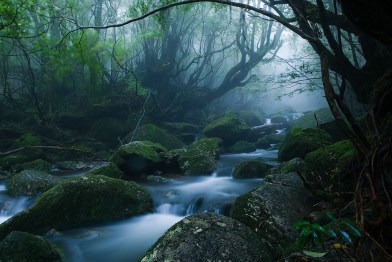
Photograph: Casey Yee
Mononoke forest, Yakushima Island, a
long the Kusugawa Trail. This is the forest that inspired Ghibli studio’s “Princess Mononoke.”

[University of Chiba‘s Yoshifumi Miyazaki] believes that because humans evolved in nature, it’s where we feel most comfortable, even if we don’t always know it. “Throughout our evolution, we’ve spent 99.9 percent of our time in natural environments,” he says. “Our physiological functions are still adapted to it. During everyday life, a feeling of comfort can be achieved if our rhythms are synchronized with those of the environment.”

To prove it, Miyazaki has taken more than 600 research subjects into the woods since 2004. He and his colleague Juyoung Lee, also of Chiba University, have found that leisurely forest walks, compared with urban walks, yield a 12.4 percent decrease in the stress hormone cortisol, a seven percent decrease in sympathetic nerve activity, a 1.4 percent decrease in blood pressure, and a 5.8 percent decrease in heart rate. On subjective tests, study participants also report better moods and lower anxiety.

Read Full Post »

I went to the concert of an oboe-playing friend Sunday. The 3 p.m. event coincided with the anniversary of the earthquake and tsunami that took place a year ago in Japan. My friend, of Japanese heritage, was moved by the music he was playing, and so was I. The modern pieces really sounded like an earthquake to me. I had visions of Poseidon, the Bull from the Sea, rising up in anger against humankind, and later of hope dawning.

The Charles River Wind Ensemble, where my friend plays, has a new conductor. I liked Matthew Marsit’s energetic style and his explanations of the pieces. Marsit, a clarinetist himself, is also a conductor at Dartmouth College, where he practices his belief in music outreach to lower-income communities.

“An advocate for the use of music as a vehicle for service, Matthew has led ensembles on service missions in Costa Rica and Philadelphia, Pennsylvania, collecting instruments for donation to schools, performing charity benefit concerts and offering workshops to benefit arts programs in struggling schools.  His current work at Dartmouth allows for outreach projects in the rural schools of New Hampshire and Vermont, working to stimulate interest in school performing arts programs.” Read more.

I think musicians can be very giving people. Indian Hill Music in Littleton, Massachusetts, offers scholarships and more. Someone I know on the board tells me that Indian Hill has “a program to bring music instruction to schools in the region that have cut out music due to budgetary constraints. They also offer free concerts, a Threshold choir (music for dying patients), and a number of other outreach efforts.”

In Providence, Rhode Island, Community MusicWorks demonstrates how music builds community and teaches social responsibility. You can read about this and other innovations in Rhode Island’s creative economy here.

Read Full Post »

Blogger Andrew Sullivan is on vacation in Provincetown (uh-oh, hurricane!), but his crack team at the Daily Beast is doing him proud.

I’m so grateful that they clued me in to the delightful Gwarlingo blog. Creator Michelle Aldredge says that her goal with Gwarlingo is to highlight “some of the most inventive work being made today in music, writing, film, performance, and the visual arts.” My first exposure confirms that she’s succeeding.

In this Gwarlingo post, we learn about the fine art of manhole covers in Japan and a book by Remo Camerota on the topic called Drainspotting. Camerota writes, “In the 1980s as communities outside of Japan’s major cities were slated to receive new sewer systems, these public works projects were met with resistance, until one dedicated bureaucrat solved the problem by devising a way to make these mostly invisible systems aesthetically appreciated above ground: customized manhole covers.”

https://i0.wp.com/www.gwarlingo.com/wp-content/uploads/2011/08/Paper-Crane-Design-in-Hiroshima-Manhole-Cover.jpg

Photo source unknown.

https://i0.wp.com/www.gwarlingo.com/wp-content/uploads/2011/08/Crane-Japanese-Manhole-Cover-Photo-by-Carlos-Blanco.jpg

Photo by Carlos Blanco via Flickr Commons

Lots more manhole covers at Gwarlingo.


Read Full Post »

« Newer Posts