Feeds:
Posts
Comments

Posts Tagged ‘kenya’

Photo: Malin Fezehai for the Washington Post.
Steve Otieno (described below) rehearsing with the Ghetto Classics orchestra in Kenya.

Charitable work is complicated. It is not always possible to do the good for people that you intend. But if you are making a meaningful difference in some lives, that may be enough.

In Kenya, an orchestra called Ghetto Classics aims to help poor children achieve something fine and eventually move away from the dangers of their extreme poverty.

Katharine Houreld writes at the Washington Post about both the successes and failures of the orchestra.

“The violin’s quaver steadied and swelled through the gloomy concrete staircase, escaped through the wire mesh and soared over the packed-dirt playground before dissipating in the acrid smoke drifting in from the smoldering dump site next door.

“It was the last day of class before Ghetto Classics broke up for Christmas, and 14-year-old Steve Otieno was practicing his Christmas carols for his final performance of 2024. Undeterred by the demolition of his home last month, the floods that devastated his neighborhood in Nairobi this year, or the eye-watering stink of burning plastic all around him, he stroked the strings to coax forth each note of ‘Joy to the World.’

“ ‘Music makes me feel calm when I’m stressed,’ he said shyly. ‘Some people have drugs. For me, it is music.’

“Steve is one of thousands of children from the poorest neighborhoods of the Kenyan capital who have been introduced to classical music by Ghetto Classics. The organization was set up in 2008 by Elizabeth Njoroge, a classically trained singer who studied pharmacology at her parents’ urging but longed to return to music. A chance encounter with a priest trying to fund a basketball court at a Catholic school in the Nairobi slum of Korogocho inspired her to raise money for the first class of musicians there. …

“Now Ghetto Classics provides lessons to about 1,000 students, who feed three orchestras, a choir and a dance group. Njoroge raises funds to support its expanding programs.

“Ghetto Classics works in schools and community centers in Nairobi and Mombasa, but its headquarters is in the St. John compound in Korogocho, where a church, school and community all share space. A tarmacked basketball court and a dirt field for soccer are enclosed by a sagging chain-link fence and scraggly trees; on one side of the compound, the children have planted a garden to try to filter out the choking smoke.

“Ghetto Classics has performed for former president Barack Obama, first lady Jill Biden and Pope Francis. Alumni are studying in the United States, Britain and Poland.

They include one determined pianist who learned to play by watching videos and repeating the motions on a piece of cardboard on which he’d drawn keys.

“The lessons provide a refugee for students suffering from hunger, domestic violence and crime, said violin instructor David Otieno, who is not related to Steve. He joined the program a decade ago as a student; now he’s one of 45 graduates working as paid instructors.

“The tall, dreadlocked 29-year-old credits Ghetto Classics with saving him from the neighborhood gangs. He witnessed his first homicide when he was still in primary school, and as he grew up, the gangs sucked in friend after friend. His teachers became so worried he’d be killed, he said, that they collected money to move his mother and six siblings to a safer neighborhood where he could continue his music.

“Back then, he said, the group shared 10 violins among 30 students. Now he has his own instrument. Once shy and fearful, he has played in Poland, in the United States and at State House, the Kenyan president’s home in Nairobi.

“ ‘The violin gives you a voice,’ he said. ‘It makes you talk to people you’d never otherwise talk to.’ His students filed into the compound bumping fists.

“Thousands of kids enroll in Ghetto Classics, but most fall away. The discipline is demanding. … About a dozen young musicians who spoke to the Washington Post said their parents had never seen them perform. Some were single parents too busy working, some weren’t interested and some were actively opposed. …

“When opera singer David Mwenje started with Ghetto Classics, his father was skeptical, he said, but he came to see him perform and was won over — a bittersweet memory to which Mwenje clings now that his father has died.

“Mwenje sang for six years, including for Pope Francis at the Vatican, before turning professional in 2021. His first audition landed him the role of Okoth — a messenger who must tell a village medicine man that his daughter has taken up with foreign missionaries — in Nyanga: Runaway Grandmother with Baraka Opera Kenya at the Kenya National Theatre. It was the first ray of hope in years darkened by his father’s death and the covid pandemic that shuttered his school, he said.

“ ‘Through this opera, I could control all my pain,’ he said. ‘I also love to sing “Bring Him Home,” from Les Misérables, because the song reminds me of my dad and I feel like I’m pleading with God to bring him home.’ ”

More at the Post, here.
Read Full Post »

Photo: Brian Otieno/The Guardian.
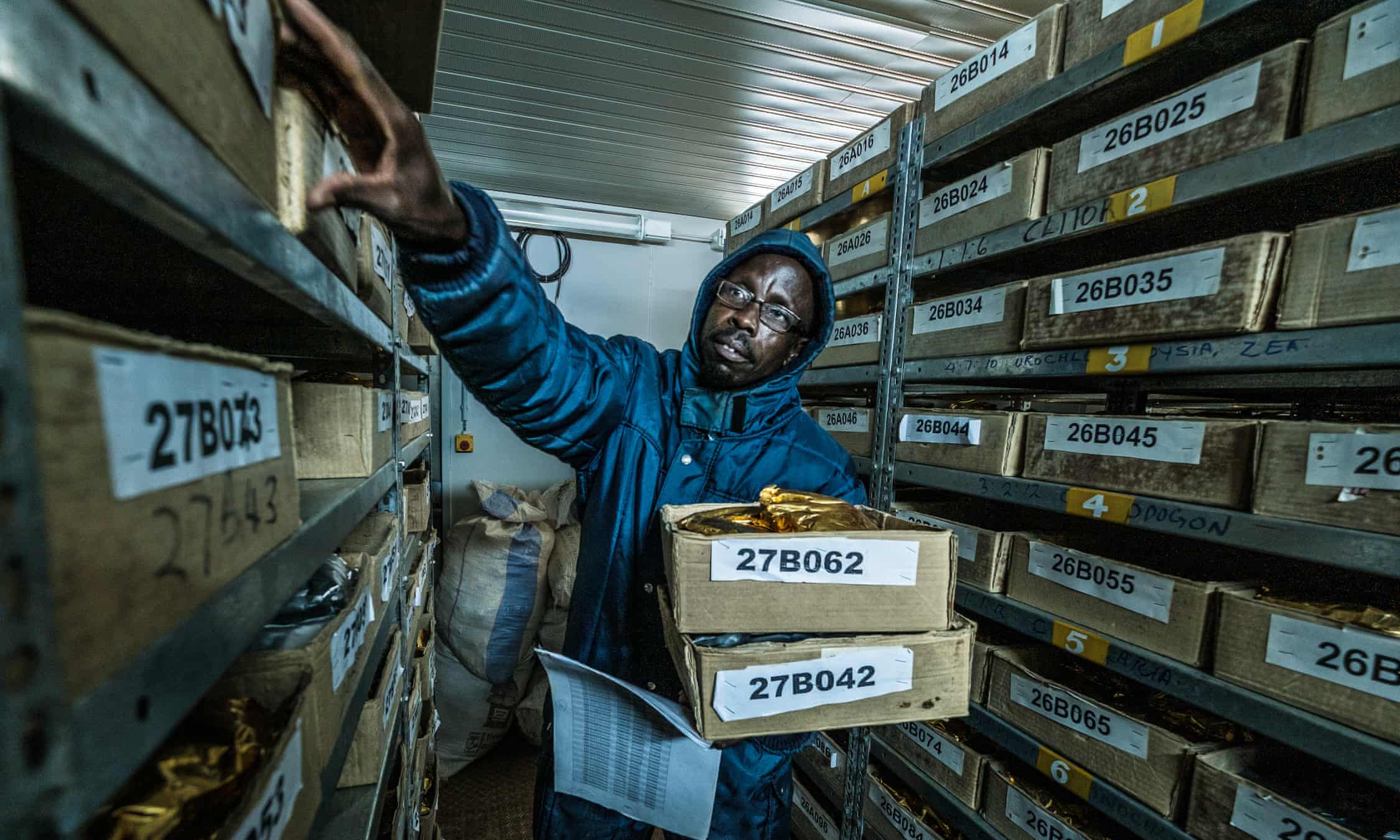
John Okemer, a seed technician, arranges some of the thousands of seeds stored inside Kenya’s gene bank. 

As our wounded planet hurtles through space, what should we take with us to replicate the better things as needed? Noah took two of each animal, bird, fish. Some of our contemporaries are taking seeds.

Caroline Kimeu writes at the Guardian, “On a winding road in the densely forested Kikuyu highlands of south-central Kenya lies a nondescript government building: the Genetic Resources Research Institute. Opened in 1988, during the country’s ‘green revolution,’ this little-known national gene bank was set up to hold and conserve seeds from the traditional crops that were in danger of disappearing as farmers and agricultural industry moved to higher-yield varieties.

“For decades, it has collaborated with researchers studying crop genetics and others working to develop improved varieties. But as the climate crisis worsens food insecurity, the repository of about 50,000 seed and crop collections could become a lifeline for farmers.

“ ‘We were established as a conservation unit, but these are unusual times with climate change, so we’ve had to diversify our work to respond to needs,’ says Desterio Nyamongo, who runs the institute. ‘Given the erratic weather these days, smallholder farmers need a diverse mix of crops.’

“Through a project with the Crop Trust organization the gene bank is now playing a part in the comeback of indigenous crops that are resistant to drought and pests, but fell from favor and have been neglected for decades.

“It stores backups of its most unique seeds at the Svalbard global seed vault in Norway, where it has been sending collections since 2008. The international repository contains more than a million seed samples from around the world.

“Matthew Heaton, the project manager for Crop Trust’s Seeds for Resilience program, says: ‘National gene banks can be overshadowed by the larger international ones, but they are best positioned to quickly improve local resilience and nutrition because their collections are adapted to local needs and growing conditions.’

“The national gene bank is a small operation, with few staff and limited funding, and its cold rooms, which plant scientists say contain only a third of the country’s plant diversity, are almost full. The Seeds of Resilience project, launched in 2019, has supported national gene banks in Ethiopia, Ghana, Kenya, Nigeria and Zambia with financial and technical support to keep resilient, healthy and nutritious crop collections, and to increase their support for farmers. …

“Farmers from the village of Obucuun in rural Busia county, on the border of Kenya and Uganda, say that before sourcing new sorghum varieties from the gene bank, growing the cereal had become challenging. Attacks by flocks of weaver birds, which can ravage entire cereal fields, increased in frequency after the wild grasses preferred by the birds became more scarce as a result of the climate crisis.

“Ruth Akoropot, a 50-year-old farmer from the area, spends hours each day watching over her crops during peak hours of attack, after studying the birds’ behavior patterns for years.

“ ‘If you don’t do that, your crop will be wiped out,’ says Akoropot, who runs the women’s sorghum farmers association, which sells bales of the grain to Kenya’s national beer brewery. …

“Most of Busia’s population rely on farming for food and to make a living, but … a number remain vulnerable to food insecurityFlooding in April and May [in 2024] swept away farmers’ seeds and yields, exacerbating poor agricultural productivity. Old improved crop varieties sourced from the gene bank, such as Kenya’s red-headed sorghum okoto, which farmers say is less prone to bird attacks, have become community favorites in Busia after decades of disuse. …

“Tobias Okando Recha, an impact researcher for the Seeds of Resilience program, says: ‘These are crops that farmers don’t need to pump a lot of fertilizer on. With just a little fertilizer, the yield is good and they are more [resilient] than hybrid varieties. …

“Plant scientists say that while the divide between farmers and seed conservationists is narrowing, more needs to be done. …

“ ‘The gene banks are not museums, but a resource for the future,’ says Heaton. ‘By linking them with farmers, we can swiftly build local resilience and food security.’ ”

More at the Guardian, here.

Read Full Post »

Photo: Creatives Rebuild New York.
Painter Athesia Benjamin created a self-portrait while participating in the guaranteed income program.

From time to time this blog has checked in on experiments in basic income taking place around the world. If you use search terms like “basic income” or “guaranteed income” in my search box, you will find many related articles, including ones on helping Kenyan villagers, keeping New Orleans teens in school, slashing homelessness in Finland, and supporting artists in Ireland.

New York has also piloted a basic income for artists.

Maya Pontone writes at Hyperallergic, “Early findings from a guaranteed income program for artists across New York State reveal that such initiatives can provide crucial support for artists’ financial stability, professional advancement, and individual well-being. 

“While more comprehensive results are slated to be released at the end of the year, preliminary outcomes show that when artists receive guaranteed income, they generally concentrate on addressing outstanding debt, bills, and increasing their personal savings. They also have more freedom to work on their practice and more time for caregiving responsibilities.

“The report was compiled by Creatives Rebuild New York (CRNY), a $125 million guaranteed income and work opportunity initiative that began in 2021 and is chiefly funded by the Andrew W. Mellon Foundation, the Stavros Niarchos Foundation, and the Ford Foundation. Under the program, CRNY provided 2,400 artists across New York no-strings-attached monthly payments of $1,000 for 18 consecutive months, prioritizing individuals who are acutely impacted by institutional barriers to financial security based on their race, physical ability, sexual orientation, citizenship status, and caregiving tasks.

“On average, the survey found that 17% of the guaranteed monthly payments were used to pay off debt, principally outstanding credit card balances and loans and mortgages. Furthermore, artists saved approximately $150 more each month and put nearly $140 of the payments toward expenses like rent and utilities. The initiative also showed that participants generally reported feeling improved mental and emotional health in comparison to those who did not receive guaranteed monthly payments. …

“ ‘Going through a breast cancer diagnosis during a pandemic was the most difficult experience of my life,’ shared one anonymous participant quoted in the report. …

‘Guaranteed Income gave me the support I needed to slowly build my life back, become strong and healthy again, and has truly led me back to this industry feeling safe, valued and supported,’ the participant wrote.

“In an interview with Hyperallergic, Maura Cuffie-Peterson, CRNY’s director of strategic initiatives, explained that critics of guaranteed income programs generally ‘claim that they disincentivize work. … Our report shows that not only are artists working with a guaranteed income, but they’re really shaping work that is meaningful to them and in their community life.’

“The report’s findings add to survey results released by CRNY this summer that showed a majority of NY artists are in precarious financial positions, currently earning significantly below living wage standards.

“ ‘When done ethically and in collaboration of those who are directly impacted, research can lead us to better designed programs and even policy solutions,’ Cuffie-Peterson said, adding that guaranteed income programs could be more beneficial if they ran for longer periods of time.

“As an example, she cited Minnesota arts organization Springboard for the Arts’s recent announcement that it is extending its guaranteed income pilot for artists to five years and offering additional financial counseling services.

“ ‘It’s less what should be researched next, but more how these things that are all being researched are building up into something bigger, more impactful, and more meaningful to more people,’ Cuffie-Peterson said.”

More at Hyperallergic, here.

Read Full Post »

Photo: Top Africa News.
One of the benefits of having Kenyan farmers raise butterflies for a living is that they are protecting East Africa’s largest coastal forest.

I’m reading a strange British novel called Ash Before Oak in which the protagonist is keeping a diary about the natural world he encounters on leaving London for England’s West Country. As a kind of self-therapy for the impending breakdown he senses, he makes lists of — and tries to focus on — all the flora and fauna he sees. Starting with butterflies.

Who knew there were so many butterflies in the world? Who knew there were so many in southwest England? They do have a mesmerizing quality. Today’s article is about how unsuspecting butterflies are mesmerizing people in Africa while doing good work for the planet.

Evelyn Makena wrote at Top Africa News, “Before becoming a butterfly farmer, Dickson Mbogo made a living by selling charcoal from trees he cut in the forest.

“ ‘In my search for food and an income, I was destroying the forest,’ he said.

“Now, after getting involved in butterfly farming, Mbogo’s weekly routine involves visiting sections of Kenya’s eastern Arabuko-Sokoke Forest to capture butterflies using trapping nets.

“Home to some of the world’s endangered animals and plants, the Arabuko-Sokoke Forest Reserve is the most extensive indigenous forest on the east African coast. Once part of an extensive coastal forest that ran from southern Somalia to northern Mozambique, the forest is visible for miles along Kenya’s north coast highway.

“It is home to several threatened bird species, including Clarke’s weaver bird and the Sokoke scops owl, as well as endemic animals like the Aders’s duiker, the golden-rumped elephant shrew and the bushy-tailed mongoose. It is also home to elephants and other members of the ‘big five.’

“The forest also hosts almost 300 butterfly species. For local communities living adjacent to the forest, these butterflies are now the source of a sustainable livelihood, enhancing the conservation of a forest previously threatened by illegal logging.

“At home, Mbogo places the butterflies in a netted cage that houses different varieties of trees for the butterflies to feed on and lay eggs.

“ ‘Butterflies can lay up to 300 eggs. After a few days, eggs hatch to caterpillars and feed on specific food plants until they develop into pupae,’ explained Mbogo.

“After the pupae stage, farmers take the insects to Kipepeo Center in Gede town, a few kilometers from their homes.

“ ‘Here, the insects are sorted according to species, graded, carefully wrapped in cotton for protection and packaged in boxes. They are then exported to markets in the United Kingdom,’ said Hussein Abdulahi Aden, Project Manager of the Kipepeo Butterfly Project.

“From an initial 141 members when the project started, [in 2022, there were] 872. … Farmers are paid for every pupa delivered, depending on the species type. Pupae can attract between Ksh. 90 – 225, (US$0.75 – 1.8) with farmers making collective earnings of up to Ksh.15 – 20 million (US$124,000 – 166,000) per year.

“According to Aden, the Kipepeo project was started in 1993 by the National Museums of Kenya and other stakeholders to reduce pressure on the forest while offering an alternative source of income to locals. Initially, the project was met with resistance from the community.

“ ‘For a community used to subsistence farming of maize, cashew nuts and coconuts, the idea of butterfly farming was strange and perceived as mystical. There was also fear that this was a government project aimed at evicting them from their farms,’ Aden explained. But other community members followed suit as the pioneer farmers began reaping the project’s benefits. …

“Among the butterfly species reared are the colourful African Swallowtail, Silver Stripped Charaxes and Taita Blue-banded Swallowtail. There are also other less colorful species, like the African Migrant.

“The project buys all the pupae brought by the farmers. When supply is higher than the demand, the surplus is released to the Kipepeo Butterfly Exhibition House at Gede to educate the public on the insects. Some are released back into the forest for the continuity of species – ensuring that the forest is not only protected from the charcoal burners but is also well pollinated. …

“In many ways, Kipepeo project members have become champions of conservation within the community. Sofia Saidi, a member of the Mkongani group, said that members report any suspicious activities they may come across in the forest to the relevant authorities, including Kenya Forest Service and Kenya Wildlife Service. The project has also trained volunteer community scouts who patrol the forest and deter illegal activities.

“The Kipepeo project has also been crucial in improving food security in the community. Specific butterfly species play a vital role in pollination. According to Aden, a survey conducted within a five-kilometre radius of the forest boundary found that farms closer to the forest had better yields, indicating the impact of the butterflies on plant reproduction.”

More at Top Africa News, here. For an audio story about Kenyan butterfly growers, check out The World, here.

Read Full Post »

Photo: Lenny Rashid Ruvaga.
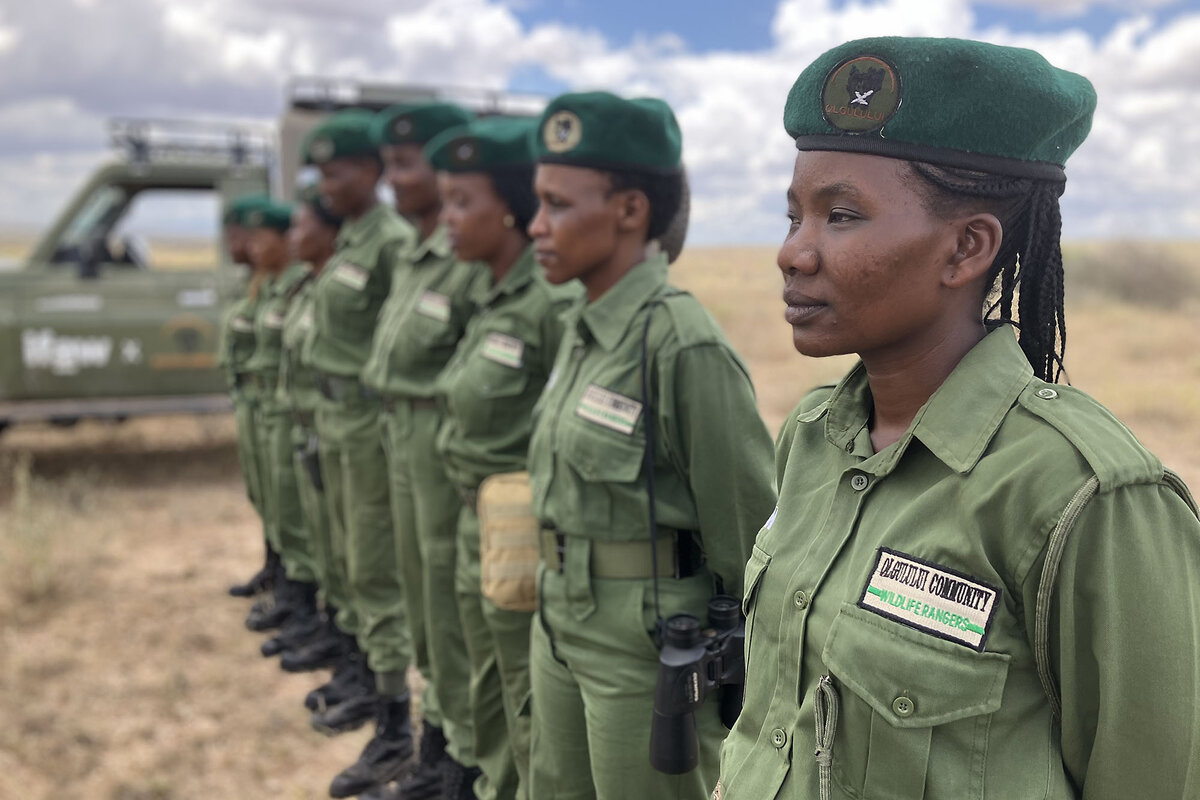
Senior Sgt. Purity Lakara (foreground) stands with members of Team Lioness at the Olgulului-Ololorashi Group Ranch. They make up Kenya’s first all-woman ranger force.

Maasai women are breaking out of traditional subservient roles, with some especially adventurous females deciding to serve as conservation rangers.

Lenny Rashid Ruvaga writes at the Christian Science Monitor, “The breakthrough was a bottle of water. For three days, wildlife ranger Everlyne Merishi had been embedded with a group of Maasai morans, or hunters. It was mid-2023, and they were searching for lions that had killed several of their cattle near this national park at the foot of Mount Kilimanjaro. For the Maasai, cows are sacred and considered members of their families. The men wanted vengeance. 

“Mrs. Merishi understood that feeling, because she is Maasai herself. That is also why she was convinced there could be a less destructive solution. 

“The group had already walked about 25 miles that day when members stopped, exhausted, for a break. Mrs. Merishi and her team began to pass around bottles of water. As the hunters drank, their faces softened and they mustered weak smiles. 

“Mrs. Merishi remembers walking over to a group where one of the leaders sat. ‘I told them that I understood their pain and that an injustice had occurred, but I promised that we would ensure that the authorities would relocate these two lions,’ she says. 

“Mrs. Merishi is part of an all-woman ranger unit working on Maasai lands near Amboseli National Park in southern Kenya. That’s rare: Globally, women account for only 3% to 11% of all park rangers. Team Lioness, as the Kenyan unit is known, was formed in 2019, part of a worldwide movement to increase those numbers. 

“These efforts are important, experts say, because they challenge stereotypes – but also because they help conservation efforts reach a wider audience. In the Amboseli area, for instance, the Lionesses have been particularly effective among the ranger teams at connecting with locals like the Maasai. 

“ ‘It’s astonishing to see the incredibly positive ripple effect of employing women from local communities and the benefits on their lives and their communities at large,’ says Holly Budge, the founder of World Female Ranger Week and a longtime advocate for women in wildlife protection. …

“The commander of Team Lioness, Sgt. Purity Lakara, has dreamed of this life since she was a child. 

“She grew up in a Maasai village approximately 30 miles from here. Her community placed heavy value on living in harmony with both animals and nature. And when she saw wildlife rangers patrolling the area, she was awed by the sense of authority they projected. There was one problem though: ‘They were all men,’ she says. 

“Meanwhile, girls like her were expected to get married young and settle into a domestic life. … But Mrs. Lakara’s parents were determined that she should get an education, and her timing was fortuitous. 

“In 2013, Africa’s first all-woman ranger unit, the Black Mambas, was formed in South Africa, and others soon followed in countries such as Zimbabwe and Congo. Supporters of the trend argued that women were more approachable and were able to communicate more easily with other women in the communities where they worked.  

“The idea to form an all-woman ranger team in Amboseli came up in 2019. It was the brainchild of a female Maasai elder named Kirayian Katamboi and the International Fund for Animal Welfare, a global charity. 

“At the time, Mrs. Lakara had just finished high school. When village elders called a meeting to pitch the new ranger unit, ‘my heart leapt for joy,’ she says. She became one of its founding members.

“Today, Team Lioness is made up of 17 women, each of whom has completed a three-month training in ecology, first aid, and ‘bushcraft’ – or the art of talking to people about conservation. They live for stretches of 21 days at a simple base camp with concrete floors and a sheet iron roof in the Olgulului-Ololorashi Group Ranch, as the Maasai land surrounding Amboseli National Park is known. 

“Each morning, the rangers patrol the surrounding area on foot, walking about 12 miles as they look for signs of poaching and survey the wildlife in the area.  The women are also responsible for managing occasional conflicts between locals and the animals, which usually flare up when lions or cheetahs from Amboseli cross into Maasai villages and kill cattle. 

“In the past, these situations often led to tensions between park rangers, who didn’t take kindly to attempts to kill the offending wildlife, and communities, who often felt authorities wanted to protect animals but didn’t care about the people they harmed. 

“However, the honest communication style of Team Lioness and other ranger units from Maasai communities has helped gain trust. They explain the law and people’s rights – like their right to be compensated for cattle killed by big cats from the park. …

“The rangers also give back to the community in other ways. In April 2022, they started a school outreach program where they hope to inspire students – particularly girls – to stay in school and pursue careers in conservation. 

“ ‘I beam with joy when I hear the students say, “I want to be like Ranger Lakara or Ranger Merishi,” ‘ Mrs. Lakara says. ‘It means that they see us as role models.’”

More at the Monitor, here.

Read Full Post »

Photo: Brian Otieno/The Guardian.
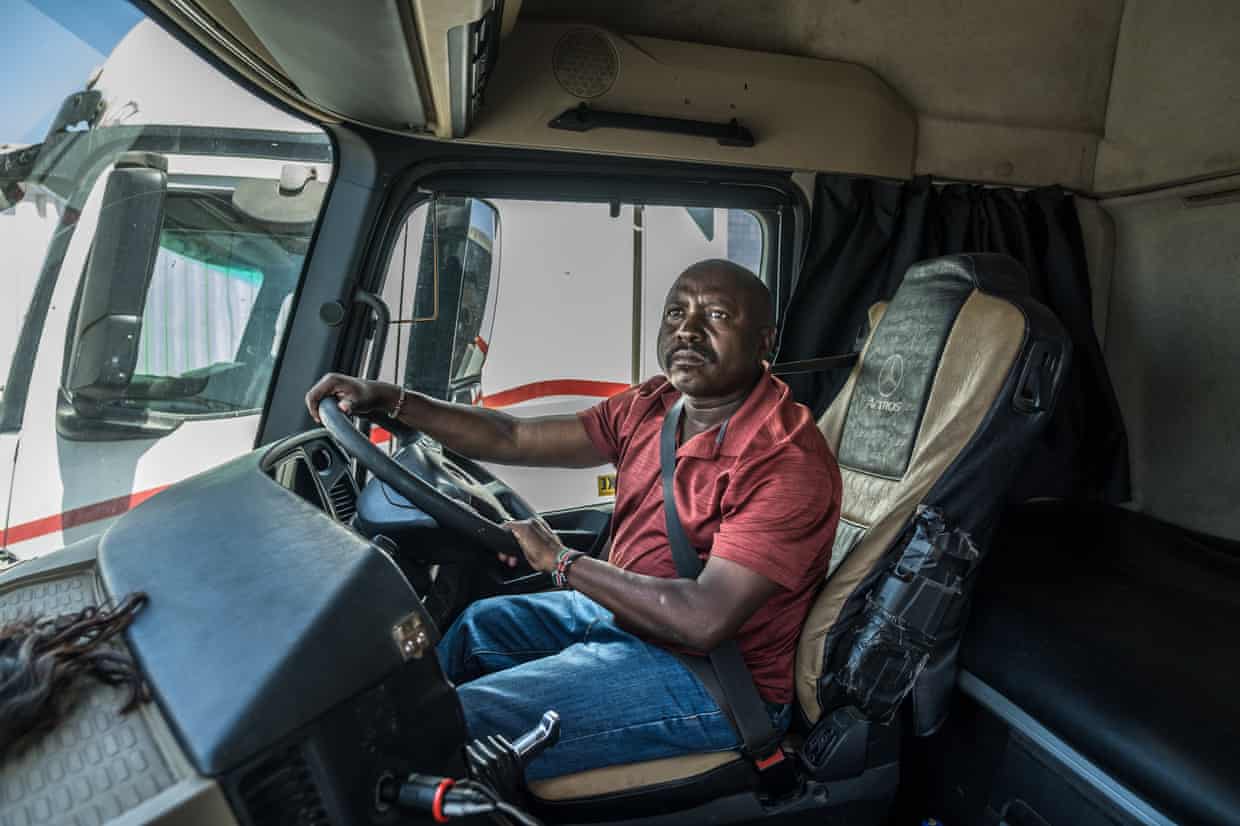
Thanks to a roadside health service in Africa, Alphonse Wambua learned he had hypertension and also how to treat it. 

Every country has different ways of handling the challenges of providing health services to its people. We can learn from each other. In the US, the Covid pandemic showed us we had cut back too much on public health programs. Many people who needed help were not being reached, which caused the disease to spread more than it should have.

Today’s story suggests that you reach the hard-to-reach by meeting them wherever they are.

Caroline Kimeu writes for the Guardian from Kenya, “A life on the road had caught up with Alphonce Wambua. Twenty-five years of transporting cargo between the Kenyan capital, Nairobi, and the coastal city of Mombasa, nine hours’ drive away, had resulted in long days, a poor diet and an irregular sleep routine for the trucker. Still, it came as a shock when doctors told him he had hypertension a few years ago.

“ ‘I wasn’t expecting it – I thought I just had serious fatigue,’ says Wambua, who has stopped by the clinic where he was diagnosed to pick up his monthly prescription. ‘This job is high pressure. There’s not much rest.’ …

“The health facility, based in Mlolongo, on the busy Nairobi-Mombasa highway, attracts a steady flow of patients. As well as workers and residents from the area, it also treats drivers from the truckers’ rest stop across the road, as one of 19 roadside health facilities run by the nonprofit North Star Alliance, offering priority healthcare to mobile populations.

“The organization, which constructs clinics out of shipping containers, has set up facilities along major transport routes, transit towns, and border crossings across east and southern Africa to increase mobile workers’ access to medical services.

” ‘When governments do their health planning, they usually plan for communities, but no one plans for mobile workers,’ says Jacob Okoth, a [program] manager at North Star Alliance. ‘Their operating hours are different, so you can’t reach them with the traditional 8am-5pm healthcare service delivery model, and many can only afford to queue for short wait times.’

“North Star was founded in 2006 to tackle HIV and STD cases in the transport sector during the height of the Aids epidemic, when some transport companies were losing more than 50% of their drivers to the disease. It extended its services to cover broader health issues after identifying other recurring health concerns among mobile workers, including non-communicable diseases.

“NCDs such as hypertension and diabetes are responsible for more than half of hospital admissions and deaths in Kenya. Health practitioners warn that the growing burden demands new approaches for prevention, diagnosis and treatment. …

“Many of the NGO’s health centres are along the northern corridor, one of east Africa’s busiest transport routes, which connects several countries in the region. Truck drivers who transport cargo along the corridor can travel for 12-hour stretches with short breaks in between, sometimes for weeks or months at a time. In some areas, the distances between hospitals are long; drivers often delay seeking care due to time pressures or irregular work cycles. …

“Regular health checkups are essential for truckers. … Many rely on high-carbohydrate meals to keep them full on long drives, and they struggle to maintain a balanced diet due to time and cost pressures, says Wambua, whose go-to meal is the Kenyan staple ugali (boiled maize meal). …

“ ‘You’re not focused on eating healthy food – you eat what you find and continue with the journey,’ he says, while a clinician takes his blood pressure and writes him a new prescription. …

“Each health center tailors its opening hours to the needs of mobile workers in the area. Some, like the Mlolongo health center, have regular 9am-6pm opening hours, but run outreach programs in which clinicians and trained volunteers offer free health screenings to target groups, such as truckers, sex workers and informal traders.”

More at the Guardian, here.

Read Full Post »

Photo: Edwin Ndeke/The Guardian.
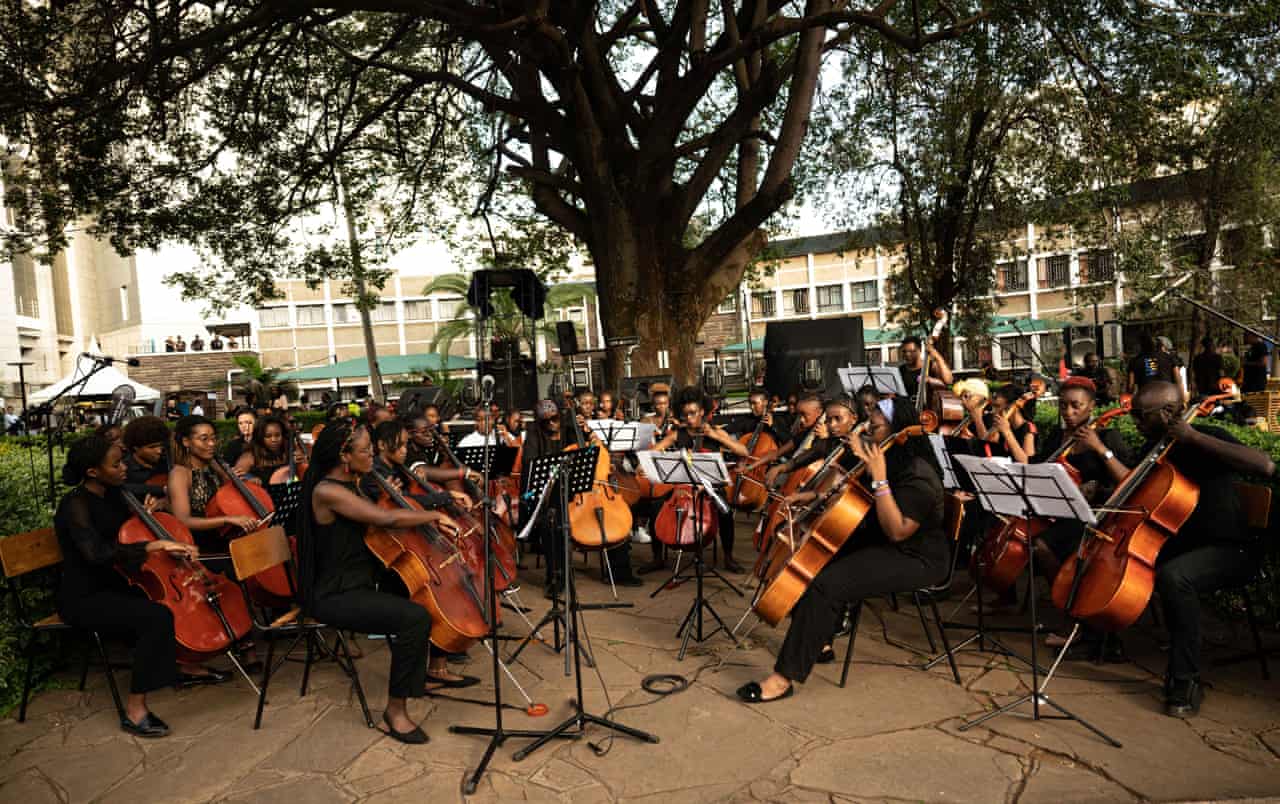
Kenyan classical musicians gave an outdoor performance in Nairobi recently. Cellist Yo-Yo Ma also performed that day. 

Do you know the cellist Yo-Yo Ma? He seems to be performing in a different country every day, and often he’s performing for charity. I follow him on Instagram, and I’m always amazed.

Caroline Kimeu wrote at the Guardian in June about Yo-Yo Ma’s recent visit to Kenya.

“Nairobi’s bustling Kenyatta market is an unlikely place to hear classical music. Yet playing today in front of stalls where butchers roast meat and hairdressers compete over heads to braid is a very surprising busker: the distinguished cellist Yo-Yo Ma. Playing ‘Over the Rainbow’ alongside Kenyan percussionist Kasiva Mutua, he matches his cello to her beats in a truly eclectic mix.

“Ma’s broad artistic sensibilities make weaving together the diverse musical traditions of drum and cello seem like a natural fit. ‘It was symbolic to introduce [classical] music to the crowd through something they know and understand,’ says Mutua. ‘Africans understand rhythm to their core.’ …

“Nairobi is Ma’s last stop of his Bach Project – a five-year, six-continent global tour. With its rising cultural and artistic scene, organizers say the city was near the top of the cellist’s list.

“The project marked Ma’s ambition to connect cultures and people across the world, performing Johann Sebastian Bach’s cello suites in 36 countries. …

“Bach’s cello suites were not well known by the time of the composer’s death in 1750. They began to resurface nearly a century later, and were brought to prominence in the 1930s when Pablo Casals, one of the world’s most highly regarded cellists, performed and recorded the neglected suites.

“Ma has recorded interpretations of the suites three times, with more than a decade between each.

“They are wrapped up with his life’s memories, he has said, citing his first encounter with Bach’s music when he was four: his father, Dr Hiao-Tsiun Ma, taught him the first suite in small, incremental steps. …

“ ‘For almost six decades, they have given me sustenance, comfort and joy during times of stress, celebration and loss,’ Ma wrote at the start of the Bach Project in 2018. ‘What power does this music possess that even today, after 300 years, it continues to help us navigate through troubled times?’

“Beyond busking, Ma takes to a more conventional stage with a concert at the Kenya national theatre. His audience now is a classical crowd – the [$145] auditorium tickets sold out in 24 hours – with prominent members including the arts minister, Ababu Namwamba, and the US ambassador, Meg Whitman. …

“Ma plays as though he is the only person in the room. Only the loud applause breaks through to him, earning his bow and embrace of the audience, arms flung wide. The solemn, lonely fifth cello suite – his penultimate performance – makes the auditorium fall silent.

“From a viewing room on the upper balcony, Brian Kivuti, a 34-year-old Kenyan jeweler, listens with closed eyes. ‘For me, it was a practice in presence,’ says Kivuti. ‘There are no lyrics telling you how to feel. It’s just the music and you, feeling your way through, so you pay more attention to how the notes make you feel. …

“ ‘When I started to listen with my body, I could feel notes of hope, the quiet of a Sunday morning, the dizziness of preparing for a party. The rise and fall of the notes allow you to tap into more than just everyday feelings.’

“At the theatre’s Wasanii restaurant, workers perched on rooftop balcony seats to watch a screening of the performance. For Margaret Wanjiru, a 22-year-old waitress, Ma’s music is a far cry from what she knows, such as her tribe’s Mugiithi. ‘It may not be the music I grew up with, but it slows you down, however much you’re busy, and allows you to get lost in your thoughts.’

“The Nairobi Orchestra, one of the oldest in Africa, performs ahead of Ma’s set, and its musicians are thrilled to have him in the auditorium. Violinist Bernadette Muthoni says: ‘For me, it was very huge to think that Ma was going to play just a few metres from where we were. He’s what a lot of us aspire to.’ …

“Ma is increasingly interested in using his work for social impact. He played outside the Russian Embassy in Washington DC last year to protest against its war in Ukraine, and dedicated his Songs of Comfort to providing solace for people during the difficult days of the pandemic.”

More at the Guardian, here.

Read Full Post »

People from the Maasai community, one of the oldest tribes in East Africa, live in a semi-nomadic state and have had to go to the UN to try to preserve a pastoral way of life.

I love reading about other cultures. Today’s article is about Maasai people living in Tanzania. It is unfortunately a worrisome story, the only upbeat aspect being that forums exist where indigenous people can fight for rights and that they are starting to use those resources.

Joseph Lee’s Grist article was reprinted at Salon.

“In Tanzania, the Indigenous Maasai face an ongoing, violent campaign to evict them from their lands and make way for protected conservation areas and hunting reserves. [In April, several were] in New York to ask the U.N. Permanent Forum on Indigenous Issues, or UNPFII, to tell Tanzania to stop taking their cattle, remove its security forces, establish a commission to investigate disputed lands and displaced people, and allow international human rights monitors to visit without restrictions. 

” ‘We, the Maasai people of Loliondo and Ngorongoro in Tanzania, are fighting against the Tanzanian government and wildlife trophy hunters who are threatening our livelihood, culture, ancestral wisdom, legacy, and basic human rights,’ Edward Porokwa, executive director of the Pastoralists Indigenous Non Governmental Organization’s Forum, said. …

“The Maasai land conflict in Tanzania is focused on two main areas: the Ngorongoro Conservation Area and Loliondo. The Ngorongoro Conservation Area is a UNESCO World Heritage Site that attracts over half a million visitors every year for safaris to see the park’s ‘Big 5’ game — elephants, lions, leopards, buffalo, and rhinoceros. Around 80,000 Indigenous Maasai call the park home, but have faced decades of government efforts to push them off their land.

“In a statement delivered at the Permanent Forum, Porokwa said that, since June 2022, the government has closed four nursery schools, nine water sources, and six mobile health clinics. The government says that Maasai are voluntarily leaving the area for resettlement sites, but the Maasai say that they are essentially being forced out. ‘It is a forceful relocation by ensuring that people don’t get the basics,’ Porokwa said. ‘They are there to die.’ 

“And in Loliondo, which is legally demarcated Maasai village land, state security forces shot at Maasai in a violent campaign to drive them from their lands [in June 2022]. In the attack, dozens of Maasai were injured and many fled across the nearby border to Kenya for medical attention. At least two dozen others were arrested, while some were not permitted to leave their homes. 

“[Nine] United Nations experts raised concern about forced evictions and resettlement plans, but the Maasai representatives at the United Nations say that the government has not changed its approach. … Tanzania has taken or killed over 600,000 of their cows and demanded over $2.5 million in fines for grazing. This is all part of what Maasai say is a massive campaign to destroy their pastoralist way of life. 

“At the Permanent Forum, a representative from the Tanzanian government pushed back on the Maasai’s claims, pointing to the East African Court of Justice’s 2022 dismissal of an eviction case brought by the Maasai, stating that the Maasai could not prove their claims about violent evictions. …

“In January, the African Commission on Human and Peoples’ Rights conducted a monitoring visit to investigate the situation. But Maasai community organizations say that at every step, the visit was controlled by the government. Commission representatives were shepherded around by state security forces who intimidated Maasai and excluded them from some meetings. Some Maasai waited for hours to speak with the Commission, only for them to never show up. While the Commission’s final report on the visit did express concern about the situation, it also commended Tanzania’s commitment to protecting human rights. The Commission also recommended starting new consultations with the Maasai, as well as addressing their concerns about the resettlement program. 

“In December, José Francisco Calí Tzay, the United Nations Special Rapporteur on the rights of indigenous peoples was scheduled for a week-long visit to Tanzania, but the visit was indefinitely postponed. Maasai leaders believe that the visit was scuttled out of concern that the Special Rapporteur would not be given full access to investigate. …

“With few options remaining, the Maasai have turned to the Permanent Forum to raise their concerns. Briane Keane is the director of Land is Life, an international organization that works with Indigenous peoples, including providing travel funding, medical assistance, and security assessments to the Maasai. Keane says that the United Nations is an important platform for the Maasai. ‘It’s a place where they can be heard. The government of Tanzania is not listening,’ he said. 

“The Maasai hope that international pressure may convince the government to finally listen to their concerns. But speaking out on the international level also comes with risks for the Maasai. Several leaders who spoke out against government abuses were forced to flee the country for their safety

” ‘Indigenous peoples are the most among the most criminalized peoples of the world,’ said Keane. ‘There’s people being thrown in jail. There are threats. So it’s very dangerous work sticking up for your rights when you’re as marginalized as the Maasai are in Tanzania.’ “

Man, if your gripe is against the government, you really don’t want the government’s security forces leading the tour for the human rights inspectors! That should be a given. More at Grist, here. No firewall.

Read Full Post »

Photo: Nick Migwi/ CNN.
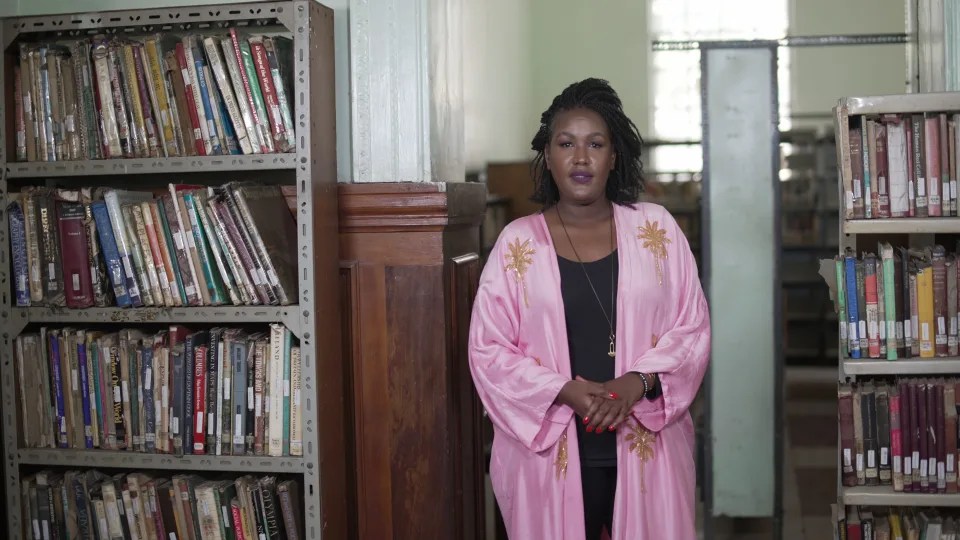
“I think that libraries are great equalizers,” says Book Bunk co-founder Angela Wachuka in Nairobi, Kenya.

Like many of you, I’m a big fan of reading books. In my family, I’ve always been known for gifts of books — books that I nearly always have read first so that I know they are right for the recipient. My aunt said she looked forward to the gifts no one else gave her on her birthday.

When I was a train commuter, I bought lightweight paperbacks to read while traveling, but after retirement, I became a devotee of the library, a place of magic, as blogger Laurie Graves knows more than most.

In recent years, Kenyan fans of libraries have been working to make them as accessible and lovely as possible.

Abdi Latif Dahir writes at the New York Times, “In 1931, the first library in Kenya’s capital, Nairobi, opened its doors — to white patrons only. Nearly a century later, Kenyans dressed in the slinky gowns, flapper headpieces and tweed suits of that era streamed into the now-dilapidated space in a celebration that was part fund-raiser for the remodel of the iconic building, part reclamation of the city’s public libraries as ‘palaces for the people.’

“ ‘Our public libraries can be glamorous spaces of storytelling,’ said Angela Wachuka, a Kenyan publisher. But, she added, ‘we are here to also reclaim history, to occupy its architecture and to subvert its intended use.’

“The restoration of the McMillan Memorial Library and others in the city was the brainchild of Wachuka and the novelist Wanjiru Koinange, who founded Book Bunk, a Kenyan nonprofit, in 2017 to restore and reclaim the city’s public libraries. The aim was to leave behind their excluding past and remake them into inclusive spaces. … Among their goals is to bring more books in African languages to the libraries, and incorporate services catering to those with visual, physical or reading disabilities. …

“As the guests streamed into the gala, in December, organizers urged them to think of themselves as ‘rebellious gate-crashers’ who, while dressed as those in the past, were about to embark on a radically different future in which libraries are an essential public good.

“Nairobi, a fast-growing city of over four million people, has very few bookstores or well-funded libraries. Book Bunk’s work comes amid heated conversations about urban design and about how corruption and colonial systems continue to shape the way public infrastructure and spaces are designed and who gets access to them.

“ ‘In the case of Nairobi, there’s almost an acceptance that certain social divisions should exist across social classes and different societal groups,’ said Constant Cap, an urban planner who has collaborated with Book Bunk in the past.

“Restoring public libraries, he said, could be an opportunity to break those barriers and bring together people from different socio-economic, ethnic, racial and religious backgrounds.

“For Wachuka and Koinange, the journey began a decade ago as they searched for a venue to host an event for the Kwani? [a literary magazine] literary festival. The two thought the McMillan library — built by Lady Lucy McMillan as a memorial to her American husband, Sir Northrup McMillan, and later bequeathed to the Nairobi City Council — would be an ideal venue given its centrality and connection to the city.

“But when they walked in, Wachuka said, they were surprised to see its crumbling state: Its interior neoclassical architecture was fading, its floors and walls were in ruinous condition and its collections were gathering dust.

“While they found another location for the event, the two immediately began researching the history and management structure of the McMillan library, and soon after, left their jobs to focus full time on its restoration.

“One of their earlier discoveries was that the McMillan library was the first of a series of other libraries built in the city. Only two were still open: the Makadara and Kaloleni libraries, in the city’s low-income eastern suburbs.

“After forming a partnership with the Nairobi city administration in 2018, Book Bunk first focused on restoring the two smaller libraries, prioritizing the needs of the communities there.

“The two branches have since reopened, with the Makadara library hosting storytelling sessions, film screenings, music performances and a literary festival. The Kaloleni branch is in a neighborhood built in the 1940s by Italian prisoners of war, and has become a hub for youngsters to do their homework and participate in workshops that help them, for example, learn how to make money using their creative talent.

“Joyce Nyairo, a Kenyan academic and cultural analyst, said that the restored libraries have the chance to be ‘great equalizers,’ particularly for people from disadvantaged backgrounds.”

More at the Times, here. I love the idea of asking Kenyans to envision themselves as “gate crashers” into spaces that should always have been theirs. Makes me think of One-Eyed Connelly, a famous gate crasher whose name my father borrowed for a pigeon that was always walking through our open doors.

Read Full Post »

Photo: Paul Stremple.
Beatrice Karore, a community leader involved in peace building during Kenya’s elections, stands outside a local vocational college in Mathare that served as a polling station.

Blessed are the peacemakers.

Often they are women. We know that not all women are peacemakers, but many are. They see where differences of opinion can get out of hand and take action.

Today’s article is about peacemakers in Kenya trying to change the pattern of violent election periods. The story was written before the country’s Supreme Court made its decision on the recount. If you can’t stand suspense, skip to the end.

Mukelwa Hlatshwayo writes at the Christian Science Monitor, “The Kenyan presidential elections are over, but peace campaigner Beatrice Karore’s work is not done.

“One recent cloudy morning in Nairobi, the founder of Wanawake Mashinani – Swahili for Grassroots Women – walks to her office in Mathare, one of the most densely populated slum areas in the Kenyan capital. 

“Sliding a heavy-duty padlock off a thick metal door, Ms. Karore and her team file into the tiny room that serves as their headquarters, and sit on blue plastic chairs. Over loud music blaring from a nearby shop, Ms. Karore begins with a prayer for a good ‘walk for the peace’ ahead.

“Ms. Karore is one of dozens of grassroots peace activists across the country who sprang into action in the months leading up to Kenya’s Aug. 9 presidential elections. Now, as the country waits for a final verdict on disputed results, that work has become increasingly important.

“The Supreme Court is due to hand down a judgment on Sept. 5, after opposition candidate Raila Odinga challenged official results that showed him losing to William Ruto by a margin of 200,000 votes. A former prime minister, Mr. Odinga has blamed five previous presidential election losses on rigging – claims that have sparked deadly riots in the past. 

“For now, an uneasy calm is holding. But some campaigners fear the Supreme Court verdict could yet unleash the violence that followed disputed polls in 2007, when more than 1,200 people were killed, and again in 2017, when more than 100 people died. 

“As her team walk out of their modest office into narrow passageways crammed with shacks, Ms. Karore says she knows the current lull is far from guaranteed. ‘We [are still] doing peace campaigns to empower the community,’ she says.

‘We realized that when there is no peace, everyone loses.’ …

“Some analysts believe that the relatively peaceful election campaign, in which the main candidates ran on social and economic issues, rather than demanding voters’ ethnic loyalty, points to a maturing democracy. 

“Widely touted reforms to the electoral process, including the effective registration of voters in the diaspora, may have given more Kenyans a sense of greater transparency. And battered by two years of COVID-19 lockdowns and rising costs of living, most Kenyans would prefer to accept the Supreme Court verdict than go to an election rerun, analysts say. …

“The manner in which Kenyans navigate the decision by the court will set a precedent for future disputes across Africa. … Even if the fragile peace holds, electoral watchers caution it will take more than one election cycle to show Kenya has left violence in the past. …

“For the past two presidential elections, Ms. Karore’s team has organized the kind of ‘holistic’ monitoring that Kenya’s human rights commission says will transform how communities like Mathare – which typically bear the brunt of any unrest – participate in the post-electoral process. Wanawake Mashinani has held several community meetings at which faith-based leaders have encouraged people to remain calm. It’s given safety tips to residents on election day. 

“And in a neighborhood that’s neglected by officials, where violence, drug abuse, and crime are prevalent, perhaps the group’s most important work is also the simplest: It checks in on residents and listens without judgment. 

“On this August morning ‘peace walk,’ Ms. Karore stops first to talk to a group of women selling hair-care products outside a corrugated iron-roof shack. Speaking in Swahili, she asks them how they are and how things have been since the elections. The discussion is light and jovial; the women laugh at a joke about a fake flour scandal doing the rounds in Mathare. 

“One vendor, a young woman called Kim, says that things have been quiet and business has been slower. She tells the group they are glad major protests didn’t break out after the results were announced, because that would have meant they would have lost everything. 

“ ‘Anything small can trigger violence on the streets,’ Ms. Karore says. ‘Many people leave their homes and go to rural areas at this time, or where people of their same tribe live.’

“Research has shown that when marginalized communities feel that their favorite candidate loses an election due to irregularities, they are more likely to resort to violence. Human rights organizations say the unrest often breaks out along ethnic and identity lines. …

“As Ms. Karore and her team walk deeper into the township, checking in on neighbors and store owners, they are greeted by passersby who recognize them from previous door-to-door visits.

“Buoyed by the work of peace campaigners across Kenya as a whole, the political atmosphere has been significantly calmer than in two previous elections. A range of activists, from artists to religious leaders, have been galvanized into action in recent months. A campaign by artists in Kibera, Kenya’s largest township, displays works that celebrate the country’s ethnic diversity. Another group of activists organized a ‘peace caravan’ across the country, carrying messages urging voters to remain calm during the heated polls.

“Still, violence and intimidation persist. … In Mathare, Reagan Victor Ondigo says he barely escaped with his life when a mob of men tried to burn down his home as he and his family slept. … He blames politicians for whipping up ethnic grievances, but he’s cautiously hopeful that those perceptions are slowly changing.

“ ‘I hope that my daughter will know that freedom is there,’ he says.”

Looks like Kenya’s Supreme Court decision was accepted by both sides. More at the Monitor, here.

Read Full Post »

Photo: Christine Lamanna/Icraf.
The Guardian reports, “A research collaboration between the University of Sheffield and the Latia Agripreneurship Institute in Kenya’s semi-arid Kajiado county had promising results.”

A recent article in the Guardian got me interested in learning a bit more about a technical college in Kenya called Latia Agripreneurship Institute.

The website says, “Latia Agribusiness Solutions (LAS), is a business support services provider to the Agribusinesses in all sectors. It facilitates Agribusinesses (farm and firm), to access markets, farm products, technology, financial services and workforce solutions. It delivers these services through an agribusiness ecosystem consisting of local and international companies who have come together to address the needs of Agribusiness in Africa.”

The school is casting a very wide net for prospective students: “LAI uses an industry led, market driven and competency based approach to deliver a broad training program referred to as ‘Apprenticeship.’

The program targets anyone who can read and write and the core criterion for selection is the passion for agribusiness, the ability and readiness to either invest in own farm, or gain meaningful employment in the industry.

Geoffrey Kamadi reports at the Guardian on a collaboration between joining LAI and the UK’s University of Sheffield.

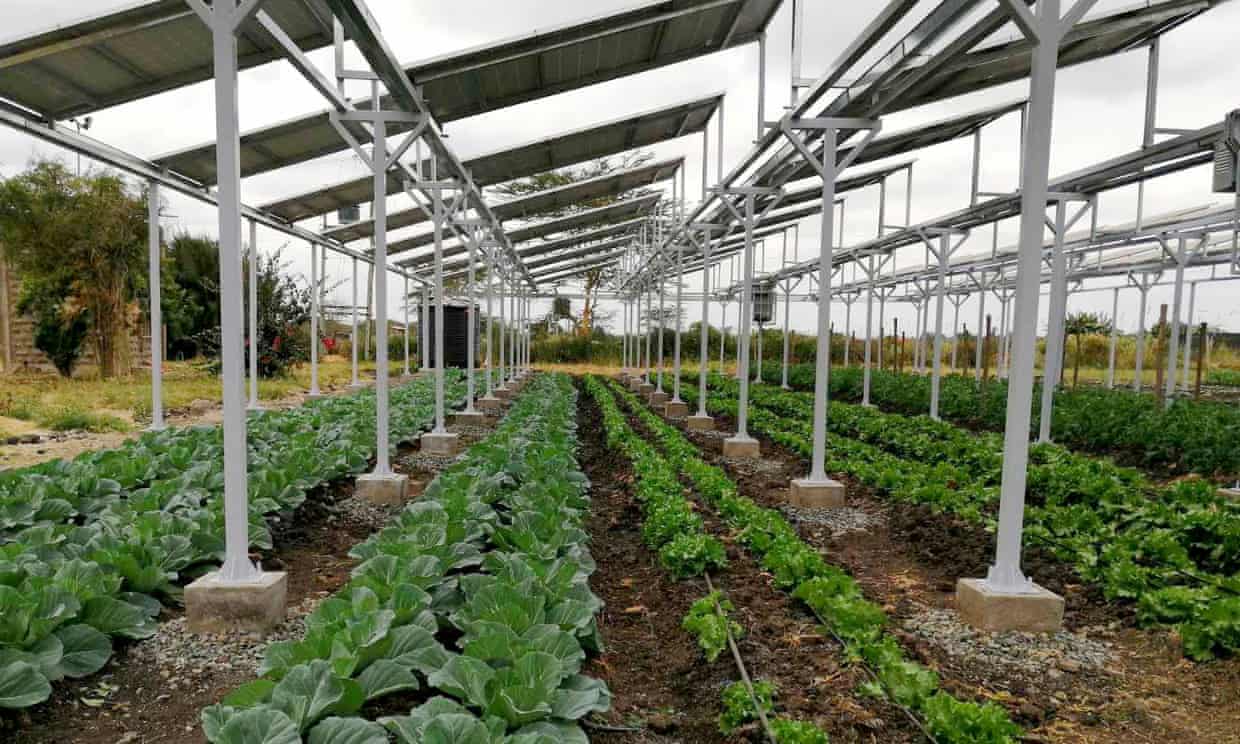
“Solar panels are not a new way of providing cheap power across much of the African continent, where there is rarely a shortage of sunshine. But growing crops underneath the panels is, and the process has had such promising trials in Kenya that it will be deployed this week in open-field farms.

“Known as agrivoltaics, the technique harvests solar energy twice: where panels have traditionally been used to harness the sun’s rays to generate energy, they are also utilized to provide shade for growing crops, helping to retain moisture in the soil and boosting growth.

“An initial year-long research collaboration between the University of Sheffield, World Agroforestry and the Kajiado-based Latia Agripreneurship Institute has shown promising results in the semi-arid Kajiado county, a 90-minute drive from the Kenyan capital of Nairobi and this week the full project will be officially launched.

“For example, cabbages grown under the 180, 345-watt solar panels have been a third bigger, and healthier, than those grown in control plots with the same amount of fertilizer and water.

“Other crops such as aubergine [eggplant] and lettuce have shown similar results. Maize [corn] grown under the panels was taller and healthier, according to Judy Wairimu, an agronomist at the institute. …

“According to Dr Richard Randle-Boggis, a researcher at the University of Sheffield’s Harvesting the Sun Twice project, the trial initiative will determine the potential of agrivoltaic systems in east Africa.

“ ‘We needed to build a test system to see if this technology will be suitable for the region,’ Randle-Boggis said, reiterating that, unlike conventional solar mini-grid systems, agrivoltaics have the additional benefits of improving food and water security, while strengthening people’s resilience against the climate crisis, as well as providing low-carbon electricity. …

” ‘Agrivoltaics can have a notable impact on household income in remote locations such as Kajiado. ‘Women here can spend up to 300 Kenyan shillings [$2.68] on a bodaboda (motorcycle taxi) fare to the market just to buy vegetables worth 100 Kenyan shillings,’ said Anne Macharia, head of training at Latia Agripreneurship Institute.

“The solar panels can be placed three metres [about 10 feet] from the ground, providing ample room for a farmer to work below, or higher in bigger systems to allow access for agricultural machinery. … In other countries, including France, the US and Germany, the technology has been employed successfully.” More at the Guardian, here.

I have posted numerous stories about innovations in Kenya over the last decade. Search this blog on the word “Kenya” for more.

Read Full Post »

Photo: Suzanne Kreiter/ Globe staff.
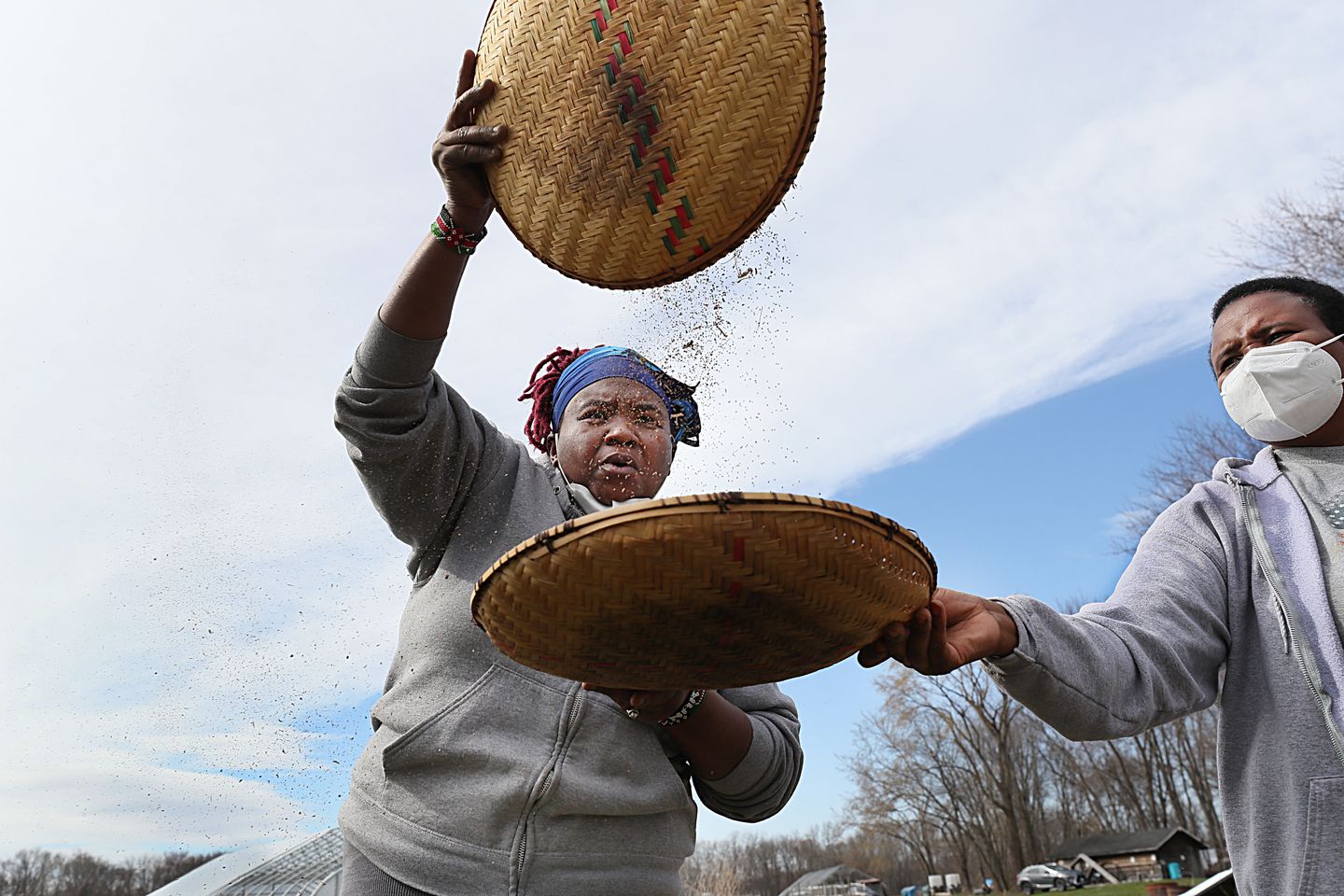
Henrietta Nyaigoti with her mother, Veronicah Nyaigoti (right), working with baskets of chinsaga spider plant seeds.

Some years ago, for the magazine I edited, I acquired an article about Hmong immigrants in Lancaster, Massachusetts, and the role that their community garden played in their new life. The garden was called Flats Mentor Farm, and I’m excited to see it’s still going strong.

Jocelyn Ruggiero wrote recently at the Boston Globe about a Kenyan transplant whose family’s garden inspired a new business. “Six days a week, May through October, 33-year-old Henrietta Nyaigoti arrives at Flats Mentor Farm by 7 a.m. She waters the inside of her two high tunnels, checks the progress of the vegetables growing there, and walks her family’s 2 acres to assess any damage from pests and weather.

“During planting season, she puts seeds in the ground, and during growing season, tills weeds and makes any necessary soil amendments. At 2:30 p.m. on weekdays, she drives 15 minutes home, where she lives with her two young daughters, then showers and changes before heading to her job as an assistant program manager at a group home for individuals with traumatic brain injuries. She works there 50 to 70 hours per week during farm season, and 80 to 100 hours in the off-season. All year round, Nyaigoti spends 30 hours a week as a home health aide at an assisted living facility. She recently began a position as a sales coordinator for World Farmers — the nonprofit that operates Flats Mentor Farm — which has so far been a 10-hour a week commitment. … And this May, after three years of hard work, she will complete coursework for her Master’s in Public Health at Southern New Hampshire University.

Nyaigoti says, ‘I work hard because I have an opportunity that many people don’t, especially in Kenya.’

“Nyaigoti was almost 14 in 2001 when, ‘seeking greener pastures,’ her family immigrated to Massachusetts from a small town in Kenya called Rigoma Market. Her parents were teachers and, like everyone they knew, grew the vegetables — managu, chinsaga, amaranth, maize, and kunde — that their family ate. When they packed their bags, Nyaigoti says, ‘we did … what a lot of people did back then. We dried our vegetables and traveled with them … because we didn’t know if we were going to find them here. And lo and behold, we didn’t.’ …

“TIn [2003] Nyaigoti’s mother first visited Manny’s Dairy Farm in Lancaster. She was delighted to discover something she hadn’t seen since her time in Kenya: amaranth. She struck up a conversation with Manny, who invited her to pick the vegetable. Shortly after, he introduced her to Maria Moreira, the executive director and cofounder of World Farmers, the Lancaster-based nonprofit whose mission is to support small farmers in sustainable agricultural production.

“In 2004, Moreira offered her a parcel of land at the 70-acre Flats Mentor Farm, where World Farmers provides infrastructure and marketing assistance to small refugee and immigrant farmers — today approximately 25 countries represented — whose ethnic specialty crops (cleared by the government for planting and growing) make their way to more than 15 farmers’ markets, dozens of direct-to-consumer outlets, and a World Farmers’ CSA. …

“By 2006, [Nyaigoti] wanted to help her mother more, who she saw ‘working crazy hours [at her day job], and still struggling at the farm.’ She knew, though, she wasn’t going to farm the way her mother did. She explains, ‘When we came to the States, we were put into a system where you have to work for somebody in order to survive.’ She saw the farm as an opportunity for a degree of economic independence. ‘When I started working it [the farm], I said, I’m not going to sweat for free.’ Nyaigoti’s personal network of Kenyan friends had grown at UMass Lowell, and she was increasingly aware of the wider Kenyan diaspora in the region. She recognized the potential value of their Kenyan crops in this narrow target market.

“She began in 2007 with a single Kenyan church. ‘I would literally just get there, and in 30 minutes’ time, I’m done selling my produce, and I’m heading home.’ The more she sold, the faster word spread within the Kenyan community. The demand became so great that by 2008, she didn’t have enough supply to keep up. She went to Moreira, who helped facilitate ‘farmer-to-farmer sales’ between Nyaigoti and approximately 10 Flats Mentor farmers. The growers Nyaigoti subcontracts from are mostly Kenyan, however, she also buys from Tanzanians, Liberians, Burundians, and Haitians. …

“Once CDC regulations prevented large numbers of people from gathering in church parking lots to pick up their orders, Nyaigoti pivoted, fast: ‘If I know you’re not coming to the church, how can we make our relationship still work? Where can you get the vegetables where you are at? My commitment to people is: “Don’t worry about it, I will deliver.” ‘ …

“Nyaigoti wants to pack more and more of these orders: ‘my personal goal is to find a new community every year.’ She has her sights set on Cambodian, Tanzanian, and Ugandan communities next. In her own business and as sales coordinator for World Farmers, she wants to familiarize Massachusetts residents with Kenyan and other cultural crops grown by farmers at Flats Mentor Farm. She plans to share recipes and cooking videos to introduce new customers to these vegetables.”

More at the Globe, here. For information on Henrietta Nyaigoti and her business, visit www.facebook.com/Lexavahproducts. And there’s more about the Flats Mentor Farm at www.worldfarmers.org/flats-mentor-farm.

Read Full Post »

Photo: Reuters.
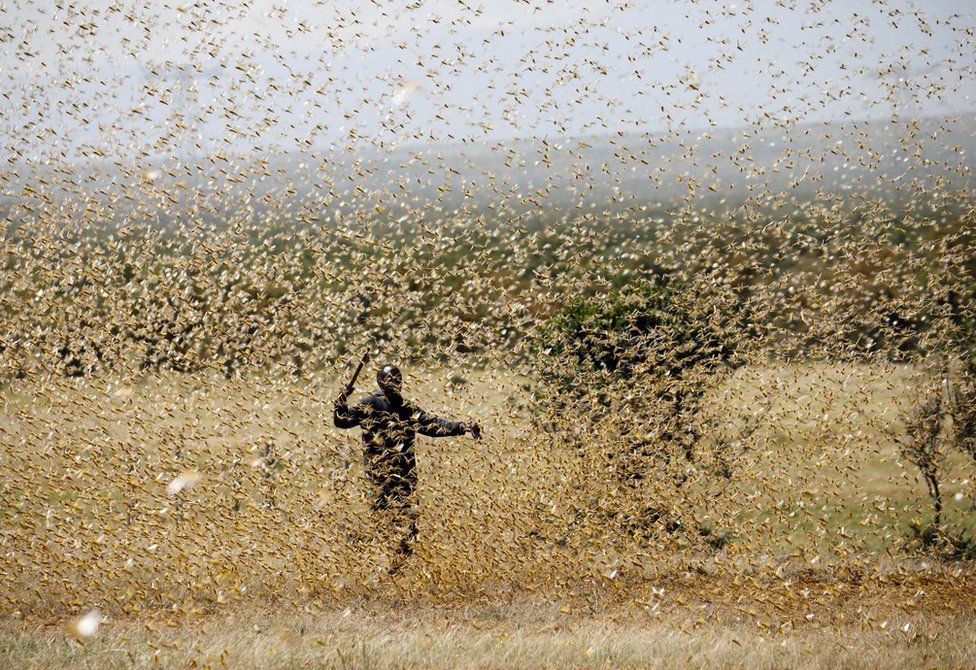
A man attempts to fend off a swarm of desert locusts at a ranch near the town of Nanyuki, in Laikipia county, Kenya.

Talk about citizen scientists! Tribal elders in Africa could teach Westerners a few things about enlisting everyone to solve problems.

Rachel Nuwer reports at the New York Times, “Melodine Jeptoo will never forget the first time she saw a locust swarm. Moving like a dark cloud, the insects blotted out the sky and pelted her like hail.

“ ‘When they’re flying, they really hit you hard,’ said Ms. Jeptoo, who lives in Kenya and works with PlantVillage, a nonprofit group that uses technology to help farmers adapt to climate change.

“In 2020, billions of the insects descended on East African countries that had not seen locusts in decades, fueled by unusual weather connected to climate change. Kenya had last dealt with a plague of this scale more than 70 years ago; Ethiopia and Somalia, more than 30 years ago. Nineteen million farmers and herders across these three countries, which bore the brunt of the damage, saw their livelihoods severely affected. …

“But as bad as 2020’s swarms were, they and their offspring could have caused much worse damage. While the weather has helped slow the insects’ reproduction, the success, [said Keith Cressman, a senior locust forecasting officer at the United Nations Food and Agriculture Organization], has primarily resulted from a technology-driven anti-locust operation that hastily formed in the chaotic months following the insects’ arrival to East Africa. This groundbreaking approach proved so effective at clamping down on the winged invaders in some places that some experts say it could transform management of other natural disasters around the world.

‘We’d better not let this crisis go to waste,’ said David Hughes, an entomologist at Penn State University. ‘We should use this lesson as a way not just to be adapted to the next locust crisis, but to climate change, generally.’ …

“The locust plague that hit East Africa in 2020 was two years in the making. In 2018, two major cyclones dumped rain in a remote area of Saudi Arabia, leading to an 8,000-fold increase in desert locust numbers. By mid-2019, winds had pushed the insects into the Horn of Africa, where a wet autumn further boosted their population. An unusual cyclone in Somalia in early December finally tipped the situation into a true emergency. …

“Countries like Sudan and Eritrea that regularly deal with small, seasonal swarms have teams of locust trackers who are trained to find the insects and recognize which life cycle stage they are in. They use a tablet-based program to transmit locust data by satellite to national and international authorities so experts can design appropriate control strategies.

“But people outside of those frontline locust nations who may want to start using this system today would encounter a typical technology problem. … Even if the hardware were available, in 2020, East Africa lacked experts who could identify locusts.

“ ‘We’d never had a dress rehearsal for the real thing,’ said Alphonse Owuor, a United Nations Food and Agriculture Organization specialist in Somalia. ‘We had people who were very familiar with locusts in theory, but who didn’t have the experience or equipment required to carry out this massive operation.’

“With swarms suddenly covering an area of Kenya larger than New Jersey, officials were tasked with creating a locust-combating operation virtually from scratch. Collecting dependable, detailed data about locusts was the first crucial step.

” ‘Saying “Oh, there’s locusts in northern Kenya” doesn’t help at all,’ Mr. Cressman said. ‘We need longitude and latitude coordinates in real time.’

“Rather than try to rewrite the locust-tracking software for newer tablets, Mr. Cressman thought it would be more efficient to create a simple smartphone app that would allow anyone to collect data like an expert. He reached out to Dr. Hughes, who had already created a similar mobile tool with the Food and Agriculture Organization to track a devastating crop pest, the fall armyworm, through PlantVillage, which he founded.

“PlantVillage’s app uses artificial intelligence and machine learning to help farmers in 60 countries, primarily in Africa, diagnose problems in their fields. Borrowing from this blueprint, Dr. Hughes and his colleagues completed the new app, eLocust3m, in just a month

“Unlike the previous tablet-based program, anyone with a smartphone can use eLocust3m. The app presents photos of locusts at different stages of their life cycles, which helps users diagnose what they see in the field. GPS coordinates are automatically recorded and algorithms double check photos submitted with each entry. Garmin International also helped with another program that worked on satellite-transmitting devices.

“ ‘The app is really easy to use,’ said Ms. Jeptoo of PlantVillage. Last year, she recruited and trained locust trackers in four hard-hit Kenyan regions. ‘We had scouts who were 40- to 50-year-old elders, and even they were able to use it.’ ”

More at the New York Times, here.

I love how many apps there are for identifying things these days. PictureThis has been a great help to me in identifying unfamiliar flowers. Now if I could just get one for birds!

Read Full Post »

Whether we know it or not, we’re always passing down family customs, sayings, songs, crafts, and more to the next generation. Sometimes I’m a bit sad that I stopped singing songs in the car as an adult, because there are a ton of old nursery rhymes and folk songs from my childhood that my kids never learned. One time my youngest brother said to them, “Does your mother still sing in the car?” and they had no idea what he meant.

I’ve blogged before about efforts to preserve marginalized languages, and any similar initiative gets my attention. Consider this story on preserving artisan techniques in danger of dying out.

Gareth Harris writes at the Arts Newspaper, “Centuries-old practices and traditions across communities worldwide that might be lost forever — from beekeeping in Kenya to creating the Dalai Lama’s clothes — are being quietly supported and documented online through the British Museum’s Endangered Material Knowledge Programme (EMKP).

“The scheme, launched in 2018, has been boosted by an [$11.7 million] grant awarded by Arcadia, a charitable fund founded by the philanthropists Peter Baldwin and Lisbet Rausing; the cash injection means the project has been extended for seven years (2021-28). …

“ ‘Locally informed knowledge is in danger of being lost — knowledge that has helped communities thrive in unique environmental, social and cultural contexts,’ says a statement from the British Museum. …

” ‘We are offering communities the resources to record themselves; that is so powerful. It’s a form of auto ethnography as such,’ says Ceri Ashley, the head of EMKP.

“ ‘Once this material has been collated, it is uploaded onto an open access digital database hosted by the British Museum, and a digital copy is also shared with a partner in the country of work so that it remains close to the community whose cultural heritage it represents,’ say museum officials. …

“This year’s supported schemes include a survey of the skills of Venerable Phuntsok Tsering, the Dalai Lama’s personal tailor. ‘Since 1959, he has been responsible for (re)constructing the tailoring requirements of the Dalai Lama in exile. He rebuilt the ceremonial wardrobe left behind in Tibet and developed new garments for use in the unfamiliar environmental and cultural conditions of India. Despite this singularity his practice has never been documented,’ says an online statement.

“Ashley points out that the EMKP team, working primarily online, has worked throughout lockdown, collaborating with an international advisory panel to review and select the next round of grants. …

“Another 2020 project focuses on the manufacture of Ostrich eggshell beads among the El Molo Community in Kenya, capturing their making and use through audio files, video clips and field notes.

“Last year, the EMKP recorded the dwindling practice of beekeeping amongst the Sengwer communities living in the Embobut Forest in western Kenya. ‘Some projects celebrate the everyday, which is so important,’ says Ashley, referring to a 2019 analysis of the traditional natural broom and fibre rope crafts of the Urhobo people of Nigeria.

“Applications are now open for the 2021 round of funding (deadline for applications is 31 January 2021). Instructions online stress that prospective candidates should ‘consider the viability and ethics of conducting this work within the context of the Covid-19 pandemic.’ ” Read more at the Art Newspaper, here.

The Kenya beekeeping reference makes me think of a wonderful documentary, Honeyland, about an isolated beekeeper in rural Macedonia. Do watch it if you get a chance. I hope her techniques are being preserved, too.

Read Full Post »

noah-3_custom-0b3f0f51611f437f5fe1b3a7ea8aad599f50b0c3-s600-c85

Photo: Noah Nasiali-Kadima
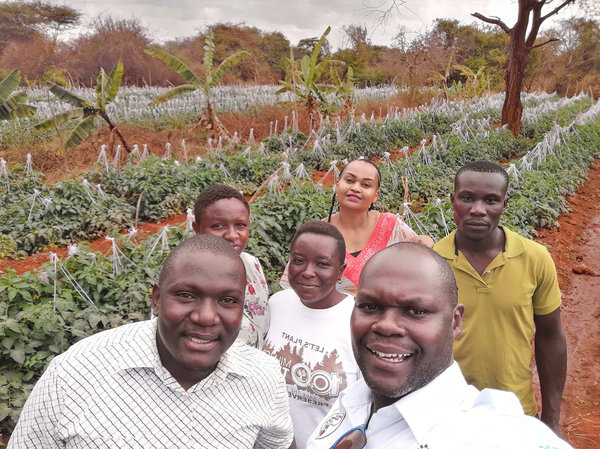
Noah Nasiali-Kadima, foreground, takes a selfie with members of the Africa Farmers Group during a tour of a member’s farm in Machakos County, Kenya. 

I was reading in the Boston Globe yesterday about a guy who, after surviving a life-threatening brain aneurysm that his doctor misdiagnosed, launched a new career as an activist for aneurysm patients. You have to hand it to such people.

In another example, see what Diane Cole of National Public Radio (NPR) learned when she interviewed an African farmer who turned a major cabbage liability into something much bigger than cabbages.

“Making lemonade out of life’s lemons is one thing. But what could Kenyan IT consultant-turned-farmer Noah Nasiali-Kadima do with the 75,000 fresh cabbages he had been stuck with?

“That was the dilemma he faced in 2016, when the buyer with whom he had a contract simply walked out on him, refusing to pay and leaving him with six acres of ripe cabbages that had cost most of his savings to produce.

“He was uncertain how to proceed, to whom he could turn for help or whether to give up altogether. So he came up with a different idea: That year, he started a Facebook group so that he and other farmers — including new ones like himself, and experienced farm veterans — could discuss and come up with solutions to problems just like this.

“The Africa Farmers Group now has 138,000 online members in Kenya and throughout Africa. He has also organized in-person educational seminars in countries across the continent including South Africa, Nigeria, Somalia and Zambia. The goal is to help farmers learn the skills they need to succeed, by providing forums in which they can share their own stories of success and failure, and offer their peers empathy, encouragement and practical tips. In recognition of his work, in September 2018, Facebook awarded him $1 million as part of its Facebook Community Leadership Program. …

“We spoke to him as he was preparing to participate as a speaker at the Food Tank New York City Summit, a two-day conference sponsored by the sustainable agriculture advocacy group Food Tank. … This conversation has been edited for clarity and length.

“First of all, whatever happened to those 75,000 cabbages?
“I sold some, and some went bad on the farm. I gave some away to schools.

“Drought has left almost 3 million people there facing acute food insecurity. How can local farmers be a part of the solution?
“We have a lot of food shortages and food waste. There is a disconnect between the farmers producing the food and then getting it to market and to the people. No one is consulting the farmers themselves about, ‘How much can you produce, what do you need to help you to produce more?’ …

“You started out in technology in 2001, in programming and network management. How did agriculture come into the picture?
“I started out just to make some extra money since the tech space had become saturated. My father is a sugar farmer, and my father-in-law is a tomato farmer. One day in 2007, I was with my wife and my father-in-law and I said to him, ‘I want to be a farmer.’ He looked at me, like, ‘Are you really serious?’ And I said yes. He gave me and my wife a small piece of land, one-quarter of an acre, near his own farm, which is about an hour away from Nairobi. …

“At first this was a side career, a way to make an extra coin. … We started with green bell peppers, switched to tomatoes and watermelons and other crops, one of them cabbages.

“Then you faced the cabbage fiasco in 2016. Was that a turning point for you?
“I thought, this shouldn’t happen to any farmer. How come I can’t sell this produce? I did not know how to market or pitch what I had, or explain the particular quality or type of cabbage I had. …

“I saw how farmers were suffering. We have very many NGOs and very many tech solutions being funded but none that involve the farmers. I also wanted to make a difference, to see if I can start a group with farmers around me where we can talk about problems, who is buying what, what they are doing that is working and what is not. And I just opened a group on Facebook.

“The target was to sign up 3,000 farmers in three months. By the end of those three months, we had 16,000 farmers from across Africa. Some said, ‘Please post in English because I cannot speak Swahili!’

“It was a venue where farmers could talk to each other. I set up weekly online conversations with expert farmers from different regions who have worked with different kinds of soil and crops. Farmers listen to other farmers, so people could ask, ‘What were the challenges, how can we learn from you?’

“Now we have 138,000 members and growing. We also have more than 100,000 offline members in areas where internet connectivity is a challenge. Our motto is sharing is caring.

I have seen farmers who had given up. Then they hear from other farmers who have been through similar experiences. They see what they can do different.

“They learn they can contact this agronomist for more information about this problem, or try a different crop at this time of year, or maybe a particular variety that will do better in a particular climate, or maybe the soil is not right. These are success stories. They learn how to keep going or start again.”

Read more on how the initiative has grown and flourished, here.

Read Full Post »

Older Posts »