Feeds:
Posts
Comments

Posts Tagged ‘low income’

Photo: Alfredo Sosa/CSM.
Community MusicWorks, a program that allows students to use stringed instruments at no cost, is shown presenting its end-of-year gala in Providence, Rhode Island.

When I was visiting Nancy on Thursday, we talked about an amazing new music hall and school in our area and how it provides free noontime concerts to all comers. My husband and I had just attended one where some of the jazz teachers performed new compositions.

Looking at the huge crowd reminded me what music means to people, and how the word “free” in connection with “music” can make a real difference in people’s lives.

Troy Aidan Sambajon reports at the Christian Science Monitor about how it can make a difference for low-income children.

“The melodies drifting from Community MusicWorks’ spacious building are more than just the sounds of young musicians practicing. They are the heartbeat of the neighborhood.

“For 28 years, an after-school program run by the Providence, Rhode Island-based nonprofit has been reimagining what access to classical music education looks like. Community MusicWorks operates in areas of the state where K-12 students might not otherwise be able to afford to play stringed instruments. The program allows students to use instruments at no cost, offers mentorship, and hosts free concerts and workshops for the wider community to attend.

“Eli Arrecis, 10, is starting his fourth season in CMW this fall. On the last day of summer camp in late July, he and his fellow campers are performing original songs for their parents, using violins, violas, cellos – and shakers they crafted out of cardboard.

“Since joining the program, Eli listens to music with a newfound appreciation and even picks up sheet music at home to read for fun. His parents hope to enroll Eli’s siblings in the program. …

“In an era when many schools’ arts budgets are dwindling, CMW offers something increasingly rare: a space where young people find joy, purpose, and camaraderie through music.

“CMW’s beginnings were modest. In 1997, while he was a senior at Brown University, Sebastian Ruth launched the program with a $10,000 grant and a vision for what he termed ‘musicianship working for positive social change.’

“Mr. Ruth grew up in Ithaca, New York, and was first inspired by a high school violin teacher, who encouraged him to think about the social and spiritual impact of music on people. He and a small team rented a tiny storefront in Providence’s West End neighborhood – one of the city’s most diverse but also most economically disadvantaged areas – and began offering free violin lessons. …

“Within a few years, CMW expanded to the building next door to accommodate its growing after-school program. Hundreds of students later, CMW has cemented its place in the neighborhood with a new state-of-the-art facility, which opened in September 2024. …

“The three-story building has a performing arts center, group practice rooms, an instrument repair workshop, and plenty of space for lessons. Financing for the $15 million project came from state and local funds, as well as individual donations.

“AlexisMarie Nelson started her CMW journey in the sixth grade in 2006. It led her to study violin and viola and to eventually graduate from the Boston Conservatory at Berklee College of Music. Now a program coordinator at CMW, she says … ‘The connections that we’re making are so important.’

“Inside the building, teens such as Cesar Mendez shuffle in and out of lessons and jam sessions. They engage in soul-searching discussions about music and identity.

“ ‘This place feels like home,’ says Mr. Mendez, an 18-year-old violist who joined the program nearly a decade ago. ‘It’s just full of life.’

“But the real impact goes beyond mastering scales. ‘The arts aren’t just about skill-building or learning to play an instrument,’ Mr. Ruth says. ‘It’s a different way of being with other people. Many communities, particularly urban communities, are just doing a disservice to the children by not having adequate opportunities to learn the arts.’ …

“Notes Cecil Adderley, chair of music education at Berklee College of Music and president of the National Association for Music Education. ‘It’s a way to model how to excel at something artistic.’

“Even if students never go pro, he adds, they’re using their creativity as well as fostering collaboration and a sense of belonging. ‘You’re learning not just how to be a musician – but how to be a better neighbor.’ …

” ‘A lot of the time, we talk just so we don’t feel alone in the questions we have,’ says Mr. Mendez, who will study biomedical engineering at the University of Rhode Island this fall.”

More at the Monitor, here.

Read Full Post »

Photo: Pat Greenhouse/ Globe staff.
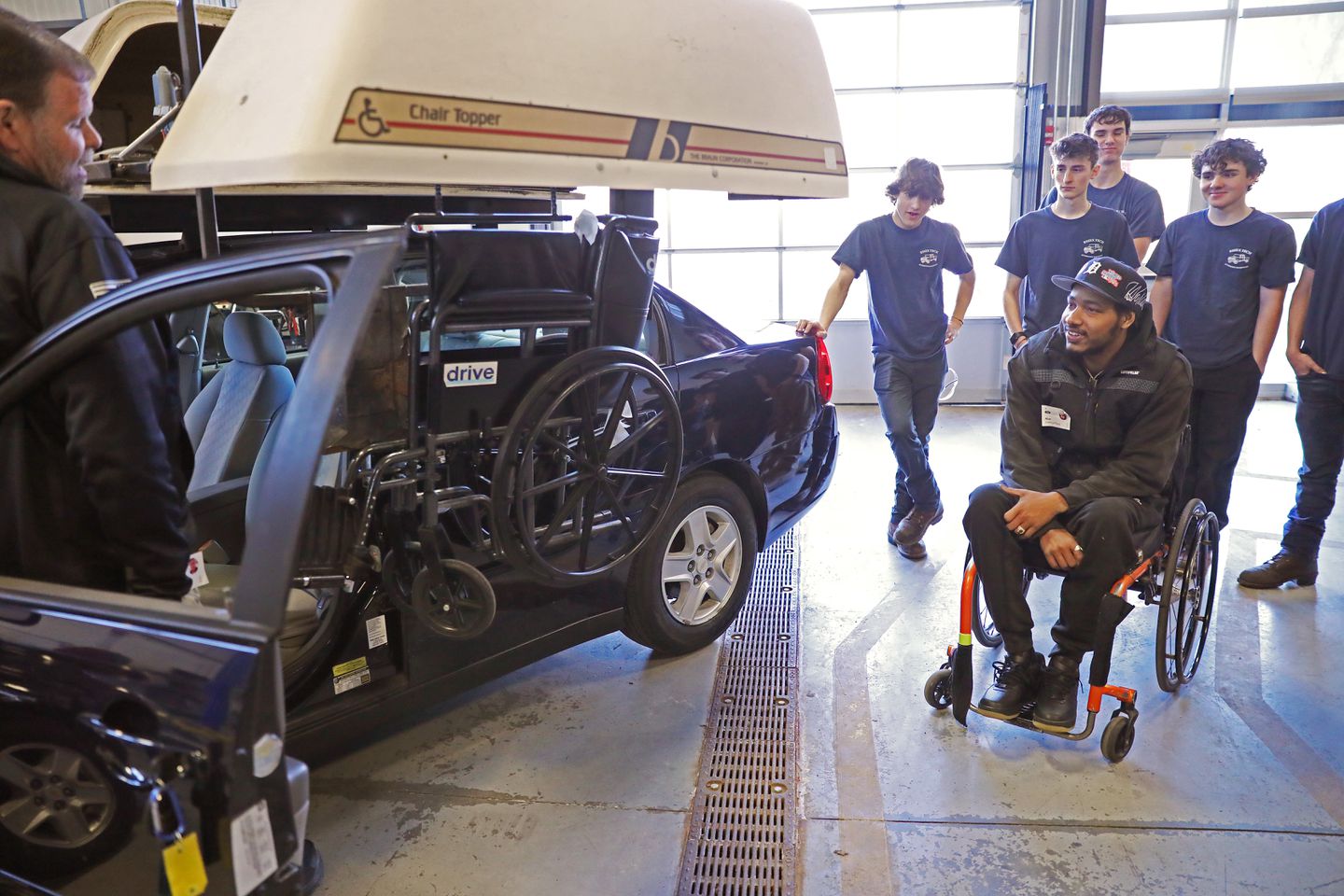
Donor Michael Solomon, left, demonstrates the use of the chair topper to store a folding wheelchair to car recipient Alan Mack of Quincy at Essex North Shore Agricultural & Technical School. It’s all in a day’s work for Second Chance Cars.

Dan Holin is a local nonprofit entrepreneur that I’ve worked with in connection with a couple different organizations. I met him in the early 2000s, when he was running the Jericho Road Project, and when he went to UTEC in Lowell, Mass., I wrote how he brought the joy of biking to teens who had been in trouble with the law, here.

Now the Boston Globe has caught up with Dan’s latest initiative, a longtime dream. He has really thought through all the pieces needed to make it work — the banks, the beneficiaries, the automotive high-school programs, the donors, etc.

Nancy Shohet West wrote, “Three years ago, Alan Mack was struggling to make ends meet as a laborer with the state Department of Recreation & Conservation when he was struck in the back by a bullet and left paralyzed. What followed was not only rigorous recuperation, but also a long stretch of being unemployed and homeless. …

“For a person in a wheelchair, the daily commute he had previously made by public transportation was nearly untenable: Typically an hour in duration and requiring several transfers from train to bus, not to mention relying on a system not known for its reliability even in the best of times.

“Fortunately, the social service organization that was helping Mack with his numerous challenges had one more idea for him: applying for a vehicle through Concord-based Second Chance Cars, which provides automobiles to low-income recipients who can demonstrate that owning a car would substantively help them to get a job, keep a current job, or advance within their field.

“Now Mack makes the 15-minute commute from home to work in his specially equipped car, which he said also will enable him to advance the music production business he recently started after entering an online bachelor’s degree program at Berklee College of Music. …

“Mack is one of about 70 beneficiaries to receive vehicles from Second Chance Cars, founded in 2019 by Concord resident Dan Holin. An Israeli-American citizen who served in the Israeli military and then pursued a career in nonprofit administration, Holin was motivated by several intersecting passions, including social outreach, cars, and entrepreneurship. He envisioned a nonprofit that would serve veterans and former prison inmates returning to society. His mission has since expanded to reach others, including legal immigrants and struggling families.

“Mentored by leaders of other nonprofits, Holin designed a business model whereby his organization provides donated cars to low-income workers for $900, paid for by the recipients in monthly installments of $75 over the course of a year.

“After talking with nearly 20 banks, Holin found two — City of Boston Credit Union and Metro Credit Union — willing to partner with Second Chance Cars by providing zero-interest loans along with free financial counseling to the recipients, with Holin serving as the guarantor. At the end of 12 months, the recipients have not only paid off the loans but also have improved their credit ratings.

“Stephanie Tetreault is the kind of person Holin envisioned helping. After battling a drug addiction and serving nearly 10 months in prison for larceny, she was determined to get her life back on track.

“Formerly living on the streets, by the fall of 2020 she had housing in Lowell and steady employment as a shift leader at Dunkin’, where she wanted to apply to be a manager. But that job required reliable transportation, and a car was something Tetreault had neither the cash nor the credit rating to obtain.

“Her case manager at Thrive Communities, which helps formerly incarcerated people transition back into society, told her about Holin’s organization.

” ‘I went through the application process and met with the board of directors of Second Chance Cars to tell them about my situation,’ recalled Tetreault, whose car was prepped at Greater Lawrence Technical School in Andover. ‘The whole process took just a few weeks, and then I had my car: a 2005 Toyota Prius. It’s been a blessing and a lifesaver.’

“Just as Tetreault hoped, Dunkin’ promoted her to a manager position, which she held for about 18 months. Empowered by her newfound independence, her ambitions grew.

“ ‘Because I had a car, I felt that I could pursue my larger goal of becoming an addiction counselor,’ Tetreault said. ‘I found a job in that field in May of 2022, and then enrolled in the addiction counseling certificate program at Middlesex Community College.’

“The benefits that Second Chance Cars provides reach more than just its recipients. The organization collaborates with five vocational high schools in Massachusetts — Essex Tech in Danvers, Greater Lawrence, Greater Lowell Technical in Tyngsborough, Minuteman High in Lexington, and Northeast Metropolitan Regional Vocational High in Wakefield — enlisting their automotive technology departments to fix any problems the donated cars might have before they are passed on to new owners.

“ ‘This is a great match for our program,’ said Jill Sawyer, director of Career, Technical and Agricultural Education at Essex Tech — more fully, Essex North Shore Agricultural & Technical School —whose automotive technology students worked on Mack’s car.

“ ‘Many of the cars our students work on belong to faculty members or people from the community who understandably need their vehicle repaired as quickly as possible.

‘With Second Chance Cars, we usually have a few weeks with a car, which gives the instructors more time to make it a learning experience.’

‘And then the students get to attend the reveal ceremony and learn about the person who is receiving the car, which is eye-opening for them.’

“ ‘It’s a win-win situation,’ agreed Donald Melanson, an auto tech instructor at Minuteman, whose students have worked on more than a dozen vehicles for Second Chance Cars. ‘A lot of the repairs the donated cars need are typical of those that the students will be doing once they get out in the trade. This is also giving them a chance to help the general public, and to see the kind of difference that they can make in someone’s life.’

“Josh Duquette found out about Second Chance Cars from a counselor at Veterans Inc., which provides services to veterans throughout New England. A divorced father of four living south of Boston, he couldn’t drive due to a combat-related disability after returning from a deployment in Kuwait and relied on a combination of ride-hailing services, public transportation, and favors from friends to get to his job as a special education paraprofessional in the North Attleborough school system.

“Once Duquette received medical clearance to begin driving again, Second Chance Cars found him a nine-year-old car with 115,000 miles on it. Students at Minuteman refurbished the interior, serviced the engine, and provided new parts. As a result of having his own transportation, Duquette was able to take a position teaching summer school in addition to his school year assignment.

“ ‘One of the biggest obstacles a lot of our veterans face in getting back to a meaningful lifestyle is transportation,’ said Bill Corcoran, a case manager with Veterans Inc. … ‘Second Chance Cars takes that barrier away, and it’s life-changing.’ ”

More at the Globe, here.

Read Full Post »

Photo: Uncommon Threads.
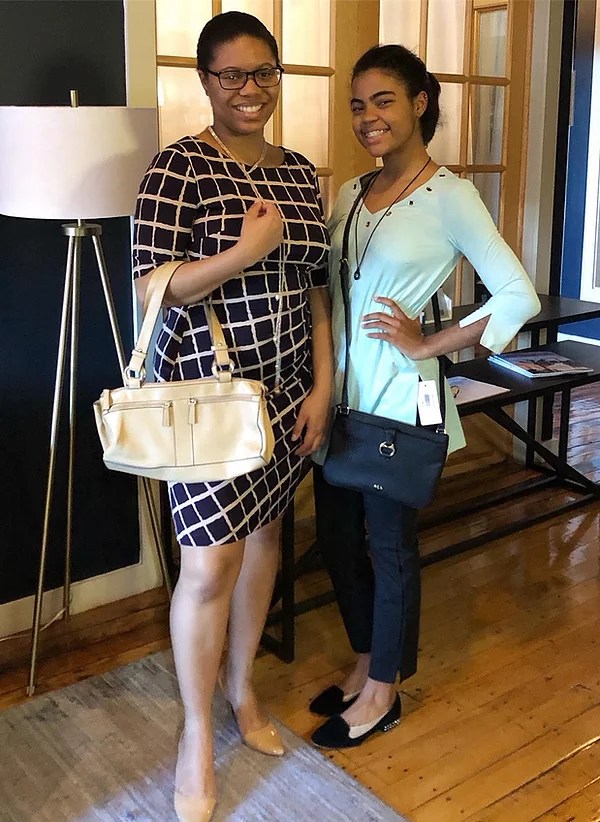
Uncommon Threads in Lawrence, Mass., helps “low-income women see and feel their true potential by using clothing and image as tools for building self-esteem.

Some time ago, Grace told me about the Lend a Hand Society, whichprovides emergency financial assistance to low-income families, individuals, seniors and disabled people primarily in the Greater Boston area.” It’s been filling a gap for generations now, and as you can imagine, has been especially needed during the pandemic.

A local nonprofit doing similar work but with a narrower focus is Uncommon Threads in Lawrence, Mass. Liz Neisloss at GBH television reported on the gap that the founder identified almost by accident.

“It’s not hard to find organizations that offer free or low-cost clothing,” says Neisloss, “but Susan Kanoff has created a boutique that uses clothes to transform not only the way women look, but how they feel.

“A social worker by training, Kanoff made her living helping low-income families move out of poverty. In her spare time, she channeled her love of fashion as a private stylist and style blogger. When her style clients began asking her where to best donate their old clothes, she had an idea.

“ ‘I started taking them into my social work office,’ said Kanoff, who lives in Methuen. ‘I had racks set up and (if) one of my clients was having a bad day, we’d put an outfit together; going on a job interview, we’d put an outfit together. And I started to realize how powerful these clothes were and how really important they were to a woman’s self-esteem.’

“Partnering with Family Services of the Merrimack Valley, she opened the non-profit Uncommon Threads [in 2017]. … In late 2019, the retailer Timberland helped fund the renovation of a larger space with dressing rooms, a sitting area in shades of beige and dark blue and a on the entry-way wall a message that reads: ‘Self Confidence is the Best Outfit.’

‘Our main goal is dignity and respect,’ said Kanoff. ‘We want women to feel like they’re in, they’re shopping in a beautiful place versus getting a handout.’

“Kanoff, who previously worked for the North Andover Housing Authority running the family self sufficiency program to help lift people out of poverty, works with a more than a dozen social service agencies who must refer women to be able to shop at the store. Retailers and the public donate clothing.

” ‘We could dress a woman who was maybe a victim of domestic violence and is ashamed to go to their kid’s school conference,’ said Kanoff. ‘Whatever it takes to get that woman to feel strong and powerful through the way she looks.’ …

“Women first meet with an Uncommon Threads volunteer to talk about their clothing needs, as well as their work or life goals. Clients can get up to four outfits and two pairs of shoes in one visit – but they can also get some items not commonly found in donation shops: bras, underwear, pyjamas and even matching jewelry. The meeting looks like one with a personal shopper at a pricey store, but costs just ten-dollars — a fee that can also be waived. Otherwise, the clothes are free.

“[Volunteer] Jen Marin sat down for a ‘styling session’ with 19-year-old JJ Ortiz. Shuttled around between group homes and foster care since she was 12, Ortiz said she struggled to find clothes that fit her as she grew and became self-conscious about her weight.

“ ‘I was kind of uncomfortable in my skin, who I was, how I would like show myself, like my clothes wasn’t the best,’ Ortiz said, ‘But they didn’t see that. They saw me for who I am.’

“Marin helped Ortiz try on a jeans jacket and then moved around to take a look. …

“Another volunteer stepped in to put a necklace over Ortiz’ head. Ortiz smiled, ‘I look so pretty,’ she said.

“With shopping finished, Ortiz stayed to sit in on a workshop called ‘Feminine Rocket Fuel.’ She took careful notes as motivational speaker Rosie Dalton explained to the gathering of clients how to use obstacles as ‘fuel’ to move forward.”

More at GBH, here, and at Uncommon Threads, here.

Are there similar services in your part of the world? But will clothes needed for work be different post-Covid? And finally, what are the chances that low-income people can start getting paid enough not to need charitable services in the future?

Read Full Post »

Photo: Tara Adhikari/The Christian Science Monitor.
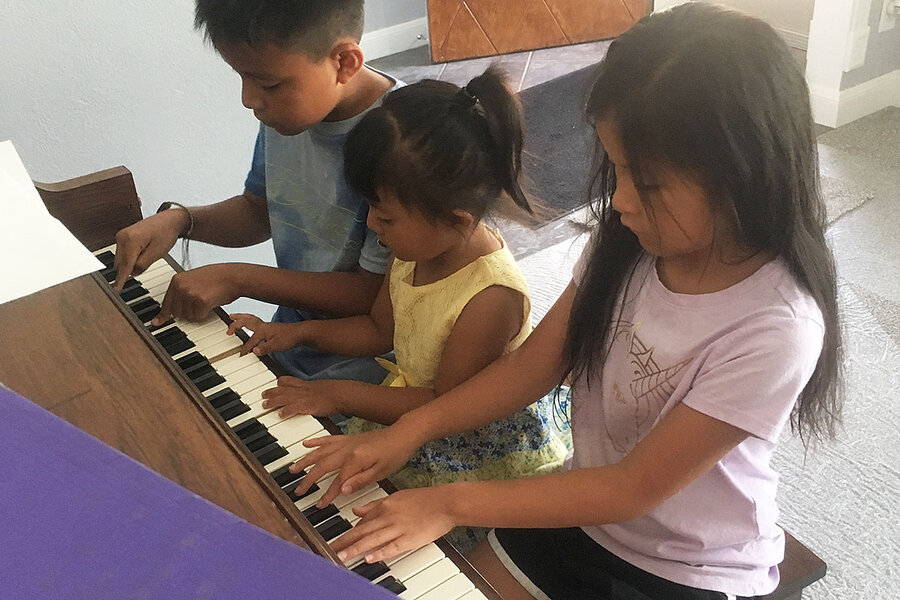
Three Pluma siblings rushed to play the upright that Pianos for People had just brought from a donor in St. Louis.

Not all children take to the piano, but for those that do, cost should never be a barrier. At least, that’s the belief of a relatively new charity in St. Louis, as we learn from Tara Adhikari at the Christian Science Monitor.

“Nose pressed to the window, 2-year-old Mary Pluma is excited, her smile so big it’s visible even from the street. Her four older siblings lean in behind her. Eyes wide, they track the movers outside. …

“Today is the day the Pluma family receives their first piano. 

“The moment the upright is nestled in the corner, three of them beeline for the bench meant for one and tap on the black and white keys. Sometimes the notes sync in harmony, more often they do not, but the room is alive with music and joy. 

“The piano was delivered by Pianos for People, a St. Louis nonprofit that reduces financial barriers to music education by providing donated pianos and free lessons to low-income families. The organization is transforming what was historically a luxury item and symbol of financial success into a tool for growth – accessible beyond the American middle-class family.

‘Our philosophy is that a piano is more than just a piano,’ says Matt Brinkmann, the executive director. ‘We use the piano as a gateway to self-esteem and connection and community.’ 

“Tom Townsend, a St. Louis advertising executive, and his wife, Jeanne Townsend, an attorney, founded Pianos for People in 2012 in memory of their son, Alex. A pianist and artist, Alex died in a car accident while attending college. …

“Their focus on saving pianos – connecting unwanted instruments with recipients who can’t afford their own – expanded to music education more broadly. They opened a piano school, in 2014, at their Cherokee Street headquarters and have since delivered more than 300 donated pianos, opened a second school, and grown lesson enrollment to 129 this past spring.

“Of the families served, 92% have annual income below $25,000. While many recognize the benefits of music education – confidence, discipline, focus – paying the grocery bill takes priority. A good upright used piano can cost upward of $1,000; a new one close to $10,000; and lessons here average $50 an hour. By cutting the costs that make learning an instrument untenable, Pianos for People creates space for self-expression that, for many, wouldn’t exist otherwise. …

“There are far more pianos available for donation than the organization can accept, says Danny Ravensberg, piano donations coordinator. This allows Pianos for People to reject pianos in poor condition and protects recipients from repair costs. 

“Every piano has a history, and donors care where their piano, often a treasured part of family memories, ends up. 

“Jackie Wennemann’s five children enjoyed playing piano when they were growing up in the 1960s – so much so the family bought two, and she’d conduct from the basement door giving cues between the instruments. ‘Sometimes we would have duets and one would get on this piano,’ she says gesturing to one in the entryway, ‘and one on the one downstairs. I would say, “Ready, set, go,” and they’d both play the same song.’

“With her children grown, Ms. Wennemann wanted the pianos to be used again. She donated the one in the best condition to Pianos for People. The organization matched it with the Pluma family, three of whom had been taking free lessons for four years. …

“ ‘When they come [home] from school, they are stressed,’ says their mother Patricia Pluma, adding that the kids speak Spanish at home, which means in school they are having to learn in their second language. But sitting at the piano bench translating the music on the page into sounds on the keys is different. It’s freeing, she says. ‘They start playing the piano and they start smiling.’

“Indeed, the peaceful power of pianos is emblazoned on Pianos for People staff T-shirts: ‘A free piano inspires peace in a child. A peaceful child becomes a peaceful adult. Peaceful adults make a peaceful world.’ “

More at the Monitor, here.

Read Full Post »

College is expensive, and for students from low-income families, even a small emergency can throw the whole thing off course.

That is why colleges are beginning to get creative with techniques to keep students’ educational goals from derailing over relatively small but unexpected expenses.

Boston Globe columnist Adrian Walker writes about one such college.

“Francis Dillon will tell you that the huge expenses associated with college aren’t necessarily what makes it hard for students of limited means to get through school. Often, it’s relatively small stuff that can have a huge impact.

“Formally, Dillon is a vice president for advancement of Stonehill College. But for years he has been the person those on campus turn to when a student can’t afford a new laptop, or a trip home during a vacation break, or to apply to graduate school — the kinds of expenses that many of their peers take for granted. …

“Tuition, room, and board at the private 2,500-student school in Easton runs about $55,000 a year. That’s not cheap, but it is often defrayed by scholarships and other financial aid. The dealbreakers are much smaller. …

“Two years ago, a benefactor surprised Stonehill with a gift of $117,000 that came with no restrictions. Stonehill officials, including Dillon, had a novel idea for it. They decided to create a small, permanent fund to take care of the little student crises they had been quietly addressing piecemeal. …

“When he thinks about students whose college careers may have been saved by emergency infusions of cash, Dillon can rattle off examples. But one of his favorites is a current Stonehill accounting student named Juan Lopez.

“Lopez grew up in a tough area on the South Side of Chicago called Little Village. He says when he was about 13, some gang members in his math class noticed his facility with numbers and tried to recruit him as a bookkeeper. He avoided getting involved, but school became a constant source of anxiety.

“A teacher encouraged him to enroll in a parochial school across town, from which he graduated as the valedictorian. From there, he was recruited to Stonehill. …

“At one point, he faced an unexpected crisis. His father had lost his job, and with it his family’s health insurance. Stonehill requires all its students to have health insurance.

“Enter Dillon, with a check for the required coverage. Lopez freely admits that it wasn’t the only time he has needed help.

” ‘If it wasn’t for this fund, I probably would [have been] out of here by the end of my freshman year,’ Lopez told me. …

“Instead, he is a junior with a 3.6 grade-point average. He’s been hired as a summer intern at a major Chicago accounting firm.” More here.

For folks struggling to pull themselves out of poverty, any unexpected expense can raise insurmountable barriers. Congrats to Stonehill College for this smart assistance.

Read Full Post »

Some initiatives that are costly up front have benefits that far outweigh those costs but don’t show up for years. Even then, people may disagree about what caused the outcomes.

One such initiative sends nurses to new mothers who are young, poor and often friendless to help ensure that their babies get a leg up in life.

At the Washington Post

“A high school senior learns that she’s pregnant — and she’s terrified. But a registered nurse comes to visit her in her home for about an hour each week during pregnancy, and every other week after birth, until the baby turns 2. The nurse advises her what to eat and not to smoke; looks around the house to advise her of any safety concerns; encourages her to read and talk to her baby; and counsels her on nutrition for herself and her baby.

“This kind of support, with trained nurses coaching low-income, first-time mothers, is among the most effective interventions ever studied. Researchers have accumulated decades of evidence from randomized controlled trials — the gold standard in social science research — following participants for up to 15 years. They have consistently found that nurse coaches reduce pregnancy complications, pre-term births, infant deaths, child abuse and injury, violent crimes and substance abuse. What’s more, nurse coaches improve language development, and over the long term, cognitive and educational outcomes.

“Nurse coaching is a vital tool that addresses both the liberal concern about income inequality and the conservative concern about inequality of opportunity. …

“Still, nurse coaching reaches only 2 to 3 percent of eligible families. Which raises the question: if it’s so successful — and people on both sides of the aisle support it — why can’t it be scaled to reach every eligible family?”

There are two stumbling blocks according to the reporters: First, funding must be cobbled together from numerous unpredictable sources; second, the costs are up front, whereas the benefits to government and society appear over time.

“If nurse coaching were fully scaled to reach every eligible family, the costs to state and federal governments would outweigh the savings for the first five years. But then the savings would start to outweigh the costs. Over 10 years, the net savings would be $2.4 billion for state governments and $816 million for the federal government.”

So the question becomes: do we have the patience? More here.

A similar initiative that Suzanne started supporting when she lived in San Francisco focuses on homeless mothers. Read about the great results of the Homeless Prenatal Program here.

Photo: iStock
When nurses coach low-income moms, their babies benefit.

Read Full Post »