Feeds:
Posts
Comments

Posts Tagged ‘marine’

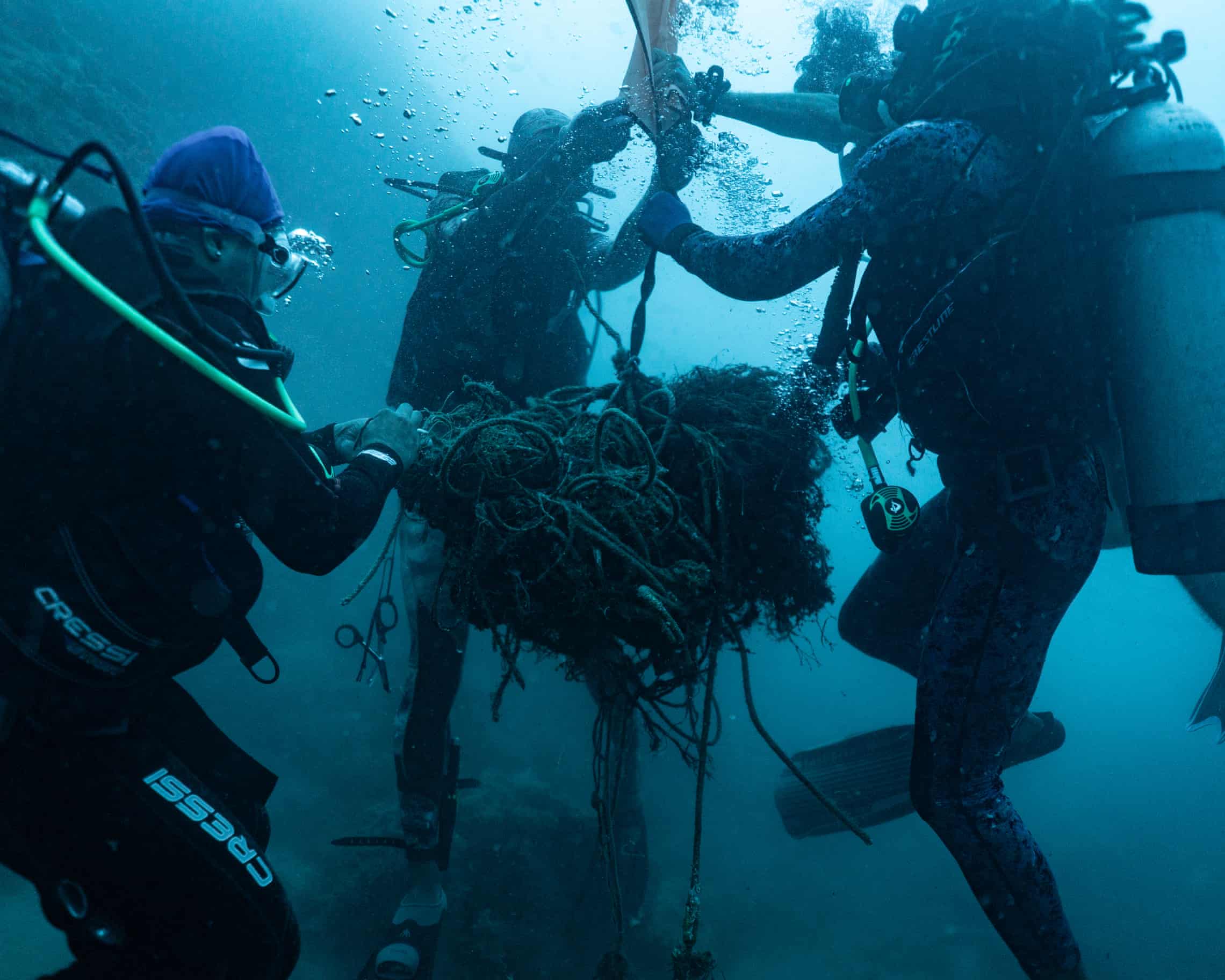
Photo: Danielle Khan Da Silva.
Divers risk their lives to protect whales from “ghost nets”
abandoned by fishermen.

Today’s article presents one of those impossible challenges pitting the environment against the need to make a living. In this case, it involves the ocean, specifically marine animals.

Danielle Khan da Silva has the story at the Guardian.

“After a day of scuba diving, Luis Antonio ‘Toño’ Lloreda was exhausted. Then a friend brought urgent news. ‘Toño, man, there’s a whale caught in a net out there.’ Lloreda, 43, had freed other, smaller wildlife from fishing nets but this would be his first marine animal of such size.

“The four- to five-meters-long juvenile humpback, accompanied by its mother, had a net studded with hooks wrapped around its fin and mouth. One wrong move could have been fatal for Lloreda or the whale.

‘To connect with the whale, I used what we call intuitive interspecies communication,’ says Lloreda, explaining that this involves non-verbal, energetic communication.

“ ‘I asked the mother for permission – energetically,’ he says. ‘At first, she didn’t want our help. But when I showed her we meant no harm, she let us in.

“ ‘She positioned herself below us. Then I asked the calf. When the calf became very still, I reached into her mouth and removed the net.’ The mother and calf swam for 50 meters before pausing to rest.

“Lloreda is one of nine Guardianes del Mar (Guardians of the Sea), a grassroots African-Colombian collective from six coastal communities around Colombia’s Gulf of Tribugá, a biodiversity hotspot on the Pacific coast that spans 600,000 hectares of ocean, forest and mangroves. The region, where dense Chocó rainforest meets the ocean, is a Unesco biosphere reserve and is designated a ‘hope spot‘ by the nonprofit organization Mission Blue for its ecological significance.

“Scuba diving is crucial for identifying and removing ghost fishing gear – lost or abandoned commercial nets made mostly of near-indestructible plastics – but it is prohibitively expensive. With sponsorship from Ecomares and Conservation International, Lloreda and his colleagues have trained not only in diving, but in removing fishing gear from coral with quick, precise and safe techniques.

“Many guardians double as coral gardeners and reef surveyors, collecting data for both their communities and scientific partners. Three, including Lloreda, are trained to free marine animals.

“According to WWF, 50,000 tons of fishing gear are lost or abandoned in the oceans globally each year. These ‘ghost nets’ drift across borders, ensnaring coral, turtles, sharks – and whales. In the Gulf of Tribugá alone, Guardianes del Mar estimates that 3-4 humpback whales become entangled each year. …

Guardianes del Mar is working to certify more local divers so they can have a greater impact. But it faces mounting logistical and financial hurdles.

” ‘We used to send the nets to Buenaventura for recycling, but fuel costs are too high,’ says Benjamin Gonzales, 53, one of the senior guardians. There are no roads – the communities are connected mainly by boat – so any rubbish or recycling must be transported out by boat or plane.

“Today, the nets are repurposed into bracelets and sold in Germany and locally in Nuquí, the main coastal municipality. Lead weights are melted down into new dive weights for the local shop, run by Guardianes del Mar advocate Liliana Arango.

“The spirit of mutual care between people and nature runs deep in Tribugá, where the population numbers about 7,000. African-Colombian communities here are descended from formerly enslaved people who escaped Spanish rule and crossed the jungle to reach the coast. They were welcomed by the Indigenous Emberá, and today co-govern the region through a state-recognized model of local autonomy. …

“Says Camilo Morante, 25, the youngest guardian and the group’s legal representative … ‘Everyone in this community fishes, so we can’t tell anyone to stop using nets. … The most important thing is that we raise consciousness locally so that we understand the consequences of our actions.’ “

More at the Guardian, here.

Read Full Post »

Photo: Shanti Mathias.
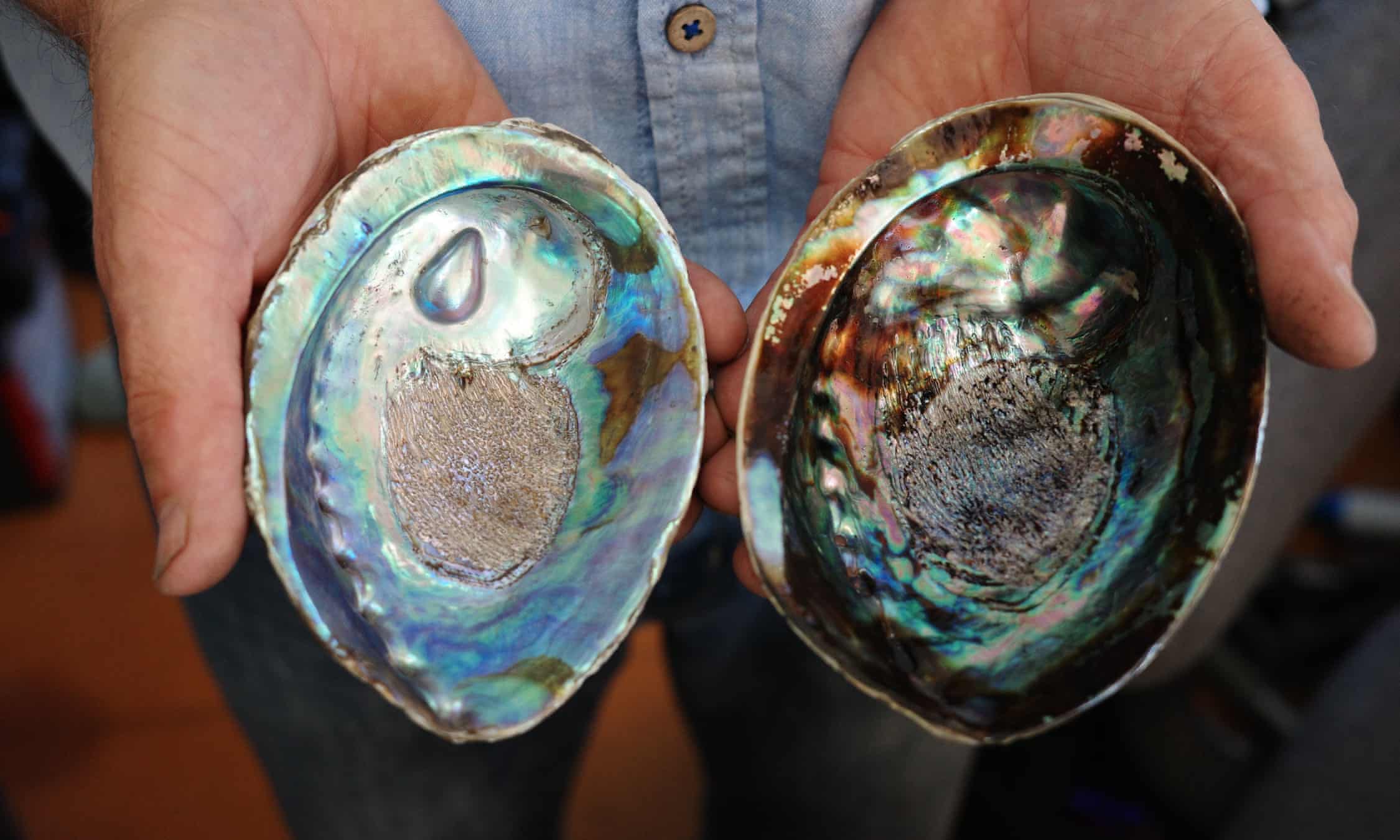
A farmed pāua shell with a pearl inside (L) held next to a wild pāua shell in New Zealand.

During the pandemic lockdown, there didn’t seem to be much point in dressing up or wearing jewelry. I certainly got comfortable with being casual all the time, and even now I mostly wear jeans. Except for funerals.

But the other day, I noticed my grandmother’s pearl necklace in a box and felt a little sorry that I hardly ever wear jewelry (unless from Suzanne’s company). I always liked pearls.

In today’s story, we learn about unusual blue pearls and how the reality of global warming suggests we better enjoy them now, while abalone can still make them.

Shanti Mathias writes at the Guardian, “Roger Beattie was diving off the Chatham Islands, about 800km [~500 miles] east of New Zealand, when he saw his first pāua pearl. Beattie was familiar with pāua, the Māori word for abalone, and their iridescent shells of shimmering purples and greens. But the pearl that had formed inside was unlike anything he had ever seen, gleaming with layers of the pāua’s natural colors. …

“That was in the early 1990s, and Beattie soon started experimenting ways of farming pāua, and creating pearls in the shell. A decade later, he began selling the so-called blue pearls commercially.

“Now a small industry exists in New Zealand cultivating the unique gems. They are rare, with only a handful of companies running farms, each producing only a few thousand pāua pearls each year. But the delicate operations are being made more complicated as changing conditions and warming seas alter the environments pāua need to survive.

“ ‘Warm waters cause physiological stress to the pāua,’ says Shawn Gerrity, an ecologist at the University of Canterbury who has studied the pāua.

“There are four species of pāua endemic to New Zealand. The blackfoot pāua is the biggest species, known for its vibrant shell and succulent flesh. All cultivated pāua pearls come from the blackfoot pāua. The pearls appear shades of blue, turquoise, purple and green.

“ ‘Only this abalone, in this water, produces such an unusual color of pearl,’ says Jacek Pawlowski, a jeweler in Akaroa, a seaside town southeast of Christchurch on New Zealand’s South Island. … ‘They have that rainbow, opal shine.’ …

“As juveniles, pāua are taken out of the water, where their flesh is pried up and a small implant placed under their shell for a pearl to form on. If their soft bodies are nicked, the pāua will bleed to death, so the process must be gentle. Only one in five pāua will create a jewelery-grade gem, Beattie says.

“Each mollusk needs to be fed vast quantities of kelp and live in water about 16 degrees for the three to four years it takes for a pearl to form. …

“But rising ocean temperatures pose a threat to their survival. … Marine heatwaves have dramatically increased in frequency around New Zealand, with a particularly severe event in 2017/18 causing thousands of sea creatures to die.

“Increased marine temperatures have caused mass die-offs of abalone species in other areas of the world, like California, where warming water has reduced abalone’s access to food and sped up the transmission of a withering disease. Beattie has had an algal bloom – which is more likely in warm water – kill a harvest of pāua by depriving them of oxygen.

“Gerrity says marine heatwaves ‘destroy habitats.’ …

“Gerrity has researched the recovery of pāua in Kaikōura, on the north-east coast of the South Island, where thousands of pāua died after the sea floor was lifted six metres [~20 feet] in a 2016 earthquake. Nine years later, with careful management, the population is healthy again. …

“Dr Norman Ragg, senior shellfish scientist at science organization Cawthron Institute, says pāua are a ‘really interesting quirk of nature’ that have remained unchanged for millennia. While New Zealand’s populations are still healthy, there is no room for complacency. … Ragg believes cultivating blue pearls could go some way to bolstering appreciation for pāua and securing its future in the face of climate change.”

More at the Guardian, here. With no paywall at the Guardian, donations are vital.

Read Full Post »

Photos: John and Suzanne’s Mom.
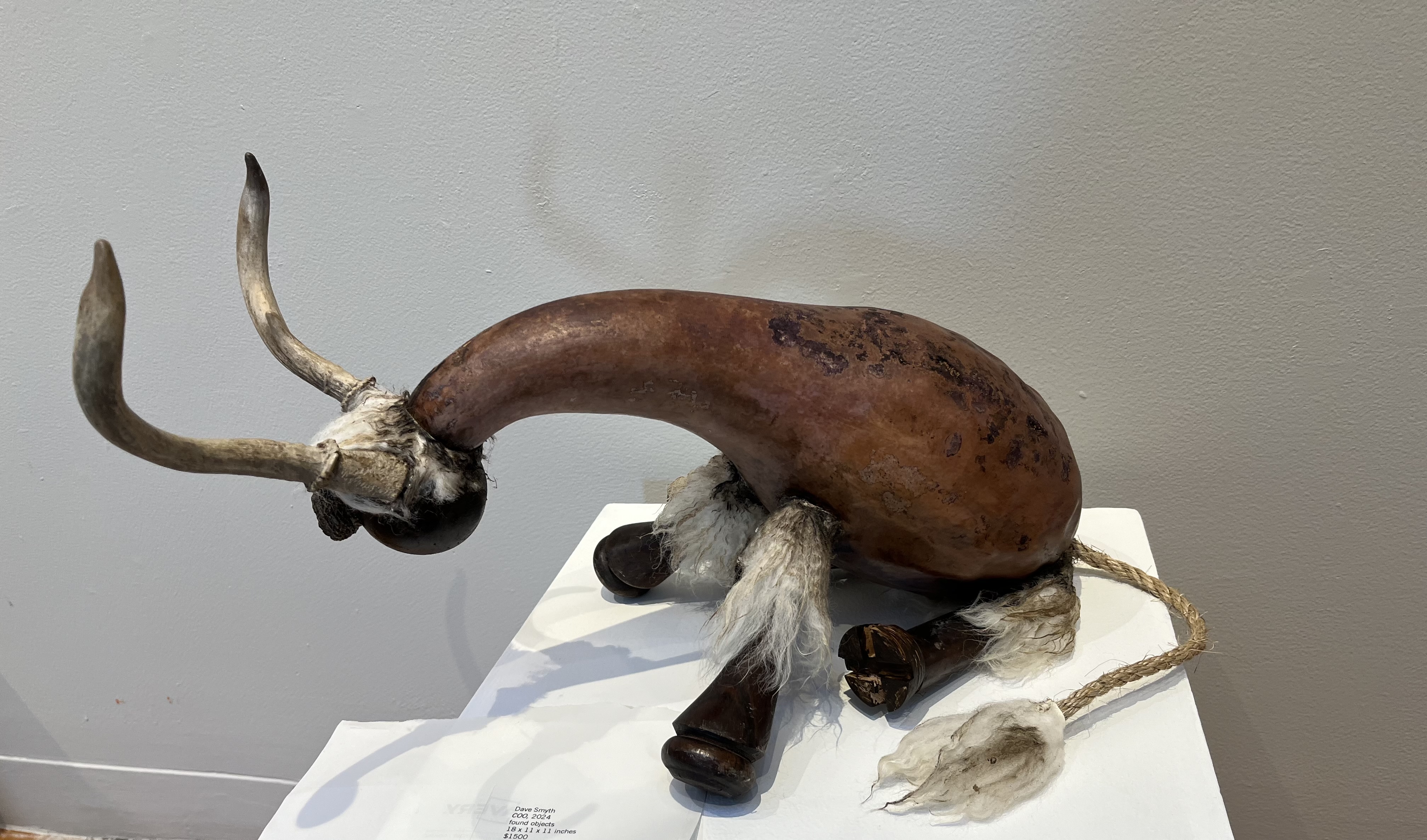
A gourd-body bull by Dave Smyth is being shown at Concord Art’s juried member show, 2025. Don’t you love how artists see potential that so many of us miss?

Today’s pictures are mostly from art exhibits I attended this month. The show at Concord Art, above, was in the process of being set up when Meredith and I went. She aims to submit work for the next show and has appeared in several earlier ones.

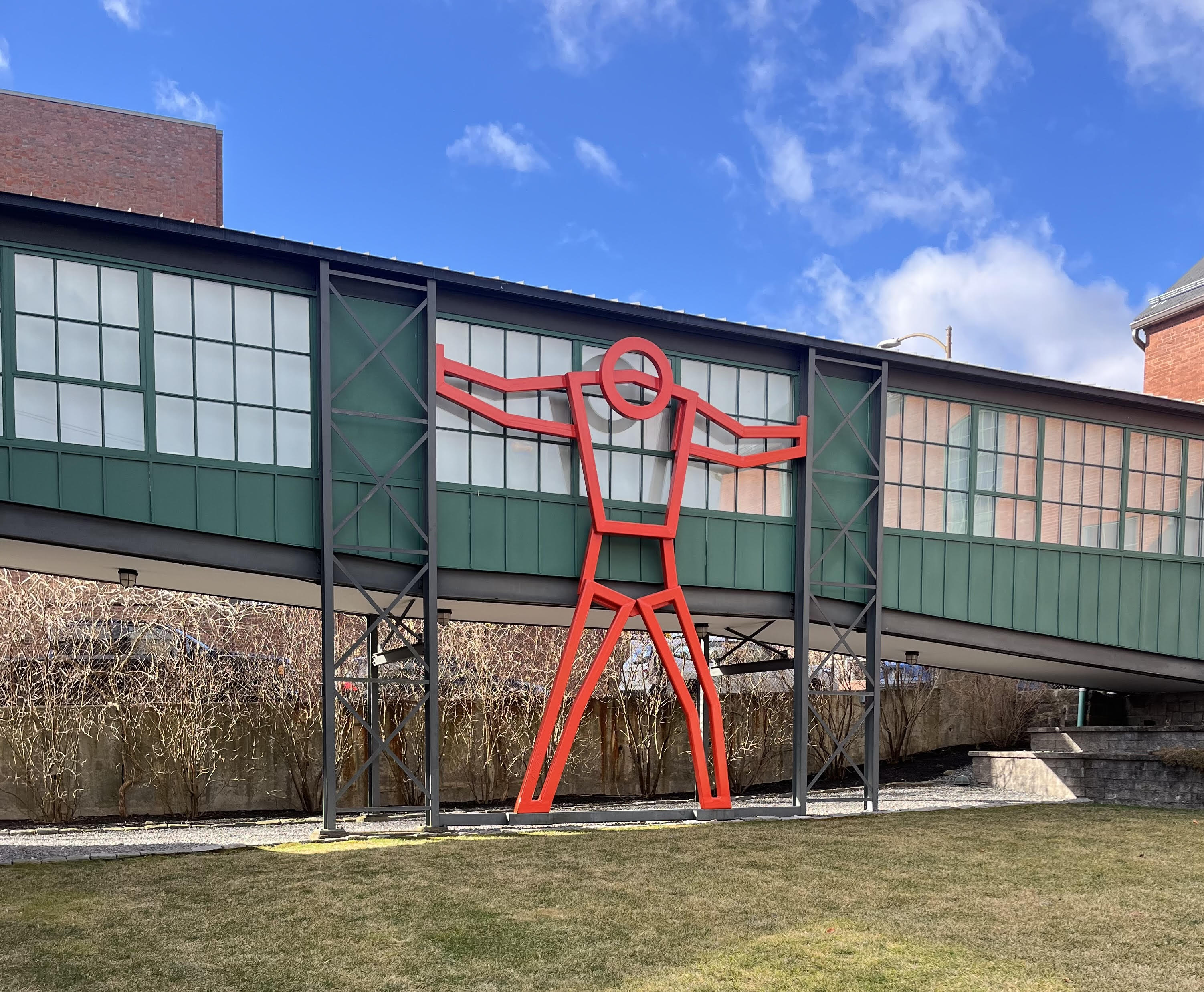
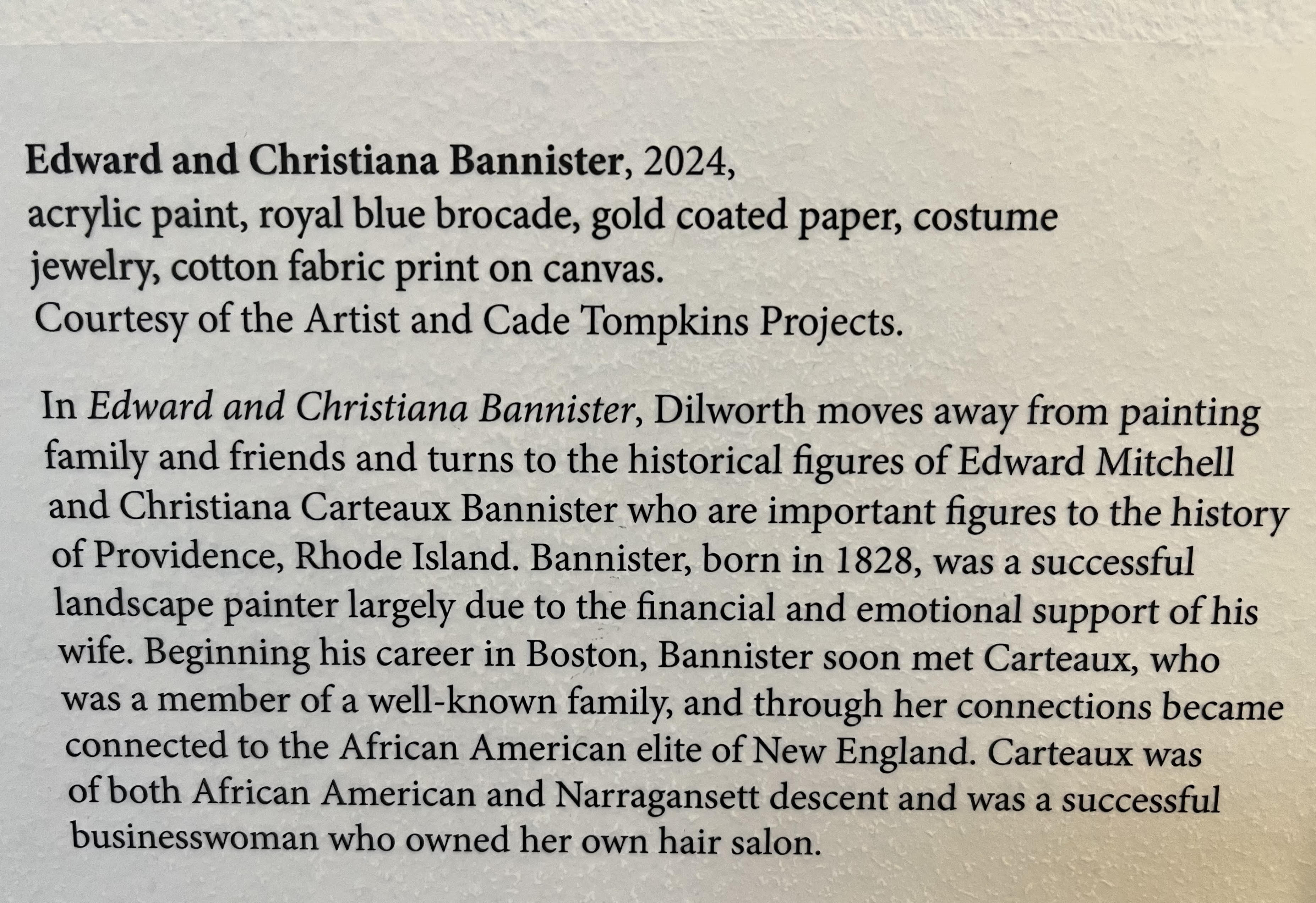
The orange giant who is holding up the world is at the Fitchburg Art Museum, where Ann and I took in several exhibits — in particular the Bob Dilworth. Born in Virginia, Dilworth taught art for many years in Rhode Island. I liked learning more about noted 19th century Black landscape painter Edward Bannister, seen in the portrait with his wife. Dilworth’s paintings, which he often worked on for years, feature a collage-like effect from the layering of textiles, stenciling, more.

I knew about Bannister before, but was glad to read something about his wife here.

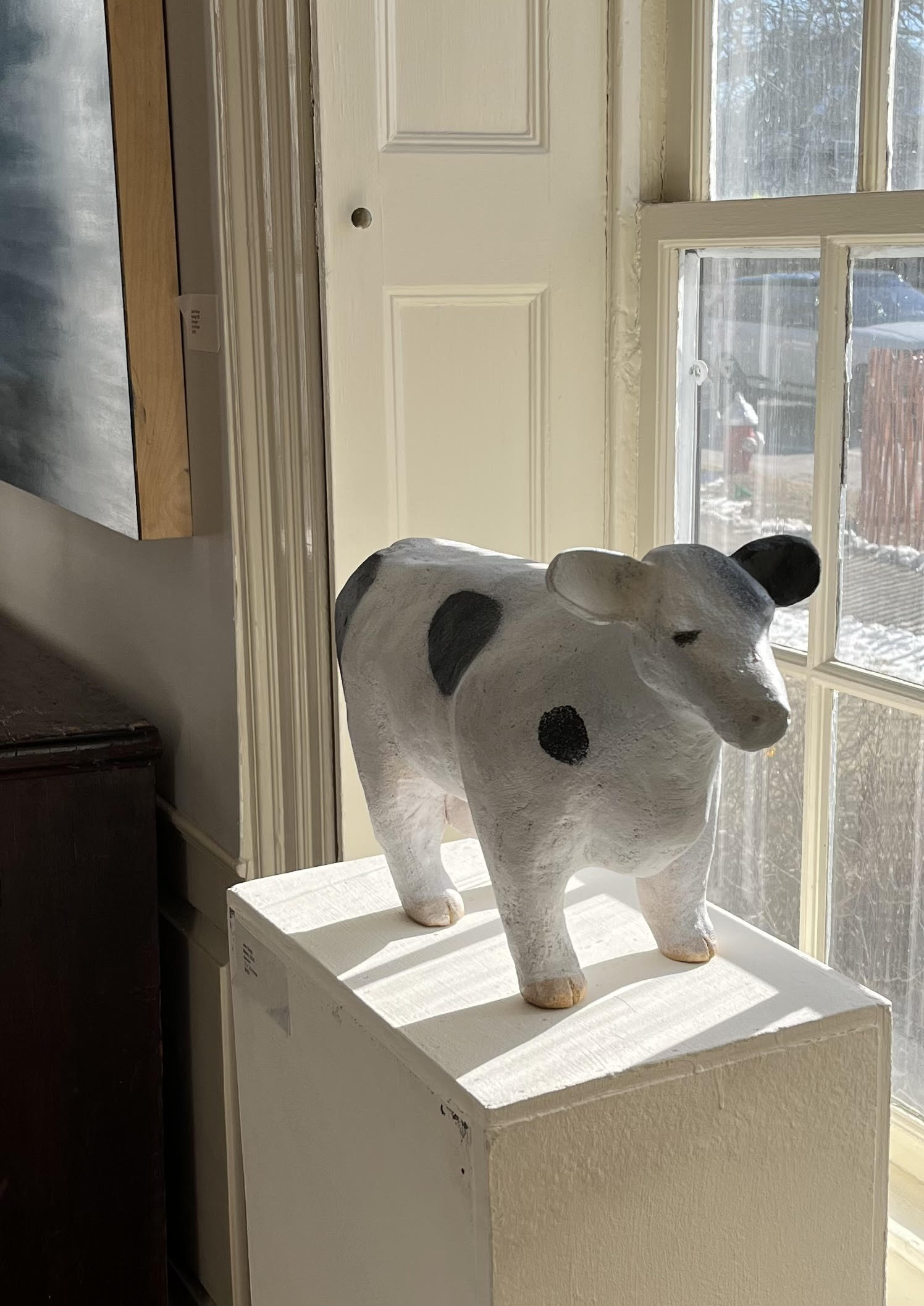
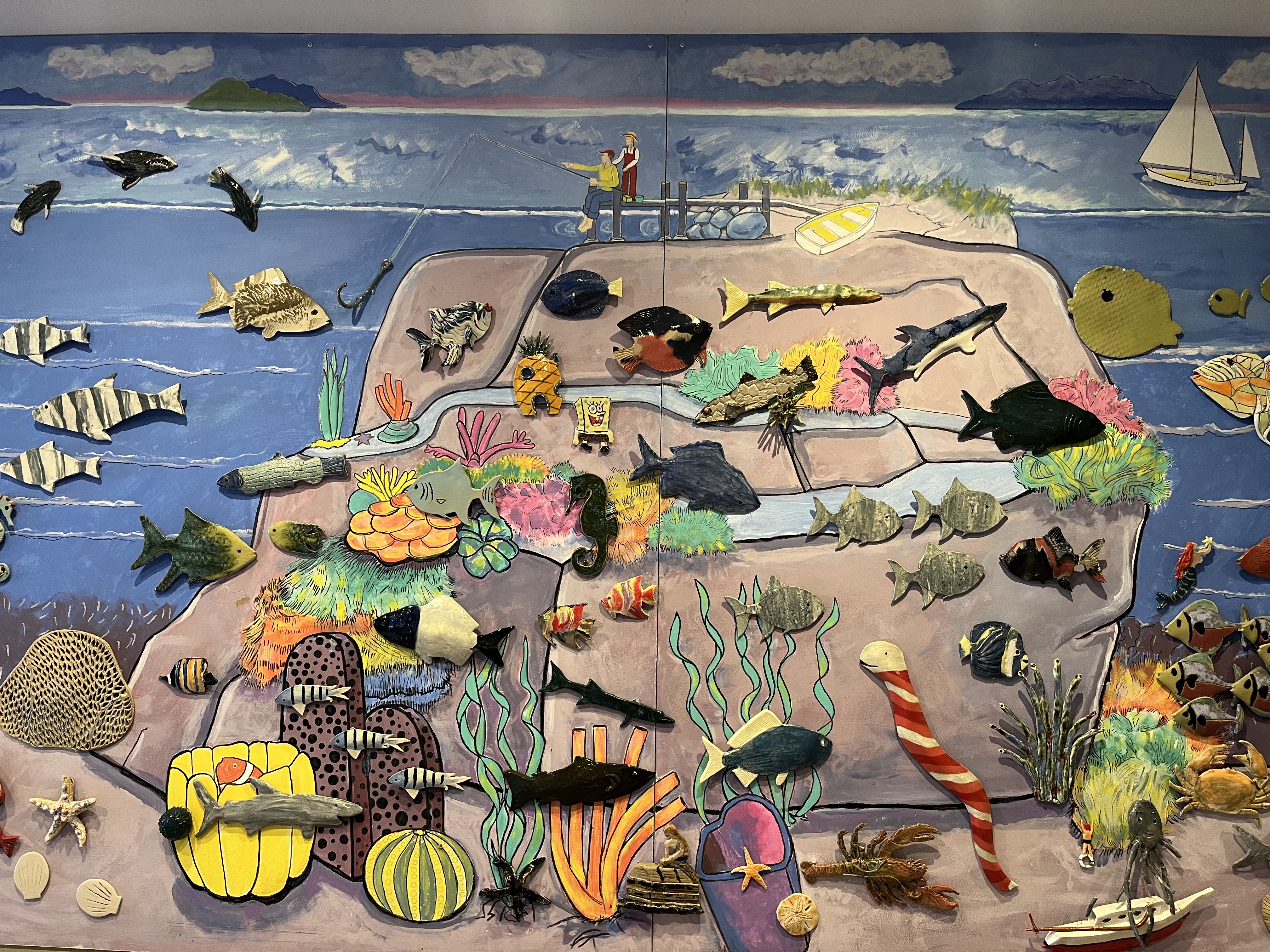
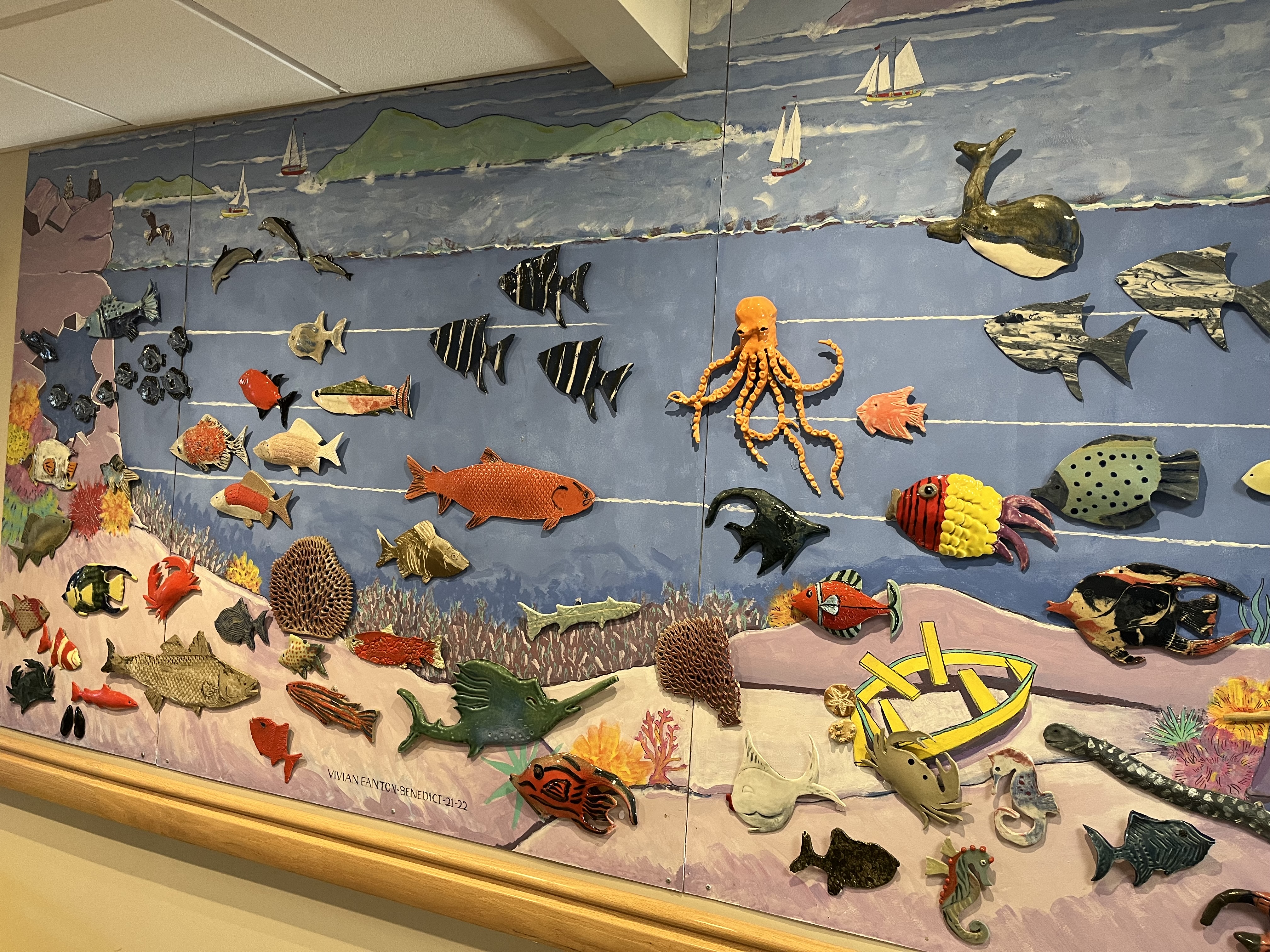
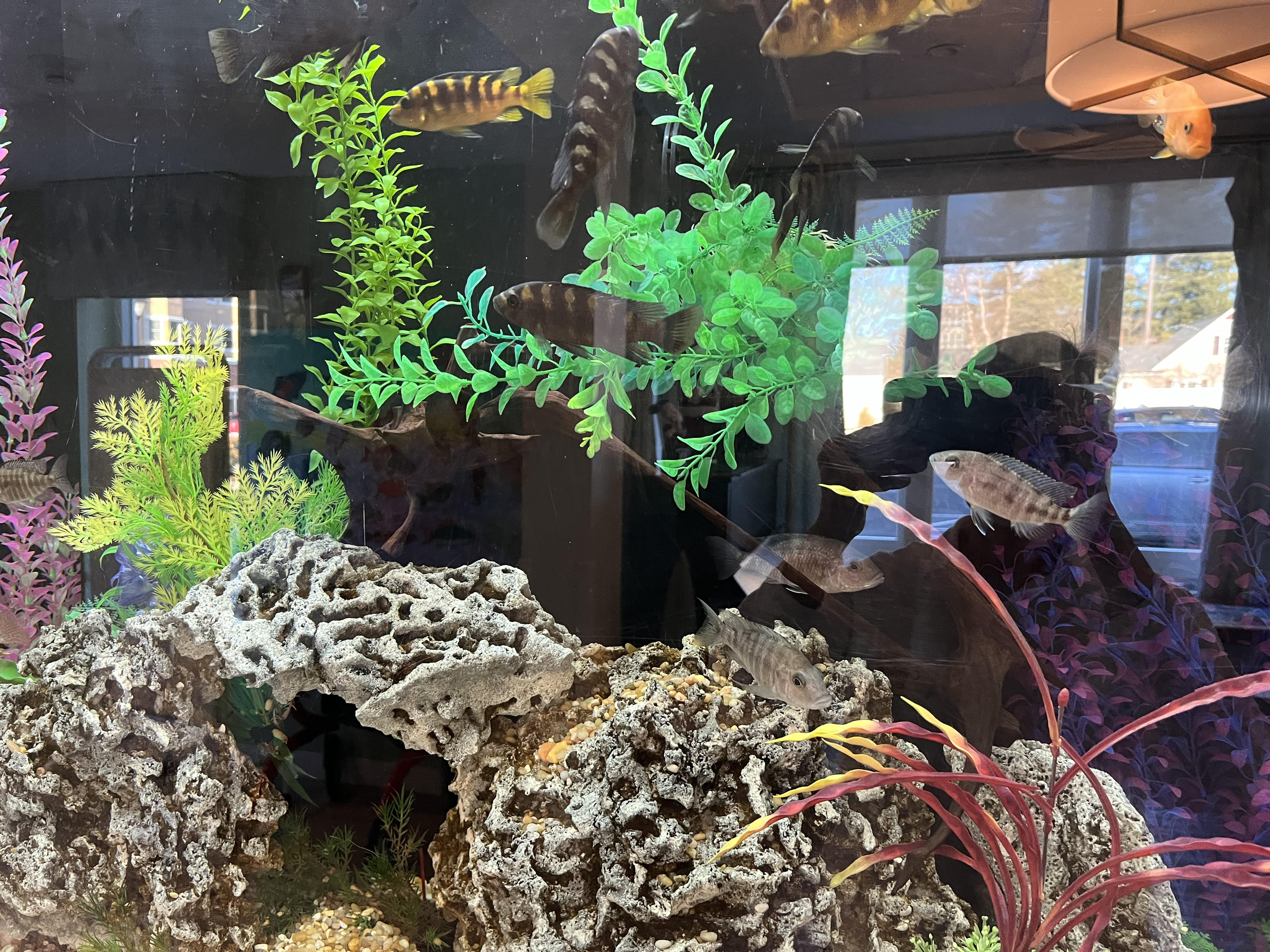
The next two photos do not show such professional work but rather are ceramics created by people of many skill levels who live in my retirement community. They made sea creatures for display in the nursing building. There’s a marine theme throughout that section, including a big salt water fish tank. I visited a friend there, and now I visit her in the memory-care building.

The final photo is actually from my December trip to New York City. There is loads of public art in Penn Station. Nice to have something to look at if your are too early for your train!

Read Full Post »

Photo:WindFloat Atlantic.
Portugal’s WindFloat Atlantic – the world’s first semi-submersible floating offshore wind farm – is now four years old.

We keep learning that our innovations to save the environment often have unexpected effects, both positive and negative. That’s why more research is always necessary.

Studies of offshore windmills, for example, need to be expanded to include a new variety — one that floats.

Michelle Lewis writes at Electrek, “The 25 megawatt (MW) WindFloat Atlantic, which came online in July 2020, was also continental Europe’s first floating offshore wind farm. … WindFloat Atlantic’s electricity production has steadily increased, reaching 78 GWh [gigawatt hour] in 2022 and 80 GWh in 2023. In July 2024, it recorded a total cumulative production of 320 GWh, providing power annually to over 25,000 households in Viana do Castelo, north of Porto [Portugal] while preventing more than 33,000 tons of CO2 emissions and creating 1,500 direct and indirect jobs.

“The offshore wind farm sits 20 km [~12 miles] off the Portuguese coast. It comprises three 8.4 megawatt (MW) Vestas wind turbines that sit on semi-submersible, three-column floating platforms anchored by chains to the seabed. A 20 km-long (12.4-mile) cable connects it to an onshore substation.

“Here’s how the semi-submersible floating platform works:

  • “Each triangular floating platform is semi-submersible and anchored to the seabed. It consists of 3 vertical columns, interconnected/solidary to each other, and one of them is attached the base of the wind turbine tower.
  • “The lateral distance of the platform (between the center of the columns) is about 50m. Its stability is reinforced by a system of gates that are filled with water at the base of the three columns, associated with a static and dynamic ballast system.
  • “This active ballast system moves the water between columns to compensate for the stresses caused by the wind thrust on the wind turbine. This moving ballast compensates for significant differences in wind speed and direction. Its purpose is to keep the wind turbine tower upright to optimize its performance.

“WindFloat Atlantic has an operations and maintenance base in the port of Viana do Castelo, where the team receives the wind farm’s information in real-time so they can address issues immediately. Onsite intervention can be complex, due to adverse weather and sea conditions in the area where it’s sited.

“At the end of 2023, WindFloat Atlantic was resilient in the face of Storm Ciarán, weathering wave heights of 20 meters (66 feet) and wind gusts up to 139 km/hr (86 mph).

“Ongoing surveys have found that over 270 species are successfully coexisting with WindFloat Atlantic, and the floating structures have fostered marine life, contributing to a conservation and reef effect underwater.” More at Electrek, here.

Of course, as we know, all offshore windmills have reef-making effects. And the mixed environmental impacts are the reason many conservationists have had mixed feelings about windmills. But now the benefits seem to outweigh the concerns.

Jared Brey wrote at Sierra Club magazine in 2022, “Historically, many environmental groups have worked to slow down the permitting process for development until possible impacts to wildlife have been studied. Today, the environmental consequences of not speeding up offshore wind development are arguably worse than delaying it. In August 2021, the most recent report from the Intergovernmental Panel on Climate Change (IPCC) emphasized how urgent the stakes are: Unless countries around the world cut their carbon emissions drastically in the next few years, climate change will devastate ecosystems around the world within our lifetimes. …

“[Environmental] groups will decide what research needs to be done and who will fund it, says Emily Shumchenia, director of the Regional Wildlife Science Entity. The group is making research plans for different topics; a marine mammal subcommittee held its first meeting in December, for example. Then it will begin researching existing wildlife and how it might be affected by offshore wind farms. ‘This is a huge opportunity to collect information about the ocean and learn about the ecosystems out there that we wouldn’t have otherwise,’ Shumchenia says.

“It’s important, Shumchenia adds, to push past the ‘data paralysis’ that sometimes delays decision-making, especially for something as critical as renewable energy. The government and offshore wind industry have a responsibility to understand how wind turbines will affect sea life. But the human footprint is already offshore, in everything from commercial fishing to shipping to anthropogenic climate change.

“ ‘I think there’s this perception that the ocean is this vast untapped wilderness, which in some ways it is — it’s vast,’ Shumchenia says. ‘But especially in the Northeast [US] and probably the entire Mid-Atlantic, it’s a lot busier than people perceive.’ ” 

See Sierra Club, here.

Read Full Post »

Photo: Giacomo Augugliaro/Getty Images.
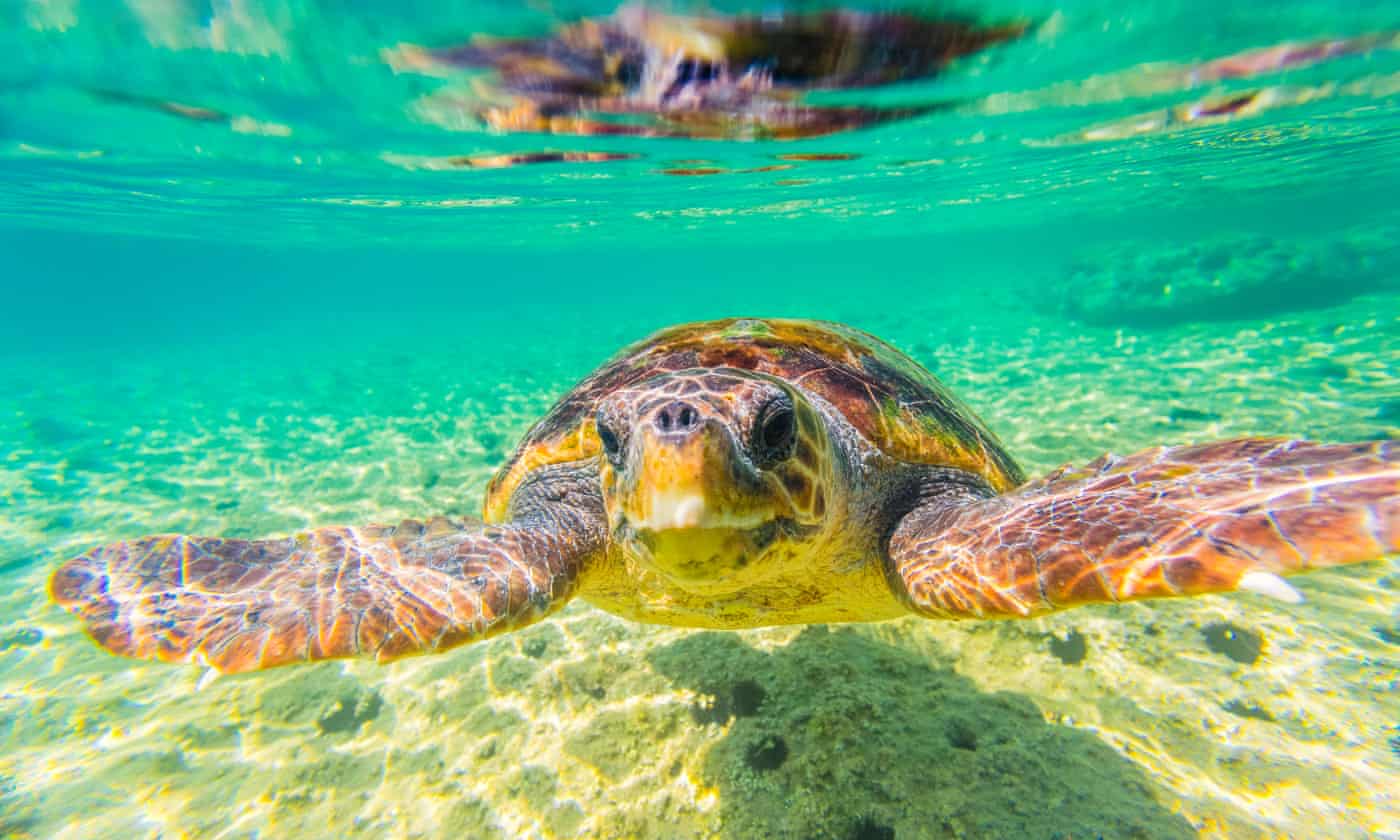
A loggerhead turtle (Caretta caretta) off Elafonissos island in Greece, where the rebound in population has been called “phenomenal.”  

Today’s article is about the resurgence of turtles in Greece. But before I get into it, I need you to indulge my current train of thought about turtles.

There are the chocolate, caramel, and pecan-footed “turtles” that my sister-in-law makes every Christmas, turtles that this week have gotten certain farflung relatives wildly excited.

There are songs about turtles like one I just found out my exercise teacher made for a fundraiser years ago, here.

And there are turtle fans all over the world who are bringing real turtles back from the brink of extinction. Slowly but surely.

Helena Smith writes for the Guardian about that.

“After nearly a quarter of a century observing one of the world’s most famous sea turtle nesting grounds,” she reports, “Charikleia Minotou is convinced of one thing: nature, she says, has a way of ‘sending messages.’

“Along the sandy shores of Sekania, on the Ionian island of Zakynthos, what she has seen both this year and last, has been beyond her wildest dreams. The beach, long described as the Mediterranean’s greatest ‘maternity ward’ for the Caretta caretta loggerhead sea turtle, has become host to not only record numbers of nests, but record numbers of surviving hatchlings as the species makes an extraordinary resurgence.

“ ‘The message sea turtles are sending is very clear,’ said Minotou, who coordinates the WWF program in the protected area. ‘And that is the measures we have taken over the past 25 years to ensure conditions are right for the marine turtles to nest here are working … It’s fantastic.’

“One of the oldest living species, sea turtles are believed to have existed for more than 100m years. Although highly migratory – over a lifetime, the reptiles cross thousands of miles of seas and oceans – female turtles always return as mature adults, about 20 to 25 years later, to the habitat where they were born to lay eggs. It is a reproductive cycle that happens with perfect synchronicity. In Sekania and other nesting grounds in Zakynthos and around Greece, turtles tagged at birth by conservationists a quarter of a century ago are now reappearing to nest.

“ ‘It’s hugely moving,’ says Minotou, a sustainable development expert who highlights the importance of technological advances, including the installation of CCTV cameras, in helping to ward off seagulls, ghost crabs and other predators. ‘This year more than 1,200 nests have been recorded in Sekania, which is one every 50cm [~20 inches] of beach. An amazing number.’

“From Spain in the west to Cyprus in the east, the Mediterranean has witnessed a record rise in sea turtle nesting – testimony to the painstaking efforts of environmentalists determined to save an ancient mariner that not that long ago was on the verge of extinction. Only one in 1,000 turtle hatchlings makes it to adulthood, making the turnaround even more remarkable.

“In Greece, which hosts 60% of Caretta caretta nests, the rebound has been phenomenal: from an average of 5,000 to 7,000 nests per year, since 2023 over 10,000 nests have been recorded annually, according to Archelon, the Sea Turtle Protection Society of Greece. …

“Thirty years ago, before the creation of a state-funded marine park on Zakynthos – the country’s biggest sea turtle nesting ground after the bay of Kyparissia in the Peloponnese – Greek authorities appeared oblivious to the plight of a species whose survival is now widely recognized as vital for marine ecosystems and the region’s ecological biodiversity.

“Few have more vivid memories of the dangers the creatures once faced than Lily Venizelos, who founded the UK-based Mediterranean Association to Save the Sea Turtles (Medasset) in the 1980s.

“The doughty campaigner, now in her 90s, spent years lobbying successive Greek governments to legislate policies to protect Caretta caretta from the then nascent threat of tourism and other perils posed by speedboat propellers, beach furniture and human activity in marine turtle habitats, conservationists say. …

“ ‘It’s been the most wonderful news, at my age, to find out that the Caretta caretta are no longer so threatened, but it’s crucial protective measures continue to be enforced. One false move and everything could be lost.’ ”

Do you have any thoughts on why turtles are so beloved? I think for me it’s their patience, the way they get everything done that they need to do while moving slowly.

More at the Guardian, here. No firewall.

Read Full Post »

Photo: Eduardo Sampaio and Simon Gingins.
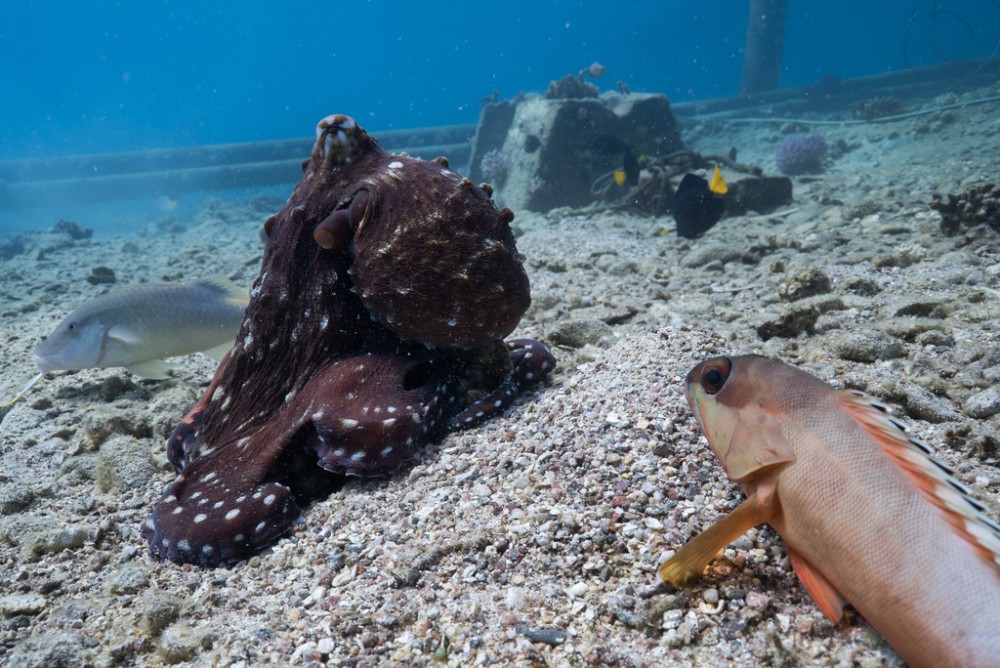
An Octopus cyanea, center, hunts with a blacktip grouper on one side and a blue goatfish on the other.

There are trends, I think, in which animals are popular and get the most news coverage. Lately, octopuses seem to be “in.” That is probably because the people who know them best, like naturalist Sy Montgomery, have demonstrated how intelligent octopuses are.

Now we learn that some octopuses hunt with partners from other species and may make the group decisions.

Evan Bush writes at NBC News, “A new study shows that some members of the species Octopus cyanea maraud around the seafloor in hunting groups with fish, which sometimes include several fish species at once.

“The research, published in the journal [Nature], even suggests that the famously intelligent animals organized the hunting groups’ decisions, including what they should prey upon.

“What’s more, the researchers witnessed the cephalopod species — often called the big blue or day octopus — punching companion fish, apparently to keep them on task and contributing to the collective effort.

“Octopuses have often been thought to avoid other members of their species and prowl solo using camouflage. But the study [is] an indication that at least one octopus species has characteristics and markers of intelligence that scientists once considered common only in vertebrates. …

“Said Eduardo Sampaio, a postdoctoral researcher at the Max Planck Institute of Animal Behavior and the lead author of the research, ‘We are very similar to these animals.’ …

“To understand the inner details of octopus lives, researchers dived for about a month at a reef off the coast of Eilat, Israel, and tracked 13 octopuses for a total of 120 hours using several cameras. The team followed the octopuses for 13 hunts, during which they observed groups of between two and 10 fish working with each octopus.

“These hunting groups typically included several species of reef fish, such as grouper and goatfish. The octopuses did not appear to lead the groups, but they did punch at fish to enforce social order — most often at blacktip groupers.

“ ‘The ones that get more punched are the main exploiters of the group. These are the ambush predators, the ones that don’t move, don’t look for prey,’ Sampaio said. …

“ ‘If the group is very still and everyone is around the octopus, it starts punching, but if the group is moving along the habitat, this means that they’re looking for prey, so the octopus is happy. It doesn’t punch anyone, Sampaio said.

“The researchers think fish benefit from such hunting groups because an octopus can reach into crevices where prey hides and root out lunch. The octopus benefits, they believe, because it can simply follow the fish to food, rather than perform what the researchers call speculative hunting. …

“After shooting their video, the researchers fed all of their hunting scenes into software that creates a three-dimensional representation, then used another program to track each animal and log its position in relation to others. The data allowed the researcher to measure how close the creatures remained to one another and which creatures anchored or pulled the group in one direction or another.

“The data showed that a particular fish species, the blue goatfish, would roam off and lead the hunting groups in that direction, but the group of fish would linger if the octopus didn’t immediately follow.

“The goatfish ‘are the ones exploring the environment and finding prey,’ Sampaio explained. ‘The octopus is the decider of the group.’

“The researchers did not see evidence that the creatures shared prey. All the species involved are generalists that eat crustaceans, fish and mollusks, but whoever was able to catch the prey got a meal. Questions remain, however, including whether certain octopuses recognize or prefer to hunt with a favorite fish companion. … It’s also not clear if this social hunting behavior is something octopuses learn or if it’s innate.

“ ‘In my intuition, I think it’s something they learn, because the smaller octopuses seem to have a higher difficulty to collaborate with fish than the large ones,’ Sampaio said.

“Jonathan Birch, a professor of philosophy at the London School of Economics who studies animal sentience but was not involved in the new research, said he … appreciated that the study’s observations were made outside a laboratory setting, where a lot of animal cognition research takes place. Octopuses can be difficult to study outside their natural setting. …

“ ‘Octopuses were seen as a problem case because they are intelligent and yet solitary, it was assumed, so researchers puzzled for a long time about what’s going on there,’ Birch said. ‘[This study shows that] For at least one species of octopus, there is quite a rich social life.’ “

More at NBC, here. No paywall.

Read Full Post »

Photo: Kumar Ganapathy via Unsplash.

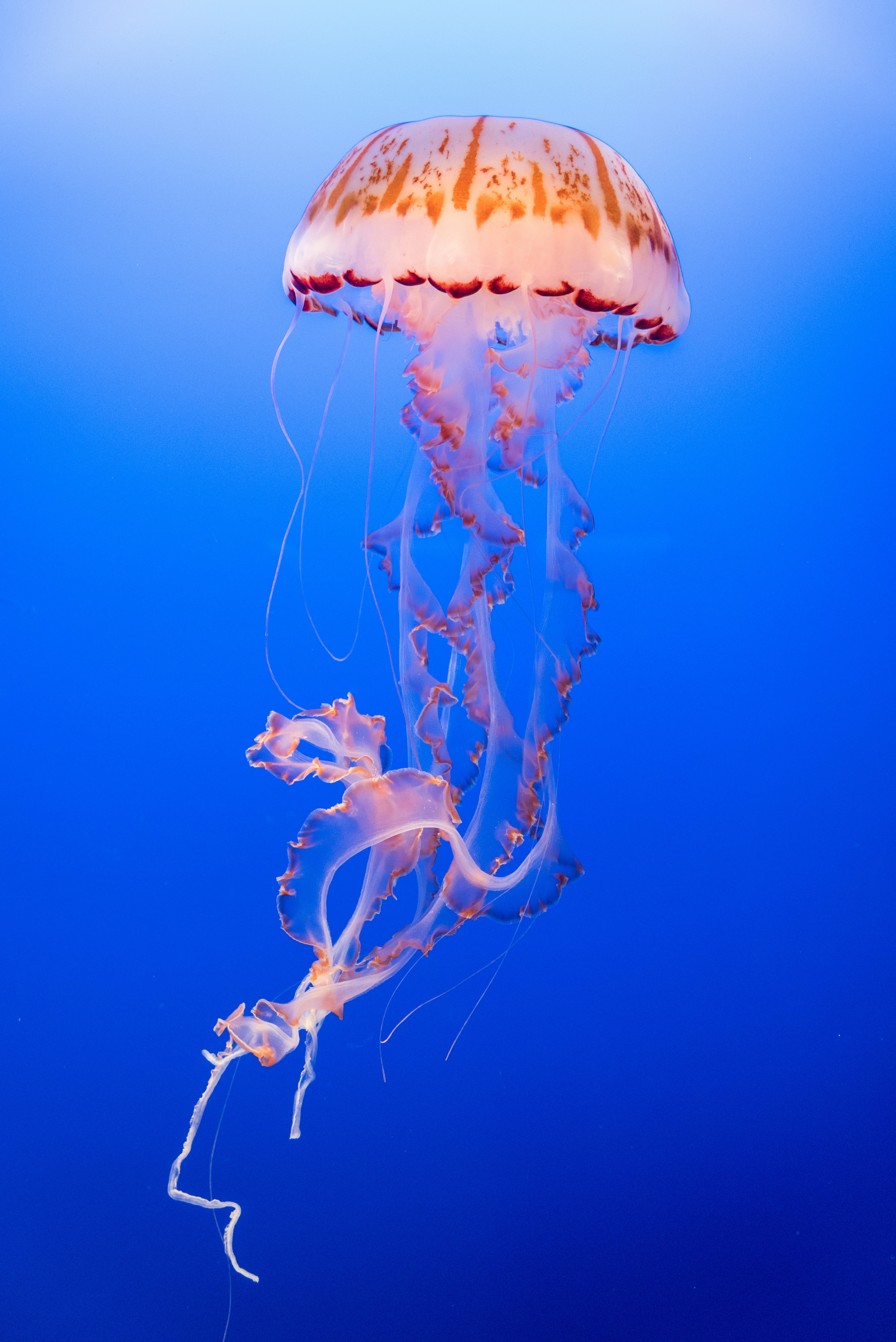
When I think of jellyfish, I remember a little marine scene I made in a shell when I was 13. As a see-through cover for the display, I used a dead jellyfish I’d found — the common kind of jellyfish that doesn’t sting.

It eventually evaporated.

James Bradley writes at the Guardian that scientists are only beginning to give jellyfish and other creatures that float on the surface the attention they deserve.

“In the summer months, north-easterly winds frequently herald the arrival of bluebottles on beaches along Australia’s east coast. But while bluebottles – or to give them their more formal name, the Pacific man-of-war – are a common sight on Australian shores, they are not native to coastal waters. Instead, they spend most of their lives on the open ocean, drifting with the winds and the currents.

“Bluebottles are just one of a collection of organisms that have made their home at the ocean’s surface. Some of these animals are hydrozoans like the bluebottle. There is the by-the-wind sailor, Velella velella, which has a stiff, transparent, oval sail about five centimeters [~two inches] attached to its bright blue float, and Porpita porpita, sometimes known as the blue button, which is shaped like a disc about three centimeters in diameter surrounded by stinging polyps. But there is also the strikingly beautiful sea dragon; crustaceans such as shrimp, buoy barnacles and tiny swimming copepods; and even mollusks such as the violet snail and Recluzia.

“Known collectively as the neuston, these creatures are not tied to any one place. Instead, they move with the wind and the water. Sometimes they gather into huge drifts, living islands of velella and bluebottles. … At other times they clump together around drifting debris or spread out sparsely over hundreds or even thousands of square kilometers.

“Despite its ubiquity, the neuston remains comparatively poorly understood and critically understudied. … Marine ecologist Associate Prof Kerrie Swadling, from the University of Tasmania, puts it bluntly. ‘“’We know more about deep sea vents than we know about the neuston.’

“The reasons for this ignorance are partly historical. Although several important studies of the neuston were published during the 20th century, they were written in Russian by scientists from the Soviet Union and were largely ignored outside the Eastern Bloc. But for the most part, the lack of research into the neuston is a consequence of the practical challenges involved in observing organisms that are scattered unevenly across the immensity of the open ocean. …

“In recent years, however, there has been an uptick in interest in the neustonNew research is revealing not just its importance to the health of ocean ecosystems as disparate as coral reefs and the deep ocean, but also important gaps in our understanding of how it will be affected by changes in the ocean environment.

‘The person most responsible for the increased visibility of the neuston is Dr Rebecca Helm. Now an assistant professor at Georgetown University in the United States, Helm was scrolling Twitter in 2018 when she came across a tweet about The Ocean Cleanup’s plans to remove plastic from the oceans by sweeping a floating net across the surface.

“Helm says she immediately wondered about the potential impact of this technology on the neuston, and so began to investigate. …

“[During the pandemic] she was locked out of her lab for several months. ‘I suddenly had all of this nebulous time to start looking into this more deeply, and became really fascinated. …

“Survival in the neuston [requires] animals to find some way to remain at the surface. For free-swimming species such as copepods and zooplankton, this is easy. But for other organisms it requires special adaptations.

“Hydrozoans like the bluebottle and velella employ gas-filled floats, while the buoy barnacle extrudes air into the cement that it would otherwise use to attach itself to ships and rocks, creating a substance a bit like pumice that it uses as a float. Similarly, violet snails suspend themselves beneath rafts constructed out of hardened bubbles of mucus. There is even a form of free-floating sea anemone that hangs upside down from the surface with the aid of a float in their pedal disc.

“Fascinatingly, this need for a float helps explain one of the more surprising discoveries to have come out of Helm’s research, which is that many of the animals that inhabit the neuston are not particularly closely related to other free-swimming species. Instead, they are descended from species that usually exist attached to the bottom of the sea that have migrated upwards, meaning that the neuston is, in a very real sense, what Helm dubs ‘an inverted sea floor’ clinging to the ocean’s surface.”

More at the Guardian, here. No firewall. Donations encouraged.

Read Full Post »

Photo: Institute For Figuring.
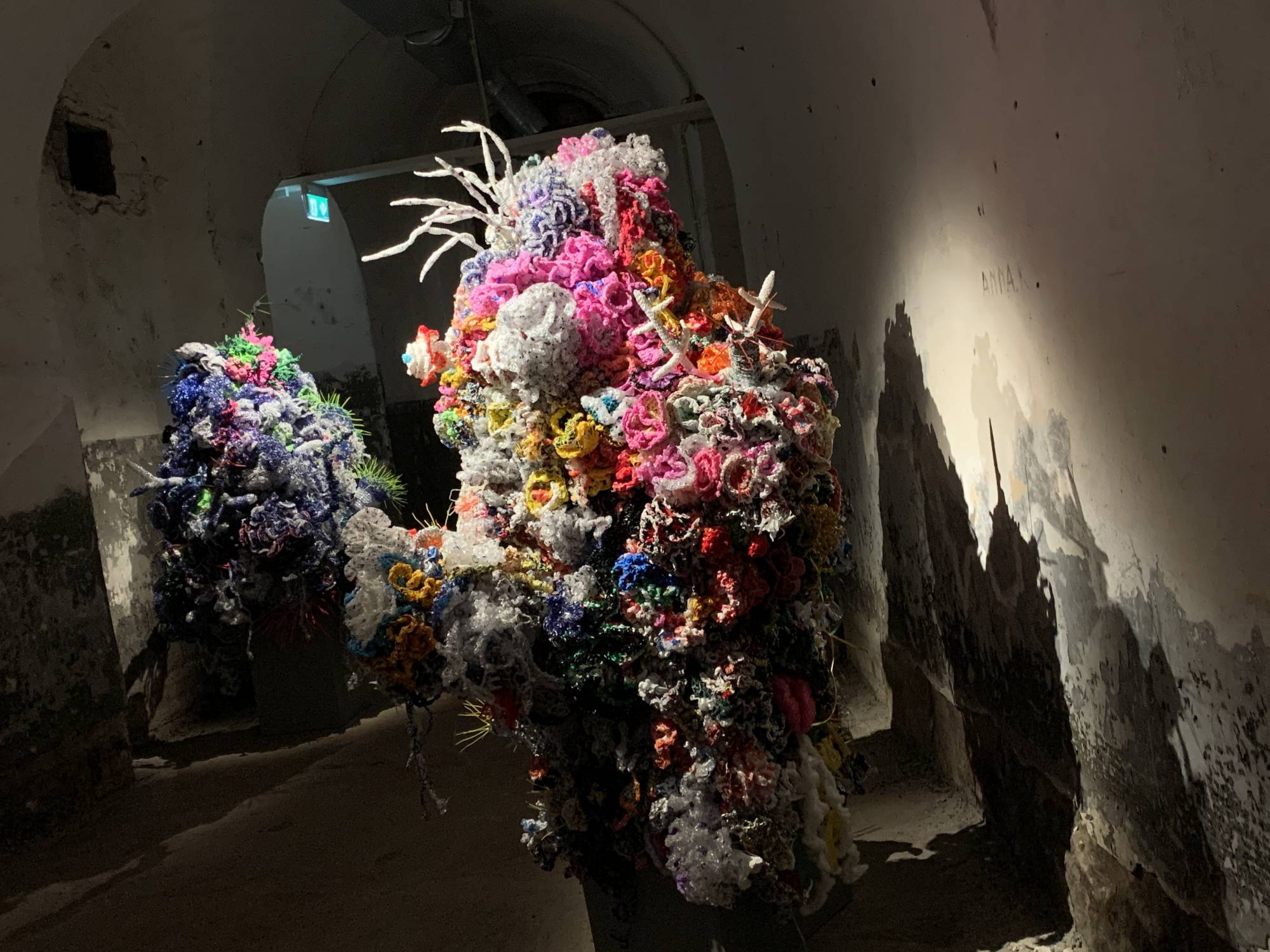
Coral Forest – Helsinki, crocheted from recycled plastic. A collaboration between Christine and Margaret Wertheim and the Helsinki Satellite Reefers, hosted by Helsink Art Museum and Helsinki Biennial 2021.

Remember my post on how crochet art was drawing attention to dying coral reefs? (See it here.) Well, after my friend Kristina told me about seeing some of the new additions to the crochet project, I decided to post a follow-up.

Siobhan Roberts reported at the New York Times in January, “Every year after the full moons in late October and November, Australia’s Great Barrier Reef begins its annual spawning — first the coral species inshore, where waters are warmer, then the offshore corals, the main event. Last year, this natural spectacle coincided with the woolly propagation of two new colonies of the Crochet Coral Reef, a long-running craft-science collaborative artwork now inhabiting the Schlossmuseum in Linz, Austria, and the Carnegie Museum of Art in Pittsburgh.

“To date, nearly 25,000 crocheters (‘reefers’) have created a worldwide archipelago of more than 50 reefs — both a paean to and a plea for these ecosystems, rainforests of the sea, which are threatened by climate change. The project also explores mathematical themes, since many living reef organisms biologically approximate the quirky curvature of hyperbolic geometry. …

“The surface of a sphere displays constant positive curvature; at all points, the surface bends inward toward itself. And a hyperbolic plane exhibits constant negative curvature; at all points, the surface curves away from itself. Reef life thrives on hyperbolism, so to speak; the curvy surface structure of coral maximizes nutrient intake, and nudibranchs propel through water with frilly flanges.

“In the artworks, marine morphologies are modeled — crocheted — with loopy verisimilitude. A bit like Monet’s water lilies, the crochet corals are abstract representations of nature, said Christine Wertheim, an artist and writer now retired from the California Institute of the Arts. Dr. Wertheim is the driving artistic force behind the project, which she created with Margaret Wertheim, her twin sister, a science writer who is in charge of scientific and mathematical components as well as management. …

“Crochet Coral Reef exhibitions typically have two main components: The Wertheims provide an anchor, of sorts, with works from their collection that they have crocheted over the years. They also incorporate pieces by select skilled international contributors. One is a ‘bleached reef,’ evoking corals stressed by increases in ocean temperature; another, a ‘coral forest’ made from yarn and plastic, laments the debris that pollutes reef systems.

“Then in response to an open call, volunteers far and wide crochet a pageant of individual specimens that agglomerate in a ‘satellite reef,’ staged by a local curatorial team with guidance from the Wertheims. … All contributors are credited.

“The largest satellite reef thus far coalesced in 2022 at the Museum Frieder Burda in Baden-Baden, Germany, with some 40,000 coral pieces by about 4,000 contributors. The Wertheims call this the Sistine Chapel of crochet reefs (documented in a splashy exhibition catalog). But the show at the Linz Schlossmuseum, which is dedicated to natural science as well as art and culture, is reminiscent of the work of the painter Giuseppe Arcimboldo, whose collage portraits from depictions of fruits, vegetables and flowers are ‘fantastically heterogeneous, also very funny and clever,’ Ms. Wertheim said.

“The Linz satellite reef unites some 30,000 pieces by 2,000 crocheters. The disparate parts take colorful inspiration from traditional Austrian ‘craftswomanship,’ as the exhibit text puts it, and there is a vast, glittery coral wall that gives a nod to the artist Gustav Klimt. In the Wertheims’ view, however, the crochet coral project is proof that it is not always lone geniuses who create great art, but also communities. In the art world, that is a radical idea, they noted, yet in science big collaborative projects and papers with thousands of authors are not unprecedented. …

“The mathematical dimension of the story intersects (from afar) with research by the applied mathematician Shankar Venkataramani and his students at the University of Arizona. They use idealized models to study hyperbolic surfaces in nature. [The] benefit, he said, is that it helps optimize processes like circulation and nutrient absorption. …

“When Margaret Wertheim, who studied math, physics and computer science at university, learned hyperbolic geometry, she found it ‘a bit bamboozling.’ She took the principles more on faith than understanding. Yet through crocheting models, she said, ‘you really do learn in a very deep way what a hyperbolic structure is, and in a way that I think is very powerfully pedagogical.’ “

More at the Times, here. Gorgeous photos.

See also Crochet Coral Reef, here. As the website notes, “Every crafter who contributes to the project is free to create new species of crochet reef organisms by changing the pattern of stitches or working with novel materials. Over time, a Darwinian landscape of wooly possibility has been brought into being. What started from simple seeds is now an ever-evolving, artifactual, hand-made ‘tree of life.’ “

Read Full Post »

Photo: Ben Toht.
Liz Sexton’s rat mask for Halloween in Brooklyn, New York, a few years ago started her papier-mâché art career.

I’m guessing that nearly everyone who launches into serious downsizing finds a papier-mâché puppet head that a kid made in school — in my case, not only Suzanne’s puppet head but also one that I made around age 10. Clumsy as the heads invariably are, it’s painful to get rid of something that feels so much like an accomplishment.

Today’s story is about a woman who has raised papier-mâché to high art.

Alex V. Cipolle reports at Minnesota Public Radio, “Hunched over her work bench with a box cutter, Liz Sexton carves out the spikes on the back of a horseshoe crab. … The crab is papier-mâché and the size of a shield. Composed of more than a dozen layers of paper bags, its shell feels as strong as one, too.  …

“The crab is one of more than 15 papier-mâché animal masks and sculptures Sexton is preparing for her first-ever solo exhibition. The show, ‘Liz Sexton: Out of Water,’ [opened] May 5 at the Minnesota Marine Art Museum in Winona, Minn. …

“At her home studio in St. Paul, many of these animal creatures — an Atlantic walrus, a humpback angler fish, a polar bear — stare down at her from the shelves. Others are placed around the house in various stages of completion. …

“Her masks are incredibly lifelike. And papier-mâché is only step one. She can spend upwards of 100 hours on a mask, honing the details using woodworking techniques, be that carving more than a hundred tri-pointed teeth of a marine iguana, or using an orbital sander to achieve the milky smooth skin of a beluga whale. …

“Sexton receives commissions from around the globe, so they must withstand all the perils of international shipping. And the masks, she says, are meant to be worn, after all. …

“Her partner, Ben Toht, is a fellow creative and collaborator. He shoots photos and creates gifs of Sexton wearing her masks in the wild, which will also be featured in the exhibition. Watching the masks progress from their initial lumpy gumdrop shape, he says, is incredible. …

“Like many of us, Sexton learned papier-mâché as a kid — her dad taught her. For many years, she did it as a hobby. …

“ ‘I moved around a lot. I was in France and Germany,’ she says of her time living in small apartments in Europe. With papier-mâché, ‘you don’t need a lot of supplies or space. You get some newspapers for free, some flour and water, and you can make whatever you want.’ 

“In her free time, she would make costumes and props for weddings. The turning point was Halloween in New York, when she and Toht were living in Brooklyn. For the city’s annual Halloween parade, she made them masks of the city’s patron saint, the rat. 

“ ‘It was kind of incredible,’ Toht says. ‘With all the insanity of New York, and all the insanity of New York Halloween, these always got a lot of attention. People love the rats.’ They recall how people would chant ‘New York City rats’ at them. …

“Since then, Vogue Singapore has used her masks in video shoots. And the New York Times Style Magazine commissioned 70 animal busts for a star-studded 2019 event. …

“Sexton and Toht moved back to Minnesota from New York right before the pandemic. Her family, a family of artists, lives here. As Sexton rips up paper bags, she says they are surprised by her career, but very excited. …

“Sexton has also been an animal lover since she was a kid, and she’s particularly keen on marine life. Part of her artistic process, she says, is doing deep research into her subjects. 

“She talks with ease about how the blood of horseshoe crabs is used for vaccines or describes the unusual mating habits of angler fish. 

“ ‘Oh, another fun fact: Manatees can regulate their buoyancy by releasing gas from their bodies,’ she says, laughing. ‘I put that in the show notes because I thought kids would appreciate it.’ “

Liz Sexton: Out of Water” runs through Sept. 3 in Winona, Minnesota. 

More at Minnesota Public Radio, here. No firewall. Delightful pictures.

Read Full Post »

Photo: Pinterest.
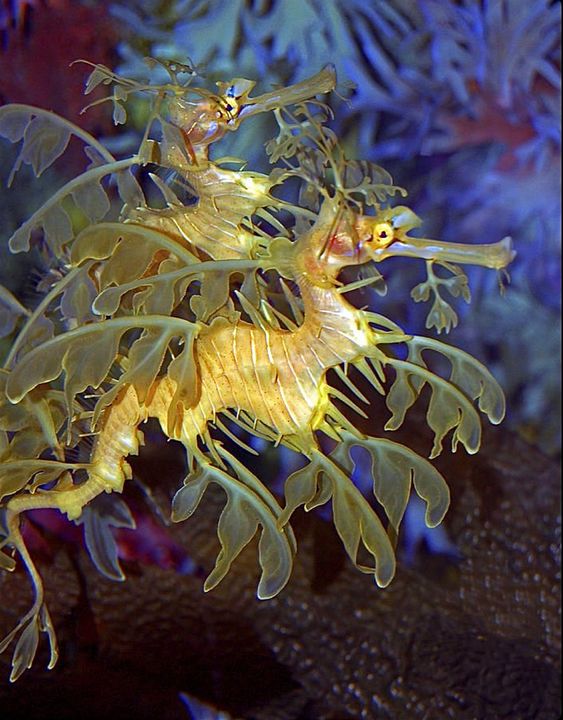
Seadragon, an elusive marine animal found in the waters around Australia.

Everyone in my family loves the ocean and the creatures that live in the ocean. Yesterday my oldest grandson was regaling me with stories of stripers swimming near where he surfs, crabs nibbling his toes, and a too-close-for-comfort encounter with a seal. His sister told me about last weekend’s visit to Mystic Aquarium in Connecticut and her subsequent internet research on sand sharks. She was relieved to learn that Rhode Island has very few shark attacks.

Australia seems to harbor some of the most exotic sea creatures, and today’s story is about another aquarium breeding one of them — the seadragon.

Remy Tumin reports at the New York Times, “For more than a decade, researchers at the New England Aquarium in Boston have been trying to breed some of the most elusive and enchanting fish under the sea. Lacy and delicate, sea dragons live only in the waters along Australia’s southern coast, and their small habitat and limited range make them an ideal candidate for in-captivity breeding.

“Since 2008, the aquarists have tried to replicate the sea dragons’ natural habitat. They have changed the temperature of the sea dragon tank to match the seasons of the southern hemisphere. They have adjusted the amount of light in the exhibit. They got a taller tank. None of it worked.

“ ‘I had kind of given up and thought it’s never going to happen,’ said Jeremy Brodt, an aquarist and galleries manager at the New England Aquarium. And then, ‘out of the blue,’ Mr. Brodt said, ‘it happened.’

“Last May, aquarium staff members discovered that a male weedy sea dragon was successfully carrying his mate’s eggs. … The eggs had hatched in mid-July, and [aquarists] have been raising 18 baby dragons since then. …

“Aquarists hope that breeding these fickle creatures in captivity will lead to fewer sea dragons being collected from their native sea grass habitat, which is under increasing stress from climate change and runoff from storms. Sea dragons, which are primarily of the leafy or weedy varieties, are not currently threatened, but the Australian government has strict regulations that allow only a limited number of them to be collected for public display in aquariums. Still, scientists are worried that the animals’ already limited habitat may be contracting.

“ ‘They’re a great, phenomenal animal, they get people’s attention,’ Mr. Brodt said. ‘It’s a way to get that message across and talk about these unique animals and the issues that they’re facing.’ …

“Like their sea horse cousins, male sea dragons are responsible for carrying the species’s eggs to term and can have more than 150 eggs attached to their tails. Their elaborate mating ritual involves male and female sea dragons mirroring each other, moving together as they spin upward through the water. During their dance, the female sea dragon transfers her eggs to a patch on the underside of her partner’s tail, where he fertilizes and carries them. If the transfer is interrupted somehow — by competing love interests, for example, or even clumsiness — the eggs may drop or end up unfertilized.

“No one has ever seen a leafy sea dragon mate in the wild, said Greg Rouse, a marine biologist at Scripps who was not involved in the New England Aquarium’s project. … To protect the male sea dragon from bumping the eggs off his tail, aquarists at the New England Aquarium moved him to his own smaller holding tank to be monitored. Once the eggs hatched, the team gently removed the baby sea dragons and placed them in a tank stocked with highly nutritious food. …

“ ‘They’re pretty impressive specimens when they’re adults,’ Mr. Brodt said. ‘That first year, it’s crazy. They’re about two centimeters when they hatch and look like floating grape stems. They grow about one centimeter a week for several months.’

“So what made this a successful pregnancy? The researchers were considering moving some of the adult sea dragons out of their display and into a larger tank to give them more space to float when they discovered the egg transfer had already occurred in the existing exhibit. Two developments may have helped the breeding effort, Mr. Brodt said: The aquarium had a surplus of live food to dole out (adult sea dragons are primarily fed frozen food with some live supplements), and because of natural population fluctuations, there were fewer sea dragons in the tank at the time. …

“Dr. Rouse, the Scripps marine biologist, said both food and space were likely factors in the success. Because sea dragons ‘bond up as pairs in the wild and they don’t hang around in big groups, maybe they get a little bit disturbed if there’s too many in a tank with them,’ Dr. Rouse said. … Even so, the hormonal ‘synchronization’ between a male and a female has to line up perfectly. Moon phase and water temperatures also probably play a role in their reproduction.”

More at the Times, here. Wouldn’t you love to be able to say to someone who asks you about your work, “Lately I’ve been raising ’18 baby dragons’ “?

Read Full Post »

Photo: Brian Yurasits/Unsplash.

Oh, what have we done? We are on our way to ruining Planet Earth with our activities. Let’s see if understanding the extent of the problem can help us rectify it.

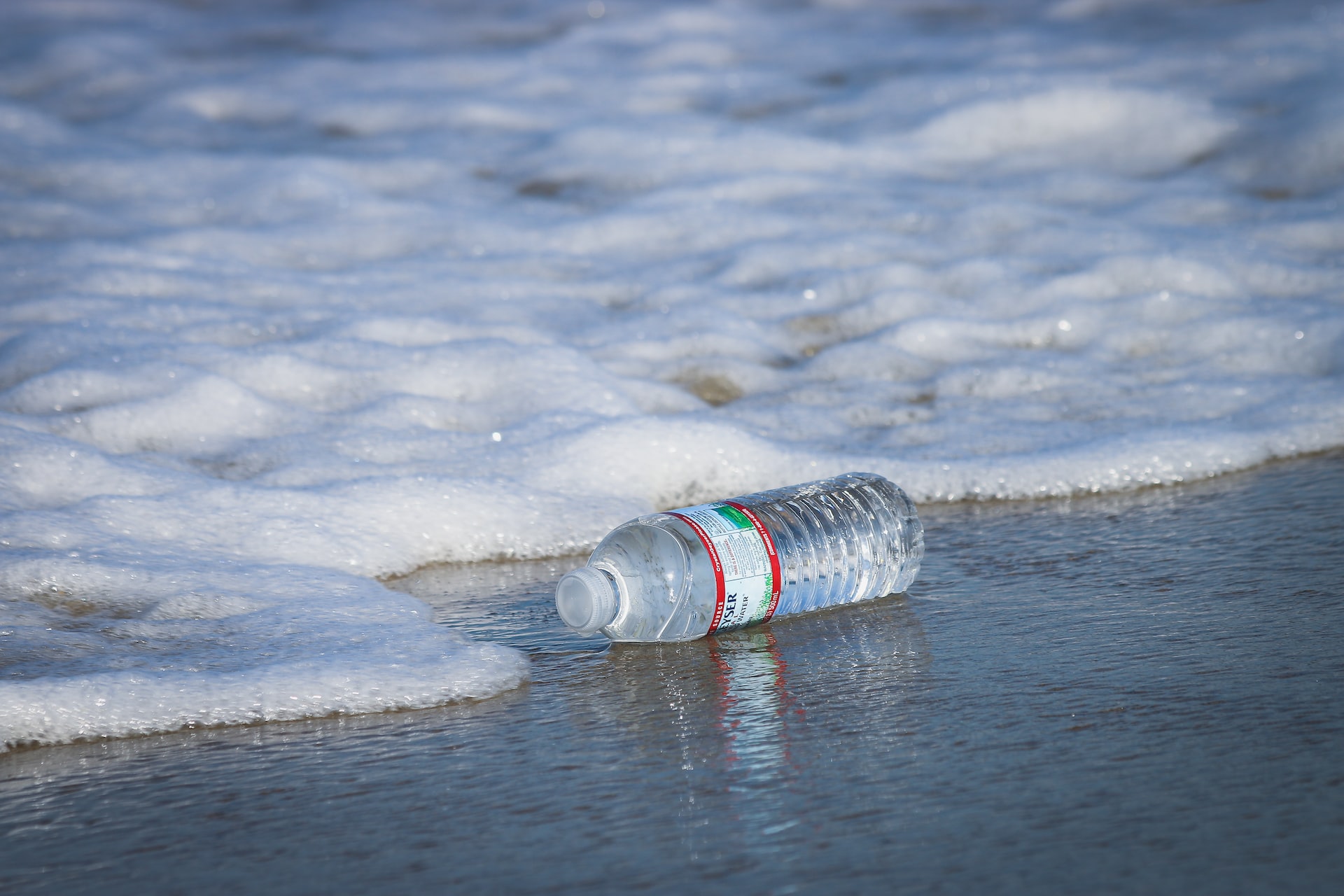
At Slate, the online magazine, Niranjana Rajalakshmi writes about plastic in the ocean.

“Richard Kirby, a marine biologist based in Plymouth, England, was looking at zooplankton wriggling under a microscope when he spotted something else: shreds of plastic pieces interlaced with the tiny creatures.

“This wasn’t unusual to Kirby. He’d collected the sample off the sea of Plymouth for the purpose of raising awareness about microplastic pollution in oceans. Examining plankton is routine for Kirby, and so is observing microplastics in his samples.

“Plastic pollution in oceans has been increasing at an alarming rate over the years. According to the World Wildlife Fund, 88 percent of marine species have been affected by plastic contamination.

“People are familiar with seabirds dying from eating cigarette lighters, or turtles suffocating as a result of mistaking plastic bags for jellyfish, but there is very little awareness about plastics that harm creatures at a smaller level, Kirby explains.

Ingesting microplastic can even kill plankton that are crucial sources of food to other marine life, including fish.

“This is because plankton cannot get a sufficient amount of food into their guts if they’re already occupied by little shreds of plastic. …

“Says Kirby. ‘You can even find plastics in plankton samples collected in Antarctica, for example.’ Plastic shreds from clothing are a significant polluter at the micro level. Microplastic can also come from tires, road markings, and personal care products.

“Plankton aren’t mistaking microplastics for food, exactly, says Bill Perry, an associate professor of biology at Illinois State University. They are filter-feeding, during which they extract small pieces of food and particles from the water. In doing so, they gather up microplastics, too.

“The damage that microplastics cause is not just confined to microscopic marine organisms like plankton. In fact, it is more pronounced in species that are located higher in the food chain, explains Perry, and which eat smaller creatures that have themselves consumed microplastics. …

“Eating microplastics, as you might imagine, is not very good for marine animals. Fishes can face problems with growth and reproduction, says Grace Saba, an associate professor who also researches organismal ecology at Rutgers University. Their guts start to have more and more plastic and less food, and they don’t have enough energy to put toward growth and reproduction like they would if they weren’t eating microplastics.

“The microplastic problem is only going to get worse: A report by the International Atomic Energy Agency projects that the amount of microplastics in the eastern tropical Pacific Ocean will rise by 3.9 times in 2030 as compared to the microplastics level in 2008 in the region.

“Once microplastics enter the ocean’s food chain, it’s hard for them to leave. Individual animals may excrete microplastics, but ‘the thing about poop in the ocean is that it serves as a food source for marine animals, including plankton and filter feeders,’ Saba explains. In this way, microplastics get continuously recycled. Marine scientists in the future will probably be spotting microplastics in their samples, too.”

Sigh. I do small things to cut down on plastic use, but then suddenly I need plastic bins or some other big plastic thing. What do you do to cut back? A couple of my friends have been studying the issue (one who volunteers with the Sierra Club, another who is with a progressive political group in Massachusetts) and are concluding that recycling doesn’t work.

More at Slate, here. Follow Dr. Kirby @PlanktonPundit on Twitter.

Read Full Post »

Photo: Encyclopedia of Life.
Paddle crab, endemic to New Zealand. A new study reports on “ways to monitor visually elusive but vocal species in aquatic environments.”

Technology is being used in ways that that sometimes hurt, sometimes help, the creatures of the natural world. Today’s story is about helping.

Shweta Varshney at Samachar Central introduces us to the Global Library of Underwater Biological Sounds and its wonderful acronym GLUBS. GLUBS uses audio technology to help monitor changes in marine life.

“Of the roughly 250,000 known marine species,” reports Varshney, “scientists think all ~126 marine mammals emit sounds — the ‘thwop’, ‘muah’, and ‘boop’s of a humpback whale, for example, or the ‘boing’ of a minke whale. Audible too are at least 100 invertebrates, 1,000 of the world’s 34,000 known fish species, and likely many thousands more.

“Now a team of 17 experts from nine countries has set a goal of gathering on a single platform huge collections of aquatic life’s tell-tale sounds, and expanding it using new enabling technologies — from highly sophisticated ocean hydrophones and artificial intelligence learning systems to phone apps and underwater GoPros used by citizen scientists.

“The Global Library of Underwater Biological Sounds, ‘GLUBS,’ will underpin a novel non-invasive, affordable way for scientists to listen in on life in marine, brackish and freshwaters, monitor its changing diversity, distribution and abundance, and identify new species. Using the acoustic properties of underwater soundscapes can also characterize an ecosystem’s type and condition.

“Says lead author Miles Parsons of the Australian Institute of Marine Science: ‘The world’s most extensive habitats are aquatic and they’re rich with sounds produced by a diversity of animals. With biodiversity in decline worldwide and humans relentlessly altering underwater soundscapes, there is a need to document, quantify, and understand the sources of underwater animal sounds before they potentially disappear.’

“The team’s proposed web-based, open-access platform will provide:

  • “A reference library of known and unknown biological sound sources (by integrating and expanding existing libraries around the world);
  • “A data repository portal for annotated and unannotated audio recordings of single sources and of soundscapes;
  • “A training platform for artificial intelligence algorithms for signal detection and classification;
  • “An interface for developing species distribution maps, based on sound; and
  • “A citizen science-based application so people who love the ocean can participate in this project

“The wide range of uses for PAM [passive acoustic monitoring] is expanding in step with advances in technology, providing a large volume of easily-accessible data. …

“Many fish and aquatic invertebrate species are predominantly nocturnal or hard to find, the paper notes, making visual observations difficult or impossible. As a result, ‘PAM is proving to be one of the most effective ways to monitor visually elusive but vocal species in aquatic environments, which can potentially aid in more effective conservation management,’ including zoning in marine park areas or fishery closures, the paper says.

“Besides making sounds for communication, many aquatic species produce ‘passive sounds’ while eating, swimming, and crawling — often less acoustically complex or distinct than active sounds but important contributions to an ecosystem’s tell-tale soundscape.

“ ‘Collectively there are now many millions of recording hours around the world that could potentially be assessed for a plethora of both known and, to date, unidentified biological sounds. …

“ ‘This developing library is a key way to catalog, monitor and track changes in biodiversity on reefs and other ocean habitats before they are gone but also help us define “what a healthy reef is” as we seek to rebuild reefs.’ …

“ ‘A database of unidentified sounds is, in some ways, as important as one for known sources,’ the scientists say. ‘As the field progresses, new unidentified sounds will be collected, and more unidentified sounds can be matched to species. …

“ ‘A global database could serve broader questions, like determining universal trends in underwater sound production, while individual, specialized repositories could continue to inform and detail other topics, such as documenting the presence of soniferous species in a particular region.’

“[Listening] to the sea has revealed great whales swimming in unexpected places, new species and new sounds.” Learn about what listening is doing for other species here. No firewall.

Read Full Post »

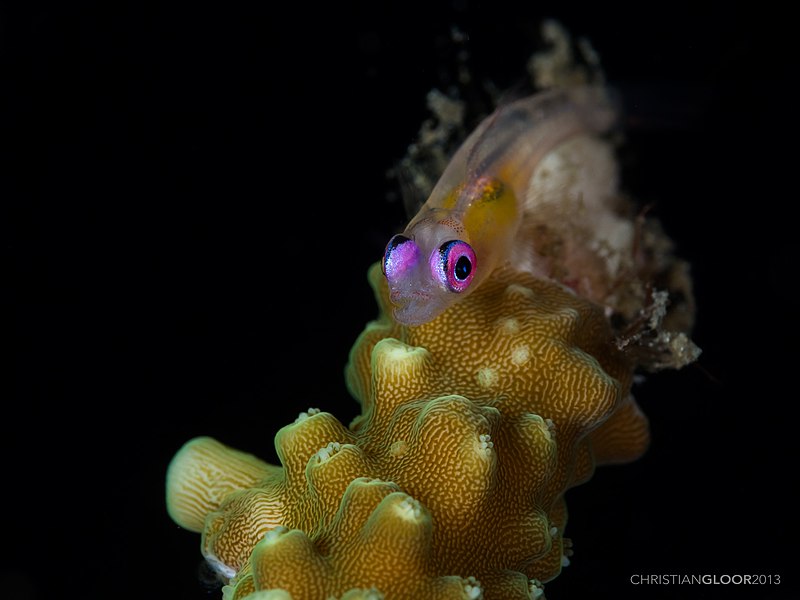
Pinkeye Goby / Bryaninops natans

Photo: Christian Gloor
By living fast and dying young, red eye gobies fuel reef fish biomass production, which helps explain why reefs can flourish in nutrient-poor waters.

You don’t have to be big to be important. Consider the tiny red-eyed goby, a fish that is vital to coral reefs. For years, scientists couldn’t figure out how there could be such lush biodiversity on coral reefs in clear, low-nutrient waters.

Turns out the answer was hiding under their noses.

Leila Miller writes at the Los Angeles Times, “It’s one of the enduring mysteries of marine biology: How can coral reefs sustain such diverse ecosystems when they are surrounded by clear, low-nutrient waters? Now scientists think they’ve found the answer, and it’s been hiding in plain sight all along.

“The coral reef food chain is powered by some of the ocean’s smallest vertebrates — tiny fish that are gobbled up so quickly they’ve been easy to overlook.

“These fish are small enough to fit in the palm of your hand, but they play an almost heroic role in sustaining coral reefs, according to a study published this month in the journal Science. In fact, these little swimmers account for almost 60% of the fish flesh eaten on reefs, researchers found.

“ ‘They’re really like high-octane fuel for larger fish,’ said study leader Simon Brandl, a marine ecologist at Simon Fraser University in Burnaby, Canada. …

“Coral reefs are like underwater rain forests — they’re incredibly diverse and are home to more than 6,000 species of fish, Brandl said. Yet the nutrients needed to maintain this abundance of life seemed to be lacking. …

“Brandl and his colleagues make a strong case that high turnover of tiny fish is an important part of the story, said Douglas McCauley, a marine biologist at UC Santa Barbara who did not work on the study. …

“The tiny fish hatch from eggs, and within a day or so, the larvae are old enough to find their own food. Then they have to grow up and reproduce within a month or two — before they get eaten. …

“The females have another problem to contend with: low egg counts. Their small bodies can produce only about 100 eggs at a time, on average, while larger fish may lay tens or hundreds of thousands.

“ ‘It didn’t seem to add up,’ said senior author David Bellwood, a marine biologist at James Cook University in Townsville, Australia. ‘How on Earth did they survive?’

“In a word: larvae. … While the larvae of most coral reef fish wander out into the open ocean to escape predators on reefs, the larvae of cryptobenthic fish hang out near the reef as they mature. This seems to dramatically enhance their survival and return rates, Brandl said. …

“It may seem surprising that scientists didn’t know where more than half of the fish food supply was coming from, but at any given moment, the tiny fish make up only a minuscule percentage of the total fish flesh on a reef. The key was to see that the population replenished itself so quickly, [Luke Tornabene, a fish biologist at the University of Washington in Seattle who worked on the study] said.”

Read more at the Times, here.

Hat tip: Matt Stiles‏ on Twitter.

Read Full Post »

nwhi-full_1

Photo: Smithsonian
A surfeit of carbon in the oceans is destroying coral reefs, home to a wide variety of marine life. But a few reefs may offer lessons for survival.

Earlier this month, I posted about an improbably successful coral reef in the busy harbor of Cartagena in South America. Scientists were thinking that if they could figure out why the reef was doing well despite inimical conditions, they might be able to save other reefs.

Now comes a story about scientists finding hopeful reefs in the Pacific Ocean and elsewhere.

Josh Gabbatiss reports at the UK’s Independent, “Sections of coral in the Pacific and the Caribbean are fighting back against the global threats that have decimated reefs worldwide. While the discovery does not allow any room for complacency in the fight to save the world’s reefs from extinction, scientists are tentatively optimistic about what they can learn from these pockets of resistance.

“Climate change, hurricanes and human activities such as intensive fishing have destroyed vast swathes of the planet’s reefs, but in a new study scientists found this destruction was not uniform. …

” ‘There are a number of reasons why one coral reef might survive while its neighbour dies,’ said Dr James Guest, a coral reef researcher at Newcastle University who led the study. ‘It could be that the location is simply better for survival – deeper water that is outside the storm tracks, for example.’

“Coral reefs might also possess certain biological characteristics that make them able to resist damage, or characteristics of their environment may allow them to rebuild themselves effectively following damage. …

“These findings were laid out in a study published in the Journal of Applied Ecology that explored dozens of these cases from tropical regions around the world. …

“The study’s lead author, Professor Peter Edmunds from California State University, Northridge, [says], ‘There are kernels of hope in places where corals are doing better, or where they are doing less badly than elsewhere and these places provide us with a focus of attention that might be used to enhance coral conservation efforts.’ …

“Scientists have voiced the need for ‘radical interventions’ such as genetic modification of corals.”

OK, I’ll let you read the rest at the Independent while I ponder the metaphors here.

Since my sister’s surgery and her diagnosis of a serious kind of cancer, I feel like I’m living in metaphor, by which I mean a couple things. For example, I can’t read about certain reefs that heal themselves because they have unique characteristics (or about scientists racing the clock to figure out how to replicate that) without thinking about how every cancer and every patient’s response to cancer is different and how researchers and physicians are trying to understand all the ways that plays out (sometimes using genetics, like the coral researchers). I also mean that literary metaphor, especially poetry, is among the few things that can help me get my head around what is going on. When you can’t understand, metaphor can be calming and provide a sense that eventually there might be answers.

Read Full Post »

new20reef201

Photo: Valeria Pizarro
The Varadero reef has survived in Colombia’s Cartagena Bay despite toxicity from heavy shipping. The corals grow twice as fast as similar corals elsewhere, but their skeletons are less dense, which may have something to do with their success.

The news about coral reefs has not been good for a long time. Rising temperatures and too much carbon dioxide have been killing off these delicate creatures worldwide, with dire consequences for the marine life that depends on their intricate communities.

But what is going on in Cartagena Bay? Elizabeth Svoboda has a fascinating story at the Christian Science Monitor.

“For the coastal communities that have harvested its bounty for centuries, and for the scientists who officially discovered it five years ago, there is no reef like Varadero. Locals call it ‘the improbable reef,’ and for good reason: It has persevered in the midst of intensive coastal development, streams of toxic runoff from the nearby Canal del Dique (Dike Canal), and waters so warm they’d turn many reefs into lifeless skeletons.

“Scientists like Lizcano-Sandoval and Pennsylvania State University’s Mónica Medina are working to uncover the secrets of Varadero’s striking resilience – secrets they can use to help other threatened reefs around the world.

“But just as Varadero begins to yield its tantalizing scientific bounty, it’s looking as if the reef may be damaged or even destroyed. A group of government officials, port authorities, and businesspeople is planning to dredge a channel so Cartagena’s harbor can accommodate more container ships – a move they say will boost the nation’s economy. However, the researchers who study Varadero, along with local environmental activists, are hoping to stall the dredging project so the reef’s storied legacy can continue – and perhaps contribute to the rescue of other endangered underwater Edens. …

” ‘Corals in Varadero have a very distinct growth pattern,’ says biologist Roberto Iglesias-Prieto, Dr. Medina’s colleague at Pennsylvania State University. Specifically, the corals grow about twice as fast as similar corals elsewhere, but their skeletons are less dense; it’s possible that these traits give them an advantage over their slower-growing coral counterparts.

“Medina thinks certain elements in runoff from the Canal del Dique may be benefiting the corals in surprising ways. ‘Part of the day, [the corals] get these nutrient-rich waters where they’re eating and photosynthesizing,’ Medina says. She notes that fairly recent changes in coral growth coincide with a period when more sediment was being dumped into the bay. …

“Varadero’s corals might also benefit from their location right at the mouth of Cartagena Bay. “They have constant communication with the sea,” [Dr. Valeria Pizarro, who discovered the reef,] says. The fresh inflow of ocean water might lessen the impact of toxic mercury, cadmium, and copper that runs off into the bay from nearby industrial facilities.

“Medina and her colleagues are trying to figure out if other aspects of the reef’s biology contribute to its success – aspects that could ultimately be replicated in reefs elsewhere. … Samples of microbes from Varadero’s corals – the onboard collection of bacteria, viruses, and algae that perform critical metabolic tasks – have revealed that they are totally distinct from those found on other reefs, Medina says. Her lab is conducting a detailed analysis to find out whether the microbes might be performing important functions, such as fighting disease, that help the corals to survive even in less-than-ideal conditions.

“In the future, if conservationists can transport Varadero’s hardy corals to other endangered reefs around the world, or even seed threatened reefs with whatever microbial cocktail helps Varadero’s corals thrive, those reefs might have a better chance of surviving despite ocean warming and pollution. Many of the world’s reefs now hang in a liminal zone between death and survival. By putting Varadero corals’ survival tactics to work on other threatened reefs, scientists like Medina, Lizcano-Sandoval, and Pizarro hope to tilt those reefs a little bit closer to the side of life.”

More at the Christian Science Monitor, here.

Read Full Post »

Older Posts »