Feeds:
Posts
Comments

Posts Tagged ‘mexico’

Photo: BLM.
“The US California Condor Recovery Program, initiated in the 1970s, represented an enormous change in the strategy of species conservation,” writes Knowable Magazine.

They are not as appealing as, say, hummingbirds, but the California condors had a lot of environmentalists worried in the 1970s, including a young boy I knew who grew up to be a respected biologist and scientific photographer.

I remember him talking a lot about condors when we were carpooling. And I thought, “Well, condors. An odd obsession for a child.”

Thank goodness people get obsessed about the least beautiful denizens of our planet.

Iván Carrillo tells the condor story at Knowable Magazine via the Tucson Sentinel.

“The spring morning is cool and bright in the Sierra de San Pedro Mártir National Park in Baja California, Mexico, as a bird takes to the skies. Its 9.8-foot wingspan casts a looming silhouette against the sunlight; the sound of its flight is like that of a light aircraft cutting through the wind. In this forest thick with trees up to 600 years old lives the southernmost population of the California condor (Gymnogyps californianus), the only one outside the United States. Dozens of the scavenging birds have been reintroduced here, to live and breed once again in the wild.

“Their return has been captained for more than 20 years by biologist Juan Vargas Velasco and his partner María Catalina Porras Peña, a couple who long ago moved away from the comforts of the city to endure extreme winters living in a tent or small trailer, to manage the lives of the 48 condors known to fly over Mexican territory. Together — she as coordinator of the California Condor Conservation Program, and he as field manager — they are the guardians of a project whose origins go back to condor recovery efforts that began in the 1980s in the United States, when populations were decimated, mainly from eating the meat of animals shot by hunters’ lead bullets.

“In Mexico, the species disappeared even earlier, in the late 1930s. Its historic return — the first captive-bred condors were released into Mexican territory in 2002 — is the result of close binational collaboration among zoos and other institutions in the United States and Mexico.

“Beyond the number on the wing that identifies each individual, Porras Peña knows perfectly the history and behavior of the condors under her care. … She captures her knowledge in an Excel log: a database including information such as origin, ID tag, name, sex, age, date of birth, date of arrival, first release and number in the Studbook (an international registry used to track the ancestry and offspring of each individual of a species through a unique number). Also noted is wildlife status, happily marked for most birds with a single word: ‘Free.’ …

“The California condor, North America’s largest bird, has taken flight again. It’s a feat made possible by well-established collaborations between the US and Mexico, economic investment, the dedication of many people and, above all, the scientific understanding of the species — from the decoding of its genome and knowledge of its diseases and reproductive habits to the use of technologies that can closely follow each individual bird.

“But many challenges remain for the California condor, which 10,000 years ago dominated the skies over the Pacific coast of the Americas, from southern Canada to northern Mexico. Researchers need to assemble wild populations that are capable of breeding without human assistance, and with the confidence that more birds are hatched than die. It is a tough battle against extinction, waged day in and day out by teams in California, Arizona and Utah in the United States, and Mexico City and Baja California in Mexico.

“The US California Condor Recovery Program, initiated in the 1970s, represented an enormous change in the strategy of species conservation. After unsuccessful habitat preservation attempts, and as a last-ditch attempt to try to save the scavenger bird from extinction, the United States Fish and Wildlife Service and the California Fish and Game Commission advocated for a decision as bold as it was controversial: to capture the last condors alive in the wild and commit to breeding them in captivity. …

“On April 19, 1987, the last condor was captured, marking a critical moment for the species: On that day, the California condor became officially extinct in the wild.

“At the same time, a captive breeding program was launched, offering a ray of hope for a species that, beyond its own magnificence, plays an important role in the health of ecosystems — efficiently eliminating the remains of dead animals, thus preventing the proliferation of diseases and environmental pollution.

“This is what is defined as a refaunation project, says Rodolfo Dirzo, a Stanford University biologist. … Refaunation, Dirzo says, involves reintroducing individuals of a species into areas where they once lived but no longer do. He believes that both the term and the practice should be more common. …

“The California Condor Recovery Program produced its first results in a short time. In 1988, just one year after the collection of the last wild condors, researchers at the San Diego Zoo announced the first captive birth of a California condor chick.

“The technique of double or triple clutching followed, to greater success. Condors are monogamous and usually have a single brood every two years, explains Fernando Gual, who until October 2024 was director general of zoos and wildlife conservation in Mexico City. But if for some reason they lose an egg at the beginning of the breeding season — either because it breaks or falls out of the nest, which is usually on a cliff — the pair produces a second egg. If this one is also lost or damaged, they may lay a third. The researchers learned that if they removed the first egg and incubated it under carefully controlled conditions, the condor pair would lay a second egg, which was also removed for care, leaving a third egg for the pair to incubate and rear naturally.

“This innovation was followed by the development of artificial incubation techniques to increase egg survival, as well as puppet rearing, using replicas of adult condors to feed and care for the chicks born in captivity. That way, the birds would not imprint on humans, reducing the difficulties the birds might face when integrating into the wild population.

“Xewe (female) and Chocuyens (male) were the first condors to triumphantly return to the wild. The year was 1992, and the pair returned to freedom accompanied by a pair of Andean condors, natural inhabitants of the Andes Mountains in South America. Andean condors live from Venezuela to Tierra del Fuego and have a wingspan about 12 inches larger than that of California condors. Their mission here was to help to consolidate a social group and aid the birds in adapting to the habitat. The event took place at the Sespe Condor Sanctuary in the Los Padres National Forest in California. In a tiny, tentative way, the California condor had returned.

“By the end of the 1990s, there were other breeding centers, such as the Los Angeles Zoo, the Oregon Zoo, the World Center for Birds of Prey in Boise, Idaho, the San Diego Zoo and the San Diego Zoo Safari Park. Then, in 1999, the first collaboration agreements were established between the United States and Mexico for the reintroduction of the California condor in the Sierra de San Pedro Mártir National Park. The number of existing California condors increased from just over two dozen in 1983 to more than 100 in 1995, some of which had been returned to the wild in the United States. By 2000, there were 172 condors and by 2011, 396.

“By 2023, the global population of California condors reached 561 individuals, 344 of them living in the wild.” Lots more at Knowable Magazine via the Tucson Sentinel, here.

I salute the cleverness and devotion of scientists. May they live long and prosper!

Read Full Post »

Photo: Gabriela Contreras González.
Saint Catherine of Alexandria, patroness of students, teachers, librarians, and lawyers.

Today’s post is about art restoration, a field that always seems brave to me. Imagine charging into some time-honored work and presuming to “fix” it! I guess a good restorer becomes the artist, too — perhaps in the way that a skilled translator of a literary work becomes a coauthor.

This month, with trepidation, my husband and I put a lovely Inuit watercolor into the hands of a conservator. Would she be able to remove all the mildew from life in a damp summer cottage? The results were nothing short of miraculous.

At Artnet, Min Chen writes about a larger work of conservation in Mexico.

“For decades, the interior of the Temple of Our Lady of the Assumption, a church in the town of Santa María Huiramangaro in Mexico, stood stark white, with blue accents. But the parish was not always so bare. A new restoration has revealed a host of resplendent 16th-century religious paintings that once spanned the ceiling of the historic church.

“The project, undertaken by participants including the Ministry of Culture of the Government of Mexico and the National Institute of Anthropology and History (INAH), dispatched a team of professionals to conserve the roof of the church. What they discovered instead were ancient images of saints and martyrs — hagiographic works rarely found in the Michoacán region — which had been painted over during the 1940s.

“The work, said Laura Elena Lelo de Larrea López, expert restorer at the INAH Michoacán Center, in a statement, ‘allowed us to recover an extraordinary work on the horizontal roof of the main altar, and to discover the rich artistic, technical and iconographic evolution that has marked this religious site.’

“The Temple of Our Lady of the Assumption was constructed in the early 16th century, when Santa María Huiramangaro was designated a district head, overseeing the communities of San Juan Tumbio, Zirahuén, and Ajuno. The building reflected the architectural styles of Mudéjar, which featured ornate motifs believed to have been originated by Muslim craftspeople in the 13th century, and Plateresque, a late-Gothic and early Renaissance aesthetic imported by the Franciscans.

“During restoration work, three pictorial layers of religious iconography were uncovered on the church’s ceiling. The oldest, from the 16th century, saw the use of tempera paint, which was applied in thin glazes to depict various characters corresponding to Saints Paul, Peter, Agatha of Cantania, and Catherine of Alexandria, as well as baby Jesus in Franciscan habit. The works were retouched with oil paints in the following century, adding volume and colors to the depicted figures’ clothing.

“When water ran dry in the region in the 17th century, the church fell largely into disrepair, as Santa María Huiramangaro lost its capital status. ‘The misfortune was a blessing in disguise, in terms of conservation,’ said Lelo de Larrea López, ‘since, not having the resources to renew its religious furnishings, the parish priests of the Temple of Santa María preserved its Plateresque ornaments. …

“Still, experts uncovered evidence of a restoration effort in the 20th century. Acrylic paints were deployed to touch up the faces of the saints. …

“During remodeling work in the 1940s, the iconography on the church’s roof was painted over in white, with blue designs. The repainting, noted Lelo de Larrea López, ’caused an alteration in the appearance of the place.’

“The latest conservation removed the repainted layer and restored missing portions of the paintings. Additionally, the ceiling was cleaned of dust and animal droppings, reinforced with joints and wood grafts, and fumigated to deter wood-eating insects. Other roof elements, such as corbels, partitions, and Franciscan cord carvings, were also given a refresh.

“The work marks the latest phase in a major restoration of the Temple of Our Lady of the Assumption, which began a decade ago with a focus on its main altarpiece. Despite a dismantling (undertaken to tackle a collapse in the church’s rear wall), conservators found the artifact in a well-preserved state. Over 2022 and 2023, they addressed damage to its cornices and carvings, and undid a repainting job to reveal its original gold leaf and polychrome.”

I admire the commitment it takes to work on projects of ten years or more like this. Have you ever had a piece of art restored?

More at Artnet, here.

Read Full Post »

Photo: BBC.
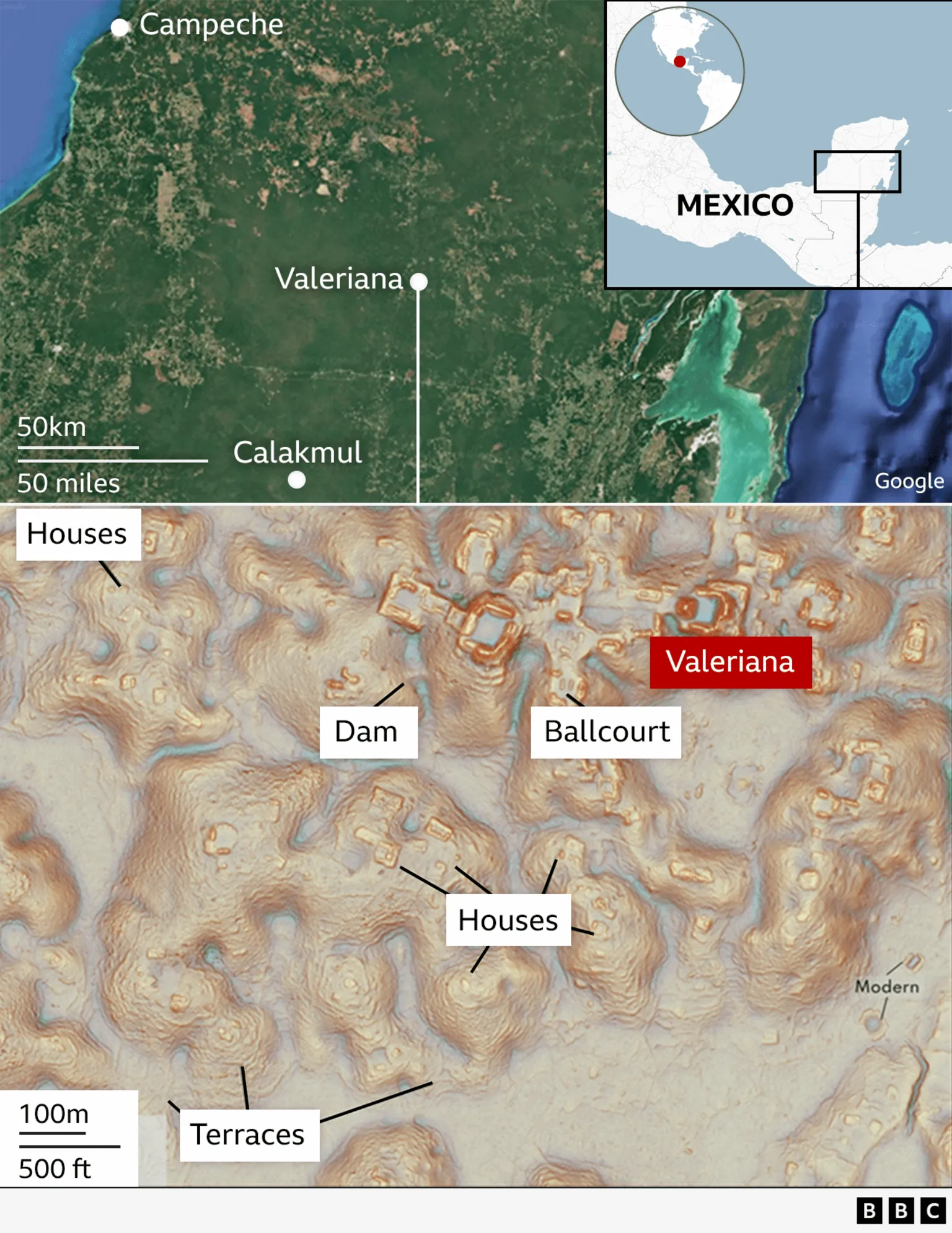
A PhD student found a lost city by accident in eastern Mexico, in Campeche.

Talk about happy accidents! I’m sure we have all experienced a few, whether in cooking or driving around. And we often hear of happy accidents in science. Today, we learn about an alert PHD student who found an ancient civilization without precisely looking for one.

Georgina Rannard writes at the BBC, ” ‘I was on something like page 16 of Google search and found a laser survey done by a Mexican organization for environmental monitoring,’ explains Luke Auld-Thomas, a PhD student at Tulane university in the US.

“It was a Lidar survey, a remote sensing technique which fires thousands of laser pulses from a plane and maps objects below using the time the signal takes to return.

“But when Mr Auld-Thomas processed the data with methods used by archaeologists, he saw what others had missed — a huge ancient city which may have been home to 30,000-50,000 people at its peak from 750 to 850 AD. … Mr Auld-Thomas and his colleagues named the city Valeriana after a nearby lagoon.

“The find helps change an idea in Western thinking that the Tropics was where ‘civilizations went to die,’ says Professor Marcello Canuto, a co-author in the research. Instead, this part of the world was home to rich and complex cultures, he explains. …

It is ‘hidden in plain sight,’ the archaeologists say, as it is just 15 minutes hike from a major road near Xpujil, where mostly Maya people now live.

“There are no known pictures of the lost city because ‘no one has ever been there,’ the researchers say, although local people may have suspected there were ruins under the mounds of earth.

“The city [had] two major centers with large buildings around 2km (1.2 miles) apart, linked by dense houses and causeways. It has two plazas with temple pyramids, where Maya people would have worshipped, hidden treasures like jade masks and buried their dead. It also had a court where people would have played an ancient ball game. There was also evidence of a reservoir, indicating that people used the landscape to support a large population. …

“Professor Elizabeth Graham from University College London, who was not involved in the research, says it supports claims that Maya lived in complex cities or towns, not in isolated villages. …

“The research suggests that when Maya civilizations collapsed from 800 AD onwards, it was partly because they were so densely populated and could not survive climate problems.

” ‘It’s suggesting that the landscape was just completely full of people at the onset of drought conditions and it didn’t have a lot of flexibility left. And so maybe the entire system basically unravelled as people moved farther away,’ says Mr Auld-Thomas.

“Warfare and the conquest of the region by Spanish invaders in the 16th century also contributed to eradication of Maya city states.

“Lidar technology has revolutionized how archaeologists survey areas covered in vegetation, like the Tropics, opening up a world of lost civilizations, explains Prof Canuto. …

” ‘I’ve got to go to Valeriana at some point. It’s so close to the road, how could you not? But I can’t say we will do a project there,’ says Mr Auld-Thomas. ‘One of the downsides of discovering lots of new Maya cities in the era of Lidar is that there are more of them than we can ever hope to study,’ he adds.

“The research is published in the academic journal Antiquity.

More at the BBC, here. Seems to me the discovery was hardly an accident. Anyone with the patience to look at page 16 of a Google search deserves a bit more credit.

Read Full Post »

Photo: César Rodríguez.
The New York Times says, “Illegal deforestation for avocado crops points to a blood-soaked trade with the United States involving threats, abductions and killings.

Today’s story about Mexico’s environment-destroying avocado production and thoughtless US demand was concerning. If anyone knows where I can get sustainably grown avocados, please let me know.

Meanwhile, here is the New York Times story. The authors were Simon Romero and Emiliano Rodríguez Mega.

“First the trucks arrived, carrying armed men toward the mist-shrouded mountaintop. Then the flames appeared, sweeping across a forest of towering pines and oaks.

“After the fire laid waste to the forest last year, the trucks returned. This time, they carried the avocado plants taking root in the orchards scattered across the once tree-covered summit where townspeople used to forage for mushrooms.

“ ‘We never witnessed a blaze on this scale before,’ said Maricela Baca Yépez, 46, a municipal official and lifelong resident of Patuán, a town nestled in the volcanic plateaus where Mexico’s Purépecha people have lived for centuries.

“In western Mexico forests are being razed at a breakneck pace and while deforestation in places like the Amazon rainforest or Borneo is driven by cattle ranchinggold mining and palm oil farms, in this hot spot, it is fueled by the voracious appetite in the United States for avocados.

“A combination of interests, including criminal gangs, landowners, corrupt local officials and community leaders, are involved in clearing forests for avocado orchards, in some cases illegally seizing privately owned land. Virtually all the deforestation for avocados in the last two decades may have violated Mexican law, which prohibits ‘land-use change’ without government authorization.

“Since the United States started importing avocados from Mexico less than 40 years ago, consumption has skyrocketed, bolstered by marketing campaigns promoting the fruit as a heart-healthy food and year-round demand for dishes like avocado toast and California rolls. Americans eat three times as many avocados as they did two decades ago.

“South of the border, satisfying the demand has come at a high cost, human rights and environmental activists say: the loss of forests, the depletion of aquifers to provide water for thirsty avocado trees and a spike in violence fueled by criminal gangs muscling in on the profitable business.

“And while the United States and Mexico both signed a 2021 United Nations agreement to ‘halt and reverse’ deforestation by 2030, the $2.7 billion annual avocado trade between the two countries casts doubts over those climate pledges.

“Mexican environmental officials have called on the United States to stop avocados grown on deforested lands from entering the American market, yet U.S. officials have taken no action, according to documents obtained by Climate Rights International, a nonprofit focused on how human rights violations contribute to climate change.

“In a new report, the group identified dozens of examples of how orchards on deforested lands supply avocados to American food distributors, which in turn sell them to major American supermarket chains.

“Fresh Del Monte, one of the largest American avocado distributors, said the industry supported reforestation projects in Mexico. But, in a statement, the company also said that ‘Fresh Del Monte does not own farms in Mexico,’ and relied on ‘industry collaboration’ to ensure growers abided by local laws.

“In western Mexico, interviews by the Times with farmers, government officials and Indigenous leaders showed how local people fighting deforestation and water theft have become targets of intimidation, abductions and shootings.

“Like deforestation elsewhere, the leveling of Mexico’s pine-oak and oyamel fir forests reduces carbon storage and releases climate-warming gases. But clear-cutting for avocados, which require vast amounts of water, has ignited another crisis by draining aquifers that are a lifeline for many farmers.

“One mature avocado tree uses about as much water as 14 mature pine trees, said Jeff Miller, the author of a global history of the avocado.

“ ‘You’re putting in deciduous forests of a very water hungry tree and tearing out conifer forests of not so very water hungry trees,’ Mr. Miller said. ‘It’s just wrecking the environment.’

“In parts of Mexico already on edge over turf wars among drug cartels, forest loss is fueling new conflicts and raising concerns that Mexican authorities are largely allowing illegal timber harvesters and avocado growers to act with impunity.”

Bad as things are in Mexico, you know they would not be happening if there was no demand. That’s on us. Read more at the Times, here.

Because I still hope to have an avocado from time to time, I went looking for advice. The Eco Experts in the UK say, “Although avocados aren’t the worst food for the environment, growing them on a mass scale isn’t sustainable. This is because of the large amount of water they need to grow, and the fact that they can’t be grown locally in countries like the UK, where they are in high demand. The solution isn’t to cut avocados out of our diets altogether, but to reduce the amount that we consume.” More from the experts, here.

Read Full Post »

Photo: Scott Ball / San Antonio Report.
The SWISD mariachi band performs during a school event at Stinson Field, San Antonio, Texas, in February. 

When education programs unite with family culture and community culture, a unique energy is born, and students are more likely to stay in school. That can be seen in this story from south Texas.

Nicholas Frank writes at the San Antonio Report, “In 1969, educator Belle Ortiz introduced mariachi to a ballet folklórico class at Lanier High School, which soon added a dedicated mariachi class. 

“Over the next decades, Ortiz’s pioneering effort would grow into dozens of mariachi education programs in middle schools, high schools, colleges and universities throughout the San Antonio area, now serving more than 2,000 students in 17 schools in the San Antonio Independent School District (SAISD) alone. …

“Musician Juan Ortiz met Belle Ortiz in that Lanier folklórico class, and the pair would emerge as changemakers establishing mariachi as an educational mainstay in the region, building off of deep Mexican American cultural roots throughout South Texas.

“Belle Ortiz spearheaded the first collegiate-level mariachi education program in 1974 at San Antonio College, and Juan Ortiz and musician Pete Moreno are widely credited with creating the first university mariachi program at Texas A&M University at Kingsville, a program that still flourishes today

“Northside ISD Director of Fine Arts James Miculka said he’s regarded as a person who could sell a tree off of an asphalt lot, but more than salesmanship helped him secure his district’s first mariachi education programs in the 1990s.

“Belle Ortiz served as Miculka’s primary research contact for his music education degree studies at UTSA because he ‘was working on a middle school band curriculum that had more cultural pieces and connected to the Hispanic population’ in a way that his knowledge of jazz and classical music did not.

“A professional trumpeter, Miculka had experience performing in salsa bands and developed a special appreciation for the art form of mariachi when he witnessed firsthand the professional mariachi ensemble assembled by Juan Ortiz for Fiesta Texas.

“Seeing and hearing the array of trumpets, violins, guitars and vihuelas, Miculka said his ‘jaw hit the floor. When I heard that I thought, “Holy cow, this is what a mariachi group should really sound like.” ‘ …

“Miculka hired Roland Sandoval as music director of the program established in 1990 at John Jay High School. Miculka then expanded to start a program at Holmes High School and created ‘feeder’ programs at middle schools in the district. …

Both Miculka and Sandoval credit parents in their districts with establishing the importance of formalized mariachi education programs.

“ ‘It’s such a visible part of our culture,’ and when parents realized their children could access the traditional music through formal education, ‘they started advocating for that,’ said Sandoval. …

“Cynthia Muñoz has been working to bring visibility to the art form of mariachi for decades, starting the Mariachi Vargas Extravaganza competition in San Antonio in 1995.

“The annual competition invites high school mariachi groups from around the country to hone their skills toward winning recognition in the prestigious event, with groups from the Rio Grande Valley regularly winning top honors.  

“Muñoz credits Belle Ortiz with inspiring her own work to promote mariachi culture, having witnessed Ortiz’s first mariachi festival in San Antonio in 1979 featuring the world-renowned Mariachi Vargas de Tecalitlán

“ ‘This had a significant impact on me as a young teenager as I realized that our culture, music and history was way deeper and more beautiful than I ever could have imagined,’ Muñoz wrote in a Facebook memorial post commemorating Ortiz’s influence. …

“Education programs need certified teachers. Miculka said that as mariachi learning evolved from being passed along through families to professional apprenticeships and public school programs, musician John Lopez saw the demand and led the effort to establish a mariachi-focused degree-level program at Texas State University in San Marcos. …

“Lopez said the Kingsville program ‘was like lighting a match,’ with students going on to create ensembles at schools in their home communities throughout the Rio Grande Valley and South Texas, many of which have been formalized as programs as those former students rose into the ranks of school administrations. …

“Despite overall growth in mariachi education programs, Poe Middle School mariachi director Augustine Ortiz nearly lost his program in February, with SAISD facing declining enrollment, budgetary tightening and school closures. But Poe principal Elizabeth Castro was able to save the program through a special allocation, in part because hundreds of students prioritized their mariachi studies.

“Studying mariachi not only creates enthusiasm for his students to come to school, Ortiz said, but helps them excel overall. ‘The standard of the students’ education is rising when they’re in programs like these,’ he said. ‘What helps is that it’s culturally relevant to them since we do have a huge Mexican American population in our school.’

“Ortiz said he has been open with his students about the challenges faced by the programs. ‘They need to learn that we need to advocate for ourselves,’ he said. ‘That way we can get the best education [for] our students, not just currently but in the future as well.’ …

“ ‘There’s a supply and demand now for mariachi teachers,’ he said. ‘If you’re gonna go into music education right now, the place to be is mariachi education.’ ”

More at San Antonio Report, here.

Read Full Post »

Photo: Alfredo Sosa/CSM Staff.
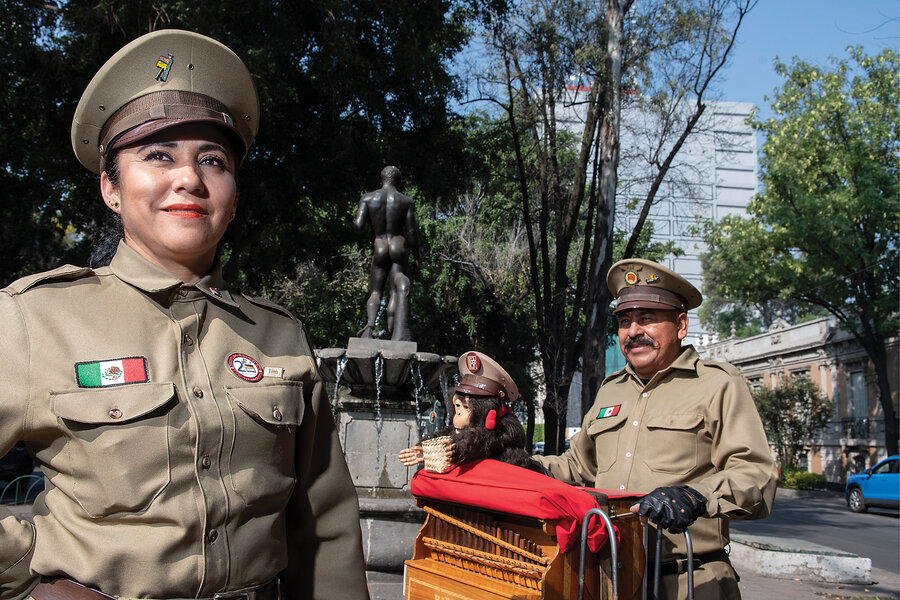
Elsi Sastre (left) and Cresencio Torres work as a team of organ-grinders in the Roma neighborhood of Mexico City.

Between the two of us, my husband and I can tell our grandchildren about having seen an ice-delivery man, a huckster selling vegetables door-to-door, a traveling knife-sharpening guy. Wouldn’t it be great to show such things in person once in a while, not just in historic villages with costumed interpreters?

Today’s article is about something we will need to hurry up to see before it fades into history: the traditional organ grinder in Mexico.

Whitney Eulich writes at the Christian Science Monitor, “Hunched over a weatherworn hand-crank organ in his repair shop, Roman Dichi explains why the work of Mexico’s organilleros has endured for a century and a half. 

“ ‘This music evokes happiness, tradition, and childhood memories of going out to a plaza with Mom and Dad – or of falling in love,’ says Mr. Dichi, president of the organ-grinders union in Mexico City. …

“Organ-grinders, especially ubiquitous in Mexico City’s historic center, date back to the presidential administration of Gen. Porfirio Díaz in the late 1800s. The dictator’s adoration of all things European inspired Mexico’s elite to import organs into their homes. Eventually, the instruments moved out of private parlors and onto the streets as public entertainment. They were used to draw customers to circuses, with the help of monkeys, and to keep soldiers in good spirits. Over time, the European songs inside the machines were replaced with revolutionary ballads and local classics, such as ‘Las Mañanitas,’ the Mexican birthday song.

“Despite these deep roots, today the tradition is at risk. Not everyone is charmed by the tip-seeking musicians. A crank organ’s sound – akin to the pitchy puff of air from a slide whistle – can be loud. In the wrong hands, an organ can be positively off-key, an assault against the ears. …

“The organs are also expensive, with many organilleros renting them from the small stock available locally. And upkeep gets costlier with each passing year. The heavy instruments can get damaged while being wheeled down crowded city streets or warped by weather and time. 

“Edgar Alberto Méndez Hernández has been slowly turning the crank on his organ in the capital’s historic center for some 15 years. He nets about 250 pesos (a little more than $15) on a good day after paying 250 pesos for his rental. …

“After several hours working along a bustling sidewalk near the Bellas Artes theater, he pushes his black-and-brown antique wooden organ on its dolly and heads several blocks toward the Zócalo square. When he shows up at this even busier – and potentially more lucrative – spot, the two young men already playing organs there take their cue, as if in a dance, and move to a side street. These shifts are imperceptible to the public but tediously negotiated with the union’s help. …

“They ‘live off of tips,’ notes Yuleina Carmona, the Mexico City coordinator for Women in Informal Employment: Globalizing and Organizing, an international nonprofit. Shoeshiners and strolling mariachi bands have fixed rates for their services, but organ-grinders churn out music whether they are paid or not. …

“In March, Mr. Dichi’s union submitted a proposal to Mexico City’s Congress to have organilleros’ work recognized as a cultural heritage. It was the fourth attempt – and this time it was approved.

“The legal recognition is expected to translate to better protection on the street from police harassment and greater support for organ-grinders in their disputes with residents and businesses. Ms. Carmona notes it will also give organ-grinders ‘a seat at the table’ – a say in how Mexico City uses funds for cultural activities in the center.”

More at the Monitor, here. Great pictures. No paywall.

Now, what is the coolest old-timey thing in your memory?

Read Full Post »

Photo: Whitney Eulich.
Angel del Rosario Hau Paat, who raps as ADR Maya, is seen here with his mother in Tulum, Mexico. He grew up resistant to speaking Maya but now embraces it.

When a new generation decides that the old folks’ way of speaking could actually be cool and even powerful, a language that is in danger of dying out may get an extension.

Whitney Eulich writes at the Christian Science Monitor, “Angel del Rosario Hau Paat leans over the rainbow-colored hammock where his grandmother lies and speaks directly into her ear: ‘What do you think of my singing?’ he shouts in Maya, the Indigenous language of Mexico’s Yucatan.

“Hard of hearing, she strokes his face as she responds. ‘She’s happy,’ he translates, with a bashful laugh. ‘She says my Maya is good.’

“Growing up in the southern Mexican state of Quintana Roo, Mr. del Rosario says he wasn’t interested in learning Maya, the only language his grandmother speaks and which his mother grew up speaking. Spanish is what was useful for him at school and among friends.

“But today he is part of a growing trend among young people – here and across the Americas, from Canada to Chile – who are rapping in Indigenous languages. It’s strengthened his connection to the language his mother raised him speaking (and to which he grew up responding in Spanish) and to his family’s traditions.

“ ‘I never imagined myself using Maya so much. I’m making more connections with my culture and with people from other countries also rapping in Indigenous languages,’ says Mr. del Rosario, a pool technician in the resort town of Tulum who records music under the name ADR Maya in his free time. ‘It feels really good.’ 

“Mexico is home to more than 60 officially recognized Indigenous languages. Many of them, and their associated cultures, are at risk – despite a 2002 law protecting the right to use one’s Indigenous language and education reforms in recent years that require some languages be taught in public schools.

“At least 40% of the world’s Indigenous languages are also in danger of disappearing, according to the United Nations. But, for young artists like Mr. del Rosario, the discovery of rap in Maya is serving as a motivation to double down on learning more. …

“Says José Antonio Flores Farfán, a professor of linguistics and anthropology at the Center for Research and Higher Studies in Social Anthropology in Mexico City, ‘Treasures that human beings have accumulated for centuries are encrypted in language. … It’s these kids, these rappers, these artists who give me hope. … They are talented, doing something about it from the bottom up, and they’re inspiring younger kids and new generations to see value in the language in the process.’

“In the Yucatec-Maya-speaking region of southern Mexico, Jesús Cristobal Pat Chablé, more popularly known as ‘Pat Boy,’ could be considered the Johnny Appleseed of Indigenous rap. The artist, in his early 30s, started playing music when he was 5 years old and experimented with different genres, from rancheras (Mexican ballads) to rock to reggae, launching his solo rap career in 2009. 

“Today, he travels internationally, rapping in Maya; collaborates with artists who speak other Indigenous languages; and encourages young Maya speakers to write and record their own music, some of which ends up on albums he produces through his label ADN Maya. He’s currently building a recording studio in the town of Felipe Carrillo Puerto, about 140 miles south of Cancun. 

“Themes of daily life in Maya communities – customs, education, love, and traditions – populate his lyrics. His efforts have won him international recognition, including the 2022 Linguapax Award.

Last year, a song Pat Boy collaborated in writing and singing was featured on the ‘Wakanda Forever’ soundtrack.

“[It brought] the Maya language to theaters around the world with lyrics like: ‘They say we disappeared from this earth, what do you think? / It isn’t true … years passed, we became stronger. / Today I treasure the Mayan culture.’

“It’s a far cry from how he started.

“ ‘It was tough. I’d try to get a spot in a public festival and people would say, “But what do your songs say?” ‘ he recalls of his early years performing in Quintana Roo. ‘I was in my right to speak and sing in my maternal language, but there was this fear [among organizers] that I was motivating people to do things against the government, to rise up, because it was written in Maya and they didn’t understand the words,’ he says.      

“ ‘People in the city say, “You can’t achieve things if you’re Maya, you come from the countryside. You can’t be an artist or a painter or a writer,” ‘ he says. ‘When I started there wasn’t a lot of interest in what I was doing. Now, everywhere I go I meet young people dreaming of singing in Maya.’ ”

More at the Monitor, here. No firewall.

Read Full Post »

Photo: Whitney Eulich.
Omar de Jesús Vazquez Sánchez shows his Sargablock solution to the smelly seaweed invasion across the Caribbean shore of Mexico. He makes construction blocks out of it.

Today’s story is an example of someone with too many “lemons” who finds a way to make “lemonade.” It all started with smelly seaweed.

Christian Science Monitor writer Whitney Eulich reports from Puerto Morelos, Mexico, “Sargassum, the invasive, sewage-scented seaweed piling up on beaches across the Caribbean, isn’t something most people look upon kindly.

“But for Omar de Jesús Vazquez Sánchez, his first encounter was ‘love at first sight.’

” ‘Everyone said, “It smells horrible!” and I remember thinking, “There’s something more here,” ‘ says Mr. Vazquez, the founder of Sargablock, a small company in Mexico’s Yucatán Peninsula that transforms the algae into construction blocks.

“A record amount of sargassum is turning crystal blue Caribbean coast waters brown and smelling of rotten eggs as it decomposes in tourist spots from Mexico to Caribbean islands and now along the beaches of Florida’s east coast.

“Researchers blame pollution, overdevelopment, and global warming for the seemingly never-ending seaweed invasion that’s also present in the Atlantic.

“In 2015, as part of his gardening business, Mr. Vazquez launched a beach cleanup service to remove the leafy seaweed. But, as its arrival intensified, he started considering how to turn it into something useful, and in 2018 conceived a way to use sargassum in building blocks. Today he not only sells those blocks to construction projects, but also builds affordable housing in his community.

“ ‘When I look at Sargablock, it’s like looking in a mirror,’ he says, comparing his company to conquering his personal struggles, including addiction, and briefly, homelessness.

‘When you have problems with drugs or alcohol, you’re viewed as a problem for society. No one wants anything to do with you. They look away.’

“ ‘When sargassum started arriving, it created a similar reaction. Everyone was complaining,’ he says. … ‘I wanted to mold something good out of something everyone saw as bad.’ …

“The state government of Quintana Roo collected 19,000 tons of sargassum from beaches in 2020; 44,000 tons in 2021; and 54,000 tons last year. Researchers say the amount could nearly double this year, and it arrived months ahead of what is typically the start of sargassum ‘season’ in May. …

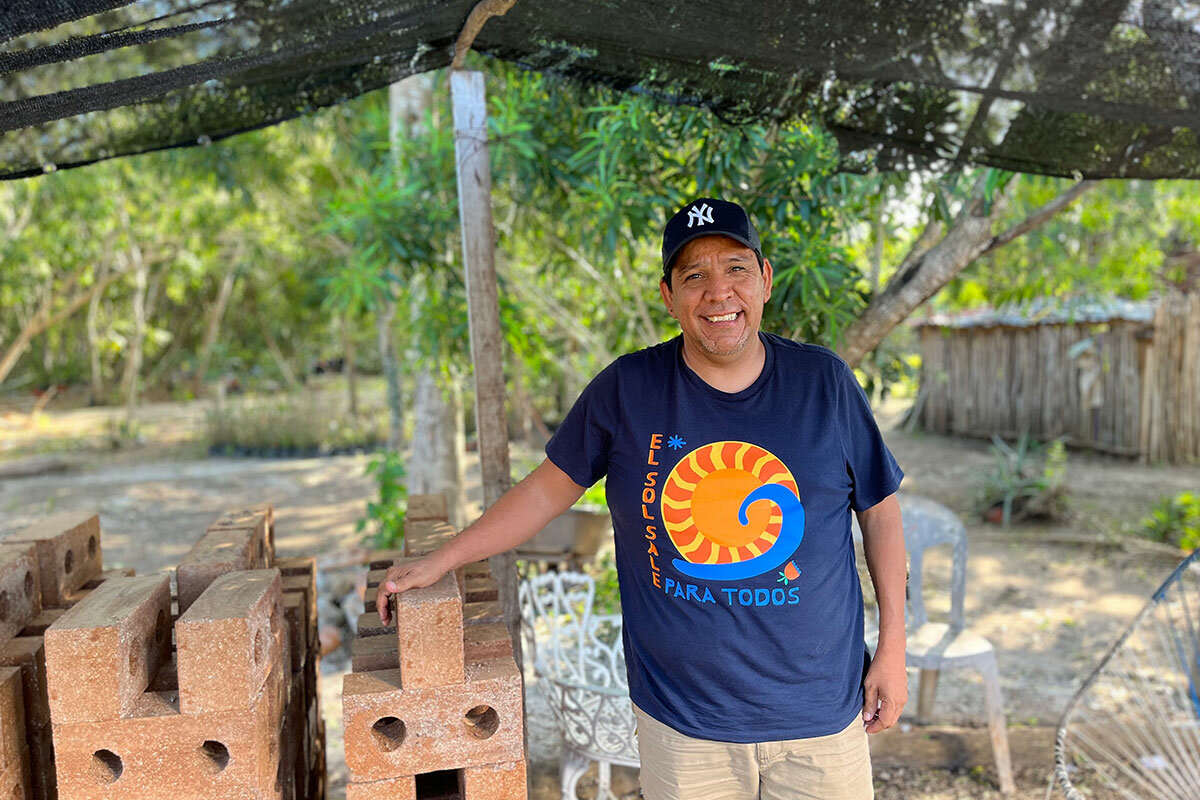
“Mr. Vazquez mixes 40% sargassum with other organic materials, like clay, that he then puts it into a cement-block-forming machine. The blocks bake in the sun for several days before they’re ready to use. He says he used 3,000 tons of sargassum in  2021, 2,000 tons last year. By early April 2023, he’d already used 700 tons.

“The UNDP [United Nations Development Program] selected Mr. Vazquez’s work transforming sargassum for their Accelerator Lab, which identifies and broadcasts creative solutions to environmental and sustainability challenges globally. The idea is that some of the most timely and creative responses come from locals living the repercussions of environmental dilemmas firsthand. …

“A joint study by universities in England and Ghana found that blocks made with organic material like sargassum can last for 120 years. The ecology and environment offices of Quintana Roo concluded the blocks are safe for use in construction. 

“Mr. Vazquez grew up surrounded by nature – and the hardships of poverty. It shaped him into someone who takes action, he says. He remembers singing for spare change on the street as a child, before his single mother moved the family to the U.S. as unauthorized immigrants. They picked grapes in California, and Mr. Vazquez dropped out of high school to double down on what he considers his profession: gardening.

“ ‘There’s this idea of the American dream. But, for me, personally,’ he says, ‘I was always asking God to let me come back to Mexico.’

“It took almost 30 years to do so. ‘Coming back, it took a lot of time to adapt – the salaries are different. Sometimes people are skeptical’ of Mexicans returning from the U.S. he says. He worked odd jobs, like selling timeshares to tourists passing through the Cancún airport. Eventually he invested his savings – $55 at the time – in a nursery.

“As his nursery grew, he was making a name for himself creating a small but promising solution to the sargassum challenge. He gained attention through appearances on Shark Tank Mexico and a locally organized Ted Talk. Although he was living the ‘Mexican dream,’ something was missing. He reflected on when he was happiest in his life and it came down to two things: Memories of spending time in his grandparent’s simple adobe-block home in Jalisco, and being with his mother, who had sacrificed so much for him before passing away in 2004.

“ ‘We never had a house of our own, we didn’t have much food or clothes. I didn’t have a father,’ he says. When he built what he expected to be his nursery’s new office with Sargablock, he designed it as a replica of his grandparents’ home and named it after his mother, Angelita.

“ ‘The first thing that came to my mind and heart was to donate houses to women like my mother, who are doing everything in their power to make it work,’ he says.

“Enter Casas Angelitas. Using Sargablock, Mr. Vazquez has built and donated 14 homes to families in need, many single moms, but also elderly couples and parents supporting kids with disabilities.”

More at the Monitor, here. No firewall. Subscriptions for the online publication are reasonably priced.

Read Full Post »

In spite of living in the Greater Boston area for 40 years, I had never been to the Boston Pops. I decided to check out this year’s holiday concert and go by public transportation.

The Red Line subway track was being repaired and was not in use that Saturday, so the transportation ended up being a problem, but I was glad I went. It was lovely.

One of the pieces featured was the premier of composer Arturo Rodríguez’s Noche de Posadas (The Night of Las Posadas), which was based on a Mexican tradition and tied to a children’s book by the late author/illustrator Tomie dePaola.

Rodríguez, a native of Mexico, wrote in the program about the custom that inspired dePaola’s storybook and about working on the commission from the Boston Pops Orchestra.

“The enduring tradition of Las Posadas in México,” he wrote, “is a representation of Joseph and Mary and their pilgrimage from Nazareth to Bethlehem. The community organizes into two groups, those who accompany the couple while they go from door to door in search of shelter and those inside the houses that reject them. These are done by singing the traditional litany. Finally the couple are welcomed, and a big celebration with food and the emblematic piñata takes place. The piñata, symbolizing the triumph of faith over sin, must have 7 spikes, each of them representing a capital sin. The candy and fruit inside the piñata represent the grace of God. The high point of the celebration is when the piñata breaks and the guests are showered by all the blessings that fall from it.

“When I was asked to compose a work about the Mexican Christmas tradition of Las Posadas, to be premiered by the Boston Pops Orchestra conducted by maestro Keith Lockhart during the Holiday season of 2022, I was delighted and honored, and immediately I had a flashback to my childhood.

“I clearly remember this particular day, growing up in my hometown of Monterrey, México (I must have been around 7 years old), when I had to stay home and skip school because it had snowed, a rare occurrence in that city. Luckily for me, the local TV cultural channel was showing a Christmas concert with the Boston Pops Orchestra conducted by maestro John Williams. The cold weather, the warm blankets, and the beautiful music that came out of the TV set have stayed in my mind and soul all these years.

“Cut to the present: having the opportunity to compose a work through which I can share my Mexican culture with the Boston audience as well as the amazing musicians of the Boston Pops Orchestra and the Tanglewood Festival Chorus at Symphony Hall, that same venue I saw on the TV set as a child, is truly the best Christmas gift I could ever receive.

“The resulting work for orchestra with narrator and choir is also inspired and built around the touching children’s book written and illustrated by Tomie dePaola, The Night of Las Posadas. I hope this music lifts you from your seats and takes you right into the heart of some magical Mexican town and that you are embraced by the flavors, rhythms, and colors of this beautiful tradition of my home country.”

Also in the concert program, I learned about Karina Beleno Carney, who narrated the storybook in between sections of the music. “A Massachusetts-based actor, Karina has appeared this year in Central Square Theater’s Young Nerds of Color, Apollinaire Theater’s Don’t Eat the Mangos, and Huntington Theatre’s Breaking Ground Festival of New Work in Rough Magic. A first-generation Colombian American and mother of three, Karina is thrilled to bring the Latine children’s book The Night of Las Posadas to life with the Boston Pops.”

In the book, the couple playing Mary and Joseph for Las Posadas get stalled by a snowstorm, but the village doesn’t know it because everything goes on as it’s supposed to. How is that possible?

Enjoy this night, wherever you are. Try to find the hidden magic in it.

Read Full Post »

Photo: Bobby Bascomb.
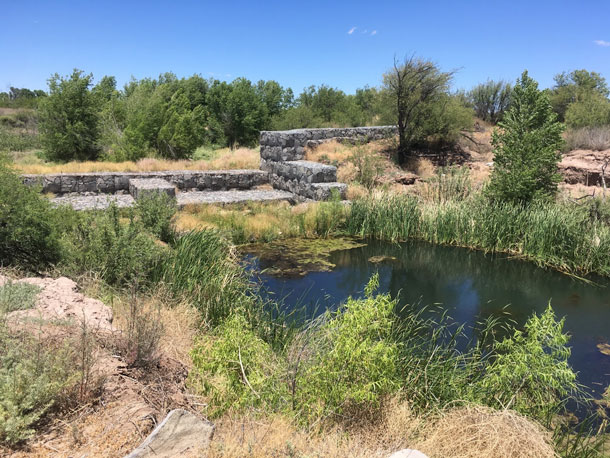
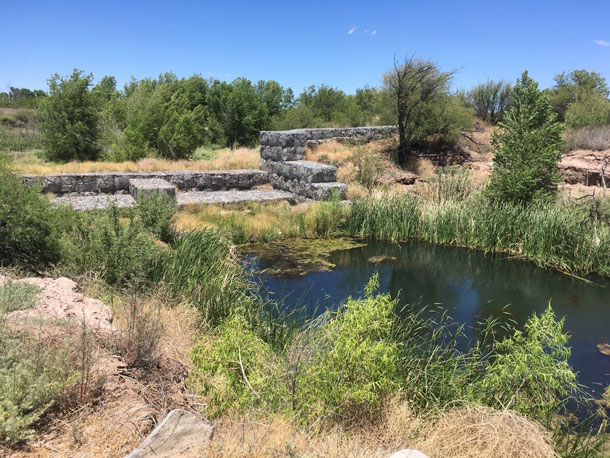
Gabions are baskets of rocks that Valer Clark places in stream beds to hold onto infrequent and precious rainfall at her ranch in Agua Prieta, Mexico.

Today I’m passing along some ideas for conserving water in dry areas. They come from a rancher in Mexico but could work elsewhere.

At the environmental radio show Living on Earth, “Bobby Bascomb visits acclaimed land preservationist Valer Clark at her ranch, Cahone Bonito, in Agua Prieta, Mexico. Valer has been a steward of dried-up lands in Mexico and the southwestern US since she purchased this property in the 1970’s, and she’s dedicated herself to finding ways to restore and maintain it. …

“BOBBY BASCOMB: For a couple months each year the region is awash with water from the seasonal monsoons. The normally dry river beds fill with flood water and swell to create habitat for all manner of water birds and amphibians. The watery paradise is short-lived though, and most of those streams dry up in a matter of weeks. But that wasn’t always the case. A network of streams, rivers and wetlands once crisscrossed the landscape. In fact, more than 150 years ago, around the time of the Civil War, people in the region struggled with malaria, a mosquito-born illness typically associated with tropical wet climates. Last year, I went to Mexico and I found a ranch owner that’s working on ways to keep some of that water on the land longer.

“My journey starts at the Gadsden Hotel in Douglas, Arizona. … The opulence of the hotel hints at an earlier time of prosperity and wealth. Valer says the whole region, north and south of the border, was made rich more than 100 years ago by the same things.

“VALER CLARK: This was copper, cotton, and cattle. The three Cs, you know, all in the early 1900s.

“BASCOMB: Those three Cs made a lot of money but heavily degraded the land. Before the arrival of settlers the region didn’t have much water but there were some dense grasslands. Forests grew alongside rivers that meandered across the open landscape. And wetlands popped up every 20 or 30 miles along those rivers. But when Valer first visited back in the 70s, decades of mining and agriculture left the arid soil dry and cracked, few trees remained and the river beds were deeply eroded.

“Valer [and] her husband at the time were traveling in Mexico and fell in love with the austere land. The wildness of the open parched landscape drew them in.

“CLARK: We just came across this ranch, by accident. And he said, Well, why don’t we bid on it, and I bid so low, I didn’t think we’d ever get it. … When I got here and started seeing the lack of water and seeing the situation, what it looked like, and the hills were bare, and there was no grass. And I thought I wonder if you could make a change. …

“BASCOMB: Valer eventually bought and rehabilitated some 150,000 acres of land in northern Mexico and the Southwest US. [Her] work here has been transformative, says Ron Pulliam.

“RON PULLIUM: There are four great geological forces: there’s volcanism, plate tectonics, there’s erosion. And there’s Valer. …

“BASCOMB: Ron is an ecologist, formerly with the US Department of Interior, and founder of the nonprofit Borderlands Restoration Network. … I pile into a pickup truck with Ron. Valer, in her own truck, leads the way out of Douglas, Arizona and across the border to Agua Prieta, … We leave behind the maquiladora factories in the duty-free trade zone of Agua Prieta and drive an hour southeast to Valer’s ranch. Pavement and two-story buildings give way to dusty soil and brittle pale green grass. To me, as a New Englander, the landscape looks rather inhospitable, but Ron says this is prime cattle grazing territory.

“PULLIAM: Generally speaking now, the stocking ratios are on the order of one cow to one hundred or two hundred acres in this area. And then think of around the turn of the century, 100 times that number of cows. … If you put hundreds of cows out on a small area here you basically reduce all the ground cover. So, when the rain comes it just runs off the land rather than being caught up in the vegetation.

“BASCOMB: And keeping that rainwater on the land is the fundamental key to what Valer is doing to rehabilitate her property. More water will mean more grass and trees, habitat for the wildlife that was once common here. … She takes me on a walk around her property. …

“CLARK: This is what we call a gabion, which is a wire basket that is filled with rocks. …

“BASCOMB: They’re about 3 feet tall, some just 5 or 6 feet wide, others more than a hundred feet across. Valer and her crew have built more than 20,000 of them on her property. They all sit in riverbeds which are dry most of the year until the monsoon rains come. That’s when the gabions get to work. They slow down the water rushing through the river bed so silt can accumulate behind them, like a sponge.

“CLARK: And that sponge holds the water. And so the water, instead of just whipping through fast, when it rains, 30% of it’s held back and goes into the ground. And so it filters down very slowly. …

“BASCOMB: Those pools of water are home to insects, birds, rare frogs, and endangered fish species.

“CLARK: And trees, all these trees coming up, they’re a result of having water here. … Some of them grow 10 feet a year. … We’ve seen ocelot, we’ve seen bobcats and lions and bears and coatimundis and javelinas, ring tailed cats.”

More at Living on Earth, here.

Read Full Post »

Photo: Kendal Blust/KJZZ via Fronteras.
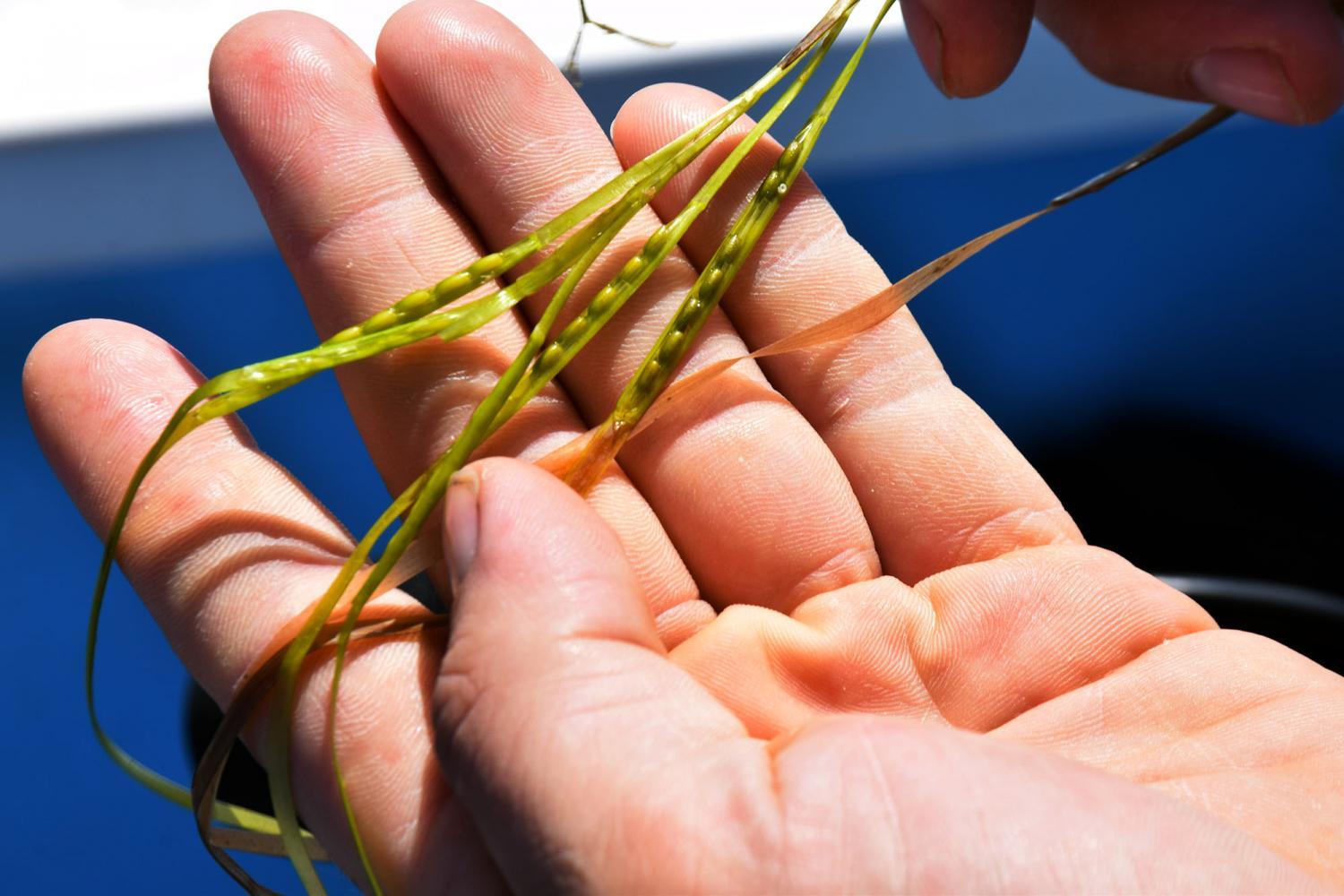
These eelgrass seeds are fresh from the sea.
Mexico’s indigenous Comcáac people have managed to protect 96% of the precious eelgrass that grows in their region.

I have long known about beach grass and how it can hold the dunes and protect the land in a hurricane. I know about how easily the roots die if you walk on beach grass and why, when “Keep Off the Dunes” signs aren’t obeyed, houses wash away.

But I’m learning there’s another fragile grass that helps the environment. This one lives in the sea and captures carbon.

Sam Schramski has the story at Public Radio International’s the World.

“At a two-day festival on the coast of northern Mexico [last] month, scientists, chefs and local residents gathered to celebrate eelgrass — a unique type of seagrass that grows in the Gulf of California. 

“Seagrass is on the decline in the world’s oceans, but the Indigenous Comcáac people who live in the region have managed to protect the eelgrass that grows in their waters. 

” ‘From my parents, I learned about medicinal plants and the songs of plants, as well as about traditional foods,’ said Laura Molina, who is Comcáac.

“She remembers how her mom made tortillas out of flour ground from eelgrass seeds known as xnois in Comcáac language, a mix between wild rice and nori seaweed. 

Seagrass is getting a lot of attention these days because of its capacity to store carbon, estimated to sequester up to half the so-called ‘blue carbon’ in the world’s oceans and coastal ecosystems — putting it on par with global forests.

“Ángel León, a Spanish chef and owner of Aponiente restaurant, has made it his personal mission to protect threatened seagrass beds off the Spanish coast. He’s interested not only in the plant’s environmental benefits but also its culinary potential in the kitchen as a nutrient-rich superfood. …

“Seagrass is down about 30% globally since the late 1800s. Through León’s restaurant and related nongovernmental organizations, he has heavily financed seagrass restoration projects.” More at the World, here. Listen to the audio version there.

Kendal Blust at Fronteras also wrote about the festival: “In the small Comcaac village of Punta Chueca, on the Sonoran coast of the Gulf of California, a group of women gathered around a white sheet piled high with dried zostera marina, or eelgrass.

“One woman sang an ancestral song dedicated to the plant, known as hataam, as others beat the dried eelgrass and rubbed it between their palms to remove its small, green seeds. Xnois, as the seeds are known in the Comcaac language, cmiique iitom, are an ancestral food.

“ ‘The Comcaac are the only people, the only Indigenous group, that consumes the seed,’ said Erika Barnett, a Punta Chueca resident who has been heavily involved in restoration efforts.

“Eelgrass seed has been a part of their culture for millennia, she said. Traditionally, the flour was used to make tortillas and a hot drink combined with honey and sea turtle oil. And because it’s quite filling, it used to be carried by Comcaac during sea journeys. …

“Barnett said her great-grandparents were probably the last members of her family to collect and eat the xnois seeds. Her father, now 76, last tasted it when he was just 7.

” ‘That’s was the last time he ate it,’ she said. ‘It’s very ancient, but it’s no longer eaten like it used to be, and most younger people have never tasted it. So this effort is really rescuing our culture.’ …

“Now, Barnett is part of a team working to bring the tradition back to their community — both because of the plant’s nutritional value and its ecological benefits. Eelgrass creates habitat for sea turtles and fish, protects the coastline and captures carbon.

“ ‘It’s important for us to revive these traditions so they can be passed on to future generations,’ she said. ‘But I think we need to show the community that it can be done, first. That it’s hard, but we can harvest the seeds.’

“So for weeks in April, a group of women and girls harvested eelgrass the way their ancestors would have. They waded into the sea to collect plants floating near the shore, then dried, thrashed and winnowed them. …

“ ‘One of the missions of Aponiente is to look to the sea with hunger,’ said Greg Martinez, a chef and biologist. … Martinez said the restaurant is committed to discovering the gastronomic potential in the ocean, both for our health and for the planet.

“And eelgrass has a lot of potential. For one thing, it captures and holds carbon below the water’s surface. Known as blue carbon, it can help mitigate climate change.

“ ‘But it doesn’t only sequester carbon,’ Martinez said. ‘It also protects coastlines. It serves as a habitat for thousands of different species that come to breed in their protection. It buffers waves so if you have a tsunami or another storm it protects the coastline in that way as well.’

“Despite the swath of ecosystem services seagrasses provide, however, seagrass beds currently are disappearing from the world’s oceans, he said. And that makes it especially important to protect the abundant meadows in the Canal del Infiernillo, a channel between the coast and the massive Tiburon Island that is entirely within Comcaac territory.”

More at Fronteras, here. Nice pictures. Both news sites are free of firewalls.

Read Full Post »

Photo: World Housing.
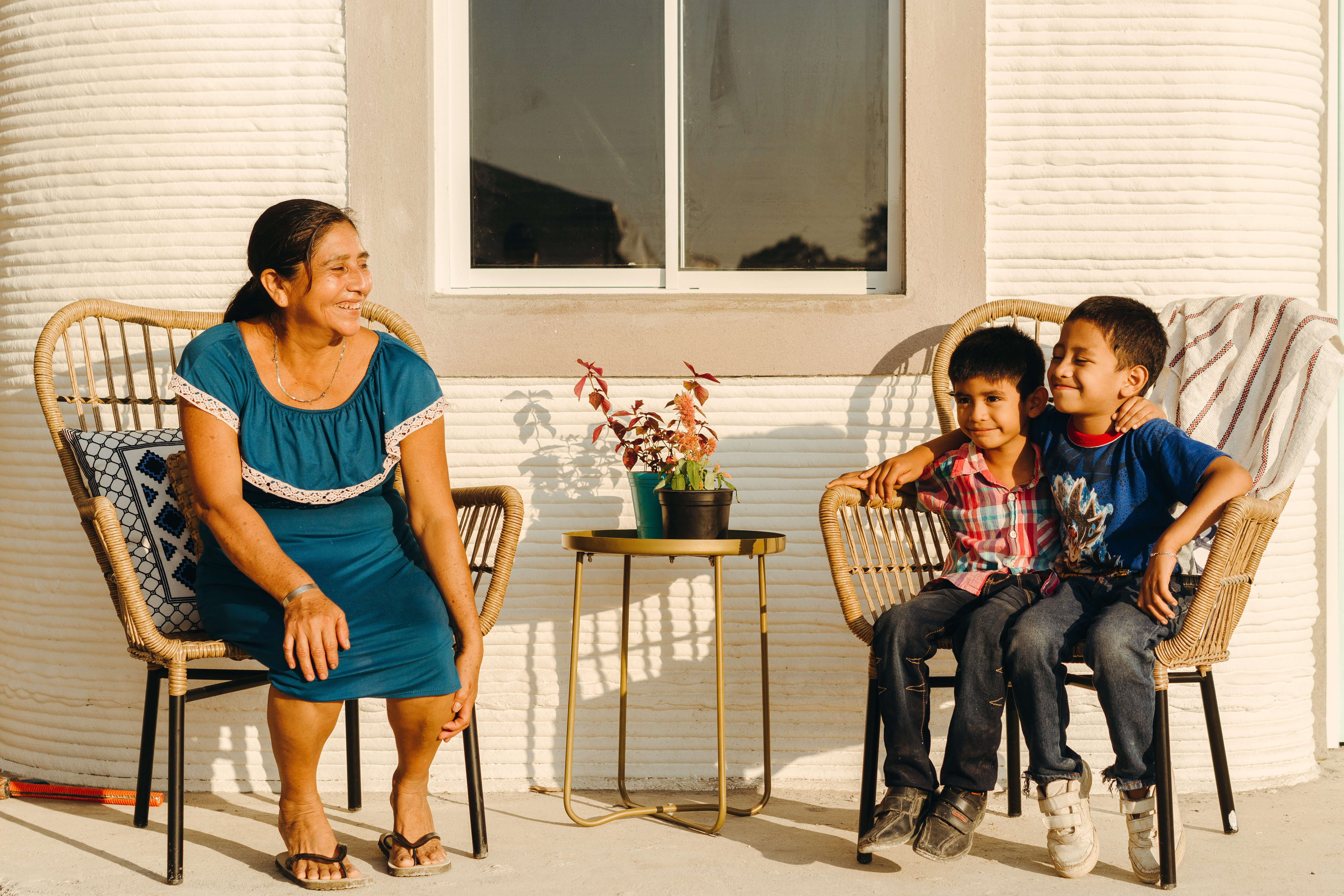
In a tiny village on the outskirts of Nacajuca, Mexico, builders are creating new homes using an oversize 3-D printer.

Pop-up temporary cabins, 3-D-printed buildings: whether such super-cheap housing is a good idea or not, it’s probably the wave of the future because we are so far behind providing shelter for all. Typhoons, floods, entrenched poverty, opioid devastation. All require new solutions to homelessness.

First, let’s take a look at 3-D homes in Mexico.

Debra Kamin reports at the New York Times, “Pedro García Hernández, 48, is a carpenter in the southeastern Mexican state of Tabasco, a rainforest-shrouded region of the country where about half of the residents live below the poverty line.

“He ekes out a living making about 2,500 pesos ($125.17) a month from a tiny workspace inside the home he shares with his wife, Patrona, and their daughter, Yareli. The home has dirt floors, and during Tabasco’s long rainy season, it’s prone to flooding. Dust from his construction projects coats nearly everything in the home, clinging to the bedroom walls, the pump toilet and the counters of his makeshift kitchen.

“But that will soon change. In a matter of months, Mr. Hernández and his family are moving to a new home on the outskirts of Nacajuca, Mexico: a sleek, 500-square-foot building with two bedrooms, a finished kitchen and bath, and indoor plumbing. What’s most unusual about the home is that it was made with an 11-foot-tall three-dimensional printer. …

“And now, the era of the 3-D printed community has arrived. Mr. Hernández’s home is one of 500 being built by New Story, a San Francisco nonprofit organization focused on providing housing solutions to communities in extreme poverty, in partnership with Échale, a social housing production company in Mexico, and Icon, a construction technology company in Austin, Texas.

“When New Story broke ground on the village in 2019, it was called the world’s first community of 3-D printed homes. Two years and a pandemic later, 200 homes either are under construction or have been completed, 10 of which were printed on site by Icon’s Vulcan II printer. Plans for roads, a soccer field, a school, a market and a library are in the works.

“Single-family homes are a good testing ground for the durability of 3-D printed construction because they are small and offer a repetitive design process without much height, said Henry D’Esposito, who leads construction research at JLL, a commercial real estate firm.

They can also be constructed to tolerate natural disasters: Nacajuca sits in a seismic zone, and the homes there have already withstood a magnitude 7.4 earthquake. …

“ ‘We know that being able to build more quickly, without sacrificing quality, is something that we have to make huge leaps on if we’re going to even make a dent on the issue of housing in our lifetime,’ said Brett Hagler, New Story’s chief executive and one of four founders.

“The organization was started in 2015, shortly after Mr. Hagler took a trip to Haiti and saw families still living in tents years after the 2010 earthquake there. Across the globe, 1.6 billion people live with inadequate housing, according to Habitat for Humanity. …

“Speed is only one factor in bringing a village to completion — New Story has teamed up with local officials in Tabasco to bring sewage services, electricity and water to the community.

“Mr. Hernández, who has plans to expand his construction business to a larger space in his new home, said he was not focused on a move-in date. He cares about the long-term impact the home will have for his daughter, who is studying to become a nurse.

“ ‘When we receive the house, my daughter will be able to rely on it,’ he said. ‘She won’t have to worry anymore.’ ”

Meanwhile in Boston, construction crews have been working on a pop-up, temporary community to relieve the pressure at a trouble spot known locally as Mass and Cass.

Milton J. Valencia reports at the Boston Globe, “The crews had already built new pop-up cabins over the last two weeks. And on this day, they were digging through concrete to connect to water and sewer lines, putting the finishing touches on a new, makeshift cottage community to house people who are homeless.

“The pop-up community — which could be fully operational by Monday — is just one piece of what state and city officials hope will be the solution to a sprawling tent encampment at the intersection of Massachusetts Avenue and Melnea Cass Boulevard, what has become the epicenter of the region’s opioid crisis.

Photo: Suzanne Kreiter/Globe.
An inside view of one of the temporary cottages on the grounds of the Lemuel Shattuck Hospital campus.

“Seventeen sleeping cabins, ranging in size from 64 to 100 square feet, are lined up in two rows. At one end is a courtyard. And at the front of the village is a 500-square-foot structure that will serve as a common room, where those living there can gather for meals or counseling. Other services — to help treat addiction or mental illness — will be available at the site. And at the end of the day, those living there can retire to their own personal sleeping space. …

“As city officials and social workers push people to leave their tent encampments near the Mass. and Cass intersection, they invite them to the new cottage community, marketing it as a temporary but appealing option that could serve as a warmer, safer transition to long-term housing.”

Will there, in fact, be safer, long-term housing? That is the question.

More on 3-D homes at the Times, here, and on Boston’s pop-up community at the Globe, here.

Read Full Post »

I’ve been reading a compelling fantasy novel about travel to different worlds that, like other fantasies I’ve read recently, underscores something important about the real world. We are destroying it.

A New York Times article by Catrin Einhorn and Christopher Flavelle focuses on a group in Mexico saving one beautiful piece of our planet, using a different way of funding the work. It’s controversial, but see what you think.

“When Hurricane Delta hit Puerto Morelos, Mexico, in October, a team known as the Brigade waited anxiously for the sea to quiet. The group, an assortment of tour guides, diving instructors, park rangers, fishermen and researchers, needed to get in the water as soon as possible. The coral reef that protects their town — an undersea forest of living limestone branches that blunted the storm’s destructive power — had taken a beating. Now it was their turn to help the reef, and they didn’t have much time.

“ ‘We’re like paramedics,’ said María del Carmen García Rivas, director of the national park that manages the reef and a leader of the Brigade. When broken corals roll around and get buried in the sand, they soon die. But pieces can be saved if they are fastened back onto the reef. …

“The race to repair the reef is more than an ecological fight; it’s also a radical experiment in finance. The reef could be the first natural structure in the world with its own insurance policy, according to environmental groups and insurance companies. And Hurricane Delta’s force triggered the first payout — about $850,000 to be used for the reef’s repairs. …

“When the Brigade laid eyes on their reef, which runs 28 kilometers south of Cancún and is home to critically endangered elkhorn coral, it looked ransacked. Structures the size of bathtubs were flipped upside down. Coral stalks lay like felled trees. Countless smaller fragments of broken coral coated the seafloor.

“On the boat, cement mixers prepared a special paste that snorkelers ferried down to divers who spent hours underwater carefully fastening pieces back on the reef. They used inflatable bags to turn over large formations rolled by the storm and collected fragments to seed new colonies. …

“Back in 2015, Kathy Baughman McLeod, who was then director of climate risk and resilience at the Nature Conservancy, asked a profound question: Could you design an insurance policy for a coral reef?

“On its face, the idea might have seemed absurd. For starters, nobody owns a reef, so who would even buy the policy? And it’s not easy assessing the damage to something that’s underwater.

“But Ms. Baughman McLeod, along with Alex Kaplan, then a senior executive at Swiss Re, a leading insurance company, came up with workarounds. First, the policy could be purchased by those who benefit from the reef — in this case, the state of Quintana Roo, which is also home to Cancún and Tulum and has a tourism economy estimated at more than $9 billion. …

“Second, rather than basing the payout on reef damage, it could be triggered by something far easier to measure: The storm’s wind speed. The stronger the wind, the worse the assumed damage to the reef.

“The idea of putting a dollar value on a reef or ecosystem by identifying a ‘service’ that it provides has become increasingly popular. For example, coastal salt marshes protect from flooding — offering economic benefits on top of environmental ones. Peat bogs store vast amounts of carbon, keeping it out of the atmosphere where it would worsen global warming. And coral reefs reduce the energy of waves by 97 percent, protecting coastal properties.

“But this notion of ‘ecosystem services’ is controversial in some circles.

“ ‘It’s a popular concept because it commodifies nature and it allows people to put a dollar value on nature,’ said Terry Hughes, who directs a center for coral reef studies at James Cook University in Australia. ‘But it’s very anthropocentric and it’s certainly not about protecting nature for nature’s worth. It’s almost kind of selfish.’

If you look at it from the reef’s perspective, Dr. Hughes said, hurricanes are the least of its problems. Climate change, coastal pollution and overfishing are far greater threats.

“But given the scale of the planet’s intertwined environmental emergencies — not only climate change but the collapse in biodiversity — conservationists say they must be pragmatic. More than a million species are at risk of extinction, including many coral species.

“And in Puerto Morelos, monetizing the reef had the almost ironic consequence of helping some in the community understand that it is actually invaluable. ‘My experience with the Brigade has changed my thinking so much,’ said Alejandro Chan, who takes tourists sport fishing and snorkeling. ‘I have to help the reef.’ …

“ ‘If the insurance money had been available in a timely manner,’ said Claudia Padilla, a researcher at the National Fisheries and Aquaculture Institute in Mexico, which developed the Brigade’s hurricane response protocols and trained its members, ‘the results of the rescue effort could have been greatly multiplied.’

“Still, the money will be put to its intended purpose of restoration, funding longer-term projects like seeding of new colonies and replenishment of reef biodiversity. And Mr. Secaira of the Nature Conservancy believes that the rest of the world will use Quintana Roo as proof of concept.

“Indeed, as the Brigade was at work in Puerto Morelos, a bill in Guam’s Legislature sought to evaluate insuring a reef there. Training is underway in other locations in Mexico, Belize and Honduras.”

Hat tip: Hannah. More at the New York Times, here.

Read Full Post »

ranching_gabions

Photo: Bobby Bascomb
Gabions are baskets of rocks that Valer Clark places in stream beds to slow the water as it rushes through in the rainy season. They’re part of her work to bring dried-up land back to life.

Having woken up today to more US nuttiness (our whole family could visit Erik’s mom in Sweden and bring back whatever germs might be there, but she herself will have to postpone her trip to visit grandchildren because she’s Swedish), I decided to focus on an American actually doing good in the world.

In this episode of Living on Earth, Bobby Bascomb visits land preservationist Valer Clark at her ranch in Agua Prieta, Mexico. …

“BOBBY BASCOMB: Today the lands of the Southwestern US and Northern Mexico are considered desert or semi-arid. But for a couple months each year the region is awash with water from the seasonal monsoons. The normally dry river beds fill with flood water and swell to create habitat for all manner of water birds and amphibians. The watery paradise is short lived though, and most of those streams dry up in a matter of weeks.

“But that wasn’t always the case. A network of streams, rivers and wetlands once crisscrossed the landscape. In fact, more than 150 years ago, around the time of the Civil War, people in the region struggled with malaria, a mosquito-born illness typically associated with tropical wet climates. In Mexico, I found a ranch owner that’s working on ways to keep some of that water on the land longer. … My journey starts at the Gadsden Hotel in Douglas, Arizona. ..

“The opulence of the hotel hints at an earlier time of prosperity and wealth. Valer says the whole region, north and south of the border, was made rich more than 100 years ago by the same things.

“VALER CLARK: This was copper, cotton, and cattle. The three Cs, you know, all in the early 1900s.

“BASCOMB: Those three Cs made a lot of money but heavily degraded the land. … When Valer first visited back in the 70s, decades of mining and agriculture left the arid soil dry and cracked, few trees remained and the river beds were deeply eroded. …

“CLARK: When I got here and started seeing the lack of water and seeing the situation, what it looked like, and the hills were bare, and there was no grass. And I thought I wonder if you could make a change. I wonder if there’s something you can do about this. …

“BASCOMB: Valer eventually bought and rehabilitated some 150,000 acres of land in northern Mexico and the Southwest US. That’s more than 10 times the size of Manhattan. And her work here has been transformative, says Ron Pulliam, … an ecologist, formerly with the US Department of Interior, and founder of the nonprofit Borderlands Restoration Network. …

“PULLIAM:  If you put hundreds of cows out on a small area here, you basically reduce all the ground cover. So, when the rain comes it just runs off the land rather than being caught up in the vegetation.

“BASCOMB: And keeping that rainwater on the land is the fundamental key to what Valer is doing to rehabilitate her property. More water will mean more grass and trees, habitat for the wildlife that was once common here. It’s sort of a build it and they will come philosophy. …

“CLARK: This is what we call a gabion, which is a wire basket that is filled with rocks.

“BASCOMB: That’s it, a wire basket full of rocks. They’re about 3 feet tall, some just 5 or 6 feet wide, others more than a hundred feet across. Valer and her crew have built more than 20,000 of them on her property. They all sit in riverbeds which are dry most of the year until the monsoon rains come.

[When] the gabions get to work, they slow down the water rushing through the river bed so silt can accumulate behind them, like a sponge.

“BASCOMB: Nearly all these trees have sprouted up since Valer began keeping more water on the land. Near the stream, a canopy of cottonwood trees towers over us and a lush green understory creates the feeling of a jungle that follows the narrow band of water. We continue our walk on the edge of the forest, which she says is a vital corridor for wildlife in the region.

“CLARK: We’ve seen ocelot, we’ve seen bobcats and lions and bears and coatimundis and javelinas, ring tailed cats. …

“BASCOMB: We drive past parched bare earth cracked into the shape of a hexagon and stop at a different ecosystem all together. …

“Instead of a riparian forest this is a wetland teeming with life. Reeds and cat tails poke up through the water. At least a dozen different species of brightly colored birds dart about, butterflies sun themselves, and bright blue dragon flies copulate in mid-air. Ron Pullium says this region is a hotbed for insect diversity, including some 450 different species of bees. …

“BASCOMB: [The next day] we walk alongside a small creek, craning our necks up, hoping to spot some birds.

“PULLIUM: This creek is interesting just in itself. It was protected by Valer because it was identified as the most intact fish stream in northern Mexico, and perhaps the most intact in all of Mexico. …

“BASCOMB: For all her ecological work, Valer is still mindful of serving as a model for other ranches in the region that depend on raising cattle for their livelihood. She removed most of the cows from her ranch when she bought the place. But she did keep a small herd and is very deliberate about where and when they graze. And it’s paid off. Her ranch manager recruited members of his family to enter three novio steers in a large cattle exposition.”

Read more at Living on Earth about Valer Clark and why preservation is so satisfying to her.

Read Full Post »

2019-11-04-nest_51

Photo: Erin Siegal McIntyre/the World
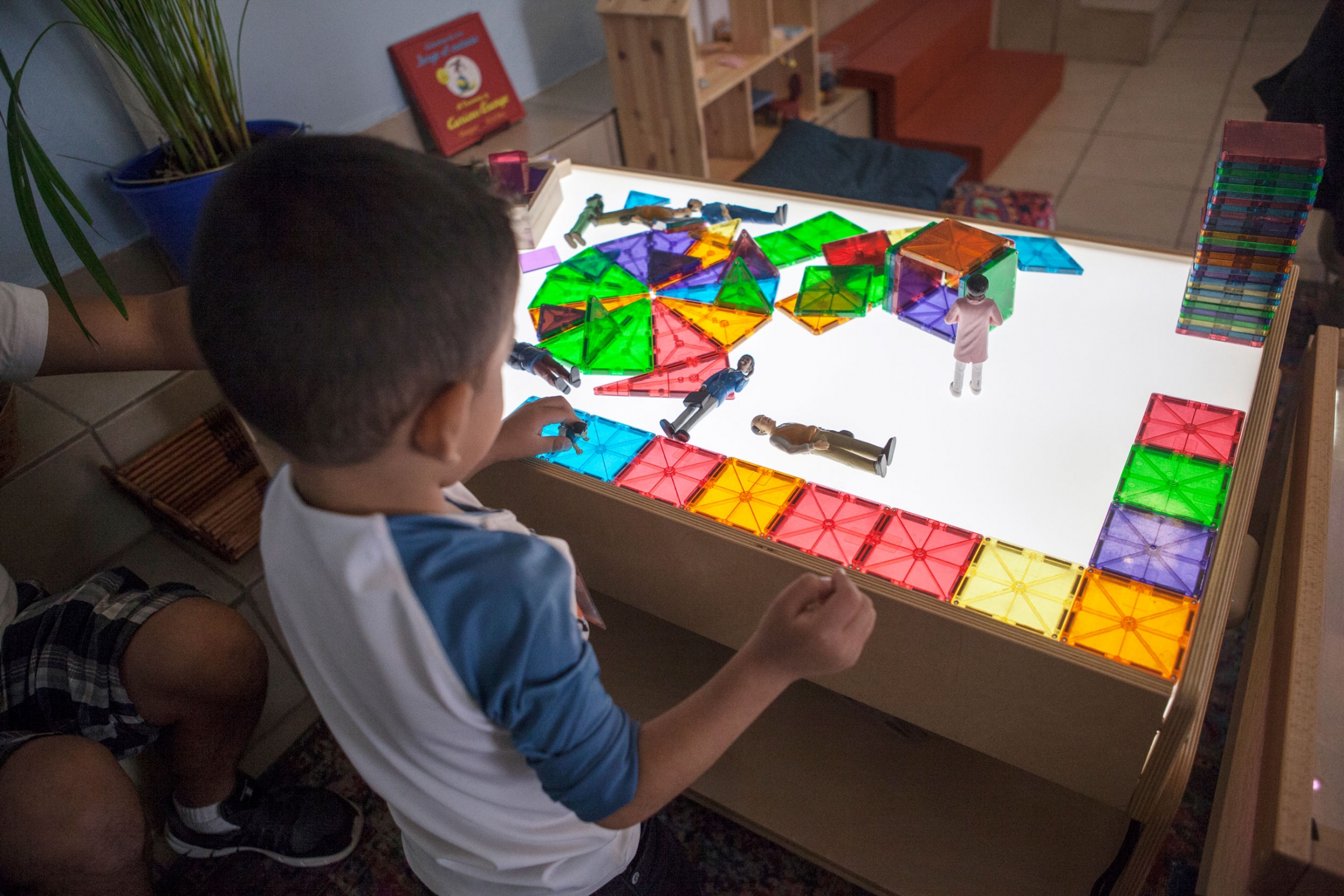
Three-year-old Kevin, whose family fled cartel violence in Michoacán, Mexico, plays at the light table with magnetic blocks at the Nest Tijuana, an informal preschool set up by a California educator.

Speaking of migrant kids who can’t register for school at the border, here’s a related story about an informal preschool that kind hearts have set up in Tijuana. The story comes from a show I like called the World at Public Radio International (PRI).

Sasha Khokha reports, “Classical music plays, silk curtains blow in the wind, and comfy couches offer a place to curl up with a book. There are wooden toys, colorful magnetic blocks and crayons organized by color in glass jars. Children use light projectors to make patterns and shapes on the walls.

“It may sound like a high-end early childhood education center in California, but this is Tijuana.

“Most students and their parents come from other parts of Mexico where there have been recent surges in drug cartel violence. They are waiting for their numbers to be called to enter the United States at the San Ysidro port of entry and hope to lodge claims for asylum. For many, the wait can last several weeks or longer, during which children have little to do.

“Alise Shafer Ivey, a longtime early childhood director from Santa Monica, California, opened this informal preschool, the Nest, in September. It’s attached to a migrant shelter in this Mexican border city. Nothing else like it exists. …

“Patricia’s 2-year-old daughter is one of the new students at the Nest. On the journey to Tijuana, Patricia said her two girls kept asking where their dad was. But how could Patricia tell them? They couldn’t even go to the funeral. It was too dangerous to show up to bury her husband, she said. …

“‘These kids have seen things no child should see,’ Ivey said. ‘They’ve been stripped of their homelands, they’ve left their families behind. They’ve been stuffed in trunks of cars and crossed over borders. … To think we’re going to deliver them to a kindergarten in the US and think it’s going to go well? Not necessarily.’ …

“The idea for the Nest began with a trip Ivey took to Lesbos, Greece, after retiring from decades of directing the Evergreen Community School in Santa Monica. She met a relief worker who invited her to visit a refugee camp, which then housed mostly Syrian refugees.

“Children were ‘digging in the dirt, playing with nails in their pockets,’ Ivey said. ‘They had old cigarette lighters that they had found. There was nothing for children.’

“Ivey offered to set up a space for refugee kids to play. She returned to California and raised $10,000 through a nonprofit she helped found, the Pedagogical Institute of Los Angeles. She went on to set up Nests on another Greek island called Samos, then two more in the Congo. …

“The Tijuana Nest got its start after Ivey visited the shelter across the street, where Patricia and her girls sought refuge. Ivey said she instantly connected with Leticia Herrera Hernández, who runs the shelter. They’re both believers in prioritizing the needs of children, especially when parents are going through trauma, Ivey said. …

” ‘The kids would just spend their days playing on their parents’ phones, having tantrums, and we’d be trying to get them to play to entertain themselves,’ Herrera said in Spanish. …

“At parent orientation night at the Nest, Ivey did what she would do back at her former school in Santa Monica: She laid out a spread with wine and cheese. She talked to the parents about brain science and neural pathways, and explained why memorizing ABCs is not enough.

“ ‘The more we talk to children about their ideas and ask them “I wonder how that would work?” Not quizzing them, but just wondering with them, the more all of those parts of the brain are activated,’ Ivey told the parents, many of whom had never been able to send their kids to preschool in their hometowns. …

“Julieta and Kevin fled cartel violence in Michoacán. When they arrived in Tijuana in August, he had a really hard time accepting the shelter as home. He would hit other kids, yell at them. The Nest has helped him to adjust.

“ ‘Now he doesn’t fight. He plays with the other kids,’ Julieta said in Spanish (The World isn’t using her real name to protect her identity since she is fleeing violence). ‘I used to have to grab him so he would turn and listen to me. Now he turns and looks at me. He reaches for my hand.’ …

“Waiting, watching and letting kids problem-solve has been eye-opening for some parents.

“ ‘I’ve learned to be a better dad,’ said Alfredo, another asylum-seeker who has been volunteering at the Nest (The World isn’t using his real name to protect him from being located by a cartel he said had targeted his family). ‘I used to tell them, “No, do it this way. Because I said so.” And I learned that I was wrong. Having them do things on their own gives them more confidence in their decisions.’ ”

More at the World, here.

Read Full Post »

Older Posts »