Feeds:
Posts
Comments

Posts Tagged ‘miniature’

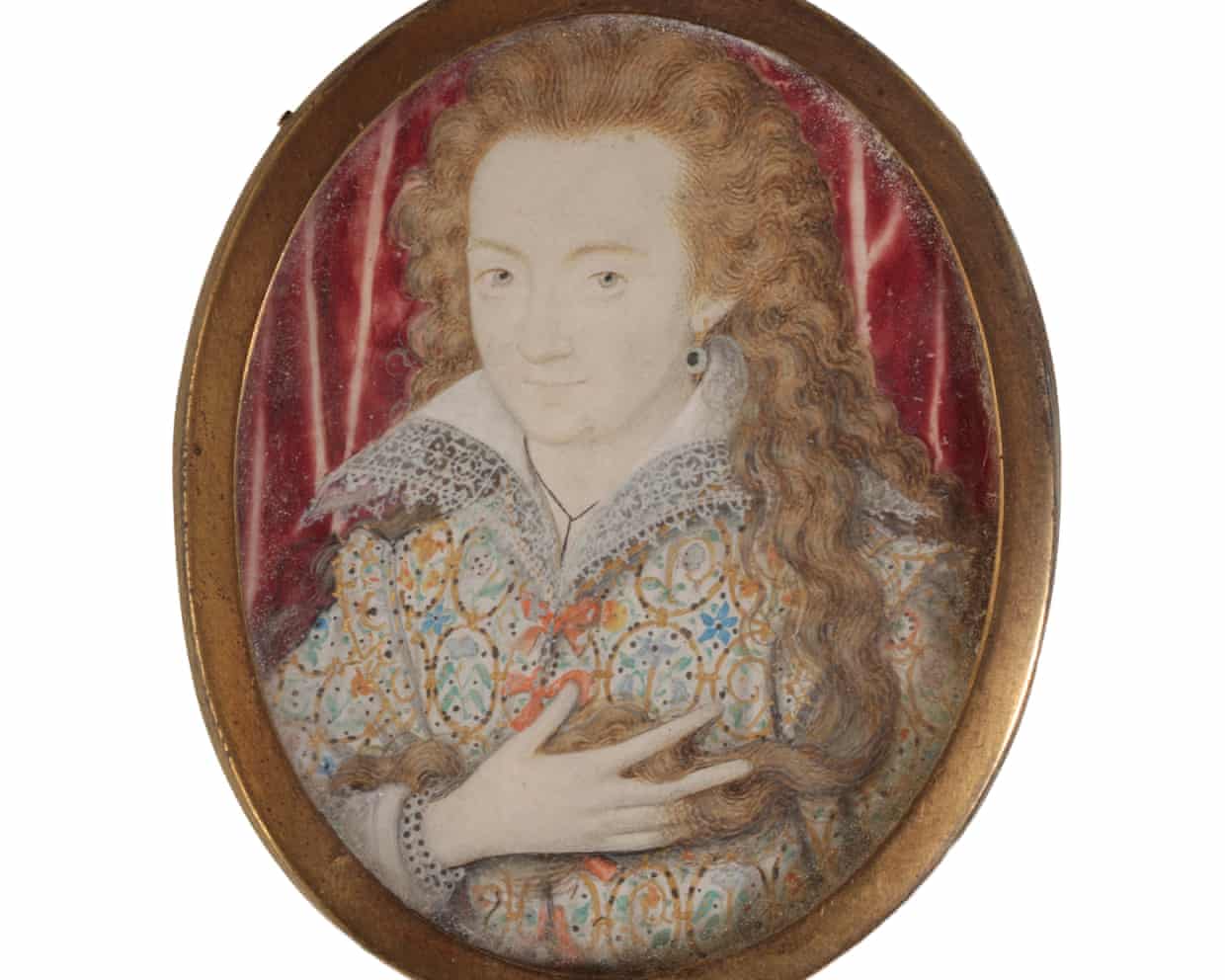
Photo: Handout of a miniature by Nicholas Hilliard.
Shakespeare’s friend Henry Wriothesley, 3rd earl of Southampton, was known for his androgynous beauty and vanity. A newly discovered miniature from his teenage years adds mystery to his story.  

There is always something new to learn about Shakespeare. Blogger Carol let us know a while back about her brother-in-law’s research into Thomas North as an important source for Shakespeare. More recently, there was “news” about Shakespeare’s wife.

Now Dalya Alberge writes at the Guardian that “the discovery of a previously unknown portrait miniature by one of Elizabethan England’s greatest artists would be significant enough. But a work by Nicholas Hilliard that has come to light is all the more exciting because it has a possible link to William Shakespeare, and a 400-year-old enigma of a defaced red heart on its reverse, suggesting a love scorned.

“Hilliard was Queen Elizabeth I’s official limner, or miniature painter. His exquisite portraits, small enough to fit in the palm of one’s hand, are among the most revered masterpieces of 16th-century British and European art.

“This example depicts an androgynous, bejeweled young sitter with long ringlets, thought to be the earliest known likeness of Henry Wriothesley, 3rd earl of Southampton, Shakespeare’s friend and patron – and possibly the ‘fair youth’ of the sonnets, as some have speculated.

“Shakespeare dedicated [‘Venus and Adonis’] and ‘The Rape of Lucrece,’ to Southampton, declaring: ‘The love I dedicate to your lordship is without end.’

“Such miniatures were painted on vellum as thin as onion skin that was pasted on to playing cards for a stiff support. This portrait’s reverse reveals a card whose red heart has been painted over with a black spear or spade, seemingly indicating a broken heart.

“The portrait has been identified by the leading art historians Dr Elizabeth Goldring and Emma Rutherford, who were taken aback by the defacement.

“Goldring, an honorary reader at the University of Warwick and author of an award-winning Hilliard biography, told the Guardian: “You always know that there’s a chance that there could be a clue on the back or tucked inside the frame, but there almost never is. On this occasion, there was – and it was absolutely thrilling. Shivers down the spine. Someone had gone to great effort to spoil the back of this work.’

“Rutherford, the founder of the Limner Company, a consultancy and dealership, said … ‘Everybody would have known that a miniature would be backed by a playing card, but the playing card back was never visible. Originally, this would have been encased in a very expensive, possibly jeweled locket. You’d have to get the miniature out of the locket in order to vandalize the back like this.’ So it is an extraordinary discovery, a 400-year-old mystery.”’ …

“Their research, jointly written with Prof Sir Jonathan Bate, a leading Shakespeare scholar, is published in the Times Literary Supplement on 5 September.

“They write: ‘The fact that the heart has been painted over with a spade, or spear, inevitably calls to … mind thoughts of Shakespeare, whose coat of arms, drawn up c1602, incorporated a spear as a pun on his surname. …

“The historians suggest there is the possibility that this portrait was a gift from Southampton to Shakespeare who returned it, perhaps in 1598, the year that he married. …

“The portrait’s owners have a family connection to Southampton, but they were unaware of Hilliard’s hand or the work’s significance, having long kept it in a box. They contacted Goldring and Rutherford after reading of [the researchers’] discovery of another Hilliard miniature. …

“They write: ‘Again and again, the sonnets return to the fair youth’s androgynous beauty. So, for example, in sonnet 99 his hair is compared to “marjoram,” the tendrils of which are long and curly: could this be an allusion to Southampton’s distinctive long ringlets?’

“They argue that everything about this miniature, including the sitter’s gesture of clasping his cascading ringlets of auburn hair to his heart, suggests an intimate image.

“Long hair was unusual at the late Elizabethan court, Rutherford said. ‘We know there was some criticism of how long hair made men “womanish.” ‘

“Two pearl bracelets adorn the sitter’s wrist. Rutherford said bracelets, though frequently encountered in portraits of women in this period, were rarely seen in portraits of men.”

More at the Guardian, here. And check out the post on Carol’s brother-in-law and his hunt for a little-known Shakespeare source, here.
Read Full Post »

Photo: BBC.
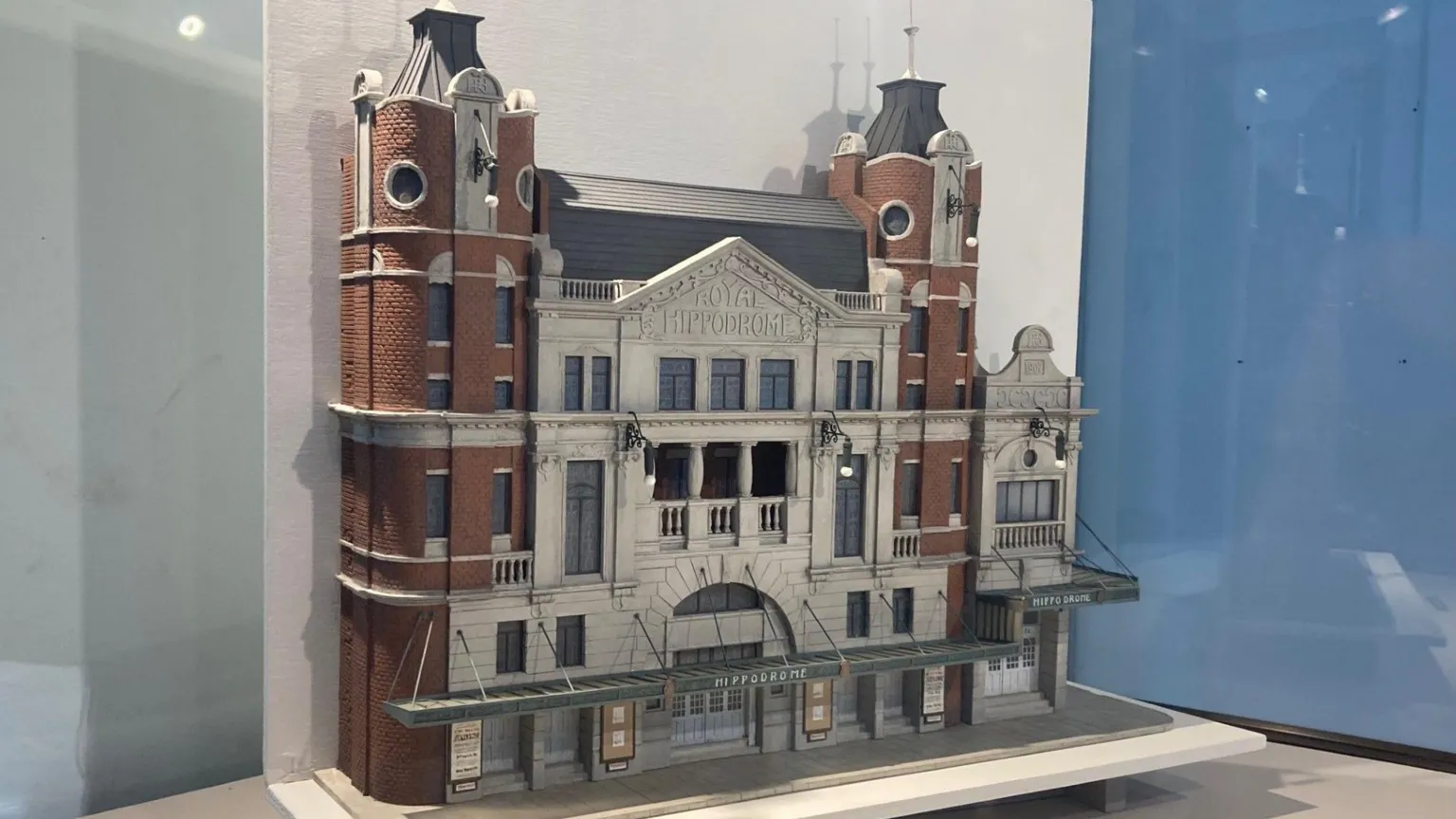
During lockdown, set designer Stuart Marshall started making models of Belfast’s lost theatrical world. Above is his model of the Hippodrome.

No one wants to go back to the pandemic’s lockdown, but enough time has passed for people to feel a little nostalgia for the creative projects some folks undertook during that dark time. I remember a guy in Boston who encouraged artists to send him miniatures of their work, which he would then display on his popular website. Refresh your memory of that here.

Jake Wood at the BBC reported in March on an exhibit in Northern Ireland that had its beginnings when a set designer was stuck at home.

“Miniature models of Belfast’s lost theatres created by set designer Stuart Marshall are bringing the city’s vibrant theatre history back into the the limelight. They are part of an exhibition at Ulster University for the Children’s Festival.

“Mr Marshall told BBC News NI that … ‘Children appreciate the miniature dolls house type model making, adults appreciate the skill that goes into making them, and older people who may remember when some of these places still stood. …

” ‘I started working on a model of the Grand Opera House as part of the heritage exhibition and through doing that got interested in looking at all the other theatres that aren’t about anymore. …

” ‘The Hippodrome was the most complicated and detailed one I’ve made; it took me around six weeks to make.’

“He said he mostly works from old photographs, but it can be hard to get enough accurate detail because ‘with a black and white photograph that you can’t move around, it’s basically static.’

“When photographs of the old theatres are not available or poor quality, Mr Marshall refers to old newspaper articles which sometimes have written descriptions of what materials the theatre was built from and how it appeared.

“Opening in the early 1870s, the Alhambra was Belfast’s first music hall and was a ‘real spit on the floor type joint,’ according to Mr Marshall. ‘In the early days, the Alhambra was more of a variety house, and I’ve heard that it wasn’t the most enticing establishment, quite a rowdy place.’ …

“A typical bill from the early days of the Alhambra shows performances which ‘would nowadays be contentious’ included events such as a minstrel show and a Japanese troupe. …

“To adapt to the evolution of mass entertainment, the Alhambra converted to a full-time cinema house in 1936. Between the late 1800s and its closure in 1959, the Alhambra suffered four separate fires.

“The Theatre Royal was Belfast’s original high-end theatre, opening in the late 1700s with a capacity of just over 1,000. The building was demolished and rebuilt a number of times.

” ‘As these places go, they kept getting burnt down or demolished and rebuilt again – there’s always a renewal aspect to them.’

“The Theatre Royal was to be Belfast’s ‘higher class establishment,’ which in the end became ‘a mixed-use building of shops and place called the “boom boom room,” which was like a dance hall upstairs. …

” ‘Now, there’s a little Starbucks in the corner where the building stood,’ he added.

“Not to be mistaken for the pub and music hall on Botanic Avenue, the Empire Theatre was situated on Victoria Square and opened to the public in 1894. …

“While it did adapt to the growing popularity of cinema, the Empire ‘stayed true to theatre for all of its life,’ Mr Marshall said.

“The Hippodrome was ‘more fiddly.’ … There aren’t too many quality photographs of the Hippodrome, so he ‘had to use his judgment’ when designing the model in terms of color scheme and scale.

“Coming quite late, the ‘Hippodrome was was built in 1907 originally with a cinema in mind’ as to take full advantage of the advent of modern cinema and growing popularity of picture shows.

” ‘And then there was the Ritz,’ which opened in 1938. The Ritz was, according to Mr Marshall, ‘a giant cinema more or less, but it called itself the Ritz Theatre.’ However, it did produce shows as part of the night’s entertainment.

” ‘They would have a brass band, dancers or a ballet, and then a film at the end. It also did huge concerts, people like the Stones, The Beatles and Billy Connolly all performed at the Ritz during their time,’ he added. …

“The Ritz was damaged by bombs hidden in the seats and the theatre’s interior and roof was destroyed in 1977.” More at the BBC Northern Ireland, here.

Did you do a particularly creative project during lockdown? Of, course, many of us kept on blogging away, but we would have done that anyway.

Read Full Post »

Photo: Seattle Miniature Show.

One of the many small challenges of our downsizing process has been what to do with Suzanne’s elaborate dollhouse, one that I ordered (even before she was born) from a talented high school student written up in a local paper.

It’s not that there aren’t plenty of people who would want a dollhouse that has wallpaper and electric lights, but maybe Suzanne still wants it. She’s not sure. The charm of miniatures is long-lasting.

Emma Orlow wrote about this charm recently at the New York Times. “Moments before 10 a.m., a security guard thanked the crowd for being cooperative.

“When the clock struck the hour, it became clear why: The doors of the Marriott Chicago O’Hare conference center opened, and hundreds of attendees, a majority of whom were over the age of 60, bee-lined as fast as they could to the booths.

“Many had studied the color-coded map ahead of time listing each booth’s location and came prepared with a shopping plan — a scene that could easily be mistaken for a Black Friday sale. Instead, it was the Chicago International Miniatures Show.

“Despite the gathering touting itself as ‘the World’s No. 1 Dollhouse Miniatures Show,’ there aren’t many actual dollhouses. Attendees instead sift through thousands of tiny objects that fill these tiny homes: miniature sponges, chocolate fondue fountains, rocking chairs, barbecue sets, Tupperware containers or fly swatters.

“The Tom Bishop show, as many attendees call it, is considered by its founder, Mr. Bishop, to be the largest dollhouse miniatures event in the world. Numbers appear to support that claim. This year, over 250 vendors traveled from 21 countries and 35 states. …

“Mr. Bishop estimates he has done over 500 miniature shows around the world, though in recent years he has downsized to only Chicago, which has been a continuous stop for nearly 40 years. Even the hotel itself is personal for Mr. Bishop: It’s where he and his wife, Leni, 77, spent the first night of their honeymoon.

“In 1977, the duo relocated from Chicago to Margate, Fla., where they opened their dollhouse store, Miniland, before closing it in 1984 to focus their attention on traveling conventions. Mr. Bishop, who also worked for American Airlines for 17 years, was inspired to create his own show after attending others that ‘weren’t run very well,’ he said. …

“Teri, 77, of Teri’s Mini Workshop, who declined to give her last name, said she wouldn’t have been able to showcase her miniature nacho cheese machines, plates of gefilte fish or medical supplies (about $10) had a booth not dropped out last minute. She hoped her soft power would be her low pricing, in contrast to some other tables, where pieces can go for hundreds of dollars a pop.

“If a collector wants something one of a kind, it might sell out on the first day, said Becky Evert, 68, a customer who had traveled from Denver with friends for the event. ‘Did I come with a budget? Yes,’ she said. ‘Did I stay to it? No.’ Of her seven years in attendance, it was the largest crowd she had ever seen.

“Beth Pothen, 42, who runs Mountain Creek Miniatures and is a full-time postal worker, is a second-generation miniaturist, making items like goth furniture and Christmas cookie trays (she got her start at a Girl Scouts craft fair). She drove from Spokane, Wash., for the convention and hoped to recoup the cost of travel and labor, and then some, she said. Individual tables cost $325, and some opt to have two at their booth, according to Mr. Bishop.

“While there’s value in breadth like that of Ms. Pothen’s, others distinguish themselves with a more niche focus. Kristin Castenschiold, 41, of Heartfelt Canines in Green Village, N.J., made a name for herself selling miniature dogs on Etsy — ‘I get some of the hair from a friend who is a pet groomer,’ she said — and has since expanded to all kinds of furry friends, miniature light-up aquariums and trompe l’oeil cat litter boxes.

“Margie Criner, 53, of Chicago’s Itty Bitty Mini Mart, makes miniatures as part of her full-time fine art practice (she’s currently on display at the traveling show ‘Small is Beautiful‘), but wanted a way to make her work more accessible. Her tiny items, which include translucent Jell-O and teensy records from the rock band Television, are inspired by items she had growing up.

“Ms. Criner is a part of a new generation of miniature makers, following in the footsteps of artists like Laurie Simmons, bringing the genre out from the home, into the gallery — with designs more modern and cheeky than the antiquarian selections that once came to define the miniature world.

“While it can be hard to stand out, everyone described the world of miniature selling and buying as quite collaborative and joyful.”

More at the Times, here.

Read Full Post »

Lydia Ricci, “I’m Not Sure They Need to Do That Now” (2020), scrap materials, 3 x 5 x 1 1/2 inches

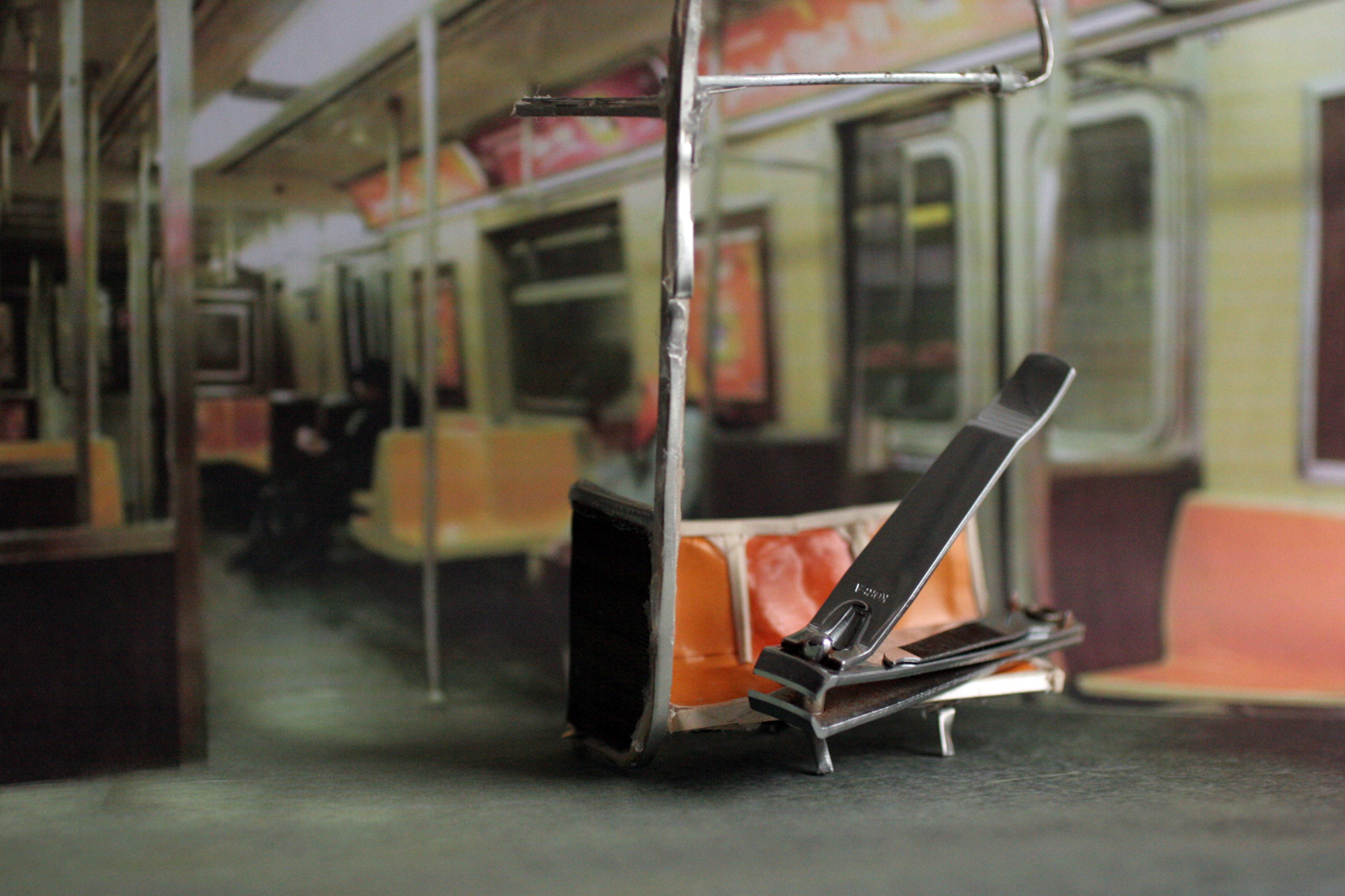
The world is full of big wonders that people want to see before Covid or some other misfortune grounds them. As for me, I’m almost more interested in not missing some small, important thing close to home. I keep thinking there might be magic in the ordinary. No wonder I enjoy art that uplifts everyday items!

Sarah Rose Sharp writes at Hyperallergic about artist Lydia Ricci and the endless possibilities she finds in everyday objects.

“As the saying goes, one man’s trash is another man’s treasure, and no one embodies this sentiment more acutely than sculptor and filmmaker Lydia Ricci. From a pile of scraps and everyday detritus accumulated over the last 30 years, Ricci makes imperfectly perfect replicas of quotidian moments and objects.

“ ‘I have been collecting my family’s scraps for over 25 years,’ wrote the artist in a confessional essay on her website, ‘but I have to admit, I also steal some too.’ These purloined scraps include a reusable BINGO card from a family function at the local elementary school (‘fancy … with red plastic windows that cover the numbers’), dusty electrical tape (‘nobody needs three rolls’), a lightbulb box from a neighbor’s garage (‘the bulb probably didn’t even work’). …

“If you leave Ricci alone in a waiting room, she considers your paper clips fair game.

” ‘I treasure an electric bill from 1984 like others would covet their family jewels,’ Ricci told Hyperallergic by email.

The results are mementos that do not so much mirror their real-world counterparts as deeply evoke a sense of life as it is remembered — a little wonky, a little irregular, very detailed in places but highly abstract in others.

“Ricci poses and photographs her tiny sculptures in tableaux in which the objects are often out of proportion, giving them the surreal quality of dreams and memory. A tiny aquarium makes tight quarters for a peeled cocktail shrimp. A ramshackle miniature couch struggles to conceal life-sized keys and Cheerios and hairballs. A teensy dishwasher is slowly buried in a drift of life-sized detergent flakes.

“As if creating these scenes out of multiple media isn’t enough, Ricci then recasts them in multimedia productions, adding single-sentence text snippets that seem to voice over the images or serve as narration to short films. Her three-minute film I WILL ALWAYS LOVE YOU (2021) made the rounds this past spring at film festivals in Arizona and Washington, DC, and tells the story of an evolving relationship through its everyday dramas: the wait for a diner booth, the politics of toothbrush-sharing, the request (or lack thereof) for help reaching a high shelf, the need (or not) for company on a grocery run.

“ ‘There is absolutely nothing precious or precise about what I am constructing,’ Ricci added. ‘The sculptures are messy and imperfect just like our memories.’ …

“Ricci was part of a four-person show that ran through April at James Oliver Gallery in Philadelphia, with another show slated to open on August 23 at the Kohler Art Museum in Sheboygan, Wisconsin. She’s also hoping to publish a book of her images, titled Don’t You Forget About Me.” More at Hyperallergic, here.

You might also be interested in a book by Richard Deming called The Art of the Ordinary, of which Cornell University Press says: “Cutting across literature, film, art, and philosophy, Art of the Ordinary is a trailblazing, cross-disciplinary engagement with the ordinary and the everyday. Because, writes Richard Deming, the ordinary is always at hand, it is, in fact, too familiar for us to perceive it and become fully aware of it. The ordinary he argues, is what most needs to be discovered and yet is something that can never be approached, since to do so is to immediately change it.”

Read Full Post »

Photo: Lover’s Eyes: Eye Miniatures from the Skier Collection.
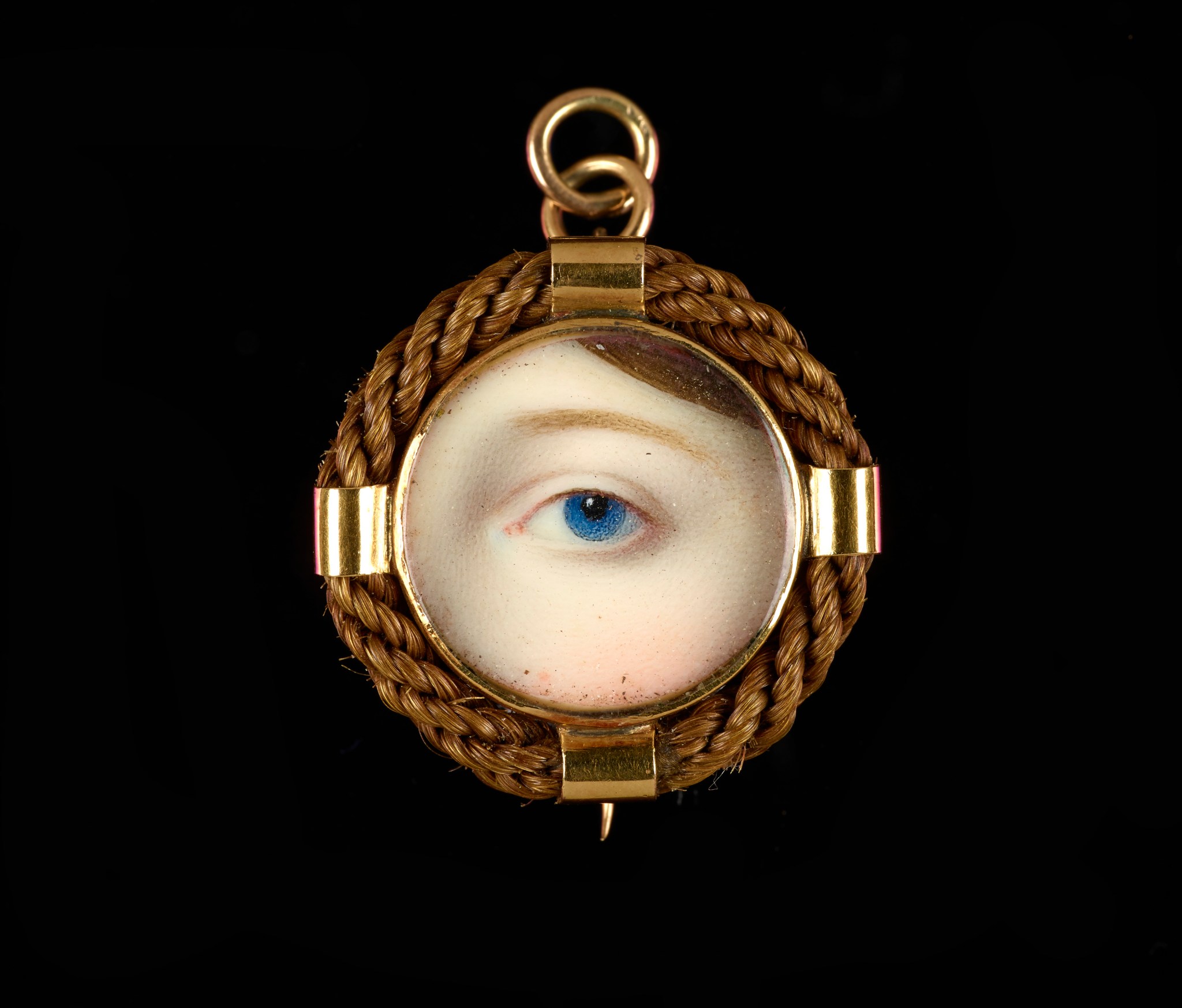
Gold brooch surrounded by a rope of brown hair (ca. 1835), an example of a short-lived craze in England.

King George IV of England was a pretty wild youth, and when he clapped eyes on one commoner that he knew he would never be authorized to marry, he sent her a picture of his love-at-first-sight eye. She sent an eye picture back. They married in secret, a marriage later abandoned.

But England was left with one of those nutty crazes for which it is is well known.

“Lover’s eyes” became a thing. The fact that they were worn close to the heart on lockets and pendants makes me wonder if the antique-locket side of Suzanne’s jewelry business, Luna & Stella, might have come across any.

Lauren Moya Ford reports at Hyperallergic on a new book about a collection of the mysterious miniatures.

“From the moment the Prince of Wales (later, King George IV of England) laid eyes on Maria Firtzherbert at the London opera in 1784, he knew it was love. But Fitzherbert, a Catholic, twice-widowed commoner, knew that British law would never allow their union. She fled to France to escape the future king’s ardor, but Fitzherbert’s absence only inflamed the prince more. In his passion, he sent Fitzherbert a miniature portrait of one of his eyes. She reciprocated with her own eye miniature, and one month later, the two were married in a secret ceremony. The scandalous tale of love at first sight set off a craze for eye miniatures across England that would stretch for nearly four decades. 

“A new book, Lover’s Eyes: Eye Miniatures from the Skier Collection (D Giles Limited, 2021) edited by Elle Shushan, features a richly illustrated cache of over 130 of these bejeweled, hand-painted treasures. Eye miniatures are typically made of painstakingly detailed watercolors on polished pieces of ivory, and surrounded by carved gems, enameled metals, and human hair. These exquisite, enigmatic objects are frequently unsigned, making the majority unattributable to a single artist, and because they depict only a single eye and sometimes a stray lock of hair or eyebrow, the sitter’s identity is also often obscured. …

“Most lovers’ eyes were worn as jewelry, especially on brooches, lockets, and pendants worn close to the heart. Others decorated small functional boxes and etuis used to hold toothpicks, false beauty marks, and other trinkets. Most eye miniatures were exchanged between lovers, though they were also given to close friends and family members. Others were produced as memorial tokens after a loved one’s death. In this case, the eye is often surrounded by clouds to symbolize the subject’s ascent from earth.

“But it wasn’t just the eye itself that carried meaning in these small portraits. An essay by art historian Graham C. Boettcher explains the messages conveyed by the miniatures’ accompanying diamonds, coral, and other gemstones. Pearls, for example, symbolized purity but also tears, and often framed the portraits of the deceased, while garnets represented friendship.

“Another essay by Shusan details the ways that eye miniature artists utilized the language of flowers, or floriography, in their work. For example, a miniature thought to be the eye of Mary Sarah Fox surrounded by foxgloves may be a play on the sitter’s last name, but could also connect the sitter to the energy, magic, and cunning that the flower was then considered to represent. In addition to eyes, some miniatures also featured locks of the sitter’s hair, another fragment of a beloved body to be captured and cherished by the miniature’s owner forever. 

“Although the king later abandoned Fitzherbert for a more legitimate marriage, he requested to be buried with her eye miniature placed directly over his heart upon his death. In this way, he took a piece of his lover — and her watchful gaze — with him to the grave.

Lover’s Eyes: Eye Miniatures from the Skier Collection, edited by Elle Shushan and published by D Giles Limited, is available on Bookshop.”

Photos showing an array of these mementos may be seen at Hyperallergic, here.

Read Full Post »

You know about the Little Free Library movement (e.g., here and at Fake Flamenco, here). And you know about the miniature art gallery that blossomed in Boston at the start of the pandemic (here). But did you know about the Little Free Art Library in Seattle? You may be interested to see how the idea evolved from something the artist had done for her mother. Cathy Free at the Washington Post has the story.

“Stacy Milrany probably runs the only art gallery in the country where visitors are encouraged to walk away with the art. And as far as she knows, her Little Free Art Gallery in Seattle’s Queen Anne neighborhood is likely the only museum where all of the works will fit neatly in a pocket.

“Milrany’s miniature gallery, which opened for public view on Dec. 13, sits five feet off the ground inside a white wooden box in front of her house. The head curator and painter said she based her idea on the popular Little Free Libraries in neighborhoods coast to coast.

‘The idea is pretty simple — anyone is welcome to leave a piece, take a piece or just have a look around and enjoy what’s inside,’ said Milrany, a painter who runs a small, appointment-only gallery featuring her works. …

“Milrany gave her wee museum a contemporary design [and] installed a tiny bench and small plastic people who, she said, appear to be reflecting on the art. The bench and people are part of the permanent collection and not for the taking. …

“Said Milrany, ‘Just the surprise of seeing what people put in there has made this super fun for me.’ So far, she has seen works featuring bulldogs, masked heroes and a chicken farmer, as well as intricate collages and painted seashells.

“It was March 2019 when she first started creating miniature art pieces. … Milrany’s mother had just been diagnosed with cancer and was about to begin chemotherapy treatment in Portland, Ore., about 2½ hours away from her home.

“ ‘I decided if I couldn’t be with her every day she was going through treatment, I could offer a little piece of something via UPS every single day — something made by a human hand to add some brightness to those dark days,’ she said.

“Friends and gallery visitors offered to help when they learned what Milrany was doing for her mother, and together they created 140 pieces of mixed-media pieces of art measuring 4-by-6 inches each. Her mother, who is now healthy, said the daily deliveries helped her to get through the most difficult time of her life, Milrany said.

“When the pandemic took hold in Seattle last year, she decided to expand her idea and paint 500 more small artworks and send them to people who were isolated because of the virus. She called her project ‘Dose of Art.’

“ ‘I put a notice on Instagram and people started asking me to mail them to people who were in nursing homes or their moms or dads who were home alone,’ Milrany said. …

“Then last month, Milrany came up with the idea for her Little Free Art Gallery.

“A carpenter friend helped her build an 18-by-15-inch cedar display case, paint it white and install it on a post out front, along with a sign:

“ ‘Welcome to the smallest free-est art gallery in the world. Have a look around! If you’d like to take a piece, please leave another piece in its place for the next art-lover who comes around.’ …

“ ‘In three days, 10 pieces had come and gone,’ Milrany said. She was a bit saddened, however, to discover that one of her plastic miniature gallery figures — a character she named Chef — had gone missing.

“Milrany posted a sign asking for the return of her ‘4.7 inch chef and arts patron’ — and a week later, an anonymous donor mailed her an entire new set of whimsical plastic people to place inside the museum. …

“Many of the people who tuck artwork inside her gallery are Seattle-area artists, delighted to find a new venue for their work.

“Artist A. McLean Emenegger created a piece that features her grandfather as a young man, enjoying some time with a friend. ‘It’s a nod to joyful abandon,’ said Emenegger, 53, who added beeswax, sewing thread and bits of turquoise and coral to an old family photo for her contribution. … She said, ‘There’s something charming and reassuring about the Little Free Library concept. And translating that into an art exchange is genius.’

“Burton Holt, an artist who primarily creates works with found objects, donated a piece he’d made from colorful rubber bands. ‘The gallery is a real shot in the arm for the neighborhood in these difficult times,’ said Holt, 80, a retired ship captain.”

More at the Washington Post, here. Follow Milrany on Instagram @stacy_milrany_art.

Read Full Post »

gallery-shot-copy-scaled-e1588694198703

Photos: Shelter in Place Gallery
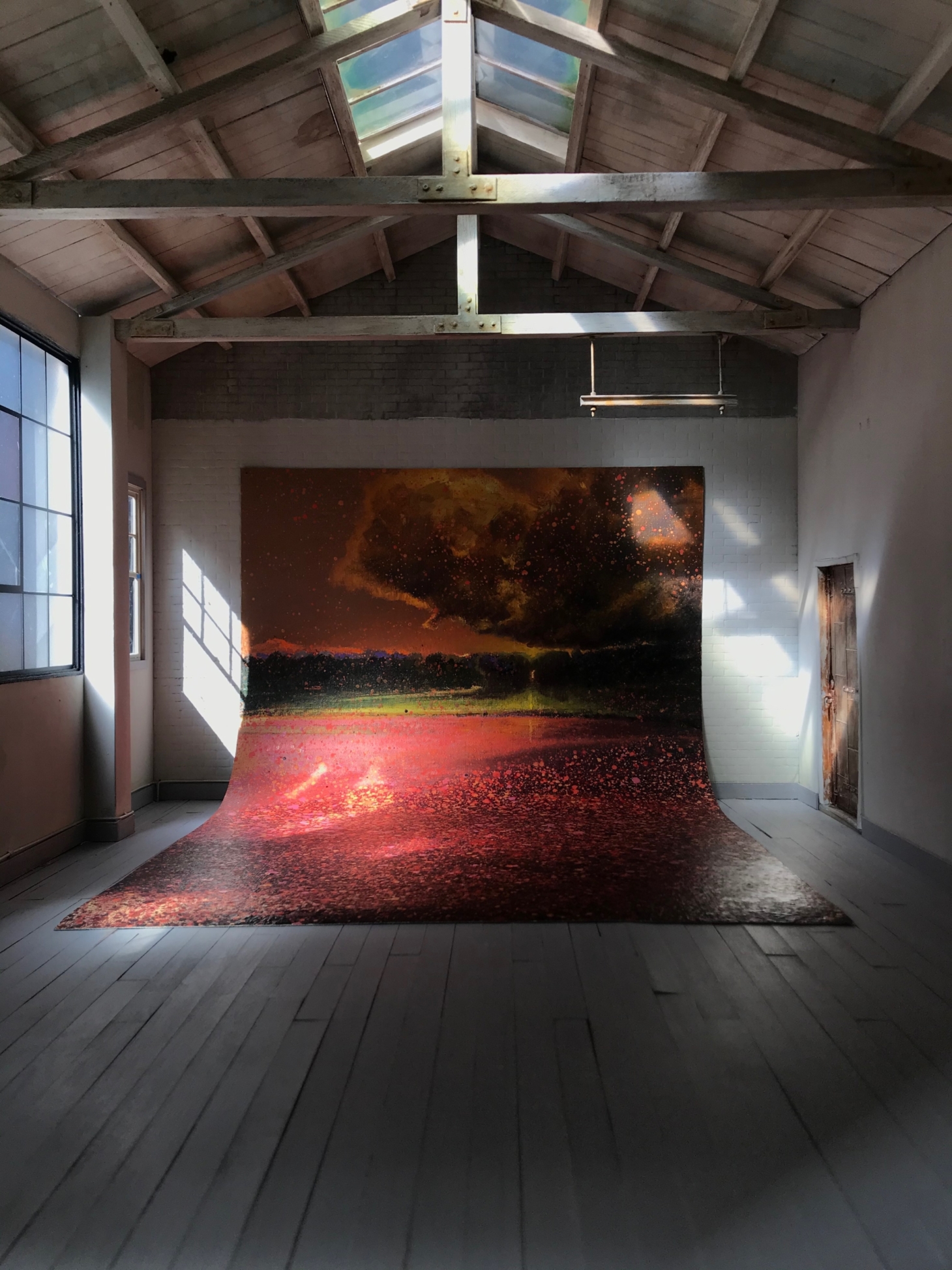
Shelter In Place is a miniature, coronavirus-inspired gallery. It was launched by artist Eben Haines, who built the maquette and invited artists to submit works to scale.

If I didn’t believe that for most of us the lockdown would last a lot longer than the current “opening up” stuff, I’d write a post about happy I am to read books to grandchildren again and how sorry I am to see artists abandon their wildly inventive pandemic pursuits.

But I’m pretty sure most of us will still be self-distancing for many moons and enjoying the output from creative people that might never have happened but for coronavirus. I love following @covidartmuseum on Instagram, for example. Some of the submissions are a little too weird for me, but most of them make me laugh out loud. Another great source is the arts website Hyperallergic, where I recently learned about a miniature gallery called Shelter in Place.

Valentina Di Liscia wrote, “In the past month, a Boston gallery has managed to mount 15 exhibitions of brand-new works, with a rigorous program still to come. With the onset of the coronavirus pandemic, arts institutions around the globe shuttered one after the other; meanwhile, Shelter in Place Gallery [@shelterinplacegallery on Instagram] was not only founded during the crisis but continues to thrive.

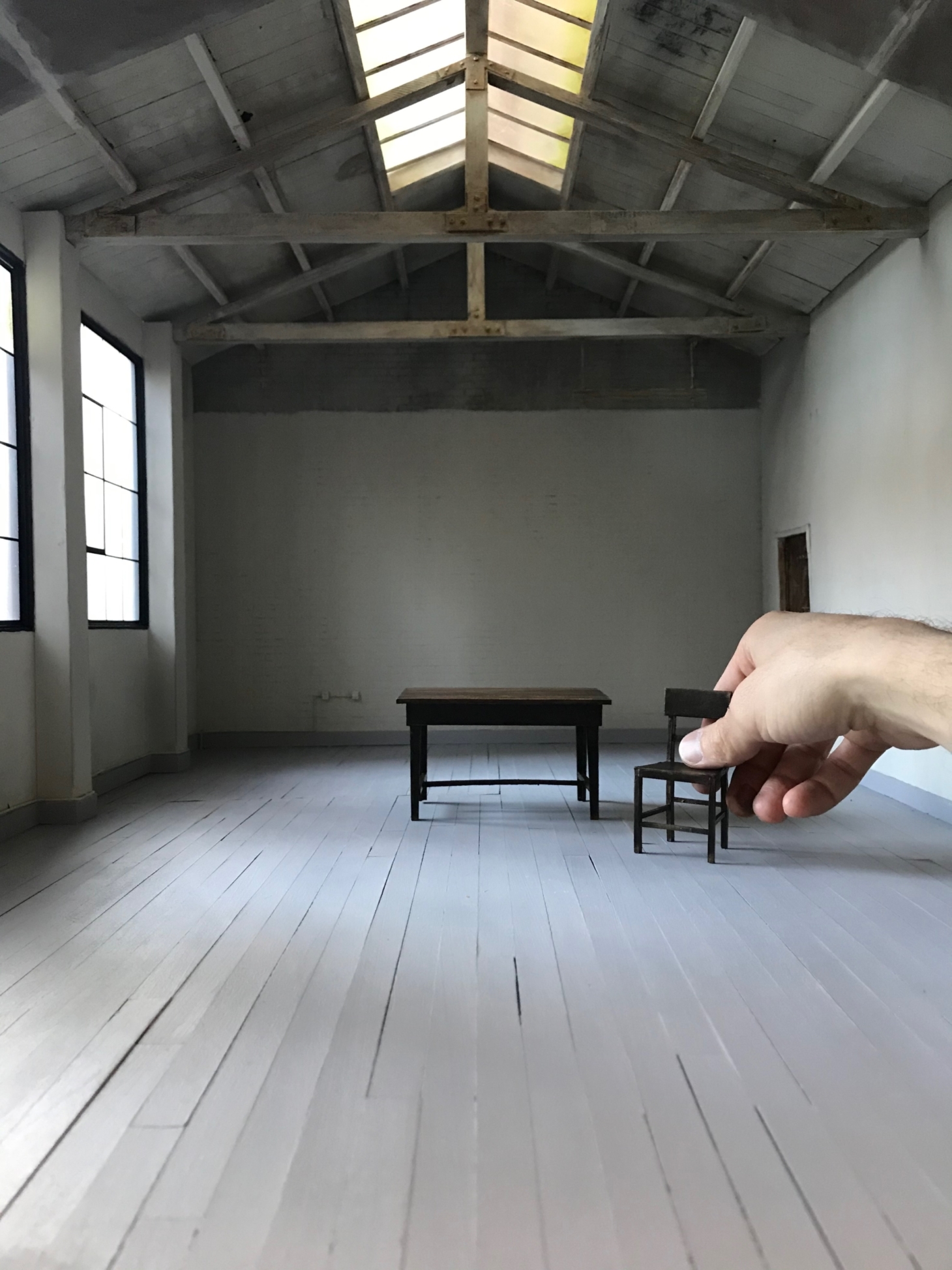
“Of course, there’s a catch. Shelter In Place is a miniature gallery, measuring 20 by 30 inches and exhibiting scaled-down works in a model structure created using foam core, mat board, balsa wood, and plexiglass. Artists can submit works at a 1:12 or one inch to the foot scale, allowing them to create and show even ambitious, seemingly large-scale pieces — a romantic, suspended latex installation by Mary Pedicini; wall-to-wall canvases by B. Chehayeb — while traditional exhibition spaces remain closed. With high ceilings and skylights that flood the space with sunshine, the condensed gallery is impressively lifelike, giving artists room to get particularly creative. …

“The brilliant concept was devised by Eben Haines, a painter and graphic designer for exhibitions at the Museum of Fine Arts (MFA), Boston.

‘With the ongoing shutdowns and lockdowns across the globe, artists are having to stay home … So I’ve built SIP gallery as a new platform for Boston Artists (and eventually from all over) to allow for large scale artworks to be made at a desk or dining room table.’ …

“The idea first came to him back in 2018, long before the pandemic, when Haines was asked to participate in a group show at the Porch Gallery in Minneapolis titled Art Fair. The concept was simple: each artist received a 10-by-10-inch, white-painted MDF box that would serve as an ersatz fair booth where they could show scaled work. …

“Months later, as a rainy day project, he decided to create his own 1:12 scale model to house maquettes for large-scale works that he could not produce in his studio due to space or financial constraints. ‘But then the weather got better, and the more or less abandoned model stayed tucked away in my studio,’ he said.

“Enter the current crisis. Haines was one of more than 300 workers furloughed from the MFA Boston, which closed its doors in March … Haines dusted off the gallery model from years back and began making miniature paintings, initially as a strategy to continue working in his reduced studio space, which had shrunk from 400 square feet to a mere 10. But it dawned on him that other artists might be in a similar predicament, confined to less-than-ideal work conditions and aching to share their creations in a meaningful way. …

“All of the works on view are original, and it prioritizes new pieces as opposed to small copies of existing ones. Digital copies are all but prohibited. … So far, all works have arrived ready to be hung, which has made installations easier. …

“Haines emphasizes the project is not commercial; instead, any sales inquiries received are rerouted to the artists themselves, or to their galleries. Nicole Duennebier’s exhibition, for instance, nearly sold out before they could deliver the mini-paintings back to her gallery, 13FOREST. …

“Said Haines. ‘One of my ambitions for this project, besides urging people to step outside of their crisis mode for a little bit, is for artists to be able to use their submission proposals and photographs of their installed work to send to galleries, residencies, or grant programs, and have some momentum when the country opens back up. …

” ‘We’re honestly so busy with the local response we’ve had that it seems daunting to open it up, but once going to the post office gets a little safer and easier, I’d love to be able to show work from outside Boston,’ said Haines.”

Read the whole article at Hyperallergic, here. The pictures are amazing.

Wilhelm Neusser, “Untitled Bog Painting” (2020), oil on linen, a miniature.

wilhelm-neusser-copy-scaled-e1588694217782

Read Full Post »

paper_theaters_the_home_entertainment_of_yesteryear_1050x700

Photo: Wikimedia
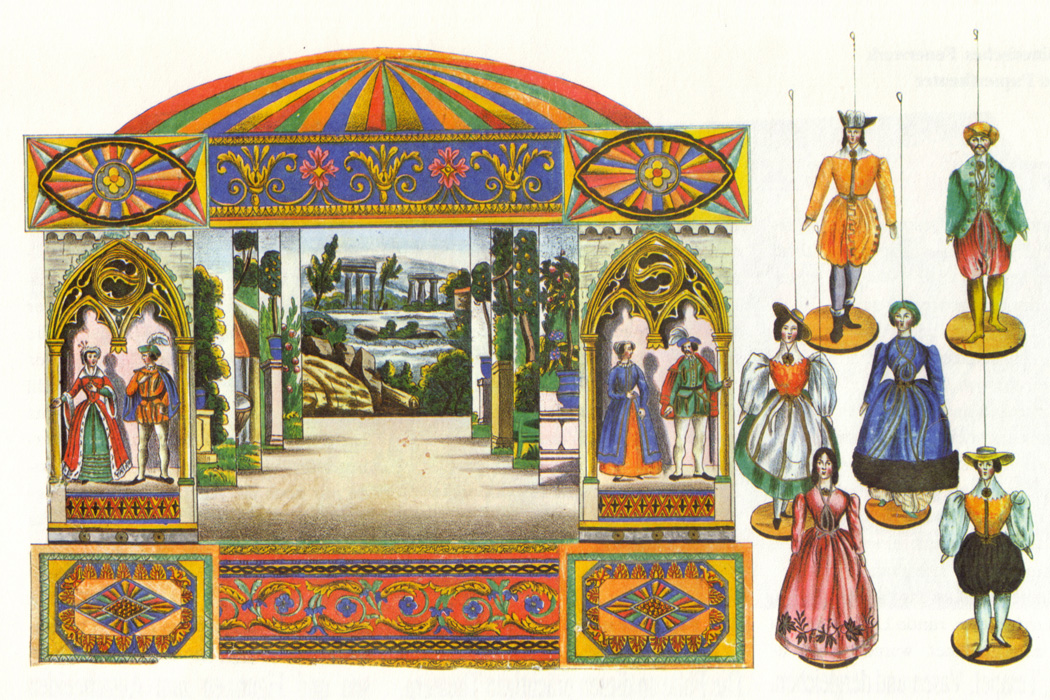
Paper theaters like the one above were popular with children in England in the 19th century. Robert Louis Stevenson never forgot his.

Children love to put on plays. I know I did, and I see my own grandchildren acting out stories as if on “The Stage.” One form of children’s theater, popular in England in the 19th century, involved paper cutouts.

As Amelia Soth writes at JSTOR Daily, “In the Regency era (early 1800s), live theater was so popular that it regularly inspired riots. In 1809, when the Covent Garden Theater tried to raise ticket prices, audiences were so incensed that they revolted. For more than two months straight, they shouted, shook rattles, rung bells, and even brought pigs into the theater to drown out the actors. The protest was successful, and the administration gave up on the price hike. …

“People were hungry for entertainment. And in this time before Netflix and YouTube, enterprising toymakers developed a novel way to bring entertainment into the home: paper theaters. For ‘one penny plain, two cents colored,’ you got a tiny cardboard stage about the size of a paperback book, complete with a proscenium arch, curtains, and sometimes even a paper audience. The characters were laid out on sheets of paper, frozen in dramatic poses: villains brandish revolvers capped with clouds of gunpowder, jolly sailors hook arms and dance, clowns emerge from barrels. …

“Then there are the sets, storybook illustrations of extravagant palaces and howling wildernesses, to be slotted in and out of the back of the theater, behind the cavorting characters. The scripts that came with them were as miniaturized as the stage, heavily abridged and censored for children’s ears and attention spans.

“Despite the scripts, it’s easy to imagine how these stories would have expanded in the hands of the children who played with them — how the plots would zigzag, how the characters would migrate from one story to another, how scribbled additions would enrich the pre-drawn scenery.

[When] Goethe’s son August put on shows in his paper theater, the family cat always served as one of the performers. …

“The magic of the paper theater was not that it allowed children to replicate a beloved play in their home; it was that it provided them with the raw materials either to copy or create, to follow or subvert, as they saw fit.

“Perhaps this is why this short-lived children’s toy left such an enduring cultural legacy. Before Robert Louis Stevenson wrote Treasure Island, before Jean Cocteau directed his iconic, dreamlike Beauty and the Beast, before Wagner composed his Ring Cycle, they each acted out their big stories on these tiny stages.

“As the literary scholar Monica Cohen points out, Stevenson’s Treasure Island reads almost like a paper-theater drama writ large. Pirates were an unshakeable cliché of Victorian melodrama, and the grim tales of cruelty and violence that featured on the Victorian stage were brightened into candy colors in their miniature theater editions. Likewise, Stevenson’s dashing pirates come to us filtered through a sunny lens. ‘As a toy theater pirate,’ Cohen writes, ‘Billy Bones is a copy of a copy.’

“Remembering the shop where he purchased toy theaters in his youth, Skelt’s Juvenile Drama, Stevenson wrote: ‘Every sheet we fingered was another lightning glance into obscure, delicious story; it was like wallowing in the raw stuff of story-books. I know nothing to compare with it save now and then in dreams, when I am privileged to read in certain unwrit stories of adventure, from which I awake to find the world all vanity.’

“He continued, ‘What am I? what are life, art, letters, the world, but what my Skelt has made them? He stamped himself upon my immaturity. The world was plain before I knew him, a poor penny world; but soon it was all coloured with romance.’ ”

Read more here.

Read Full Post »

The Concord Museum has an exhibit on dollhouses right now, and I walked over to check it out. I’ve always liked dollhouses and even sought out one for Suzanne  when she was in utero.

At the museum, children were playing happily with the sturdy contemporary dollhouse they were allowed to touch, but I suspect the people most intrigued by the glassed-in displays from the Strong Museum and various private collectors were the adults.

The Concord Museum is a history museum, and so I was less troubled by the accurate recreation of inequality in the miniature scenes than by the lack of relevant commentary in the placards. I couldn’t help thinking, for example, that some of the black schoolchildren who pass through the museum might be troubled by one dollhouse and might appreciate some discussion of the life of the servants in the attic and kitchen. But the placard was silent about wealth, poverty, and the legacy of slavery.

Another aspect of social history that seems fundamental to a discussion of dollhouses involves the many women who created them as a hobby.

Women who had servants in the attic and the kitchen were not folding the laundry. They were not cooking or tidying up. They were not raising their children. They did not have jobs. In short, they had almost nothing useful to do — a recipe for depression.

I often wonder about the psychological constraints that kept such women from giving themselves permission to go out into the world, as Jane Addams or Beatrix Potter did, each in her own way.

If making exquisite little worlds at home gave the dollhouse creators and their friends and families pleasure, that is a great thing in itself. If it represents a determination to create something fine when hardly any meaningful activity was allowed, then that is an even greater thing.

The dollhouse exhibit is up through January 15. Related events may be found here.

122916-dollhouse-reflects-unequal-history

122916-racial-inequality-in-dollhouse

Read Full Post »

Cultural institutions are getting smaller. And more local.

We wrote about a library in a phone booth here and the Little Free Library here. You can see fully realized short films on YouTube and street art just around the corner.

Now folks in Somerville have launched a museum in a doorway. It’s The Mµseum.

From the website: “Judith Klausner (Co-Founder, Curator) is a Somerville MA artist with a love for small, intricate, and overlooked things. She first dreamed up the Mµseum in 2010, as a way to combine her love of  serious miniature art with her passion for making art accessible, and her conviction that New England arts institutions should show the work of New England artists. Three years (and a lot of planning) later, she is delighted to see it become a reality. … Contact Judith at judith@themicromuseum.com.

“Steve Pomeroy (Co-Founder, Engineer) is a programmer and a builder, both by profession and by nature. He’s largely responsible for the engineering behind the Mµseum, from the solar-powered miniature track lighting to the 3D-printed doric columns and laser-cut façade typography. He formally studied computer science at the Rochester Institute of Technology where he discovered a love of communication protocols and formal computer languages. Contact Steve at steve@themicromuseum.com.”

WBUR had a story on the micro museum here.

There is something childlike and innocent about miniature enterprises. Didn’t you always think as a child you could take a few toys and tea cups and bags of flour and new sponges from around the house and set up a table on the street as an authentic store? You thought, Why not? Just do it.

I get a kick out of people just doing it.

Photo: Mara Brod, http://marabrod.com/fineart.html

Read Full Post »