Feeds:
Posts
Comments

Posts Tagged ‘morocco’

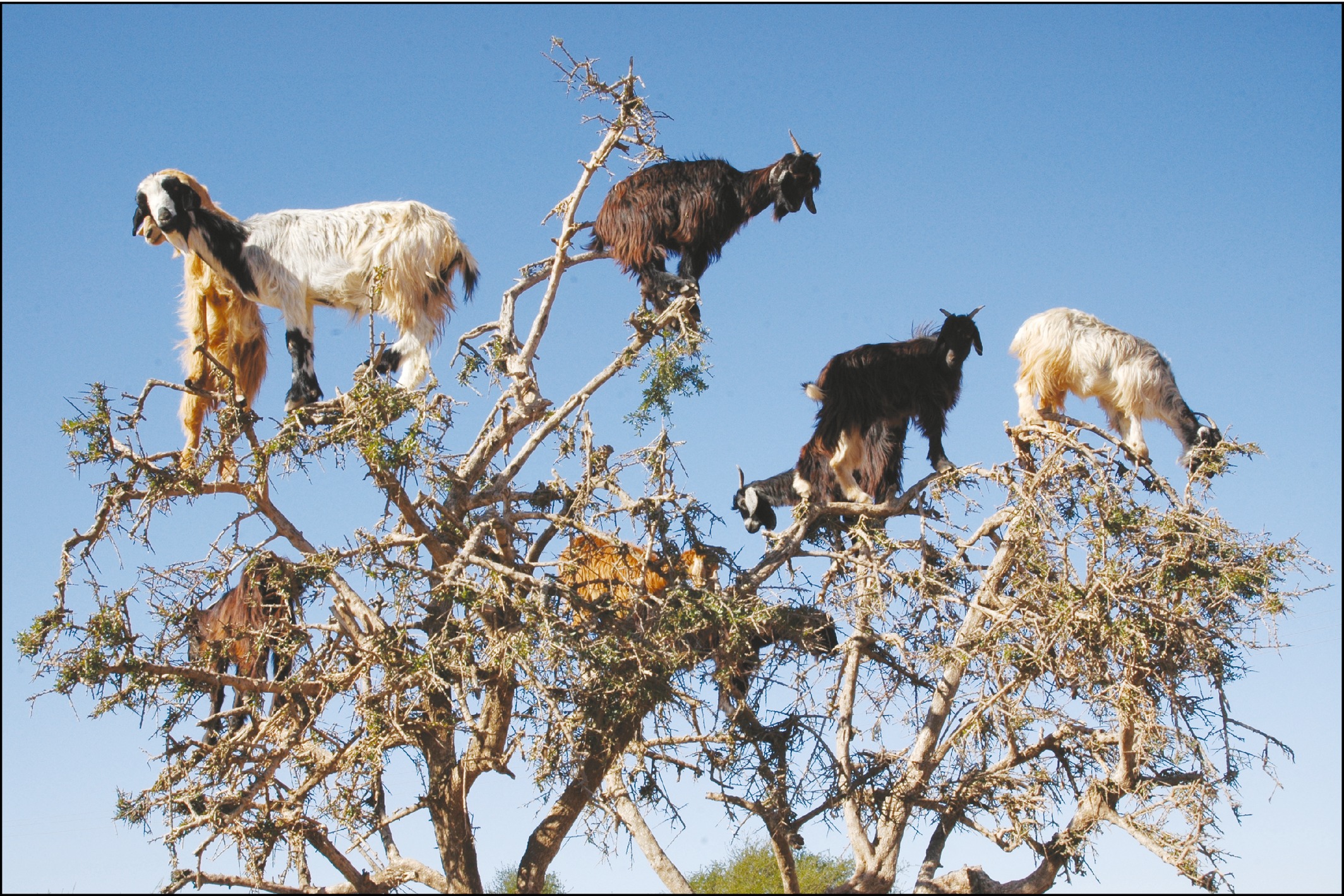
Photo: H Garrido/EBD-CSIC.
Goats grazing on an argan tree in southwestern Morocco. They disperse seeds during rumination, which is one of the ways the trees extend their presence.

When I first saw the picture above, I knew I needed it for the blog. An internet search revealed plenty of touring companies that offer customers photo ops with climbing goats.

But there is more to these guys than that.

Here’s a study by Miguel DelibesIrene Castañeda, and José M Fedriani from an Ecological Society of America journal called Frontiers in Ecology and the Environment. It explains that the goats’ role on the planet goes beyond being cute.

“Most people are familiar with domestic goats (Capra hircus) climbing on rocks,” the authors write, “but few know they are talented tree climbers too. In temperate countries where green pastures abound, goats do not need to climb trees to forage, but in arid regions the only available forage is sometimes found on the tops of evergreen shrubs and trees. Furthermore, goats often like seasonal fruits and collect them directly from fruiting trees when fallen fruits have been depleted.

“In southwestern Morocco, where the average annual rainfall is only 300 mm (~12 inches), goats climb the endemic argan tree (Argania spinosa).

Herders assist kid goats in learning to climb and even occasionally prune the trees to facilitate climbing.

“During the autumn, when herbaceous vegetation is lacking, goats devote 74% of their foraging time to ‘treetop grazing.’ …

“We previously observed Spanish and Mexican goats grazing on short trees or shrubs, but in Morocco we were astonished to see between 10 and 20 goats regularly climbing thorny 8–10-m-tall argan trees, mostly defoliated after intensive grazing. The purpose of our research was to verify that goats regurgitated the nuts of argan fruits while ruminating. …

“Argan forests are ecologically and economically important in southern Morocco, which is a developing country. The forests serve as an effective barrier for the Saharan Desert and provide local people with wood, fodder for livestock, cooking oil, medicine, and cosmetic materials. …

“To extract the oily kernels, the fleshy pulp of the tree fruits must first be removed and the hard nuts broken manually. Most popular accounts [say] that to remove the pulp, traditional Berbers feed the fruit to goats so the nuts pass through the digestive system and the seeds can be collected from the manure. However, goats do not usually defecate large seeds, so we were skeptical. …

“We wondered whether goats, which are ruminants, might spit out the nuts while chewing their cud, as we had seen goats do when fed with olive (Olea europaea) and dwarf palm (Chamaerops humilis) fruits in Spain (unpublished data). Moroccan goat herders confirmed that goats regurgitated most argan nuts while ruminating, although regurgitations and excrement found on the ground are usually mixed, resulting in misunderstandings about the way the nuts were expelled.

“Why is it important that goats regurgitate and spit out seeds from the cud? For plants there are well-known reproductive benefits associated with dispersing their seeds far from the maternal parent, including a greater probability of seed and seedling survival. To successfully disperse, many plant species produce edible fruits that attract frugivorous vertebrates, which ingest the fruits and transport the seeds inside their body until they are released elsewhere by regurgitation or defecation. …

“The possibility of ruminant ungulates spitting out some viable seeds from the cud is not even mentioned in [many] comprehensive reviews. … To illustrate the potential of domestic ruminants to spit viable seeds from their cud, we supplied Spanish domestic goats with fruits differing in size and structure, corresponding to five species (six varieties) of plants, including five drupes or pomes (fleshy fruits) and one legume (pods). …

“For all the plant species, we recovered appreciable numbers of seeds that the goats had regurgitated, despite not being able to find all of the seeds, since the goats were not subject to controlled conditions. As might be expected, larger seeds were more frequently spat out during rumination. …

“Our observations suggest that almost any seed could be ejected during mastication, spat from the cud, digested, or defecated. We tested the viability of regurgitated seeds by incubating them in a solution containing tetrazolium chloride; the embryo and endosperm of most seeds (71.5%) were stained red, indicating they were viable after processing by goats. …

“In conclusion, many previous studies that investigated the role of ruminants as seed dispersers were based exclusively on dung analyses and may have underestimated an important fraction of the total number of dispersed seeds. Moreover, this fraction of seeds should correspond to plant species with particular fruit and seed traits (eg large linear dimensions) differing from those of plant species dispersed exclusively or mostly through defecation. Importantly, the seeds of some species are unlikely to survive passage through the ruminant lower digestive tract so that spitting from the cud may represent their only, or at least their main, dispersal mechanism. It is therefore essential to investigate the effectiveness of this overlooked mechanism of seed dispersal in various habitats and systems.”

Don’t you love the language they use? “Processing by goats”! More at Ecological Society of America, here. No firewall. I have removed citations, so check out the original if you want to know who discovered what.
Read Full Post »

Photo: Taylor Luck
Bargaining over a Berber rug in Khemisset, Morocco.

Yesterday I mentioned to Nancy that the pandemic may have affected the timeliness of some of the stories I’ve collected for future blog posts. I wasn’t sure, for example, if the Berber women who weave carpets and manage their markets in Morocco were still working.

Today I found a late May report indicating the weavers work from home and continue to produce for export companies despite Covid-19 lockdowns. So I think I can share this article from the Christian Science Monitor. When it’s safe to return to public spaces, I’m counting on women like these to be fully in charge once again.

Taylor Luck writes, “The carpet palace is at the far end of the bustling, dusty, weekly outdoor market here. Past heaps of wheat and grain, mounds of clothes, and piles of sandals and animal feed is a rust-colored structure with vaulted archways and bushels of thread and fabric.

“But visitors drawn by the allure of Berber rugs of every hue must abide by one important law: Inside this palace, women rule.

“For here at Khemisset’s zarabi souk – literally ‘rug market’ – women are the shearers, weavers, mediators, sellers, and distributors. There is no room for men in their business model – and they like it that way.

“Moroccan connoisseurs know their straight-from-the-source products: the minimalist, black-and-white geometric weaves of the Beni Ourain; the colorful reds, blues, yellow symbols, and wavy lines of the Azilal tribe; patchwork confetti-like Boucherouite rugs of leftover textile scraps; the blue-and-red, lightweight, tightly-nit kilims.

“Anyone who wishes to fill their tourist bazaar, auction house, hotel, or travel bag with these intricate multicolor Berber rugs must first go through these merchant matriarchs. … The women of Khemisset know more than their carpets; they know how to drive a hard bargain.

“Situated 60 miles east-southeast of Rabat and nestled in the plains below the Berber-inhabited Middle Atlas Mountains, Khemisset is a bilingual town of Berbers and Arabs. It has long been a natural trading post where Berber farmers and craftswomen from the mountain villages and rural hinterlands sell to urban, mainly Arab clientele. For the past three decades, women from the town have teamed up with relatives and contacts from the outer villages to sell carpets and rugs directly to vendors. …

“Khemisset merchants such as Fatima Rifiya gather at the marketplace to await dozens of women from far-off Berber villages (locals refer to themselves as Amazigh, which means ‘free people’) who arrive in horse-drawn carriages at 4 a.m.

“The sellers and middle-women then rummage through the piles of rugs, evaluating every piece by size, coloring, thickness, weave, and pattern. Khemisset women say their secret to success is an eye for desirability – fitting each carpet to the target audience and buyer who never knew they always needed it. …

“ ‘Once we grade the carpets, we explain to the weavers the values and who their customers may be, [and] we set a price and our commission,’ explains Ms. Rifiya, herself a transplant from a mountainous Berber village who now acts as a head matriarch and an Arabic translator. …

“Carpet dealers come from Marrakech and Fez. The men pace between the tiny stalls muttering, ‘Really, that is too much,’ or, ‘I swear to God, I can get half that price somewhere else.’ But Ms. Rifiya and her sisterhood stand their ground. She and some of the more veteran sellers such as Faten act not only as translators for the Berber weavers, but as coaches in the ways of bartering and selling.

“Simple rules such as: Never appear desperate for a sale. Let the customer walk away, they’ll always come back. Add 20% to your preferred price to open up bargaining. …

“This souk is not sponsored by a charitable association, a collective, or even a government or royal initiative to help rural women. Instead, it is an organic, grassroots product of local residents and shared interests.

“Here at the zarabi souk, women are selling individually yet banding together – an alliance driven by economic opportunity, supply and demand, and a dash of solidarity.

“It was not always like this. Three decades ago, most Berber weavers say they would sell to middlemen who would go off to market towns and sell at any price they wished, or to traveling ‘dealers’ who would purchase directly from village women for their bazaars and tourist shops. But each Berber woman would not know how much others were being paid for their work or what the market rate was for their carpets.”

Sounds like this market has made a real difference in people’s lives. Here’s hoping that post-Covid, these strong women will see to it that everything goes back to normal. More at the Christian Science Monitor, here.

Read Full Post »

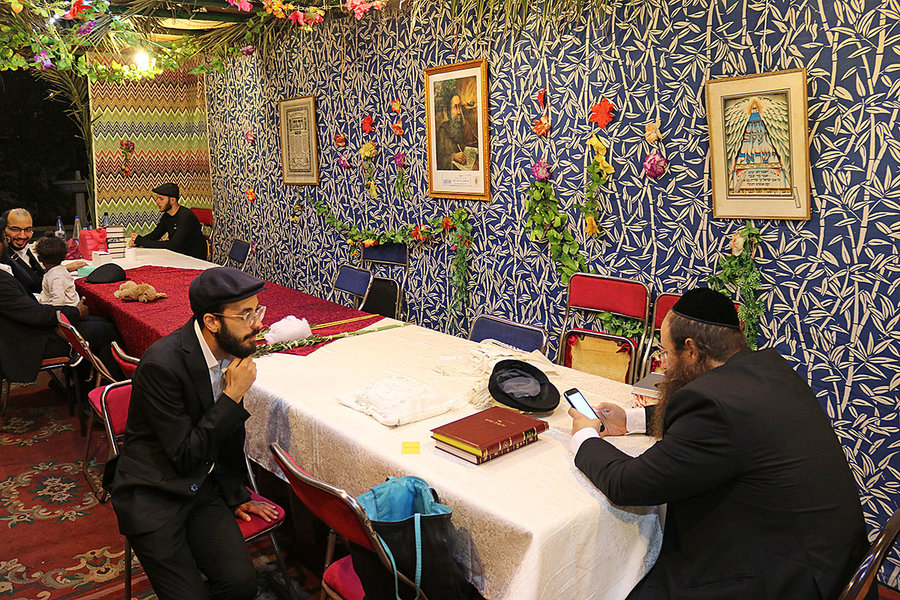
110520maghreb20jews20yashiba

Photo: Taylor Luck
Yeshiva students are seen studying in a Casablanca sukkah hut last October. “Jews and Muslims have a long history of amity in Northern African countries like Morocco and Tunisia,” says the
Christian Science Monitor.

It seems to me that when people want to get along, they do. In the following story, we see how two religions usually depicted at odds have coexisted comfortably in Northern Africa for generations. What isn’t clear to me is how communities can start this kind of positive relationship if they haven’t had it before. There has to be a way.

Taylor Luck reports at the Christian Science Monitor from Morocco, “Even as congregants recite evening prayers at Temple Beth El, the Muslim call to prayer rings out from minarets across the city and into the courtyard, a mix of Arabic and Hebrew filling the dusk sky with praises to God. And as the yeshiva students file out of Beth El (literally, House of God), Mohammed, the gatekeeper, kneels down in Muslim prayer at the synagogue’s entrance.

“This is not a mirage; this is Casablanca. After decades of economic migration and geopolitical tensions that reduced North African Jewish communities from hundreds of thousands to a few thousand people, hope is being rekindled in Morocco and Tunisia that as Jews keep the light of their communities alive, so too does the region’s unique model of Muslims and Jews living side by side.

“For even in a time of global polarization, Moroccans and Tunisians are proving that historical bonds bind, rather than divide, Jews and Muslims, whose shared past they say paves the way for a shared future. …

“In Morocco, a country that is 99% Muslim, whose monarch carries the title ‘commander of the believers,’ a distinct Hebrew culture nevertheless permeates practically every town today. … Moroccans will be quick to tell you that this is not only Jewish heritage, but Moroccan heritage.

“ ‘We have Jewish life from the cradle to the grave in Morocco,’ says Zhor Rehihil, an anthropologist specializing in Moroccan Judaism and curator of Casablanca’s Museum of Moroccan Judaism. …

“King Mohammed VI has promoted the return of the Moroccan Jewish diaspora and Israeli tourism to the country, funding the preservation and renovation of 162 ancient Jewish cemeteries and several synagogues across the country. Under Moroccan law, anyone with Moroccan Jewish ancestry can claim citizenship.

The preamble to Morocco’s 2011 post-Arab Spring constitution enshrines Moroccan Jews as integral to the national fabric, stating that Morocco ‘is a sovereign Muslim state … whose unity is nourished and enriched by its African, Andalusian, Jewish, and Mediterranean constituents.’ …

“ ‘Visiting Arabs and Israelis see the atmosphere in the [Casablanca] streets, signs in Hebrew, Jewish and Muslim families living together in the same apartment building, and they can hardly believe it,’ says Serge Berdugo, secretary-general of the Council of Jewish Communities of Morocco and a community leader. ‘But the fact is, it is not a slogan or some dream, it is daily life for us, and that is a model we need to preserve for the world.’ ”

Meanwhile in Tunisia, “The demand for kosher meat – seen as even more meticulously prepared than by Islamically halal butchers in the capital – is high among Tunisian Muslims as well as Jews.

“On a rainy Friday this October, men and women lined up at the kosher butchery of Amran Fennech, the store name in Hebrew and Arabic, red spicy merguez sausage hanging from the storefront. Ask anyone in central Tunis; hands down, Amran has the best cuts in town. …

“ ‘We are Jews and we are Tunisians – we have specific cuisine, a specific dress, and a specific way of life – you can’t separate one from the other,’ Mr. Fennech says. …

“Historians say the high-water mark of Jewish-Muslim relations may have been over a millenium ago at the time of Al-Andalus, or Islamic Iberia, when the Muslim empire stretched across the Mediterranean to modern-day southern Spain.

“Jews and Muslims had become an intertwined community that was a beacon of science, philosophy, art, and enlightenment while much of Europe was in the Dark Ages. They flourished as the leading scientists and writers: philosopher Moses ben Maimon (Maimonides), diplomat and physician Abu Yusuf ibn Shaprut, poet Moses ibn Izra. …

“For Tunisia’s Jews, communal tensions arose in the second half of the 20th century amid regional crises and the birth of Israel. …

” ‘Every time there was a war in the region, tensions would increase and certain people would direct their anger toward their Jewish neighbors,’ says one 50-year-old Jewish resident, preferring not to speak in the name of the community.

“But in the 21st century, particularly after the 2011 revolution, Jewish Tunisians say they have noticed a marked difference. …

“ ‘At the time of the revolution, there were bigger issues than the Jewish community and the question of Israel; the troublemakers left us alone,’ says Mr. Fennech, the butcher. ‘Now we are all living in a new Tunisia together.’ …

“Officially there are no diplomatic relations between Morocco and Israel, forcing Israeli visitors to receive visas in a third-party country such as Spain. Israeli tourists to Tunisia must fly to the island of Djerba; there are no direct flights to Tunis. But Israeli and European Jewish tourism to Morocco and Tunisia is on the rise; as is the demand for kosher foods and Jewish religious tourism experiences. Locals hope visitors come away with a lesson as well.

“ ‘For the good of the community, for the good of the world, for the good of Morocco, and for the good of Judaism, we must remain to maintain this link between peoples,’ says Mr. Berdugo, the Moroccan community leader.”

More here.

Read Full Post »

In a recent NY Times article, art critic Holland Cotter expressed skepticism that a show of new artists lumped together as “Arab” could work. (Some artists declined to participate for the same  reason.)  The artists in the New Museum exhibit are from “Egypt, Iraq, Jordan, Kuwait, Lebanon, Morocco, Saudi Arabia, Syria, Tunisia and the United Arab Emirates, not to mention Europe and the United States.”

But in the end, he was thrilled with the opportunity to see the new works.

“It’s a big show, intricately pieced together on all five floors of the museum, and starts on the street-level facade with a large-scale photograph of an ultra-plush Abu Dhabi hotel. The image was installed by the cosmopolitan collective called GCC, made up of eight artists scattered from Dubai to London and New York who make it their business to focus on the preposterous wealth concentrated in a few hands in a few oil-rich countries on the Persian Gulf.”

Cotter goes on to describe many of the pieces in detail, here, and concludes with some advice for visitors.

“To appreciate this show fully, a little homework can’t hurt. But really all you need to do is be willing to linger, read labels and let not-knowing be a form of bliss. In return, you’ll get wonderful artists, deep ideas, fabulous stories and the chance, still too seldom offered by our museums, to be a global citizen. Don’t pass it up.”

The show will be up until September 28.

Photo: Ruth Fremson/The New York Times

“Here and Elsewhere” show at the New Museum

Read Full Post »

Judith Ross has a beautifully written and photographed WordPress blog she calls Shifting Gears. Recent posts have covered a visit with her younger son, who is a Peace Corps volunteer in Morocco.

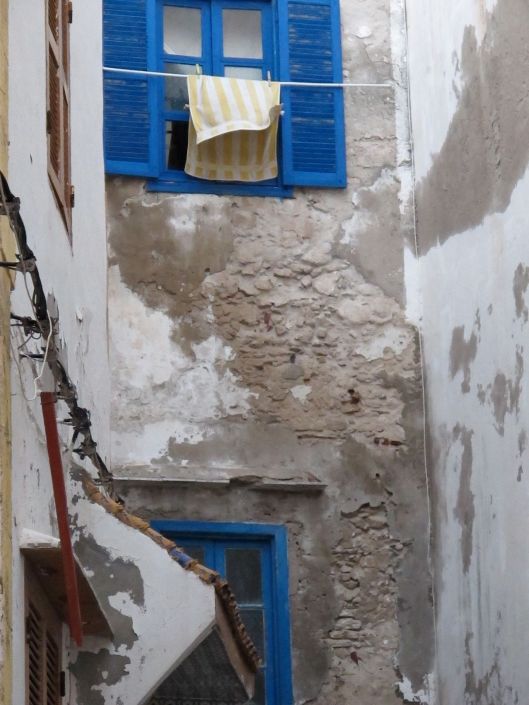
I was particularly taken with an entry in which Judith captures a luscious blue color that is reiterated all over one picturesque town, on everything from fishing boats to bread baskets.

She writes that one morning, she and her husband and son “climbed into our rental car and headed to Essaouira, a beach town. Much less intense than Marrakech, it was a good place to start our journey. [Our son] has friends there, who are also in the Peace Corps.

“The name of the riad where we stayed, Les Matins Bleus, reflected the town’s color scheme. …

“At the docks you can buy fish directly from the fishermen. Then, back in the medina, stop at the market for vegetables, before taking these purchases to a restaurant where they grill your food to perfection and serve it to you with bread – which also functions as your knife, fork, and spoon.” More.

Photo: Judith A. Ross

Read Full Post »

Today I walked down to 300 Summer St. for one of the Channel Café’s great lunches and to see the latest in the Fort Point Arts Community Gallery.

The exhibit, a touring show organized by Terra “Touria” Fuller, features unusual carpets woven by Zahra, a cave-dwelling nomad in Morocco, and Mouhou, a subsistence farmer.

Touria also created a documentary. In “Living with Barbarians and Cave Dwellers … Fuller moves to the pre-Saharan desert plains of Morocco from 2008-2010 and integrates into an Amazigh village and learns the survival skills necessary to live with a family of cave-dwelling nomads on the edge of the village. Over two years, she follows along and documents their lives. This is a rare look into a private and fiercely independent nomadic people made possible by the patient friendship Fuller built with the villagers and cave dwelling society.”

More about the Boston show here.

Touria also is bringing two master weavers on tour this year, and you can learn about that at Kickstarter.

Read Full Post »