Feeds:
Posts
Comments

Posts Tagged ‘Netherlands’

green-bus-stop

Photo: The Independent
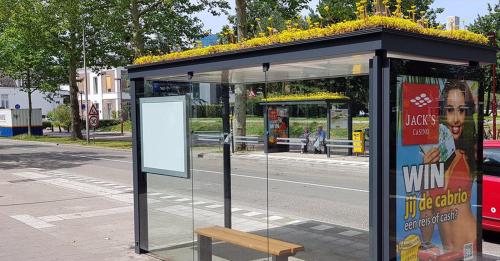
Holland is welcoming bees to bus-stop roofs with plants that also clean dust from the air.

Here is a cool idea for nourishing our valuable pollinators — as long as you’re not allergic to bee stings.

Sophie Hirsh at Green Matters has the story. “Waiting for the bus is typically pretty uneventful — unless you live in one Dutch city. Utrecht, a city in Holland, the Netherlands, recently gave makeovers to 316 bus stops, outfitting them with ‘green roofs,’ The Independent reports. The roofs are covered with sedum flowers and other plants, which act as an oasis for bees. …

“As explained by BrightVibes, the plants will also help absorb rainwater, capture dust or pollutants from the air, and regulate temperatures. …

“In addition to the green roofs, the bus stops also feature bamboo benches and LED lights, which are much more efficient than fluorescent and incandescent lights. And to keep the maintenance of the green bus stops as eco-friendly as possible, Utrecht’s municipal employees who service the bus stops travel from station to station using electric vehicles.

“If Utrecht citizens find themselves inspired when waiting for their daily bus ride, the city is encouraging residents to install green roofs on their houses. In fact, Utrecht residents can actually apply for a subsidy to cover the costs of planting greenery on their roofs, according to BrightVibes. …

“According to the USDA, bee pollination assists in producing one out of every three bites of food we take in the U.S. Many foods we regularly enjoy would not be possible without bees. According to the NRDC, 42 percent of U.S. bee colonies collapsed in 2015, putting our nation’s food supply in jeopardy.

“But over the past few years, there have been a few other local projects to protect bees around the world. For example, in 2010, a German couple began installing bee hives on buildings around Berlin, with the goal of helping bees, as well as creating awareness for the importance of protecting pollinator insects. …

“If you have a garden at your home, there are plenty of ways to use your outdoor space to help bees and other pollinators. For example, you can plant flowers that will attract bees, such as alyssum, echinacea, geranium, and clover, preferably in bright colors like blue, purple, and yellow, according to Gardeners Supply Company. You can also stop weeding your garden and mowing your lawn. As explained by the New York Bee Sanctuary, dandelions and other weeds are great food sources for bees.”

More here.

Photo: GreenMatters.com
Pollinator gardens on bus-stop roofs offer numerous environmental benefits.
bus-stop-bees-1562873127347

Read Full Post »

Photo: Nederlandse Spoorwegen
A special book given out as gift to readers during National Book Week is accepted instead of a ticket on the train.

The Dutch seem to be ahead of the curve on many things. I’ve posted about their friendly communities for people with dementia, about their environmental innovation, about their biking culture. This story is on their support for reading books.

Jon Stone writes at the Independent, “Dutch book lovers got free rail travel across their country’s entire network [in March] as part of the Netherlands’ annual book week celebrations.

“Every year since 1932 the Netherlands has encouraged reading with Boekenweek – a celebration of literature marked with literary festivals and book signings across the country.

“Traditionally, a well-known Dutch author writes a special novel – the ‘book week gift’ or Boekenweekgeschenk – which is given out for free to people who buy books during the festivities or sign up to a library.

“But the special book – this year the novel Jas Van Belofte by celebrated author Jan Siebelink, can also be presented instead of a rail ticket on every train in the country on the Sunday of book week.

“Nederlandse Spoorwegen (NS), the Dutch state railway company, has long been a sponsor of the annual festivities – and even organises book readings signings by top authors on its trains.

” ‘It is good to see all those happily surprised faces of travellers,’ author Jan Siebelink said after boarding a train for the city of Utrecht to meet passengers and read his book. …

“This year the book week gift was given out by bookshops to anyone who spent €12.50 on Dutch-language books.” More here.

And check out this cool article by Feargus O’Sullivan at CityLab, in which he describes a wide array of unusual ways to pay fares — ideas from all around the world.

Because of a problem with rail passes, he writes, England’s Virgin Trains let people pay with an avocado for a while. And “Indonesia’s second city, Surabaya, came up with a novel way of clearing its streets of plastic waste last autumn: It has been encouraging passengers to trade in trash for bus tickets.”

Among other creative approaches, Russia promoted the Winter Olympics by offering passes for doing a certain number of squats, Berlin partnered with Adidas to offer sneakers with a pass in the tongue, and Japan started experimenting with cryptocurrency.

Can you think of other ideas cities should try? Maybe on Giving Tuesday, transit systems could allow free travel for proof you gave to a charity.

Read Full Post »

Photo: Eric Helgas for the New York Times
Tiny books, called dwarsliggers in the Netherlands, are the size of a cellphone and feature extremely thin pages that a reader can flip horizontally as if scrolling.

When I was a kid, I loved the Golden Book collections that the publishers miniaturized. I still have the set I got for my own children, and I notice that my grandchildren are drawn to the surprising size. So I’m guessing that a kind of tiny book already popular in Europe is going to take hold in the US, not just with kids.

Alexandra Alter writes at the New York Times, “As a physical object and a feat of technology, the printed book is hard to improve upon. Apart from minor cosmetic tweaks, the form has barely evolved since the codex first arose as an appealing alternative to scrolls around 2,000 years ago.

“So when Julie Strauss-Gabel, the president and publisher of Dutton Books for Young Readers, discovered ‘dwarsliggers’ — tiny, pocket-size, horizontal flipbacks that have become a wildly popular print format in the Netherlands — it felt like a revelation.

“ ‘I saw it and I was like, boom,’ she said. ‘I started a mission to figure out how we could do that here.’

“[In October], Dutton, which is part of Penguin Random House, began releasing its first batch of mini books, with four reissued novels by the best-selling young-adult novelist John Green. The tiny editions are the size of a cellphone and no thicker than your thumb, with paper as thin as onion skin. They can be read with one hand — the text flows horizontally, and you can flip the pages upward, like swiping a smartphone. …

“Mr. Green was already familiar with dwarsliggers, which he first saw several years ago, when he was living in Amsterdam (the term comes from the Dutch words ‘dwars,’ or crossways, and ‘liggen,’ to lie, and also means a person or thing that stands out as different). In the last decade or so, the format has spread across Europe, and nearly 10 million copies have been sold, with mini editions of popular contemporary authors like Dan Brown, John le Carré, Ian McEwan and Isabel Allende, as well as classics by Agatha Christie and F. Scott Fitzgerald. …

“ ‘Like a lot of writers, I’m a complete nerd for book making and the little details that make a physical book really special,’ Mr. Green said. ‘It didn’t feel like a gimmick, it feels like an interesting, different way to read.’ …

“Dutton and Mr. Green are hoping that younger readers from a generation that grew up with the internet and smartphones might be receptive to the concept of a miniature flipbook.

“ ‘Young people are still learning how they like to read,’ Mr. Green said. ‘It is much closer to a cellphone experience than standard books, but it’s much closer to a book than a cellphone. The whole problem with reading on a phone is that my phone also does so many other things.’ …

“Ms. Strauss-Gabel began her mission to import flipbacks to America this year, when she received Dutch editions of two of Mr. Green’s novels. She was startled by their size and ingenious design — the spine operates like a hinge that swings open, making it easier to turn the pages. She contacted the Dutch printer, Royal Jongbloed, and asked if Dutton could become partners with the company to print English editions. …

“But getting English flipback editions of Mr. Green’s books proved endlessly complicated. Jongbloed is currently the only printer in the world that makes them, using ultrathin but durable paper from a mill in a village in Finland. The first sample pages that Jongbloed sent looked cluttered, with letters and words crammed too close together. …

“ ‘I have no idea how people will respond to this,’ Mr. Green said. ‘They’re objects that you almost can’t get until you’re touching them.’ ”

More at the New York Times, here. I expect that one-handed reading will improve life in crowded subways, where commuters are likely to need the other hand just to hold on.

Photo: AbeBooks
Remember these?

Read Full Post »

2048

Photo: Gemeente Zwolle
The plastic bicycle path in Zwolle, the Netherlands, is a test for building roads from plastic waste in the future.

I don’t know if it’s because, historically, they’ve had to protect their land from the encroaching sea, but the Dutch seem to be repeat innovators. This blog has covered a lot of new ideas from the Netherlands. (3-D printed houses, anyone? Wind power for trains?) Today’s post is on a possible use for discarded plastic bottles.

Daniel Boffey writes at the Guardian, “The world’s first plastic bicycle path made of recycled bottles, cups and packaging has opened in the Netherlands, as part of a pilot that could see similar roads open up across the country.

“The 30-metre path, made of recycled plastic equivalent to more than 218,000 plastic cups, is expected to be three times as durable as an asphalt alternative. It also contains sensors to monitor the road’s performance, including its temperature, the number of bikes that pass over it and its ability to cope with the traffic.

“The prefabricated sections of cycle path are light and hollow making them easy to transport and 70% quicker to install. Cables and utility pipes are able to be easily fitted inside, and the path is designed to drain off rainwater. … It is believed that many of the benefits of the paths will apply to plastic roads.

“The path’s inventors, Anne Koudstaal and Simon Jorritsma, said: ‘This first pilot is a big step towards a sustainable and future-proof road made of recycled plastic waste. When we invented the concept, we didn’t know how to build a plastic road, now we know.’

“Asphalt concrete is responsible for 1.5m tonnes of CO2 emissions a year, equivalent to 2% of global road transport emissions. …

“Earlier this year the EU [European Union] launched an urgent plan to clean up Europe’s act on plastic waste and ensure that every piece of packaging on the continent is reusable or recyclable by 2030. … Each year, 25m tonnes of plastic waste is generated by Europeans, but less than 30% is collected for recycling.”

The idea has real possibilities, but the concerns of groups hoping to end the use of plastics altogether need to be addressed. “Plastic Soup has warned that small particles of the plastic could find their way into the living environment due to heat, wear and run-off.” More at the Guardian, here.

I’m just glad people are trying to find solutions to some of the damage that human activity has done to the planet. The issues are in the news right now as both great powers and small, climate-impacted countries are meeting in Katowice, Poland, to improve on the Paris Agreement.

By the way, if you are on twitter, do follow Sweden’s 15-year-old climate activist Greta Thunberg (@GretaThunberg), who is speaking truth to power in Poland: “I will not beg the world leaders to care for our future. I will instead let them know change is coming whether they like it or not.” I just read that Venice is likely to succumb of sea-level rise. Greta’s urgency is warranted. Young people give me hope.

And read a wonderful, inspiring book by former president of Ireland Mary Robinson called Climate Justice, which connects human rights and poverty to the effects of global warming and offers hope in the shape of brave, ordinary people.

Read Full Post »

http3a2f2fcdn-cnn-com2fcnnnext2fdam2fassets2f180606130200-02-3d-printed-houses-netherlands

Photo: Houben/Van Mierlo architecten
New homes in the Netherlands are being created with a 3-D printer. 

Now for something completely different: how those creative Dutch are using 3-D printers to create homes.

Gianluca Mezzofiore reports at CNN, “Living in a community of 3D-printed homes will soon be reality in the Dutch city of Eindhoven.

“In what is considered a world first, a single-floor, three-room house made of 3D-printed concrete will be ready for occupation in 2019. More than 20 people have already registered their interest in the house since Dutch construction company Van Wijnen announced the project. …

” ‘We need a technical revolution in the constructing area to respond to the shortage of skilled bricklayers in the Netherlands and all over the world,’ Rudy van Gurp, a manager at Van Wijnen, told CNN. ‘3D printing makes things quicker, better, cheaper and more sustainable by using less material. It also fosters creativity and freedom in the design.’

“Working along with the Eindhoven University of Technology, the construction firm is printing a special type of concrete for the house’s exterior and inner walls by adding layer upon layer.

In laying concrete only where it is needed, the amount of cement being used is significantly lower, which helps cut down on costs and environmentally destructive carbon-dioxide emissions. Van Gurp estimates that 3D-printed walls of the new houses will be 5 centimeters thick, while normally they would be about 10 to 15 centimeters. …

“At the moment, research costs and regulation restraints outweigh the benefits of 3D houses, but we may see mass production of these in the next few years, van Gurp said.”

For more pictures and details, go to CNN, here.

Photo: Houben/Van Mierlo architecten
A 3-D printer lays down layer upon layer of concrete for a new home.

http3a2f2fcdn-cnn-com2fcnnnext2fdam2fassets2f180606130600-03-3d-printed-houses-netherlands


Read Full Post »


Photo: YouTube
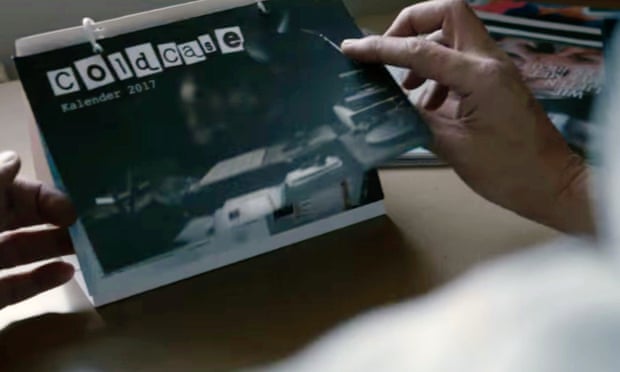
One of the calendars used in the Dutch prison system to encourage prisoners to help solve cold cases.

Here’s a new twist on solving cold cases. It’s being implemented in the Netherlands, and I was going to say, “Trust the creative Dutch to come up with this idea!” But it turns out they got the idea from the United States.

Daniel Boffey writes at the Guardian, “Prisoners across the Netherlands are to be issued with calendars for their cells featuring unsolved murders or disappearances as part of a drive by the Dutch police to crack unsolved cases.

“The so-called cold case calendars will be handed to all 30,000 prisoners in the country after a trial run in five jails in the north resulted in 160 tips to the police.

“Each week of the year in the brightly coloured 2018-19 calendars will be illustrated with a photograph of a missing person and details of the case. The hope is that many of those in jail will know details of some of the crimes or may have heard other criminals chatting about them. …

“Jeroen Hammer, the calendar’s inventor, told Dutch newspapers the calendars had also proved popular with bored prisoners, although some had regarded the initiative as an attempt to turn them against their own. …

“The calendar has been printed in Dutch, Arabic, Spanish, English and Russian to maximise its impact, and a €800,000 reward is being made available for those whose information ends in a successful conviction. …

“The police say they can offer anonymity to people in certain cases.

“ ‘There is no penalty for keeping information about a criminal offence committed. Therefore, you do not have to fear persecution if you have been sharing information, even after years of deliberation,’ they said.

“The idea of the calendars was borrowed from the United States, where every year several states distribute a deck of cards containing information about cold cases among prisoners.”

More here. Someone should study whether participating prisoners are motivated mostly by the reward, by boredom, by outrage at certain crimes, or something else.

Read Full Post »

Photo: Ronald van der Meijs
In January, this candle organ was on exhibit in the Netherlands. 

You may recall my January 2014 post about zebra finches playing instruments at a museum (here) and a December 2016 post on Croatia’s sea organ (here). The sea organ harnessed the tides to push water through narrow passages leading to organ pipes under marble stairs.

How many ways there are to make music! So much need for music!

Today’s post is about an artist who created a candle pipe organ. Lauren Young at Atlas Obscura explains.

“There’s a curious low industrial hum emanating from what used to be a fish market built in 1769. At De Vishal gallery in Haarlem, Netherlands, a large nine-pipe organ operated by burning candles purrs a continuous concert.

“In the video, Dutch artist Ronald van der Meijs shows his elaborate musical mechanism. Inspired by the Muller Organ housed at Grote Kerk church next to the gallery, the series of pipes looks like a massive artillery weapon connected to wooden beam air ducts. The intricate system requires careful maintenance — van der Meijs changes out the candles multiple times a day as they burn.

“For the pipe organ, ‘the candles are the musicians,’ van der Meijs explains. The candles vary in size. As the wax melts, the pitch of each pipe shifts slowly and irregularly. The shortening of the candles causes a vertical movement in each mechanism, pulling a wheel connected to a brass valve at the front end of each pipe. Opening the valves allows for different toned pitches.” More.

The mechanical kookiness makes me smile and reminds me of Rube-Goldberg-esque egg-breaking machines I have known. (See this February 2013 post.)


Read Full Post »

All Dutch electric trains are now powered by wind energy, the national railway company NS has said.

“Since 1 January, 100% of our trains are running on wind energy,” said NS spokesman, Ton Boon. …

“We in fact reached our goal a year earlier than planned,” said Boon, adding that an increase in the number of wind farms across the country and off the coast of the Netherlands had helped NS achieve its aim.

“[Dutch electricity company Eneco] and NS said on a joint website that around 600,000 passengers daily are ‘the first in the world’ to travel thanks to wind energy. NS operates about 5,500 train trips a day.

“One windmill running for an hour can power a train for 120 miles, the companies said. They hope to reduce the energy used per passenger by a further 35% by 2020 compared with 2005.” More at the Guardian, here.

Meanwhile in London, researchers are looking into solar-powered trains.

As Michael Holder said in BusinessGreen, part of the Guardian Environment Network, “Imperial College London has partnered with the climate change charity 10:10 to investigate the use of track-side solar panels to power trains. …

“The renewable traction power project will see university researchers look at connecting solar panels directly to the lines that provide power to trains, a move that would bypass the electricity grid in order to more efficiently manage power demand from trains.” More.

I wonder what sounds solar- and wind-powered trains make. Can we still say choo-choo-choo and whoo-oo-OO with our grandchildren? And who will update Thomas the Train?

Photo: Geography Photos/UIG via Getty Images
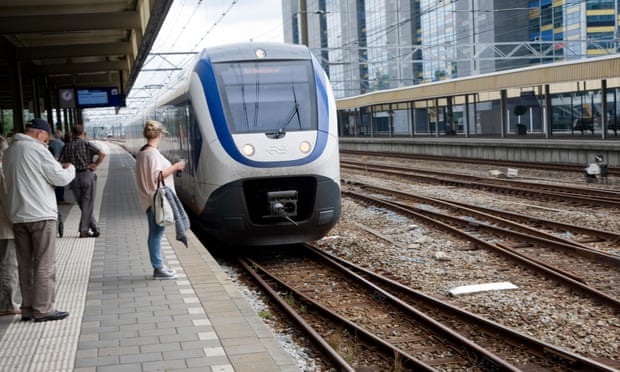
Intercity train arriving at Leiden Central railway station, Netherlands.

Read Full Post »

I’m beginning to think that this period of history will come to be known as one of enormous creativity. It’s not just isolated incidents. I was working on the upbeat story below and skipping back and forth to Facebook, where each sign from the marches and each costume seemed to outdo the last — and where I saw women on the US-Mexico border weaving their hair together Friday — when it hit me. One and one and 50 have already made a million. And there is no sign of stopping.

The story I wanted to share is on a creative effort to help refugees, this time in the Netherlands.

Liz Alderman described it at the NY Times.

“Mahmoud al-Omar leaned over a sewing machine in the basement of a former prison being used to house refugees and began stitching jeans for a popular clothing line. With more than 15 years experience as a tailor in Syria, he zipped through one pair and moved on to another, methodically filling a small order.

“The job, set up by a Dutch organization that matches refugees with work opportunities, is only temporary. Yet after Mr. Omar fled his war-torn hometown, Aleppo, two years ago, just having a place to go each day felt like a salvation.

“ ‘Working is completely necessary to speed up integration,’ said Mr. Omar, 28, who still struggles to speak Dutch, hindering his chances of a full-time job. ‘I want to become independent as soon as possible, so I can start giving back to the country that took me in.’

“When more than one million men, women and children streamed into Europe last year to seek a haven from conflict and poverty in the Middle East and Africa, governments viewed the labor market as the quickest path to absorb newcomers. The sooner people started working, the thinking went, the faster they could get off government aid and start contributing to the economy.

“Yet permanent jobs have proven elusive. The lack of language is a big barrier, as is a skills mismatch. Some refugees do not have the right experience, while others cannot get their professional qualifications or degrees recognized.

“Private initiatives have sprung up across Europe to help. The Refugee Company, the Dutch group that steered Mr. Omar toward work, is one of scores guiding refugees into professional networks and opportunities to improve employability.” More here.

From the company’s About page: “Our mission is to empower refugees. We believe work is the best tool to integration; through work, refugees can blend in with their society and build up a new meaningful life in The Netherlands. We speed up integration by providing opportunities for newcomers upon arrival to utilize their talents again. …

“We decided Refugee Company will focus on craftsmanship. We provide work opportunities in the creation and hospitality sector, as that is where our roots lie. We see a growing demand for craftsmen and horeca [Hotel/Restaurant/Café] staff in the Netherlands.” More.

The Providence Granola Project does something similar in Rhode Island, though on a smaller scale. Language is definitely a barrier, so if you have always liked explaining English to people, consider volunteering near your home.

Photo: The Refugee Company


Read Full Post »

Despite its size, the compassionate Netherlands has welcomed a large number of refugees during the largest migration since World War II, perhaps remembering the terrified families that fled Hitler.

To house all the newcomers is naturally a challenge, but a design competition has yielded creative ideas.

Jon Comulada writes at Upworthy, “As the worldwide refugee crisis continues, innovative solutions are needed so that the people fleeing civil war and sectarian violence have a safe place to live. …

“In January 2016, the Netherlands launched a design competition called ‘A Home Away From Home’ in which entrants were tasked with designing temporary housing for refugees and disaster victims. All of the winning designs rethought the idea of public housing, adding amenities and innovations to make the buildings more like fully functioning homes than simply a bed to sleep on.

“The winners of the contest recently appeared on display in Amsterdam as part of Dutch Design Week and included things like solar power, water purification systems, and ingenious use of space and material.

“The cube design of the Farmland [below] means dozens can be stacked, placed together, and moved easily. The architects of this design imagined the miniature villages establishing a ‘DIY economy’ with local towns. …

“Home is a concept many of us take for granted, but it’s not a small thing. It makes us feel safe, comfortable, and human.

“The current refugee crisis hasn’t showed signs of slowing down, and with climate change creating more and more dangerous weather systems, we’re likely to see climate refugee numbers grow sharply. All of those people are going to need places to live. Innovative solutions like these help them to not only live, but live with dignity and opportunity.”

Check out several other designs from the competition at Upworthy, here.

Photo: A Home Away From Home
This Farmyard shelter is designed to transform vacant farmland into mini villages.

Read Full Post »

According to Josh Planos at the Atlantic, the forward-looking Dutch are at it again. Not only are they on the cutting edge in matters such as energy use and floating forests, they have anticipated the increase in Alzheimer’s diagnoses, creating a village where patients can feel normal.

“The isolated village of Hogewey lies on the outskirts of Amsterdam in the small town of Wheesp. Dubbed ‘Dementia Village’ by CNN, Hogewey is a cutting-edge elderly-care facility — roughly the size of 10 football fields — where residents are given the chance to live seemingly normal lives.

“With only 152 inhabitants, it’s run like a more benevolent version of The Truman Show, if The Truman Show were about dementia and Alzheimer’s patients. Like most small villages, it has its own town square, theater, garden, and post office. Unlike typical villages, however, this one has cameras monitoring residents every hour of every day, caretakers posing in street clothes, and only one door in and out of town, all part of a security system designed to keep the community safe. Friends and family are encouraged to visit. Some come every day.

“Last year, CNN reported that residents at Hogewey require fewer medications, eat better, live longer, and appear more joyful than those in standard elderly-care facilities. …

“Residents are only admitted if they’re categorized as having ‘severe cases of dementia or Alzheimer’s disease.’ Vacancies are rare, given that a spot only opens when a current resident passes away, and the village has operated virtually at full capacity since it opened in 2009.

“Hogewey was primarily funded by the Dutch government and cost slightly more than $25 million to build. The cost of care is nearly $8,000 per month, but the Dutch government subsidizes the residents—all of whom receive private rooms—to varying degrees; the amount each family pays is based on income, but never exceeds $3,600.”

More at the Atlantic.

Where did I just hear about someone with Alzheimer’s? Oh, right. A detective series on TV. So moving. Boy, I hope that detective’s daughter knows about this village.

Photo: Gabriel Rocha/Flickr

Read Full Post »

When homes are destroyed in disaster zones, the Mobile Factory can turn the rubble into Lego-like building blocks to create new housing. They snap together without mortar.

Stella Dawson of the Thomson Reuters Foundation writes, “In Amsterdam a mobile factory, the size of two shipping containers, ingests rubble at one end, liquifies it into cement, and spurts out Lego-shaped building blocks.

“Call it rubble for the people, converting the deadly debris from disasters into homes and hospitals, cheaply and quickly.

“It’s the brainchild of Gerard Steijn, a 71-year-old sustainable development consultant turned social entrepreneur, who leads the Netherlands-based project to recycle the rubble from natural disasters and wars.

“He plans to create ecologically sound and safe housing by producing 750 building blocks a day from the debris, enough for one home at a cost of less than $20,000 each.

” ‘In disasters, you have piles and piles of rubble, and the rubble is waste. If you are rich, you buy more bricks and rebuild your home,’ Steijn said in a telephone interview.

‘But what happens if you are poor? In disasters it is the poorest people who live in the weakest houses and they loose their homes first. I thought, what if you recycled the rubble to build back better homes for poor people?’

“His rubble-busting Mobile Factory has fired the imagination of a landowner in Haiti and a civil engineer at the University of Delft. They have joined forces to test Steijn’s idea and build the first rubble community in Port au Prince next year. …

“Unskilled people can build the homes with the blocks, which meet demanding Dutch construction standards to ensure they will last for many years. [Hennes de Ridder, an engineering professor at the University of Delft,] expects further stress tests he planned for Peru in a few months will show the homes can withstand temblors of at least 6 on the Richter scale.” Read more here.

Photo: The Mobile Factory
Model homes built from cement rubble are on display at an industrial park in Amsterdam. The brightly painted homes are designed for disaster zones, using technology that creates Lego-style building blocks from cement rubble.

Read Full Post »

I had to share a delightful report from the radio show Studio 360 in which Khrista Rypl looks at the cultural aspects of African textiles.

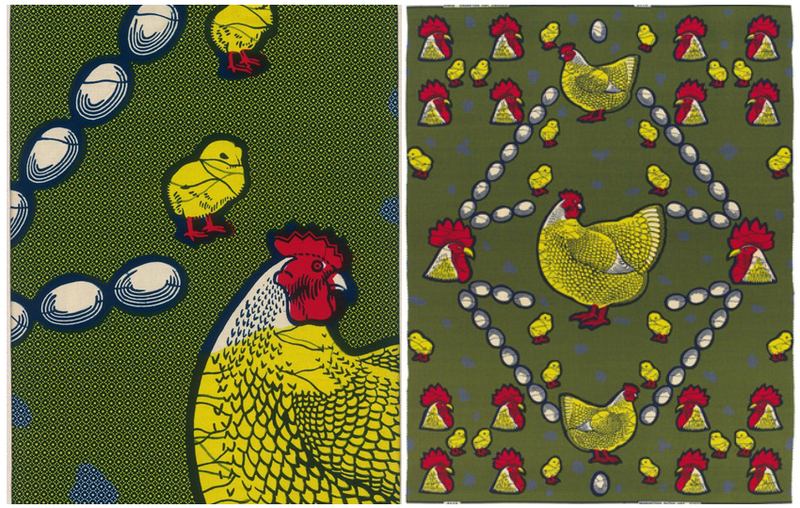
She writes, “African textiles are distinctive for their vibrant colors, bold patterns, and batik dyes that give the fabric a unique crackled texture. But I had no idea that some of the trendiest of these prints are actually designed and produced in the Netherlands by a company called Vlisco.

“Inge Oosterhoff wrote a wonderful deep dive into the history behind the Vlisco textile house, and explained how their designs have remained hugely popular in Africa since the late 1800s. But Vlisco doesn’t just make fabric; they’re known for their printed designs. … Some patterns are designed with different countries in mind, while others are distributed widely around the continent. As the patterns catch on among shopkeepers and consumers, many of them get colorful names like ‘Love Bomb,’ ‘Tree of Obama,’ and ‘Mirror in the Sun.’ …

“Many patterns are sold widely in Africa, and different countries and cultures adopt different meanings and associations. [A swallow] print is a perfect example. The fabric was used for airline uniforms in Togo, so there the pattern is commonly referred to as ‘Air Afrique.’ The pattern also symbolizes asking for a favor, like the hand of a woman in marriage. In Ghana, the swallow refers to the transience of wealth, and the pattern is referred to as ‘Rich Today, Poor Tomorrow.’ It has a similar connotation in Benin, where it’s referred to as ‘L’argent vole,’ where it could either be interpreted as ‘Money Flies’ or ‘Stealing Money.’ ”

More designs and more of Studio 360 report, “Textiles Tell a Cultural History,” here.

Photos: Vlisco

Read Full Post »

New online services make it easy to borrow things you need temporarily but don’t want to buy.

Janet Morrissey writes at the NY Times, “When vandals broke into Stephanie Ciancio’s Land Cruiser in 2014 and stole her car stereo, she did not have the time and money to replace it. It was particularly vexing for Ms. Ciancio, a 34-year-old San Francisco resident, because she had been planning to take a four-day road trip to Fern Canyon, Calif., over the long July 4 weekend, and the idea of making the eight-hour drive without music was depressing.

“So she logged onto Peerby.com, typed in her predicament, and within 40 minutes was connected with someone willing to lend her a Beats wireless Bluetooth speaker for her car trip.” She was thrilled.

Peerby founder Daan Weddepohl, Morrissey contintues, “was born in Rotterdam in 1980 and developed a passion for computers and programming at a young age. ‘I asked for a compiler for my 13th birthday,’ he said.

“He pored over books and joined online bulletin boards to hone his programming skills. His parents, both psychiatrists, encouraged his entrepreneurial spirit and interest in technology. But it was a fire that ignited the Peerby dream.

“In February 2009, fire ripped through Mr. Weddepohl’s apartment building, … Most of Mr. Weddepohl’s belongings were destroyed by fire, water or smoke.

“He was devastated. But in the months after, Mr. Weddepohl watched in amazement as friends — and even strangers — offered furniture, tools and other items to help him get back on his feet. It was a revelation. “’ discovered that the people around me were so much more important than the stuff,’ he said. ‘People love to help other people out — we’re wired to help others.’ ”

Read how the Peerby concept grew from the ashes, here.

I blogged earlier this year about this concept. You can read “Borrowing Gadgets you Need Only Once,” here.

Photo:Jason Henry for The New York Times
Stephanie Ciancio was able to borrow a wireless Bluetooth speaker from Matt Dodge through an online service called Peerby.com. 

Read Full Post »

National Public Radio’s Eleanor Beardsley reported recently on a borrowing trend.

Nothing to do with Mary Norton’s Borrowers, who gather up all the buttons and safety pins you’ve lost and store them in their home somewhere under your floorboards. No, this is about you needing a rarefied plumber’s tool to replace the kitchen faucet and deciding to borrow one for a day. (Maybe two days if a two-year-old I know offers to help.) All you need is an app called Peerby.

“It isn’t surprising that the idea for the borrowing platform Peerby [peer nearby] originated in one of the world’s most densely populated countries — The Netherlands,” says Beardsley.

“Founder Daan Weddepohl says he had the idea for the startup after his house burned down, and he had to borrow everything. At first, he says, he felt dependent, but then realized people generally like helping each other because it creates a bond. …

“In June, Peerby was selected best urban app in the AppMyCity! competition, held as part of the New Cities Summit in Dallas. Peerby hooks up 100,000 borrowers and lenders each month in the Netherlands. Since its launch in 2012, the company has expanded to Belgium, Berlin and London. …

“Cindy Bakum, an Amsterdam native, is a regular Peerby user.

” ‘Last time I had a friend over, and we were watching a movie on his laptop, but he forgot his adapter, and my adapter didn’t fit,’ she says. ‘So I put out a request, and it was actually my neighbor. He really lived on my block, and he had an adapter, so we could finish watching the movie. So that worked very well.’ ”

It’s all about the sharing economy. Read up on it at the All Things Considered blog, here.

Photo: Merriam-Webster

Read Full Post »

« Newer Posts - Older Posts »