Photo: Grounds Krewe. In the interest of environmental protection, barriers were set up to block discarded Mardi Gras parade throws and party trash from going down storm drains.
New Orleans likes to have fun, and whether it’s a funeral with a brass band playing “When the Saints Go Marchin’ In,” men high-stepping in feathers to welcome the New Year (Mummers), or the abandon of Mardi Gras before the solemnity of Lent, parades produce litter. A lot of litter.
That’s why environmentally oriented New Orleanians have decided to do something about cleaning up.
As Jackie Delamatre writes at the New York Times, “In recent years, the city’s huge, weekslong party has been producing more waste than ever: an average of 1,123 tons per year for the last decade, according to the city’s Sanitation Department.
“ ‘It’s an environmental catastrophe,’ said Brett Davis, who runs a nonprofit group, Grounds Krewe, that’s trying to make Carnival greener.
“The New Orleans area is especially vulnerable to climate change because of hurricanes and coastal erosion. Yet, for weeks of ebullient parading, which culminate on Tuesday, those problems are forgotten as float riders fling plastic beads, cups, doubloons and foam footballs at teeming crowds. In the moment, these baubles can seem like treasures. Within days, though, what was caught, as well as the excess left on the streets or dangling from oak trees like Spanish moss, ends up in the trash.
“Now, a coalition of nonprofit organizations, city officials and scientists is trying to clean up the party. … It’s not just that all this party detritus is swelling landfills. A 2013 study found that more than 60 percent of Mardi Gras beads contained unsafe levels of lead. And in 2018, the city discovered 46 tons of beads clogging catch basins that are essential for clearing floodwaters. …
” ‘When I was a kid, we caught everything that came off the floats,’ Mr. Davis said. ‘There was a big hoopla about who was going to get it. Now it’s a carpet, a river of waste.’ …
“Mr. Davis came to believe that, by reusing beads, he was just ‘recirculating toxic, plastic junk no one wants,’ he said. Now, he has pivoted to waste prevention, building a catalog of sustainable throws.
“To date, he has sold more than $1 million of these festive but practical items, including jambalaya mix, native flower starter kits and plant-based glitter. He has also recruited a cadre of volunteers, from fifth graders to retirees, to help package the goods.”
Read at the Times, here, about scientists inventing sustainable Mardi Gras beads containing okra seeds. Imagine yourself cooking the okra you grow in your gumbo and reliving happy New Orleans memories.
Photo: Melanie Stetson Freeman/CSM. One Man Swamp Band street musician Brian Belknap performing in the French Quarter of New Orleans in April.
Here’s a story of resilience, 20 years after the devastation of Hurricane Katrina in New Orleans, Louisiana.
Patrik Jonsson writes at the Christian Science Monitor, “When Hurricane Katrina careened into Mississippi and Louisiana 20 years ago this week … the overtopping of New Orleans’ levees caught local, state, and federal officials flat-footed in the days after the storm’s Aug. 29, 2005, landfall just east of New Orleans, near the Pearl River. …
“As I head back to New Orleans ahead of the 20th anniversary of that historic storm, looking to chronicle the growth that has taken place since that disaster threatened to wash away the soul of this vibrant city, I’m following some of the paths I took when covering the aftermath of Hurricane Katrina, remembering that time, those scenes.
“Twenty years after that catastrophe, New Orleans’ larger recovery has been a complicated story of progress, ongoing challenges, and missed opportunities.
“It was still a lawless city when I arrived in 2005. As dark descended and I settled into my van for the night, so did fear. Rumors abounded – most outrageous, but some not far from the truth about the human toll. About 1,800 people are believed to have perished during Katrina and its aftermath, most from the storm surge in Mississippi and catastrophic flooding in New Orleans. The most expensive natural disaster in United States history, it caused over $200 billion in damage. …
“Communities reemerge, but they reemerge differently. People search for what once was – a piece of flatware, a boat transom, a bent-up old .22 rifle. Or an old guitar. They drag the past from the wreckage and use it to imagine the future.
This year, I’ve brought my Guild A-20 dreadnought guitar, my road companion. I’m realizing that this reporting trip is also to build a connection across the decades – maybe one as rickety and rusty as that old Huey Long – and to see the effects on communities and people, including myself, and how they recover. …
“This time I am staying in a rental, a shotgun-style short-term place near the Tremé, the city’s iconic music district.
“I go to a nearby coffeehouse the next morning, where schoolkids in uniforms are already plinking away standards on a well-tuned upright piano. Wrens are cajoling amid the Magnolia grandiflora. I sip chicory-infused coffee and chat with the shop owner about a day that’s dawning with surprising coolness.
“Afterward, I find a great, steep stoop from where I can less watch but rather consider the city. I grab my Guild and sit down, strum some cowboy chords in B major, and noodle some lines from my reporter’s notebook: ‘She’s an angel, even when she’s falling down / She’s an angel, in the wrong part of town.’ …
“Brian Belknap traded a guitar for a life in New Orleans.
“The Chicago native arrived a decade ago, well after the ravages of Katrina. Like so many before him, he fell for the languid city’s slow charms. With little money, he lived on the streets for a while, busking for change. But then he traded his 1942 Martin D-18 for a battered shotgun shack in St. Roch. …
“Every day, Mr. Belknap walks into the French Quarter in the early, cooler parts of the day, setting up the instruments that now make up his One Man Swamp Band on Royal Street.
“ ‘There’s still desperation here,’ Mr. Belknap says. ‘But out here it’s an intimate experience. The people are close. The music is everywhere. Even in hard times, the sense of joy is unmistakable.’
“To punctuate that point, he grabs an accordion, gives a kick on a high hat pedal, and rolls into an original song about folks stomping the varnish off a dance floor.
“Though he’s not a native, in some ways Mr. Belknap’s presence here is a small part of New Orleans’ recovery. The city lost a third of its population after the hurricane. But it has been bouncing back – though not to what it was before Katrina.
“There’s a new $15 billion system of levees, floodgates, and drainage canals built to better withstand storms like Katrina. The public school system, among the worst in the country before 2005, has been revamped. Today, graduation rates have risen significantly, and more New Orleans high schoolers are going straight to college than before.
“But the city continues to grapple with the lasting impacts of the initial federally funded rebuilding plan, called Road Home. Over $9 billion in federal funds was allocated for residents to rebuild – but within a tangle of Byzantine application procedures. Disbursements, too, were based on property values before Katrina struck. This left mostly Black, low-income residents with far less to rebuild, and long-standing racial disparities continue today.
“ ‘Katrina in many ways reshaped the way we think about vulnerability in disasters,’ says Jeannette Sutton, a sociologist who studies emergency preparedness at the State University of New York at Albany. Road Home and other programs, she says, have proved that ‘If you were poor before a disaster, the [disaster response] is not going to improve your well-being’. If you were barely getting by before, you’re not going to be better off with the funding in the aftermath. But those who could ‘afford’ a disaster are probably going to recover pretty well.’ …
“Gentrification has also changed the flavor of New Orleans in many ways. The city continues to debate limiting short-term and highly profitable tourist rentals – like the one I’m staying in – which create a demand for housing and cause other rents to rise. The checkerboard of empty lots in the hard-hit Lower Ninth Ward, too, still defines many of the failures of the federal rebuilding plan. …
“Liz LeFrere was 8 years old, living in New Orleans East, when Katrina struck. She thought she’d miss a day or two of school. Four months later, the family returned to live in the broken city, since her father was a police officer.
“Ten years ago, when she was a student at Tulane, the campus flooded on Aug. 29 – the Katrina anniversary. Ms. LeFrere broke down in uncontrollable tears. ‘It came out of nowhere,’ she says. ‘It’s definitely part of a communal trauma.’
“Yet the storm’s indelible impact also created a new life for her. Today, Ms. LeFrere is part of an artist collective dedicated to understanding Katrina and its aftermath through art – including massive portrait murals that now dot and define the city.
“Artists like Ms. LeFrere are committed to telling a tangibly redemptive story. ‘The art is where expression can be a catalyst for change,’ she says. The murals ‘help create a sense of people seeing themselves reflected in the face of the city. The narrative of New Orleans expanded.’ ”
There’s a lot more at the Monitor, here. Impressive photos. No paywall, but subscriptions keep responsible news coming. Reasonable prices.
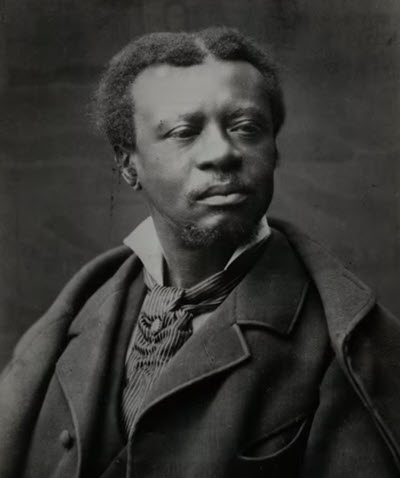
Photo: Opera Lafayette. Nineteenth-century American composer Edmond Dédé at about age 50.
When I think of an African American born in pre-Civil War New Orleans studying music with the best and rising to high levels of composing, the word that comes to mind is courage.
There is so much I don’t know about the lives of others, and I am grateful to Early Music America for enlightening me about the Edmond Dédé, America’s first black opera composer. Patrick D. McCoy has the story.
“Like many artists of color with the opportunity,” writes McCoy, “Edmond Dédé fled the antebellum United States. After a time in Mexico, he eventually settled in France. … Among Dédé’s surviving works is a four-act opera, Morgiane,ou Le Sultan d’Ispahan, which was never performed or published in his lifetime.
“Morgiane, a happy-ending tale inspired by Ali Baba and the Forty Thieves, was finished in 1887, making it perhaps the oldest-known complete opera by a Black composer born in the United States. …
“Morgiane [received] its world premiere, fully staged, with shows in the Washington D.C. area (Feb. 3 and 7) and New York City (Feb. 5). … Patrick Dupré Quigley, artistic director-designate of Opera Lafayette, will conduct. …
” ‘I knew it was my mission to get this done,’ recalls Givonna Joseph, co-founder of OperaCreole, after receiving a digital file of the opera in 2014. ‘The world needed to know that a free Black man from New Orleans not only composed over 100 works, but also a complete French grand opera with a ballet and an extra brass section. It was never performed, so I was set on a path for restorative and transformational justice.’
“Not long after, conductor Quigley was investigating musicians of color from New Orleans and happened upon that same digitized, 550-page manuscript, which had been crammed into another composer’s score, part of a large private collection from France that ended up in Harvard’s Houghton Library. The full opera is now online and available for public view. …
“Thinking about an eventual performance, Quigley and Opera Lafayette founder Ryan Brown checked if anyone else was working on the project. They quickly found Joseph and her daughter, Aria Mason, who co-founded OperaCreole in 2011. … It was a double jackpot: Morgiane checked every box for both companies.
“And they’d all worked with a singer in common, bass-baritone (and noted composer) Jonathan Woody, who introduced them in a Zoom call in 2023. …
“Much of what’s known about the composer comes from scholarship by Candance Bailey and by Sally McKee, author of The Exile’s Song: Edmond Dédé and the Unfinished Revolutions of the Atlantic World. He was born in 1827 in New Orleans, when the city was the center of opera in America, and was educated by visiting European musicians on clarinet and violin. He was locally celebrated as a skilled violinist and composer. His earliest published music straddled the line between art song and popular tunes — an attractive mix that Joseph has called ‘an early version of the blues.’
“By the late 1850s he studied briefly at the Paris Conservatoire and built a career in Bordeaux, where he worked as a repetiteur, violinist, and assistant conductor at the prestigious Grand Théâtre. …
“Decades later, with Morgiane, he seemed to bring together his musical heritage: ‘People will be shocked that they’ve never heard of this composer,’ says Quigley. ‘The vocal writing is virtuosic, the orchestration is unbelievably colorful. He was a string player, and you hear the inner voices, it’s masterful. He combines the tunefulness of what you think of from New Orleans with the prevailing French operatic forms of the time.’
“Morgiane is through-composed — everything is sung and the orchestra plays the entire time, with no spoken dialogue. … The score calls for bright, agile voices.
“Its sensational plot, with a libretto by a still-obscure poet named Louis Brunet, taps the sort of ‘exotic’ Middle Eastern locales then in vogue (think Aïda, Samson et Dalila, or Thaïs). A beautiful young woman on her wedding day is kidnapped by the evil henchman of the Persian Sultan. Her family crosses the desert from Arabia to Isfahan (in Persia) and infiltrates the Sultan’s court on the day he’s planning to marry the young woman. They have disguised themselves as itinerant singers. But moments before they’re about to rescue her, disaster! They are discovered, imprisoned, and condemned to death. Just before the execution, the mother of the young woman who’s been kidnapped — the title character, Morgiane, is the mother — speaks to the Sultan with a shocking revelation.
“Spoiler alert: From under her cloak Morgiane pulls out a diamond ring, the very ring that he’d given her the day their daughter was born. ‘I was your sultana,’ she says. …
“Quigley says he was ‘taken aback at my own ignorance of just how early composers of color were an integral part of both American and European art music. In New Orleans alone, people of color were involved with the composition, performance, and production of opera from the late 18th century onward.’ …
“For now, says Quigley, there are plans to help ensure the success and longevity of Morgiane. Opera Lafayette will record the opera, and make the score and parts available to help the opera enter the repertoire. In addition, some of its most delectable music — the overture, the entr’actes, the ballet sequences, plus a few other numbers — would make a highly attractive orchestral suite.”
Photo: Creatives Rebuild New York. Painter Athesia Benjamin created a self-portrait while participating in the guaranteed income program.
From time to time this blog has checked in on experiments in basic income taking place around the world. If you use search terms like “basic income” or “guaranteed income” in my search box, you will find many related articles, including ones on helping Kenyan villagers, keeping New Orleans teens in school, slashing homelessness in Finland, and supporting artists in Ireland.
New York has also piloted a basic income for artists.
Maya Pontone writes at Hyperallergic, “Early findings from a guaranteed income program for artists across New York State reveal that such initiatives can provide crucial support for artists’ financial stability, professional advancement, and individual well-being.
“While more comprehensive results are slated to be released at the end of the year, preliminary outcomes show that when artists receive guaranteed income, they generally concentrate on addressing outstanding debt, bills, and increasing their personal savings. They also have more freedom to work on their practice and more time for caregiving responsibilities.
“The report was compiled by Creatives Rebuild New York (CRNY), a $125 million guaranteed income and work opportunity initiative that began in 2021 and is chiefly funded by the Andrew W. Mellon Foundation, the Stavros Niarchos Foundation, and the Ford Foundation. Under the program, CRNY provided 2,400 artists across New York no-strings-attached monthly payments of $1,000 for 18 consecutive months, prioritizing individuals who are acutely impacted by institutional barriers to financial security based on their race, physical ability, sexual orientation, citizenship status, and caregiving tasks.
“On average, the survey found that 17% of the guaranteed monthly payments were used to pay off debt, principally outstanding credit card balances and loans and mortgages. Furthermore, artists saved approximately $150 more each month and put nearly $140 of the payments toward expenses like rent and utilities. The initiative also showed that participants generally reported feeling improved mental and emotional health in comparison to those who did not receive guaranteed monthly payments. …
“ ‘Going through a breast cancer diagnosis during a pandemic was the most difficult experience of my life,’ shared one anonymous participant quoted in the report. …
‘Guaranteed Income gave me the support I needed to slowly build my life back, become strong and healthy again, and has truly led me back to this industry feeling safe, valued and supported,’ the participant wrote.
“In an interview with Hyperallergic, Maura Cuffie-Peterson, CRNY’s director of strategic initiatives, explained that critics of guaranteed income programs generally ‘claim that they disincentivize work. … Our report shows that not only are artists working with a guaranteed income, but they’re really shaping work that is meaningful to them and in their community life.’
“The report’s findings add to survey results released by CRNY this summer that showed a majority of NY artists are in precarious financial positions, currently earning significantly below living wage standards.
“ ‘When done ethically and in collaboration of those who are directly impacted, research can lead us to better designed programs and even policy solutions,’ Cuffie-Peterson said, adding that guaranteed income programs could be more beneficial if they ran for longer periods of time.
“As an example, she cited Minnesota arts organization Springboard for the Arts’s recent announcement that it is extending its guaranteed income pilot for artists to five years and offering additional financial counseling services.
“ ‘It’s less what should be researched next, but more how these things that are all being researched are building up into something bigger, more impactful, and more meaningful to more people,’ Cuffie-Peterson said.”
Photo: Chris Granger/Times-Picayune. New Orleans 12th grader Dejah Grimes was part of a pilot program, soon to be expanded, that gives students $50 per week with no strings attached.
Paying kids to do something they should be doing anyway — for their own sake — does not always have the intended result. But I can see that to keep some teens in school, it might help. And for those who’d stay in school anyway, what a nice bonus!
Marie Fazio writes at the Times-Picayune, “Every Wednesday morning for nearly a year, Dejah Grimes woke up to a $50 deposit in her account, money she was free to spend however she chose.
“Most weeks she gave the card to her mom, who put it towards the water or electric bill. Occasionally she used it to go to the movies or the mall with her friends, or to pay for school expenses, including the recent purchase of a black polo shirt with the G. W. Carver school logo embroidered on the breast, a privilege reserved for seniors.
“ ‘It helped my family a lot,’ Grimes said. ‘It really made life easier.’
“Now, hundreds of other New Orleans teens are set to receive similar assistance as part of a groundbreaking study on the impact of providing young people with a ‘universal basic income,’ or recurring cash payments with no strings attached.
“After promising preliminary findings and a $1 million investment from the city of New Orleans, a guaranteed income program that began with 20 students at The Rooted School in 2020 will expand this fall to 1,600 high school seniors at schools across the city over the next three years. Deemed the ‘$50 Study,’ the program gives students $50 per week and follows their academic and financial progress. It’s one of the first of its kind to study the impact of universal basic income on youth.
“Researchers said that high schoolers over the past two years — 386 students from The Rooted School in New Orleans, The Rooted School Indianapolis and G. W. Carver High School — who received payments missed fewer days of school, showed more literacy growth and enjoyed more financial stability than their peers who did not receive money. …
“At the height of the pandemic in 2020, [Jonathan] Johnson, then executive director of Rooted New Orleans, noticed an alarming spike in absenteeism among his students, many of whom had to take on extra shifts at work to help their families make ends meet.
“Hoping to alleviate some of the financial stress on students, they launched a ‘micropilot’ with 20 Rooted seniors, ten of whom received weekly payments. From 2022 to 2024, they expanded to a randomized control trial with 386 students over two cohorts.
“According to preliminary data, which has not yet been peer reviewed, students who were given the funds attended an average of two more school days per semester and their reading test scores grew by nearly double that of the control group. Researchers also found students who received the money demonstrated better ‘financial capability,’ a term used to refer to financial literacy and real-world application, and scored higher on tests measuring their financial well-being.
“Stacia West, who co-founded the Center for Guaranteed Income Research at University of Pennsylvania and acts as lead researcher for the $50 study, said the program can provide young people with valuable lessons, including how to navigate — or avoid — risky financial instruments such as payday loans and credit cards.
“ ‘The fact that these kids are able to interact with these financial markets so early,’ said West, who is also an associate professor at the University of Tennessee, ‘means they’re going to be better equipped when they get into their 20s to make better financial decisions.’
“Students in phase one of the study, which took place from 2022 to 2023, only used about half of cash assistance. About 47% of the money remains in the students’ bank accounts, suggesting many are saving.
“Of the money they did spend, about 50% went towards food and groceries, 30% to goods and services, 12% to transportation, 3% to healthcare and the rest to other expenses.
“Results from the second phase of the study, which followed 28 students from Rooted Indianapolis, 47 students from Rooted New Orleans and 155 students from G. W. Carver — a Collegiate Academy-run high school — will be published in the spring.
“Grimes, who participated in the second phase, said having the money helped her family with unexpected expenses, like food and travel purchases while out-of-town for her great-grandmother’s funeral. This summer, she used it to pay for Ubers back and forth to work as a camp counselor-in-training at Live Oak Camp. …
“Malik Williams, a junior at G. W. Carver, said he spent money on food and school supplies, including a pair of New Balance sneakers and a pair of headphones.
“New Orleans used to have a guaranteed basic income program aimed at young people ages 18-24 that was part of a national initiative called Mayors for Guaranteed Income. An effort to expand the program in December was not funded by the city council.
“Jeff Schwartz, Director of Economic Development at the City of New Orleans, said in a statement that the agency is ‘thrilled to be an investor’ in the $50 study. …
“West said that the Rooted School’s study is the first to track the impact of guaranteed income on young people. … ‘I think this could be a new way to think about educating and socializing our children financially.’ “
Not to mention relieving some of the stress that interferes with learning, I’d say. Financial literacy shouldn’t be the only goal. Staying in school, learning more, having a better shot at a good future as a result … what about that? I hope to track down the newer study once it’s completed.
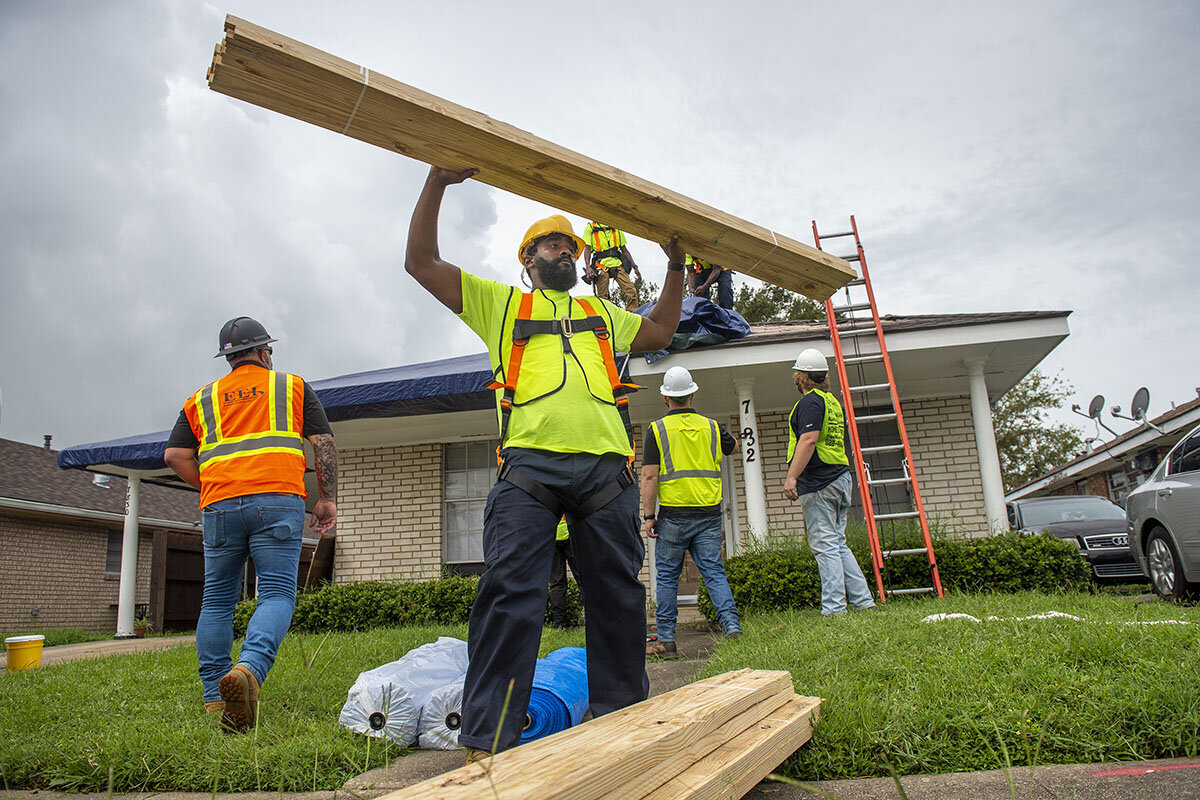
Photo: Chris Granger/The Times-Picayune/The New Orleans Advocate/AP “Roofing contractors install a temporary roof on a home in New Orleans East, Sept. 8, 2021. FEMA and the U.S. Army Corps of Engineers are overseeing this Blue Roof program to help homeowners recover from the damage cause by Hurricane Ida,” the Monitor reports.
Can humanity learn from history? Sometimes, yes. According to this September 2021 story, people are learning from climate disasters. Even I, as a child on Fire Island, learned that people who build houses on sand dunes ask for heartbreak. Collectively, the towns on the island learned the same thing.
Marshall Ingwerson wrote this report on collective learning at the Christian Science Monitor.
“In the weeks since Hurricane Ida landed at New Orleans, it has illustrated two very different stories. One is the rising violence of the changing climate. The other, which is only now fully emerging, is the human resilience that has already made the world far safer. …
“The aftermath of Hurricane Ida is now entering what we might call the resilience zone. It can be the most testing, and telling, phase.
“As part of the Monitor’s Finding Resilience project, here is a tale of two cities: The New Orleans hit by Hurricane Katrina 16 years ago and the New Orleans hit by Hurricane Ida late last [August].
“They were not identical storms. Ida struck with less sweeping girth than Katrina but more sheer force. They weren’t all that different, either.
“But they hit a different New Orleans. Katrina killed more than 1,800 people. The breaching of the levees put 80% of the city underwater. The blow was nearly existential to New Orleans as we knew it. Three in 10 residents vacated, many permanently.
“After Ida struck last month, the now-fortified levees held against the surge. The toll in fatalities in Louisiana is at 28. A similar number died in New Jersey as Ida-driven rain flooded the Northeast. The scale of damage and heartbreak is so vastly different that clearly Louisiana is more robust and storm-hardy than in 2005. The population had even grown back in New Orleans, recently surpassing its pre-Katrina numbers.
“Ida has been covered as an example and a warning of the rising violence of climate change, making hurricanes stronger, floods higher, and fires bigger and more frequent in the dry West. And that’s an important context.
“But here’s another: Even as climate events become more dangerously frequent and potent, humanity has actually become safer – dramatically safer.
“The economist Bjorn Lomborg finds that the number of people killed worldwide by climate-related events in the 1920s, a century ago, was 27 times higher than the number killed over the decade ending 2019.
Corrected for the far higher global population today, the death rate a century ago was more than 130 times what it is today.
“Dr. Lomborg’s point is that when we assess the costs, the dangers, and the difficulties that climate change implies, human resilience and ingenuity is a nontrivial factor. So far, in fact, it has been an overwhelming factor.
“A term like resilience can risk sounding a little minimizing and reductive – just a personal character trait. It is much more than that.
“Those who have been through a hurricane strike report that it is after the winds have gone quiet, the ground dried, and the sun shining in steamy afternoons, only then have they arrived at the hard part – the exhausting building back, the forging ahead, the relaunch into forward motion. …
“Many of the efforts to resuscitate post-Katrina New Orleans were deeply personal, with families making remarkable sacrifices to rebuild the economy and education, much less the roads, bridges, and buildings of the city itself.
“So resilience is a matter of spirit, of finding the heart to come back. But its structure, the ladder resilience climbs, is learning. We pick ourselves up, we learn what we need to learn, and we get to work.
And it’s not just person-by-person resilience that drives the kind of change we have seen. It’s collective.
“Only big, complex teams can achieve what New Orleans accomplished in the past 16 years. The scale of the investment, the engineering, the overlapping interests, the cross-cutting visions and values – only politics can put all that together and sort all that out. …
“Yet humankind has made the world, per Mr. Lomborg’s numbers, more than 99% safer against natural disasters in the last century by scaling resilience. And we do that through the institutions we use to work together.
“The only way we can learn and then act on as massive a scale as demanded of New Orleans is through the institutions we’ve developed over centuries – whether it’s a city council, a police department, a university, an engineering association, a religious denomination, a news organization, a Supreme Court, or an updated building code.
“It’s the lack of robust institutions that reduce resilience in a country like Haiti – where such institutions were undermined by Western powers for centuries – to a more individual matter. Anyone who has visited the nation has witnessed the sheer energy and unoppressed vitality of the people that crowd the streets of Port au Prince. The spirit is there, but it’s a resilience on foot, a personal challenge, and not yet a resilience that can collectively build safety from the next natural disaster.
“Individual learning can be a flashlight for families, communities, organizations, nations. But it is collective learning, what we achieve together, that holds real power. In fact, civilization itself could be defined as collective learning.”
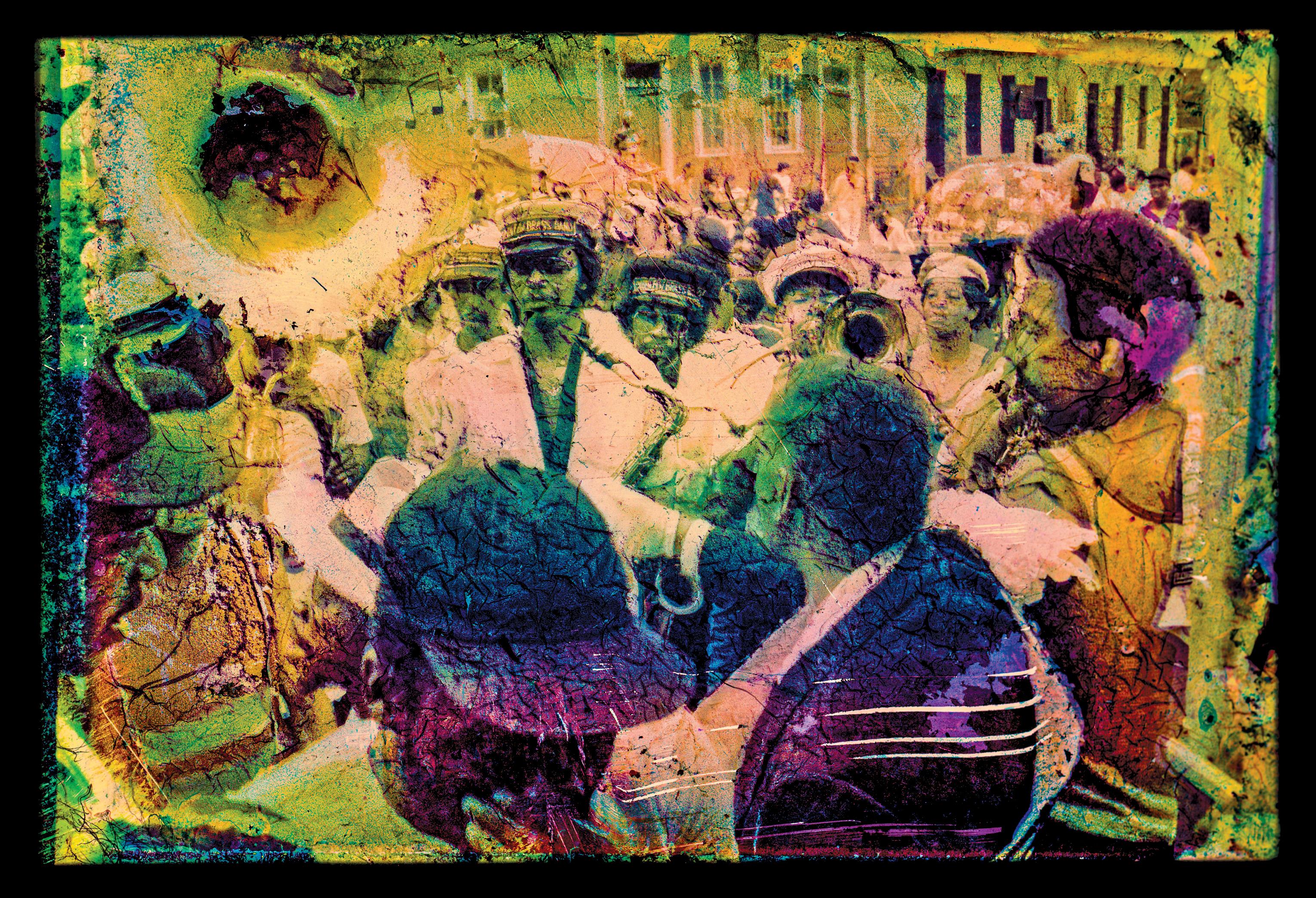
Photos: Chandra McCormick and Keith Calhoun. “The Sound of Our Resurrection Is Stronger Than the Silence of Death” is what McCormick and Calhoun call their picture of A Chosen Few Brass Band.
A recent article in Smithsonian magazine about the Louisiana photography duo Chandra McCormick and Keith Calhoun got me interested in learning more about them.
Reporter Amy Crawford focused on something new they were doing with old photographs: working with the Hurricane Katrina water damage to elicit the ghostly spirit of an indomitable city.
Crawford writes that in 2005, “Hurricane Katrina was bearing down on New Orleans, so Chandra McCormick and Keith Calhoun packed their photography archive — thousands of slides, negatives and prints the couple had amassed over three decades documenting African American life in Louisiana. …
“Then they drove to Houston with their two children, planning to be gone for maybe two weeks. Ten weeks later, McCormick and Calhoun returned home to…devastation. ‘All there was, was waterlogged,’ Calhoun says. ‘Imagine the smell — all that stuff had been in that mud and mold.’
“They figured they had lost everything, including the archive, but their teenage son urged them not to throw it away. They put the archive into a freezer, to prevent further deterioration. With an electronic scanner they copied and enlarged the images — at first just searching for anything recognizable. The water, heat and mold had blended colors, creating surreal patterns over ghostly scenes of brass band parades, Mardi Gras celebrations and riverside baptisms.
‘Mother Nature went way beyond my imagination as a photographer,’ Calhoun says of the otherworldly images. McCormick says, ‘We no longer consider them damaged.’
“Today McCormick and Calhoun’s altered photographs are viewed as a metaphor for the city’s resilience. Yet they’re also a memento of a community that is no longer the same. By 2019, New Orleans had lost more than a quarter of its African American population. ‘So much is vanishing now,’ Calhoun says. ‘I think this work serves as a record to validate that we once lived in this city. We were its spiritual backbone.’ ” More at the Smithsonian, here.
From the couple’s website: “Keith Calhoun and Chandra McCormick were born and raised in the lower ninth ward of New Orleans, Louisiana. As husband and wife team, they have been documenting Louisiana and its people for more than 25 years. In New Orleans, they have documented the music culture, which consists of Brass Bands, Jazz Funerals, Social and Pleasure Clubs, Benevolent Societies, and the Black Mardi Gras Indians.
“In addition to documenting New Orleans social and cultural history, Calhoun and McCormick have also covered religious and spiritual ceremonies throughout their community, as well as river baptisms in rural Louisiana. They have created several photographic series, including: Louisiana Laborers; The Dock Worker, Longshoreman, and Freight Handlers on the docks of New Orleans; Sugar Cane Field Scrappers in the river parishes along the Mississippi river; Cotton Gins, and Sweet Potato Workers in East Carrol parish of Lake Providence Louisiana.
“Calhoun and McCormick have documented the soul of New Orleans and a vanishing Louisiana [including] the displacement of African Americans after Katrina … and the cruel conditions of the Louisiana State Penitentiary at Angola, a former slave-breeding plantation named for the African nation from which ‘the most profitable’ slaves, according to slave owners, were kidnapped. …
“[Angola] is an 18,000-acre prison farm where inmates are traded like chattel among wardens of neighboring penitentiaries. Although the 13th Amendment to the United States Constitution abolished slavery in 1865, its prohibition of forced labor does not apply to convicted inmates. … Calhoun and McCormick’s work restores visibility and humanity to a population often forgotten by the public at large.”
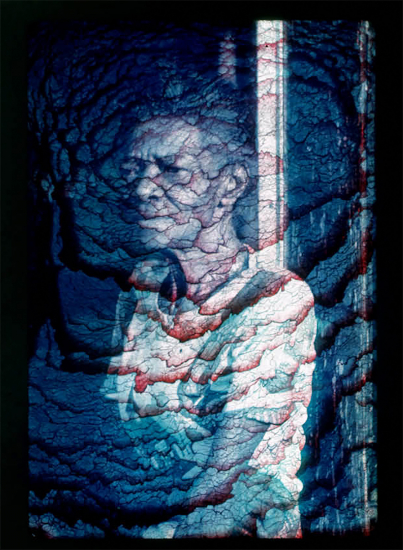
And from the Southbound Project: “The photographic emulsion merging with mold and water sedimentation left interesting patterns and color transformations. … Sometimes the textural quality of the effects even suggests physical markings and scars of trauma. Ida Mae Strickland (1987, ca. 2010), for example, is a portrait of an elderly woman shown from the waist up, seemingly lost in thought with a furrowed brow. She appears contemplative and dignified, as one whose internal strength has carried her through the years. The water damage creates rippling patterns that appear to emanate from her head and evoke wrinkled folds of aged skin. These unintentional effects reinforce qualities of the original image. The photograph, like the original sitter, has quietly weathered the influence of time and nature but still survives.”
So many things have been cancelled this year! But the people of New Orleans are not taking the cancellation of their beloved Mardi Gras lying down. Where there’s a will, there’s a way.
Doug MacCash writes at NOLA.com, “Carnival season 2021 may lack the usual parades, marching bands and big bags of beads, but never-say-die New Orleanians have taken their holiday back by inventing a whole new way of celebrating. …
“Socially distanced float houses have become a thing. A really big thing. … Lavishly, lovingly, laughingly decorated houses are becoming as ubiquitous as potholes. …
“Tiffany Tandecki, a marketing and development exec, said the thing she would have missed most about Mardi Gras parades is the satire. So she transplanted some Carnival-style comedy to her 5975 Canal Blvd. home for the pleasure of passing commuters. Tandecki used the characters from her TV binge-watching fave ‘Schitt$ Creek’ to lampoon the crumbling streets of her Lakeview neighborhood and COVID-19-era frustrations in general.
“In Tandecki’s view, the sweet-tart sitcom, in which a family of millionaires finds themselves adapting to small-town life, is a perfect metaphor. There’s millionaire Moira Rose shaking up an afternoon martini to take the edge off the stress of home schooling. There’s disdainful son David passing judgment on the inconvenient virus with raised eyebrows. There’s ditzy daughter Alexis stating the obvious: ‘I miss my life.’ And there’s bewildered hubby Johnny, standing beside a burglarized Lakeview car with a smashed-out window.
“The painted plywood cutouts of the ‘Schitt$ Creek’ characters standing in Tandecki’s front yard look exactly like the sort of thing you might see on a passing Carnival float, because they were made by professional float maker Lindsay DeBlieux, who Tandecki hired to bring her vision to life. …
“For DeBlieux, like most Mardi Gras float artists, the cancellation of this year’s parades was a catastrophe. Her employer, Mardi Gras Decorators LLC, tried to keep the staff employed as long as possible, she said, but in December, she was laid off. Thank goodness that by that time, the float house fad was fast taking root.
“Almost immediately, DeBlieux said, she was commissioned by three homeowners who planned to participate in the Krewe of House Floats, a citywide stationary house parade. … Then she was enlisted into the Krewe of Red Beans ‘Hire a Mardi Gras Artist’ campaign that is producing some of the city’s most elaborate float houses.
“Of course, DeBlieux welcomes the income at a time when many of her fellow citizens are unemployed. But the float house phenom is important in another way, too. Despite the popularity of parades, the talents of float artists can go unnoticed in the joyful chaos. Carnival 2021 has helped slow down the parade, so to speak, and let the creativity shine. …
“Megan Boudreaux, an insurance claims adjuster and member of the Leijorettes Carnival dance troupe, has made a historic impact on Mardi Gras. She’s right up there with the first person who put a plastic baby in a king cake, or tossed the first doubloon. … Boudreaux’s contribution began humbly. She just didn’t want to sit out Carnival 2021. So she planned to decorate her front porch and maybe toss trinkets to passersby on Mardi Gras morning. …
“Boudreaux didn’t invent Carnival house decoration, of course. But she made it into a movement. In no time, her Krewe of House Floats Facebook page attracted thousands of do-it-yourselfers aching for a way to safely celebrate, plus homeowners eager to employ professional artists. Before Boudreaux’s widening eyes, KOHF subkrewes sprouted up in 39 neighborhoods across the city. …
“On Feb. 1, the KOHF plans to launch an online map that will allow Carnival fans to tour decorated houses in social-distanced safety. Boudreaux said it was startling to realize that roughly 3,000 participants have added their addresses to the site. Some of them live far, far from the parade routes. …
“Artist Devin DeWulf, the captain of the Krewe of Red Beans, a marching group known for its dizzyingly complicated costumes decorated with dried legumes, has become a COVID-era hero. His organization raised more than $1 million to support restaurants by supplying meals and snacks to front-line hospital employees. To help provide float sculptors and painters with work, the krewe founded the Hire A Mardi Gras Artist project. …
“The project was conceived by Caroline Thomas, a float designer with Royal Artists. … Each house cost $15,000, paid for by donations and a lottery. DeWulf said the project has employed 45 artists and is on track to produce 21 projects.”
Photo: Russell Haydn
Kitty Lunn, New Orleans ballerina who refused to let paralysis stop her.
Lately, I’ve seen a number of articles about incorporating more artists with disabilities into the theater and dance worlds. Ballerina Kitty Lunn didn’t set out to be an advocate in that movement, but after a paralyzing accident, she took charge of her future in way that helps others.
As reporter Erika Ferrando says at 4WWL television in New Orleans, “A ballerina embodies grace, control, and beauty. It takes years of practice and few are ever able to dance as a profession. For dancers, that’s the dream.
“What if that dream was achieved, then stolen? What if it no longer seemed possible for a dancer to dance? That’s what happened to Kitty Lunn and it’s been her mission ever since to overcome.
‘Life is a choice. We can either live while we’re alive or wait to die,’ said Lunn, who is now almost 70-year-old.
“Life is full of choices. Lunn always chose to dance even when it seemed she had no choice but to give up her dream. …
“Lunn trained in her hometown of New Orleans until she was 15, when her work here led to a scholarship with the Washington Ballet. She was living her dream. …
“She was 36-years-old, preparing for her first Broadway show when it all changed. …
“Lunn slipped on ice and fell down a flight of stairs, breaking her neck and back. The accident put her in a wheelchair for the rest of her life.
” ‘I was very depressed because I had been a dancer since I was 8-years-old. I had to find a way,’ Lunn said.
“She had just started dating the man she would marry, Andrew. …
” ‘Andrew said, spoken like a true non dancer, said if you want to dance, who is stopping you? I was stopping me, fear was stopping me,’ Lunn said. …
Photo: Dan Demetriad
” ‘I went back to class I put my money on the table. They had to let me in, I had the ADA behind me,’ she said. …
“Surrounded by world class ballet dancers, she was forced to break down barriers.
” ‘They said ‘well you can come in, but you’re on probation. If anyone complains, you’ll have to leave. Many people have complained and I didn’t leave,’ Lunn said.
“In 1995, Lunn founded Infinity Dance Theater in New York. It’s a non-traditional dance company featuring dancers with and without disabilities. The company performs all over the world. …
“Kitty Lunn visited New Orleans this month to help launch a program that keeps veterans moving. The New Orleans VA partnered with the New Orleans Ballet Association for ‘Freedom of Movement’ classes. The program is for veterans, wheelchair-users or not, teaching them to keep moving and dancing.
” ‘It helps me move joints that are a little difficult to move,’ veteran Tina Boquet said. ‘Although I may not be able to do things like I did before my accident, I am still able to move.’
“Now Lunn travels the world teaching others to move, despite anything trying to hold them back.
” ‘I learned that the dancer inside me doesn’t care about this wheelchair. She just wanted to find a way to keep dancing,’ she said. “I think I’m living the life I was born to live. That was an accident, this is a choice.’ ”
More at 4WWL, here, and at Infinity Dance Theater, here.
Photo: Robert Galbraith/Reuters/Corbis
Clinging to the top of a vehicle before being rescued by the U.S. Coast Guard from the flooded streets of New Orleans after Hurricane Katrina, 2005. The city’s homelessness problem grew exponentially after Katrina. Then a unique collaborative decided to do something about it.
Homelessness is increasing all over this wealthy, unequal land of ours. And you know what? It’s possible to do something about it. Where there’s a will, there’s a way. Consider this effort in New Orleans, as reported by Jeremy Hobson on WBUR’s Here and Now.
“Across the U.S., more than a half million people have been identified as homeless. New Orleans faced a major crisis in homelessness following Hurricane Katrina.
In 2007, two years after the storm, there were more than 11,600 homeless people in the city. Since then, New Orleans stepped up its effort to tackle homelessness and has brought that number down 90 percent.
“Martha Kegel, executive director of Unity of Greater New Orleans, tells Here & Now‘s Jeremy Hobson the strategy to tackle the ‘unprecedented explosion’ of homelessness in the city following Katrina was threefold.
“First, Kegel says, Unity of Greater New Orleans — a nonprofit leading a collaborative of organizations providing housing and services to the homeless — had to assemble an outreach team that ‘was willing to go anywhere and do anything to rescue and rehouse a homeless person.’
“Second, Kegel says the group put all its effort behind gathering a rent assistance fund. ‘We went directly to Congress,’ she says. …
“And lastly, she says, the team took a ‘Housing First’ approach, which is ‘simply the idea that you accept people as they are,’ whether they are sober or not. … ‘Once they’re in their apartment, you immediately wrap all the services around them that they need to stay stable and live the highest quality life that they can live.
” ‘Actually, this is a very cost-effective approach, because when you think about it, it is costing the taxpayer a tremendous amount of money to leave people on the street. They’re constantly cycling in and out of jail on charges that wouldn’t even be relevant if they had an apartment, things like urinating in public, drinking in public, obstructing the sidewalk because they’re having to sleep on the sidewalk. Homeless offenses, in other words, that are costing the taxpayers a lot of money to be putting them in jail and processing them through the criminal justice system. Their health is deteriorating while they’re out on the street. They’re being taken by ambulance to the emergency room constantly. Those are huge charges.
” ‘Really what you need is, you know, a relatively small amount of money to pay for some rent assistance and they can contribute some of that rent as well with disability benefits or if they’re able to work with, you know, employment income and a little bit of case-management assistance. It really has been proven over and over again in studies to be very cost effective.
” ‘This is permanent housing. How long the rent assistance lasts depends on what people need. And we’re kind of masters at trying to spread what is always an inadequate amount of money as far as it’ll spread. …
” ‘We have reached what we call “functional zero,” which means that we compiled a list using our outreach team [and] using our shelter lists that are updated every night. We housed, in their own apartments, every veteran on that list except nine that had refused housing, mostly because of mental illness. And we continued to work with those nine, at that point, [we] have housed four more of them. Then going forward, we have made a commitment that any time a veteran becomes newly homeless, we house them in an apartment within an average of 30 days or less. And we’ve maintained that now for over four years and we’re extremely proud of that. It is very hard work. It requires a lot of organizations working together — and the VA and the Housing Authority — everybody working together to make that happen.’ ”
Think about those homeless veterans this Memorial Day. If we do “war” to them, can we also do housing with services? It’s about compassion and taking responsibility.
And I like how Kegel says, “You have to love the people in your community and want your community to thrive and care very deeply about the vulnerable people in it, that you’re willing to do, what we say, whatever it takes.”
I’m always interested in new stories about street art and street artists. This one from the NY Times tells how street artist Swoon (otherwise known as Caledonia Curry) has been picked up by art museums.
Melena Ryzik writes, “With a glowing paper cutout pinned over her heart, the artist known as Swoon led a procession through the Brooklyn Museum early one summer night to her installation ‘Submerged Motherlands,’ a site-specific jumble that includes two cantilevered rafts, seemingly cobbled out of junk; a tree, of fabric and wire, that reaches to the rotunda; and nooks of stenciled portraits.
“A sellout crowd was there for a film premiere and multimedia concert, documenting and inspired by Swoon’s travel on the rafts. As the audience sat spellbound, Swoon, her red curls bobbing, flitted around, snapping photos, taking it all in.
“ ‘There’s that feeling that you get when you see something that you don’t understand the origin of: wonderment,’ she said. ‘It brings about a kind of innocence, and I love that. I love to witness it. I love to be a part of making those moments happen.’
“Since she began illegally pasting images around the city 15 years ago, Swoon has inspired a lot of wonderment. Born Caledonia Curry, she started her career as a street artist, but quickly leapfrogged to the attention of gallerists and museum curators, which let her expand to installation and performance art, often with an activist, progressive bent. Her intricate paper-cut portraits and cityscapes, often affixed to walls in hardscrabble places, are meant to disintegrate in place, a refrain to the life around them. Meanwhile, her socially minded work has focused on building cultural hubs for far-flung artistically welcoming communities. …
“ ‘When you look at the work of a lot of her peers, hers stands apart,’ said Sarah Suzuki, an associate curator at the Museum of Modern Art, which bought several Swoon pieces for its permanent collection in 2005. …
“In New Orleans, Swoon helped create a shantytown where each house is a musical instrument. In Braddock, Pa., a dwindling postindustrial landscape, she worked on an arts center in an abandoned church.”
The rest of the NY Times story is here. And you can read more about Caledonia Curry at her website and at wikipedia.
Candy creates interactive street art. Her “Before I Die” wall garnered a lot of attention — and contributors. Folks wanted more.
So she decided to create a website explaining in detail how others could replicate the wall.
Here she tells how it all started: “It’s easy to get caught up in the day-to-day and forget what really matters to you. After I lost someone I loved very much, I thought about death a lot. This helped clarify my life, the people I want to be with, and the things I want to do, but I struggled to maintain perspective. I wondered if other people felt the same way. So with help from old and new friends, I painted the side of an abandoned house in my neighborhood in New Orleans with chalkboard paint and stenciled it with a grid of the sentence “Before I die I want to _______.” Anyone walking by could pick up a piece of chalk, reflect on their lives, and share their personal aspirations in public space.
“It was an experiment and I didn’t know what to expect. By the next day, the wall was bursting with handwritten responses and it kept growing: Before I die I want to… sing for millions, hold her one more time, eat a salad with an alien, see my daughter graduate, abandon all insecurities, plant a tree, straddle the International Date Line, be completely myself… People’s responses made me laugh out loud and they made me tear up. They consoled me during my toughest times. I understood my neighbors in new and enlightening ways.”
Candy’s how-to page reads, in part, “Once you’ve created a wall, you can share your wall here by creating a mini-site! A mini-site is a page where you can post photos and responses and document the story of your wall. It’s super easy to use, absolutely free, and no technical skills are required. Visit the Budapest mini-site to see an example.”
Everything you need if you’re going to create a “Before I Die” wall is here.
Summer concerts on the lawn in front of the library mean lawn chairs and group participation. Toddlers in pajamas gradually get up their courage to dance. Young gymnastic girls do sudden cartwheels and back flips, then walk away casually, pretending not to check if anyone was impressed.
Last Wednesday, the featured band, PanNeubean Steel, consisted of steel drum, electric guitar, drums, and saxophone.
The band played some New Orleans jazz. “The Saints Go Marching In” brought back memories of my brother Will playing his sax every New Year’s Day to family acclaim.








 Suzanne's Mom's Blog