Feeds:
Posts
Comments

Posts Tagged ‘newspaper’

Photo: NiemanLab.
A late private equity bid to disrupt the sale of the Dallas Morning News to Hearst was foiled by a fourth-generation newspaper owner turning down more money.

Some days journalism and free speech seem threatened on every hand. Whether its officials trying to control what is said or hedge funds buying up newspapers to wring them dry, a girl could get depressed.

Today’s story is about how one newspaper escaped disaster at the eleventh hour.

Joshua Benton at NiemanLab gives his views on what happened. As a former employee of the paper he’s writing about, he gets pretty worked up, but his take is interesting. It reminds me that not all shareholders are greedy. It also reminds that usually they are.

“By now, it’s a familiar move to watchers of Alden Global Capital, the ravenous hedge fund with the unusual hobby of sucking the lifeblood out of newspapers.

“See, Alden likes to wait until a newspaper merger or acquisition is juuuuust about consummated. Then, right before the final papers get signed, it swoops in with a late bid that promises the seller a bigger payday. Respectable newspaper owners don’t love the idea of selling to Alden, whose relish for laying off journalists is well known. They’ve sometimes built entire strategies around selling to anyone but Alden. But in the tense final hours of a deal, it can be difficult to explain to shareholders why, exactly, they should turn down a few extra million.

“It’s smart: wait until some other buyer has kicked the tires and run the numbers to come up with a valuation. If Random Newspaper Company thinks it can profitably run a paper at the price of $𝑥 million, surely Alden can run it profitably at $(𝑥 × 1.2) million. All it’ll take is 20% more cuts — and that’s Alden’s specialty.

“Sometimes it works. In 2018, just before a bankruptcy auction for the Boston Herald, Alden announced its intentions to bid, offering more than double the stalking horse bid made by rival GateHouse. Alden got what it wanted. …

“After a few comparatively quiet years, Alden opened up its playbook again six days ago when it announced a bid for the Dallas Morning News, offering $88 million. This came 12 days after the Morning News had taken itself off the market by announcing it would be acquired by Hearst for $75 million. …

“This time Alden won’t get the prize — because of one particular shareholder. This morning, the DallasNews Corporation (formerly A.H. Belo) announced that its board had “reviewed and rejected” Alden’s offer. …

” ‘DallasNews Corporation controlling shareholder Robert W. Decherd, a great-grandson of co-founder George Bannerman Dealey, sent a letter Friday to his former company’s board emphatically stating his complete commitment to the Hearst merger.’ …

“The Morning News was objectively one of the most appealing solo newspapers left for a chain to snare. For one thing, North Texas continues to boom in population. The Metroplex’s population has grown by 2.9 million people since I started there 25 years ago. (For context, that’s equivalent to adding the entire Denver metro area to a place that already had 5.2 million people.)

“But the DMN is also appealing because it hasn’t been gutted as much as most other metro newspapers in its weight class. To be clear: It’s been cut — a lot. When I started there, the newsroom had more than 600 people and bureaus around the world. Today, newsroom headcount is at 157 people. That’s not 600, of course. But 157 is significantly larger than Alden’s (roughly) 70 at the Orange County Register50 at the Denver Post, or 50 at the Orlando Sentinel.

“For a chain thinking for the long term — like still family–controlled Hearst — that relative strength makes the Morning News an asset worth investing in. But it also makes the DMN appealing to a raider like Alden, for a very different reason: Taking over a bigger newsroom means more opportunities for cuts. …

“It’s easy to over-romanticize the days of family ownership of newspapers. The Dealey–Decherd family has been running the Dallas Morning News, in one way or another, since 1885. Over that century-plus, there’s plenty to complain about. … But there’s a simple grace to how that era of stewardship is ending. Robert Decherd turned down several million dollars to keep his family’s newspaper out of Alden’s hands. I’m not sure how many newspaper owners would do that today — but I’m glad the number is at least one.”

More at NiemanLab, here.

Read Full Post »

Photo: Hannah Hoggatt/Midcoast Villager.
The Villager Cafe in Camden, Maine, serves as a newsstand and events space for the Midcoast Villager. It allows locals to mingle comfortably with reporters — and maybe share news.

Blogger Laurie Graves in Maine had a fantasy podcast at one point that involved a café/sandwich shop run by elves. I couldn’t help thinking about it as I read today’s story.

Mackenzie Farkus, a staff writer at the Christian Science Monitor, reports, “Inside the Villager Cafe, the scent of freshly brewed coffee lingers, and chatter is sporadically interrupted by chirps from a cafégoer’s walkie-talkie. Three women settle into a window-side table. They’ve known each other since high school, and they regularly meet to discuss politics.

“It’s an apt place to do so. Print copies of the Midcoast Villager — an online daily and weekly print newspaper covering midcoast Maine — are displayed near the cash register. … Just upstairs, a small, bustling newsroom is rushing to meet the weekly print deadline.

“The Villager Cafe, which opened in April, isn’t just a café. It’s a newsstand and events space for the Midcoast Villager. The newspaper wants the café to be a ‘third space for community engagement,’ in the words of deputy editor Alex Seitz-Wald. …

“Last year, 130 newspapers shut down at a rate of almost 2 1/2 per week, according to a report from Northwestern University’s Local News Initiative. As of last October, 206 counties across the U.S. don’t have a local news outlet at all. … The loss of local newspapers is ‘really damaging to civic life and civil discourse, and the ability of average people to be informed about their community,’ says Meg Heckman, an associate professor of journalism at Northeastern University in Boston.

“ ‘It’s a lot harder to know what’s going on in town hall, [or] what changes to federal environmental policy might mean to rural farmers or fisheries or tourism,’ she adds.

“Reade Brower has long been regarded as Maine’s ‘media mogul.’ In 2019, he owned six of Maine’s seven daily newspapers, more than 20 weekly publications, and three printing presses. In 2023, he sold the vast majority to the National Trust for Local News, a nonprofit. Four of the papers he held onto … became the Midcoast Villager. It published its first issue in late 2024. …

“U.S. newspapers earned $49 billion in advertising revenue in 2006; that number dropped to less than $10 billion in 2022.

“Around 85% of U.S. adults believe that local news outlets ‘are at least somewhat important to the well-being of their local community,’ according to a 2024 Pew Research Center survey. But only 15% say they’ve paid or given money to any local news source in the past year, which has largely remained unchanged since 2018.

“People have been curious to check out the café, says Aaron Britt, publisher … says Mr. Britt. ‘And I’ve just heard like nothing but great things. People like the food, people run into everybody that they know. … Community members can feel like, “Oh, this is my spot.” ‘ …

“ ‘I think a lot of where we are today is due to the perception that there are editors and writers away in this tower who are covering issues, but they’re not fully connected with readers,’ [Kathleen Fleury Capetta, co-founder of the Midcoast Villager] says. ‘We’re trying to shift that perspective.’ …

” ‘The café’s goal at the very start has been, “How do we connect our community and create a respectful place of dialogue?” ‘ says Mr. Brower. ‘We believe we’re achieving that.’ …

“Staffers at the Midcoast Villager have already fielded calls from other media organizations interested in the approach.

“ ‘Anybody is welcome to call us up and steal our idea if they like it,’ Mr. Brower says.”  More at the Monitor, here.

In my town, we have a community paper, too. It’s doing very well thanks to donations and ads. As delightful as the Villager Cafe sounds, I hope our paper will stick to what it knows best and not try to get into the food business. The rents alone would guarantee failure here.

Read Full Post »

Photo: NiemanLab.
Now nonprofit, the Salt Lake Tribune has achieved something rare for a local newspaper: financial sustainability.

Yesterday we talked about getting news from a whistler in the mountains. Today we look at a more traditional approach, but one that is also seeing changes. Here’s one of NiemanLab’s deep dives into what’s going on in US news delivery.

Sarah Scire writes, “It started when Andy Larsen, sports reporter and data columnist for the Salt Lake Tribune, got annoyed with an ‘obnoxious’ ad on the Tribune’s own site. He brought his frustration about the digital clutter to someone else who happened to be working late in the newsroom — chief development officer Ciel Hunter.

“ ‘I asked her: “Hey, how much money do we make on this? Is it really worth it?” ‘ Larsen said. ‘That led into a conversation about how much we make from digital ad revenue overall, when compared to sponsorships and donations, which then led to talks on everything else. I was pretty floored and impressed with her transparency on everything over the course of the next couple of hours, which then led me to ask about making those same numbers public, and if I could help with the project.’

“That’s how Larsen ended up writing an annual report that gives the public — including nosy newshounds like you and me — a look at the inner workings of the first legacy newspaper in the U.S. to become a nonprofit.

“Larsen said he was given access to ‘internal financials and metrics of every kind.’ … He also interviewed [chief executive officer Lauren Gustus], Hunter, and director of finance Doug Ryle about the company’s finances and future plans. …

“This public-facing report is a first for the 153-year-old Salt Lake Tribune, which took inspiration from Defector and the Texas Tribune. It imagines an audience that includes subscribers, local residents, potential donors, news industry followers, and — as its origin story suggests — at least some of the Tribune’s own employees.

“News organizations have historically sought to maintain a strict separation between business and editorial operations to protect newsroom independence, and it’s been said — maybe not unfairly — that journalists don’t know much about the business of news. There are signs that is changing. … We’ve seen news organizations open communication that gives journalists a better idea of what, exactly, needs to happen for their publication to survive and thrive — and where they fit in.

“ ‘A firewall between business and editorial is essential for the integrity of the product, IMO,’ Larsen said. ‘On the other hand, that firewall can also be limiting when it comes to belief between the two groups — frankly, I think some of our own writers, including myself, had just assumed that our business was in worse shape than it was, just based on us operating in the newspaper biz in 2024. One way to get the information out to staff without breaking that firewall was just publishing everything to everyone.’

“Larsen said some expenditures stood out to him but that, mostly, he was happily surprised with what he found poking around his employer’s finances. ‘Honestly, that we were seeking donations to specifically address my biggest Tribune if-I-was-czar wants — a better website, free to all — brought me joy.’ …

“Larsen also takes time to address some common misconceptions and criticisms he encounters as a Tribune reporter, including readers who believe Paul Huntsman runs the paper (Huntsman, who rescued the paper from hedge fund ownership eight years ago, stepped down as board chair in February) or assume the Tribune is failing financially. …

“ ‘People in Utah appreciate knowing how we’re doing,’ Gustus said. ‘This is understandable, both because everyone thinks local news is on the rocks and here in Utah it’s the Tribune that can publish stories nobody else does.’ …

“The Tribune expects revenue and expenses to dip in 2024 after chief revenue officer Chris Stegman departed the Tribune in May and brought several Tribune advertising employees with him. Executive editor Gustus praised Stegman for helping turn the Tribune toward financial sustainability but said the change has allowed the newspaper to reorganize its business-side operations to better reflect the nonprofit mission, including moving philanthropy and advertising into the same division, and reduce expenses. …

“The newspaper has not made layoffs — which Larsen describes as ‘damaging to the soul of the Tribune‘ — since 2018 and has grown the newsroom by 10%.

“In July, staff at the Salt Lake Tribune announced their intention to form a union — including, as he disclosed in the annual report, Larsen himself. The newspaper’s management voluntarily recognized the Salt Lake News Guild four days later. …

“The paper edition (now printed twice a week) of the Salt Lake Tribune has 9,165 subscribers — down from 36,000 print subscribers when the Tribune ended its 149-year run as a daily paper back in 2020 and 200,000 subscribers at its peak.

“As of early June 2024, the Salt Lake Tribune also has 30,362 digital subscribers. Digital access costs $8 for the first three months and $8 per month after that. … The newspaper anticipates digital subscription revenue will edge out print revenue for the first time in 2024.”

Larsen also stated in the report, “Our goal is, at some point in the years to come, to remove that paywall. To allow all, regardless of their ability to pay, to read more Tribune journalism.” I would follow it then because Utah is a whole different world to me. “Free” is possible. Thanks to ads and donations, the nonprofit paper in my town is free to all.

More at NiemanLab, here. No paywall.

Read Full Post »

Photo: Dominique Soguel.
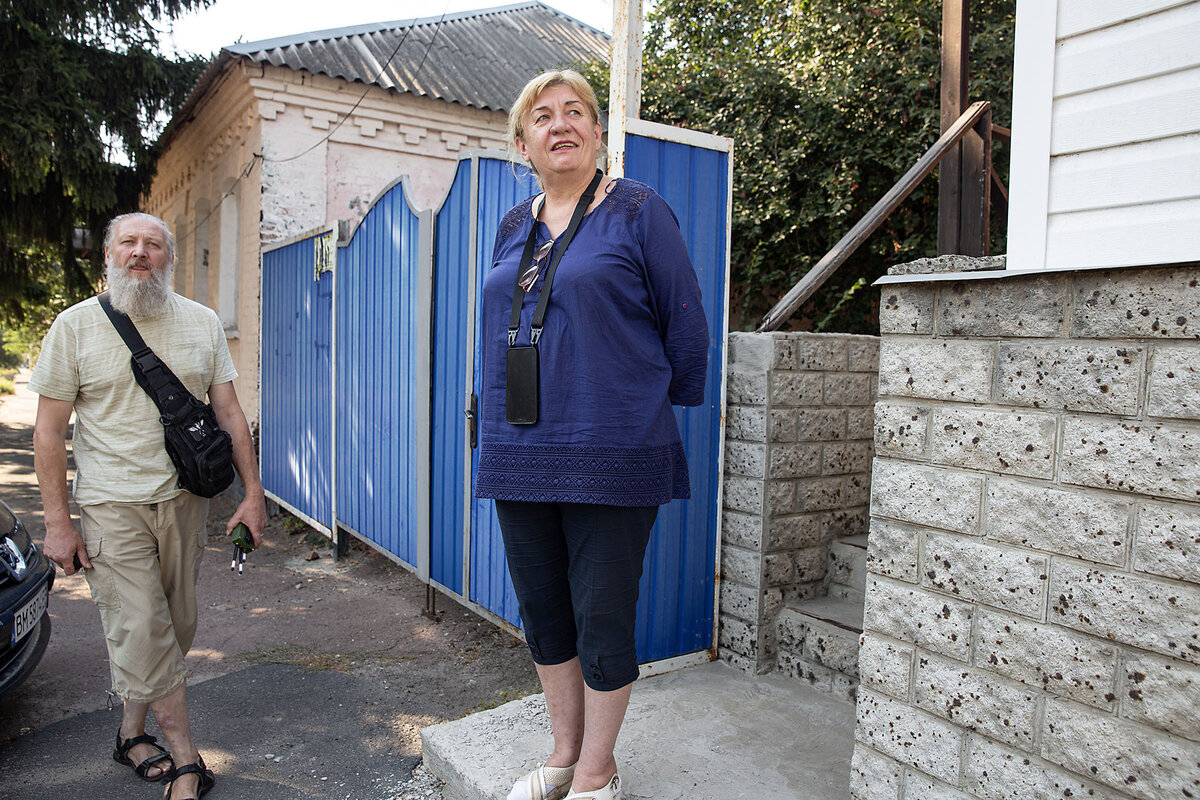
Nataliia Kalinichenko and her husband, Yurii, outside the office of the print weekly Bilopilshchyna, which they have continued to publish despite the war.

And while we’re on the subject of Ukraine, I want to share a story while it’s fresh, because in a war zone, you never know how long a piece of good news will last.

Dominique Soguel (with support from Oleksandr Naselenko) reports at the Christian Science Monitor, “The streets of [Bilopillia, Ukraine], just seven miles from the Russian border, are nearly deserted. Air-raid sirens have been a round-the-clock reality for weeks, and people take them seriously: When the warnings blare, everyone lies flat to take cover or scrambles to underground shelters.

“But for Nataliia Kalinichenko and her husband, Yurii, there’s no break from getting the news out to the community. They have safety routines; Ms. Kalinichenko asks friends or relatives to monitor social media platform Telegram for news of incoming Russian attacks, while Mr. Kalinichenko uses a drone detector while driving. But their mission is to keep locals informed through publication of their print weekly, Bilopilshchyna.

“Before the war, the newspaper featured 12 to 16 colorful spreads with articles on local entertainment, politics, and practical information like bus schedules. Now, it is a stark black-and-white publication filled with military and civilian obituaries and snapshots of local buildings destroyed by Russian attacks.

“ ‘With the onset of Russia’s invasion, our community’s information needs changed dramatically, as did our ability to meet them,’ says Ms. Kalinichenko, who joined the newspaper in 1996 and became its editor-in-chief a decade later. ‘Safety became the primary concern.’ …

“The information landscape has transformed over the past 2 1/2 years. Televisions, once tuned to Russian and Ukrainian channels, lost their appeal. The first Russian strike on the town’s television tower in March 2022 marked the beginning of a series of barrages. Telegram, which now tracks incoming missiles, has become a lifeline – though it requires electricity and an internet connection. Both have been hard to reliably access amid Russia’s offensive. …

“Inevitably, the community has shrunk. The agricultural district of Bilopillia was once home to about 16,000 residents. Now the figure is between 3,000 and 8,000, according to Ms. Kalinichenko. Residents come and go depending on attacks and electricity supplies. New arrivals from other regions temporarily swell the numbers.

“The Kalinichenkos are determined to stay put and keep the paper running as a team. On the walls of their office hang photographs documenting the paper’s history, including a period when it was known as the Flag of Stalin. Piles of newspapers are testament to disruptions in postal delivery services, and a collapsed ceiling from a recent blast prevents Ms. Kalinichenko from sitting at her usual desk.

“At a nearby shop, salesperson Nina Davydova and her teenage daughter, Victoria, discuss the toll of constant strikes. Though Victoria gets her news only through Telegram, Nina says Bilopilshchyna is still popular.

“ ‘People really like to buy the newspaper,’ she says, pointing out that she has already sold six copies this morning, even though Russian attacks were particularly intense. ‘Grandmothers will buy five to six copies so that they can bring it to their neighbors who cannot walk.’

“The newspaper sells at 20 locations in the Sumy region, which shares a 28-mile border with Russia. While many readers have fled, they continue to pay for a subscription in order to remain connected to their homeland, says Ms. Kalinichenko. Even in its reduced format, it serves as a vital source of information for local agricultural communities.

“Serhii, a sardonic shopkeeper, displays the latest copies alongside shrapnel that damaged his shop, which sits a few blocks from Nina’s. ‘If people would not buy it, I would not sell it,’ he says. ‘About five people buy it every day. But people also come from surrounding villages on market days to buy 10 copies at a time.’

“Articles pay tribute to slain soldiers and quote analysts to dispel rumors and dismantle Russian disinformation. One recent instance involved pollution of the river Seim – caused by industrial activities upstream in Russia. Russian trolls on Telegram spread the notion that drinking water had also been compromised, but that was not actually the case. Experts quoted in the paper helped debunk that notion.

“ ‘For villagers with no internet, it is an important source of information and local news,’ says Serhii.

“That assessment is echoed by customer Dymtro Potiomkyn, who grew up with the paper on the family table. He recalls it being a way for people to buy and sell goods locally. Today, it publishes information about what kind of social help is available locally. He buys the paper in person, while his mother gets it delivered by mail.

“ ‘This newspaper is crucial for villages that are right on the border with Russia,’ says Mr. Potiomkyn, who runs a funeral business in the region. ‘Some have been without electricity or internet for years. It’s literally their only source of Ukrainian news.’ “

I know from my own four-month remote gig with a Ukrainian news outlet that Telegram is important to the information landscape there. I also know about Ukrainians’ concern that the outside world gets false information from social media posted by Russians. That’s why Americans like me were helping Ukrainian journalists put their own Twitter and Facebook updates in colloquial English. My experience here.

More at the Monitor, here. No paywall. Subscriptions are reasonable.

Read Full Post »

Photo: Kerem Yücel/MPR News via Oregon Public Broadcasting.
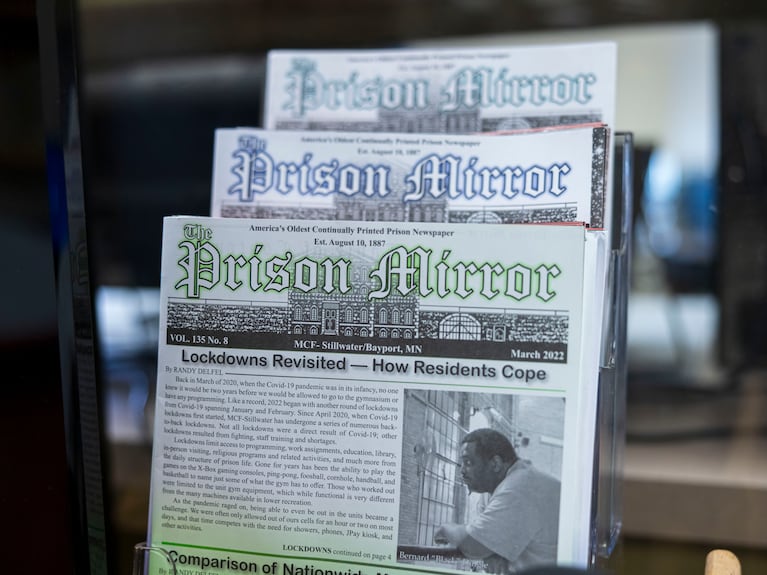
Previous issues of the Prison Mirror, which has been publishing since 1887, sit on display in the Minnesota Correctional Facility in Stillwater.

From time to time I like to run a story about interesting prison programs or ex-offenders trying to make good. I’m pretty sure we don’t have the right kind of prisons in the US. You may recall me writing about the system in Norway, which is completely different. (Click here and here.)

Meg Anderson (Minnesota Public Radio NPR) wrote recently about a longtime enrichment program at a prison in Minnesota.

“Inside a state prison near Stillwater, Minn., past the guards and the wings of cells stacked one on top of another, tucked in the corner of a computer lab, Richard Adams and Paul Gordon are fervently discussing grammar.

“Both men are on staff at the Prison Mirror, a newspaper made by and for the people held at the Minnesota Correctional Facility – Stillwater. Gordon had written a profile on the prison art instructor. He read it aloud to Adams. …

“Conversations like this have been happening in this prison for more than a century. The Prison Mirror is one of the oldest prison newspapers in the country, running since 1887. Publications like this aren’t common, but in an era where many journalism outlets in the free world are struggling to thrive amid scores of layoffs, journalism behind bars is actually growing.

“ ‘Overall we do see a growth and a lot of interest in starting publications, starting podcasts even. And so that’s really quite exciting,’ says Yukari Kane, CEO of the Prison Journalism Project.

“Thirty years ago, she says there were estimated to be only six prison newspapers. Today, there are more than two dozen. That doesn’t take into account the hundreds of incarcerated writers submitting work to publications on the outside, like The Marshall Project’s Life Inside series.

“Kane says this kind of work can offer a window into what prison is actually like, one that prison administrators aren’t necessarily going to offer up freely. … Even if a newspaper doesn’t circulate far beyond the prison yard, it can offer a sense of empowerment for its writers. …

“The Stillwater prisoners write book reviews, legal explainers, and summaries of local, national and international events for the monthly newspaper. One man recently submitted an essay on homesickness. Another wrote an editorial criticizing lockdowns. The men on staff — there are only three of them — had to apply for these unpaid jobs, and they’re highly sought after.

“Adams says the job requires a lot of reading and research about what’s going on around the world and the prison. There are challenges. They don’t have the internet, for instance, so they have to rely on print media and articles printed out by prison staff.

“The prison also has to approve everything the paper publishes. The men say that can limit what they write about, especially if they want to report on the harsher aspects of their lives.

“ ‘I am limited in the sense of, they’re not going to let me print all types of crazy things about the water or the lockdowns or getting restrained or anything like that, which is understandable to a degree,’ Gordon says.

“Last fall, around 100 Stillwater prisoners refused to return to their cells. Gordon says the disobedience was their way of protesting extreme heat, poor water quality, and staffing shortages, which he says often result in lockdowns. He plans to write about it, but says he has been retaliated against in the past for sending reporting to outside publications.

“ ‘I was a lot more aggressive in my writing back then, and that was a learning experience for me,’ he says.

Brian Nam-Sonenstein, a senior editor at the Prison Policy Initiative, says punishment for doing journalism behind bars is common. ‘You can lose what are called good time credits, which are essentially time off of your sentence based on good behavior. You could go to solitary confinement. You could have your privileges revoked,’ he says. …

“Marty Hawthorne works at the Stillwater prison and oversees the Prison Mirror.

“ ‘They have a lot of freedom. My philosophy is: It’s their newspaper. It’s not my newspaper,’ he says. ‘I believe they have a right to do what they’re doing.’ He says if the men plan to publish something critical, he makes sure whoever they’re writing about has an opportunity to respond. But he says he also pushes back when leadership tries to censor stories he believes are fair.”

More at NPR, here. No firewall.

Read Full Post »

Photo: Molly Haley for the Boston Globe.
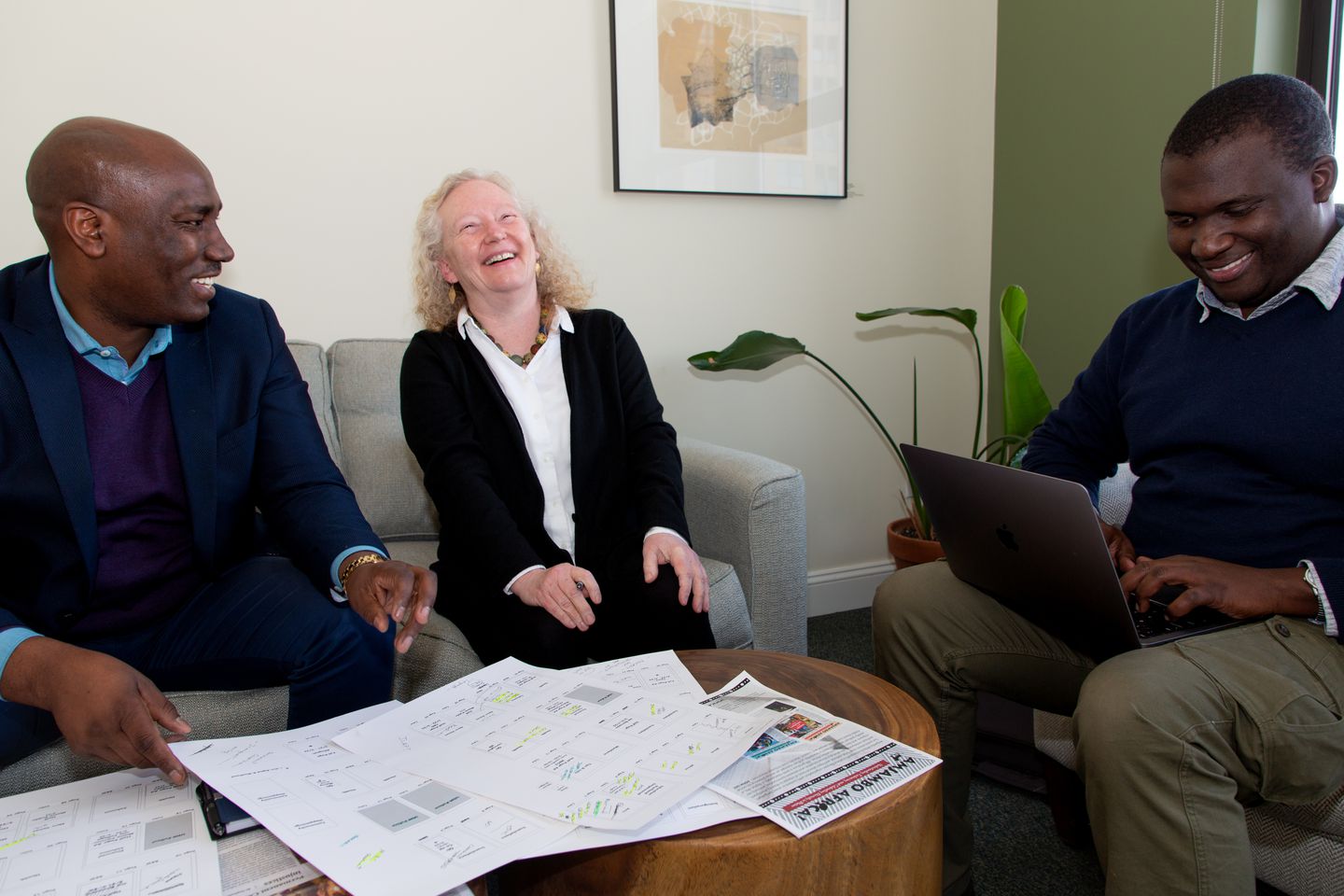
The Amjambo Africa! team: Georges Budagu Makoko, cofounder and publisher; Kit Harrison, cofounder and editor in chief; and Jean Damescène Hakuzimana, deputy editor and kinyarwanda translator [Bantu language]. They make use of a co-working space at the Greater Portland Immigrant Welcome Center.

When I edited a Boston Fed community-development magazine, we had several articles on the resettlement of Somalians in Lewiston, Maine. With some exceptions, Mainers welcomed the refugees because that part of the state had been losing population. But I also read that among the immigrants themselves, the Bantu had a hard time. Prejudices had carried over from Africa. Today’s story focuses on the Bantu community.

Thomas Farragher reports for the Boston Globe about an unusual partnership.

“She is the daughter of a celebrated Washington Post correspondent who wrote from New Delhi and Tokyo, seeking out truth and telling the essential stories of people’s lives. And so, Kit Harrison continues to nurture the journalistic flame. …

“It’s a passion shared, too, by Georges Budagu Makoko, who is the publisher of the newspaper that Harrison edits here called Amjambo Africa!

“It’s a free publication about the African diaspora and immigration. And it’s intended for the eyes of newcomers to Maine with this lofty goal: to build a community by spreading information about its readership throughout Maine.

” ‘We operate on chutzpah and brains and energy and teamwork,’ Harrison told me when I visited her offices here the other day. ‘I grew up abroad quite a bit with my journalist father. I also taught kids in the range of (kindergarten) through eighth grade and the focus for me was always international. … I was constantly trying to teach kids about what we all have in common around the world — and why we can live together peacefully if we try.’ …

Amjambo Africa! [chronicles] the efforts to curb hunger in Africa and the state of the forests of the Congo and the environmental challenges facing Burundian coffee farmers. There are stories about efforts underway in Nigeria, Kenya, and Uganda to address mental health issues — and another one about a center that helps kids in Nigeria with autism. …

“All of it done in seven languages: English, French, Kinyarwanda, Portuguese, Swahili, Somali, and Spanish. …

“Makoko first arrived in Maine in 2002 and thirsted for news about the Africa he had recently fled. He could find none. So, he set out to do something about it.

“ ‘When I came here,’ he told me the other day, ‘I didn’t speak English at the time. I had to take English classes. After that, I was hired by a nonprofit organization that develops housing.’

“The people for whom he provided housing wanted something else from him: help in navigating a bureaucracy without the language skills to do it.

“ ‘So I started thinking: “What can I do to help these people?” ‘ he said. … ‘They need information about how to find their way in the system.’

“Makoko had written a book, Ladder to the Moon. A Journey from the Congo to America.

“It told the story of a growing up in a beautiful peaceful village surrounded by family — a life upended during the genocide in Congo and Rwanda. …

“ ‘But then my book was not enough. I started thinking maybe we can come up with something that will regularly inform the immigrants about resources that are around here, but also the whole community as to why people are coming here and what’s happening where they are coming from.

“ ‘And that’s where the whole idea of the newspaper came from. I didn’t know how to do it. I didn’t know how to start a newspaper. I was thinking I have this idea. And I have zero background in journalism.’

“But Harrison did.

“And so a friendship and a critical collaboration and a partnership were forged.

“The first issue appeared on April 1, 2018, the product of a year’s worth of planning and answering critical questions: Who’s going to read it? Who’s going to advertise in it? How is this all going to work?

“ ‘You can’t print for free,’ Makoko said. ‘That’s an obvious cost that was there. We needed somebody to design the paper. Those are skills that we didn’t have. Kit was very good in writing and doing interviews and coming up with articles — but also translation. ‘You’ve got to understand that this newspaper is published in (multiple) languages.’

“All of that is a tall task. A monumental and important undertaking. And, yet, they have done it. It exists, telling stories about conflict in Ethiopia and about how to stay warm when Maine’s temperatures dip to dangerously low levels. …

“ ‘We’re about to celebrate our fifth anniversary,’ Harrison told me. ‘And we’ve grown. We’ve always been small and we still are. But within that smallness there’s been quite a lot of big reception and a lot of interest. We’re in it for the long haul. But it’s not easy. It’s very challenging to get the finances in place to do what we want to do, which is big stuff.’ …

“ ‘The word Amjambo — by the way — has meaning which you might want to know,’ Harrison said. “It means two things. It’s a greeting. But is also means W-O-R-D. Word.’ …

“ ‘You try to work for the common good, using whatever skills and attributes you happen to have,’ she said.”

More at the Globe, here. And at Amjambo Africa! here.

From a recent issue, you can read Bonnie Rukin’s article, for example. It’s on the Somali Bantu Community Association’s Liberation Farms in Lewiston, where farming skills have translated relatively easily from Africa to America.

“Two large building projects are planned for springtime at the farm – building a goat barn, and also a corn house for processing and storage. Local contractor Scott Doyon will oversee both projects. He has worked with the community before, on several projects. Good Shepherd Food Bank is supporting the goat barn; a State of Maine grant is funding the corn house. In addition, a new small commercial kitchen is going into the building that currently houses the farm stand. The space will allow community members to process produce grown at the farm.” More.

Read Full Post »

Photo: Suzanne and John’s Mom.
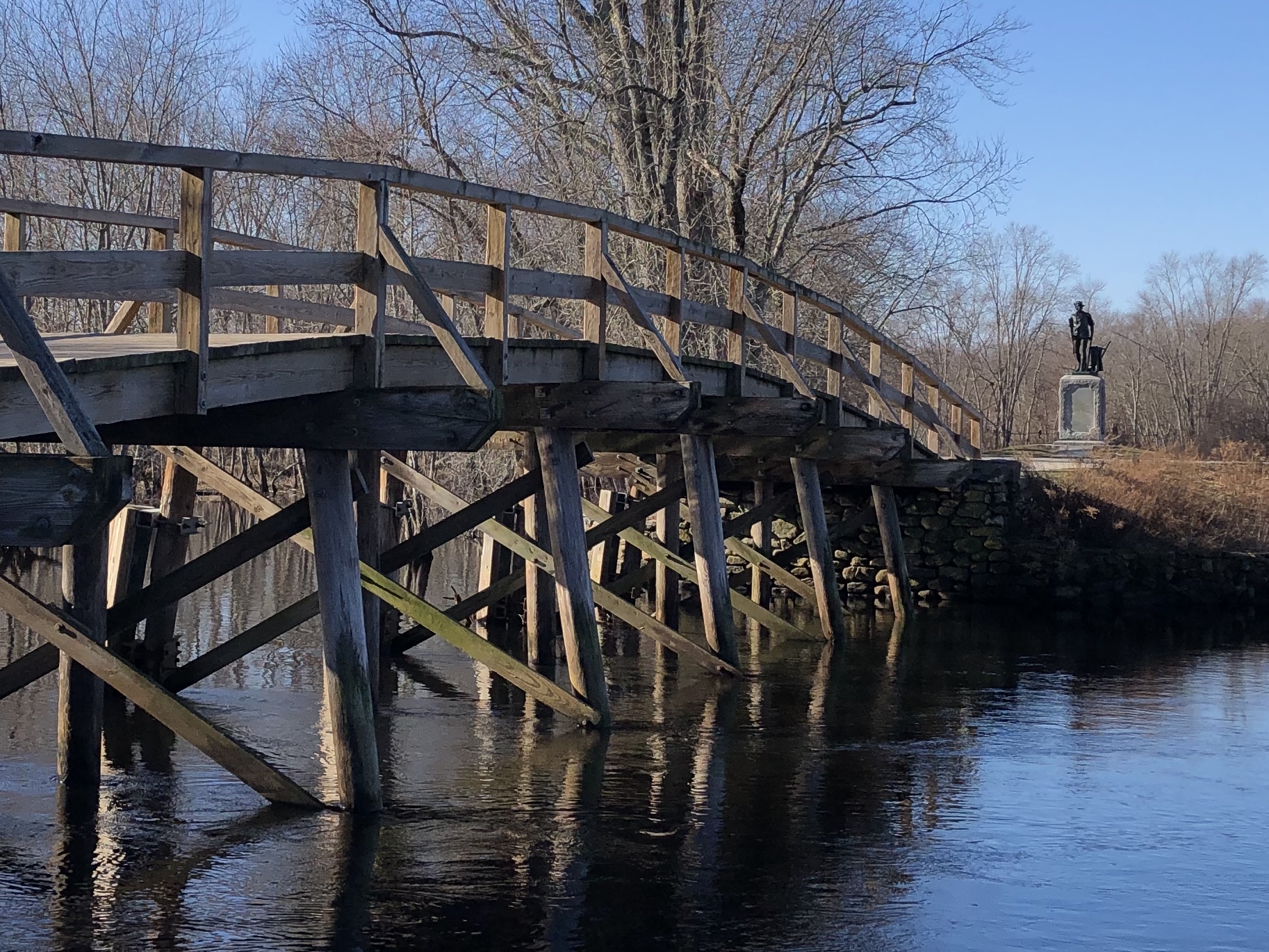
Remember Ralph Waldo Emerson’s lines, “By the rude bridge that arched the flood …”? A nonprofit news site named after this bridge will expand on a local-news trend led by the
Texas Tribune.

Hope is coming for one of the cornerstones of democracy, local journalism. Nowadays, it looks like the for-profit model ends in acquisitions, hedge fund ownership, and generalized stories that can be plugged into any town. Which is why we are seeing more nonprofit efforts for community news.

Margaret Sullivan writes at the Washington Post that if local journalism manages to survive, we need to “give Evan Smith some credit for it. The Texas Tribune founder has been a ‘true pioneer’ in finding ways to cover local communities as a nonprofit.

“When Evan Smith co-founded the Texas Tribune back in 2009, digital-first nonprofit newsrooms were something of a rarity. There was ProPublica, only two years old at the time, MinnPost in Minneapolis, the Voice of San Diego, and a few others.

“So his move from top editor of the award-winning Texas Monthly magazine, at the urging of venture capitalist John Thornton, was considered slightly bizarre.

“ ‘The tone of the coverage was almost mocking,’ Smith recalled last week, soon after he announced he would step down as the Tribune’s CEO at the end of this year. ‘It was, “What does this joker think he’s doing?” ‘

“As it turns out, Smith and company — he and Thornton recruited Texas Weekly editor Ross Ramsey to join the endeavor — had a good idea of what they were doing, or figured it out along the way.

“The Austin-based Tribune has grown from 17 employees to around 80 (more than 50 are journalists), raising $100 million through philanthropy, membership and events, including its annual Texas Tribune Festival that has attracted speakers including Nancy Pelosi and Willie Nelson.

Most important, it has done a huge amount of statewide news coverage with a focus on holding powerful people and institutions accountable.

“These days, such newsrooms are springing up everywhere; there are now hundreds of them. They are easily the most promising development in the troubled world of local journalism, where newspapers are going out of business or vastly shrinking their staffs as print revenue plummets and ownership increasingly falls to large chains, sometimes owned by hedge funds.

“In Baltimore, the Banner — funded by Maryland hotel magnate Stewart Bainum — is hiring staff and expects to start publishing soon. In Chicago, the Sun-Times is converting from a traditional newspaper to a nonprofit as it merges operations with public radio station WBEZ. And in Houston, three local philanthropies working with the American Journalism Project (also co-founded by Thornton) announced a $20 million venture that will create one of the largest nonprofit news organizations in the country.

“ ‘These newsrooms are popping up like mushrooms after a rainstorm,’ Smith, 55, told me. …

“As a speaker at Trib Fest myself, I’ve seen Smith in action — a promotional force of nature, energetic organizer, prodigious fundraiser, and lively onstage interviewer.

“Emily Ramshaw, who started at the Trib as a reporter and was named its top editor in 2016, called him ‘an innovator, a ringleader and a fearlessly ambitious local news entrepreneur.’ What’s more, she told me, Smith has brought along ‘a whole series of news leaders who have grown up in his image.’

“Ramshaw counts herself among them; she left the Trib in 2020 to found a new nonprofit news organization, the 19th, which covers the intersection of gender, politics and society.

“The Trib’s new editor is Sewell Chan, most recently at the Los Angeles Times, where he was the top opinion-side editor, and previously at the New York Times and the Washington Post. Smith considers it a triumph for nonprofit newsrooms that it’s no longer unusual for them to attract the likes of Chan, or of Kimi Yoshino, who was managing editor of the L.A. Times before being named editor in chief of the Baltimore Banner. …

“The Trib’s journalism is influential well beyond its own free website. More than 400 Texas Tribune stories appeared on the front pages of newspapers throughout the state last year, provided free of charge. The site has done investigative projects on the effect of sex trafficking on young girls, the influence of religious belief on the lawmaking of Texas legislators, and an investigation, part of its voting rights coverage, into the state’s review of voting rolls. In 2019, it announced it was joining forces with ProPublica to form a new investigative unit based in Austin. …

“With local news outlets withering in many communities — statehouse coverage, in particular, has dwindled despite its importance — and democratic norms under attack in many states, the need for that kind of watchdog reporting is acute everywhere.” More at the Post, here.

Another nonprofit news site will launch locally in fall, The Concord Bridge. Hooray. A world for which the “embattled farmers” fought doesn’t have to be merely aspirational. Neither does good local journalism.

Read Full Post »

Photo: Capital Canvas Prints.
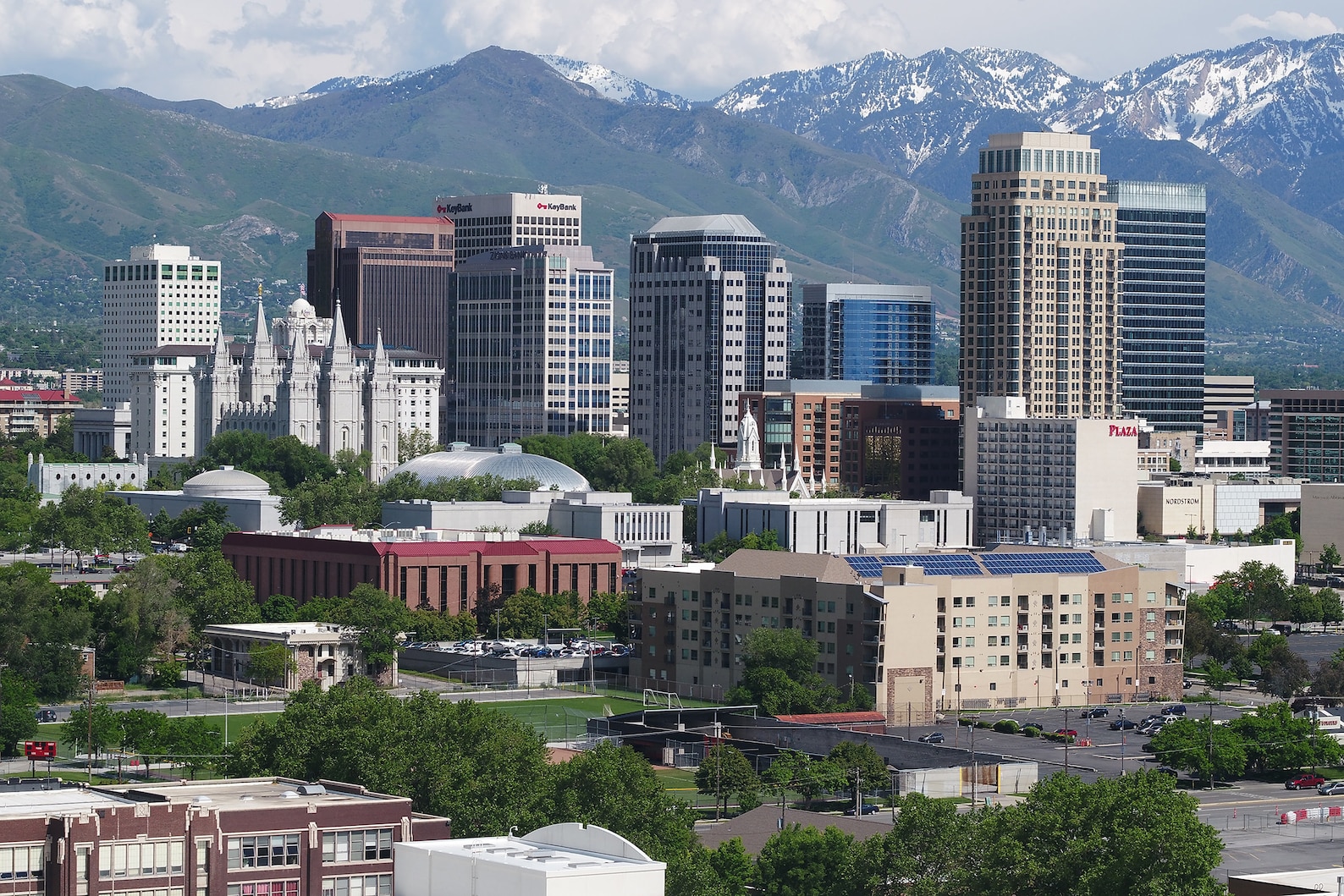
Salt Lake City, Utah.

Our local paper is owned by a national chain, Gannett, that cares nothing about our town. It prints generic articles from national outlets like USA Today or towns in other parts of New England and doesn’t get around to printing the library’s schedule or candidate letters until the events are over. Once in a while, it covers a controversial meeting or interviews a school coach — exceptions that prove the rule.

So I was not surprised to learn that a group of prominent citizens, including an experienced journalist, is working to establish a nonprofit competitor here. This is not unheard of. Today’s article from NiemanLab describes one successful effort to save local journalism, only in this case, the nonprofit board built on an established newspaper.

As Sarah Scire wrote last November, “The Salt Lake Tribune has plenty to celebrate in 2021. The first (and so far only) major newspaper to become a nonprofit is financially sustainable and, after years of layoffs and cuts, is growing its newsroom. Executive editor Lauren Gustus announced the news in a note to readers in which the relief of escaping hedge fund ownership was palpable.

“ ‘We celebrate 150 years this year and we are healthy,’ Gustus wrote. ‘We are sustainable in 2021, and we have no plans to return to a previously precarious position.’

“It’s been quite the turnaround. Utah’s largest newspaper escaped the clutches of the hedge fund Alden Global Capital in 2016 only to see its local owner, Paul Huntsman, lay off a third of staff two years later in the face of plunging ad revenue. In 2019, the Tribune made history as the first daily newspaper to become a nonprofit. And then amid the height of the pandemic last year, the Tribune ended a 149-year run of printing a daily newspaper and a 68-year-old joint partnership with the Deseret News. …

Gustus pointed out that hundreds of American newspapers are owned by financial institutions with a well-deserved reputation for making every newspaper they touch worse by gutting newsrooms, selling off assets, and jacking up subscription prices for readers.

“Gustus herself joined the Tribune from McClatchy (owned by a hedge fund) and spent years at Gannett (once managed by one hedge fund, and now deeply in debt to a different one). …

“The Salt Lake Tribune’s transition to nonprofit status has been closely watched in the news industry. Does that put additional pressure on Gustus and the rest of the Tribune team? ‘The opportunity for us to prove that this can work is significant and so is the responsibility,’ she said.

“The Tribune grew its newsroom 23% in the last year and will add new reporting roles focused on education, business, solutions journalism, food, and culture in 2022. Gustus also expects to follow the Utah News Collaborative (launched in April to make the Tribune’s reporting available to any news organization in the state) with more multi-newsroom projects centered on saving the Great Salt Lake and the centenary of the Colorado River Compact.

“Other changes include introducing six weeks of paid parental leave and a 401(k) match for employees. In response to readers who said they missed the ‘daily drumbeat‘ amid the weekend edition’s in-depth reporting, the newsroom will publish an e-edition to accompany the Sunday paper. They’re also introducing a second printed edition — delivered by mail, rather than carriers — on Wednesdays at no additional cost to subscribers.

“The Salt Lake Tribune draws revenue chiefly from subscriptions, donations, and advertising. … Subscribers pay for a digital subscription ($80/year), while ‘supporting subscribers’ ($150/year) add a donation on top. In the donations category, members of The First Amendment Society pledge to donate at least $1,000/year for three years while major donors provide one-off gifts and grants.

“The Tribune has about 6,500 supporting subscribers, more than 50 members of its First Amendment Society, and dozens of major donors. (In a bid for transparency, The Tribune forbids donations over $5,000 to be anonymous. You can see the full list here.) Gustus stressed that consistency of support is invaluable.

“ ‘We are so grateful to them [supporting subscribers] because it enables us to plan.’ …

“Gustus says that being ‘relatively lean’ — the newsroom currently stands around 33 reporters, with a handful of open positions — sometimes lends itself to some unusual experiments. The Salt Lake Tribune’s NBA beat writer, Andy Larsen, told his sizable Twitter following he wanted to get 500 new subscribers for the Tribune by the end of the year.

“Larsen had to clarify that this was his own idea and not something his bosses were making him do. … Roughly 24 hours after his first tweet, the thread had earned the Tribune 82 new subscribers. In November, roughly halfway through the self-assigned challenge, Larsen said that number had grown to 294 new subscribers.

“ ‘Andy is a gift to Utah,’ Gustus said, noting that Larsen wrote a popular column that dug into Covid data in the state when professional basketball ground to a halt. ‘He has really taken his curiosity and run with it.’

“Looking ahead to 2022, Gustus was brimming with ideas for the newly-enlarged newsroom. The Tribune will continue to investigate the dark history of Indigenous boarding schools in the state, start a conversation about the long-term impacts of children being educated during the pandemic, address water resource issues, and make sure readers have the information they need to vote in November elections.

“Gustus says The Salt Lake Tribune will also be wrestling with what it means to be a nonprofit news organization, beyond its official 501(c)(3) tax status.

“ ‘2021 has been all about finding stability for the Tribune,’ Gustus said. ‘We are so happy to say we’ve arrived in that spot and we don’t want to go back to where we were.’ “

More at NiemanLab, here, and at the newspaper’s website, here.

Read Full Post »

rtx79fmi-e1584114422319

Photo: Reuters/Guglielmo Mangiapane
Italy formally recognizes that newspapers are essential services.

The demise of newsprint has been exaggerated. Newspapers are still needed. Not only did one in Australia — partly as a joke — print some blank pages with dotted lines for making your own toilet paper, but in Italy newspapers have now been characterized as “essential” services.

Luiz Romero reports at Quartz: “As it became increasingly clear earlier this week that the Italian government would announce even more stringent measures to combat coronavirus, in a country that already faces extraordinary restrictions, a debate began to brew over what should be left open and what should be forced to closed. Places that sell food and medicine would have to keep functioning, but what about the edicole—the small shops that sell newspapers and magazines, and that still exist in the thousands in Italy?

“On Wednesday (March 11), Carlo Verdelli, the director of Repubblica, one of the two largest newspapers in the country, alongside Corriere, published a note arguing that newsstands should be added to the list of essential services that was being prepared by the government. …

“Here, like everywhere else, newsstands are disappearing. They went from 18,400 to 14,300 during the 2010s—a number that  includes those that also sell souvenirs for tourists. Excluding them, the real number of newsstands in Italy is estimated to be around 5,000. Still, Italians like to read newspapers. Almost a third of the population gets its daily news in print. …

“After some debate, and as the number of cases continued to spike, the government finally took a decision. Everything had to close except what it deemed essential services—food stores, pharmacies, hardware stores, and factories. … Newsstands were also allowed to keep going. …

“In Milan, newspaper vendors are proud of what they do. Rosi Varezza, who operates a small but busy newsstand, explained that papers are essential for elderly readers, who are most at risk from the outbreak. Clients buy newspapers for habit, but also to get information they deem more trustworthy; to go deep into subjects they consider important; and to hear the news delivered from specific voices—columnists that have informed them for decades. …

“Newsstands are even registering a small bump in sales. That was clear in Milan. In a busier newsstand, near a major shopping street here, I had to wait to pay for the newspaper. And when my turn came, I had to ask my questions quickly. The newsagent was impatient, answering with short sentences, and insistently looking over my shoulder. A line was forming.” More at Quartz, here.

In my own case, I have always read articles more deeply if they are in print. And in my semi-isolation, I look forward to the paper delivery every day and read more sections than usual. You?

Read Full Post »

Photo: Tom Goldman/NPR
Reporters at rural Oregon’s profitable
Malheur Enterprise keep the news flowing while other local papers nationwide are folding.

This morning I read that television is expanding like crazy, no end in sight. Wasn’t the internet supposed to kill off television? Wasn’t television supposed to kill off radio? It seems to me that new technologies don’t necessarily destroy everything that went before the way cars destroyed horse-drawn carriages. It all depends on whether the old technology finds a new way to meet needs that still exist.

Consider local newspapers. Many are folding — and it’s definitely scary because that’s where big stories often break. But there’s still a need for local news, and I think someone will fill it. In rural Oregon, a small newspaper survived and became profitable by hiring a salesman and improving quality.

Tom Goldman at National Public Radio (NPR) has the story.

“The Malheur Enterprise was founded in 1909, and, like many other newspapers, was languishing. But in the past few years, its circulation has surged and it has won several national awards. … [It] has boomed in the past three years.

” ‘Boomed’ is a relative term when it comes to a rural weekly. Paid subscriptions are at about 2,000. But during a recent week, more than a third of Malheur County’s roughly 30,000 residents read the paper’s online edition. And advertising dollars, the lifeblood of a small newspaper, are way up.

” ‘Our overall revenue is more than triple what it was three years ago,’ says Les Zaitz, the paper’s editor and publisher. ‘Circulation is probably double. We’re profitable, and there are not a lot of papers in the United States that can say they’re profitable.’ …

“Zaitz, 63, was a longtime, award-winning investigative reporter for the Oregonian, the state’s largest newspaper. He is a two-time Pulitzer Prize finalist. But he has always had a passion for small-town papers. Which is why, in 2015, he tabled his retirement plans and bought the Enterprise with family members. The paper, at the time, was almost out of business. It was filled with gossip and press releases.

” ‘It wasn’t delivering much in the way of real local news,’ Zaitz says, adding, ‘[it] had one reporter who primarily focused on high school sports. … It had not had an ad salesperson in 10 years. … There was just no doubt in my mind that if we turned around the news product, and got a salesperson in, we could make the thing profitable pretty quick.’

“Sure enough, the Enterprise now is a serious, award-winning newspaper.

“This spring, the paper won a prestigious national Investigative Reporters and Editors award for its coverage of a case that rocked Malheur County. A man released from the state hospital after claiming he faked his mental illness was accused of killing two people after being freed. The Enterprise was the first weekly paper to win the IRE Freedom of Information award. …

“Reporter Pat Caldwell, who has been a journalist for 22 years, says Zaitz has transformed the way he works. ‘It’s all about detail,’ Caldwell says, ‘detail, detail, detail. Y’know? And why, why, why, why? Why are you doing this? Why is this happening? Who pays for it?’ …

“Zaitz has earned his readers’ trust with his devotion to bedrock principles of journalism. He acknowledges it also helps that he is one of them. His hands are thick from bucking hay and fixing barbed wire fences on his ranch about 100 miles outside Vale. But being on the inside doesn’t mean he and the Enterprise pander. … Enterprise reporting has angered local politicians. Some still don’t talk to Zaitz or his reporters.

” ‘Public officials who’ve evaded scrutiny for decades here aren’t very fond of us in some quarters,’ Zaitz says. ‘But the good public officials, those who are trying to do a good job, they recognize that we are doing our job and we are holding them accountable and we’re making them better governing officials. And they don’t object to that. Because we try to be accurate; we try to be fair. While they may have to salve the sting of a particular story, that sting wears off and they appreciate what we’re doing. …

” ‘Rather than worrying about what’s going on in journalism at the national level,’ he says, ‘let’s turn the periscope around and let’s rebuild from the small guy up. And I think that’s going to have more influence in the long run.’ ”

More at NPR, here.

Read Full Post »

Ian Burrell has a funny story at the Independent about the Times of London deciding to create the old-tyme newsroom ambiance by piping in the sound of typewriters clacking. Goodness knows if the young people can concentrate, but it must make the guys with the green shades feel they’re in the right place.

“Almost as if the digital revolution never happened,” writes Burrell, “the newsroom of The Times once again resounds to the clatter of the old-fashioned typewriter.

“Nearly three decades after Rupert Murdoch’s UK newspaper publisher revolutionised the industry by moving to Wapping and ending the ‘hot metal’ era, his flagship title has reintroduced the distinctive sound of old Fleet Street.

“To the surprise of Times journalists, a tall speaker on a stand has been erected in the newsroom to pump out typewriter sounds, to increase energy levels and help reporters to hit deadlines. The audio begins with the gentle patter of a single typewriter and slowly builds to a crescendo, with the keys of ranks of machines hammering down as the paper’s print edition is due to go to press.

“The development, which was described as a ‘trial’ [in August] by publisher News UK, has caused some bemusement among journalists, one of whom tried unsuccessfully to turn the sound off. …

“The Times’s initiative coincides with a revival of interest in the typewriter, a trend which the newspaper reflected on Page 3 today, with a report on how the actor Tom Hanks has developed the Hanx Writer app, which simulates the sound of an old-fashioned typewriter and has gone to the top of the iTunes app store in the US. Hanks, it noted, can tell the difference between the sounds of an Olivetti, a Remington and a Royal typewriter model. …

“Michael Williams, who began his newspaper career at The Times’s old offices in London’s Gray’s Inn Road in 1973, and is now a senior lecturer in journalism at the University of Central Lancashire, saw merit in the idea.

“ ‘People feel to some extent disengaged from the thrill of producing a newspaper, which is galvanising,’ he said, referring to the relative quiet of modern newsrooms.”

More here.

Photo found at Gizmodo 

Read Full Post »

No sooner had I posted yesterday about the NY Times story on how a high school parent’s complaint to the Humans of New York went viral, than I opened a link in twitter that was unexpectedly relevant.

A blog called NewsWhip was showing the real front page of numerous newspapers and then, “using NewsWhip Spike’s publisher view, which breaks out stories by social shares, place of publication and other details,” it showed what each front page would have looked like if the layout had been based on the articles most popular with online readers.

And the lead NY Times article for that day (below) would have been the one I blogged about last night.

If you go to NewsWhip, here, you can see similar reworkings of front pages. Lots of fun. I felt quite reassured that the most popular stories were not all about movie stars or gruesome accidents. When I go to online news, I make a point of refusing to click on those. I don’t want the content generator to keep featuring them, and maybe if no one clicks on junk news, they will stop highlighting it.

 Right, people-powered front page from the NewsWhip blog.

Read Full Post »

When I was little, I liked to look at the cartoons in my parents’ New Yorker, and the ads, too if the pictures were interesting.

I loved the old ads for the Philadelphia Bulletin, in which one skinny, anxious guy in black, like a modern day Cassandra, tried to get people’s attention about something going wrong. Cassandra’s fate was to see the future and never be believed. His was never to be heard.

Usually what he saw was something that had me worried, too, like a shark coming onto the beach. I really couldn’t understand why all those beachgoers were reading the paper instead of paying better attention. On some level, I sensed that the ad might not hit its mark: it might make people wary of reading the Bulletin and maybe getting eaten by a shark.

My husband remembers those ads, too, and when we were reminiscing about them in a restaurant Saturday, he did some Googling and turned up the artist’s name and the cartoon below.

The cartoonist was Richard Decker. Wikipedia writes about him here.

From his obit: “Mr. Decker worked nearly four decades as a contract cartoonist at the New Yorker, starting with the magazine in 1929 and becoming well-known on its pages for his detailed cartoons and lush washes. …

“Those cartoons Mr. Decker crafted that did not appear in the New Yorker often found their way into such magazines as the Saturday Evening Post, Look, Colliers and Playboy.

“And over the years, he also did illustrations for advertising campaigns. Among the best known was a 28-year Philadelphia Bulletin series, which ran until the 1960s, that centered on the slogan, ‘In Philadelphia, nearly everybody reads the Bulletin.’ A major feature of the campaign was ‘Mr. Nearly’ – the only man around not reading the paper.” Decker’s full obit is here.

The cartoon character Mr Nearly is no more. But I can’t help hoping that sometime before his demise, someone heard his warnings.

Photo from the University of Pennsylvania

Read Full Post »

When I was working at the newspaper in the early ’90s, beginners were often given the task of writing obituaries. Whether the family or the funeral home offered the information, the assignment was mostly a question of putting the obit in AP style and perhaps making a call to get a key detail. You didn’t often get a sense of the writer’s style in an obit.

Margalit Fox of the NY Times may be an exception.

“Dr. Peter Praeger, a heart surgeon who saved a man’s life and as a result wound up owning a gefilte fish company — and who as a result of that wound up starting a successful natural-foods company — died on Sept. 22 in Hackensack, N.J. He was 65. …

“Though the story of Dr. Praeger’s company — born of two rabbinical prognostications, any number of hairpin turns of fate and the transformative realization that man cannot live by gefilte fish alone — reads like something out of Sholem Aleichem, it began, no less, on a Christmas Eve.”

Dr. Praeger helped to save the life of a man on Christmas Eve and over time developed a friendship with the man’s brother-in-law, Rubin Unger, the owner of a struggling gefilte fish company. The family rabbi made a prediction: “Any surgeon smart enough to save his congregant’s life would be smart enough to save his congregant’s brother-in-law’s gefilte fish company.

“Dr. Praeger demurred: he was, after all, a surgeon, not a fish maven. Mr. Ungar persisted. …

“Who, in the end, can fly in the face of rabbinical foreordination?” asks the obit writer.

“ ‘It was like The Godfather,’ Dr. Praeger told the magazine New Jersey Monthly in 2007. ‘They pulled me into it.’ ”

At his death, Dr. Praeger was as well-known for the food company that emerged from the gefilte fish as for his surgical prowess.

More.

Photograph: Gefilte fish, which Dr. Praeger learned to like in time, http://chewonthatblog.com

Read Full Post »

Asakiyume writes a blog I enjoy a lot, and this week she had an intriguing post on Jackie Ormes, generally considered the first female African American cartoonist. See examples of work by Ormes at Asakiyume’s blog, here.

According to wikipedia, Ormes (1911 to 1985), “started in journalism as a proofreader for the Pittsburgh Courier, a weekly African American newspaper that came out every Saturday. Her 1937-38 Courier comic strip, Torchy Brown in Dixie to Harlem, starring Torchy Brown, was a humorous depiction of a Mississippi teen who found fame and fortune singing and dancing in the Cotton Club.”

The strip waxed and waned as Ormes pursued her many career interests, bur she always returned to Torchy.

“In 1950, the Courier began an eight-page color comics insert, where Ormes re-invented her Torchy character in a new comic strip, Torchy in Heartbeats. This Torchy was a beautiful, independent woman who finds adventure while seeking true love. …  The strip is probably best known for its last episode in 1954, when Torchy and her doctor boyfriend confront racism and environmental pollution. Torchy presented an image of a black woman who, in contrast to the contemporary stereotypical media portrayals, was confident, intelligent, and brave.”

Being a cartoonist seems harder than writing a blog. You not only need to find daily topics that interest you enough to dwell on, but you have to encapsulate them in a piece of art. Asakiyume sometimes illustrates her posts, but art is one thing you won’t find me doing here. (Unless maybe a collage.)

Read Full Post »

Older Posts »