Feeds:
Posts
Comments

Posts Tagged ‘nutritious’

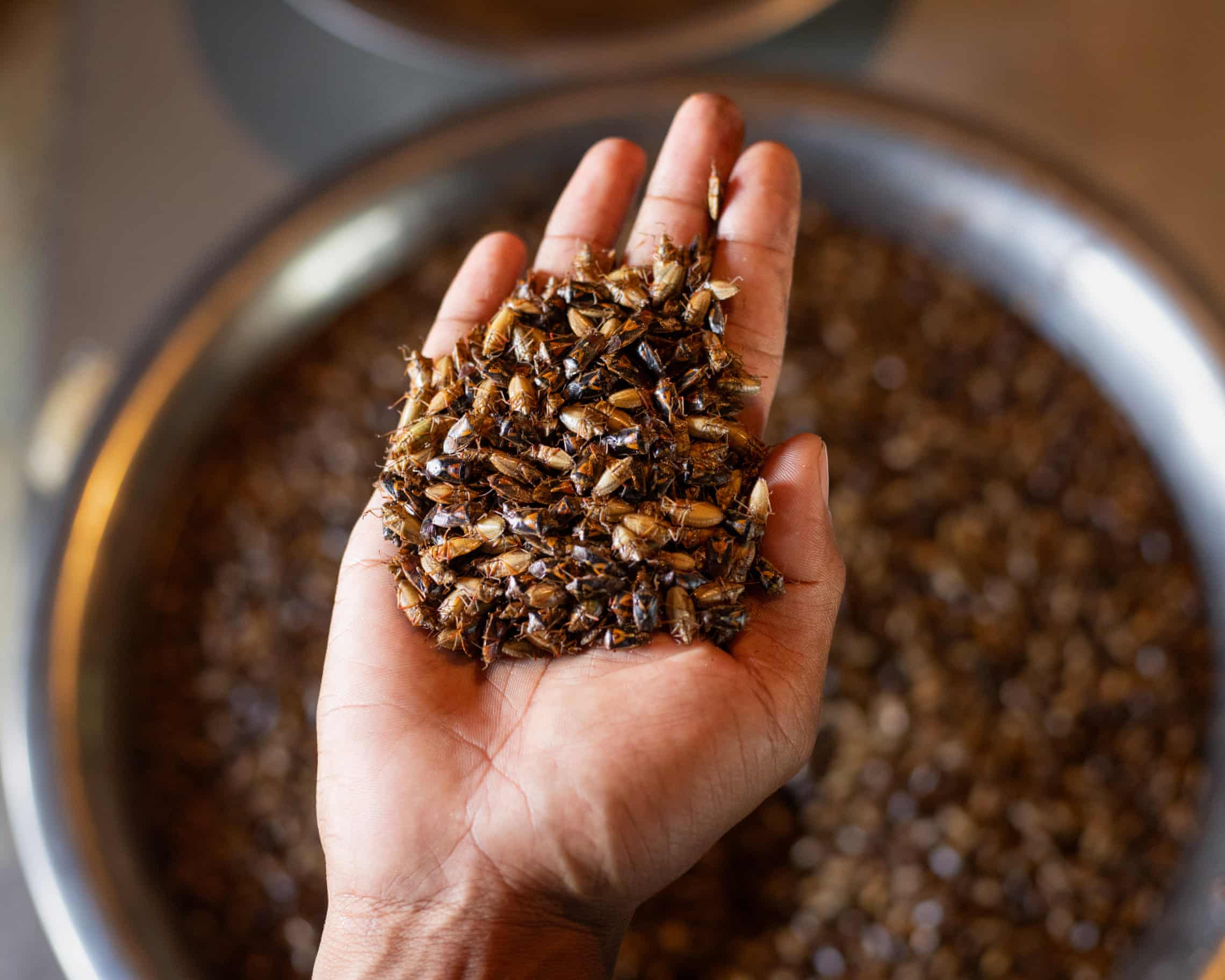
Photo: Thejavikho Chase.
Today we learn that stink bugs can be ground into a thick paste and used to make valuable products. 

OK, this food may be nutritious, but it sounds pretty gross to me. I suppose that eating unfamiliar foods outside your culture takes extreme hunger — or a sense of adventure.

But as Femi Ezhuthupallickal Benny and Thejavikho Chase report at the Guardian, the people who routinely eat stink bugs are doing it because they like it.

“Every few years when Udonga montana, a bamboo-feeding stink bug, erupts in massive swarms,” they write, “the people of the Mizo community in northern India don’t reach for pesticides. Instead, they look for baskets.

“Locally, this small brown stink bug is called thangnang. Outsiders see them as an infestation but in the bamboo forests of Mizoram state this small brown bug has long been woven into the food culture.

“Drawing on generations of traditional ecological knowledge, the Mizo people have developed an intricate system of harvesting, processing and consuming the insects that not only provides high-protein nutrition but also helps control pest populations without harming the forest with pesticides.

“ ‘We have been eating thangnang for more than 100 years,’ says Salemkulhthangi, an elder from the Serhmun village. …

“The big harvesting opportunity comes during mautam, the rare mass flowering of bamboo (Melocanna baccifera) that triggers stink bug outbreaks. ‘There isn’t a fixed date or month; it’s mostly around September-October,’ says Lalvohbika, a conservationist at Dampa tiger reserve in Mizoram. …

“Instead of spreading a sheet on the ground to collect the falling insects, as entomologists might, the Mizo have designed a fishing net-like implement with a long bamboo handle and a conical plastic pocket held open by a strong circular metal wire. As the flowering approaches, the villagers shake the branches, sending the bugs tumbling into the net. Once full, the bag’s narrow end is untied and the catch is emptied into gunny sacks at the base of the trees.

“Hot water is poured over to kill the insects, which are then cleaned and put in a basin where twigs, leaves and other debris are removed by hand. The cleaned bugs are soaked again in warm water, then ground into a thick paste that is processed into two valuable products: a fragrant cooking oil used as food and medicine, and a protein-rich paste used as animal feed.

The taste, it should be said, is an acquired one.

“The stink in the bugs’ name comes from the pungent odor they emit when they are stressed or threatened. … The oil that appears as a top layer as the paste is boiled is carefully skimmed off, bottled and sold in local markets. Nothing goes to waste: even the pulp that remains after oil extraction becomes hmun hlui, a tangy condiment eaten with rice, and the leftover residue is sun-dried and fed to pigs. …

“As global demand for protein rises and climate change threatens food security, the Mizo way of turning a sporadic pest outbreak into protein is a reminder that perhaps the future of food lies not in modern laboratories but in the ancient wisdom. …

“Yes, insects can ravage crops and frustrate farmers, but some of the creatures that chew through leaves and stems are, remarkably, more nutritious than the plants they destroy. … As the entomologist Victor Meyer-Rochow once asked: ‘Why kill insects when they per se are nutritious?’

“It’s a question that resonates deeply in several villages in north-east India where even crop pests find their way into the cooking pot, not out of desperation but as part of a sustainable, seasonal diet that values what their land provides.”

More at the Guardian, here. Have you ever tried chocolate-covered ants or any similar foods that Westerners like me are too squeamish to enjoy?

Read Full Post »

Sweet potato evangelism has won the World Food Prize. I learned about this at National Public Radio, which has a regular feature on eating and health called the Salt.

Dan Charles reports, “One summer day in 2012, on a long drive through northern Mozambique, I saw groups of men standing beside the road selling buckets filled with sweet potatoes. My translator and I pulled over to take a closer look. Many of the sweet potatoes, as I’d hoped, were orange inside. In fact, the men had cut off the tips of each root to show off that orange color. It was a selling point. …

“In Africa, that’s unusual and new. Traditionally, sweet potatoes grown in Africa have had white flesh. …

“Those orange-fleshed sweet potatoes along the road that day represented the triumph of a public health campaign to promote these varieties — which, unlike their white-fleshed counterparts, are rich in Vitamin A. [In June], that campaign got some high-level recognition at a ceremony at the U.S. State Department. Four of the main people behind it will receive the 2016 World Food Prize. This prize is billed as the foremost international recognition of efforts to promote a sustainable and nutritious food supply.

“This year’s laureates are Maria Andrade, Robert Mwanga, Jan Low and Howarth (Howdy) Bouis. Three of them — Andrade, Mwanga and Low — worked at the International Potato Center, which is based in Peru, but has satellite operations in Africa. Bouis worked at the International Food Policy Research Institute in Washington, D.C. …

“In recent years, researchers have documented health improvements among villagers in Mozambique and Uganda, simply because they chose to eat sweet potatoes with orange flesh.” More at NPR.

Don’t you love the orange truck? I call that multichannel messaging.

Photo: Dan Charles/NPR
Maria Isabel Andrade is one of four researchers honored with the World Food Prize for promoting sweet potatoes that are orange inside to combat malnutrition.

Read Full Post »

Like most Americans, I don’t know much about the multibillion-dollar Farm Bill, which is up for renewal this year. NYU professor Marion Nestle talks about its enormous complexity in the Boston Globe.

“I’d like to bring agricultural policy in line with health policy. Health policy tells us that we ought to be making fruits and vegetables inexpensive.” Her biggest concern is that those who produce and sell processed foods benefit most from current policy, which has had the effect of lowering prices for processed food and increasing the prices for the fresh fruits and vegetables people really need.

I have blogged before about the related problem of “food deserts,” localities where there is no reasonably priced market and people end up eating too much junk food. (Check out this post and this one.)

Today I would also like to point you to a National Public Radio story by Nancy Shute.

“Increasingly, metropolitan areas are creating or bolstering their food policies, recognizing the need to ensure that healthful and affordable foodstuffs are available for residents. Baltimore fashioned a food policy initiative in 2009 which involves multiple city departments and an advisory group of over 30 organizations. Priorities included the reduction of ‘food deserts’ and the support of projects that allow low-income residents to order groceries online and pick them up at the local library. New York and San Francisco have also created their own food policy initiatives, and mayors across the U.S. have met to launch a food policy task force.”

“In the summer, Shirley and Ewald August grow blueberries at their Windsor Mill, Md., farm and sell at Baltimore farmers markets.” Photograph: Amy Davis/MCT/Landov

Read Full Post »

There’s a new think tank at Babson College in Wellesley, Massachusetts, one that’s focused on food access.

Food access, food “deserts,” and sustainable agriculture are big issues these days, and Food Sol founder Rachel Greenberger believes that addressing the challenges must involve bringing together all the stakeholders, even agribusiness.

Greenberger refers to her strategy as the “uncommon table,” writes Kathleen Pierce in the Boston Globe. “Located at Babson’s Social Innovation Lab, the company seeks to identify how so-called food deserts — geographical areas without access to a grocery store or fresh food — are formed, and how to make healthy food sustainable for all. …

“Greenberger, a 33-year-old Babson MBA graduate who studied food-system dynamics and consumer behavior in the sustainable food movement, came up with the concept for a company similar to a think tank, but centered on action. By creating a digital map to pinpoint food-related issues, Food Sol intends to highlight pressing topics such as food deserts and fair trade, linking experts in the field with would-be entrepreneurs to ignite working relationships. …

“Food Sol intends to foster ‘a way into thinking about innovation in the food-supply chain, whether it’s creating more cooperatives or building agribusiness in Fall River,’ says Cheryl Kiser [executive director of Babson’s innovation lab]. ‘We are a laboratory where people can come and engage in conversation.’ ”

The theory is that companies will pay to engage in a food think tank like this. In fact, Kiser hopes to involve Cargill Inc., Monsanto Co. , PepsiCo , the Coca-Cola Co., and more. Read more here.

The mention of entrepreneurs who might address food issues is reminding me of two young women who recently launched shipping-container grocery stores in food deserts. Read about that in this NY Times article.

“Carrie Ferrence, 33, and Jacqueline Gjurgevich, 32, were in business school at Bainbridge Graduate Institute in Washington State when they noticed that many local neighborhoods were ‘food deserts,’ without easy access to fresh local produce and other grocery staples.

“Their answer was StockBox Grocers, a company that repurposes old shipping containers as small grocery stores. The company won $12,500 in a local business plan competition and raised more than $20,000 online in a Kickstarter campaign to finance its first store, which opened in the Delridge neighborhood of Seattle in September.”

Read Full Post »