Feeds:
Posts
Comments

Posts Tagged ‘opera’

Photo: James Glossop 
Charlotte Hoather as Uccellina in the “BambinO” production from Scottish Opera, Improbable theater company and the Manchester International Festival.

I know that babies take swimming lessons these days and yoga with Mama. I know they go to music classes (“put your instruments back in the Taster’s Choice bin before we go home”). But opera?

Well, why not? Some babies are so loud everyone says they will be opera stars when they grow up.

Michael Cooper, a reporter for the New York Times, wrote in March at about an opera actually designed for babies. “The average age at the Metropolitan Opera is about to get lower — much lower. Sitting still will not be required: Audience members will be encouraged to crawl around and interact with the singers if they like. The dress code will be so relaxed that many operagoers may opt for onesies.

“No, the barbarians are not at the gate. The Met is presenting a new opera for babies.

“The company will present 10 free performances of ‘BambinO,’ an opera for babies between 6 months old and 18 months old, from April 30 to May 5. …

“The most unusual opera, about a bird, an egg and chick, was written by the composer Lliam Paterson and developed by Scottish Opera, Improbable theater company and the Manchester International Festival. It was directed by Phelim McDermott. …

“ ‘In the Met’s never-ending quest to develop audiences of the future, we’ve decided to start at the very beginning,’ Peter Gelb, the Met’s general manager, said in a statement.

“The opera will be performed for 25 babies, who will be seated on the laps of their caregivers on benches with cushions around the perimeter of the stage area.

Changing tables and stroller parking will be provided.

“The Met’s education team will work with researchers in infant development and early childhood music education from the Rita Gold Early Childhood Center at Teachers College, Columbia University.” More at the New York Times, here.

I apologize for not posting this in time for New York readers to take babies to the opera, but you can read a thoughtful review at Broadway World:

“No one in the audience as on Facebook or Twitter during Lliam Paterson’s opera BAMBINO at the Met’s List Hall — a rare occurrence for the company these days — on Friday May 4. In fact, no one looked at a cell phone at all during the performance. And nobody fell asleep — even though the opera was written for 6-18 month-olds. …

” ‘It’s lovely to see the full range of reactions the show has received,’ says Paterson, ‘and that every little toddler is just a person — and you’re already seeing all of the characteristics that are eventually going to come out.’ ”

Let’s hope operas for babies help build audiences for the future. “Free” is definitely the way to start.
Read Full Post »


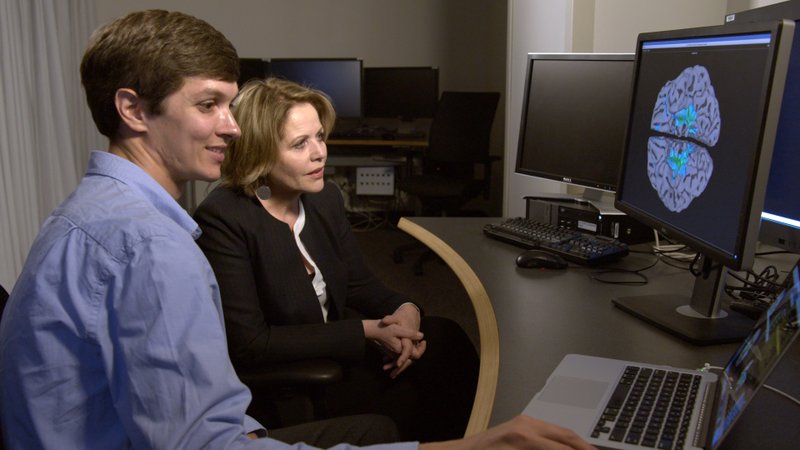
Photo: National Institutes of Health via AP
Soprano Renee Fleming looks at a brain scan with NIH neuroscientist David Jangraw after singing in the MRI machine.

To help scientists understand how music helps patients heal, notable musicians like opera’s Renee Fleming are getting brain scans.

Lauran Neergaard writes at the Associated Press, “Music increasingly is becoming a part of patient care — although it’s still pretty unusual to see roving performers captivating entire wards, like at MedStar Georgetown University Hospital one fall morning.

“ ‘It takes them away for just a few minutes to some other place where they don’t have to think about what’s going on,’ said cellist Martha Vance after playing for a patient isolated to avoid spreading infection.

“The challenge: Harnessing music to do more than comfort the sick. Now, moving beyond programs like Georgetown’s, the National Institutes of Health is bringing together musicians, music therapists and neuroscientists to tap into the brain’s circuitry and figure out how.

“ ‘The brain is able to compensate for other deficits sometimes by using music to communicate,’ said NIH Director Dr. Francis Collins, a geneticist who also plays a mean guitar.

“To turn that ability into a successful therapy, ‘it would be a really good thing to know which parts of the brain are still intact to be called into action. To know the circuits well enough to know the backup plan,’ Collins added. …

“ ‘The water is wide, I cannot cross over,’ well-known soprano Renee Fleming belted out, not from a concert stage but from inside an MRI machine at the NIH campus.

“The opera star — who partnered with Collins to start the Sound Health initiative — spent two hours in the scanner to help researchers tease out what brain activity is key for singing. How? First Fleming spoke the lyrics. Then she sang them. Finally, she imagined singing them.

“ ‘We’re trying to understand the brain not just so we can address mental disorders or diseases or injuries, but also so we can understand what happens when a brain’s working right and what happens when it’s performing at a really high level,’ said NIH researcher David Jangraw, who shared the MRI data with The Associated Press.

“To Jangraw’s surprise, several brain regions were more active when Fleming imagined singing than when she actually sang, including the brain’s emotion center and areas involved with motion and vision. One theory: it took more mental effort to keep track of where she was in the song, and to maintain its emotion, without auditory feedback.”

Read how the new insights are being used to study Alzzheimer’s patients and others here.

Read Full Post »


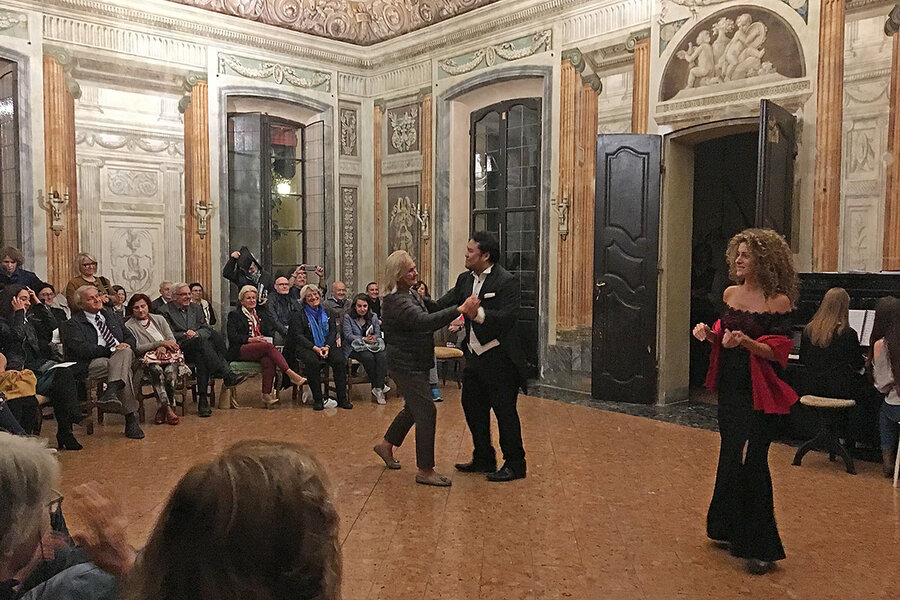
Photo: Sara Miller Llana/Christian Science Monitor
The annual Festival Verdi in Parma, Italy, brings opera to the people by performing in private homes. Just like the old days.

I love the idea of having arts performances in one’s living room, whether it’s a cabaret duo, jazz, opera, drama, or anything similar. It’s partly because I used to write and perform plays as a kid, especially at Christmas in the living room.

Sara Miller Llana has a cool story about living-room concerts at the Christian Science Monitor, a really interesting newspaper with an international focus, in case you’re interested.

She writes, “A young tenor’s voice, in his rendition of ‘La donna e mobile,’ fills the palatial living room with one of Giuseppe Verdi’s most famous canzones from ‘Rigoletto.’

“It’s a late Thursday afternoon and the sun is setting, as guests seated around the piano begin to clap. The hostess is suddenly in the center of the circle for a short waltz.

“For a moment, it feels as though we are transported back to the 19th century, when Verdi, among the world’s most famous composers, created 27 operas, some of them the most-loved in the world.

“But it’s 2017, and this is the sidelines of the month-long Festival Verdi held each year in Parma, Italy. If any region can call itself a heartland of opera, it’s this one.

“The festival … aims to bring opera off the stages into the community in a series of events – from Verdi sung in rap, to the staging of ‘Nabucco’ by inmates at the local jail, to these living room performances for aspiring opera stars. And at least with the latter, the festival brings an ancient custom of private home performances that started in mid-18th century Europe to 21st century Italy.

“Accompanist Claudia Zucconi, who is studying for her masters and wants to specialize in opera, says that playing these antique keys in such a living room ‘was very emotional.’

“ ‘The piano was very ancient, so it was special for a pianist to play it. I felt like it was another epoch, in another time, like I could be dressed liked a princess playing in a room like this.’

“Opera – and specifically local hero Verdi – are so central to the town’s identity and culture that people debate it at locales the way they might discuss the latest soccer match. …

“The director general of Parma’s Teatro Regio, Anna Maria Meo, says the responsibility she feels is nothing short of enormous. Only a few nights ago, after a performance that had only one intermission, theatergoers stopped her on her way down from her office and asked why there weren’t two. She replied that the opera was already long. ‘ “But you can’t cut the space for us to discuss what we are watching, we need at least two,” they said,’ she recounts over a cappuccino in the theater’s baroque café.”

More here.

Read Full Post »


Photo: Lemon42
Follow along at Vienna State Opera in any of six languages with the new subtitle system.

My husband and I use the subtitle feature for DVDs we get from Netflix, even when the movies are in English. We’re not hard of hearing, but it’s so easy to miss what people are saying — especially if the film is from England and the characters speak Mumblecore.

For the oddball plots of operas, subtitles can be even more important. Consider what the Vienna State Opera has done to keep patrons from too much confusion.

Elsabeth Parkinson reports at Limelight Magazine, “The Vienna State Opera has replaced its 16-year-old seat-back system with a new setup offering opera libretti in up to six languages …

“Since the opening of the company’s 2017/2018 earlier this month, subtitles are offered from suitably dimmed screens, in English, German, Italian, French, Russian and Japanese.

“A pre-performance information system provides such useful things to know as plot synopses, cast lists, and any general current news to do with the activities of the company. Audience members are able to view a list of frequently asked questions, or subscribe to the Vienna State Opera’s monthly newsletter. …

“Several other opera companies around the world have been diversifying their sub- and super-titling options in recent years. In New York, the Metropolitan Opera has been building on their custom-designed Met Titles system since 1995, and today it offers opera translations in English, Spanish, German and Italian. Opera Australia’s annual outdoor production Handa Opera on Sydney Harbour has allowed the audience to follow along in either English or Chinese since last year. …

“ ‘It’s extremely beneficial for [tourists] to be able to read the text in the language that they’re most comfortable with,’ [Opera Australia’s Artistic Director Lyndon Terracini] said. …

” ‘The trick is making it as unobtrusive as possible, so that you don’t detract from the performance and having it in the back of the seat is a fantastic solution to that.’ ”

Implementing such a system is more difficult when opera companies don’t own their home venues, of course.

“ ‘There are only a few companies in the world that have in-seat surtitles, and to the best of my knowledge they are only offered in venues which are controlled by those companies,’ [Victorian Opera’s Managing Director Andrew Snell] says.” More at Limelight, here.

Do you enjoy opera? I don’t go as often as I’d like. I do appreciate help with text. One of the reasons I thoroughly enjoyed Resurrection, which composer Tod Machover based on a story by Leo Tolstoy, was that it had supertitles. Of course, when you use words above the stage, you really can have only one language.

Read Full Post »

Photo: Craig T. Mathew / Mathew Imaging
Morris Robinson and Brenton Ryan in L.A. Opera’s “The Abduction From the Seraglio.”

Yesterday my husband and I were talking about Swedenborgianism. I’m not sure why. The little I know comes from an obscure 1876 Wilkie Collins novel called Two Destinies. From that I learned that followers of Swedenborg believe that nothing but trouble can result from trying to avoid your destiny.

Whether or not bad things would have happened to Morris Robinson if he kept running from his destiny, I can’t say, but as Christopher Smith writes in the Los Angeles Times, it sure took the acclaimed bass a long time to embrace it.

“Opera,” writes Smith, “is often called the most irrational art form. Seen through that lens, bass singer Morris Robinson’s unlikely career path makes wonderful sense.

“At a young age, from a family and culture that reveres singing, Robinson aspired to be a drummer instead. He ignored college music scholarships and conservatory programs for a free-ride to play football at a military college. Afterward, bypassing all thought of studying music at grad school, he worked for a Fortune 500 company in regional sales of data storage.

“At 30, in finally attempting to sing professionally, he tried out for the chorus of ‘Aida’ at the Boston Lyric Opera, the biggest company in New England. A week later, the music director handed him music for a solo role, accompanied by a plea: ‘Please don’t screw it up.’

‘A lot of the purists, they don’t believe my story,’ Robinson said. ‘They don’t believe it until they witness it themselves.’ …

“Now 47 and equipped with 18 years of major roles with A-list companies nationally and internationally, Robinson has forged a life path in opera that seems inevitable in retrospect. After all, he was ‘the rare person,’ L.A. Opera music director James Conlon said, ‘born with the great voice where strength predates technique. It’s a round, large voice.’ …

“But throughout his life he seemed to ignore, even actively ward off, singing — though it was always around him.

“Raised in a musical clan in Atlanta, Robinson had a dad, mom and three young sisters who all sang. Around 6, he participated in a church choir and then the Atlanta Boy Choir, alternately immersed in religious and secular music.

“But singing was at best a backdrop, maybe even an obstacle. …

“ ‘To me, at heart, I was a drummer. Because if you’re going to be in a church in the South, there has to be rhythm. It was always about beats, beats, beats.’

“He entered a performing arts high school. His senior year he made all-city band and all-state chorus.

“But all he really cared about? Football. Standing 6-foot-2 and weighing in the high 200s, he was aware ‘the cool guys are out there making plays on the football field while you are wearing your uniforms, marching around at halftime. … Who wants to do that?

“ ‘I had to redeem myself, my masculinity, I guess.’ ”

Read how Robinson kept resisting the inevitable and how destiny got the last say, here.

Read Full Post »

Tim Jonze wrote a funny story at the Guardian about hiring a therapeutic opera singer to deal with his anxiety about becoming a father.

“The soprano reaches a dramatic climax, demonstrating impressive lung power as she sustains the dizzying peak note, before bringing Quando me’n’ vo’ to its close. It is a powerful, emotionally draining performance, and one that seems to resonate around the room for some time after she has finished. Which is why I get up off the sofa and ask her if she would like a cup of tea.

“This, as you might have guessed, is not your typical night at the opera – and not only because it’s only just gone 11 am. It is called Opera Helps, and is a project dreamed up by the artist Joshua Sofaer. The gist is this: contact the Opera Helps phoneline with a personal problem, and they will endeavour to send a singer to your house. Said singer will briefly discuss the issue with you, select a suitable aria that addresses it, then perform it for you while you relax in familiar surroundings: on a comfortable chair, for instance, or even in bed.

“It’s not therapy as such – in fact, they are very keen to stress that their singers are not trained therapists – but the project does aim to help you look at your problem from a new perspective and, hopefully, experience the healing power of music.

“ ‘It’s about giving someone the space for reflection, the same way having a chat with a friend might give you fortitude to carry on,’ says Sofaer, who found success running the project in Sweden before bringing it to the UK. …

“ ‘In my experience, you either respond to the music or you don’t – I don’t think it is based on your musical education or what class you’re from or how much money you’ve got, which is the common perception. The idea that opera needs an expert audience is a complete misnomer.’ ”

More at the Guardian, here.

Photo: David Bebber for the Guardian  
Opera singer Caroline Kennedy sings to Tim Jonze to relieve his stress.

Read Full Post »

It’s a little hard to get my head around using this topic for an opera, but an article at FastCo Design makes it seem almost logical.

“A legendary 1960s battle over the urban design of New York City is getting its dramatic due. The struggle between urban planner Robert Moses and journalist/activist Jane Jacobs over Moses’s proposed Lower Manhattan Expressway will become an opera, thanks to composer Judd Greenstein and director Joshua Frankel.

“Moses and Jacobs had deeply divergent visions of New York City’s future. Moses was the powerful planner behind a swath of New York City expressways that displaced half a million people during his reign as the city’s master builder. He envisioned a city built for easy driving.

“Jacobs, who popularized the idea of eyes on the street — the notion that streets are safer and more vibrant when there are pedestrians on them — vehemently opposed Moses’s plans to raze Washington Square Park and much of Greenwich Village, where she lived, to build yet more miles of highway.” More here.

If you ask nicely, I will sing you the lyrics Arnold Horwitt wrote to the tune of “Everything’s Coming Up Roses” (substituting the word Moses) that the crowd sang on a ferry ride to protest a road Moses proposed for Fire Island.

Photo: FastCoDesign

Read Full Post »

13Forest is an art and craft gallery in Arlington that invites Opera on Tap singers to perform at openings. Our daughter-in-law sent us an e-mail about this today, and we went. It was charming.

From Mark Adamo’s opera Little Women, the young performers sang Amy’s aria, Prof. Bhaer’s aria, and Beth’s, a gentle farewell. There was also a song based on a letter a soldier wrote to his wife before a battle in the Civil War.

A short and sweet event. Made us wonder why more galleries don’t do this.

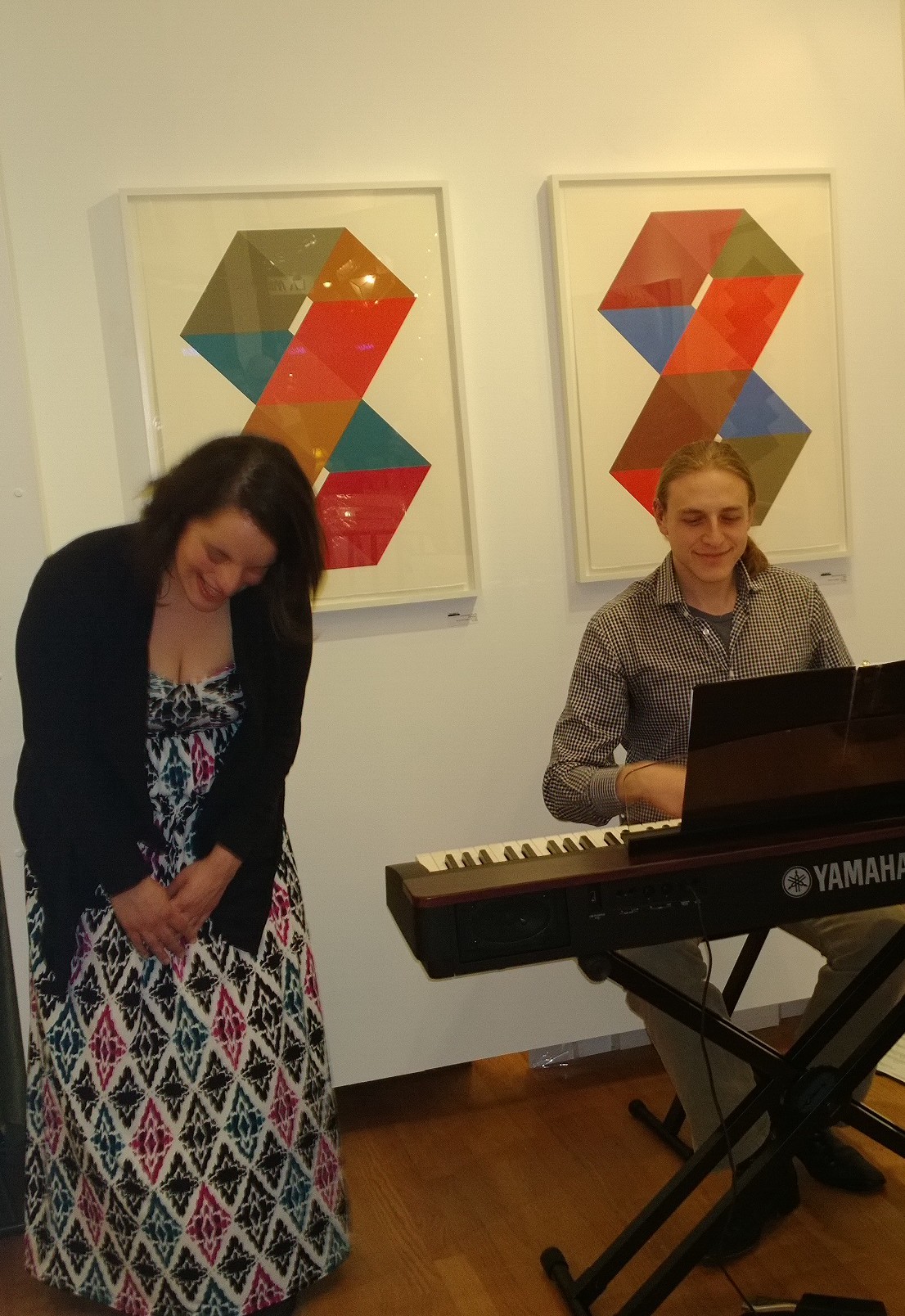
Opera on Tap taking a bow at 13Forest Art Gallery. Read about the national organization bringing opera to the people here.

opera-on-tap-13-forest-gallery

Read Full Post »

Well, if you aren’t into musicals, it might not be hilarious to you, but I just love that a famous songwriter wrote this number for Great American Soup back in 1970, and a famous Broadway star performed it. Terry Teachout posted it, here, on his theater blog. His blog is called “About Last Night,” and I connect to it through ArtsJournal.

Back when I was reading the Wall Street Journal, I used to enjoy Teachout’s theater reviews. But according to his blog, reviews are just the tip of the iceberg for this Renaissance Man.

“Terry’s first play, Satchmo at the Waldorf, opens off Broadway at the Westside Theatre on Mar. 4. Previews start Feb. 15. The production is directed by Gordon Edelstein, with John Douglas Thompson appearing in the triple role of Louis Armstrong, Joe Glaser, and Miles Davis. It was seen in 2012 at Shakespeare & Company of Lenox, Mass., Long Wharf Theatre of New Haven, Conn., and Philadelphia’s Wilma Theater. For more information, go here.

“To see John Douglas Thompson on stage in Satchmo at the Waldorf, go here. To watch a Wall Street Journal-produced video interview with Terry, go here.”

Teachout also writes opera libretti. I always thought it would be fun to do that.

Below: “Great American Soup” commercial, written by Stan Freberg and starring Ann Miller.

Read Full Post »

We watched a lovely thing on PBS recently, an opera about the Christmas armistice in World War I. You have probably heard of it. The combatants decided to take Christmas off. A movie was made about it, taking a few liberties with the story. Then the Minnesota Opera Company commissioned  composer Kevin Puts to write an opera based on the movie.

From the composer’s website: “Silent Night is an opera in two acts by composer Kevin Puts and librettist Mark Campbell, based on the 2005 film Joyeux Noël, directed by Christian Carion and produced by Nord-Ouest Production. Commissioned by Minnesota Opera with co-producer Opera Company of Philadelphia, it opened on November 12, 2011 at the Ordway Theater, St. Paul Minnesota … The opera is sung in English, German, French, Italian and Latin.

The interplay of the five languages was charming, especially when the German officer translated English into French and French into English so the three main officers could understand one another.

Read Allan Kozinn’s comments about this Pulitzer Prize winner at the NY Times ArtsBeat blog, here.

I will say that, delightful as it is to see the soldiers put down their arms and show each other pictures of loved ones back home, it makes the misery and futility of war doubly painful as the men are ordered back to battle and the camera pans over the lifeless bodies and the very young faces.

Peace is something to think about at Christmas. Ordinary people just want to live in peace.

Read Full Post »

Saturday night we saw a splendid production of Puccini’s opera La Bohème at a $25-a-seat benefit for the Friends of the Performing Arts. Pretty amazing to have fully staged opera professionally sung with orchestra accompaniment someplace other than the big city.

Robin Farnsley, who sang the role of the Bohemian seamstress suffering from tuberculosis, was the heart and soul of the production. I blogged about her before, here. Not only was her singing exquisite, but her acting was unusually sensitive and subtle for opera.

But all the leads were great in this tale of poverty and the artistic spirit: Ray Bauwens as as Mimi’s love, Rodolfo; Tim Wilfong as a delightful Marcello; and Sarah Vincelett as the thoroughly convincing coquette, Musetta. Also worthy of mention were Michael Prichard, Thomas Dawkins, and Miles Rind.

I loved the naturalistic translation, shown in supertitles.

Alan Yost conducted, Kathy Lague was stage director, and Paula Eldridge was chorus master. As far as I know, everyone donated their time to support the performing arts in Concord.

Read Full Post »

We are going to the opera tonight, and I’m remembering the last opera we saw, by MIT Media Lab innovator Tod Machover.

It was called Death and the Powers, and it was about a genius who wanted to live forever and figured out how to convert himself into a sort of computer after death. Given that it had lyrics by former poet laureate Robert Pinsky, I thought it would be great, but it was nowhere near as good as Machover’s Resurrection, a Tolstoy story adapted by MIT’s Laura Harrington. (The robots in Death and the Powers were cute anyway.)

Machover is a tremendously interesting and prolific musician. Here he talks about how music can bring back memories, not unlike Proust’s petit madeleine.

Below he explains how his “hyper instruments” have drawn people of all types, including the elementary school classes he visits, into the joy of music making.


Read Full Post »

My husband went to college with Frank Popper, who went on to become a professor at Rutgers and Princeton. Along with his wife Deborah, also a professor, Popper has written extensively about the loss of population in the industrial Midwest and the idea of returning former urban areas to a “Buffalo Commons.”

That once seemed far out, but today he is popular with leaders of shrinking cities like Detroit that are open to any idea that might make cities livable again, including turning abandoned neighborhoods into parkland.

This week he sent a surprising e-mail. His research is in an opera being performed by a Milwaukee new-music ensemble called Present Music.

“The libretto.” writes Popper, “has big quotes from a 1999 academic-journal article Deborah and I wrote about the Buffalo Commons, and two of the actors  play us. Composer Kitzke, librettist Masterson, baritone Ollmann and the other performers are all excellent.”

From Present Music’s website: “Buffalo Nation (Bison bison), by Jerome Kitzke and Kathleen Masterson, [was] commissioned by the Map Fund, a program of Creative Capital supported by the Doris Duke Charitable Foundation and the Rockefeller Foundation; Forest County Potawatomi Foundation, Suzanne and Richard Pieper Family Foundation and by other individual donors. This project is supported in part by an award from the National Endowment for the Arts.”

Jerome Kitzke and Kathleen Masterson

Read Full Post »

Mice find Verdi and Mozart more healing than Enya. Tom Jacobs at Miller-McCune (now called Pacific Standard) explains.

“Writing in the Journal of Cardiothoracic Surgery,” he says, “a team of Japanese researchers led by Dr. Masanori Nimi describe an experiment in which a group of 8- to 12-week-old mice underwent heart transplants. The rodents were randomly assigned to one of five groups: those exposed to opera (a recording of Verdi’s La Traviata, conducted by Sir Georg Solti); instrumental music by Mozart; New Age music (The Best of Enya); no music; or ‘one of six different sound frequencies.’

“After one week, the mice whose personal soundtrack featured Enya, one of the sound frequencies, or no music at all ‘rejected their grafts acutely,’ the researchers report. …

“In contrast, those exposed to Verdi or Mozart ‘had significantly prolonged survival.’ …

“In explaining the results, the researchers point to the immune system. They report exposure to classical music generated regulatory cells, which suppress immune responses and are thus vital to preventing rejection of a transplanted organ. …

“In any event, this provides more evidence that classical music has a health-inducing impact on the body.” Read more.

Hmmm. You want to suppress your immune system when you have a transplant because you don’t want your body to reject an organ from a donor. But suppose you want a strong immune system for some other reason? Would classical music be bad for you (or a mouse) in that case? Hard to get my head around that one.

Read Full Post »

Gian Carlo Menotti composed Amahl and the Night Visitors for an NBC Christmas show in 1951. He was under deadline and drawing a blank when the painting “The Adoration of the Magi” at the Metropolitan Museum of Art sparked his childhood memories of three kings who visit Italian children with gifts.

I have seen the operetta and listened to the recording many times. It takes only the first few bars and the lovely oboe representing the shepherd boy’s pipe for me to bring out the tissues and start crying and smiling all the way through.

A production today at the Friends of the Performing Arts in Concord was excellent. Kim Lamoureux took the role of Amahl. Robert Runck was stage director. Robin Farnsley was music director. Farnsley also was a breathtaking Mother of Amahl. Her anguish in the scene where her fear for her son overcomes her is heartbreaking as she inches toward the gold of the sleeping kings.

“All that gold! All that gold!
I wonder if rich people know what to do with their gold?
Do they know how a child could be fed? Do rich people know?”

You may read the whole script of this short operetta here. And there are lots of snippets on YouTube.

Update: December 22, 2013 at 2:00 p.m. and 4:00 p.m.
Amahl and the Night Visitors, with soloists Julia Shneyderman, Robin Farnsley, Ray Bauwens, Brad Amidon, Thomas Dawkins, and Michael Prichard. Chorus and orchestra conducted by Alan Yost,  Tickets $20 adults/$10 students. Call 978 369-7911 or buy on-line.

Follow us on twitter @LunaStellaBlog.

Read Full Post »

« Newer Posts - Older Posts »