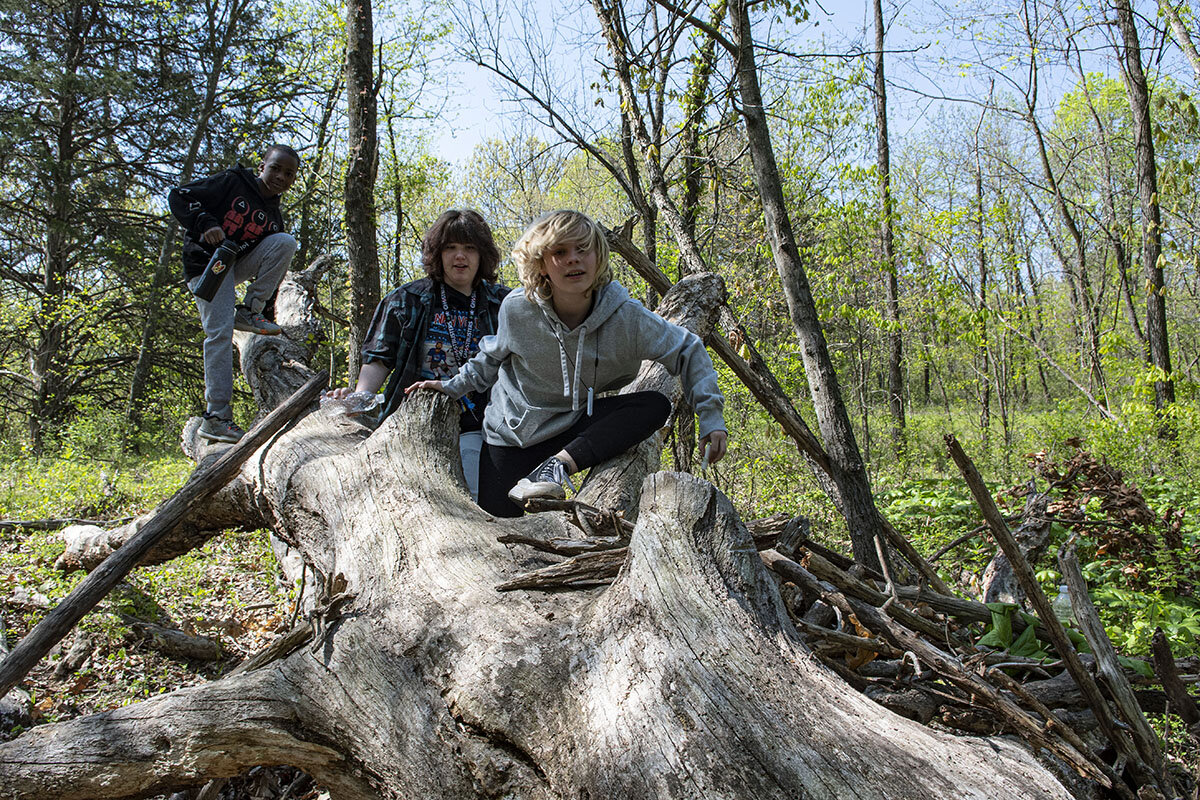
Photo: Alfredo Sosa/CSM Staff.
Students from Thorpe Gordon Elementary in Jefferson City, Missouri, at the Runge Conservation Nature Center in April.
It’s not a new idea, but it’s gaining traction: Getting kids outside into nature benefits their learning.
Jackie Valley writes at the Christian Science Monitor, “Down a hiking path and through the woods, giggles and chatter echo from a clearing where elementary students have just finished constructing makeshift shelters.
The challenge blended environment with engineering, hence this visit to the Runge Nature Center from third, fourth, and fifth graders. They’re part of a STEM (science, technology, engineering, and math) club at nearby Thorpe Gordon Elementary in Jefferson City, Missouri. …
“A boy announces he saw a turkey, while another student proclaims ‘teamwork’ her favorite part. The scene portrays what conservation leaders and educators in Missouri are hoping to instill in the state’s youngest residents: an appreciation for the outdoors, a new experience, and some learning along the way.
“ ‘I think it’s so important,” says Melanie Thompson, a librarian from the elementary school who’s leading the STEM group on this day. ‘Kids don’t spend enough time playing outside.’
“In Missouri, efforts to connect children with nature date back to 1939. That’s when the Nature Knights program launched, giving children recognition for conservation practices. Three years earlier, the state’s residents approved an amendment that created an apolitical conservation agency.
“Today, terms such as nature education, outdoor learning, and environmental education refer to instruction that, in many ways, takes students out of traditional classroom settings. Subtle nuances exist, though, depending on the location and programming. The Environmental Protection Agency defines environmental education as a type of learning that allows people to ‘explore environmental issues, engage in problem solving, and take action to improve the environment’ – while also not advocating a particular viewpoint.
“The Missouri Department of Conservation, meanwhile, sees nature education as a way to ‘inspire and educate individuals about nature so they appreciate and ultimately protect our resources and wild places,’ says Brian Flowers, a regional supervisor for the agency’s education branch. …
“ ‘You introduce them to it,’ says Mr. Flowers, referring to conservation, natural resources, and wildlife. ‘You show them why it’s important, and, eventually, that leads to that they care about it. They protect it.’
“A study called The Nature of Americans, conducted in 2015 and 2016, found that more than 80% of children surveyed said time in nature made them feel creative, happy, healthy, and smarter. …
“ ‘Once they’re there, there’s so much that happens – curiosity and creativity and just enjoyment of being outside,’ [Megan Willig, a program coordinator for the National Environmental Education Foundation] says. It can also introduce students to career pathways in the natural resource, conservation, and STEM fields.
“In a grassy field not far from an elderberry patch, a sustainably designed building with large windows and a gently sloping roofline is under construction. It’s the future Boone County Nature School, which occupies land in the Three Creeks Conservation Area and will welcome a rotating cast of 12,000 to 13,000 students each year, says Mr. Flowers.
“The project represents a partnership among the Missouri Department of Conservation, Columbia Public Schools, community organizations, and other school districts in Boone County.
“Columbia Public Schools has hired a teacher to lead instructional efforts at the Boone County Nature School, which fits into the district’s overall mission to pour more resources into place-based learning, says Michelle Baumstark, the chief communications officer. About half of the district’s students qualify for free or reduced-price lunch.
“ ‘These may not be experiences that they would have any other way and when you can create an access to an enriching opportunity, that can change the trajectory of a kid,’ she says.
“The land surrounding the nature school will feature a food forest, pollinator plots, a prairie restoration area, trails, a pavilion, and a council house with three tiers of stadium seating. The karst topography of the conservation area – caves, springs, and hills – is typically only found in southern Missouri near the Ozarks, making it an ideal exploration area for local children, Mr. Flowers says. …
“The Missouri Department of Conservation also operates programs that teach students archery and how to fish, among other things. And, in St. Louis, pavement will be removed and replaced with a green schoolyard at Froebel Literacy Academy. Picture a park-like setting with trees and wildflowers, where students can play and learn through STEM activities.
“The schoolyard project represents a step toward outdoor equity for children who grow up in urban areas that have more concrete and asphalt than lush, green recreation space, says Aaron Jeffries, deputy director of the Missouri Department of Conservation. …
“There’s no national standard for outdoor learning or environmental education, says Ms. Willig of NEEF, which was congressionally chartered in 1990 to complement the work of the EPA. So efforts differ by state and local jurisdiction, though she has seen more interest in making it a formal part of the curriculum.
“If barriers such as time or transportation exist, Ms. Willig recommends that school systems seek community partnerships. For instance, a local nonprofit that supports watershed health, she says, may be keen on helping with programming.
“ ‘The school doesn’t need to reinvent the wheel or start from scratch,’ she says.”
More at the Monitor, here. No firewall, nice pictures.
You can read another of my posts on kids benefiting from nature at school, here.



 Suzanne's Mom's Blog