Feeds:
Posts
Comments

Posts Tagged ‘parks’

Photo: Connatural Archive.
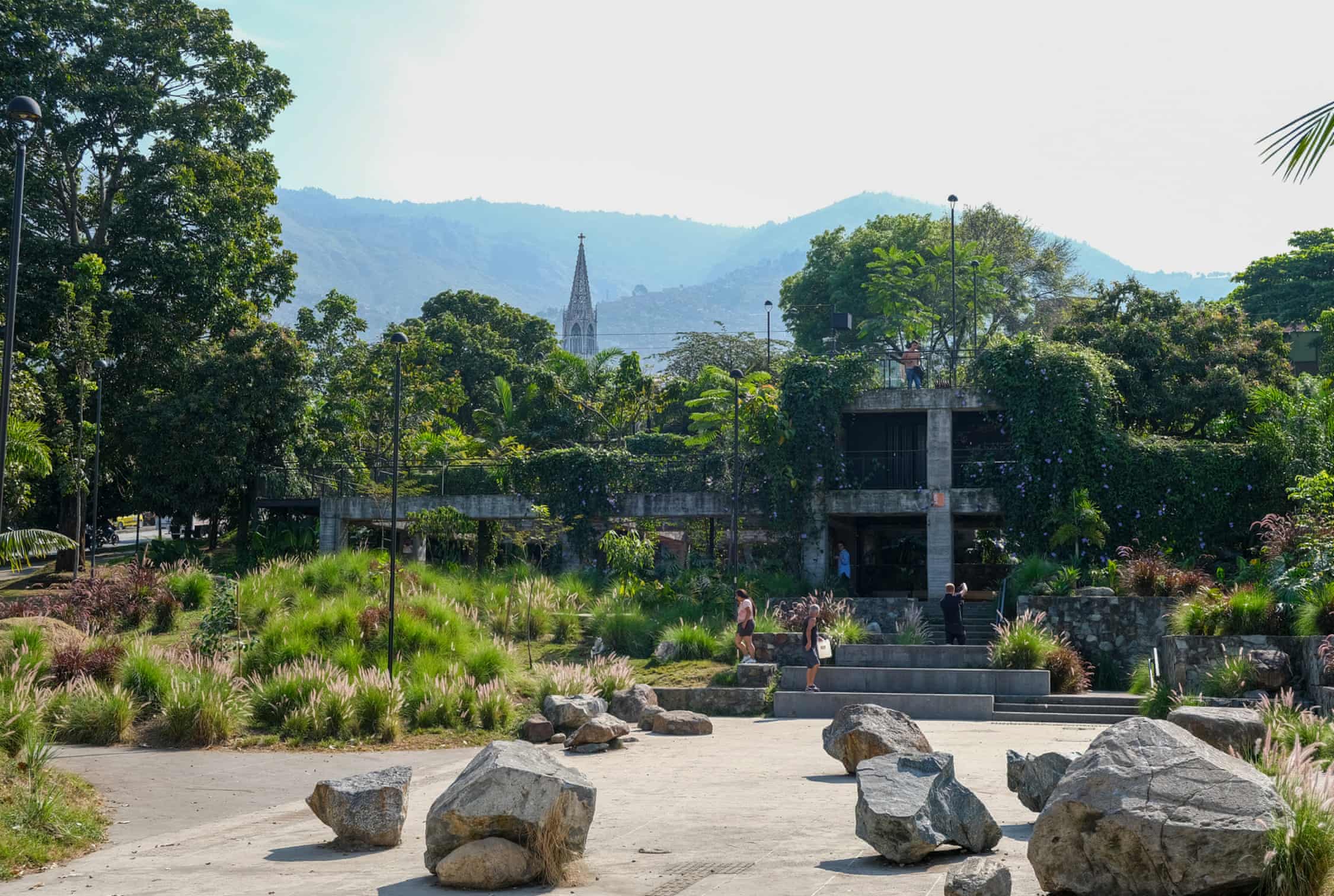
Surrounded by hills: Colombia’s Parque Prado, no longer abandoned to illegal activity.

What is your first reaction to the words Medellín and Colombia? If you have kept up on the news for a few decades, your associations may include both drug wars and change.

Oliver Wainwright at the Guardian focuses on the change.

“Lilac-flowering creepers engulf an abandoned house on a street corner in Medellín, Colombia, spilling from the roof and smothering most of the upstairs windows. A giant fan palm is visible through one opening, while a knotty tangle of aerial roots cascades down to the pavement from another. Step through the doorway of this overgrown ruin, and you find not a scene of desolation and decay but a sleek steel frame holding up the crumbling facade, which forms an unusual entrance to an enchanting new public park.

“ ‘We behaved more like archaeologists than landscape architects,’ says Edgar Mazo of Connatural, the firm behind the Parque Prado, in the working-class neighborhood of Aranjuez. He leads me through a series of planted terraces; fountain grasses and trumpet trees sprout from where a derelict car park and abandoned homes once stood. ‘You dig up the concrete, water gets into the ground, vegetation grows up, and the people come back,’ he adds, speaking through a translator. ‘That’s natural regeneration.’

“In recent decades, Medellín has been widely celebrated for its astonishing urban transformation. In the 2000s, it went from being one of the most dangerous cities on the planet, riven by murderous drug cartels, to a case study in the miraculous peace-bringing powers of architecture and landscape. Sergio Fajardo, the son of an architect who served as Medellín’s charismatic mayor from 2004 to 2008, was hailed for sprinkling the city’s poorest neighborhoods with dazzling new libraries, stadiums and swimming pools.

“These determinedly ‘iconic’ projects were enthusiastically feted on the pages of glossy design magazines, and their stories recounted in keynotes at international conferences. Impoverished hillsides were connected to a new metro system with an elegant web of cable cars and outdoor escalators, while parks dotted with expressive architect-designed canopies sprang up across the city. The dramatic fall in crime during Fajardo’s term was largely credited to this vision of ‘social urbanism,’ and the increase in the amount of public space per citizen.

“But the Medellín miracle has since lost some of its sparkle. Take the Biblioteca España, one of the flagship projects, designed by Colombian star architect Giancarlo Mazzanti. It stands as a striking cluster of chiseled concrete boulders, rising from the hillside in the formerly no-go barrio of Santo Domingo. But it has been shuttered since 2015, due to structural defects. …

“Mazo’s work takes a markedly different approach from the 00s penchant for spectacle. When he was asked to look at the sloping half-hectare site in Aranjuez, which was home to a rundown car park and six boarded-up houses, abandoned for more than a decade, there was an existing plan to raze everything and replace it with a park traversed by a big zigzagging ramp. It looked like a hangover from the earlier lust for shape-making, something that might photograph well from a helicopter.

“Instead, Mazo and his team decided to keep most of what was already there. Almost 70% of the material on-site remains, albeit in a new form. Walls and floor slabs were chiseled from the two-storey parking structure, and the rubble used to fill the basements of the houses, with soil packed on top. The buildings’ roof timbers were reclaimed and used to make benches, while the landscape was shaped in such a way that rainwater is retained, meaning that no artificial irrigation is needed. The team even collected seeds from the plants that had sprung up on the plot, so they could be scattered around the new park after the project’s construction – allowing the natural colonizers back in.

“The project was built during the pandemic for a cost of just [$1.5m] and the lockdowns allowed time for the plants to establish, without the threat of being trampled by visitors. Five years on, the planting has reached a level of maturity that makes this urban oasis seem like it’s always been there. …

“The former car park’s concrete frame makes for an imposing armature at the centre of the park, supporting a raised steel walkway and framing a series of semi-enclosed spaces beneath it. Reclaimed bricks and stacked roof tiles serve as retaining walls, creating a rugged backdrop to lush clumps of grasses and palms. Gabion cages filled with rocks and rubble line water retention ponds, and provide platforms for seating. A sandy clearing down below makes space for ballgames and events, while park-goers can watch the action from the terraced decks above, and enjoy a grandstand view across the sprawling city and its seven hills.

“ ‘When people first colonized this valley,’ says Mazo, ‘they used to climb up to the top of the hills to communicate with each other. The park now becomes part of that system, giving people an elevated view to connect with others.’ …

“Crucially, there’s a space for everyone here – from elevated walkways, to quiet shrub-lined reading areas, to seating tucked away from prying eyes. The sense of fragmentation, as well as the level changes, allow different social groups to coexist.” 

Read more about this and other pilot projects at the Guardian, here. No paywall, but anything you can donate helps to keep factual news accessible to all.

Read Full Post »

Art: Xiomara Morgan and Kathy Urbina, “Found in New York City” (2023), styrofoam life preserver, found Metrocards, plastic water bottles, candy wrappers, snack bags, labels, and bottle tops with a crocheted ribbon of plastic, rope, and caution tape.

Artists can turn anything into art. And I have learned that among New York City Parks employees, there are a few who are artists like that and a few who just have fun playing at art.

Maya Pontone wrote about a New York City Parks’ exhibition called “Wreath Interpretations” in 2023.

“More than 30 original holiday wreaths handcrafted from unexpected materials, including discarded Metro cards, thumbtacks, artificial hot dogs, pharmaceutical vials, and candy wrappers,” she reported were “on display in Central Park for the 41st iteration of New York City Parks’‘Wreath Interpretations‘ exhibition [bringing] together an eclectic assortment of alternative wreaths created by Parks employees, commissioned artists, and New York City residents for a whimsical display.

“Wreaths have historically played a number of roles. In Roman and Greek antiquity, they were emblems of power and victory, frequently awarded to the winners of sporting competitions and appearing in depictions of various deities, such as Apollo in Antonio Canova’s marble sculpture ‘Apollo Crowning Himself‘ (1781–1782). In Christianity, evergreen wreaths symbolize eternal life and everlasting faith; during Advent season, laurel rings are decorated with four candles that are subsequently lit each week leading up to Christmas.

“But the artists in ‘Wreaths Interpretations,’ go beyond these classic meanings to transform a holiday staple into new works of art, from an aluminum and gold leaf display commemorating Caribbean cooking to a diorama wasp nest containing a hidden memorial honoring Ukraine. On one wall, an unsettling wreath crafted out of plastic eyeballs tackles sleep deprivation, while another piece made of yellow Post-It notes playfully comments on work-life imbalance.

“In another corner, a pizza box with wiry rat tails emerging from the center — an unmistakable homage to the viral ‘Pizza Rat‘ — is situated between a spiral of playing cards and a ring of glistening frankfurters, humorously titled ‘The Wurst Wreath Ever Made: You Never Sausage a Terrible Wreath’ (2023). As Elizabeth Masella, Public Art Coordinator for the NYC Department of Parks & Recreation, told Hyperallergic, ‘the weirder, the better.’ …

“Many of the artworks are constructed out of found objects and recycled materials, such as Xiomara Morgan and Kathy Urbina’s joint project ‘Found in New York City’ [above]. … Marie Ucci’s ‘The Shape of Dreams’ (2023) is an assemblage of ceramic shards, dried fruits and vegetables, scraps of felted wool, and feathers, carefully pieced together like a bird’s nest, while Suzie Sims-Fletcher’s ‘All is Calm, All is Bright (Home for the Holidays)’ (2023) comprises cleaning puffs, scouring pads, plastic mesh, and rubber gloves. …

“Several of the displays also focus on environmental issues plaguing the city’s parks. A work by Maria Magdalena Amurrio employs repurposed water bottles for a wreath of butterflies, an insect increasingly threatened by climate change and human development, while Jean-Patrick Guilbert’s ‘Coral Wreath’ (2023) calls attention to the destruction of our oceans’ coral reefs. Another wreath made of saltmarsh cordgrass, hay, lavender branches, and other natural materials native to Staten Island’s William T. Davis Wildlife Refuge tackles the issue of marsh degradation. The work was created over two days by a team of eight ecologists, wildlife biologists, and botanists from NYC Parks Environment and Planning.

“ ‘The wreath is meant to symbolize how New York City salt marshes are at risk of drowning from sea level rise under climate change,’ Desiree Yanes, an NYC Parks wetlands restoration specialist, told Hyperallergic, pointing out the materials’ symbolic placement around the circle.

“ ‘We’re very much a science driven team, but it was a really refreshing mindset shift just to undertake an artistic endeavor together,’ Yanes added.”

More at Hyperallergic, here. No paywall. Does it make you want to try your hand at a wreath this year? You still have time.

Read Full Post »

Photo: Frank Carini/ecoRI News.
These Growing Futures RI staff members help trainees get landscaping experience through park maintenance.

In a win-win reminiscent of the Great Depression’s Civilian Conservation Corps, trainees are gaining valuable work experience while benefiting Rhode Island parks.

Frank Carini at ecoRI News has the story.

“The infamous hurricane of 1938 built the Tefft Hill Trail. Well, that’s not entirely accurate. One of the most powerful hurricanes in recorded history did the no-bid prep work. The FDR-era Civilian Conservation Corps, while conducting search and salvage operations and helping with the cleanup, built the Tefft and many other hiking trails in the area that would become known as Arcadia.

“The Rhode Island Department of Agriculture and Conservation — now the Department of Environmental Management — acquired the 14,000-acre Arcadia Management Area a few years before the 1938 hurricane struck. Today, Arcadia features a wide range of natural landscapes, including hardwood and pine forests, hills and valleys, ledges, fields, and lakes, ponds, and streams of various sizes. It also boasts miles and miles of trail.

“DEM doesn’t have the staff necessary to maintain all of Arcadia’s recreation aspects, so a 21st-century version of the Corps lends a hand — many hands, in fact. … The trails in Rhode Island’s largest management area are maintained and tended to under the direction of Jordan Miller, director of education and training for the Rhode Island Nursery & Landscape Association and the leader of RINLA’s Growing Futures RI initiative. …

“For the past three winters, Miller and the program’s two other staffers — Christie Milligan, director of workforce programs, and Mason Billings, program associate and resources coordinator — shepherd 30-40 workers into the Arcadia Management Area to maintain trails, clear overgrown vegetation, repair wooden walkways, and remove invasives. …

“Throughout Arcadia during its destination heyday, there were picnic tables and other amenities, offices in the woods, and a house for the caretaker and his family. In the decades since DEM changed its management strategy for state-owned land, the picnic tables and structures that once decorated Arcadia have faded into the landscape. The baseball field swallowed by vegetation. …

“After the campground closed, the state maintained the beach and recreation area until the mid-1990s, which is around the same time that the universal access boardwalk was built and the Tefft Hill Trail was being transformed into an area more accessible to those living with mobility issues.

“Funded by a federal grant, the boardwalk and bridge were built in three phases over 10 years. DEM’s Division of Forestry did the work using no mechanized equipment to avoid disturbing the sensitive environment,’ according to Michael Healey, the agency’s chief public affairs officer. …

“Miller, who has worked in the horticulture industry in a variety of roles since 2004, was hired in 2020 to run RINLA’s new initiative. The purpose of Growing Futures is to ‘cultivate, train, and educate the next generation of natural resource professionals who will be charged with stewarding, protecting, and responding to a changing environment and feeding our community.’ …

“Every January and February for the past three winters, the 30-40 workforce trainees, under the guidance of the Growing Futures trio, prepare Arcadia trails for a new season of hiking and nature watching. Trainees are hired for a week or five, and crew leaders from RINLA’s 250 member businesses are loaned to the program to ‘help run things in small groups,’ according to Miller.

“ ‘One of the main reasons for that is timing of when our industry starts up for the year and hires people, which is typically in March,’ he said. ‘So we’ll do the training so that people graduate and then they go straight into job interviews and are able to get jobs for the season. The other part of it is because that’s a winter layoff time, we can actually get crew leader staff who were laid off from their landscaping jobs to be able to help us out.’ “

More at ecoRI News, here. No paywall. Nice pictures.

Read Full Post »

Photo: Wikimedia.
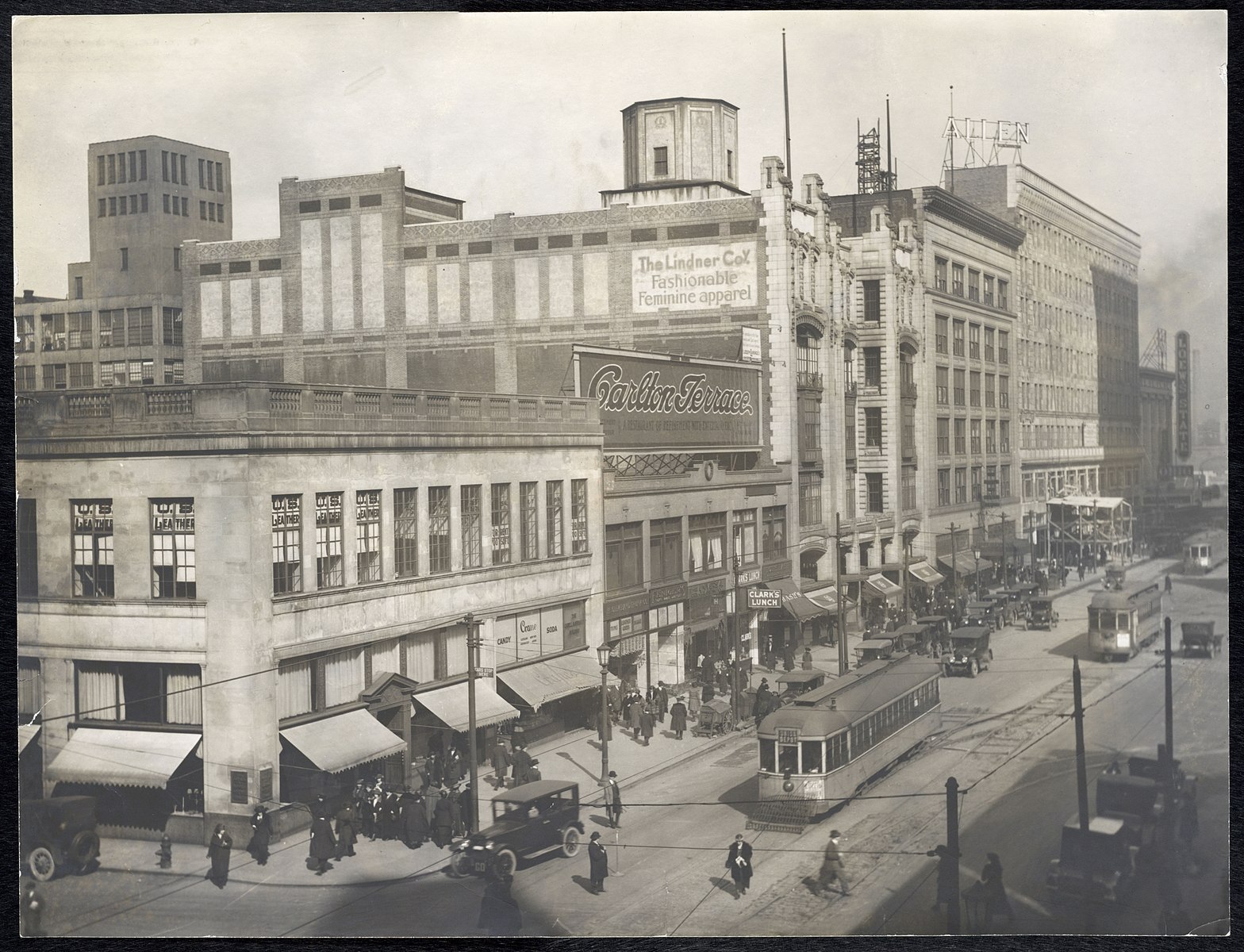
Cleveland in 1922, when the city was more walkable. Note the trolleys, which eventually succumbed to Americans’ love affair with the automobile.

For decades, cities were planned around cars and the convenience of people driving in from the suburbs. Now planners are giving more thought to urban quality of life and the “15-minute city” — even looking back to the Old Days for ideas. How lovely to live in a city and be able to do most of your daily errands within 15 minutes of your home!

Adele Peters writes at Fast Company, “When Paris mayor Anne Hidalgo touted the idea of becoming a 15-minute city — a place where it’s easy to reach work, school, stores, and other destinations on a short walk or bike ride — it didn’t have as far to go as many other cities. Hidalgo has pushed for multiple changes to help cut air pollution and improve quality of life, from making a highway car-free to adding so many bike lanes that the streets now look more like Copenhagen. But Paris was already compact, densely populated, and relatively easy to walk. …

“The goal is a bigger challenge in Cleveland, which currently has a Walk Score of 57 (Paris has a perfect score, 100 out of 100). Cleveland’s 35-year-old mayor [Justin Bibb], who took office earlier this year, still wants to move in the same direction.

“ ‘We’re working toward being the first city in North America to implement a 15-minute city planning framework, where people — not developers, but people — are at the center of urban revitalization, because regardless of where you live, you have access to a good grocery store, vibrant parks, and a job you can get to,’ Bibb said in his first State of the City speech in April. …

“The city was more walkable in the past, and more people lived a short distance from their jobs. ‘We had an industrial heritage, and we had housing very proximate to these plants and factories where people worked,’ says Jeff Epstein, the city’s chief development officer. Corner stores and other neighborhood retail shops were also within walking distance from homes. But as factories closed, and highways helped spawn the growth of suburbs, city neighborhoods became much less dense, and people had to travel farther. …

“Says Jason Kuhn, communications manager at the bike advocacy group Bike Cleveland, [‘You] ended up with this network of roads that are really built for car movement efficiency, and really not for people on bikes. There’s a potential, absolutely, to turn back to the other direction and really make the city work for the people who live there.’

“New protected bike lanes that run through the middle of the city and from east to west are already planned, though the overall bike network needs to improve. ‘You might have a road where there’s a bike lane for a mile, and then maybe it’s gone for two, so it’s kind of broken,’ he says. ‘So it’s still difficult to move around the city by bicycle just because the network is incomplete.’ A new ‘complete streets’ ordinance will help improve planning and deal with challenges like wide streets that are difficult for pedestrians to cross, he says.

The city is also starting to map out assets like parks and stores and identify which neighborhoods have the most potential now to be 15-minute neighborhoods. …

“Planners are also looking at where there are clusters of amenities near transit, and looking for ways to increase the number of people living in those areas. A neighborhood called Detroit Shoreway has the basic assets of a 15-minute city, but needs around 18,000 more housing units strategically located near public transit. There’s plenty of space, they say, to build new housing, from former industrial sites to closed fast-food restaurants, underused parking lots, and land owned by the city itself.

“On the riverfront — where the water was once so polluted that it famously caught on fire, but is now much cleaner — a new 35-acre development plans to add new park space, 2,000 housing units, and new office and retail space, all designed to encourage people to live downtown and easily walk where they need to go.

“ ‘We came in with that as a fundamental objective — planning to create 15-minute neighborhoods, and also to be an essential component of getting downtown Cleveland to be part of an 18-hour city, which in essence means that folks can come downtown and find something to do for at least 18 hours of the day,’ says Kofi Bonner, CEO of Bedrock, the real estate firm developing the site. The firm just completed a master plan for the area; the first steps for construction could begin in 2024, depending on the city permitting process, but the full project will take 15 to 20 years. The development will help connect the riverfront to the rest of downtown.”

My friend Mary Ann bikes Cleveland with her family. I love seeing her photos of nighttime group rides.

More at Fast Company, here.

Read Full Post »

Photo: Baileigh Industrial.
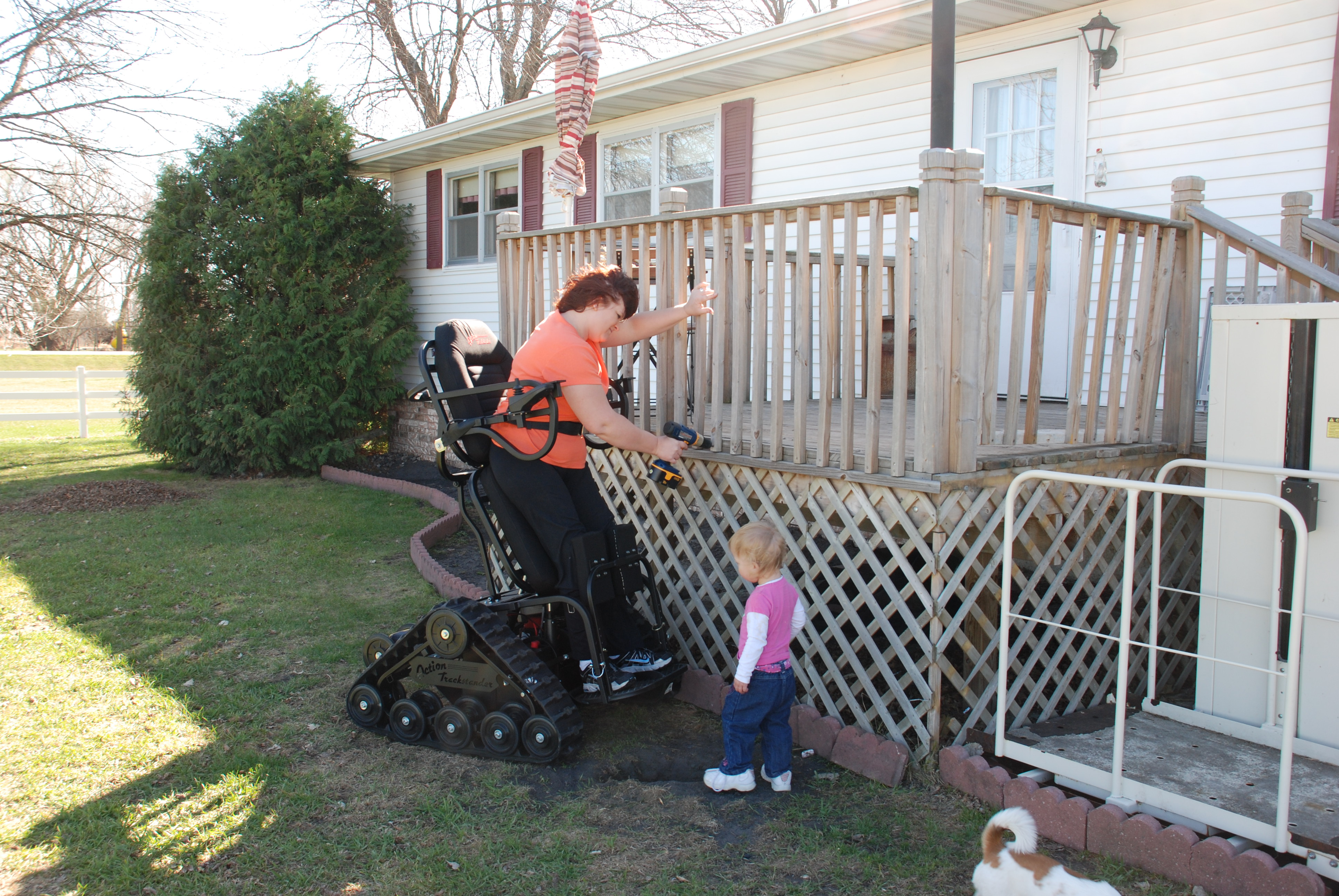
Above, using the Action Trackchair around the house. Wilderness adventurers love it, too.

Technology is erasing the barriers for people with disabilities who want to do everything other people do. At the Washington Post, Andrea Sachs and Natalie B. Compton wrote on Nov. 8 about a 500-pound miracle arriving in US parks: all-terrain wheelchairs.

“Cory Lee has visited 40 countries on seven continents,” they write, “and yet the Georgia native has never explored Cloudland Canyon State Park, about 20 minutes from his home. His wheelchair was tough enough for the trip to Antarctica but not for the rugged terrain in his backyard.

“Lee’s circumstances changed [recently], when Georgia’s Department of Natural Resources and the Aimee Copeland Foundation unveiled a fleet of all-terrain power wheelchairs for rent at 11 state parks and outdoorsy destinations, including Cloudland Canyon.

The Action Trackchair models are equipped with tank-like tracks capable of traversing rocks, roots, streams and sand; clearing fallen trees; plowing through tall grass; and tackling uphill climbs.

“ ‘I’ll finally be able to go on these trails for the first time in my life,’ said the 32-year-old travel blogger, who shares his adventures on Curb Free With Cory Lee. …

“In 2017, Colorado Parks and Wildlife launched its Staunton State Park Track-Chair Program, which provides free adaptive equipment, though guests must pay the $10 entrance fee. Michigan’s Department of Natural Resources has placed off-road track chairs in nearly a dozen parks, including Muskegon State Park. …

“South Dakota is [expanding] its squadron: On Tuesday, the South Dakota Parks and Wildlife Foundation unveils its second all-terrain chair. South Dakota resident Michael M. Samp is leading a fundraising campaign to purchase up to 30 chairs. Last year, Samp’s father packed up his fishing pole and piloted a track chair to Center Lake in Custer State Park. He reeled in trout, just as he had before he was diagnosed with spinal cerebral ataxia. …

“This month, the Minnesota Department of Natural Resources will wrap up its months-long pilot program that tested out the chairs in five parks. … Said Jamie McBride, a state parks and recreation area program consultant with the Parks and Trails division of the Minnesota DNR, ‘People have told us this is life-changing.’

“The Georgia initiative was spearheaded by Aimee Copeland Mercier, who suffered a zip-lining accident in 2012 and lost both hands, her right foot and her left leg to a flesh-eating bacterial infection. Copeland Mercier, a psychotherapist and licensed clinical social worker, tested several types of all-terrain chairs before committing to the Action Trackchair, which several other state programs also use.

“The Minnesota-based company was founded by Tim and Donna Swenson, whose son, Jeff, was paralyzed in a car accident. The original design resembled a Frankenstein of sporting goods parts, with snow bike tracks and a busted boat seat. Today’s model could be an opening act at a monster truck rally.

“ ‘I was floored by what it could do,’ said Copeland Mercier, whose foundation raised $200,000 to purchase the chairs at $12,500 each. ‘Oh my gosh! I can go over a whole tree trunk, up a steep incline and through snow, swamps and wetlands. If I took my regular wheelchair, I’d get stuck in five minutes.’

“Each program has its own reservations system and requirements. For Georgia’s service, visitors must provide proof of their disability and a photo ID, plus complete an online training course available through All Terrain Georgia. Once certified, the organization will forward the rental request to the park. Copeland Mercier urges visitors to plan ahead: The certification course takes about an hour, the foundation needs 72-hour advance notice and the park requires a 48-hour head’s up.

“ ‘These are 500-pound chairs,’ she said. ‘There are some risks involved.’

“The Minnesota DNR, which owns and maintains its five chairs, advises visitors to call the park to reserve a chair. …

“Track chairs can conquer a range of obstacles, but they do not work in all environments.

“ ‘You need the width. If two trees are too close together, the wheelchair can’t pass between them,’ Copeland Mercier said. ‘And some inclines are too steep. The chair also can’t go down staircases.’

“To steer visitors in the right direction, parks have created maps highlighting the trails designated for the track chairs, such as Staunton State Park’s trio of routes that range from roughly three to four miles. … McBride said one goal is to erect markers that would provide detailed information about the hike, such the extent of accessibility. ‘We want to let people know if they can get all the way to the waterfall or halfway,’ he said, using a hypothetical example.

“Copeland Mercier also has a wish list. She hopes to expand the network of chairs to other parts of Georgia, such as the coastal, southern and central regions. Once the foundation acquires several vans (another aspiration), the staff could move the 30 to 40 chairs (ditto) around the state to fill fluctuating demand. She is also eyeing other states.

“ ‘North Carolina is next,’ said Copeland Mercier, who divides her time between Atlanta and Asheville, N.C. But the grand plan is even bigger. ‘The goal is to alter the U.S.A.,’ she said.”

More at the Post, here.

Read Full Post »

Photo: Lucas Jackson/Reuters
More than just a tourist attraction, Manhattan’s High Line is a development destination, says author Richard Florida.

Have you walked on Manhattan’s High Line when it’s not too crowded? It is a magical linear garden high above the dusty streets of the city.

And what about the magnificent parks in New York?

I’m in the city now and, having had beautiful walks in the extraordinary Central Park, am determined do a post soon on the genius of designer Frederick Law Olmsted and the supporters who made his urban landscapes possible.

Today’s post, however, is on the economic value of beauty in cities — not that beauty ever needs to be justified in terms of dollars and cents. But it’s worth noting.

Richard Florida asks at CityLab whether cities “benefit from a beauty premium? According to a new study by two urban economists, it seems that they do.

“The study by Gerald A. Carlino of the Federal Reserve Bank of Philadelphia and Albert Saiz of Massachusetts Institute of Technology, examines the connection between a city’s beauty and key growth indicators. A raft of previous studies have found a connection between economic and population growth and urban amenities (a broad category ranging from parks to restaurants, art galleries, and museums). But this study takes a much closer look at the effects of beauty itself.

“To get at this, the researchers measure attractiveness in a unique way: through tourist visits and photos of picturesque locations. … The study compares its own measure of urban beauty to more established measures of urban amenities such as parks, historic spaces, proximity to coastlines, bodies of waters or mountains, the size of the tourism industry, and more. ..

“The study finds evidence of a significant beauty premium for cities and neighborhoods. A city with twice as many picturesque locations as another city saw 10 percent growth or greater in population and jobs from 1990 to 2010. In fact, urban beauty ties with lower taxes as the most important predictor of overall population growth in cities. Plus, these cities disproportionately attract greater numbers of college graduates. Cities in the top 25 percent of picturesqueness saw nearly 3 percent higher growth in the number of college grads than those in the bottom 25 percent. …

“City beauty is not an effect of size, the study finds: Smaller and medium-sized places with more parks, historic buildings, proximity to water and mountains, and clearer skies and less rain are perceived as beautiful as well.

“It’s not just metros broadly that benefit from an urban beauty premium, it’s specific neighborhoods within them. A large number of studies have documented the back-to-the-city movement of younger, more educated, and more affluent people to the urban center. These studies typically document the urban influx into neighborhoods near the Central Business District (CBD), the downtown commercial core of a city. …

“Urban beauty is a powerful tool for economic growth and urban resurgence, but with it comes gentrification and displacement. As the authors of the study put it: ‘Rents, incomes, and educational attainment increased faster in urban beautiful neighborhoods but at the cost of minority displacement.’

“Urban policy makers have to take in the full costs, as well as the benefits, of urban beautification into account. They could mandate that developers who create new condominiums adjacent to publicly created and valued amenities pay more in taxes, provide some affordable housing, or employ local residents in their projects. Cities can devote the increased revenues from beautification projects to affordable housing, workforce development, and the reduction of concentrated poverty.”

Read more here.

Read Full Post »

Photo: Paul Chinn, The Chronicle 
Artificial turf is installed in a park under construction in San Francisco, which claims to be the first city with a park near every home.

More and more research is showing that access to nature and urban parks improves not only quality of life but the health of city dwellers. Municipalities save, too, when they have healthier residents.

Recently San Francisco was able to claim the distinction of being first in the nation to offer a park 10 minutes from every home.

Lizzie Johnson reports at the San Francisco Chronicle, “In 10 minutes, you can load a TV episode on Netflix, check your mail waiting for BART or make an avocado toast. Now, you can add to that list: take a walk to the park.

“San Francisco is the first city in the nation to have every resident live within a 10-minute walk of a park or open space. The percentage is calculated by the Trust for Public Land, a nonprofit that facilitates the creation of parks and analyzes park systems for the 100 largest cities nationwide. …

“But don’t expect to see a small army of city workers and volunteers with stopwatches in hand counting their steps. The data were gathered using a complex geographic mapping program. The average person can walk a half-mile in about 10 minutes, according to the U.S. Department of Transportation, which counts even your two legs as a mode of transportation. The distance has to include sidewalks — crossing highways or skirting canals doesn’t count.

“ ‘We developed this as the gold standard,’ said Adrian Benepe, the Trust for Public Land’s director of city park development. ‘A 10-minute walk to a park is an important indicator of the livability of a city.’ …

“Criteria for the nonprofit’s annual ParkScore analysis also includes the number of individual parks, overall spending and facilities upkeep. …

“The city has spent $355 million in bond and general fund money over the past four years to purchase land, renovate dilapidated parks and improve open spaces. In 2012, voters passed the $195 million Clean and Safe Neighborhood Parks Bond to fix up neighborhood parks.

“Those measures made the difference in reaching the No. 1 spot, said Recreation and Park Department Director Phil Ginsburg.

“ ‘It speaks volumes about this city’s commitment to open space,’ he said. “It is the reflection of literally a century and a half of decisions regarding parks and open space.’ ”

More at the San Francisco Chronicle.

Read Full Post »

Photo: Evensi

My husband and I alternate between our two sets of grandchildren on Halloween. Last year we got a kick out of seeing John perform the role of MC for the costume fashion show at the park on his street. Although we won’t be there this year, I’m glad I got to see my oldest grandson in this year’s Yoda costume and his sister as a mermaid. Her puzzlement about the way the bottom of her costume was cut led to explanations of mermaid anatomy and collaboration on mermaid drawings.

This year we join the Providence grandkids (one gentleman fire chief, one lady construction worker) for the gathering at Brown Street Park and the annual parade through blocked-off Providence streets.

Brown Street Park has many Friends (changed to “Fiends” for the holiday). It’s in an upscale neighborhood near the university and flourishes because of people who both care about it and know how to raise money. If only all Providence neighborhoods were like that (which I say because behind one place where I volunteer, there’s a filthy campsite where drugs are sold. I am told the city cleaned it up once, but the vacant lot reverted to its current sorry state. How I wish the city would try again and neighbors would feel that they could go in and plant a garden or something!) But I digress.

If you go to the Friends of Brown Street Park website, here, you will find a well-organized group of volunteers soliciting help from other potential volunteers for initiatives such as the Hallloween party and parade, the summer concert series and the Earth Day clean-up.

In poor communities, good things can happen, too, but no outsider can come in and decree what those good things should be. First come efforts to build trust among all neighbors, as suggested here, then come deliberations about what neighbors actually want. I am going to look into getting the city to deal with that no-longer-vacant lot. It’s so disturbing for children who attend nearby activities. All neighborhoods should be safe for children.

Read Full Post »