Feeds:
Posts
Comments

Posts Tagged ‘poet’

Photo: Andrea Shea/WBUR
Amy Clampitt used her award money to buy a house in Stockbridge, Mass., where today rising poets can have six- to 12-month tuition-free residencies.

When National Public Radio’s Andrea Shea heard about this year’s winners of the MacArthur award, she began to wonder how past recipients had spent the money. Her curiosity led her to 1992 honoree and poet Amy Clampitt.

“The recipients of this year’s MacArthur Foundation ‘genius grants’ will each receive $625,000 over five years, no strings attached,” writes Shea.

“[Clampitt] was on vacation when she heard from her friend, writer Karen Chase, that she had been named a MacArthur genius.

” ‘ She was furious with me because she thought I was teasing her,’ Chase recalls. ‘And by the end of the conversation she said, “I’m gonna buy a house in Lenox!” ‘

“That’s Lenox, Mass., home of Edith Wharton, one of Clampitt’s favorite writers. Chase helped Clampitt find a small, clapboard house that became the 72-year-old poet’s first major purchase. The next year, Clampitt was diagnosed with ovarian cancer. Chase reads from notes of conversations between Clampitt and her husband, Harold Korn:

” ‘What’s going to happen to the house? I don’t want it broken up,’ Clampitt said. …

“After his wife’s death, and before his own in 2001, Korn dreamed up a fund to benefit poetry and the literary arts. Since 2003, the house Clampitt bought with her MacArthur money has been used to help rising poets by offering six- to 12-month tuition-free residencies.

“Clampitt herself didn’t publish her first volume of poetry until she was 63.”

Her Atlantic Monthly editor, poet Mary Jo Salter, thinks Clampitt “would be delighted that her house is helping give poets the kind of opportunity that she didn’t have when she was coming up. …

“This December, the 19th resident of the house Amy Clampitt purchased with her MacArthur purse will settle in.”

More at NPR, where you also can listen to the audio.
Read Full Post »

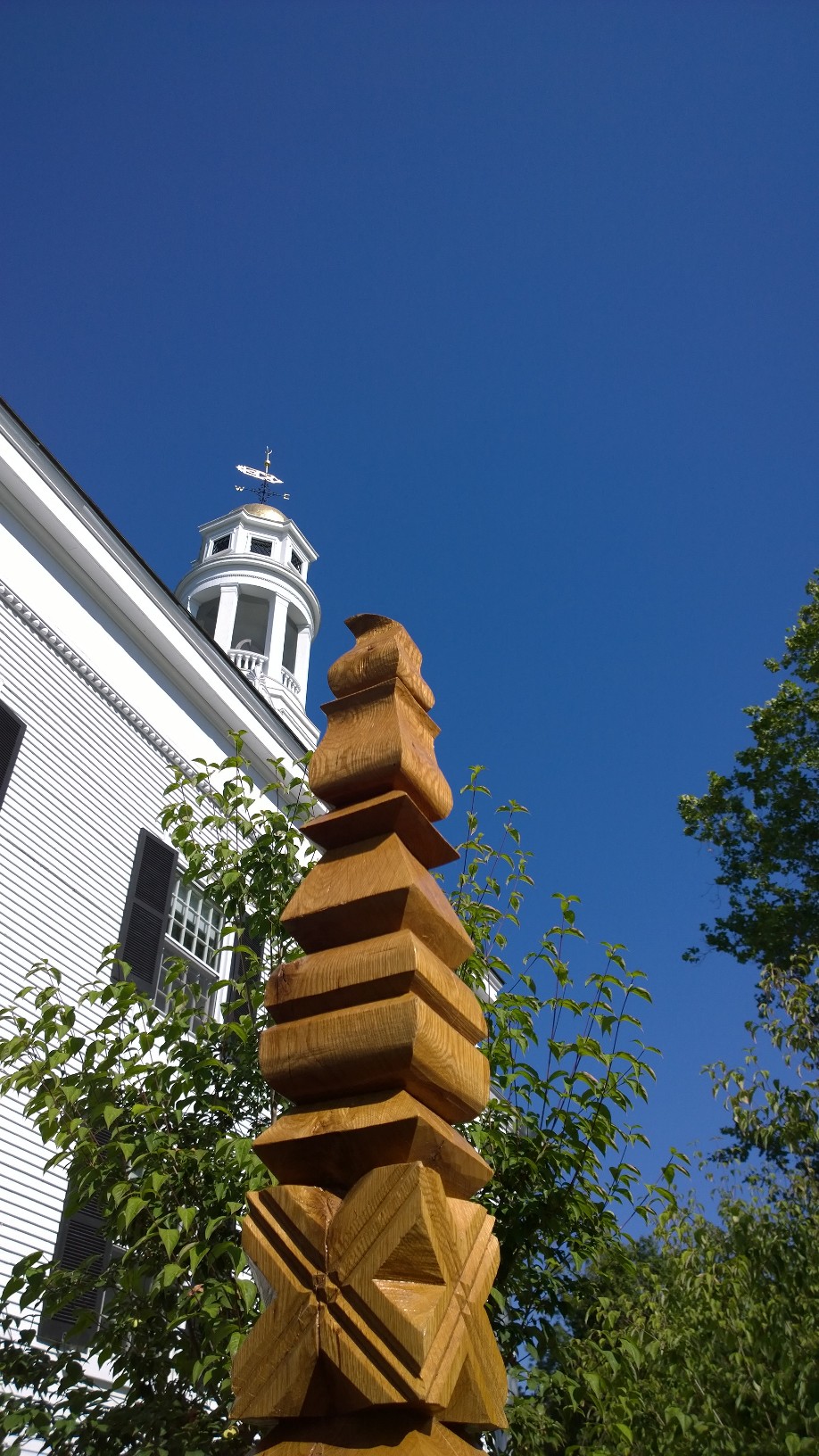
OK, it’s not really a totem pole, but I was afraid the word kopjafa wouldn’t ring any bells with readers.

Today at church we dedicated a wooden pole that was carved by the minister of our sister church in Transylvania when he visited Massachusetts last year.

A translated Wikipedia entry says that, originally, two kopjafa poles were to used to carry a coffin to a cemetery. The poles were then placed at the head and foot of the mound. But according to my minister, nowadays kopjafa poles are set outside churches and, as in our case, sometimes given to a partner church.

The minister read the poem below as he spoke about our church’s connection to Transylvanians of the (almost) same religion. The subject is a little sad for what we do at Suzanne’s Mom’s Blog, but it fits with our previous discussions about the value of preserving language and customs in minority communities. (Hungarian Transylvania was handed over to Romania after World War I, and has had some challenges, starting with language challenges.)

“Leave, if you can …
“Leave, if you think,
“That somewhere, anywhere in the world beyond
“It will be easier to bear your fate.
“Leave …
“Fly like a swallow, to the south,
“Or northward, like a bird of storm,
“And from high above in the wide skies
“Search for the place
“Where you can build a nest,
“Leave, if you can.
“Leave if you hope
“Against hope that homelessness
“Is less bitter abroad than at home.
“Leave, if you think
“That out in the world
“Memory will not carve new crosses from
“Your soul, from that sensitive
“Living tree.”

Read about the poem’s author, Hungarian poet Sandor Remenyik, here.

Transylvania-kopjafa-at-sister-church

Read Full Post »

If you want people to innovate, get out of the way. That’s what I think must have happened when Bill Littlefield launched his sports program at WBUR. Clearly, someone gave him freedom to do it his own kooky way, and when radio stations around the country wanted to carry the program, that laissez-faire manager must have smiled.

Both sports fans and non-sports fans like Littlefield’s show. He covers all the usual sports topics but also showcases offbeat competitions like this one at the Vermont College of Fine Arts in Montpelier. Karen Given was the reporter.

“Just 15 minutes before game time, the vast and serene campus green at Vermont College of Fine Arts showed no signs of the annual Writers vs. Poets softball game. There were no bats, no balls, no bases, and no players. Suddenly, Victorio Reyes stormed onto the scene.

“ ‘First of all I’m a poet,’ he said. … ‘There’s two things,” Reyes continued. “One: the United States invests way too much money in sports and too much emotion, okay? That’s the first thing. The second thing? This game is life or death. That’s all you need to know.’ …

“No one seems to know the overall record. Louise Crowley, director of the MFA in Writing program, said the game itself is similarly imprecise.

“ ‘We might have 50 people in the outfield. It’s just kinda an informal, crazy game.’

“ ‘Eventually, will there be bases?’ I asked.

“ ‘There will be bases, yes,’ Crowley said. ‘There will be bases, there will be a batter, there will be a catcher, you know. But other than that, it’s just sort of a free flowing, everything goes.’ …

“After dinner, there’s a reading, and then hours of painstaking writing and re-writing before workshops begin again early tomorrow morning. …

“Poetry instructor Matthew Dickman had a preexisting injury this time around, so his job was to provide inspiration — of the negative variety.

“ ‘Whenever a fiction writer gets to bat, a student, I’m going to sit behind them and talk about how difficult it is to get published,’ Dickman said. ‘How they’ll probably just go back to working wherever they work and their dreams will come to an end.’  …

“Every once in a while, the pitcher lobbed in a good one and the batter managed a hit — usually a pop fly that floated over the outfield. And, although the number of outfielders had ballooned to at least a dozen, every single one of those pop flies dropped to the grass.” More at Only a Game.

I laughed all the way through this report.

Photo: Going the Distance Blog
At the annual Vermont College of Fine Arts softball game, it’s war. Cats vs. dogs have nothing on poets vs. prose writers.

Read Full Post »

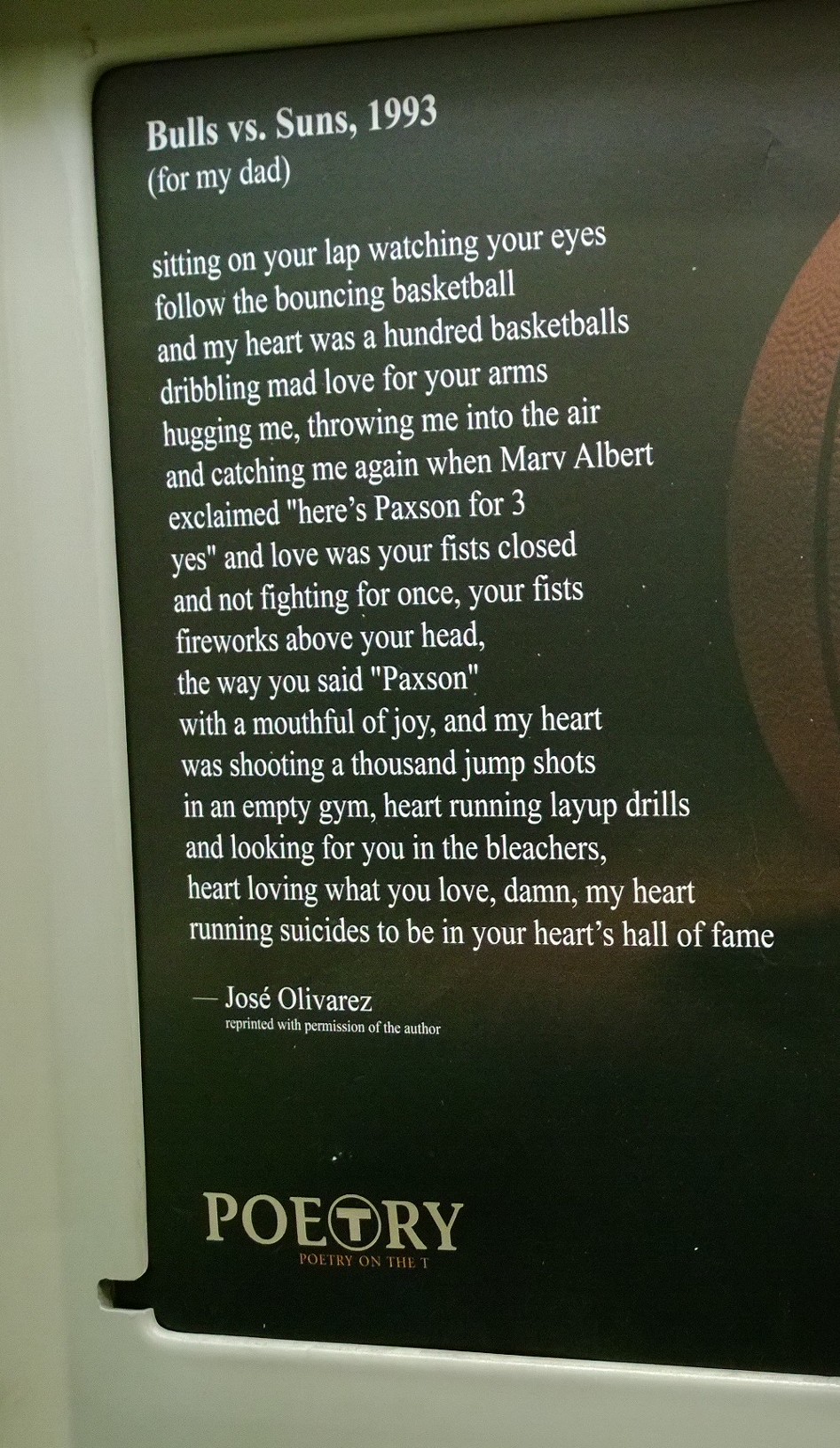
Jose-Olivarez-MBTA-poem


I was always impressed when I saw a poem in the place of an ad in the New York City subway. Now Boston has caught on.

Martine Powers wrote recently at the Boston Globe, “Finally, Bostonians will have the chance to experience the pleasures of poetry on the MBTA.

“Mass Poetry [is] bringing poems to advertisement spaces on subway cars. The initiative, dubbed PoeTry, is part of the organization’s Poetry in Public Spaces initiative, which began last year, said Mass Poetry program director Laurin Macios…

“ ‘Contemporary poetry is barely taught in schools, and often when it is, it is taught in a very scholastic sense instead of an artistic one,’ Macios said. “People often grow up without ever realizing there is poetry out there that can speak to them, or that they can speak back to. …

“Each appearance of a poem includes a tearsheet on the corner of the sign, allowing passengers to take a copy of the poem with them if the spirit strikes them.”

One poem in the series, says Powers, “What Travels,” by Joseph O. Legaspi, takes place on a subway car. “What travels beneath their secret faces? What is train but transport to other lives?” More at the Globe.

See also http://masspoetry.org.

Photo: Suzanne’s Mom
Poem: “Bulls vs. Suns, 1993,” by Jos
é Olivarez

Read Full Post »

An Imperial Elegy
by Wilfred Owen

Not one corner of a foreign field
But a span as wide as Europe;
An appearance of a titan’s grave,
And the length thereof a thousand miles,
It crossed all Europe like a mystic road,
Or as the Spirits’ Pathway lieth on the night.
And I heard a voice crying
This is the Path of Glory.

@-> @-> @->
Born in Shropshire, England, poet Wilfred Owen is best known for telling the truth of what he saw in World War I, a war joined too lightheartedly by many of his countrymen 100 years ago. He  died at the Sambre-Oise Canal a week before the Armistice was signed.

Read more about Owen here.

Photo: Suzanne’s Mom
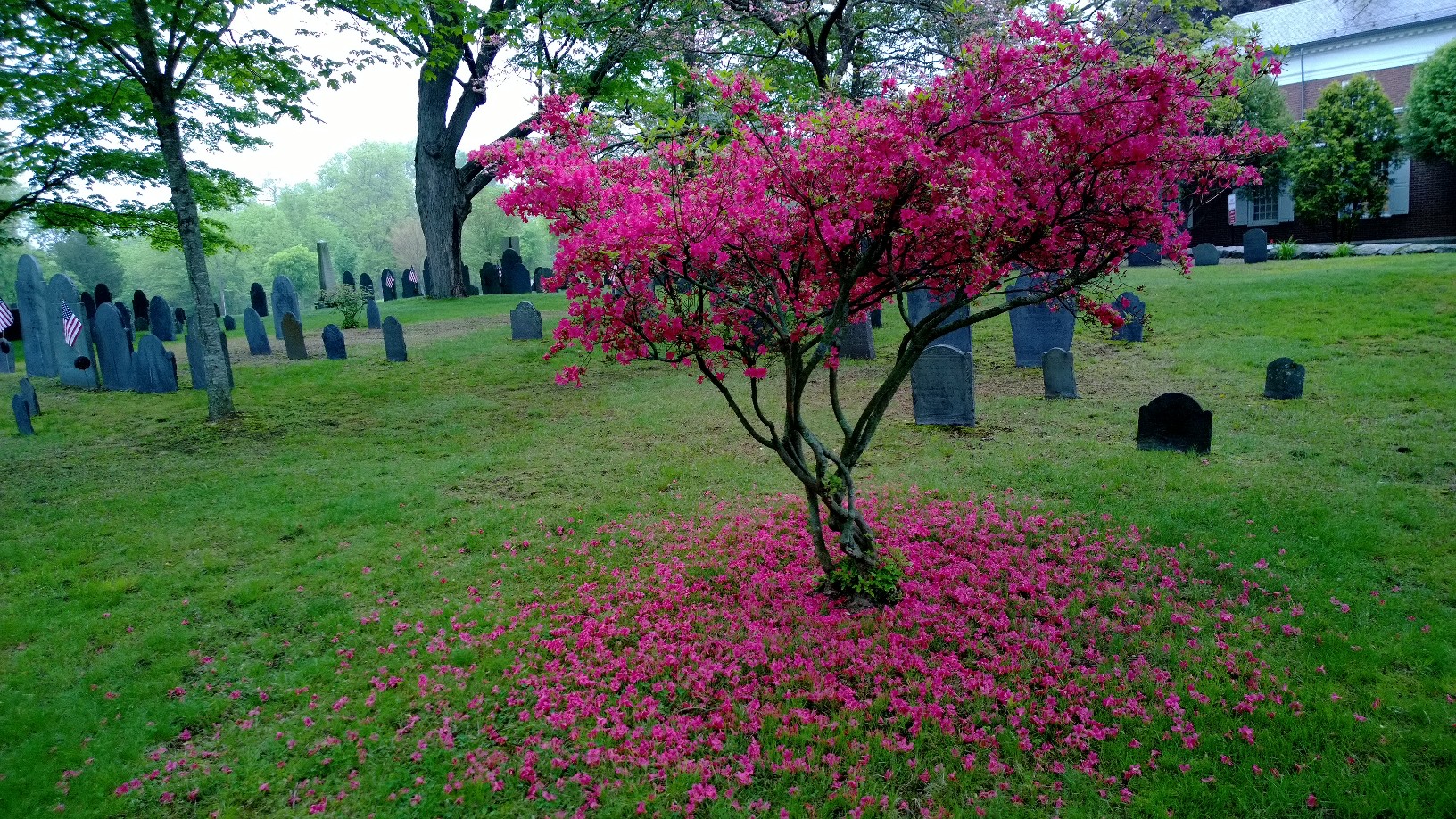
Azalea moving to the next phase

azalea-moving-to-next-stage

Read Full Post »

You don’t have to love everything that someone calls a poem to believe that it’s a great thing to encourage poetic expression and enjoyment of poetry in all walks of life.

One of the memorable aspects of Jason Elliot’s book on Iran, Mirrors of the Unseen, at least for me, was how many ordinary people in that country were interested in the great poets of their culture and could recite ancient verse.

Meanwhile, in Miami, there’s a poetry festival that aims to touch everyone.

William Grimes at the NY Times says, “If you live in Miami and you do not read, recite or listen to a poem in April, something has gone seriously wrong. For the third year, the O, Miami Poetry Festival will flood the city with words, using any pretext to accomplish its mission of putting all 2.6 million residents of Miami-Dade County in contact with at least one poem. …

“Poems will be pasted on the mirrors of public bathrooms and positioned at congested intersections, so drivers stuck in traffic jams can get some uplift while their engines idle. …

“One of last year’s most popular events, run with WLRN, the local public radio station, was a poetry contest in which citizen-poets were asked to contribute lines dedicated to the theme: ‘That’s so Miami.’ The winner in the ‘best ode to Miami Spanglish’ category was Lauren Fernandez: ‘Exciting and Extravagant/Guajiros in Bentleys./Tostones and Champagne. That’s so Miami.’

“This year contestants must pick a location between the Palm Beaches and the Keys and enshrine it in verse, incorporating the words “this is where.” Winners will see their work published in The Miami Herald. …

“Ivan Lopez, an actor, will dress as the poet and revolutionary José Martí, mount a white horse and ride down Calle Ocho handing out roses with poems attached. That’s so Miami.”

More  at the Times.

Photo: Ting-Li Wang/NY Times
Reading poetry. Can you identify the poet? Hint: He’s not so Miami.

Read Full Post »

Today KM added three short poems to my recent blog post “Do you feel a poem coming on?”

Because of KM and the fact that everyone on twitter seems to be writing Valentine rhymes today, I thought I would point out an Andrew Sullivan post on the connection between poetry and childhood games.

Andrew quoted poet Sandra Simonds, who writes in the Boston Review, “The first thing is that sound itself intoxicates and that we connect sound, rhythm, and rhyme to form very early on, probably from infancy.

“The music of language forms our understanding of the world and that is why it seems so fundamental, in poems, to follow the music and sounds over sense, and to trust that your ear will take you where you want to go.

“We also learn that language is deeply connected to play — riddles, jokes, nonsense, and, for lack of a better word, fun. But it is also wedded to tragic losses, lost time, lost childhood, the loss of the child itself and the body of the child. … As poets, we take [a feeling of childhood] smallness with us into adulthood and turn it into poetry.” More here.

I need to think about that.

And while I’m thinking, I’ll share a rhyme that goes with jumping rope — and also perhaps with Valentine’s Day.

“Cinderella dressed in yella
“Went downtown to see her fella.
“How many kisses did she get?
“One, two, three, four, five, six, seven, eight …”

You are limited only by your jumping ability.

Photo: Luna & Stella, the birthstone jewelry company

Read Full Post »

Yesterday I was thinking about how Lewis Carroll’s wry humor was a kind of code targeted directly at kids. No kid could miss that Alice is the only sensible person among a nutty bunch of adults in Wonderland — Caterpillars, Mad Queens, March Hares, and Mad Hatters — who can’t seem to follow the rules of social behavior they always lecture children to follow.

I was thinking particularly of Carroll’s spoof on the moralizing poem about the little busy bee — familiar to children of that day — and how he entertained with verses about a completely irresponsible and self-indulgent reptile.

Instead of admonishing children to be industrious with “How doth the little busy bee improve each shining hour,” he writes, “How doth the little crocodile improve his shining tail.” (Click there and watch the delicious Disney version on YouTube. Note how confused Alice looks at hearing the wrong words and how polite she is anyway.)

I realized I could write a post on spoofs of poems after my husband pointed out a second item this morning. It seems that the tree Joyce Kilmer praised in his best-known poem turns out to have been close to where I grew up.

And I can never hear these words by Kilmer — “I think that I shall never see/A poem as lovely as a tree” — without immediately hearing Ogden Nash spoofing Kilmer with “I think that I shall never see/A billboard lovely as a tree/And that unless the billboards fall,/ I’ll never see a tree at all.”

Please help me think of more examples. I’m sure there must be more.

Beacon-Hill-tree

Read Full Post »

I love this poem.

For me, the poet is saying that darkness can never completely win; focus on what it can’t touch.

Try to Praise the Mutilated World
Adam Zagajewski

Try to praise the mutilated world.
Remember June’s long days,
and wild strawberries, drops of wine, the dew.
The nettles that methodically overgrow
the abandoned homesteads of exiles.
You must praise the mutilated world.
You watched the stylish yachts and ships;
one of them had a long trip ahead of it,
while salty oblivion awaited others.
You’ve seen the refugees heading nowhere,
you’ve heard the executioners sing joyfully.
You should praise the mutilated world.
Remember the moments when we were together
in a white room and the curtain fluttered.
Return in thought to the concert where music flared.
You gathered acorns in the park in autumn
and leaves eddied over the earth’s scars.
Praise the mutilated world
and the gray feather a thrush lost,
and the gentle light that strays and vanishes
and returns.

cloud-study

Read Full Post »

Photo of Patricia McCarthy: Agenda

The editor of a small poetry journal in England was desperate for money to keep the magazine going, so she entered a poem of her own in a contest — and won.

The poem came straight from her mother’s memories of World War I. WW I poems — mostly written by young men in service who never came home — are some of the saddest ever composed.

At the Guardian, Alison Flood has the story on Agenda editor Patricia McCarthy’s win.

“McCarthy, who has published several poetry collections of her own, beat 13,040 other entries to win the anonymously-judged prize. Her winning poem, ‘Clothes that escaped the Great War,’ tells of the plodding carthorse who would take boys away to war, and then return, later, with just their clothes. ‘These were the most scary, my mother recalled: clothes / piled high on the wobbly cart, their wearers gone,’ writes McCarthy. …

“McCarthy said winning the £5,000 prize was ‘just extraordinary.’ “I’ve never even won a raffle. I don’t go in for competitions – the only other time I did was decades back, when I got runner-up,’ she said. ‘But I’m really down on my finances – I edit Agenda, and was really struggling, and thought this was probably better than a gamble on the horses.’ ”

More.

Read Full Post »

When grandmas recite poetry before you are three, the look on your face probably translates as, “What the heck?”

Here we are testing out Edward Lear’s “The Owl and the Pussycat.”

A week or so ago, Ogden Nash’s “Custard the Dragon” held a certain fascination, but there was ambivalence about the “big, sharp teeth.”

In the spontaneous-story department, we have been working on variations of “The Three Bears” and are edging up on “The Pig Won’t Jump over the Stile.” Stay tuned.

listening to Edw Lear poem

what kind of story is this?

Read Full Post »

I think I first heard about poetry slams from Patricia Smith when she was a columnist at the Boston Globe. I went with Kristina to hear her slam some poetry at Cambridge Adult Ed once. It was fun.

Patricia Smith had too much imagination to be a Globe columnist, but I still remember one of her stories that, if it wasn’t real in the usual sense was real on a level that has meaning for me. She has developed her poetry side since then and has won the awards she deserves.

Today my husband pointed me to an article on another poetry slam guru, Jack McCarthy.

Bryan Marquard writes in an obit in the Globe, “At some 200 lines, Jack ­McCarthy’s first published ­poem appeared in the Boston Sunday Globe in October 1976. Filling a page, ‘South Boston Sunday’ describes a family stroll through the neighborhood of his youth

“He thought the poem would launch his writing career, but that didn’t happen until another October, in 1993, when Mr. McCarthy took his youngest daughter to a poetry slam at the Cantab Lounge in Cambridge. He got up to read and the positive response brought an epiphany: The poet’s voice and the audience’s ears were inseparable.

“ ‘For me, the live audience is really the only audience I ever think about,’ he said by phone when he knew his death was near. “When I put something down on paper and publish it, my highest hope is that someone somewhere will pick it up and read it to a third party. My sense of audience does not stop with the person who reads the poem. I hope the poem goes on to another life.’ …

“ ‘The only ambition he seems to have is to tell the truth as best he can in poems,’ the poet Thomas Lux once wrote of Mr. McCarthy.”

Stephen Dobyns, a respected poet and one of my favorite mystery writers, called him “one of the wonders of contemporary poetry. He writes — and often performs — dazzling narratives full of wit and humor, sadness and hard thinking. He should be cloned.”

Read more about McCarthy here, about Patricia Smith here, about poetry slams here.

Photograph: Peter Vicinanza/file 2007/Boston Globe
Mr. McCarthy became well known after he in the 1998 documentary “SlamNation.”

Read Full Post »

Last year around Christmas my husband visited Southeast Asia on business and came back with descriptions of Christmas trees decorated from head to toe with written words on strips of paper.

That got me thinking about a new stealth project, one I hinted at here.

I printed out the quotes below and covered the paper with sticky plastic. I will put one set of quotation strips on our Christmas tree, but the first strips are now posted here and there around town. We’ll see what happens to them.

Feel free to use the lines here for a stealth project of your own, with or without sticky plastic. Or send some other quotes that I can use. If you are really ambitious, you might put strips of poems at the bottom of a poster headed something like “Help Yourself to Poetry” so people will be encouraged to take one.

“The roses had the look of flowers that are looked at.” T.S. Eliot

“The endlessly changing qualities of natural light, in which a room is a different room every second of the day.” Louis Kahn

“God inhabits the praise of his people.”

“Flowers have their agendas.” Mark Jarman

“I’d like to have a hand in things, what’s going on behind the screen.”  Kate Colby

“I don’t know where I’m going but I’m on the way.” Carl Sandburg

OLYMPUS DIGITAL CAMERA

OLYMPUS DIGITAL CAMERA

Read Full Post »

Maybe one of my Egyptian relatives will know about this poet. I enjoyed what Abdalla F. Hassan had to say about him in the NY Times, but I wish there had been examples of his poems to share with you. (Sorry, Poets!)

“Along a narrow, leafy road just past a small domed mosque is an electric pole with a handwritten sign showing the path to the country home of the poet Abdel-rahman Elabnoudy. The sign reads Aya and Nour, the names of his daughters.

“Sequestered from the big city, Mr. Elabnoudy, a songwriter, dramatist, social critic and man of verse, lives in a whitewashed home on small plot of land planted with mangoes and date palms in a village in Ismailia Province, along the Suez Canal. A couple of decades ago, he tilled and sowed the earth, and designed a home modeled on the traditional architecture of Abnoud, the Upper Egyptian village of his birth.

“ ‘I am from a village where everyone sings, except the shop owners, who reap the output of the singing at the end of the day,’ said Mr. Elabnoudy, 74, one of the Arab world’s best-known vernacular poets. ‘People work and sing, and with their earnings they would buy simple things like cigarettes and tea.’

“Books and awards line the shelves of his sunny study and reception room. On one wall, below a black-and-white portrait of his father, Mahmoud Elabnoudy, is a photograph of a beaming Abdel-rahman embraced by his mother, Fatma Qandil.

“ ‘It was an exaggerated love,’ he said of his mother. ‘She is present a lot in my poetry, but my father isn’t. She is my true educator.’ …

“Mr. Elabnoudy wrote the songs and the dialogue for the landmark 1969 film ‘Touch of Fear,’ which tells the story of a tyrannical village chief and his demise. The film narrowly passed the censorship authorities and was screened only after Mr. Nasser had seen it and given his approval. …

“Its theme — a mass uprising against tyranny ignited by a senseless death — was what unfolded four decades later to topple a system of authoritarianism established by the military coup-turned-revolution of Nasser and the Free Officers in 1952. Mr. Elabnoudy’s only poem in homage to a leader was written to Nasser 40 years after his death in 1970 and weeks before the 2011 revolution, praising his incorruptibility.

“Mr. Elabnoudy’s ascendancy has endured through six decades. His poem ‘The Square’ … captured the dreams and hopes of a nation during the height of the 18-day revolution. ‘A ruler should never think he understands Egypt,’ he said.”

More.


Photograph of vernacular poet Abdel-rahman Elabnoudy is by Abdalla Hassan

Read Full Post »

I’m a sucker for a good title. I even bought a novel once just because I liked the title — Time Will Darken It. (I didn’t like the book, but what a great title!)

So here I am recommending a song by Greg Brown called “Playing the Poet Game.” The other words are good, too. See how you like them.

As wistful as the lyrics are, you could do worse than play the poet game. I know someone who is building a fine reputation as a poet today. It is clearly a better arena than the one he was in before. He was active in politics and got carried away with his enthusiasm for one guy and his fear of what would happen if the other guy won. He broke the law. And paid for it.

Today, his poetry is enriched by his hard life lessons.

Poetry is good for everyone because, at its best, it is first cousin to truth.

Read Full Post »

« Newer Posts - Older Posts »