Feeds:
Posts
Comments

Posts Tagged ‘poetry’

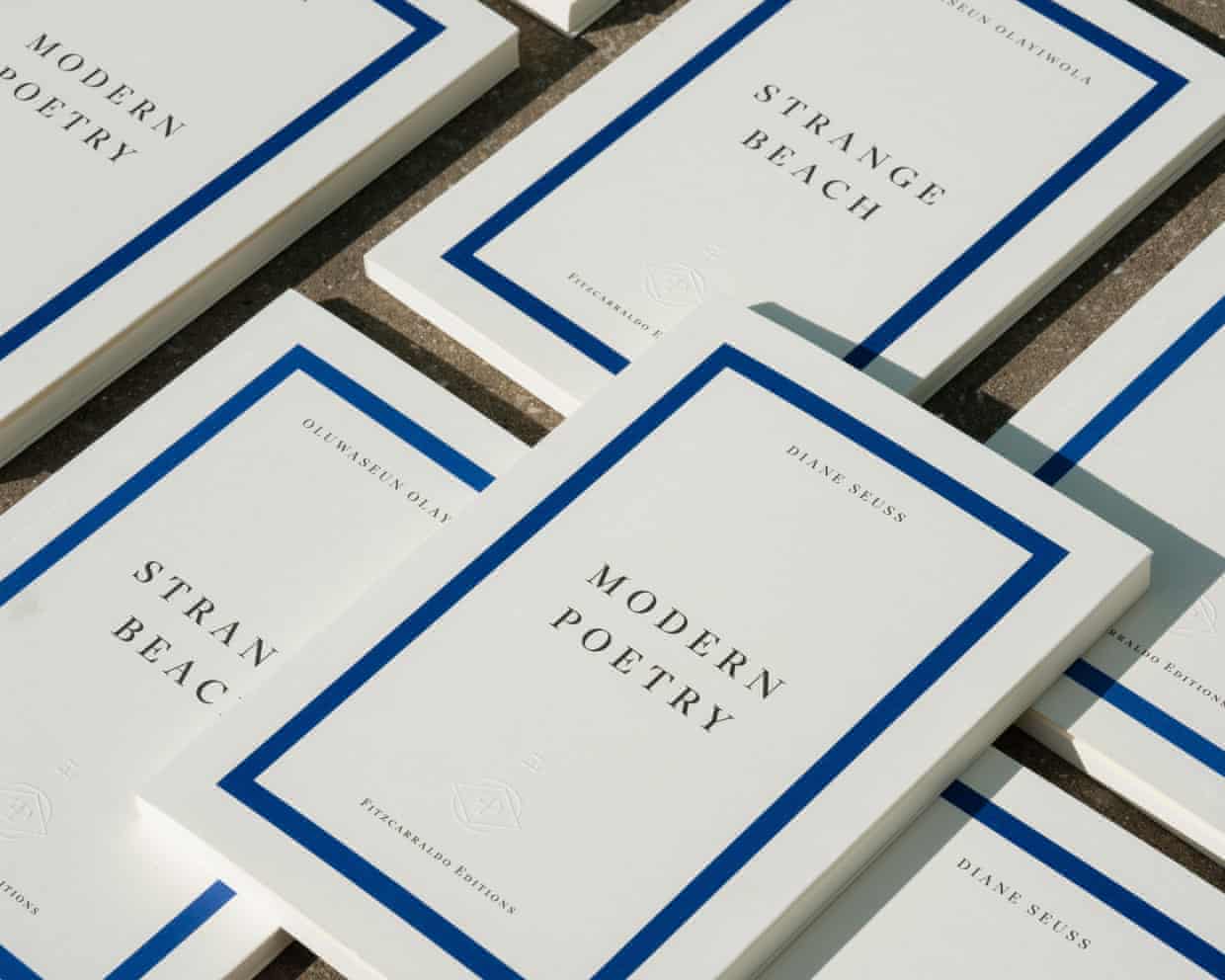
Photo: Fitzcarraldo Editions.
Three publishing companies have launched the biennial Poetry in Translation prize, which will award an advance of $5,000 to be shared equally between poet and translator.

Anyone who has used Google Translate for a simple sentence knows that AI is not going to be doing quality translations of whole books anytime soon. There is too much subtlety needed.

And if that’s true for, say, a murder mystery, imagine how important a human translator is for poetry!

That’s why a new prize for poetry translation from publishers in the UK, Australia, and the US is arriving just in time — before the world gets lulled into thinking an AI translation is just fine.

Ella Creamer reports at the Guardian, “A new poetry prize for collections translated into English is opening for entries. …

“Publishers Fitzcarraldo Editions, Giramondo Publishing and New Directions have launched the biennial Poetry in Translation prize, which will award an advance of $5,000 (£3,700) to be shared equally between poet and translator.

“The winning collection will be published in the UK and Ireland by Fitzcarraldo Editions, in Australia and New Zealand by Giramondo and in North America by New Directions.

“ ‘We wanted to open our doors to new poetry in translation to give space and gain exposure to poetries we may not be aware of,’ said Fitzcarraldo poetry editor Rachael Allen. …

“The prize announcement comes amid a sales boom in translated fiction in the UK. Joely Day, Allen’s co-editor at Fitzcarraldo, believes that ‘the space the work of translators has opened up in the reading lives of English speakers through the success of fiction in translation will also extend to poetry.’ …

“Fitzcarraldo has published translated works by Nobel prize winners Olga Tokarczuk, Jon Fosse and Annie Ernaux. ‘Our prose lists have always maintained a roughly equitable balance between English-language and translation, and some of our greatest successes have been books in translation,’ said Day. ‘We’d like to bring the same diversity of voices to our poetry publishing.’ …

“The prize is open to living poets from around the world, writing in any language other than English.

“The prize is being launched to find works ‘which are formally innovative, which feel new, which have a strong and distinctive voice, which surprise and energize and move us,’ said Day. ‘My personal hope is that the prize reaches fledgling or aspiring translators and provides an opening for them.’ …

“Submissions will be open from 15 July to 15 August. A shortlist will be announced later this year, with the winner announced in January 2026 and publication of the winning collection scheduled for 2027.

“The ‘unique’ award ‘brings poetry from around the world into English, and foregrounds the essential role of translation in our literature,’ said Nick Tapper, associate publisher at Giramondo. ‘Its global outlook will bring new readers to poets whose work deserves wide and sustained attention.’ ”

More at the Guardian, here. I hope a certain blogger who translates Vietnamese poetry into English will apply for that prize.

Read Full Post »

Art: Christina Chung.
A Chaucer fantasy.

What soothes you? Things like a massage, granola, walking, or reading generally work for me. Today, I’m delighting in a literary essay. I’m glad Camille Ralphs wrote at the Poetry Foundation about “how Chaucer remade language.” Good-bye for now to November 2024.

Ralphs says, “Chaucer’s works are very much of their moment, and perhaps required some distance from their context and coevals for their worth to be apparent. Ezra Pound observed that ‘Chaucer had a deeper knowledge of life than Shakespeare.’ If Chaucer hadn’t played so many roles in the medieval city, he likely couldn’t have written so expansively.

“He was the son of a vintner and grew up in London’s Vintry Ward, where he was formed and informed from the start by a babel of trades and trade-offs. He became a page in the house of the Countess of Ulster, a squire in the King’s household, a soldier, a controller of customs in the port of London, a justice of the peace, and Clerk of the King’s works. The Canterbury Tales owes some debt to the genre of ‘estates satire,’ which tallies different social classes and professions and elucidates both their importance to the state and their deficiencies. … Yet there is more reality to Chaucer’s characters than that.

“Who else could have imagined such a motley ensemble but someone who had jostled with the many flavors of humanity? The medleyed voices of the Miller, who can break down doors by running at them with his head; the ‘gat-toothed,’ half-deaf Wife of Bath, who rides astride in bright red stockings; the Canon alchemist, so sweaty from the ride that his horse is a lather of suds; the ‘ful vicious’ Pardoner with his jar of dubious holy ‘pigges bones’; and the garlic-loving Summoner, with a face so pimply ‘children were aferd’ — Chaucer knew them all.

“As Mary Flannery argues in her authoritative and diverting monograph Geoffrey Chaucer: Unveiling the Merry Bard (Reaktion Books, 2024), the mercenary assets of ‘The Shipman’s Tale,’ in which a merchant’s wife offloads a difficult financial situation by insisting she’ll repay her husband with sex (‘By God, I wol nat paye yow but abedde!’) must come from Chaucer’s roving through ‘warehouses, docks and markets.’ Works such as The Book of the Duchess (1368) — probably penned on the death of Blanche of Lancaster, the wife of John of Gaunt (it also circulated under the title ‘The Deth of Blaunche’) — could only be written by a man who’d worked in ‘palaces and great houses in England and on the Continent.’

“For a writer to be all things to all men, he must know a bit about things, and a lot about men — not to mention a lot about language and literature. Had Chaucer not been born into a mercantile environment and had the opportunity to mingle with Italians by the Thames, he may have struggled with Italian, and had he not spent so much time around nobility, he may not have learned French.

“His narratives are mostly borrowed from Latin and Romance-language sources (including Boccaccio’s DecameronOvid’s Metamorphoses, and the Roman de la Rose by Guillaume de Lorris and Jean de Meun). His forms and genres almost all derive from French minstrel romances and fabliaux (bawdy medieval stories), and, more granularly, from the verse structures of poets such as Guillaume de Machaut, from whom Chaucer stole the seven-line form now known as ‘rime royal‘ or the ‘Chaucerian stanza.’ And he may never have thought about writing in English had he not observed how Dante elevated Florence’s vernacular in his Commedia (1321), a technique Chaucer noticed while in Tuscany for diplomatic work.  …

“Chaucer never claims to be inspirited by God or gods, nor does he ever refer to himself as a ‘poet’ or ‘author.’ This may result from his ‘distinctive self-deprecation,’ in Flannery’s terms, though comic exaggerations of the scribbler’s incompetence are found in Machaut too, as the scholar Colin Wilcockson notes.

“Such modesty was a way of keeping or getting out of trouble with those who might be offended by his bawdy side, or who might chide his literary aspirations — like his efforts to wash his hands of his own writings. In the Miller’s Prologue, for example, he ‘makes his audience responsible for whether they enjoy his work.’

‘In the Prologue to The Legend of Good Women (c. 1387), the God of Love and his wife Alceste chastise Chaucer with a list of his works (Chaucer later updated the Prologue to include recent works, assuring the record was correct), and the Man of Law’s Prologue from The Canterbury Tales offhandedly abuses Chaucer’s rhyme before giving another catalogue. The ‘retraction’ at the Tales’ end, in which Chaucer — apocryphally from his deathbed — asks God to forgive him for his ‘translaciouns and enditynges of worldly vanitees,’ fulfils the same role. …

“In her painstaking biography Chaucer: A European Life (2019), Turner argues that Chaucer’s writings must proceed from some sort of democratic impulse. … This, perhaps, is Chaucer’s great innovation in our literature, surpassing even the invention of the decasyllabic English line that found its way to iambic pentameter: a level narrative playing field, inviting interaction and discussion.”

If you’d enjoy leaving 2024 for another world, there’s lots more at the Poetry Foundation, here. No paywall.

Read Full Post »

Photo: Dua Anjum.
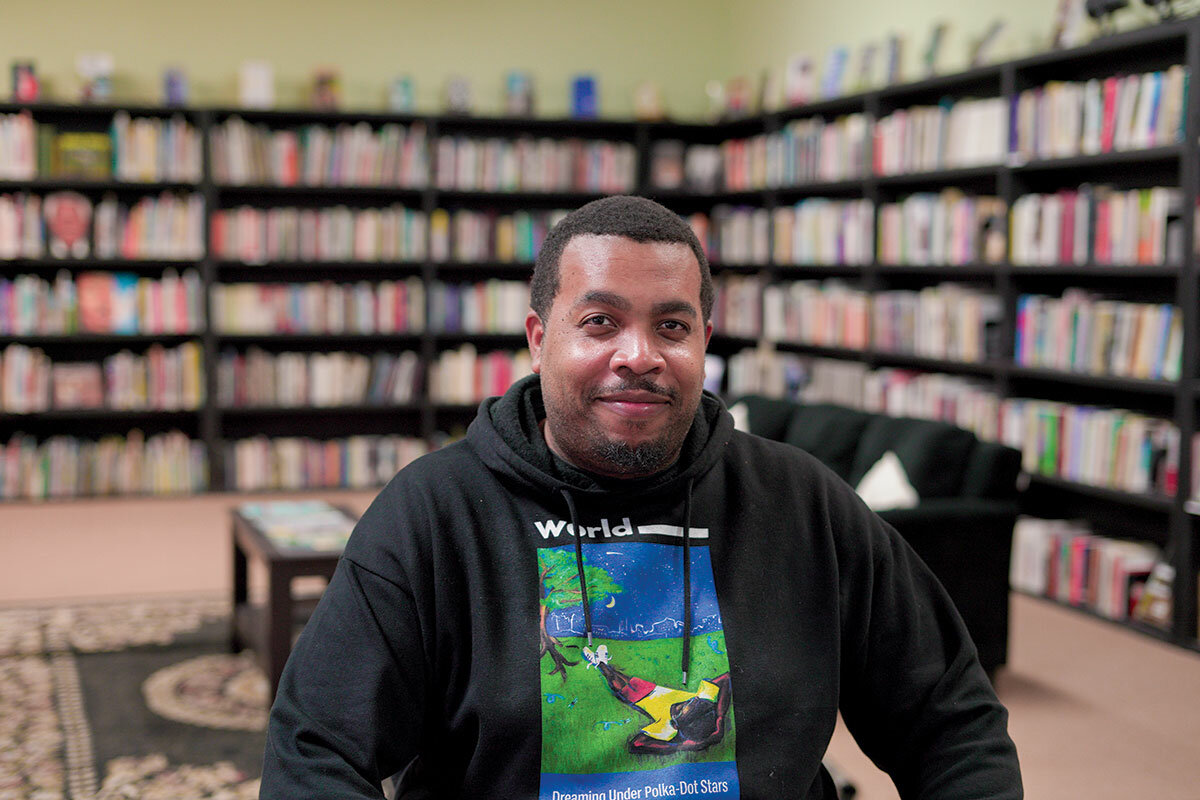
“Poet Hiram Sims,” the Christian Science Monitor reports,” has given poetry a permanent home in his South Los Angeles neighborhood.

This is another story about how the Covid pandemic gave some people a moment of “not much going on” to pursue a dream.

Dua Anjum writes at the Christian Science Monitor, “From Hiram Sims’ earliest memory, poetry defined his inner world – songs of praise at his church choir; the rap lyrics of The Notorious B.I.G., Puff Daddy, and Mase’s ‘Mo Money Mo Problems’; Edgar Allan Poe’s ‘The Raven’ in seventh grade.

“ ‘Poetry’s like a frequency that I can hear above all other frequencies,’ he says. … ‘When I hear that sound, I pay attention.’

“That sound became his favorite form of expression. As a kid, he wrote about candy, his thoughts about God, and a lot of verses for girls at school. In college, while he progressed to mature writing around the Black experience in America and the struggles of being young and broke, witty comic poems remained key to his repertoire. He chuckles recalling a poem comparing Ugg boots to rhinoceros feet. Now, he has published three collections of poetry and frequently writes love poems for his wife.

“While it was clear early that his calling was poetry, Mr. Sims remembers having an anchorless feeling: Poetry sections of libraries were rare, and the poetry scene was a series of countless borrowed spaces in restaurants, cafes, and bars. It felt like ‘poetry is homeless because it’s constantly couch surfing,’ says Mr. Sims, who became a creative writing and composition professor at colleges in the area, including his alma mater, the University of Southern California.

“In 2020, he gave poetry a permanent home in his South Los Angeles neighborhood, founding the Sims Library of Poetry, for reading, writing, studying, and performing poetry. 

“The space has evolved into an indispensable gathering place for anyone looking for inspiration, say poets who live nearby. It whimsically invites the public in: ‘Poetry Lives Here’ is painted on a low concrete boundary. A mural pays homage to the dragon fire that poets spit in words. A ‘Poet Parking Only’ sign peeks from a patch of grass. 

“The spiritual foundation for this landmark came from what Mr. Sims considers a personal triumph: the Community Literature Initiative (CLI), through which he helps poets produce manuscripts ready for publication and connect to presses.  

“ ‘I was at an open mic and I heard all of these amazing poets. After the show, I said, “I’d like to buy a copy of your book,” and none of them had books,’ says Mr. Sims, who has coached poets in publishing now for 10 years in space provided by USC. … Sims Library origin story goes back to a $29.99 suitcase.

After assigning his CLI students to read one book of poetry a week, he realized: They couldn’t afford them, and libraries had slim poetry offerings. 

“So, he fit 80 books from his collection into the purple-brown suitcase, carted it around in his car, unzipped it, and let students borrow poetry collections by living authors, especially local LA poets.

“ ‘One of my students said, “This is the little Sims library of poetry right here.” And I was like, “Wow.” … After that, I put all my energy into building that microcosm of the library that I had in my head.’

“The idea came to life in his garage at a birthday party-turned-library-launch. … Several poets read their own verse. And people brought boxes full of books: The party started with 300 and ended with 2,000. 

“Mr. Sims’ mother, Gwendolyn, who remembers her young son loved to read greeting card stanzas at the Rite Aid, was one of the first to donate money. The library continued to thrive with family, community, and foundation contributions of books, cash, and grants. And CLI class tuition also helped. 

“It was peak pandemic, and the preschool run by his wife, Charisse, closed. The family decided to take over the building as the next iteration of the library. Mr. Sims’ father, Edward, who is a contractor, and his brother Job helped with shelves. Word of another donation drive reached further and book donations came from across the country. …

“The nonprofit offers more than 9,000 volumes of poetry, says Mr. Sims. ‘So many of these books are people that live in LA, you know, people in this community.’ 

“Open until 8 on Saturday nights, the thrum of activity – from book launches, workshops, and open mics – spills into the neighborhood with singing voices, fingers snapping, and the rhythm of rhyme. …

“Mr. Sims says, ‘I think the library represents value for a part of people they don’t often share. So people often bring poems from their shoeboxes and folders. It’s so personal with people.’ …

“ ‘When the first volunteers came in, they expected to come to a library, but then realized, we have to build one,’ says Karo Ska, library manager and a CLI writer. For them, the best part is that the library has books that can’t be found elsewhere – pre-1950s special collections, self-published collections, periodicals, local literary journals, and handmade chapbooks.

“ ‘The idea of giving back to the community is a phrase that a lot of people use but isn’t always manifested,’  says Lynne Thompson, 2021 Los Angeles poet laureate. ‘[Hiram] is as interested in the work of others and facilitating not only the writing of it but the publishing of it as he is in his own work.’ …

“Poet bridgette bianca, who grew up in the neighborhood without a public library nearby, says: ‘We are in an area that’s very much Black, very much brown, very much working class. And that somebody built a library here is just fantastic.’ 

“Now, as a community college professor, she uses the library as a resource, encouraging students to explore the poetry collection and attend events for extra credit.”

More at the Monitor, here. No firewall, but subscriptions are encouraged.

Read Full Post »

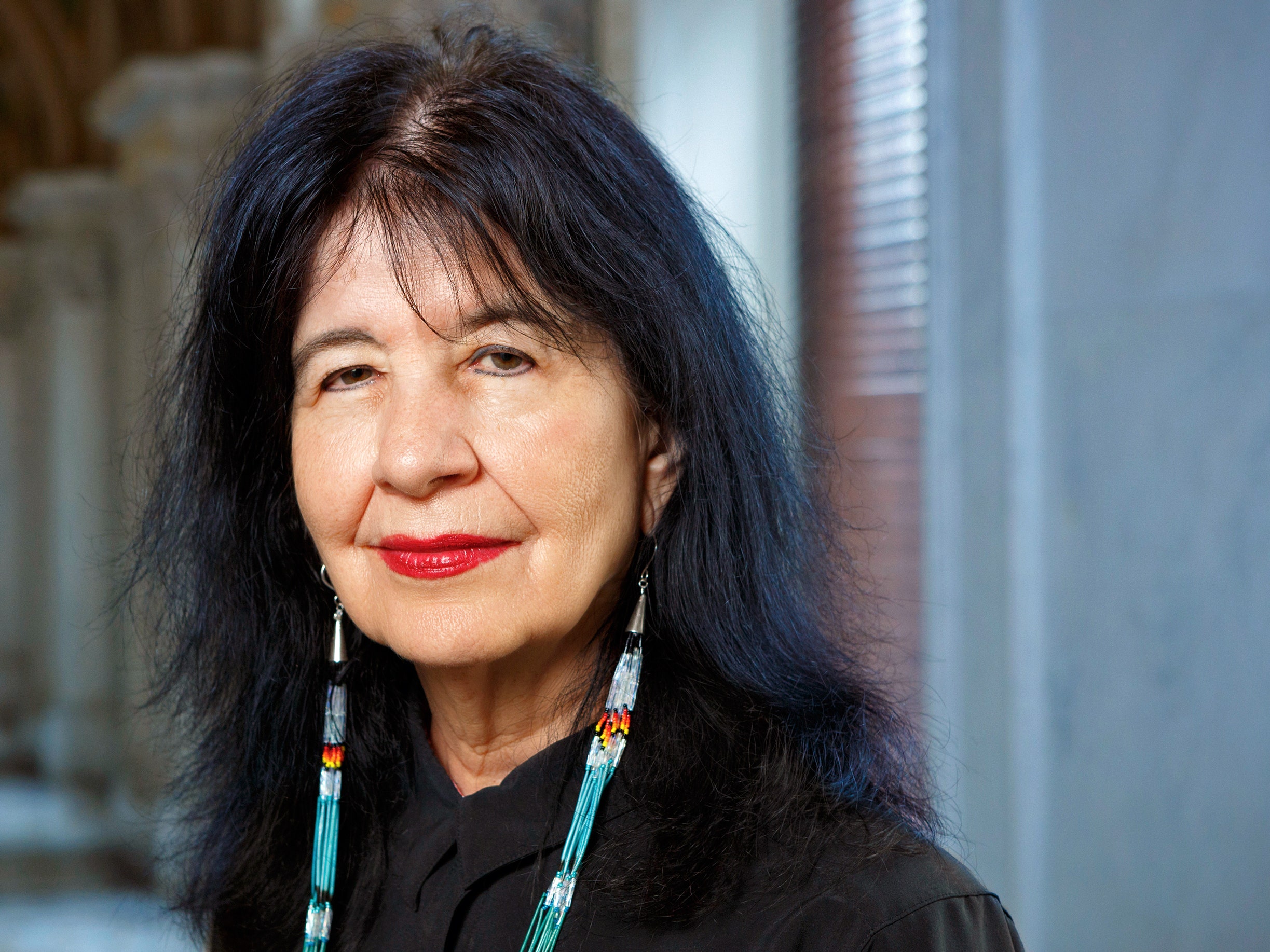
Photo: Shawn Miller / Library of Congress / NYT / Redux via the New Yorker.
Joy Harjo, US Poet Laureate, is an enrolled member of the Muscogee Creek Nation. Her hometown is Tulsa, Oklahoma.

Are you familiar with the work of our current poet laureate, Jo Harjo? I felt moved to share an article about her today because I’m about to attend for the first time the online version of my local library’s poetry readings.

Jason Berry at the Daily Beast writes, “I started a Joy Harjo reading jag the summer before last in Santa Fe, New Mexico, at op. cit., a magical store in whose forest of books, new and older, I picked up her 2012 memoir, Crazy Brave. I knew Harjo was the U.S. Poet Laureate, the first Native American so exalted, but I had never read her work. Her memoir’s opening scene hooked me right away:

“ ‘Once I was so small I could barely see over the top of the back seat of the black Cadillac my father bought with his Indian oil money. He polished and tuned his car daily. I wanted to see everything. …

“ ‘I wonder what signaled this moment, a loop of time that on first glance could be any place in time. I became acutely aware of the line the jazz trumpeter was playing (a sound I later associated with Miles Davis). I didn’t know the words jazz or trumpet. My rite of passage into the world of humanity occurred then, through jazz. The music was a starting bridge between familiar and strange lands.’

“That bridge runs through Harjo’s impressive trek of 22 books of poetry, six albums as a jazz saxophonist and husky spoken-word poet, two children’s books, two plays, last year’s memoir sequel Poet Warrior, screenplays, and editor of major anthologies. …

“The scenic lilts of self-discovery in her early work never took Harjo far from a steely focus on the dynamics of identity, enduring and transcending government injustices heaped on Indians, a legacy she came, over time, to see as precursor to the greater earth plundered by pollution, heaving from convulsions of the climate. …

“In Poet Warrior, Harjo circles back to devastating childhood episodes initially described in Crazy Brave, with new details on how she survived her early years. The father she initially adored, who came from a family with land generating some oil lease revenues, was an airline mechanic and raging alcoholic who chased women, beat his wife, and terrorized his kids. Joy’s mother sang as she bustled in the kitchen to sweet radio songs, doing a memorable take on Patsy Cline’s ‘I Fall to Pieces,’ getting the girl into jitterbug dancing. …

“The child had a poetry anthology which opened a new world with the kindred spirit of Emily Dickinson: … ‘I liked to read aloud to myself: “I’m Nobody! Who are you?/ Are you — Nobody — Too?/ Then there’s a pair of us!”

“ ‘Two nobodies equal one somebody. Emily’s poems told me she found herself with words. Poetry was a refuge from the instability and barrage of human disappointment. When I read and listened to disappointment I was out of the crossfire of my parents.’ …

“As a teenager [Harjo] found rescue with acceptance to the Institute of American Indian Arts, a high school in Santa Fe where she boarded in the late 1960s, meeting young Seminoles, Sioux, Creek, and Pawnee students among those from other nations, awakening to a Native American renaissance as they found expression in classes on drama, literature, music, and the arts. …

“She fell in love with a Cherokee boy, became pregnant, ended up going to live with the boy and his cloying mother in Talequah, Oklahoma. After working day jobs to cover babysitting for her son while the boy-husband failed to get jobs, she took the baby and moved to Albuquerque, a single mom balancing work and classes at the University of New Mexico.

“She fell in love with a poet by whom she had another child, only to realize that his wild binges, jumping in hotel swimming pools where he wasn’t staying, crawling home with flowers and florid apologies, were a disaster she had to escape. …

“She [had earlier] joined the Creek-Muscogee nation, adopting the surname Harjo in honor of a grandmother whose artworks inspired her. ‘Just as I felt my grandmother living in me, I feel the legacy and personhood of my warrior grandfathers and grandmothers who refused to surrender to injustice against our peoples.’

“In Albuquerque, at U.N.M., Joy Harjo became a poet, charged with a spiritual sensibility given shape by the stories and tribal history she absorbed in the Muscogee Creek Nation. The challenge of poetry was stark, as she writes near the end of the first memoir.

“ ‘I could not express my perception of the sacred./ ‘I could speak everyday language: Please pass the salt. I would like … When are we going … I’ll meet you there./ I wanted the intricate and metaphorical language of my ancestors to pass through to my language and my life.’ …

“She experienced a conceptual turning point in 1990 while attending a conference of indigenous peoples in a mountain village near Quito, Ecuador, discussing a counter-response to the approaching celebration in the Americas of the 500th anniversary of Columbus’ arrival in 1492.

“ ‘I’ll never forget the arrival of the people from the Amazon villages,’ Harjo wrote in a 2010 piece for Muscogee Nation News. ‘They walked up to the encampment barefoot, with their beautiful, colorful feathers and spears. They came to share a story of American oil companies, and how the lands were being destroyed and their way of life irrevocably broken.’ “

More at the Daily Beast, here. I especially liked an insight about indigenous people that Harjo quotes from one of the elders of her tribe: “No matter how small a tribal people may be, each of them has a right to be who they are.”

Read Full Post »

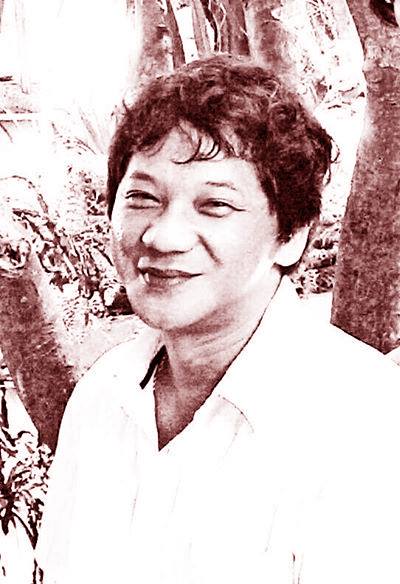
Photo: via Songngutaitram,
Vietnamese poet Lê Vĩnh Tài.


Blogger Nguyễn Thị Phương Trâm got a couple of us hooked on Vietnamese poetry with her translation of a long and moving epic by the poet pictured above, Lê Vĩnh Tài.

At the AJAR Press, where Lê Vĩnh Tài’s work is published, Nguyễn Trọng Tạo provides background on the poet, “Lê Vĩnh Tài was born in 1966 in Ban Me Thuot, Daklak. He graduated from Tay Nguyen Medical School but later pursued a career in business and making poetry. Le Vinh Tai’s poetry is rich in intellect but also carries much of tenderness and trembling. He is like a ‘balanced renovator.’ ”

A small sample of his more playful poetry comes from Nguyễn Thị Phương Trâm’s blog, Songngutaitram:

“I want to write a poem

“because the poem will
“because the poem be

“the poem
“will throw itself upon the pages
“with the vigour of a child learning how to talk

“the poem
“the lyrics you’ve forgotten

“I want to turn us into a poem.”

Nguyễn Thị Phương Trâm, herself a poet as well as a translator, reports that she was “born 1971 in Phu Nhuan, Saigon, Vietnam. The pharmacist currently lives and works in Western Sydney, Australia.”

A word on the Vietnamese press called AJAR: “AJAR is dedicated to the discovery of poetry and art in both ordinary and hidden places, providing a space for these works to be exhibited, loved, and challenged. As a bilingual journal and independent small press based in Hanoi, AJAR provides an opening for questions, imaginings, and poetic (im)possibility to be shared across borders, inhabiting language as it moves between worlds and words. In bringing fresh and critical voices of Vietnamese literature and art into English, and welcoming those voices from everywhere into Vietnamese, we focus on quality translations and envision books as artifacts of artistic collaboration. Alongside single author poetry collections, AJAR publishes a bilingual journal of poetry, short fiction, essay, and artwork that revolves around a specific word of choice for each issue. 

“While accepting donations from individuals, AJAR is self-funded and unaffiliated with any outside or inside organization. To be a part of keeping AJAR alive, please buy books or contact us at shop@ajarpress.com.”

To learn more about translation in general, check out This Little Art, by Kate Briggs. Briggs brings up many fascinating points about the decisions that translators must make — points you may never have thought about — and opines that, in fact, the translator is also the author. At least, the author in the second language.

Read Full Post »

Photo: University of Pennsylvania
An illustrated headpiece from a mid-18th century collection of ghazals and rubāʻīyāt.

Today’s article is about an ancient type of poetry still in use. Before yesterday I might have thought it a bit too esoteric for a chatty blog post, but yesterday Suzanne’s kids showed me an educational iPad program they love, and the 8-year-old started discussing metaphors and onomatopoeia.

I decided we could handle ghazals.

Claire Chambers writes at 3QuarksDaily, “Ghazal poetry is an intimate and relatively short lyric form of verse from the Middle East and South Asia. The form thrives in such languages as Arabic, Persian, Urdu, and now English. Like the Western ode, these poems are often addressed to a love object. …

“A mixture of sacred, profane, romantic, and melancholic elements are frequently stitched into the ghazal’s poetic fabric. Many ghazals revolve around the theme of lovers’ separation. This topic also functions as an image for the Muslim worshipper’s longing for Allah. In doing so, the ghazal draws comparisons with seventeenth-century metaphysical poetry. Like ghazalists, John Donne would ostensibly write about love for a woman but also shadow forth devotion to God. …

“In the Muslim world, the arts are less likely to be locked away in compartments or considered elitist as they are in the West, and more likely to be part of everyday life. In the Indian subcontinent and its diaspora, mushairas (meaning ‘gathering of poets’) are interactive poetic meetings. These recitals, with their call and response tradition, have made the ghazals an instantly recognizable form in the popular consciousness.

Because of this accessible performative and musical tradition, working-class South Asians have nearly as much access to poetry as the elite. …

“Rich images can be found in Urdu ghazals: tropes include the moth and the flame, stars and diamonds, and the rose and the nightingale. Such leitmotifs from ghazal poetry have various connotations (relating to such issues as politics, love, and religion) to different people in particular contexts. …

“By noticing the opulence associated with Urdu poetry, one realizes that Islam is a diverse religion and culture. … In modern-day Britain and the United States, ghazals have become a popular form. Here, they sometimes touch on a migrant’s yearning for home and belonging. The year before he died, the Kashmiri-American poet Agha Shahid Ali (1949–2001) published Ravishing DisUnities, a collection of ghazals mostly by fellow Americans. …

“Chafing against the free-verse liberties new world poets had previously taken with the ghazal, he exhorted contributors to return to structural ‘form for form’s sake’, while reinvigorating the form in the fresh language of English. As a Pakistani-American poet from the next generation Shadab Zeest Hashmi puts it in her beautiful nonfiction book Ghazal Cosmopolitan, ‘the ghazal fuses the old with the new, the friend with the stranger – reflecting, refracting, and constantly reminding us that America to is a convergence of sorts, a cultivation of diversity – at least the promise of it’. …

“The ghazal is made up of semi-autonomous couplets, each of which helps to set up the logic of the whole poem. The form is notable for its rhyme, the symmetry of its couplets, and a [refrain] at the end of the second line of each couplet. …

“In the first ghazal Ali ever wrote, he ends with an explanation of his middle name’s significance in Arabic, that language which has been extolled in the [refrain] of each of the foregoing couplets:

‘Listen, listen: They ask me to tell them what Shahid means:
‘It means “The Beloved” in Persian, “witness” in Arabic.’ ”

The article also features an amusing explanation from the American poet John Hollander — known partly for inventing the humorous double dactyl with Anthony Hecht — which uses the ghazal form to show how a ghazal is constructed. The poets among you might find it useful.

More.

Read Full Post »

2019-Malcolm-Greenaway-Voices-from-Village

Photos: Malcolm Greenaway

April is National Poetry Month. I know quite a few poets, and I truly value the way they capture feelings obliquely and more deeply than common speech. In fact, at my sister’s memorial service in January, I read my friend Ronnie Hess‘s poem called “What We Scarcely Know,” from her collection Ribbon of Sand about a childhood on Fire Island. The theme of sand repeatedly washing away and returning in a new form really spoke to me. What poems speak to you?

ronnie_hess_writer-poet

Photo: Wisconsin poet Ronnie Hess

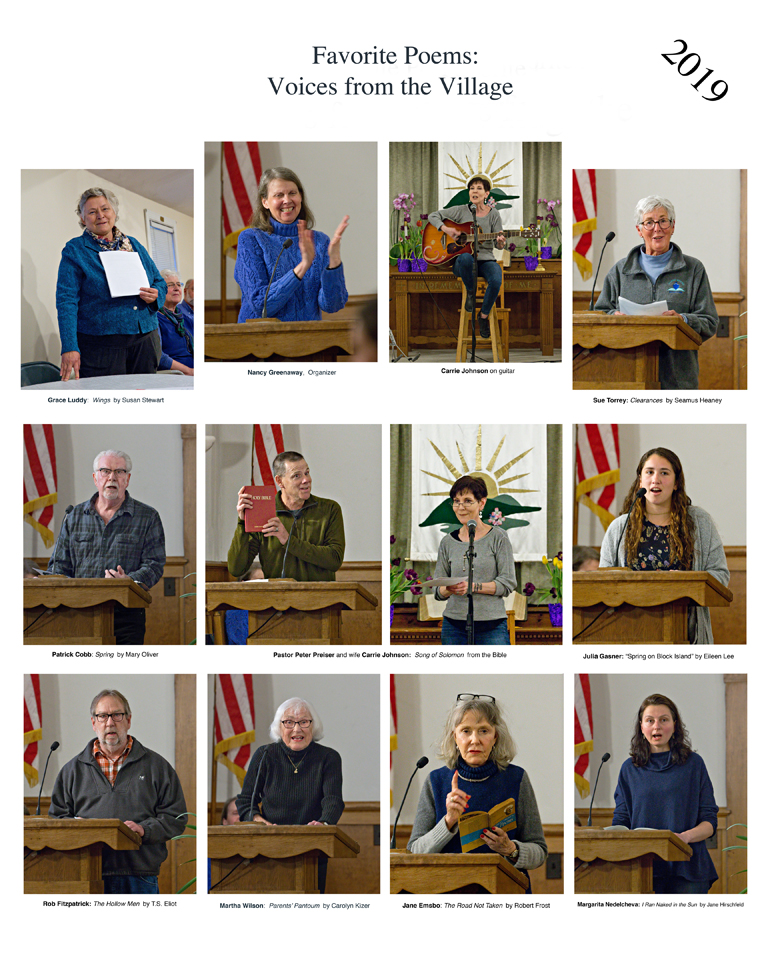
Rhode Island poet Nancy Greenaway has been bringing a love of poetry to her community and to students on Block Island for decades. Recently she told me, “For National Poetry Month, I usually organize a reading of favorite poems by community members who are not poets: a ferry captain, a police chief, a teacher, a real estate broker, a minister, a doctor, a guitar-playing student, a gift shop owner, a first warden [something like a mayor], a manager of the power company, for example.

“We had scheduled the Voices from the Village reading for April 24, but cancelled because of COVID 19. Instead, we are asking community members to email favorite poems to their friends during the month of April. I’ve received two so far:
Wendell Berry’s ‘The Peace of Wild Things‘ and Kitty O’Meara’s ‘And the people stayed home.’ ”

Nancy’s email inspired me to search online for articles about past Voices from the Village events. This is from the Block Island Times, May 2018: “The annual community poetry reading known as Voices from the Village featured a wide range of voices reading the works of many different poets:

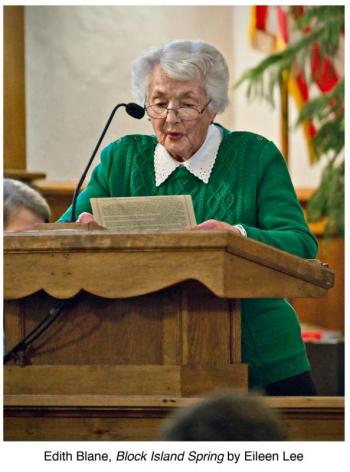
“Here is the poem by [former first warden] Edie Blane’s sister, Eileen Lee, titled ‘Block Island Spring,’ from Jan. 31, 1962.

miss20edie20blane

Photo: Malcolm Greenaway

“Spring doesn’t come to our bleak island home

“With whispering air and fragrant smell of earth.

“Ours is a different world —

“Grey, cold and harsh,

“And April days are angry with us still.

“The equinox comes in with windy roar;

“Pale dune grass dips and rises in its path.

“Seas crash

“White crested and dark shining green.

“The sun is bright but gives no pleasant warmth.

“And yet we have a portent, old as time,

“Though cold winds rule us yet, with icy breath;

“A day of quiet comes —

“The Sound grows still, a pale and milky blue

“The smallest waves lap gently on the shore.

“In the great echoing stillness on the sea

“The sweet slow tolling of the buoy rolls in.

“At last, this is the long awaited time,

“First sign of island spring.”

See all the Malcolm Greenaway photos of the 2018 readers here. And for inspiration from Nature, check the photographer’s website, here.

I’m wondering if a group poetry reading could be done virtually, the way these singers handled the old-time spiritual “Down to the River.” Looks complicated.

Read Full Post »

1949

Photo: Ben Stansall/AFP via Getty Images
Tate Britain’s curator said the projection of William Blake’s Ancient of Days was in keeping with Blake’s ‘lifelong dream to be an artist with real public impact.’

As happens all too often, I miss the deadline for when you could go see something I’ve written about. If you were in London two months ago, I apologize. I would have loved to see this art myself, having long been a fan of William Blake.

Mark Brown, writing at the Guardian in November, explains what we all missed.

“William Blake always dreamed of making vast works for churches and palaces but to his bitter disappointment he never achieved it. More than two centuries after his death Tate has announced it is going some way to making up for that by projecting his final work on to the giant dome of St Paul’s Cathedral.

“For four evenings [in November], his illustration Ancient of Days will dramatically light up the skyline of London.

“Martin Myrone, the senior curator of pre-1800 art at Tate Britain, said Blake always had grand ambitions as an artist, proposing huge frescoes that were never realised. … ‘What he said he wanted to do was produce altarpieces and large-scale pictorial schemes in churches and palaces.’ …

“Blake is regarded as a visionary, radical artist who was ahead of his time and unappreciated for most of his life.

“ ‘He had a frustrating career and had moments when he was really down and depressed,’ said Myrone. ‘He felt alienated from the art establishment and he never really won the audience that he wished to have. He did see himself as an artist who should be read and seen by not just a few connoisseurs but by lots and lots of people.’

“The project, which marks his birthday, stems from Tate Britain’s current exhibition of Blake, the biggest for a generation. … The St Paul’s dome takes it to another level and is an appropriate venue because it is home to a memorial to Blake. His body was buried in an unmarked grave in Bunhill Fields burial ground near Old Street in London.” More at the Guardian.

A Wikipedia post says in part, “The Ancient of Days is a design by William Blake, originally published as the frontispiece to the 1794 work Europe a Prophecy. It draws its name from one of God’s titles in the Book of Daniel and shows Urizen [who in the mythology of William Blake is the embodiment of conventional reason and law] crouching in a circular design with a cloud-like background. His outstretched hand holds a compass over the darker void below. Related imagery appears in Blake’s Newton, completed the next year. As noted in Gilchrist’s Life of William Blake, the design of The Ancient of Days was ‘a singular favourite with Blake and as one it was always a happiness to him to copy.’ ”

Anyone else a Blake fan?

Read Full Post »

6016

Photo: Akhil DT
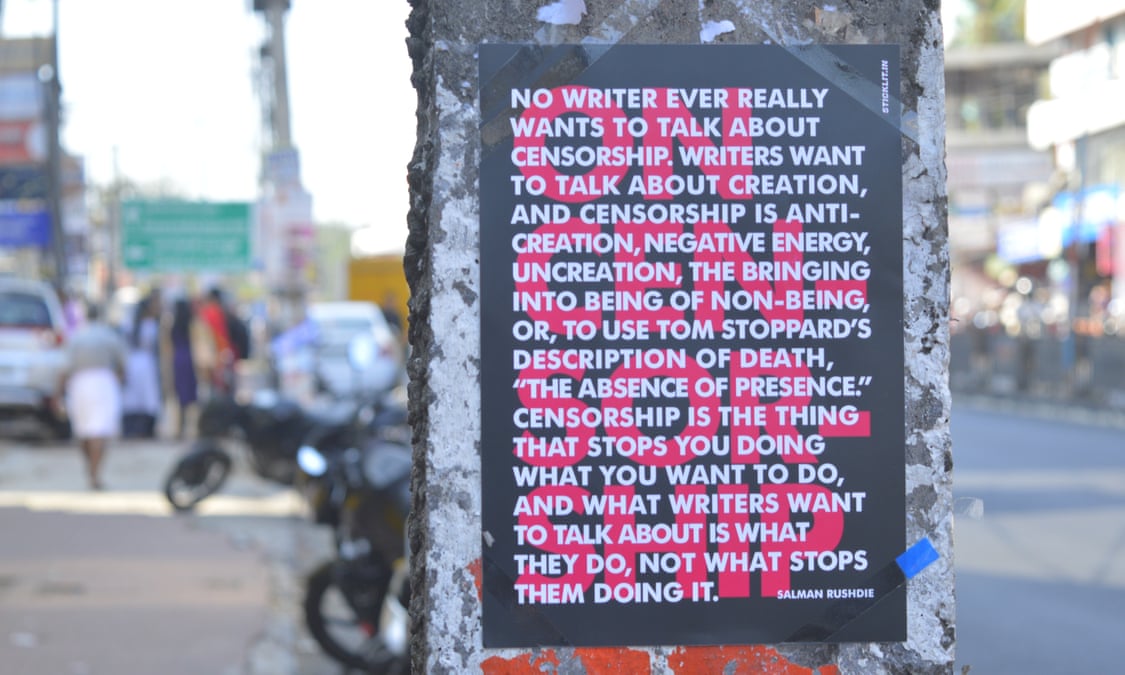
“Censorship is anti-creation” … A quote from a lecture by Salman Rushdie, as seen on a StickLit poster on a Bangalore cement pillar. StickLit brings literature to the people using stickers.

In the New York metro and the T in Boston, I’ve enjoyed the poetry posters that give riders something more meaningful to read and ponder than ads. Now I’m learning about a new poetry-for-the-people effort in India. It uses poetry stickers in both English and a local language in site-specific venues.

Priyanka Sacheti reports at the Guardian, “There are thousands of street food carts in New Delhi. But only one has the opening lines of Riyazat Ullah Khan’s poem ‘Wazoodiyat’ on the side:

Where can the pauper keep his pain of existence?
He has no container but a heart.

“The sticker bearing the couplet is from a campaign called StickLit, which seeks to make literature more accessible by placing quotes in public spaces.

“Nidhin Kundathil and Manoj Pandey had the idea for the project while contemplating the advertisements, posters and billboards that are consumed almost subliminally on Indian streets.

“ ‘We thought of turning this [visual] experience on its head to create a completely new and refreshing alternative for passersby – [one] which was not just selling something, for a change,’ says Pandey, 32, a freelance writer in Darjeeling.

“The idea subsequently evolved: they would make what they call the world’s largest library – ‘the largest repository of good literature in public spaces: a library that’s free for all.’ So they hit the streets, putting up free-format stickers, posters and wall murals. …

“After starting in Bengaluru and Delhi in 2017, the project has spread all over India, with volunteers in various cities taking it up. The stickers are available from the StickLit website and the founders encourage people to download them and use them freely. …

“The founders encourage placement based on context: poems in railway stations, for example, when people have longer to contemplate them; shorter quotes and excerpts for busy streets. They also use place-specific languages – Hindi in Delhi, or Kannada in Bengaluru – alongside English. There are plans to share prison poetry in prisons as well.

“Kundathil, 33, a Bengaluru-based graphic artist, handles the design. He says he deliberately chooses bold, brightly-coloured fonts and minimal design elements in order not just to attract attention but to ensure that attention remains focused on the text.

“The list of authors chosen is inclusive and diverse, from Rushdie and former government minister Shashi Tharoor to newer voices such as Nishita Gill and Nikhil Mhaisne. They have also shared works of Kannada literary greats across Bengaluru. ‘A lot of our material consists of work by aspiring writers as well,’ Pandey says, adding that the project is open to submissions.

“ ‘We like to believe that people, especially the young, are drawn towards StickLit as they are not cynical,’ Pandey says. ‘They still believe that a pen can change the world. And we’d like to foster that.’ ”

More at the Guardian, here.

Read Full Post »

3641

Photo: Hayley Madden/Spread the Word
Theresa Lola is the new young people’s laureate for London. Her writing has been described as “breathtakingly beautiful.”

Poetry will survive at least one more generation, judging from the numbers of young people who are enjoying it and even buying poetry books.

Sanjana Varghese writes at the Guardian, “Poet Theresa Lola, named the new young people’s laureate for London, says she hopes to use the role to help the capital’s demonised youth to find confidence in their voice.

“The 24-year-old British-Nigerian from Bromley, south London, studied accounting and finance at university before turning to poetry. She is the third young people’s laureate, after Caleb Femi and Momtaza Mehri. The joint winner of the 2018 Brunel international African poetry prize, her debut collection, In Search of Equilibrium, was published in February, and was described as breathtaking by author Bernardine Evaristo. …

“ ‘It’s easy for us to demonise young people and social media,’ [Lola] said. ‘Poetry was instrumental for me, to find my voice and to find my confidence, and hopefully it can do that for other young people too.’

“Sales of poetry books have increased over the last three years, hitting an all-time high of [$15 million in the UK] in 2018. Two-thirds of poetry buyers are now under 34, with teenage girls and young women identified as the biggest consumers last year. …

“ ‘A lot of young people are seeing that yes, [poetry] is reflective of their experiences and upbringing. They’re getting to understand that [it] exists anywhere. I’m hoping to meet so many different young people and help them see the poetry in their lives,’ Lola said.

“ ‘London is so important to me, especially for my craft – it’s such an eclectic city. It inspires me to be a form of myself in every poem.’ …

“The young people’s laureate title was established by writer development agency Spread the Word in 2016. Lola … will work on four residencies around London and a PoetryLab, which aims to nurture talented young poets in the capital.

“Spread the Word director Ruth Harrison said: ‘At a time of political uncertainty, when young people’s lives, concerns and aspirations are often ignored and dismissed, it is vital that their voices are heard by those in power.’ ” More.

My grandchildren are big on finding words that rhyme. Not that a poem has to rhyme, but sometimes that’s where nascent poets get hooked. I have made up some silly poems with the kids while driving home from school, and I expect they’ll always get a kick out of making words go together in surprising ways.


Read Full Post »

Photo: UNHCR
Shukria Rezaei, an Afghan Hazara refugee in the UK, with Kate Clanchy, writer-in-residence at Shukria’s school.

Years ago, my husband’s company ordered his department to move to Dallas from upstate New York. We decided not to go, which was a big no-no in the corporate world at that time. Other wives got a laugh when I said, “I don’t transplant well.” That’s probably true of many people who get used to their place. When I think of the thousands of migrants leaving home now, I know they are not doing it just for fun but because there is no other choice. Most people love their home.

The young Afghan refugee in this story longs to go home someday. In the meantime, she is learning all she can, including how to write poetry in a new language.

Caroline Brothers reports for the UN Refugee Agency (UNHCR) that a few years ago “no one, not her family, her teachers, nor any of her 900 schoolmates, was more surprised than Shukria Rezaei herself, when she was judged the best poet in her year. A shy, 15-year-old Afghan girl, who was still grappling with an adopted language.

“Oxford Spires Academy, a secondary school whose catchment area includes deprived localities, had just run a poetry competition to discover what talent might lie hidden in a student body speaking 54 different languages.

“ ‘Everyone was shocked, even myself,’ said Rezaei, now 20 and a scholarship student at the University of London, recalling the moment when Kate Clanchy, the school’s writer-in-residence and the competition’s judge, announced Rezaei had won first prize.

“Less than a year before, Rezaei and her mother – Hazara refugees – had arrived in Oxford from Quetta, Pakistan, which hosts a large population of displaced Afghans. The two were reunited in 2011 with Rezaei’s father, who had been granted asylum in the UK, after a three-year separation.

“Rezaei, for her part, was still struggling to master a language whose barest bones she had learnt at Afghan primary school and refugee school in Pakistan. As a child in the Afghan province of Ghazni, she awoke to the tap-tap of sheep trooping past on their way to the fields; a few hours later, she would set off through the mountains with a dozen other girls.

“ ‘School was two mountains away, and it snowed a lot,’ Rezaei told UNHCR, the UN Refugee Agency. ‘We went on a rocky mountain path and it took an hour and a half.’ …

“In England, in the thick purple jumper of a strange school uniform, she was struggling to keep up.

“ ‘I could only understand what was written down,’ Rezaei said of her first year. She survived, she said, by reading rather than speaking, copying everything she saw on the blackboard: ‘I just did as much as I could.’

“With the poetry prize, however, things shifted. From feeling invisible, Rezaei suddenly had an identity within the school. Clanchy, meanwhile, invited her to join a poetry group she had formed on a hunch that the quiet foreign girls at Oxford Spires might in fact have something to say.

” ‘At the beginning, I couldn’t talk,’ said Rezaei. But seated among 15 or 20 aspiring poets, she began to express herself. …

“Since then, Rezaei has had work published in Oxford Poetry, the emblematic literary journal that has showcased many of the country’s greats. She will be included in an anthology, England, to be published by Picador in June; one of her poems, ‘Homesick,’ has already been translated into German. …

“Like many children of refugees, Rezaei is acutely aware of how much hope her parents have invested in her. Even in the bleakest moments, amid profound dislocation, giving up was never an option, either for them or for her. …

“Rezaei is finding her feet in London, another major adjustment after Quetta and Oxford. Having won a scholarship to Goldsmiths College, she is studying politics, philosophy and economics, which she hopes to convert into a law degree.

“She still misses aspects of her Afghan childhood, but for now her hopes are firmly focused on England. She recently passed her driving test, and is exploring the creative writing scene.

“ ‘Afghanistan is still dear to my heart,’ she said, ‘but I have a lot more to achieve here before I go back.’ ”

Here is one poem.

I want a poem
with the texture of a colander
on the pastry

A verse
of pastry so rich
it leaves gleam on your fingertips

A poem
that stings like the splash of boiling oil
as you drop the pastry in …

I’d really like to copy the whole lovely thing, but you better click through to read it.

Hat tip: Beautiful Day on Instagram.

Read Full Post »

04poets_600

Photo: New York Times
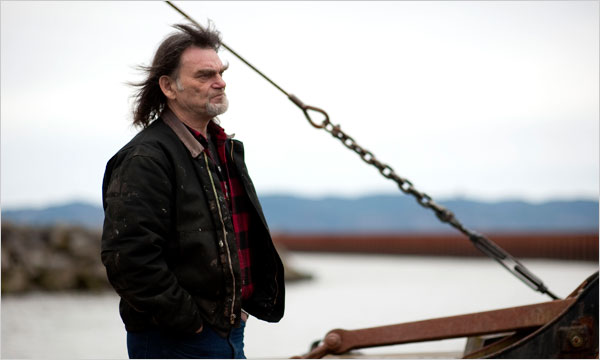
Fisher poet Dave Densmore, on his boat, wrote his first poem as a joke in the 1970s. Now he studies writing.

Jobs like commercial fishing can provide a lot of of time to think, and it’s amazing how thinking often leads to poetry. That is also true of experiences that are so hard to capture they must be addressed obliquely.

Poetic storytelling is alive and well in the fishing community, it seems. Consider this transcript of a National Public Radio (NPR) report, in which Melanie Sevcenko describes an annual fisher poet event.

“MELANIE SEVCENKO: Moe Bowstern named herself after the front and back end of a ship. She calls herself a fishing woman. And for her, writing poetry comes with the job.

“MOE BOWSTERN: Well, I mean, have you ever been fishing? …  It’s unbelievably boring. And so you just have to think of something else to do.

“SEVCENKO: Now retired from commercial fishing, Bowstern is one of dozens of fisher poets who have been meeting for their annual gathering in a Astoria, Ore. During the last weekend of February, the far-flung fisher people interpret the commercial fishing industry in prose, poetry and song. …

“Bowstern started fishing in Kodiak, Alaska, in the mid-’80s when women on commercial boats were scarce. Her zine shares a name with a popular brand of deck boots, XTRATUF. This piece is called ‘Things That Will Be Difficult.’

“BOWSTERN: ‘It will be hard, if you are a man, to understand why your female crewmate, who started out so friendly, is so silent now when you are only trying to help. It will be hard if you are a woman to go’ …

“SEVCENKO: The poetry onstage at FisherPoets touches on what Bowstern calls an incredibly difficult life.

“BOWSTERN: Not just because of the rigors of the actual physical experience of the life, but it’s just, how can you be a fisherman at a time of climate change? And, like, where are you going to position yourself with resource extraction?

“SEVCENKO: That’s something John Copp has written about. For 20 years, he ran operations in Bristol Bay in the Bering Sea. Multinational corporations want to mine gold and copper from the area nearby and have been angling to do so for years. His poem ‘Tsunami’ is inspired by his opposition to the proposed Pebble Mine. … Many commercial fishermen have been against the Pebble Mine because of the damage it could do to the biggest salmon run on the planet. Copp is retired and lives in Oregon now. But he’s still inspired to write by the natural beauty of Alaska. …

“This weekend, once again, the fisher poets will do what they’ve done for more than two decades — gather on piers, in cafes and in theaters to perform their poetry for grateful audiences in this seaside town. Bowstern feels lucky that people who’ve never even been fishing want to hear their stories.

“BOWSTERN: We’re participating in two traditions that have been going on. Like, storytelling is probably only a little bit older than fishing, you know? So we get to tell stories in our special, weird language. And people just can’t get enough of it.”

The NPR transcript is here, and there’s another good article at the New York Times, here. If you know people who fish and also write poetry, have them check out the Fisher Poets website, here.

Read Full Post »

Photo: Lee Allen Photography
Dispensing poetry on prescription: Shropshire’s Emergency Poet, Deborah Alma.

Sometimes poetry can play a role in emotional healing. I think that’s because ordinary sentences often miss the mark but poetry is fluid enough to go where it’s needed. In the UK, a Shropshire poet is putting her faith in this art and opening a “poetry pharmacy.” She notes that a recent report shows “poetry sales were up by more than 12% in 2018, driven largely by younger buyers.”

Alison Flood writes at the Guardian, “Following in the hallowed footsteps of Milton, who wrote in 1671 that ‘apt words have power to swage / The tumours of a troubled mind / And are as balm to festered wounds,’ the poet Deborah Alma is preparing to open the UK’s first poetry pharmacy. Here, instead of sleeping pills and multivitamins, customers will be offered prescriptions of Derek Walcott and Elizabeth Bishop.

“Alma, who as the ‘Emergency Poet’ has prescribed poems as cures from the back of a 1970s ambulance for the last six years, is now setting up a permanent outlet in a shop at Bishop’s Castle in Shropshire. An old Edwardian ironmonger’s, it still has the original fixtures and fittings, and, together with her partner, the TS Eliot prize-shortlisted poet James Sheard, Alma is preparing to turn it into a haven ‘to help ease a variety of maladies with the soothing therapy of Poetry.’

“Dressed in a white coat and stethoscope, Alma says she was invited to appear as the Emergency Poet at ‘schools, hospitals and festivals all over the place, but I’m a middle-aged woman and I’m getting a bit old for driving around.’ …

“The [pharmacy’s] mortgage was approved [in January], and Alma is buzzing with plans for how the shop will be divided like a pharmacy ‘into areas for particular ailments.’ … The sections will be set up along the lines of a poetry anthology she edited in 2016, The Everyday Poet, which was split into poems ‘addressing areas of emotional need’ such as love, ageing, grief and hope. …

“ ‘I think probably more than any other art it speaks directly as though from one person to another,’ says Alma, who published her own first collection, Dirty Laundry, last year. ‘It’s intimate and it’s empathetic. It can be a prayer or a curse, or something just to hang on to.’ ”

More at the Guardian, here. I’m glad to know something more about Shropshire poets beyond “The Shropshire Lad,” which I know only by reputation.

Hat tip: Wisconsin poet Ronnie Hess on Facebook.

Read Full Post »

janae

Photo: Poetry Out Loud
Janae Claxton of South Carolina is the 2018 Poetry Out Loud National Champion. A new survey suggests interest in poetry is growing in the United States.

I’ve been thinking about poetry lately. The team of family and friends keeping my sister company before her surgery was made up of people who enjoy poetry — reading, listening, memorizing, or reciting poetry. My sister herself knows a lot of poems by heart, and we all had fun quoting what we knew and looking up favorites on the web. Some of the poems were so moving, we had to stop and recover ourselves.

Poetry is the right thing in difficult times. And it seems my sister’s hospital team is not alone in feeling a need for it. A new survey shows that poetry reading is up nationwide.

Sunil Iyengar, National Endowment for the Arts director of research and analysis, writes at the NEA Art Works Blog, “Poetry reading in the United States has increased since five years previously. Nearly 12 percent (11.7 percent) of adults read poetry in the last year, according to new data from the National Endowment for the Arts’ 2017 Survey of Public Participation in the Arts (SPPA). That’s 28 million adults. As a share of the total U.S. adult population, this poetry readership is the highest on record over a 15-year period of conducting the SPPA, a research partnership with the U.S. Census Bureau. …

“Growth in poetry reading is seen across most demographic sub-groups (e.g., gender, age, race/ethnicity, and education level), but here are highlights:

• Young adults have increased their lead, among all age groups, as poetry readers. Among 18-24-year-olds, the poetry-reading rate more than doubled, to 17.5 percent in 2017, up from 8.2 percent in 2012. Among all age groups, 25-34-year-olds had the next highest rate of poetry-reading: 12.3 percent, up from 6.7 percent in 2012.

• Women also showed notable gains (14.5 percent in 2017, up from 8.0 percent in 2012). As in prior years, women accounted for more than 60 percent of all poetry-readers. Men’s poetry-reading rate grew from 5.2 percent in 2012 to 8.7 percent in 2017.

• Among racial/ethnic subgroups, African Americans (15.3 percent in 2017 up from 6.9 percent in 2012), Asian Americans (12.6 percent, up from 4.8 percent), and other non-white, non-Hispanic groups (13.5 percent, up from 4.7 percent) now read poetry at the highest rates. Furthermore, poetry-reading increased among Hispanics (9.7 percent, up from 4.9 percent) and non-Hispanic whites (11.4 percent, up from 7.2 percent).

• Adults with only some college education showed sharp increases in their poetry-reading rates.  Of those who attended but did not graduate from college, 13.0 percent read poetry in 2017, up from 6.6 percent in 2012. College graduates (15.2 percent, up from 8.7 percent) and adults with graduate or professional degrees (19.7 percent, up from 12.5 percent) also saw sizeable increases.

• Urban and rural residents read poetry at a comparable rate (11.8 percent of urban/metro and 11.2 percent of rural/non-metro residents). …

“More than 300,000 students from more than 2,300 high schools around the country participate in [the Poetry Out Loud] recitation competition. Last April, champions from 53 states and territories competed in the National Finals here in D.C. This year’s winner was high school senior Janae Claxton from the First Baptist School of Charleston, South Carolina. …

“Each year, the NEA Big Read supports community reading programs in approximately 75 communities nationwide, and includes poetry books such as [Muscogee (Creek) member] Joy Harjo’s How We Became Human and Adrian Matejka’s The Big Smoke in the available titles.”

Iyengar speculates that use of social media to promote poetry may explain part of the expanded interest. As for me, I think the obliqueness and beauty of good poetry help people to get their heads around big, impossible things.

More.

Read Full Post »

071218-fancy-NYC-bike

Thank you for all the lovely things you have written. My sister has a long road ahead, but she is a strong person and is facing it well. Ms. Mighty Mouse.

I actually saw a Ms. Mighty Mouse sculpture on my walk and took a picture. Unlike her, my sister has both her arms and all her faculties.

I liked the Alice Walker poetry mural I saw, too, and will repeat the poem here as my sister loves poetry. In fact, the day before her surgery, the four of us who were gathered in her room had the best time quoting poetry at each other. It was a lot of fun.

The Nature of This Flower Is to Bloom

Rebellious. Living.
Against the Elemental Crush.
A Song of Color
Blooming
For Deserving Eyes.
Blooming Gloriously
For its Self.

071218-Alice-Walker-1

071218-Alice-Walker-2

071218-Ms-Mighty-Mouse-text

071218-Ms-Mighty-Mouse

Read Full Post »

Older Posts »