Feeds:
Posts
Comments

Posts Tagged ‘poor’

Global Envision is part of an effort at the nonprofit Mercy Corps “to foster a richer conversation about global poverty.”

Last fall, Global Envision’s Erin Butler set off to investigate technologies that help schools in impoverished parts of of the world.

“For some students, hopping on the school bus is hopping into the classroom. Four communities are using solar-powered mobile classrooms to overcome inaccessibility to the power grid.

“Last week,” writes Butler, “we looked at a bus in Chitradurga, India, that brought modern computer technology to students in energy-poor rural schools through solar power. SELCO, a private energy company, engineered the bus with 400 watts of solar modules, 10 laptops, fans, and lights.

“Circumventing the area’s erratic power supply with its solar panels, this bus provides much-needed modern computer education and exposure to the advantages of solar energy. Motoring through rural villages in Chitradurga since January 2012, the bus has reached ’60 schools and 2,081 children,’ the New Indian Express reported in early September. …

“Where there’s more water than land, boats replace buses, and with rising sea levels, low-income Bangladeshi students have difficulty getting to school altogether.

“Pushed to inaccessible riverside settlements that lack basic infrastructure, students often can’t get to school due to monsoon flooding. Shidhulai Swanirvar Sangstha, a nonprofit organization started by Mohammed Rezwan, rides the rising tides with his solar-powered floating schools.

“Trained as an architect and personally experienced with soggy school disruptions in Bangladesh, Rezwan rode a brainwave that led him to floating schools. Combining the best of traditional boat design and modern sustainable practices, the organization’s 54 boats have been operating since 2002 and have served over 90,000 families.”

Read about the other solar-powered schools here.

Photograph: Jayanta Shaw/Reuters/File
Students in Kolkata, India, check out their solar sunglasses as they prepare to watch the transit of Venus across the sun. The sun is being harnessed in India and Africa to power mobile solar classrooms for students.

Read Full Post »

I was pushing the stroller this morning, singing the old Thanksgiving hymns (“Come Ye Thankful People,” “We Gather Together,” “We Plow the Fields and Scatter the Good Seed on the Ground”) and thinking of harvests.

So today might be a good time to blog about harvests and drought-resistant crops.

“Scientists are developing faster-maturing and drought-tolerant varieties of corn and cotton,” writes Madalitso Mwando at AlertNet, “holding out the hope of much-needed relief for thousands of farmers across Zimbabwe.

“As planting season approaches amid concerns about successive poor harvests, research into drought-resistant seeds is gaining momentum …

“Zimbabwean farmers have suffered a succession of poor harvests with yields far below what the country needs, forcing the agriculture ministry repeatedly to revise its projections for harvests.

“Farmers and their unions blame the cyclical uncertainties of their sector not only on a lack of up-to-date farming technology, but also on their inability to obtain seed varieties that can survive the low rainfall caused by climatic shifts.

“The Scientific and Industrial Research and Development Centre (SIRDC), in partnership with the University of Zimbabwe and Biotechnology Research Institute (BRI), has developed a drought-resistant variety of maize (corn) seed called Sirdamaize 113.

“Farmers have had to wait between 150 and 180 days before harvesting their traditional maize crop, but the center says the new seed takes only 136 days to mature.” Read more.

I hope a bountiful harvest was represented at your dinner table today.

With gratitude to blog readers for reading,
Suzanne’s Mom

Photograph: Philimon Bulawayo/Reuters/File
Martha Mafa, a subsistence farmer, stacks her crop of maize (corn) in Chivi, about 378km (235 miles) southeast of the Zimbabwean capital of Harare.


Read Full Post »

I’ve really gotten to like the Science section of the NY Times, which comes out on Tuesdays. Today Donald G.McNeil wrote about a solar-powered gizmo for sterilizing surgical instruments in rural areas that can’t afford autoclaves.

“A Rice University team recently modified a prototype of an old solar stove to power a simple autoclave, which is a pressure-cooker for instruments, and tested it in the Texas sun.

“On all 27 attempts, it reached United States government sterilization standards.

“How practical it is awaits African trials; it is nearly 12 feet long and 6 feet tall and has bright curved mirrors to focus sunlight on a water-filled pipe. On sunny  … days, it can make steam at 150 degrees Celsius (302 degrees Fahrenheit) from about 9 a.m. to 3 p.m.

“Douglas A. Schuler  … a Rice business professor and lead author of the study, published in The American Journal of Tropical Medicine and Hygiene, said he ‘married into the project.’ His French father-in-law designed the solar stove years ago after a student trip to West Africa. But women in Haiti, where they tested it, ‘just hated cooking on it,’ Dr. Schuler said, so they found a different use for it.

“The initial setup costs about $2,100. But sunlight costs nothing, making five years of operation about $2,000 cheaper than using propane.”  More.:

Photograph: Jeff Fitlow

Read Full Post »

Today I want to highlight Taylor Barnes’s story in the Christian Science Monitor about the transformative effect of volleyball among poor Brazilian children.

But first an admission that the topic of volleyball reminds me (incongruously) of the movie A Thousand Clowns, in which an out-of-work writer goes around New York City fulfilling lifetime ambitions such as  standing on Park Avenue at dawn and hollering, “All right, all you rich people; everybody out in the street for volleyball.”

OK. Got that off my chest. Back to Brazil.

“Roberto Bosch’s volleyball school was getting nowhere,” writes Barnes. “Then he invited kids from the slums to join for free.

“The gangly [Bosch] joined his first volleyball club at age 12; before he was old enough to drive, he was already under contract and being paid for playing the sport. In college, Betinho, as he is known [in Rio], dropped out of his classes in economics to travel with a professional team. When he competed in the youth world championships in Italy at age 20, he was considered the best player on earth.

“But health concerns made him leave pro volleyball just as his peers were graduating from college. Soon he found he was struggling to find a new direction for his life. …

“His wife suggested he start his own volleyball school.

” ‘Given that I was really depressed, really low at the time, I didn’t think I was capable’ of running a school,’ he says. Still, he set up a volleyball court on Rio de Janeiro’s glamorous, celebrity-studded Leblon Beach.

” ‘In the beginning, it was one old net, three old balls, and one student, which was my wife,’ he recalls. …

“Then Betinho had an idea … Why not go to the public schools and offer volleyball lessons to students free of charge?”

Students from the favelas and shantytowns jumped at the chance. As the school’s reputation grew, wealthy children signed up, too. Volleyball became the great leveler in Rio. And Betinho found a purpose in life, better than the first.

More here.

Photograph: Jimmy Chalk
Roberto Bosch teaches beach volleyball on Leblon Beach in Rio de Janeiro. His students come from both local slums and wealthy neighborhoods.

Read Full Post »

Shawn and Laura Sears were touched by inner-city kids with too many strikes against them and invited a few for an outdoor camping experience. The outing was so satisfying all around that they just kept doing it.

Marilyn Jones has the story at the Christian Science Monitor.

“Leaving college with liberal arts degrees – his in psychology, hers in geology – Shawn and Laura applied to Teach for America and were eventually placed to teach in one of the poorest regions in the country.

“Today, celebrating 14 years together (getting married along the way in 2004), they’ve seen the seeds sown during their experiences in Mississippi grow to fruition in the founding of Vida Verde Nature Education, a nonprofit outdoor education camp they’ve now run for 11 years.

“Located on northern California’s spectacular coast between San Francisco and Santa Cruz, this free camp for children from low-income families has served more than 7,000 kids from the inner cities of Oakland, East Palo Alto, San Francisco, and San Jose.

” ‘We help them let go of much of the negativity they often carry,’ Shawn says. ‘It’s nonstop fun, and they get to just be kids for a few days. Three days later, they’re transformed.’ ”

Read more.

Tony Avelar/Special to the Christian Science Monitor
Laura and Shawn Sears founded Vida Verde to give groups of students three days of exposure to and hands-on experience in the outdoors.

Read Full Post »

I’ve been meaning to blog about the wildly successful music-education program out of Venezuela, El Sistema.

Here music critic Mark Swed follows the L.A. Philharmonic to Caracas and writes about El Sistema for the Los Angeles Times.

“Musically, Venezuela is like no other place on Earth. Along with baseball and beauty pageants, classical music is one of the country’s greatest passions.

“In the capital, Caracas, superstar Venezuelan conductor Gustavo Dudamel is mobbed wherever he goes. Classical music teeny-boppers run up to him for autographs when he walks off the podium at concerts. The state-run music education program, which is known as El Sistema and from which Dudamel emerged, is the most extensive, admired and increasingly imitated in the world. One of its nearly 300 music schools for children, or núcleos, is deep in the Venezuelan Amazon, reachable only by boat. …

“The basic tenet of José Antonio Abreu, the revered founder of El Sistema, is the universal aspect of music. He likes to say that music is a human right. That’s an effective, politically expedient slogan. But what he has demonstrated on a greater scale than ever before is that music is not so much a right as a given. El Sistema is not about talent, ingeniously effective system though it may be for discovering and fostering musical talent. The truly revolutionary aspect of El Sistema is its proof that everyone has a capacity for music.”

Read about how El Sistema has spread worldwide in the Los Angeles Times.

Children at La Rinconada in Caracas, Venezuela, Feb. 14, 2012. Gustavo Dudamel, right, among students at a showcase of El Sistema in Caracas, Venezuela, Feb. 15. Photograph: Mark Swed / Los Angeles Times

Read Full Post »

Pamela Boykoff at CNN has a nice story about a ballet school in the Philippines and the hope it offers children from very poor families.

“Jessa Balote is 14-years-old and training to be a professional ballerina in Manila,” writes Boykoff.

“It is a task that takes enormous amounts of dedication for even the most determined of young women, but Balote’s challenge is nothing compared to life outside the dance studio where she has to support her entire family.

” ‘I’m the only one they expect to bring the family out of poverty,’ she says.

“Balote is one of 54 students enrolled in ‘Project Ballet Futures,’ a program run by Ballet Manila to provide free ballet training to children from some of the city’s most deprived neighborhoods.

“Balote lives in Tondo, a slum built next to a major waste dump in Manila. Her parents make what little money they have by selling trash. If Balote was not involved in the dance program, she says she wouldn’t be able to eat everyday.

” ‘They want to earn money to be able to survive,’ says Lisa Macuja-Elizalde, founder of the program and the Philippines’ first prima ballerina. She believes in her students, personally paying for their lessons and uniforms.

“Macuja-Elizalde’s goal is to help these children become professional members of the company with incomes to match. They are among her most focused students, she says, not afraid to work hard and to push themselves and their bodies.”

Read more.

Photograph: CNN

Read Full Post »

A while back I watched the movie The Little Red Truck, a documentary by producer Pam Voth and director Rob Whitehair highlighting the work of the Missoula Children’s Theatre. It was a moving experience.

The Missoula (Montana) Children’s Theatre travels by truck from city to city all over America to put on productions with children in low-income urban and rural areas. The transformation of some of these children in the week it takes to produce a full-scale, one-hour musical is something to see, with many insecure children discovering talents that no one, including the children themselves, knew they had.

For kids who have never seen a play and have no place to rehearse — nor any props or costumes or sets other than what the theater company can pack into the truck —  putting on a production seems unimaginable.

As the movie unfolds, you see how doing the unimaginable builds self-confidence, and generates both laughter and ideas about possible futures. It’s not about growing up to be actors. It’s about seeing that there are options, and starting to think differently.

And in case anyone is more interested in the academic skills boosted through theater, this Education Week article makes that case. Not a bad case to be made, but it’s the magic of Queen Mab that speaks to me.

Read Full Post »

A reason that poor children are sometimes unprepared for school is that the words they are starting to read in books may not convey meaning to them. What does it mean to park a car if you have never ridden in a car?

The NY Times has a lovely article about one NYC school’s unusual field trips, designed to fill some gaps in knowledge that textbook writers take for granted.

Michael Winerip writes, “Experiences that are routine in middle-class homes are not for P.S. 142 children. When Dao Krings, a second-grade teacher, asked her students recently how many had never been inside a car, several, including Tyler Rodriguez, raised their hands. ‘I’ve been inside a bus,’ Tyler said. ‘Does that count?’

“When a new shipment of books arrives, Rhonda Levy, the principal, frets. Reading with comprehension assumes a shared prior knowledge, and cars are not the only gap at P.S. 142. Many of the children have never been to a zoo or to New Jersey. Some think the emergency room of New York Downtown Hospital is the doctor’s office. …

“Working with Renée Dinnerstein, an early childhood specialist, [Ms. Levy] has made real life experiences the center of academic lessons, in hopes of improving reading and math skills by broadening children’s frames of reference.

“The goal is to make learning more fun for younger children. … While many schools have removed stations for play from kindergarten, Ms. Levy has added them in first and second grades. [And] several times a month they take what are known as field trips to the sidewalk. In early February the second graders went around the block to study Muni-Meters and parking signs. They learned new vocabulary words, like ‘parking,’ ‘violations’ and ‘bureau.’ JenLee Zhong calculated that if Ms. Krings put 50 cents in the Muni-Meter and could park for 10 minutes, for 40 minutes she would have to put in $2. They discovered that a sign that says ‘No Standing Any Time’ is not intended for kids like them on the sidewalk.” Read more.

One thinks of all the small daily interactions one has with one’s own children and the learning occurring without forethought. There are interactions and learning in poor families, too, but if the words and concepts are not what they kids will encounter in school, I think these excursions can be very helpful.

Photograph: Librado Romero, NY Times

Read Full Post »

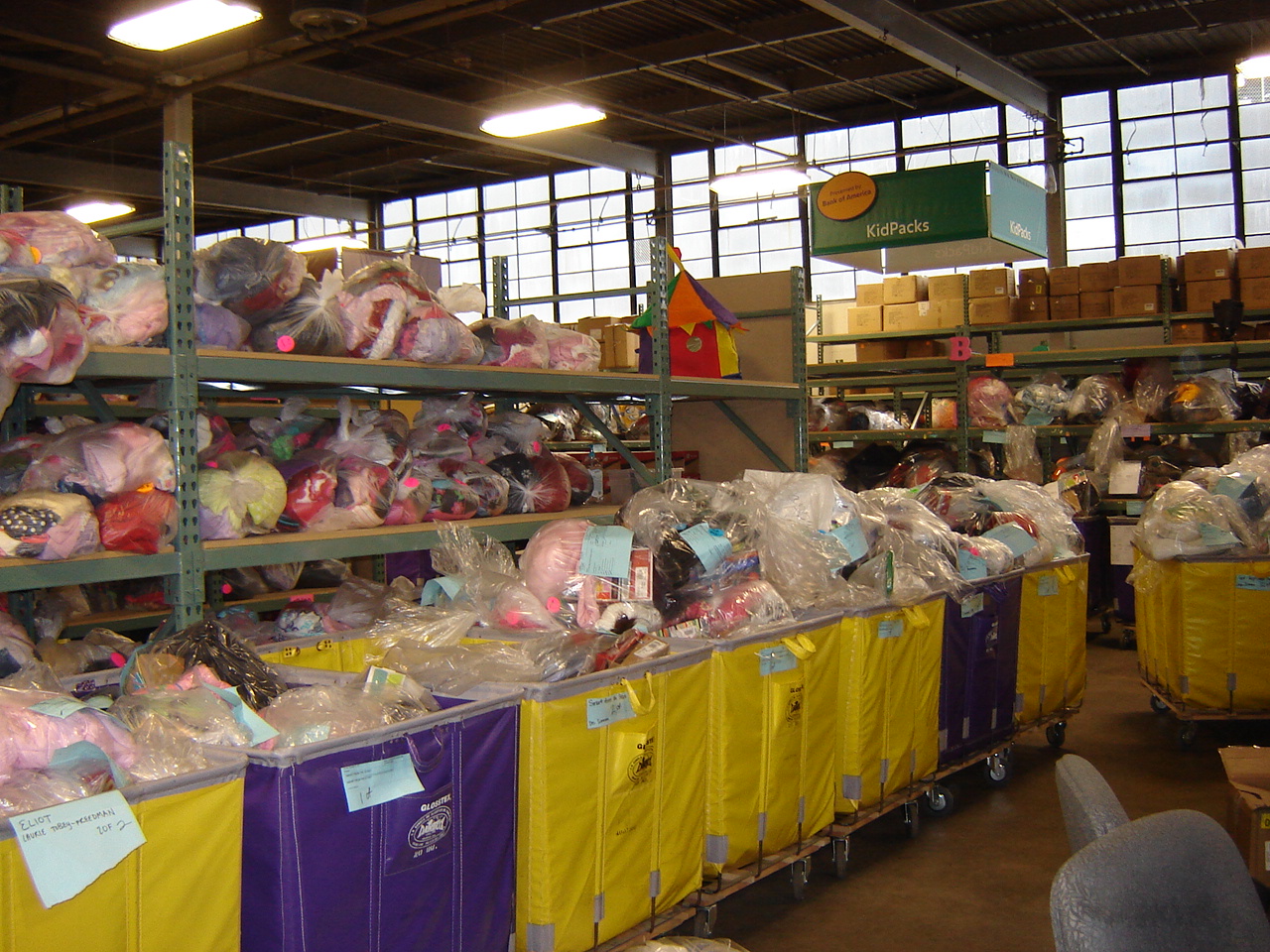
Today at work we had a holiday team-building outing to the nonprofit Cradles to Crayons. A lot of organizations bring employees to the group’s Giving Factory for their community service projects. Our team volunteered at the same time as Blue Cross Blue Shield and Bank of America.

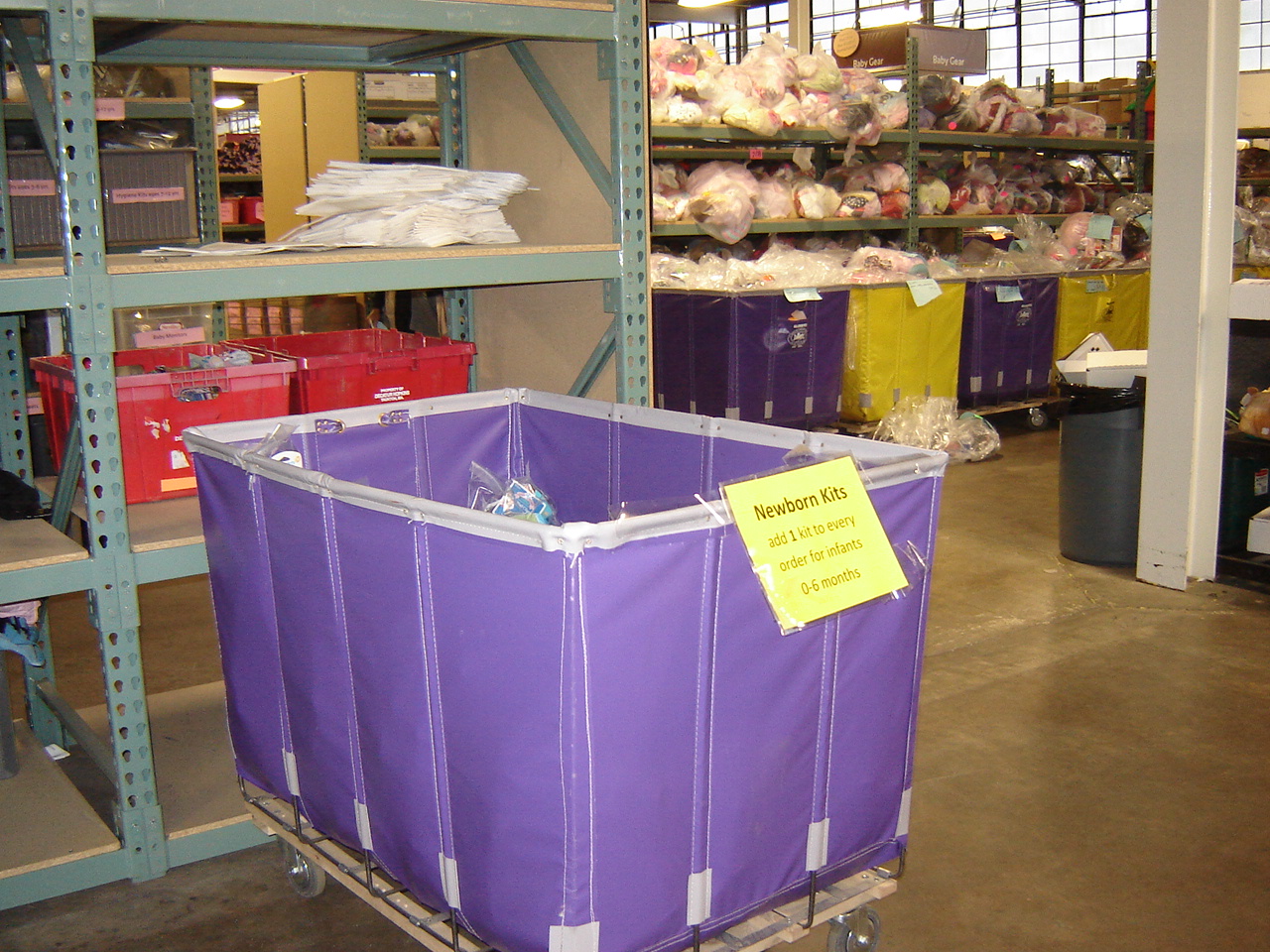
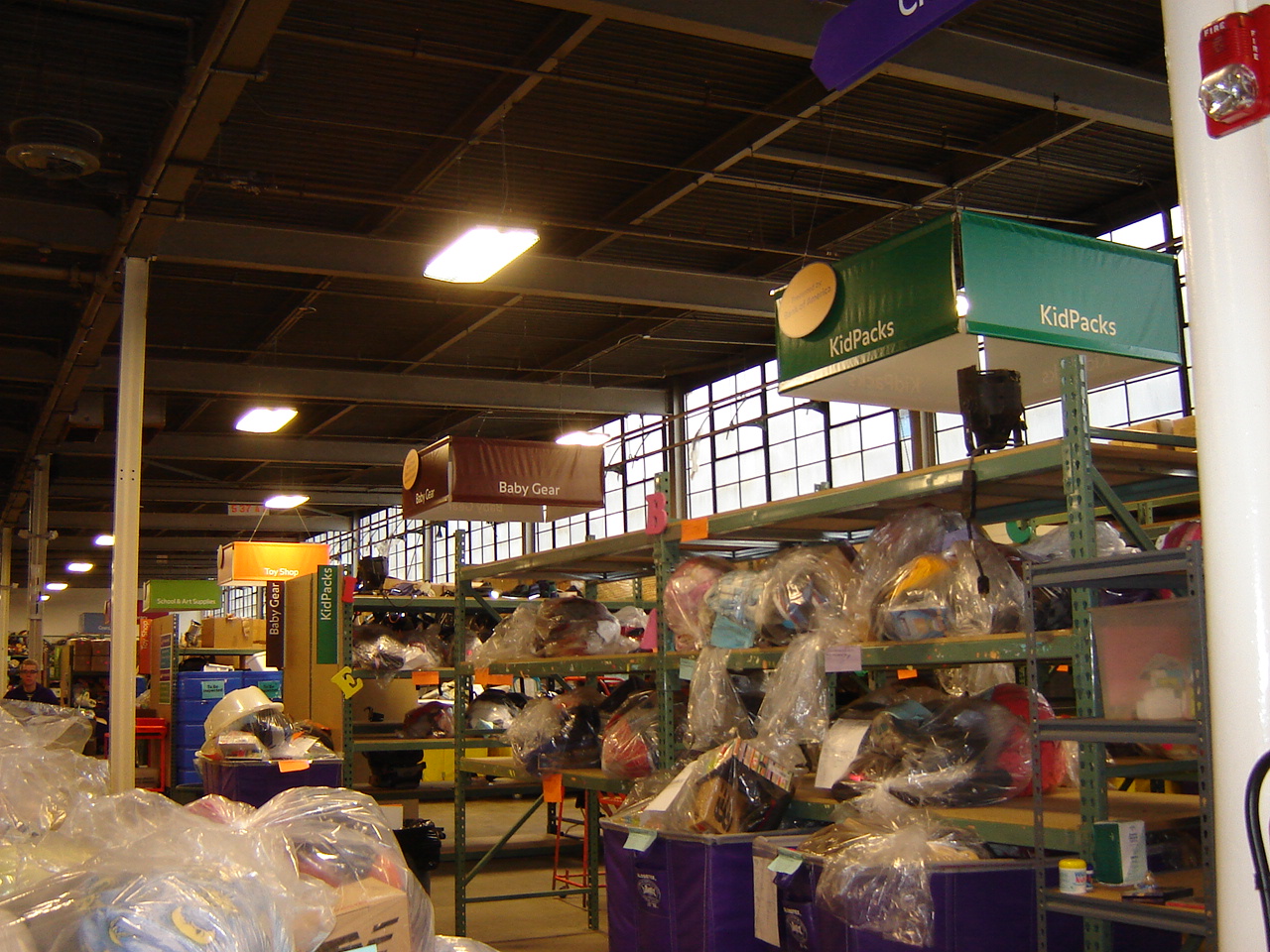
First we watched a video about the history of the organization, which takes donations of clothes and equipment for children, sorts them, and fills orders for individual children at the request of social service agencies. The donations come from ordinary people and from partner corporations.

A group of us sorted donated coats. I was with the group that “shopped” among the warehouse shelves for bundles of sorted and age-labeled items, looking for the needs listed on individual order sheets. For example, we might have a sheet for a boy, age 4, that said “clothing pack, book bundle, craft packet, boots size 6, coat size 6.” It was very well organized. If we found that Cradles to Crayons was  out of something, the staff would fill the order anyway and invite the requesting agency to reapply for missing items. They like to provide whatever they can as fast as they can.

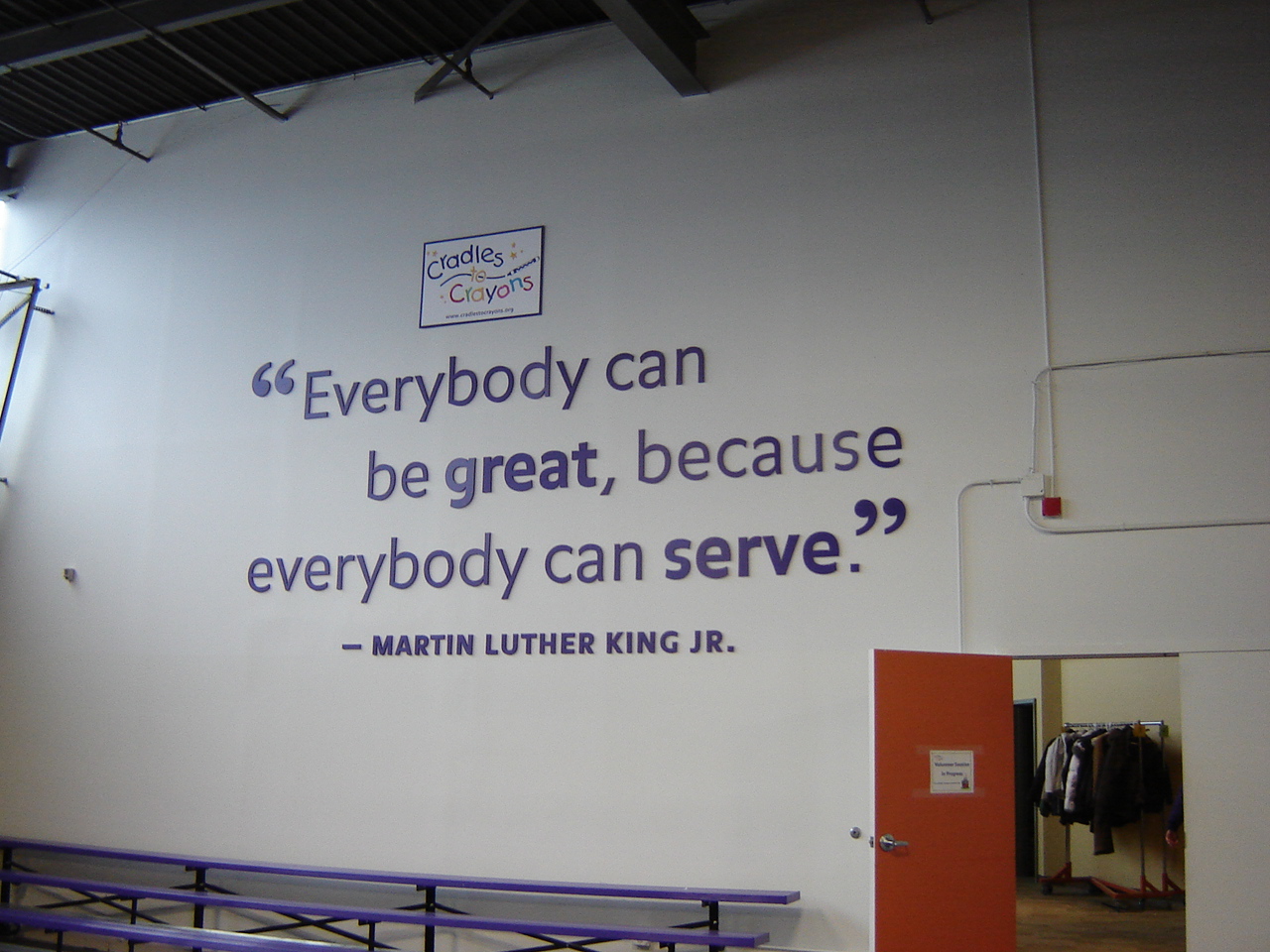
Cradles to Crayons says, “Our vision is that one day every child will have the essentials they need to feel safe, warm, ready to learn and valued. Through the Giving Factory, we provide those essentials, as donated clothes, shoes, books and school supplies to homeless and low-income children. We also offer meaningful volunteer opportunities to hundreds of corporations and thousands of individuals and families each year.”


Read Full Post »

The Boston Medical Center, whose patients are mostly poor, has been a pathbreaker in treating the whole person. Its volunteers and staff help patients find services for life issues that may be exacerbating health problems. BMC works with lawyers to get landlords to make building-code-required changes that affect asthma and other conditions.

Now it is doing an experiment with yoga.

On Monday, the Boston Globe wrote, a “yoga class, held in a Boston Medical Center lobby for staff and patients, features postures vetted for people with back pain. It was a prototype for an ongoing study exploring the use of yoga in the city’s poorer neighborhoods.

“A survey of 5,050 people who practice yoga, conducted for Yoga Journal in 2008, found that 44 percent — almost half — reported annual incomes of $75,000 or more, and 24 percent said their income was higher than $100,000. Chronic low-back pain annually affects between 5 and 10 percent of all income levels of the population …

“Because many yoga postures stretch and strengthen the muscles affecting the back, at least 10 published studies have been done on yoga and chronic low-back pain, says [BMC’s Dr. Robert B.] Saper. But though the majority have shown yoga to be promising as a low-cost treatment, all have been done on predominantly white, educated, affluent populations, he says.

“ ‘In our patient population, it’s unusual to have back pain alone as a single problem,’ Saper says, noting that many patients also suffer from hypertension, diabetes, obesity, depression, and anxiety. And while he emphasizes that he doesn’t consider yoga a ‘panacea for everything,’ he says that ‘because of the mind-body component of yoga, we’re aware that [it] may be helpful for a variety of patients with co-morbidities. And that it may help with depression, anxiety, and resilience.’ …

“The yoga group received one 75-minute class each week that included postures, deep breathing, and meditation. They were also given an instructional CD and equipment to practice 30 minutes a day at home. After 12 weeks, the yoga group reported one-third less pain and an 80 percent decrease in pain medications. The control group reported a decrease in pain of 5 percent and no change in medication use.”

Read more here.

Read Full Post »

I went to a conference today on how industry and higher-education entities can collaborate better to prepare students for the jobs that companies want to fill. There was a big crowd, and among the speakers were U.S. Senator Sheldon Whitehouse of Rhode Island and Connecticut Governor Dannel Malloy.

I was especially pleased to hear panel member Gerald Chertavian and catch up with what his nonprofit has accomplished in the past few years.

Starting in college, Chertavian volunteered as a Big Brother, and the experience had a profound effect on him. After he went to Harvard Business School, launched a company, and sold it, he decided to invest in helping motivated youths aged 18-24 who lacked the money, networks, or opportunity to get a good education or decent job.

So he founded Year Up. He built on his list of corporate contacts to make internships a key part of a training program that ended in jobs.

Interested young people had to have a high school diploma or GED and demonstrate through the application process (which involves getting references) that they are serious. They earn a stipend during a year of training in either financial-industry or tech skills. They learn workplace behavior and business communication. At the same time they get college credits at an affiliated school, which most students decide to put toward a degree after their year in the program. Companies have found the Year Up youths invaluable, and some are changing their HR requirements to allow in more people without a bachelor’s already in hand.

At the conference, Chertavian acknowledged that in spite of having helped 5,000 students over a decade through Year Up programs around the country, the organization was not big enough to achieve its ambition of a major impact on the opportunity divide. To scale up, he said, Year Up is partnering first with a college in Baltimore that will use the approach. It hopes to keep expanding the new model after Baltimore.

There are a lot of great You Tube videos that might interest you — some about the Year Up program, some about Chertavian, some about the students. Here is one.

Read Full Post »

A new exhibit organized by the Cooper-Hewitt National Design Museum in New York demonstrates the power of design to make life better for disadvantaged people.

“This is a design show about remaking the world … And that’s thrilling,” writes Michael Kimmelman, “whether it’s happening in Cupertino, Calif., or Uganda, where H.I.V. infects hundreds of people a day, and the latest news cellphone-wise has been the design and distribution of a text-messaging system that spreads health care information.

“In Kibera, an area of Nairobi, Kenya, and one of the densest slums in Africa, the challenge was different. Traditional wood and charcoal fires cause rampant respiratory disease there. Refuse fills the streets. So a Nairobian architect designed a community cooker, fueled by refuse residents collect in return for time using the ovens.

“From cellphones and cookers to cities: in Thailand, a public program called Baan Mankong Community Upgrading has, for the last eight years, been improving conditions in hundreds of that country’s 5,500 slums, bringing residents together with government and nongovernment agencies to design safer, cleaner places to live.”

Read more in the NY Times.

You will also enjoy reading about slum (favela) painting in Brazil and what a new coat of paint can do for building residents’ skills while lifting their spirits.

Read Full Post »

Nicholas Kristof writes in the NY Times about a Kenyan called Jane, who was pushed out when her husband took a second wife and who found herself supporting her children through prostitution. That is, until she joined a remarkable nonprofit and made a better life for herself through sewing. She takes used wedding gowns and bridesmaid gowns and cuts them up to create several smaller dresses that she can sell.

Kristof writes that in 1999, Jane was fortunate to find “an antipoverty organization called Jamii Bora, which means ‘good families’ in Swahili. The group, founded by 50 street beggars with the help of a Swedish woman, Ingrid Munro, who still lives in Nairobi, became Kenya’s largest microfinance organization, with more than 300,000 members. But it also runs entrepreneurship training, a sobriety campaign to reduce alcoholism, and a housing program to help slum-dwellers move to the suburbs.” Jane became an entrepreneur, was able to get her children into good schools, and rejoiced to see them thriving.

But as Kristof explains, the lives of the working poor tend to remain one accident or illness away from upheaval. Jane’s daughter was hurt in a traffic accident and treatment for the injury sucked up all Jane’s savings, affecting her ability to pay for school.

Kristof likes to go beyond traditional reporting in his columns and give readers a way to help, so you might want to check his blog.

More on Jamii Bora:


Read Full Post »

Years ago, when we were living near Rochester, New York, it was pointed out to me that poverty in rural areas was often worse than in cities because people were more isolated and there were fewer services. That winter I contacted an outreach coordinator who had put out a call for warm clothing. I offered to drop off some clothes we no longer needed.

The coordinator, an African American, believed deeply that dropping off clothes was not the same as understanding what the need was. She herself had grown up in a family of migrant farm workers and was acquainted with grief. When she was small, I later learned, her family had even been assigned to a chicken coop for their housing.

The coordinator knew a family who needed my clothes, and she thought I should go with her to make the delivery. Somewhat reluctantly, I agreed.

I will never forget the wary, beaten-down look in the eyes of a young woman living with family members in a tumble-down old house. After handing over the donation, the coordinator and I hung around for a brief, awkward chat. I could see that my contribution could not scratch the surface of the family’s need and was mostly for my conscience (which is not a reason to give up on donations, of course).

The main thing that has changed in the America in 30-plus years is that greater percentages of Americans are poor.

That is why some photojournalists, outraged at the lack of serious coverage in the mainstream media and recognizing that a picture is worth a thousand words, have founded an organization to fight poverty called American Poverty. See their recent photos here.

Perhaps you know the work of Walker Evans and James Agee in the Great Depression. The photographers’ new antipoverty site may, like Walker and Agee’s “Let Us Now Praise Famous Men,” provoke the question, “Is this America?”

Read Full Post »

« Newer Posts - Older Posts »