Feeds:
Posts
Comments

Posts Tagged ‘portugal’

Photo: Dominique Soguel.
The
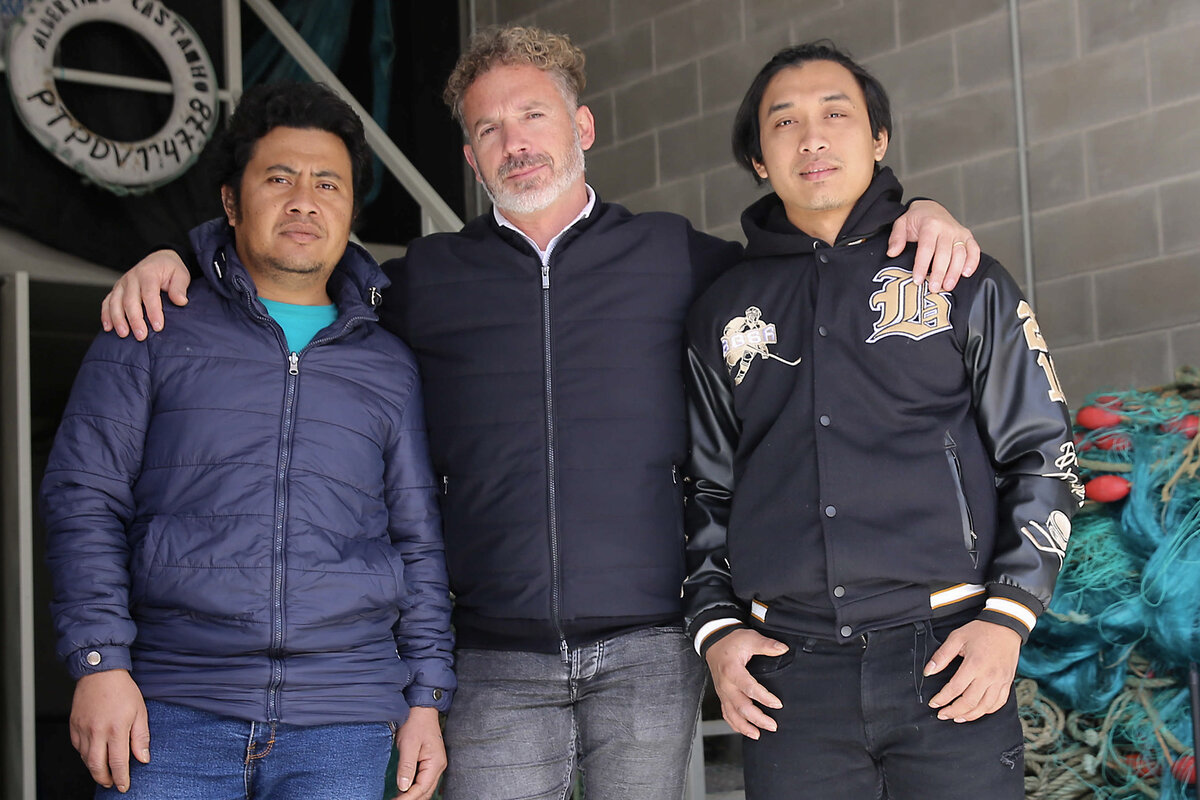
Christian Science Monitor shows a Portuguese fishing vessel captain with two of his Indonesian deckhands, March 8, 2024.

The Christian Science Monitor does a great job of finding stories about humans treating other humans with respect, even kindness. Such stories do exist. Why other media outlets don’t spend much time on them is anybody’s guess. They seem to think that anger is what people want, but why do they think that?

Dominique Soguel writes that many in Portugal are giving a welcome to migrants rejected elsewhere. They know it’s in their mutual interest. A far-right party is trying to change that, but so far harmony, says Soquel, is winning.

“Among the warehouses of one of Portugal’s oldest ports, conversations are flowing among the men sorting their fishing nets. But not without the help of Google Translate.

“The fishers at work include not just Portuguese people but also Indonesians. Thanks to a local ship captain who ventured east to solve labor shortages, Póvoa de Varzim sees a steady supply of deckhands from Indonesia, and now they account for half of all crew mates.

“And while an influx of Muslim migrants into a traditional vocation like fishing is the sort of event that would be potentially inflammatory elsewhere in Europe, in Portugal it seems to be working out without much fuss.

“ ‘The Indonesians are quite well integrated in the community,’ says another ship captain, Manuel Marques. ‘We were never against their culture. We did not ask them to change a single thing. We tried to make things as easy for them as if they were at home.

‘We do need them, and we know it. There is a mutual respect.’ …

“ ‘We also have a place to worship here, like a mosque,’ says Wahono Lucky, an Indonesian fisher. ‘I tell my boss that I don’t eat pork – I eat meat, chicken, rice, pasta, but no pork. Muslim, Christian, it’s never a problem here.’ …

“ ‘We are the only country in the European Union that allows people to come to Portugal without a job,’ notes journalist and professor Paulo Agostinho. ‘We are one of the biggest entry doors for Europe, and we are having problems with Brussels because of that. But Portugal does not have an immigration problem.’

“People from former colony Brazil make up about a third of the migrant population. Citizens of the Community of Portuguese Language Countries are also well represented, benefiting from facilitated residency procedures. In recent years, migration from India, Pakistan, Nepal, and Bangladesh has ticked up.

“Not all of Portugal’s South Asian arrivals are integrating smoothly. In the agricultural fields of Póvoa de Varzim, the sense of harmony that is palpable portside is elusive.

“Lazaro Morgado, a foreman overseeing a quartet of Indians planting seeds, clearly prefers working with a Brazilian, with whom he shares a native tongue. ‘It is complicated for the Portuguese to work with the migrants,’ says Mr. Morgado. ‘Sometimes they don’t know the procedure, and it is hard to explain. And sometimes they don’t obey the Portuguese worker even though at the end of the day, the Portuguese one is the one directly accountable to the boss.’

“Two Indian workers say they paid exorbitant sums – about €14,000 ($15,200) – to visa consultants to get here. ‘Not all Portuguese like migrants,’ notes Hardy Singh, one of the Indian workers, citing experiences of job and housing rejections on account of his ethnicity. ‘But our boss here is good.’

“Back at the port, Mr. Marques wants the Indonesian crews to stay. That’s why he – like other shipowners in the area – houses the workers in apartments scattered across the community and invites them for barbecues. The Indonesian fishers also get minimum-wage contracts and a paid-for trip home for vacation.

“ ‘Some Portuguese don’t make as much as them because they are on contract, while we only get paid if we go to sea,’ laments Tomas Postiga, an older fisher. But he grasps the importance of Indonesian workers to keep the traditional community afloat and prefers them to workers of other nationalities. Religious differences are not a problem. ‘Some are religious. Some are not. It changes nothing,’ stresses Mr. Postiga. …

“For Masrura Rashid, [Portugal’s Moorish quarter] is simply home. She arrived here six months ago, after studying engineering and wandering in the lush tea gardens of Sylhet, Bangladesh. Her father moved to Lisbon first, obtaining the right to family reunification. Now she works at her uncle’s travel agency.

“In a street rich in halal butchers and supermarkets, Ms. Rashid does not especially stand out. Donning traditional Muslim attire that fully covers her face, she is keen to learn Portuguese. ‘It’s easy here,’ she shares. ‘The weather, the environment, the people, it’s all good.’ “

More at the Monitor, here. No paywall. Subscriptions are not expensive.
Read Full Post »

Photo: Alfredo Sosa/CSM Staff.
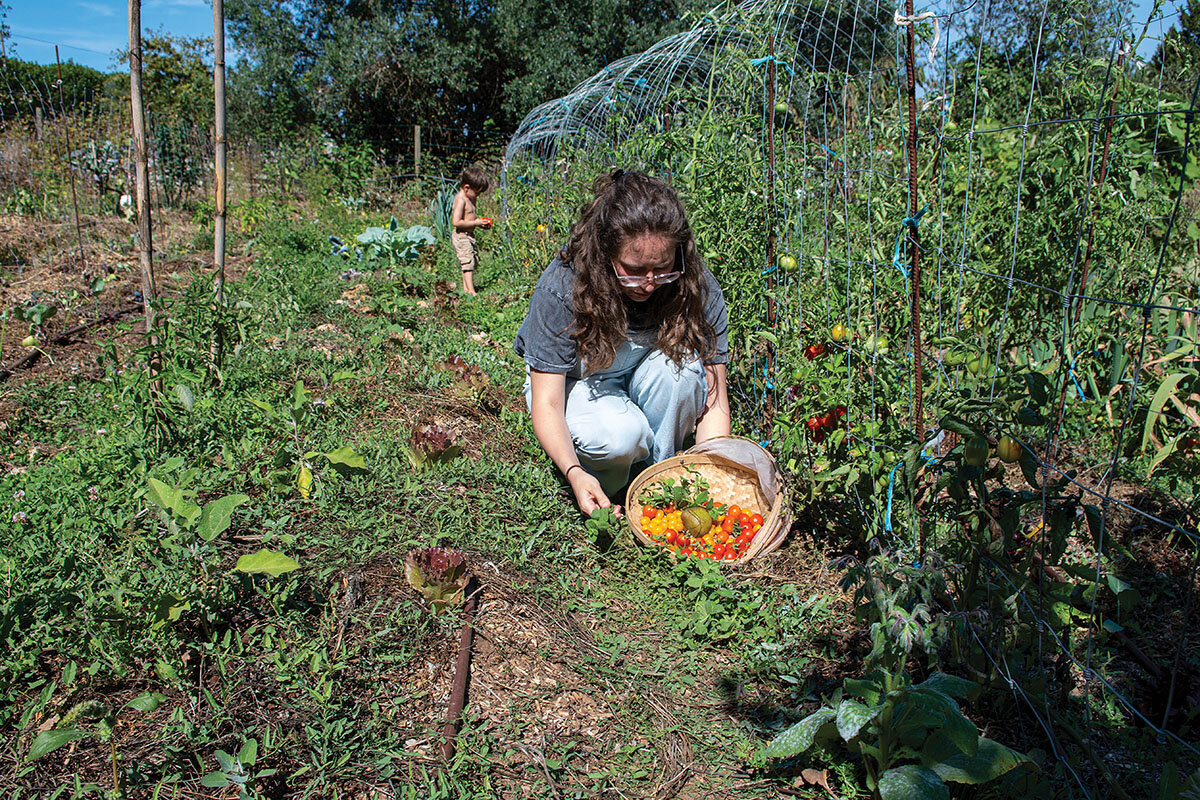
Rute Gabriel and her 3-year-old son, Isaac, pick tomatoes on their regenerative farming homestead, Projeto Liberta-te, in Porto de Mós, Portugal.

I’m impressed with the many young couples in today’s story who have chosen a life that is more friendly to the earth. My only question: how do people who are not 30 incorporate some of these principles into their daily lives?

Stephanie Hanes writes at the Christian Science Monitor, “For Rute Gabriel and Pipo Vieira, it was the tomato plant on their 25th-floor balcony in Toronto that convinced them to return home. 

“The couple, sweethearts ever since high school in this Portuguese region of stone-fenced fields and olive groves, were sharing an apartment with Ms. Gabriel’s grandmother. Their friends back home thought they had hit the jackpot. They had managed to move from the country to the city. They had immigrated to a higher-income country. And in the middle of the 2010s, they had jobs at a time when the global financial crisis – known here simply as ‘the austerity’ – was still hitting Portugal hard. 

“But the couple had a sense that something was wrong. They were in their 20s and working constantly in jobs they did not love. They missed the bright sunlight and rosemary-fresh scent of home, and had a growing unease about what felt like an unsustainable lifestyle – not only in their balance of life and work, but also in their lives and the environment. …

“Then one day, browsing the internet, Ms. Gabriel came across a YouTube video about ‘permaculture’ … a philosophy that focuses on re-integrating humans into their habitats in a way that’s mutually beneficial for people, the land, and animals.

“Ms. Gabriel was fascinated, she recalls. This was the sort of lifestyle she and Mr. Vieira were craving.  They tried to implement bits and pieces of permaculture at their high-rise apartment, putting a little tomato plant on their balcony, and then trying out ‘companion planting,’ in which they added peppers and carrots to the same container. …

“In 2016, they did what generations of young Europeans have avoided: They moved back not only to their homeland, but also to the countryside and an agrarian life. Their plan was to build a homestead and run Portuguese-language permaculture classes – to support themselves, to regenerate the land, and to help others create sustainable lifestyles. …

“Many of their friends thought they were crazy. … Over the past decades, some rural villages have dwindled to five, eight, or 20 people; schools have closed, and health clinics have shuttered. Portuguese farmers are the oldest in the European Union, with 51.9% above age 65, according to government data. Only about 6.4% are under the age of 40.

“But some in the Climate Generation – as we’re calling the cohort that was born since 1989 and into a world of accelerating impacts from a heating atmosphere – are bucking this trend. Government data shows a small but clear uptick in young people entering the agricultural sector over the past few years. And some are coming back to rural areas in Portugal to intentionally step onto the front lines of their country’s climate struggle, trying out new methods of climate-friendly food production. 

“The full size of this movement is hard to quantify because many of these young people hold other jobs and may not identify themselves as farmers for government statistical purposes. But it is recognizable. … The Climate Generation knows that what we eat, and how we grow it, has huge climate implications. Everything from shipping feed to making fertilizer to throwing wasted food in a landfill contributes to greenhouse gas emissions. But by focusing on rebuilding soil’s natural fertility, ‘regenerative’ farming practices can sequester carbon – a potential climate solution. …

“But food systems reflect something even more for the Climate Generation. Food is a tangible, everyday doorway into larger questions about how we relate to the earth and how we consume and share resources. Look at food closely, and it illuminates questions about how and why we work. It brings a tangible practicality to philosophical theories – about whether we keep demanding more by expanding and growing, about modern consumption and lifestyles, about what it means to continue extracting from a planet showing its limits in the form of wildfires, droughts, storms, and heat waves. …

“ ‘This is the future of humanity,’ says João Rodrigues, a 34-year-old artist-turned-farmer, standing by his tomato plants in the interior of Portugal. ‘To go small.’ ”

More at the Monitor, here. No firewall. The article has a lot of interesting detail.

Read Full Post »

Photo: Jessica Lustig.
Jessica Lustig, left, and Lesley Friedman Rosenthal, part-time Berkshires residents, went to Portugal to greet students, faculty and family from the Afghanistan National Institute of Music. Thanks in part to their efforts, the school was rescued and is resettling in Portugal, along with its founder and director, Dr. Ahmad Sarmast, center.

There are still small community newspapers that are doing actual reporting. Not where I live, where the the “local” paper mostly republishes content from a chain headed up by USA Today. It’s been so bad for so long, a group of community leaders is raising money for a nonprofit local newspaper such as we’ve begun to see around the country.

But I digress. Today’s Berkshire Eagle article is not a local story but I am not sure it would have happened if the reporter had not taken the time to interview local people.

Felix Carroll wrote that from a home in Otis, Massachusetts, “a daring, dangerous, complicated and ultimately successful rescue effort was coordinated beginning last August. …

“The denouement came on Dec. 13, when a community of school children from the Afghanistan National Institute of Music (ANIM) landed in Lisbon, Portugal — to safety, freedom and a future far afield from one that would have demanded their silence.

“Lesley Friedman Rosenthal, a part-time resident of Otis, was in Portugal to greet them. So was Jessica Lustig, a part-time resident of Great Barrington.

“ ‘It was remarkable to watch the young music students, their faculty and families come off the plane,’ said Rosenthal, president of the United States-based Friends of ANIM. ‘These 273 individuals, whose names, birth dates and national ID numbers I had helped work through so many lists for government agencies, and about whose lives and safety I had been so concerned in the past four months, suddenly appeared before us, with a look on their faces I can only describe as hopefulness.’

“Rosenthal and Lustig make up two-thirds of the board members of Friends of ANIM, the charitable group that, beginning in 2016, has supported the school, the first and only music academy in Afghanistan’s capital, Kabul.

“The school, which was inaugurated in 2010, had gained international fame for teaching Afghan and Western music to a co-ed student body against the backdrop of threats from the Taliban, the militant Islamist regime that had prohibited nonreligious music outright when it led Afghanistan from 1996 to 2001.

“The third member of Friends of ANIM is the school’s founder and director, Dr. Ahmad Naser Sarmast, who still suffers the physical effects following a Taliban attack on his school in 2014.

“The philanthropic efforts of Friends of ANIM took a dramatic turn in August upon the withdrawal of U.S. military troops in the country and the ensuing consolidation of control by the Taliban.

“Rosenthal, who serves as chief operating officer of The Juilliard School, the performing arts conservatory in New York City, and Lustig, the founder of a New York City-based publicity, advocacy and consulting business, engaged in round-the-clock efforts to assist Dr. Sarmast in rescuing the school.

“They reached out and received the support of political leaders, military veterans, academics, and artists, including local musicians Yo Yo Ma and Emanuel Ax.

‘It became clear, just in a matter of days, that the only way to salvage the school was to actually do a mass evacuation and airlift of the entire school community,’ Rosenthal said.

“In the meantime, videos began surfacing of Taliban members making a public show of destroying musical instruments. The Taliban had taken over the school campus. …

“News reports from Kabul told of how seven busloads of people associated with the school were left waiting at the airport for 17 hours, unable to board their plane amid fears of a terrorist attack. With that in mind, the evacuation efforts became less conspicuous; the efforts moved more slowly and comprised waves of smaller groups.

“In the end, the evacuation consisted of five airlift flights of 273 school members (including students, staff and immediate family) over a six-week period from Oct. 2 through late November.

“The first stop was Doha, in Qatar, whose government provided shelter and helped negotiate with the Taliban to ensure safe passage. Then, the school community flew on Dec. 13 to Portugal, where they have been offered asylum.

“ ‘Friends of ANIM is now working to reestablish the school in Portugal so that Afghan music and music education can continue for the girls and boys of the ANIM community,’ said Rosenthal.

“Rosenthal and Lustig had never imagined that their charitable efforts to support a school 7,000 miles away would ever come to this — essentially to establishing a war room in the Berkshires in the year 2021. …

“In December 2014, [a] suicide bomb attack at a student concert [in Kabul killed] an audience member and injured many others. Sarmast had to be airlifted to Australia for treatment. His hearing has been permanently damaged.

“ ‘The needs were clear,’ said Lustig. ‘He had threats to his life and threats to his school.’

“With the formation of Friends of ANIM in 2016, Sarmast and his staff and students would come to know that the world has his back.”

More at the Berkshire Eagle, here.

Read Full Post »

Melita posted this link on Facebook. She was so excited about the idea of a graffiti class for older folks that she contacted the organization to see if they were planning anything for Boston. I told her I would join her if they held a class. But, alas, Boston is not on their calendar. We have to get the experience vicariously from AxaNews.net.

The Axa article is a series of photos with captions like this: “Women spray their designs on a wall during a graffiti class offered by … LATA 65 [an] initiative for the elderly in the area of urban art. Since it began in 2012, they have introduced the world of graffiti to over 100 senior citizens, giving workshops in different neighborhoods of Lisbon.”

Dovas adds more at Bored Panda, “Graffiti and street art have both often served to deepen the rift of misunderstanding between young and old, but there’s one art organization in Lisbon, Portugal that’s working to change that. LATA 65 works to destroy age stereotypes and turn senior citizens into street artists by providing them with spray paint cans, masks and gloves and finding them free spots in the city to tag up and paint!

“It all begins with workshops, where the students learn about the history of street art and get to create their own stencils. They then find run-down parts of the city to jazz up with colorful tags and stencil art.

“According to the organization’s Facebook, their goal is to connect older and younger generations through art, to help the elderly engage in new forms of contemporary art and, most importantly, to let them have fun.”

This is a whole different level from the knitting groups Di organized with old folks and young girls at church back in the day. Suzanne and Joanna were regulars when they were about 7.

See the seniors’ graffiti artwork here.

Photo: Rafael Marchante/Reuters
Women spray their designs on a wall during a graffiti class offered by the LATA 65 organization in Lisbon, Portugal, May 14, 2015.

Read Full Post »

Sometimes I get leads from twitter. Liz Devlin @FLUXBoston earned a hat tip for this one.

Andrea Magrath writes at MailOnline about Monsanto, a “medieval Portugal village build in and around gigantic 200-tonne [ton] boulders. …

“Living beneath a roof that weighs more than the average cruise ship may make some people a little nervous. But it is commonplace for the villagers of Monsanto in Portugal, who adapted their homes around the environment, filled with gigantic granite boulders.

“In the mountaintop village, homes are sandwiched between, under and even in the 200-tonne rocks. The enormous boulders have been utilised as walls, floors, and most astoundingly, as roofs for houses that date back to the 16th century. …

“Located in the municipality of Idanha-a-Nova, in eastern Portugal near the Spanish border, Monsanto sits at 2,486 feet above sea level and has spectacular views. Donkey is the preferred form of transport for Monsanto’s 800 residents, who have managed to maintain the village’s medieval character.”

For some great pictures of life amid boulders, click here. One photo really looks like a hobbit home.

Photo: Xalima Muriel/Media Drum World
Monsanto, Portugal, villagers have formed their homes around the existing boulders, rather than attempt to move them.


Read Full Post »