Feeds:
Posts
Comments

Posts Tagged ‘recreation’

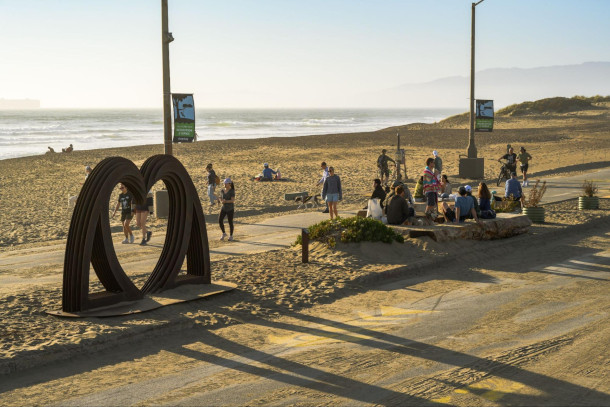
Photo: Jack Persons, Friends of Sunset Dunes.
Once a four-lane highway threatened by flooding, Sunset Dunes Park now welcomes visitors who fancy recreation along the Pacific coast.

Many of us have had a chance to enjoy the elevated park in New York City known as the High Line. Once it was a highway. Now I’m learning about a similar conversion in California.

There’s an interesting story about it at the environmental radio show Living on Earth,

Jenni Doering
“The four-lane Great Highway used to run along the Pacific Ocean on the west side of San Francisco. But in April 2025, this pavement became a little slice of paradise. Now visitors to Sunset Dunes Park can bike, walk, skate, and play next to the water. Zach Lipton is a volunteer with the nonprofit Friends of Sunset Dunes and he joins us now to talk about this highway’s transformation. … For someone who’s maybe never been to San Francisco or to Sunset Dunes Park … what is it like?

Zach Lipton
“Sunset Dunes is a 50 acre park at the edge of San Francisco along the Pacific coast. It used to be a four lane highway and has been converted into a recreational space for people to walk and bike and sit by the ocean, have a bite to eat and just enjoy our Pacific coast. So we brought in eleven local artists to paint murals. … The city has installed benches made out of logs that have fallen in recent storms from the park … a bike park and a skate area. … And of course, just the Pacific Ocean View is the star of the show. …

“[There’s a sculpture] called Spinning Rock. It’s a 20,000 pound rock that is on a spinner. And just the look of delight when kids and adults, when everyone realizes you can just push this rock and start spinning it around. It’s a lot of fun. We have a giant octopus the kids love to climb on, some giraffes down by the zoo. [The park] is a perfectly flat space, which is great for people, especially riding bikes. I know folks who have come out, learned to ride a bike there during the pandemic as an adult, using Sunset Dunes. …

Doering
“Going from a four lane roadway to a coastal park, how exactly did we get here?

Lipton
“So let’s go back all the way to just give you the long version of the history. The entire western side of San Francisco originally was just sand dunes, and in the 1800s some folks started creating a coastal path back when a road really was a recreational facility. This was a place to go ride your horse along the ocean. In time, that road was paved, but it always, for over a century, has been part of the city’s Recreation and Parks Department, even though gradually, it kept shifting from a recreational use to really just transportation. … Then during the pandemic, there was a huge need in San Francisco for socially distanced outdoor recreation, and the city converted a couple of streets to recreational facilities, including what was the Great Highway. …

“Ultimately, we ran a campaign, a ballot measure last November for the city to vote on its future. 55% of the city voted that they wanted it to be a full time park. And then we worked quickly with the city, with the California Coastal Commission, to make that vision a reality and start its transformation. …

“The park sells itself more than we can ever explain its benefits to people. And this is something where if a few years ago, you said, ‘y”Yeah, let’s turn the Great Highway into a park,’ people would look at you like you were crazy. But having tried it during the pandemic, and having just had the chance for people to experience it, all of a sudden, it makes a lot more sense. And I think there’s a spirit of experimentation there that cities can embrace, whether it’s this or other environmental efforts, that it’s okay to just try things and see how they go.”

Can you think of other pandemic experiments that have lasted? I’m going to be thinking about that.

More at LOE, here. No firewall.
Read Full Post »

lot_daughters_1200

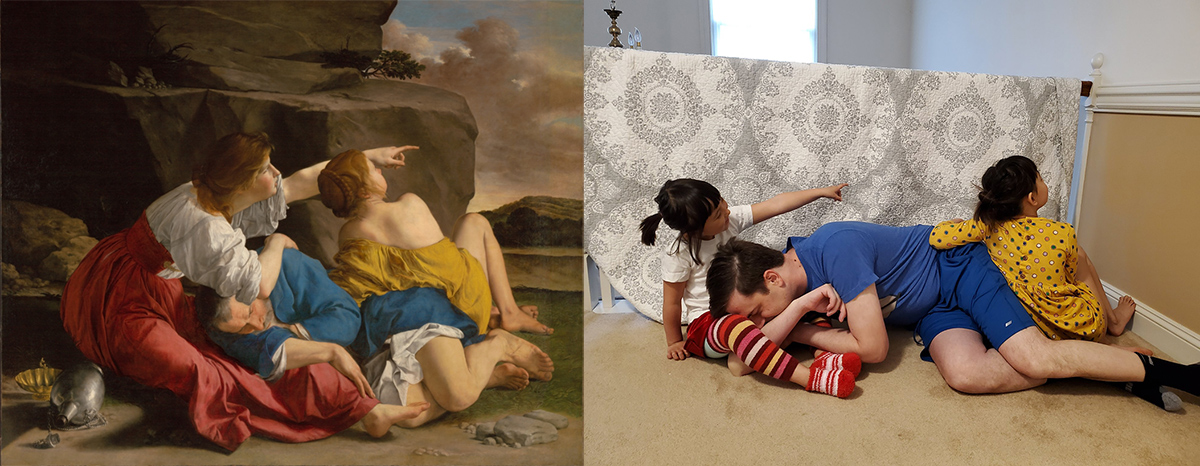
Lot and His Daughters, about 1622, Orazio Gentileschi, at the J. Paul Getty Museum. Recreation on Twitter by Qie Zhang, Erik Carlsson, and their daughters with sheet and yellow dress.

Oh, my goodness! How I loved reading about this yesterday! The J. Paul Getty Museum in California invited fans on social media to use everyday objects from around the house to replicate pieces of art in the museum’s collection. I’m posting a couple of the results, but you really have to go to the site and enjoy everything that the museum has shared.

Sarah Waldorf and Annelisa Stephan wrote at the Getty blog, “On [March 25] we issued a playful challenge on Twitter, Facebook, and Instagram to re-create your favorite art using just three objects lying around home. And wow, did you respond! Thousands and thousands of re-creations later, we’re in awe of your creative powers and sense of humor.

“The challenge was inspired by the Rijksmuseum in Amsterdam and a brilliant Instagram account called Between Art and Quarantine, but adapted with the invitation to use digitized and downloadable artworks from Getty’s online collection. …

“You’ve re-created Jeff Koons using a pile of socks, restaged Jacques-Louis David with a fleece blanket and duct tape, and MacGyvered costumes out of towels, pillows, scarves, shower caps, coffee filters, bubble wrap, and — of course — toilet paper and toilet rolls.

Cézanne and Vermeer have been a popular source of inspiration, especially Still Life with Apples (done to perfection with household pottery and gin) and Girl with a Pearl Earring (restaged with selfies and grandma, pug, or lab). Grant Wood’s American Gothic seems to capture the current socially distant mood, while Munch’s The Scream is appropriate for all ages and apparently tastes good on toast. …

“Christian Martinez’s 6-year-old daughter Bella has a love of nature that drew her immediately to this page from a Renaissance manuscript. Encountering the challenge over breakfast, the family let their imaginations run wild. …

“ ‘Pasta being life for a 6-year-old, it was first selected, followed by the boiled eggs, which happened to be cooling off to the side,’ Christian told us. Next came a brown paper bag as the canvas, and a basil stem from last night’s dinner. …

“[An] early 20th-century Scandinavian interior spoke to Tracy McKaskle ‘because we are all confined to home,’ she said. … For her re-creation, she stood on a chair and carefully placed some pins to hold the little picture, moved her dining room furniture out of the way, then perfectly placed an easel with a blank canvas. …

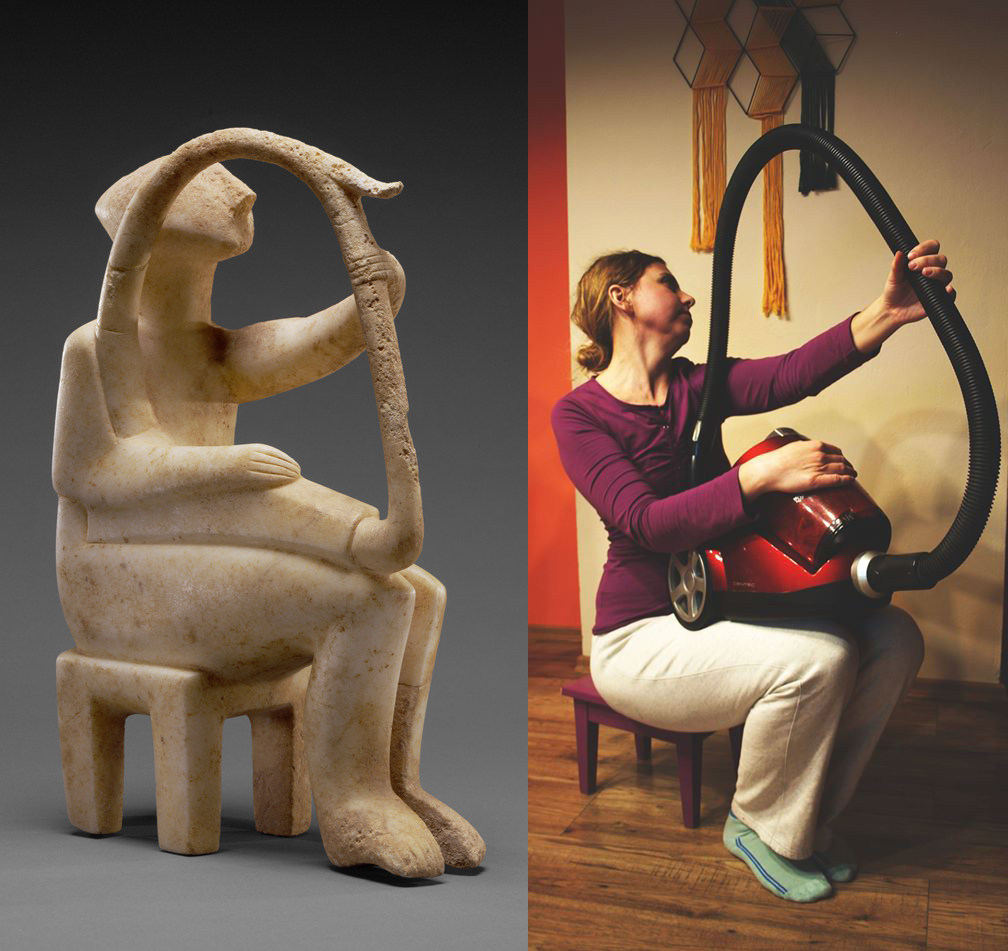
“Transforming into an ancient harp player with a vacuum cleaner ‘was the first thing that came to mind when I was looking at your collection,’ says Irena Irena Ochódzka, who posed herself into this amazing sculptural recreation. …

“[A] Baroque masterpiece ‘was the first painting that stood out to me [in the Getty collections] and I thought we could do it pretty easily,’ said Qie Zhang of this family project. Her two girls fought over the yellow dress, she told us, but you can’t tell from the delightful end result.

“Her husband’s pose also made us laugh with its allusion to parental exhaustion.”

More here. Don’t miss the Van Gogh made of Play Doh, carrot slices, and wooden beads! And tell me your favorite.

Male Harp Player of the Early Spedos Type, 2700–2300 B.C., Cycladic. Marble. Recreation via Facebook DM by Irena Ochódzka with canister vacuum.

irena_harpist_1008

Read Full Post »

img_5016-f520f9fd787c7488d3b9ceda7cf25a3dd9ca05aa-s800-c85

Photo: Martin Kaste/NPR
Tempelhof, a German airfield once used for the Berlin airlift, is now a big, open park featuring recreational activities and temporary housing for refugees.

I recently learned that Germany has a reputation for repurposing old buildings in ways that maintain aspects of historical significance. That seems to be true of how the country is adapting an old airfield to modern uses.

Sam Shead reported at Business Insider, “Berlin is a city full of abandoned buildings with long and troublesome histories. But one building has been through more turmoil than most: Tempelhof Airport. …

“Tempelhof has been used to test some of the world’s first aircraft, house World War II prisoners, and give the people of West Berlin a vital lifeline to the outside world during the Cold War. It’s also been used to film movies such as ‘The Hunger Games,’ ‘The Bourne Supremacy,’ and ‘Bridge of Spies.’ …

“Tempelhof was designed to wow visitors to the new Third Reich capital of Germania. It represents the monumental thinking behind Nazi architecture and it’s a landmark in civil engineering. …

“Berliners flocked to the airfield to see early airships and balloons being tested. It was here, for example, that the Humboldt balloon was launched on its maiden voyage on March 1, 1893. …

“At the end of World War II, the US, British, French, and Soviet military forces divided and occupied Germany. Berlin, which was also divided into occupation zones, was located far inside Soviet-controlled eastern Germany.

“There was initially an alliance between the Western Allies and the Soviet Union in Berlin, but on June 24, 1948, the Soviet forces blockaded rail, road, and water access to parts of Berlin that were controlled by the Western Allies.

” ‘The United States and United Kingdom responded by airlifting food and fuel to Berlin from Allied airbases in western Germany,’ the US Office of The Historian website says. ‘The crisis ended on May 12, 1949, when Soviet forces lifted the blockade on land access to western Berlin.’ …

“The airport eventually ended up with many of the things that are commonplace in airports today, such as restaurants.” Shead adds that the airfield is now used by “kite surfers, rollerbladers, allotment enthusiasts, artists, cyclists, joggers, jugglers, batton twirlers, and dancers. …

“Tempelhof is also home to Germany’s largest refugee shelter. There were 3,000 refugees from countries like Iraq and Syria living in a hangar at one point, but that number has fallen to about 600 as German authorities have relocated many of them, while others have returned home. There is enough space in the hangar for 7,000 refugees. … The shelter is closed to the public, but there is a refugee cafe in Hanger 1 the public can visit and provide German lessons.”

I must say, I like to think how very unhappy the WW II owners of this airfield would be about that. Justice served.

More at Business Insider, here.

Read Full Post »

Providence is engaging in so many entertaining pop-up activities I can’t keep up. Suzanne sent this link about one that happened today. I guess it is what people mean when they talk about “placemaking.”

Chris writes at the blog for Our Backyard Rhode Island, “Where else but Our Backyard could you walk to dozens of parks in just one day? Today 32 temporary parklets have sprung up in Downtown, the West Side, and the East Side of Providence to mark PARK(ing) Day. More than 30 metered parking spaces have been transformed into temporary public parks. Designers worked with local businesses to find creative ways to add green space to the urban environment. They trucked in plants, Astroturf and picnic tables to create alluring stop offs for people out for a walk.

“On Matthewson Street, you can even use frisbees to play checkers on a board as big as a queen-size comforter. Organized locally by the RI chapter of the American Society of Landscape Architects (RIASLA), the RI chapter of the American Institute of Architects (AIAri), and Transport Providence, Park(ing) Day strengthens connections in Our Backyard.”

More here.

Photo: http://ourbackyardri.com/
A Providence parklet today.

Read Full Post »

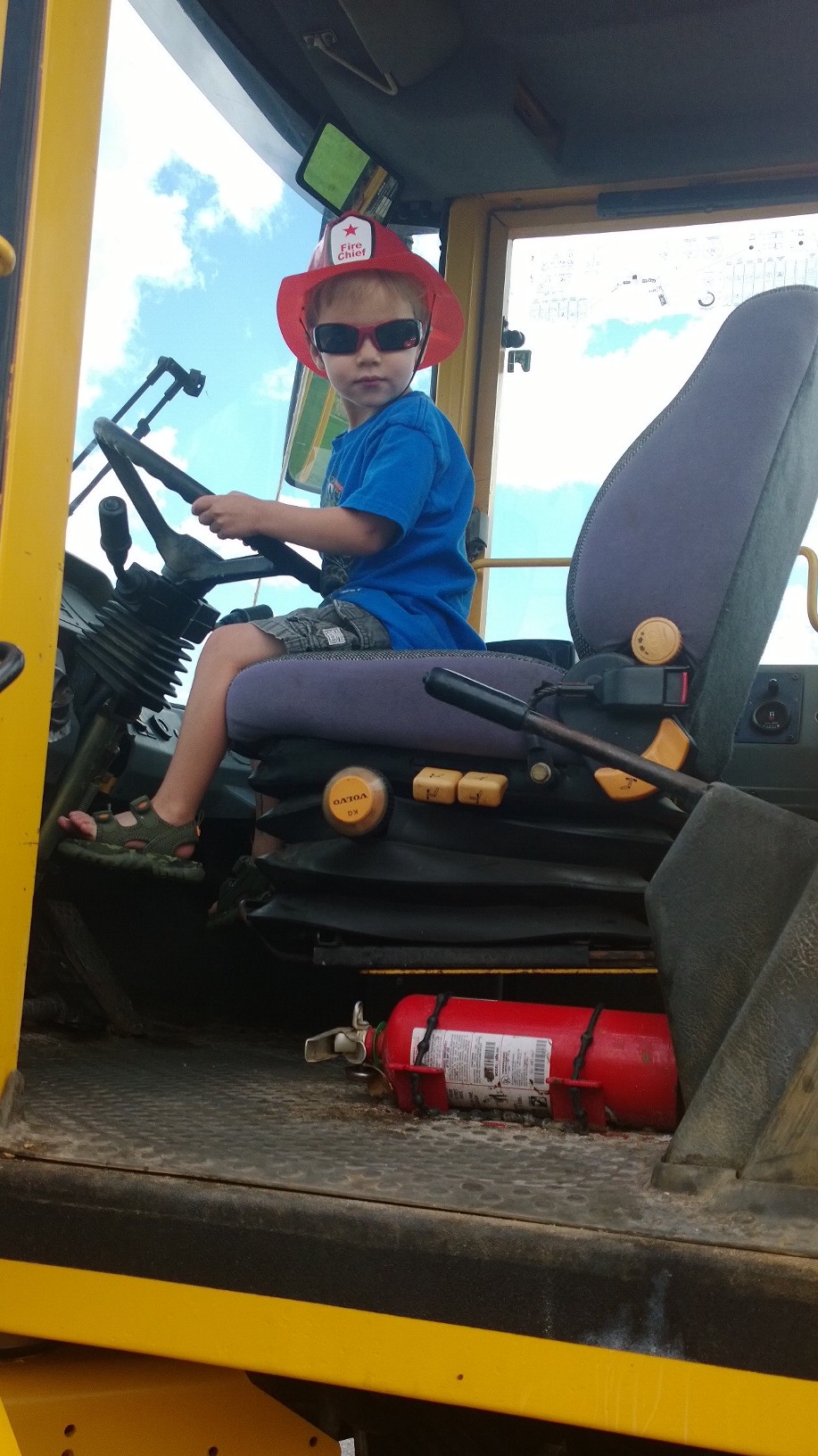
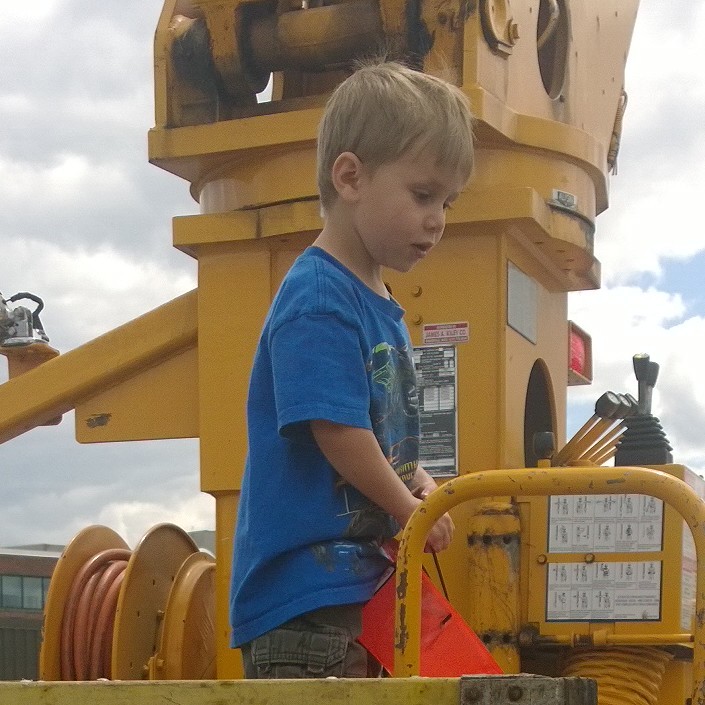
Kids ages 3 to 5 seem to have a strong compulsion to check out trucks up close. So when organizations like Concord Recreation decide to do a little fundraising by providing the opportunity, parents of preschoolers know they just have to go.

I was walking back from the store when John’s wife and son pulled up and said they were on their way to Touch a Truck. I couldn’t resist. I said we’d meet them there.

I don’t know the names of all the trucks, but I can tell you the array included an ice cream truck, a fire engine, a police van, a front loader, and a truck for drilling telephone pole holes. There was one with a bucket for raising a person up high. My husband pointed out the rubber gloves you have to wear if you’re working around high-voltage lines. He explained how many times the gloves get dipped in rubber and carefully checked during the manufacturing process.

My grandson tried all the trucks. You can see that it’s fairly serious business.

051814-touch-a-truck

serious-truck-driver


checking-out-the-truck

Read Full Post »