Feeds:
Posts
Comments

Posts Tagged ‘repair’

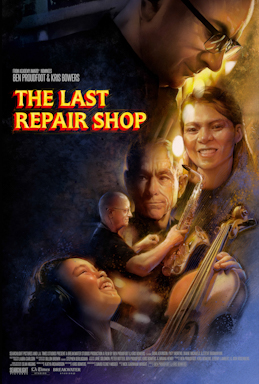
The Last Repair Shop, above, is a 2023 American short documentary film directed by Ben Proudfoot and Kris Bowers

I listen every day to WICN, a jazz station in Worcester, Massachusetts. Besides providing wonderful music, the station does good works that I appreciate. For example, they collect unused school instruments to donate to local public school students. Both Suzanne (oboe) and John (sax) let me take the instruments they hadn’t touched for years to WICN and donate them.

Other school districts also offer free instruments, but few have a reliable way to repair any that need work. Now, publicity for an Oscar-winning film about a repair initiative in one district is spreading inspiration.

Sheena Goodyear reports at CBC Radio, “Steve Bagmanyan is putting retirement on hold — and he couldn’t be more thrilled about it. Bagmanyan is the supervisor at a warehouse in Los Angeles, where a small, but mighty, team of music lovers repair musical instruments for thousands of public school students. 

“One of the last programs of its kind in the U.S., it has struggled to stay afloat over the years. But now, thanks to the Oscar-winning documentary short The Last Repair Shop, donations are pouring in. …

The Last Repair Shop tells the story of the L.A. Unified School District (LAUSD) Musical Instrument Repair Shop, where 11 technicians service about 6,000 instruments each year for more than 1,300 schools across the city.

“It spotlights the shop’s staff, including Bagmanyan, as well as the students who benefit from their work, showing how music has changed each of their lives in momentous ways. 

In an interview with As It Happens earlier this year, co-director Ben Proudfoot, a Halifax native, called the film ‘a vehicle to get people to stand up and cheer for music and arts education around the world.’

“Now, that’s exactly what people are doing. Proudfoot and co-director Kris Bowers have teamed up with the Los Angeles Unified School District to create ‘The Last Repair Shop Fund,’ hosted online by Paypal. …

” ‘Ben and I can’t think of a better impact for our film to make,’ Bowers said in a press release. … As the money comes in, Bagmanyan says he and the school district have big plans — new equipment, upgraded tools, more technicians and, if possible, an apprenticeship program.

” ‘Maybe some high school kids would be interested in learning the trade since there’s not many repair people left really,’ Bagmanyan said.

“Ever since The Last Repair Shop was nominated for best documentary short at the Academy Awards, Bagmanyan says life has been a whirlwind. After years of toiling in relative obscurity, he and his colleagues are now attending screenings, doing media interviews and going to red carpet events. 

At one of the first screenings, they met some of the students who rely on the public school instruments they repair — many of whom could never afford an instrument out of pocket.

” ‘It was very rewarding,’ Bagmanyan said. ‘I felt very proud. I always did, but when I met students and actually went to all the screenings, it’s a different way of feeling proud. It’s like you actually see who you’re doing it for.’

“One of those students, violinist Porché Brinker, was featured in the doc and shared the stage with Proudfoot and Bowers when they won the Oscar.  Bagmanyan and the other technicians were watching proudly from the balcony.

” ‘To see the way that everyday people have shown up to make sure that kids like Porché have a working violin in their hand is truly moving, and goes to show that good old fashioned generosity and goodness is still very much alive,’ Proudfoot told CBC in an emailed statement. …

“But the most amazing thing to come out of the film, Bagmanyan says, are the boxes of hand-written, thank you letters that keep arriving at the shop from L.A. public school teachers and students, he says. …

” ‘Every note is our Oscar. Every thank you email from a teacher, that’s our Oscar,’ he said. …

“Funding cuts and furloughs over the years meant that by the time he took over as supervisor in 2013, [the repair team was down to six from 30].

“With new funding and attention from the Oscars win, he’s aiming to ‘bring it — at least partially — back to its capacity.’ “

More at CBC, here.
Read Full Post »

Photo: BBC.
Under a government voucher plan, Austria will pay residents to repair broken machines instead of throwing things out.

A new plan in Austria could lead to the emergence of a whole class of tinkerers. There’s money to be made.

Bethany Bell writes at the BBC, “Has your washing machine broken down, or is your electric kettle, laptop or mobile phone refusing to work? Well, if you live in Austria, the government will pay up to €200 ($219) towards getting it repaired.

“The Repair Bonus voucher scheme is aimed at trying to get people to move away from throwing away old electrical appliances – and focusing on getting things mended.

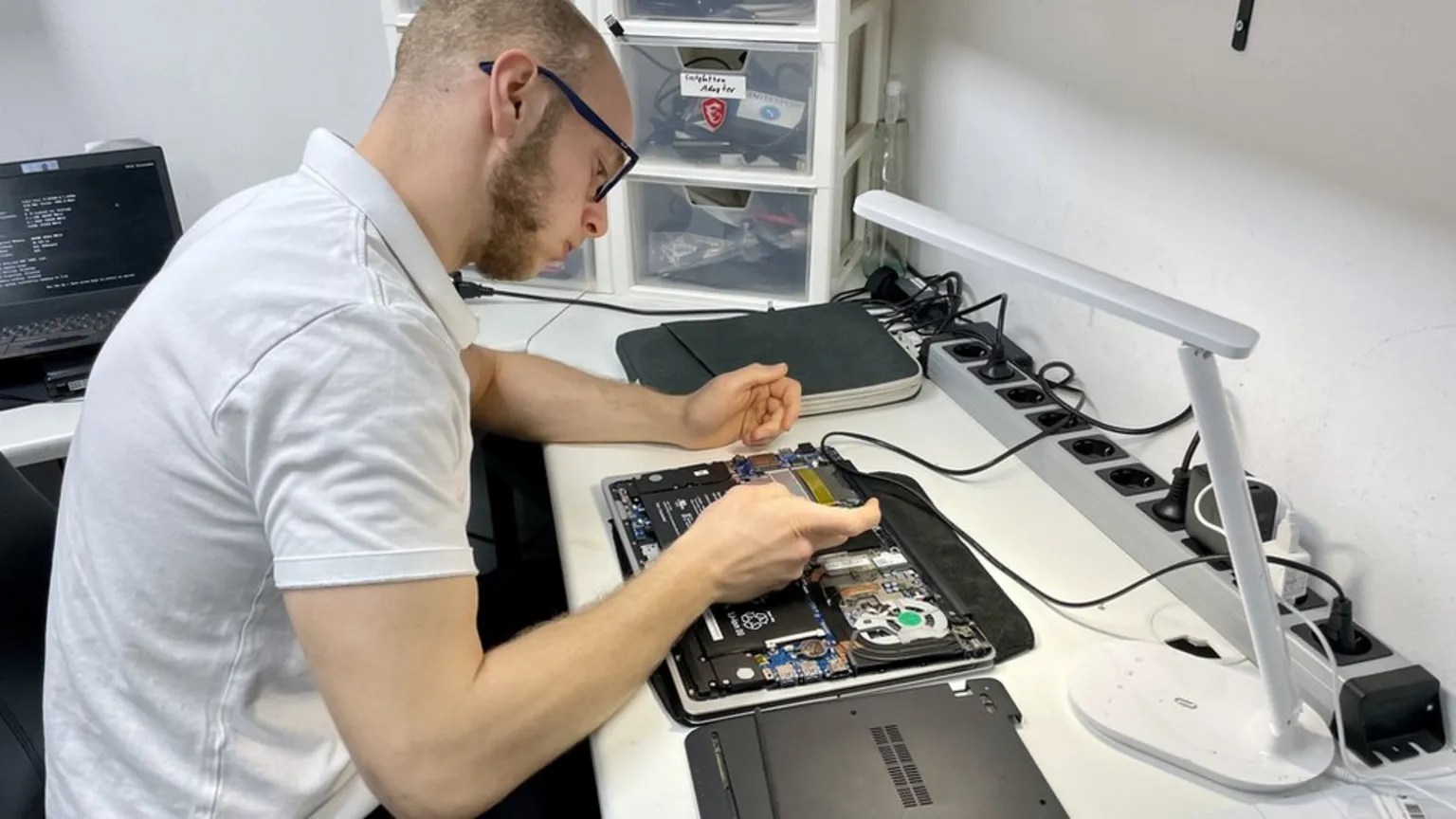
“Erik’s laptop is broken, so he has come to Helferline, a computer and mobile phone repair workshop in Vienna. Because of Austria’s Repair Voucher scheme, he will only have to pay 50% of the repair costs to get it fixed. … Erik has already used the Repair Bonus to mend an old CD player, which is now working well. He says the scheme makes it easier to decide whether or not to throw something away. …

“Helferline’s chief executive, Clemens Schmidgruber, says the Repair Bonus scheme has been great for his business. ‘Our revenues have doubled since it was introduced. So we’re very happy about it,’ he said. …

” ‘Customers benefit because it helps them save a lot of money. Of course, it’s good for local businesses because they generate additional revenues. And the environment benefits, because there’s less electronic waste.’

“Mr Schmidgruber says customers have to download a voucher from a government website and then pay the repair shop upfront. ‘Then you get back half of the costs after three to four weeks.’ …

“The City of Vienna runs a separate scheme – which works in a similar way and helps people pay for repairs to old clothes, bicycles or furniture.

“Markus Piringer, the co-ordinator of the Repair Network in Vienna, says ‘if the costs of the repair are more than 20-30% of the cost of the new product, people tend to buy new. And as the Repair Bonus lowers those costs, it’s a big incentive to repair more. … [But] for many people, it’s still very positive to have always the newest product and to throw away your clothing after half a year or even less. And so this is also something where we need awareness raising.’

“And he warned that while the number of repairs was rising in Austria because of the voucher schemes, there were still too few technicians and craftspeople to do it. ‘We have a problem that we don’t have enough repairers. So we also need a system which is promoting repairs as a job.’ …

“At his bicycle shop in Vienna, Marc Warnaar and his team are fixing a bike, which has rusted brake and gear cables. ‘They don’t make spare parts for this gear system,’ he says, ‘Especially the gear cables, you cannot buy them anymore. So what we’ll do is exchange them with a newer model, so it will run again.’

“He says the Vienna Repair voucher has made a big difference to his business. ‘Normally we see a large decline in repairs, especially in winter. But now we see a lot of people coming because of this voucher and getting their bikes repaired also in winter.’ “

More at the BBC, here. And check out my 2012 post about Dutch repair cafés, here

Read Full Post »

Happy Cobblers

Photo: Marcie Parker for the Boston Globe.
Leslie Bateman and Emily Watts are the founders of Coblrshop, a modern shoe repair company in Boston.

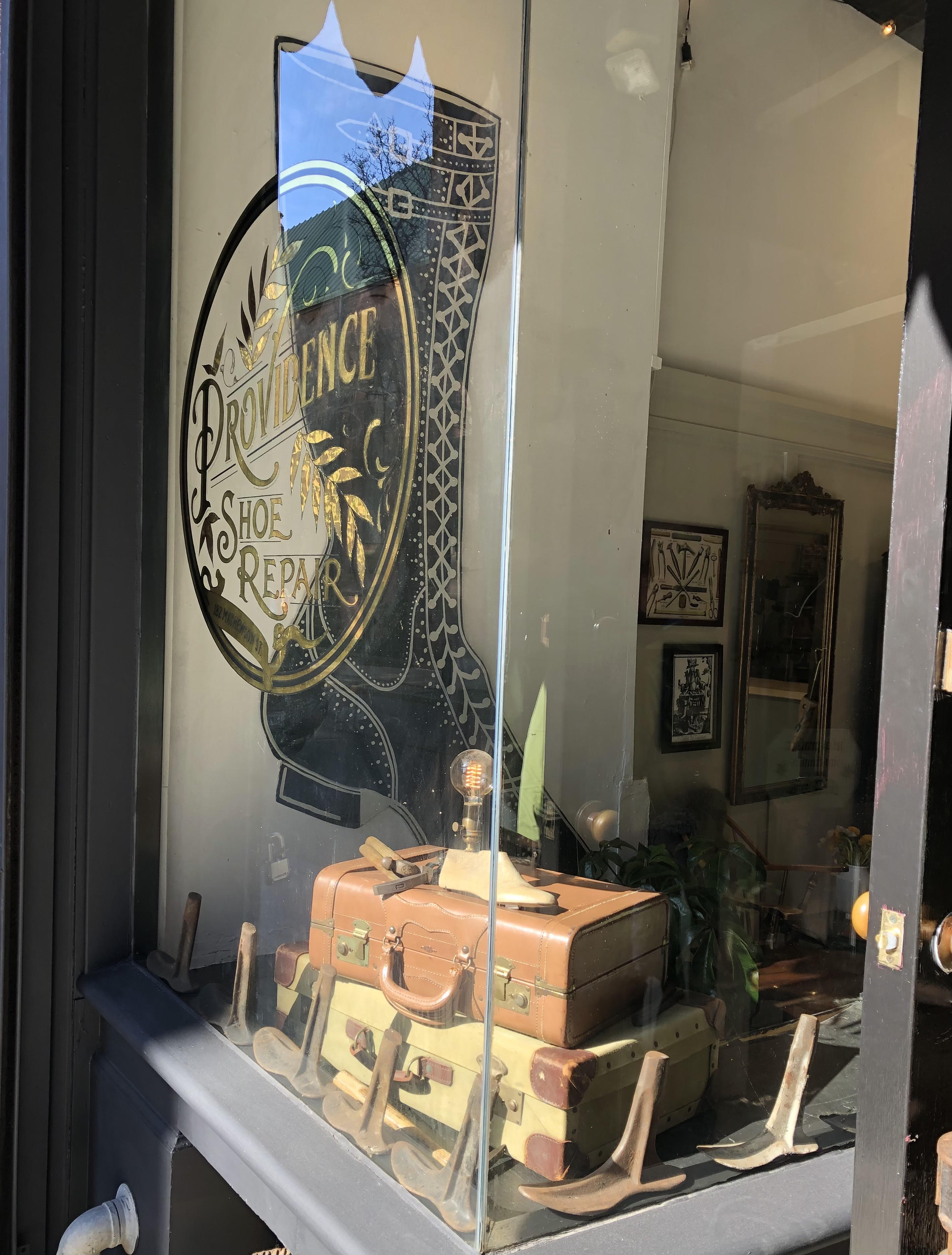
I don’t know if you would recall a photo blog post of mine that included a picture of a new-ish cobbler shop in Providence. I was surprised at the time to see that anyone new was eager to get into the shoe-repair business. Wasn’t it supposed to be a dying art?

It turns out that there are enough customers who want to keep their favorite shoes intact that cobbling services are actually increasing.

Marcie Parker reports at the Boston Globe, “Leslie Bateman always loved shoes. Since she was a little girl, she has walked with her eyes cast downward, checking out shoes as their owners stepped along sidewalks. She scoured shoe stores, department stores, and vintage clothes shops for the perfect shoes for school, work, exercise, formal occasions, and casual gatherings.

“And once she found the right shoes, she never wanted to toss them out. Thus began Bateman’s relationship with cobblers, the craftspeople who repair, customize, and sometimes make shoes. Whenever she moved to a new city — Montreal, New York, and now Boston — she searched for cobblers to keep her shoes in good condition, a task that became harder as the number of people practicing the trade dwindled.

“Now Bateman and her partner, Emily Watts, are launching a new service to make it easier for shoe lovers to get their shoes fixed. Their Boston-based startup, called Coblrshop, combines the latest in digital technology with a centuries-old craft, using its website and a mobile app coming next year to diagnose repairs for luxury shoes and handbags, estimate costs, and connect to cobblers.

“ ‘You bring technology in and it adds so much efficiency,’ Watts said. ‘[We’re] using technology to really improve a well-established and long-lasting industry.’

“Coblrshop is among the latest companies to use technology to connect customers with services, joining a host of websites and mobile apps that provide one-stop shopping for auto repair, dry cleaning, home maintenance, and food delivery.

“Bateman and Watts are betting if they make shoe repairs fast, convenient, and competitively priced, more people will fix rather than toss out worn shoes, not only helping to revive the art of shoe repair but also reducing the environmental impact of the footwear industry. …

“Coblrshop contracts with a downtown Boston shoe repair shop, David’s Instant Shoe Repair on Franklin Street, to make repairs. Ultimately, the company plans to find a larger, central location to host several cobblers and train new ones.

“Here’s how the service works: Customers go to the company’s website, where they can choose the type of shoe or handbag that needs repair. From there, they select from a drop down menu the condition of the shoes and the services needed.

“Customers can choose from broad repair categories, such as a clean and shine, wear and scuffing services, or a complete repair. They also have the option to add protective soles to reduce future wear and tear. … After ordering repairs and paying online, customers receive within three to five days a biodegradable and recyclable mailer bag to send their shoes to the company’s cobbler. The process, from estimate to delivery of just-like-new shoes, takes about two weeks.

“Eduard Harutyunyan, who works at David’s Instant Shoe Repair, is Coblrshop’s cobbler. After immigrating to Massachusetts from Armenia in 1997, he learned the craft from a cousin who owned a shoe repair shop in Natick.

“Bateman and Watts said they searched extensively to find a cobbler who they believed would do the highest quality work and be open to modernizing shoe repair. They chose Harutyunyan after speaking to more than 60 cobblers.

“Harutyunyan, 46, said … ‘The issue with the cobblers in general — they don’t get much respect,’ said Harutyunyan. ‘What I like is to be able to change that.’ …

“Few appreciate that as much as Bateman. She recalled becoming particularly attached to a pair of gold Chanel flats that her husband found at a vintage store in Manhattan in 2010 and gave to her for her birthday. She wore the flats every day for years, getting them resoled four times. …

“ ‘You’re not buying something and sending us something new or something via resale,’ Bateman said. ‘You are sending something in that has a story, and we need to take care of that and give you back that magical experience.’ ”

More at the Globe, here.

Photo: John and Suzanne’s Mom.
Providence cobbler shop.

Read Full Post »

Photo: Richard Saker/Guardian.
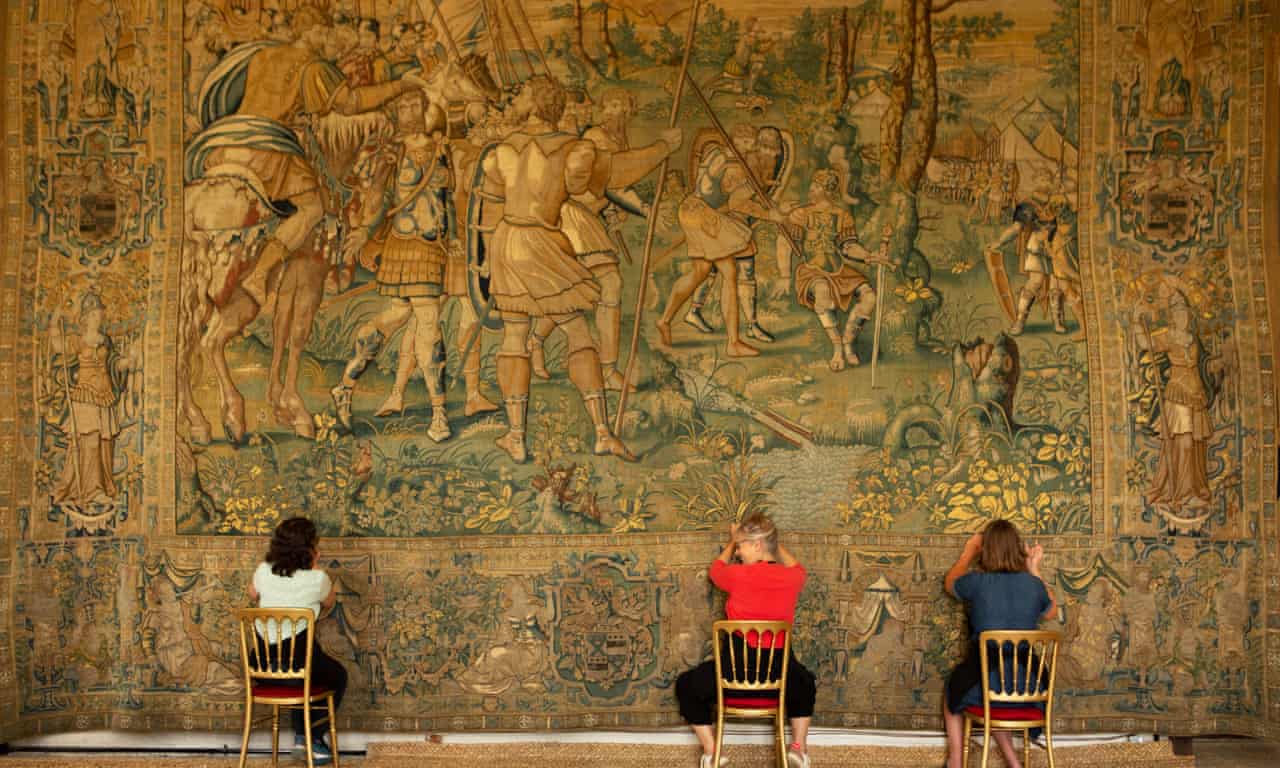
Staff at Hardwick Hall making final adjustments to restored tapestries that Bess of Hardwick bought for £326 15s 9d [~$406] in 1592.

This story is reminding me of childhood visits to the Cloisters before my father had his stroke and how he liked to point out the years of work that went into medieval tapestries.

Jessica Murray, Midlands correspondent of the Guardian, reports on 24 years of work just to do repairs.

“After a 24-year project, the National Trust has finally finished the restoration of a set of 16th-century tapestries at Hardwick Hall in Derbyshire, the longest such endeavor in its history.

“[In July] the final tapestry in the set of 13 Gideon tapestries was unveiled on the wall of the long gallery, the culmination of a painstaking effort to clean and handstitch the huge pieces one at a time, at a cost of £1.7m [~$2,118,718].

“ ‘It has been quite emotional because this is the first time I’ve seen them all on the walls together, and this project was in the background of my every day for so long,’ said Denise Edwards, the former general manager of the estate who retired last year, having overseen the project since 2003.

“ ‘They were supposed to be completed in 2021, the year I was due to retire, but they got delayed because of Covid so I stayed on because I really wanted to see the project through to the end,’ she said. ‘It has taken up a lot of my life for 20 years.’

“The enormous works, 6 metres tall [~20 feet] and more than 70 metres [~230 feet] in length, are considered to be one of the most ambitiously scaled tapestry sets of their time, and were last on display together before the project began in 1999.

“Hardwick Hall, an Elizabethan country house situated on a hilltop between Chesterfield and Mansfield, was at one point surrounded by nine coal mines. ‘You can imagine all the pollution that brought, and with leaky windows they were absolutely filthy,’ Edwards said. ‘And cleaning them is just the beginning of the battle – then it’s repairing all the damage done to the fine silks of the tapestries.’

“The set was bought by Bess of Hardwick, one of the richest women of her time and a friend of Elizabeth I, in 1592 after the death of the lord chancellor Sir Christopher Hatton, who had commissioned them for his estate in Northamptonshire. …

“The set, which depicts the biblical story of Gideon who led an army to save his people from the Midianites, has remained in the long gallery at Hardwick Hall since the end of the 16th century, and unlike many other tapestry sets it has never been moved or cut up. …

“Each tapestry took more than two years to restore, after a process involving a thorough vacuum to remove loose fibers, dust and soot, and a journey to Belgium for specialist wet cleaning.

“National Trust conservators used specialist conservation stitching with hand-dyed yarns to repair damaged areas, with each tapestry taking about 5,000 hours to complete.

“ ‘We work through it slowly … and we use different conservation stitches to bring structure to the tapestry and to fill in the design where it’s missing due to damage,’ said Yoko Hanegreefs, a textile curator, adding that ‘recipe books’ for bespoke dye colors were created to maintain consistency over the life of the project.

” ‘We use wool and stranded cotton to do that because they have faded and no longer have the brightness new silk would have.’ …

“Visitors can see the full Gideon set at Hardwick Hall, and there are plans to remove portraits hanging on some of the tapestries so they can be viewed unrestricted as they would have been 400 years ago.”

More at the Guardian, here. No firewall.

Read Full Post »

Photo: Lauren Petracca/PostAndCourier.
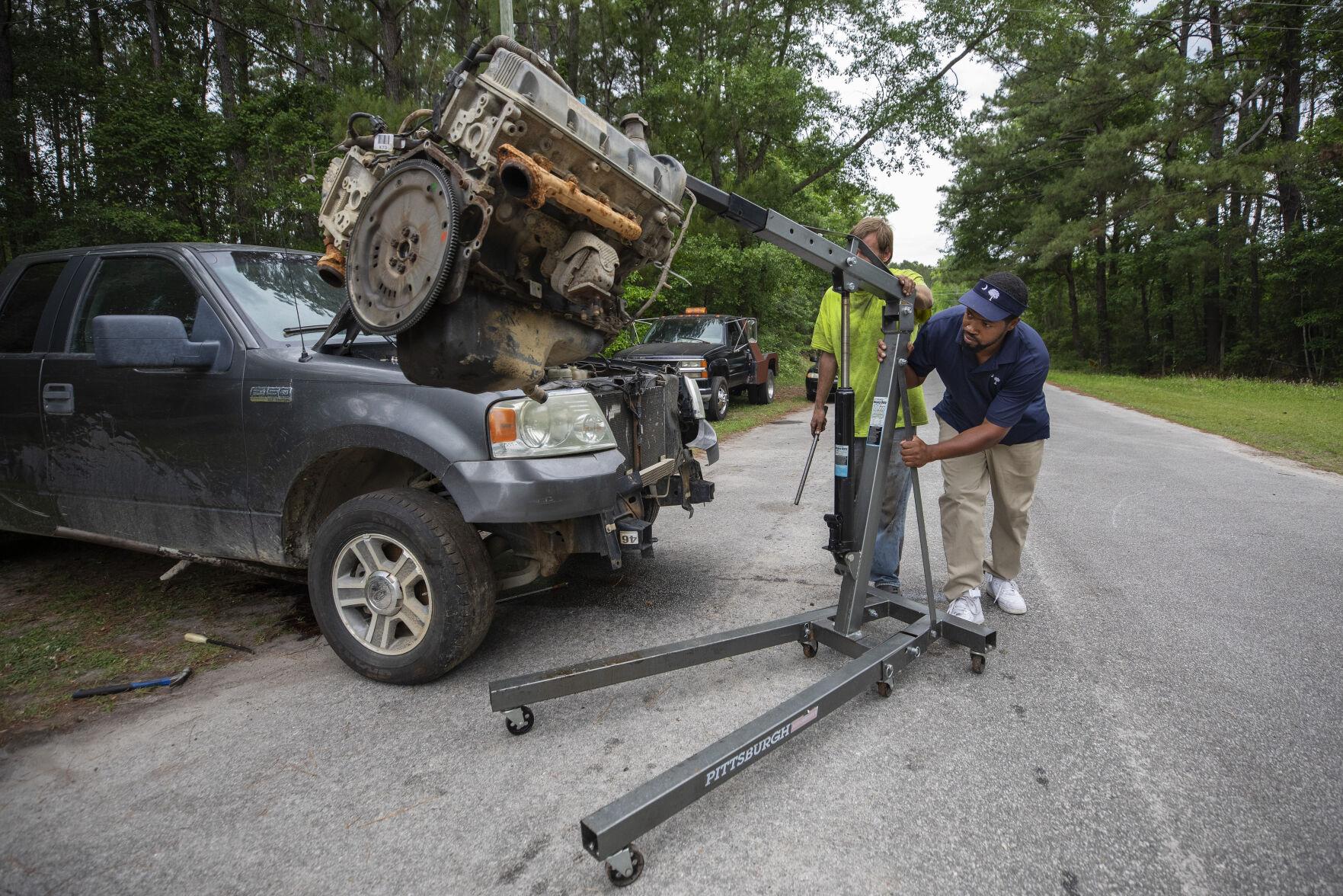
Eliot Middleton (right) and Matthew Poston remove an engine from a truck they are fixing up for donation in McClellanville, South Carolina, on May 10, 2021.

The roots of today’s story were planted in a strong relationship between a South Carolina father and son who knew how to repair cars.

Sydney Page reported at the Washington Post in July, “On Christmas Day last year, Eliot Middleton showed up unannounced at Melanie Lee’s home in Andrews, S.C., with a white 1993 Oldsmobile. What happened next shocked her: Middleton, whom she had never met before, put the key to the Oldsmobile in her hand. He didn’t charge her a dime. He just gave her the car, no strings attached.

‘I had no idea what was going on,’ said Lee, 59. ‘He handed me the keys and didn’t ask for anything.’

“She is one of 33 people Middleton has gifted with a car in the past nine months. Middleton, 38, is a restaurant owner and former auto mechanic who spends his spare time repairing used cars and giving them to people in need in rural South Carolina.

“ ‘There’s a lack of transportation in the rural areas, and I knew I could use my previous experience in mechanics to help,’ Middleton said.

“Only a few weeks before Middleton dropped off the car, Lee’s 33-year-old son, who was ill for several years, passed away. After driving daily for two hours to and from the hospital in Charleston to visit him, her 2007 Chevrolet Tahoe broke down.

“She took the car to a shop to replace the transmission, but ‘I had no means of paying for it,’ she said. She needed a car to help with child care for her two granddaughters, who are 12 and 6 and rely on her to pick them up from school every day and drive them to dance rehearsal. …

“The idea to fix and donate old vehicles came spontaneously to Middleton in early 2020, after he hosted a food drive and several local families showed up with no transportation. They walked more than four miles to get a hot meal. …

“ ‘There’s no public transportation in the area whatsoever,’ said Middleton, who lives in McClellanville, a small fishing town on the Atlantic coast with a population of about 600. ‘We don’t have taxis and Ubers. Without a car, people don’t have a way to get around.’

“So, Middleton — who co-owns Middleton & Maker Village BBQ, a restaurant in the neighboring town of Awendaw, S.C. — decided to put his auto mechanic skills to use the two days a week he isn’t at the restaurant. [As of July], nearly 100 vehicles have been donated for him to fix up. …

“Before jumping into the restaurant industry, Middleton worked as an auto mechanic for 15 years. As a young boy in McClellanville, his plan was to follow in his father’s footsteps.

“ ‘My dad was a mechanic, and I would hang out around his shop since I was 4 years old,’ Middleton said. ‘I’ve always been fascinated by cars.’

“After he graduated from high school, Middleton trained to become an auto mechanic, and in 2004, he and his father opened their own auto service. …

“ ‘We had a lot of single moms as customers, and we always ran into problems with them not having enough funds,’ Middleton recalled. ‘We spoke about trying to find a way to help them,’ [but] whenever they started to brainstorm ideas, something got in the way. Middleton’s father’s health began to decline, and in 2014, they closed the shop. Barbecuing has always been a side passion for Middleton, he said, so he decided to change course and pursue it professionally.

“Still, despite leaving the auto industry, the notion of repairing used vehicles for people in need remained a shared goal for Middleton and his father. But after receiving the first donated car in January 2020, several things in their lives took priority, including Middleton’s father’s failing health — he died in March 2020. Around the same time, Middleton opened a restaurant, just as the coronavirus pandemic was taking hold.

“ ‘Things started changing in my life, and I couldn’t focus on the car program the way I wanted to,’ said Middleton, who has two daughters, ages 14 and 8.

“By September 2020, though, Middleton felt ready, with fresh motivation to honor his father’s legacy. He repaired the first car — a 1997 navy Toyota Camry — and gave it to an unemployed single mother of two children, one of whom is disabled and requires regular medical appointments. …

” ‘That felt great. I could feel my dad’s presence around me, and I could hear him saying “this is exactly what we always wanted to do.” ‘

“Within two months, the same woman was able to land a stable job, and she recently contacted Middleton to say she bought herself a new car and is donating the one he gave her back to him.

“ ‘That blew me away,’ Middleton said.”

More at the Post, here.

Read Full Post »

Photo: EdiliziAcrobatica.
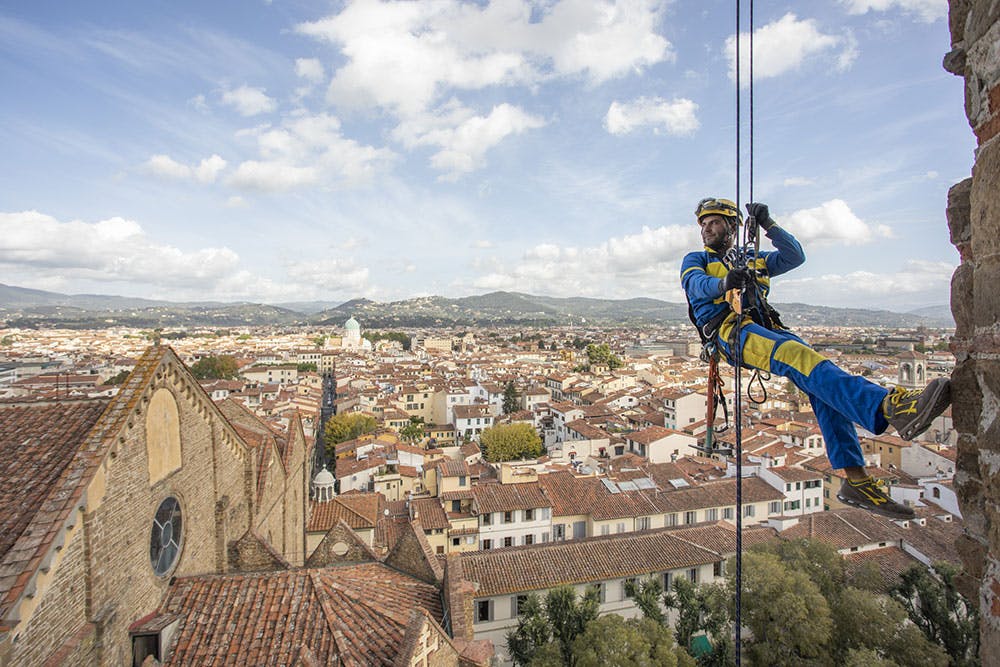
A construction worker has a great view from Santa Croce in Florence.

So many different kinds of jobs in the world! Today’s story is about construction workers with specialized talents that might just as easily have gotten them hired by the circus.

Rebecca Ann Hughes has the story at Apollo. “Beneath the celestial vistas of Parma Cathedral’s frescoed dome, two men swing like trapeze artists from ropes crisscrossing under the roof as though in a circus tent. They seem to be attempting to join the swirling vortex of angelic limbs in Correggio’s scene of the Virgin’s Assumption above them. But they are actually members of EdiliziAcrobatica, an Italian construction company specializing in rope access building interventions. On this occasion, the company has been drafted in to repair a bell in the cathedral.

“EdiliziAcrobatica’s team has rock-climbed up and abseiled down some of Italy’s most significant historic monuments. The company has worked on the Ponte Vecchio in Florence, Siena Cathedral, and the Roman Forum, to name a few. It has also intervened in banks, apartment blocks and various other public and private buildings. Suspended from ropes, the acrobatic technicians can perform a whole range of tasks, from the waterproofing of roofing to welding – all the necessary tools in bags and buckets attached to their harnesses. To watch the team at work is a breathtaking and nail-biting experience. From street level, they are minute figures poised on the roof of Parma’s dome to replace copper panels damaged by rain or casually dangling above the waters of the Arno to repair a leaking fountain on the Ponte Vecchio. …

“The building company didn’t choose to specialize in these acrobatic techniques just for the spectacle. Rope access, a construction work-at-height technique that started to become popular in the 1980s, comes with a multitude of advantages over traditional scaffolding, as Riccardo Iovino – who founded EdiliziAcrobatica in 1994 – explains via email.

“At the forefront is safety. Workers are attached by two ropes, one for safety, and ropes can also relay equipment. Although founder Iovino was, as a skipper, at home shimmying up and down rigging – and was thus inspired to adopt the technique professionally – EdiliziAcrobatica’s workers are not expected to have a mountaineering or caving background. The company assists the construction workers – who are overseen by specialist surveyors – with training and obtaining the required permit for rope access work. Thus, suspended from the side of a building, EdiliziAcrobatica’s technicians can carry out restoration work, paint walls, clean windows, replace gutters and repair unsafe elements of a building in total safety.

“That’s not to say that these strict safety procedures dampen the thrill of the work. Enzo Spitale, who began as an acrobatic builder and now acts as coordinator overseeing the team in Italy, returned from his interview 10 years ago thinking it was all completely mad. But he now says his employment at EdiliziAcrobatica was a life-changing opportunity. Dangling from a Renaissance dome or a medieval bridge, ‘you feel one step away from the sky,’ Spitale says. ‘It is unique and unimaginable for those with their feet on the ground.’

“This aspect of the job comes with its own risks. ‘It is always important, as I remind the new company recruits, never to lose concentration at work,’ says Spitale. ‘We are suspended from ropes several metres off the ground, we have to pay attention to what we are doing and not get distracted by the clouds!’ “

More at Apollo, here.

Read Full Post »

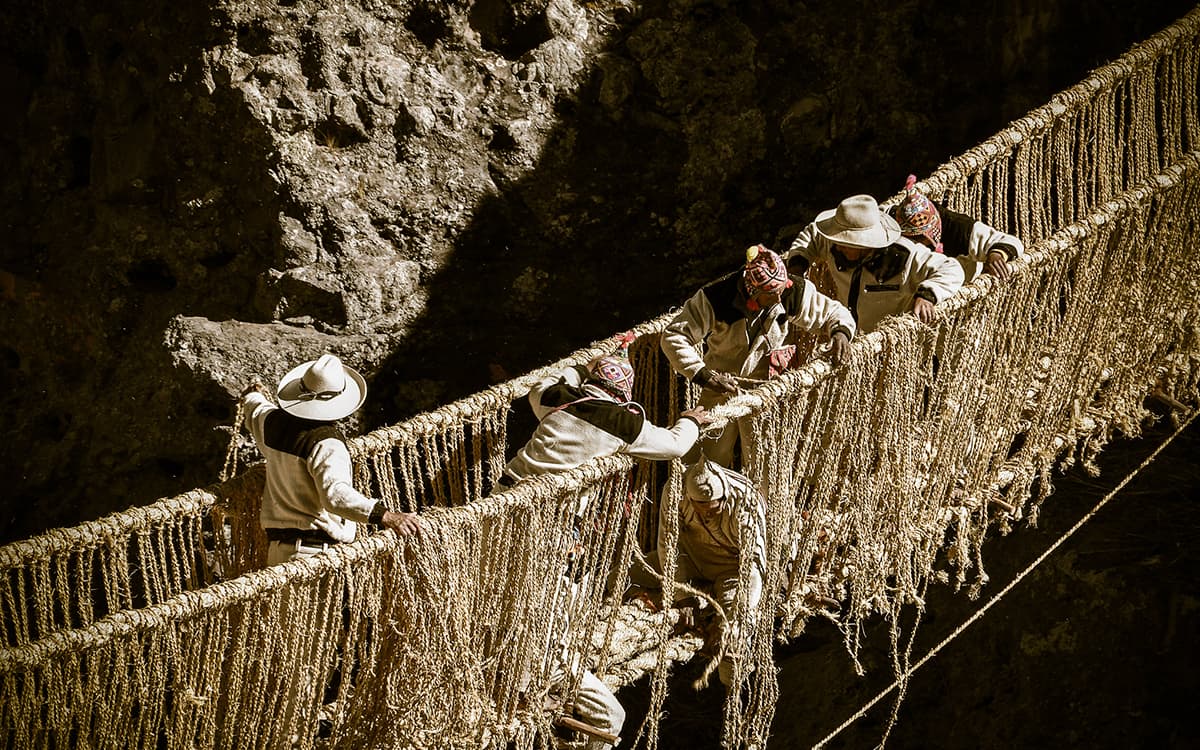
Photo: Qoriankatours.
Q’eswachaka, the last Inca bridge in use and also part of the extensive road network or Qapac Ñan, has been recognized by UNESCO as a Cultural Heritage of Humanity.

On Father’s Day, John’s family tried out an aerial adventure park that included a high bridge made of ropes and slats. I told my grandson I thought his picture looked scary, but that was before I knew about the Peruvian rope bridge in today’s article. It may be a UNESCO heritage site, but it looks unbelievably scary to me.

The Guardian via Reuters-Lima explains that local artisans are constantly reweaving the bridge over the river to keep it in good repair.

“Peruvians from the Huinchiri community in Cusco region are rebuilding a 500-year-old Incan hanging bridge, made using traditional weaving techniques to string a crossing together spanning the Apurimac river far below.

The Q’eswachaka bridge has been used for over 500 years to connect communities divided by the river. But during the Covid pandemic it fell into disrepair and collapsed in March.

“Members of the affected communities, such as the Huinchiri, decided to rebuild the 30-meter (98.43 ft) long bridge in the traditional Incan style: by weaving it.

“Teams of workers, starting from both sides of the ravine and balancing on giant main ropes that had been stretched over the river, worked towards the centre, putting in place smaller ropes as barriers between the handrail ropes and the walkway’s floor.

“ ‘Last year because of the pandemic, it wasn’t strengthened … That is why at the beginning of this year the bridge fell,’ said Cusco Regional Governor Jean Paul Benavente. …

“In 2013, Unesco recognized the skills and traditions associated to the reconstruction of the Q’eswachaka bridge as Intangible Cultural Heritage of Humanity.

” ‘This is history. More than 500 years of a paradox in time. The Q’eswachaka, this Incan living bridge, is really an expression and cultural manifestation,’ added Benavente.

“ ‘This is community, in this particular case, the Huinchiri community from the Quehue district is currently working to string up this bridge that connects villages, but that also connects traditions and connects culture.’ ”

For additional scary pictures, check out the Guardian, here. If you plan to visit, Qorianka Tours here, is one option.

By the way, you can see fascinating examples of UNESCO’s Intangible Cultural Heritage of Humanity designations, here. They include such curiosities as Al Aflaj, “traditional irrigation network system in the UAE, oral traditions, knowledge and skills of construction, maintenance and equitable water distribution” in the United Arab Emirates and tree beekeeping in Poland and Belarus.

Read Full Post »

102319-floss

Although I’m a fan of dental floss for the normal reasons, I had no idea that it could serve many purposes that have nothing to do with teeth.

In a story adapted from a Life Kit newsletter, National Public Radio’s Suzette Lohmeyer reports, “Dental floss can be used for more than just making you feel guilty and keeping gums healthy. It’s the Swiss Army knife of modern travel, according to Onebag.com’s packing expert, Doug Dyment.

“[NPR’s] Life Kit team poked around Dyment’s website for practical tips on the many other uses of dental floss. …

“Let’s start with using floss to deliver a baby, because … wait, what? It’s true. … Whether on a plane to Norway or on a sailboat to the Caribbean, just pull out the travel dental floss and cut the umbilical cord. … Other surgical ways to use it: to suture a wound, Dyment says. …

“And dental floss can get off those rings stuck on puffy fingers. Thread the floss under the ring and then watch this YouTube video for the rest.

“Dental floss makes an excellent knife substitute while you’re traveling as well, Dyment says. Try using it to slice foods like cake, cheese, watermelon and cookie dough. …

“Dental floss can be used to tie things. Try tying the bottom of your pants legs during a hike to avoid mosquitoes and ticks, or use floss to replace a broken shoelace. You can also thread floss through the hinge of a pair of broken eyeglasses.

“If you find yourself in the middle of the woods without matches, waxed floss can be used as a fire starter. And if you need to catch a fish to cook over that fire, floss can be used to bind a knife to make a spear or as fishing line and a snare. …

“For a broken toilet chain, replace it with dental floss (yes, it is strong enough). Have a drippy faucet that is keeping you up at night? ‘Tie a piece of dental floss around the end of the faucet, and let the water dribble down the dental floss so it won’t drip, drip, drip anymore,’ says Dyment.”

OK, I get that dental floss is strong. It has to be to get between my own very crowded teeth. But some of these tips require a level of skill that sounds like pie in the sky. I mean, could you spear a fish even if you had an actual spear?

More fun stuff at NPR, here.

Read Full Post »

The United States still has a primarily throwaway culture and has not caught on yet to the Dutch “repair café” concept or Swedish notions about a mall for recycling.

Which is why it probably took a New American to notice that there was a need.

As Isaiah Thompson reports at WGBH radio, “It isn’t entirely clear from looking through the big windows facing Dorchester Avenue, in the Field’s Corner neighborhood, what the business is.

“The only advertising is an inauspicious plastic sandwich board reading ‘Repair Service: From $30 and Under 30 Minutes, Walk-in Welcome.’

“Inside is a large, room, with electronic equipment stacked in bins along the wall and lying in piles around the floor, and a few guys hunched over cheap plastic tables. But what they’re doing is as much a fine craft as it is hi-tech.

“They’re fixing cell phones.

“These guys don’t work for Apple or Samsung, or any manufacturers. That’s the whole point.

“ ‘I’m not officially sanctioned by the manufacturer,’ explains Quang Le, who, with his friend and business partner Minh Phan, started this scrappy repair shop in 2015.

The shop, says Le, ‘exists because there’s a need, and they don’t satisfy it.’ …

“The need he’s talking about is ubiquitous: cracked smartphone screens.

“Samsung screens can cost hundreds of dollars to replace. iPhone screens can cost an Apple customer around $150. …

“ ‘When they come to my store it’s like 80 bucks … Wouldn’t you rather go to the store down the block? we do it in like five minutes!’

“Born in Vietnam, Le came to the United States as a foreign student when he was sixteen. ..

“Where most of us see broken glass, Quang saw opportunity. …

“Le realized that by teaching himself this one, super-difficult skill: separating the broken glass from working screens — he could get an edge – and make money.

“He and his partner Phan hired some friends. They bought heavy-duty glue-warming tables from China. They built a dust-proof chamber out of metal. And they taught themselves by watching Youtube videos – and by trial and error. …

“ ‘Like, we broke so many screens – like we broke probably hundreds of them, trying to do it,’ Le chuckles.” Read more here and see what ambition Le wants to tackle next.

Hat tip: The International Institute of New England, on twitter.

Photo: Isaiah Thompson/WGBH News
Quang Le has built a business doing phone repairs the tech giants would rather not bother with.
 

Read Full Post »

What to do about our throwaway culture? Well, Sweden has a proposal: tax breaks to encourage people to get things repaired.

Charlie Sorrel at fastcoexist.com explains that the idea involves “halving the tax paid on repairs and increasing taxes on unrepairable items. …

” ‘If we want to solve the problems of sustainability and the environment we have to work on consumption,’ Sweden’s finance and consumption minister Per Bolund told the Local. ‘One area we are really looking at is so-called “nudging.” That means, through various methods, making it easier for people to do the right thing.’ …

“The proposed legislation would cut regular tax on repairs of bikes, clothes, and shoes from 25% to 12%. Swedes would also be able to claim half the labor cost of appliance repairs (refrigerators, washing machines and other white goods) from their income tax. Together, these tax cuts are expected to cost the country around $54 million per year. This will be more than paid for by the estimated $233 million brought in by a new ‘chemical tax,’ which would tax the resources that go into making new goods and computers.

“In 2015, France passed a law requiring manufacturers to label products with information about how long spares will be available, and also requires free repair or replacement for the first two years of the product’s life. That’s another step forward, but it’s also cheaper for manufacturers to replace a broken cellphone than to repair it.

“Apple takes a third path—it swaps out your broken phone for a new one, often free of charge, and then breaks down your old unit, reusing its internals if possible, or recycling them.”

More here. Not sure how you benefit if you do the repair yourself. But knowing those Swedes, they’ll figure out something.

Photo: Geri Lavrov/Getty Images

Read Full Post »

Large quantities of clothes that are damaged in textile manufacturing end up in landfills. To organizations like Renewal Workshop, that seems like a waste. So they are stepping up to the plate, with real benefits to the planet.

“As discarded clothing piles up in landfills around the country,” writes the Huffington Post, “a handful of companies are trying to save some of those garments and give them new life.

“The Renewal Workshop is one of these. It takes shirts, jackets and other items damaged during manufacturing, then repairs and resells them for 30 to 50 percent off the original price, co-founder Nicole Bassett told The Huffington Post. Its goal is to prevent imperfect items, which traditional retailers can’t sell in stores, from being tossed in the trash. …

“Companies fighting clothing waste have their work cut out for them. The average American throws out 70 pounds of clothing or household textiles a year. Only 15 percent of that is recycled, according to a report by the Environmental Protection Agency. The other 85 percent ― around 13 million tons of textiles in 2013 ― ends up in landfills, where it decomposes alongside other solid wastes, releases greenhouse gasses and contributes to global warming.

“The Renewal Workshop is attempting to combat waste in the textile industry by ‘closing the loop,’ or trying to ensure new clothes are made from recycled or used garments. … It creates every single one of its products out of existing garments.

“The company partners with apparel companies like prAna, Ibex and Toad & Co, which are all outdoor clothing brands selected specifically for their commitment to sustainability, Bassett told HuffPost.

“The Renewal Workshop takes those brands’ damaged or returned clothes ― items with broken zippers, seam tears or missing buttons ― and then repairs, cleans and resells them at a discount.

“Apparel partners provide damaged items at no cost to The Renewal Workshop, and pay a partnership fee. When a customer buys a repaired garment, the partner business that provided it gets a portion of the sales, and the customer receives an item with the original company’s brand label and a Renewal Workshop label on it.” Read more here.

And ordinary folks can always help by giving old clothes to organizations that distribute nice ones to new users.

Photo: GaijinPot

Read Full Post »