Feeds:
Posts
Comments

Posts Tagged ‘restaurant’

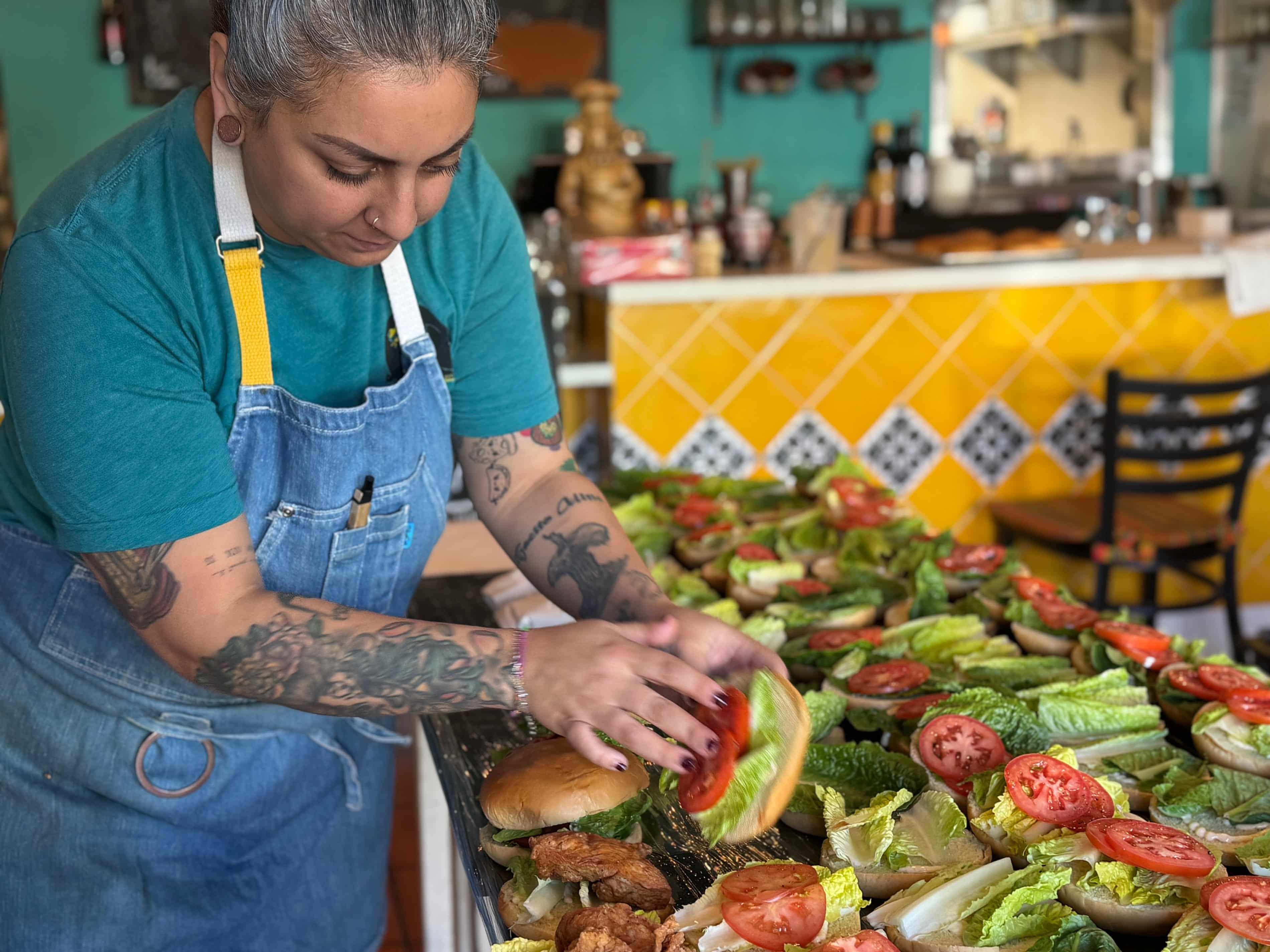
Photo: Danielle Duran Zecca/Amiga Amore.
Danielle Duran Zecca, co-owner of Amiga Amore in Highland Park, Los Angeles. 

Well, in one way, this is a time of great opportunity. There are endless opportunities in the US to meet the growing needs. Endless opportunities to practice charity in daily life.

A chef in Los Angeles knew opportunity as soon as she saw it. The revealing moment took the form of government officers in masks snatching people off the streets.

Victoria Namkung reports the story at the Guardian.

“When Danielle Duran Zecca saw military-style immigration raids and people being snatched off the streets and put into unmarked vehicles in her native Los Angeles earlier this summer, she was in disbelief. …

“Duran Zecca, a James Beard Award nominated chef and co-owner of Amiga Amore in Highland Park, a historically Latino neighborhood in north-east LA [said] ‘I didn’t know what to do, but I knew how to feed people and love on people because that is exactly how I was brought up in my family.’

“When several of Duran Zecca’s workers expressed fear about coming into the restaurant, the chef had a realization.

“ ‘If they didn’t want to leave their homes, how many others were like this and how many weren’t eating,’ she said. Earlier in the year, Amiga Amore received donations that allowed the Mexican-Italian restaurant to give meals away to those affected by the LA wildfires, but this time she would need a different approach, one that made people feel safe.

“Duran Zecca began personally delivering free meals to 25 to 30 people every other Sunday in nearby Boyle Heights. …

“Since ICE began to infiltrate LA in June, once-bustling neighborhoods have become quiet. Vendors locked up stalls in the flower district. Popular taco stands and fruit carts are closed and some restaurants sit empty. Although it is unknown exactly how many people are staying home due to Ice’s aggressive arrests, immigration sweeps at restaurants, farms, Home Depots and even car washes have created a chilling effect on businesses that rely on immigrant labor.

Restaurants such as Amiga Amore and other groups from the food and hospitality industry are stepping in to help people in their community who have nowhere to turn – even while their own businesses are suffering economically. …

” ‘Latinos are not only the backbone to our industry, they are the industry,’ said Duran Zecca. ‘Behind every chef are Latino line cooks ready to make magic happen. All they want to do is work, make a living and feed their families.’

“To make her deliveries twice every month, Duran Zecca receives logistical support from her good friend Damián Diaz, the co-founder of No Us Without You, an LA-based non-profit that provides food security for undocumented people, including back of the house staff from bars and restaurants.

“ ‘The administration has been doubling down on making it much more difficult for the families in the community and also small grassroots organizations like us to really be impactful,’ said Diaz. In the past, No Us Without You had drive-through lines for food distribution, but stepped-up enforcement made that impossible, so they pivoted to working with a coalition of restaurants to serve up to 40 families every fortnight so they can shelter at home.

“ ‘This environment of fear in light of increased enforcement, and really excessive enforcement, is causing folks to miss out on some very key necessities such as doctor’s appointments and going to the grocery store,’ said Rita Fernández director of immigration policy project at UnidosUS, a Latino non-profit advocacy organization. …

“This summer, Congress allocated $170.7bn in additional funding for immigration and border enforcement … creating what some critics call a ‘deportation-industrial complex.’ …

“That’s why many others in the restaurant and non-profit industry have also been mobilizing to bring groceries to immigrants who are in hiding. The Oaxacan-Mediterranean restaurant X’tiosu in Boyle Heights, one of the US’s most heavily Latino-populated neighborhoods, packed 150 bags of fresh produce, dried pasta and other goods that were delivered to people in need by local Oaxacan youth in June and they have continued to support undocumented families. The student-led group, Raíces Con Voz, coordinated food and care package deliveries to more than 200 families, and Aquí Para La Comunidad, which operates throughout southern California, has a growing waitlist.

“Vanny Arias decided to host an impromptu food drive in front of the Offbeat Bar in Highland Park, where she’s a bartender, after realizing people staying home were likely in need of groceries. … Arias organized with other community activists and volunteers to start dispensing basics.

“Once she launched an Instagram account, she started hearing directly from desperate families. ‘People said: “My husband got arrested” or “We’re afraid to leave the house and my kids haven’t eaten in days,” ‘ said Arias. ‘When you’re on the ground you see the hurt and pain in their eyes and hear it in their voices.’

“Since July, Arias’s Nela Food Distribution has grown to deliver free groceries to 150 people in and around Highland Park with the help of community donations, two local food warehouses, a bakery and a team of volunteers. ‘We’re a bunch of people who love their community,’ said Arias. ‘I don’t care what color you are, we’re freaking humans and I’m here for you. You’re not alone.’ ”

More at the Guardian, here. The Guardian is free, but please consider donating to them.
Read Full Post »

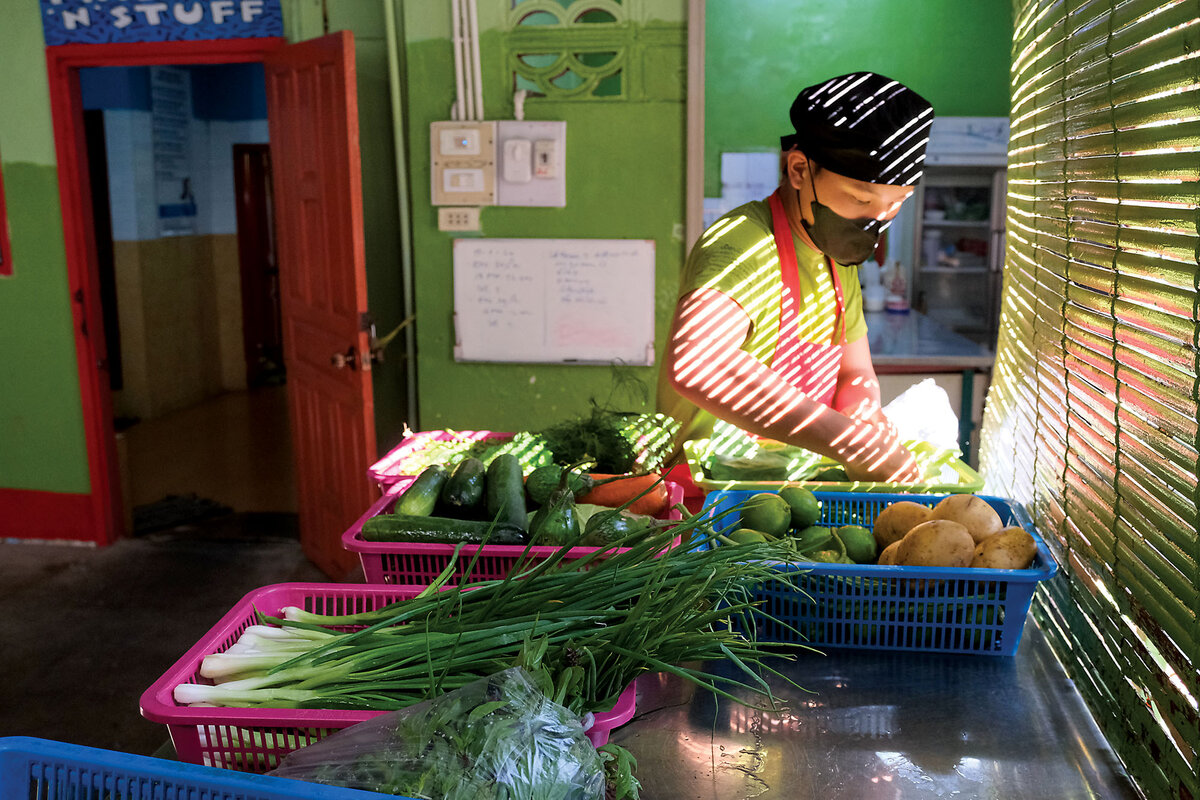
Photo: Zinara Rathnayake.
A student prepares vegetables before lunch begins at Mini-Makphet, a vocational restaurant in Vientiane, Laos.

I can’t read anything about Laos without thinking of the mystery series that Colin Cotterill wrote, which includes a plea for the poor of that country and for removing the explosive mines left by the US. Since today’s article is about training young restaurant workers in Laos, I’m particularly remembering the noodle shop in the mystery series, run by Daeng, the wife of investigator Dr. Siri Paiboun.

Zinara Rathnayake wrote the following story for the internationally focused Christian Science Monitor.

“Until about a year ago, Xue Xiong had never seen a town,” wrote Rathnayake. “She lived in a small village with a dirt road that turns muddy when it rains, making travel difficult. She dropped out of school early to help her parents farm rice and breed cattle to feed her 10-member family. 

“It was at Khaiphaen, a charming restaurant two hours away in Luang Prabang, that Ms. Xiong learned to dream. The Laotian fusion eatery trained her to prepare and serve food for the tourists who flock every day to the bustling city. 

“ ‘I want to save money and open my little Lao food stall, because tourists love Lao food,’ says Ms. Xiong, who is Hmong, one of Laos’ marginalized ethnic minorities. ‘Because I feel like I can do anything now.’

“Khaiphaen was opened by the Cambodia-based organization Friends-International and collaborates with the Lao government and other nonprofits to aid young people interested in culinary education as a path to more prosperous futures.

“Laos is one of Asia’s least-developed countries, and poor education and the lack of economic opportunities often force children and young people there to work in lower-paid, menial jobs under exploitative conditions. Many others are trafficked into factories or prostitution.

“At almost 10 a.m. on a chilly January morning, an hour before Khaiphaen opens for the day with plates of laab (spicy minced-meat salad) and beer-battered Mekong River fish, Ms. Xiong laughs as she watches her friend, another young woman, slice carrots. Ms. Xiong shows off her yellow T-shirt from Le Petit Prince, a nearby Korean cafe where she started working after Khaiphaen. She thinks the cafe’s owner is nice, her English is improving, and soon she will play the piano at the cafe, Ms. Xiong tells her friend.

“ ‘I see children tremble the first time they come to serve,’ says Khaiphaen’s restaurant manager, Anousin Phanthachith, ‘and then in a few years, you see them grow into entrepreneurs.’ He joined the team at Friends-International in 2014 when Khaiphaen was just a concept with a few dining tables, and he has never thought of leaving. ‘You feel fulfilled because you help many young people – especially children who come from remote, underprivileged communities, some of them with traumatic childhoods.’ 

“Nearly a third of Laos’ population lives in poverty, subsisting on less than $4 a day, according to 2022 figures from the World Bank. Children bear the brunt of it. Although Laos has made progress on child mortality, 43 out of every 1,000 children die before reaching age 5 – one of the highest child mortality rates in Southeast Asia (down from 154 in 1990). The government is pushing for primary education for all children, but the number of dropouts is high. 

“More than 130 students have graduated from Khaiphaen. Yet it is not a traditional cooking school, says Friends-International social worker Ae Thongkham. Besides waiting tables, students gain experience making noodle bowls with their teachers from scratch in the kitchen as well as preparing beverages. Mr. Thongkham adds that when students arrive from minority ethnic groups, many of them don’t speak Lao, the country’s official language. So at the social work center upstairs, students learn basic Lao and English, in addition to life skills such as managing their finances. 

“Students aren’t salaried but receive free training, accommodations, meals, transportation, and health care. After graduation, they are placed in hotels, cafes, and restaurants across Luang Prabang’s flourishing tourism industry.

“For Mr. Phanthachith, who left his village at age 18 and studied at a temple before working at the city’s restaurants, looking after his young students has always been the priority. ‘We always talk to our students even after they leave the program to make sure that they are in a safe workplace that benefits them and treats them well,’ he says.

“Khaiphaen is part of a series of vocational restaurants that Friends-International operates across Southeast Asia. Although some of the eateries shuttered during the coronavirus pandemic, Khaiphaen began delivering food to locals to stay afloat. In the capital, Vientiane, Khaiphaen’s sister restaurant Mini-Makphet turned into a soup kitchen, feeding underprivileged children and their mothers. Housed in a tin-roofed space with varnished wooden tables and chairs, Mini-Makphet is much more modest and mainly serves Vientiane residents.

“Ketsone Philaphandet, Friends-International’s country program director for Laos, is quick to highlight that Vientiane receives far fewer tourists compared with Luang Prabang. The quiet, industrial Lao capital serves only as a pit stop for many foreign travelers exploring the country’s far-flung karst mountain towns and vibrant cultural hubs. ‘So we keep our prices lower and food spicier,’ Ms. Philaphandet says, smiling.

“For many young people, Mini-Makphet is a social lifeline. Mala Thoj has worked at the restaurant for only two months but can already pour a latte with a little foam heart on top. ‘I feel happy here, because I have friends who support me,’ she says. She used to live with abusive relatives and was compelled to toil at a rubber estate. …

“Emi Weir, founder of the social enterprise Ma Té Sai, which sells handmade products crafted by Laotian women [notes] that although Khaiphaen lacks marketing to reach tourists who are ‘ready to spend more for a good cause,’ its program has excellent social work, training, and outreach initiatives.”

More at the Monitor, here. No firewall. You can learn a lot more about our world from the Monitor or The World, on radio, than you can from the Washington Post or the New York Times. Check them out.

Read Full Post »

Photo: Boston Globe.
Teenage phenom and pastry chef Piper McAloon.

Some folks are still figuring out their calling when they are on Social Security. Others, like this chef in Bristol, Rhode Island, discover it when they are 11 years old.

Andrea E. McHugh has the inspiring story at the Boston Globe, “When she was a little girl, Piper McAloon had a natural curiosity when it came to baking, and was influenced by popular pastry-centric reality television shows. In her family kitchen, her parents Robin and Patrick encouraged her culinary creativity. What was once an 11-year-old’s lighthearted hobby morphed into the now 17-year-old’s career path.

“The high schooler, who lives in Bristol with her parents and sister, maintains a vegan dietShe applied for a job at Foglia when the plant-based restaurant opened in the summer of 2022, hoping she’d land a server position. But when chef/owner — and fellow vegan — Peter Carvelli, who was just named a semifinalist for 2024 Best Chef Northeast by the James Beard Foundation, saw her self-taught pastry skills for himself, he had other plans.

Andrea E. McHugh: How did you hear about Foglia?
Piper McAloon: Someone told me that there was a new vegan restaurant opening and so I reached out, never thinking I’d be their pastry chef — maybe I’d be a waitress. And I told [Peter Carvelli] about all my baking, and he was like, ‘I want you to be my pastry chef.’ I was so shocked. …

Have you always adhered to a plant-based diet?
“I’ve been a vegetarian since I was 11, and I’ve been vegan for about the past two and a half years. I think I was just kind of losing interest in meat, and like, the ethics of it, and then I cut out dairy. It was a very slow process, and eventually, I cut out eggs and other products. I didn’t have to go vegan, but I’m glad I did. I feel so much better.

Dairy is used in a lot of baking. How did you learn about vegan alternatives when it comes to pastry?
“It’s a big learning curve, learning how to switch everything. I’ve gotten the hang of it, and there’s so many people doing it now. At Foglia, we’re also nut-free, so I can’t use almond milk or any cashew [products]. … I learned so much from videos online and YouTube, I would just absorb so much information. I’ll see something and be like, ‘Hey, I could do this with this or that,’ and completely just take the inspiration and make it my own. Ground flaxseed and water, it gets really thick, and you can use it to replace eggs in different recipes. Aquafaba is more for say, macarons, and whipping, like you would an egg white. …

How has this experience at the restaurant expanded your business skills?
“Oh, it’s awesome. My boss, Peter, is such a great mentor. We’re always working together and he’s very, very supportive of me doing my own thing. I’ve also done a couple of pop-ups at the restaurant. I create a limited menu and he lets me use the restaurant during the afternoon because they’re only open for dinner, and I set up kind of like a mini-bakery, and people come in to buy food and I do all the accounting for it, and he helps me. We use Toast [a restaurant point-of-sale and management system], and if I have a special order for someone, he’ll let me use the kitchen.

What are you making right now for Foglia?
“Panna cotta is one of the things that’s a staple right now. It’s gluten-free and really good. It’s kind of like a custard. Generally it’s made out of gelatin, but I use something called agar, which is big in vegan baking for pastry cream, actually. We also have what we call a brownie snowball. …

What do your future plans look like?
“I’m going to Johnson & Wales in the fall, the Baking & Pastry Arts associates program, and then eventually I want to open a vegan bakery. It’s two years, and right after that I want to, I don’t know, travel and experience food everywhere else, and learn from them, and then eventually, probably a couple years after college, open my bakery. I’m very excited about it — it’s been my dream since I was 10.”

More at the Globe, here. What did you want to be when you were 10? Did you do it? I think I wanted to be an actress. Or maybe a ballerina.

Read Full Post »

Photo: Restaurant of Mistaken Orders.

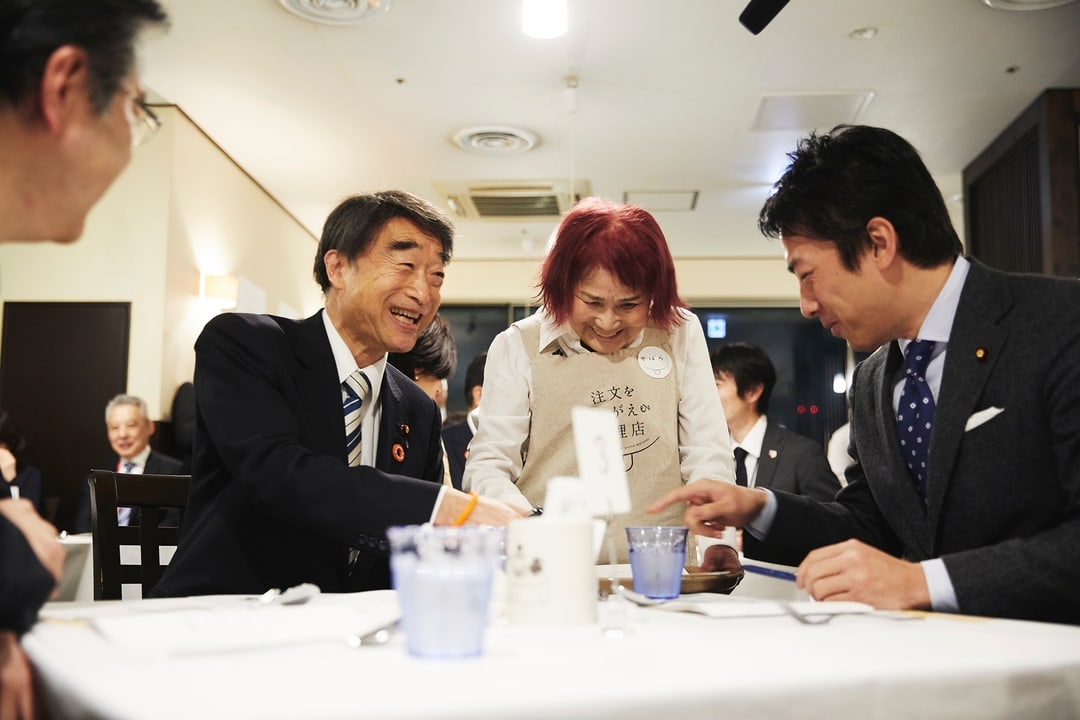
Our friend Toshi was lucky to have Yuriko to take care of his aging mother in their home. That was always the custom for daughters-in-law.

Nowadays, Japan has a greater percentage of people over 65 and not enough caregivers. So the Japanese are getting creative. Monthly “dementia cafes,” where elderly people can enjoy working, are a drop in the bucket. But charming.

Michelle Ye Hee Lee and Julia Mio Inuma report at the Washington Post, “The 85-year-old server was eager to kick off his shift, welcoming customers into the restaurant with a hearty greeting: ‘Irasshaimase!’or ‘Welcome!’ But when it came time to take their orders, things got a little complicated.

“He walked up to a table but forgot his clipboard of order forms. He gingerly delivered a piece of cake to the wrong table. One customer waited 16 minutes for a cup of water after being seated.

“But no one complained or made a fuss about it. Each time, patrons embraced his mix-ups and chuckled along with him. That’s the way it goes at the Orange Day Sengawa, also known as the Cafe of Mistaken Orders.

“This 12-seat cafe in Sengawa, a suburb in western Tokyo, hires elderly people with dementia to work as servers once a month. A former owner of the cafe has a parent with dementia, and the new owner agreed to let them rent out the space each month as a dementia cafe. The organizers now work with the local government to get connected to dementia patients in the area. …

“ ‘It’s so much fun here. I feel like I’m getting younger just being here,’ said Toshio Morita, the server, who began showing symptoms of dementia two years ago.

“A condition of unending indignities and financial burdens, dementia is a global phenomenon that every society is confronting. But in Japan, the world’s oldest society, dementia is a pressing national health challenge.

About 30 percent of the Japanese population of about 125.7 million is over 65. More than 6 million Japanese people are estimated to have dementia, and the number is expected to grow as high as 7.3 million — or 1 in 5 people over the age of 65 — by 2025, according to the Health Ministry.

“Japan’s chronic lack of caregivers and the soaring costs of elderly care mean it needs to find creative ways to empower these dementia patients so that they can be mentally and physically active for as long as possible, rather than isolated at home or at a hospital.

“Dementia cafes [were] introduced in Japan in 2017 through pop-up events, but more permanent efforts are now cropping up throughout the country.

“In June, Japan passed legislation to enact a slew of new programs and services to help those with dementia, which Prime Minister Fumio Kishida has identified as an urgent national project. …

“Kazuhiko, a 65-year-old diagnosed with dementia five years ago, has been working at the cafe every month. … At one point, Kazuhiko was heading to a table with an order but became distracted when the construction crew outside made a loud noise. He proceeded to leave the cafe and move toward the sound, and the staff rushed to bring him back in. …

“Kazuhiko rarely talks or shows emotion anymore. He usually doesn’t make eye contact with customers until he sees them multiple times. But that day, he showed a smile.

“The smile was directed at Tomomi Arikawa, 48, and her 16-year-old daughter, Sayaka, who visited around noon for a piece of chiffon cake and a citrus jelly dessert. … Kazuhiko brought them their orders. Sayaka thanked him and smiled, and he smiled back. ‘It felt really special,’ she said. …

“Since April, the Cafe of Mistaken Orders has opened once a month around lunchtime. One dementia patient works as a server per hour, wearing an apron that is bright orange, the color associated with dementia care. There is a chair set aside for them near the kitchen so they can rest in between orders.

“Younger volunteers help the elderly servers as they mark customers’ orders on the order forms, which are simple and color-coded.

“Table numbers were difficult for the elderly to remember, so the staff switched them out for a centerpiece with a single flower, a different color for each table.

“The cafe’s administrators wanted to help the community see that dementia patients can prolong their active years, with a little bit of understanding and patience from those who interact with them. …

“ ‘I hope that our initiative will give people with dementia something to look forward to,’ said Yui Iwata, who helps run the cafe. ‘If people get a deeper understanding, it would become easier for people with dementia to go out, as well.’ ”

More at the Post, here. Or just check out the restaurant’s site, here.

Read Full Post »

Photo: Joe Buglewicz for the New York Times via OddityCentral.
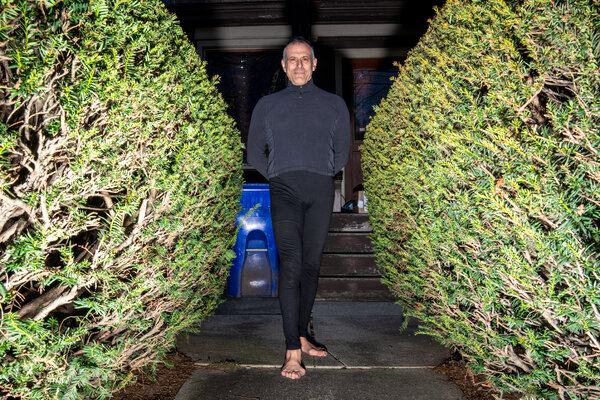
Joseph DeRuvo has gone barefoot for years. He says going barefoot means being mindful of how you move through the world. (And washing well at night!)

Here’s an unusual guy worth writing about. We can always learn something interesting from the outliers in our society. Let me know what you think. In my case, this guy makes me wince just thinking about all the stubbed toes I had as a barefoot child on Fire Island.

Katherine Rosman reports at the New York Times, “A few years back, Joseph DeRuvo Jr. made a quick stop at an upscale supermarket to buy eggs and was stopped in the dairy aisle by a store manager. ‘You’re not wearing shoes,’ he recalled the manager saying to him.

“He was right. Mr. DeRuvo wasn’t wearing shoes. He almost never does. The employee cited health codes; Mr. DeRuvo disputed that he was in violation. The employee made vague references to insurance policies; Mr. DeRuvo replied, ‘More people break their necks with high heels than they ever do going barefoot.’ …

“Mr. DeRuvo initially decided to forgo shoes because of agonizing bunions, but he has stayed barefoot for reasons that transcend physical comfort. …

“There are questions he is asked frequently that he is always happy to answer. How does he manage snow and ice? Doesn’t he get sharp objects stuck in his thick calluses? But that’s the simple stuff. ‘Navigating the terrain is easy,’ Mr. DeRuvo said. ‘Navigating people is tricky.’

“When asked to leave a shop or a restaurant, he normally does so without protest, said Mr. DeRuvo’s wife, Lini Ecker, a shoe-wearer who serves as a bridge between her husband and a world that generally asks for conformity. …

“For two decades, Mr. DeRuvo, 59, has lived an almost entirely barefooted life, one he has constructed, with Ms. Ecker’s help, to limit or avoid such confrontations. After years spent as a photographer and a photography teacher, he is still self-employed, now as a Pilates instructor, a particularly barefoot-friendly profession. And the couple stays close to home. When they go out, they gravitate toward mom-and-pop stores and restaurants where they can forge personal connections with owners and managers, and he can be seen as more than the guy with the feet.

“Still, said Ms. Ecker, 61, ‘we get thrown out of a lot of places.’ … Ms. Ecker, a preschool teacher, prepared lunch, lightly grilling bagels in a cast iron pan, slicing avocados, tossing a salad. Mr. DeRuvo grabbed a pair of chop sticks, his preferred cutlery. This is among his ‘quirks,’ as he calls them. He needs reggae music to play in the background at almost all times; the only numbers he can remember are of radio stations, which he uses for internet passwords.

“ ‘I clearly have one foot on the spectrum,’ he said earlier (though he clarified that he has never undergone an autism evaluation).

“Mr. DeRuvo’s lifestyle has given him reason to think a lot about bare feet, assessing their safety and hygiene and whether they threaten polite society. He can come up with no health risk. What germs can his feet carry that the bottom of someone’s shoes do not? …

“Mr. DeRuvo assumes all risk of stubbed toes, or worse. He has performed a number of jobs all in his bare feet and all safely. He is a tinkerer and a maker, including of his own Pilates equipment that he fabricates in the elaborate workshop he built out of the garage behind his house, sometimes wearing safety goggles but rarely shoes. (He will wear moccasins while welding.)

“In case he steps on something sharp, he carries a sunglasses case filled with tweezers to remove detritus, pulling his feet close to his face to spy metal splinters and shards of glass. He showers at night, scrubbing his feet clean before getting into bed with his wife.

“And he knows when to capitulate, he said, keeping a pair of loosefitting sandals in the car in case there is an event where others would be inconvenienced by him getting refused entry, like when they go to dinner with friends.

“But generally Mr. DeRuvo chooses the comfort of his feet over doing anything or going anywhere that forces him to force them into a pair of shoes.

“Bare feet outside of the beach, the yoga studio or the pedicure chair tend to attract attention. … ‘People have a thing about feet,’ Mr. DeRuvo conceded. ‘People get skeeved.’

“Mr. DeRuvo’s look like they would hurt inside a pair of shoes: His big toes, with a protruding large bump at their bases, jut aggressively toward the pinkie toes on a diagonal.

“The bumps are bunions. About 20 years ago, they had become painful — throbbing during long runs in tight sneakers and interfering with his life. Mr. DeRuvo saw a doctor who recommended surgery. As he awaited the scheduled procedure, he went without shoes because the pain was so intense. In the intervening days he learned that the screws that were to be implanted in his feet contained a metal he was allergic to. He also realized that he felt better since he quit shoes.

“It did not take long before he came to see that going barefoot was enriching his life in ways he did not anticipate. There were physical benefits in addition to the relief for the bunions: He found comfort from the ground beneath him. ‘The tactile feedback just kind of makes everything else going on feel a little bit smoother,’ he said.

“There are spiritual benefits too, said Mr. DeRuvo, a religious man. ‘God says to Moses, “Take off your sandals,” you know, “this ground is holy,” ‘ he said. ‘Well, I kind of like to take that as far as it can go.’ ”

More at the Times, here.

Read Full Post »

Photo: Teagan Ferraby/ Unsplash.
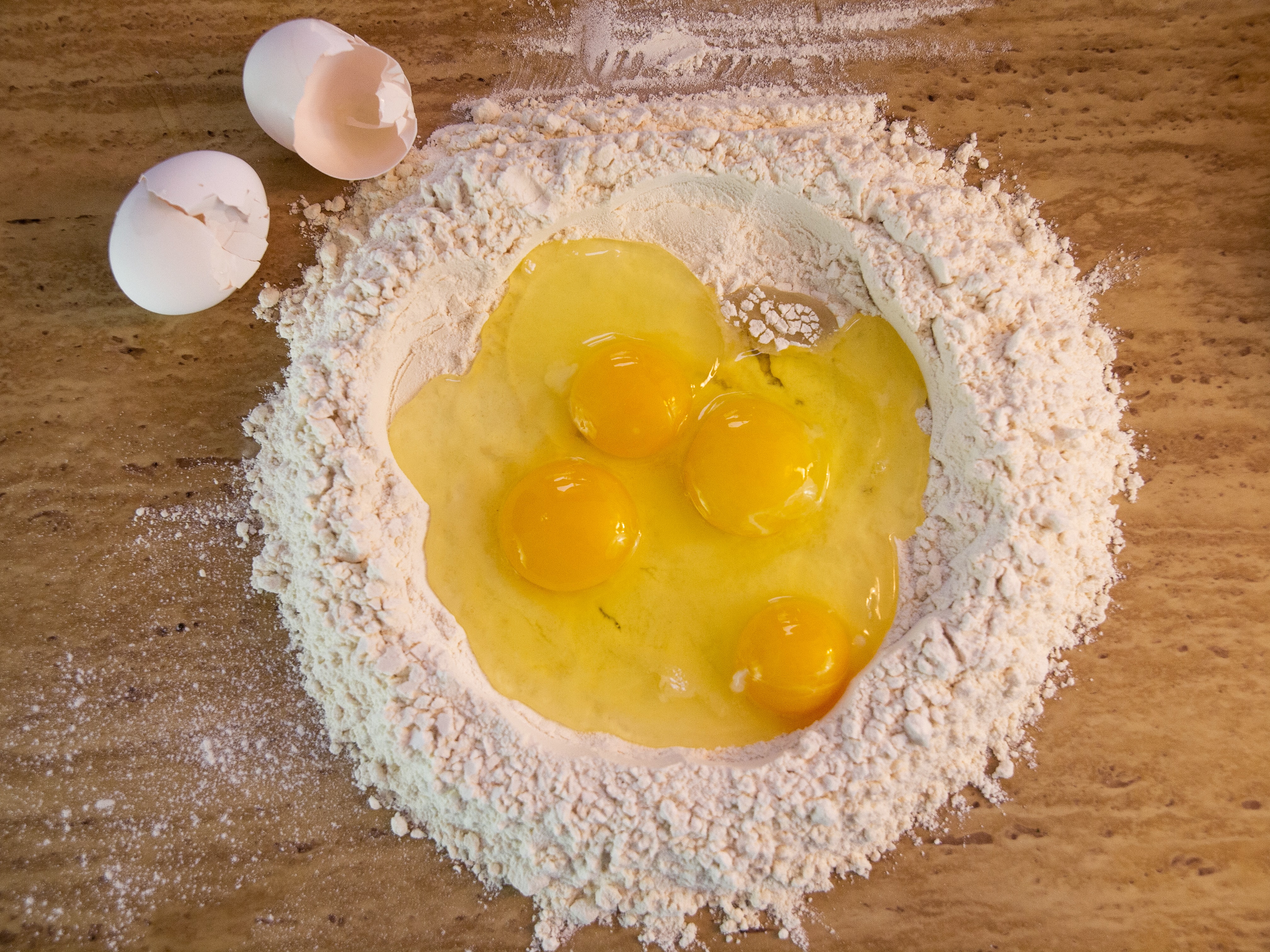
Making pasta from scratch.

This one is for my friend Sandra, who makes many Italian dishes the way her mother taught her. For example, she makes a labor-intensive pasta at Christmas in quantities that can feed a large extended family, including great great nephews.

Sydney Page writes at the Washington Post, “After all the food is served at this New York restaurant, customers clap for the grandmother who cooked it. It’s not scripted, but it happens every night.

“The Staten Island establishment, run by women known as ‘nonnas of the world,’ is as much a celebration of the people who toil in the kitchen as the places they hail from. …

“There are about a dozen women who cook regularly at Enoteca Maria, a casual 30-seat Italian eatery. Its menu is made and executed by a rotating group of international women, most of whom are matriarchs.

“The nonnas — the Italian word for grandmothers — include Maria Gialanella, 88. She has amassed such a following that some customers come only on nights they know she is in the kitchen. She even has her own Instagram page.

“Seeing strangers taste her culinary creations, she said, gives her immense pleasure and pride.

“ ‘Everybody likes it, so I’m very happy,’ said Gialanella, an Italian immigrant known for making ravioli by hand, rich ragus, soups and other family recipes she learned growing up near Naples.

“Gialanella, who moved to the United States in 1961 and worked as a seamstress, said that 10 years ago, her daughter heard about Enoteca Maria and encouraged her to become a cook there.

“ ‘It’s nice with the other nonnas,’ said Gialanella, who has six grandchildren. ‘I like every food.’

“Restaurant owner Joe Scaravella is a huge fan.

“ ‘She is not even 5 feet tall, but she’s a powerhouse,’ said Scaravella, who opened the eatery in 2007. ‘She goes around and does selfies. She spends the night hugging people.’

“Initially, you had to be an Italian grandmother like Gialanella to join the kitchen staff, but about nine years ago, Scaravella decided to broaden the cooking criteria.

” ‘They just have to be women that can bring their culture forward,’ he explained, adding that the cooks — all of whom are called ‘nonna’ by patrons, regardless of their background — range in age from 50 to 90, and possess a deep knowledge of their culture’s unique cuisine. While most are grandmothers, some are not. …

“In the beginning, the restaurant served only Italian fare — to reflect Scaravella’s roots. He opened the eatery after losing several family members, including his grandmother and his mother, both born in Italy, as well as his sister. They were all excellent cooks, he said. …

“At the time, Scaravella had spent more than 17 years working for the Metropolitan Transportation Authority and had no experience running a restaurant — let alone working in one.

“ ‘I had no idea what I was doing,’ he said. ‘No business plan or anything.’

“On a whim, he used the money his mother, Maria, had left behind to purchase a vacant storefront and decided to name his new restaurant after her. … Scaravella wanted his restaurant to serve the traditional Italian classics that he was desperately missing. It was the women in his family who dominated the kitchen.

“ ‘There were a lot of ladies at home that had all this information,’ said Scaravella. His mother and grandmother, for instance, knew ‘the secret to a good meat ball’ and ‘how to repurpose stale bread.’

“ ‘My whole life, I never wanted to go to an Italian restaurant, because it just never hit the spot,’ he continued. ‘These ladies, they’re the source. They are the vessels that carry this information forward.’

Given that his own matriarchs were gone, Scaravella embarked on a quest to find some nonnas who could prepare authentic, warming meals. …

“Before opening the restaurant, Scaravella put an advertisement in the local Italian American newspaper, seeking nonnas who could cook regional dishes from different parts of Italy. He was stunned by the response.

“ ‘I invited these ladies to my home. They showed up with plates of food,’ said Scaravella. ‘That was really the birthplace of the idea.’

“From there, he opened Enoteca Maria’s doors, staffing the kitchen with genuine nonnas who prepared everything from lasagna to chicken cacciatore. The concept, Scaravella said, was meant to mimic the experience of going to his nonna’s house for a meal.

“ ‘There’s a certain safeness when you go to your grandmother’s house, generally,’ he explained. ‘That is a strong memory and it’s very comforting, and I just really needed to be comforted.’

“The restaurant quickly took off. A few years later, Scaravella began inviting grandmothers from other cultures to cook their classics in his kitchen, and it got even busier.

“ ‘There are so many different people from so many different cultures,’ he said. ‘It just made sense to feature everybody’s grandmother.’ …

“Scaravella and the restaurant manager, Paola Vento, organize the weekly schedule and work with the nonnas to determine the menu. Typically, visiting nonnas are hired to cook at the restaurant about once a month, Scaravella said, though some come more often, and others come only once or twice a year.

“ ‘My favorite part of the job is getting to work with the grandmothers,’ said Vento, adding that the daily highlight is when customers clap for the visiting nonnas at the end of the evening. ‘You have to see the faces of the nonnas. They are so proud and so excited that they were able to share a part of their culture through food.’

“Many of the nonnas, Vento said, have become close friends. Although they speak different languages and come from different places, they have found ways to bond — mainly, through food.

“ ‘There’s a lot of love in the room,’ she said.

“To become a visiting nonna, there is one criteria: ‘They have to have a love for cooking, and that’s it,’ Vento said.

“While there is no required test, many prospective cooks attend a one-on-one free class offered at the restaurant called ‘nonnas in training.‘ …

“While Scaravella misses his own nonna, he said that his heart — and stomach — feel full again. What started as an effort to reconnect with his roots has allowed others to do the same.

“ ‘It’s hundreds of years of culture coming out of those fingertips,’ he said. ‘It’s beautiful stuff.’ ”

More at the Post, here. Can anyone share a picture of their grandmother in the kitchen? One of mine sold jellies, but I don’t have a photo.

Read Full Post »

Photo: Tadek Kurpaski.
A sauropod at the Carnegie Museum in Pittsburgh, Pennsylvania.

Who doesn’t love a dinosaur — at least, now that dinosaurs are extinct? Wouldn’t it be fun to discover evidence of one like the people in today’s story? At the Washington Post, Dave Kindy reports that In recent years, a number of major dinosaur finds have occurred by happenstance.

“A diner sitting in the outdoor courtyard of a small restaurant in China’s Sichuan province happened to look down at the ground and spot something unusual. It appeared to be a dinosaur footprint.

“[In July], Chinese paleontologists confirmed that the diner was right. The depressions had in fact been left by two dinosaurs. …

“Using a 3D scanner, scientists determined that the tracks were made by sauropods — large herbivorous dinosaurs with long necks and four legs. According to Lida Xing, a paleontologist at China University of Geosciences who led the team investigating the site, these footprints were probably made by the species Titanosauriformes. The footprints are about 22 inches long on average, and the dinosaurs probably measured about 26 feet long and weighed more than 2,000 pounds, Xing told the Washington Post.

“While not an everyday occurrence, the discovery of dinosaur footprints happens on occasion in China — just not in urban environments.

“ ‘Sauropod tracks are not rare in Sichuan Basin … but they are very [rarely] found in restaurants in downtown,’ Xing said in an email. …

“But this wasn’t the first accidental discovery of dinosaur remnants in recent years. Take, for example, the case of Mark McMenamin, who was walking across the campus of the University of Massachusetts at Amherst last year. He and his wife collected stones at a construction site, then later noticed one of them appeared to be a fossil. It was, in fact, the elbow bone of a 30-foot-long predatory dinosaur known as a neotheropod. …

“Then there was the discovery of a well-preserved dinosaur ‘corpse,’ unearthed by miners in Canada. While excavating at the Suncor Millennium Mine in Alberta in 2011, they stumbled upon the fossilized remains of a Nodosaurus, a heavily armored creature. … Displayed for the first time in 2017, it is considered one of the best-preserved dinosaur fossils ever found.

So complete are the remains that scientists at the Royal Tyrrell Museum in Alberta were able to examine the contents of its stomach, including twigs, leaves, mosses, pollen and spores.

“Last year, archaeologist Marie Woods was looking for clams on the beach in Yorkshire, England, when she spotted something unusual: the [footprint] of a species of theropod. A dinosaur similar to a Tyrannosaurus rex, this ancient reptile also stood on two legs and was carnivorous. It was the largest footprint of its kind ever found in that part of England, reported the Good News Network. …

“In 2011, paleontologists in China encountered a big rock with a fish fossil on the surface. They hauled it back to the lab, where it sat for about a year, according to New Scientist. Then the researchers decided to crack it open.

“To their amazement, they discovered inside the remains of a mother ichthyosaur [giving] birth to three babies. One was already out of the womb, another was halfway out, and the third was waiting for its chance.

“This fossil find altered the view of when dinosaurs began having live births. … Ichthyosaurs, which evolved from land-based creatures, proved that dinosaurs had moved on from egg-laying much earlier than previously believed.

“ ‘This land-style of giving birth is only possible if they inherited it from their land ancestors,’ one of the researchers told Live Science. ‘They wouldn’t do it if live birth evolved in water.’

“Back at the restaurant in Sichuan province, [the] owner was anxious that news of the primordial find would impact her business serving homestyle meals based on local cuisine. However, she has since embraced the media hype.

“ ‘She was initially concerned that she would attract a lot of curious people and affect the restaurant’s traditional customers,’ Xing wrote. ‘But now she understands the change and is ready to roll out some dinosaur track-themed treats.’ ”

I love the names of dinosaurs and how children can recite many of them at a very young age — their first introduction to ancient Greek. When John was five, he would chant dinosaur names to baby Suzanne to make her laugh. She thought they sounded funny.

More at the Post, here.

Read Full Post »

Photo: Stephen Humphries/Christian Science Monitor.
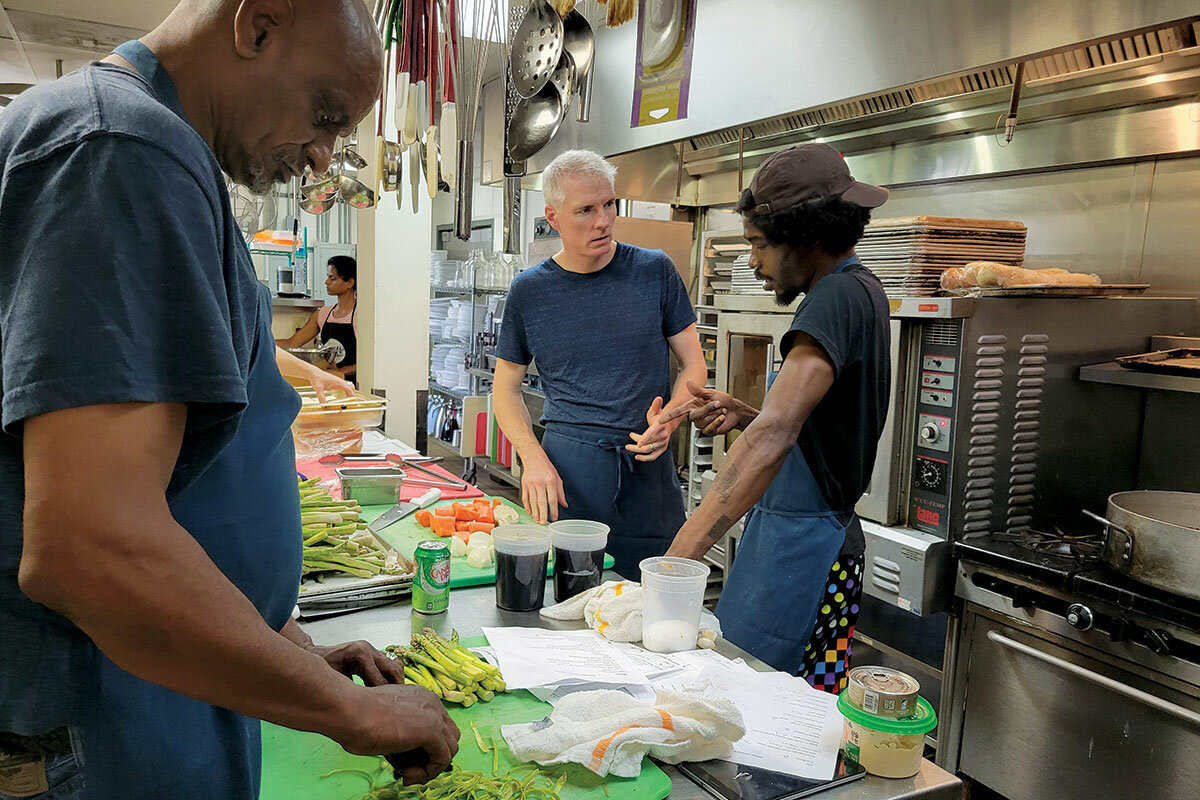
Chef Brandon Chrostowski (center) teaches trainees inside the kitchen for Edwins Too, one of his two French fine dining restaurants on the East Side of Cleveland.

When you take a wrong path in life, does it have to determine everything that happens later? At the Christian Science Monitor, Stephen Humphries writes about a chef who is making sure that some people are successful when they start over.

“Brandon Chrostowski is telling his origin story for probably the thousandth time. He’s pacing the stage of a local high school, holding his microphone with the confidence of a rock star. Mr. Chrostowski is a distinguished chef – he was a restaurateur semifinalist in the 2022 James Beard awards – and founder of a Cleveland restaurant with a philanthropic mission. Yet he’s ambivalent about all the acclaim. He’s tasted what it’s like to be stripped of dignity. At 18 he was arrested for fleeing and eluding the police. He and some friends had been in a car with drugs they intended to sell.

“ ‘I learned a lot of things. One, the dehumanization in the criminal justice system,’ he tells the students at Gilmour Academy. ‘Also, the idea of freedom. You don’t really know what freedom is until you lose it.’

“A lenient judge decided against sentencing him to prison. Mr. Chrostowski has never forgotten that he was fortunate not to serve a 5-to-10-year sentence. It’s the reason he launched Edwins Leadership & Restaurant Institute on Cleveland’s East Side. 

“What makes Edwins unique isn’t just its French cuisine, but its workers – they’re formerly incarcerated adults. Over six months, those in training learn skills for employment in the culinary world. More than that, Mr. Chrostowski tries to draw out a sense of self-worth in those who’ve served time by showing them how to attain excellence. 

‘The single hardest thing we have to do at Edwins is really build esteem in someone that has lost that, or that sense of humanity, through incarceration,’ says Mr. Chrostowski.

“Hours before giving his speech at the high school, Mr. Chrostowski strides into a kitchen where two trainees are singing along to a Bobby Womack tune on the radio. Tying a half apron around his waist, the chef quickly assesses a hunk of braised beef inside a pot as large as a bassinet. …

“As Mr. Chrostowski shares tips with Richie, he picks up a knife and demonstrates how to slice asparagus. In 2017, Edwins was the subject of an Oscar-nominated short documentary titled Knife Skills. …

“Abdul El-Amin enrolled in the program in June after being incarcerated for 20 years. ‘When you come here, it is sincere. You’re welcome. You can feel it,’ he says after his first two weeks of training. He adds, ‘I’m seeing so many other opportunities that I didn’t think about when I was incarcerated.’

“That’s not to say the program isn’t demanding. Over 2,000 people have trained at Edwins since its opening in 2013. Of those, only 600 have graduated because most drop out, often within the first two weeks. (They’re always welcome to reapply.) The program boasts a 95% employment rate for its alumni, and fewer than 1% of graduates are re-incarcerated. Star pupils have gone on to work in restaurants across America and even in France.

“ ‘[Mr. Chrostowski] really doesn’t care what walk of life you’re from, who you are, what you’ve done,’ says William Brown, a staff member at Cleveland’s Community Assessment & Treatment Services, a rehabilitation organization that enrolls promising individuals in the Edwins program. ‘He wants to see you succeed. And he will go the extra mile.’ 

“Mr. Chrostowski has a hectic daily schedule. During peak restaurant rush hours, the chef admits to hurling pans in frustration, but they’re not aimed at anyone. … He pursues the exacting standards he learned as an apprentice at restaurants such as Charlie Trotter’s in Chicago, Le Cirque in New York, and Lucas Carton in Paris. He rose fast. But he’s never forgotten his first break. In the late 1990s, a Detroit chef named George Kalergis took him in while he was still on parole. 

“Years later, Mr. Kalergis called from Detroit with bad news. A man named Quentin, who’d learned the rudiments of restaurant cooking alongside Mr. Chrostowski, had been stabbed to death. …

“ ‘I started to think, “How is it possible I’m here, and others are not?” ‘ says Mr. Chrostowski. … He wanted to help others, just as Chef Kalergis had helped him. But it took another decade of working in restaurants – including a move to Cleveland in 2008 – before he was able to raise the money to fulfill his vision.

“Mr. Chrostowski came up with the name, which is shorthand for ‘Education wins.’ Edwin is also the chef’s middle name. A few years after moving to Cleveland, he opened his restaurant in a historic, racially diverse area called Shaker Square. In 2020, he expanded by opening a second restaurant, Edwins Too, on the opposite side of the town’s leafy square. He’s also launched a French bakery and a butchery. The expansions have helped the area become a dining destination. 

“Just off the main street in Shaker Square, Mr. Chrostowski proudly shows off his latest project, which will become a child care center. ‘We’ve raised about $250,000 for a family center or day care,’ he says. ‘Free day care for staff and students, because 80% of our students with children don’t finish. It’s a big number and we want to change that.’

“The chef also wants to help outside Ohio. In April he traveled to his ancestral home of Poland to cook for refugees fleeing Ukraine. He’s also created a 30-hour curriculum and distributed it on 400,000 tablets to prisons in the United States. Dee and Jimmy Haslam, co-owners of the Cleveland Browns football team, will pay for transportation for anyone in the U.S. who completes the virtual instruction and applies to join the Edwins program.”

More at the Monitor, here.

Read Full Post »

Photo: Mile Marker One.
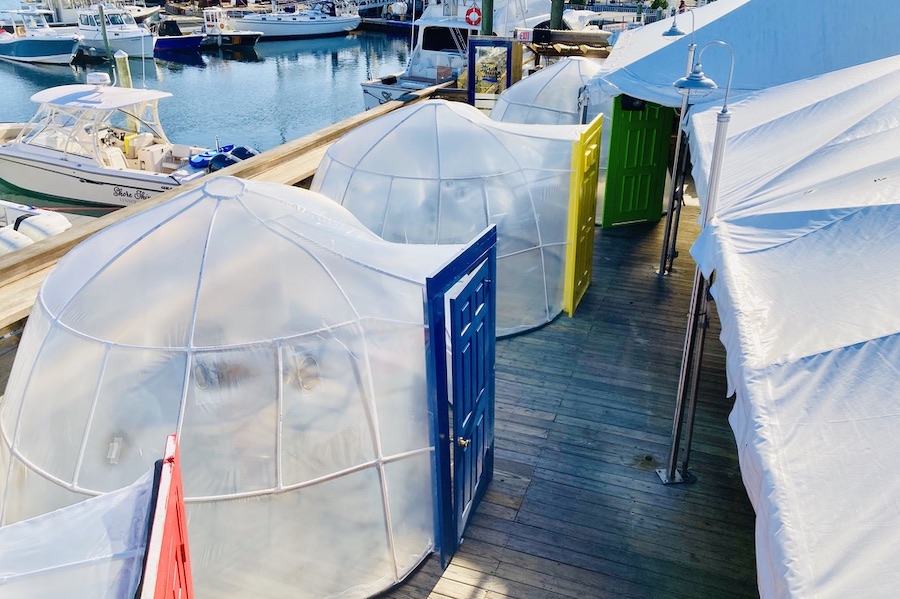
Igloos at Mile Marker One restaurant in Ipswich, Mass.

Plenty of people I know are eating indoors at restaurants again, but I’m still too Covid-phobic. I want to support restaurants by doing takeout, but I am not going to take off a mask indoors unless I know that everyone in the building is triple vaccinated.

One innovation during the pandemic has been the tent for outdoor dining. Although some of those tents look too enclosed for your faithful hypochondriac, I thought it was interesting to read what Carolina A. Miranda had to say at the Los Angeles Times about their evolution.

She wrote, “Over the course of the last year, I’ve eaten enchiladas in a party tent. I’ve gotten COVID-tested in a party tent. I spent a night dancing to house music in a party tent. I’ve seen party tents double as retail shops, church naves, gymnasiums and outdoor living rooms. …

“Last year, as the pandemic isolated us into our respective domestic cocoons, designers took to their AutoCAD to imagine a brave new world of design ‘solutions’ for the pandemic. These included wearable head-to-thigh social distancing shields and space-age cones [But] we’ve learned infinitely more about how to rethink the design of our buildings from the pandemic’s most prominent workhorse: the party tent. …

“It can be staked into soil or anchored on pavement. The simplest models, a standard canopy, can shield you from the sun; more protective ones come with collapsible walls that can be adapted to the weather as needed. …

“The party tent is symbolic of all the other improvised architectures that have arisen during the pandemic: the parking lots turned into eating spaces with twinkle lights and umbrellas; the wooden dining platforms crafted out of plywood and two-by-fours; the izakaya on La Brea whose collapsible walls are actually transparent shower curtains. In Echo Park, Misty Mansouri, the owner of the Lady Byrd Café, has turned an impractical triangle of concrete on her property into an al fresco dining room courtesy of an ebullient agglomeration of Christmas trees and portable greenhouses employed as individual dining pods.

“Temporary structures can even be found in hyper-glam iterations — like the space-age, vented dining pod at Wolfgang Puck’s Spago in Beverly Hills. A 6,500-square-foot modular dining room constructed in the middle of Canon Drive, it was created by VX Design Solutions, a custom fabrication studio, and Choura, an event production company, and was assembled in less than a week. That structure opened in March 2021 and is still going strong. ‘We fill it up every single day,’ says Steve Scott Springer, the restaurant’s general manager.

“Party tents may not be around for the long haul, but they have qualities that are worth integrating into the hardscape of our cities. They offer flexibility and permeability and serve as a reminder that in the mild Southern California climate we don’t always need to encase ourselves in hermetically sealed cells of HVAC. If well-building design issues such as fresh air and sunlight had been gaining currency before the pandemic, COVID-19 and its many variants have made it a matter of urgency.

“ ‘Being able to kick open the doors makes people who are inside those doors feel so much better,’ says architect Oonagh Ryan, founding principal of ORA, an L.A.-based studio that has worked extensively in the commercial and hospitality sectors. ‘And operable windows, those are key.’

“One of ORA’s most recent projects is the design of Agnes, a popular Pasadena comfort food outpost that also contains a cheese shop. Housed in a 1920s stable once employed by the Pasadena fire department, the bulk of the restaurant’s design was conceived before COVID, but a number of programmatic choices made since the pandemic began have helped make the space more resilient.

“The key is flexibility. The street-facing side has operable windows and the rear of the dining room has sliding doors that can be propped open to connect with a patio out back, drawing fresh air through the building. A private dining room likewise opens to the elements. The patio, which harbors additional seating, is protected by a weatherproof canopy that can be pulled back when the weather is mild. It’s an outdoor space that can be used come rain or come shine. And the furniture isn’t fixed, so it can be reconfigured into different densities. …

“When the restaurant opened in June, the surge of COVID-19 infections had tapered off and indoor dining had resumed. But the pandemic made the coming months wildly uncertain, meaning that the design needed to be responsive to shifting health directives. ‘If the pandemic was still going strong,’ Ryan says, ‘we had a plan for how we could rearrange everything into more retail.’ ”

“If the pandemic was still going strong.” Is it? Who knows?

You get several free articles at the LA Times, here, if you’re not a subscriber. I think you will enjoy the variety of party tents in the photos.

Read Full Post »

Photo: Kara Holsopple, The Allegheny Front.
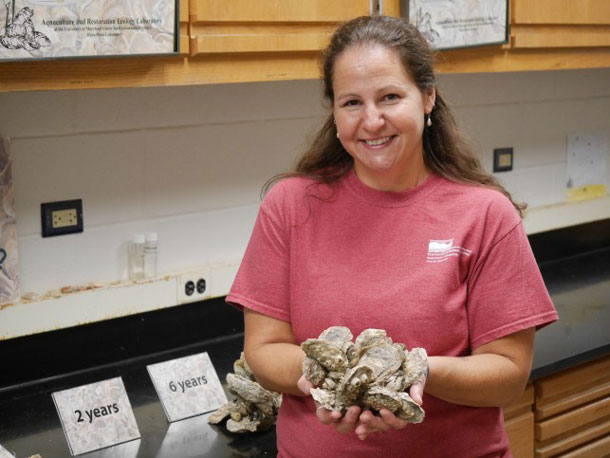
Stephanie Alexander at the Horn Point Lab oyster hatchery. Lawn chemicals pollute Chesapeake Bay. Oysters fight back.

Today I want to expand on my 2019 blog post about New York City’s Billion Oyster Project, which uses restaurants’ discarded oyster shells to fight erosion in the harbor.

According to a July broadcast of Living on Earth [LOE], Pittsburgh restaurants are doing something similar. In this case, it’s to counteract pollution caused by fertilizer that runs into Maryland’s Chesapeake Bay.

LOE’S BOBBY “BASCOMB: The Chesapeake Bay is routinely inundated with fertilizer runoff from the surrounding watershed in parts of Pennsylvania and Maryland. The result is algae blooms that suck up oxygen in the water and create dead zones for most other forms of life in the Bay. Oysters are particularly vulnerable, but as Kara Holsopple of the Allegheny Front reports, some local groups have come up with a novel way to help oysters recover.

“KARA HOLSOPPLE: Jessica Lewis says shucking an oyster is like picking a lock.

“JESSICA LEWIS: You press down and then you just wiggle, pop it open and, the abductor muscle right there. You clean that. …

“HOLSOPPLE: Lewis says they go through about three to four hundred oysters here a week from the East and West coasts. This oyster is from Maryland’s Chesapeake Bay — and its top and bottom shell are going back there… Lewis and her staff toss the spent shells in a 35 gallon barrel with a screw-on lid, located in the trash area on the ground floor of the building. …

“About once a month a truck picks up the old shells from this and six other participating restaurants in Pittsburgh, and drives them more than 250 miles to a staging area just across the Chesapeake Bay Bridge in Maryland. From there, the oyster shells from Pittsburgh and ones collected from Maryland, Virginia and the D.C. area are taken to a site at the University of Maryland’s Horn Point Laboratory in Cambridge, for processing.

“KARIS KING: So here you’re looking at about 7,000 tons of clean shell.

“HOLSOPPLE: Karis King is with Oyster Recovery Partnership, a nonprofit which works to increase oyster numbers in the Chesapeake Bay. We’re standing at the base of a mountain of gray shells. They’ve been dumped into a machine that’s like a modified potato hopper, which sorts the shells. … Smaller fragments of broken shell fall away as a conveyor belt deposits the half shells into wire cages or piles where they’re cured for a year. …

“KING: Even with all the shell that we do recycle, and that we also purchase from shucking houses, we still don’t have enough to do large scale restoration, at the rate that we could.

“HOLSOPPLE: That’s because of the scale of the problem. Stephanie Alexander manages the Horn Point Lab oyster hatchery. …

“ALEXANDER: We’ve pretty much wiped the oyster out to less than 1 percent of historic levels. So we started this restoration effort where we’re using a hatchery to produce spat on shell to put back into the bay so we can kind of help jump start Mother Nature.

“HOLSOPPLE: The concept is pretty simple: Scientists here at the lab produce baby oysters from adults harvested from the bay, nurture the microscopic larvae with a custom algae diet, then get them attach to the recycled, treated oyster shells. That’s the ‘spat on shell.’ In practice, it’s a lot harder than it sounds…

“Ben Malmgren is an intern here, a student from St. Mary’s College of Maryland.

“BEN MALMGREN: Right now we’re placing the oysters out on the spawning table where we are going to simulate river conditions that are ideal for spawning.

“HOLSOPPLE: The saltiness and temperature of the water in the shallow black basins has to be just right. Malmgren places the oysters in a grid formation, so it’s easier to separate the males from the females…

“MALMGREN: Because if we just let them spawn out on the table all these eggs are gonna go down to the into the drain. So once we see a female and we’ll we’ll know she’s a female by she’ll clap her top and bottom shell together and we’ll see a plume of eggs come out. …

“HOLSOPPLE: Even in the lab, nature is in charge. Stephanie Alexander says it was a slow summer…a lot of rain meant the adult oysters have lived with lower salinity levels, and they’re stressed. Out in the bay, the water is warmer, meaning the spat on shell might have a harder time growing that second shell, and over the years, forming the clusters that create oyster reefs.

“STEPHANIE ALEXANDER: When one thing gets out of whack everything else is going to kind of follow. So we’re trying to get the oysters back into balance so then hopefully everything else will follow as well. …

“Oysters are the vacuum cleaners or the kidneys of the bay and they just suck the water in, they decide if it’s food or not food. But no matter what it is that will remove it from the water column and that’s how they vacuum the bay up and clean it.

“HOLSOPPLE: Because of this superpower, oyster aquaculture is a best management practice identified by the regional partnership that oversees cleaning up the Chesapeake Bay. Some of the spat raised at the Horn Point Lab will make its way to oyster farmers, and those are the oysters on a half shell that are served in restaurants. But the majority of the spat will help rebuild oyster reefs, creating habitat for fish, and restoring the ecosystem.”

More at Living on Earth, here.

Read Full Post »

Photo: Sierra Mar via Forbes.
A California restaurant has initiated impressive air-quality controls post-pandemic.

In the beginning, we were wiping everything down with bleach. I know I kept sharing a video from a doctor who’d worked with Ebola protocols. And for quite a while, I was treating all my groceries as if they could kill me.

Then we learned Covid was contracted mainly through the air, in invisible droplets from people breathing. So now that it’s possible once more to eat indoors in restaurants, the wary among us are asking how well restaurants are doing on ventilation.

At the Washington Post, Chris MooneyAaron Steckelberg and Jake Crump report on a few restaurants in California.

“When California’s Monterey County allowed restaurants to reopen in March, indoor dining returned to the cliff-perched Sierra Mar, known for its spectacular views of the Pacific Ocean.

“The Big Sur restaurant now featured some new pandemic touches: 18 tabletop mini-purifiers, 10 precisely distributed HEPA air purifiers, an upgraded heating and air conditioning system, and four sensors measuring the air quality in real time.

“The bar was closed, and at a table in the back sat someone new: an engineering professor whose specialty is air quality.

‘If this is going to work right, the ventilation keeps up with the head count,’ explained the expert, Mark Hernandez of the University of Colorado.

“Every 15 minutes, he would walk to the front desk to check how many people were now seated indoors. Then he would compare that number to the air’s current levels of carbon dioxide and particulate matter, to see how much exhaled breath lingered in the air and what expelled aerosols it could contain.

“Indoor dining remains risky, as the pandemic rages on, propelled by highly transmissible new coronavirus variants that threaten gains from widespread vaccination. The virus has been brutal for the restaurant industry. … Thousands of restaurants already have shut down permanently.

“Those struggling to hold on are considering a broad range of air ventilation and filtration techniques to keep customers and staff safe. Sierra Mar’s new air-quality experiment, partly funded by a regional foundation, cost about $30,000. That’s a hefty expenditure that might be out of reach for many restaurants running on thin profit margins.

“Mike Freed considers it a worthy investment. He’s the managing partner of the Post Ranch Inn, the exclusive resort that contains Sierra Mar and caters to an affluent eco-conscious traveler. Since the setup, if successful, could potentially be utilized in other restaurants and indoor spaces, the Washington Post asked several experts on indoor air to review the restaurant layout and strategy. They agreed it should work to make the dining experience considerably safer, while noting 100 percent safety is unattainable.

“These experiments in the restaurant industry may usher in a new data-driven relationship with indoor air, with people able to judge where they dine, vacation and work based on the quality and transparency of real-time readings. …

“[One] interior air circulation has been designed, says Hernandez, as a ‘seat belt in a place where you can’t control your peers … This is long overdue for public places.’

“At a time when its vista is clouded by recurrent wildfires, the Post Ranch Inn now displays the restaurant’s air quality updates on its website, so diners can time their escape around what they want to eat — and breathe.”

Check the Post, here, for a variety of new air-quality gizmos. For example: “An air purifier about the size of a water bottle [that] sits on each table. It can’t clean a lot of air quickly, but it can direct filtered air in a small area. And it runs on batteries.

“While the portable air purifier can be tilted toward a person’s face, Hernandez positioned it straight up, to reduce the risk of unmasked diners infecting others by breathing across the table. Instead, the device, made by Wynd and marketed as a personal air purifier, should push any shared or unfiltered air aloft”!

I keep thinking how the the pandemic has created new opportunities for obscure products like that and has also made rock stars out of certain kinds of engineering professors. Those are among the changes we’ll keep.

Read Full Post »

Photo: Yenvy Pham.
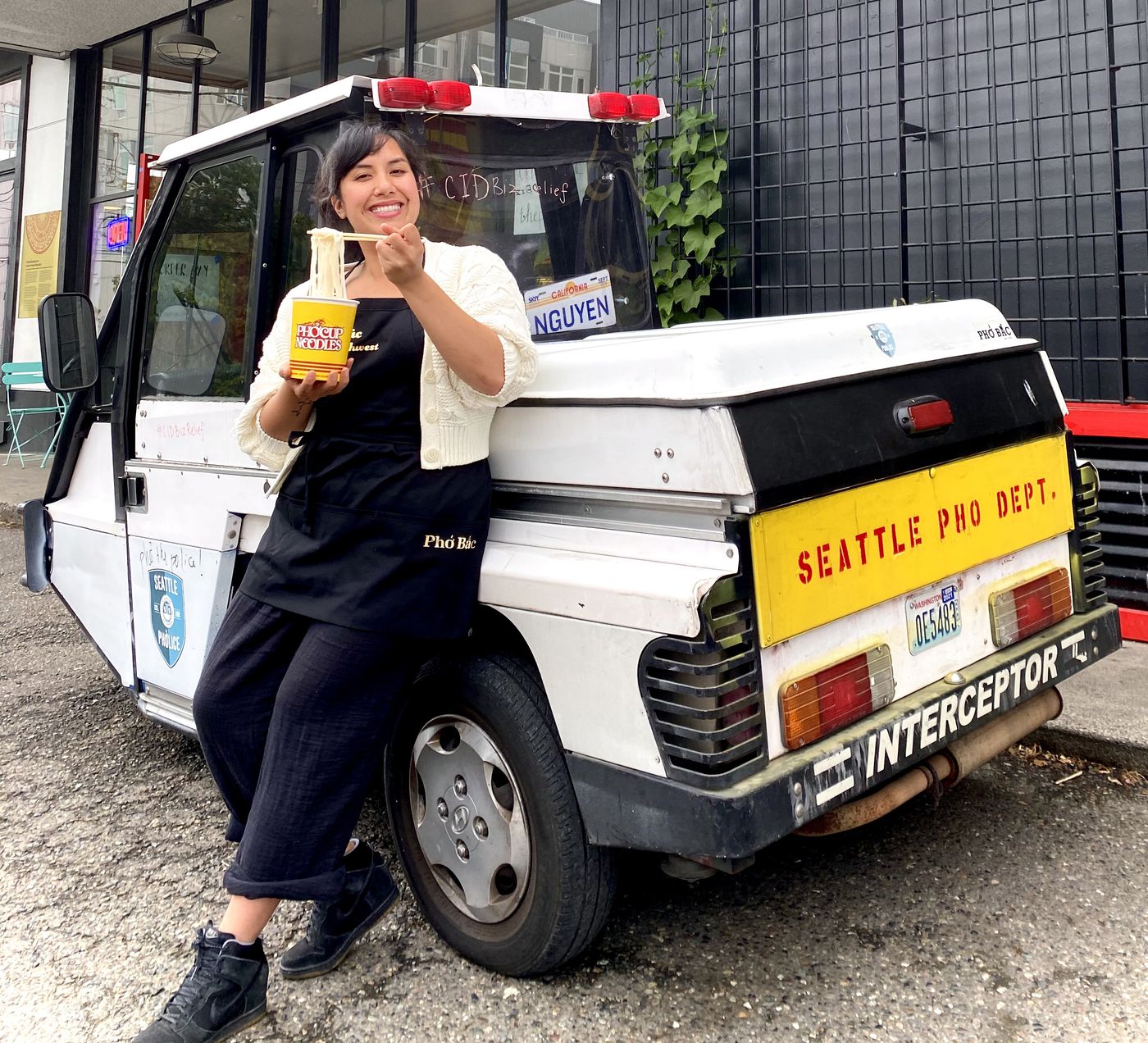
The owners of a Seattle Vietnamese restaurant, Phở Bắc, came up with the idea of a “Pho Now” cup and a “Pho Later” meal kit during the pandemic. “Survival mode is in our blood,” says Yenvy Pham.

I like to have a pipeline of possible articles in case I draw a blank some morning. But after Covid changed so much, it seemed like a good idea to check whether last year’s stories were still relevant. So I did a search on the restaurant in today’s article and found that the Covid innovations described here really worked.

In June 2020, Ashley Nguyen wrote at the Lily that Seattle’s Phở Bắc pivoted fast. “On March 13, Yenvy Pham went to New York City to celebrate the grand opening of her friend’s new Vietnamese restaurant, Saigon Social. But as the coronavirus spread, Helen Nguyen — Saigon Social’s chef and owner — decided to cancel.

“By the time Pham flew home to Seattle on March 16, Washington Gov. Jay [Inslee] had ordered restaurants and bars to cease in-person dining. Pham and her siblings, who own and operate several restaurants called Phở Bắc in Seattle, saw sales plummet. … They instituted new safety precautions, made sure their employees had masks and gloves and started pivoting.

“Phở Bắc’s namesake dish is not something people typically order to-go, Pham said. To appeal to their customers, the Pham siblings introduced a ‘Pho Now’ cup that people could eat while sitting on a nearby curb, on their walk home, or in the car. They also began selling a ‘Pho Later’ meal kit, complete with broth, separately wrapped ingredients and assembly instructions. The restaurant started delivering orders using an old parking enforcement vehicle dubbed the ‘Pho Mobile.’

“As it became clear that the pandemic wasn’t going to end anytime soon, Pham and her siblings had to start making tough decisions. They closed two of their four Phở Bắc locations, and they were forced to reduce staff. … But if any of Phở Bắc’s current or former employees need something, the restaurant owners try to help: ‘My restaurant dynamic is very Vietnamese,’ Pham said. ‘It’s very practical. If [workers] need money, help [or] loans, we just kind of do what we can.’

“Operating multiple restaurants during a pandemic isn’t easy, but ‘survival mode is in our blood,’ Pham explained. Her parents, Theresa Cat Vu and Augustine Nien Pham, opened the first Phở Bắc location in 1982, a year after they came to the United States. Ultimately, Theresa and Augustine created a nourishing landmark in Seattle’s Little Saigon: The restaurant takes the shape of a red boat.

“Yenvy Pham and her Phở Bắc partners, siblings Khoa and Quynh-Vy, are dedicated to supporting fellow business owners in Little Saigon as economic fallout from the pandemic persists.

‘It’s my neighborhood, my Little Saigon,’ Pham said. ‘For me, business comes and goes, but the vibe of the neighborhood is so important, and so are the characters here. You’ve got to take care of your own people.’

“They recently donated $5,000 in proceeds from the Pho Mobile to the International Community Health Services clinic, where their sister works as a primary care doctor, and a small business relief fund for business owners in the Chinatown International District. …

“The siblings are also collaborating with other business owners. They added Hood Famous Bakeshop’s mini Filipino-flavored cheesecakes to their menu. Pham let Mangosteen — a traveling Texas-style barbecue joint from chef Thai Ha — take over one of their closed locations to sell brisket and wings with specialty sauces for pickup.

“The pandemic has given people more time to take stock of what’s important, Pham said in late April.

“ ‘I like the world stopping for a second to reassess our morality and get us out of this state of complacency,’ she said. ‘We’re doing powerful thinking about each other, ourselves, about the world. … We’re being more creative too and helping each other out,’ Pham added. …

“Despite the unknowns, Pham is confident that everything will work out. In her family, ‘we either fix it, we take care of it, we accept it, or we move onto something else.’ ”

More at the Lily, here.

Read Full Post »

Photo: ergey Ponomarev for the New York Times.

This was completely new to me: Many Russian restaurants provide disposable gloves for things like burgers that you eat with your hands. Although I know I’m much more likely to get Covid-19 from breathing droplets, I think I could get used to the glove concept.

As Anton Troianovski reports at the New York Times, “When you enter a home in Moscow, you take off your shoes. When you go to a play, you have to check your coat. When you eat a burger, you often wear gloves.

“Across hygiene-conscious Eastern Europe, many people consider it uncouth and unsanitary to eat a burger with their bare hands. The answer used to be a knife and fork. But the pandemic has accelerated a years-old trend: order a burger from Kyiv to Kamchatka — or in Brighton Beach, Brooklyn — and there is a fair chance it will come with a side of disposable gloves.

“Most often, the gloves are made of a synthetic, latex-free rubber called nitrile. At Black Star Burger, which launched the phenomenon in Moscow in 2016, the gloves on offer are black, individually wrapped in plastic packets. At Star Burger in Kyiv, Ukraine, they are green (or pink on Valentine’s Day). At Butterbro, a gastro pub in Minsk, Belarus, they come wrapped discreetly inside a napkin next to a serving dish made of the trunk of an ash tree.

‘Gloves, I think, are an unspoken, required attribute of any burger restaurant,’ said Butterbro’s manager, Alina Volkolovskaya. ‘I’m surprised that establishments in every country don’t offer them.’

“To visiting Americans, the practice always seemed odd, bordering on blasphemous. But when Moscow’s lockdown ended this month and I went out to celebrate, nervously, with a cheeseburger to go, it suddenly kind of made sense. …

“I called George Motz, a New York hamburger specialist, and he insisted that gloves negate the ‘very tactile experience’ of eating a burger. ‘Take the gloves off and get closer to your burger!’ Mr. Motz said. ..

“Several American restaurant safety experts, however, were intrigued, having never heard of establishments providing diners with disposable gloves. They doubted the practice would take off in the United States — the coronavirus, after all, is not even known to spread through food — but some said that gloves used properly could help protect people who don’t wash their hands from a variety of germs. …

“Vanity, not health concerns, first propelled Eastern Europe’s gloves-and-burgers fad. Mr. Levitas of Black Star Burger recruited Timati, a Russian rap star close to the Kremlin, to lend a celebrity cachet to his new burger chain, which now has 67 locations across the former Soviet Union and one in Los Angeles. …

“The gloves help Black Star’s customers feel special, Mr. Levitas said, like the sparklers that go off when waiters bring out the $11 ‘V.I.P.’ burger.

“The gloves proved impervious to politics. A Kyiv restaurateur, Gennady Medvedev, says he had the idea to serve gloves with burgers independently of Black Star Burger in the years after he opened his Star Burger chain in the Ukrainian capital in early 2014 — during his country’s anti-Putin revolution. …

“The trend took off behind the former Iron Curtain as fancy burger places popped up in a region unfamiliar with the dish before McDonald’s arrived in the 1990s. Alexander Monaenkov, a Moscow-born burger-bar owner in Prague, says he handed out gloves to evoke the refinement of white-gloved waiters in Michelin-star restaurants. Corina Enciu, a Moldovan-born restaurateur in Krakow, Poland, said she introduced gloves because her burger joint lacked a place for people to wash their hands. …

“Gera Wise, a Kyiv-born cafe and nightclub owner in the Russian-speaking Brooklyn neighborhood of Brighton Beach, said his customers started asking for gloves after Timati started modeling them. …

“Isaac Correa, a Puerto Rico-born chef who lived in Moscow for two decades, thinks the gloves-and-burgers concept could have a global future. Mr. Correa worked with Mr. Medvedev in Kyiv to start the Star Burger chain. … Now Mr. Correa runs a restaurant in Sarasota, Fla., and his diners hesitate to touch menus or to come inside to collect takeout orders.

“ ‘I could see some of my customers in a casual restaurant say, “Hey, look, I’m going to try this,” ‘ Mr. Correa said.”

I’m thinking of adding gloves to my other nutty pandemic practices, including throwing out the takeout container immediately and reheating all the food in the oven. Now, if only I could find a place that sells disposable gloves.

More at the New York Times, here.

Read Full Post »

mediamatic_eten_serre_separee_6-0

Photo: Anne Lakeman/Mediamatic ETEN
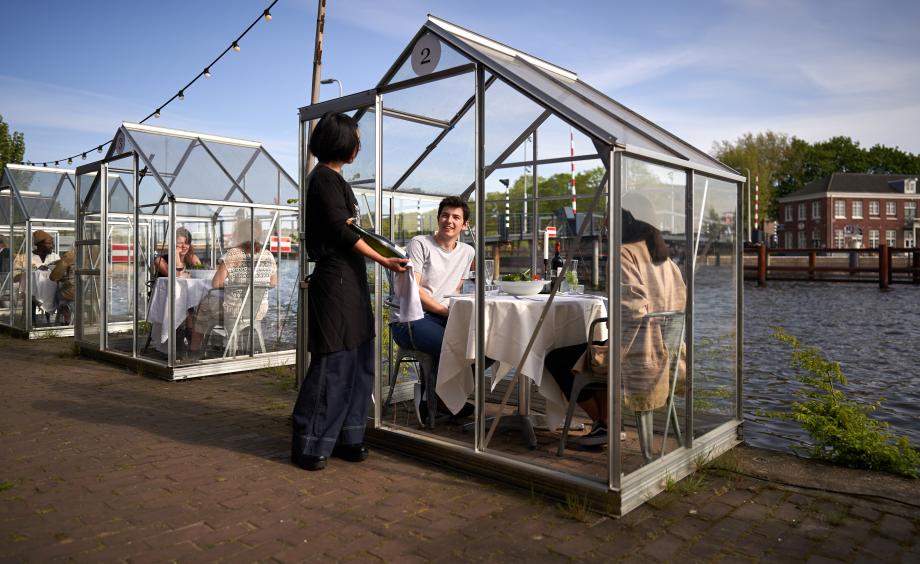
Testing the Serres Séparées safe-eating concept at Mediamatic restaurant in the Netherlands.

My husband keeps saying he can’t imagine that going to restaurants will ever be the same after coronavirus. In fact, he says, if nice restaurants continue doing takeout, maybe we should just stick with that.

Of course, restaurant owners are already thinking about these issues.

Byron Mühlberg reports from the Netherlands that the possibility of future guests requesting their own separate spaces has got some restaurateurs thinking creatively.

“With Dutch restaurants, bars and other catering services engulfed in uncertainty over how they might adjust to the 1.5-meter society,” he writes, “one Amsterdam restaurant is set to experiment with a brand new way of condoning off its guests: Using enclosed greenhouses.

“Mediamatic ETEN, part of a larger arts and entrepreneurship center focusing on sustainability, is a vegan restaurant. … From May 21, the restaurant will begin taking in guests, only this time they will be seated inside Serres Séparées (‘separated greenhouses’), enclosed glass structures, each equipped with a table for two or three diners.

” ‘This was one of the most feasible ideas from a large list of ideas we had when brainstorming,’ Mediamatic’s founding partner Willem Velthoven told NL Times. …

Initially, no more than three guests will be allowed to dine inside each greenhouse, even though there is the capacity for more. ‘[This is] is because we are now careful with our optimism,’ Velthoven explained. …

” ‘Bigger groups could [come] now, but then they should be families. For now, bigger groups are being discouraged because, from our experience, they are just louder and then you get the excited behavior causing spittle to fly and so on, and that’s the kind of behavior that would make the virus spread faster,’ Velthoven said. …

“Catering industry association KHN told NL Times, ‘We sent a protocol to the government two weeks ago, containing advice on how best to open the 1.5 [meter] distance. It is crucial that the government provide perspective quickly.’

“While KHN said it would not yet advise restaurants to reopen on June 1, renowned catering tycoon Laurens Meyer … questioned the idea of people becoming too careful with space.

” ‘We have to realize that there will always be some kind of virus. Whether it is worse than the flu, we have to see. If there is nothing left of our economy, we will no longer be able to afford health care and that will also cost human lives,’ explained Meyer.

“Velthoven, on the other hand, disagrees with Meyer’s approach, urging caution before advising restaurants to open their doors to the public without careful examination. ‘It’s about others and not just yourself in this case,’ he said. …

“Velthoven also understands the business argument, even though he has spent a career looking for creative solutions to problems instead of blunt responses. He ultimately wondered what the government’s plan is for the catering sector if those businesses are ordered to stay closed for a longer duration. If billions of euros are being diverted to KLM, he wonders what the government will be able to do to bail out his industry.

” ‘If I am not allowed to do anything the rest of this year, it’s finished,’ he lamented.” More at NL Times, here.

If you have heard of other good ideas for restaurants and bars in our cautious Covid-19 world, please share them in Comments. Pretty sure that there’s a large group of potential patrons who will be looking for the safest way to dine out — at least until a vaccine is widely available.

Read Full Post »

http3a2f2fcdn.cnn_.com2fcnnnext2fdam2fassets2f191115120957-immigrant-food-columbia-road

Photo: Irena Stein Photography/Immigrant Food
Chef Enrique Limardo says the “Columbia Road” bowl at his restaurant, Immigrant Food, combines elements of Salvadoran and Ethiopian cuisine. A special side dish: opportunities to help recent immigrants.

People say, “I’m upset, but I don’t know what to do.” Or, “I don’t have time to do anything extra.”

Look, when you shop, do you have time put a can in the food pantry bin? Do you have time to write a handful of postcards to voters once in a while? There is always time to put a can in a bin; there are always nonprofits that will accept a tiny bit of volunteering. It adds up.

And here’s the biggest benefit: you will feel better. Was it Ann Landers or Dear Abby who was always recommending helping someone worse off as a cure for nonclinical blues? You just need to find a volunteer gig that fits your interests.

This post is mostly about a cool restaurant in Washington, but be sure to note what the owners are trying to do in addition to presenting delicious, creative dishes.

In November, Catherine E. Shoichet reported at CNN about a new restaurant that opened up in the nation’s capital.

“It’s called ‘Immigrant Food,’ ” she wrote, “and it’s just a block from the White House. The fast-casual spot caters to a weekday lunchtime crowd, with bowls blending cuisines from different cultures around the globe — like a dish that combines Vietnamese spicy-rice noodles with pickled bananas in what the restaurant says is an ‘ode both to Central America’s favorite fruit and to German-style pickling.’

“It also gives diners a chance to donate to local immigrant advocacy groups, all under a slogan aiming to bridge the political divide and find common ground: ‘United at the Table.’

“[Co-founder Peter Schechter] wants people to feel at home here, and to hear the story he’s excited to tell. …

“As the child of immigrants from Austria and Germany, Schechter says he felt like he had to respond to the surge in anti-immigrant rhetoric across the United States.

” ‘This isn’t the America I recognize. … Immigrants have been the foundation of growth and vibrancy. This country has been great again and again and again because of immigrants. …

” ‘Immigrants are feeding America,’ he says. ‘All of the industries that make food, whether it is the picking or the shucking or the meatpacking or the slaughterhouses, (or) in restaurants, the servers, the bus boys, this is an industry that is dominated by immigrants.’ …

“At Immigrant Food, menus available by the door describe each of the nine fusion bowls and five vegan drinks on tap. They also encourage visitors to donate to and volunteer with local immigrant advocacy groups.

“Among the suggestions listed on the restaurant’s ‘engagement menu’: teaching English, visiting detention centers, staffing hotlines and helping with mock ICE interviews. …

“There’s also a photo booth featuring a world map. Diners can point to where their families are from, snap a selfie and get a text message with a frame around the image that says, ‘We are all immigrants!’ …

‘People say, “I’m really upset about what’s happening, but I don’t know what to do,” ‘ Schechter says. ‘And so, you come to this restaurant, we will give you stuff to do — concretely and easily.’

“Local immigrant advocacy groups will also be able to use the restaurant’s upstairs space for things like meetings and English classes, free of charge. And on its website, the restaurant will serve up bite-sized breakdowns of immigration policy issues, dubbed ‘The Think Table.’ …

“The location turned out to be a case of serendipity, Schechter says. ‘[But] I really think it goes beyond the political.’ …

As he sips on a drink called ‘Across the Border’ — which blends cacao, dates, peppers, allspice, vanilla and cashew milk — Robert Evans, 72, says he loves the concept but worries the restaurant might end up preaching to the choir rather than crossing political lines.

“But then again, he says, one day someone who works in the White House might stop by. … In Schechter’s view, immigration shouldn’t be a polarizing topic. He points to polls that show most Americans say immigration is a good thing. And he hopes Democrats and Republicans will dine at Immigrant Food together.

” ‘The table, the restaurant, has always been a place where people unite,’ he says.” More.

By the way, if you’re ever in Providence, the immigrant restaurant called Aleppo Sweets is just fantastic. An extra treat for me is running into one of my former ESL (English as a Second Language) students who’s working alongside her family members there.

Read Full Post »

Older Posts »