Feeds:
Posts
Comments

Posts Tagged ‘sculpture’

Photo: Navy Yard Garden & Art, Inc.
Gillie and Marc’s “The Wild Table of Love,” part of their “Wildlife Wonders” collection.

There’s a new outdoor art exhibit in Boston that seems like it might be worth a special trip. It entails impressive bronze sculptures of animals from rhinos to octopuses. In its way, it conveys messages about conservation and human coexistence.

Solon Kelleher reports at WBUR, “There’s a new 36-foot-long octopus on display in Boston as of this week. It’s made of bronze and weighs nearly 8 tons.

“You’ll find the massive octopus on Dry Dock 2 at the Charlestown Naval Shipyard, as if it climbed out of the water by the USS Constitution Museum to meet a few land animal friends. A different wild animal sits on each of its hefty tentacles. … The piece is called ‘The Arms of Friendship.’

“It’s one of three fantastical wildlife sculptures installed in Charlestown, on view for the next two years. The name of the collection is ‘Wildlife Wonders’ by activists and artists Gillie and Marc, a duo known for public art displays of animals around the globe. This particular installation is organized by the Boston nonprofit Navy Yard Garden & Art, Inc.

“  ‘The term that we gave is a “Bridge of Joy” to connect Charlestown — which is divided by the Tobin Bridge,’ said Robin DiGiammarino, president of Navy Yard Garden & Art. …

“There’s another statue a short walk down 5th Street underneath the Tobin Bridge. That one is called ‘The Wild Table of Love,’ and it features about a dozen wild animals sitting at a table together as if to share a meal. Two empty chairs function as an invitation for passersby to pose with the sculptures. The third is located closer to the water in the Charlestown Naval Shipyard Park. It portrays a figure with the head of a rabbit and the body of a human attempting to get a hippo to try something new. That work is aptly named ‘The Hippo Was Hungry to Try New Things with Rabbitwoman.’

“DiGiammarino said the group collaborated with the Charlestown Coalition and several of its partner organizations — including Turn it Around, Charlestown Trauma Team, Institute of Health Professions, Harvard-Kent Elementary School and the National Parks Service — to review proposals of four different art installations. “’The one that had the most votes was Gillie and Marc,’ said DiGiammarino. …

“Although the scenes are out of this world, DiGiammarino imagines the ways visitors can see themselves in these statues. ‘ There are different animals sitting at the table with all different food in front of them, and those animals in the wild would not get along,’ she said. ‘But here they are having a meal together.’ …

“Navy Yard Garden & Art plans to announce events and curated offerings around these statues, including an augmented reality workshop with local tech company Hoverlay and a photo contest with a grand prize of a Gillie and Marc mini octopus statue.” More at WBUR, here.

Other amazing photos are here. And the artists’ website, here, has additional pictures and background information.

It reads in part, “British and Australian artists, Gillie and Marc … are redefining what public art should be, spreading messages of love, equality, and conservation around the world. …

“The artists are best known for their beloved characters, Rabbitwoman and Dogman, who tell the autobiographical tale of two opposites coming together to become best friends and soul mates. As unlikely animal kingdom companions, the Rabbit and the Dog stand for diversity and acceptance through love. Gillie and Marc believe art is a powerful platform for change. Their art is multi-disciplinary, paying homage to the importance of togetherness, as well as the magnificence of the natural world, and the necessity of preserving it. …

“Gillie grew up in Zambia and realized her love for art by sketching all the wonderful wildlife that surrounded her, falling in love with the captivating creatures with each drawing she created. Tragically, she saw an elephant brutally shot one day. This had a profound impact on her as a young child and from then on she vowed to dedicate her life and work to protecting Earth’s innocent animals. While in his twenties, Marc fell in love with conservation on a trip to Tanzania to see the chimpanzees. …

“Finding an extra special place within the hearts of the artists are rhinos. This love affair began during a project memorializing a black rhino and her calf who mysteriously died in a Zoo in Australia. The artists were heartbroken by this tragedy and wanted to create an artwork that would not only remember the rhinos but also raise awareness about conservation. This sparked a fire that led to the duo learning all they could about rhinos, trying to find a way to give a voice to the voiceless, and help people to understand the urgency for the conservation of these beautiful animals. …

“Their unique approach to contemporary conservation has generated unprecedented awareness and funds to protect some of the world’s most endangered animals. Most recently they unveiled ‘A Wild Life for Wildlife’ in NYC, featuring the world’s longest interactive wildlife tandem bicycle; ‘Love the Last March’ at Gardens by the Bay in Singapore, showcasing a 200-meter wildlife-saving sculpture; and ‘A Wild Life for Wildlife’ in London, featuring nine magnificent interactive sculptures displayed along the Thames in the heart of the city.”

Read Full Post »

Photo: @risdmuseum on Instagram.
Conservator Ingrid Neuman (left) with Rhode Island School of Design undergrad student Sophie Bugat, doing repair work on a statue of Pan.

When a new artwork is acquired by a museum, it doesn’t go right on display. At least one expert must look it over and make sure it’s in good shape.

At the Rhode Island School of Design [RISD ] in Providence that expert is often Ingrid Neuman.

Kristine Yang writes at the Providence Eye, “This past November, Ingrid Neuman, senior conservator at the RISD Museum, wheeled a twelfth-century Japanese wooden Bodhisattva Avalokiteshvara into Hasbro Children’s Hospital for a CAT scan. Conservators have repaired the ancient figure, a revered Buddhist symbol, over centuries — Neuman’s examination would reveal exactly where and how they had carried out those repairs. …

“Over time, sculptures accumulate dirt and often chip, show wear, or even break. Some arrive with broken parts or past repair attempts that complicate restoration. Preparing these pieces for public exhibition falls to the museum’s conservation team.

“Through a meticulous process that integrates chemistry, art history, and craftsmanship, conservators work to stabilize and restore each object. … Neuman’s background in organic chemistry is essential to her work. Sculptures are vulnerable to a host of natural forces over time such as ultraviolet radiation, pollution, humidity, and fluctuations in temperature – all of which can degrade original materials. Pieces with organic materials like wood and ivory, along with metals such as bronze or iron, are particularly prone to these ‘agents of deterioration’ and can experience accelerated degradation if not properly maintained, says Neuman.

‘An ancient bronze beaker from China wants to corrode. It wants to go back to its original copper ore,’ says Neuman. ‘We’re trying to keep it from doing that.’

“Corrosion is a natural chemical reaction that occurs when metals like bronze are exposed to oxygen, moisture, or pollutants over time. This reaction, called oxidation, causes the metal to slowly break down. Left unchecked, this chemical process can eat away at the surface of a sculpture. …

” ‘We borrow a lot of techniques from dentists and doctors,’ says Neuman. ‘There’s a lot of overlap with the medical field.’ With limited in-house instrumentation at the RISD Museum, Neuman often relies on nearby hospitals such as Hasbro’s and research institutions for specialized evaluations.

“Understanding a sculpture’s composition and preservation history is crucial, as it directly informs the selection of repair materials. … Conservators intentionally choose repair materials that are visually similar to the original but chemically distinct, ensuring that their work can be easily differentiated from the artist’s upon chemical evaluation.

“ ‘We don’t like to use the same materials as the artist,’ Neuman says. ‘We’re not trying to be the artist, or be better than the artist, or confuse people.’ 

“The ease with which any added materials can be removed is also a crucial consideration for conservators, as they must ensure that any restoration work can be undone without damaging the original piece. …

“For this reason, conservators use inpainting – a technique used to fill in missing parts of an artwork – with materials that can be easily distinguished and removed. For example, Neuman says conservators often use acrylic paint when filling in an oil painting. Acrylic is water-based and chemically different from oil paint, allowing it to be safely removed. …

“Neuman emphasizes the importance of reversibility and the chemical properties of adhesives. ‘There’s so many glues in the world. A zillion,’ she says. ‘Everyone uses epoxy or Gorilla Glue, but we never use them because they’re too strong.’

“If conservators use a glue that is stronger than the sculpture’s original material, any physical stress on the object could result in new fractures, rather than breaking along existing lines. … She prepares her own adhesives in the lab, including wheat starch paste and Funori, a traditional Japanese adhesive made from seaweed — both of which are gentle yet effective enough for conservation work.

“While conservators intentionally make their repairs distinguishable from the original through their selection of materials, their work must remain invisible to the viewer. … This means conservators must address each deformity with painstaking precision and care. Inpainting demands an especially detailed approach. … Neuman says, ‘You have to use a very tiny brush, with only a few hairs in it, and you have to be really good at color matching.’

“One of the challenges of inpainting is a color perception phenomenon called metamerism, where colors that match under one light source may look different under another. … To navigate this, she moves the piece back and forth on wheeled carts between her sunlit lab and the gallery space to ensure the colors match under different lighting conditions.

“Once the restoration is complete, detailed documentation is essential, Neuman says. Photographs of the piece before, during, and after the process, along with written records, are uploaded to the museum’s database for future conservators’ reference. ‘It’s important to leave a record,’ Neuman says.”

More at the Providence Eye, here. This story reminds me of the work that Sotheby’s did on one of my mother’s Pousette-Dart paintings, one that had been too close to a chimney fire!

Read Full Post »

Photo: Christie’s Images Ltd. 2025.
Eva Hesse, “Landscape Forms” (1959).

If you found a painting you loved in some cheap second-hand shop, what would you do with it? Even if it turned out to be valuable? I think if I bought it because I loved it, I’d want it on my walls. Everything in the world is not valued only in terms of gold.

In April, Laurie Gwen Shapiro reported at Hyperallergic about a brother-sister team who are in it for the gold.

“One afternoon last fall, 55-year-old Kara Spellman was working from her Upper East Side apartment when her phone pinged. Her big brother Glenn, 58, a longtime licensed appraiser and self-described ‘picker,’ who lives in the same building, had texted a photo and a short message: ‘Take a look at this.’

“The image was of a small abstract painting — 30 by 24 inches — titled ‘Landscape Forms’ and newly listed on ShopGoodwill.com, the online auction wing of the national thrift store chain. The brushwork was gestural, the color palette felt just right, and in the lower-right corner, a signature: E.H.

“Glenn had a hunch. Kara, director of Estates and Acquisitions at Hollis Taggart Gallery in Chelsea, had a stronger one.

“ ‘We both have a good eye,’ she told Hyperallergic, laughing. ‘The brushwork looked too specific to be a copy.’

“But instinct wasn’t enough. The siblings, who’ve teamed up before on treasure hunts, needed the catalogue raisonné — the official compendium of an artist’s authenticated work.

“Kara emailed the Watson Library at the Metropolitan Museum of Art and begged them to pull the volume by the end of the day. Miraculously, someone she knew replied right away: They’d do it. She jumped in a cab.

“ ‘There it was,’ she said. ‘Landscape Forms’ (1959). Signed. Documented. And officially marked: ‘Whereabouts Unknown.’

“The only visual in the book was an off-color image made from an unmarked slide in the artist’s papers at Oberlin College’s Allen Memorial Art Museum. In fact, as noted in the catalogue raisonné, it’s ‘one of 15 paintings known only by unmarked slides’ included in that archive. But it matched exactly. And it was lost for decades until it popped up at a Goodwill warehouse in Frederick, Maryland.

“The Jewish artist Eva Hesse, born in Hamburg in 1936, escaped the Nazis as a child via the Kindertransport to London with her sister. Their desperate parents followed soon after, and the family eventually resettled in New York. Hesse would go on to become one of the most influential figures of the postwar American avant-garde. Best known for her radical, impermanent sculptural work in materials such as latex, fiberglass, and cheesecloth, she died in 1970, at just 34. Fragile and emotionally charged, her most important pieces helped define Post-Minimalism and, though rarely offered at auction, have sold for millions. Most are held in the collections of major museums.

“But before all that, Hesse painted. ‘Landscape Forms,’ made while she was an MFA student at Yale under Josef Albers — who affectionately called her ‘my little colorist’— is part of that rare early body of work. …

“And then one day, it was gone. Was it lost? Stolen? A gift quietly passed along, then forgotten?

“ ‘I’m not an artist,’ Glenn said in a phone call late at night after a grueling 10-hour day looking at estates. ‘I’m a treasure hunter. A detective.’ …

“ ‘Once or twice a year, something outstanding shows up there,’ he said of ShopGoodwill. ‘You just have to know what you’re looking at.’ …

“For bigger finds, Glenn often partners with Hollis Taggart, his former boss and longtime friend. They agreed it was worth pursuing together. After winning the lot for $40,000 — not exactly a steal, but Hesse’s auction record is above $4 million — Glenn drove to Frederick, Maryland, himself. …

“Back in New York, Glenn brought the painting to Hollis Taggart Gallery. There, it underwent conservation: surface cleaning, minor restoration, and re-stretching.

“It was shown at two major art fairs, including the Armory Show last September. There was interest — almost a sale — but no one bit. …

“Now, after regrouping, ‘Landscape Forms’ is headed to Christie’s Post-War and Contemporary Art Day Sale in May, with an estimate of $60,000–$80,000. [Update: It sold for $107,100.]

“The Spellman siblings, Gen Xers who’ve been in New York for decades, grew up in Ballston Spa, near Saratoga Springs, and got their start as bottle diggers.

“ ‘There was an old slaughterhouse near the creek bed,’ Glenn recalled. ‘We’d find colored, hand-blown bottles and sell them downtown, because there was also a one-cent candy store in town. If we sold an old bottle for a quarter, we’d get 25 pieces of candy. A home run would be a dollar bottle, which equaled 100 pieces of candy!’ …

“Both are longtime fans of American Pickers (2010–), the History Channel’s reality TV series whose hosts travel across the country in search of valuable artifacts. ‘I still watch it religiously,’ Glenn added. ‘You pick up more than you’d think.’

“When asked how it felt to hold the Hesse in his hands for the first time, Glenn got quiet.

“ ‘It was very exciting,’ he said. ‘You get the thrill when you win it, but when you finally handle it, when you know it’s real, that’s the magic.’ ”

More at Hyperallergic, here. No paywall, but your donation helps keep great art coverage going.

Read Full Post »

Photo: David L. Ryan/Globe Staff.
Maya Lin’s landscape artwork in Kendall Square in Cambridge. It’s an “undulating wave field” in front of the Volpe Transportation building on Binney Street.

For most of us, sculptor Mia Lin first came to our attention when she was chosen to create the Vietnam war memorial in Washington, DC. The solemn listing of the names of the dead on black granite was a brilliant idea, endlessly moving.

Until now Lin had never created landscape art in Massachusetts, so people were surprised to learn that in fact she had had an impressive earthwork in busy Cambridge since 2023.

Scott Kirsner writes at the Boston Globe, “What if someone spent $1.3 million on a work of art, installed it in one of the busiest parts of Cambridge, and forgot to tell anyone?

“That’s effectively what happened with a piece called ‘The Sound We Travel At,’ by the New York City artist Maya Lin. She is best known for works like the Vietnam Veterans Memorial in Washington, D.C., and the Civil Rights Memorial in Montgomery, Ala. …

“But she also makes works of landscape art … and that’s what was created in Kendall in 2023. You can find it on Binney Street as you head toward Boston, to the left of a new 13-story building that houses the Volpe National Transportation Systems Center, a research center run by the US Department of Transportation. Sandwiched between a row of trees and lampposts is a series of 11 grass-covered, wave-like mounds of earth.

“Apropos of the Volpe Center’s work … the artwork outside is a physical representation of the Doppler effect. You know: the phenomenon of a sound, like a train’s horn, changing in pitch as it races past you. Some of the rippling mounds in Lin’s work represent sound waves that are approaching the viewer, and some of them represent sound waves that are receding from the viewer. Visitors are invited to walk atop, or even sit on, the work.

“There’s so much construction work in Kendall Square right now that I only noticed the artwork in November 2023, when I was visiting the Volpe Center to write a piece. … A year later, I noticed that there’s still no sign, and it doesn’t appear on the website of either the Volpe Center or the Maya Lin Studio. I couldn’t find a single museum curator or former curator in town who knew about it. …

“The artwork is part of a 14-acre site that MIT’s real estate management arm acquired from the federal government in 2017, and is redeveloping to include housing, retail, office space, parks, and a new community center. Part of that deal involved MIT building a newer home for the Volpe Center, and any time a new federal building goes up, half of one percent of the building’s cost goes to art. (That’s even true when MIT is footing the construction bill, as it was in this case.)

“Paul Ha, the director of MIT’s List Visual Arts Center, helped make the connection to Lin for the project. He was one of the few people in the local art world I could find that was aware of its existence. Ha had worked with Lin on a major exhibit when he was running the Contemporary Art Museum in St. Louis. …

“Aprile Gallant of the Smith College Museum of Art says, ‘I do believe this is Lin’s first landscape piece in Massachusetts, so it is a milestone.’ That museum hosted a major exhibit of Lin’s works in 2022, when a library that she’d designed opened on campus. …

“Did ‘The Sound We Travel At’ fall through the cracks, in a neighborhood peppered with cranes and construction fencing, and tech and biotech workers who go from garages to offices perhaps two or three days a week?

“ ‘We felt that way,’ says James Ewart, manager of the Maya Lin Studio.

“But according to the government’s General Services Administration, by the time spring rolls around, a sign will finally be installed next to the artwork.”

More on the Maya Lin project at the Globe, here.

Read Full Post »

Photo: Sanjaya Dhakal/BBC Nepali.
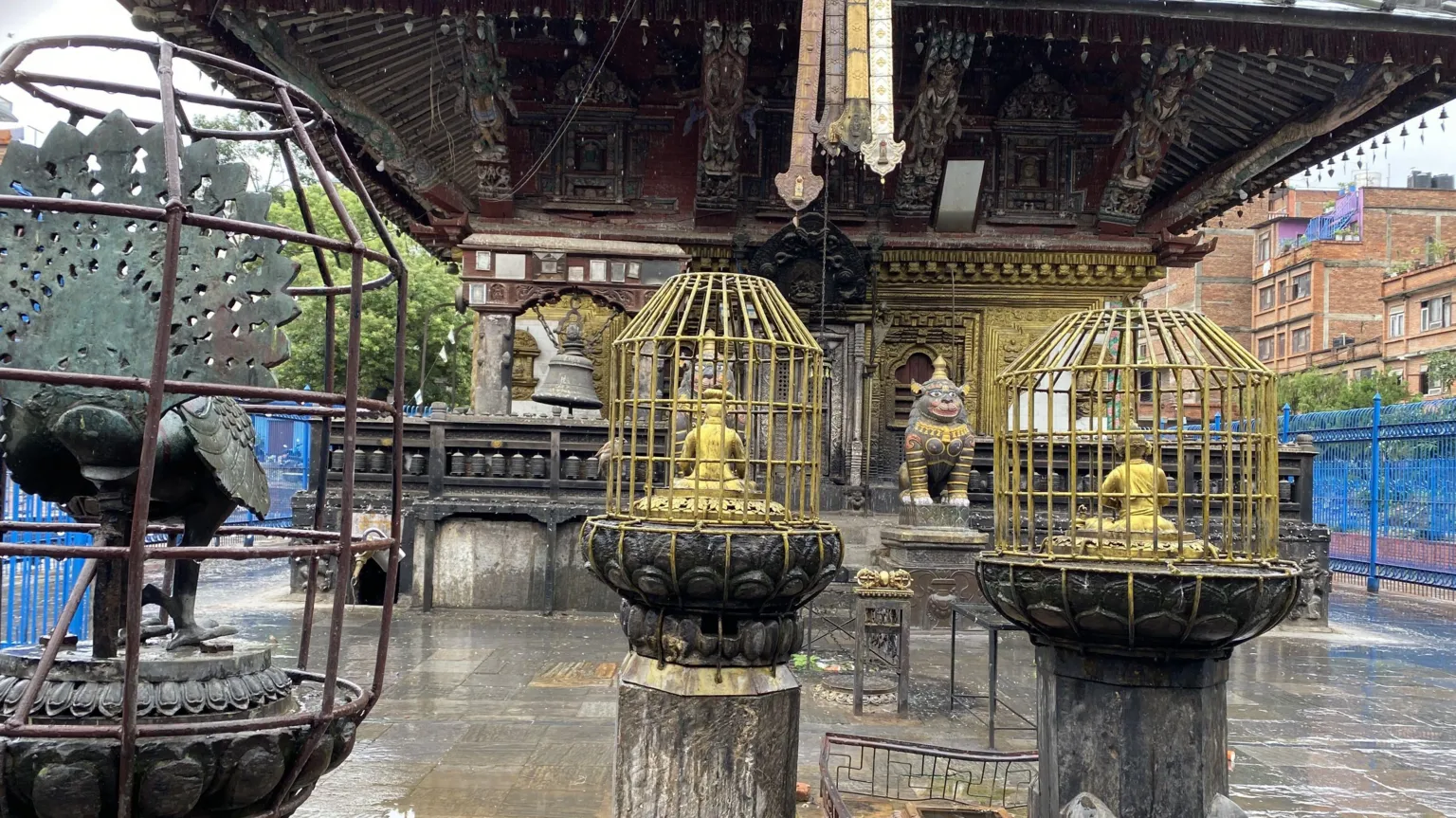
In Nepal, some communities have put their recovered idols in iron cages for security.

Who does art belong to? For centuries, looters have justified their thefts by asserting that they aim to protect the stolen art for posterity. That no longer holds up, and now art is getting returned to the plundered countries.

And if you play nice and return Nepali idols, you may be given an accurate replica.

Sanjaya Dhakal writes at The Guardian, “Along a small street in Nepal’s Bhaktapur city stands an unassuming building with a strange name — the Museum of Stolen Art. Inside it are rooms filled with statues of Nepal’s sacred gods and goddesses.

“Among them is the Saraswati sculpture. Sitting atop a lotus, the Hindu goddess of wisdom holds a book, prayer beads and a classical instrument called a veena in her four hands.

“But like all the other sculptures in the room, the statue is a fake. The Saraswati is one of 45 replicas in the museum, which will have an official site in Panauti, set to open to the public in 2026.

“The museum is the brainchild of Nepalese conservationist Rabindra Puri, who is spearheading a mission to secure the return of dozens of Nepal’s stolen artifacts, many of which are scattered across museums, auction houses or private collections in countries like the US, UK and France.

“In the past five years, he has hired half a dozen craftsmen to create replicas of these statues, each taking between three months and a year to finish. The museum has not received any government funding. His mission is to secure the return of these stolen artifacts – in exchange for the replicas he has created.

“In Nepal, such statues reside in temples all across the country and are regarded as part of the country’s ‘living culture,’ rather than mere showpieces, says Sanjay Adhikari, the secretary of the Nepal Heritage Recovery Campaign. Many are worshipped by locals every day, with some followers offering food and flowers to the gods. …

“It is also common for followers to touch these statues for blessings — meaning they are also rarely guarded — leaving them wide open for thieves.

“Nepal has categorized more than 400 artifacts missing from temples and monasteries across the country, but the number is highly likely to be an underestimate, says Saubhagya Pradhananga, who heads the official Department of Archaeology.

“From the 1960s to the 1980s, hundreds of artifacts were looted from Nepal as the isolated country was opening up to the outside world. Many of the country’s most powerful administrators back then were believed to have been behind some of these thefts — responsible for smuggling them abroad to art collectors and pocketing the proceeds.

“For decades, Nepalis were largely unaware about their missing art and where it had gone, but that has been changing, especially since the founding of the National Heritage Recovery Campaign in 2021 – a movement led by citizen activists to reclaim lost treasures. …

“There are many hurdles. The Taleju Necklace, dating back to the 17th century, is a case in point. …

“It’s still unclear how it might have been stolen and many in Nepal had no idea where it might have gone until three years ago, when it was seen in an unlikely place – the Art Institute of Chicago.

“It was spotted by Dr Sweta Gyanu Baniya, a Nepali academic based in the US who said she fell to her knees and started to cry when she saw the necklace.

“According to the Art Institute of Chicago, the necklace is a gift from the Alsdorf Foundation — a private US foundation. The museum told the BBC it has communicated with the Nepali government and is awaiting additional information.

“It’s not just a necklace, it’s a part of our goddess who we worship. I felt like it shouldn’t be here. It’s sacred,” she told the US university Virginia Tech. …

“But [Saubhagya Pradhananga, who heads the official Department of Archaeology] said Nepal’s Department of Archaeology had provided enough evidence, including archival records. On top of that, an inscription on the necklace says it was specifically made for the Goddess of Taleju by King Pratap Malla.

“It’s these ‘tactics of delay’ that often ‘wear down campaigners,’ says one activist, Kanak Mani Dixit. ‘They like to use the word “provenance” whereby they ask for evidence from us. The onus is put on us to prove that it belongs to Nepal, rather than on themselves on how they got hold of them.’ …

“Many worshippers are now a lot more paranoid — putting these idols in iron cages to protect them from going missing.

“Mr Puri however hopes his museum will eventually have its shelves wiped bare.”

More at the BBC, here. No paywall.

Read Full Post »

Photo: John and Suzanne’s Mom.
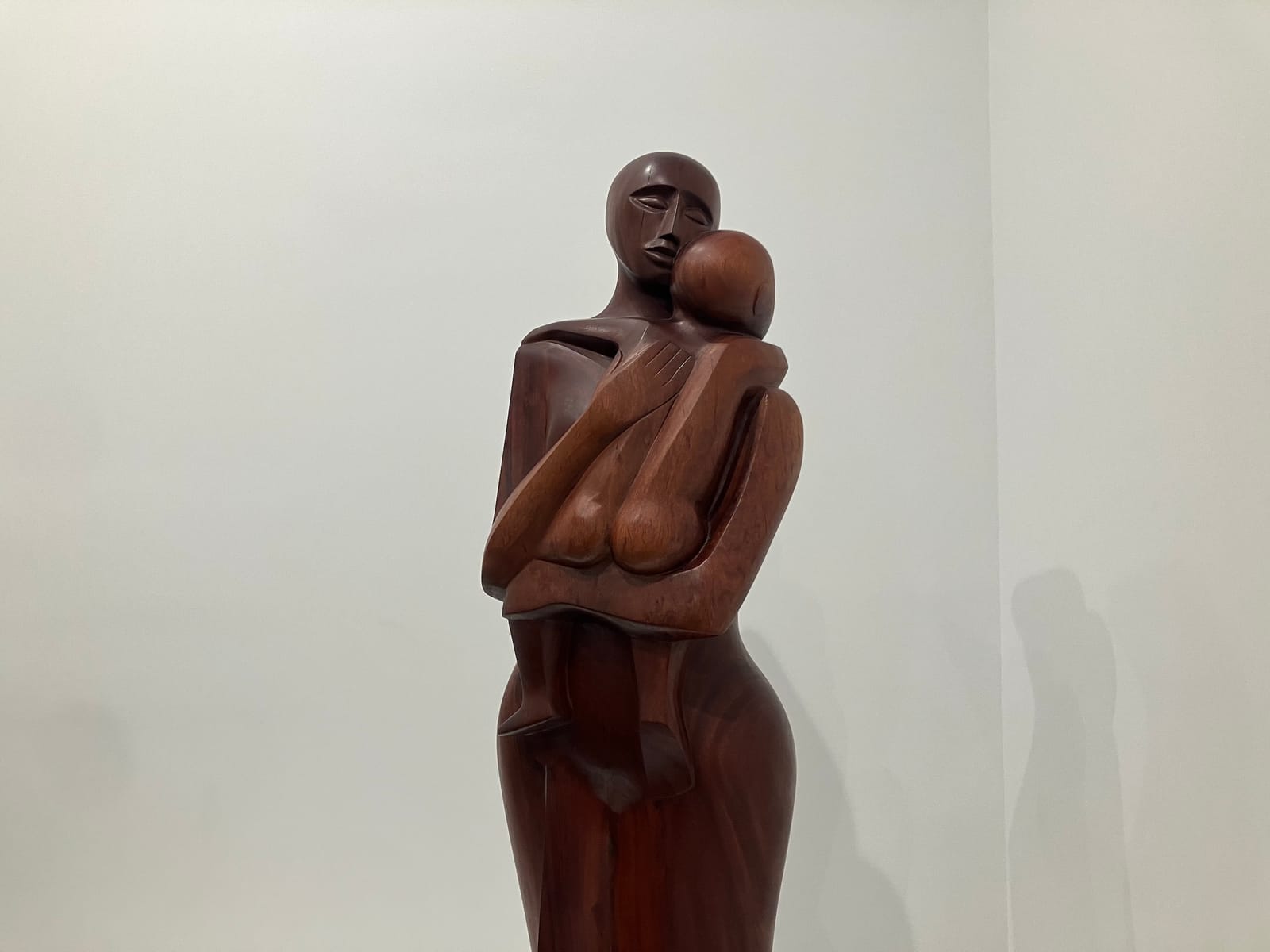
Mother and baby sculpture at Mass General Hospital in Boston.

Sending love to all mothers today and to nonmothers who rise up in times of need to mother children. This year, I’m thinking particularly of those in the world’s trouble spots who do all they can to mother and protect frightened children. Wishing them strength and an end to the chaos around them.

Read Full Post »

Photo: John and Suzanne’s Mom.
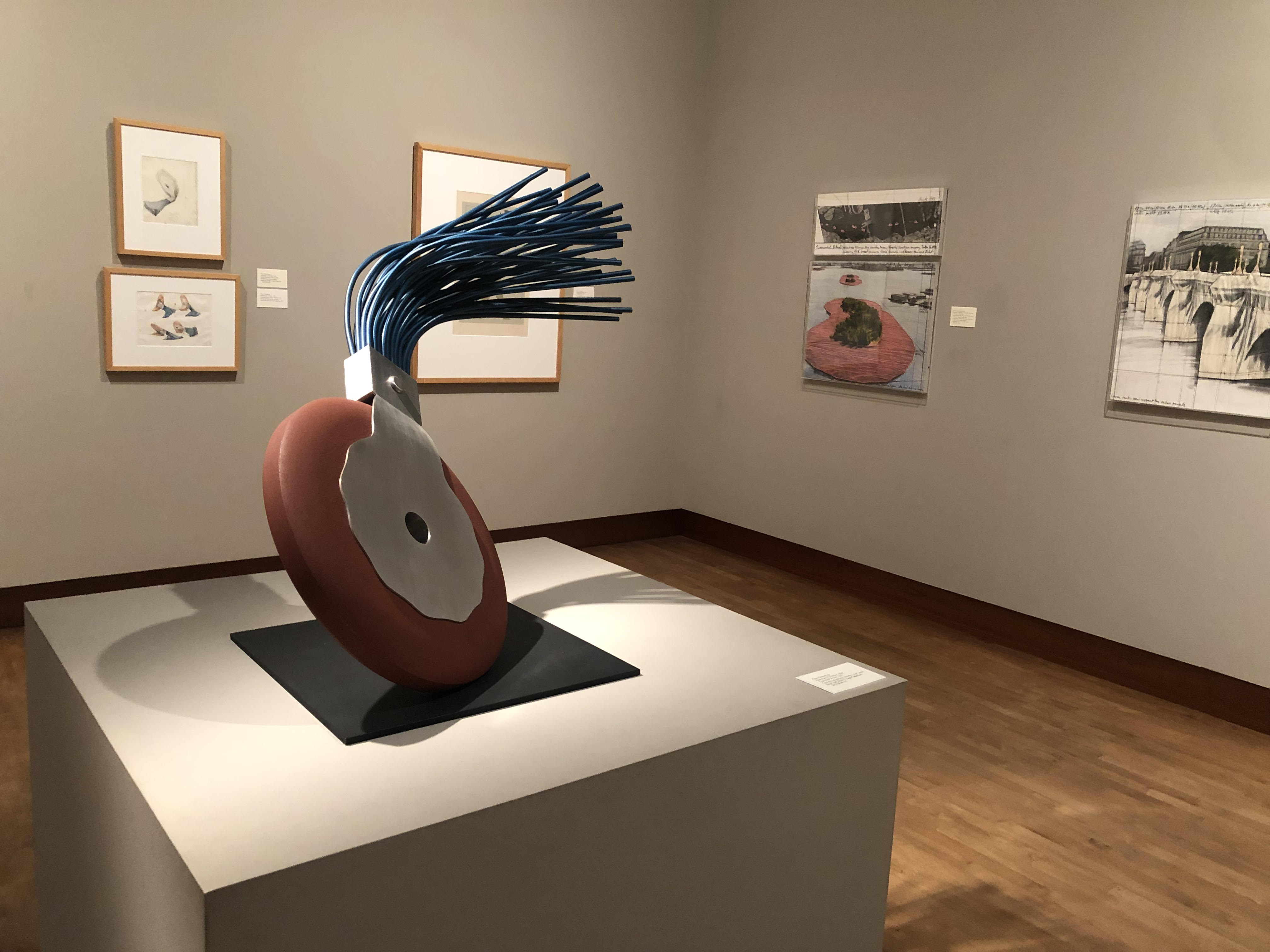
“Typewriter Eraser,” by Claes Oldenburg, at Chazen Museum of Art, Madison, Wisconsin, August 2022.

When I saw this a year and a half ago in Madison, I loved so much that Claes Oldenburg was drawn to the artistic possibilities of a typewriter eraser that I took a picture.

More recently, a larger, outdoor version of that eraser drew in an owl.

Alisa Tang has the story at the Washington Post.

“It was the morning of Friday the 13th, and staff members were tending the grounds of the National Gallery of Art Sculpture Garden when they spotted something amiss: feathers sticking out of the blue bristles of the gigantic typewriter eraser.

“As they stepped in for a closer look, they realized a barred owl was stuck in the brush of ‘Typewriter Eraser, Scale X‘ — the garden’s six-meter-tall steel-and-fiberglass sculpture of the once-common office relic.

“The bird was still. But as the gardeners approached, it turned its head and blinked. …

“Brett McNish, the garden’s supervisory horticulturist, wrote in an email, ‘Occasionally, we see hawks momentarily perched on other taller sculptures in the garden, but never on Eraser. This is the first Owl seen in the garden.’ …

“There is a lot of wildlife in the garden, including dozens of species of birds and small mammals, McNish wrote. Hawks mainly like to sit on ‘Graft,’ a stainless steel sculpture of a leafless tree, though they tend not to stay for long. …

“Then came Friday the 13th and the extraordinary owl in the eraser. It was unclear how the owl got into its predicament, but staff members sprang into action. ‘It clearly needed help,’ McNish wrote.

“Workers hauled out a ladder and steadied it under the eraser. McNish, feeling ‘slightly anxious’ because of the bird’s thrashing as staff members neared, put on goggles and heavy-duty rose-gardening gloves for protection. He climbed the rungs and extracted the bird.

“The gallery’s sculpture conservation department provided a quilted cotton blanket normally used to move artwork to swaddle the owl, and McNish said that within an hour of its rescue, the owl was delivered into the care of City Wildlife, an animal rescue center in D.C.

“ ‘It was extremely lethargic, and it looked really sad,’ said Jim Monsma, City Wildlife’s executive director. ‘An owl during the day should not just be lying there in a box. It should be trying to fly away. It looked like it had just given up.’ …

“Staff members evaluated the owl, X-rayed it and found no broken bones. But its right shoulder was swollen, its ‘gums’ were pale, and it wouldn’t eat, said Sarah Sirica, a veterinarian and City Wildlife’s clinic director.

“The clinic put the owl on pain and anti-inflammatory medication, injected it with an electrolyte solution around the base of its leg and put it in a private room in a large cage that was lined with cloth so it wouldn’t damage its wings. The clinic bought frozen dead mice, thawed them and left them in the cage overnight — which is when owls normally eat — but the owl didn’t touch the food.

“So staff members hand-fed it: One person held the owl, while another, sometimes Sirica, wore gloves, opened the owl’s beak and put pieces of chopped-up thawed mice into its mouth, ‘a finger-length down,’ Sirica said.

“After about a week, Sirica deemed the owl healthy enough to travel; the swelling on its shoulder had gone down, and its gums were pink again. On Oct. 21, a City Wildlife volunteer drove the bird to Tri-State Bird Rescue & Research in Newark, Delaware. Upon arrival, staff at the facility placed it directly inside a 100-foot-long, gravel-floored flight enclosure for ‘prerelease flight conditioning,’ said Lisa Smith, the executive director of Tri-State Bird Rescue.

” ‘It gives them the opportunity to have a long flight. Then we can evaluate that they are flying properly — you can’t do that in a small enclosure,’ Smith said. ‘You have to see multiple flaps. Also, the enclosure is 20 feet high, so you want to make sure they can get from the ground up and make it from one end to the other at that height.’ …

“Tri-State Bird Rescue has admitted … ducklings that fall into storm drains, and birds that lose their nests during storms or get caught in sticky glue traps. But eraser owl was a novelty. …

“Tri-State Bird Rescue normally will return an adult bird of prey to the area where it was found, but it avoids transporting younger raptors because they can injure their wings in the carrier. Besides, as juvenile birds of prey become adults, they often have to find territory away from where they were raised anyway, Smith said. … ‘For the birds’ safety, we tend to release them here. It’s good habitat. It’s migration season.”

More at the Post, here.

And just for no reason, here’s a handy expression you can use the next time you are in Sweden: “Det är ugglor i mossen.” There are owls in the marsh. Erik’s mother says, “It is something that is not quite OK or not reliable. You should really not believe it. It’s a sort of feeling.” Maybe “I smell a rat”?

Read Full Post »

Art: John James Audubon.
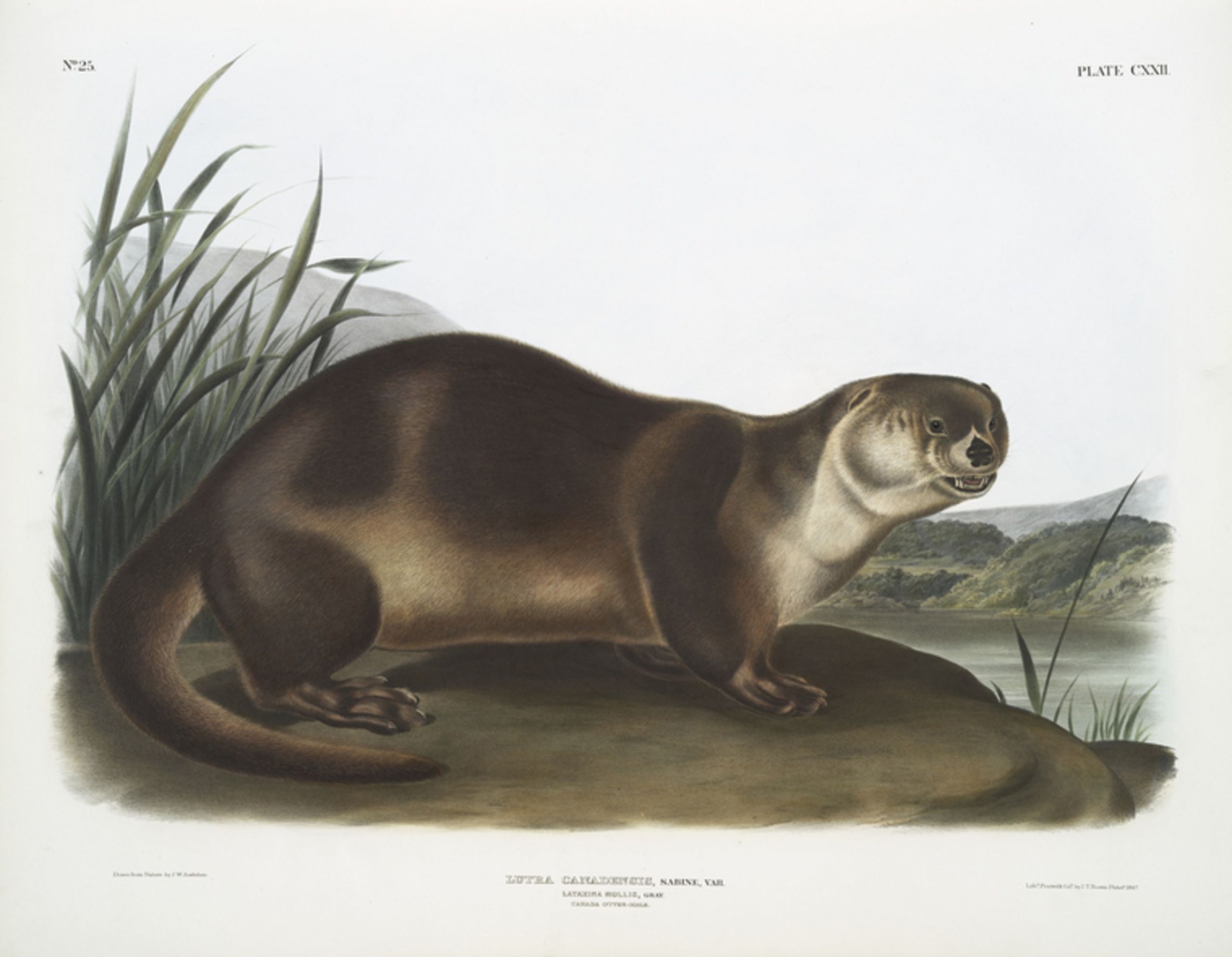
“Lutra Canadensis, Canada Otter” (New York Public Library).

Hyperallergic is an online art magazine with a wide variety of stories that you just want to share. You can read it without paying, but of course, they need contributors as well as readers.

Today’s inspiration from Hyperallergic is about otters.

Sarah Rose Sharp writes, “Though seals are probably the gateway to aquatic mammal fandom, connoisseurs of the genre all agree that otters are best in class. These furry powerhouses are not only capable of tender intimacy and novel tool usage, they often just seem to be having the best time ever. So it’s no wonder that they have been a recurring motif throughout art history. …

“Though better known for his bird illustrations, John James Audubon’s last major work was The Viviparous Quadrupeds of North America, produced in collaboration with his friend, the Reverend John Bachman, who wrote the text that accompanies his illustrations. On his final drawing expedition in 1843, Audubon traveled with his son up the Missouri River to document and depict the four-legged mammals of North America — including, of course, otters.

“But the love of these little water scamps goes back much further than a couple of centuries. On view at the Metropolitan Museum of Art is just one example of otters as a common motif during the Late Period and Ptolemaic times.

“ ‘The pose of raised paws signifies the otter’s adoration of the sun god when he rises in the morning,’ reads the label on this Ancient Egyptian bronze statuette, dating to between 664 and 30 BCE.

‘In myth otters were attached to the goddess Wadjet of Lower Egypt, whose cult was centered in Buto, in the northern Delta.’ …

“For high otter drama, you can hardly do better than the standoff in Pieter Boel’s painting ‘Otter Harassed by Dogs‘ (c. 1600) currently in the collection of El Museo del Prado in Madrid, Spain. … Otters could mess you up at any time, so try to stay on their good side.

“Obviously, otters are a common motif in ancient and contemporary animal fetish carvings, such as [one] example of an ‘otter toy‘ from Cape Prince Of Wales, Alaska, part of the Smithsonian’s Museum of Natural History collection. According to the Toh-Atin Gallery, otters as a fetish animal represent ‘balanced femininity.’ …

“For the painfully literal seeking out otters in museum collections, nothing can hold a candle to the American Museum of Natural History (AMNH) in New York, whose permanent River Otter installation and background mural in the Hall of North American Mammals was captured by AMNH photographer Denis Finnin. ‘As morning mist veils a lake in Algonquin Provincial Park, a young female river otter comes ashore and inspects a spider web,’ reads the AMNH image description. …

“Speaking of meditative otters, a beautiful painting on silk from the Meiji period, the work of Japanese artist Seki Shūkō, is sure to meet all your needs for minimalist marine mammals. You can practically hear the noise of the rushing river. …

“But otters need not only be social animals, they can also be voices for animal welfare, as a woodcut by South Korean artist Shumu demonstrates.

“ ‘Animals are different from humans in language and appearance,’ the artist said in a message to Hyperallergic. ‘But animals feel the same or similar pain as humans, and they have emotions. Species discrimination against animals must stop. I hope that by continuing to work and share the life of veganism, it can become a small but resonant message.’ “

Nice examples of otter art through the ages at Hyperallergic, here. No firewall. Do you have favorite otter stories or images? Please share them.

Read Full Post »

Photo: Laura Young via LiveAuctioneers.
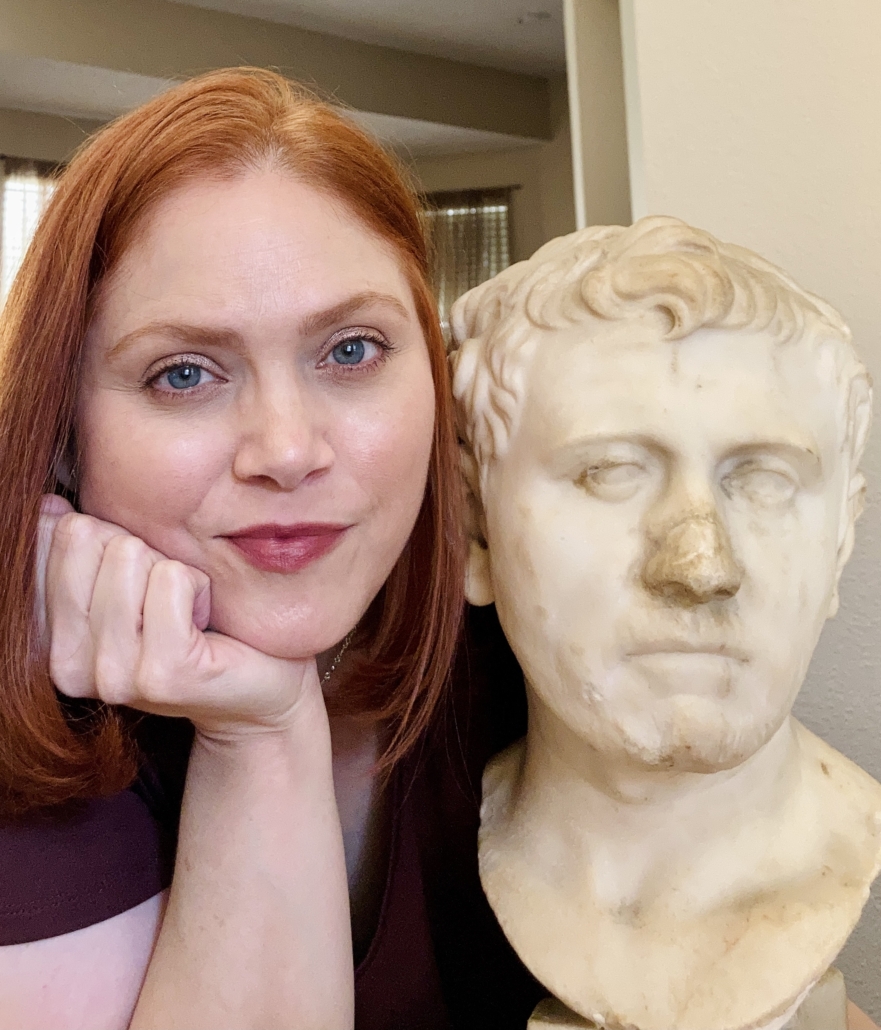
Laura Young with the Roman sculpture she found at a Goodwill in Austin, Texas.

Here’s a fun story. You may have heard it before as it was all over the media for a while. This version is by Matt Largey, reporting for KUT, an NPR station in Austin, Texas.

“When Laura Young found a human head under a table at the Goodwill store on Far West Boulevard in 2018, she had no idea what she was getting herself into.

“The price tag said $34.99. Seemed like a deal. It was all white. Made of marble. Weighed about 50 pounds.

“ ‘Clearly antique — clearly old,’ said Young, who runs her own business as an antiques dealer and goes to a lot of thrift stores looking for treasures.

“So she bought the head and lugged it out to her car, buckled it into the passenger seat and took it home.

“Young wanted to figure out what the sculpture was, so she did some Googling and she started to piece things together. She contacted an auction house in London that confirmed it was really old — like first century old. Another auction house managed to find the head in a catalog of items from a German museum in the 1920s and 1930s.

“It was listed as a portrait bust of a man named Drusus Germanicus.

“And so began Young’s four-year ordeal trying to get rid of a 2,000-year-old sculpture.

“How did a 2,000-year-old sculpture of a Roman general’s head wind up in a Goodwill in Austin, Texas?

“ ‘There are plenty of Roman portrait sculptures in the world. There’s a lot of them around. They’re generally not in Goodwills,’ joked Stephennie Mulder, an art history professor at UT Austin. ‘So the object itself is not terribly unusual, but the presence of it here is what makes it extraordinary.’ …

“The marble bust was cataloged at a museum called Pompejanum in the German city of Aschaffenburg. The museum was a replica of a villa in Pompeii, which was buried in volcanic ash in the first century. The German king, Ludwig the First, had something of an obsession with Pompeii, so he built this villa in the 1840s to house a bunch of Roman art. Germanicus was among the collection.

“Almost 100 years later, World War II was raging. In spring of 1945, Aschaffenburg was the site of a battle between the Nazis and the U.S. Army. …

“ ‘We know that many of the objects [in the museum] were either destroyed in the Allied bombing campaign or looted afterward,’ Mulder said. ‘So unfortunately in this case, it might have been a U.S. soldier who either looted it himself or purchased it from someone who had looted the object.’ …

“Perhaps the person who took it died or perhaps they gave it away. But somehow, someone decided they didn’t want it anymore and dropped it off at Goodwill. Workers slapped a price tag for $34.99 on it and put it out for sale. …

“Back at home, Young had a problem: She was in possession of a looted piece of ancient art. She couldn’t keep it. She couldn’t sell it. And giving it back to its rightful owners was a lot harder than it sounds.

“ ‘At that point, I realized I was probably going to need some help,’ Young says. ‘I was probably going to need an attorney.’

“So she hired a lawyer in New York who specializes in international art law, Leila Amineddoleh.

“Negotiations began. It was complicated. It takes a long time to figure out all this stuff — even in the best of times. But the pandemic complicated things even further. It was slow going and in the meantime, she was stuck with this 2,000-year-old head on display at her house. …

“It looked great in the house, she says. In a weird way, Young started to get attached. She named him — half-jokingly — after Dennis Reynolds, a narcissist character from the TV show It’s Always Sunny in Philadelphia.

“ ‘He was attractive, he was cold, he was aloof. I couldn’t really have him. He was difficult,’ she says. ‘So, yeah, my nickname for him was Dennis.’ …

“Finally, they got a deal: The Germans would take Dennis back. The exact terms of the deal are confidential, but the head will stay in Texas — on display — for about a year. Last month, the movers came to get him. …

“Young says, ‘It’ll be a little bittersweet to see him in the museum, but he needs to go home. He wasn’t supposed to be here.’

“[You] can see Dennis at the San Antonio Museum of Art, which already has a significant Roman antiquities collection.

“ ‘It actually ended up being a really, really good fit. He’s just right down the road,’ Young says. …

“In a way, Dennis will always be with Young. Before she let him go, she had a half-size copy of him 3D-printed. ‘I do have a collection of busts at home,’ she says. ‘So he’s with my other heads.’ “

More at station KUT, here.

Read Full Post »

Piñatas as Art

Photo: Henry Gass/Christian Science Monitor.
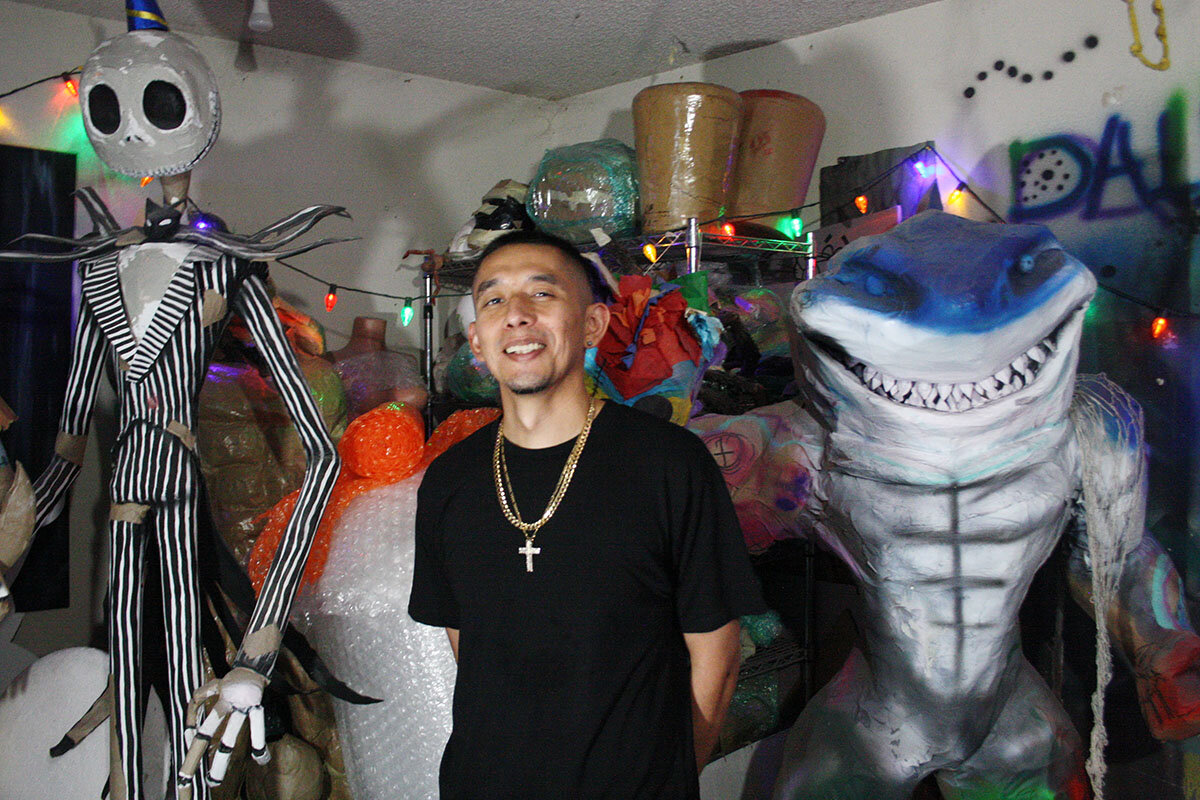
Piñata sculptor Alfonso Hernandez in his garage studio in Dallas. He is one of a growing group of piñata makers hoping to transform the industry and get recognition for the piñata as an art form.

When you think of piñatas, what do you picture? Kids’ birthday parties? Long cudgels? Here’s an article about people who want you to know that piñatas can be a serious art form.

Henry Gass asks at the Christian Science Monitor, “Would you take a sledgehammer to the David? A flamethrower to the Mona Lisa? A shredder to the latest Banksy? (Actually, scratch that last one.)

“Why then, some people are beginning to ask, would you want to pulverize a piñata? Alfonso Hernandez, for one, wants you to lower the bat and take off the blindfold and appreciate the artistry of a form that dates back hundreds of years.

“The Dallas-based artist has crafted life-size piñata sculptures of Mexican singer Vicente Fernández and Jack Skellington from The Nightmare Before Christmas. He wants the public to help turn an industry into art.

“ ‘Piñata makers never treated it like an art form,’ he says. ‘They’re taught to make it fast. It doesn’t matter what it looks like, just hurry up because they’re going to break it.’

“Unsatisfied with the generic mass production that has characterized their discipline for decades, piñata makers are pushing the artistic limits of the party pieces. These piñatas, bigger and more detailed, are made out of wood, foam, wire, and clay, and sculpted to look like beloved icons and life-size low-riders. Some move, some are political, and some even talk. Rihanna is a fan, as are, increasingly, art galleries.

“For generations, the real cost of bargain piñatas has typically been borne by the piñata makers themselves working long, arduous hours for less than minimum wage. By proving that piñatas can be more than just clubbable party pieces, people like Mr. Hernandez hope they can both create art and bring a wider respect and dignity to a craft long viewed as cheap and disposable.

“ ‘It’s been an underappreciated art form,’ says Emily Zaiden, director and lead curator of the Craft in America Center in Los Angeles. ‘Piñatas are so accessible. They speak to everybody,’ she adds. But there’s also a flip side. Piñatas ‘can be about appropriation, can be about, I think, the trivialization of a cultural tradition.’

“A new generation of Hispanic artists, she continues, ‘see how much metaphorical potential piñatas have, and how deeply it reflects their identities.’ …

“There are lots of questions around where piñatas come from. They may have emerged in Europe, or China, or the Aztec era – or in all three independently. There are few preserved, written historical records on the origins of piñatas – another sign of how underappreciated the craft has been, Ms. Zaiden believes.

“ ‘A lot of this work probably hasn’t been collected or preserved in ways that other types of art have been,’ she says. ‘It’s all speculation and oral history really,’ she adds, ‘but that goes hand in hand with the idea that these are ephemeral objects.’

“For centuries, piñatas were used for religious ceremonies in Mexico. Typically built to resemble a seven-pointed star, symbolizing the seven deadly sins, they would decorate homes – and be smashed – during the Christmas season.

“Their religious significance faded over time, and they became the popular children’s birthday party feature. But as the piñata industry commercialized, quality and craftsmanship became secondary to quantity.

“Yesenia Prieto grew up in that world. A third-generation piñata maker, she watched her mother and grandmother create in her grandmother’s house in south central Los Angeles, and when she was 19 she started helping herself. It was a constant struggle to survive, she says.

“ ‘I was tired of seeing how poor we were,’ she adds. ‘My grandma was about to lose her house. And we just needed to make more money. We needed to survive.’

“She describes a week in the life of a typical piñata maker. A four-person crew makes about 60 units out of paper, water, and glue a week. Selling wholesale, they make $600 and split it between the four of them. That’s about $150 for a full week of work. …

“ ‘What you’re seeing is an art form having to be mass produced and rushed because they’re getting sweatshop wages,’ she adds. …

“In 2012, Ms. Prieto went independent from her family, and independent from the mainstream piñata industry. She founded Piñata Design Studio and set to making custom, complex pieces that reflect the artistic potential of the craft.

“They’ve created pterodactyls and stormtroopers. They’ve made a giant Nike sneaker, and an 8-foot-tall donkey for the 2019 Coachella music festival. They made a piñata of singer Rihanna for her birthday. …

“But the need to hustle hasn’t abated, according to Ms. Prieto. They work longer on their piñatas than most makers do – up to 16 hours in some cases – but still struggle to sell them for more than $1 an hour. They’ve been leveraging the internet and social media – posting pictures of pieces as they’re being made, to illustrate the labor that’s involved – and they’re slowly raising their price point. …

“She’s also now reaching out to other piñata makers about forming a co-op. By working together, she hopes, piñata makers can get paid fairly, at least. Artistic quality could also improve. And as people see elaborate, custom piñatas more often, she believes, demand will grow, and pay will grow with it. …

“ ‘There is a shift taking place,’ she adds. She’s seeing piñatas in galleries more often. But ‘there’s [still] a need for us to push hard to survive.’ ”

More at the Monitor, here.

Read Full Post »

Photo: Casa Dei Pesci.
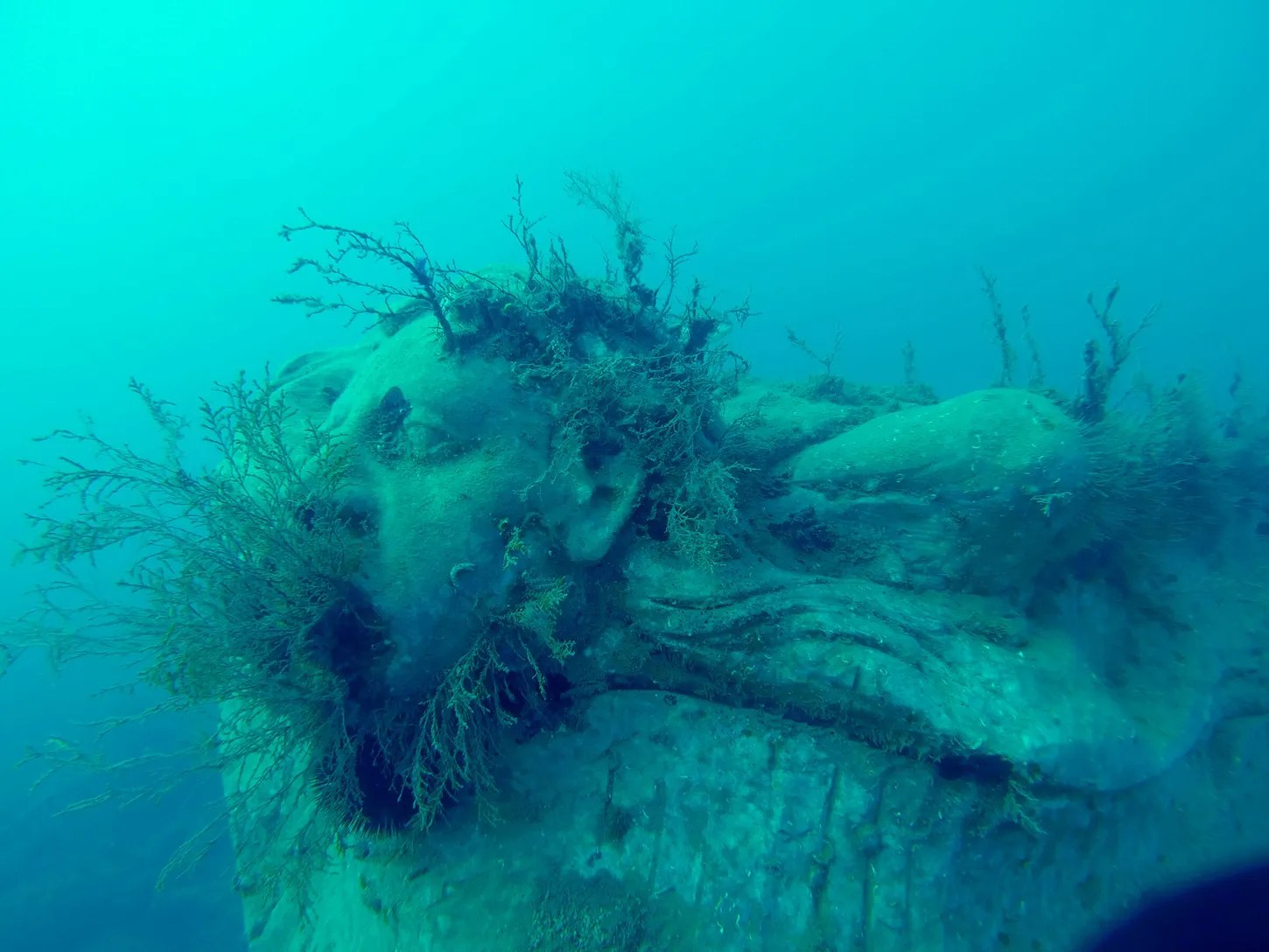
A sculpture named ‘Acqua’ by Giorgio Butini is one of 39 underwater sculptures helping to deter illegal fishing off the coast of an Italian port.  

Here’s a creative idea to thwart illegal activity: attract enough sightseers to make it too public to pursue. Today’s story shows how environmentalists, artists, and a fishing community in Italy are collaborating on shared goals.

Veronique Mistiaen writes at National Geographic, ” ‘The stone is asking me to give it the right face: it is thoughtful, quiet,’ says British stone sculptor Emily Young. She carves boldly, clad in a thick jacket, leather hat, sturdy boots, face mask and ear plugs, but no gloves because ‘you need to feel what’s happening with the stone through the tool.’ …

“Young, who has been called ‘Britain’s greatest living stone sculptor,’ has work exhibited and collected around the world, but it is the first time that one of her creations reposes at the bottom of the sea.

“Young’s 18-tonne Weeping Guardian and two other colossal faces (The Gentle Guardian and the Young Guardian), which she carved in Carrara marble with the help of two associates over five days, were lowered down on the sea bed off the coast of Tuscany at Talamone, a town between Florence and Rome, in 2015. There, her massive stone guardians are protecting marine life against gangs trawling illegally at night.

“Young’s unusual work is part of an on-going project by local fisherman Paolo Fanciulli and his non-profit Casa dei Pesci to try to protect the sea in a creative way. There are now 39 underwater sculptures and marble blocks at Talamone, placed in 2015 and 2020, and another 12 are ready to join them as soon as necessary funds can be raised.

“Bottom trawlers drag their heavy-weighted nets multiple times over the sea floor, scraping it bare and destroying the Posidonia (Posidonia oceanica), known as Neptune grass, a flowering seagrass endemic to the Mediterranean, which forms large underwater meadows and acts as a nursery and sanctuary for all marine life.

The Posidonia also soaks up 15 times more carbon dioxide annually than a similar sized piece of the Amazon rainforest.

“For these reasons, the Posidonia is a protected species included in the EU’s Habitats Directive and the Marine Strategy Framework Directive, and bottom trawling is illegal within three nautical miles from the coast in Italy. But because it is very profitable, and impossible to police the 8000km of Italian coastline, boats carry on at night regardless. 

“Now in his 60s, Fanciulli has been fishing around Talamone since he was a teenager.  In the 1980s, he started noticing the devastation caused by bottom trawlers and the impact it had on his and other local fishermen’s catch and livelihood. He has been trying to fight them ever since.

“In 2006, he joined force with the municipality of Talamone and a few environmental organizations to drop big concrete bollards on the bottom of the Mediterranean to ‘serve as secret agents under the sea.’ The action received media attention and he became a national hero – but it wasn’t enough to deter the trawlers. The local mafia also retaliated by making sure he couldn’t sell his fish at the market, and threatening him.

“He needed to find another way. ‘He thought: “This is Italy. We do art. If we could put art and conservation together, we might have more impact,” ‘ explains Ippolito Turco, a friend of Fanciulli and president of the non-profit Casa dei Pesci, which they created together for that purpose with the support of several cultural and environmental associations.

“They asked nearby Carrara quarries if they could donate a few stones. Franco Barattini, the president of one of Carrara’s best-known quarries – Michelangelo cave, the very place where the eponymous artist came at the turn of the 16th century to select stones for his iconic David and Pietà statues – promised to donate not a few, but 100 huge blocks of marble.

“Young, along with Italian artists Giorgio Butini and Massimo Lippi, and other artists from four countries, was asked to carve the marble blocks. ‘We all donated our time. I thought it was a brilliant project: it would attract more attention to the problem,’ says Young. …

“The sculptures were placed in a circle, four metres apart around a central obelisk, carved by Massimo Catalani, another Italian artist. A bit further sleeps a mermaid, a collaboration by sculptor Lea Monetti and young artist Aurora Vantaggiato, and a reclining figure by Butini, among other works.

“The marble sculptures create both a physical barrier for the trawlers’ nets and a unique underwater museum, open to anyone either through arranged scuba diving tours or their own dive. “It’s really beautiful and it’s amazing to see how easy it is for nature to recover. …

“The scheme has completely stopped illegal trawling within three miles off shore in front of Talamone as far south as the mouth of the Ombrone river, Turco says. ‘But now the pirate boats have moved north of the Ombrone. Casa dei Pesci plans to protect this stretch of sea as well.’ “

More at the Geographic, here. Needless to say, the photos are wonderful. No firewall.

Read Full Post »

Photo: Deb Nystrom.
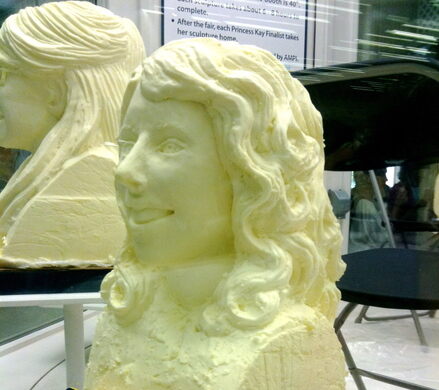
The Minnesota State Fair crowns a “Princess Kay of the Milky Way” every year, and for 50 years, Linda Christensen has been sculpting her head in butter.

OK, no laughing. A regular attraction of the Minnesota State Fair, which I visited when I lived in Minneapolis, is one that celebrates the dairy industry. It includes a pageant to select the year’s Princess Kay of the Milky Way. And for 50 years, Princess Kay and her attendants have had their heads sculpted in butter by Linda Christensen.

Cathy Free writes at the Washington Post, “Photos and paintings can be lovely, but if you really want to impress, get your likeness chiseled into a 90-pound block of butter.

“Every year at the Minnesota State Fair, a dozen young dairy pageant finalists are sculpted live as part of a spectacle, a tradition that dates back to 1965. The butter busts began as a way to bring attention to Minnesota’s dairy industry and have remained a draw since, as thousands of visitors show up every August to watch the painstaking artistry while a winner is named Princess Kay of the Milky Way.

“ ‘It would be hard to find a person in Minnesota who doesn’t know about Princess Kay of the Milky Way,’ said sculptor Linda Christensen, 79, about the contest naming a state dairy ambassador.

“For almost 50 years, Christensen has been the principal artist to create the busts. She uses a kitchen knife she calls ‘Old Faithful’ to carve the faces into salted butter. Each one takes about six hours.

“Now, after churning out more than 500 princess butter heads over nearly five decades, Christensen has decided to retire her knife. She turned her last 90-pound block into a creamy masterpiece at the fairgrounds last month from her glass-enclosed studio.

‘You learn to get used to working in a rotating glass booth with everyone watching you,’ she said. ‘You have to bundle up, because the temperature is set at 39 degrees. There probably aren’t a lot of artists who’d like to work with cold butter, but I really enjoyed it.’ …

“State fairs in Iowa and Illinois are famous for showcasing cows crafted from butter, but Christensen said she doesn’t know other artists who regularly sculpt the likenesses of live dairy models year after year. She said she admires the women she sculpts, most of whom come from dairy farming families.

“ ‘As kids, they knew what it was like to get up at 4:30 to help with the farm chores before catching the bus to school,’ she said. ‘They’re tough.’ …

“The Princess Kay of the Milky Way contest is not based on looks. It is a goodwill ambassador program focused on leadership skills and ‘promoting the goodness of dairy products,’ according to the Minnesota Dairy Princess Handbook. … The princess is selected based on how well judges think she will promote Minnesota’s dairy industry at trade shows and community events. Women who live or work on dairy farms are encouraged to compete in county contests every year, with the finalists advancing to the Minnesota State Fair.

“The top dozen ended up in Christensen’s see-through butter booth as she chiseled their likenesses into edible works of art.

“The princess is selected based on how well judges think she will promote Minnesota’s dairy industry at trade shows and community events. Women who live or work on dairy farms are encouraged to compete in county contests every year, with the finalists advancing to the Minnesota State Fair. …

“Christensen began the niche portraits in 1972 when the American Dairy Association of Minnesota (now known as Midwest Dairy) was looking for a new artist to make giant princess butter heads at the state fairgrounds in Falcon Heights, outside of St. Paul.

“Christensen had recently graduated from the Minneapolis College of Art and Design and was recommended by one of her instructors to make sculptures of the pageant’s finalists. Christensen worked as an art teacher at the time, but she thought two weeks of butter sculpting would be a fun way to make extra money, she said. She didn’t imagine she’d remain for nearly 50 years. …

“The Princess Kay of the Milky Way pageant — named in the 1950s by the winner of a public contest — wouldn’t have been the same without Christensen’s sculpting talent, said Molly Pelzer, the CEO of Midwest Dairy.

“ ‘Linda’s butter sculptures have helped solidify [the pageant’s] iconic place in Minnesota culture,’ she said.

“Past winners have included Kristi Pettis Osterlund, who in 1996 was crowned as the 43rd Princess Kay of the Milky Way. She took her butter bust home to Winthrop, Minn., where it was kept frozen in a meat locker until the last month of her reign. She then decided to melt down her likeness and serve it to her community to slather on corn on the cob. …

“She and her mother fired up the largest slow-cooker they could find, cut the butter head into big chunks and melted it one batch at a time, she said.

“ ‘I remember cringing when my mom took a butcher knife to the head,’ she said. ‘That was a little emotional for me. But it was such a fun and memorable party. I’ll bet we easily had six or seven quarts of melted butter.’

“Donna Schmidt Moenning, a Princess Kay finalist in 1980, opted for a different approach. Moenning shared the back half of her butter bust with friends and neighbors in Marietta, Minn., for baking projects. But then she froze the face portion. It’s still sitting in her deep freeze, next to the pork chops, she said.” More at the Post, here.

And at CBS, here, you can see three sisters posing with the butter sculptures they have preserved. Jeni Haler says, “We’re a generation of butter heads. My mom was a butter head. And I have two older sisters that were also butter heads.”

Read Full Post »

Photo: Andrew Milligan/PA.
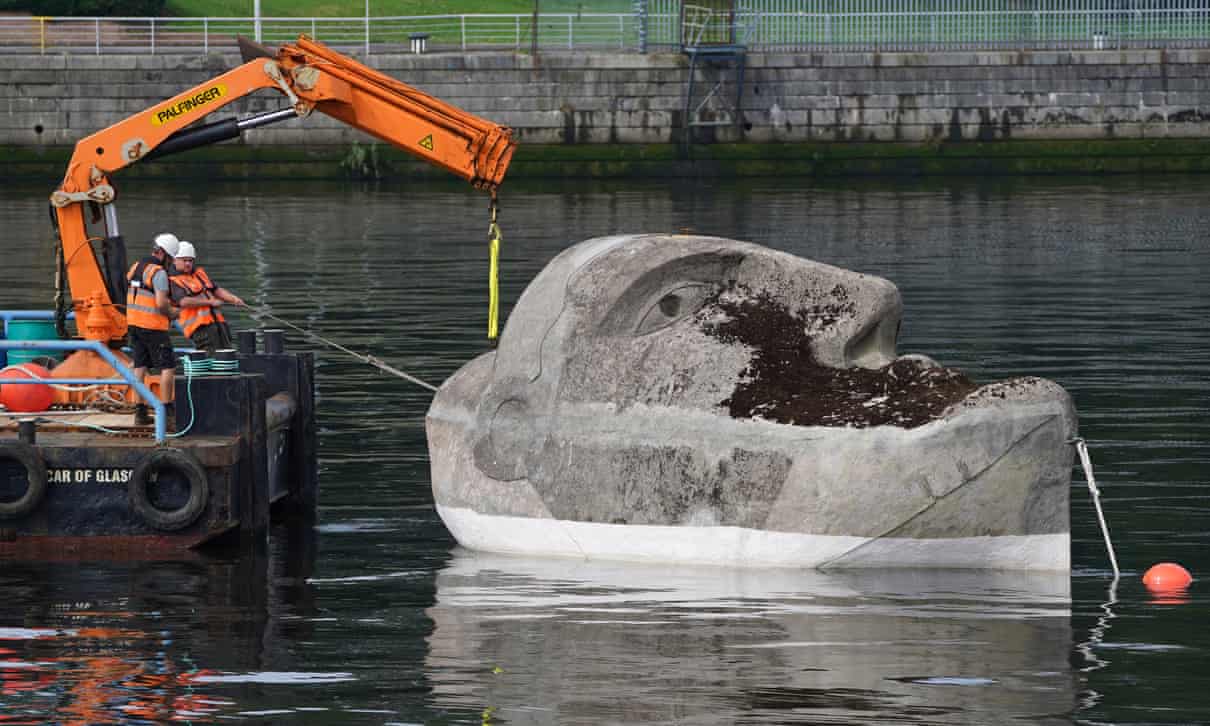
The giant head is grafted onto the hull of a boat and made up of a steel framework and cement. Forgotten after a Glasgow festival in the 1980s, it was sought out by sculptor Richard Groom’s family after his death.

Artworks may be forgotten when no one connected to the artist thinks they are worth keeping track of. It wasn’t until mourners at the funeral of UK sculptor Richard Groom told family members how well they remembered the giant floating head he once made that the family decided to find out what happened to it. Libby Brooks has the story at the Guardian.

“Bobbing in the water in the Canting Basin, by the shiny crescent of the Glasgow Science Centre, the Floating Head remains impassive as a seagull lands on its broad forehead. The seven-metre-long, 26-tonne buoyant sculpture could be a refugee from Easter Island, brought to the Clyde by the tide, only to have a bird peck at the moss covering its cheek and chin like a lopsided beard.

“In fact, it was commissioned from the artist Richard Groom as the centrepiece of Glasgow’s 1988 Garden festival, but then lost for decades – forgotten and unclaimed in a boatyard until a dogged relocation and restoration project brought it back to the spot where it started, three decades later.

“It was a conversation at the artist’s funeral in 2019 that inspired his family to seek out the sculpture.

“His brother Andy Groom said: ‘Myself and my family were so touched at Richard’s funeral where so many of his friends and colleagues commented on all of his work, especially the Floating Head. It became apparent very quickly we had to find it, fix it, float it.’

“Working with the Sculpture Placement Group (SPG), an organisation that aims to bring sculpture to different audiences, the family discovered the head had been stored at the Clyde Boat Yard for more than a decade after being rescued from another dock site where it was about to be bulldozed.

‘We had no idea whatsoever where it was,’ said Groom. ‘It was listed as abandoned on the banks of the Clyde, so I started phoning round scrap and storage yards asking: do you happen to know where a 30ft concrete head might be?’

“The head, which is grafted on to the hull of a boat and made up of a steel framework with a concrete render, was then partially restored – some graffiti was removed, but the natural weathering, and the encroaching moss, remains.

“Kate Robertson, the co-director of the SPG, said: ‘People still remember the Garden festival as a big highlight, they were aware of the focus on Glasgow and the visitors, and it also marked a turning point for the city from post-industrial to a cultural destination.’ … The Garden festival site began the redevelopment of the once booming dry docks that had become a symbol of an industry in permanent decline.

“With an official launch later this month, the head will feature at Glasgow Doors Open Days festival, forming part of a sculpture trail through Govan, while Groom’s family and the SPG seek a permanent mooring. …

“ ‘The scale of it is quite intimidating,’ Robertson said. ‘The best way to see the possibilities there are for the sculpture is to bring it out into public view again.’ ” More at the Guardian, here.

Although I don’t know what ideas the artist himself intended to emphasize with the floating head at the festival, it certainly brings home to me that Glasgow is a city on the water. Fort Point Channel features floating art, too (for example, here). It reminds viewers not only that much of Boston was salvaged from the ocean, but that rising seas want it back.

Read Full Post »

Photo: Washed Ashore.
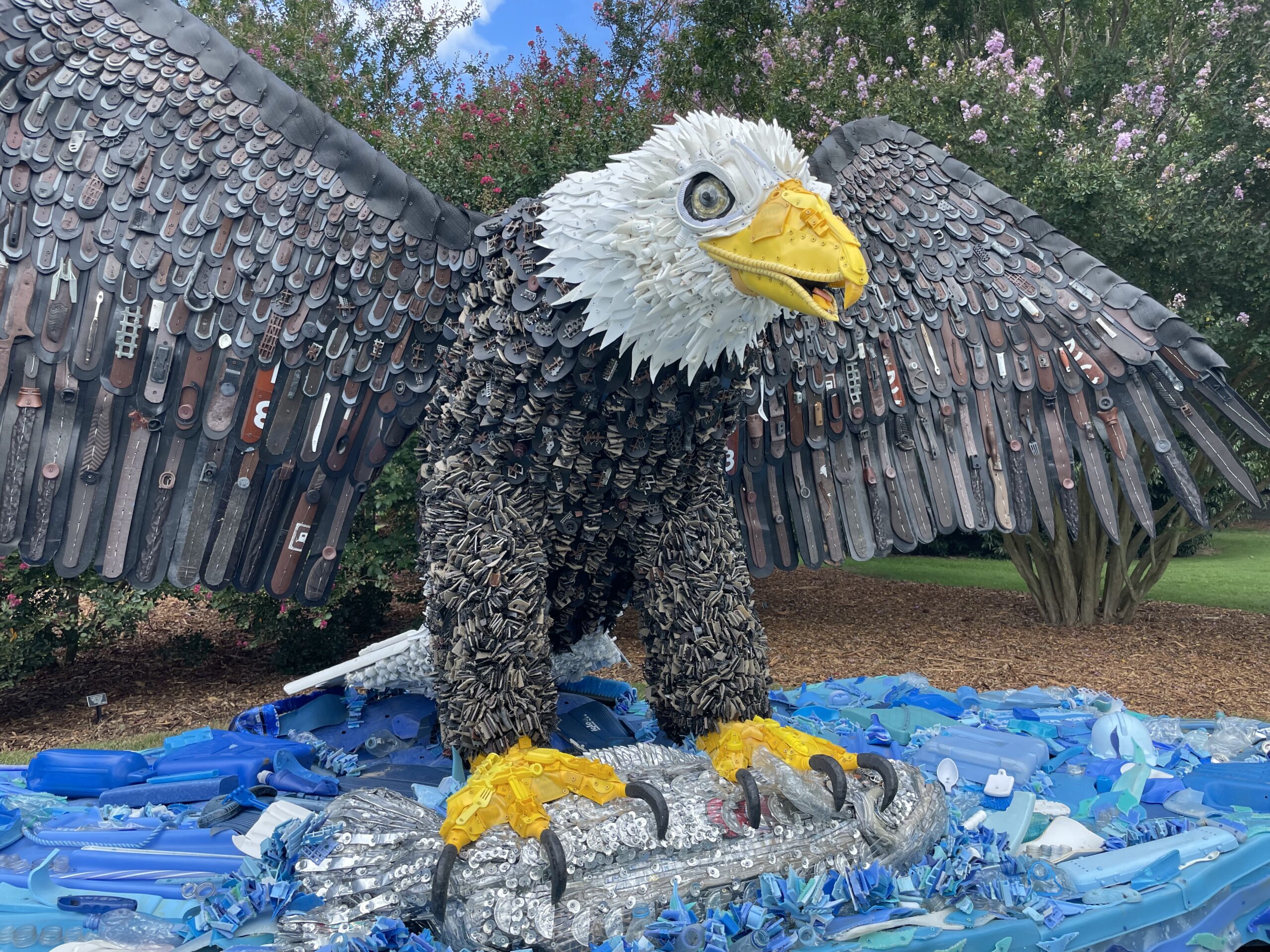
Rosa, the bald eagle, was created by Washed Ashore volunteers collaborating nationwide despite the pandemic. Washed Ashore is a nonprofit that repurposes ocean plastic to make art and raise awareness.

Having read about Washed Ashore at the New York Times before the pandemic, I wondered how these plastic-waste-fighting artists managed to keep going during lockdown. I should have known: nothing can stop them.

Founder Angela Haseltine Pozzi showed her mettle in an early March 2020 interview with Alex V. Cipolle: “Angela Haseltine Pozzi stands shoulder to shoulder with Cosmo, a six-foot-tall tufted puffin, on a cliff overlooking the blustery Oregon coast. It is January and the deadly king tides have come to Coquille Point, making the shoreline look like a churning root-beer float.

“Cosmo endures the weather just fine, as he is composed of plastic that has washed ashore — flip-flops, bottle caps, toy wheels, cigarette lighters — all mounted to a stainless-steel frame and bolted to concrete. The puffin is a sculpture from Ms. Haseltine Pozzi’s art and education nonprofit, Washed Ashore, whose tagline is ‘Art to Save the Sea.’

‘We’ve cleaned up 26 tons off the beaches, Ms. Haseltine Pozzi said, ‘which isn’t a dent in the actual pollution issue, but we’re doing something by raising awareness and waking people up.’ …

“Washed Ashore has taken those 26 tons of garbage, all debris that washed up on the Oregon coast (the majority within 100 miles of Bandon), and built 70 large-scale sculptures and counting, including Octavia the Octopus, Edward the Leatherback Turtle and Daisy the Polar Bear. …

“[The National Oceanic and Atmospheric Administration] estimates that eight million metric tons of plastic end up in the ocean each year. Marine animals become entangled in it or ingest pieces they mistake for food, such as the whale that recently washed ashore in Scotland with 220 pounds of debris in its belly — the same weight in plastic an American throws away annually.”

So having read about Haseltine Pozzi’s efforts to draw attention to this travesty through art, I wondered what happened to Washed Ashore during the pandemic. Surely, there would have been no more of Pozzi’s in-person workshops, workshops where Washed Ashore invites “the Buddhists and the Baptists, and the rednecks and the hippies, and the Republicans and the Democrats, and they all sit around the table and they all work together.”

The nonprofit’s excellent blog has that piece of the story.

“When the Covid-19 pandemic led to a national lockdown of indoor spaces in early 2020, the Washed Ashore gallery and art studios were affected much like everyone else. Volunteer activity ceased, exhibits were closed, and workshops were emptied. Washed Ashore relies heavily on a steady stream of volunteers to collect and sort debris and build parts of sculptures, accompanying our full-time staff of artists and helpers. But overnight, our doors were closed and volunteers sent home.

“Knowing the problems of plastic ocean pollution were too great to ignore, Washed Ashore looked to find a creative way to continue our mission to create ‘Art to Save the Sea’ and finding a way to still work together, but differently. …

“And so we got to work, calling on supporters and putting together a plan to unite us as the pandemic kept us all apart. [We] opened our determined efforts nationwide with a goal to work together and create a new sculpture, a symbol of unity.

“What better symbol of hope and unity for the people of the United States than a giant American Bald Eagle, the symbol of our democracy?

“The project was named ‘Come Soar With Us,’ by our Executive Director Katie Dougherty, and our team got to work putting together detailed plastic debris construction kits and instructions and mailing them out across America to over 1,550 volunteers across seven states. Their tireless participation stretched well over eight months, creating the feathers for what would be become Rosa’s impressive wingspan. …

“During a time when so much was halted, the momentum and collaboration from creating Rosa with all of our staff and volunteers was inspiring and has given our team an enormous sense of pride and accomplishment. … You can see Rosa in person at Norfolk Botanical Garden in Norfolk, Virginia, from August 21 – November 4, 2021.”

More at the Washed Ashore blog, here, and at the New York Times, here.

Read Full Post »

The Journey Junkies blog doesn’t seem to have a Reblog button, but I have their permission to share this post about an unusual garden in India.

They write: “The Nek Chand Rock Gardens had been on our radar for a long time before we finally made it there. Located in the city of Chandigarh, at the foot of the Himalayas, the gardens are one of India’s hidden gems. In fact, they largely undiscovered by foreign tourists. Indeed, on our visit, we were the only foreigners enjoying the gardens. Interestingly, although they are largely overlooked by visitors from overseas, the gardens are the second most visited tourist attraction in the country after the Taj Mahal. Around 5000 visitors a day enter the gates of the gardens to experience Nek Chand’s captivating wonderland.

“Although the gardens themselves are incredible, the story of the Nek Chand Rock Gardens is even more so. Nek Chand was born in 1924 in Pakistan and moved to India during partition in 1947. Two years later he joined the Highway Department in Chandigarh as part of the Refugee Employment Programme. In 1951, he secured a position as a road inspector at Chandigarh Public Works Department. His job was to supervise the construction of a re-vitalisation of the road system in the city. …

“It was Nek Chand’s job to supervise the re-vitalisation of the road system in the 1950’s. However, Nek Chand was a man with a vision. It was during this period, that he started to collect unwanted materials that had been discarded throughout the area. These were items that had been abandoned when the city was being re-built, as well as objects that had been thrown away by residents. He searched for rocks, broken crockery, coloured glass, along with tiles and whatever else he could find. With these materials, he secretly built a sculpture garden hidden on government land. It started small, just a patch of land, with stones bordering the area, together with a few sculptures. However, before long, the garden had expanded significantly and various courtyards were added.”

More here.

Read Full Post »

Older Posts »