Feeds:
Posts
Comments

Posts Tagged ‘singing’

Photo: Nick Ut / AP.
A blue whale, the largest mammal on Earth, surfaces in the Pacific Ocean near Long Beach, California.

Whether we’re talking about Jonah and the whale or Pinocchio or the lobster fisherman’s uncomfortably close encounter in 2021, we humans have always been fascinated by the largest mammals on Earth. And the blue whale is the most massive of them all. But what is going on with Leviathan of late?

Shola Lawal writes at Al Jazeera that it is not singing as much as it used to.

“Unlike our musical sounds, those produced by whales are a complex range of vocalizations that include groans, clicks and whistles and that can sound like anything from the mooing of a cow to the twitter of a bird. These vocalisations can be so powerful that they can be heard as far as 10km (6 miles) away, and can last for half an hour at a time. …

“For researchers, these complex sounds are a window into whale behavior, even if humans don’t yet know exactly how to decode them.

“The frequency of songs and their intensity can signal various things: an abundance of food, for example. In recent studies, however, researchers have been alarmed to find that blue whales, the largest whales and, indeed, the largest mammals on Earth, have stopped singing at specific times.

“Their eerie quietness, scientists say, is a signal that ocean life is changing fundamentally. The most recent study, conducted by scientists from the Monterey Bay Aquarium Research Institute in California in the US and published in February, examined three types of whales. Researchers found that blue whales, in particular, have become more vulnerable to this change.

“Whale songs are critical for communication between males and females when mating and among schools of whales migrating. …

“The first study, conducted in the sea waters between the islands of New Zealand between 2016 and 2018, was led by scientists from the Marine Mammal Institute at Oregon State University in the US. Over that period of time, researchers tracked specific blue whale vocalizations linked to feeding (called D-calls) and mating (called patterned songs).

“Researchers used continuous recordings from underwater devices called hydrophones, which can log sounds over thousands of kilometers, and which were placed in the South Taranaki Bight – a known foraging spot for blue whales off the west coast of New Zealand.

“They discovered that during some periods, particularly in the warmer months of spring and summer when whales usually fatten up, the frequency and intensity of sounds related to feeding activity dropped – suggesting a reduction in food sources. That decline was followed by reduced occurrences of patterned songs, signaling a dip in reproductive activity.

” ‘When there are fewer feeding opportunities, they put less effort into reproduction,’ lead researcher Dawn Barlow told reporters. The results of that study were published in the journal Ecology and Evolution in 2023.

“Then, in a study published in the scientific journal PLOS One in February [2025] researchers tracked baleen whale sounds in the California Current Ecosystem, the area in the North Pacific Ocean stretching from British Columbia to Baja California. Blue whales are a type of baleen whale, and the study focused on them, alongside their cousins, humpback whales and fin whales.

“Over six years starting in 2015, the scientists found distinct patterns. Over the first two years, ‘times were tough for whales,’ lead researcher John Ryan, of the Monterey Bay Aquarium Research Institute in California, noted in a press statement, as the whales, particularly blue whales, were found to be singing less. Over the next three years, however, all three whale species were back to singing more frequently, the study noted.

“Both studies found one main reason for the reduction of whale song: food or, in this case, the lack of it. It turns out that the research, conducted between 2015 and 2020, captured periods of extreme marine heatwave events that killed off krill, the small shrimp-like animals that blue whales feed on.

“Those heatwaves are part of a looming environmental catastrophe … caused by high-emission human activities, chief among them being the burning of fossil fuels. …

“Krill, which blue whales primarily feed on, are highly sensitive to heat and can all but vanish during heatwaves, the studies found. Their movement patterns also change drastically: instead of staying together, as they usually do, krill disperse when it is hot, making them harder for predators like blue whales to find.

“Typically, when foraging, blue whales sing to others to signal that they have found swarms of krill. … Heatwaves can also trigger harmful chemical changes in the oceans that encourage the growth of toxic algae, which causes poisoning and death to mammals in the oceans and sea birds, researchers have previously found, suggesting that blue whales are also at risk of being poisoned.

“In the more recent study in California, researchers found that in the first two years when whales were singing less frequently, there was also a reduction in other fish populations. …

“ ‘Compared to humpback whales, blue whales in the eastern North Pacific may be more vulnerable due to not only a smaller population size but also a less flexible foraging strategy,’ Ryan, the lead author of the California study said in a statement. …

“It is likely, both studies say, that blue whales need to spend more time and energy finding food when it is scarce, instead of singing.”

At Al Jazeera, here, you read about climate change effects on other species, too.
Read Full Post »

Photo: The Aphasia Choir of Vermont.
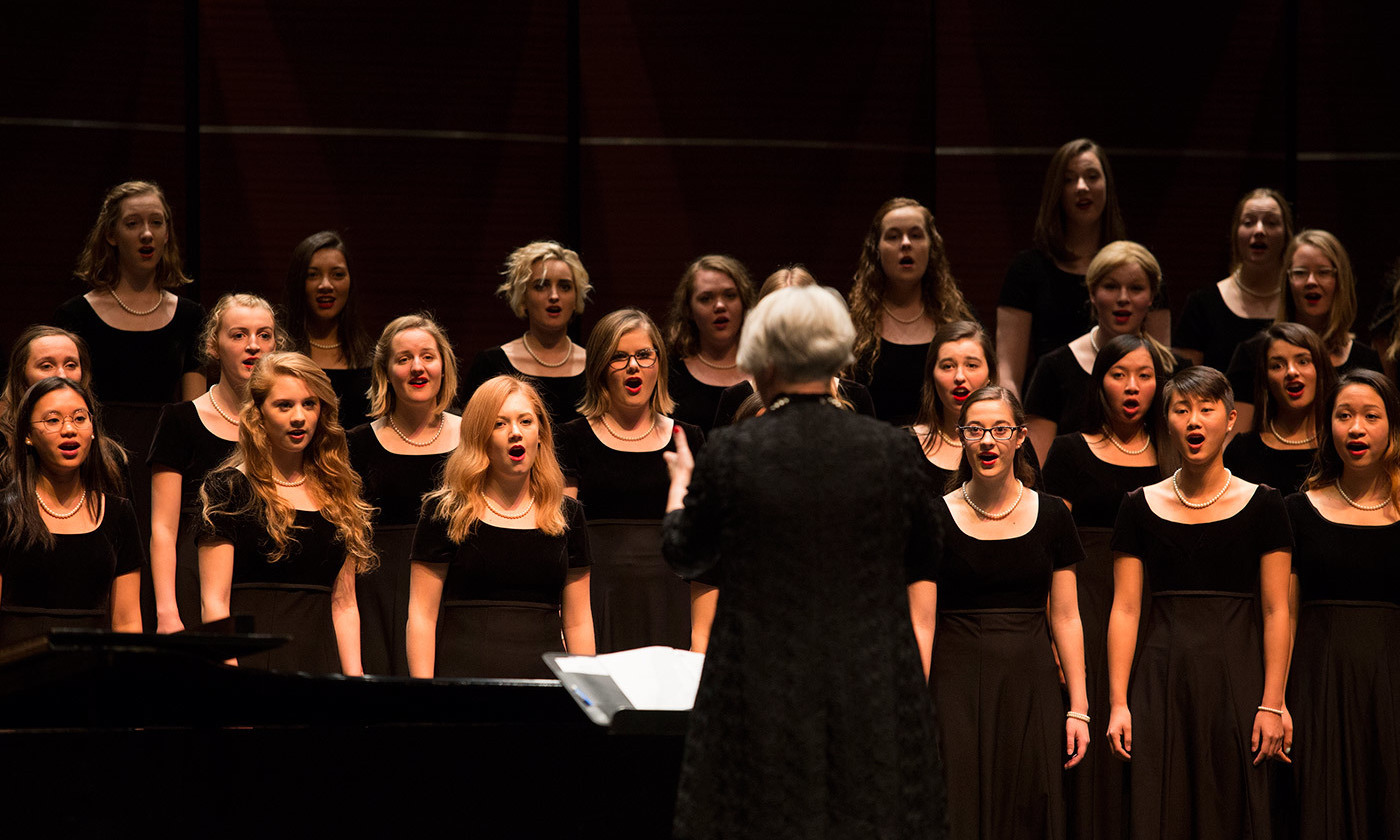
Aphasia Choir of Vermont founder and director Karen McFeeters Leary leading the group in a concert. Aphasia is caused by damage to the parts of the brain that control language.

We all know, or knew, someone who lost the ability to speak well because of a stroke or other brain injury. The condition is called aphasia. We also have heard that music can do miracles for people with disabilities — dementia for example. (Click here.)

Now read about the Aphasia Choir of Vermont and how it produces miracles for people with aphasia — and their families.

From the website: “The Aphasia Choir of Vermont was founded in 2014 by singer/songwriter and former speech-language pathologist Karen McFeeters Leary.

“The choir is composed of stroke and traumatic brain injury survivors who have expressive aphasia (difficulty talking or using language) as well as spouses, family members, University of Vermont (UVM) students studying speech-language pathology, and rehabilitation professionals from the UVM Medical Center who provide assistance.

“Because music is largely mediated by the undamaged hemispheres of the brains of people with aphasia, they can sing and are often fluent while singing even if they have severe difficulty speaking or are nonverbal. Bringing these individuals together in song enables them to experience freedom of expression in a context that fosters social connections and a sense of belonging.

“In honor of National Aphasia Awareness Month, the Aphasia Choir of Vermont performs a free public concert each spring, wherein educational information is provided in order to raise aphasia awareness in our communities. Concert audiences have grown since the choir’s inception, and attendees have used words and phrases such as ‘amazing’ and ‘awe-inspiring’ to describe what they’ve witnessed. In 2020, the American Stroke Association chose the Aphasia Choir of Vermont as the winner of their Stroke Hero Award for Outstanding Group. …

“If you or someone you know has aphasia and is interested in joining next year’s choir program, please contact Karen McFeeters Leary at kmcfeeters@aol.com or (802) 288-9777 for more information.”

But if you don’t live in Vermont, you should know there are aphasia choirs around the world. Click here.

It was my daughter-in-law who first heard about this music program in Vermont and knew it would be great for the blog. More here.

Read Full Post »

Photo: Classical-Music.com.
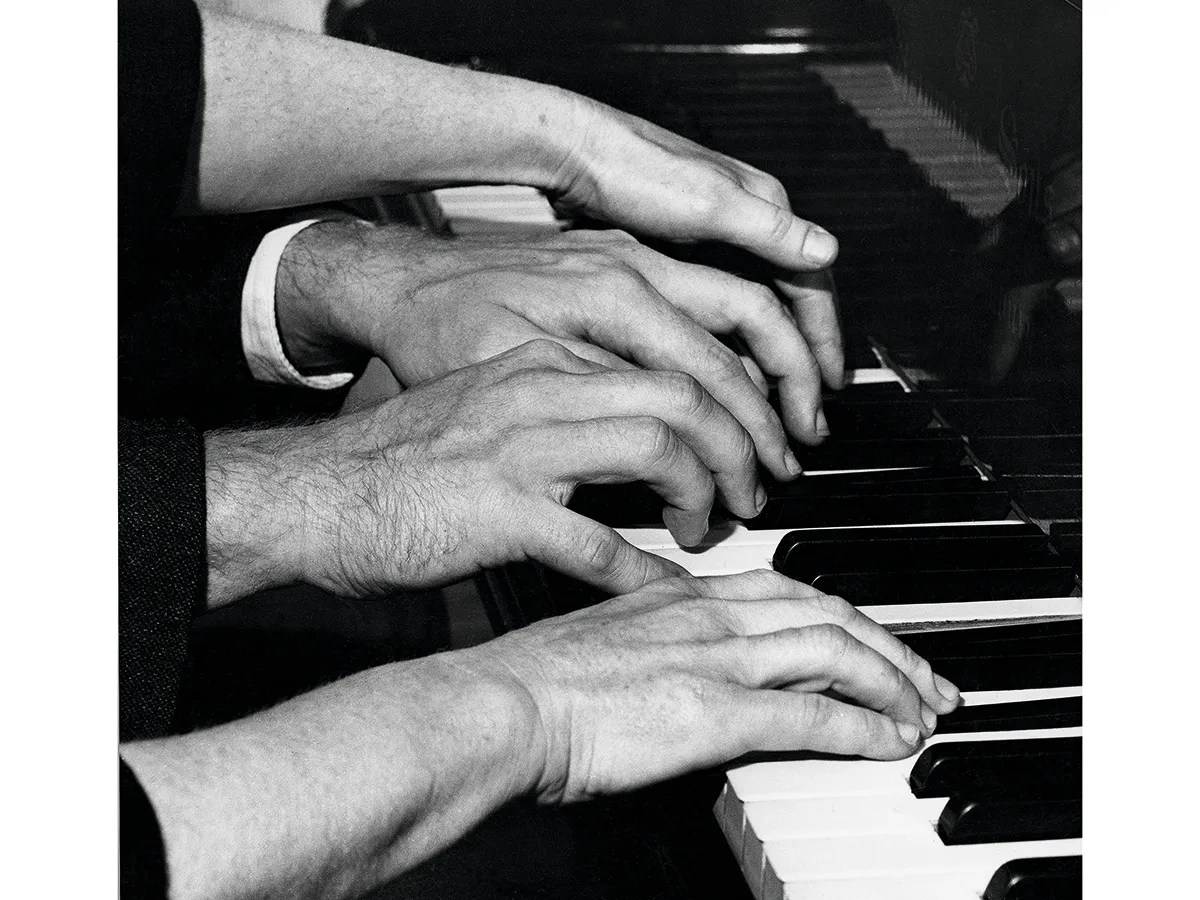
Playing piano four-hands.

Where I live now, we think a lot about brain health. We know that parts of our brains are not working as well as they used to. It takes longer to remember a word. Sometimes a memory is completely gone, and then we worry.

I like to think of a young man I know whose father helped him use other parts of his brain for daily functioning after he was born without a cerebral cortex. This young man now lives independently, has a job in the city to which he takes a train, and is the subject of study by amazed doctors. He’s my hero these days. Brains can learn new tricks.

BBC health reporter Aurelia Foster wrote recently about one way to teach your brain new tricks, and that’s through music.

She wrote, “Playing a musical instrument or singing could help keep the brain healthy in older age, UK researchers suggest. Practicing and reading music may help sustain good memory and the ability to solve complex tasks, their study says. In their report, published in the International Journal of Geriatric Psychiatry, they say music should be considered as part of a lifestyle approach to maintain the brain.

“More than 1,100 people aged over 40, with a mean age of 68, were studied. Scientists at the University of Exeter observed their brain function data as part of a wider study that has been finding out how brains age, and why people develop dementia.

“They looked at the effects of playing an instrument, singing, reading and listening to music, and musical ability.

“The researchers compared the cognitive data of those in the study who engaged in music in some way in their lives, with those who never had. Their results showed that people who played musical instruments benefitted the most, which may be because of the ‘multiple cognitive demands’ of the activity.

“Playing the piano or keyboard appeared to be particularly beneficial, while brass and woodwind instruments were good too. Simply listening to music did not appear to help cognitive health. The benefit seen with singing might be partly because of the known social aspects of being in a choir or group, the researchers say.

” ‘Because we have such sensitive brain tests for this study, we are able to look at individual aspects of the brain function, such as short-term memory, long-term memory, and problem-solving and how engaging music effects that,’ lead author Prof Anne Corbett told the BBC. …

” ‘Playing an instrument has a particularly big effect, and people who continue to play into an older age saw an additional benefit,’ she said. In the study, people who read music regularly had better numerical memory.

“Prof Corbett said: ‘Our brain is a muscle like anything else and it needs to be exercised, and learning to read music is a bit like learning a new language, it’s challenging.’

“Researchers did not test potential benefits of taking up a musical hobby for the first time later in life, but Prof Corbett said she believed, based on current evidence, it would be ‘very beneficial. …

” ‘The message is around how people can proactively reduce their risk of cognitive decline or dementia, and really thinking about engaging with music as a way of doing that.’ … However, she said: ‘It would be naïve to think taking up a musical instrument would mean you won’t develop dementia. It’s not as simple as that.’ “

More at the BBC, here.

Read Full Post »

Photo: Clay Bank/Unsplash.
There’s a musical road near Mt. Fuji, one of several discovered around the world.

When my mother was a kid, she loved to go to Singing Beach in Manchester-by-the-Sea. If you scuffed your feet in the sand, it squeaked. It didn’t really “sing,” but that was how the beach got its name.

Now I’m learning there is also such a thing as a singing highway. Stacy Conradt shares the story at Mental Floss.

“You’re probably familiar with rumble strips, those grooves on roads that make a loud, obnoxious noise when a car crosses them. Shoulder and centerline strips are placed to alert drivers that they’re getting too close to the edge of their lanes, while transverse strips typically cross the entire road and are used to signal that drivers should slow down.

“In most cases, rumble strips are anything but pleasant to the ear — but a few enterprising individuals realized that it doesn’t have to be that way. In fact, varying the length and distance of the grooves can allow cars to create melodies on the road. Here a few places where you can find harmonious highways.

DENMARK

“The road-as-an-instrument concept was invented in 1995 when two Danish artists came up with the ‘Asphaltophone,’ raised pavement markers that are more closely related to Botts’ dots than rumble strips. See it in action just after the 1:30 mark:

NEW MEXICO

“Transportation officials in New Mexico hope that ‘America the Beautiful’ will get cars to slow down on a section of historic Route 66 between Albuquerque and Tijeras. To hear the song at the proper speed and pitch, vehicles must strictly obey the posted speed limit of 45 mph. Drivers are unable to hear the song if they are going even a few miles under or over the limit.

CALIFORNIA

“The only other musical road in the U.S. can be found in Lancaster, California, where a snippet of the ‘William Tell Overture’ plays for drivers going 55 mph. … The attraction was originally installed near a residential area, but citizens complained so much that the grooves were paved over just two weeks after they were installed. The city received hundreds of phone calls from people who missed The Lone Ranger theme song and eventually agreed to reinstall the strips in an industrial area where it wouldn’t bother residents. …

 JAPAN

“Japan embraced a number of singing streets after engineer Shizuo Shinoda accidentally scraped a road with a bulldozer and realized that the resulting grooves made interesting sounds. There are now several melody roads in Japan, including [one] near Mt. Fuji.

 SOUTH KOREA

“Nearly 70 percent of highway accidents in South Korea are caused by distracted or dozing drivers, so the Korean Highway Corp. has installed musical grooves in particularly dangerous stretches of road in an attempt to get motorists to pay attention. [One] of the songs, which you’ll recognize as a slightly off-tune version of ‘Mary Had a Little Lamb.’ ”

More at MentalFloss, here.

Read Full Post »

Although coronavirus on surfaces still seems to be an issue (read about a lab study in Australia that says it can cling to phones and banknotes for 28 days), my current focus is on droplets suspended in the air. More ventilation, fewer ventilators!

So I’ve been following stories about people who have found ways to do things outside that would be too dangerous inside right now.

Bob Morris writes at the New York Times about singers feeling more like they are part of a real choir when they rehearse from their cars. (More or less how I hope to be with friends in winter.)

“I love singing four-part harmony,” Morris says. “It isn’t just about the precision, the ringing sound when voices blend together. It’s also about community, listening to one another and breathing together, creating a mood-lifter and balm in a fraught world.

“But like theater and hand shaking, choral singing has been canceled for now — and for good reason. Singing is the AK-47 of expression in the coronavirus era, shooting out so many aerosols that a church choir in Washington made the news in March when almost everyone present contracted the virus after a rehearsal; 53 singers became ill, and two died.

“When my men’s a cappella chorus on Long Island turned to Zoom rehearsals in the spring, I didn’t last long. The lag time over Zoom didn’t allow for live harmonizing or even the simplest singing in unison. ‘Performing’ meant recording ourselves alone at home so our conductor could edit us together.

“It felt like homework for hobbyists, without the emotional payoff. So when I first heard about choirs singing live in cars, it struck, well, a chord.

“It started with David Newman, a baritone on the voice faculty of James Madison University in Harrisonburg, Va. In May, after a widely discussed web conference on the dangers of singing, Mr. Newman set up a sound system with four wireless microphones, an old-school analog mixer and an amplifier. Several singers gathered in their cars on his street, and he conducted them from his driveway.

“It worked. Out of respect for the neighbors, Mr. Newman started using an FM transmitter, so the blended sound came through over car radios — as it does for drive-in movies — not over a loudspeaker. He found barely any audio delay. ‘The latency was near zero, which was really exciting,” he told the Chorus Connection. ...

“Word of Mr. Newman’s drive-in chorus gradually spread as he posted instructions to help other groups. Bryce and Kathryn Denney, in Marlborough, Mass., were inspired … and were soon showing up with a car full of equipment for dispirited local choirs to facilitate live singing for up to 30 participants.

“On a recent Sunday, I was one of them. … The steeple of the First Parish Church of Stow and Acton, towered over the verdant town of Stow, Mass., west of Boston. …

“ ‘This is one concert that can’t be canceled,’ Bryce. …

“Kathryn, who directs musical theater productions, added, ‘We figured out how to bring people together to sing without making them sick,’ as she checked a spreadsheet of arriving participants and, wearing black latex gloves, [then gave participants] color-coded … sanitized microphones. …

“[The choir’s boyish conductor, Mike Pfitzer] had us sing scales and arpeggios. Hearing others not just over my radio but also outside made my voice shaky with emotion, especially when we sang the chords I’d been missing for so long: sunny major ones, darker minor ones and a trickier major seventh, as well. …

“I struggled with ‘Bonse Aba,’ the cheerful Zambian call and response song. … A rough translation of the song — a hymn — suggests it means that all children who want to sing should be able to sing. And so I did in close, bright harmony; we all did, with bells from the steeple ringing 5 o’clock just as we were finishing with another hymn, ‘May I Be Still.’ …

“ ‘It wasn’t just wonderful,’ said Ruth Lull, a soprano. ‘It was like coming home.’ ”

More here.

Read Full Post »

linnea-leidy

Photo: Zulekha Nathoo/CBC
Singer Linnea Leidy, 20, says she has relatives in Mexico and hopes the drop-in choir event on two sides of the border can “defuse some of the myths around these families who live around here.”

Sometimes our country feels noble for providing aid somewhere, and that’s OK. But how do we feel when other countries do the same for us — for example, when other countries stepped up because we failed to provide timely aid to Puerto Rico after Hurricane Maria? I think we need to be grateful and accept graciously, not get a chip on our shoulder. A similar dynamic can be seen in journalism. If we aren’t covering it, it’s great that another country does. Not sure if US journalists captured the following story, but I’m glad Canadians did.

Zulekha Nathoo reported at CBC about a Toronto choir that arranged a special friendship event at the US-Mexico border.

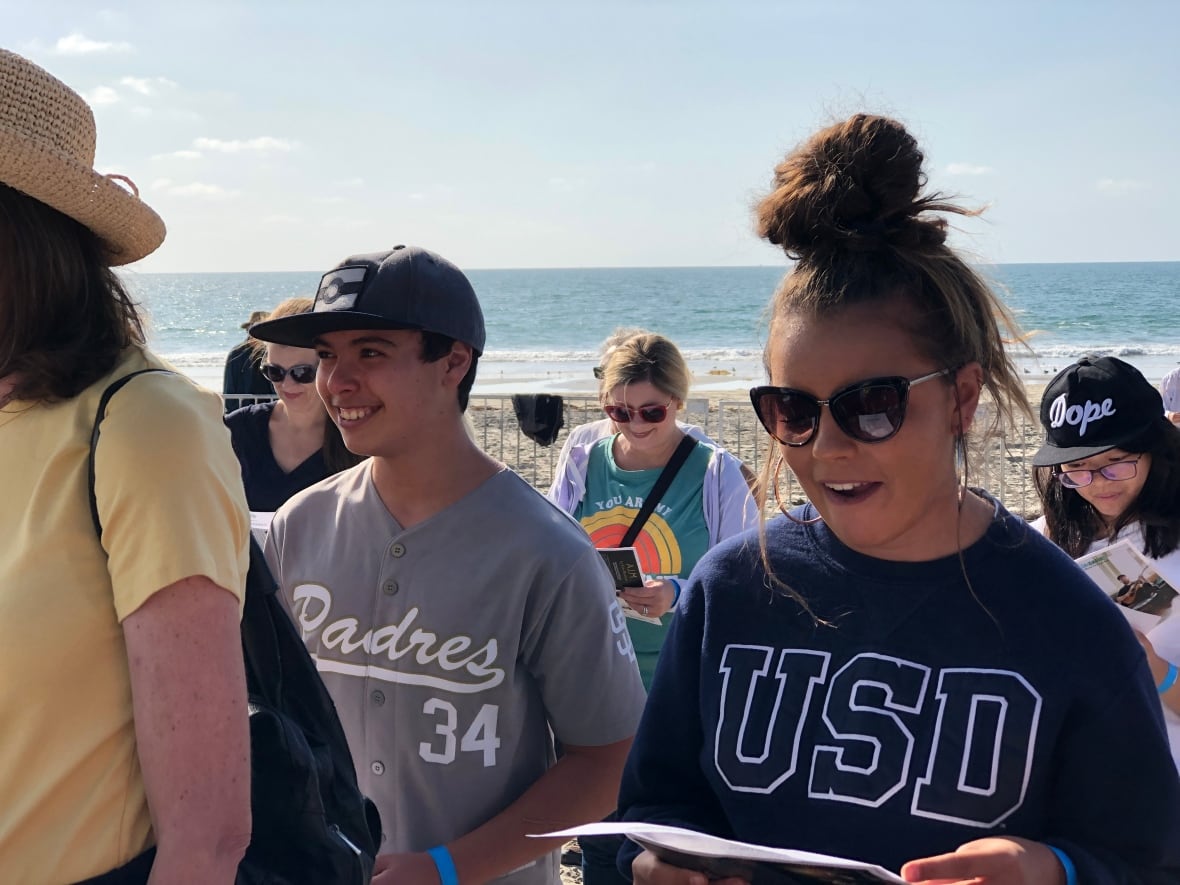
“The Toronto-based singing group Choir!Choir!Choir! staged a performance [in October] at the U.S.-Mexico border, saying the decision was based on a desire to foster community rather than on politics alone.

“With a barbed wire fence and border patrol dividing two groups of drop-in singers, one located on the beach at Border Field State Park in San Diego, Calif., and the other just metres away in the border town of Tijuana, Mexico, the popular choral group performed a rendition of ‘With A Little Help From My Friends’ by The Beatles. …

“About 300 people took part on the U.S. side and 500 across the divide in Tijuana.’We’re just trying to create a moment that can be shared and that will bring people hope,’ said Daveed Goldman, co-founder of Choir!Choir!Choir!. …

“Tens of thousands of migrants from across Central America are seeking asylum. … It has led to stiffer immigration policies, including forced family separation.

‘These people are no different than the rest of us,’ said Linnea Leidy, 20, who came to sing. She said she has family in Mexico. ‘[This event] can help defuse some of the myths around these families who live around here.’

“A short walk from the singers is the famous Friendship Park, a bi-national space at the border where residents from both sides can meet their loved ones through a guarded fence. The spaces in the fence barely allow a pinky finger to fit through. …

” ‘There are things that we can’t solve by singing, obviously,’ said Molly Clark, who works at ArtPower at University of California San Diego, which helped organize the event. ‘But I hope that in the end, we just feel more connected to one another.’

“Choir!Choir!Choir!, which invites audience members to join singalongs around the world in an effort to build a sense of community, was founded by Goldman and fellow Canadian artist Nobu Adilman in 2011. The pair teaches a song’s arrangements to participants before performing it live as a group. In addition to travelling across Canada, the duo has put on shows around the U.S. and in Europe. …

“Adilman, who was directing singers on the Tijuana side, couldn’t be seen through the fencing, but his voice could be heard on the San Diego side through loudspeakers set up near the stage.

” ‘We stand with you,’ Adilman told the Tijuana crowd. ‘We just want you to know: you have a lot of friends who you haven’t met yet.’ ”

Choir!Choir!Choir! does these events a lot and probably has the logistics and partnerships down to a science, but I’m still impressed with the organizational chops.

More at CBC, here.

Read Full Post »

idea_sized-cod-newsroom-38012019442_148f3964b4_oPhoto: CoD Newsroom/Flickr
Singers at the Illinois American Choral Directors Association conference. Research explores how people bond through singing together.

Sometimes when the grandkids were small and fighting, I would break out in a song they liked — “Mister Moon,” say, or “Baby Beluga” — and they would join in enthusiastically and forget to fight.

The bonding aspect of singing together is something that many other people have discovered on their own. Now researchers want to learn more.

Eiluned Pearce, a postdoc research associate in experimental psychology at the University of Oxford, writes at Aeon, “Singing is universal. It is found in all cultures and, despite protestations of tone deafness, the vast majority of people can sing. Singing also often occurs in collective contexts: think about sports stadiums, religious services and birthday celebrations. Given these two characteristics, my colleagues and I wondered whether singing is a behaviour that evolved to bond groups together.

“Being part of a group is essential to human survival. In our hunter-gatherer past, having supportive social relationships would have enabled people to get the resources they needed to defend them against outsiders, to benefit from collective childrearing, and to share and develop cultural knowledge about their environment and about useful technological inventions. We now also know that feeling sufficiently socially connected guards against physical and mental illness, and increases longevity. …

“Whereas monkeys and apes create social bonds through one-to-one grooming sessions, human groups are too large to be able to do that and still have enough time to eat and sleep. We needed a more efficient mechanism of creating social cohesion, a way to bond larger numbers of individuals together simultaneously.

“To find out whether singing might fill this role, we needed to find out if this activity was capable of making large groups of individuals feel closer to each other. To help us answer this question, we teamed up with Popchoir, a British organisation that runs local choirs across London and beyond. What is great about Popchoir is that these different local choirs of a few dozen members periodically come together to create a unified ‘Megachoir’ of several hundred members.

“Our research team went along to some rehearsals to collect data before and after they sang together, either in their local choir or in the amalgamated Megachoir. … On average, people showed a significantly bigger increase in how close they felt to the Megachoir over the course of singing with them, compared with when they were singing with their local choir. …

“So singing can create cohesion in large groups of several hundred individuals, supporting the idea that this behaviour might have evolved to create community cohesion in humans.

“What we still didn’t know, however, was whether singing itself is special, or whether any activity that provided opportunities for social engagement could have similar bonding effects. To tackle this issue, we collaborated with the Workers’ Educational Association (WEA), a national adult-education charity in the UK. We predicted that singing classes would become more closely bonded than other types of classes (either creative writing or crafts). We were wrong: at the end of the seven-month courses, all the classes were equally bonded.

“But as we looked more closely at the data, we saw something that surprised us. Singing seemed to bond the newly formed groups much more quickly than the comparison activities. It was the most effective. So singing is special: it has an ice-breaker effect.”

More at Aeon, here. Even when groups of singers are competing, the researchers found, bonding occurs among opposing groups.

Read Full Post »

I have often noticed how absorbed and peaceful an ordinarily boisterous child can be when doing artwork. I myself feel happy when I have accomplished something creative —  even a little bit creative.

It’s nice to know but will surprise no one that research supports the idea that being creative makes people feel good.

Here’s a report from the BBC.

“Whatever gets your creative juices flowing will boost your mood, according to new research.

“Almost 50,000 people took part in the BBC Arts Great British Creativity Test. It suggested that being creative can help avoid stress, free up mind space and improve self-development, which helps build self-esteem.

“The findings also said there are emotional benefits from taking part in even a single session of creativity. But there are cumulative benefits from regular engagement in arts activities and trying new pursuits is particularly good for our emotions and well-being. …

“76% of participants used creative activities as a ‘distraction tool’ to block out stress and anxiety; 69% used them as a ‘self-development tool’ to build up self-esteem and inner strength; 53% used them as a ‘contemplation tool’ to get the headspace to reflect on problems and emotions.

“The survey also revealed that the most benefit comes from taking part in live creative activities that involve face-to-face social interaction, like singing in a choir or taking part in a group painting class. …

“Dr Daisy Fancourt, a senior research fellow at UCL [said], ‘You don’t actually have to take part for a long time for it to have benefits. … Also, we find that for somebody who’s been doing the same activity for more than 10 years, it actually starts to have less of an effect. So there’s a definite benefit to novelty.

” ‘And we also found that talent doesn’t affect this relationship. It’s not about being good at it — it’s genuinely the taking part that counts.’ ”

Of the top ten creative choices reported, singing comes in first. Read the others at the BBC, here.

I loved the part about getting headspace. That makes so much sense to me. If you are going around in circles with a problem, do something creative for a while. When you come back to the problem, you will be able to see new possibilities.

Read Full Post »

dsc0221-2_wide-3fcfb07127773efdd138130d9f2491856f240005-s700-c85

Photo: Claire Harbage/NPR
Susan van Rooyen and Moe Kekana of communications firm King James Group were behind the 2-Minute Shower Song project the helped rescue Cape Town, South Africa, from a severe water crisis.

When it’s a matter of life and death, people can cooperate. That’s what we saw in Cape Town, South Africa, this year, when residents threatened with the very real possibility of running out of water were able to cut down enough on consumption to save the day.

And one way they cut down on consumption was by singing in the shower.

In this January report from National Public Radio (NPR), Ari Shapiro explains. “When the drought in Cape Town, South Africa, was worsening in late 2017, one of the country’s leading insurance companies, Sanlam, wanted to help get the word out that people needed to save water. Sanlam’s idea was to make a billboard telling people to cut down on water use.

“But that seemed boring to copywriter Susan van Rooyen and art director Moe Kekana. They’re with the King James Group, the communications firm that Sanlam pitched.

“So van Rooyen and Kekana started brainstorming. Cape Town’s government was asking people to save water by taking showers that lasted two minutes or less. Inspiration struck soon enough.

” ‘What do people do in the shower?’ says 30-year-old van Rooyen. ‘They sing.’

“She and Kekana, 28, came up with something of a musical challenge: the 2-Minute Shower Songs campaign. The team asked South Africa’s biggest pop stars to record new, shortened versions of their most famous songs.

” ‘I remember sending an email where somebody said, “How many do you want?” And I said, “I could live with four or five, but 10 would be the dream,” ‘ Kekana says. ‘And we got 10.’ …

“The idea of 2-Minute Shower Songs is fairly simple: You hit play as you jump in the shower, sing along and finish by the time the song ends. …

“In June — after the city cut down on water usage by more than half — Cape Town officials proclaimed that ‘Day Zero’ had been averted. The term refers to the day it was predicted the city would have had to turn off its taps and distribute rationed water. …

“During this water crisis, everyone had a role to play.

” ‘Sometimes you don’t know what you can do to help within a crisis,’ van Rooyen says, ‘and [the pop stars] were doing what they do best.’ ” More at NPR, here.

I take away the encouraging message that if you contribute whatever you’re good at to save your place, you can be successful.

Image: Gifer

2idr

Read Full Post »

bigsingcaliforniaeric-whitacre-crop

Photo: Marc Royce/Los Angeles Times
Conductor Eric Whitacre (above), the Los Angeles Master Chorale, and a 2,200-person audience at Walt Disney Concert Hall participated in “the largest free group singing event in California history” on July 21.

Kudos to creative thinkers who keep coming up with new ideas to engage people in the arts! In July, the conductor of the Los Angeles Master Chorale led an exceptionally large audience of interested Californians in a free singing event that must have warmed the cockles of a lot of hearts. This went well beyond the annual singing of the “Hallelujah Chorus,” which many other choral groups invite the public to join.

Jessica Gelt of the Los Angeles Times reports, “Eric Whitacre, the Los Angeles Master Chorale’s Swan family artist-in-residence, says he’s like that old cola commercial — he wants to teach the world to sing. The whole world. And he’s not joking. But he’ll start with a statewide singing event, ‘Big Sing California.’ …

“The massive project, years in the making, [featured] the 100-voice Master Chorale onstage singing along with 2,200 audience members to a program of songs selected and conducted by Whitacre and Master Chorale Artistic Director Grant Gershon, along with guest conductors Moira Smiley and Rollo Dilworth.

“Those proceedings [were] simulcast to five venues all over the state packed with additional audience members [also] singing along. Each venue [rehearsed] with its audience for a few hours before the event. …

“ ‘If you’ve never experienced a couple thousand people singing together, it just brings chills. … It’s the best of human experience … the best of who we are distilled together.’

“Whitacre began singing when he was 18, and it changed his life. He has been singing and composing since then, traveling the world in the process, establishing a massive social media following and creating a series of online ‘virtual choirs,’ which are edited together after participants upload videos of themselves all singing the same song. …

“Gershon adds that Whitacre has ‘single-handedly gotten more people excited about singing together than anyone else on the planet. He confirms that the choral experience is transcendent and transformative.’ ”

More at the Los Angeles Times, here. The list of songs are here.

Read Full Post »


Photo: Jason Rosewell
No one’s singing is hopeless, says a Toronto voice teacher.

I know many people who say they can’t sing, but a teacher in Toronto begs to differ. Anyone can sing, she says. People just need a little help.

Anya Wassenberg writes at Ludwig van Toronto, ” ‘I’m tone deaf. I can’t sing.’ It’s usually accompanied by a smile or laugh, but the message is both clear and absolute. And wrong.

“Lorna MacDonald is Professor of Voice Studies and Vocal Pedagogy at the University of Toronto, and she puts it even more strongly. ‘That’s a blatant lie.’

“Of all creative endeavours, singing is perhaps the most poorly understood. To the chagrin of vocal teachers everywhere, singing is the one pursuit where you will be told, you can’t sing, so don’t bother. Parents will readily pony up the resources for acting lessons, or soccer, but when it comes to the ability to sing, many people are still under the impression that it’s something magical – you either have it, or you don’t. …

“Sean Hutchins is the Director of Research at Toronto’s Royal Conservatory of Music. His lab looks into how music affects the mind, and how the mind affects music, in essence. …

“He points out that in older generations, in particular, the sole emphasis was on performance. When school children who couldn’t naturally hit the right notes, rather than training them, they would simply be told to mouth the words, and not sing at all. ‘There’s no better way to make sure someone is bad at something than to tell them they can’t do it.’ …

“Lorna MacDonald cites breath, posture, and vowels as the essential elements that are integral to vocal training for anyone. ‘It’s very much a physical process,’ she explains. ‘Our larynx isn’t necessarily made to create those beautiful sounds, any more than our legs were designed to kick soccer balls.’ …

“[MacDonald] suggests that thinking about what styles and genres you’d like to sing, and your ultimate goals as a singer are a good place to start. ‘It’s so important that it comes from a place of communication — not to be famous.’ …

“In reality, people with congenital amusia, or the innate inability to hear pitch properly, form a very small percentage of the population. The study of amusia is still quite recent, but estimates put it at no more than 1.5 to 4 percent. …

“In essence, amusia testing looks for evidence of faulty pitch perception. That’s the difference. Someone with clinical amusia actually can’t hear variations in pitch. …

“In extreme cases, a little delusional thinking can help. Florence Foster Jenkins was a Manhattan heiress in the early 1920s to 1940s who dreamed of being an opera singer, and was somehow entirely convinced of her talent. There are a smattering of Youtube videos that attest to the fact that she was, let’s say, entirely lacking in training. Still, she went on to become a cult favourite of the NYC music scene. …

“So why sing, in the end? Professor MacDonald puts it best. ‘You contribute beauty to the world,’ she says.” And pleasure to yourself, I’d add.

More here, at Ludwig van Toronto.

Read Full Post »

In April, singer Will McMillan read a post at Suzanne’s Mom’s Blog, here, about research on why people feel joyful when singing with others.

Having dug into the physiological research and found that heartbeats often synchronize, Will wrote a blog post of his own and included an MP3 of singing “Blue Moon” with his frequent collaborator, Bobbi Carrey. “(They perform at Scullers in Cambridge this coming Thursday.)

It was in the comments at Will’s blog, here, that I found this YouTube recommendation — a deeply empathetic baby listening to a sad song. You see what music can do.

I hasten to add that for me, there are fewer happier moments than crying to a sad song. Don’t know how old you have to be to feel  happy-sad. I hope the baby feels good.

Read Full Post »

This post is for singer Will McMillan. It refers to singing in choirs, but I think singing with family around the campfire — or on the stage — would have the same effect on endorphins.

Slate  recently adapted a chapter from Imperfect Harmony: Finding Happiness While Singing With Others, by Stacy Horn,  Algonquin Books.

Horn says, “I used to think choir singing was only for nerds and church people. Since I was neither, I never considered singing in a group—even though I loved singing by myself. ”

She describes a period in her 20s when she was feeling really down. As she searched for ways to pull herself out of it, she remembered how happy she felt one time when she joined others to sing Christmas carols.

So, she continues, “I joined a community choir. Except that at that first performance, we didn’t sing Christmas carols—we sang a piece of music that was 230 pages long: Handel’s Messiah. It was magnificent. I was left vibrating with a wondrous sense of musical rapport. Since that performance, I haven’t found the sorrow that couldn’t be at least somewhat alleviated, or the joy that couldn’t be made even greater, by singing. …

“Music is awash with neurochemical rewards for working up the courage to sing. That rush, or ‘singer’s high,’ comes in part through a surge of endorphins, which at the same time alleviate pain. When the voices of the singers surrounding me hit my ear, I’m bathed in dopamine, a neurotransmitter in the brain that is associated with feelings of pleasure and alertness.

“Music lowers cortisol, a chemical that signals levels of stress. Studies have found that people who listened to music before surgery were more relaxed and needed less anesthesia, and afterward they got by with smaller amounts of pain medication. Music also releases serotonin, a neurotransmitter associated with feelings of euphoria and contentment.  ‘Every week when I go to rehearsal,’ a choral friend told me, ‘I’m dead tired and don’t think I’ll make it until 9:30. But then something magic happens and I revive … it happens almost every time.’  More.

Makes me want to sing. (Thanks for the lead, Jean!)

Photo: Slate.com

Read Full Post »

Here’s a tip for anyone planning to be in London in late fall. A cabaret festival, said to be the first ever, will take place in locales around the city.

Matthew Hemley writes at The Stage, “Comedian Alexander Armstrong and US singer Michael Feinstein are among the performers lined up to appear as part of the first London Festival of Cabaret.

“The festival will run from October 22 until November 15 with events taking place in a variety of venues across London.”Other acts taking part include Elaine Paige, Maria Friedman and Barb Jungr.

“Armstrong will appear in Alexander Armstrong and his Band Celebrate the Great British Songbook from October 28 to 31 at the St James Theatre, where Friedman will give a master class in performing cabaret on October 25.

“Friedman said: ‘Cabaret is a unique way for an artist to hone their communication skills, allowing the audience an up-close, concentrated, in-the-moment experience.’ ”

More.

My husband and I enjoy cabaret music. We like to catch Will McMillan when he performs, whether it’s in Jeff Flaster’s original musical Tortoise or on the terrace in front of Cambridge Adult Ed.

Are you going to London, Will? These London guys need to see the show you put on with Bobbi and Doug, don’t you think?

Photo: Willsings.com

Read Full Post »

First Parish does not have a typical service on New Year’s Day. For one thing, attendance is sparse.

Sunday’s “Taizé” service put me in mind of something my mother used to say about Unitarians to tease my father, who was one. (The denomination was not yet Unitarian-Universalist.) She liked to say that her impression of Unitarians had always been “seven people in an attic with a violin.”

Parishioner Joan Esch and her cello provided the opening music yesterday. Instead of going into the main sanctuary, we gathered in the parish hall, sitting on folding chairs around a small table with candles and flowers. At most there were 40 people, including toddlers running and climbing.

Mark Richards led the Taizé service, explaining that the concept started in France. The First Parish version is short and consists of one-verse songs sung over and over in unison without accompaniment and interspersed with readings, cello interludes, meditation, and candle lighting — for remembrance (such as an illness or death) and hope (such as a new beginning or a birth).

I enjoyed being there. It was different. And I liked a line that was quoted from a long-ago minister — something about the mystery within reaching for the mystery without.

Read Full Post »

Older Posts »