Feeds:
Posts
Comments

Posts Tagged ‘storytelling’

Art: Scott Wilson.

I had a college roommate whose father was an English professor in Colorado. He had a custom of reading Dickens to the family, not phasing out the custom just because the kids grew up. My roommate loved it and always looked forward to being read to when she went home on school vacations.

This is not a common thing, although it was at one time. What it gave people in terms of doing something together while soaking up a good yarn — and sometimes beautiful writing — has never been replaced. With those cadences in your head, you may even learn to write better.

At the Christian Science Monitor, Sherilyn Siy writes, “Every night after dinner, our 14-year-old daughter picks up her Rubik’s Cube, and our 12-year-old son stretches out on the tatami, his head on the beanbag. Our 4-year-old son settles into the crook of my legs, fitting himself into the space formed by my cross-legged seat like a puzzle piece. Story time’s about to start. My husband, who started listening in a couple of years ago, now leans back against the ornate wooden post in our tatami room, stretching out his legs. Then, I pick up our chapter book and continue from where we left off.

“I have always loved reading to my children. When they were younger, reading together was about language exposure, filling their world with the expansive vocabulary that books provide. As a multinational family – American, Filipino, and Chinese – living in the Japanese countryside, we have helped our children stay connected to English through books. I’m not the kind of mom who builds train tracks or towers, but if the kids hand me a storybook, I’ll always read to them.

“I started reading to my children when my oldest was 8 months old. When they were smaller, stories helped them process big emotions, as well as learn new words. We began exploring chapter books when my older kids were about 7 or 8 years old, starting with fun, lighthearted stories before moving on to longer and more complex books. 

“At first, illustrations played a big role in their comprehension and enjoyment of stories. Today, they take pleasure in visualizing scenes through words alone. Now that they’re older, reading together is no longer just about language acquisition; it is about connection.

“I select our books carefully. We reach for classics like Lois Lowry’s The Giver and its sequels, compelling middle grade fiction like Kelly Yang’s Front Desk, and books that simply capture our interest, like William Kamkwamba and Bryan Mealer’s The Boy Who Harnessed the Wind. Sometimes, the choices come from my kids. My daughter read a Japanese translation of Ban This Book, by Alan Gratz, and enjoyed it so much that we read the original English version together. That book became a favorite, not just for the story but for the conversations and inside jokes it sparked.

“In one of our favorite parts, the main characters decided that the best way to hide their banned books was to create fake covers for them. The moment I read aloud some of the ridiculous titles they came up with, the whole family lost it. My kids were doubled over, hands clutching stomachs, as we gasped for air between fits of laughter. 

“Other moments were quieter but just as meaningful. While reading Front Desk, I was deeply moved by a scene in which the immigrant parents of the main character talk after the mother is attacked and then hospitalized. The father, crying, says, ‘I promised when I married you that I’d take care of you, and I’ve failed you.’ I was struck by the depth of his devotion to his wife in the face of the harsh realities of their immigrant life. I couldn’t get the words out. My children knew the words carried something deep for me. …

“The story of a young Chinese immigrant family navigating life in America, as portrayed in Front Desk, felt personal for us – my kids saw reflections of their own identity in it. Although The Boy Who Harnessed the Wind is set in Malawi, we saw striking parallels to Filipino ingenuity and resilience in the face of hardship. David Walliams’ Grandpa’s Great Escape celebrates the wisdom and adventurous spirit of elders, reminding us of the Chinese emphasis on respecting them. …

“We bring all kinds of emotions to the table – frustration, exhaustion, lingering tension from the day. But when we start reading, it’s like tuning in to the same frequency, finding common ground even if we had been at odds just minutes before. The shared experience provides a reset, a neutral space where we can just be together. …

“I hold on to these evenings, these moments when we all gather around the same story. I may not be able to shield my children from every storm that adolescence and life brings, but for a few minutes each day, I can offer them a hearth in a story.” More at the Monitor, here.

I love the mention of the 14-year-old’s Rubik’s Cube. The kids I know often need something to fiddle with while listening to a story.
Read Full Post »

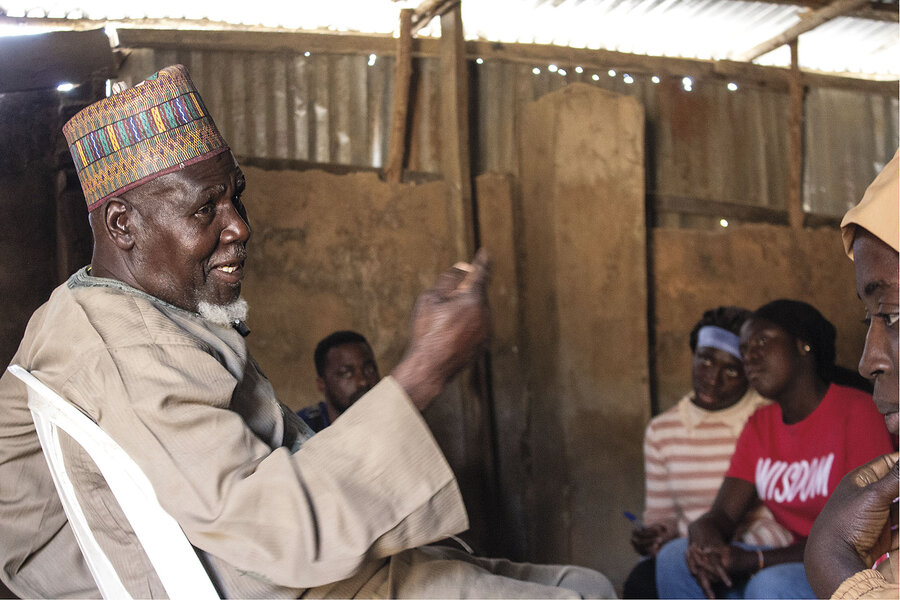
Photo: Nathaniel Bivan.
Ahmed Haruna speaks during a storytelling session in Nigeria.

I know I pick sides when I read about wars. It’s pretty clear that Russia invaded an independent neighbor when it launched attacks on Ukraine, for example. I have to remind myself that civilians on all sides suffer. And then for years after — sometimes generations after — bitterness festers. Not a good thing.

So I was interested to read how some Nigerians are working to ease longlasting enmity. Whatever works, I’d say.

Nathaniel Bivan writes at the Christian Science Monitor, “Seven years ago, when Dalyop Timothy Toma was 15, an angry mob came in the night to torch his family’s home in Kyeng village. Everyone but his grandfather fled outside into the bushes to safety. 

“ ‘He couldn’t run because he was disabled,’ recalls Mr. Toma, his face contorting in grief at the memory of his grandfather’s killing. Then he adds matter-of-factly, ‘We were planning revenge.’

“Mr. Toma and his family, who are Christians from the Berom ethnic group, blamed Muslims, mainly from the Fulani group, for the attack. Sectarian tensions run high in Kyeng and other communities in Nigeria’s Plateau state. Disputes often involve politics or land and sometimes erupt into violence.

“But in 2022, a youth leader from Kyeng invited Mr. Toma to do something extraordinary: Recount his painful story aloud to a large room full of people from different ethnic groups that he distrusted. That gathering, organized by a nongovernmental organization called Youth Initiative Against Violence and Human Rights Abuse (Yiavha), changed Mr. Toma’s attitude toward those he thought were his enemies.

‘Telling my story helped me heal gradually,’ says Mr. Toma, explaining that he no longer thirsts for vengeance.

“Yiavha has made him a peace ambassador, tasked with spreading his story of grace and forgiveness at intergenerational storytelling sessions in his community and in others.

“Plateau state, in central Nigeria, is home to some 4 million people. Jacob Choji Pwakim, a longtime peace-building activist in Jos, the state’s capital, founded Yiavha to change the narrative in communities that have been riven by ethno-religious attacks.

“The origins of the violence in Plateau state can be traced to a tumultuous week in Jos in early September 2001. More than 1,000 people were killed and tens of thousands displaced amid a long-running struggle for political and economic power among the area’s different ethnic groups. Disputes also flared between settlers and people indigenous to Jos. 

“Yiavha has held at least 66 storytelling sessions across the state. Elders have given accounts of bygone times when residents from various ethnic groups lived in harmony, even sharing gifts during religious celebrations for Eid and Christmas. Meanwhile, young people have recounted why they destroyed farms or livestock belonging to members of a different faith or tribe.

” ‘This was what inspired me to set up Yiavha in 2014, with the objective of creating a platform where young people across the divide can talk about their experiences without judgment,’ Mr. Pwakim says. 

“So far, Yiavha has worked with up to 3,300 young people, including more than 300 who have been trained as peace ambassadors who might eventually organize storytelling sessions in their communities. Other young people become agents of change after attending the sessions, organizing interfaith meals, youth soccer competitions, and trash cleanups. …

“One sunny afternoon in February, a group of young people is assembled at a soccer viewing center in Kambel, a community in the Anglo-Jos settlement within Jos. Ahmed Haruna is at the front of the room telling stories to the rapt audience, which includes residents of both Kambel and Channel Seven, another community in Anglo-Jos.

“ ‘Growing up, we didn’t even know the difference, who was Muslim or Christian among us,’ Mr. Haruna says. Over the years, residents have lived in segregated areas, with Christians mainly in Kambel and Muslims mainly in Channel Seven. But the storytelling sessions are gradually bringing them together to interact once again. 

“After Mr. Haruna finishes sharing stories about the settlements’ tranquil past, peace ambassador Joshua Tsok opens the floor for questions. …

“Training for peace ambassadors is extensive. In 2023, for example, peace ambassadors gathered in Barkin Ladi, another community in Plateau state known for violent sectarian conflict. A training facilitator, Hussaini Umaru, who is an associate professor in the department of theater and film arts at the University of Jos, says he divided the young people into groups and asked them to narrate and dramatize personal experiences of conflict, and then discuss the episodes. 

“It is not easy for ambassadors to trust their trainers. Umar Farouk Musa, a development consultant who facilitated a training session last August, explains that this is typically the first hurdle. ‘Some thought we were there to introduce an agenda or to spy. But we built their confidence,’ he says. 

“The government’s Plateau Peace Building Agency is a key partner with Yiavha. Kenneth Dakop, a team lead for the agency, says that Yiavha’s initiatives have helped transform young people who previously were drivers of violence in their communities. ‘Most of them are either unemployed or into substance and drug abuse,’ he says. 

“Yiavha’s ambassadors have seen transformations in themselves. ‘I want to become a professional teacher,’ Mr. Toma says. 

“This year, Yiavha paired Mr. Toma with a Fulani boy and assigned each of them to plant a pear tree in the other’s village to signify a commitment to peace.”

More at the Monitor, here.

Read Full Post »

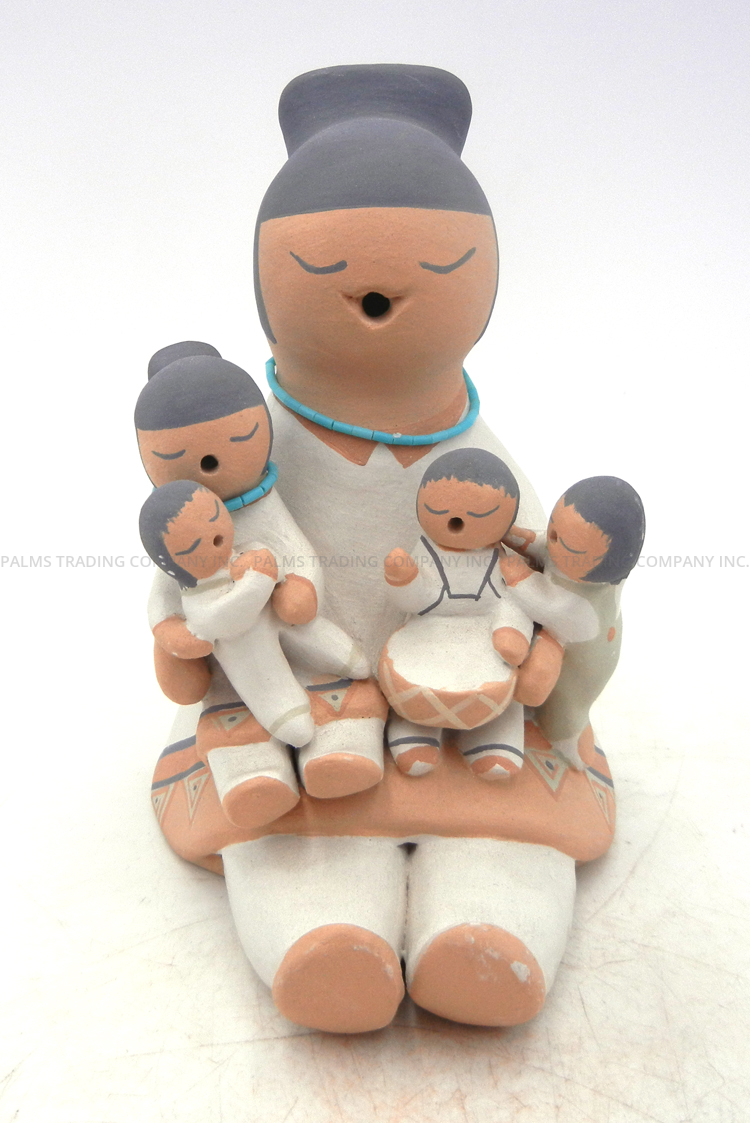
Art: Stella Teller.
“Seated Storyteller with Four Children.”

For too long, the dominant culture has missed out on some great storytelling. Gradually that is changing, and indigenous playwrights are part of the change.

Mark Kennedy wrote at the Associated Press (AP), “The financial crisis of 2008 hit Mary Kathryn Nagle differently. As a playwright and a citizen of the Cherokee Nation, she saw parallels to events that negatively impacted Indigenous people centuries ago.

“Her play Manahatta juxtaposes the recent mortgage meltdown when thousands lost their homes to predatory lenders with the shady 17th-century Dutch who swindled and violently pushed Native Americans off their ancestral lands. …

“Nagle’s 2018 play has landed in New York City at the prestigious Public Theater this winter and it’s just the latest in a flowering of Native storytelling. From Reservation Dogs, Dark Winds and Rutherford Falls on TV to Prey on the big screen and Larissa FastHorse becoming the first Indigenous female playwright on Broadway, barriers are being broken.

“ ‘I hope it’s not a moment. I hope it’s the beginning of an era,’ says FastHorse, a member of the Sicangu Lakota Nation and a 2020 MacArthur Fellow. …

“ ‘[Most] film studios had never produced any content actually written or produced by Natives. It may have been about some Native people, but it was not written by Native people. And we’ve just seen that flipped on its head,’ Nagle said. …

“Nagle recalls moving to New York in 2010 and asking artistic directors of theaters why they weren’t producing Native work. They would answer that they didn’t know any Native playwrights or that there weren’t enough Native audiences to power ticket sales.

“ ‘Good storytelling is good storytelling, whether the protagonist is white, Black, Asian, LGBTQ — it doesn’t matter,’ said Nagle, who is on the board of IllumiNative, a nonprofit working to deal with the erasure of Native people.

” ‘There’s a lot of projects out there that are changing the narrative and that are proving that our stories are powerful and that non-Natives are really moved by them because they’re good stories.’

“Madeline Sayet, a playwright and professor at Arizona State University who also runs the Yale Indigenous Performing Arts Program, sees the contemporary Native theater movement flowing from the Civil Rights Movement of the ‘60s and ’70s and an increase in awareness of Indigenous issues ever since Native people won the right to legally practice their culture, art and religion.

“She connects the Wounded Knee occupation of 1973 to the Standing Rock standoff over the Dakota Access Pipeline in 2016 to Ned Blackhawk’s The Rediscovery of America: Native Peoples and the Unmaking of U.S History winning the National Book Award this year.

“Sayet, a member of the Mohegan Tribe who became the first Native playwright produced at the Public when her Where We Belong made it in 2020, said keeping Indigenous stories being produced depends on changing funding structures and getting long-term commitments from theaters and programs like Young Native Playwrights Contest.

“FastHorse, who made history on Broadway in 2023 with her satirical comedy The Thanksgiving Play, which follows white liberals trying to devise a culturally sensitive Thanksgiving play, has since turned her attention to helping rewrite some classic stage musicals to be more culturally sensitive. …

“She has recently reworked the book for an upcoming touring musical revival of the 1954 classic Peter Pan, which was adapted by Jerome Robbins and has a score by Moose Charlap-Carolyn Leigh and additional songs by Jule Styne, Betty Comden and Adolph Green.

“FastHorse found the character of Peter Pan complex, the pirates funny, the music enchanting but the depictions of Indigenous people and women appalling. There were references to ‘redskins’ throughout, a nonsense song called ‘Ugh-A-Wug’ and Tiger Lily fends off randy braves ‘with a hatchet.’ …

“FastHorse widened the concept of Native in the musical to encompass members of several under-pressure Indigenous cultures from all over the globe — Africa, Japan and Eastern Europe, among them — who have retreated to Neverland to preserve their culture until they can find a way back.

“The playwright said one of her guiding principles in the reworking was to make sure a little Native girl in South Dakota could see herself and celebrate. ‘Then we’ve done our job and she can join the magic instead of having to armor herself against the magic.’ …

“ ‘I think one thing I’m just hoping that people take away from this play is like, “Wow, Native stories are really compelling. Native people are incredible. They’re incredibly resilient. They’re incredibly brilliant. Yes, there’s tragedy, but they have such incredible senses of humor,” ‘ [Nagle] said.

“ ‘I want them to love my characters the way I love them. I want them to feel the heartache. I want them to feel the laughter. I want them to feel the love,’ she said. ‘And I want them to leave the theater just wanting to know more about our tribal nations and our Native people.’ ” More at AP, here.

Got ideas for a show that needs the red pencil of FastHorse? I’d start with Annie Get Your Gun. Come to think of it, that show also needs the red pencil of poor, white mountain people. Their presentation is painful, too.

Read Full Post »

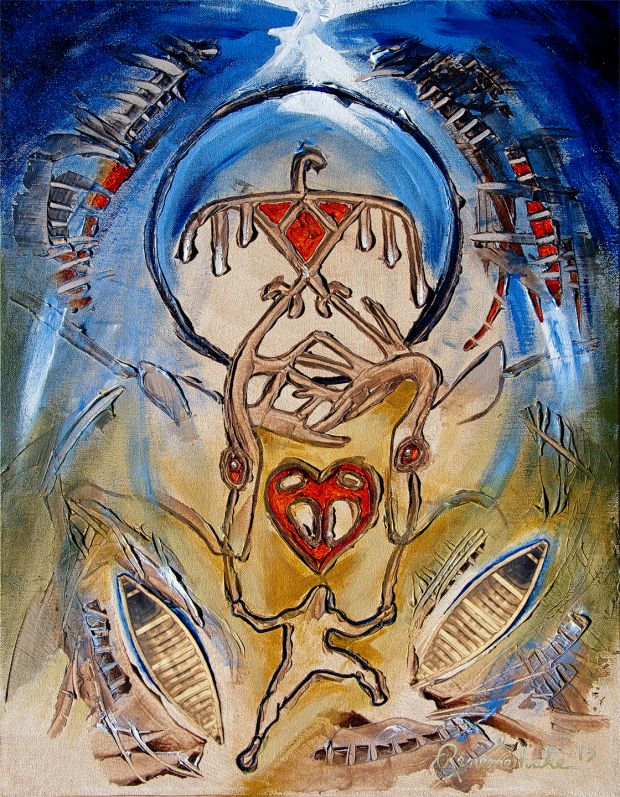
Art: Rene Meshake
Ojibwe artist Rene Meshake was part of a group of indigenous storytellers from Canada who attended the Untold Stories conference in Ireland in May.

As many people know, there was a dark period in US history when authorities thought is would be a good idea for indigenous children to be separated from their language, families, and culture. The same thing happened in Canada. Today, those children and their children are reclaiming their voices and telling their own stories.

Here is Catherine Conroy at the Irish Times: “On a Friday morning in a house in Dublin, I sit down to speak with three indigenous storytellers from Canada. They are here for a conference called The Untold Stories of the Past 150 Years/Canada 150 at [University College Dublin]. …

“Maria Campbell, Rene Meshake, and Sylvia Maracle, from Canada’s ‘Indian Country,’ accompanied by indigenous historian Kim Anderson, tell me a story of pain, resilience and the rebuilding of a shattered community through stories.

“Sylvia Maracle is an activist and storyteller from the Tyendinaga Mohawks. She believes their stories will resonate with Irish people, ‘with colonisers having come and disrupted what was probably the natural order.’ …

“She tells me of a conversation she had with an Irish taxi driver when she arrived. ‘He asked, “Are people recovering their memories?” I said, “They were always there, we just didn’t have the conversation.” He said, “That’s what happened here.” ‘ …

“Maracle believes in the power of storytelling as a force for rebuilding their communities. She feels privileged to have been ‘old woman raised’ by her traditional grandmother. …

“Maracle tells me that people now visit Maria Campbell ‘because they want this good medicine, this traditional stuff.’

“Campbell agrees that storytelling is medicine. ‘I grew up with a great grandmother and she never spoke English, she was a total “savage” according to the priest because she never converted.’

“But while Campbell grew up with stories, she always felt split between her traditional home life and her life outside. It was only after she stopped using drugs and attended her first ceremony in her late 20s that she realised the healing power of the stories, which came from ‘the old ladies, always women laughing.’ It was a revelation to realise ‘that you’d got this medicine, everything you need to help put yourself back together.’

“Campbell tells a story about the effects of colonisation that she learned from her teacher, the Old Man. …

“He had been trying to explain to her the effect of colonisation on their community’s wahkotowin, which in English means kinship, ‘but if you look at the word bundle, it’s all of our laws, it’s the way that we talk to each other, the way that we laugh.’

“He threw [a] jigsaw in the air. ‘He said, ‘”That’s what happened to us, everything was shattered and wahkotowin flew. Maybe you have three pieces, maybe she’s got half of one, if we come back together and we start to rebuild that, you bring your three pieces, you bring yours, and soon we’ll make the picture.” ‘…

“She recalls one story she wanted from her father that he would not give. ‘Then he got diagnosed with a terminal illness and I had to do the translating for him [in hospital]. I kind of went to pieces when we were driving home. He pulled to the side of the road, rolled me a cigarette, and he said, “That story you want, I’ll give it to you now.” He retold it and she understood now that it was a story about death, not the funny story she’d always thought it was.

“She translated and published the story. ‘In my family’s way, they were telling me that they trusted that I would treat it with integrity.’ ”

More at the Irish Times, here.

Read Full Post »

I have been reading a comic book by Jessica Abel, “How to Make Radio That’s Good,” about Ira Glass and his special brand of storytelling for Public Radio International’s “This American Life.” The book was recommended by a National Public Radio guest speaker where I work. The library was able to order it from WBEZ in Chicago, but it might be out of print.

I have to admit that I have never been a huge fan of “This American Life” or the Ira Glass style of speech. But I’m really liking his ideas on how to build a story from a central character and hooking onto “something surprising.”

And I love this little animation of one of the shows, which is a near-perfect illustration of the comic book’s precepts.

Read Full Post »

I remember trying some years ago to persuade a certain lobster fisherman I know that fiction has value. A recent Boston Sunday Globe article has left me feeling validated.

Washington & Jefferson College’s Jonathan Gottschall writes, “Fiction seems to be more effective at changing beliefs than nonfiction, which is designed to persuade through argument and evidence. Studies show that when we read nonfiction, we read with our shields up. We are critical and skeptical. But when we are absorbed in a story, we drop our intellectual guard. We are moved emotionally, and this seems to make us rubbery and easy to shape. But perhaps the most impressive finding is just how fiction shapes us: mainly for the better, not for the worse. Fiction enhances our ability to understand other people; it promotes a deep morality that cuts across religious and political creeds.”

Read more here.

As Dickens said in Hard Times, it’s important to make room for Queen Mab among all the hard facts.


Read Full Post »

Barefoot Books, the children’s book publisher, opened its retail store in Concord this past spring.

In addition to selling books, the shop offers storytelling and pottery every day and numerous other activities, like music, dance, and yoga for children. There is a puppet theater play area, a kitchen for food events, and toys. Note the list of August activities in the photo.

The neighbors, by and large, loved the way the company decorated this long-empty building. And they especially loved the new landscaping.

Read Full Post »